
While the majority of yards start their production at the fateful 12-metre (40’) threshold, Aventura Catamarans has taken the challenge of offering a similar interior space in just 10 meters (33’) of hull length. With an innovative layout, the company is doing just that.
Infos pratiques
- Le chantier : Aventura 10
- La fiche technique
- Découvrez notre vidéo exclusive
- Financez votre Aventura 10 CS
- Assuez votre Aventura 10 CS
- Articles autour du Aventura 10 CS
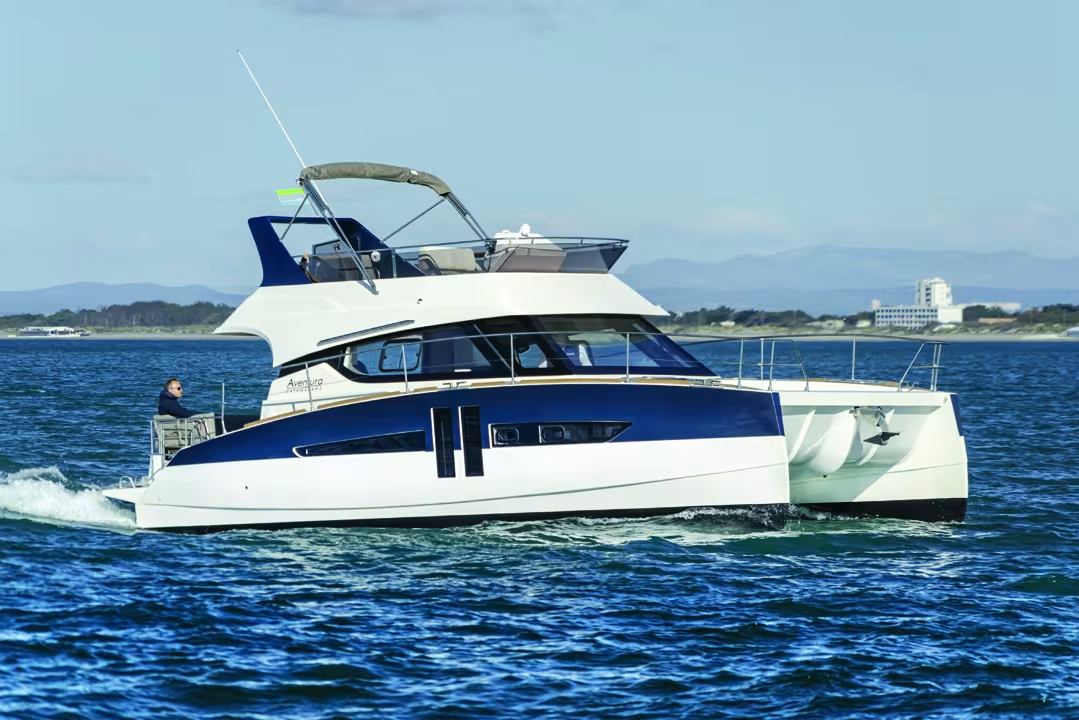
In the power catamaran market, we’ve not seen models of less than 12 meters (40’) for a few years now, apart from the very successful Aquila 32 and 36. However, the Highland 35 from the Fountaine Pajot shipyard had been a great success with no less than 68 models produced from 2005 to 2011. But demand from the charter sector has overwhelmed this size, which is considered too small to accommodate four real double cabins. The forward cabins, in particular, were not wide enough to accommodate two adults comfortably. Aventura Catamarans, which has been producing sailing catamarans in its Tunisian shipyard since the early 2000s, decided to start the process three years ago by calling on Samer Lasta. The naval architect had already designed some of the company’s other models, including the Aventura 34. While the length was predefined at just 10 m (33’), the other characteristics were left to his discretion. The design studio of course exploited this freedom of design: the freeboard, for example, is quite high. The taut lines don’t suffer because of it, though, and the boat even displays a beautiful modern elegance. The proportions are well-balanced and offer the advantage of using the nacelle and foredeck, which is high enough above the water, to install a very spacious and deep forward cockpit. Inside, large beds occupy the forward cabins, accessible from the hull. This arrangement of the deck layout is clever and offers the extra square footage much needed in this size. Even though the “family” feel to the Aventura 34 is obvious, the hulls have been specifically designed to accommodate a pair of Yanmar inboard engines ranging from 110 to 250 hp, or outboard motors from 2 x 150 to 2 x 300 hp. With this latter configuration, access to the sea is not so straightforward, with the outboards sitting on the sugarscoops.
Three cockpit versions
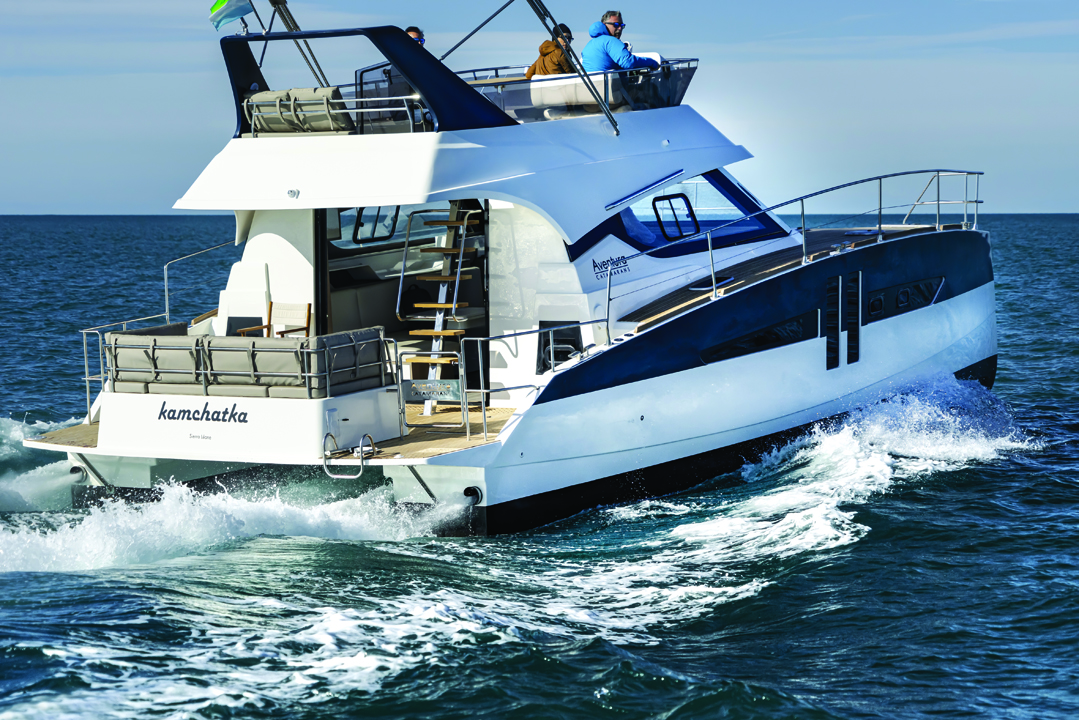
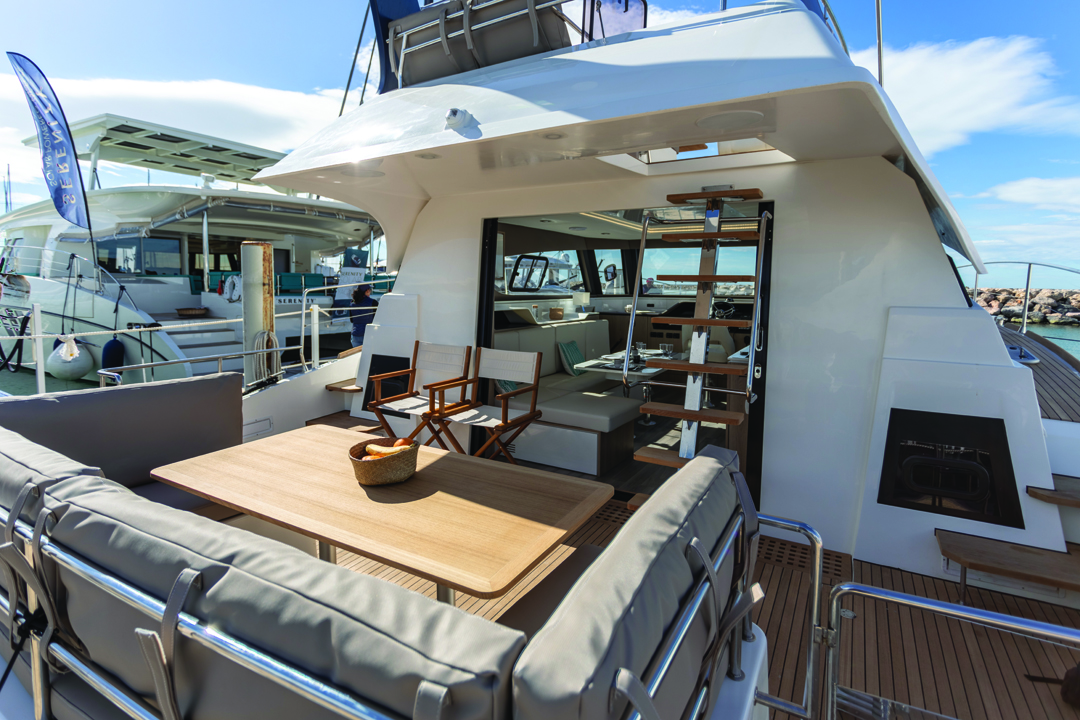
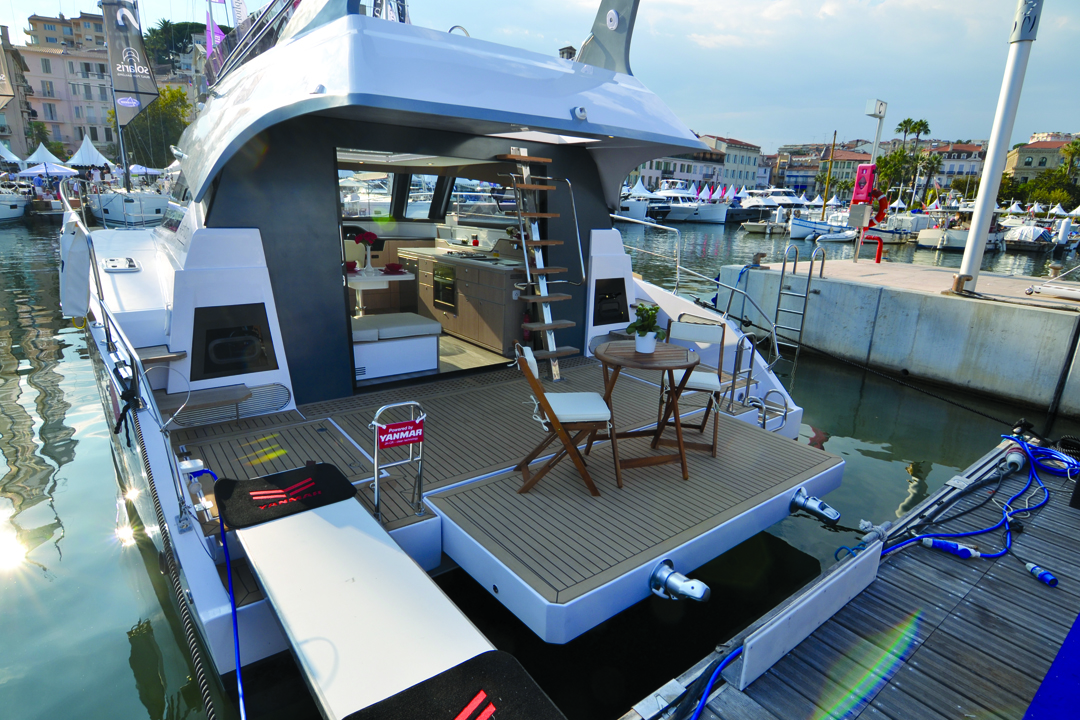
The first model to leave the yard had an open cockpit, simply with a guardrail around it. It’s an interesting configuration for fishing, but a little bit smaller in size. The first option is a transom that acts as a bulwark but that can be pivoted to transform into a platform and expand this space. Modular at will, this version can be equipped with seating or loungers to create a sunbathing area. Since the last International Multihull Show at La Grande Motte in France, a third option has been a U-shaped bench and table. This CS version brings the overall length of the A10 to nearly 11 meters (36’), and it seems to us to be by far the most accomplished, with its comfortable dining area that can be used when under way. On the model we tested, all that was missing were storage compartments under the benches, an omission that will soon be rectified.
Two or three comfortable cabins
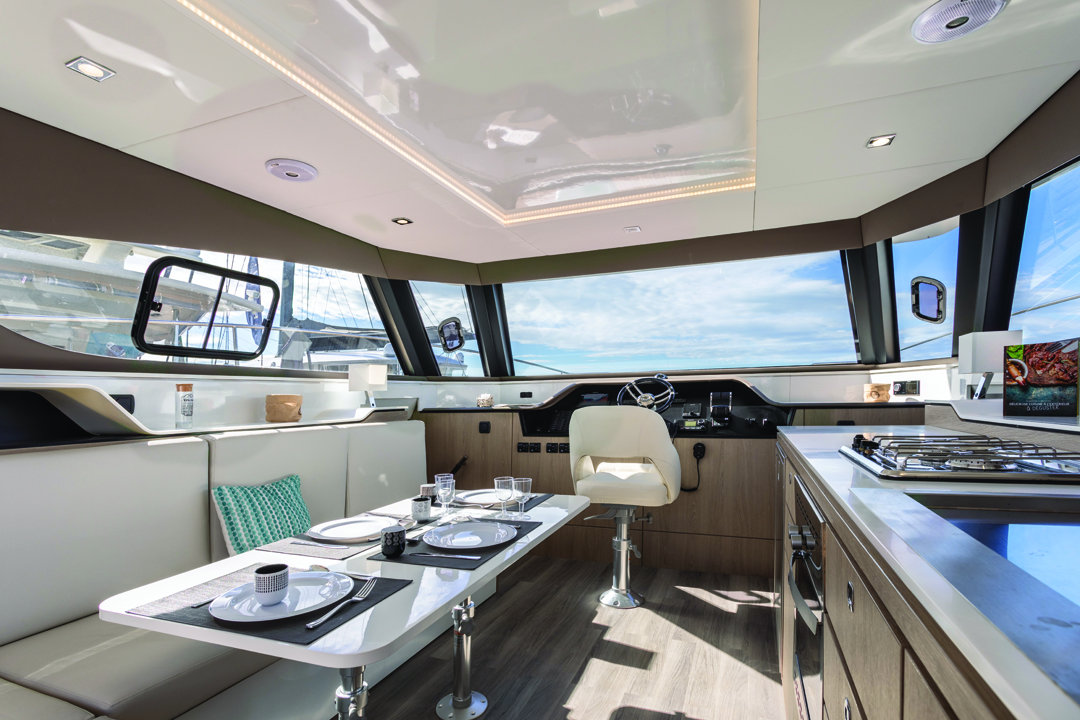
The saloon, closed-in by a sliding bay window, all on one level, is divided into three parts. A beautiful dining area faces a well-equipped galley on either side of a passage that leads to a helm station and companionways down into the hulls. Instead of a console, in the three-cabin version, it is possible to equip this helm station with basic engine controls and an autopilot control, to make way for an additional fridge or dishwasher and storage space. Each hull has an aft cabin with a full width bed. Daylight enters fully through the large vertical and horizontal windows. The forward ends of the hulls, narrower, is used for a beautiful bathroom. But before entering it, there is access athwartships to a double forward bunk in the nacelle. A sliding partition isolates it from the passageway and it gets its light through a forward window that opens onto the cockpit. In the standard three-cabin version, this space becomes a large storage area for the owner's cabin, which occupies the entire hull. A dressing room with a washing machine, for example, can be organized there. The materials are of good quality with woodwork trimmed with beautiful light oak Alpi veneers and a Corian worktop. The whole is well-assembled and feels very seamanlike. Access to the flybridge is via a ladder with stainless steel rails and teak treads. Once at the top, there is nothing missing: a complete cockpit, sunbathing and dinette make it possible to stay for as long as you like - all the more so as you can equip the flybridge with an optional fridge. The view from here is good to all angles. The console is equipped with all the necessary navigation instruments. The forward cockpit is very accessible by wide side-decks. It is deep and you can sit on a very friendly U-shaped bench with a small retractable table placed above the anchor locker. Despite its location close to the bows, this cockpit remains very usable under way: surprisingly no spray comes over to disturb you.
Good aptitude under way
Perfectly built in foam/fiber/epoxy sandwich, the hulls are painted to half-height, further refining the silhouette. The fine-entry bows and rounded forefoot are surprising at first sight. Our model is equipped with 195 hp Yanmar engines, which seems to us to be the best choice. No space requirement on the transom and a very efficient performance/range ratio. On passage at 12 knots, it would be possible to cover more than 300 miles. In calm seas, the top speed approaches twenty knots. Range remains ok at this speed: you could complete a 200-mile round trip, all quite comfortably as movement in the sea remains gentle. Even at high speeds, life on board is comfortable thanks to the amazing lateral stability of this powercat and the very quickly dampened pitch. The addition of trimtabs would be a significant improvement to perfect the trim. With the engine compartments being located aft, the noise level inside the boat is very acceptable. V-drives direct the power to the propellers so that the angle is as small as possible, which is a guarantee of efficiency. The slightly firm steering system will get you engaging the autopilot sooner, but overall the seakeeping qualities are impressive.
Conclusion
At 2 m (6’) shorter than most of the smallest powercats on the market, the Aventura Power 10 is a great compromise for coastal and even offshore cruising. Its advantages are numerous: its habitability is more than convincing, well served by multiple relaxation areas and a very pleasant interior volume, especially in the saloon. Its two cockpits – fore and aft - and the flybridge allow you to fully enjoy the outdoors in complete privacy. Under way, the results are very positive, with performance yet simplicity, especially for the 195 hp inboard version, which makes it possible to plan some great cruising. The versatility of the different versions and combinations will satisfy different specifications. The price is the other favorable argument since it comes in at almost 60% of that of a 12-13 meter (40-43’) powercat.
Technical specifications:
Builder: STGI Marine
Naval architect: Samer Lasta
Length overall: 9.98 to 10.88 m (32’5” to 35’8”) depending on the version
Beam: 5.30 m (17’5”)
Draft: 0.80 m (2’8”)
Light displacement: 6.4 t (14,100 lbs)
Cabins: 3/4
Sleeping arrangements: 6/8 +2
Inboard std/max: 2 X 110/250 hp
Outboard std/max 2 x 150/300 hp
Transmission: V drive
Cruising/max speed: 12/19 with 195 hp
Fresh water: 2 x 250 l (2 x 66 US gal)
Black water: 45 l (12 US gal)
Fuel: 2 x 500 l (2 x 132 US gal)
Price ex-tax: € 239,000 with 2 x 110 hp
Price of the version we tested: € 310,641 ex-works, Bizerte (Tunisia)
+
Record habitable volume for its size
Very good marine qualities
Versatility of versions and layouts
-
No trim-tabs on the inboard version
Steering is a little firm
