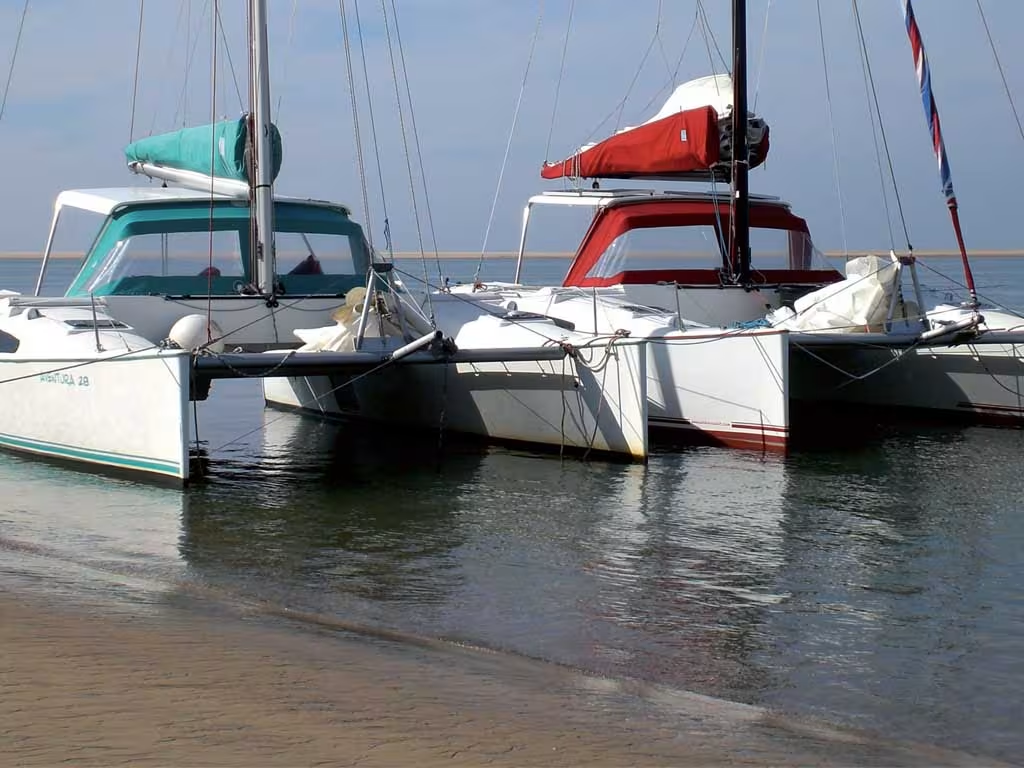
A catamaran under 9m, capable of accommodating a big family for several weeks is not common… A good reason for taking an interest in the Aventura 28!
Infos pratiques
- Le chantier : Aventura 28
- La fiche technique
- Découvrez notre vidéo exclusive
- Financez votre Aventura 28
- Assuez votre Aventura 28
- Articles autour du Aventura 28
The Aventura 28 is not an original version… It is rather a remake for the general public, thus cheaper and more basic. We’ll explain: in the mid-80s, Jean and Jacques Fioleau designed a little 8.5m catamaran, in strip planking, the Diabolo. The machine was very light (just under a tonne) and well canvassed (42.7m to windward), and therefore fast, even distinguishing itself in races. About twenty examples were built before this model disappeared. About ten years later, Go Catamarans was looking for the best way to launch a range of boats at the fairest possible price. Thus to limit the expense of an architect and building moulds, Eric Roger had the idea of re-launching good earlier boats, by updating them. The builder really fell for the Diabolo, and concocted a more docile version in polyester. It was 600kg heavier, and lost the daggerboards, in favour of fixed keels, but it gained favour with a wider, family public: since 2002, Go Catamarans – which has become Indigo Yachts – has produced 35 examples.
Philippe and Sandra Roby appreciated the qualities of their First 211, a small, 6.2m monohull. There were already five of them aboard… and a fourth ship’s boy was on the way. The family was therefore looking for a sailing boat which could accommodate them. They quickly decided on the Aventura 28: “it was the only one offering so much in so short a boat, a well-protected cockpit which can be completely enclosed, and hulls with a relatively modern design,” Philippe explained. The Robys presented their ‘Parfum des les’ to us. They bought 75% of the boat, along with another family, to keep the cost down. “We found it on the ‘Le Bon Coin’ site,” Sandra told us. “The boat was moored at Castlenaudary; we took it to the Atlantic via the Canal du Midi.”
Cockpit protected by a large sprayhood
Before its peaceful life in fresh water, this Aventura 28 belonged to the UCPA, and was based at Hy res. The boat’s mast was stepped again in Bordeaux and it was prepared for a short offshore passage – VHF and electronics – to the Bassin d’Arcachon. Because the frail Aventura 28 proves to be quite comfortable at sea… It has crossed the Atlantic several times and even sailed half way round the world! The Robys had no such ambitions, for the moment: they were taking advantage of the fine weather to get used to the boat: “the thing we liked immediately,” Philippe explained, “was that there are four big areas: the two hulls, of course, but also the cockpit and the trampoline. Not to mention the pleasure of living with no heel and being able to beach the boat.” Thanks to its keels, the rudders are well protected, and the boat actually settles level, whilst its draft is less than 70 centimetres. The accommodation is simple, but well though-out, despite the narrow hulls: to port, we discover, aft of the heads, a chart table close to the companionway and a double berth – just 110cm wide, as against 140 for a standard bed ashore. In the starboard hull, the galley occupies the aft end, followed by a narrow saloon which can be turned into a (small) double berth and a last berth which is longer but even narrower. So, where do you sleep? "When the weather is fine, we put two children in each hull,” Sandra explains. “We sleep in the enclosed cockpit. But in bad weather, the water runs everywhere and we have to go inside...we take the biggest berth on the port side and cram the four children into the starboard hull.” And guests? In a Queschua tent on the trampoline. Last summer, the Roby family tackled the Arcachon channel: on the itinerary, three weeks’ cruising in the Pertuis and the Gironde estuary, but neither the Ile d’Yeu or Brittany, thanks to poor weather. The assessment, in a few words: “the big sprayhood is ugly, but excellent! We are always happy to be underneath it. The galley is OK: we prepare everything in a pressure cooker. There is a slight lack of stowage space. The fridge is well supplied by a large solar panel. The headroom is acceptable, but it remains a small boat, so we spend our time stowing things.”
Lazy in light weather exciting in strong winds
With this boat, Philippe is discovering catamarans. This is what he thinks of them, under sail: “With less than 10 knots, from a close reach to close-hauled, we tend to use the engine.” It’s true that the self-tacking jib is very practical, but it really lacks power. Acquiring a good gennaker would certainly be a good choice. The very basic fittings are perfectly suited to family cruising use. A good 10hp outboard propels the boat easily at 5/6 knots. But port manoeuvres demand a bit of experience: it’s not easy to manoeuvre with a single engine and significant windage, especially when the sprayhood is in position. From a force 3 onwards, the Aventura 28 comes alive; it quickly reaches 7/8 knots at 40/50 degrees to the true wind. Not a fantastic pointing angle, it’s true…the fault of the very short keels. Sailing freer and downwind, on a flat sea, the boat quickly reaches 10 knots, or even 12 with an asymmetric or a gennaker. Surfing on a big wave, the record for ‘Parfum des les’ stands at 16.5 knots. Not bad! But Eric Roger, the manager of the company in France is categorical: “some people have reached 20 knots!”
The Pluses:
+ Simplicity and strength
+ Well-suited to family sailing
+ Safe and exciting behaviour in strong winds
The Minuses:
- Disappointing performance to windward in light weather
- Steering system to be revised
- Tricky manoeuvres under engine
The points to be checked
The Aventura 28’s big black spot is its steering system the rudder and its shaft are only held by one bolt, which ends up by breaking in the long term. Two other problems: the blade breaks free of the shaft. It must be said that a simple threaded bar is trying to hold, in a mixture of chopped strand, filler and resin… The top of the shaft is damaged by the significant overhang, so the helm descends... Philippe replaced the aluminium shaft with a solid stainless steel tube, and Teflon bushes now hold the rudder in place. The portlights and hatches are not watertight.
Technical specification
Builder: Go Catamarans/Indigo Yachts/Aventura Catamarans
Architect: Jacques Fioleau
Hull length: 8.50 m
Waterline length: 7.99 m
Beam: 5.25 m Draft: 0.68 m
Unladen weight: 1,600 kg
Mainsail area: 25 m
Genoa area: 15 m
Engine: 10 – 15hp outboard
Production: 35 examples since 2003
Second-hand price: 35,000 to 45,000 euros