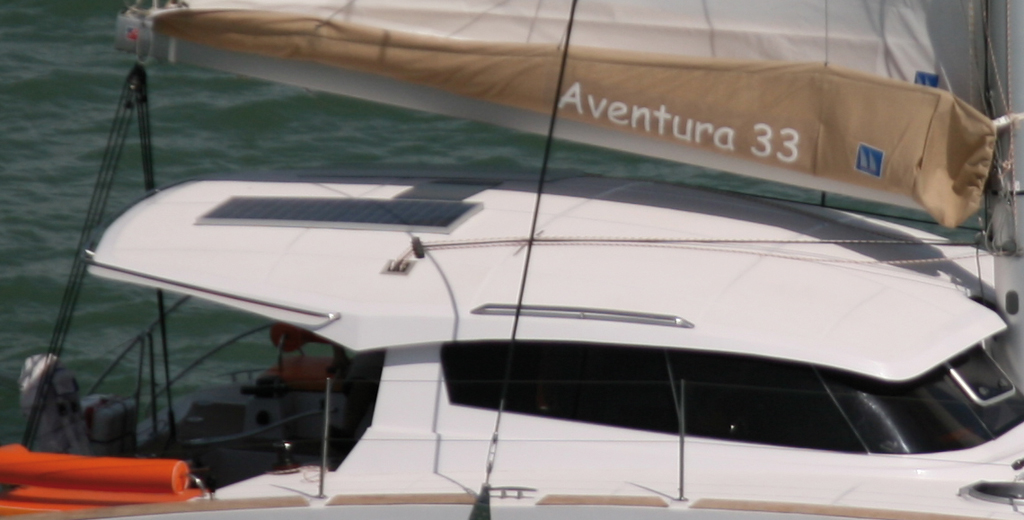
Fitting what would be found in an 11 or 12m catamaran into one measuring less than 10m is the challenge Martin Defline and Aventura Catamarans have tried to take up. And with a neat design and a low price into the bargain. For the builder, which until now was used to re-using existing moulds, this is also the first real new boat.
Infos pratiques
- Le chantier : Aventura 33
- La fiche technique
- Découvrez notre vidéo exclusive
- Financez votre Aventura 33
- Assuez votre Aventura 33
- Articles autour du Aventura 33
Harbour manoeuvres are carried out from the port side, next to the engine controls. First surprise: the builder has adopted a control box fitted athwartships. Forward is to starboard, astern to port. You have to get used to it! And in an emergency, it would be best to reflect for a moment before giving full throttle on the wrong control. Apart from this particularity, which would benefit from suitable adhesive marking, the Aventura, propelled by its two 14hp engines, can be manoeuvred rather easily. Obviously, similarly to all cats with high freeboard (that of our 33 is equivalent to the height of a good 38), you have to beware of strong crosswinds.
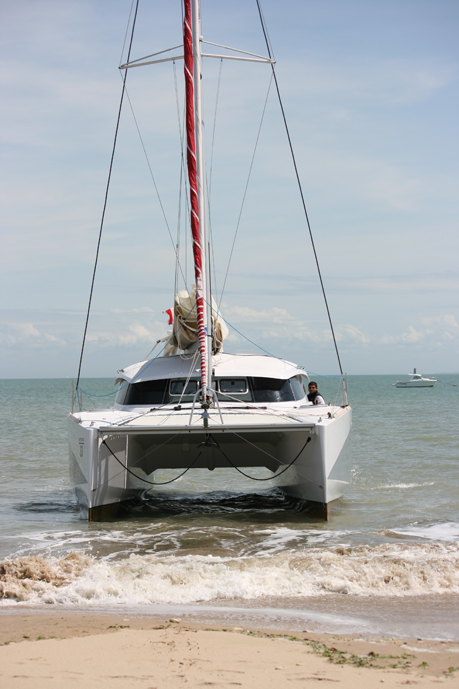
The fins, even short ones, prevent beaching if the beach is not really sloping. Beware: the shape of the 33’s appendages doesn’t facilitate getting away in reverse when you touch.
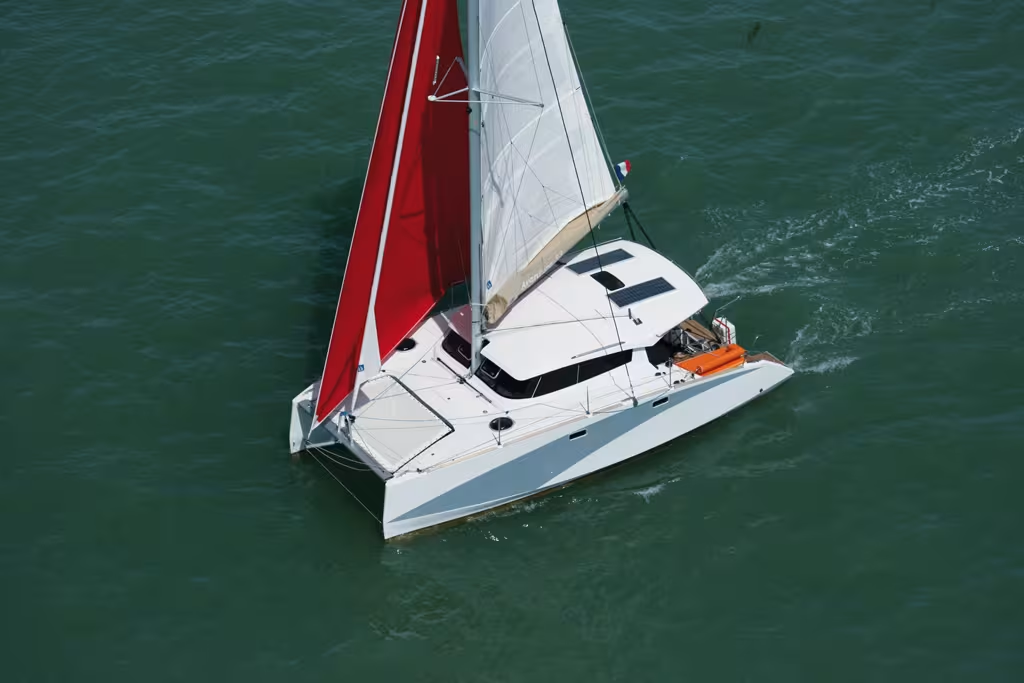
Bright sunshine and a light breeze in La Rochelle: our outing aboard the Aventura 33 was exactly like our first sail two months earlier at La Grande Motte. The Martin Defline design was actually presented to the public for the first time in the Languedoc port, at the Multihull Boat Show. Taut, modern lines, two-colour decoration, which shows off the ‘step’ in the hull, orange soft furnishings – the newcomer attracted the visitors. At the moment, two examples have already been built and two others have been ordered. The professionals also crowded aboard, which pleased Igor Cherques, the company’s sales engineer: “our catamaran could interest charter companies; for the price of a Lagoon 400, they could buy two Aventura 33s!” he joked. The construction is looked after in Tunisia. The hull below the waterline is in monolithic, for maximum sturdiness and ease of repair in case of damage. Above the waterline, the construction logically tries to bring down the weight specification, by adopting a more sophisticated PVC foam/glass sandwich. The width and clearance have been studied to fit the Canal du Midi. Visibly, potential customers don’t really care. But not the Aventura Catamarans team, which regularly delivers its boats to the Atlantic coast via this canal. A superb route, built at the request of Louis XIV, but one which has to be earned: 8 days minimum under the plane trees. But it’s that or sailing round Spain, with the Portuguese trades on the nose. So...
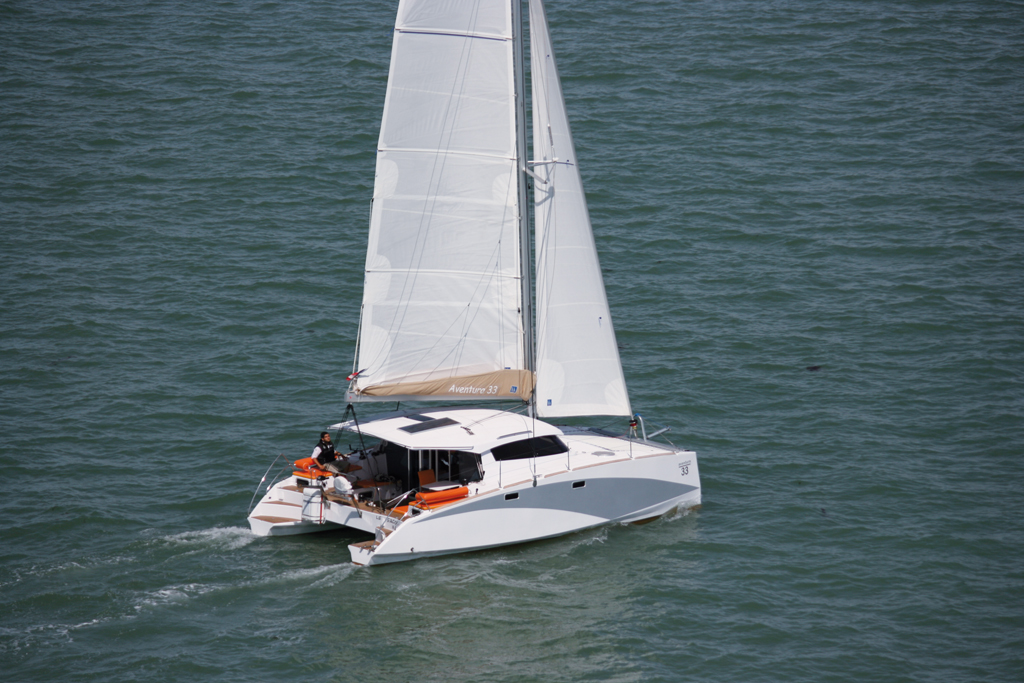
The hull design is particularly modern: pronounced ‘steps’, tandem fins and inverted bows.
A SELF-TACKING JIB WHICH IS PERFECT FOR STRONG WINDS
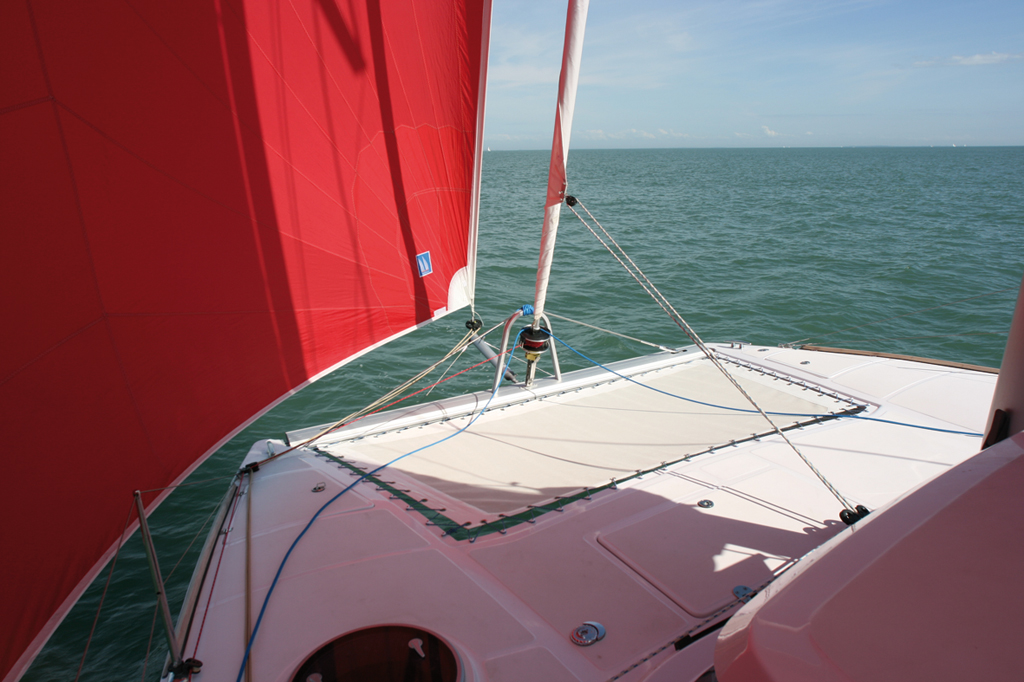
In the channel, in front of the Tour Richelieu, we hoisted the square-headed mainsail with no difficulty. The Z-Spars sliders obviously make the job easier. It’s easiest to hoist it most of the way from the mast foot. Unfortunately, the halyard outlet is quite low for this exercise! The jib was then unrolled in a second. Quite normal, as with just 17.5m², it is about a third of the size of the mainsail. With 12 knots of wind, we could point very high, at 45° to the true wind, as the sails can be sheeted in very flat. The results were not convincing: the speed levelled off at 3.5 knots. Not brilliant. We accelerated to 4.4 knots by bearing away 10° and opening the sails. The little jib was clearly lacking horsepower, especially as we had the impression that the boat is appreciably heavier than the advertised 3.2 tonnes – the first examples of a boat are often ‘over-built’; the next ones will without a doubt be livelier. On the other hand, the boat tacked very easily, without sailing backwards. An appreciable quality for a family crew, especially as you don’t have to touch the self-tacking jib sheet. The Aventura 33’s slender sail plan on the other hand requires precise trimming to give of its best. The speed comes by bearing away further, it’s well-known: our GPS displayed nearly 6 knots with the wind on the beam. Thanks to the red gennaker, we even managed a top speed of 7 knots. A sail which is easy to use, thanks to the furler, and frankly essential to liven up the boat.
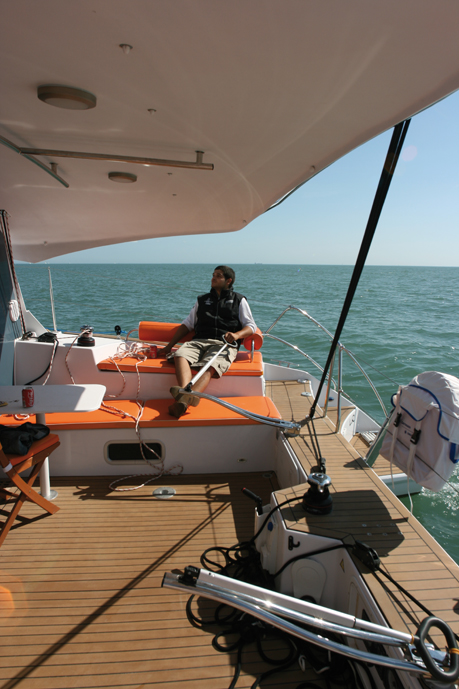
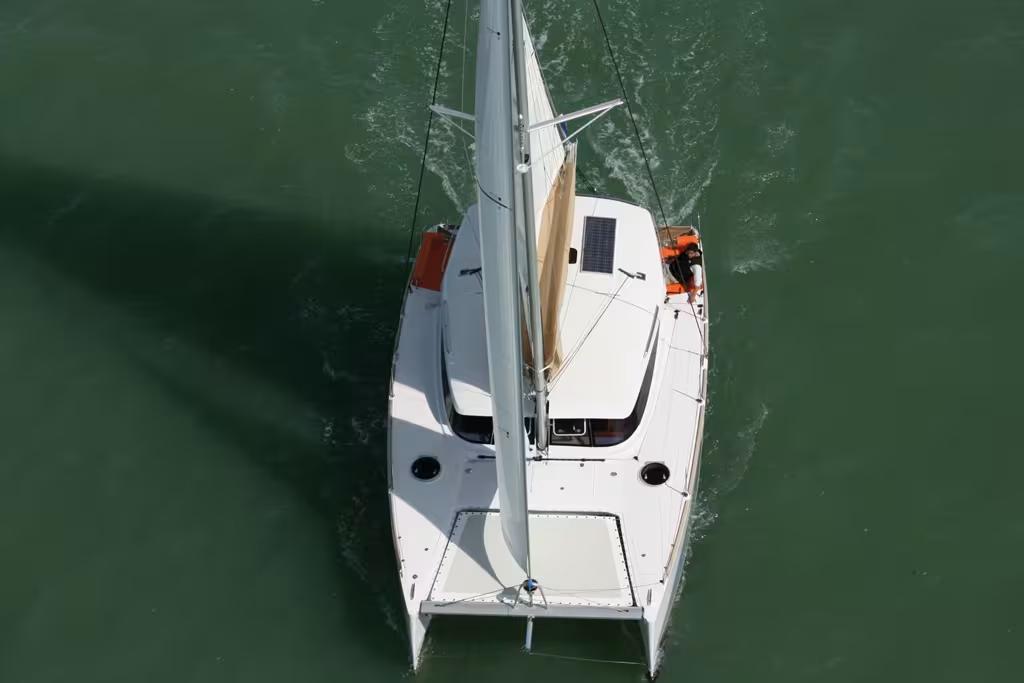
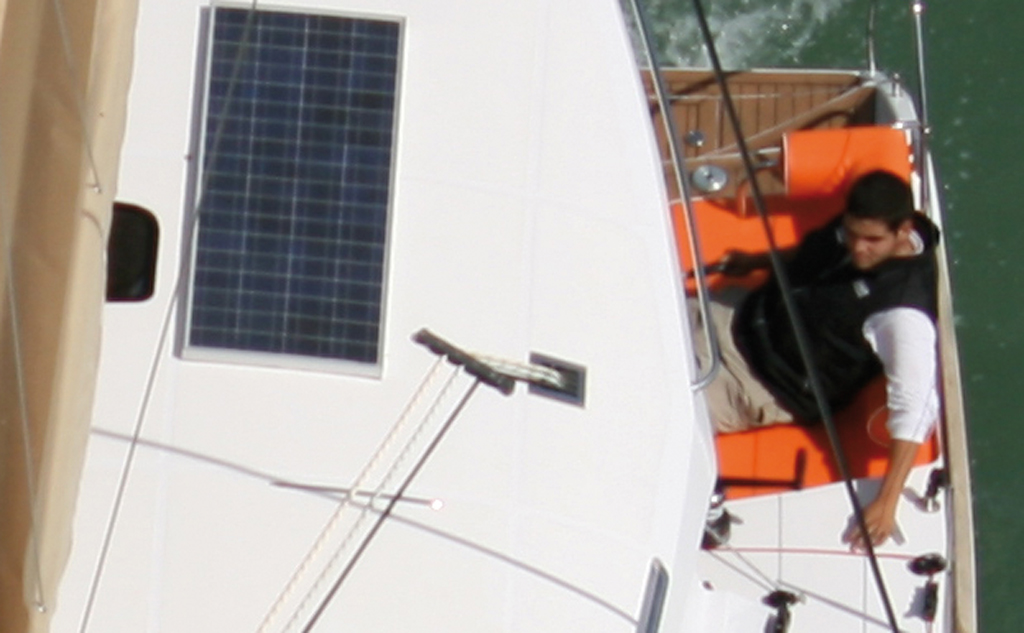
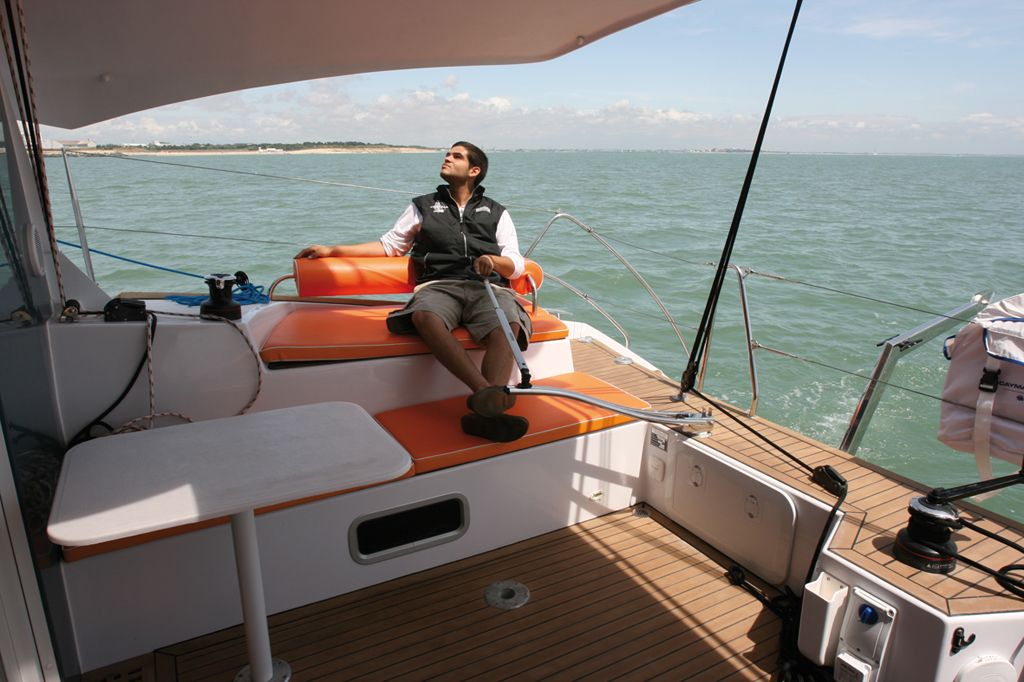
A large terrace in teak, lateral seating, two tillers, and that’s about it. The builder is offering a more conventional arrangement with a large table, on request.
TANDEM FINS
After losing weight, and equipped with a real overlapping genoa, there is no doubt that the Aventura 33could sail a lot faster. The builder has adopted two tillers. On our test model, the attractiveness of this configuration was slightly spoilt by bearings which were too tight. But we were comfortable, with a good view of the bow. On the other hand, we couldn’t see what was happening under the coachroof, on the other side. We had to stand up regularly to inspect the horizon. The same goes for the manoeuvring stations: split between the two sides, they only offer a partial view of what you are doing. A few glazed panels and openings could remedy this problem. The mainsail has no kicking strap, and is trimmed thanks to two block and tackles led to a winch mounted on the aft crossbeam. The deck plan is distinguished by a particularly marked sheer. The side decks are wide, the coachroof and bimini are bordered by handrails; the welcoming trampoline and the anchoring and mooring equipment are functional. There are a few details to be revised, however: an opening – it’s planned – to get aboard without struggling to climb over the pushpit, more rigid stanchion bases, and a spring cleat further from the shroud (already moved on the n°2). The cockpit is completely uncluttered: a big wooden floor and a tiny table, accompanied by two folding chairs. Other accommodation configurations can be studied by the builder. To take photos of the catamaran, and because we didn’t have a dinghy, we decided to beach at Sablanceaux, on the Ile de Ré. The undertow encouraged us to approach gently...the rising tide reassured us. Boom, boom, the tandem fins touched. They are attached to the hull and are strong. And even in the case of a breakage, they won’t cause a leak. It was time to get the swimming costume wet to reach the dry sand. The Aventura 33, full astern, had a bit of trouble getting back to the open sea. Without a doubt the fault of the shape of the fins, which ‘grip’ the sand... In any case, there was no question of presenting the rudders towards the beach: they are very slender and of course much more fragile than the fins. .
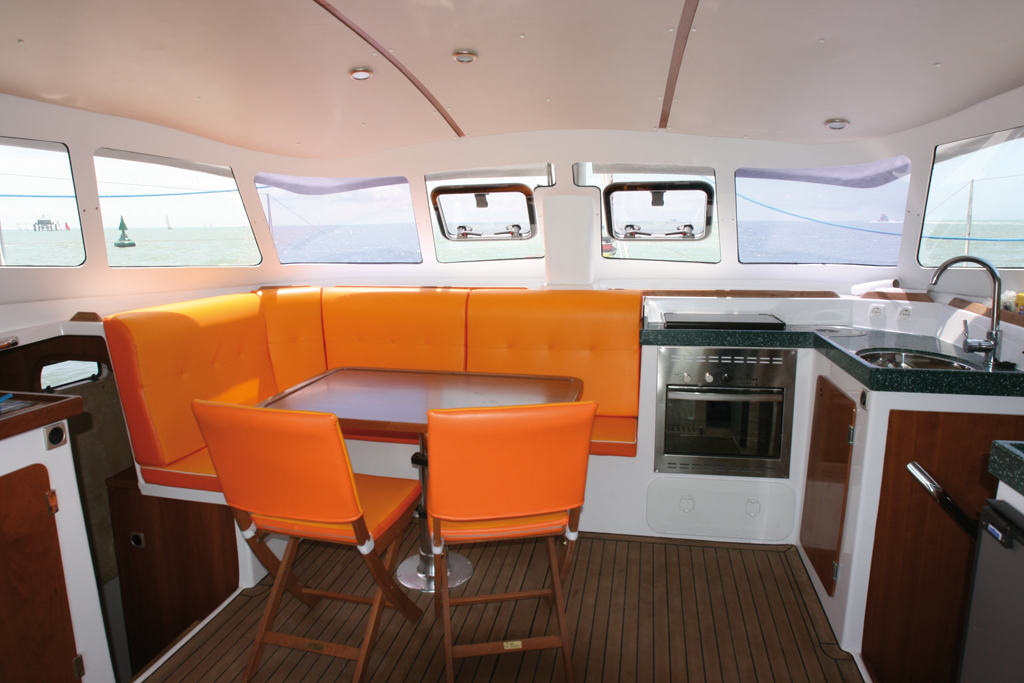
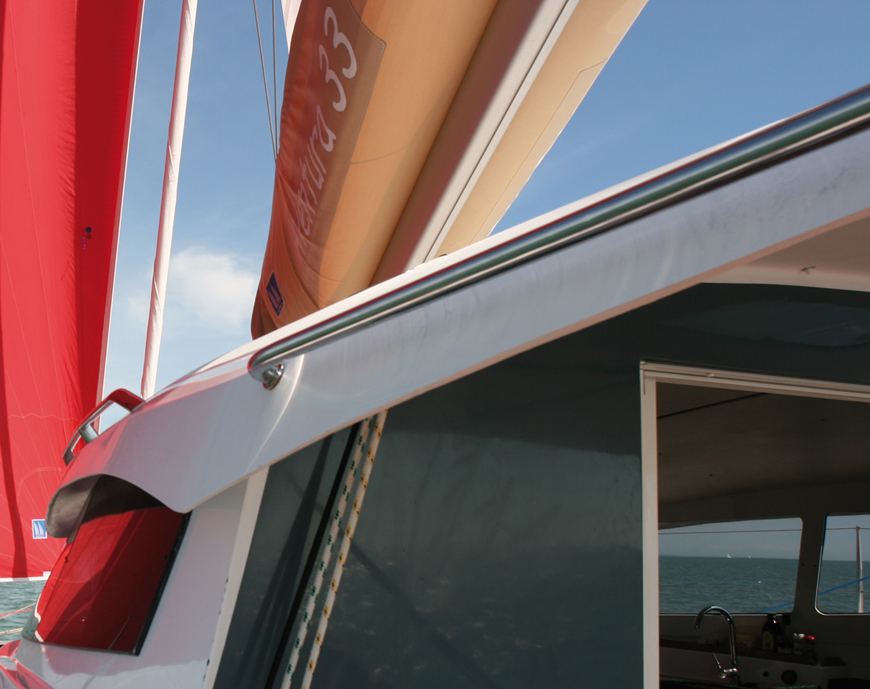
Volume, lots of light and always cool, thanks to the roof extension: the bridgedeck is a success.
A SALOON WHICH IS MORE ATTRACTIVE THAN THE CABINS
Our return to La Rochelle, pushed along by the gennaker, left us the time to enjoy the accommodation. We appreciated the teak strips in the cockpit, which extend into the saloon. Aboard a 10-metre catamaran, this big living room with 2m headroom is a success. It is cool and five or six people can eat here, with an uninterrupted view of the anchorage. And all on the level and with no rolling, of course! The builder has nevertheless fitted fiddles. Very good... Could we also have a stronger table leg? The extension effectively provides shelter from the most vertical of the sun’s rays. The interior of the saloon deserves a gel coat finish. The L-shaped galley, housed in the starboard forward corner, is comprehensive, with its sink, stove, dustbins and stowage areas. Close to the entrance, a sliding flap serves as a chart table, but you will be more comfortable in the saloon. Three steps lead to the cabins. To port, the two double berths are rather narrow, in the absence of wider hulls. The aft double, 1.35m wide is almost of the same format as ashore, but the forward berth measures less than 1.2m. The dark, uniform headlining gives a gloomy atmosphere, compared to the bridgedeck. But aboard the next model, there will be elegant wood strips in its place. The ventilation is satisfactory, but there is not too much stowage space: aft there are the engines – not too noisy. There is a large locker under the forward berth. The floors are glued; there is an inspection hatch, but we would prefer to be able to examine all the bilges. For the heads, we have to go to the starboard hull, dedicated to the owner. Here there is just one cabin aft, a small desk and a large bathroom nestling in the bow.
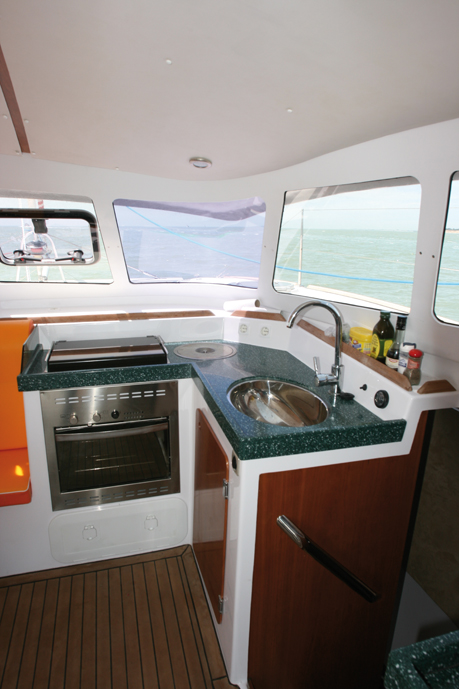
An innovative and modern interior…
IN CONCLUSION
The Aventura 33 was able to validate its seakeeping qualities during its express delivery from Tunisia to La Grande Motte. The boat is certainly sturdy. Too sturdy, perhaps. Its weight specification does not appear to have been respected, a corpulence which results in sluggish performance in light weather. This is a shame, as the carefully-designed hulls need at least 15 knots of wind to exploit their full potential. The deck plan and the cockpit are clean and well thought-out. The wincher will however have to be provided with a view of the sails. Inside, there are also a few finishing details to be revised, but the accommodation offers an unusual amount of volume for a 33-footer. A good support for coastal and semi-offshore cruising as a family.
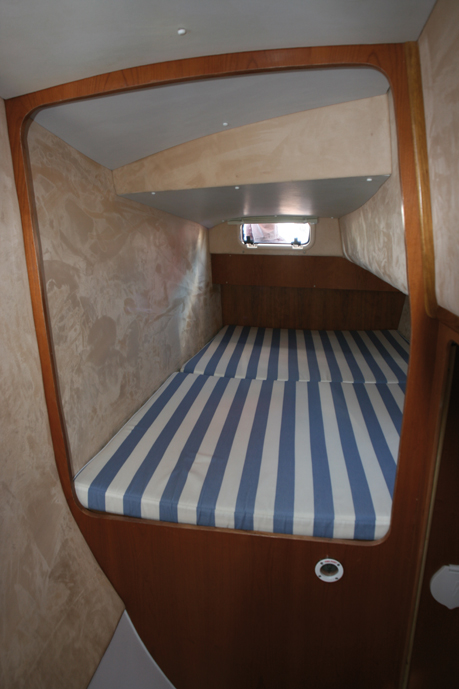
An innovative and modern interior…
THE PLUSSES
- Modern design
- Interior liveability
- Low price
THE MINUSES
- Performance in light weather
- A few finishing details to be reviewed
Technical specifications
- Aventura 33
- Overall length: 10.56 m
- Hull length: 9.98 m
- Waterline length: 9.98 m
- Beam: 5.30 m
- Draft: 0.90 m
- Weight: 3,200 kg
- Windward sail area: 63.7 m²
- Mainsail: 46.2 m²
- Genoa: 17.5 m²
- Spinnaker: 48 m²
- Engines: 2 x 14 hp
- EC category: B
- Architect: Martin Defline
- Builder: Aventura Catamarans
- Launch year: 2011
- Price: 157,872 euros inc. VAT
Caption
With its huge trampoline, its voluminous coachroof and its high hulls, the Aventura 33 is playing with the ‘big’ catamarans of 36/38 feet.
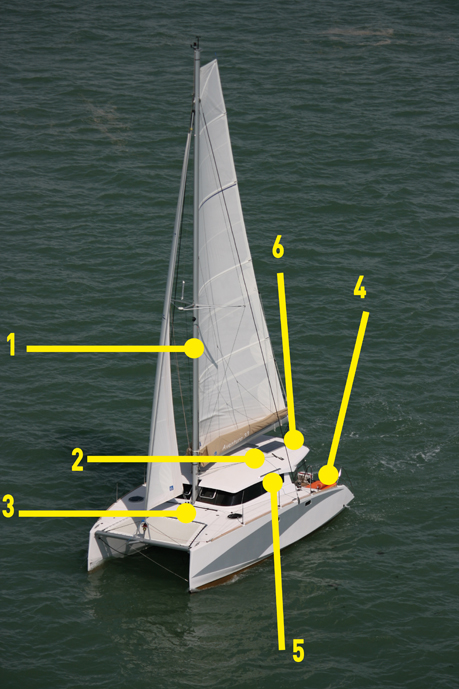
1)
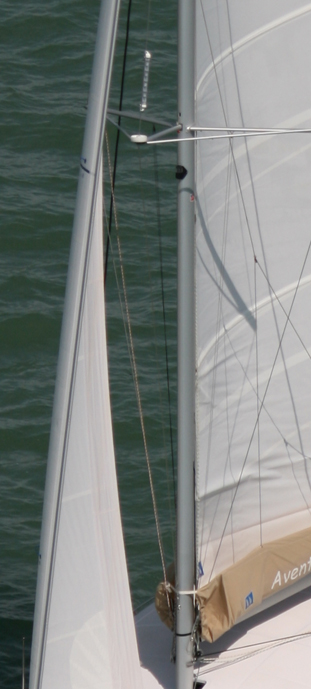
2)
3)
4)
5)
6)