
This new model logically fits in the range between the Aventura 34 and the 44. In this 11-meter sector there are few competitors, yet there is strong demand, judging by the manufacturer’s order book: several dozen Aventura 37s have been signed. This compact catamaran, presented for the first time at the Cannes show, back in September, is pretty successful and notably well-positioned in terms of price.
Test location: Canet-en-Roussillon, South of France
Conditions: Wind - ESE 10 to 16 knots / Sea state – moderate
Infos pratiques
- Le chantier : Aventura 37
- La fiche technique
-
 Découvrez notre vidéo exclusive
- Financez votre Aventura 37
- Assuez votre Aventura 37
- Articles autour du Aventura 37
Aventura: already 20 years in multihulls!
Originally, Aventura Catamarans was oriented toward the production of small multihulls for coast hopping. Then came the very clever 23 and 28 (from the Camping Cat 23 of the Fauroux group and the Diabolo 28 of Jean and Jacques Fioleau). The Aventura 20 was the first catamaran entirely designed and built by the manufacturer. But it was the 33, drawn by the pencil of Martin Defline, that truly signed the house style; the adventure of modeling and industrialization continued with the 43 by the same architect. Then in 2015, production moved to a new modern factory in Menzel Bourguiba (near Bizerte) in Tunisia. In 2017, the manufacturer unveiled its new range, now signed by Lasta Design which includes the 34, the 44, the 10, the 14 (these latter two are powercats) and of course the new model for 2021: the Aventura 37. This is a catamaran built entirely in infusion in female molds with a sandwich matrix of Airex foam, glass, and polyester. The underwater hulls are also in sandwich as far down as the base of the skegs (in monolithic glass/ polyester).
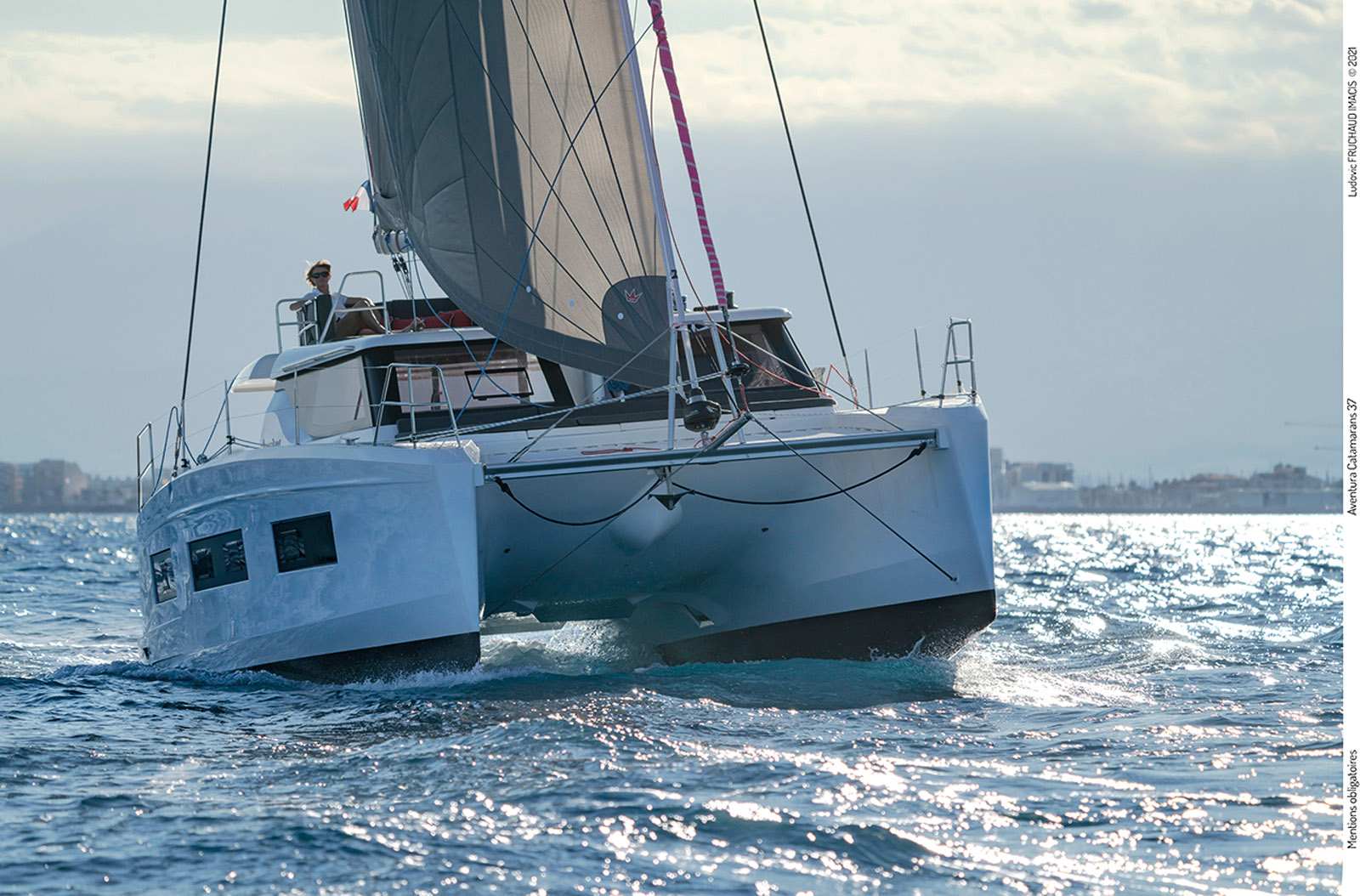
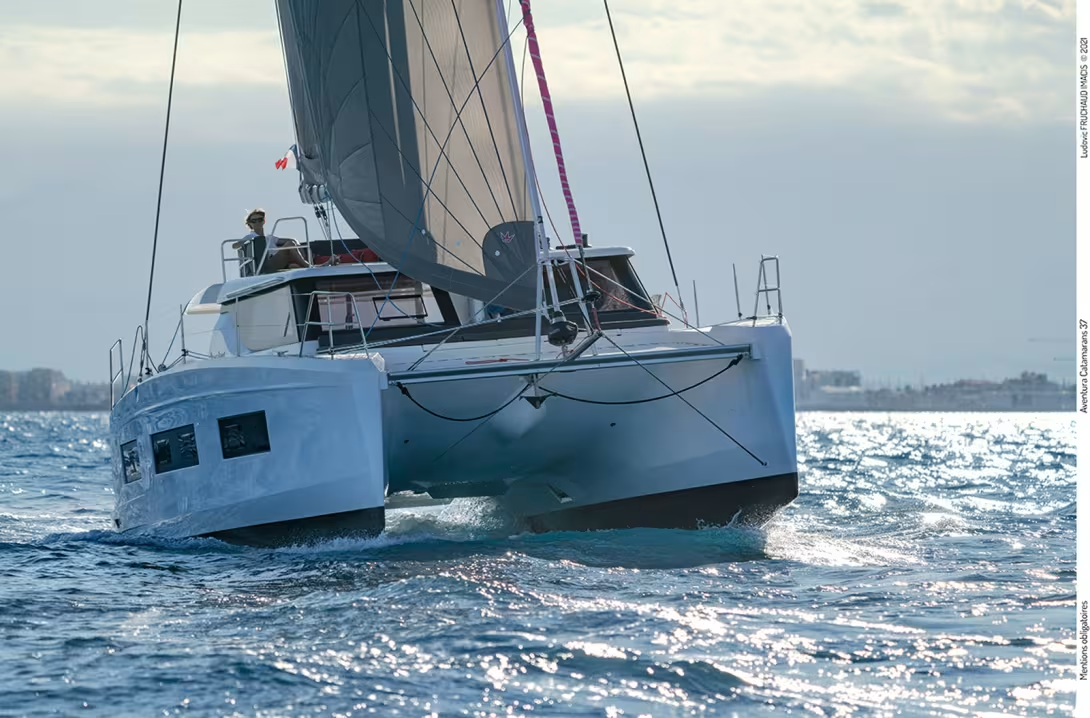
The short chop during our test didn’t impact the vitality of the Aventura 37 under sail.
Designing a 37-foot catamaran: a delicate exercise…
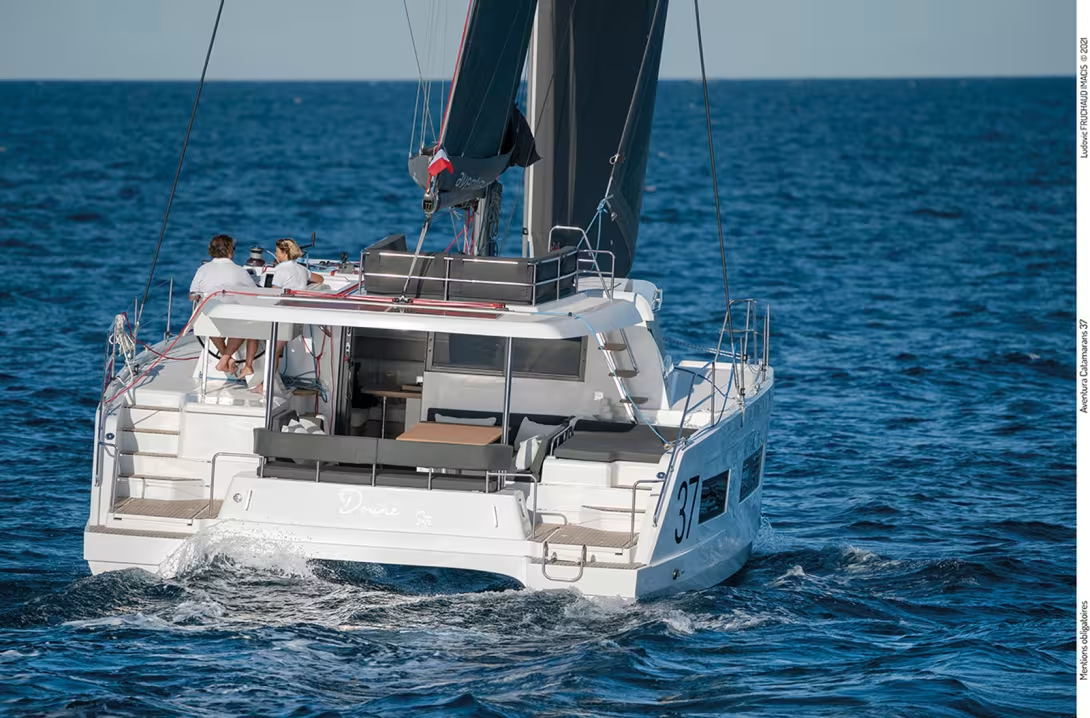
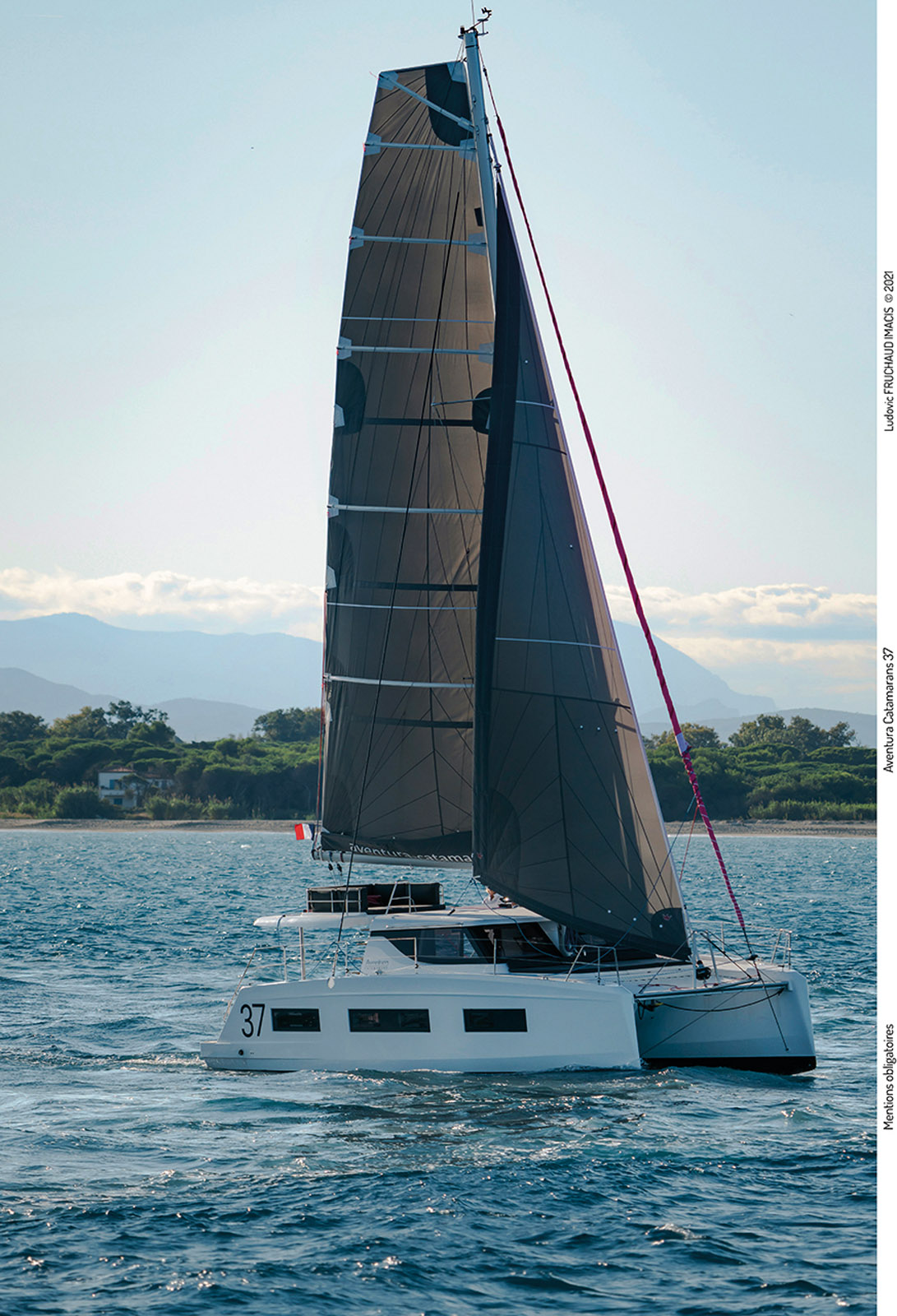
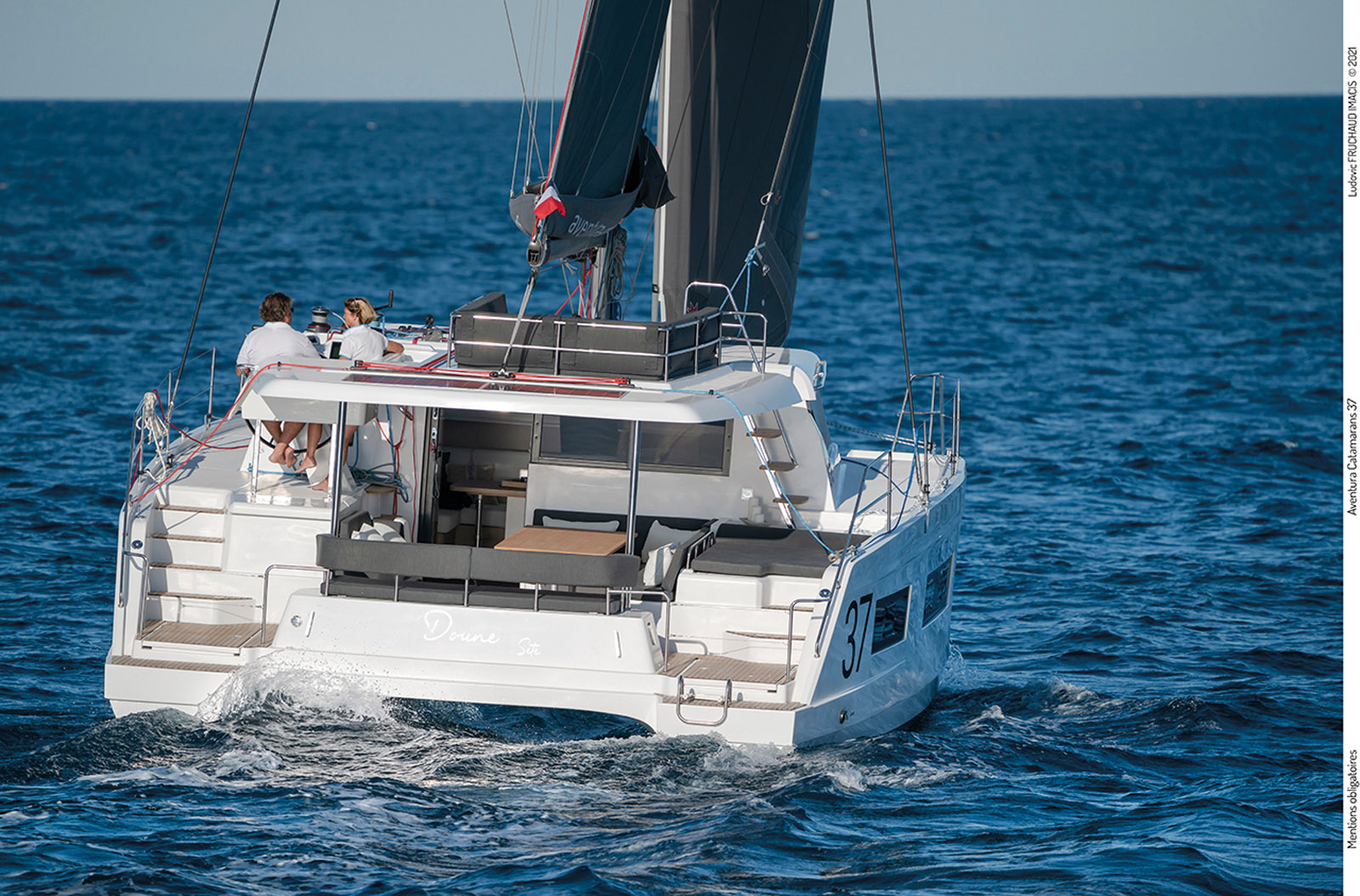
No one disputes that designing a liveaboard catamaran is a delicate exercise, and that under 40 feet, the challenge becomes even more complicated if you want to offer a “comfort” package capable of satisfying customers who place a premium on amenities they have in their modern apartment... Within this 35’9” (10.9 m) hull, Samer Lasta’s creativity combined with Eric and Romain Roger’s experience seems to have found the path to success. The recipe for a cruising catamaran deemed habitable (in the contemporary sense of the term) is well known, and includes at least three independent double cabins, a covered cockpit which has become the patio living area since the helm station has become an independent entity, very “relaxation” oriented ergonomics, a trendy urban chic interior design that’s neutral, but not sad, and with attention to creating appeal to the female members of the crew. The boat must also have good nautical qualities, there’s no compromise on that one... Achieving all this implies solving a complex problem - a challenge that Aventura seems to have taken up with care and intelligence. The overall silhouette is really quite attractive if (for the photos) you uninstall the somewhat massive upholstery of the upper sundeck, which remains an anchorage accessory. The inclusion of the bimini in the general design is successful, the sloping windshield and the overhanging “eyelid” give movement to the coachroof, the proportions are elegant, and the style of the hulls is dynamic. The discreet deck line underscored by a double rib, the imperceptibly inverted bows and the ventilated portlights, that are both elegant and very effective, combine to make up the characterizing stylistic elements of the 37. The sugarscoops with well exposed transoms are practical for dinghy arrivals or access to the boat when alongside a dock. I would, however, be happy to see the aft guardrail a foot higher to minimize any risk of falling in.
 |
 |
The architect and builder propose a sail area/weight ratio of 11.9 m²/t: a pretty favorable figure compared to its main competitors in the 40-foot sector.
Only this aft view betrays the “compactness” exercise that Samer Lasta undertook to fit everything into just 37 feet.
A successful interior and carefully-designed ergonomics
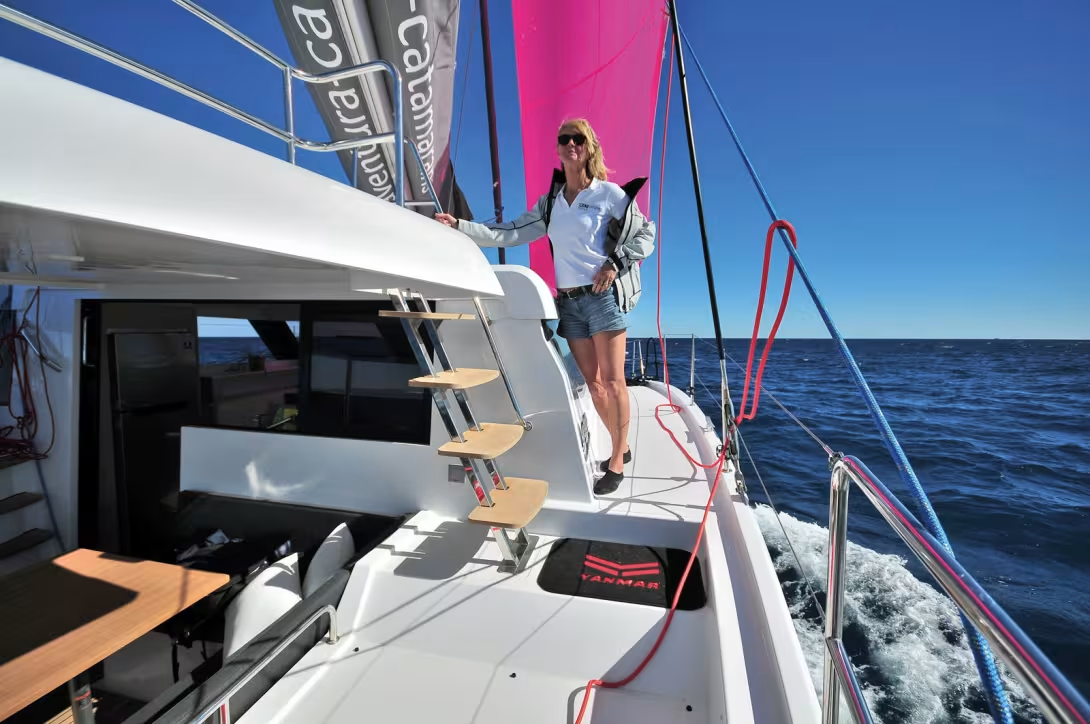
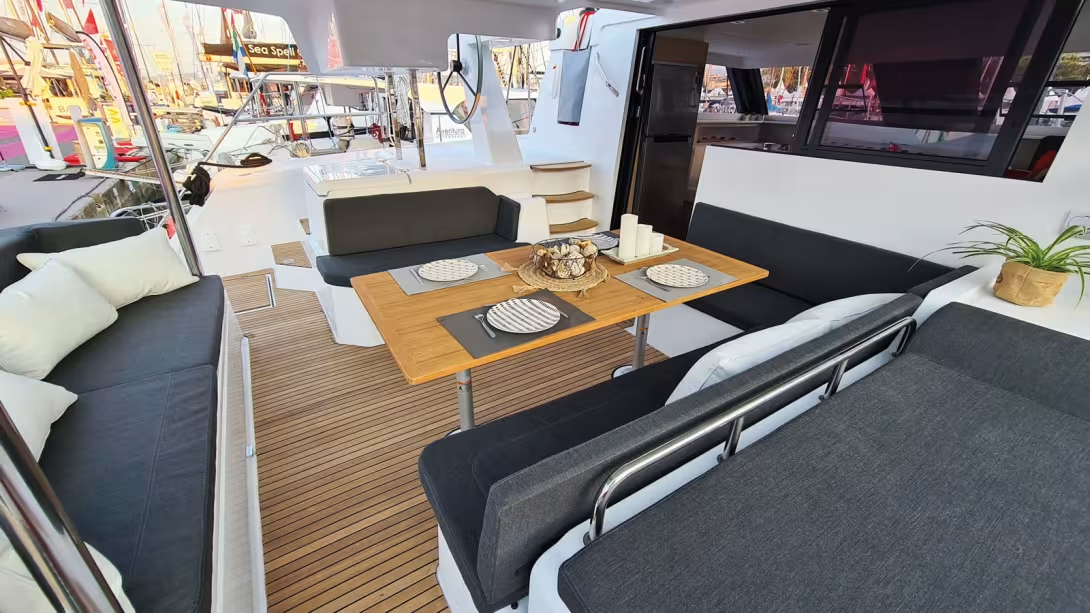
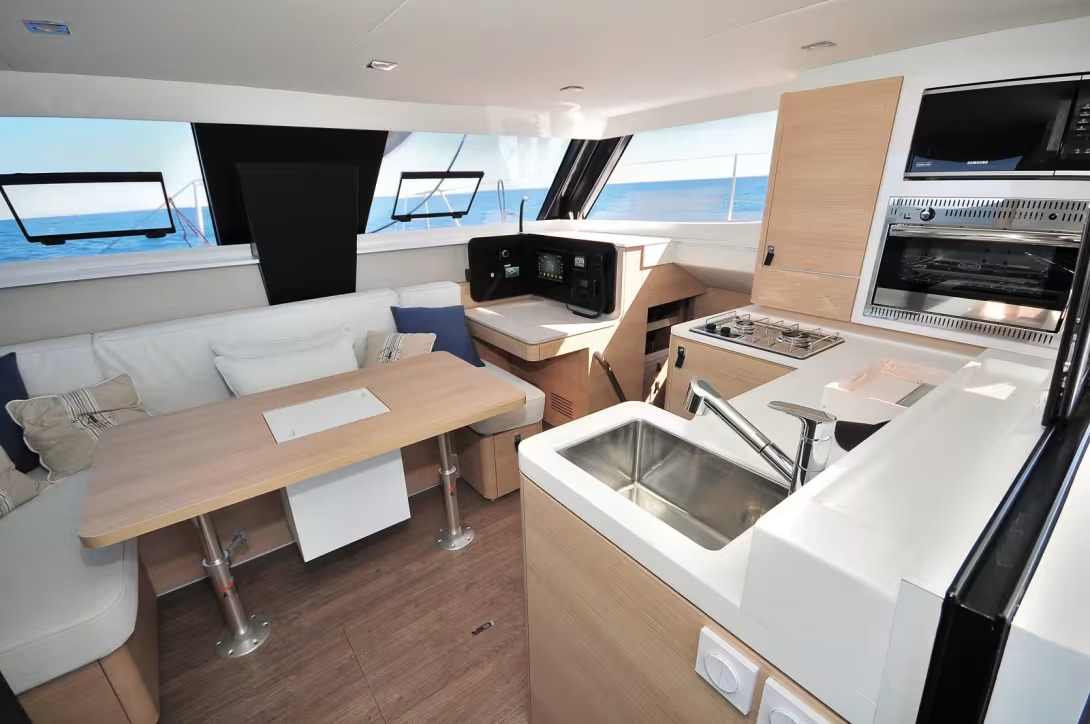
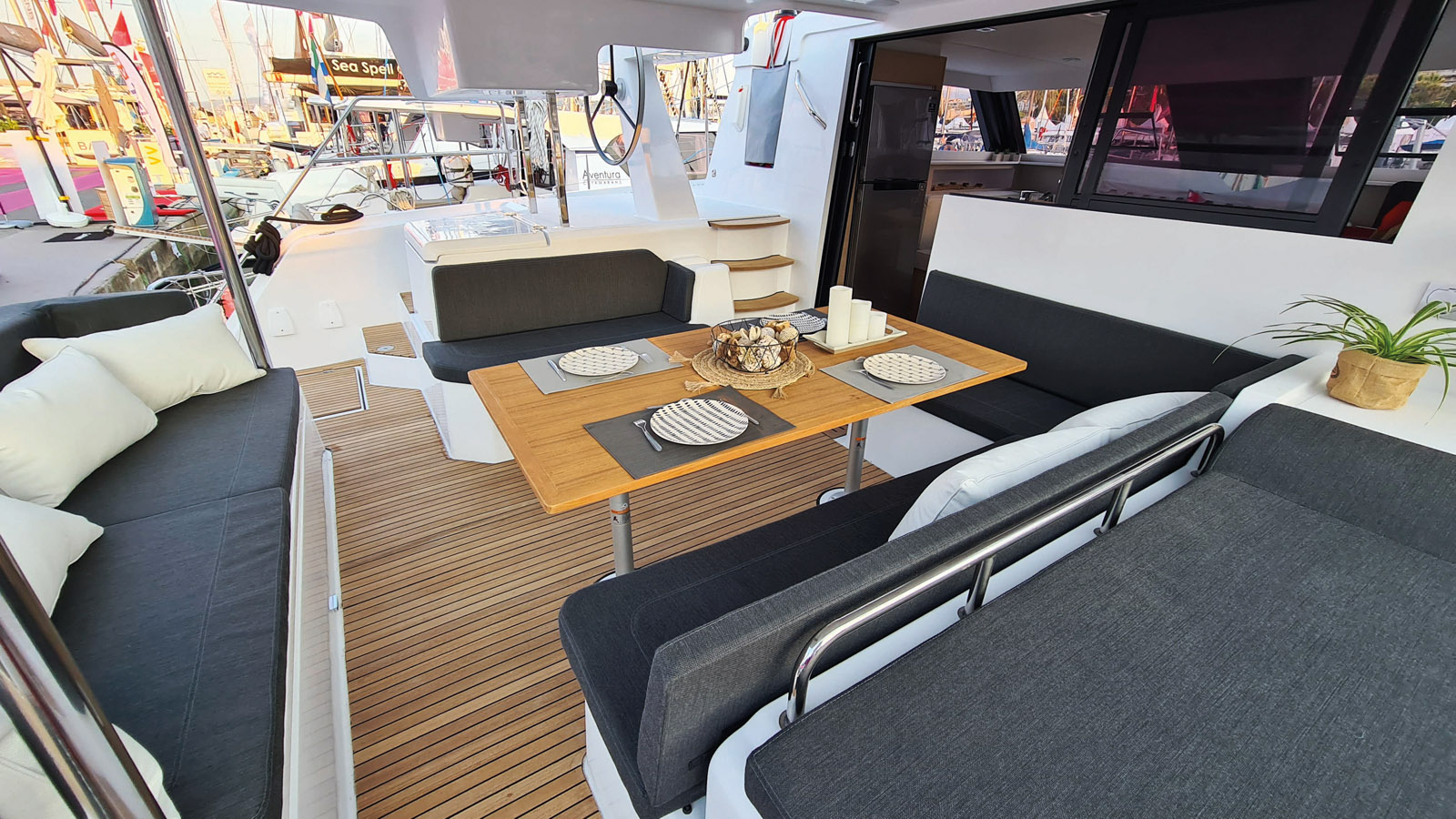
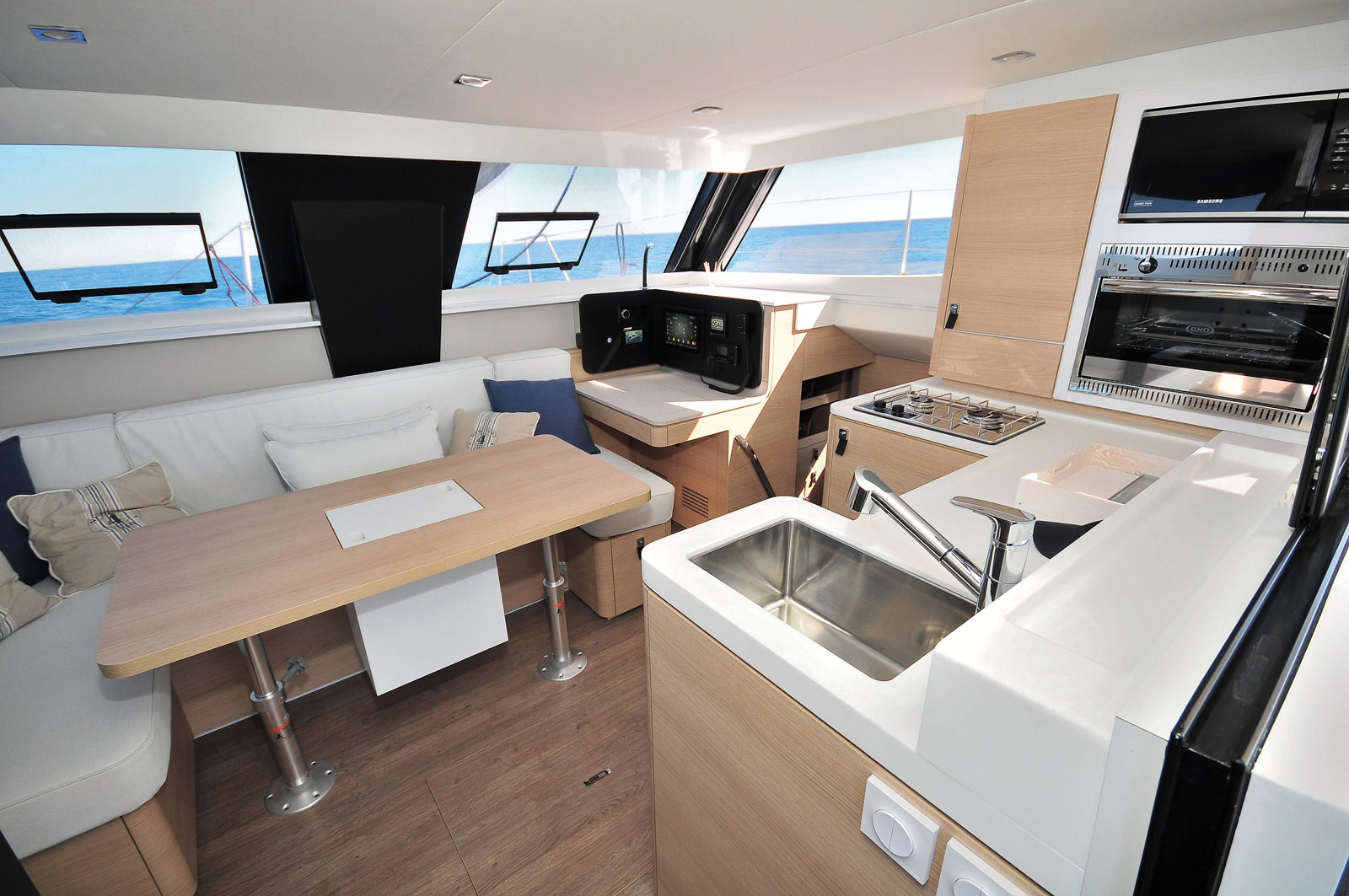
First off, I’ll give very good marks to the cockpit space which includes a large sunbathing area on the starboard side, an L-shaped outdoor lounge around a nice wooden table on solid legs, a very comfortable aft bench seat and a small lounger, all featuring good-quality upholstery. The descent to the sugarscoops is convenient, with the ascent to the helm station achieved via a small flight of steps secured between the maneuvering station and the helm served by a pleasant double seat. Access to the large sunbathing area on the coachroof is achieved using a beautiful stainless-steel staircase secured by a handrail and a solid balustrade. The lounge area is well thought out and the woodwork is attractive (both in appearance and finish). The U-shaped galley opens directly onto the cockpit and has all the desired elements - large sink, oven, two-burner hob with potholders. A microwave is available. The table in the saloon will only be used in cooler weather or as a side table – this can seat 5-6 people with two additional seats. The bar integrated in the table is an option, one that, in my opinion, is more of hindrance than a benefit. The telescopic base allows you to transform the saloon into a lounging area. Visibility is good, ventilation from forward is served by excellent opening panels that are easy to use. On the version we tested, it’s clear there’s been a real evolution of the quality of the Aventura production: ventilation, natural or electric lighting, choice of wood species, atmosphere, everything contributes to a pleasant ambiance, a perception of high-end manufacture. We also noted an abundance of good ideas such as shelves, storage space, external ventilation panels and openings in the cockpit.
 |
 |
 |
The cockpit offers ample seating and a lounger to starboard.
Saloon, galley, chart table and storage space: everything fits neatly into this generously glazed nacelle.
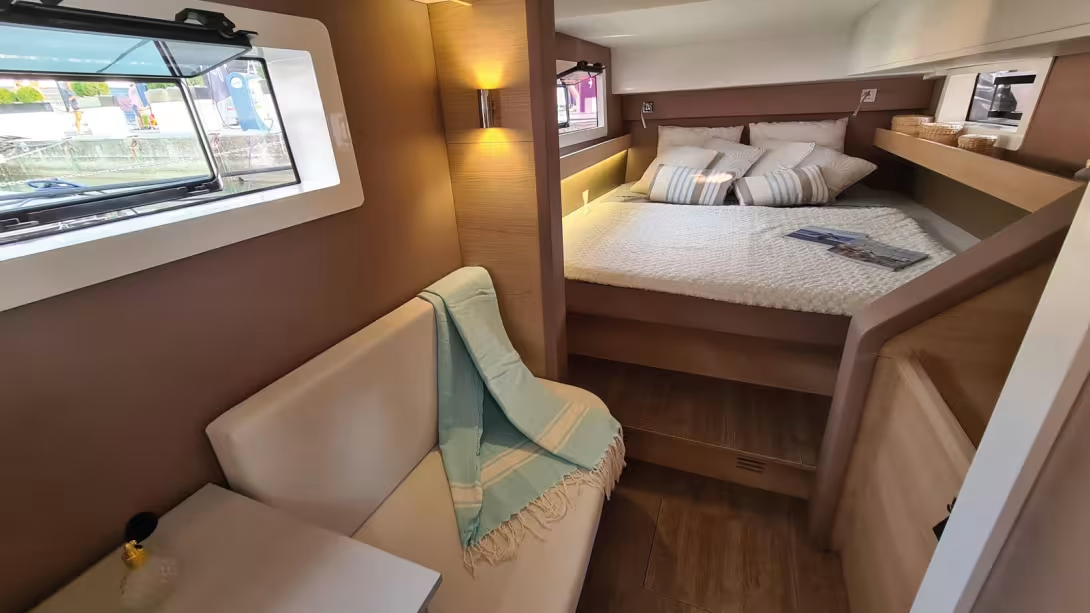
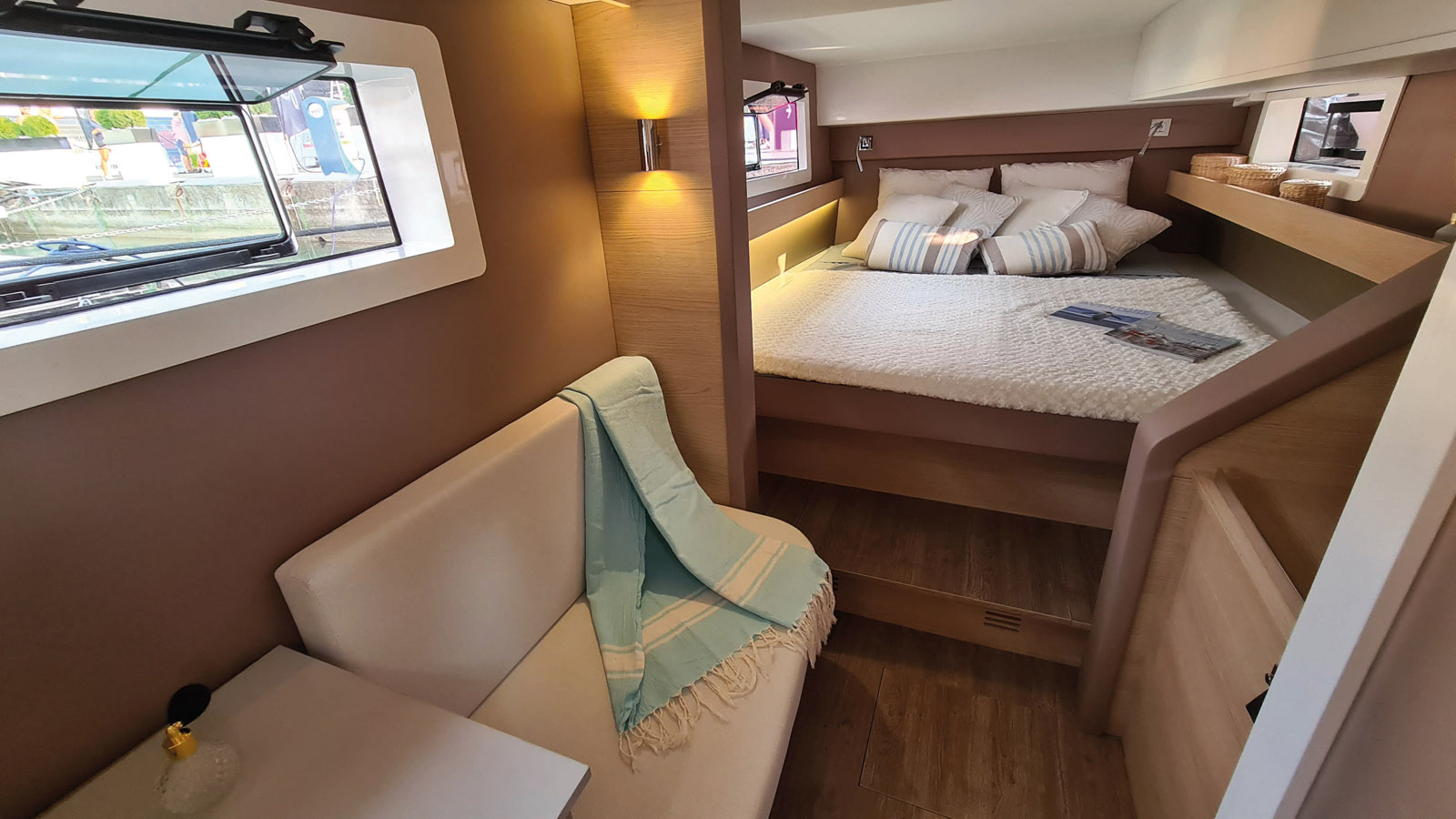
The cabins are well designed - volume, brightness, storage and finish, nothing is left out.
A word from the architect - Samer Lasta

For the Aventura 37, we proceeded according to my usual method of project development. This means establishing close communication with the shipyard in order to gather their precise expectations, based on customer feedback. This approach may sound simple, but it involves countless exchanges of sketches and ideas (at any time of the day or night!) to arrive at the result. Next, I put forward a draft proposal resulting from a global approach to the boat. I am very fond of this spiral design philosophy (an idea dear to James Wharram) which implies taking a look back at the whole, after each issue has been solved so that no element (be it structural, interior design, rig or whatever) collides with any other. Being the sole designer (lines, interior design, exterior design), I keep control of this coherence, it’s my way of working. And this suits the STGI shipyard well. For the 37, we wanted an 11-meter boat that would have nothing to envy to a 12-meter model in terms of life on board and ergonomics. A structurally sound catamaran (chainplates angled back 11°, in line with a bulkhead for example), that’s agile, lively and enjoyable to be on.
The technical and mechanical installations
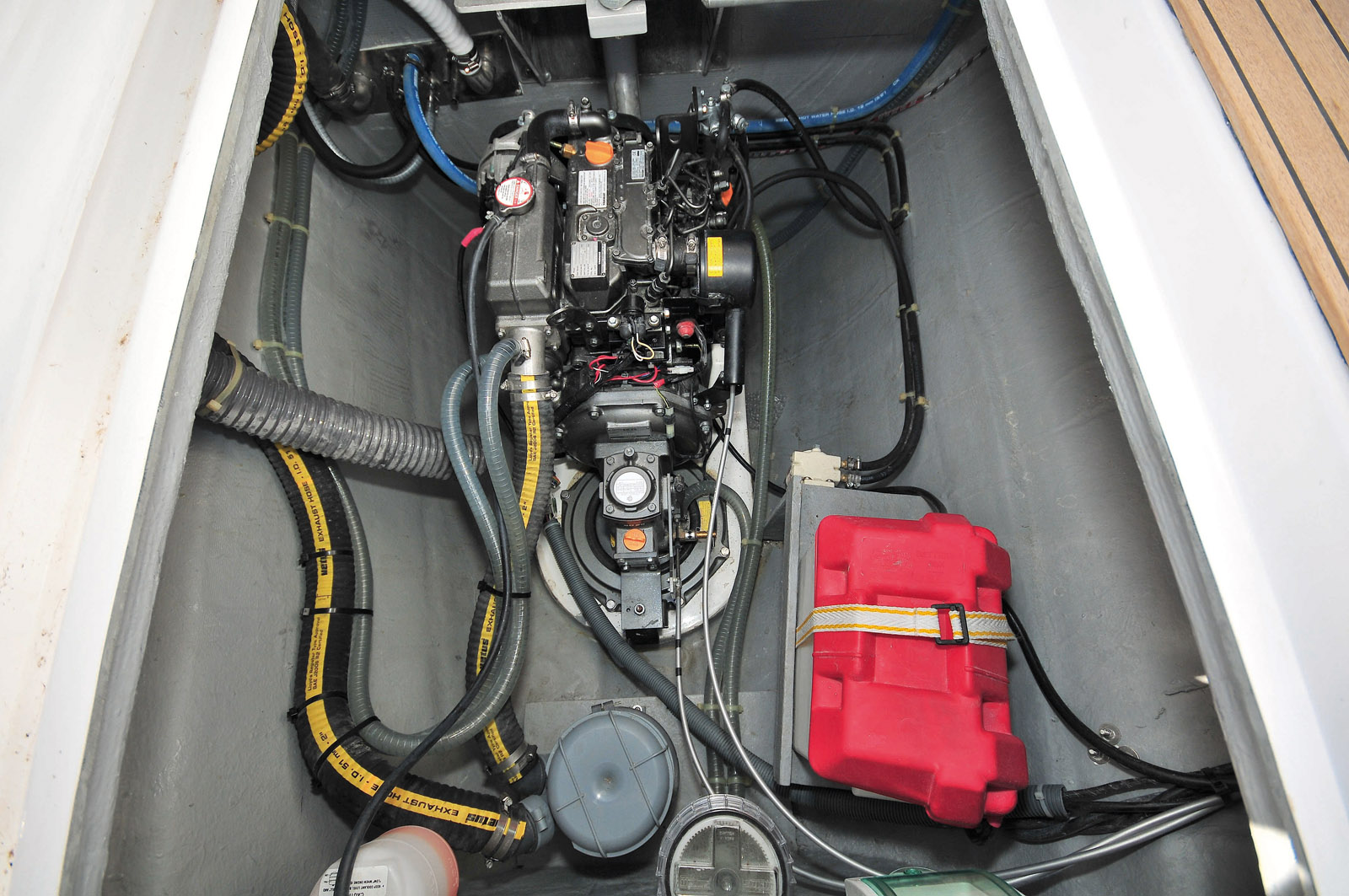
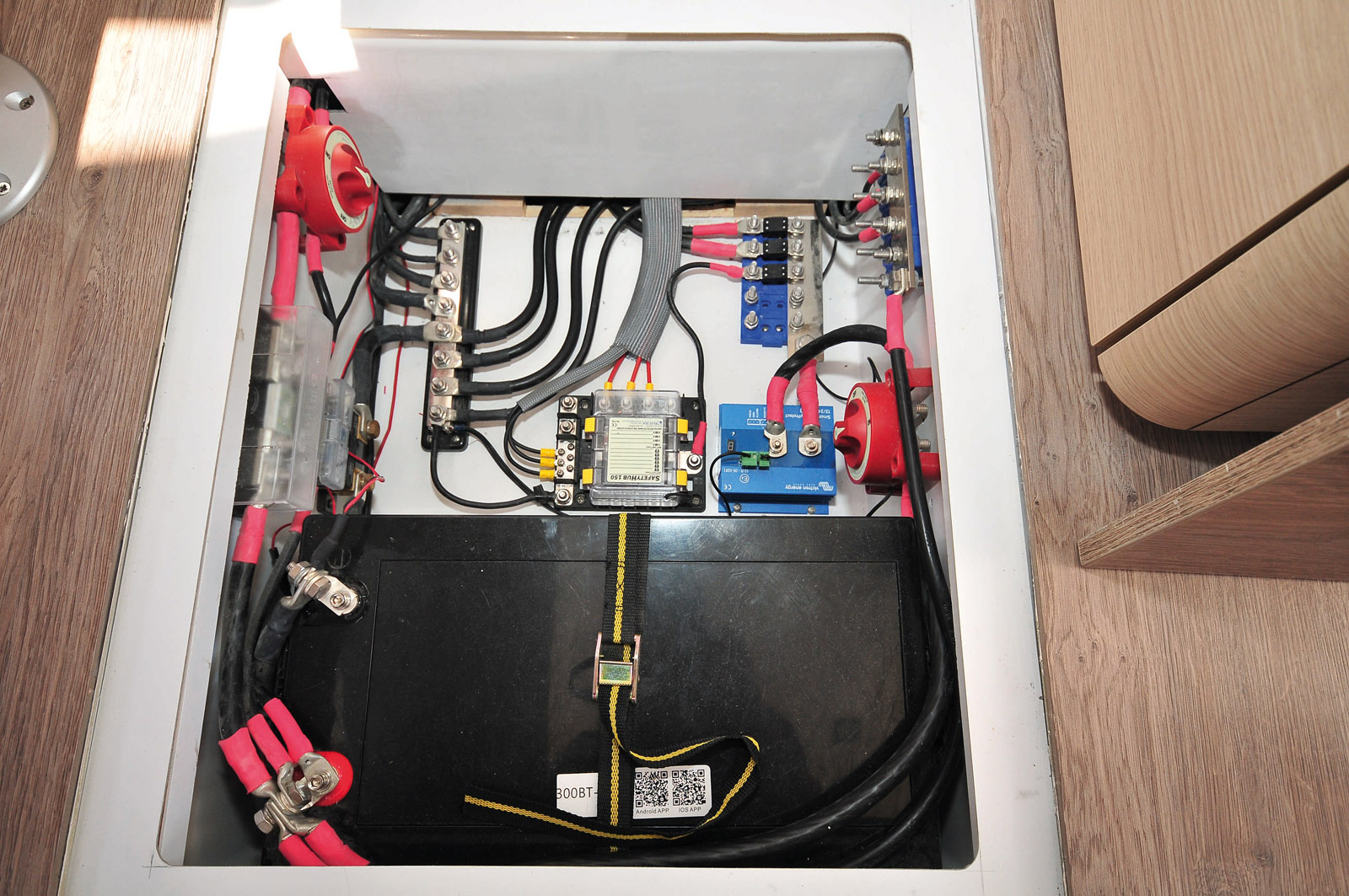
It’s clear and clean: it’s unfortunate that there’s a few loose wire bundles and a cut-out for the inter-rudder linkage in the bulkheads that should have deserved better. The welded aluminum shelves on which the autopilot rests are well-sized and solidly bolted to the aft bulkheads, crossed by the rudderposts, the steering stops are satisfactory, but could be more generous to allow these exposed parts more protection during any involuntary backward movements in the waves. The watertightness of the ducting passages towards the front of the catamaran seems to have been well taken into account in order to confine any possible water ingress in the engine compartments. The battery compartment under the floor of the saloon is pertinent, provided that the electronic management system is located under the chart table (which will be the case on future models, allowing for the installation of additional elements).
 |
 |
 |
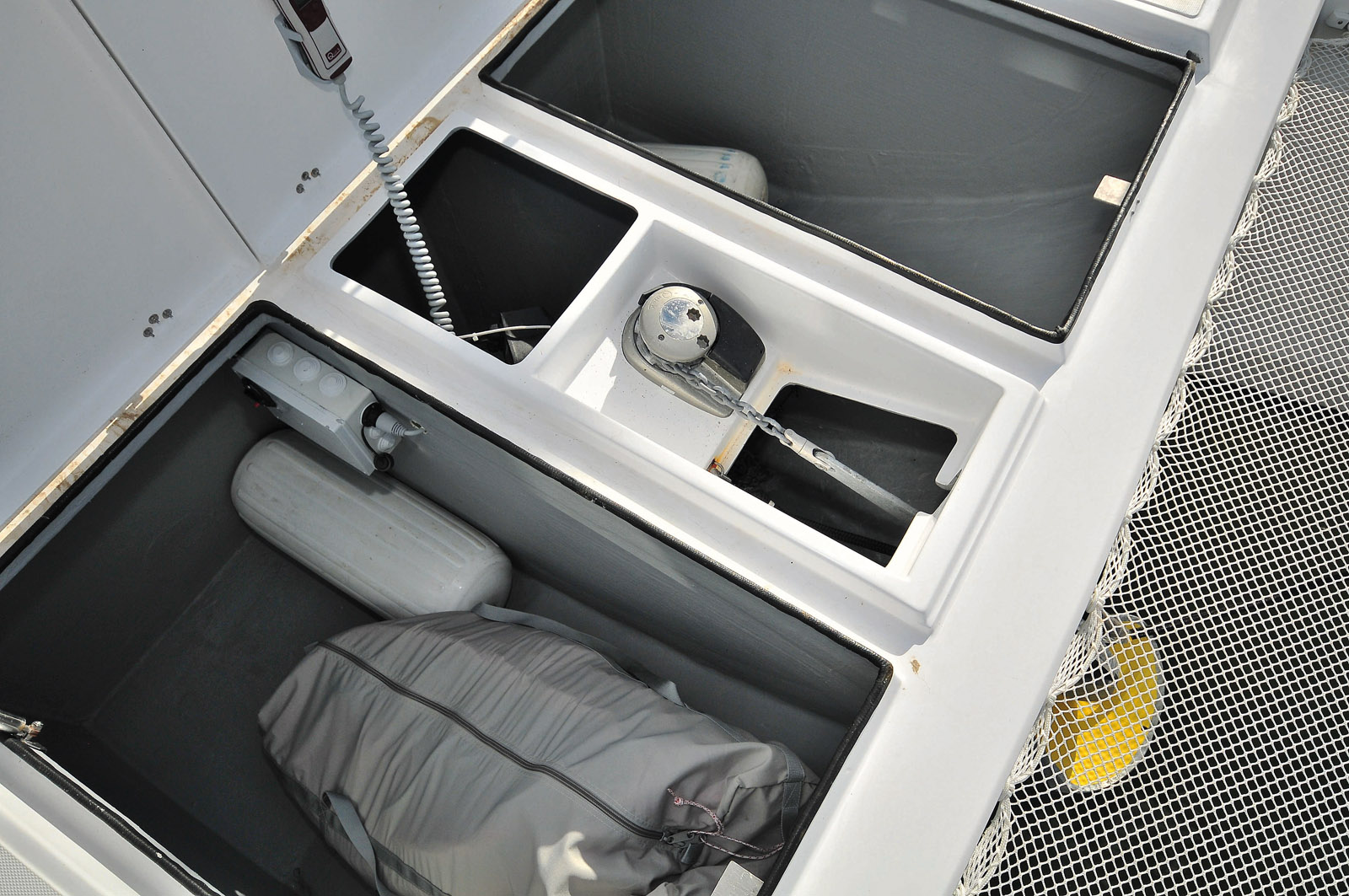
Forward of the coachroof, deep storage spaces surround the chain locker.
The installation of the engines and their peripherals is neat except for some of the cable runs and cutouts that could be perfected.
The electronic management system housed in the battery compartment under the floor will be moved to beneath the chart table.
A catamaran that’s fun and easy to handle
At 8 tonnes (17,500 lbs) lightship, the 37 sits in the average displacement of comparable catamarans. The comfortable bridgedeck clearance, combined with fine-entry bows, good aerodynamics and coherent weight centering, all allow for good maneuverability under power with limited windage and small size - qualities to be appreciated in an anchorage or in saturated ports. For our test, we saw good conditions (fine weather, 10 to 16 knots of ESE wind, but a large cross sea with a chop of 3 to 5 feet), the boatspeed on a close reach was quite satisfactory (6.8 to 8.2 knots), as was the passage through the waves in choppier seas. It was obvious that in these conditions a code 0 (recommended!) would have reduced the platform movements by better supporting the catamaran while providing an extra knot of speed. With the breeze oscillating quite a bit, we noticed good acceleration in the 13/14 knots of wind. Sail maneuvers aboard the 37 are child’s play under furling genoa and mainsail thanks to a neat console separated from the helm which groups together the clutches and winches. The visibility over the whole deck plan is appreciable and the helmsman placed at the back can observe the action and advise the crew. The wellthought- out ergonomics of the helm station allow perfect control of the main on your own for tacking, traveler and mainsheet adjustment, and gybing) using the excellent Garmin autopilot whose controls are easily accessible. The Elvström Black suit of sails is remarkable both in shape and quality of manufacture. The lightly overlapping genoa is easy to tack. The Selden furler is perfectly sized and smooth in use. The 625-sq ft (almost 60 m²) square-topped mainsail is powerful and intuitive to set. A lovely asymmetric spinnaker allowed us to enjoy a great downwind run at around 9 knots while keeping good stability. The Selden mast and rig inspire confidence (in quality and inertia).
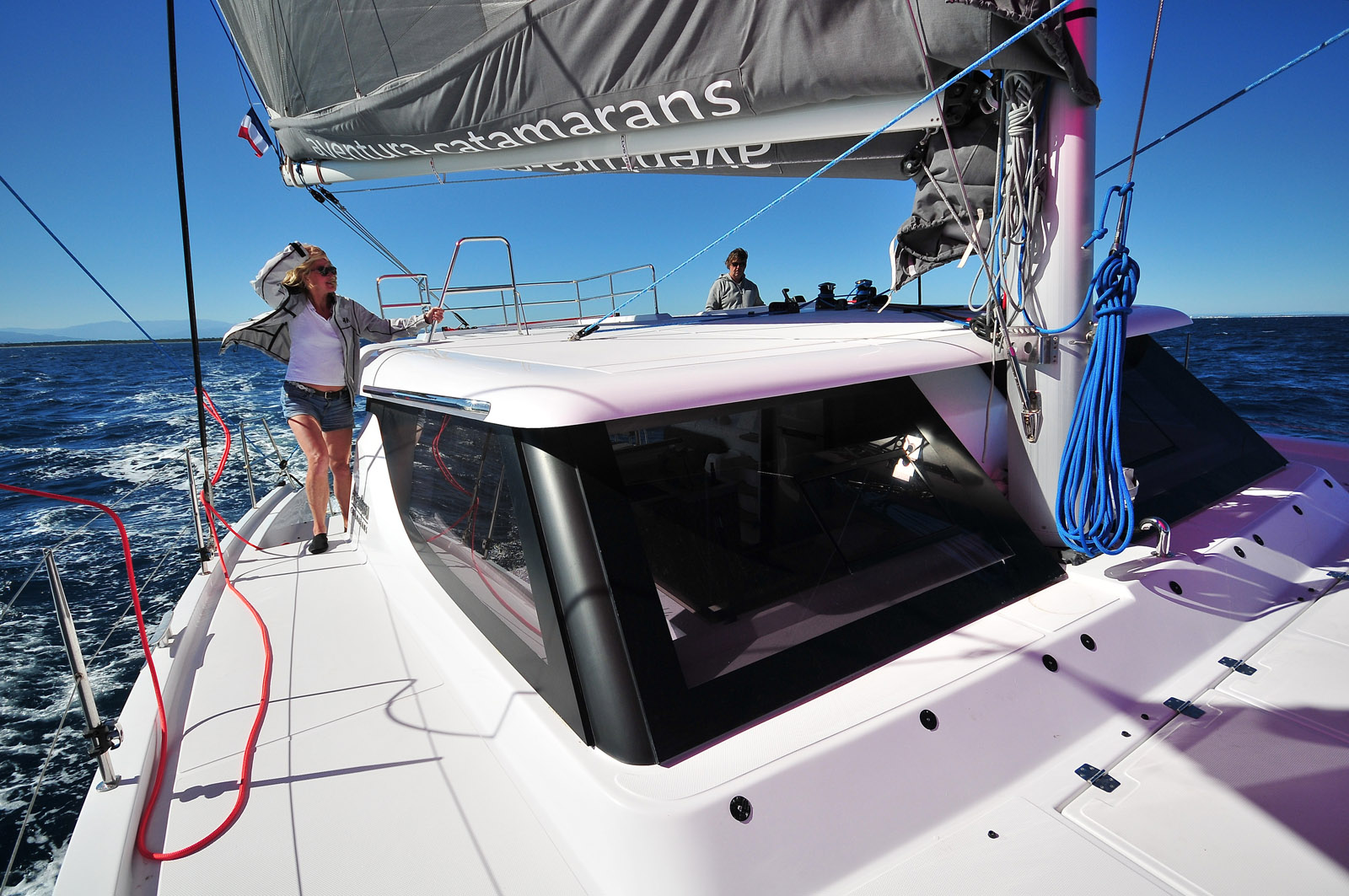
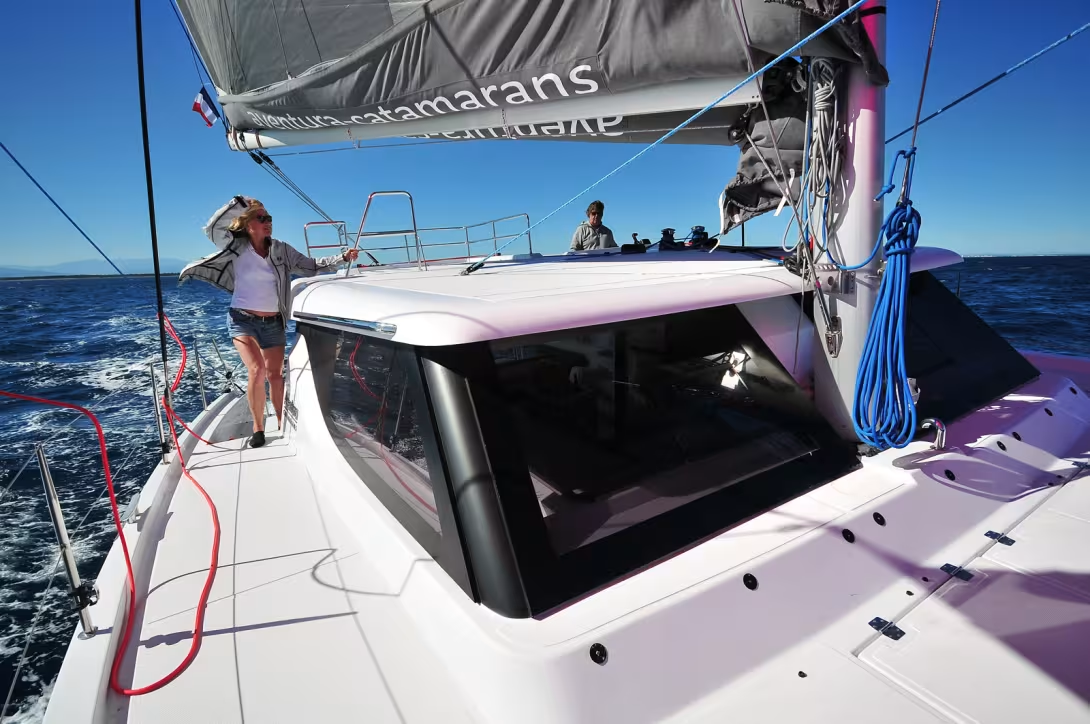
The deckplan ensures easy and safe sailing.
The Helmswoman's point of view
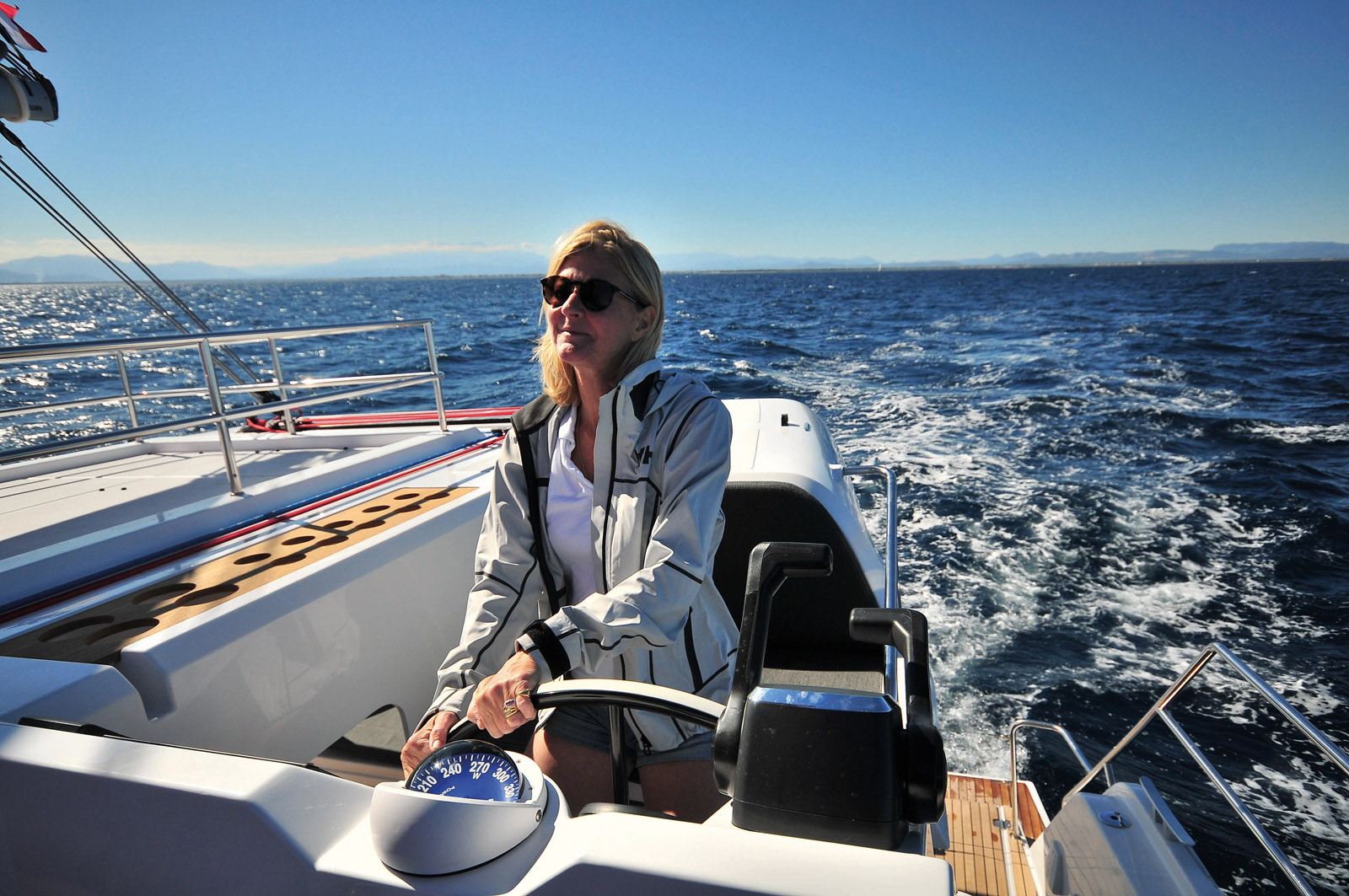
I appreciated the spacious, well-lit and ventilated cabins and the convivial lounge-galley area. The pleasant interior volume doesn’t impact on the cockpit space or the relaxation/sunbathing area. This Aventura is a modern, attractive cruising catamaran, ideal for four pleasure-seekers, a “little/big” multihull! The cockpit is comfortable, the deck plan clear and efficient. I felt perfectly at ease under spinnaker at 9 knots.
Patricia Desloge
Conclusion
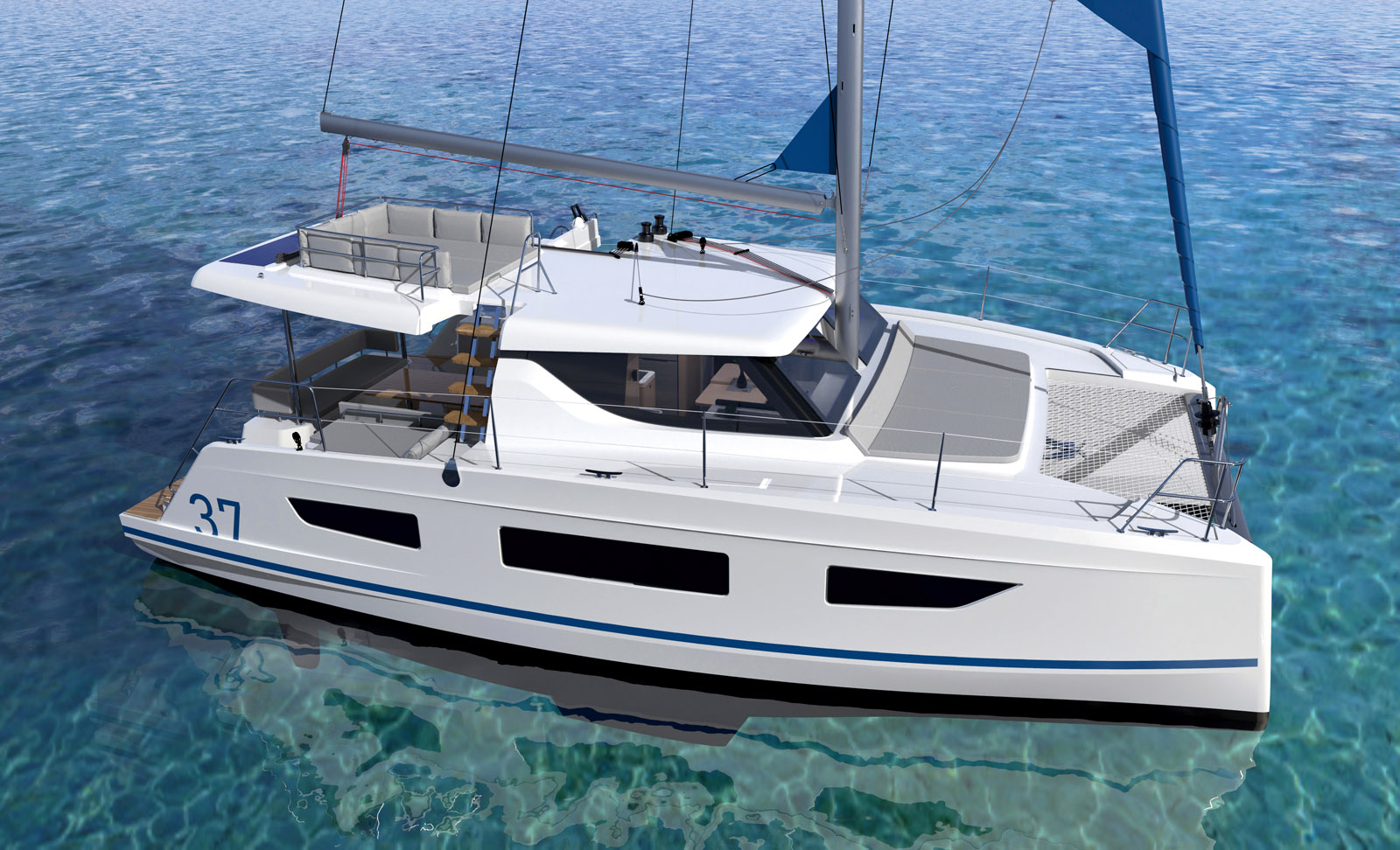
During this test, I had the pleasure of discovering a coherent, well thought out and carefully built catamaran. The 37 achieves a relevant synthesis of solutions already implemented by other leading builders while blending them into the Aventura melting pot. The result is a pleasure to live aboard and to sail. Despite its modest size, the 37 will be fit just about any boating program, with none of the complexities that might be found aboard larger - and unwieldy - units.
 |
 |
The Pluses:
+ Successful silhouette, layout and ergonomics
+ Coherent catamaran, easy to use
+ Behaves well under sail
The Minuses:
- Location of the electronic battery management system on hull #1 (corrected)
- Aft guardrails should be higher
- Organization of the wiring in the engine compartment
Technical Specifications
Builder: Aventura Catamarans/STGI
Architect: Samer Lasta
Overall length: 35’9” (10.9 m)
Beam: 19’6” (5.94 m)
Minimum draft: 3’11” (1.2 m)
Air draft (inc. antennas): 65’8” (20 m)
Light displacement: 17,420 lbs (7.9 t)
Upwind sail area: (94 m²)
Mainsail: 625 sq ft (58 m²)
Genoa: 388 sq ft (36 m²)
Gennaker: 645 sq ft (60 m²)
Spinnaker: 915 sq ft (85 m²)
Symmetrical spinnaker: 970 sq ft (90 m²)
Water: 2 x 66 US gal (2 x 250 l)
Fuel: 2 x 66 US gal (2 x 250 l)
Black water: 21 US gal (80 l)
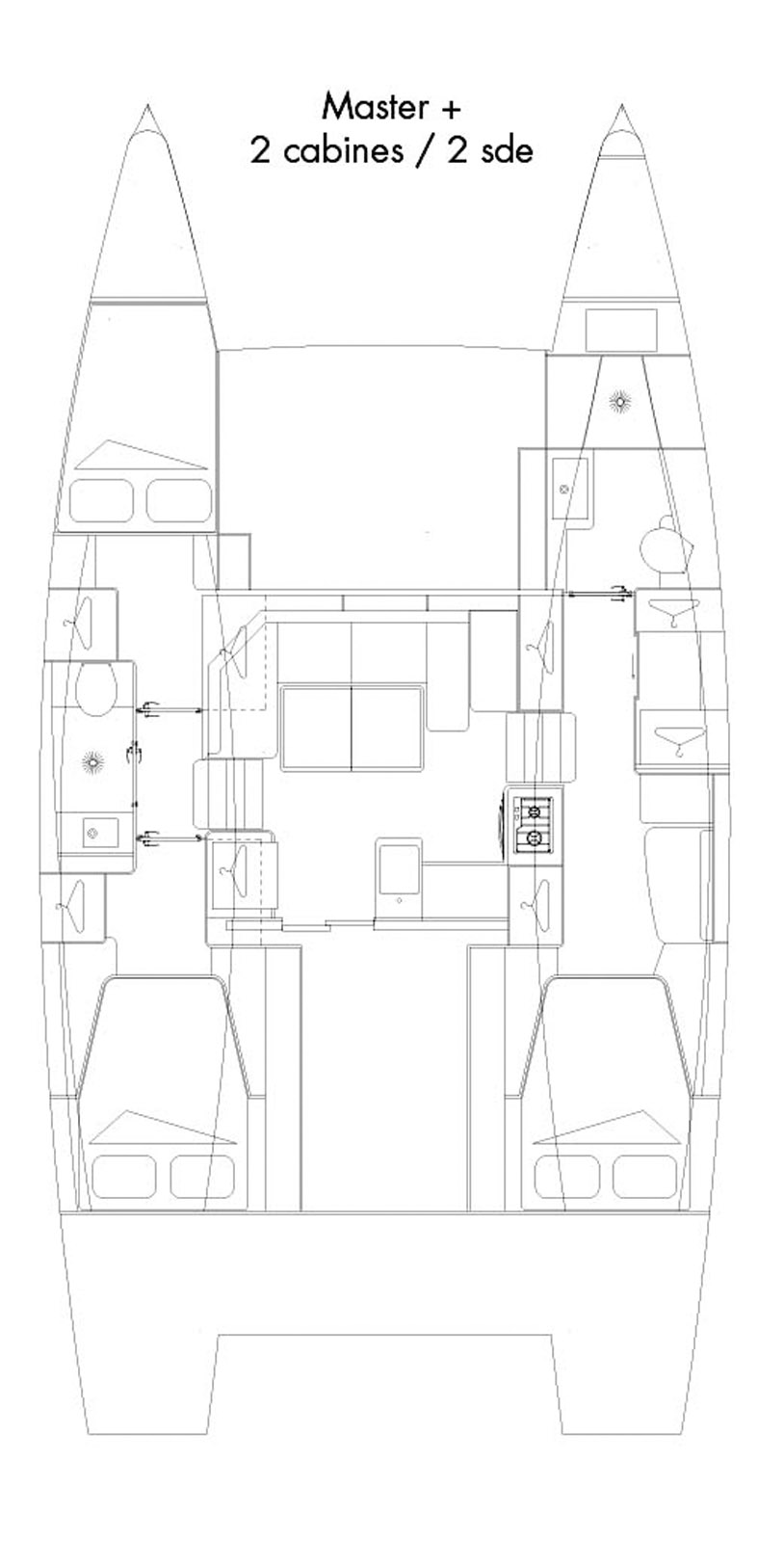
Standard configuration: 3 cabins / 2 bathrooms
Optional configurations: 3 c / 3 b, 4 c / 2 b, 4 c / 4 b
Engines: 2 x 20 or 30 HP
Approval and CE Category: A8 - B12 - C16 - D20
Price Standard version: € 237,500 ex-tax
Quattro Version 4 c / 2 b: € 240,500 ex-tax
Trio Version 3 c / 3 b: € 241,500 ex-tax
Charter Version 4 c / 4 b: € 243,500 ex-tax
Main options in € ex-tax
Easy Sail Pack including batten cars, lazy bag and genoa furler: 3,700
Comfort Pack including exterior upholstery, windlass, led lighting, 220 V circuit + charger, curtains, ground tackle, antifouling, 225 Ah battery: 19,800
Folding propellers (20 HP): 3,912 Harken 46 electric winch: 4,189
Elvström gennaker with deck hardware: 6,201 13 US gal (50 l) / h
Watermaker: 8,504
Anti-osmosis preventive treatment: 2,382
Garmin pack #2: 9,985
Safety equipment: 6,550
Launching: 2,950
