
Constructed in epoxy plywood, this small day-boat is propelled by two electric motors. The deck plan, completely open, has no cabin. We were able to test sail the Bagoù during her first public presentation at last year’s La Rochelle boat show in France.
Infos pratiques
- Le chantier : Bagou 7.0
- La fiche technique
- Découvrez notre vidéo exclusive
- Financez votre Bagoù 7.0
- Assuez votre Bagoù 7.0
- Articles autour du Bagoù 7.0
The Bagoù (the word means boats in the Breton language) meets the specifications established by Jérôme Clément, based in Brittany (in western France). This electrician who’s passionate about watersports saw a market for offering a simple and non-polluting dayboat. The plans were ordered from Julien Marin, who is familiar with plywood-epoxy construction - this material was chosen for its lightness and ease of use as it does not require molds. The catamaran configuration quickly became the obvious choice because of its two major advantages: excellent stability and low drag. The design combines inverted bows, a moderate waterline beam for the hulls (60 cm/24”) and a very pronounced inverted deck shear. This original design won’t necessarily have aesthetic appeal for everyone, but it can be credited with responding very accurately to multiple boating programs.
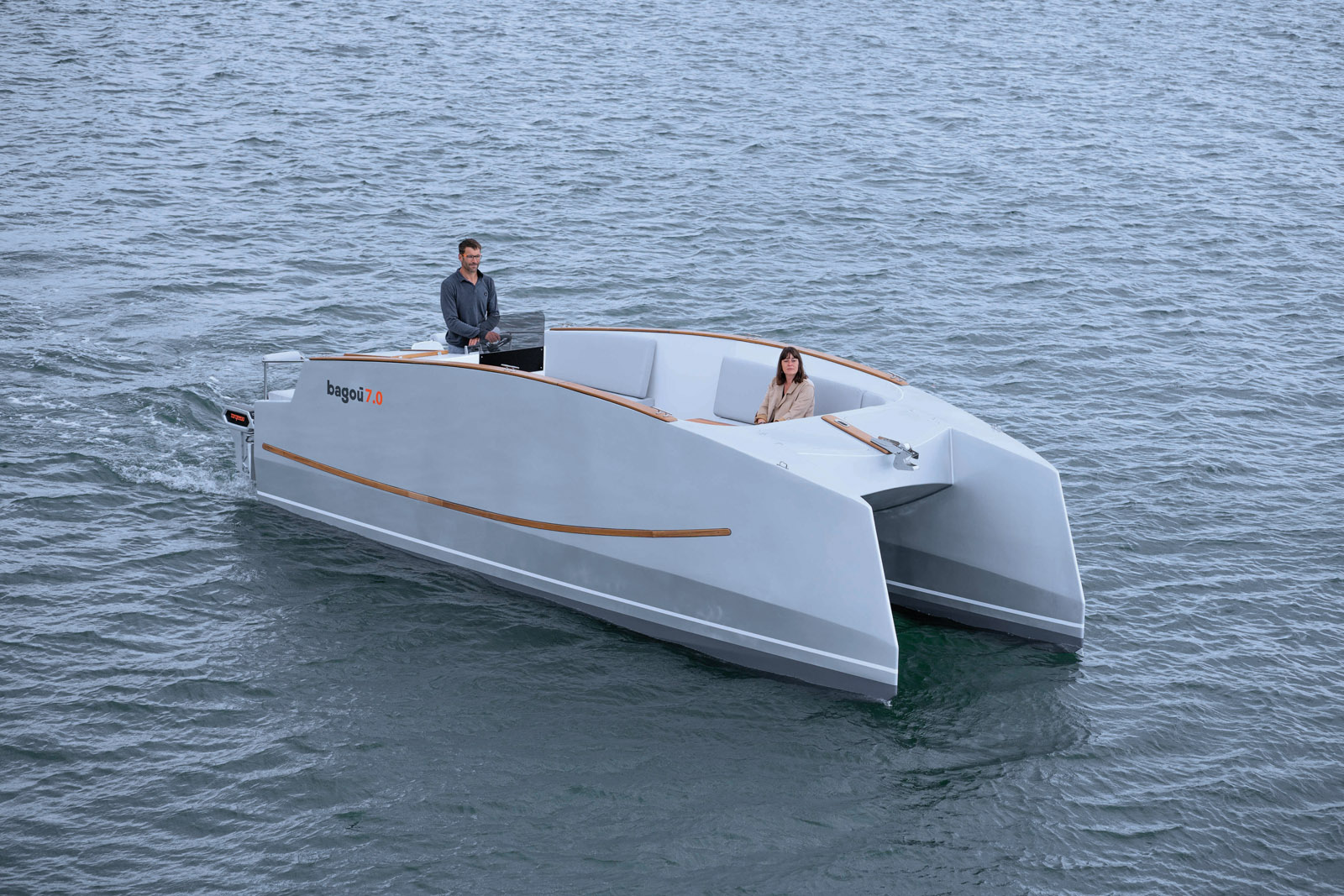
No cabin, so maximum deck area
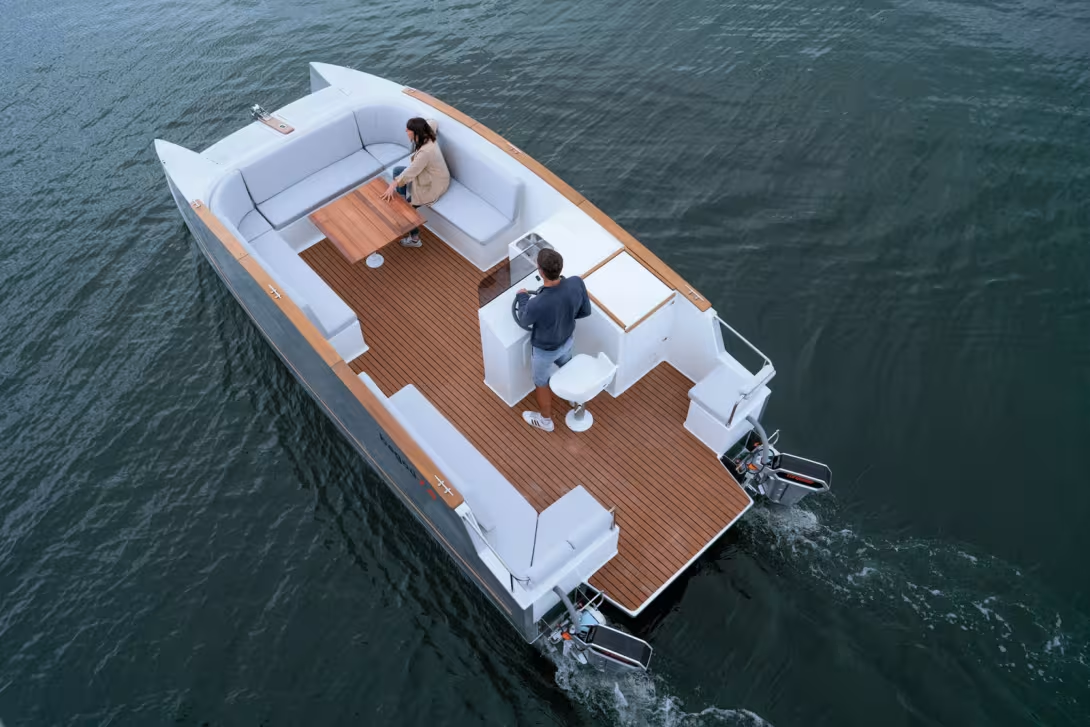
Here’s the first radical choice: no cabin. This means you can take advantage of an unprecedented deck area for a 24-footer. Access on board is facilitated by the large central stern platform – this can even be used for access by wheelchair users. The side-decks are lined by bench seats, which form a U-shape at the bow. This is where the table is set up. The steering console, off-center on the starboard side, hides a chemical toilet and also houses a mini galley. Numerous lockers have also been integrated, easily compensating for the absence of a cabin. In the center of the boat, where the freeboard is highest, the bulwark culminates at 1.20 m (4’) above deck level, providing protection never before seen on such a small catamaran.
Speed or range, it’s up to you to choose!
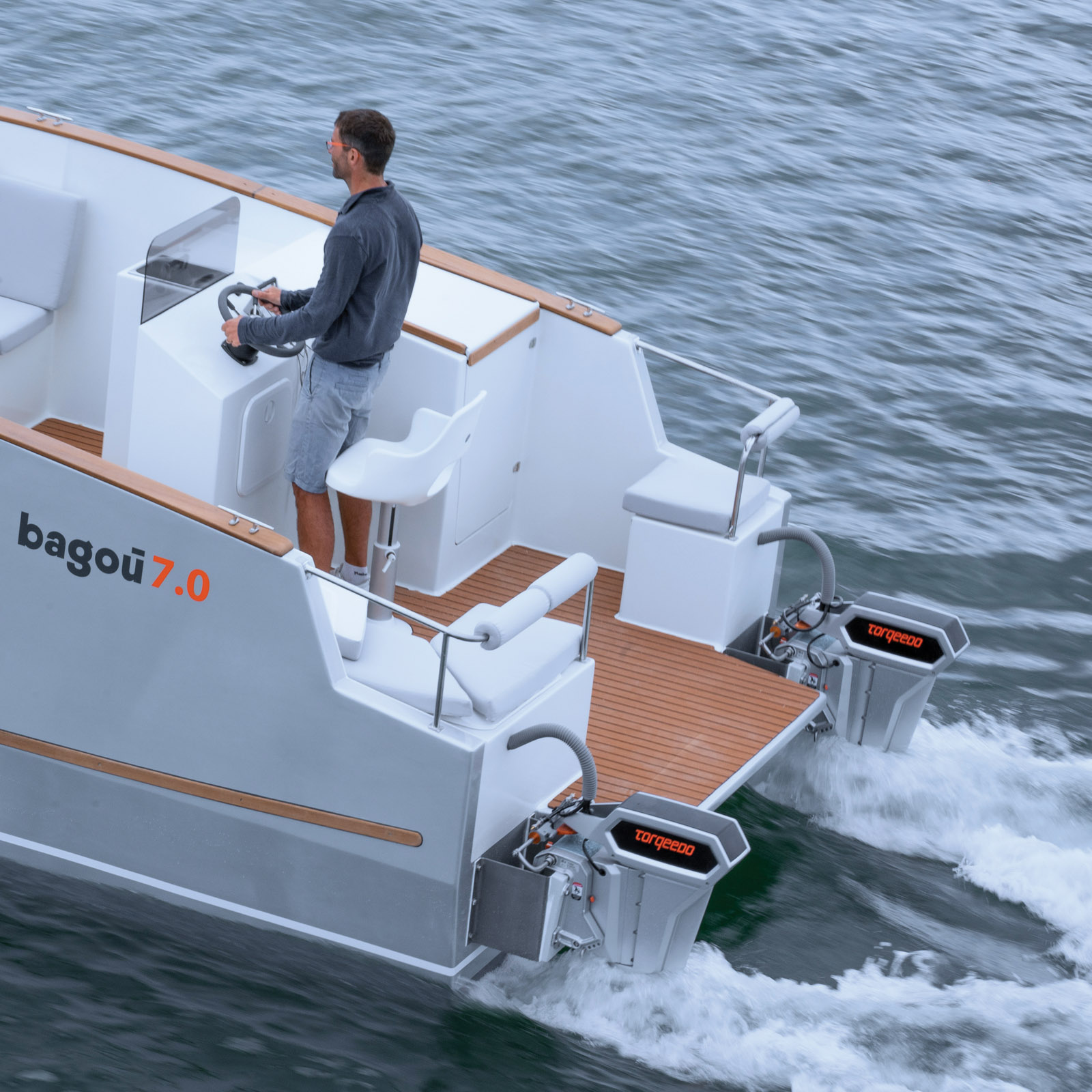
The Bagoù's handling is immediate - one wheel, and one throttle for each engine. The spacing of the engines combined with the high torque of the electric motors, even at low rpm, makes maneuvering in port - and turning on the spot - easier. Our test model was equipped with two 10 kW Torqeedo motors (Cruise 10) and two 10 kW/h (95 kg/210 lb) batteries. In this configuration, 10 knots is easily achievable, but the range is limited to two hours. At a cruising speed of 6 knots, you can last 6 to 8 hours - a maximum range of 48 nautical miles. So, undertaking a coastal cruise is quite feasible: the Bagoù reached La Rochelle from Lorient (more than 150 nm) in five stages. The fact remains that the recharging time - 6 hours - requires long stays ashore. The manufacturer offers no less than four electric motor options and of course a conventional internal combustion propulsion.
There were four of us on board: the Bagoù didn’t seem to feel us moving around. Evolutive, this catamaran can turn tightly, but remains level. As there was no chop on the water, I aimed at the big wake of a passenger boat, at full power: the hull passed through easily, creating no spray. However, the table attachment fixed very far forward didn't appreciate the exercise – but that’s a detail that would be easy to deal with.
Conclusion
The Bagoù is a perfect boat for day-sailing. Comfortable and seaworthy, it offers great fun on the water, in complete relaxation. Among the options currently being validated, there’s a bimini that could support solar panels. An excellent way to limit recharging at the dock.
TECHNICAL SPECIFICATIONS
Builder: Bagoù Boats
Overall length: 7.35 m (24’1”)
Beam: 2.77 m (9’1”)
Draft: 0.45 m (18”)
Unladen weight: 850 kg (1,875 lbs)
CE Category: C/10 D/12
Construction: Plywood/epoxy
Electric drives: 2 x 2 kW, 2 x 6 kW, 2 x 10 kW, 2 x 50 kW
Batteries: 10 kWh to 60 kWh
Max. engines: 2 x 75 HP
Price: from € 60,000 ex-tax
Price of the boat we tested: € 72,500 ex-tax
Plusses
Seakeeping qualities of the hulls
Powerful electric motors
Excellent deck plan
Minuses
Motors exposed
Debatable design
Lack of rigidity of the table