Everyone agrees... a success! The Venezia 42’s big sister, voluminous, comfortable and at ease under sail, was one of Fountain-Pajot’s ‘best’...and remains a leader in the second-hand market!
Infos pratiques
- Le chantier : Bahia 46
- La fiche technique
- Découvrez notre vidéo exclusive
- Financez votre Bahia 46
- Assuez votre Bahia 46
- Articles autour du Bahia 46
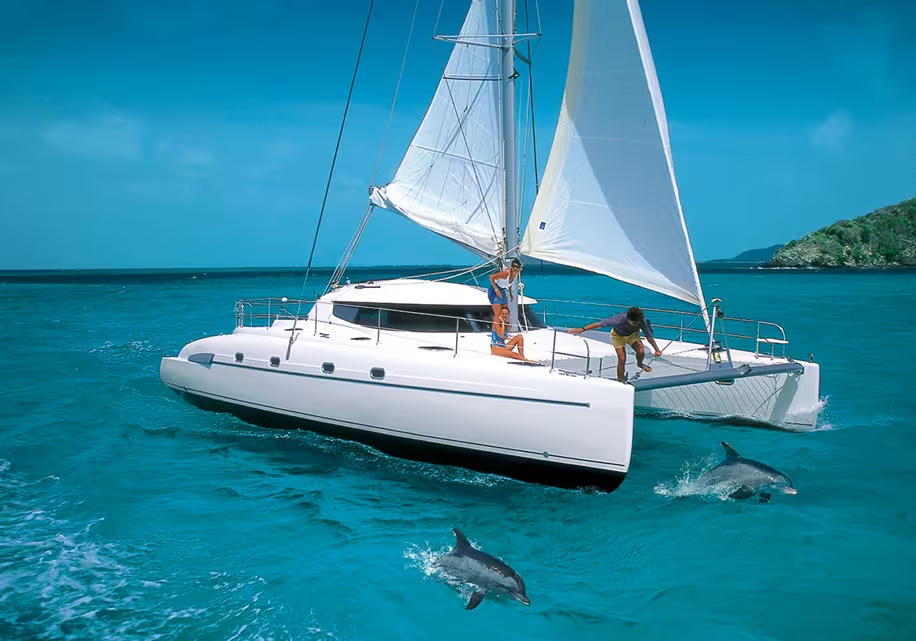
The Bahia 46 is a catamaran which continues to appeal. The proof: search the web, its blogs, opinions, reports, then do the same again in English, German, Spanish...the conclusion quickly stands out: this catamaran, available from 1996 to 2007, is unanimously appreciated by skippers, delivery skippers and crews of all nationalities. It’s perhaps not for nothing that the Bahia 46 remained in Fountaine-Pajot’s catalogue for over 10 years, and that 176 examples were sold – one of the company’s biggest successes. For the R&D department, this 46 represents the quintessence of the cooperation between the architects Joubert/Nivelt and the designer Olivier Flahault! Faithful to the trends of the time, the Bahia adopted rounded lines. Although it retained the coachroof and its extension, and the 'pug-nosed’ bows, characteristic of the builder, it adopted beamier hulls than the previous models. Yet the 46 remains a catamaran with a moderate displacement, and is generously canvassed. With a sail area/weight ratio of 11.71m²/tonne, it is well-canvassed and above all displays performance which would put a number of modern production multihulls to shame...
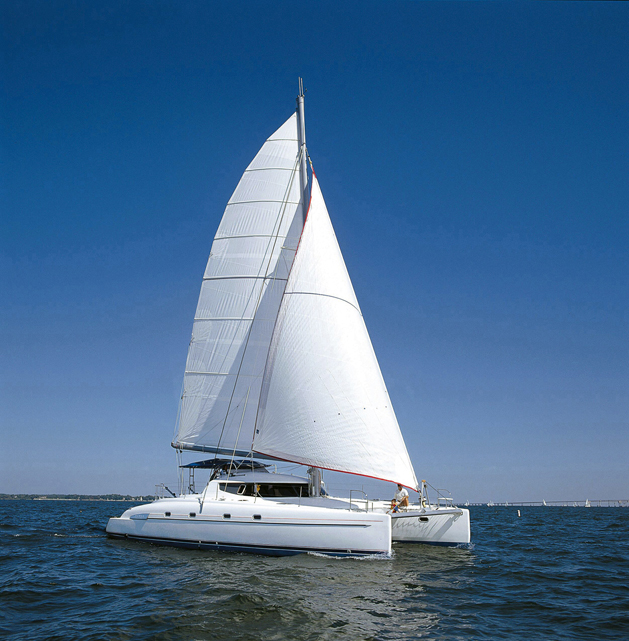
The stub keels which take the draft to 1.3m represent a good compromise between a good course to windward and access to the beach.
Averages of over 10 knots!
But although it is fast, comfort is not forgotten, thanks to its beamy hulls – which do restrict the boat’s potential in light airs a little. Clearly, below a force 2, assistance from the engines – 2 x 38 or 2 x 48hp depending on the model – will be welcome. However, by opting for a square-headed mainsail, a gennaker on a bowsprit, and folding propellers, the boat can easily be boosted...and it is crying out for it! Because from 10/12 knots of wind, the Bahia 46 will surprise you with its acceleration, and above all the ease with which it returns two-figure averages. To windward, with its fixed stub keels, it does rather well, with a course close to 50/55° to the true wind, and very little leeway. Gentle movements, sails well – this Joubert/Nivelt-designed boat is certainly one of the fastest and most pleasant catamarans (comfort type, of course) in its category when cruising. And compared to more performance-oriented boats, it has the advantage of tolerating a significant load capacity without losing too much speed...but beware, we aren’t saying that a cat which is full to bursting is a good thing; we can’t repeat it often enough: the enemy aboard is weight!!!
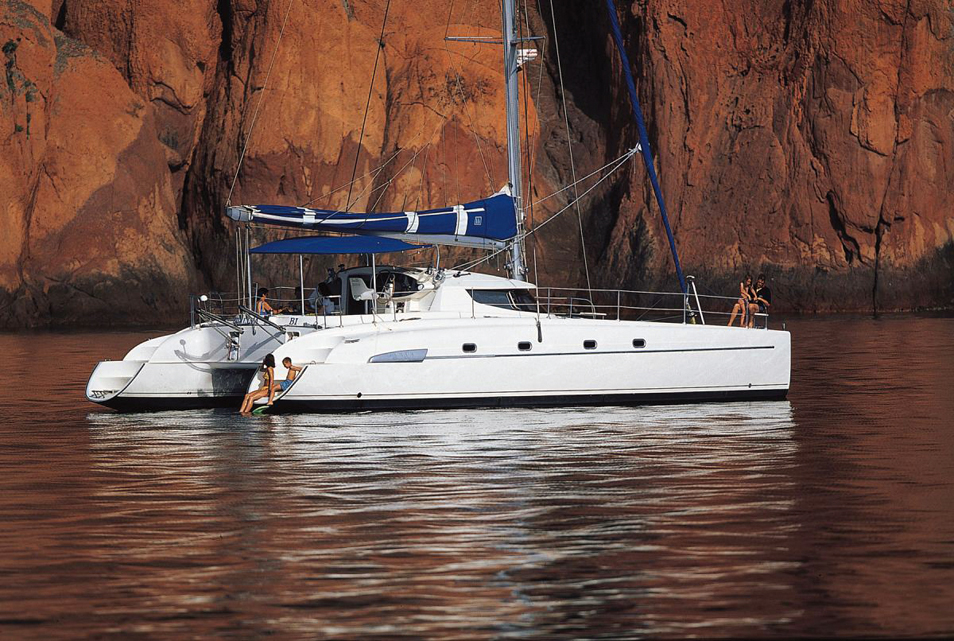
Simple and uncluttered, with a steering position on the back of the coachroof and control lines at the mastfoot, the Bahia 46 is as easy under sail as it is pleasant at anchor.
Deck plan: sober and effective.
Compared to the deck plan of the more recent boats, the Bahia can be distinguished by its relatively short cockpit and a limited coachroof footprint. Here there is no aft gangway, but nevertheless there is comfortable seating around a round table with folding leaves. It won’t necessarily be easy to seat the whole crew (at the table, in any case) in a fully laden version – ten to twelve people. The cockpit is protected from the sun and the elements on most models by a canvas bimini or a mixed canvas/polyester structure. The sugar scoops are rather huge and accessible thanks to steps – classic. The side decks and the forward part of the coachroof are flat and uncluttered, to give easy access to the bows. The one-piece trampoline is huge, as it represents almost a quarter of the whole area available. The slightly raised steering position adjoins the aft side of the coachroof. The helmsman’s field of view of the sails is sometimes reduced to zero, if the bimini is not equipped with a removable section. Note: although the halyards were at the mast foot on the first models, they were returned to the cockpit later. Similarly, the steering position to starboard, with the entrance and table to port developed into a central position, with an entrance to port and the table to starboard.
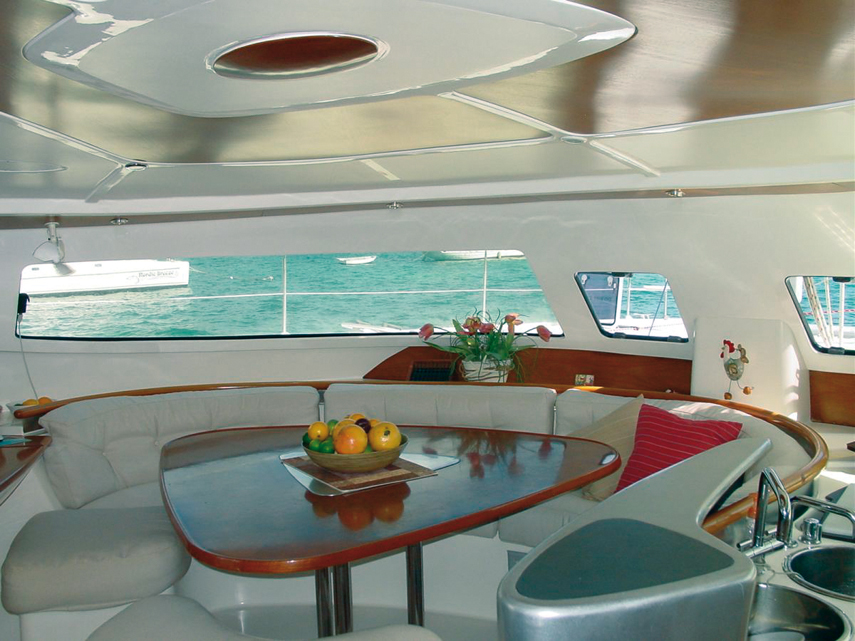
The nacelle sets the tone: the priority is light! The volume is to be found in the hulls. The charter version offers up to 10 berths.
More volume in the hulls than in the nacelle
You will without a doubt be surprised by the narrowness of the coachroof door, which is well below current standards...and by the moderate volume of the nacelle. Not as long, not as high, not as wide – it is nothing like that of a modern 45-footer. But we find the essentials, with a semi-circular saloon, and a U-shaped galley which is very practical at sea. On the other hand, the floor area is limited and the aft-facing chart table is clearly sacrificed.
However the hulls have an unheard of amount of volume for the time. As a result, there are four heads and as many double cabins in the charter version, which are more often than not supported by two singles in the gangway and two more in the forepeaks. The Bahia 46 was the first of Fountaine-Pajot’s models to offer a Private Owner’s version, which dedicates a whole hull to the owner – a formula which has since been a huge success. It is of course this version which attracts the attention of long-term cruisers, and they are right!
The Bahia 46 is thus an excellent support for a long-term voyage as a family. With 400 liters of diesel and 800 liters of water, it offers excellent self-sufficiency. Prefer the Private Owner’s version to the Charter, even though the former is harder to find: these boats have often aged better and benefit more often than not from an excellent level of equipment. The Bahia today remains perfectly topical, seaworthy, reliable and above all... accessible!
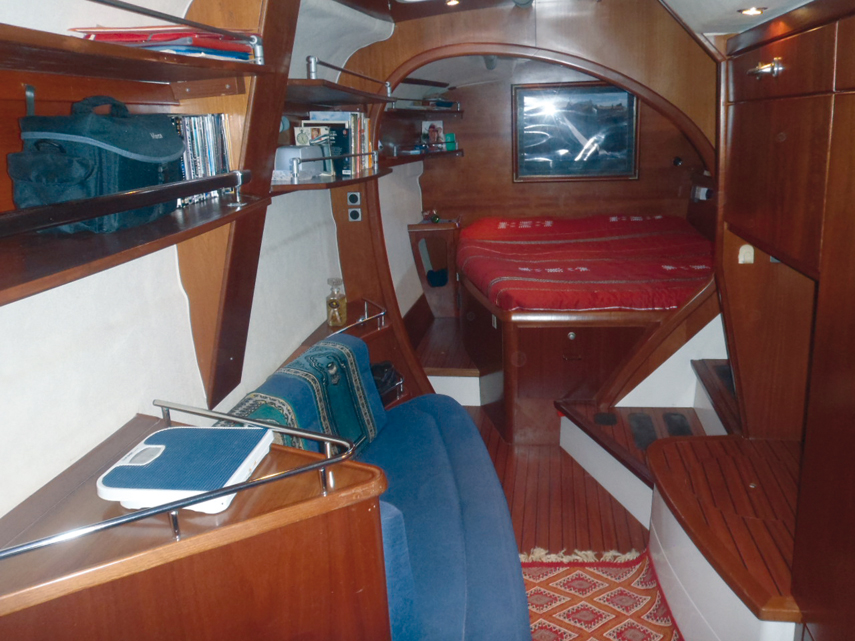
If you can find one, the Private Owner’s version will offer you top level accommodation!
The plusses
General robustness and good quality of the accommodation
Good performance in moderate conditions and above
Load-carrying capacity compatible with long-term cruising in comfort
The minuses
Sluggish in less than 10 knots of wind
Control lines not returned to cockpit on early models
Aft-facing chart table
The points to check
No flaws concerning the structure, the rig and its anchorages: the Bahia 46 is undeniably well-built, a quality which allows it to lend itself to long ocean crossings and a long-term voyage program. The only drawback is that most models have been used for charter and have covered thousands of miles. The points to check are therefore logically the parts which wear. Stainless steel cables, helm/rudder transmission, seacocks – and plumbing in general – engines and peripherals, jammers are all points to be checked closely before setting off.
Technical Specifications:
Hull length: 14m
Waterline length: 13.66m
Beam: 7.4m
Draft: 1.30m
Weight: 10.5 t
Windward sail area: 123 m2
Mainsail: 72 m2
Genoa: 51 m2
Cabins: 3 to 4
Engines: Inboard, 2 x 38 or 48hp
Material: polyester sandwich
Architect: Joubert/Nivelt
Design Olivier Flahault
Builder Fountaine Pajot
Production: 176 examples from 1996 to 2007
Second-hand price: from 170,000 euros exc. tax