
Two years after its successful launch and with 140 boats sold, the Bali 4.0 has transformed into version 4.1 (version 4.0 is still available). This innovative catamaran is taking a leap forward in interior design. The perceived quality is also progressing, but it’s the distribution of volume that is really evolving toward improving the quality of life on board. We took advantage of the launch of the first model to rediscover this very resourceful multihull.
Infos pratiques
- Le chantier : Bali 4.1
- La fiche technique
- Découvrez notre vidéo exclusive
- Financez votre Bali 4.1
- Assuez votre Bali 4.1
- Articles autour du Bali 4.1
An inspired design showing off innovative architecture
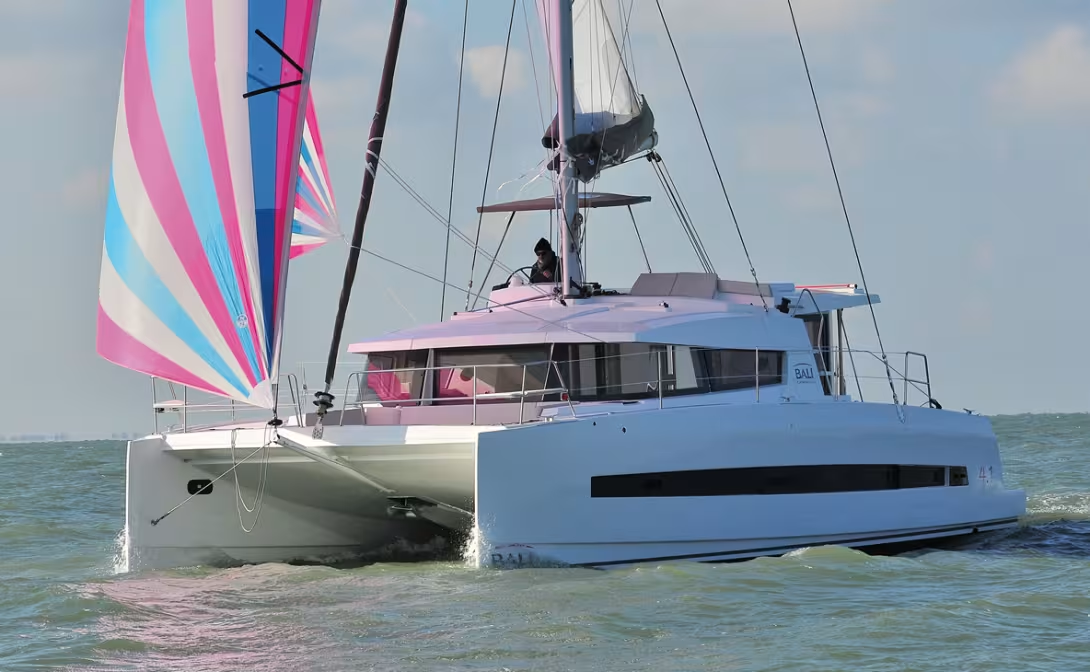
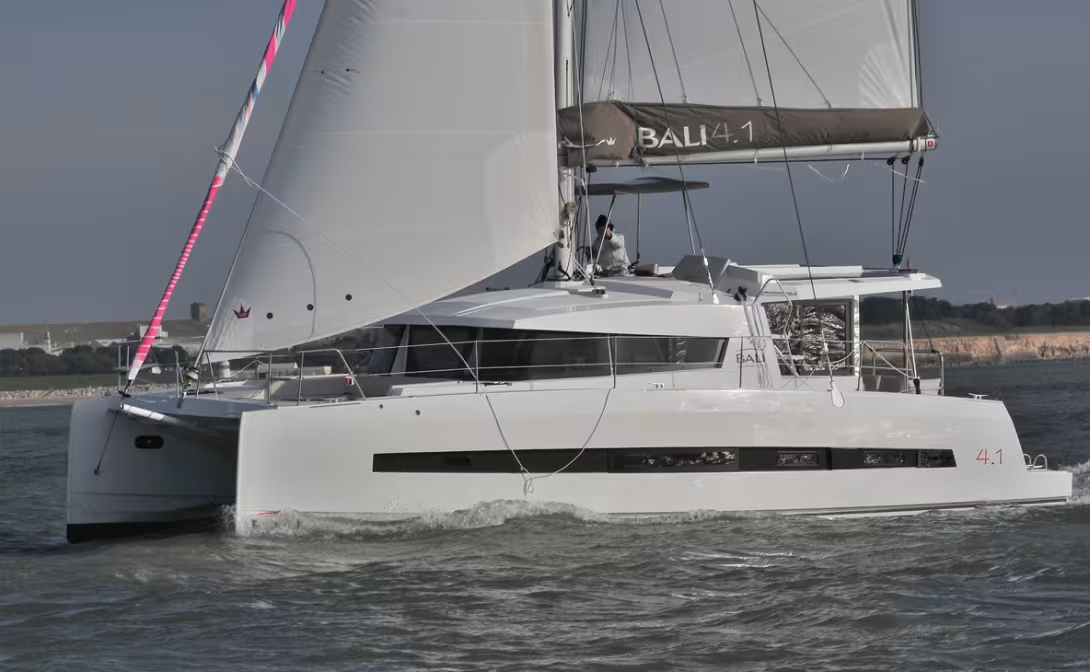
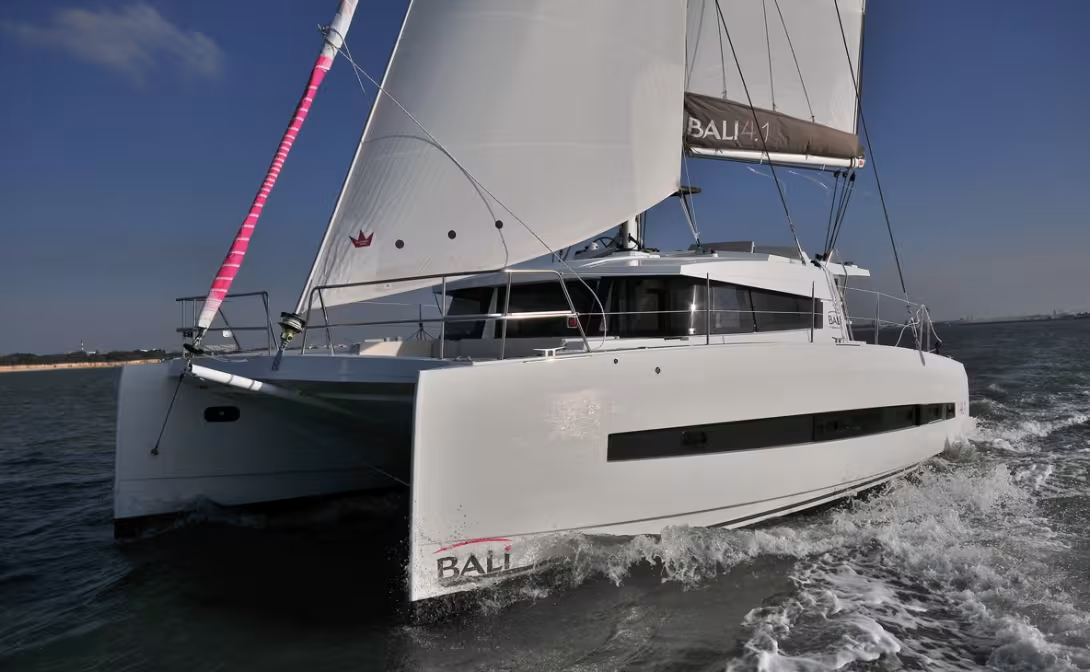
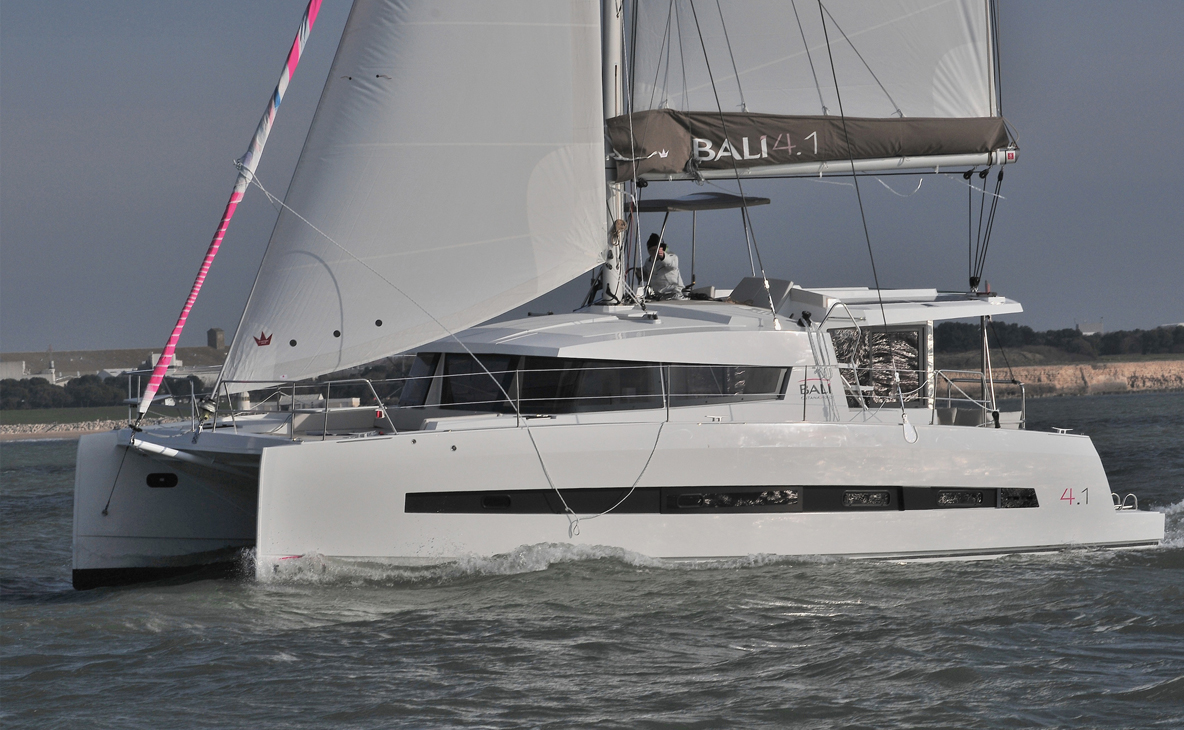
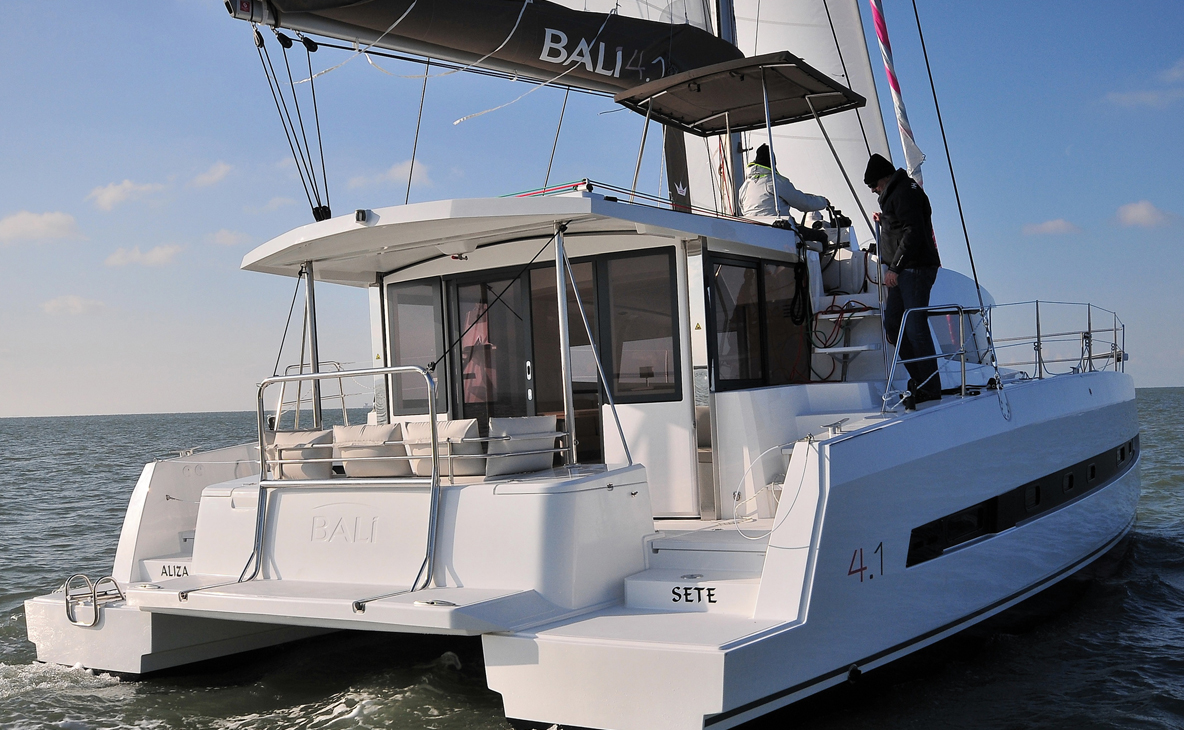
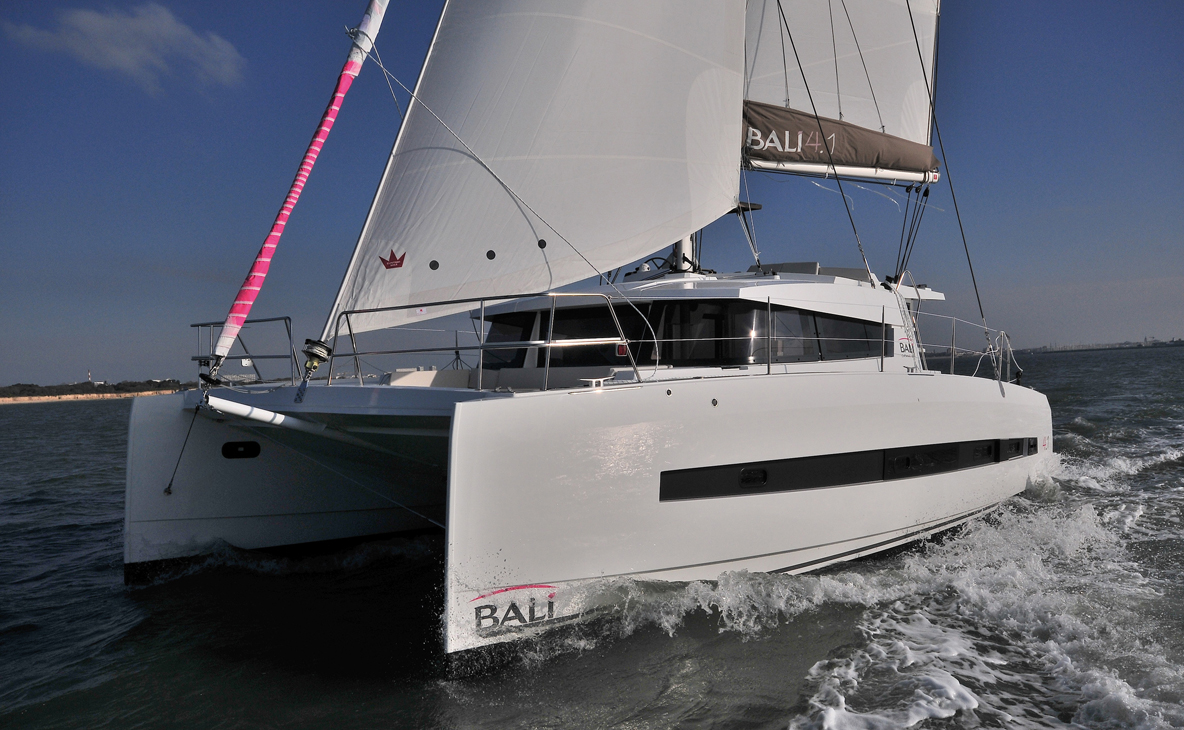
Viewed from ahead, the profile is neat, with attractive lines. The shape of the windshield is skillful, the upper edge clearly stands out, and extends forward with a protective “eyelid” to give a signature look to the Bali 4.1’s coachroof. This identifying feature is a success. The visual perception of the after end of the boat and the cubic form of the deck saloon is harsher, but it is functional. At the waterline, the bows are fine-entry, overhung with a nice deflecting step which creates volume and attenuates the uprightness of the freeboard. The topsides are skillfully underlined by a ridge below the deck edge, and a longitudinal recess integrates the portholes and characterizes the style. The top of the bow is subtly broken by a short inverted edge. The big accomplishment here lies in the deft design of the ski-shape, forward, and the tunnel-effect which this generates. Experience gained from the different Balis has shown any concerns initially raised over this bold option to be invalid: a recent transat from Cape Verde to the Caribbean by a Bali 4.5 at an average of 8.96 kts over 2,475 miles confirms the dynamic qualities of the concept (our test 4.1 has just completed a trip around Spain, from La Rochelle to Canet en Roussillon in 13 days). The semi-flybridge helm station is comfortable, with an elegant steering wheel; the change of engines (Volvo instead of Nanni) has allowed for the very exposed ignition keys to be done away with.
Quality construction
The factory at Marans, on France’s Atlantic coast is a modern industrial site built to house the Harmony Monohulls automated assembly line. There is a composite preparation room in which the organization of work is exemplary. Every element (foam or glass cloth) is coded; the installation is carried out calmly and carefully in order, in the absence of noise and smell: essential conditions for successful production! The molds are made in-house, by a magnificent 5-axis CNC milling machine. During our visit to the yard in 2016, we were able to observe every stage of construction from lay-up of the hull, to the installation of technical equipment. Once the composite phase is infused, the outer half-hulls are brought together and their jointing faces carefully bonded by lamination. The skegs are then grafted onto a male protrusion from the hulls - this technique creates a fuse effect in the event of a major shock load, avoiding structural damage and water ingress. Balis are not simple boats to build even if they do benefit from the significant contribution of digital modeling. The two main bulkheads are produced in sandwich molds and placed forward and aft of a central frame attached to the bottom of the hull (this supports mast compression). This “box” is integral with the bulkheads, forming a very robust structural H-shape. The forward ski-shaped section benefits from reinforced composite samplings stiffened by a network of resin-impregnated plywood bulkheads and generously glued by filleted joints. Assembly precision, density of reinforcements and the care taken in all the joins guarantees solidity. An anti-osmosis polyester resin is used for the underwater hull.
A transformation inside the nacelle
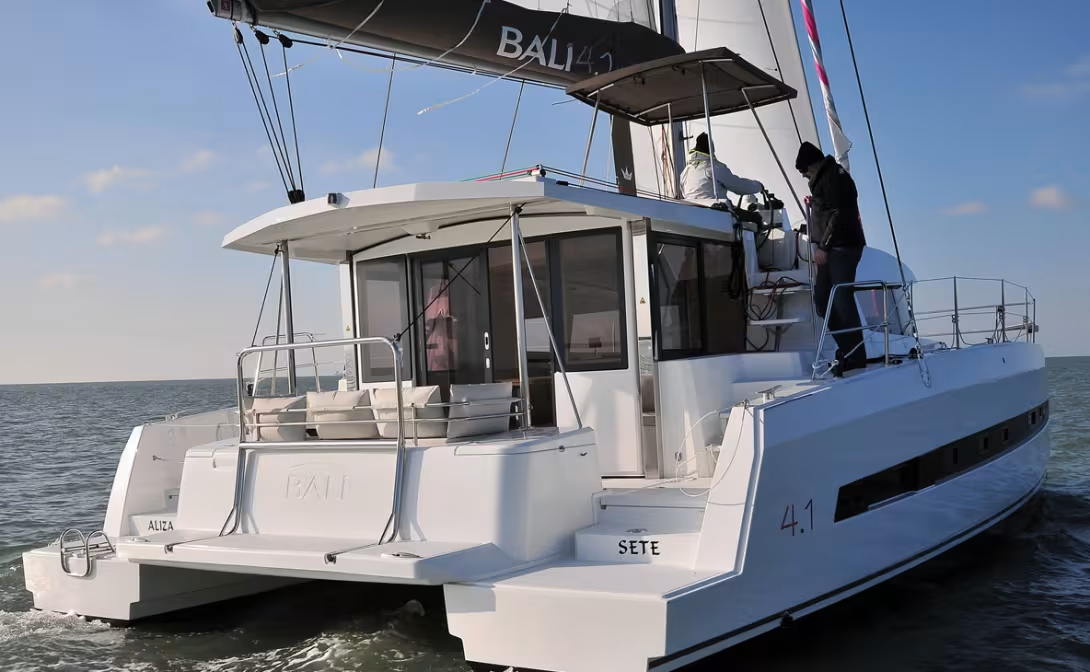
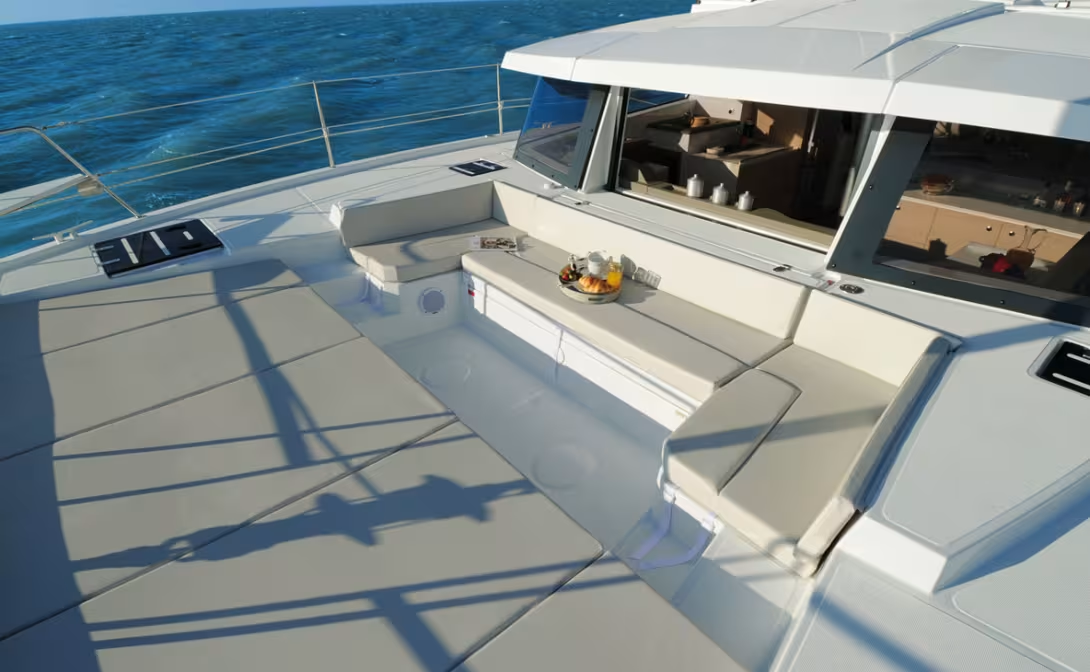
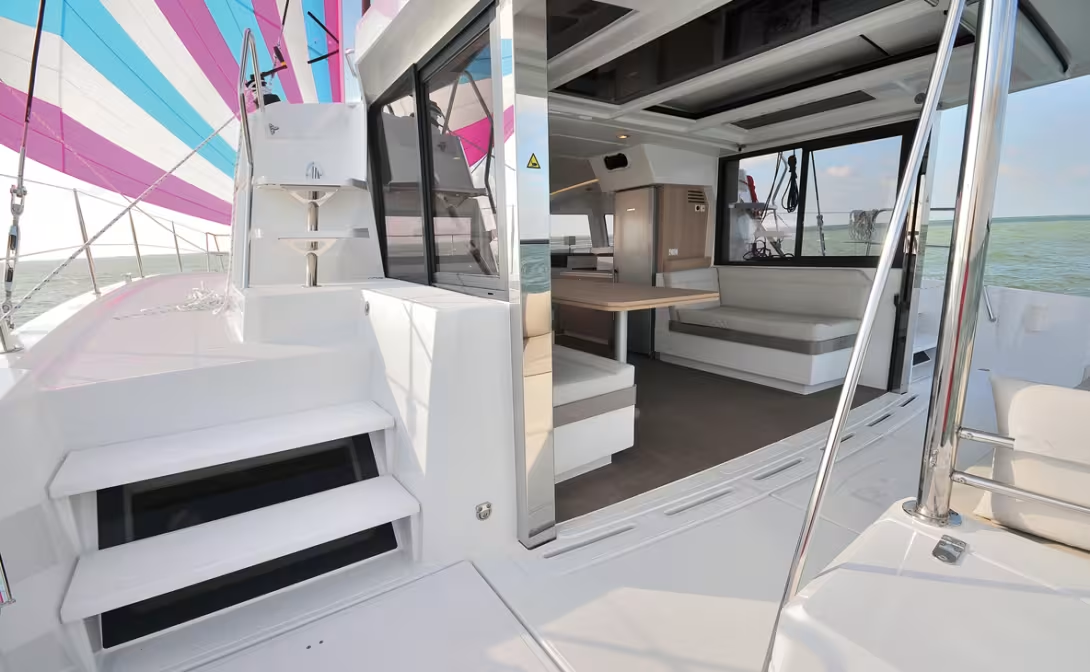
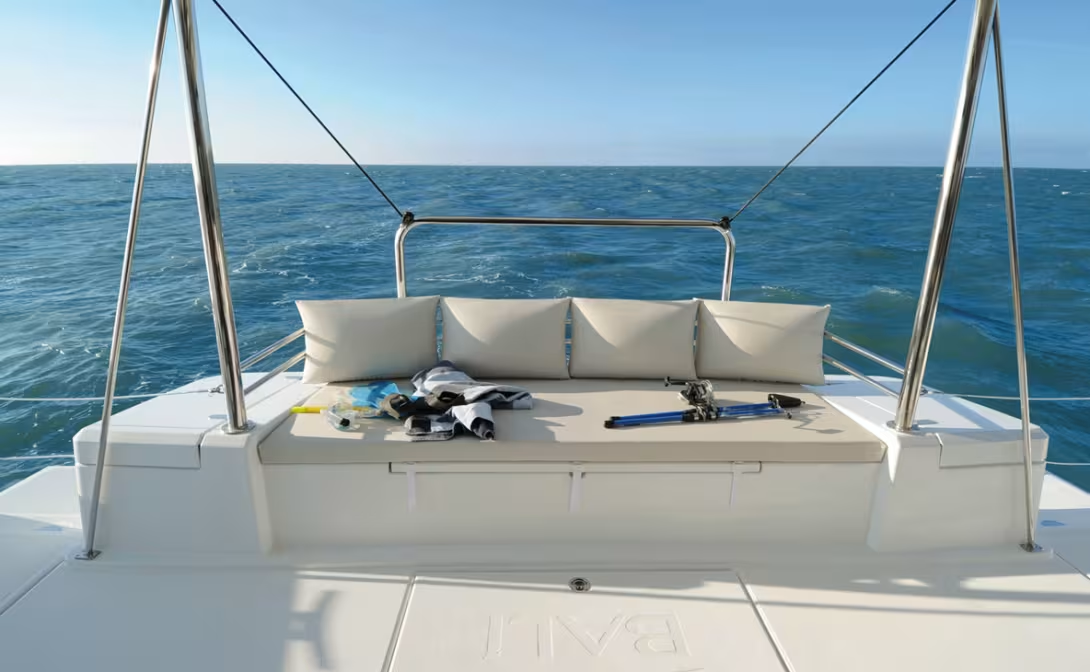
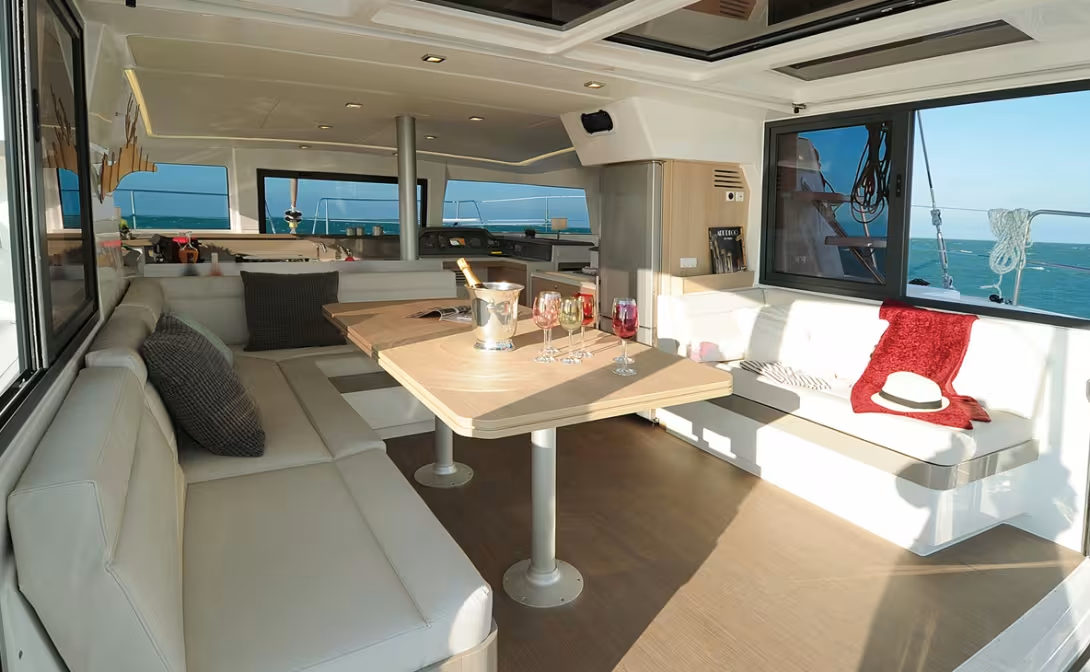
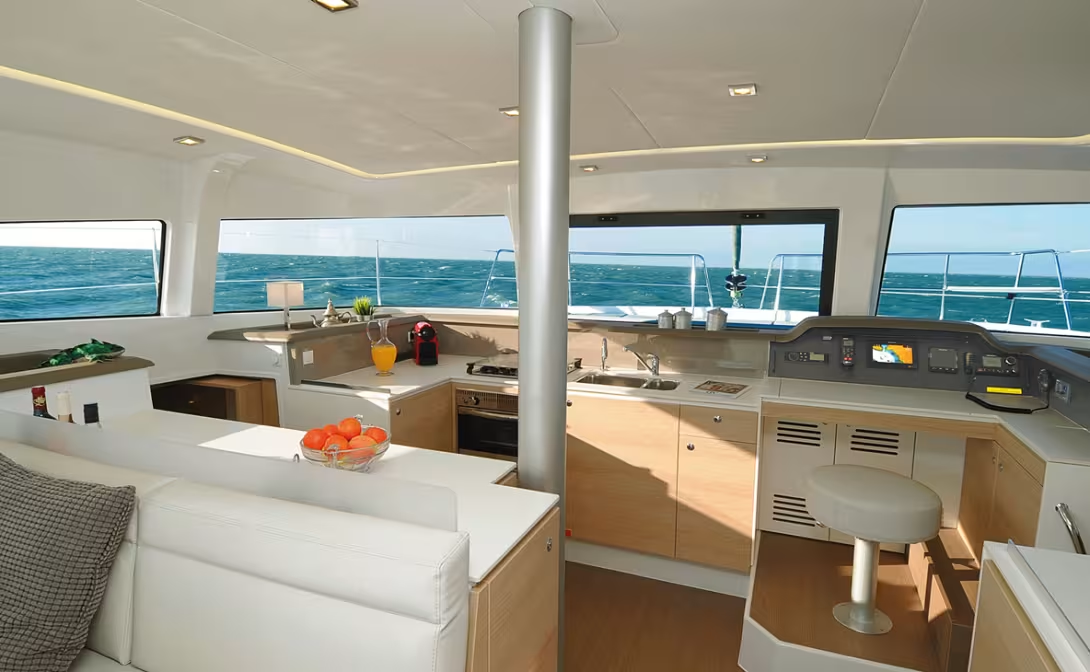
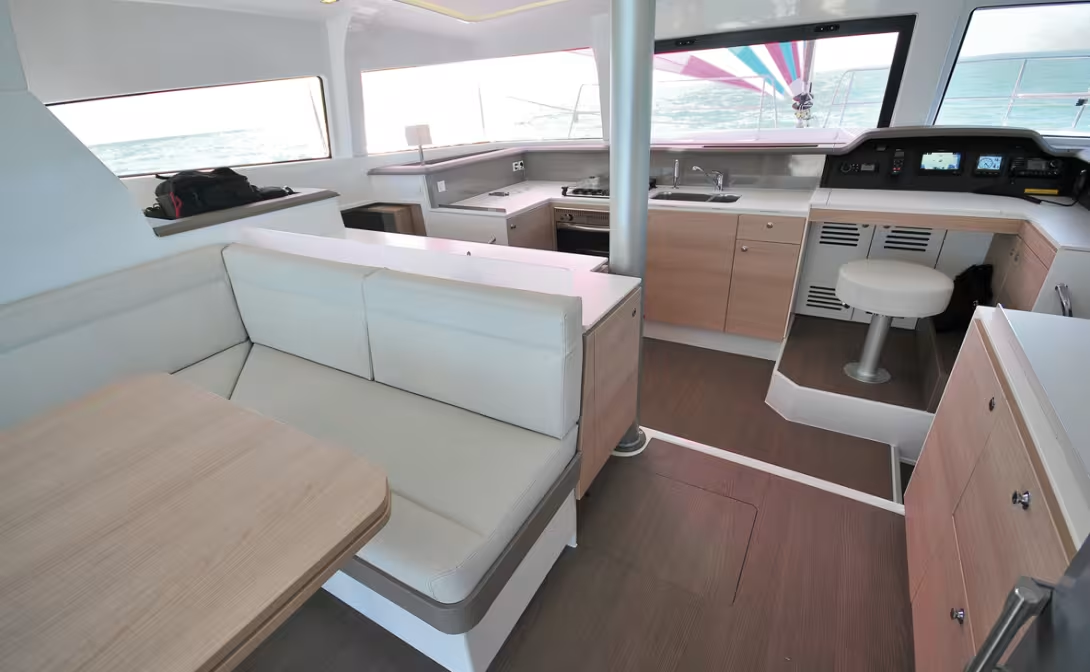
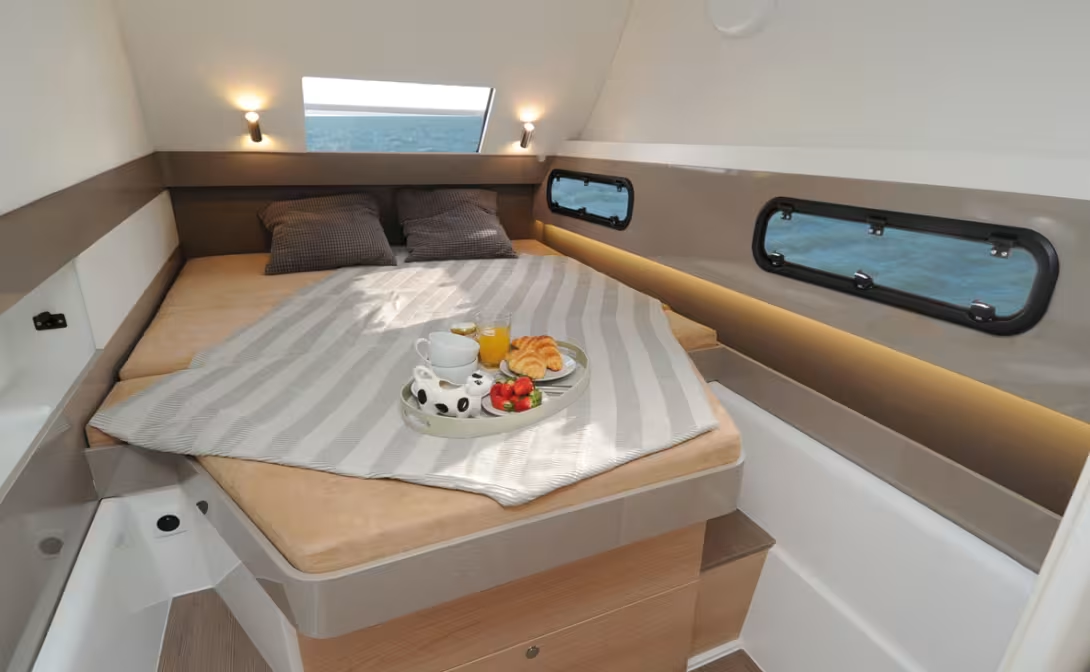
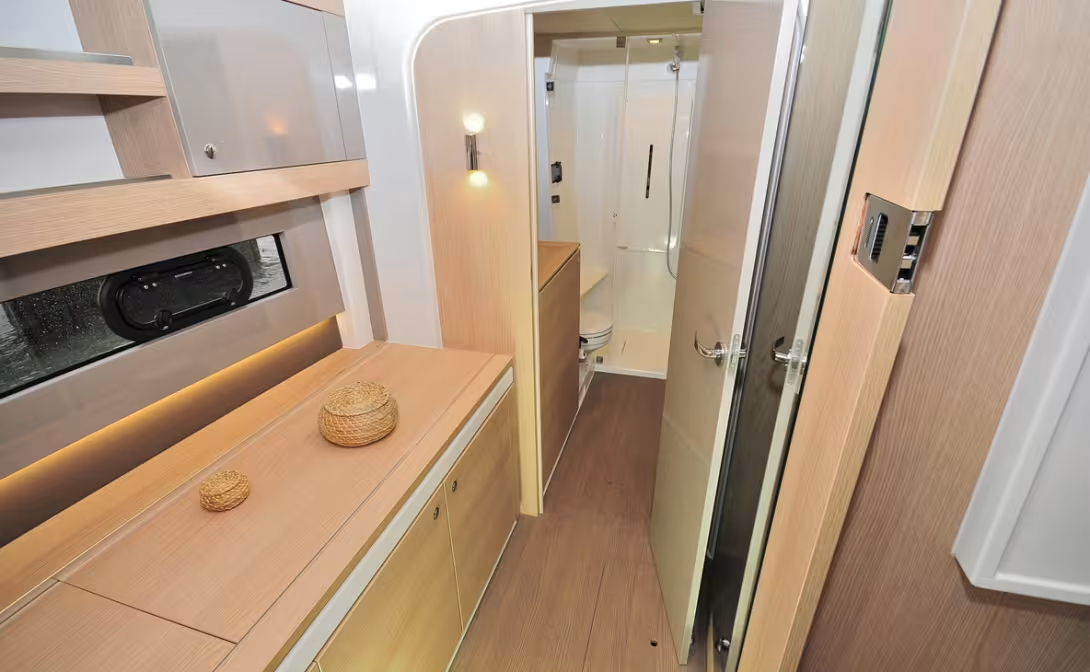
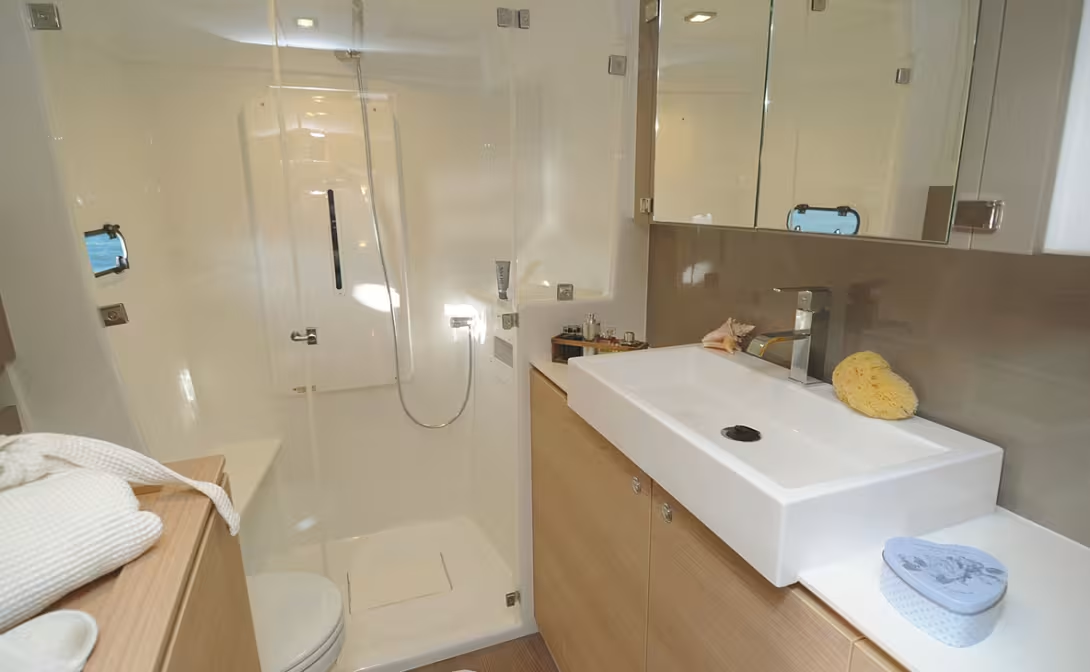
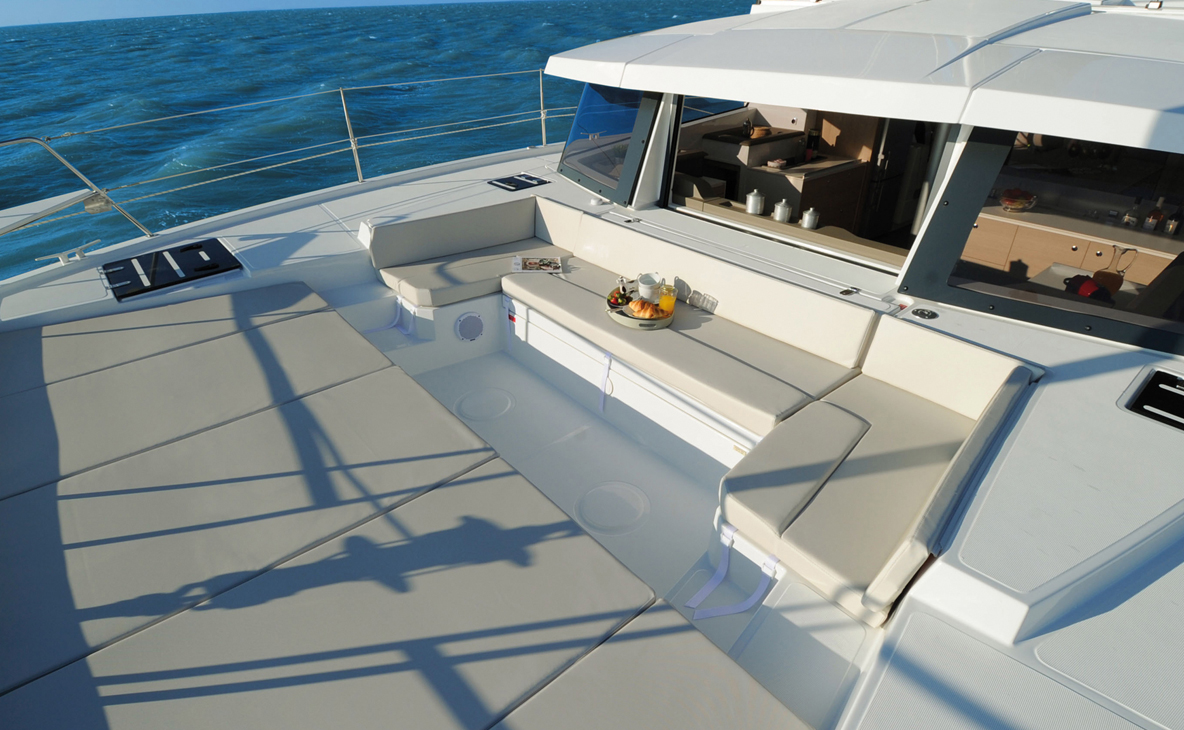
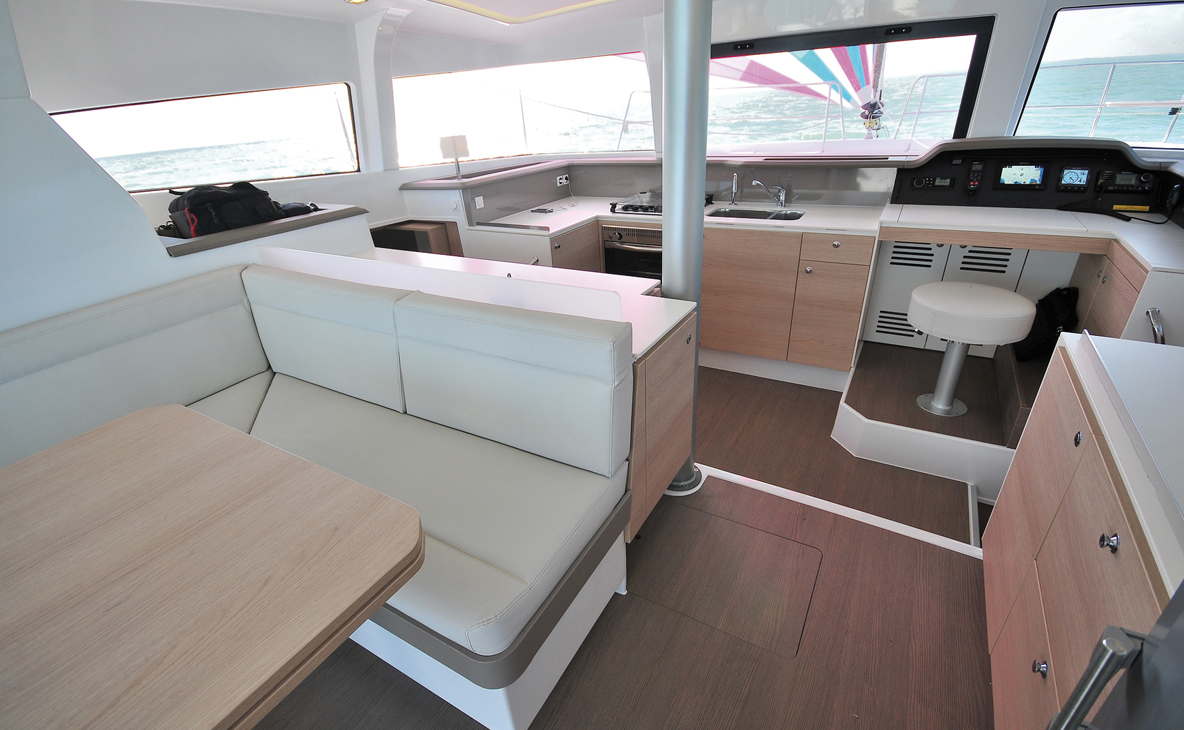
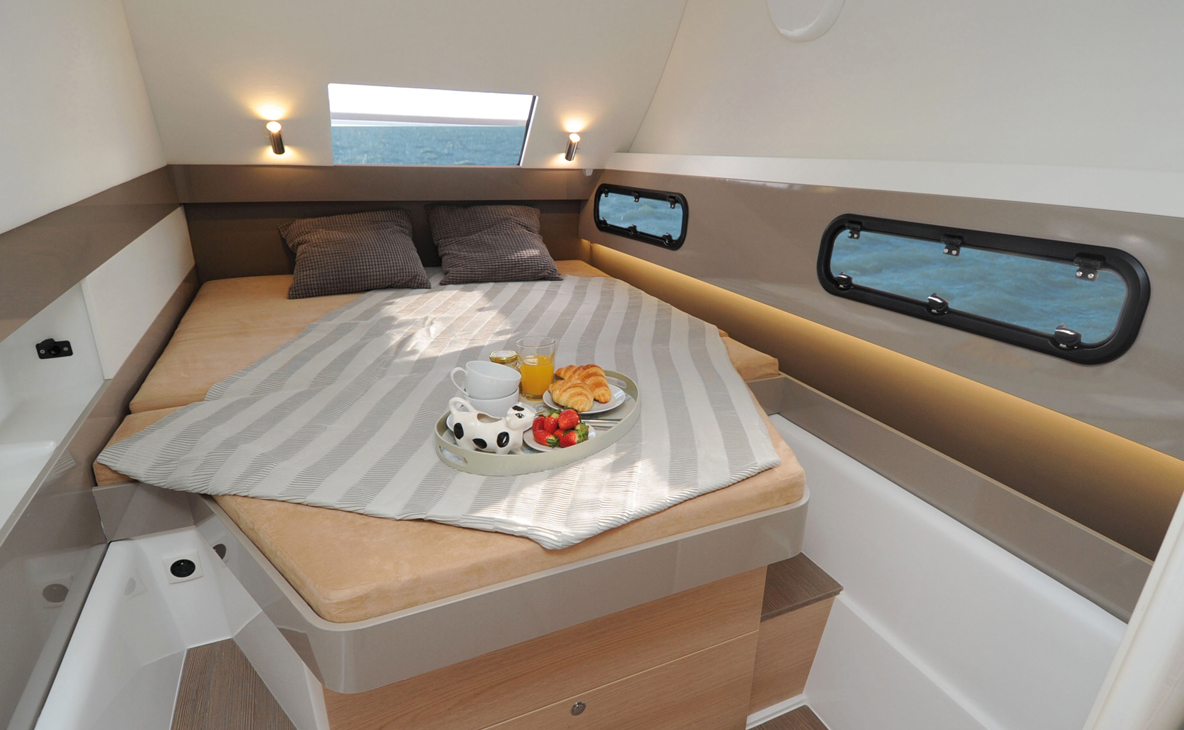
With the 4.0, we discovered amazing volumes and an innovative nacelle layout with a large opening front window (a Plexiglas panel sliding vertically with 3 stop positions, which is easy to handle) whose efficiency, combined with that of the moveable bulkhead aft (the boat’s other innovation), makes any air conditioning unnecessary. This setup “de-compartmentalizes” communication with the front of the boat while the opening side windows and the elimination of an aft door produce a real transformable, "semi-open" cat! The dining area is in a wide L-shape around a large table for eight guests, making it completely different from that of its predecessor and the installation of a multi-purpose bar unit really optimizes the use of the galley. In good weather, the aft bulkhead can be retracted, making the 4.1 feel like a bigger boat while remaining compact and easy to use. The forward cockpit becomes a furnished terrace capable of welcoming many guests. The side-decks and their access steps are safe and pleasant. On the port side, an independent staircase allows access to get to the sun-lounger on the bimini without getting in the way of sail handling or helming. The new aft seat is superb and comfortable thanks to its smart design and elegant, quality upholstery: the 3 built-in lockers offer an XXL-sized storage space which is suitable for fenders, mooring warps, outboard engines and diving equipment. The creative modularity of the Bali allows you to adapt to all the external conditions (cold or excessively hot conditions, or spray coming over). The pertinent interior design, by Samer Lasta, and the build quality of internal components (Catana cabinetry) are of a very high standard. In the owner’s version, the port hull offers a beautiful cozy space, and the use of contemporary materials and the care taken with the finishes creates a clear, comfortable and functional atmosphere. The two double cabins to starboard, separated by the shower/toilet are large and private, and only the traffic between the central corridor and the aft cabin is a little cramped when in use. The battery bank is housed in the center of the boat, beneath the saloon floor, and access to the 3 main circuit breakers is just perfect.
Powerful motors and a great layout for maintenance
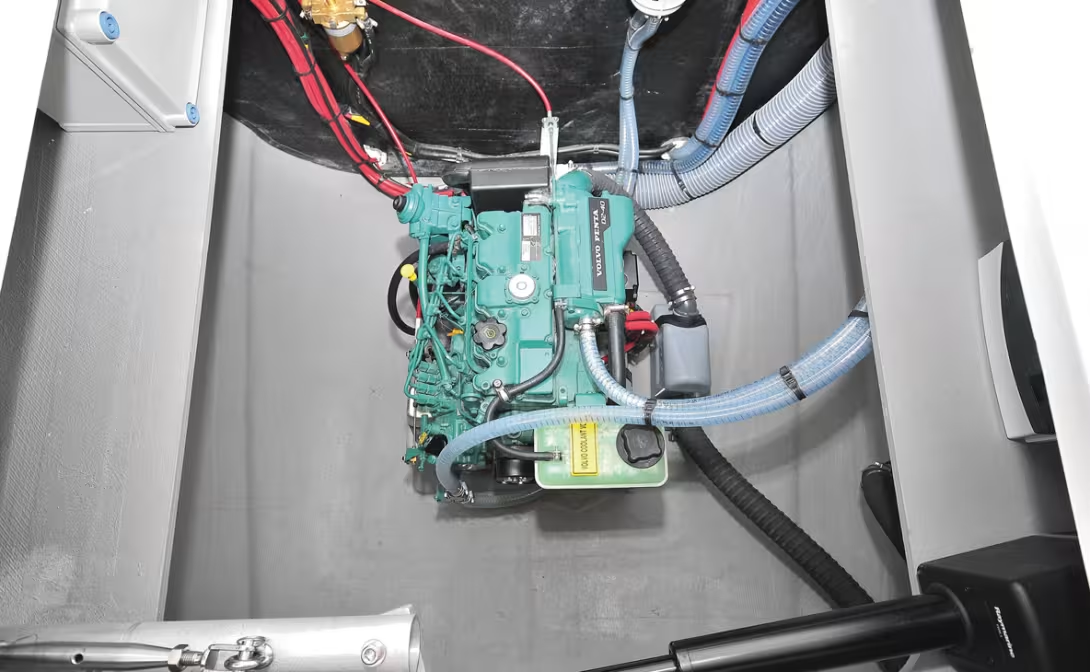
The current trend is to move all the machinery aft, but some engines can quickly become insufficient on these sizes of boats. On the Bali 4.1, it is exceptional: the compactness of the 40 hp Volvo engines does the rest, and it is possible to go around the whole motor and really work without contorting yourself. With all engines, accessibility is a guarantee of smooth operation, optimized maintenance and easy visual checks, and therefore reliability! A large shelf makes it possible to secure optional accessories or provide space for stowage of consumables. Access to the rudder linkage bar, to the turning blocks and to the autopilot is excellent, with these vital parts also benefitting from simple but regular maintenance.
A spacious and lively catamaran
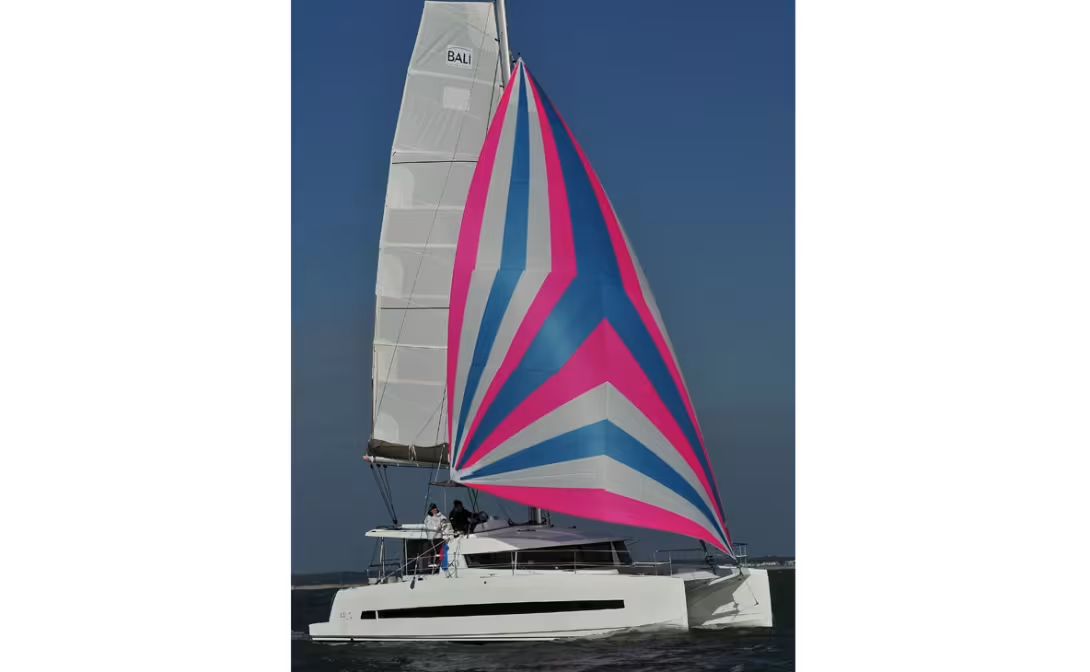
It is cold in February on the waters off La Rochelle on France’s Atlantic coast. There was even snow falling the day before our test! Paradoxically, these tough conditions offer different sensations and make it possible to get an understanding of the sailing and of the boat itself from a different perspective. The two days spent on board highlight the good adaptability of the “Maxi-Lounge” concept: the modularity of the spaces, openness to the outside, through-light and panoramic vision clearly target summer use, yet these characteristics combined with the insulating qualities of the sandwich construction also lend the boat to less conventional all-season use. A multihull for discovering the charms of winter sailing perhaps? A small forced air heater would help to convince you perhaps. The shots taken outside confirm the Bali 4.1’s good turn of speed: in 12 kts of wind at 100 ° to the apparent (under Elvström main and solent), this catamaran shows its agility. The neat bow wave underlines the dynamism and the fact that the boat is at ease. Under asymmetric spinnaker, it slides along between 9 and 10 kts in 15 kts true, and our camera boat needed to apply the gas to keep up! On board, all the external upholstery is in place, but we were able to stow it away, avoiding having to dry it off! There is no spray despite tacking upwind a dozen times to get ourselves back to the Ile d’Aix. At the helm, I find the direct feel of the cable transmission, and the nice composite steering wheel pleasant to use, whether sitting or standing.
The semi-flybridge layout does away with the uncomfortable sensation of being excessively elevated and the boat's balance amplifies this favorable feeling. Under asymmetric spinnaker (by North Sails), the catamaran really comes alive, is easy to handle, and swift: 10.2 kts top speed in 15 kts true with the sails filled (helped by folding propellers)! Great performance for a multihull of reasonable size which is more oriented to comfort than sport. A quick overview shows an average of 7.2kts over 25 miles mixing 1/3 of sailing under spinnaker and 2/3 upwind under main and solent. Not that impressive, but very honorable! The quality of the deck hardware (Antal-Rutgerson) allows fluid and easy sail maneuvers. Particularly good is the versatility of the large Rutgerson traveller car, one of the best in its class and fundamental on a catamaran. En route under spinnaker, we tried opening the aft bulkhead: the kinematics have been optimized (2 small gas struts assist the final closing). The operating accuracy is remarkable, without any sticking points. This clever arrangement, combined with the design of the "small aft-house", the lateral openings (seen only on a few rare models: TAG 60, MC52) characterize the Bali 4.1 and allow users, owners or charterers to enjoy the benefits. Back on the dock, we tried out launching and retrieval of the dinghy: hats off to the design team, who clearly know how to combine simplicity and efficiency. Coupled with the electric winch at the helm station, this process is absolutely remarkable.
Conclusion
This restyled evolution allows the 4.1 to express its full potential. The build quality is excellent, and the renewed design amplifies the seductive atmosphere. The Bali 4.1 remains alive, enjoyable to sail, simple to handle, and the innovations seen on board are both relevant and very well implemented.
Technical specifications
Shipyard: Catana
Naval Architect: Xavier Faÿ
Designers: Olivier Poncin and Yves Chabaud
Interior Design: Lasta Design
Construction: Foam/glass/polyester sandwich in infusion
Length: 12.35m
Beam: 6.72m
Displacement: lightship 8.9t / laden 11.8t
Mast height: 17.85m
Upwind sail area: 81m²
Mainsail: 48m² or 50m² (squared-topped)
Self-tacking solent: 33m²
Motors: 2x20 / 2x40hp Volvo
Fresh water: 800l
Fuel: 400l
Price in Euros ex-tax: 294,800 (3 cabin version) / 297,800 in 4 cabin, 4 bathroom version
Excellence Pack (essential equipment): 35,800
Square-topped mainsail: 3,980
Hydranet solent: 2,790
Code 0 (with deck hardware and bowsprit): 10,230
2 Yanmar 45hp motors: 8,345
Folding three-bladed propellers: 3,045
Carpeting in saloon and cabins: 1,920
Raymarine electronics pack with autopilot: 13,770
Launch at La Rochelle and 1-day handover: 8,980
Outdoor upholstery: 3,710
Additional electric winch: 2,140
PLUSES
Dynamic qualities
Very enjoyable to helm
Incredible natural ventilation
Notable modularity of the various spaces and appropriate new saloon layout
Space in the engine compartments and battery bank
MINUSES
Positioning of the solent sheet winch could be improved
Helm station bimini aesthetics
Lots of upholstery to stow
Glazed components difficult to replace
Heavy appearance when viewed from aft
THE ESSENTIALS
Successful new saloon layout (dining area, bar, aft bench seat)
Comfortable to use and good performance
The competition
|
Model |
Builder |
Upwind sail area in m² |
Weight in T |
Basic price in € or $ ex-tax |
|
Lagoon 40 |
Lagoon |
81 |
10.8 |
256,000 |
|
Lucia 40 |
Fountaine Pajot |
94 |
9.1 |
274,000 |
|
Leopard 40 |
Robertson & Caine |
96 |
9.4 |
289,000 |
|
Nautitech 40 |
Nautitech Bavaria |
92 |
7.8 |
272,000 |
|
Seawind 1260 |
Seawind |
90 |
8.2 |
$410,000 |
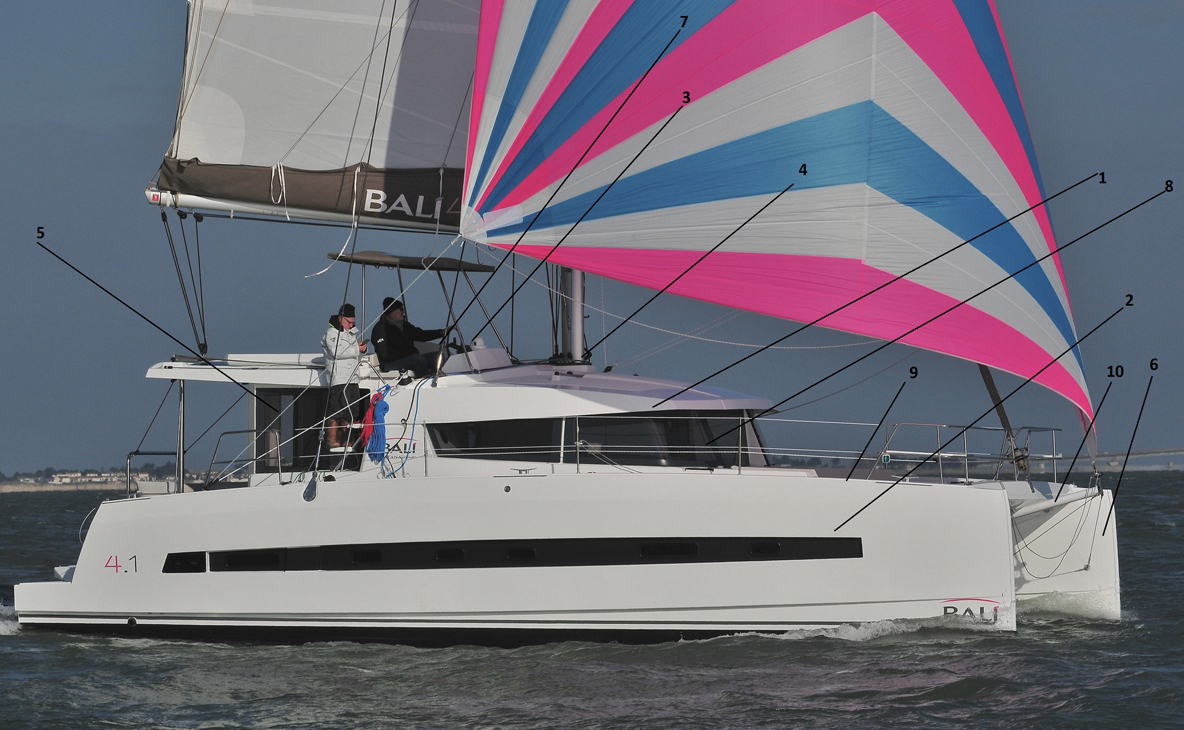
1: Coachroof styling is successful, with the clever extension of the cap-type visor
2: The design elements of the outboard hull (proportions, upper rib, longitudinal recess, and step) are well-managed and highlight the appearance of the 4.1
3: The comfortable lounger (with shaped back) is accessible by a separate staircase, adjacent to the cockpit offering great conviviality
4: The mast step is set well aft (the mast support strut is in the middle of the coachroof). This trendy sail plan perfectly suits the program of the boat and offers satisfactory performance and a good balance under sail
5: The 4.1’s saloon can be fully “de-compartmentalized” by opening the forward sliding door, retracting the aft bulkhead and opening of side windows! Open or closed, the Maxi Lounge concept offers amazing comfort. The cockpit bench-seat is particularly comfortable. The davit system for the dinghy is remarkable.
6: The bows are fine-entry, and overhung with an elegant and efficient step (serving as a spray limiter, volume enhancer and stiffener)
7: The semi-flybridge helm station is pleasant to use and the visibility is panoramic. The feel of the helm (mechanical transmission) is one of the boat’s strong points.
8: Inside, the Samer Lasta design and the high-quality Catana joinery create an attractive atmosphere. Congratulations are due for the bar-serving module and the new dining area
9: After provoking some controversy, the forward cockpit comes into its own with the 4.1
10: The base for the bowsprit allows a sound mechanical fixation for a spar which can be subjected to significant loads. The lead for the ground tackle and the windlass installation are well thought-out and produced (no piling-up of the chain).
