It’s been five years since the Bali range began to make a name for itself, with the Bali 4.5. The DNA of the brand remains unchanged: maximum volume and pleasure, ease of use, disappearance of the internal/external boundary on demand... As for the new models, they follow each other tightly in a row, with 2 to 4 a year! The 4.2 is replacing the 4.3 and the 4.5. And its finish is much more polished than its predecessors.
Infos pratiques
- Le chantier : Bali 4.2
- La fiche technique
-
 Découvrez notre vidéo exclusive
- Financez votre Bali 4.2
- Assuez votre Bali 4.2
- Articles autour du Bali 4.2
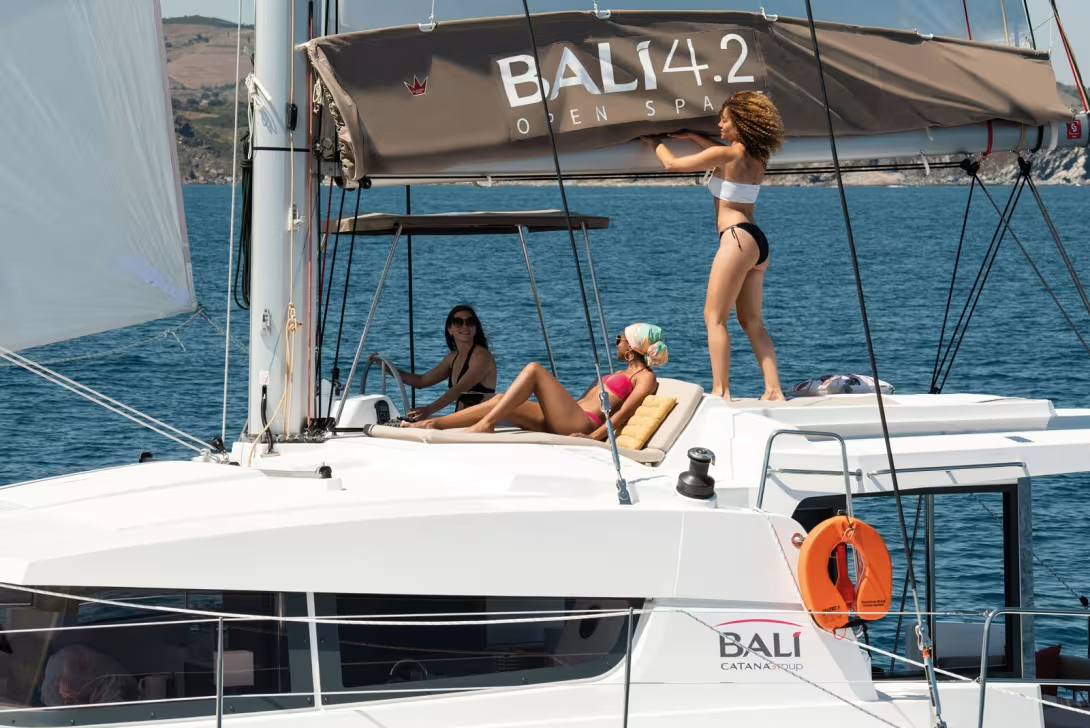
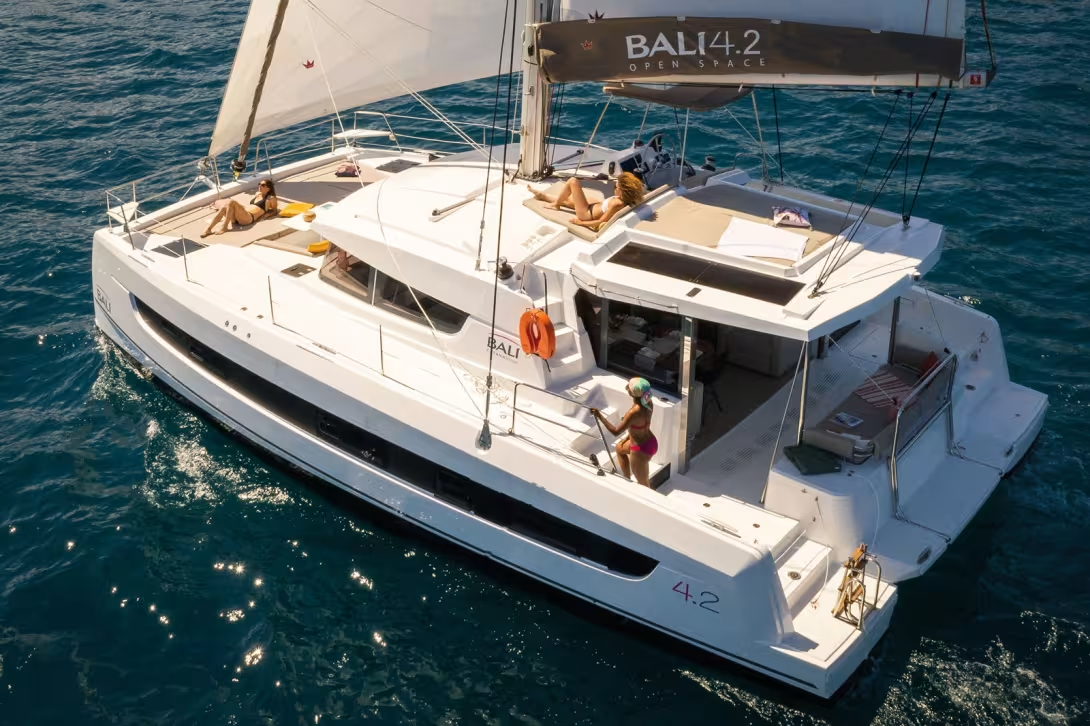
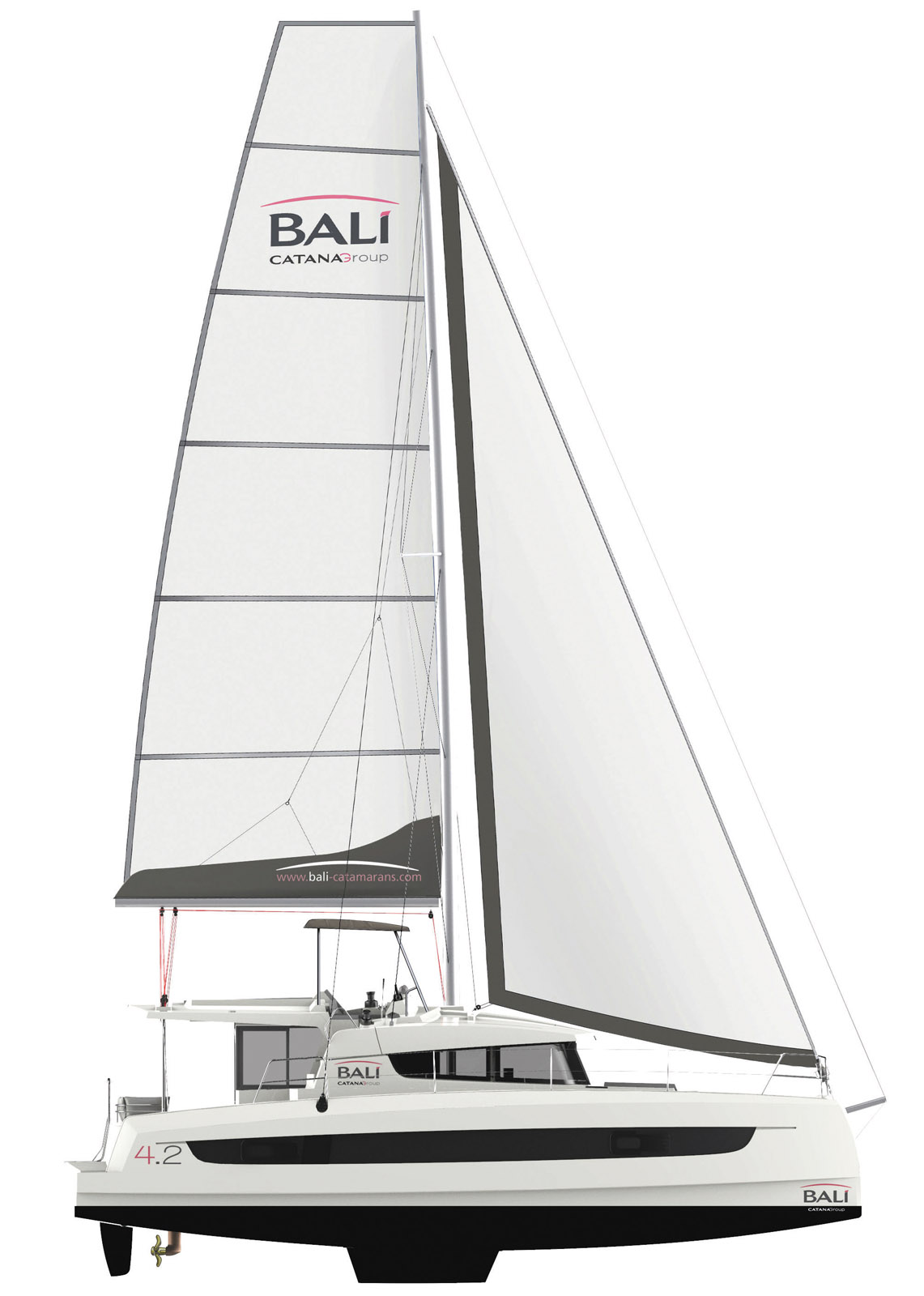
In terms of overall design, there have been few changes to the coachroof: the nacelle is still topped by a large roof overhang. The hulls have numerous openings integrated into a black reveal - note the double function of longitudinal reinforcement and rain shield. The hulls feature bows that are stubby and inverted. If you find that the different Balis all look a little too similar to be easily identified, you should be able to recognize the new 4.2 every time: it is - for the moment - the only model in the range with a spreader-less rig. The aluminum mast is slightly bigger in fore-and-aft section to ensure optimum stiffness with a pair of cap-shrouds and lowers. This formula has the advantage, at comparable weight and cost, of simplifying the setting-up of the standing rigging and improving aerodynamics. Some might suggest that the windage of a Bali is large enough that airflow through the rig might not make much difference... well, it does! This detail shows the extreme care that has been taken during the development of each model. Another common misconception is that the Bali is only of interest to charterers. Not true! The last few months of the pandemic have put a stop to many orders from professionals, to be replaced by private individuals - these now account for 60% of orders.
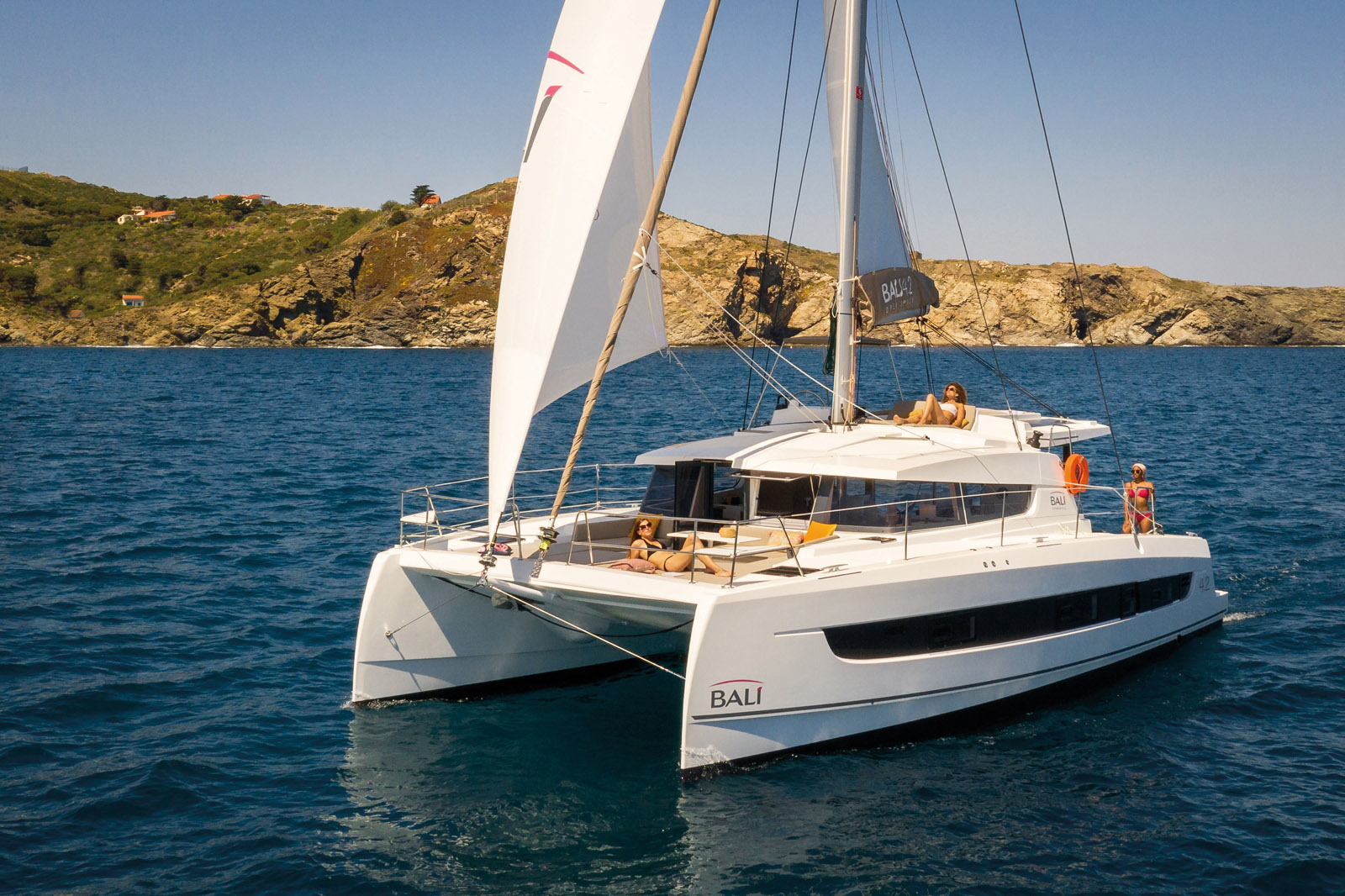
The Bali 4.2 is above all a platform dedicated to comfort. However, the bows are narrow and there’s good bridgedeck clearance.
Maximum deck space
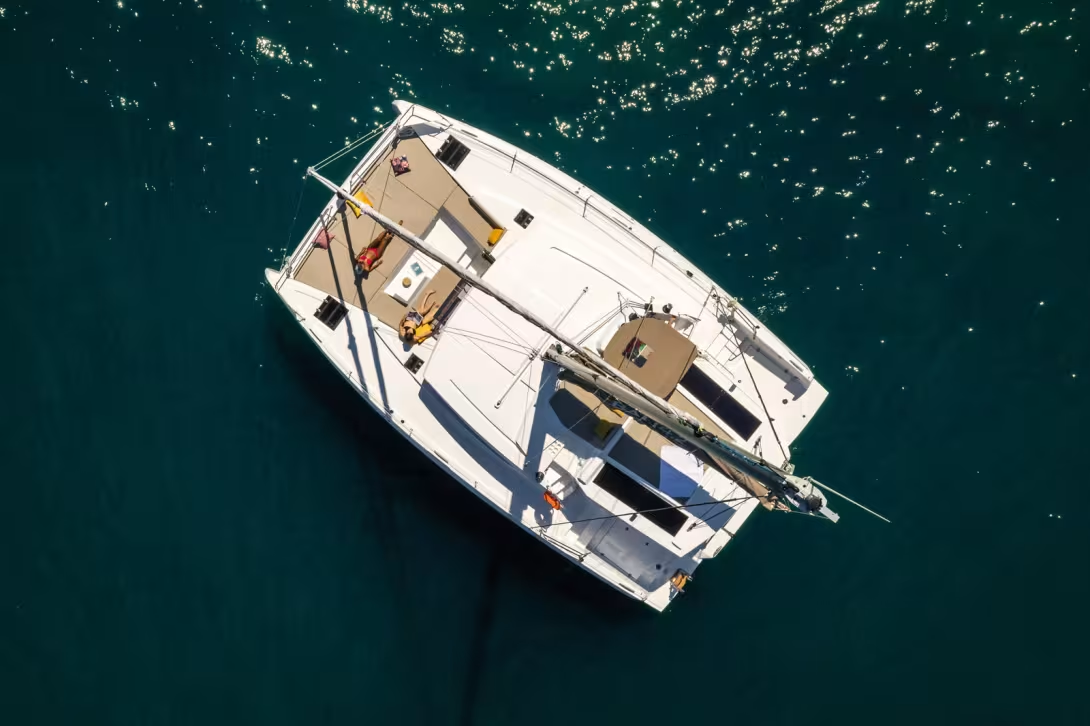
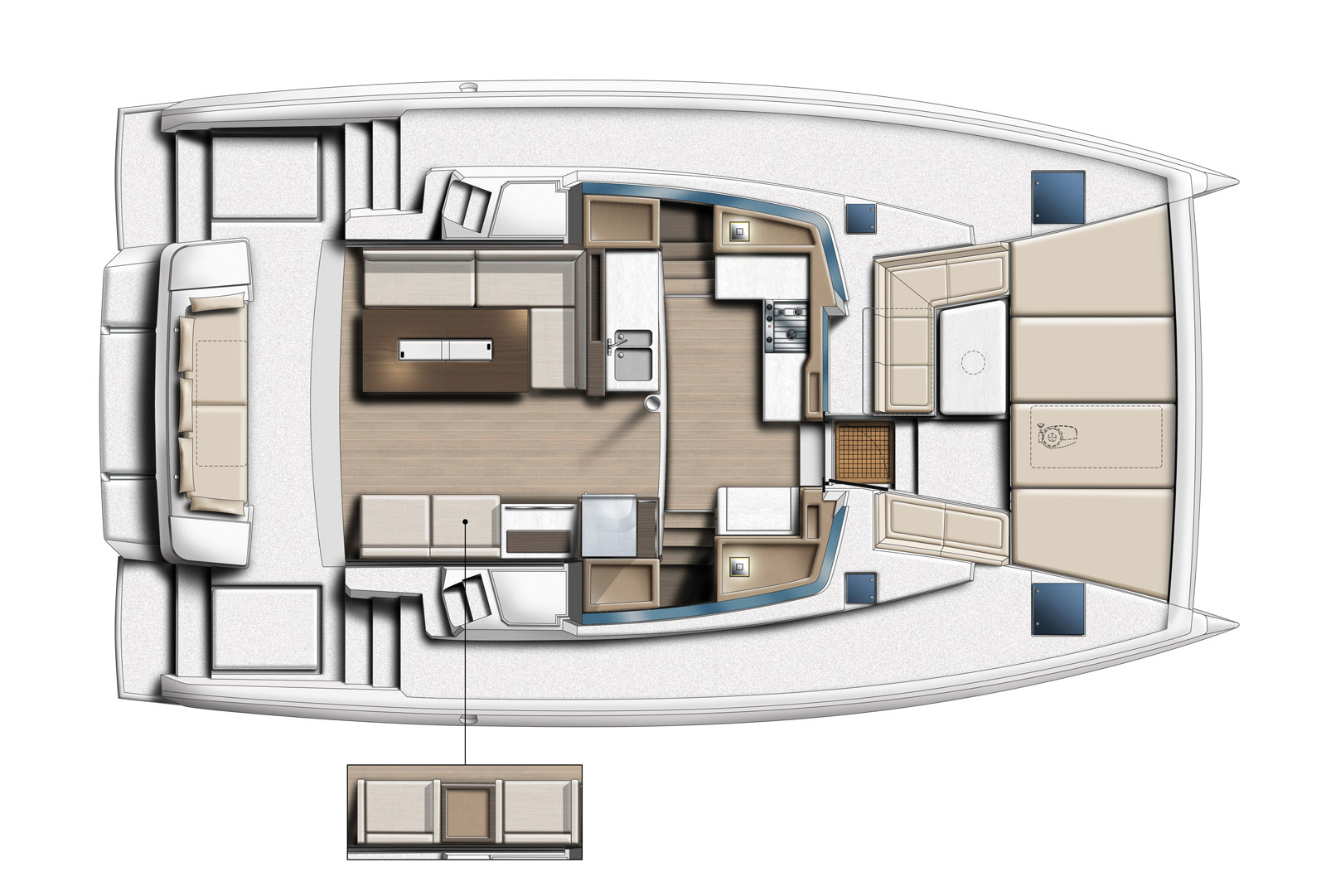
It is tricky to explain the aft cockpit as it’s really an integrated part of the nacelle: the famous “Bali door” measuring 11‘ (3.34 m) in width by 7’2” (2.18 m) in height opens up or closes off the living space on demand, depending on the conditions of the moment. In closed mode, there is of course enough room to move around outside and even enjoy the bench seat - all the available space between the two hulls is decked. A standard door, 5’10” (1.77 m) tall 2’ (0.62) wide remains available. The 4.2 has two large sugarscoops, joined by an uninterrupted platform - this is overhung by the tilting stainless steel davits. This is also the area where you access the engine compartments, where the liferaft is stowed, and there are lockers here too. On the starboard side, a plancha-style barbecue can be fitted.
The flybridge is accessed by steps molded into both sides. Like the side-decks – minimum 2 feet (61 cm) wide – moving about on deck is made safe by numerous handrails and guardwires. The sail maneuvering station, lower down, is equipped with a battery of clutches and three winches. The two on the outside are cleverly angled to receive the gennaker or spinnaker sheets. The whole system is operational and intuitive. Only the port winch is a little bit far away. The helmsman’s bimini is somewhat low when standing... but this helps maintain the mainsail area, which remains easily accessible. Perhaps it would be possible to gain (more) precious inches... below? The bench seat can accommodate two adults, and then there’s the central lounger and the aft sundeck - a total of six people. Forward, there are lockers, a cockpit with a table measuring 43” by 21” (108 by 53 cm) and a huge deck/sunbathing area that extends almost to the bows. The total deck area is precisely 852 square feet (79.2 m²), making it 10% more than a Lagoon or Leopard 42. Anchoring operations are perfectly managed with a recessed and integrated bow roller, a large chain locker and a powerful windlass. A cutout is provided in the deck to monitor the anchor and chain. A very deep locker has been molded out under the benches. A watertight door measuring 5’5” (1.65 m) by 21” (0.53 m) provides direct access to the nacelle. An 8” (19 cm) sill protects the interior from any unwanted water ingress.
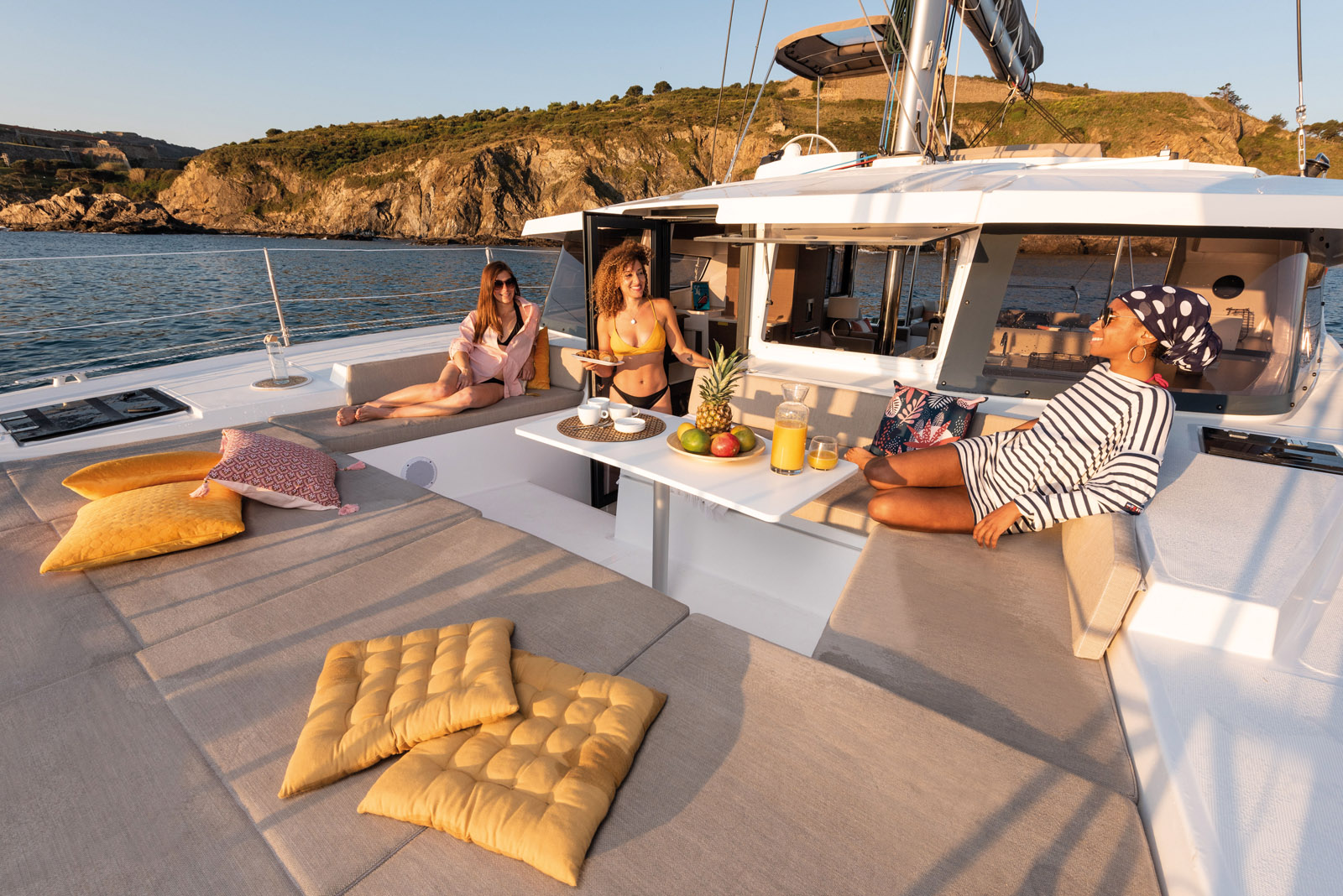
The large forward cockpit is directly connected to the nacelle via the front door.
Open space
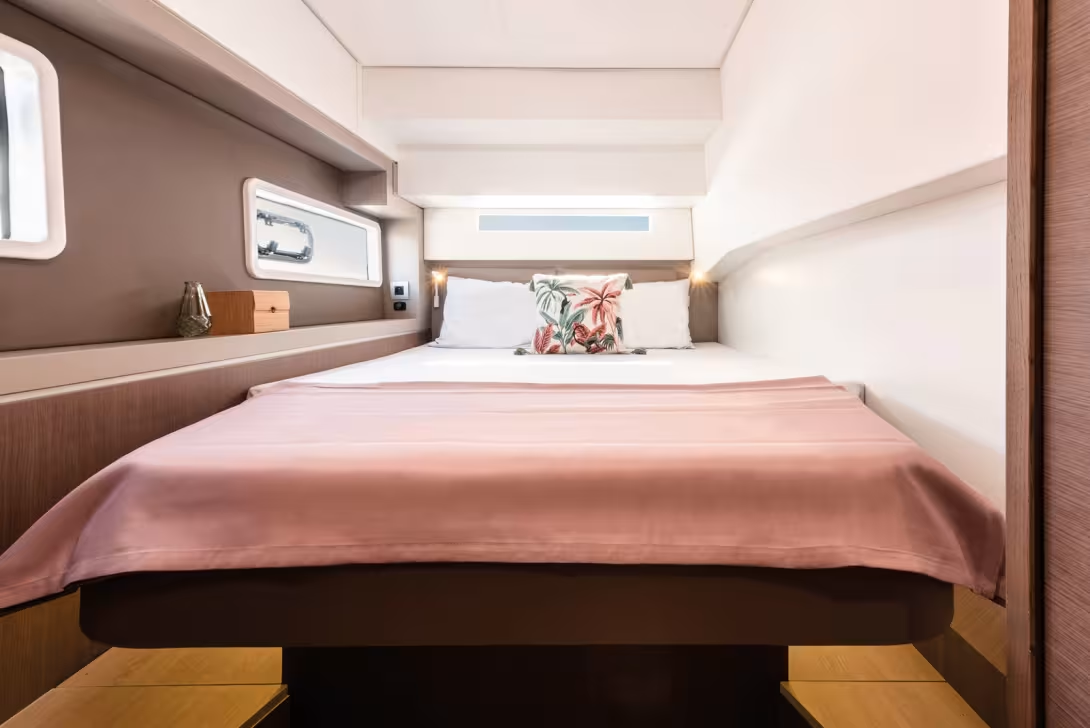
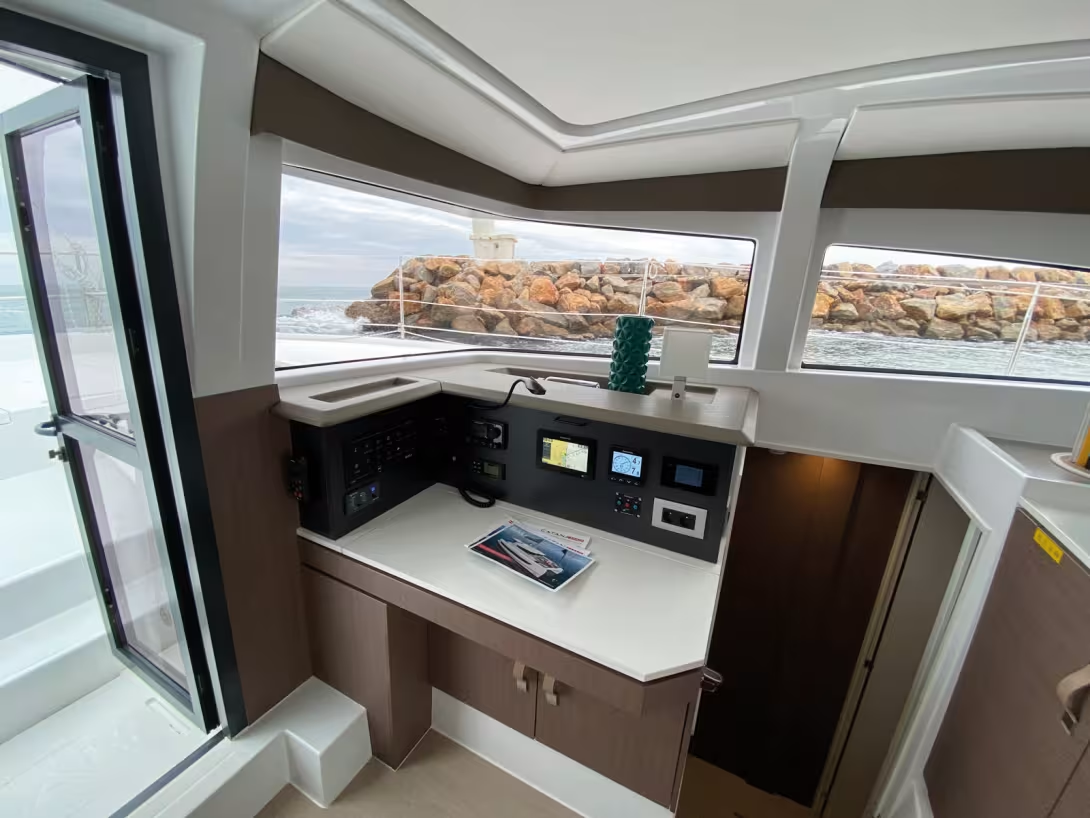
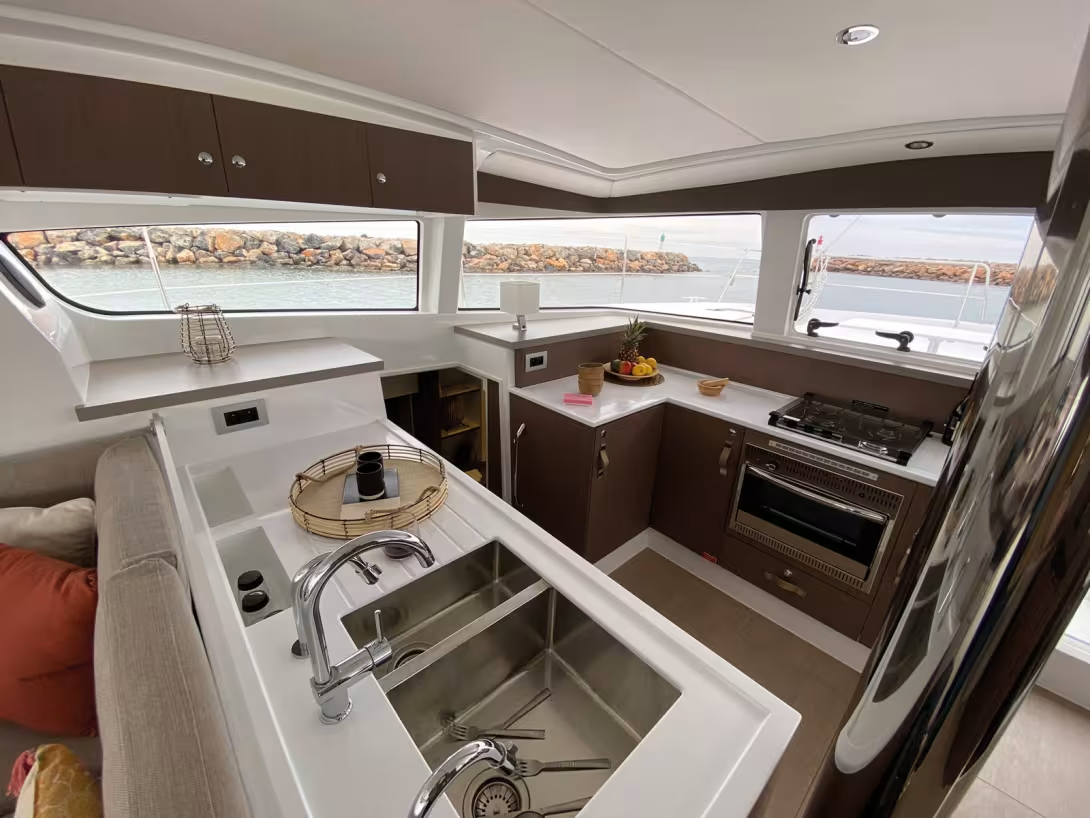
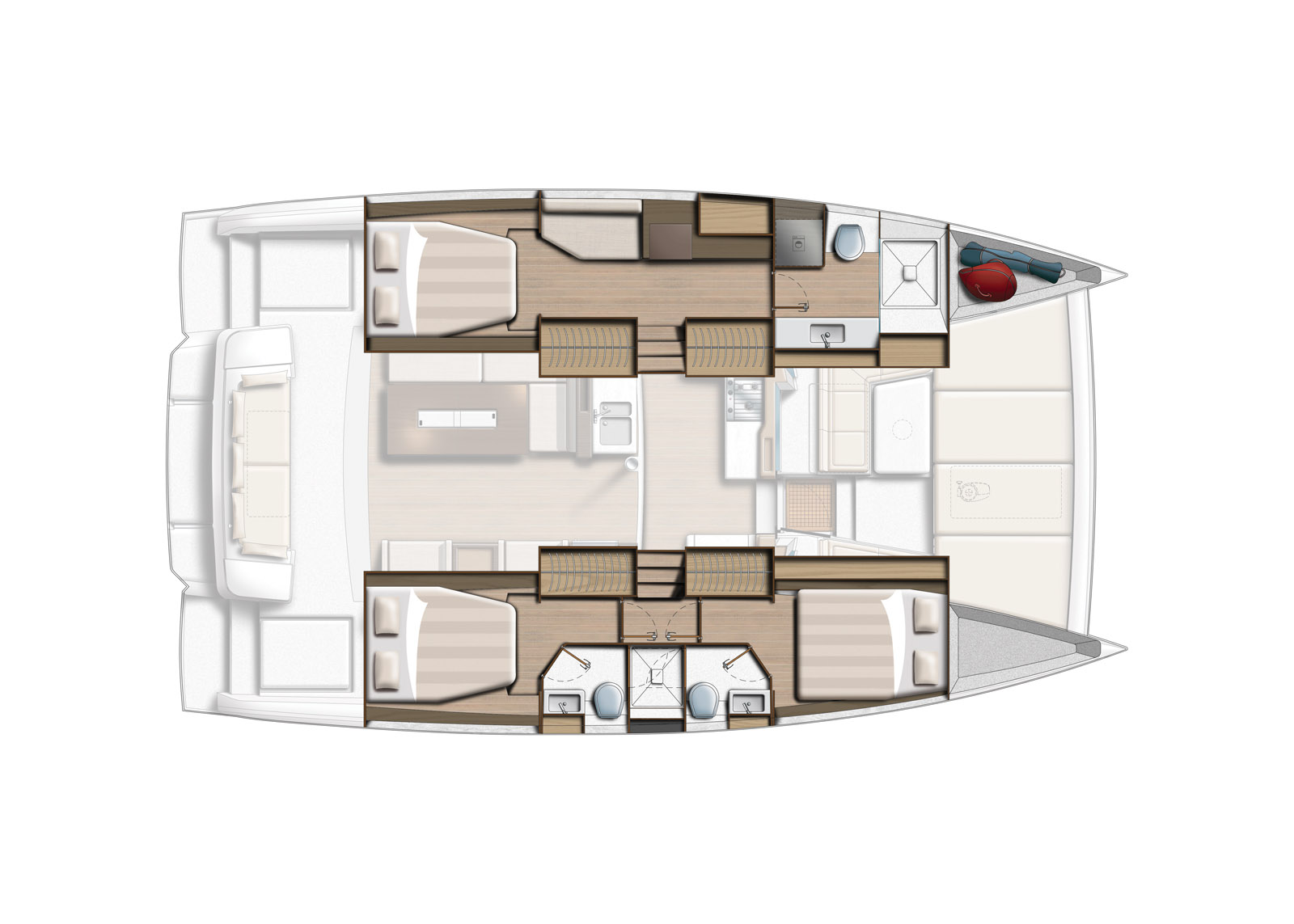
The living area, when all the doors, the forward hatch and the lateral bay windows aft are open, does not give the feeling of being “inside”. Ventilation is obviously excellent. In a few seconds, however, we can be nicely inside, having bypassed the ugly tarpaulin cockpit enclosures that have flourished on other boats... The headroom is generous: it varies between 6’6” and 6’10” (1.98 m and 2.10 m). The saloon/cockpit table is offset to port and measures 64 x 33 inches (162 by 85 cm). Six people can sit at it without feeling crowded, and eight people would still have elbow room. The manufacturer also offers a larger table. Opposite, two comfortable lounge chairs are offered to owners, with charterer companies likely opting for a more classic bench seat. These new features aboard catamarans designed initially for the charter market, show the attention now paid to owners. The finish and perceived quality are also much more flattering compared to the rustic nature found five years ago aboard the 4.5. On the starboard side, in the center, the huge refrigerator/freezer unit – 11.5 cubic feet (326 l) in total - remains easily accessible. Red latches secure the doors when under way. After a step (6”/16 cm), the galley takes its place forward in the nacelle on two countertops. Underneath, the storage volume is impressive. On the starboard side, a chart table is fitted, its top measuring 40” by 18” (101 by 46 cm). Proof, if it were needed, that the Bali is aimed at private owners, the three-cabin version was the one presented to us in Canet. The port hull is entirely dedicated to the owner. Four wide, relatively gentle steps separate the hulls from the saloon, over a slope of 40½” (103 cm). The bed offers a nice width of 5’7” (1.70 m) – and it’s the same in the other aft cabin. The hull also offers a bench seat and a dressing table/ desk, with the bathroom forward. At the front of the starboard hull, the berth is 5’1” (1.55 m) wide. Everywhere, beautiful windows with a sea view, carefully designed ventilation and storage. Each cabin has its own bathroom - with a shared shower for the two cabins in the same hull. The Bali 4.2 is of course available in four cabins, and also, the forepeaks peaks can be fitted out.
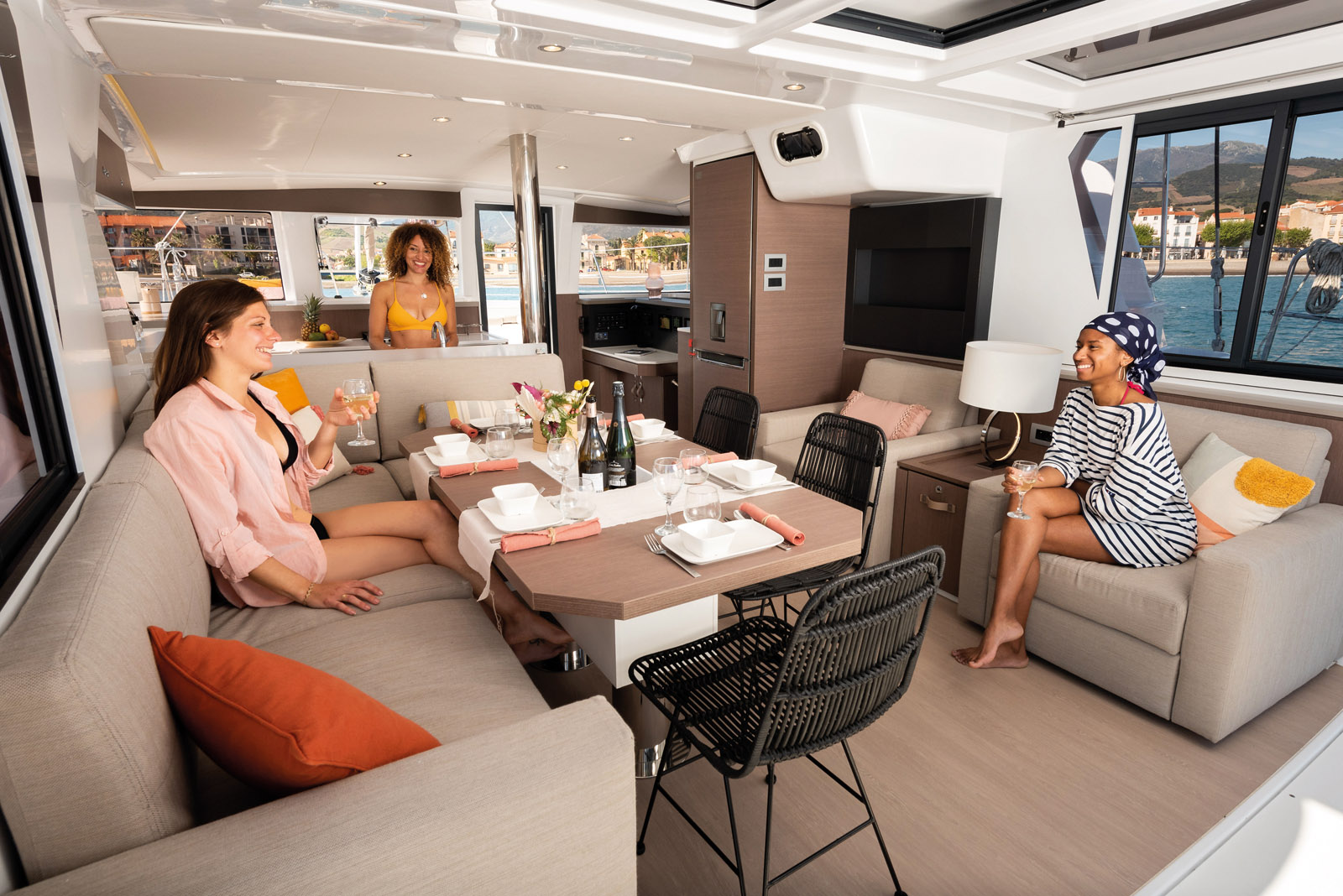
With the “Bali door” and side windows open, the saloon is clear to the outside.
Convincing rigidity
As we cleared port, there was no wind, but we had a residual swell out of the southeast. So we began with testing the engines. Our test boat was equipped with the optional 45 HP motors, rather than the standard 30s. I set the speed of both the engines to 2,200 rpm, which gave a boatspeed of a little over 7 knots with a consumption of 1.7 US gal (6.4 liters)/hour. Counting a safety reserve of 15%, the Bali 4.2 could cruise 612 miles at this speed. No matter how hard the Bali is sailed whether into waves or with them on the quarter, it is obvious: the careful structure, the deep hull ribs and the integral deck result in irreproachable rigidity and an absence of any squeaking. Passage through the water is smooth, when sailing without the nacelle making contact. The wind eventually settled in, and the gennaker was immediately unfurled to accompany the main, which had been hoisted beforehand. In spite of the swell that was trying its best to unhook the sails from the wind, the Bali managed to make 4 knots in the little 6 knot breeze. Obviously, more wind is needed for the 4.2’s fine hulls to demonstrate their potential. We won’t expect miracles upwind or in light airs in general: the keels are short, the windage is high and the sail/weight ratio is not terribly favorable. On the other hand, good passage though the water bodes well for comfortable passagemaking. We also appreciated the direct and rather soft feel to the helm. The self-tacking jib and the double purchase system for the mainsheet are simple and work perfectly.
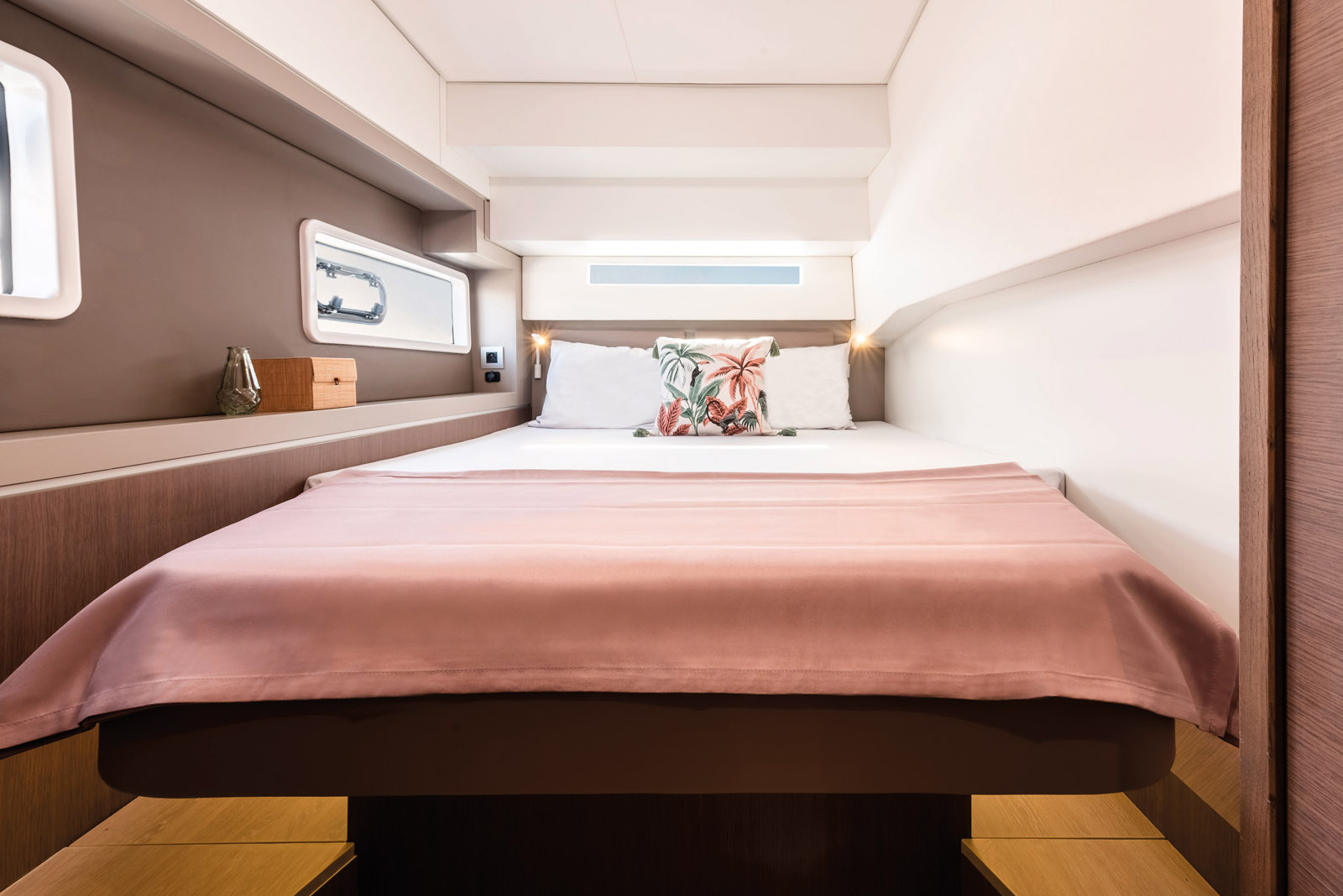
In the aft cabins, the mattresses are a nice 5’7” (1.70 m) wide.
Conclusion
For its size, the Bali 4.2 offers unusual comfort - it is indeed like being at home. With its huge saloon/ cockpit, its XXL-sized galley and its comfortable cabins, this new model will convince even die-hard landlubbers to cast off! Where the manufacturer scores additional points is that the seakeeping has not been forgotten. Of course, an ORC 42 that is half the weight for the same sail area will inevitably go much faster. But the 4.2 is still a well-built, rigid and safe platform whose hulls will allow for nice sailing in medium airs.
 |
 |
TECHNICAL SPECIFICATIONS
Builder: Bali Catamarans/Catana
Architect: Xavier Faÿ
Interior design: Lasta Design Studio
Material: polyester sandwich
Length: 40’3” (12.27 m)
Beam: 23’2” (7.07 m)
Draft: 4’ (1.22 m)
Light displacement: 26,500 lbs (12.02 t)
Fully-battened mainsail: 613 sq ft (57 m²)
Self-tacking jib: 377 sq ft (35 m²)
Code 0: 678 sq ft (63 m²)
Asymmetric spinnaker: 1,098 sq ft (102 m²)
Water tank: 180 US gal (860 l)
Fuel tank: 169 US gal (640 l)
Engines: 2 x 30 HP or 2 x 45 HP Yanmar
Prices ex-tax: From € 363,800 in the 3-cabin/2-shower version
Excellence Pack: € 49,500
Elegance Pack: € 15,800
Fully-battened square-top mainsail and fittings, solent + lazy bag & lazy jacks: € 4,960
Code 0: € 5,120
Asymmetrical spinnaker: € 4,490
Code 0 fittings: € 5,450
Additional winch on port side for gennaker sheet: € 1,080
Electric winch: € 2,180
Opening front window: € 1,780
Diesel heating with hot water circulation, hulls and saloon: € 11,330
Low consumption watermaker: € 13,490
Hydraulic rams for overhead door: € 4,060
Yanmar 45 HP 4-cylinder engines instead of standard 30 HP 3-cylinder: € 4,690
Three-bladed folding propellers: € 2,485
ONAN 7 kW 50hz generator with cover and remote control: € 19,980
Solar panels kit (400 Watts): € 4 870 €
Helm station bimini :€ 3,380
Removable table for the forward cockpit: € 1,320
Forward cockpit sun cover: € 1,490
Set of 3 sunbeds on the foredeck: € 2,090
Maxi sunlounger cushion on flybridge: € 1,280
Sunbathing area on flybridge: € 2,640
Composite, folding passerelle 7’3” (2.20 m) + cover & 1 deck socket: € 1,860
Underwater lighting with blue 21 W LEDs under each sugarscoop: € 4,020
Plancha bbq with gas installation: € 1,710
9’2” (2.80 m) tender + 5HP outboard + davits: € 8,140
Delivery from Cap Bon (Tunisia) to Canet-en-Roussillon (France): € 5,430
The Pluses
+ Modularity of the nacelle/cockpit
+ Multiple lounging areas
+ Easy sailing maneuvers
The Minuses
- Helm station bimini too low
- Port winch (gennaker sheet) a little out of reach
- Some areas - forward corners of the coachroof – could snag the gennaker sheets.