
First seen with the Nautitech Open 40 followed by the Bali 4.5, the idea of blending the nacelle and the cockpit into a single, and therefore enormous, volume has been implemented 100% aboard the Bali 4.3. What’s new is that the aft part of the coachroof pivots upwards and is housed under the roof itself. A new concept which is set to revolutionize cruising…
Infos pratiques
- Le chantier : Bali 4.3
- La fiche technique
- Découvrez notre vidéo exclusive
- Financez votre Bali 4.3
- Assuez votre Bali 4.3
- Articles autour du Bali 4.3
New concept, new range…
Seeking to join the wider market in the cruising catamaran sector - a market shared by big yards such as Lagoon, Leopard and Fountaine-Pajot - in 2014 the Catana Group launched their new range, christened Bali. Following the 4.5 and just ahead of the 4.0, we have the 4.3… whose development took a little longer than planned, due to the time spent adapting this model to its power version, the MY 43. Left behind are the Catana specifications: on the Bali you won’t find carbon at every stage of the build, nor load-carrying daggerboards. But the upshot is that you’ll find a price range similar to that of their “mass-producing” competitors. On the construction side, the yard has gone for molds in three sections, with a join in the bottom of the hull, interior half-hulls and the nacelle, for greater rigidity. All of this has been realized in PVC foam sandwich and polyester resin, not forgetting the special anti-osmosis gelcoat. The deck bracing is in plywood and monolithic resin and the bulkheads are in glued or laminated plywood. In short, nice work, simple and robust, though not the lightest. Far from mimicking existing examples, Bali has gone a lot further, not holding back on innovations, which have certainly pricked the curiosity of our testers… Because even though we already know that multihulls - and catamarans in particular - are the ideal craft for water-based vacations (long or short), the “open space” configuration of our Bali has got to be tried for real. Thanks to the XXL-sized opening roof, this Bali 4.3, (the fourth one built), is really breaking down the boundaries between the salon and the cockpit. In short, when the weather’s good, there isn’t really an inside and an outside any more…
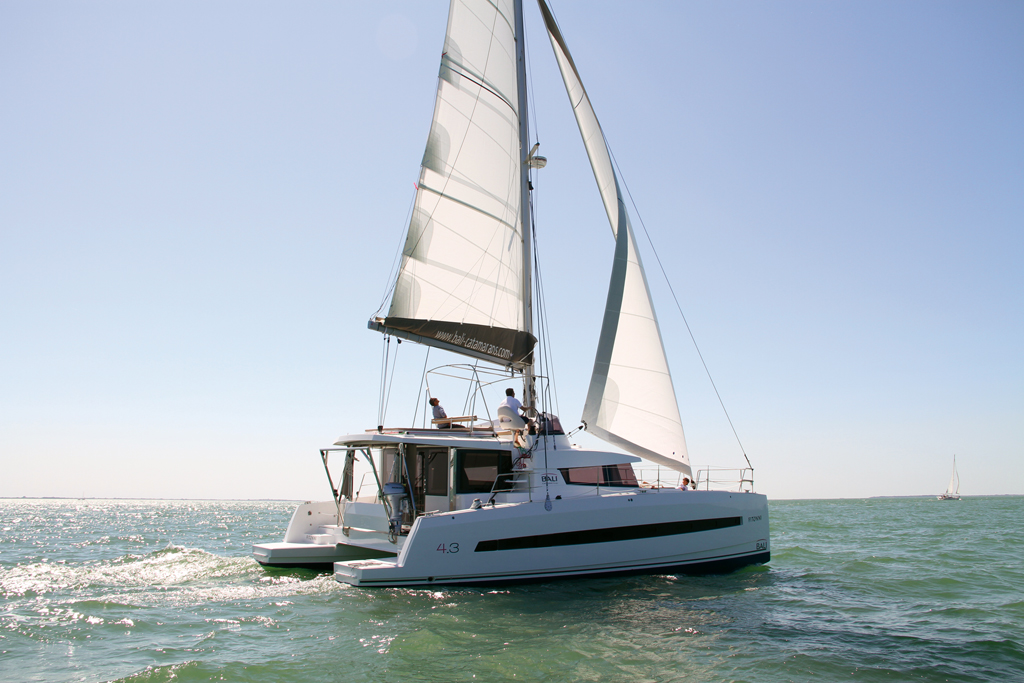
The Bali is a comfortable catamaran, but enthusiastically swallows up the miles given the right conditions.
Hull shape
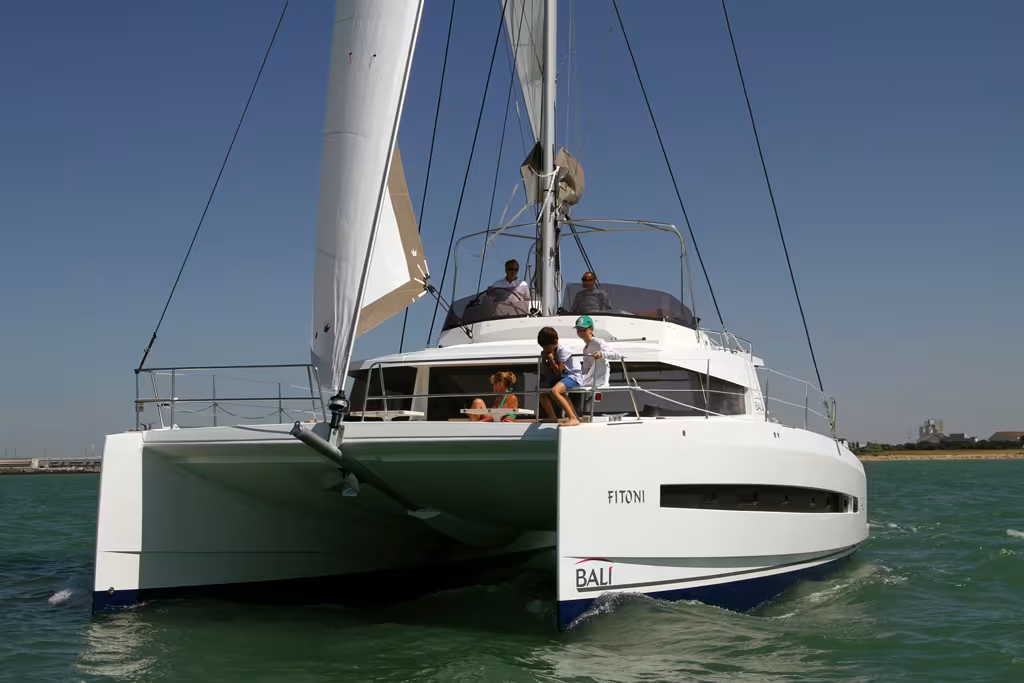
The design of architect Xavier Faÿ deserves a detailed look. Seen from ahead, the hulls show a marked step and a curve, highlighted by a black stripe. This is clever from several points of view… firstly it gives the hulls a good habitable volume at bunk height, without translating into a large waterline beam - the straightness of the hulls remains one of the key elements for maintaining good average speeds under sail. And also because any spray is effectively done away with. Furthermore, the opening hatches, small but numerous, are relatively sheltered from any rainfall, so they can be left slightly open in damp weather, and, especially, are not subject to the huge force from fenders wedged between the hull and the dock. Finally, the most interesting is without doubt the ski-like shape forward - forming the rigid forward deck. Already seen on the Bali 4.5, and strengthened by a central rib, it serves as a deflector in heavy weather and following seas, and as insurance against burying the bows.
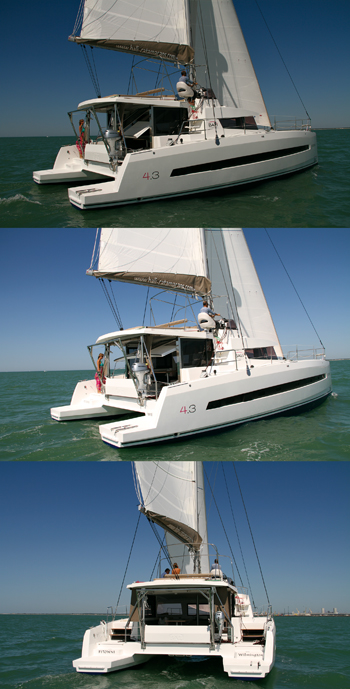
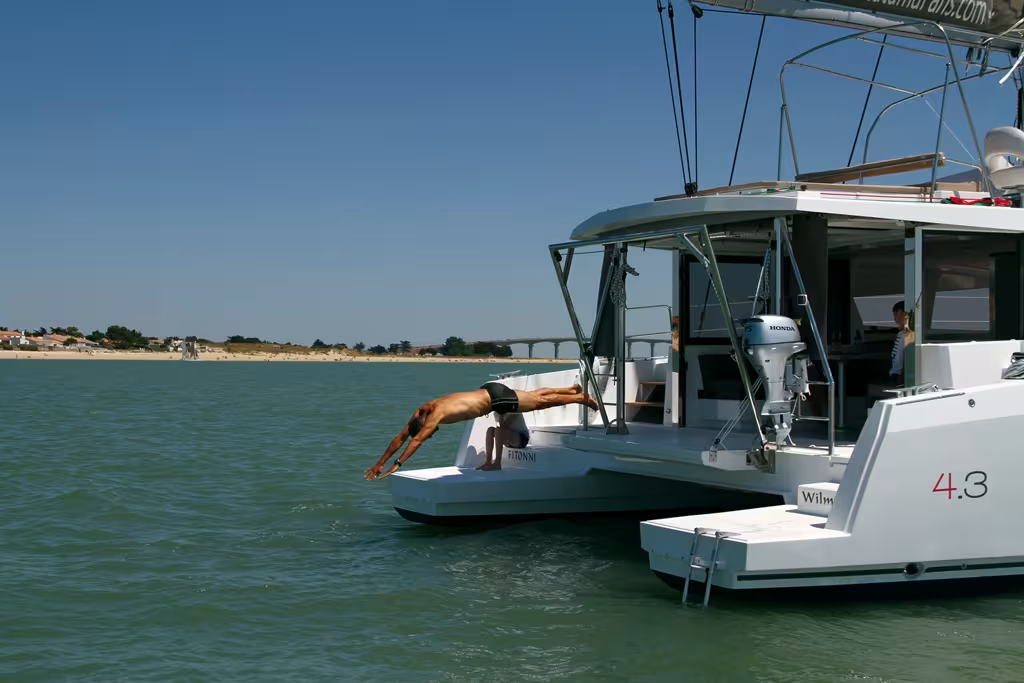
The aft door opens without difficulty, even when under way. Here’s the proof in three pictures…
A sleek rig with self-tacking jib
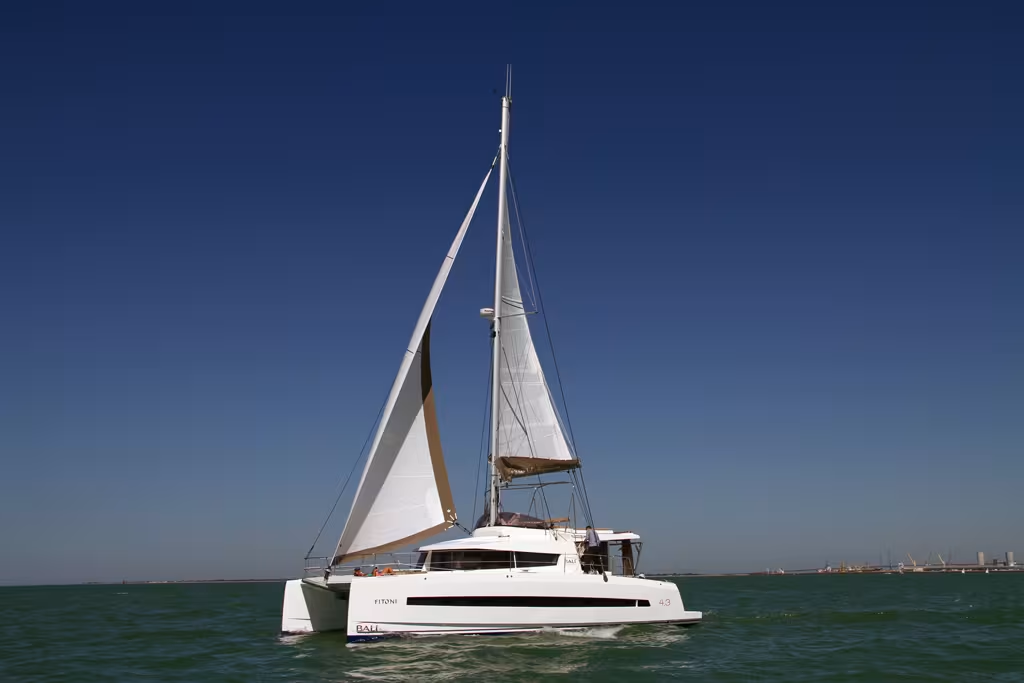
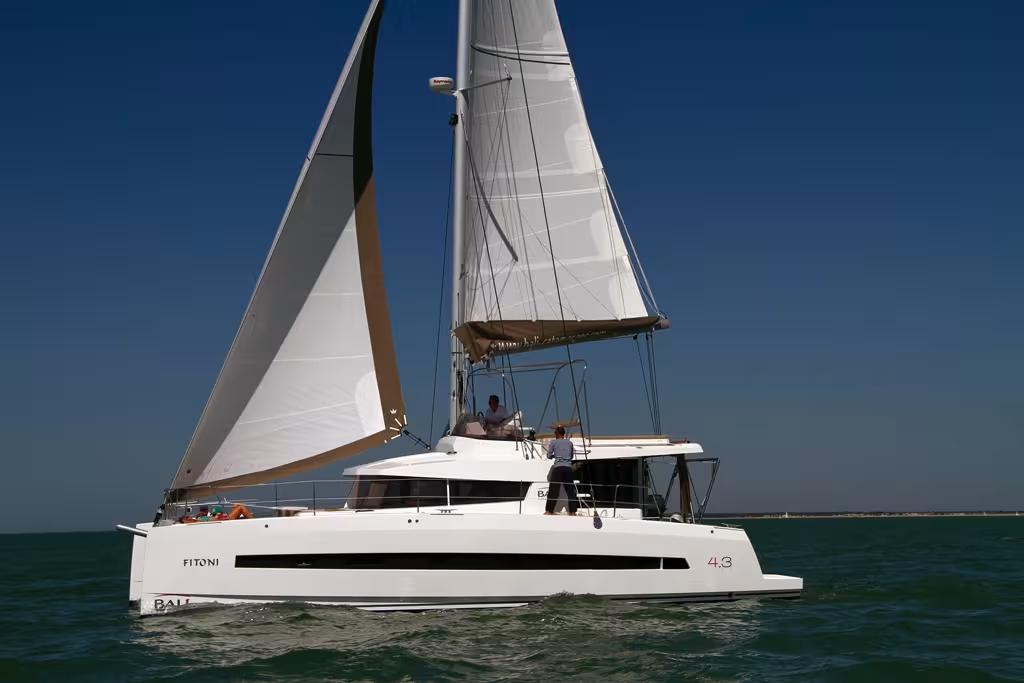
You can’t say enough about the joy of having two motors on a catamaran… and on our test boat, the choice of engines more powerful than the standard option - 2 x 50hp as opposed to 40s - ensured that when you apply opposite throttle, you are capable of making tight enough circles to get you out of even the most confined spot. In short, despite a relatively significant freeboard, the Bali 4.3 slips into the busiest marinas like a scooter. And at 2,800 revs, the Bali bowls along at 8.4 knots. As soon as we were out of the channel at Les Minimes, on France’s west coast, we were able to set sail. The rig is fairly sleek, and set aft. This sits well with the self-tacking jib, which has gained a fair amount of area - 37.5m². The mainsail now looks well, being square-topped, though undeniably suffers somewhat from being made shorter due to the height of the boom. Of course from a crew safety point of view, there’s no problem, but when it’s a question of neatly flaking the sail, or re-threading a reefing line, it’s not so straightforward crawling on all fours along a boom at that height. Being aware of this, the yard doesn’t even include a zipper on the sail cover! For now, there’s 13 knots of wind allowing us to comfortably make 6 knots on all points of sail. We would definitely gain a knot or two by hoisting the 61m² gennaker which is stowed in a locker, but our test boat is so new that not all the deck hardware has finished being fitted yet. Note that as an option, you could go for a 100m² asymmetric spi. We are tacking through 100°, which is ok for a cruising cat with skegs. And being able to tack without having to adjust a thing is a real pleasure when cruising. On the other hand, when the wind drops below 8 knots, the self-tacking jib feels like it lacks a bit of bite. Basically, the advice from Multihulls World is that you’ve got to have the gennaker!
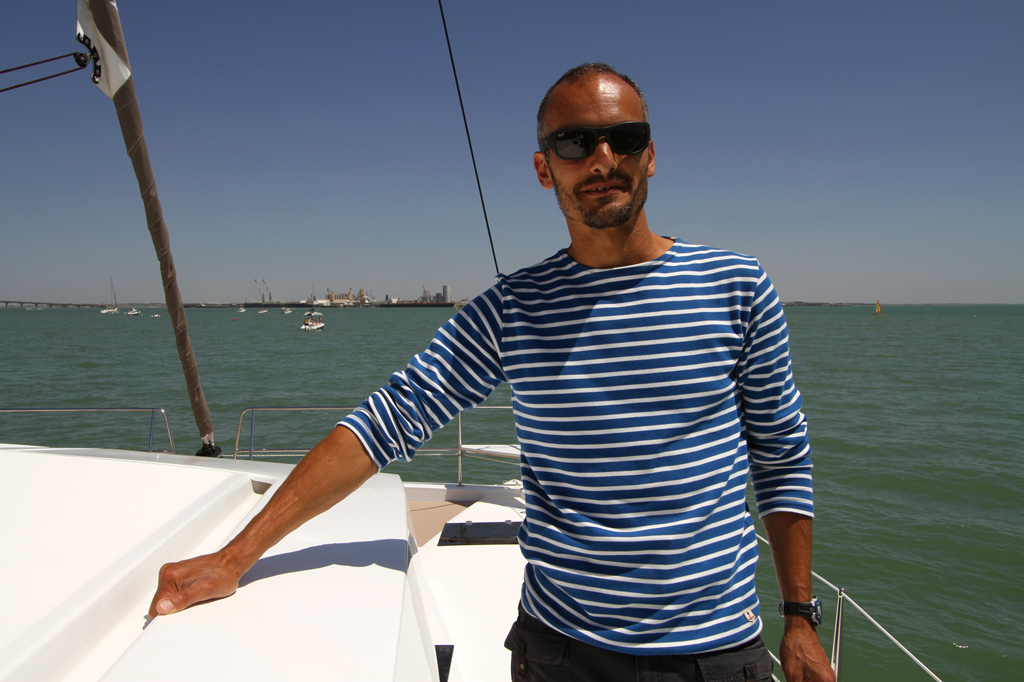
Clever handrails.
Deck Layout
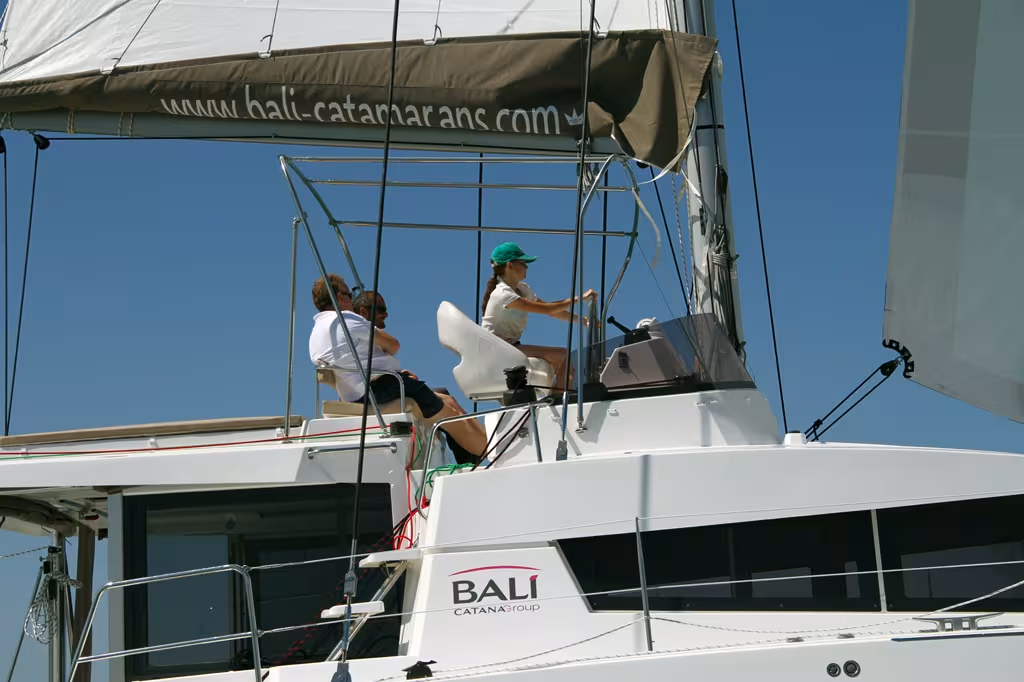
The best bit of the Bali 4.3? The flybridge, for sure, fitted (among other reasons) to comply with the requirements of the MY 4.3, the power cat version of the Bali 4.3. You would think that since it was first introduced on the Lagoon 440 (as long ago as 2004!) there's nothing that hasn't been said or written on the subject. However, the topic is far from exhausted, as Lagoon now offer, as an option, a more traditional helm station on their 450 and 52. Here, access to the flybridge is relatively easy from both sides, which is already a very positive thing. Next, from the bucket seat (two positions, either sitting or standing) the helmsman has an uninterrupted view over the water, apart from the blindspot of the jib. The windshield provides reasonable protection. The composite wheel is 90cm in diameter and gives an excellent feel. Finally, the helmsman has all the sailhandling gear to hand, so the crew can 100% make the most of cruising. And the Antal 48 electric winch really makes light work of that sailhandling. The only negative point: a few lines at the mast foot flog against the bimini frame. Moving around on the side-decks is safe: generous width combined with handrails along the coachroof allow you to reach the bows effortlessly. When it comes to tying up, another good point is the enormous cleats, capable of taking some big warps. Neat idea!
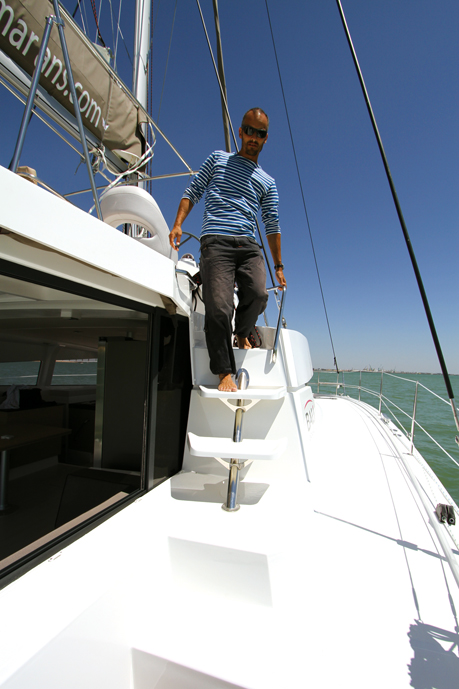
Access to the flybridge is practical and can be achieved from either side of the coachroof.
Relaxation
The decreasing easterly wind wasn’t kicking up any chop, and this enabled us to anchor peacefully a few cables off the beach at Sablanceaux. Anchoring: now here was the next surprise! The bow roller is all the way forward at the front of the platform. This is good and not so good… ok,it does away with the need for a bridle, but gives for poor centering of weight, and in particular, restricts somewhat the view of the anchor and chain. There is however, an inspection hatch below the cushions, but to be honest, you can’t see a lot through it. So you might be tempted to pull a bit of chain in, without really being able to see if it’s at an optimum angle… On the upside, though, life on board is great fun. Firstly thanks to the flybridge, with a big bench seat 212cm long, a sun lounger measuring 186 by 208cm and finally a table (101 by 70cm folded up) and secondly because of the forward cockpit. Forward of the mast foot, there is a giant, modular sunbathing area nearly 4 meters by 2, lockers, a bench seat over 3 meters long, and even two small tables. Note that these can be a bit in the way when sailing offshore, but it’s not a problem as they are (easily) demountable. Aft, there are two more stowage areas (shame you have to unclip the lifelines to open them up wide) and a housing for the liferaft. For swimming, in addition to the divine sugarscoop steps, a retractable platform adds to the pleasure of bathing: kids will love it. Another of Bali’s great ideas: once this 237 by 62cm lifting polyester panel is raised, it provides the perfect support for the dinghy, loaded with the aid of pivoting davits.
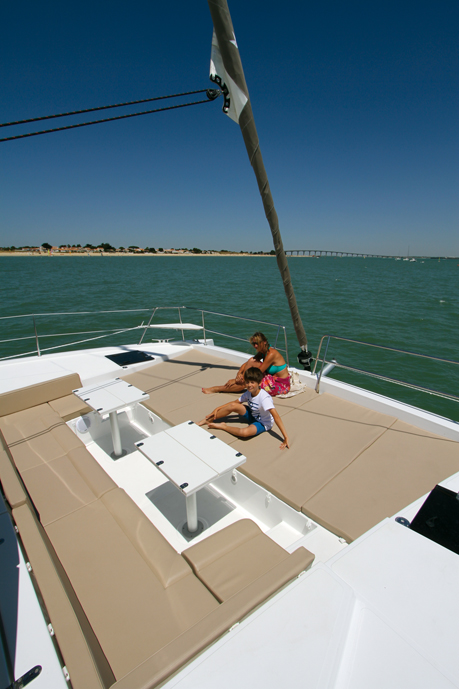
Another great Bali feature: the forward cockpit. Fantastic!
So? Inside, or out?
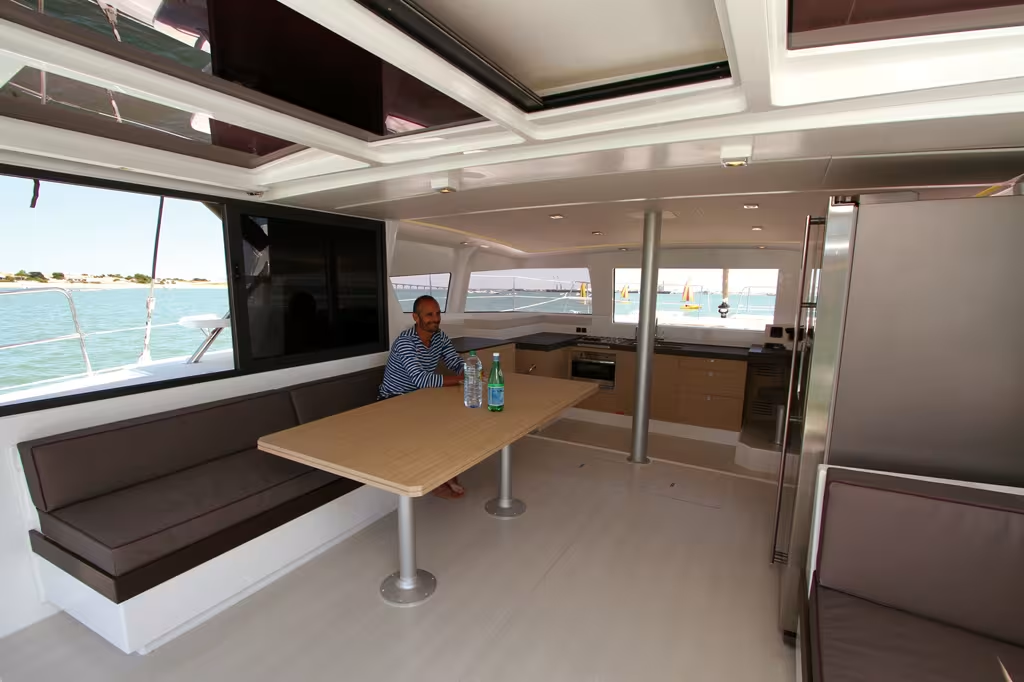
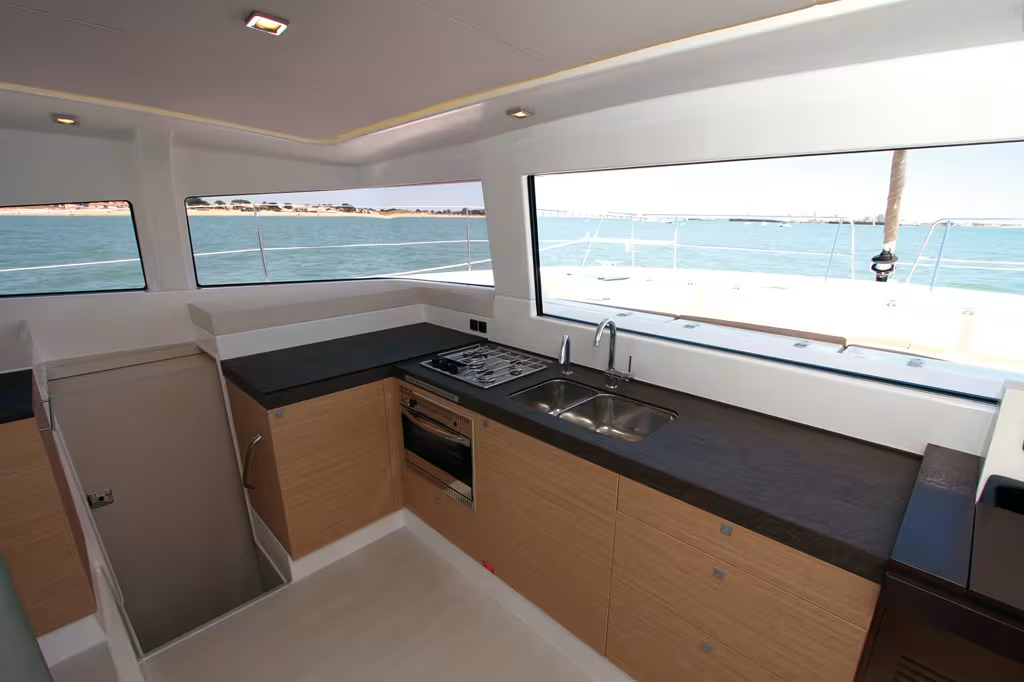
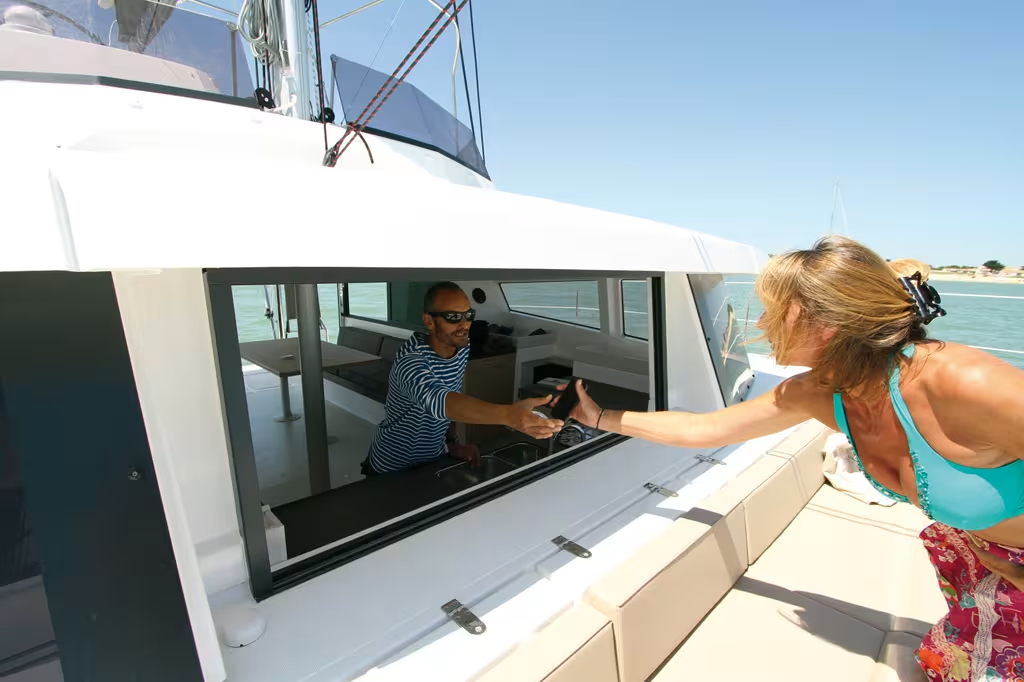
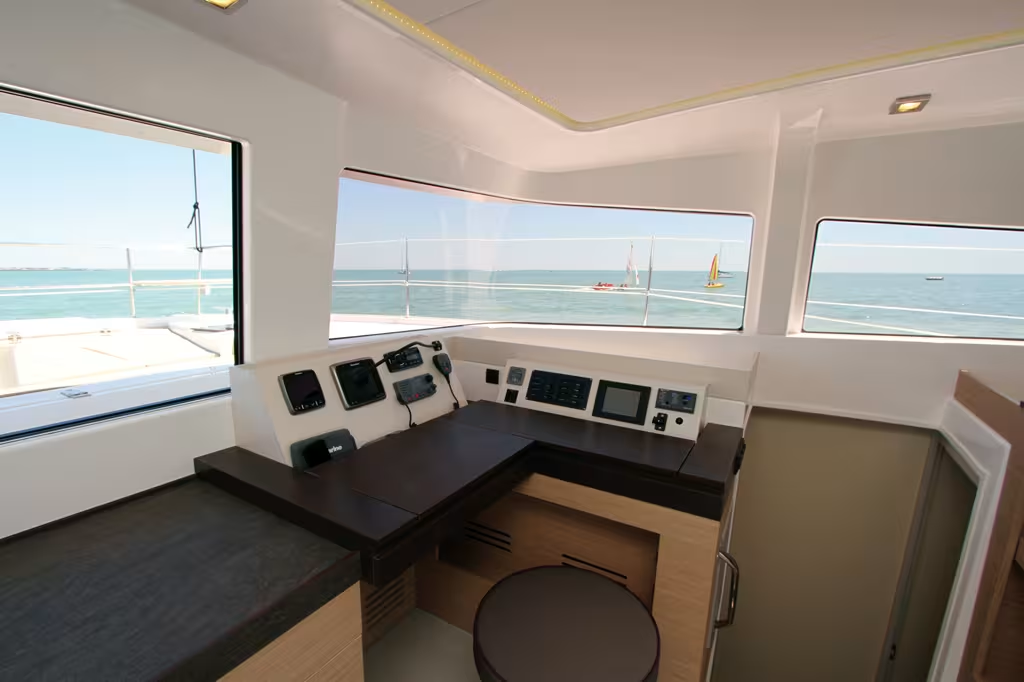
When closed up, there is nothing particularly special about the nacelle, except that it feels like it extends into the cockpit by a couple of meters, well protected by the hard-top bimini… but what a transformation once the door is opened! Yann Chabaud, who was formerly at Dufour and several other big names in the yachting world has designed a hydraulic system which can lift the whole of the rear face of the nacelle to horizontal in thirty seconds! And there’s no need to panic if ever it were to break down… all you need to do is disengage it, and the panel lowers back down under its own weight. For ordinary coming and going, you just need to use the door. Opening up the nacelle and the big side windows allows you to merge the cockpit and the interior. Straight away you’ve got one enormous table which can seat eight, next to a sofa which is perfect for spending time reading, and a colossal 630 liter refrigerator. Obviously you move about a lot in this area, and this is where there’s a problem: the flooring covering chosen - imitation wood - is slippery if you’re wet and in bare feet. This needs attention! The L-shaped chart table is positioned fairly traditionally, forward at an angle, in this case to starboard of the salon, next to the galley, something which you don’t see that often. In use, this is a neat arrangement, thanks to the retractable front window - another Bali brainwave - which measures 173 by 66cm and disappears into its housing in just a few seconds, providing ultra-efficient ventilation! And there's direct contact with the forward cockpit. You can’t actually climb through it obviously, but as a serving hatch for passing food and drinks through, it’s great! And so the head-chef is facing forward. At his disposal, a three-ring cooktop, two sinks, a dishwasher (optional) and another, smaller, refrigerator. In the hulls, the yard offers traditional layouts in either three or four-cabin versions. For our test, we have the former, the owner’s version. This gives the owner a bunk, aft, a desk and an immense bathroom. In the starboard hull, you have a choice of two cabins with either one large or two small bathrooms. The aft bunks have space to be accessed from both sides, whereas the forward bunks are against the hull both sides.
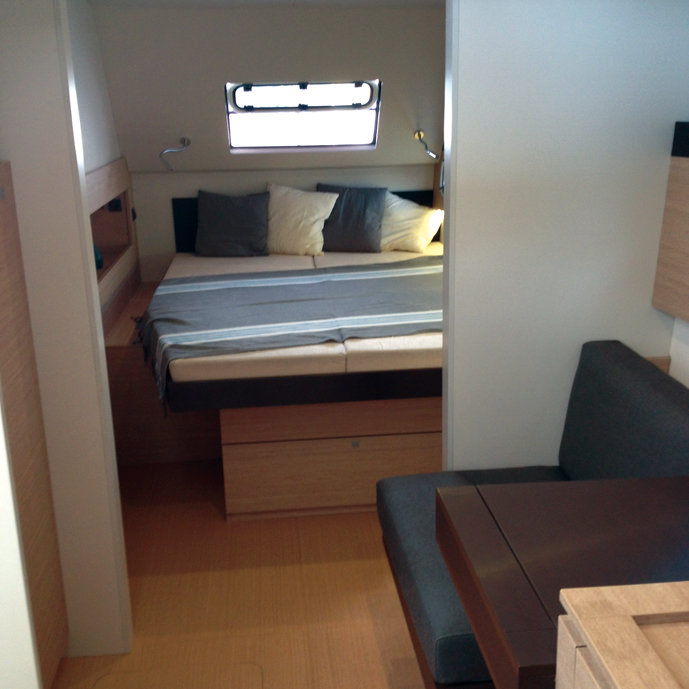
The cabins are good (shown here, the owner’s cabin) and are particularly airy.
Conclusion
Cheaper than a Catana, the Bali is, however, not a low-cost boat! But on the other hand, it is a model outside the norm, with real innovations and which is built to a high standard of finish and with nice woodwork. We would perhaps prefer a slightly more traditional helm station - the yard can make one - to reduce the windage and enable the mainsail to be bigger… but remember that a flybridge has its advantages too!
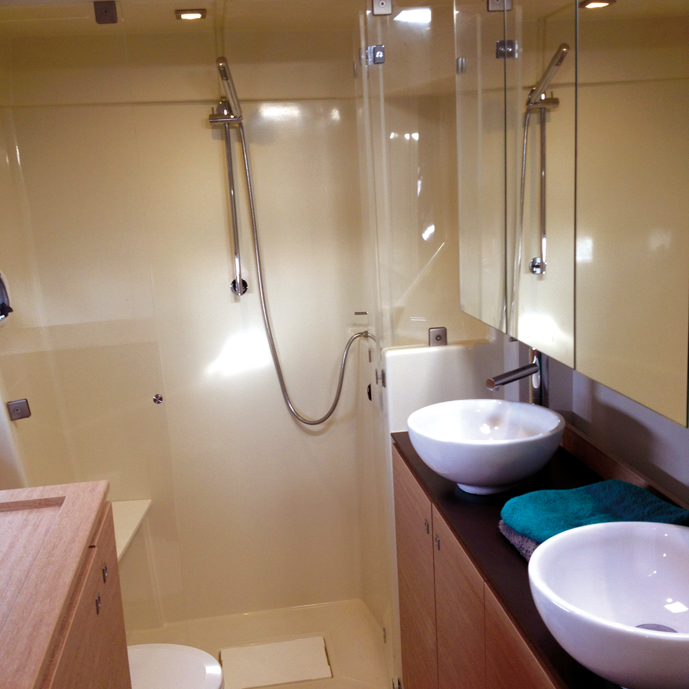
The bathroom in the owner’s hull is particularly spacious.
A word from the architect, Xavier Faÿ
The positioning and the specifications from Bali are very clear and very ambitious: a superior level, in terms of volume, of comfort, of natural ventilation, of standards, of equipment and of capacity, than other equivalent catamarans in the same class. While at the same time sticking to equivalent budgets and programs, with better performance, and better sea-keeping. One of the essential features which makes the Bali stand out, and renders possible all these objectives, is the use of the forward deck. Because, in addition to all the obvious advantages in terms of comfort which it brings (new ergonomics with gigantic forward cockpit, sunbathing area and anchor handling area), this deck also provides a new structural element, making the platform lighter and much stiffer. And for the life of the boat, this stiffness is essential for lively performance and seakeeping behavior, and also guarantees longevity throughout, from the rig to the furniture. But all that doesn’t come without upsetting a few preconceptions. Some people think that it will slam! But it doesn’t! No more than any other cat, maybe even less! On a catamaran, when a wave or a cross-sea slams under the bridgedeck, in general it will be near or even aft of the mast support. The underside of the nacelle is really only a natural lengthening forward of the pre-existing area on other “traditional” catamarans, and this lengthening is overall much higher up than the bottom of the nacelle below the mast, where slamming occurs anyway. In reality what’s important is the bridgedeck clearance in the area below the mast and aft of this point, and this criterion which is part of the specifications is significantly higher on Balis than on some of their direct competitors.
Pluses
- Immense and friendly living space
- Very effective natural ventilation
- Platform aft for swimming
Minuses
- Boom too high
- Poor view of the anchor and chain when anchoring
- Not very lively in light airs
Technical specifications
- Builder: Catana Group Naval
- Architect: Xavier Faÿ
- Interior Design: Couëdel Yacht Design
- Year first produced: 2014
- Overall length: 13.20 m
- Waterline length: 12.70 m
- Beam: 7.12 m
- Draft: 1.20 m
- Weight: 11.3 t
- Upwind sail area: 115 m²
- Mainsail: 52 m²
- Self-tacking solent: 37.5 m²
- Motors: 2 x 40 or 50 hp diesel
- Diesel: 2 x 400 liters
- Water: 2 x 400 liters
- Cabins: 3 or 4
- CE Category: A for 12 persons
- Basic price: €327,000 ex-tax
- Price of the boat we tested: €479,476 ex-tax
- Principal options ex-tax: Excellence Pack: €35,000 50 hp motors: €5,000 Reinforced sails: €3,460 Code 0: €4,980 Supplementary winches: €2,050 Anchoring equipment: €1,480 Electronics: €12,300 Safety equipment: €5,180 Watermaker: €11,500 Solar panels: €4,800 3.40m dinghy and 15 hp outboard: €7,460 Microwave: €600 Dishwasher: €1,346 Washing machine: €1,740
The competition
Model Lagoon 42 Hélia 44 Evolution Leopard 44 Lagoon 450 F Builder Lagoon Fountaine-Pajot Leopard Lagoon Sail area in m²: 87.40 115 123 133 Weight in tonnes: 12 10.8 12.62 15.10 Price in € ex-tax: N/A N/A 369,000 381,200
| Model | Builder | Sail area in m2 | Weight in tonnes | Price in € ex-tax |
| Lagoon 42 | Lagoon | 87,40 | 12 | N/A |
| Hélia 44 Evolution | Fountaine-Pajot | 115 | 10,8 | N/A |
| Leopard 44 | Leopard | 123 | 12,62 | 369 000 |
| Lagoon 450 F | Lagoon | 133 | 15,10 | 381 200 |
Caption
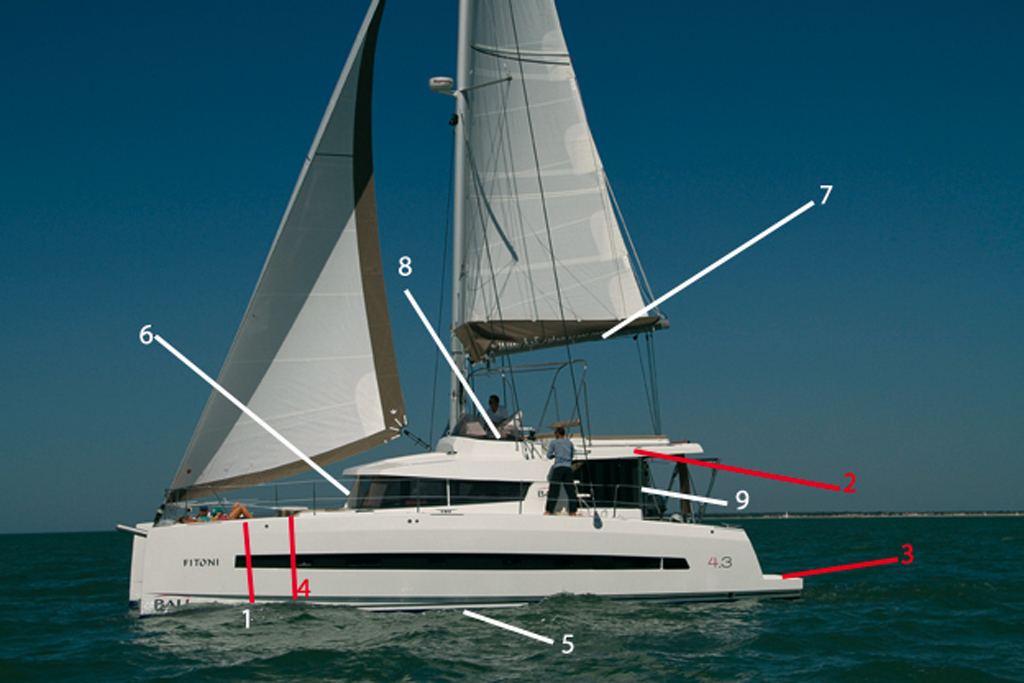
- : A little access panel below the cushions allows you to see - or glimpse - what’s going on below, while the crew is working the windlass. But it’s not enough for anchoring with complete peace of mind.
- : A reveal on both sides of the coachroof provides for a handrail
- : The sugarscoops are of course very practical… but at anchor the addition of the folding platform completes the picture.
- : The traditional trampoline is replaced by a polyester deck, which goes practically as far forward as the bows. Two small tables can be fitted by the large bench seat, and these can be removed when under way.
- : No sign of the deep - and now curved - daggerboards fitted to all the Catanas: Bali has opted for fixed skeg keels.
- : Very different from the pair of small opening hatches you find on most catamarans… here the entire front opens up and slides into the coachroof, like a car window.
- : As a tradeoff for the flybridge, the boom is so high as to be out of reach, or almost, when you need to rethread a reefing line. Note that the yard hasn’t even included a zipper on the sail cover…
- : Here on the flybridge is where you find the helm station. All sail handling, with the exception of the gennaker sheets, is centralized here.
- : The large pivoting door is controlled by a hydraulic system. It comes down under its own weight thanks to a solenoid operated by a switch, thus allowing for manual closing in case of failure.
