
With its concept of open space and rigid foredeck, Bali has contributed much to the evolution of the cruising catamaran. The builder successfully continues to evolve the models in its range, with the brand new 4.6 taking over from the 4.5, the first model by the brand, launched back in 2014. We went for a test sail off Canet-en-Roussillon, in France.
Infos pratiques
- Le chantier : Bali 4.6
- La fiche technique
-
 Découvrez notre vidéo exclusive
- Financez votre Bali 4.6
- Assuez votre Bali 4.6
- Articles autour du Bali 4.6
Test location: Canet-en-Roussillon, France
Conditions : : slight sea, northwest wind 15 knots
For several years now, Bali Catamarans has been offering ingenious and uncomplicated specifications for family cruising catamarans and charter catamarans. One of the objectives is to always seek more space for the same surface area on the water. But beyond ideas that may seem as simplistic as they are radical, the builder puts much more thought into this than might appear. After precise analysis of the competition, Olivier Poncin and his team noted the avowed desires of boaters, but then went further, seeking out desires that are hidden or simply ignored or neglected – maybe because they disturb the right order of things? Until this point, only Lagoon had pushed the boundaries quite so far towards full-comfort, while remaining relatively traditional in terms of interiors. Bali has seriously shaken up everyone’s marketing certainties by offering multihulls that were unheard of in terms of ease of access. This excess of user-friendliness mixed with marine-based yet landstyle comfort first made the headlines, then took its place on the medium-size cruising catamaran market. In just a few years, Bali has established itself as our manufacturer of nautical SUVs, thanks to two major new concepts. First, on the 4.5, the trampoline was replaced by a rigid foredeck, doubling up the traditional aft cockpit to give an XXLsized sunbathing area. On paper, some people doubted good offshore performance - yet the seakeeping qualities have proved to be flawless in difficult sea conditions (see our test MW 139). Moving on to the saloon-galley-cockpit area, initially open, it was then transformed into a convertible space inside and out aboard the 4.3 and then the 4.0, thanks to the famous rear bulkhead that retracts up under the coachroof, like an up-andover garage door. Add to this a design – that was decisive from the outset - and a management of consumables and functions more akin to those found in a summer residence ashore. Without forgetting remarkable ease of use and an optimized manufacturing/cost ratio... you can see how 85 units of this first 4.5 were sold, putting Bali among the top 5 major catamaran builders.
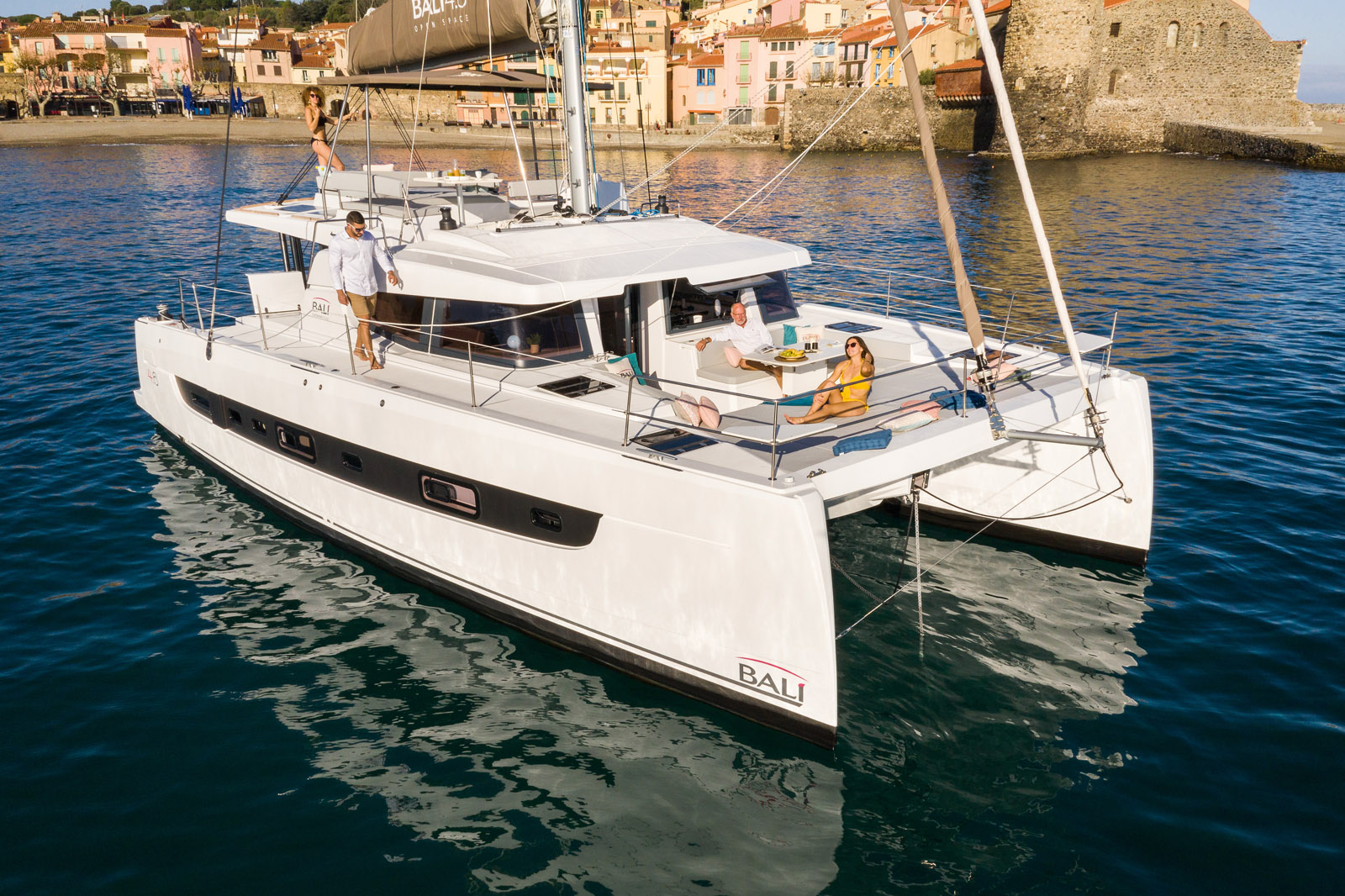
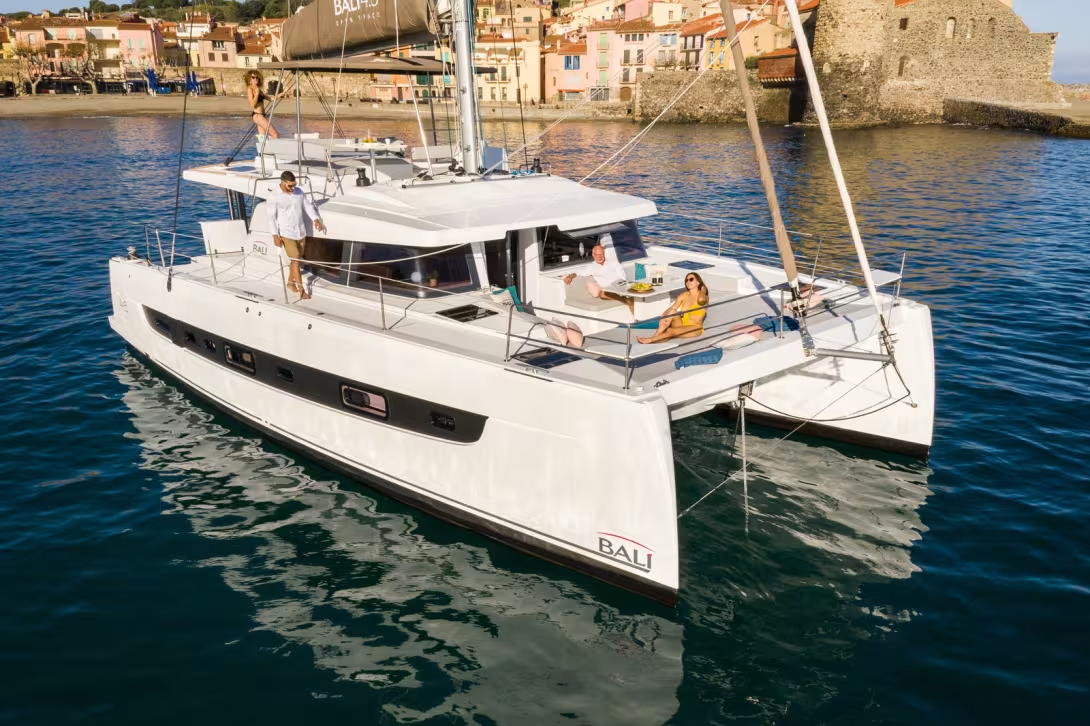
The freeboard height is significant and the flybridge seems to be perched up high.
However, coming down is done in complete safety and the ergonomics contribute to the comfort, everywhere on board.
In the black reveals of the hulls, the portlights could do to be bigger
A very well-managed mid-range market
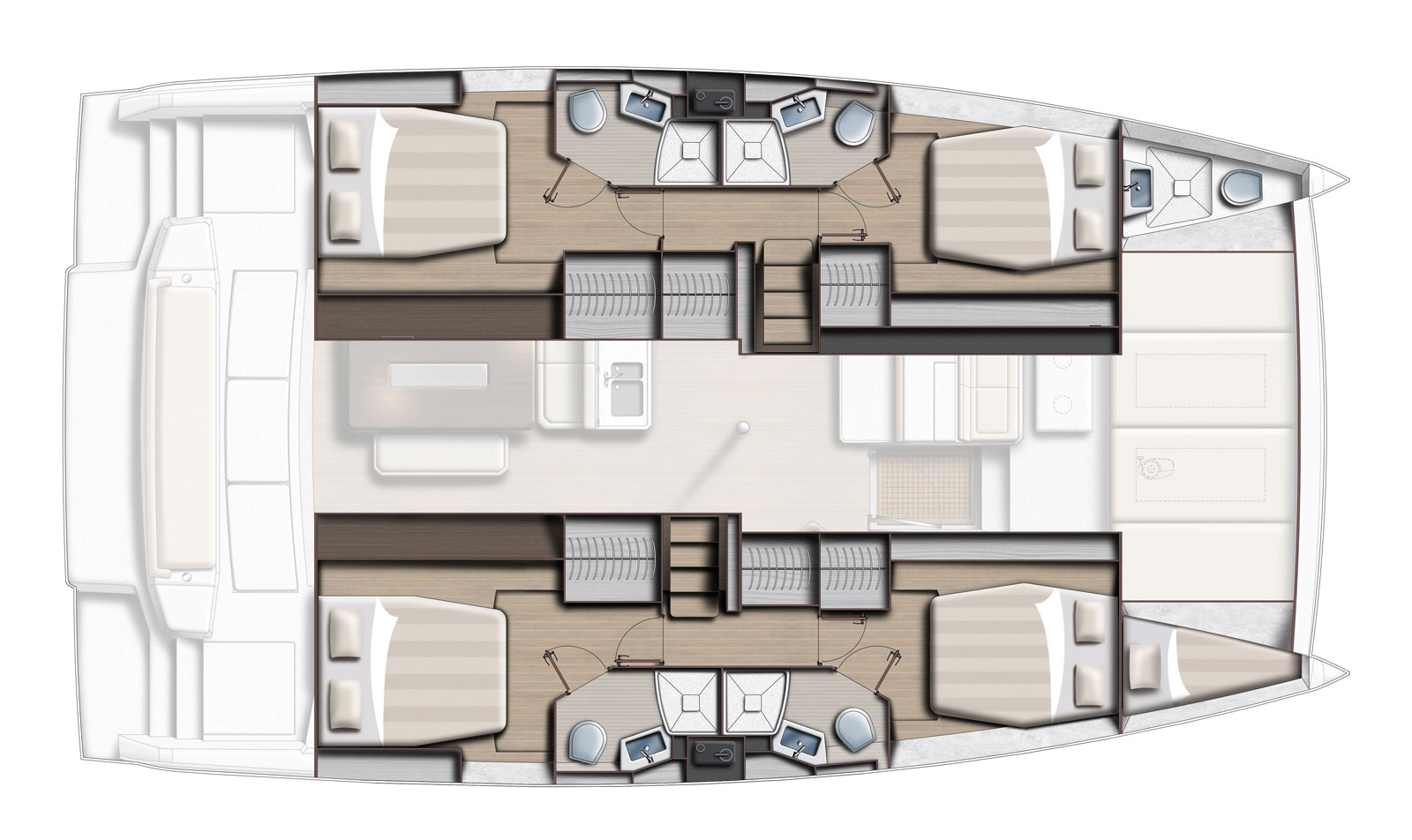
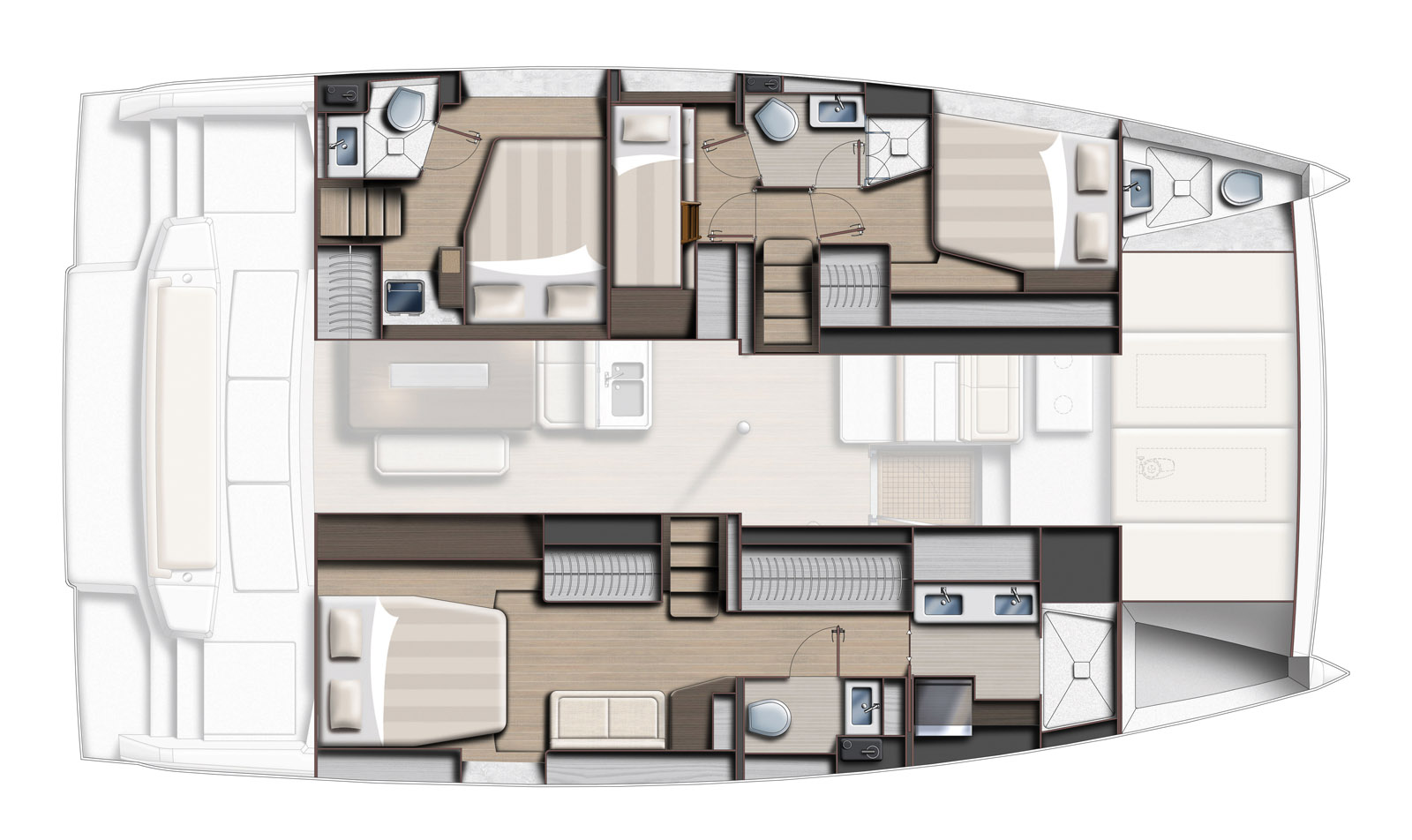
So, the challenge for the 4.6 was therefore twofold: to do better than its predecessor, the 4.5, and the tough competition in this size. Fortunately for the 4.6, in the meantime the 5.4 and then the 4.8 had brought their share of new features, that were certainly approved of on the larger models, but adaptable to this 46-foot sector. The flybridge with sundeck and mini saloon as well as the door leading to the forward cockpit from the saloon seem to have become a must-have for a good vacation on the water - these two features have therefore made their appearance on all these models. The 4.6 that we discovered at the Canet shipyard in the South of France in November claims to compile all these ergonomic improvements. At first glance, the similarity with the 4.8 raises questions about market positioning. Boris Compagnon, sales director, explained to us the stakes of this key length of 46 feet - the heart of the market today - and the accessibility effort made by the manufacturer. Boris points out that six cabins and the same number of bathrooms, with king-size beds installed athwartships, are still possible while removing these two feet - three or four wouldn’t allow it anymore. The layout of our 4.6, the prototype of the series, includes four cabins. The Owner’s cabin occupies the entire starboard hull with a walk-in wardrobe suite leading to the forward bathroom and a lounge/office area and bed aft. This cabin is huge, though lacks a little brightness, but we’ll come back to that. The port hull has three cabins, the largest of which is independent with access from the aft cockpit. The two others, at the bottom of the companionway from the saloon, share a common bathroom. The middle one is equipped with a pullman bed fitted athwartships, and combined with the forward double cabin, is perfect for a family. The different versions vary in number from three to five cabins with a maximum of four bathrooms. The layout, with small bookcase niches and blinds, is very cozy. The independent forepeaks can be fitted with a cabin and/or toilet if required. The star feature remains the open living space on the main deck which composes a joined-up suite. Two tables, one in the forward cockpit and a very big one in the aft part under the flybridge, sit either side of a very large galley that sets the area apart from the cabins and the nav station. A nerve center in which one can circulate easily, just like on the entire main deck, all on the same level - without a sill or step. In all, over well 1,000 square feet (about 100 square meters) are usable - a record for this size category.
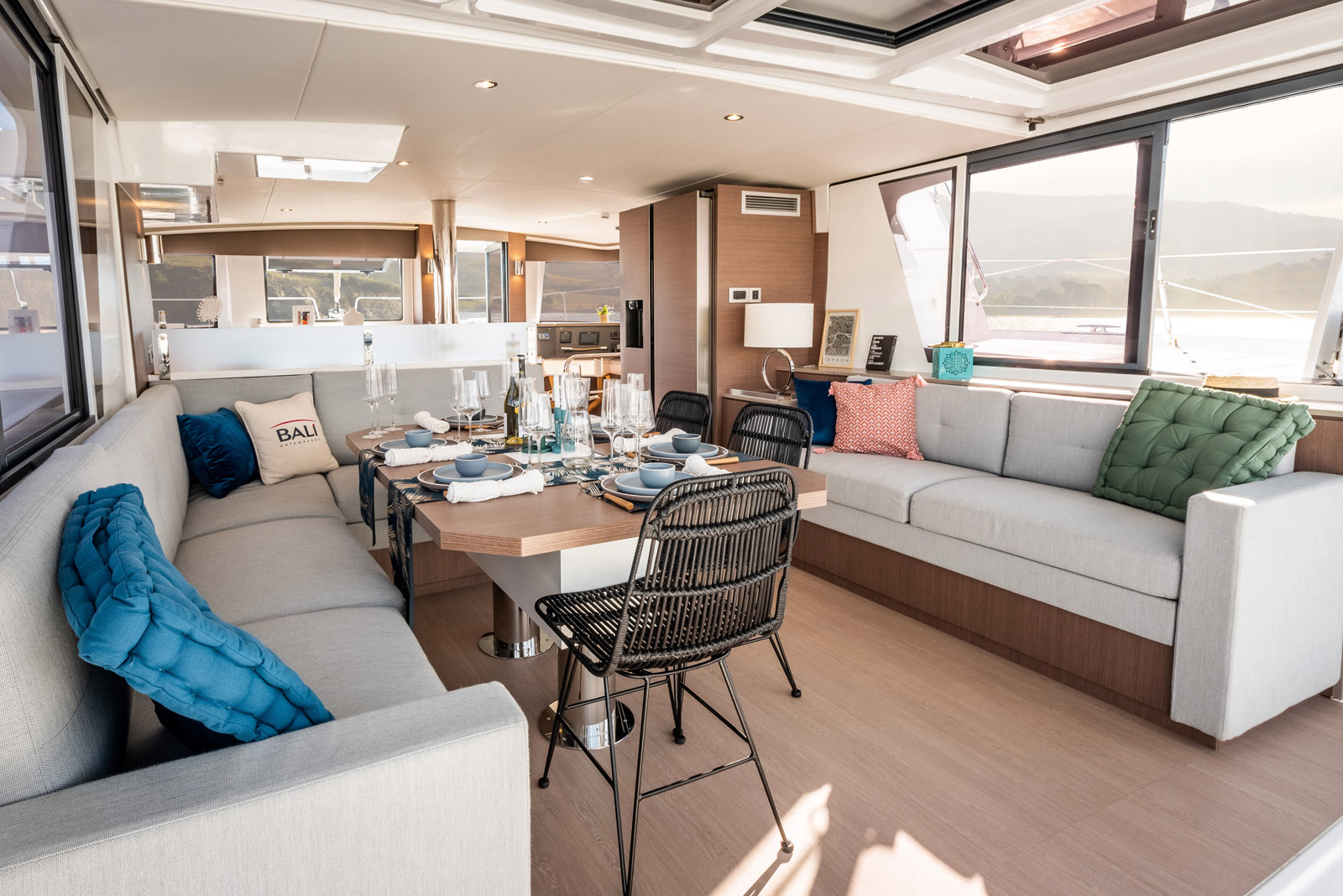
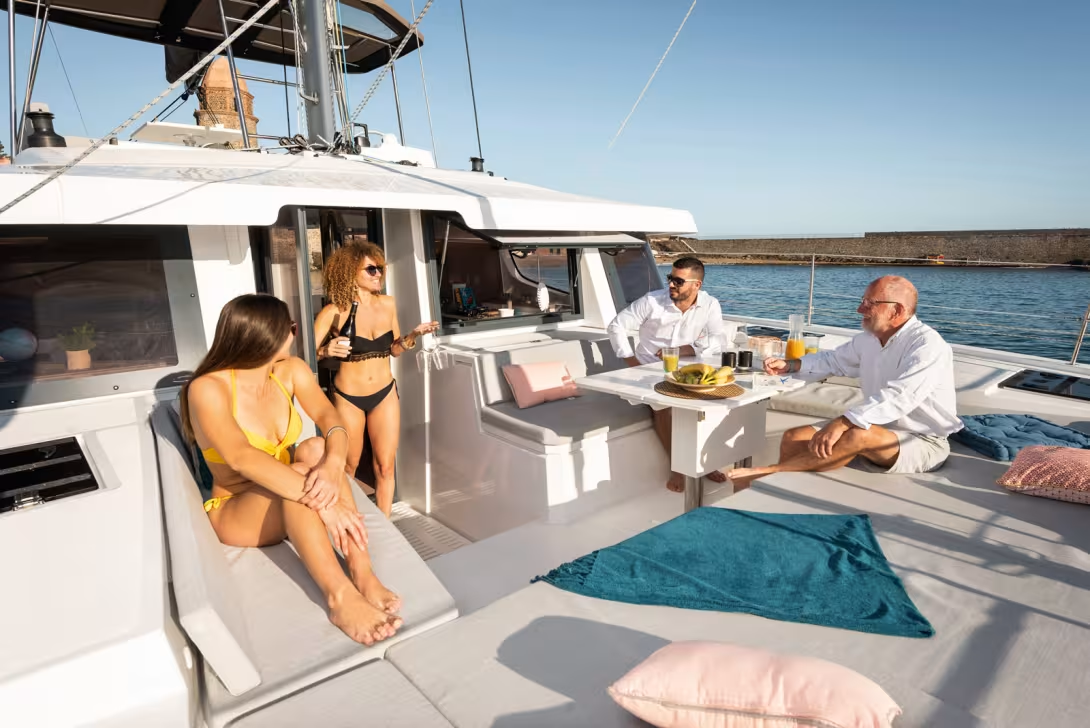
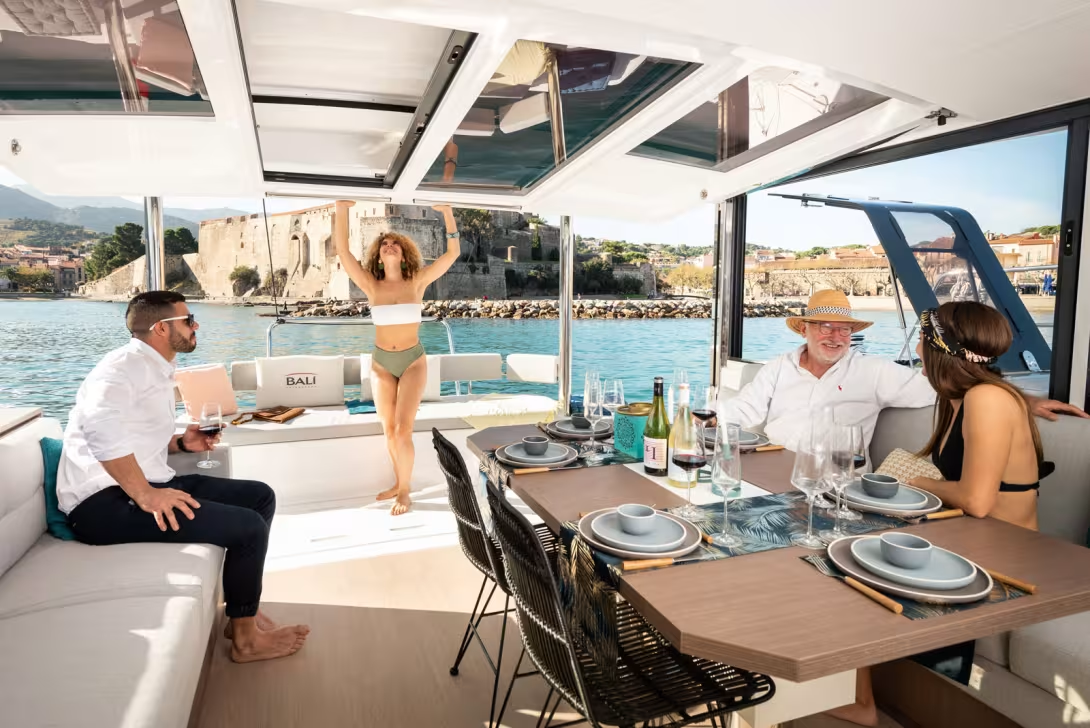
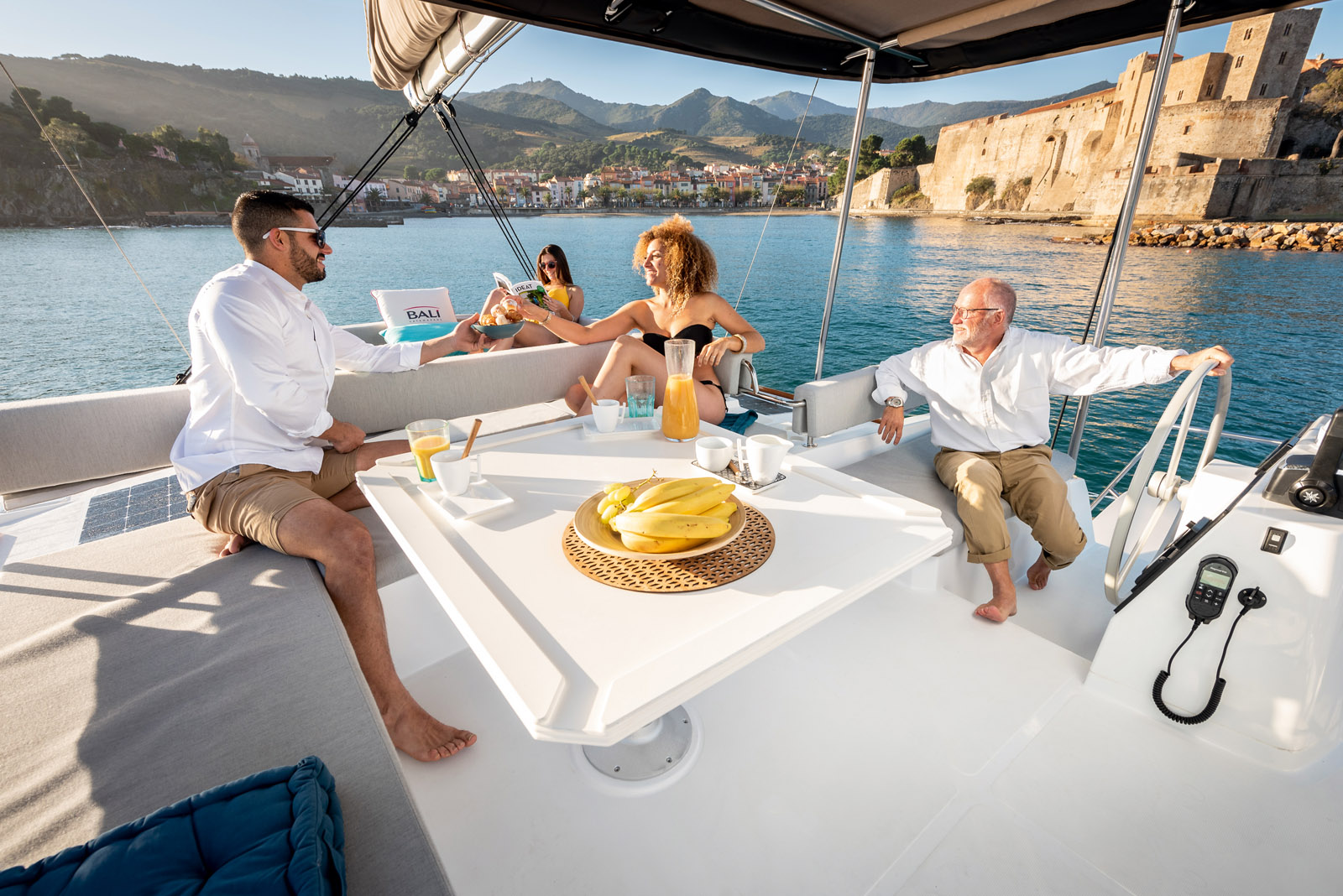
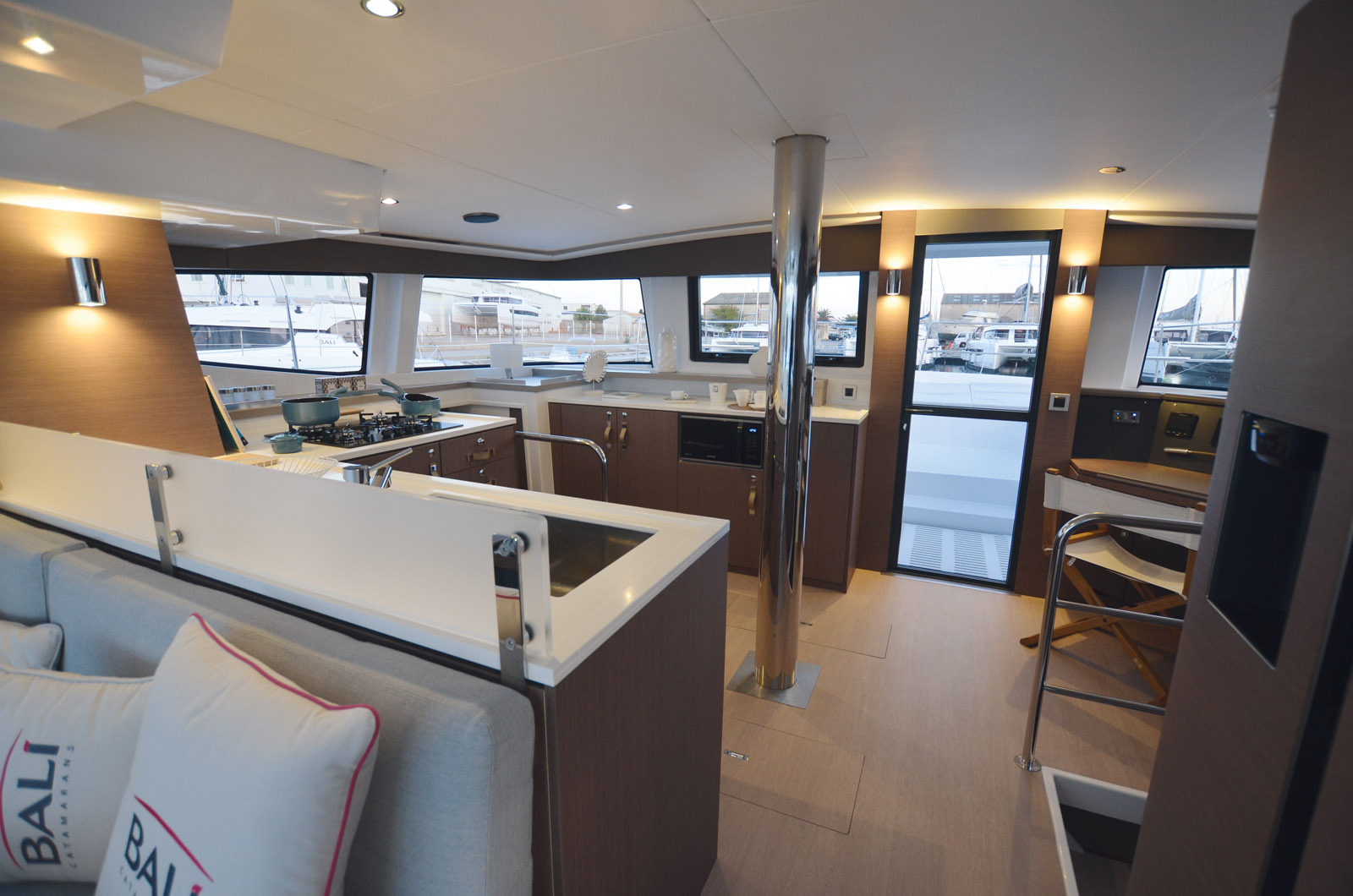
The Bali concept is a lounge open to the sea. This huge space combines lounge, galley in the middle and relaxation area on the foredeck.
In heavy seas, the sliding bay door will have to be closed - behind the sofa, the tv screen may be vulnerable
A high silhouette on the water
Before taking the helm of 4.6, I was tasked with going out on a motorboat to take a few shots. It was an opportunity to get a better idea of the design; where the straight bows exit the water, they invert at half the height in line with current trends, but you immediately notice the significant freeboard. This gives an interesting nacelle height and places the forward platform high - which guarantees a good tolerance for passage in rough seas. A concave reveal in the topsides, already enlarged with a strong chine, allows for concealing the openings and portlights in the hull (a little small, compared to the trend, and explaining the lack of brightness in the cabins) in a black paint. The coachroof cap covers two thirds of the length and the flybridge it houses enhances the silhouette with a semi-rigid bimini. The boom stands at a height of 16 feet (5 meters) and the flybridge is 10 feet (3 meters) high. From the outside, it looks like you’ll feel perched up high, but we’ll see when we get on board that it’s nothing of the sort.
 |
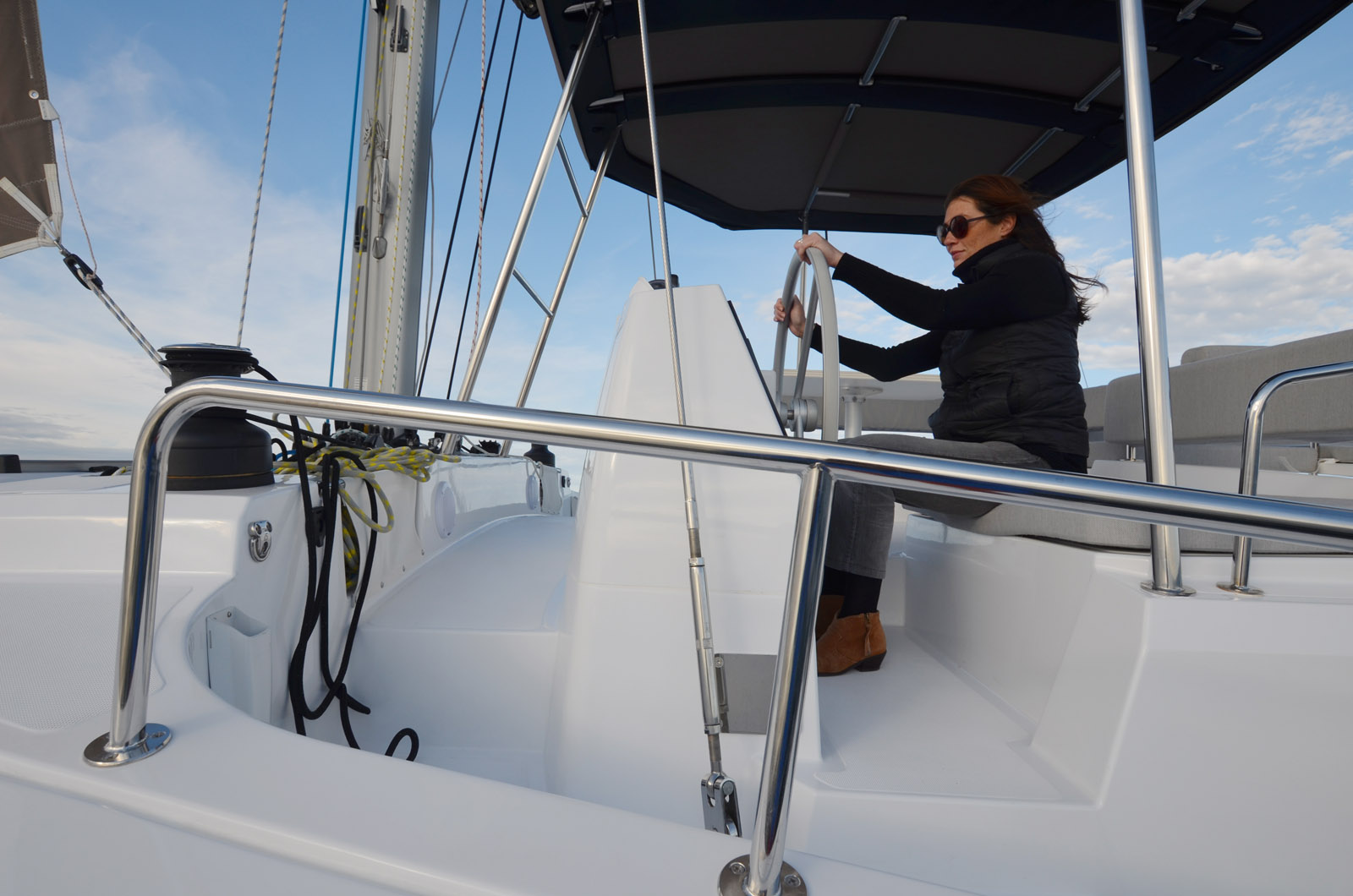 |
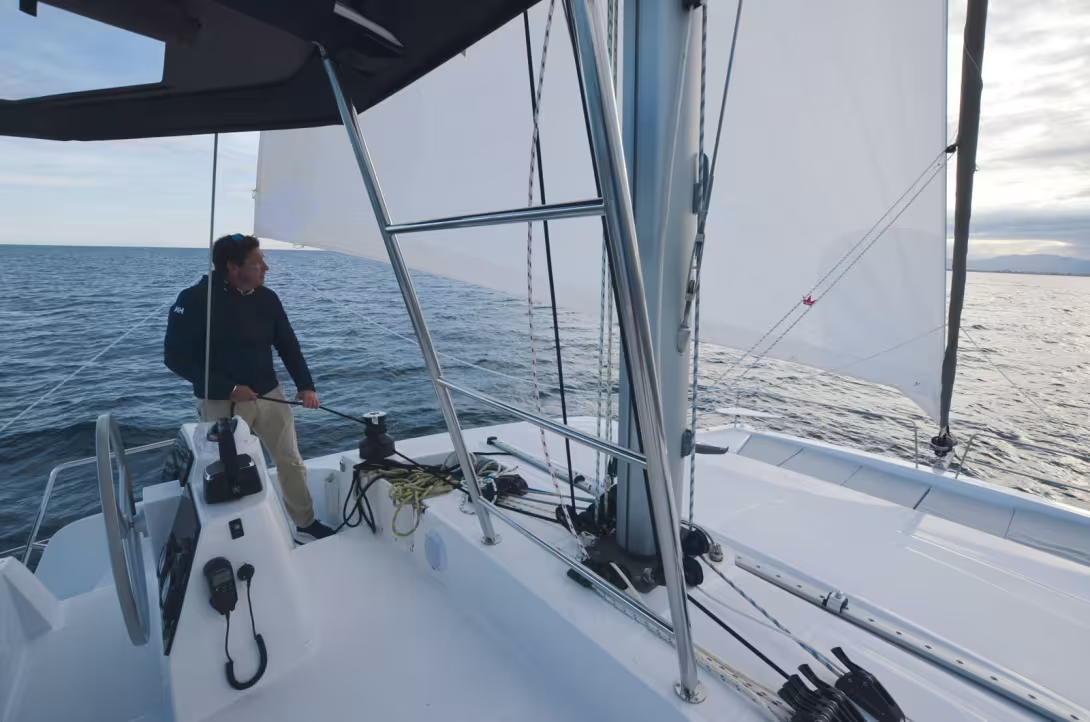
On the flybridge, a mini “Portuguese bridge” gives remarkable ease to sail trimming.
The lines are handled without disturbing the helmswoman or her passengers and all maneuvers are performed at the console.
Excellent deck ergonomics
From the dock, one step is enough for me to embark easily - so I hop onto the sugarscoop, climb the few steps, and immediately fall under the spell of this space that opens up right to the foredeck. The ventilation is surprising and dispenses with the need for any air conditioning (except for the cabins). The through-vision is very pleasant. With the low autumn light, the sun illuminates the aft lounge-dining room. It feels like a winter lounge, the sofa or the club chairs stretch out your arms and the table is already laid. The chilly wind forces us to close the hydro-electric rear bulkhead and in this warm atmosphere, we would gladly sit down. However, outside, Boris hoisted the self-tacking solent and here we are hard on the wind in fourteen knots true, with ease! Passing to the galley and the foredeck is done without any problem, even with numerous people on board. En route, you can grab something from the double fridgefreezer. As I join the crew, I pass the barbecue integrated into the sidedeck: gastronomy is clearly taken very seriously! Getting on and off the flybridge forward is easy and super safe - ideal for accessing a mini “Portuguese bridge” (a perfectly protected outside walkway) which incorporates all mast-foot sail maneuvers. Just aft, the helm station, then a lounge area and finally a nice sunbathing area. From this deck bridge, you can keep a course while trimming sails. The mainsail and self-tacking solent sheets are within easy reach. You can even bring back (via the deck winches) the furling lines and the gennaker or spinnaker sheets on the two electric winches. All maneuvers are therefore manageable from this bridge, disturbing neither the helmsman, nor those enjoying the deck saloon or lazing around in the sun. Brilliant!
 |
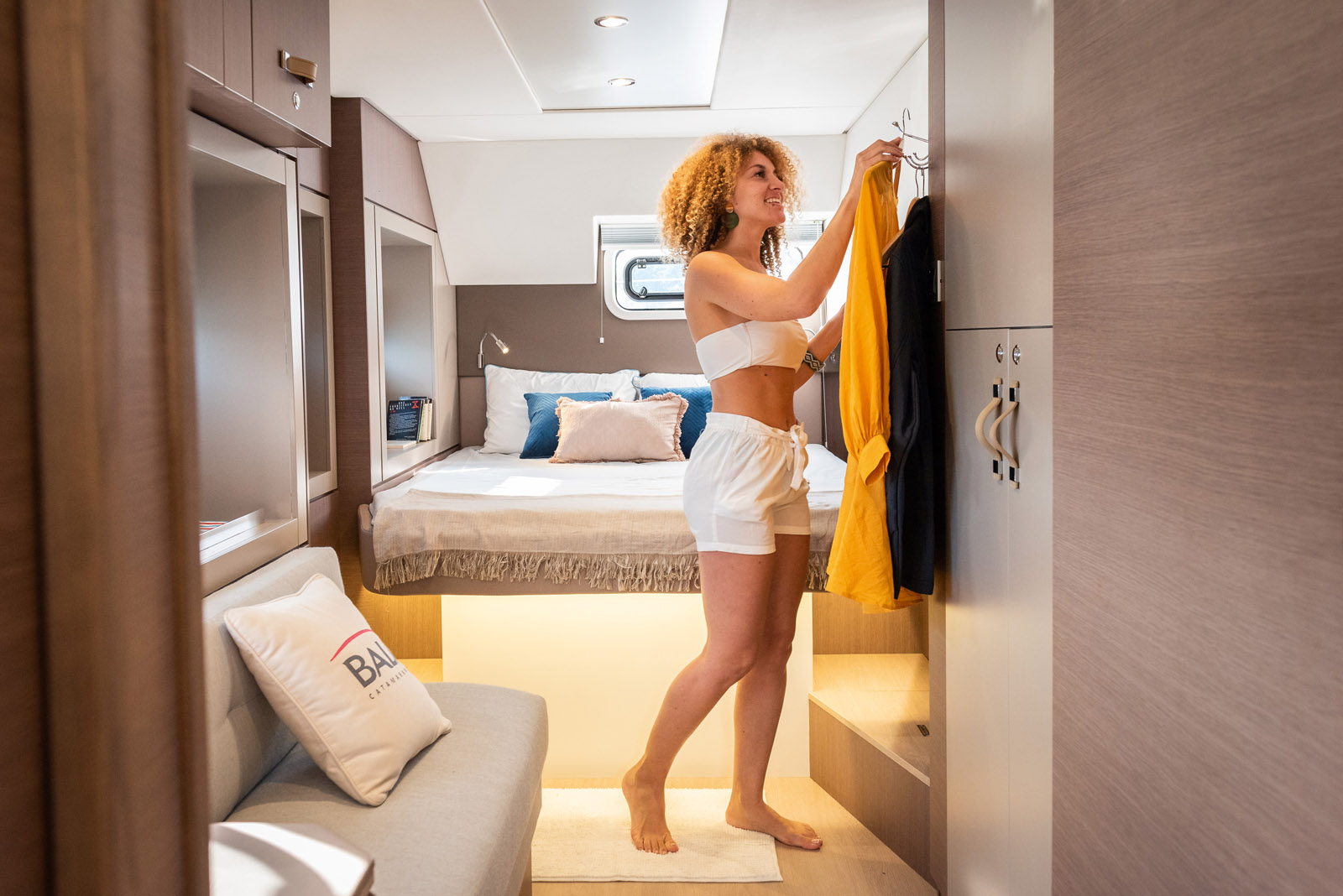 |
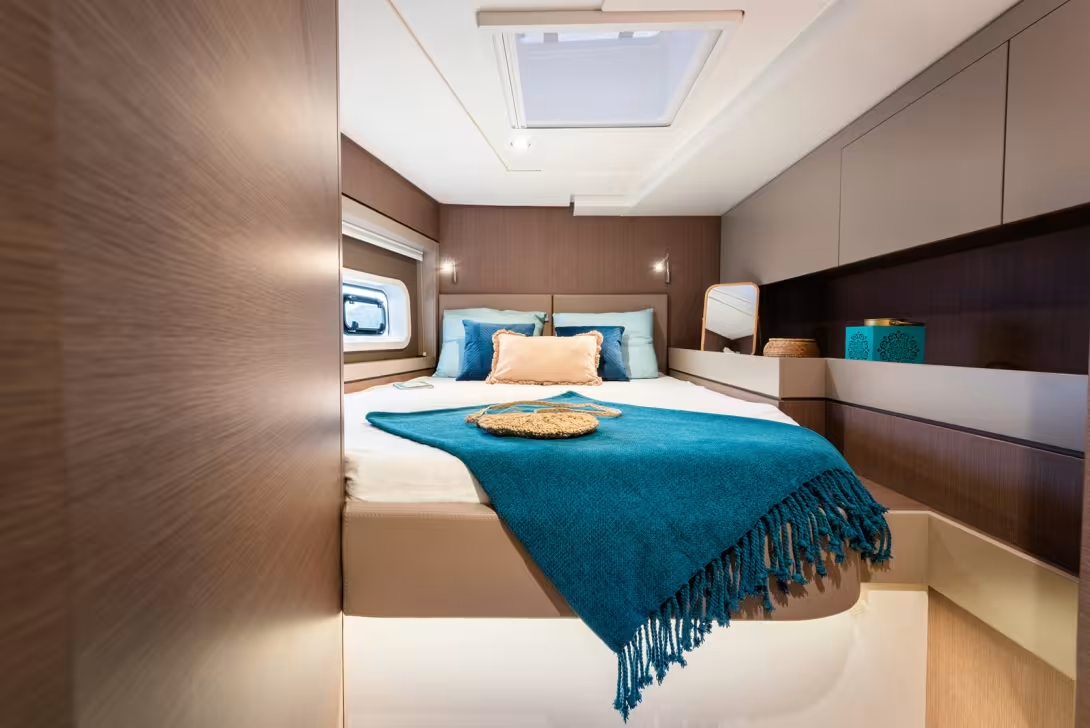
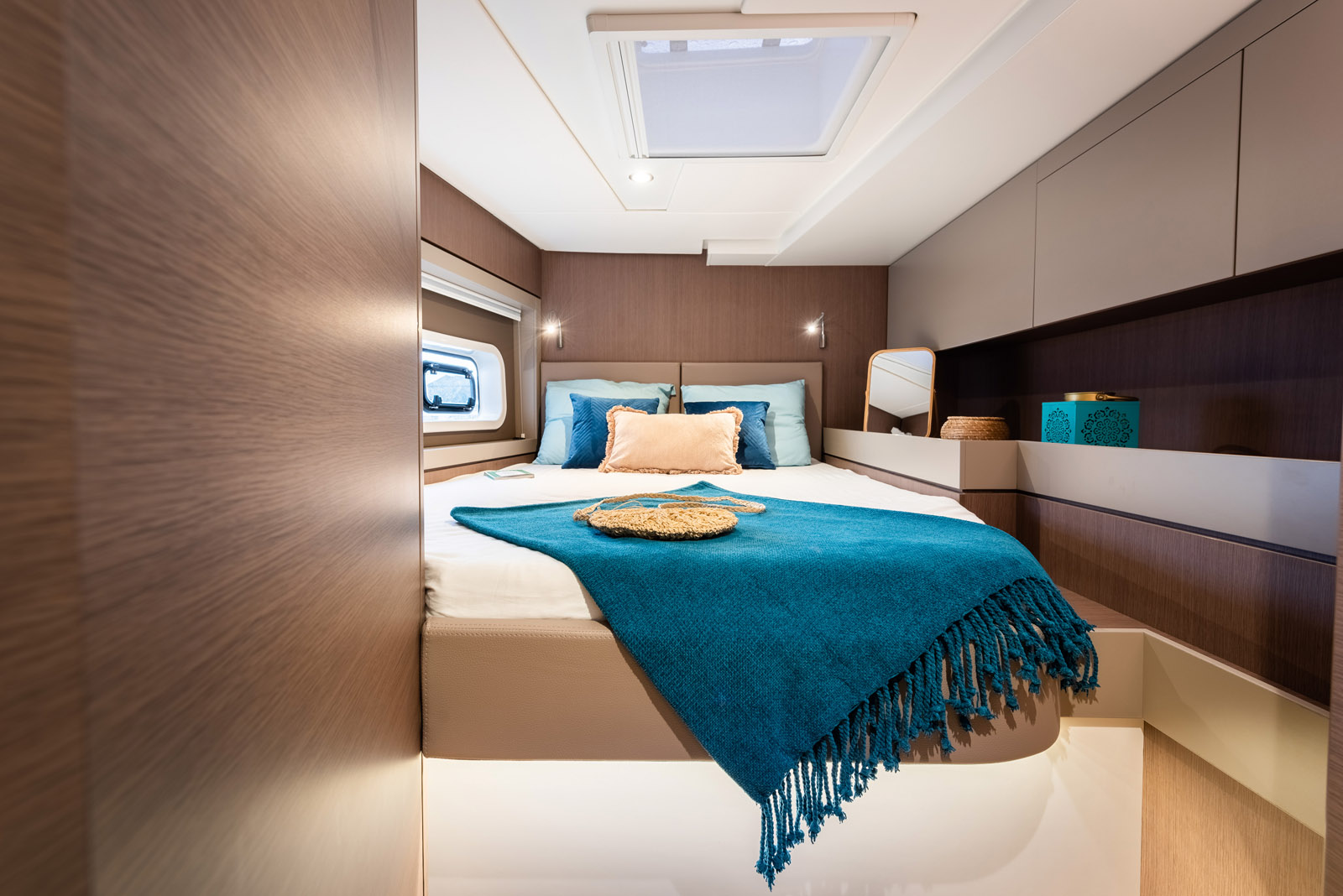
The owner’s cabin, which occupies the entire hull, is equipped with all the expected features - walk-in closet, bathroom forward, lounge area and bed aft. However, it is not very bright.
Sailing as if you were at home
Won over by the option to either have fun sailing or to relax, I made a few tacks in order to gauge the nautical aspects of the 4.6. A good sea had started to pick up with the fifteen knots of wind off Canet-en-Roussillon. In this chop, we were going upwind at 30° off the apparent, making 6 knots of boatspeed with the solent. Bearing off to 60°, the speed increased by a knot. To demonstrate how smoothly the hulls pass through the sea, I closed and then opened the aft bulkhead again while under way - no problem. The same goes for the galley: you can work easily there. The rigidity provided by the forward platform is quite noticeable. It contributes to a very pleasant “active” comfort. After a few tacks that allowed us to appreciate the smoothness of the helm system, we hoisted the gennaker. Furling lines and sheets are sent back to the maneuvering console and are unfurled and trimmed very easily. In a softening wind at 13 knots then 10, this sail propels us to an average of 7.5 knots, then 6.5 knots - which is very honorable. On board, everything is very easy and intuitive. With the engine, the cruising speed of the 57 HP Yanmars (option) is also 7 knots - you can push them harder, but the noise becomes frankly disturbing. More insulation, please!
 |
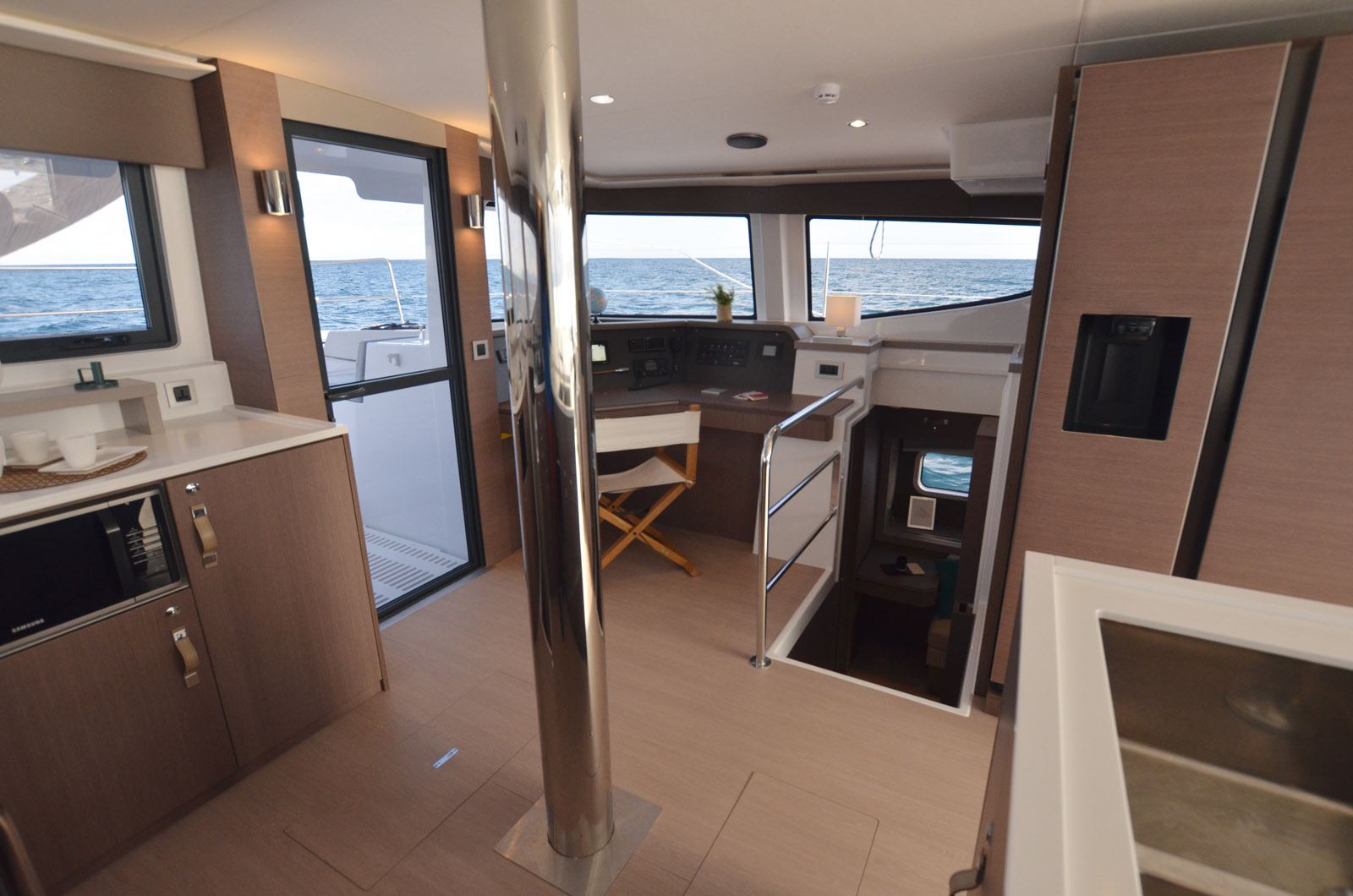 |
The clear space through the center of the catamaran is very large because there is no table. It hosts an XXL-sized galley, a chart table and an enormous refrigerator.
Conclusion
The results of our trip out were very positive - we want to go out again! Moving around on board is carried out with remarkable fluidity and the safety offered is real. Everywhere on board, you feel welcomed, expected - so you feel good everywhere, and the convertibility of this magnificent deck space makes for enjoyable cruising for ten or twelve people. This Bali 4.6 sets the bar very high in terms of sailing enjoyment for this category. Its price, manufacture, and quality of finish – up, compared to that of the 4.5 - make it a formidable competitor among 46-foot cruising catamarans.
Bali, an exotic brand, but rational manufacturing

Olivier Poncin, Catana Group CEO
We crossed paths with Olivier Poncin in the corridors of the shipyard, and he explained his choice of name for this brand in its own right - the idea was to be completely different from Catana. “I didn’t want to have to find a name for each model, as our competitors do, but to have a generic brand with a strong image, not belittled by the numerical naming of the models. Bali, an Indonesian island located between Java and Lombok, signifies well-being and lifestyle, according to local dialects. A paradise, by extension that brings good luck. This seems to be the case for customers who appreciate the gentle way of life aboard our catamarans”. But this apparent relaxation is due to rigorous work. Designers Xavier Faÿ and Lasta Design are constantly pushing the boundaries to use the smallest available square inch, while studying new innovative concepts. On the manufacturing side, three different factories are involved depending on the size of the models. The 4.8 and 5.4 are produced at the historic Canet-en-Roussillon shipyard in the South of France, where immense know-how has been acquired on the large Catana units. The small models - Catspace, 4.1 and 4.2 - where control of production costs is essential to remain competitive and profitable - are produced at the Haco plant in Tunisia. As for the mid-range sizes, the 4.3 and 4.6, they are produced at Marans, near La Rochelle on France’s Atlantic coast, a yard equipped with modern tooling.
The Pluses
+ Space and ergonomics on every deck
+ Easy and comfortable sailing
+ An array of innovation, especially the layout of the main deck
The Minuses
- Lack of brightness in the cabins
- Built-in TV needs more protection
- A little noisy under engine
TECHNICAL SPECIFICATIONS
Builder: Bali Catamarans
Designer - Architect : Olivier Poncin - Xavier Faÿ
Interior design: Lasta Design studio
Overall length: 46’10” (14.28 m)
Waterline length: 44’6” (13.56 m)
Beam: 25’2” (7.66 m)
Draft under keels: 4’ (1.22 m)
Light displacement: 30,000 lbs (13,600 kg)
Laden displacement: 41,900 lbs (19,000 kg)
Engines: 2 x 45/57 HP Yanmar
Roached mainsail: 835 sq ft (77.60 m²)
Jib: 475 sq ft (44.20 m²)
Gennaker: 915 sq ft (85 m²)
Spinnaker: 1,460 sq ft (135.50 m²)
Fresh water: 211 US gal (800 l)
Fuel: 211 US gal (800 l)
Refrigerated capacity: up to 21.7 cu ft (615 l)
Basic price with 45 HP engines: € 489,300 ex-tax
Price of the model we tested: € 548,640 ex-tax
Excellence Pack: € 52,940 ex-tax
Elegance pack: € 17,400 ex-tax
Solar panels 400W: € 4,800 ex-tax
Aluminum canoe boom with led lights: € 10,830 ex-tax
ONAN Generator 9 kW: € 20,900 ex-tax
 |
 |
