
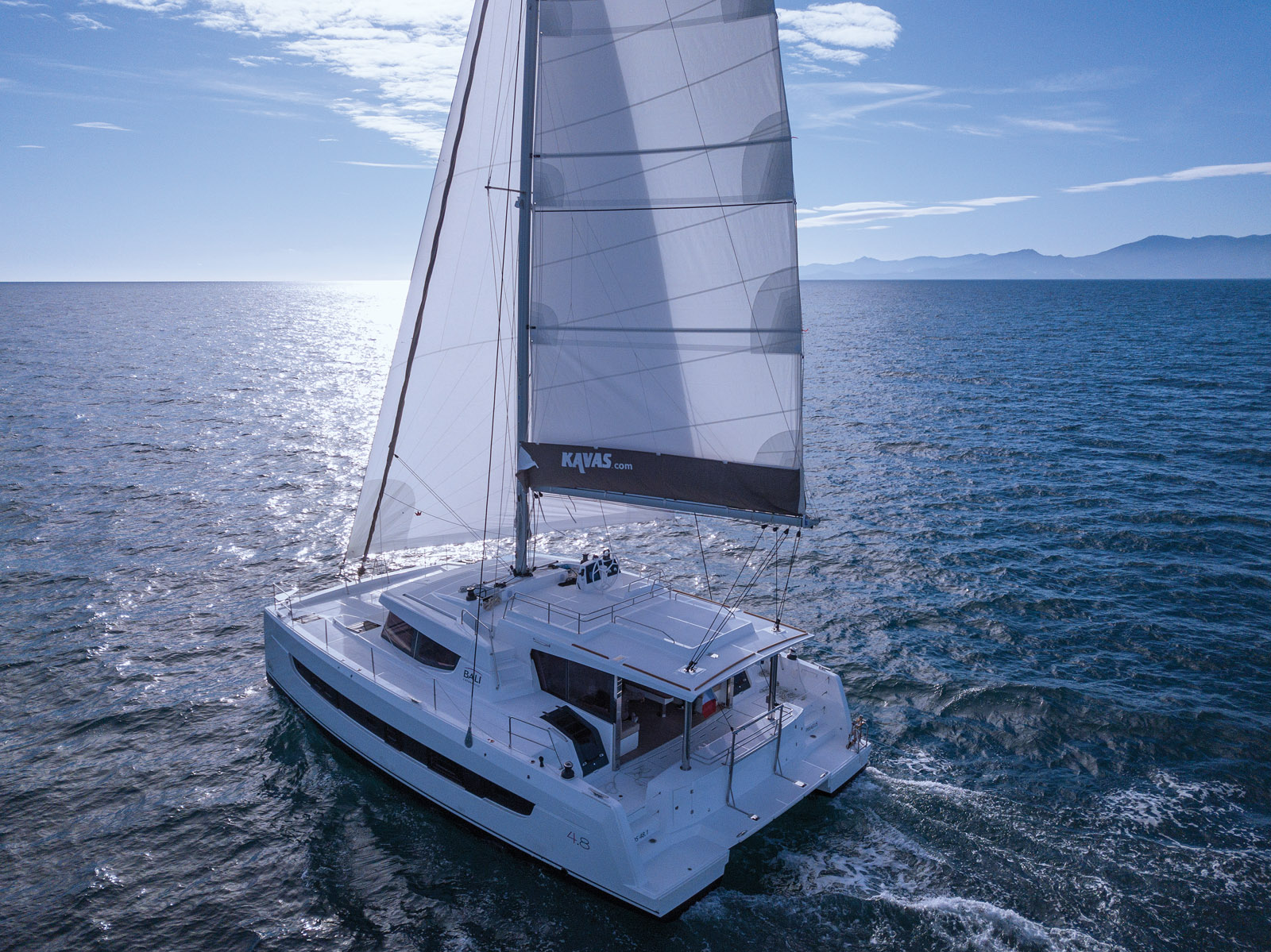
Five years after their launch, it’s clear that the Bali range, created from scratch by Olivier Poncin, has silenced the doomsayers. Not only have the Catana Group become one of the top four catamaran builders in the world, but they are also pursuing their ambition by producing a model to match every size offered by the competition. While waiting for a 4.6, the 4.8, the brand’s seventh opus, is filling a fairly large gap between the 5.4 and the 4.5, with all the expected Bali features - and some new ones too.
Infos pratiques
- Le chantier : Bali 4.8
- La fiche technique
- Découvrez notre vidéo exclusive
- Financez votre Bali 4.8
- Assuez votre Bali 4.8
- Articles autour du Bali 4.8
With their rigid foredeck, their fully open interior, their full-width tilt-and-turn door transforming the saloon into a cockpit - or vice versa, in a matter of seconds - their huge 220 V refrigerators “just like at home”, Bali has made the most conservative yachtsmen who haven’t yet assimilated the multihull revolution shout out loud. Even their aficionados were skeptical about the “behavior at sea”, the “performance”, the “stiffness” of the whole platform... But this was forgetting that the Bali brand didn’t come out of nowhere. Technically, Bali boats benefit from Catana’s know-how, notably an integral construction in closed-cell PVC foam sandwich, and above all bulkheads which are not simply glued but laminated, a guarantee of rigidity and longevity. The yard’s facilities have grown exponentially in Canet-en-Roussillon, in the South of France: from around 100 employees, the group has grown to nearly 900 including its sites at La Rochelle and in Tunisia. The 350 catamarans produced in less than five years confirm the step up to an industrial pace.
Five layout options from 3 to 6 cabins
With rigorous organization, the Bali 4.8 retains a certain level of flexibility in order to offer no less than five versions. There is, of course, the attractive 3-cabin version with a huge owner’s hull including separate WC, interior companionway, but also having direct access to the starboard transom for a private morning swim for example. There are also the more traditional 4 and 5-cabin versions. But where the 4.8 really comes into her own, is in offering for the first time on a multihull under 15 meters (50’) in length, 6 double cabins and 6 en-suite bathrooms. Knowing that via professional charter companies or through the charter-management of privately owned boats, two thirds of catamarans built are destined for charter, there’s no need to get out your calculator to work out what investors will see in this catamaran, compared to what was until now the “norm” in the 50- foot bracket.
Already the second-generation Bali!
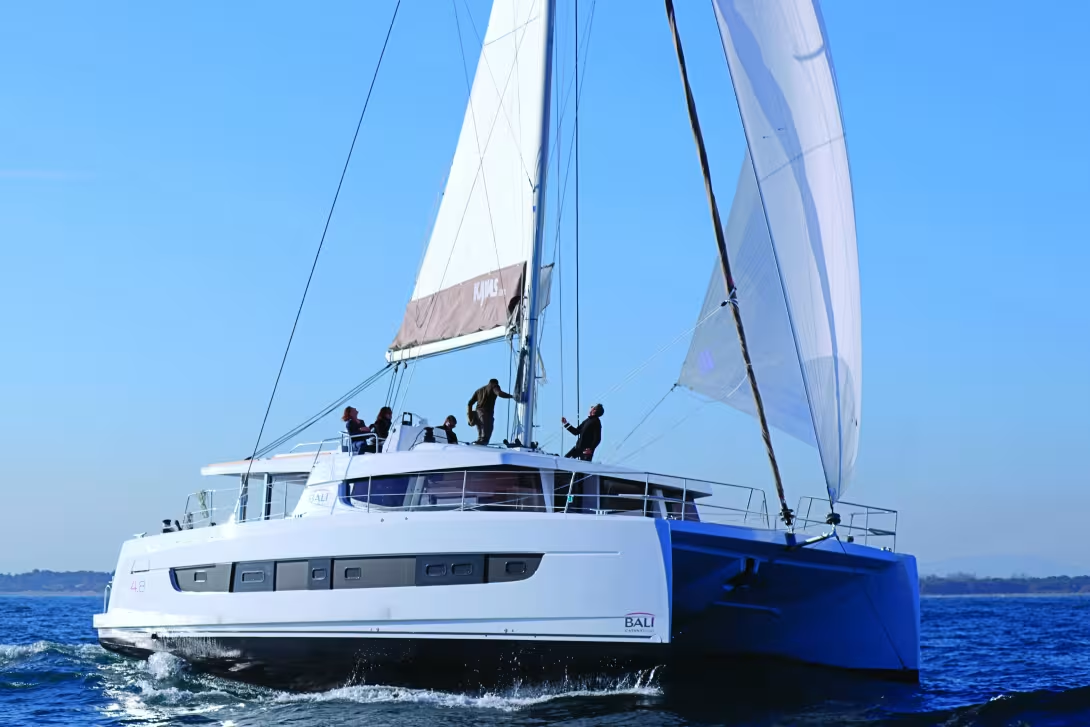
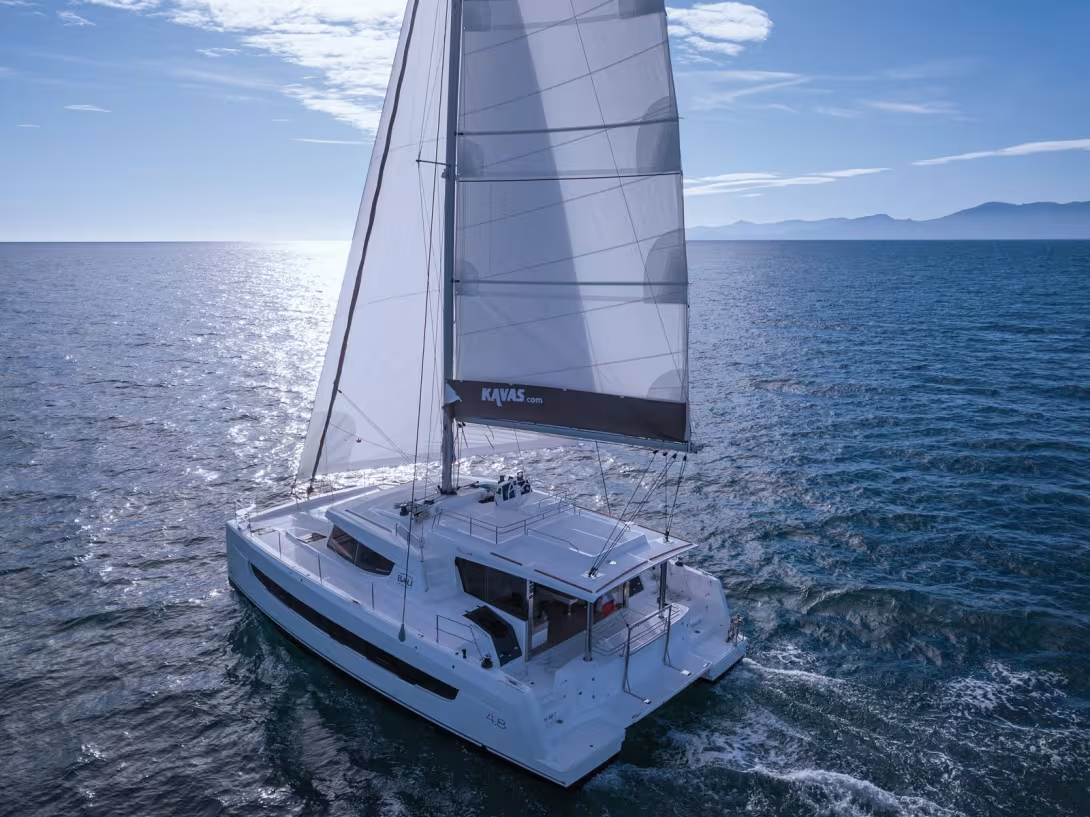
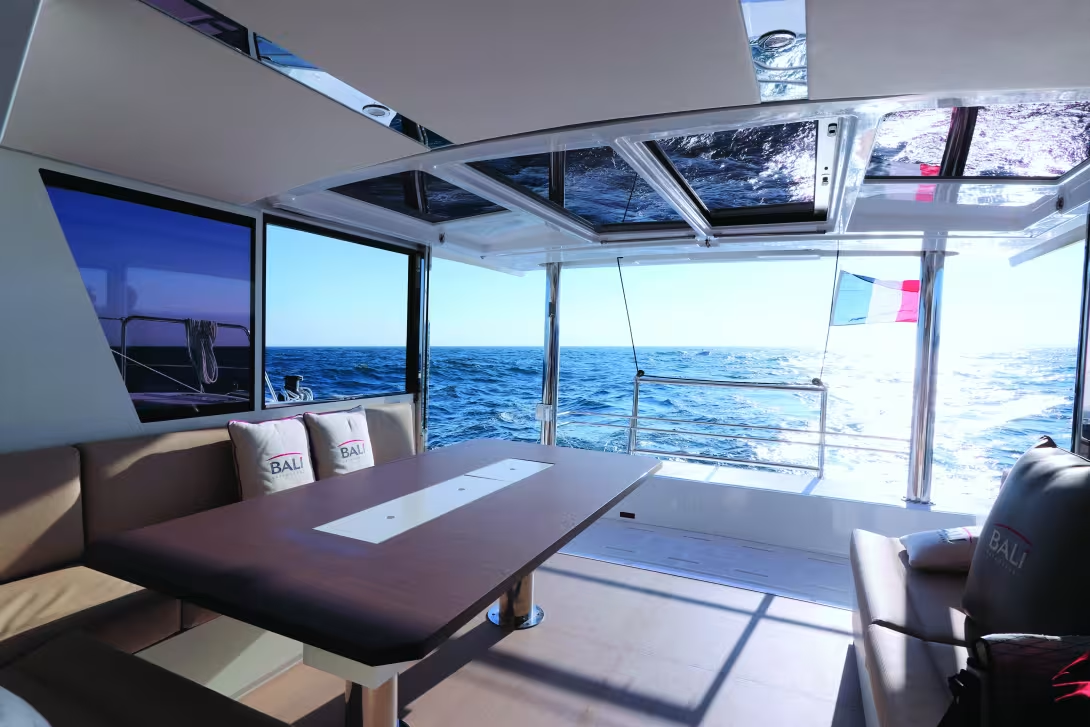
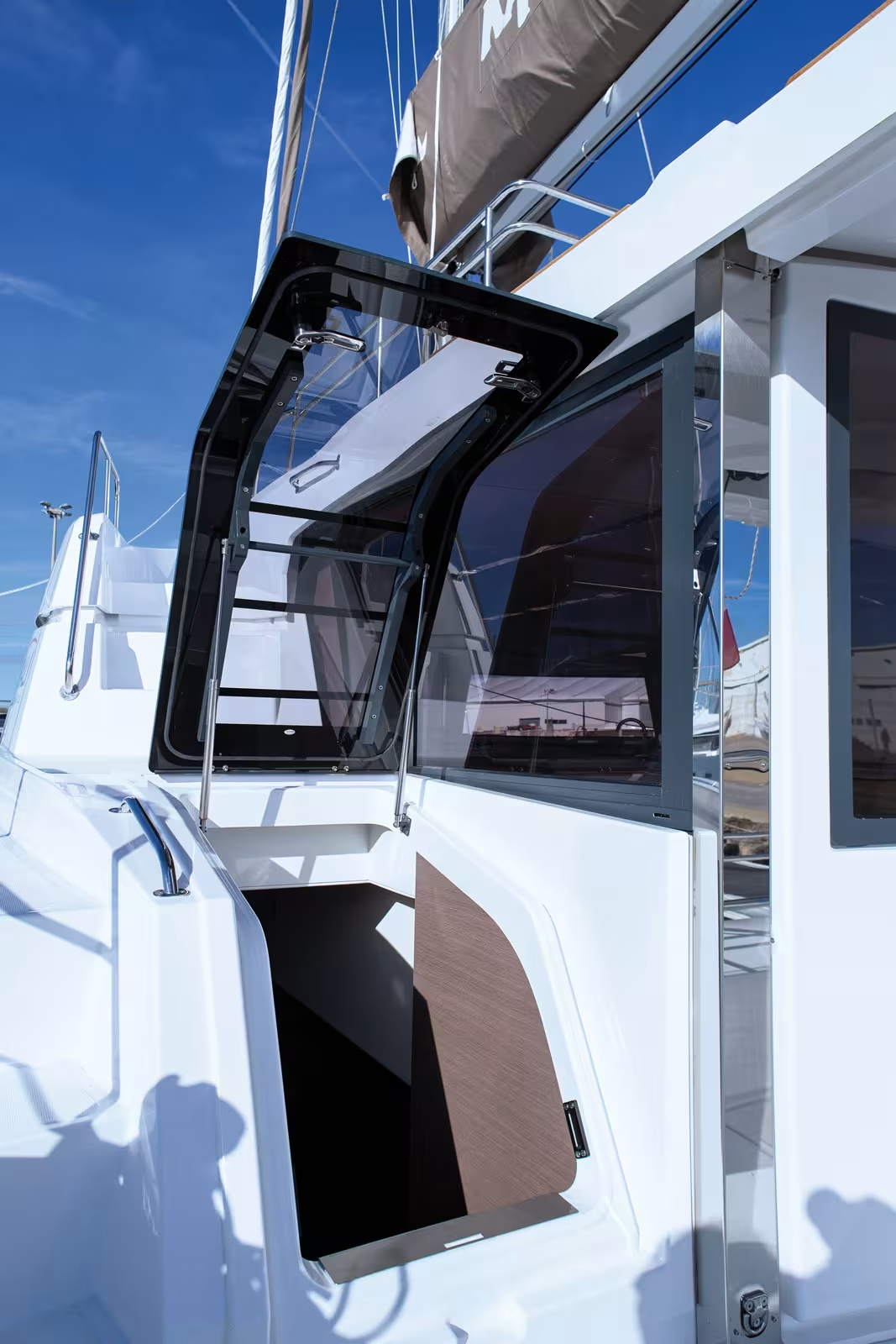
But does this economic promise go hand in hand with attractive nautical qualities? At the very beginning of winter, we had the opportunity to conduct an on-the-water test of the one that the yard is (already) presenting as the first Bali in the second generation. What distinguishes her from her predecessors, apart from the size of course, is first of all an evolution in the exterior style. It’s more fluid, in line with the Bali Catspace, which was unveiled almost simultaneously. It’s the accumulation of small details in the design: an angle cut here makes the immense volumes a little less massive; larger dark inserts there make the very large hatches a little less conspicuous; the whole is more pleasing to the eye... Moored alongside the pontoon, getting aboard is easy via the sugarscoop that extends beyond the imposing topsides. The height, and therefore the windage, remains quite impressive. The existence of a proper flybridge accessible from both side-decks, with a helm station on the starboard side, a seat and a table that can be transformed into a huge sunbathing area, is no doubt not without reason, even though we are only talking about a “small” 15 meter, (14.28 m / 46’10”) hull to be exact. However, beyond this flybridge, the Bali 4.8 has everything you’d find on a big boat. Or rather, a lot that you’d find on her big sister, the 5.4. Starting with a remarkable 3-meter (10’) wide swinging door at the stern which, complemented by sliding windows on the sides, transforms the saloon into a cockpit, and vice versa, in no time at all. And we’ve got to admit that when the breeze freshens and the sun goes down very quickly in this month of January, it is really attractive to find, once the whole thing is closed in a few seconds, a cozy interior. Suddenly, everything outside is muffled, protected from the wind, the cold and even from a large part of the exterior noise. What’s more, the space remains really impressive, even if it’s reduced by the meter (3’3”) of outside space that connects the sugarscoops skirts or the two engine compartments, depending on which way you look at things.
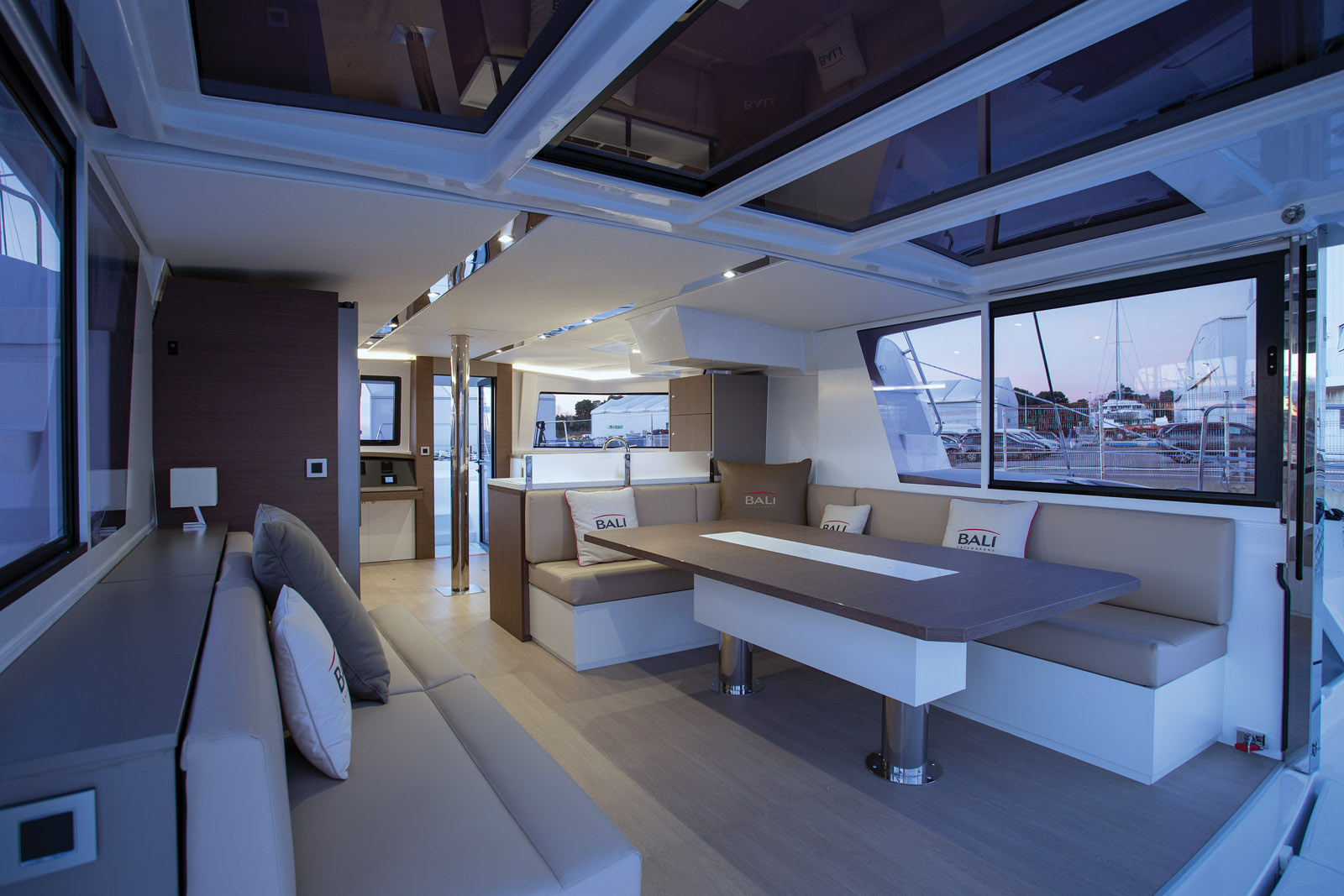
A refrigerator for 12 crew
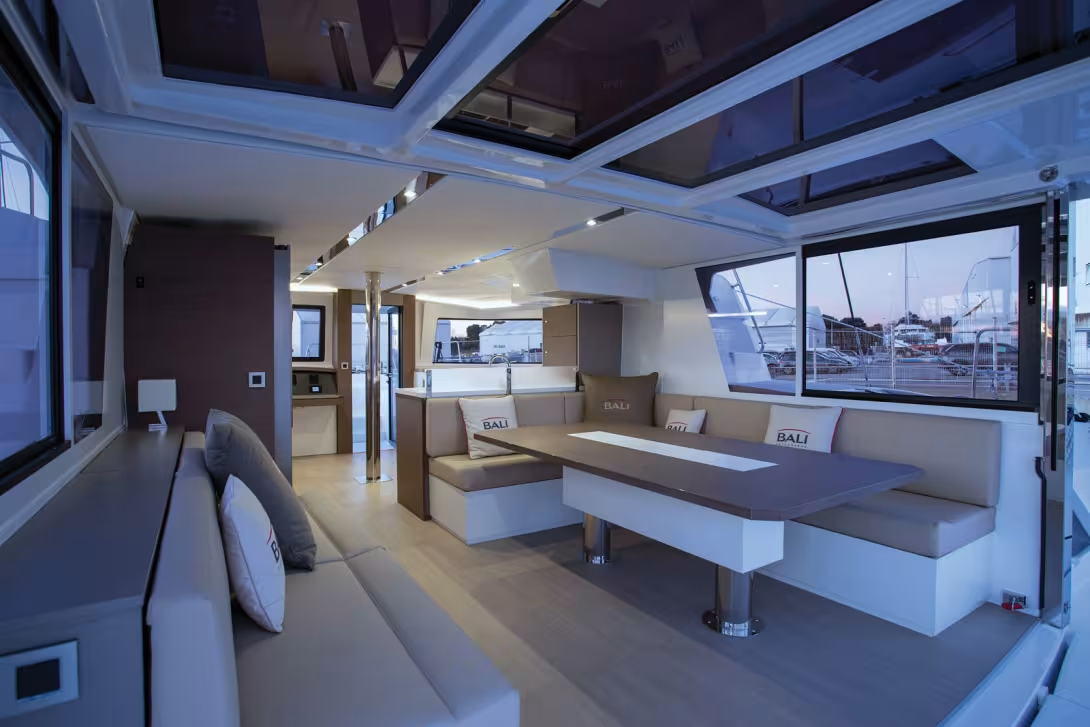
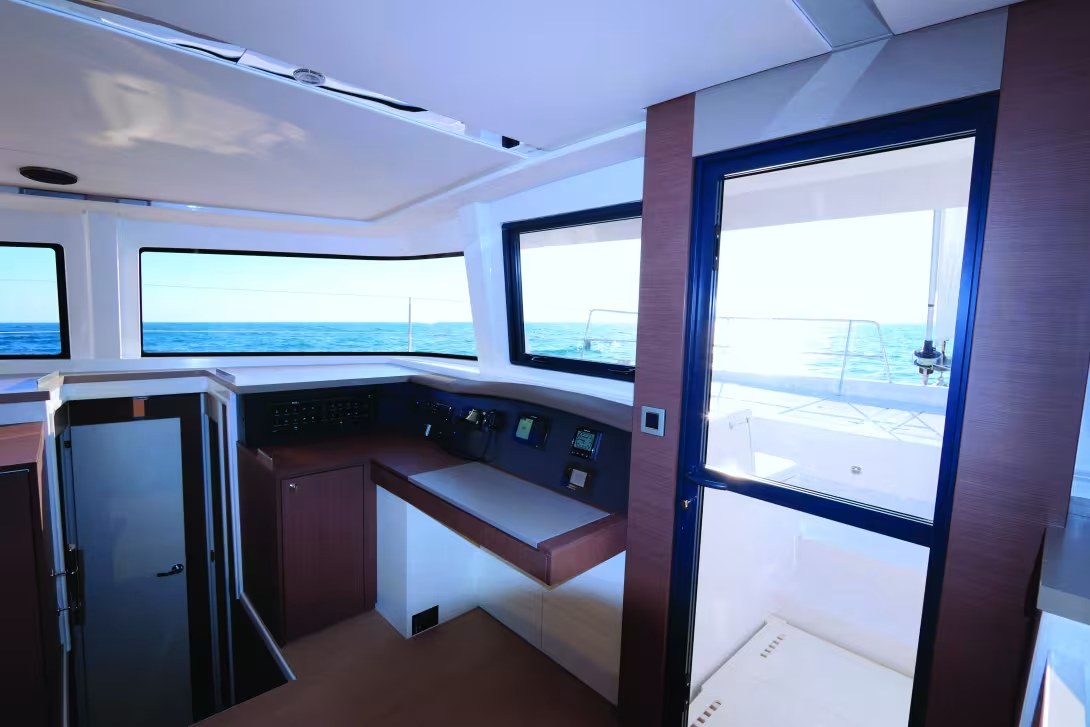
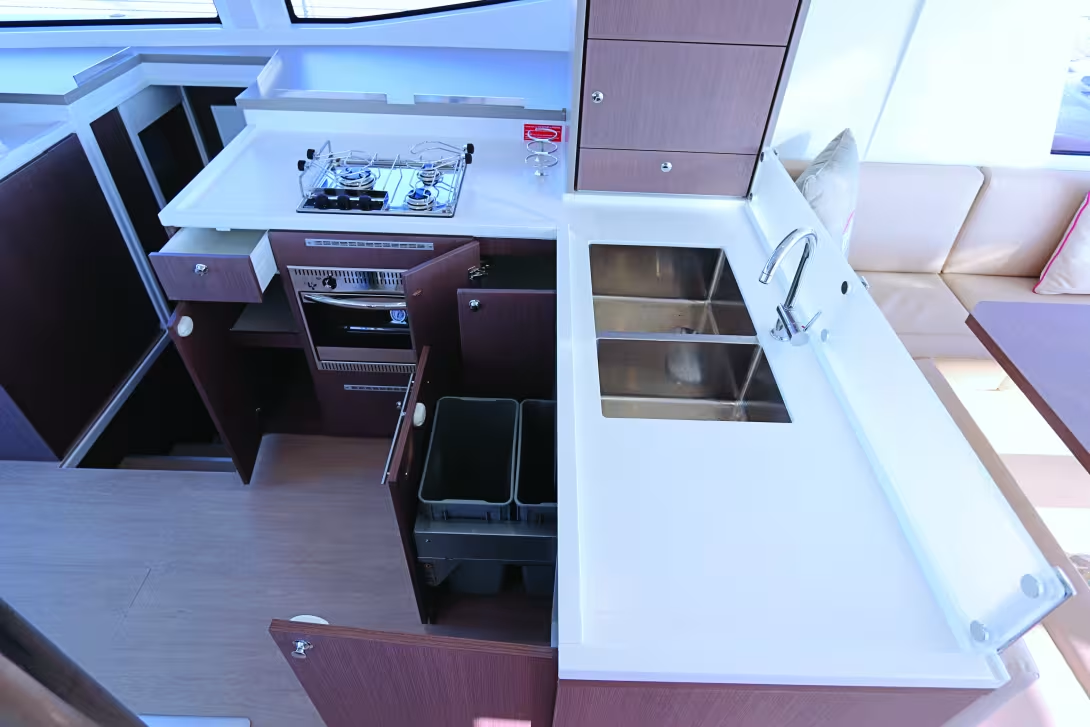
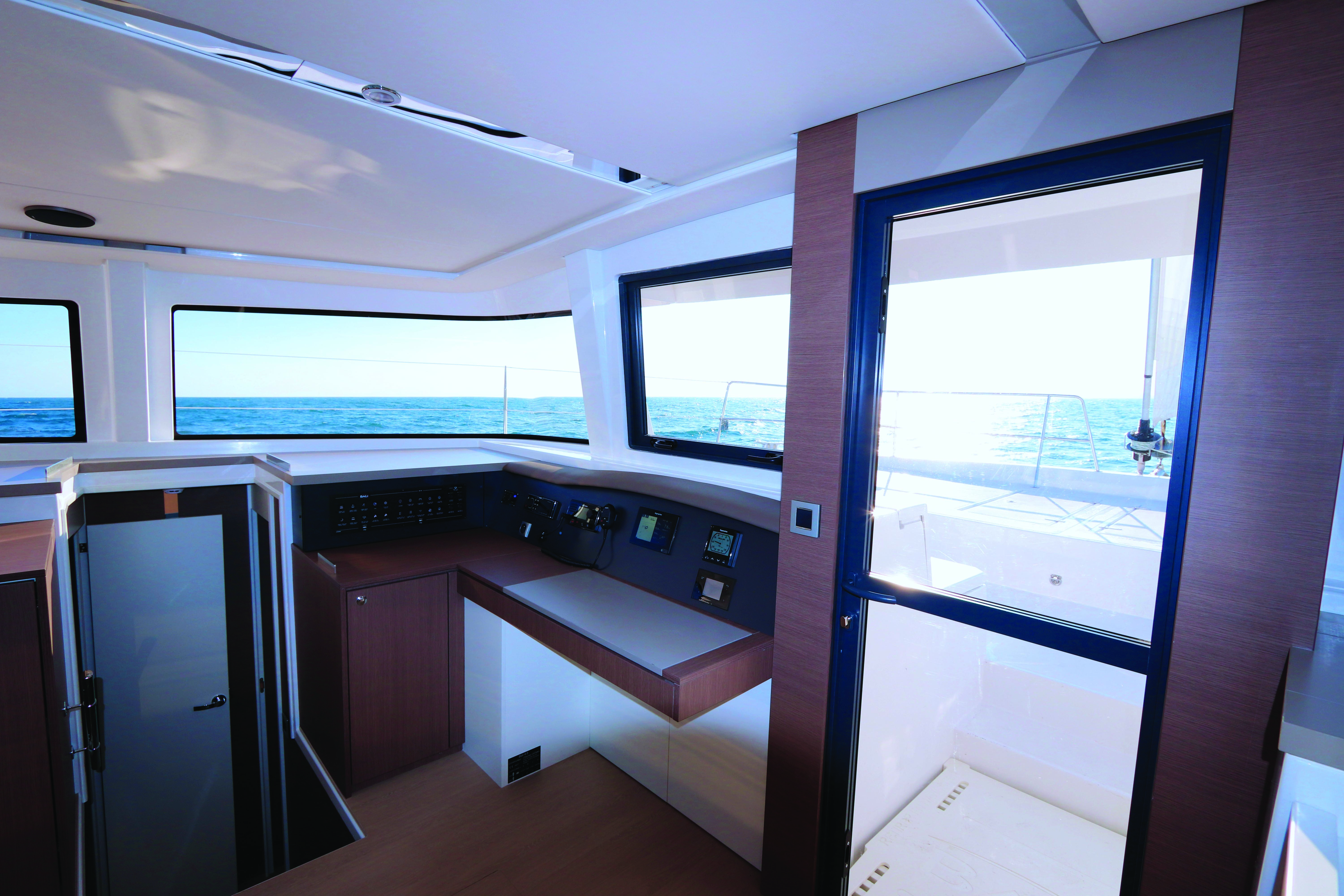
Once inside, imagine a saloon, galley and chart table area of a good 27 m² (290 sq ft), entirely on the same level, and in which light enters through portholes from almost 360 degrees. As the table (220 x 116 / 7’3” x 3’10”) and the seats (6.5m / 21’ of cumulative length) are both those of the cockpit and those of the saloon, the dimensions are more than generous. The refrigerator/freezer unit cleverly sits between the saloon and the galley, easily accessible from either of these two privileged living areas. With its double door 1.60 m (5’3”) high, it looks huge, but it can cater for no less than 12 crew members on board. The galley itself is not lacking in space, with 2.60 m (8’6”) of Corian-covered worktop. The storage space hasn’t been neglected, whether it is high up (where a microwave can also be integrated), or lower, with a clever compartment dedicated to waste sorting, but also on the port side and finally forward to the chart table. The latter benefits from a nice surface area, and is usefully forward-facing, and offers a panoramic view. It is both pleasant when the sea is idyllic and reassuring as you keep a constant watch on the coast, the buoys and other boats.
Forward door and ski-effect
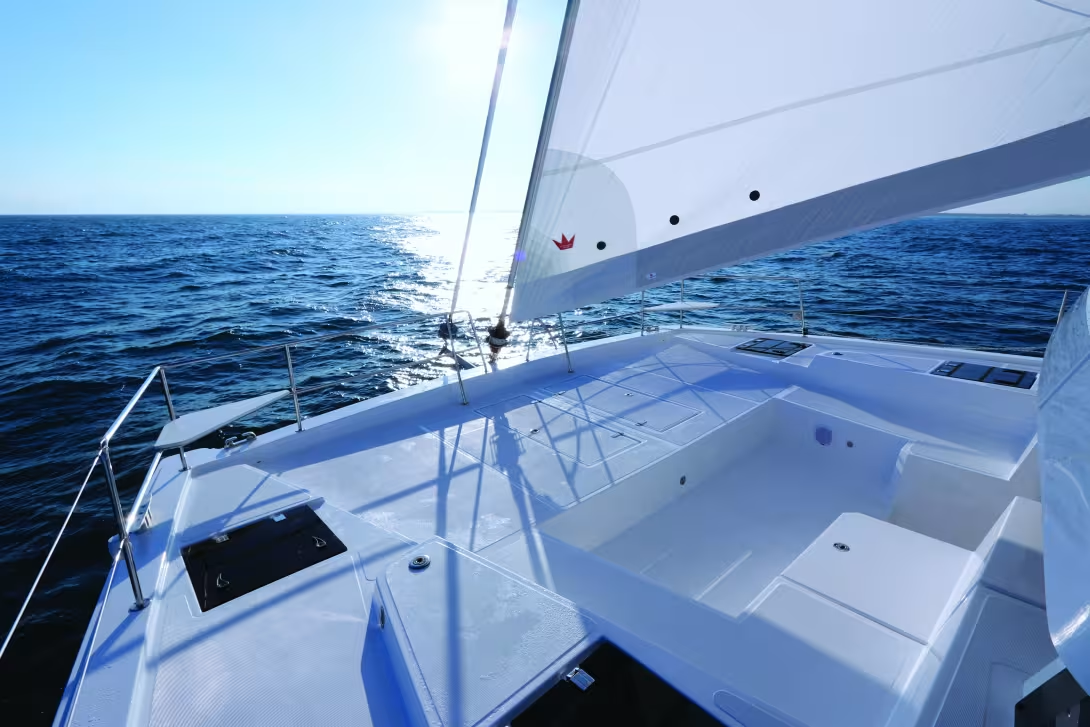
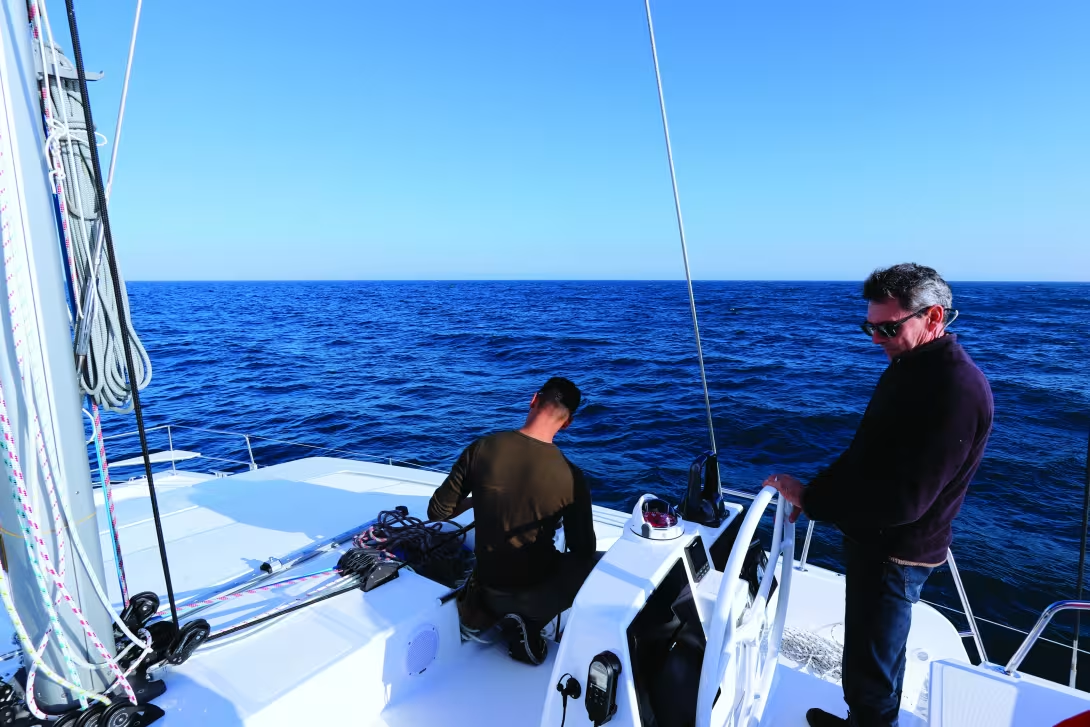
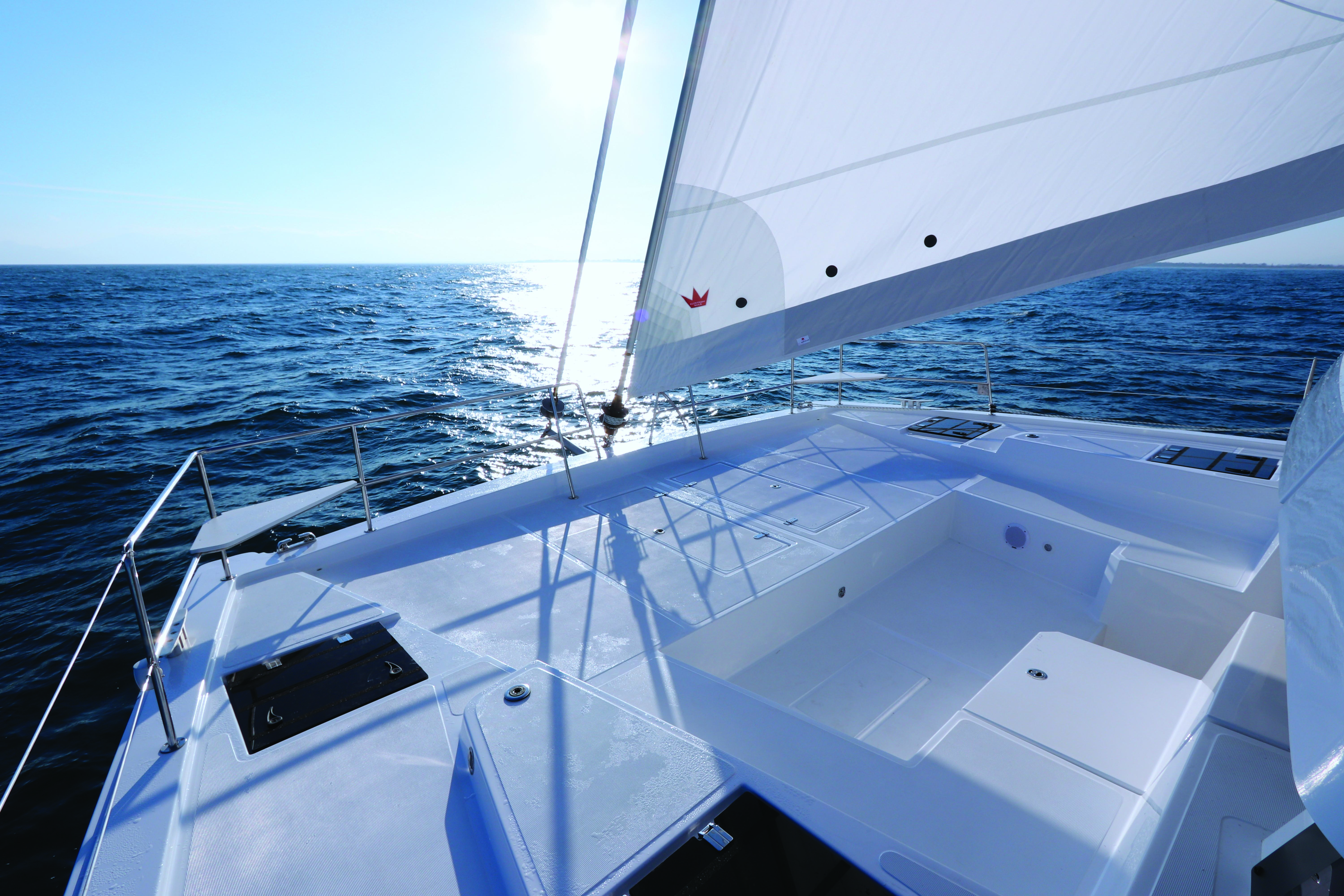
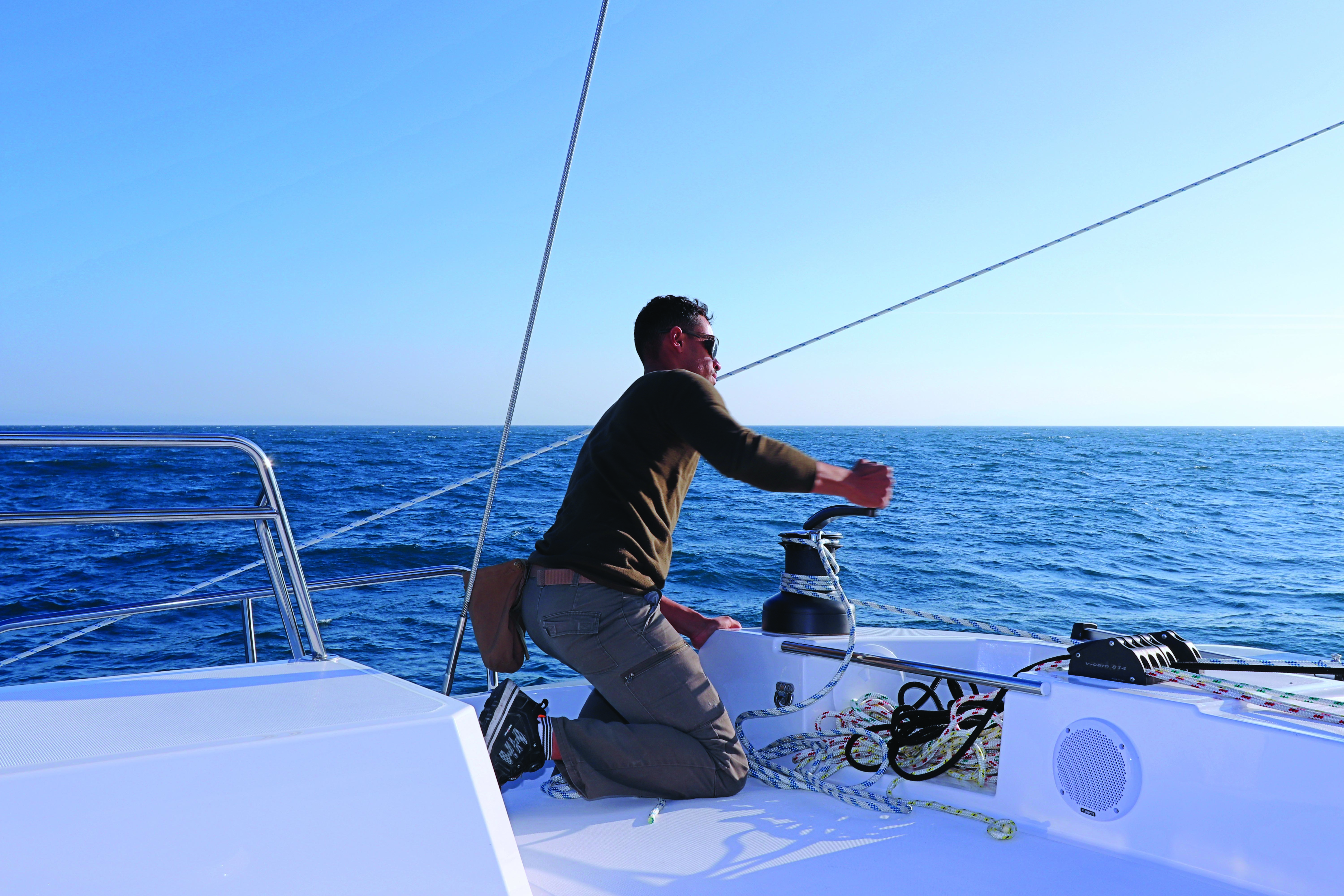
The other feature borrowed from her big sister, the 5.4, is the forward door. Slightly offset to starboard, it gives access to the foredeck. The term deck is used deliberately here, as the forward cockpit would probably be too restrictive. Indeed, this beautiful space of nearly 15 m² (160 sq ft) offers two L-shaped benches surrounding a table at the back, and a forward sundeck occupying the entire space between the two hulls, right up to the bows. This is the advantage of this entirely rigid section, which Bali dared to replace the traditional trampoline with. Initially perceived as heresy by any multihull enthusiast (me first) who has been aboard the boat for a while, two characteristics upset our preconceived ideas. First of all, from our photo boat, as the Bali confronts the characteristic swell head-on as you come out of Canet-en-Roussillon, I notice that the forward composite beam is particularly high and that the shape of the nacelle descends very gradually towards the foot of the mast. And if you really want to imagine the worst-case scenario, while a trampoline doesn’t in any way prevent the boat pitching down into the water, the rigid platform acts “like a ski in powder”, as our chief boat tester, Philippe Echelle, would say. So, this dynamic favors the bows to rise up out of a wave that might be bigger than others. If the bows are high, then so is the helm station on the flybridge. The advantage of this is that all four corners of the catamaran are within sight, but the downside is that you feel a bit isolated during port maneuvers. You’ll have to rely on a good pair of crew members to pass the lines ashore. On the other hand, within easy reach of the mast foot, all sail trimming maneuvers are within reach, even if the winches are a little low for my liking. Conversely, a disadvantage inherent in the flybridge formula, the boom is perched very high. At 8 knots with the engine at 2,400 rpm, the Bali 4.8 quickly cleared the coast to find a light southerly breeze of around twelve knots, once past Cape Béar. As the boat struggled to exceed 6.5 knots under the selftacking solent, doubling the surface area of the fore-triangle by unfurling the Code 0 (90 m² / 970 sq ft compared to 47 m² / 505 sq ft), immediately brought the Bali 4.8 to life. Without claiming that she was born for performance, her behavior is more than I expected. Cruising at 8.5 knots, at 95 degrees off a wind blowing at a mere 13 knots, is no disgrace in our eyes for a purely cruising or even charter catamaran.
Direct access to the cockpit from the aft cabins
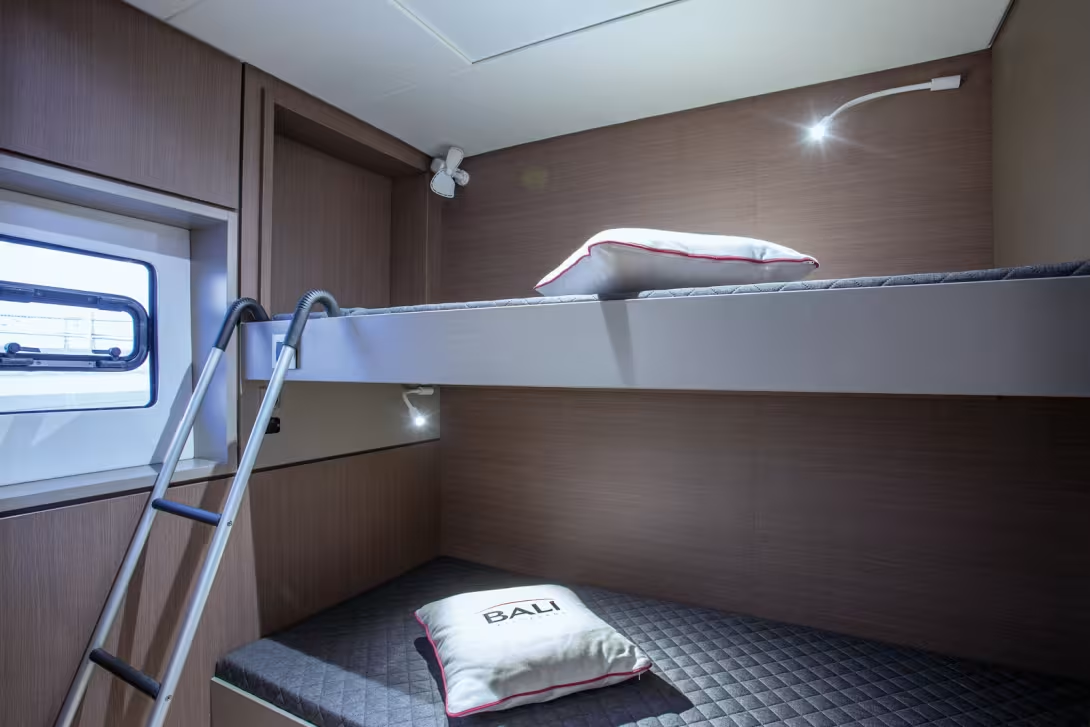
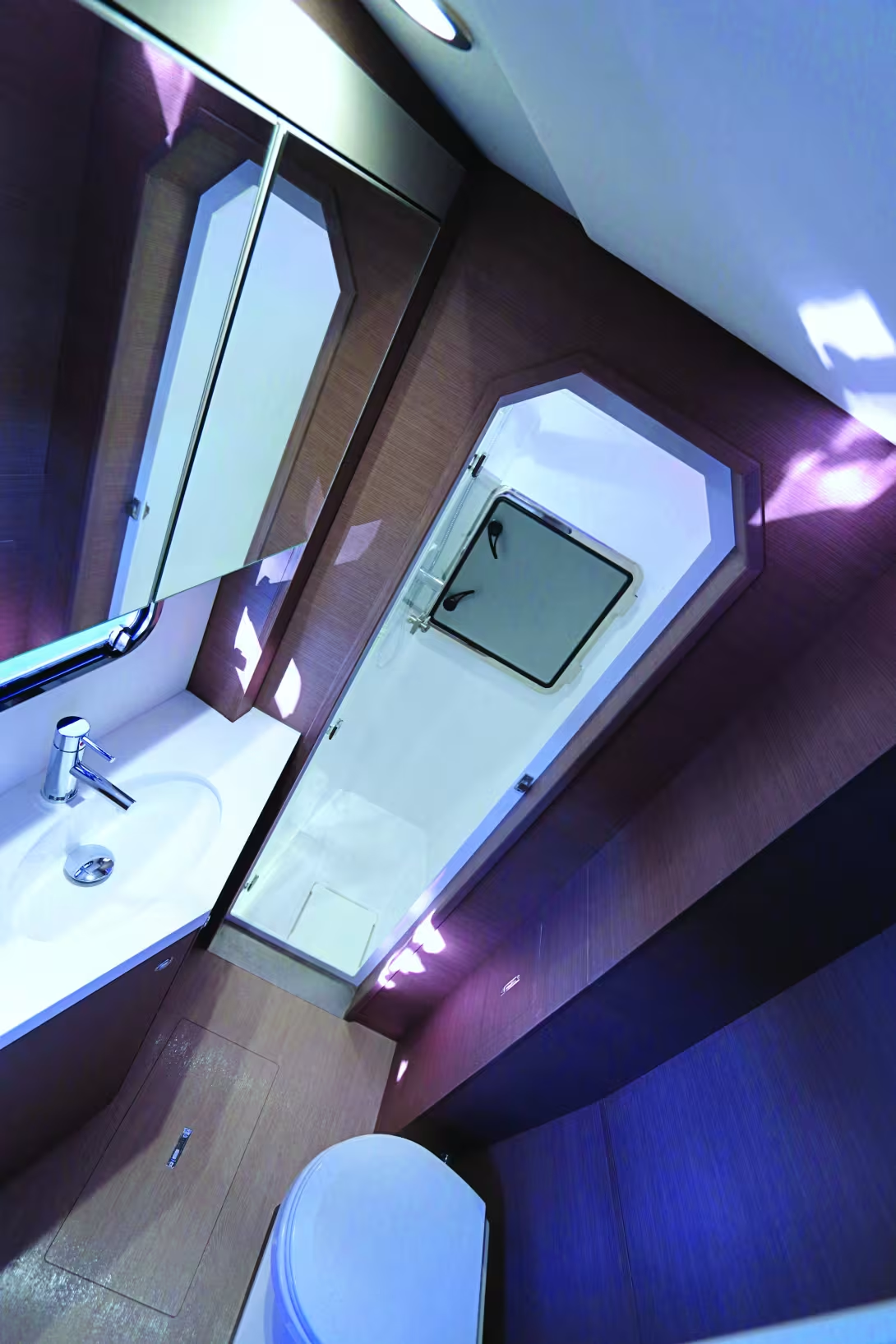
When you go down into the hulls, you’ll clearly see why this boat is going to be destined for the charter market, unless you have a very large family. Rigorously identical, they offer two double beds set athwartships at the bow. Their orientation implies that they are positioned quite high, but they benefit in return from good dimensions (150 x 190 cm / 5’ x 6’3”) and an unobstructed view of the sea through the hull portholes. These cabins also inherit the only opening deck hatches on the boat, a legacy from the Catanas which, historically, have been completely devoid of them, thus limiting the greenhouse effect and the risk of water ingress. The bathrooms in the forepeaks are equipped with separate showers, again the only ones on the boat. The four other head compartments offer “only”, of you’ll excuse the expression, showers integrated between the sink and the toilet. The two central cabins each have two single berths one above the other and of similar dimensions (respectively 190 & 200 cm / 6’3” & 6’7” in length, 80 & 90 cm / 32” & 35” in width). A rather uncommon layout, but which will nevertheless be very well suited to children, teenagers and perhaps even more so to adults who aren’t necessarily sailing as a couple. What’s more, they’ll provide very practical storage space when not in use. While the forward cabins have their own separate shower, the two aft cabins have a decisive advantage when it comes to both boarding and sleeping arrangements: their direct access from the cockpit. The promise of perfect privacy and privileged access to swimming at all times. No doubt that drawing lots or rotating who’s where during your stay will be necessary to guarantee fairness and comfort for all, knowing that this positioning also has its drawbacks: everyone passes in front of your cabin to reach the sugarscoops, and that the engines are just behind the bulkhead. Wouldn’t they therefore warrant a little more soundproofing? Either way, their accessibility via two large deck hatches is absolutely fine.
Conclusion
Our sea-trial was too short, and it was easy to begin dreaming of taking family and friends on board for a couple weeks in warm waters just to make sure that the Bali 4.8 meets the goals they have set. But with just one day, the balance sheet is overwhelmingly positive. Between an exceptional level habitability on deck, in the nacelle, as in the hulls, and very pleasant performance on the water with regard to the volumes offered in less than fifteen meters (50’), this is undeniably quite some boat that has just been launched. And it’s all this quality and originality she’ll need to impose herself in this highly competitive 50-foot sector of catamarans designed for pure cruising.
The plusses:
5 versions of layout
The tilt-and-turn door
Space and light everywhere
The minuses:
Position of the winches
Companionway behind the chart table
Height of the boom
TECHNICAL SPECIFICATIONS:
Builder: Bali Catamarans
Design: Olivier Poncin
Architect: Xavier Faÿ
Interior Architect: Lasta Design Studio
Length overall: 14.86 m (48’9”)
Hull length: 14.28 m (46’10”)
Maximum beam: 7.88 m (25’10”)
Draft: 1.35m (4’5”)
Light displacement: 15.3 t (33,730 lbs)
Max. laden displacement: 22 t (48,500 lbs)
Max. sail area upwind: 173 m² (1,862 sq ft)
Engines: 2 X 45 to 57 hp
Diesel: 600 + 400 l (158 + 105 US gal)
Fresh water: 600 + 400 l (158 + 105 US gal)
Refrigerator + freezer: 615 l (21 cu ft)
CE approval: A - 14 persons
Standard configuration: 3 cabins/3 bathrooms
Basic price: € 589,400 ex-tax
Optional configurations: 4-5-6 cabins/4-5-6 bathrooms
Tested configuration: 6 cabins / 6 toilets
Price of the boat tested: € 619,600 ex-tax
Main options in € ex-tax:
Excellence Pack: 53,900
90 m² / 970 sq ft Code Zero: 6,920
Onan 11kW generator: 23,590
Solar panel kit 5 x 100 W: 5,880
Safety equipment for 12 people including liferaft: 5,990
Reversible air conditioning for 6 cabins: 28,050
Watermaker 12V 105 l/h (28 US gal/h): 13,490
Large flybridge bimini: 15,960
| THE COMPETITION | |||
| MODEL | Saba 50 | Lagoon 50 | Leopard 50 |
| LENGTH | 14.98 m (49’2”) | 14.76 m (48’5”) | 15.40 m (50’6”) |
| BEAM | 7.99 m (26’3”) | 8.10 m (26’7”) | 8.04 m (26’5”) |
| LIGHT DISPLACEMENT | 15.7 t (34,600 lbs) | 20.8 t (45,860 lbs) | 20.6 t (45,420 lbs) |
| UPWIND SAIL AREA | 141 m² (1,520 sq ft) | 158 m² (1,700 sq ft) | 136 m² (1,465 sq ft) |
| PRICE | € 673,000 ex-tax | € 589,000 ex-tax | € 639,000 ex-tax |
