
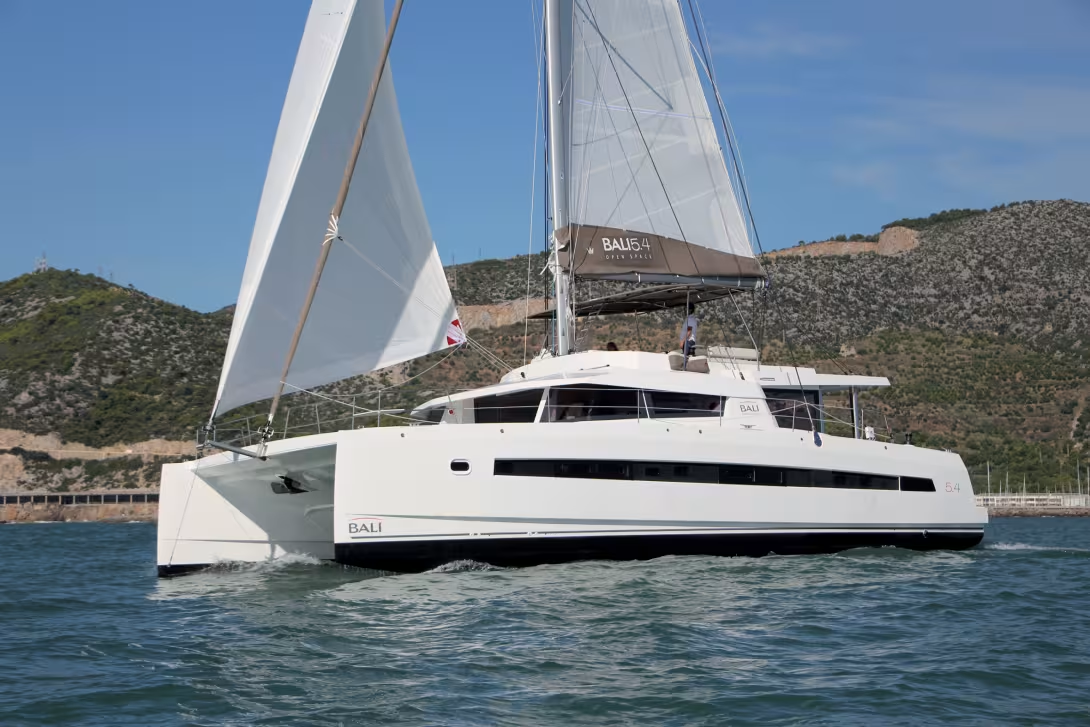
Catana Group's Bali range is incredibly dynamic and several evolutions are currently in the pipeline! The launch of the Bali 5.4, however, is a major step forward which will allow the brand to enter the charter fleets at the right time, at the right level, and at an affordable price. We tried the first model in the series.
Infos pratiques
- Le chantier : Bali 5.4
- La fiche technique
-
 Découvrez notre vidéo exclusive
- Financez votre Bali 5.4
- Assuez votre Bali 5.4
- Articles autour du Bali 5.4
The spectacular growth of a new brand
In less than 5 years, Bali Catamarans has succeeded in establishing a new style and imposing technical choices in a market which, although expanding and being boosted by fleet replacements (following Hurricane Irma, among others), is one which is highly competitive. The first 4.5 caused quite a stir, both in print and verbally, because of the elimination of the trampoline and the full use of the whole platform’s surface area! The skill of the designer and the mastery of composite construction have allowed for reducing or even eliminating the objections linked to this nacelle architecture (for this type of program), which has facilitated the scale-up of the Bali family to charter and private owners. Since the 4.5 was first presented at boat shows in the fall of 2014, the range has been enhanced with a 4.0, a 4.1, a 4.3 and soon there will be a 4.8! So the 5.4 (16m) tops off the range with an innovative approach that really has found its audience.
An original construction process
Looking at the Bali 5.4 just before the deck was installed at the Canet en Roussillon yard in the South of France, I was observing the same construction principle I’d seen with the 4.3 at their Marans factory on France’s Atlantic coast. The platform is infused in a female mold in a glass/polyester sandwich, and then an impressive structural mesh is integrated with the hulls by gluing and then assembled using fileted joints. This dense network of resin-coated plywood partitions and stringers creates a really integral chassis effect to prevent any twisting or bending. A mechanical grid system made essential by the aft-set position of the mast and the particular architecture of the forward face of the coachroof (front panel opening and access door to the forward cockpit). This provides the 5.4 with the stiffness of a wooden composite multihull combined with the simplicity of maintenance of an infused polyester hull, but at the cost of a certain level of complexity of implementation by the yard.
An uncomplicated and innovative architectural approach
It was without doubt a good idea for the boss (Olivier Poncin) to start this daring new concept within the Catana Group! Bali has taken advantage of the obvious notoriety of its parent company and their existing industrial and marketing tools, and is responding to a demand that Catanas couldn’t take advantage of! Neither brand impinges on the other, with each one enriching the group's overall range. A neat commercial and industrial move! Xavier Faÿ is probably less well-known to the public than other designers with a strong international reputation, but he has collaborated with several Anglo-Saxon firms, participated in the development of some early Lagoons (the 410 and 380) and with his cousin, Sébastien Magnen, put his signature to a superb 74' CNB (a benchmark in project design!). Xavier has a creative freedom that allows him to listen to new and audacious programs: and this is how he approached the complex specifications of the Bali 5.4 catamaran. Fifty-four feet (16 m) of waterline length necessarily determines a big boat, but if you decide you’re going to have 6 double cabins and 2 crew cabins in there, the challenge is tough! In the designers' minds, the boat must be able to meet a new, developing market, that of charter with or without fully chartering the whole ship (which is why the layout plan is divided into 6 cabins, with a possible combination of doubles and bunk-beds). It must also offer quality facilities for each guest and allow the crew to live well and independently. The private owner's prerogative is not forgotten though, with 4 and 5 cabin versions also available. In addition to all these characteristics, the catamaran also needed to offer good sailing performance. Now there’s a challenge!
Warning before the guided tour of a large multihull
There was a time when multihulls were thought of a bit like sports cars: the driver wasn’t obliged to don coveralls, a helmet and aviator's eyeglasses, but the thought was there! Talking about on-board facilities was almost sacrilege! It was all part of the charm of this up and coming culture! Taking advantage of the opportunity offered by the catamaran's geometry led to the advent of the "sedan" (to continue the automobile analogy) followed by "limousines", and then "SUVs". The latter assumed their weight well, as the process was all happening to the applause of crew members enjoying their beautiful revenge against yellow oilskins and their dripping vision of a rough and ready boat that they no longer wanted! It’s interesting to see how the destinies of the marine and automotive sectors can cross! Noise, fury and thrills seem to have gone out of fashion! Between this "bourgeois" evolution and the marginal fringe of highwire acts taking to the air at high speed, there is still the romantic, basic, sometimes cash-strapped multihuller still building in Spain and claiming to have a sympathetic Moitessier-like sensitivity close to the vision of James Wharram or Dick Newick. The philosophy of the Bali 5.4 is the absolute opposite of that of these "primitive" enthusiasts and offers 21st century sailors a cozy, reassuring, comfortable, almost homely, but quite seductive "sea life-style". In short, breaking with the identity attributed to leisure boating: penetrating cold or excessive heat, damp, discomfort and overcrowding... some would miss it, but most (especially newcomers) appreciate it! When you go on board a Bali 5.4, you are clearly crossing the line between these two worlds, and are seeing a catamaran that implies something new: a shared, family or tribal and dilettante pleasure that gives itself the means to seduce reluctant boaters.
Friendliness, intimacy and new spaces
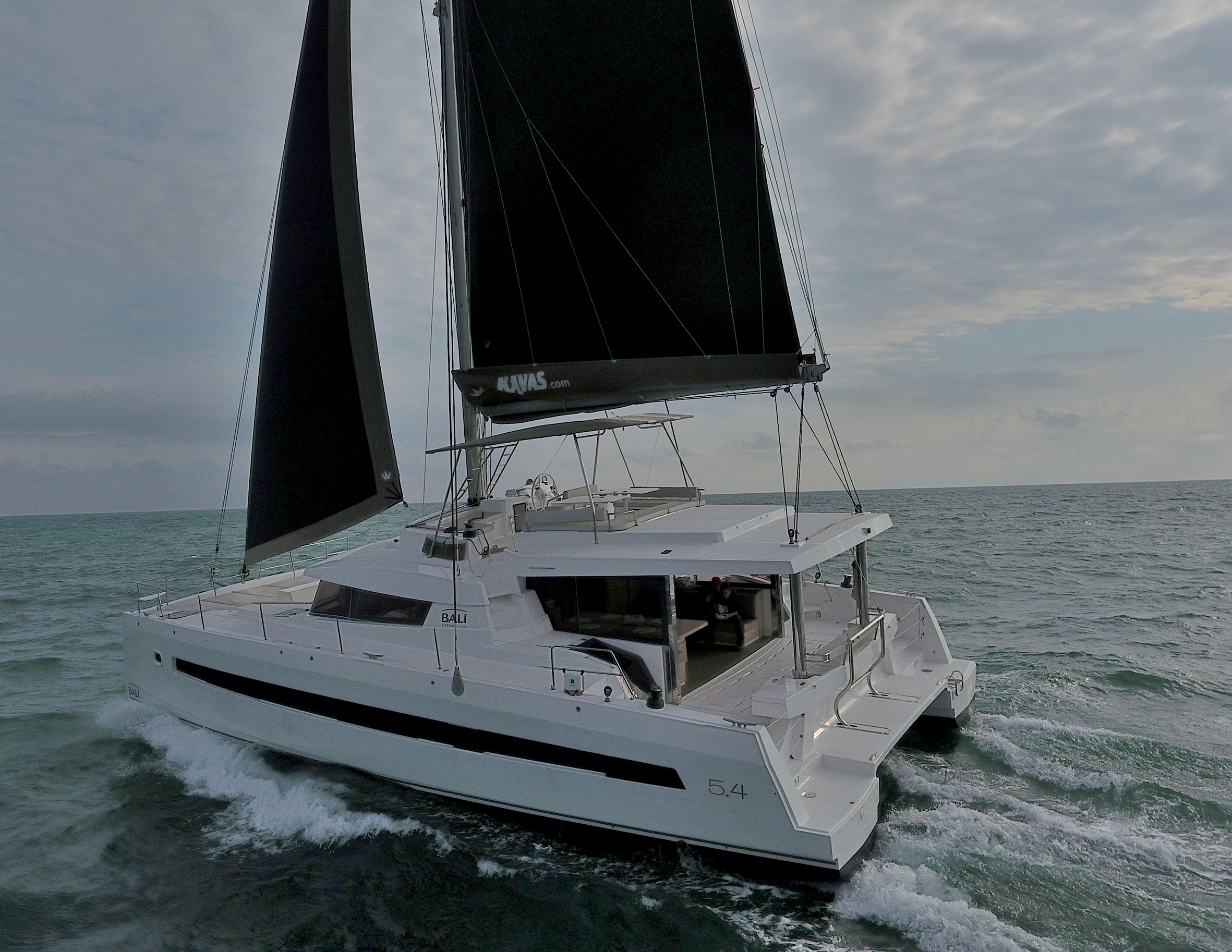
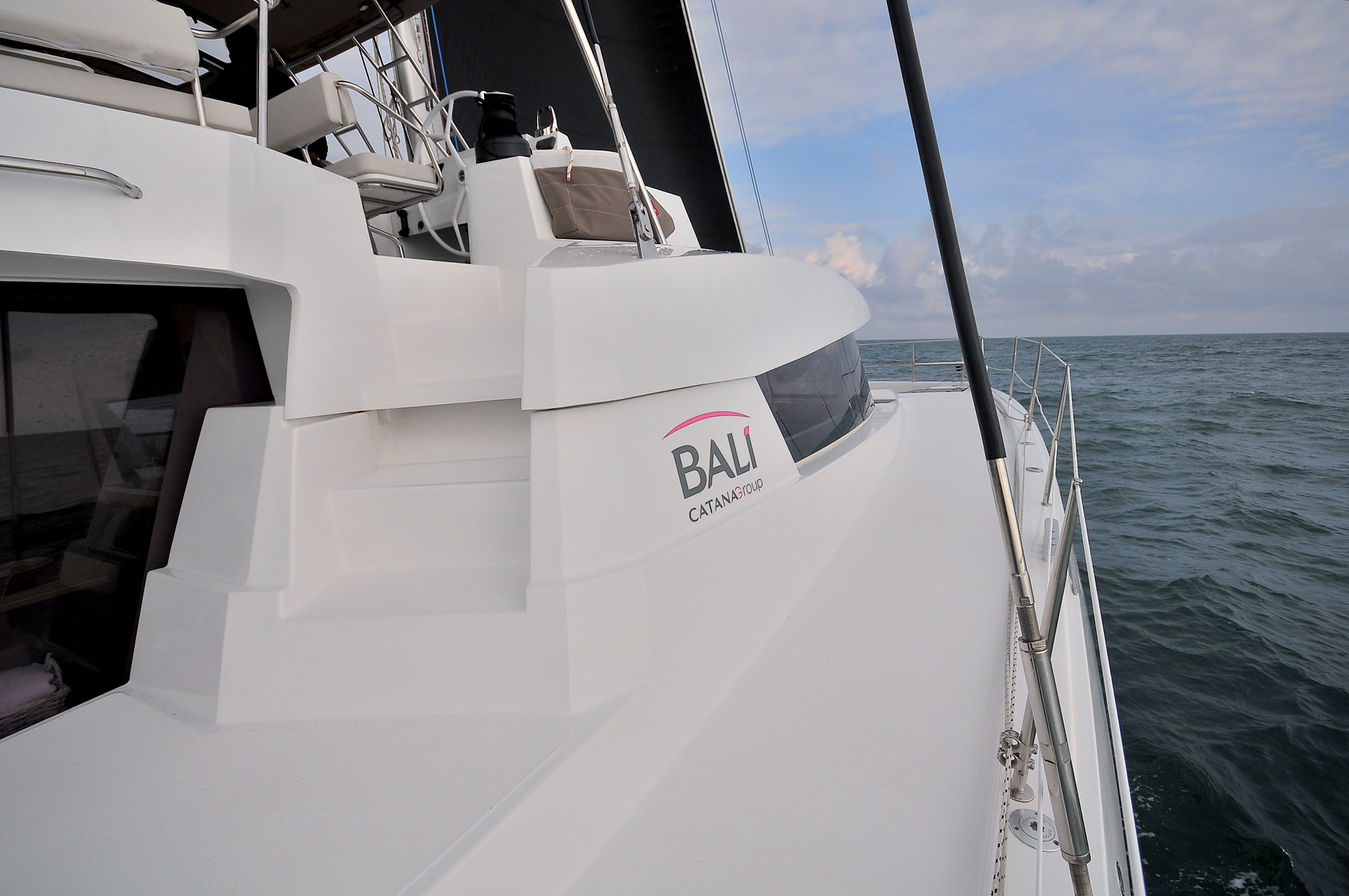
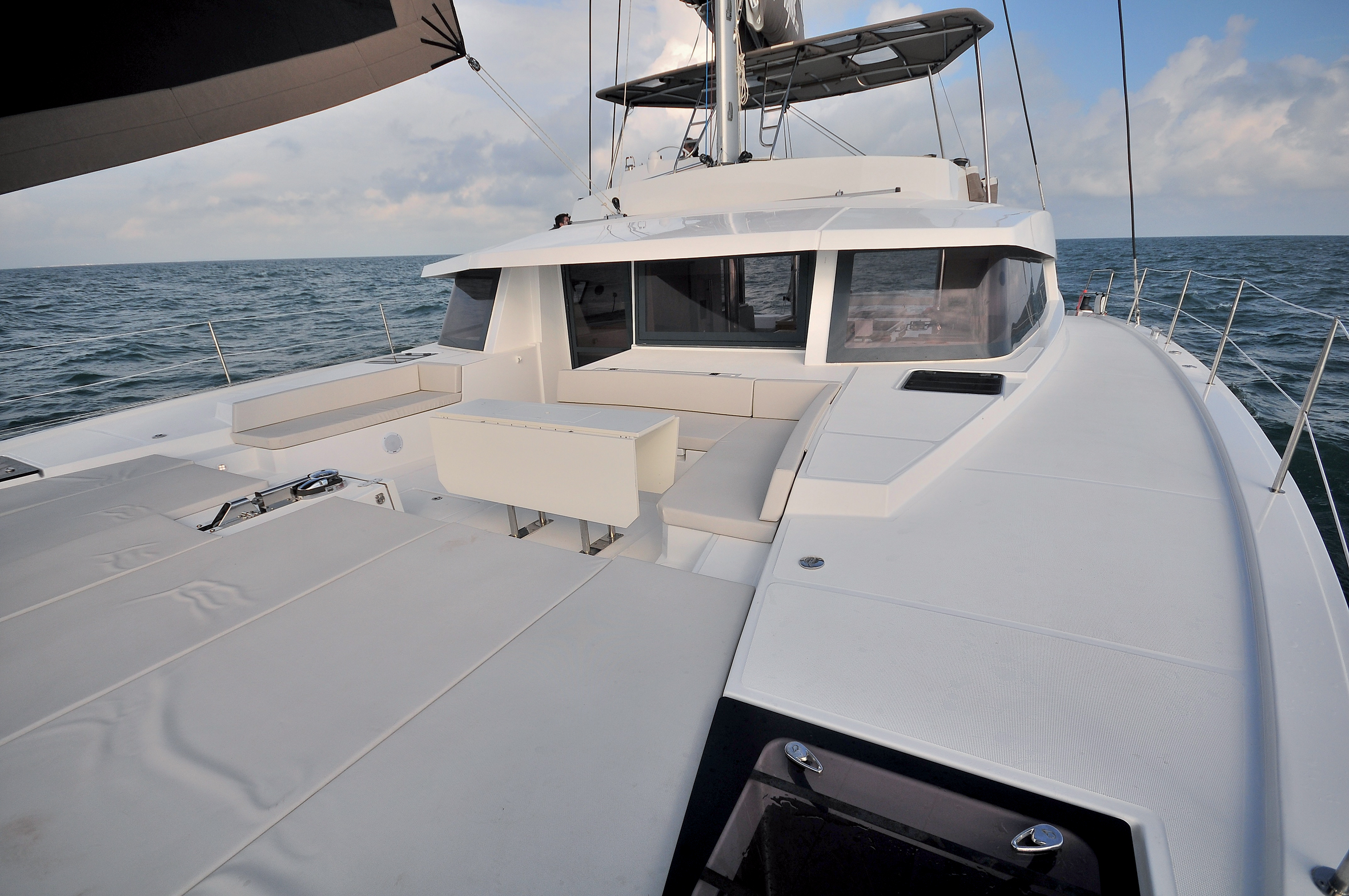
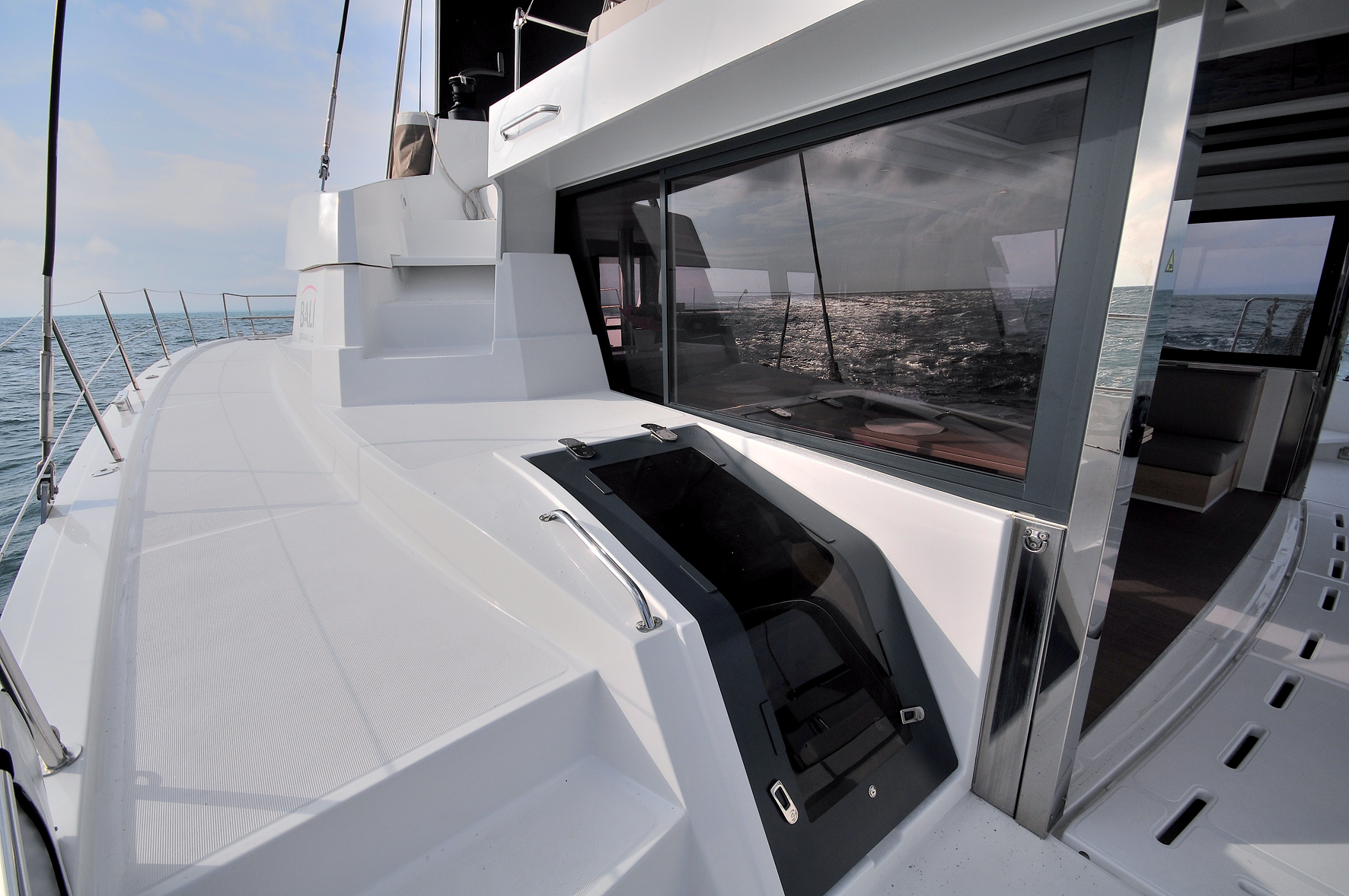
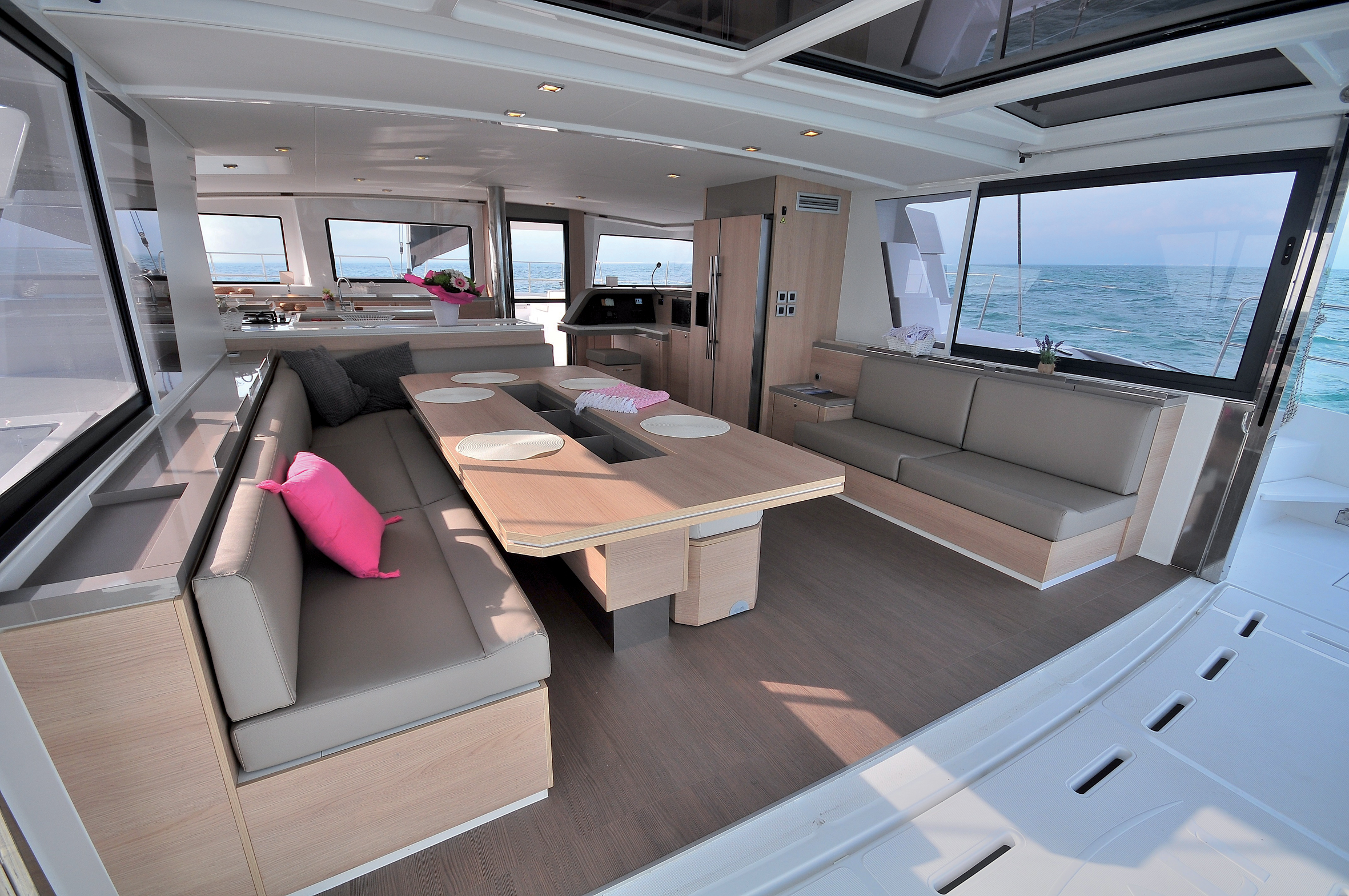
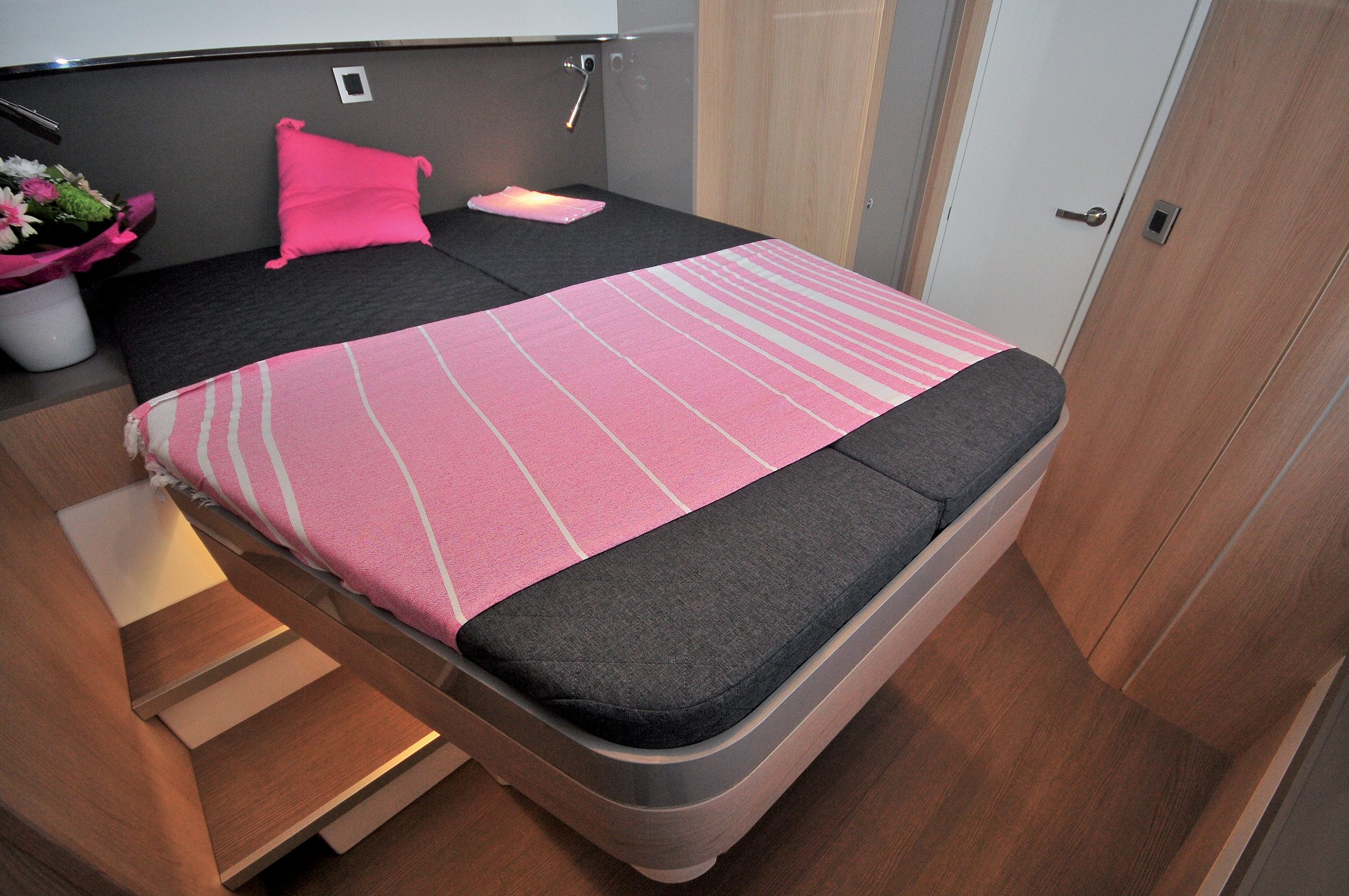
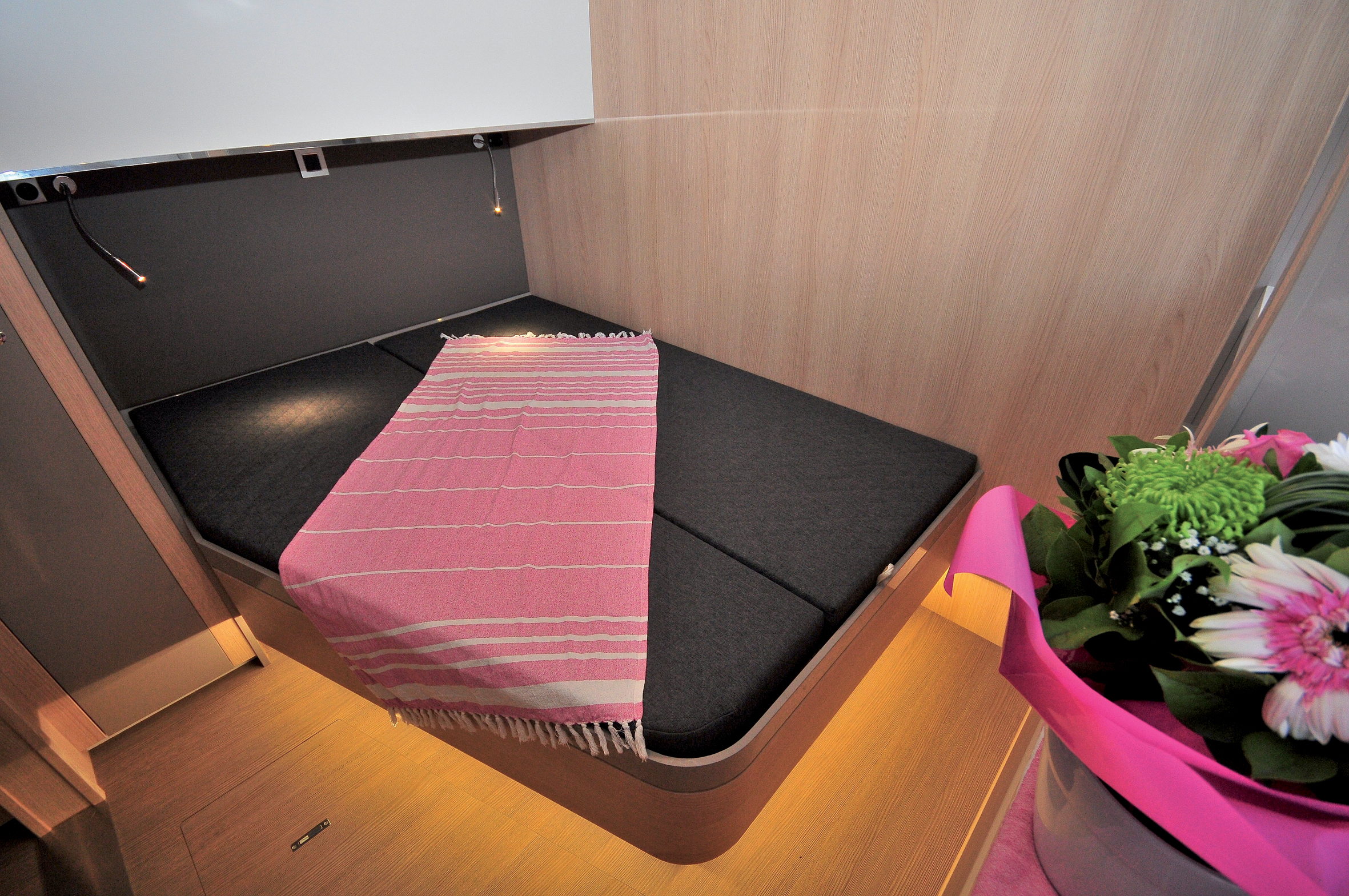
Contrary to the trend of the majority of catamarans of this size, the Bali 5.4 doesn’t offer the traditional cockpit with table, bench seating and lounger, but completely redraws this aft space by merging it with the convertible saloon/gallery (open to the outside with the tilting bay window and side panels). This "revolution" goes against the "cockpit lounge" option chosen by their French or South African competitors by replacing it with a nacelle space organized in a way similar to that proposed by Greg Young on his day-charter units or on the TAG 60 (see Multihulls World N°130), and by adding a new living space forward. With the exception of the comfortable bench seat athwartships, the stern of the boat is more dedicated to the role of an exchange-area between inside and outside and for access to the sugarscoops or gangway (when the tender is in the water). The layout plan provides direct access from the outside to the two aft cabins (extra freedom for late nights or early risers!). The other 4 cabins (all equipped with private bathroom and toilet facilities!) are accessible by 2 lateral companionways, on either side of the chart table (which will be better integrated into the hulls on future units to facilitate forward passage) and from the galley. The design for moving around the boat unveils new possibilities and allows you to reach the huge forward cockpit directly through a forward door: an unparalleled solution, conquering the usual trampoline, to offer a friendly relaxation/sunbathing/brunch/happy-hour space worthy of a model 10 feet longer! The individual volumes of our 6 cabin version are only slightly smaller than those of some traditional owner’s versions and meet the primary expectations of the typical client couple: privacy and comfort. A real achievement on a boat of this size! The clean style is effective without being impersonal: the upholstery and the combination of materials create a pleasant and functional atmosphere that lends itself well to personalization through simple decorative contributions and the woodwork is of a high standard. The two crew cabins are comfortable and practical, and their individual access via deck hatches is coupled with the possibility of entering in bad weather via an internal watertight door: very well thought out!
An essential flybridge
Considering the extreme optimization and innovative organization of the space on board the 5.4, the flybridge was essential for clearing the technical hardware from the deck and offering a fitting helm station which also serves as a desirable marine terrace (accessible from both sides). The deck layout is simple and efficient with a readable and direct distribution of sail handling maneuvers: the 2 electric winches are obviously essential. Access to the coachroof from the bimini and to the rigid walkways embedded in the fabric top (to work at the boom) is via two solid welded stainless steel ladders. This works well!
A simple, powerful and efficient rig
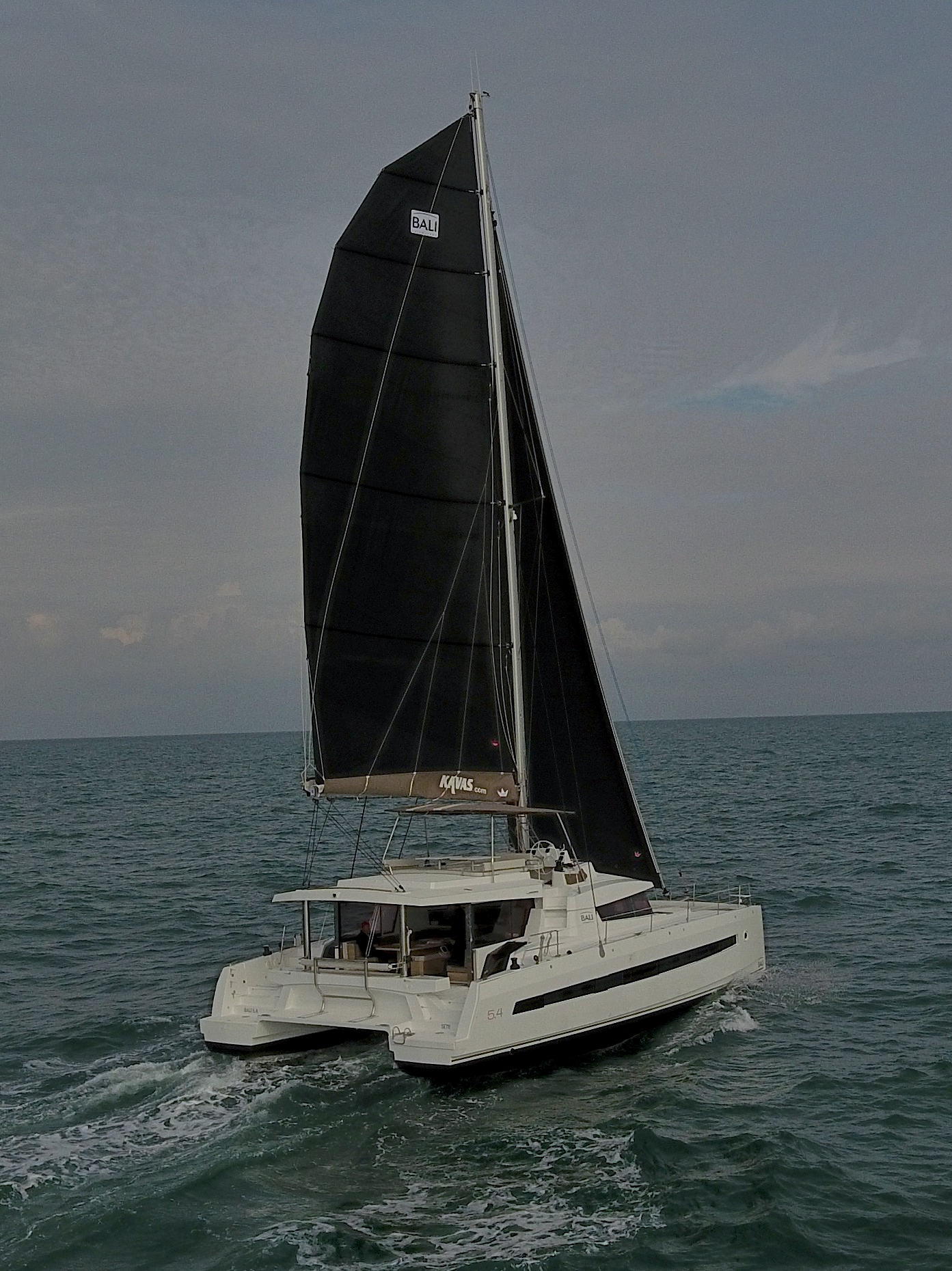
The generous Sparcraft tube is held laterally by two cap shrouds and a pair of lowers, the chain plates of which are taken up on the coachroof to free up the sidedecks. Self-stiffening is ensured by a single set of aft-swept spreaders which provide a pronounced angle to prevent the tube from pumping or inverting. The positioning of the spar further aft allows for a good surface area of the self-tacking solent (58m² / 625 sq ft) with a mainsail of 99m² / 1065 sq ft and a code 0 of 105m² / 1,130 sq ft, which will help in light airs and boost downwind performance in a breeze.
Accessible electrical and mechanical spaces
As standard, the Bali 5.4 is equipped with Yanmar 57hp motors. However, the 80hp seems a wise option for a catamaran of this size. This 2-liter turbo-charged, common rail injection engine weighs 274kg (604 lbs) including the saildrive, and will provide the best performance with a pair of variable-pitch Autoprops (consumption 9l/h/engine or 2.4 US gallons/hour at 2,600rpm). The battery bank (4 130A gel batteries as standard, 2 additional batteries as an option) is housed on a solid rack installed in the starboard engineroom: the high-power electrical panel as well as the 1,600W charger and inverter are installed under the companionway of the neighboring starboard aft cabin: a good solution to shorten and lighten the cable runs. The control panel is located below the chart table.
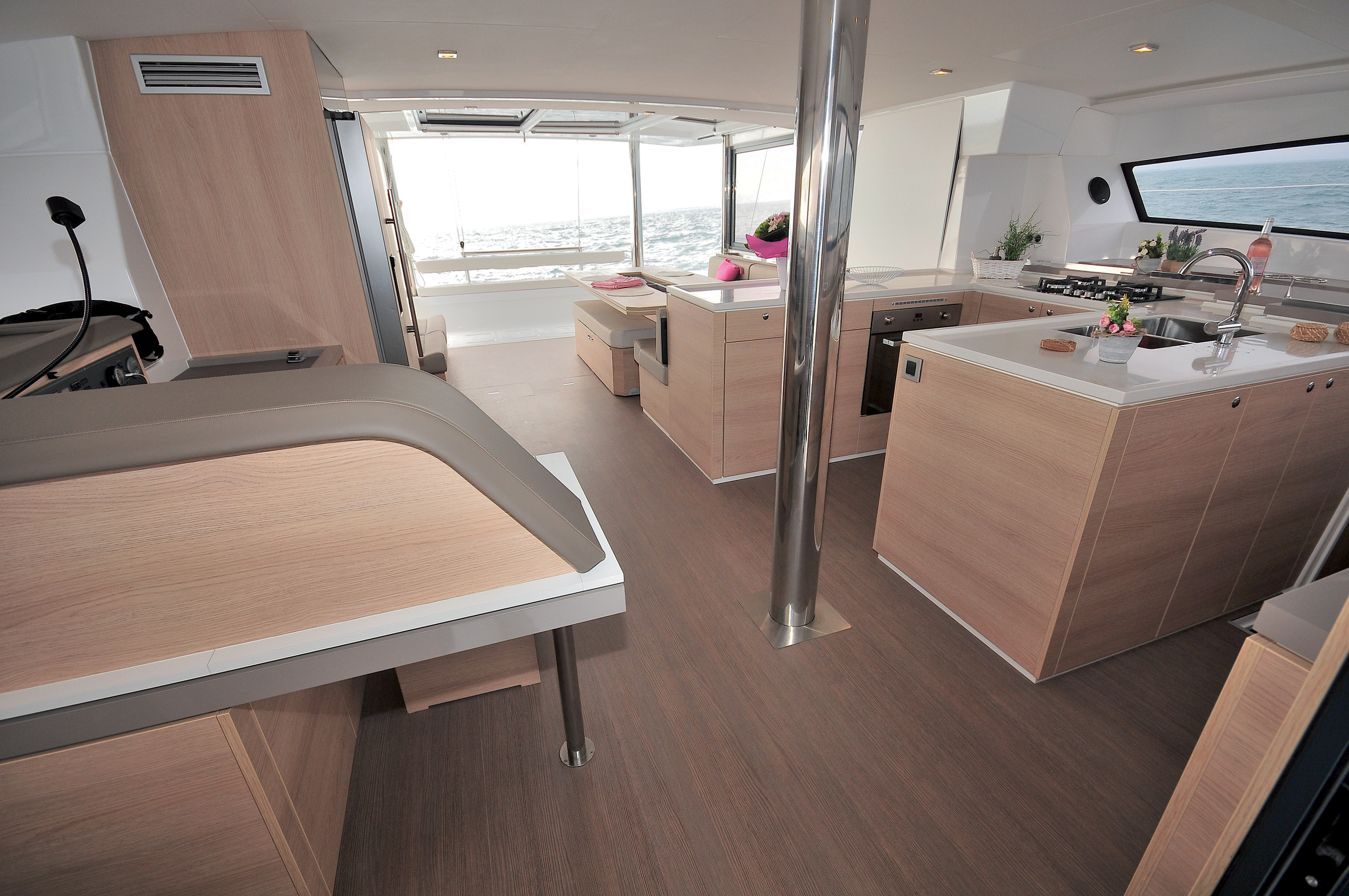
Sea trial
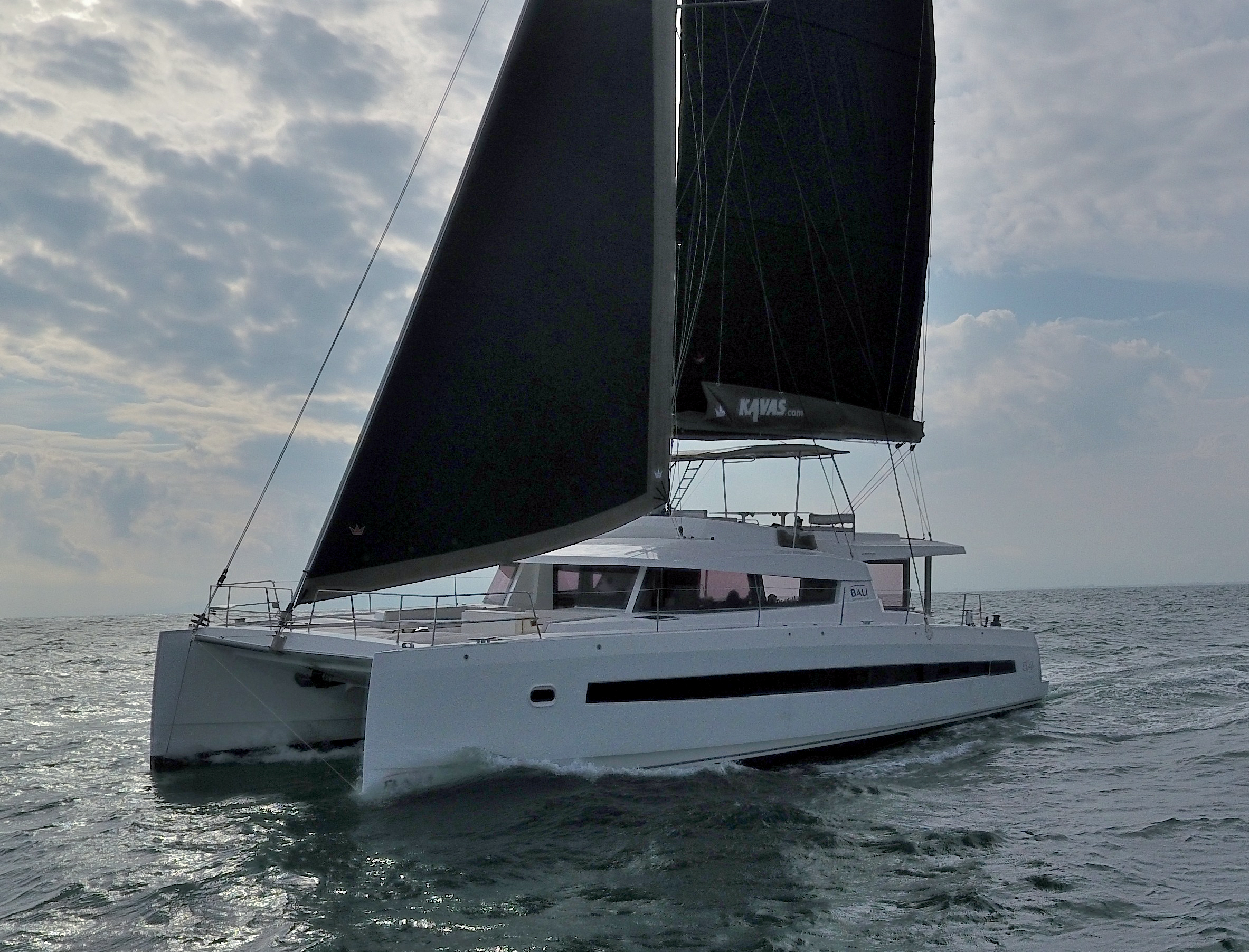
After having found a manageable weather-window between the successive storms this past fall, all that remained was to bend on the brand new set of black sails delivered by Elvström. Congratulations are due for the whole set-up: the Rutgerson fittings (beautiful batten cars) and the material itself; double-fold Dacron mainsail and elegant jib! Straight away we were sheeted-in with 12-13 knots of wind, with both the solent and the main revealing superb shapes for cruising sails aimed at the charter market. The Bali was alive upwind against a rough, residual sea, crossing small waves with agility and maintaining a good steady speed without slamming. The wakes are delicate and the movement under-foot reveals well-balanced progress. Under these conditions, the helm position is pleasant, despite a fuzziness to the hydraulic transmission (which will be improved on successive models). In these choppy conditions, moving around the boat remains safe and the flybridge comfortable. We were able to sail constantly with the big bay window in the open position (this was late October) and enjoy the fluidity offered by this extremely pleasant arrangement in manageable weather: the small bar around the central island was evidently a success! The autopilot seemed to use no effort to keep the boat on course when off the wind on the trip back. Not necessarily that easy to achieve! Watch-keeping from inside is greatly facilitated by unlimited visibility. It was only afterwards that I spotted on the Navionics that we’d had a peak of 11.4 knots, which had gone unnoticed. The average speed (8-9 knots) consistently gave the feeling of an agile and dynamic platform when we were under way.
Conclusion
Transposing the Bali geometry onto a 54 footer was a bold challenge, but the designers and builders seem to have successfully met the challenge! We couldn’t really judge the qualities of the future owner's version from our 6 cabin model, but if the challenge was to fit the performance of a big boat in a 16-metre catamaran, then it is a real success! The Bali 5.4 should offer large crews an excellent base for watersports: it is smart, comfortable and not too expensive for a large multihull for commercial use. Moreover, it sails nicely if not overloaded.
Descriptif technique
Technical specifications
Shipyard: Catana Group
Naval architect: Xavier Faÿ
Designer: Olivier Poncin
Interior design: Lasta Studio
Length: 16.80m / 55’1”
Beam: 8.74m / 28’8”
Waterline length: 16.20m / 53’2”
Draft: 1.48m / 4’10”
Light displacement: 24t / 52,900 lbs
Upwind sail area: 157m² / 1690 sq ft
Mainsail: 99m² / 1065 sq ft
Solent: 58m² / 625 sq ft
Code 0: 105m² / 1,130 sq ft
Water: 1200l /315 US gallons
Fuel: 1200l / 315 US gallons
Motors: 2x60hp/2x80hp option
Transmission: Saildrive
CE certification: 12 persons in Category A
Construction: foam/glass/polyester composite for the hulls and deck with structural reinforcement in ply/glass/polyester (infusion process)
Basic price: € 755,400 ex-tax for the 4-cabin version (€779,000 ex-tax in 6-cabin)
Principal options:
Pivoting door supplement: € 28,600 ex-tax
Comfort Pack (electric winch for the solent, exterior upholstery, automated pivoting door…): €63,800 ex-tax
Square-topped mainsail: € 5,540 ex-tax
Hydranet solent: € 8,870 ex-tax
Code 0 + deck hardware: € 19,900 ex-tax
Flybridge fitted out: € 8,800 ex-tax
Bimini for flybridge: € 18,870 ex-tax
2x80hp Yanmar: € 14,290 ex-tax
A word from the architect
by Xavier Faÿ
Undoubtedly, the concept established with the first Bali has now been now validated. With exacting specifications and the spirit of innovation, the 5.4 is definitely a Bali! For even more convivial spaces and fluidity of movement around the boat, we decided to incorporate direct access from the saloon to the forward cockpit. From an architectural point of view, one of the Bali's major strengths is the stiffness of its platform. Beyond the obvious advantages in terms of comfort, the introduction of a foredeck allows for a new and very advantageous structural layout. This structural stiffness is an asset throughout the life of the boat, for both liveliness and behavior, but it is also a guarantee of good performance and longevity for all components, from the rig to the interior fittings.
PLUSES
- Creative organization of space
- Privacy and comfort of the 6-cabin version
- Good dynamic qualities when semi-laden
MINUSES
- Putting out and maintaining the abundant and voluminous upholstery
- Lack of feel and vagueness at the helm
- Console at the chart table sticks out
The Competitors
|
Model |
Builder |
Upwind sail area in m² |
Weight in T |
Basic ex-tax price in €, £ or $ |
|
LAGOON 52 F |
Lagoon |
155 |
26 |
684 400 |
|
IPANEMA 58 |
Fountaine/Pajot |
169 |
22,5 |
1 100 000 |
|
LEOPARD 58 |
Robertson/Caine |
187 |
28 |
1 059 000 |
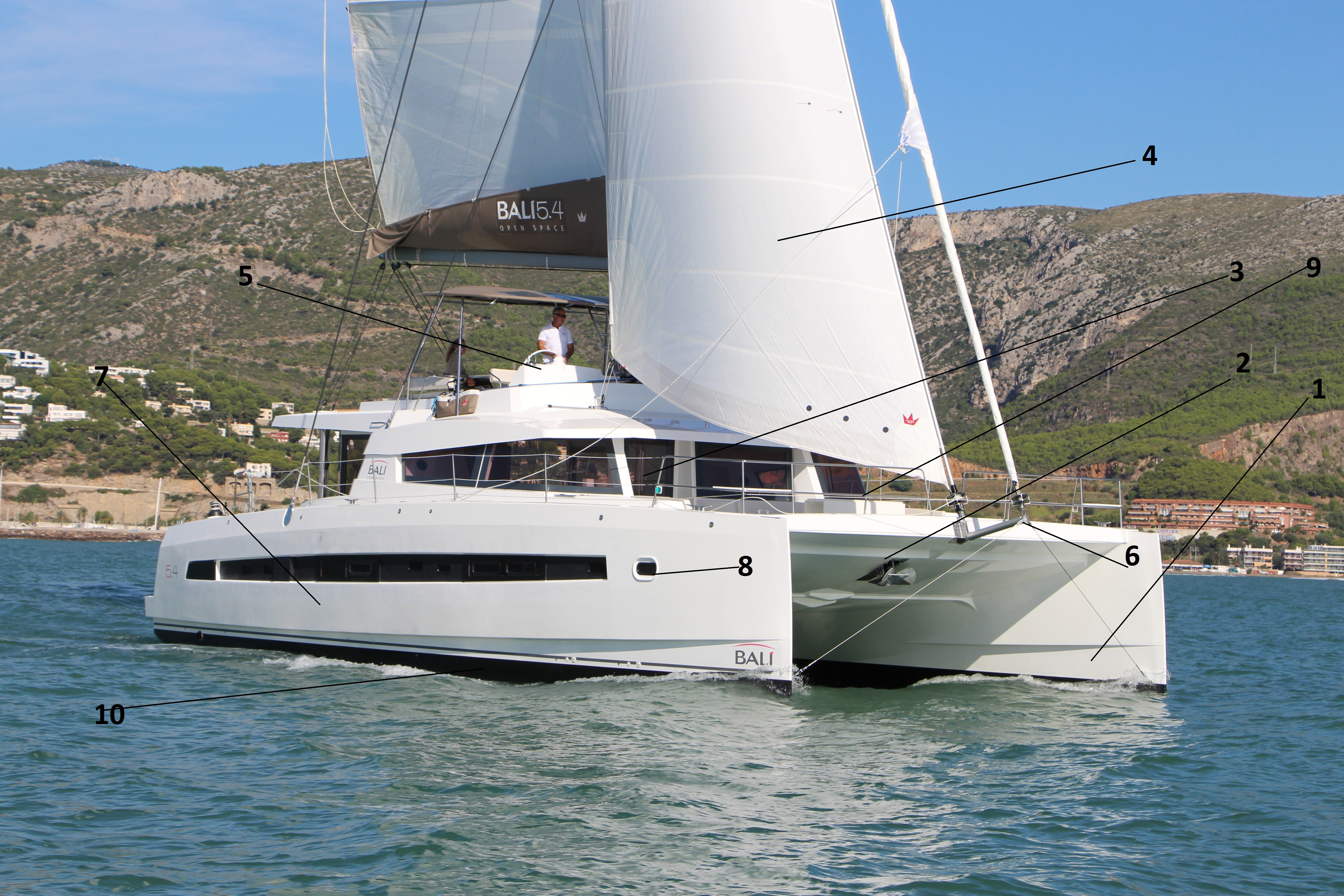
1: The fine-entry bows and the little anti-spray chine allow for a smooth passage through the water
2: The structural underside of the foredeck is high, and gently blends with the hulls to offer good seagoing agility under normal loading conditions without any significant slamming effect. Anchoring is rationalized, with a bow roller set far forward
3: Innovation at Bali: a door gives access to the forward cockpit, whose surface area and performance are worthy of a bigger boat
4: The set of black sails (Elvström) on our test boat was perfectly satisfactory, in terms of shape, finish and equipment.
5: The helm position is good, but the steering transmission is vague
6: The structural needs of the bowsprit are facilitated by the geometry of the nacelle
7: In the 6-cabin version. There are 3 double cabins in this hull!
8: The 2 crew cabins are comfortable and well installed with double bunks/shower/toilet and their own entrance
9: The "marine terrace" offers all the features of an attractive lounge area
10: The architecture and the mixed construction process make for a good sailing performance for a cruising catamaran of this size.
