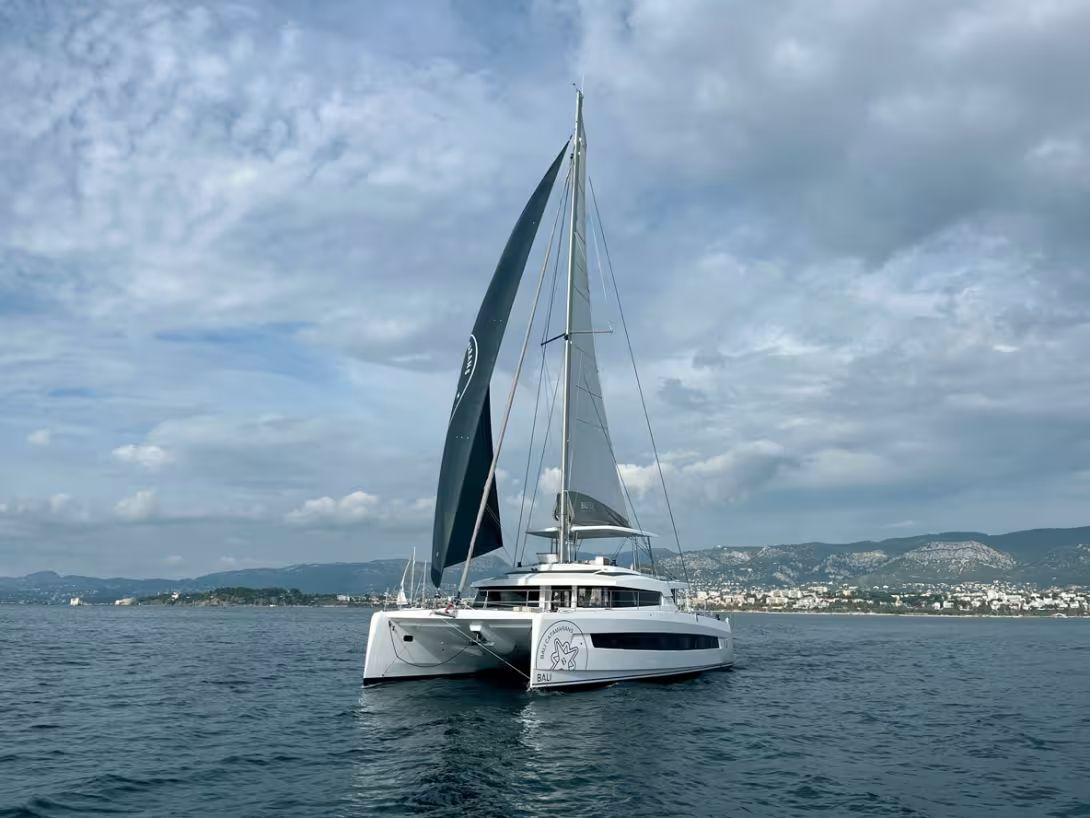
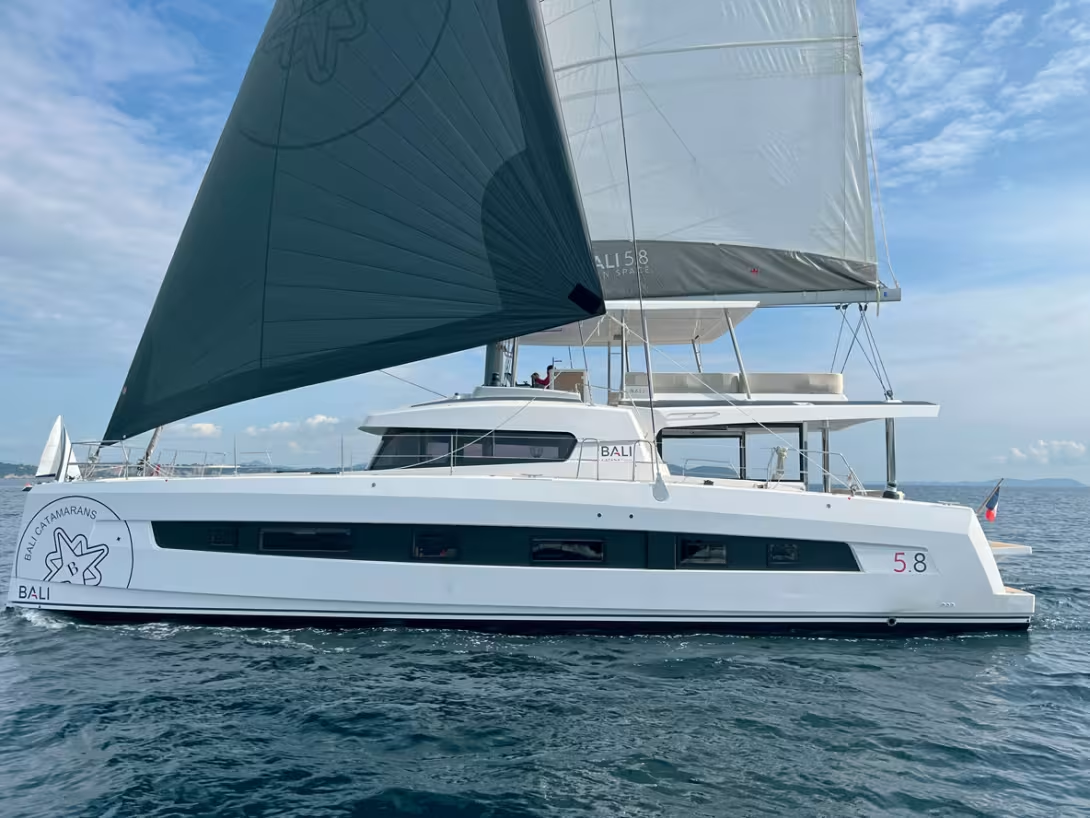
We were able to take a detailed look at this big catamaran at Port-Pin Rolland, the marina belonging to the Catana Group, the boat having been presented to the public for the first time at the Cannes Yachting Festival back in September. Larger than the venerable Bali 5.4 launched in 2018, the 5.8 pushes the boundaries of comfort even further to offer an extraordinary onboard living experience. The Bali DNA applied to a platform measuring the best part of 60 feet by 30 (18 m by 9) means that you’ve got a unique usable surface area and volume on board a multihull of this size...
Infos pratiques
- Le chantier : Bali 5.8
- La fiche technique
-
 Découvrez notre vidéo exclusive
- Financez votre Bali 5.8
- Assuez votre Bali 5.8
- Articles autour du Bali 5.8
Conditions: Calm sea, wind 6 to 7 knots
At the beginning of November, the weather can still be very mild on the Côte d’Azur, but it can also rain... In any case, it was a rather unusual autumnal period that Bali had chosen to organize its open days in the manufacturer’s marina near Toulon. It turned out to be a good choice, as the weather was very pleasant - so I will refrain from complaining...
Under the command of Boris Compagnon, the group’s sales and marketing director, all Bali models were on display, not forgetting the latest Yot 41 from their motorboat division. Since 2014, the manager reminded us, 14 Balis have been launched and their presence in the full-comfort catamaran market has been very well received, and even represents a significant market share, since Catana Group has joined the top 4 largest manufacturers of cruising multihulls, alongside Lagoon/Excess, Fountaine Pajot and Robertson & Caine. As for the 5.8, it should have a bright future, judging by the 5.4’s success - soon to be replaced by the 5.2, which we talk about in the news section of this issue - with 200 examples of this model having been sold.
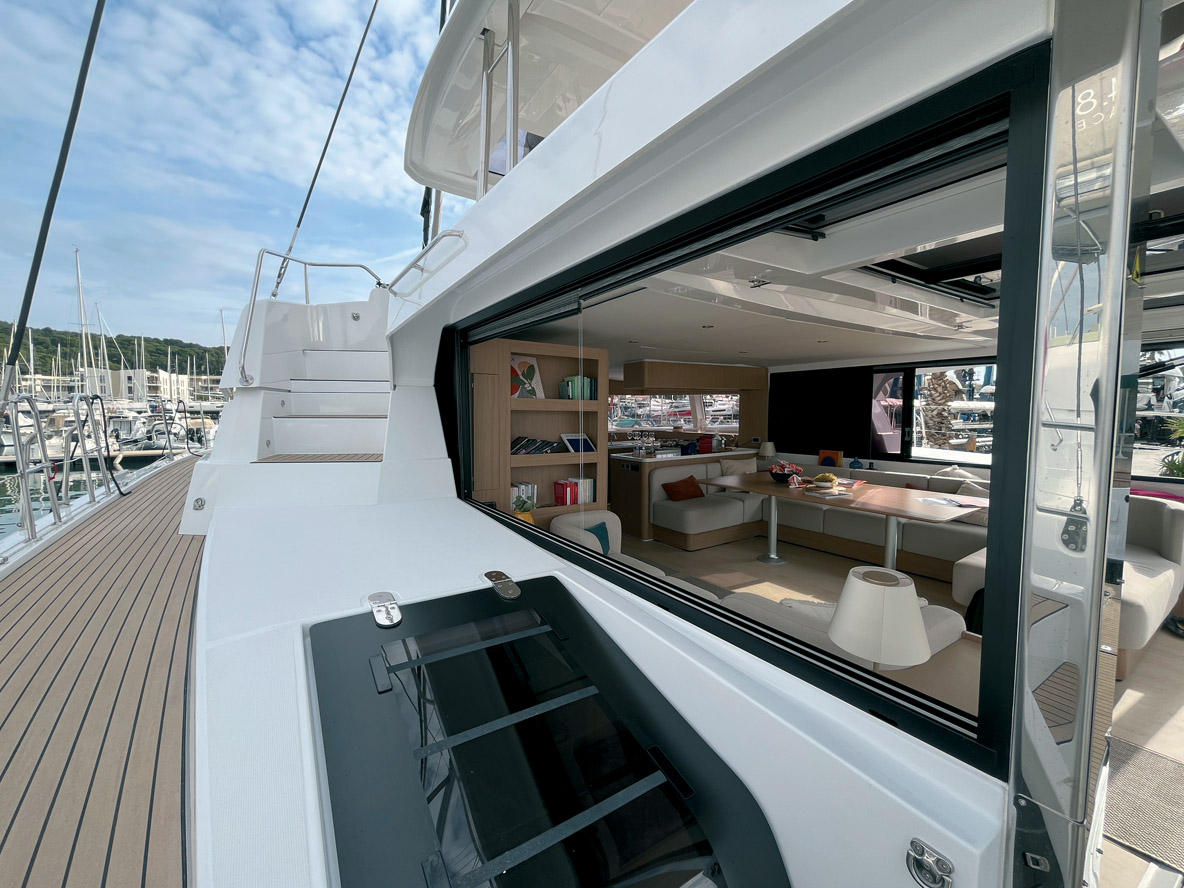
The reason for this success undoubtedly lies in the interest customers have in the features specific to the Bali, namely the cockpit with the open/closed space saloon, the famous tilt-and-turn rear door, the solid foredeck and aft deck covering the entire surface area, the forward door that provides level access from the saloon, and finally the XXL flybridge. “However,” Boris reminds us, “The Bali didn’t start out as a sure bet - there was a lot of questioning and criticism at the time.” Questions were asked about safety and behavior in heavy weather, and the answers provided by the Bali over the course of long offshore passages (delivery trips undertaken by professional sailors and blue water cruising with families) proved convincing: yes, a Bali can cross the oceans! As for the habitability and conviviality gained compared to “conventional” competitors, we have reached a spectacular level. As proof of this, I would cite a trip aboard a 40-foot Catspace to Menorca with 19 people on board. Not only did everyone, young and old, find their place on board without question, but there was no feeling of overcrowding, even during sailing maneuvers or at mealtimes. The fact that the tables are not split into an inside and an outside table but are one large saloon table that is either almost outside when the door is raised and the side windows are open, or snugly protected inside when everything is closed, is more than pragmatic. The space gained in this way means you’ve got a very large galley and a vast navigation station, not to mention the ease of moving around that this configuration provides. For all these reasons, we can pay tribute here to the genius designer Olivier Poncin - the Bali Catspace I mentioned earlier was the personal catamaran of the former group CEO who passed away two years ago.
Catamarans Becoming Larger and Larger!
“Customers continue to demand more space and more comfort,” says Boris, “And we are in fact seeing an increase in the size of our catamarans. This is true for all manufacturers.” Though the Bali range was initially intended to extend from 38 to 54 feet, the market orientation has convinced the new decision-makers of the post-Olivier Poncin era to now address the 60-foot sector with the newcomer that we present to you here - a size that can easily be handled in the shipyard’s workshops at Canet-en-Roussillon. In fact, when you board the Bali 5.8, you realize just how large it is - the living space increases from 120 m² (1,290 square feet) on the 5.4 to 140 m² (1,505 sq ft). What’s more, the Open configuration further increases this perception of space. A quick thought (again) for the Catspace and its 24 authorized persons in CE category D: on board the Bali 5.8, 40 people can be aboard.
While the largest units tend to reinforce the brand image, the risks associated with after-sales service are greater: the level of finish must also evolve according to this parameter. Another notable change at Bali is that the distribution, which before 2020 was 70/30% between catamarans intended for charter and those for owners, has now changed to 50/50. In terms of charter, we’re seeing the emergence of high-end charters, which is one of the targets of the Bali 5.8, which provides crew accommodation services and a higher standard of finish for the woodwork.
Lighter and Cheaper
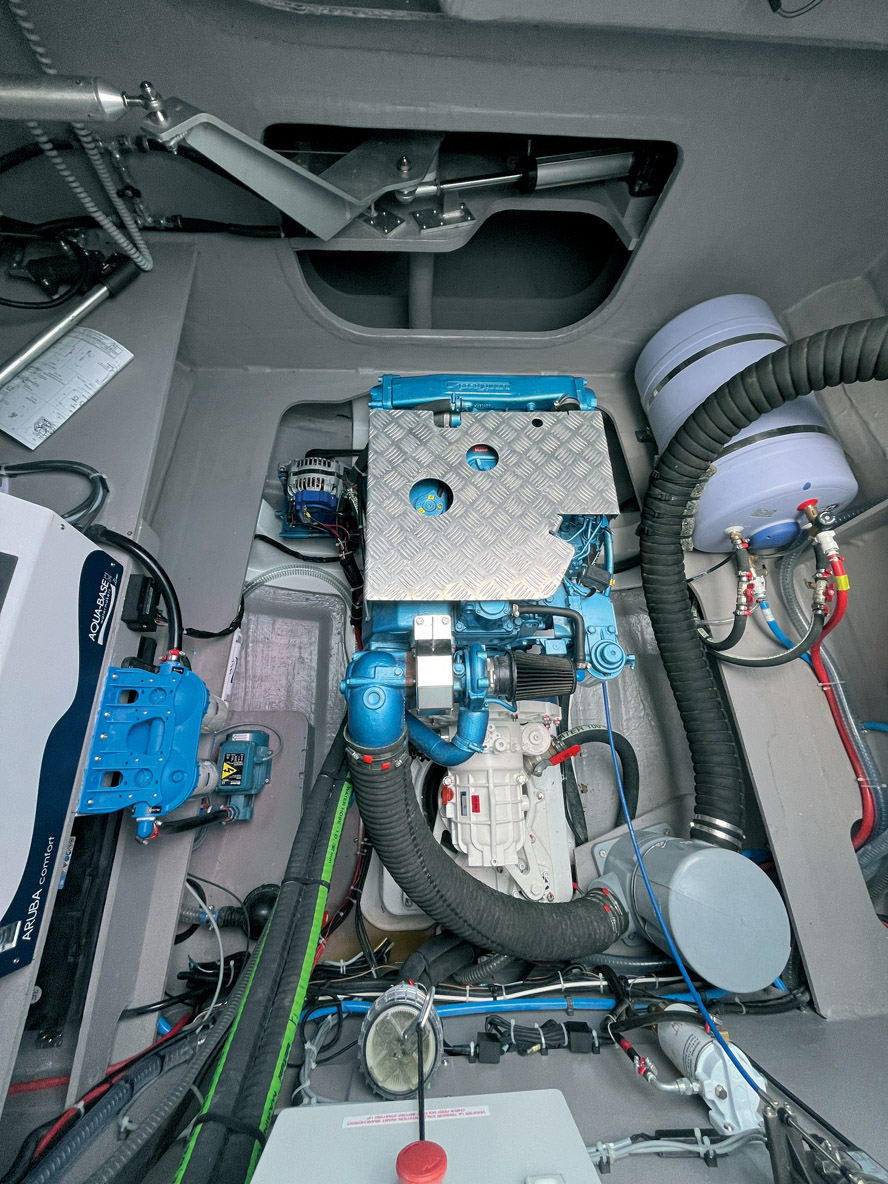
Many boaters will swear that the Bali are among the heaviest catamarans in their category… but they would be wrong! The Bali 5.8 and its 58-foot hulls come in at 24 t (54,000lbs), while a Samana 59 is 4 t (9,000 lbs) more and a Lagoon 60 weighs in at 34 t (75,000 lbs). The weight saving is partly due to the carbon reinforcements of the six structural bulkheads, avoiding thick layers of fiberglass cloth. Less weight and less sail area: 179 m²/1,927 sq ft for the Bali, 204 m²/2,195 sq ft for the Samana and 234 m²/2,518 sq ft for the Lagoon. Lower mast height and lower engine power too: the Bali offers a maximum of 2 x 115 HP, compared with 150 for the other two. Put end to end, these elements end up saving money. Admittedly, the degree of finish, although improving, is not yet – in my opinion – at the same level as the two market leaders, but the price is 30% lower.
A King-size Bed for the Owner
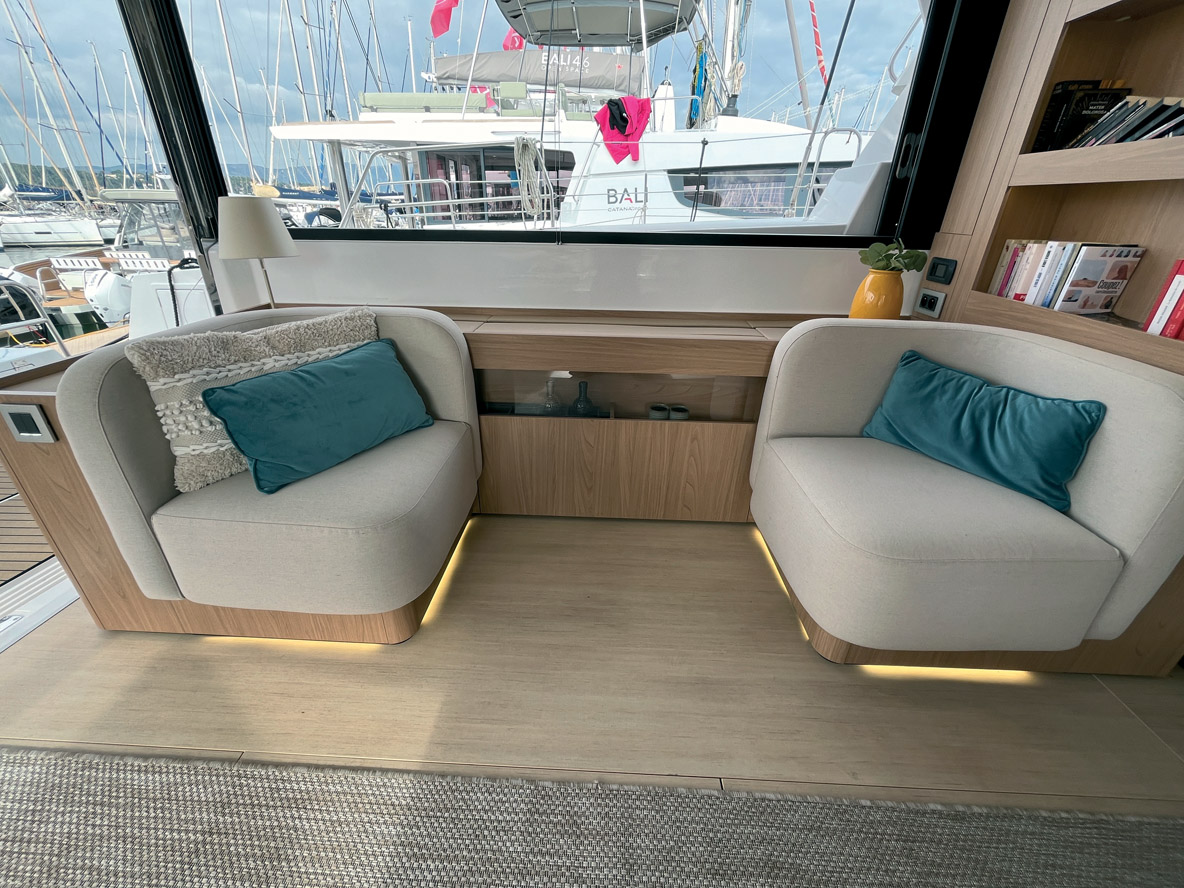
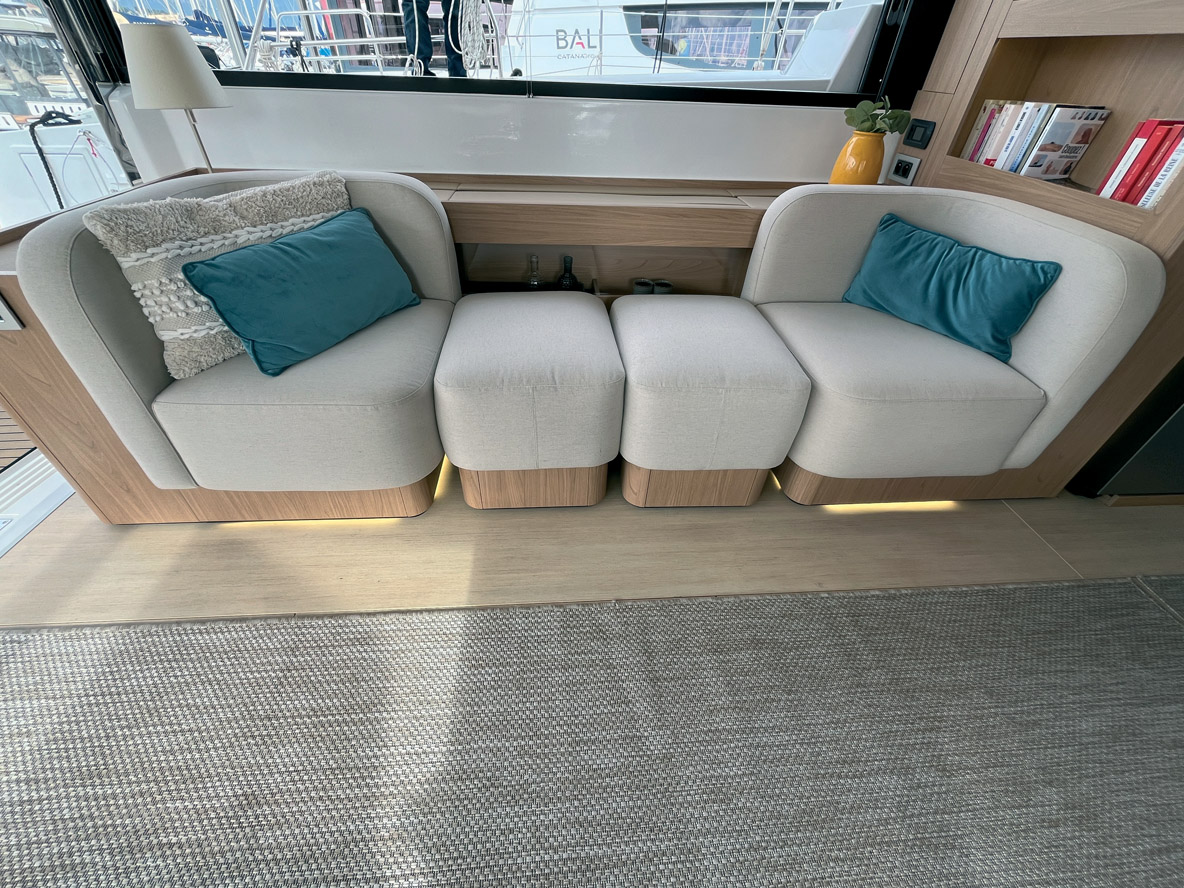
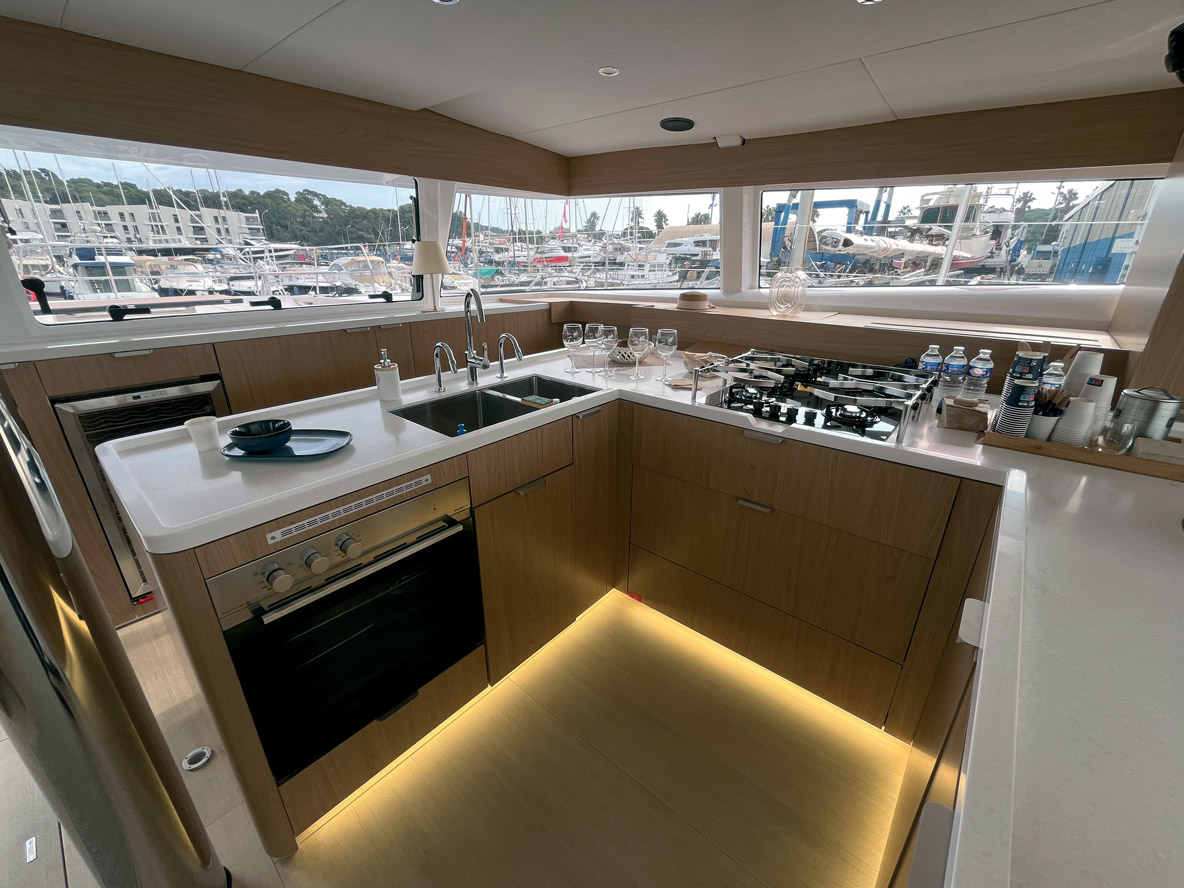
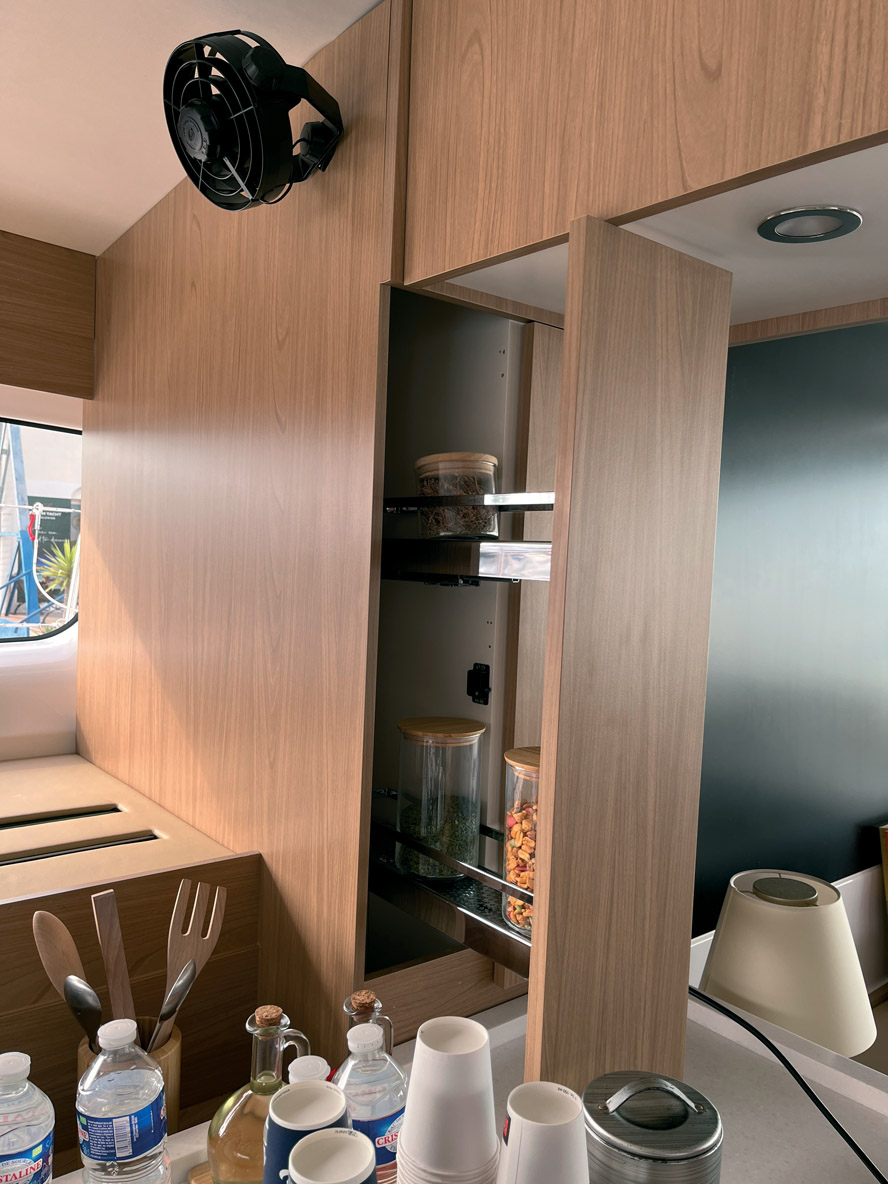
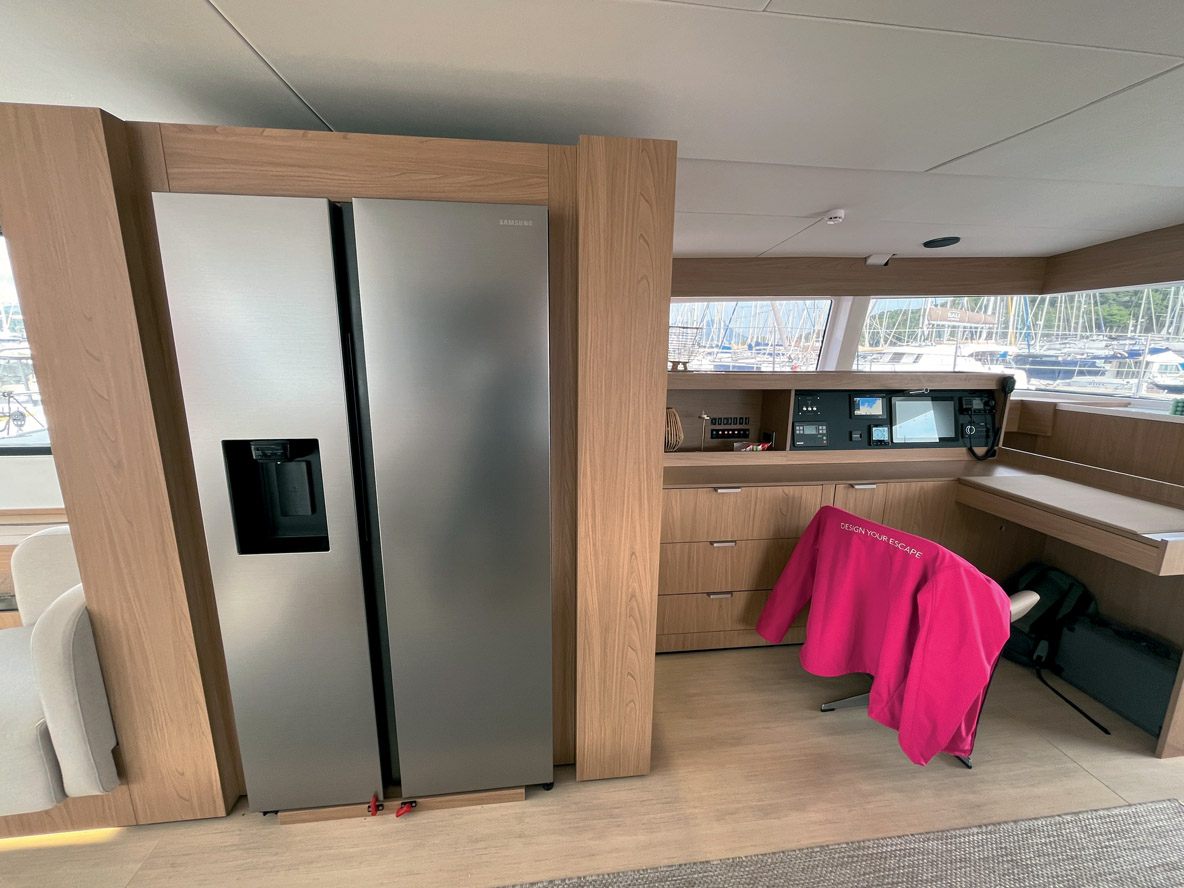
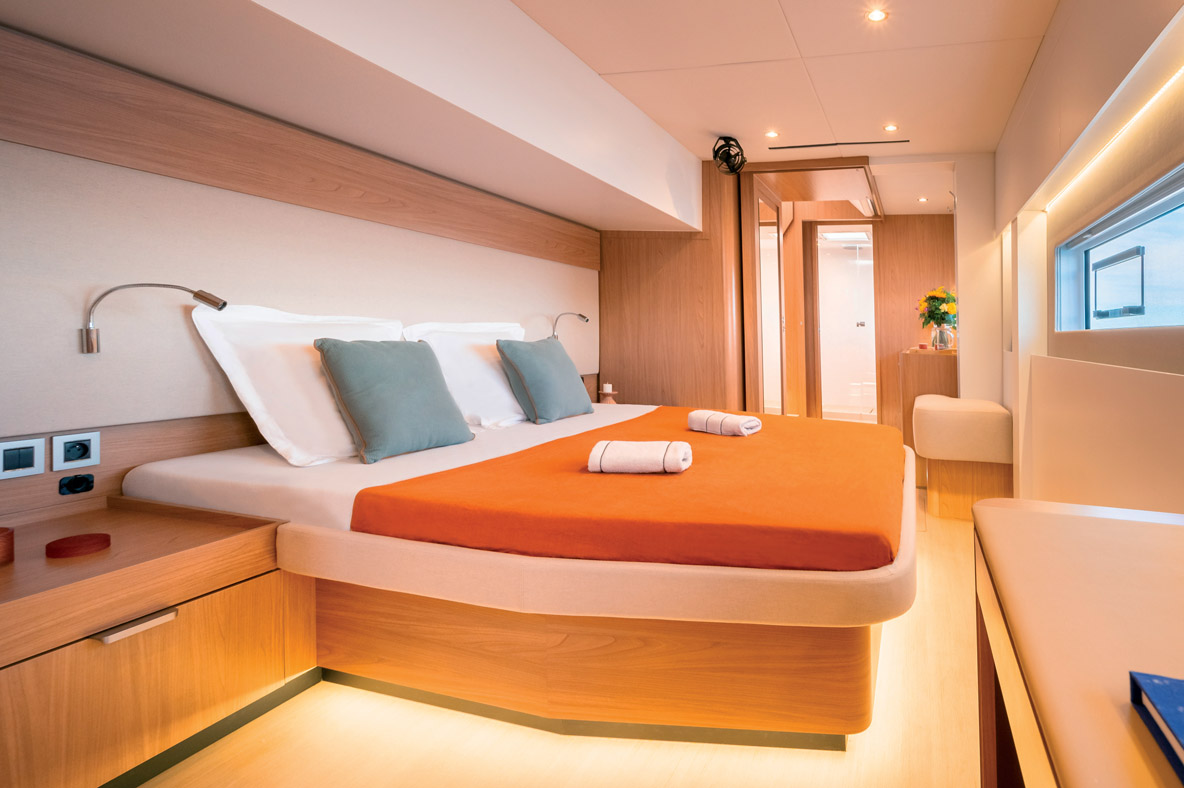
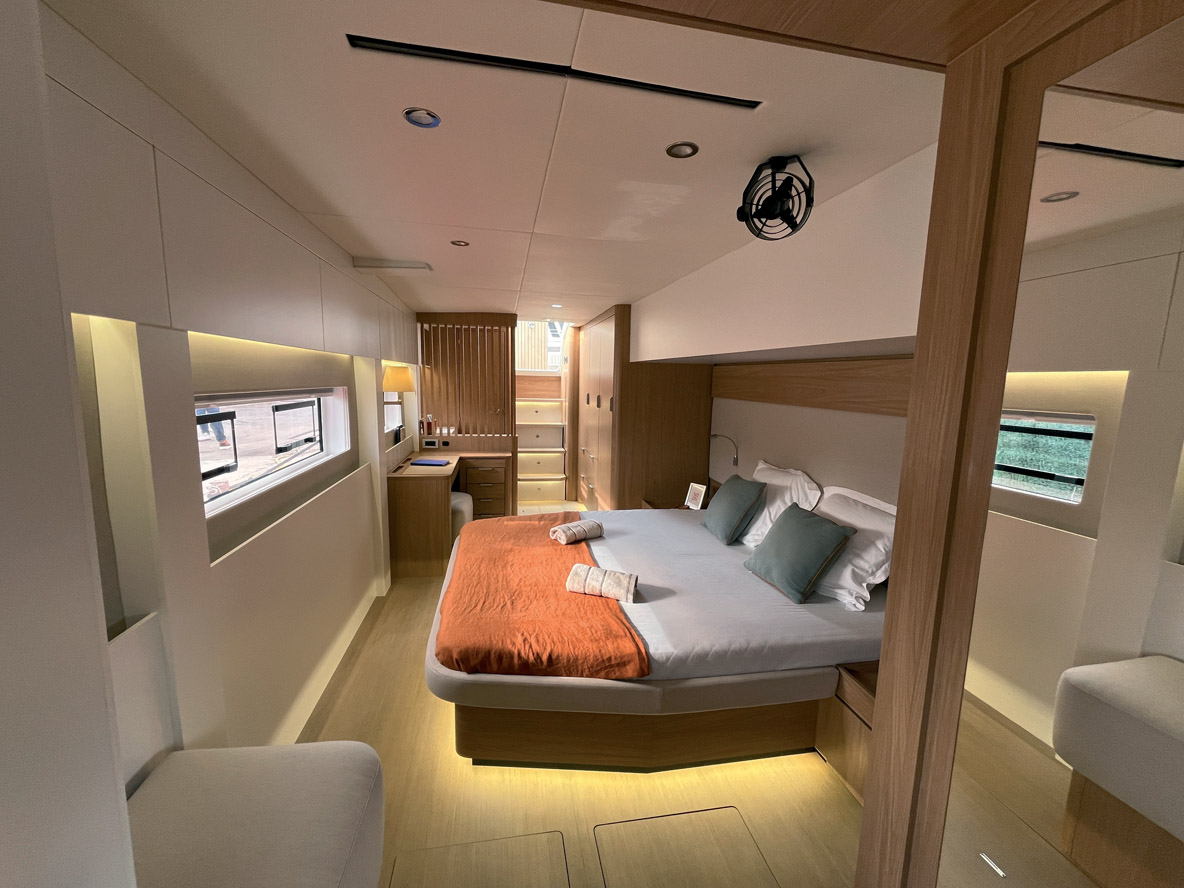
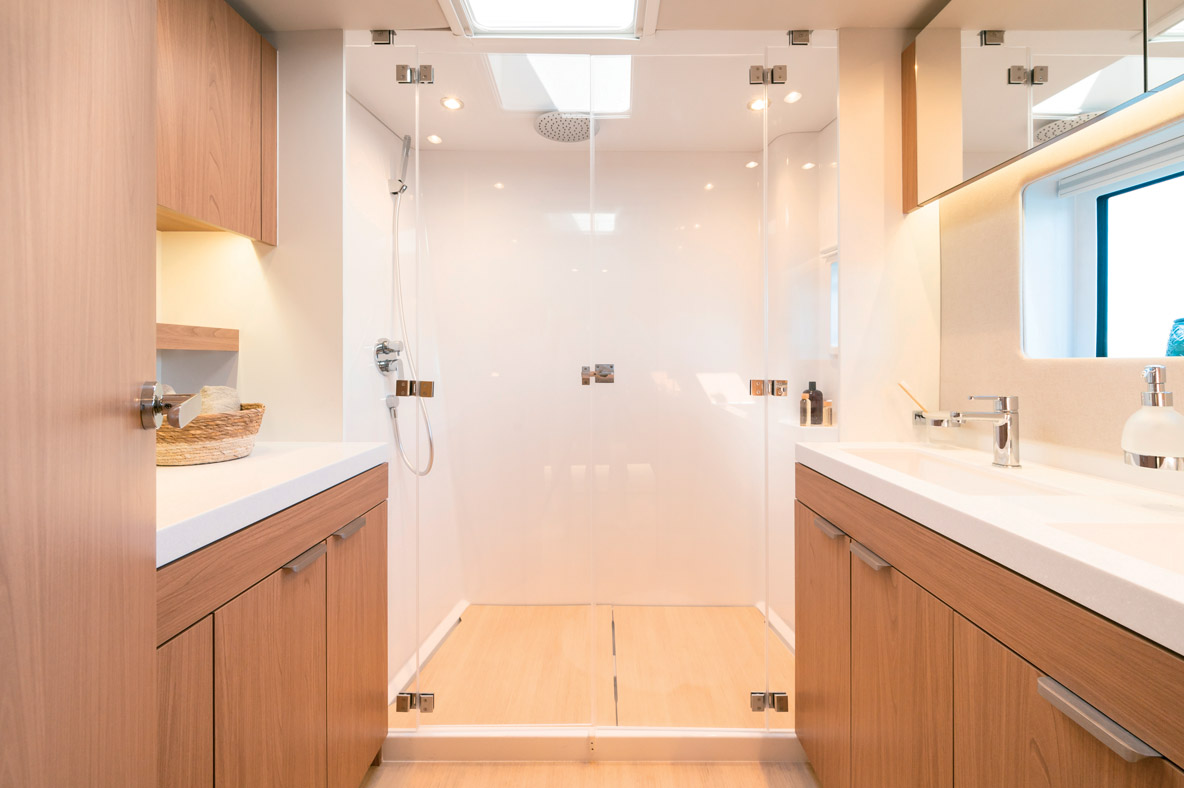
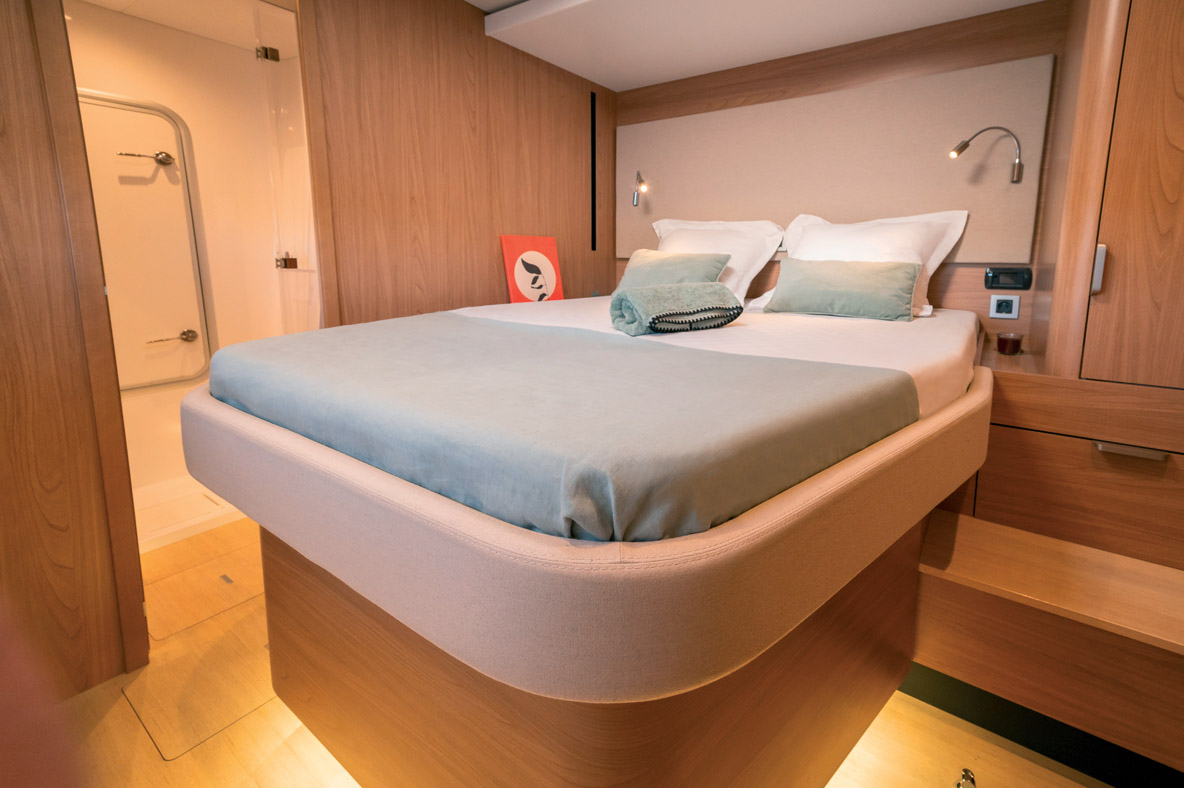
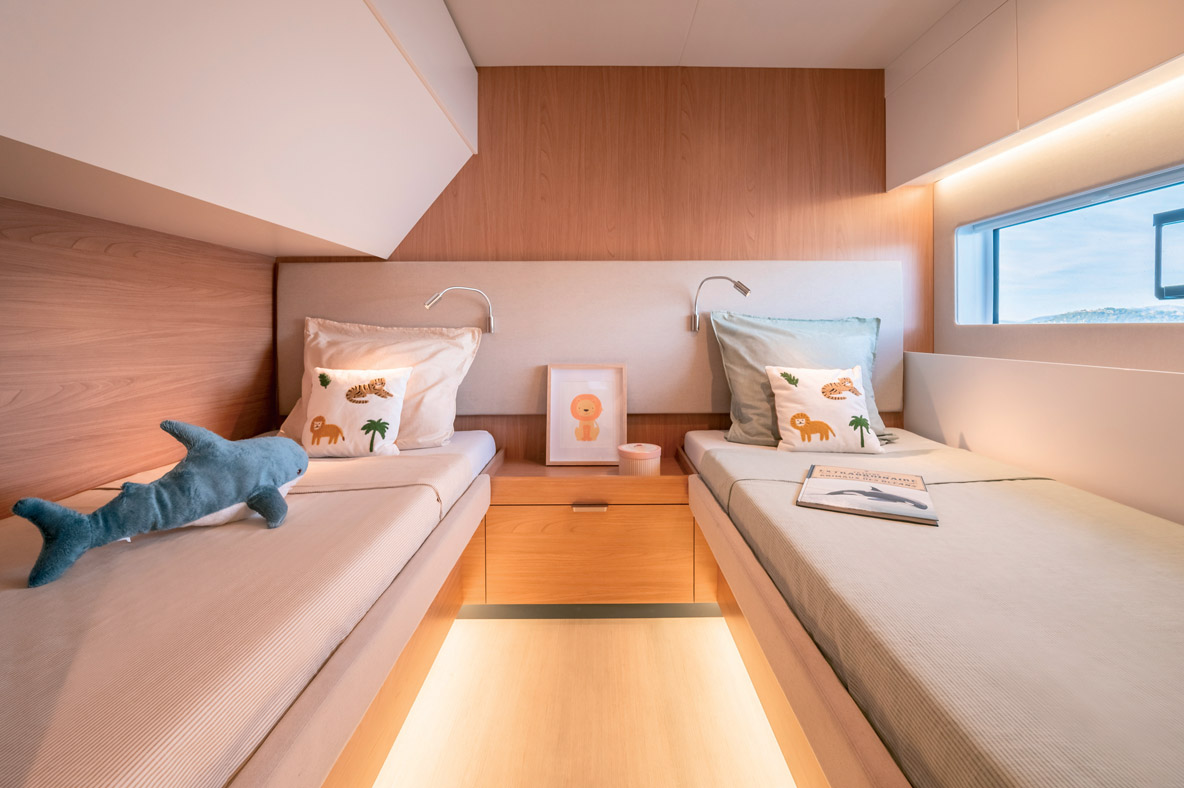
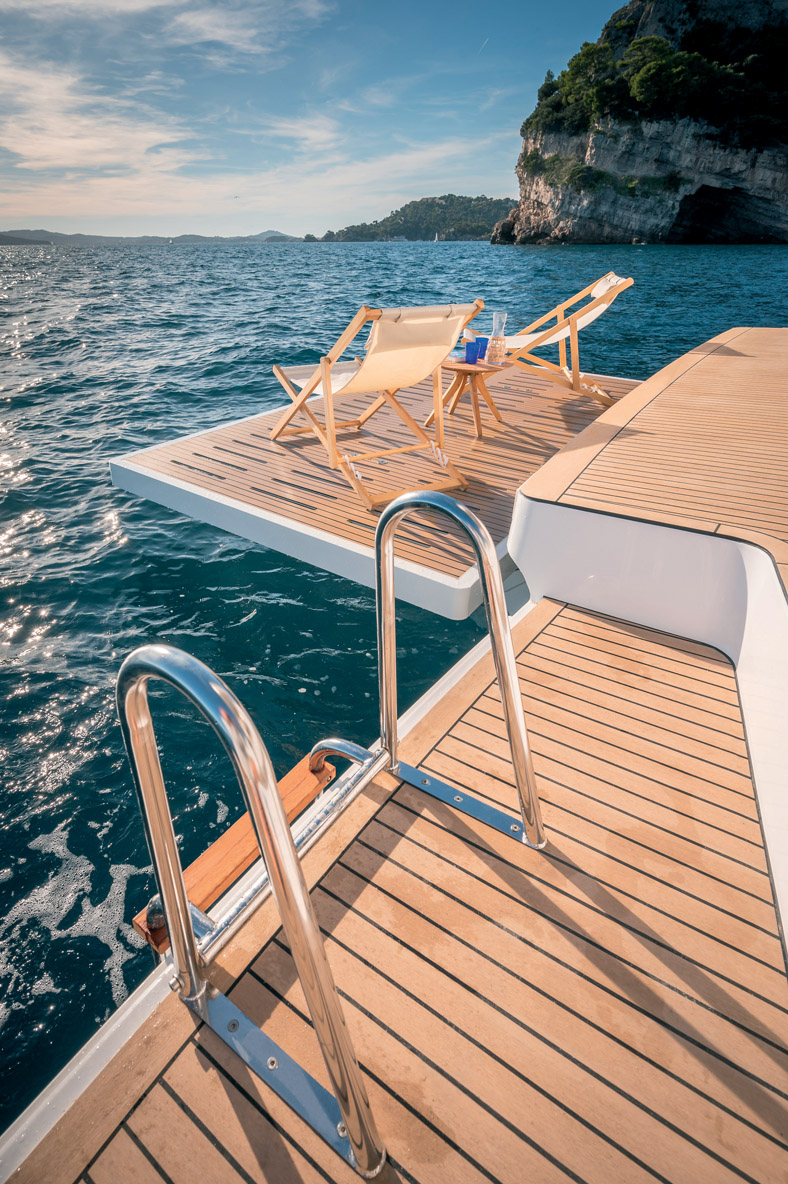
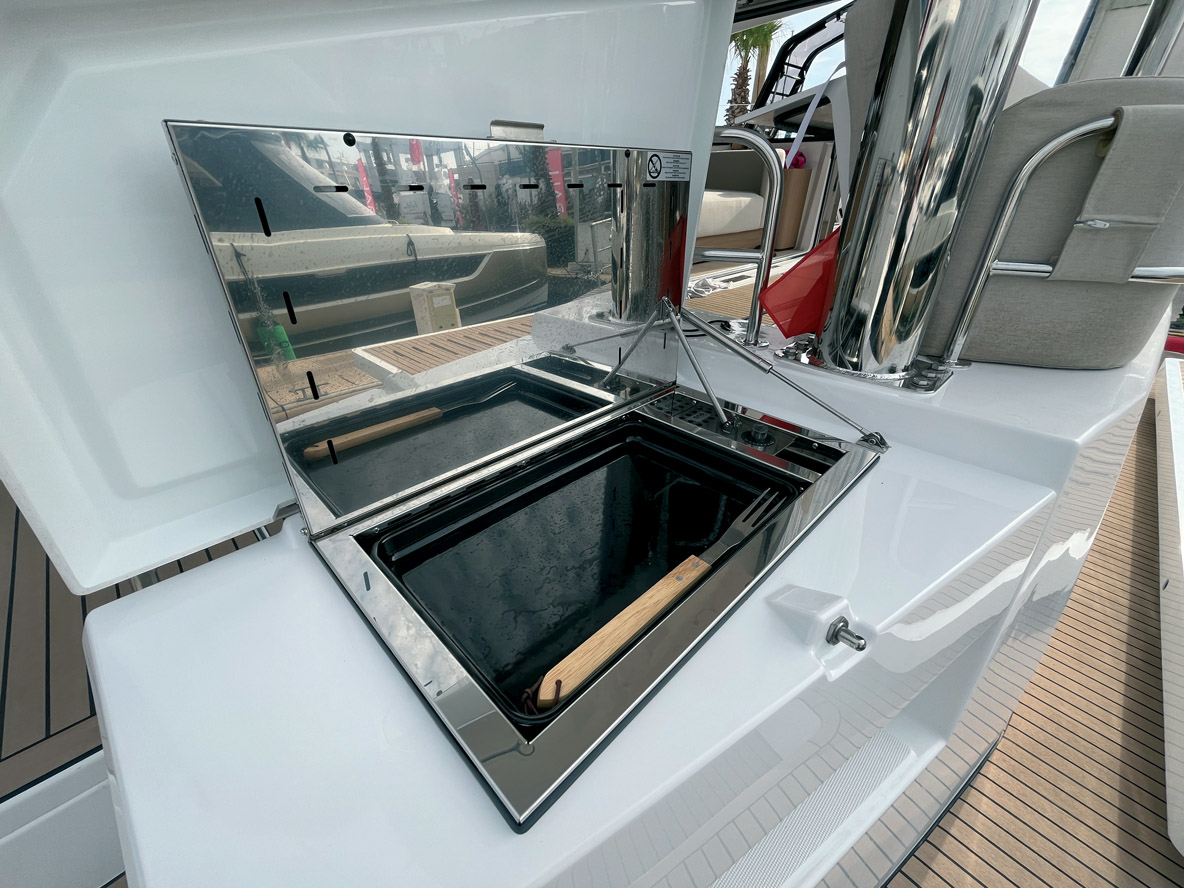
Fifteen seconds is all it takes to raise the aft door, revealing an XXL living space. To start with, the table can seat six to twelve people. Opposite, a lounge area can be adapted with an armchair or sofa. In the center, the two-door refrigerator can become two, bringing the cooling capacity to over 600 liters (21 cubic feet). Six linear meters (20’) are allocated to the galley countertop and very large storage spaces accommodate the washing machine and dryer. Sliding cabinets are dedicated to condiments or for a bar in the saloon. As for the chart table, it is complemented by a desk area. If you want to have lunch outside in peace and quiet and in the sun, just go through the forward door to access the foredeck, which also has a very large table. When you go down into the hulls, you’ll find cabins with island beds - king-size for the owner and queen size for the guests. Two twin cabins can complete the sleeping area, which comes in a dozen different versions, ranging from three to six cabins, all with their own private bathrooms. The laminated oak veneer joinery has rounded corners. Decorated with bookshelves, they contribute to a much more upmarket and cozier atmosphere than previously seen on Bali catamarans. The optional crew cabins offer genuine comfort, with a clear improvement compared to earlier models. Located in the forepeaks, these cabins are systematically equipped with a separate shower. Three cabins are possible - this configuration is reserved for the Owner’s version with three cabins. The only downside is that there is no longer a sail locker, and therefore greatly limiting the possibility of storing nautical toys. The choice of having a three-person crew will thus reduce the possibilities for fun activities when at anchor. The other point that somewhat limits any increase in the range of charter features is the absence of a “galley-down” version - a layout that would preserve greater discretion. Similarly, the optional hydraulic platform, which can hold 480 kg (1,060 lbs), doesn’t provide a very large aft deck. These factors all contribute to the lower price.
Very Easy Sailing Maneuvers
The flybridge has also received its share of improvements: The bench seat at the helm, whose backrest tilts to transform into a sofa when turned towards the lounge area, can seat four people. The sun lounger is also much larger, with room for six people on its mattresses. The provision of energy is adapted to suit domestic requirements, with the catalog offering 4.5 kW of solar panels on the coachroof and T-top, lithium batteries and of course a generator, of up to 20 kW. These options can compensate for the consumption of equipment such as air conditioning, refrigeration and other kit that will inevitably be chosen by the customer.
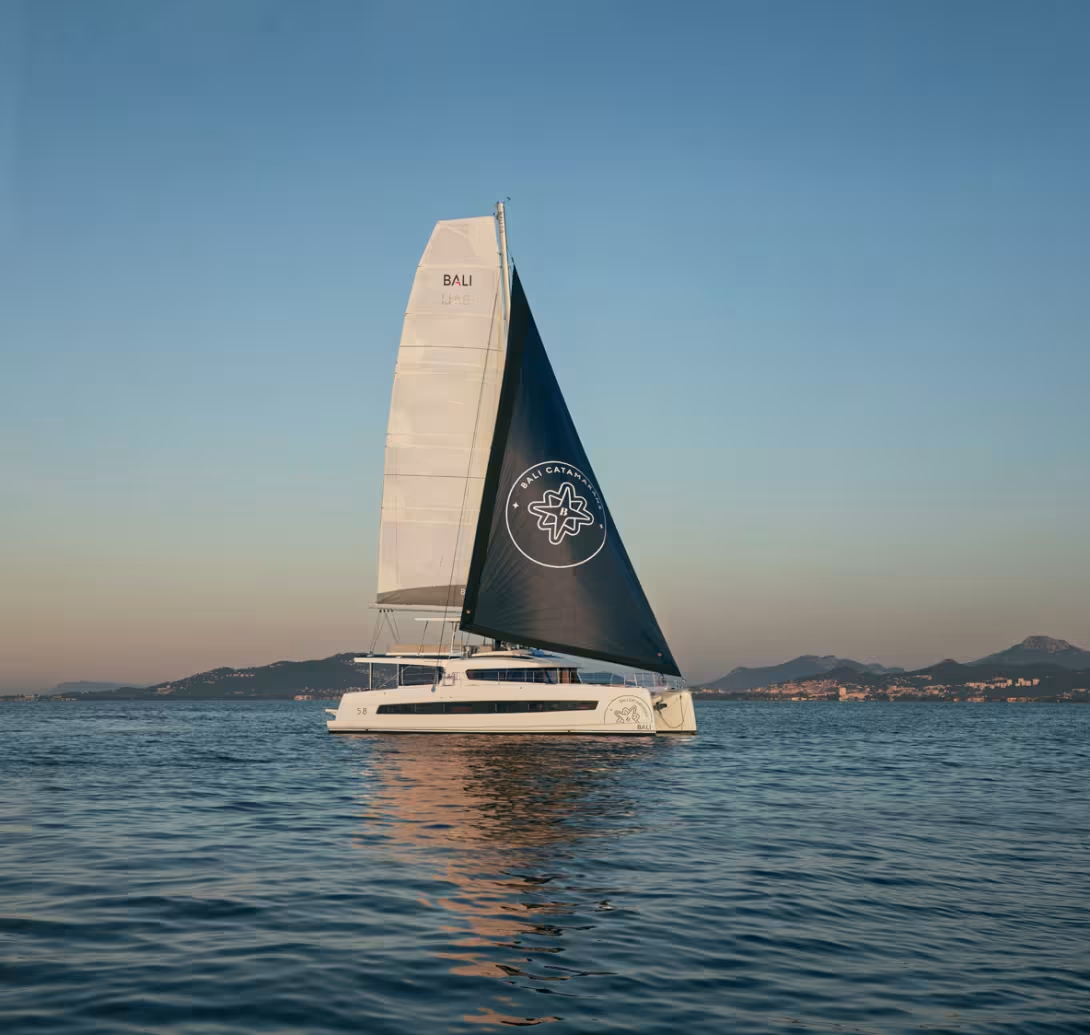
The conditions on the day of our test were not exactly challenging, with only 6 to 7 knots recorded on a perfectly flat sea. To limit the wetted surface area, chines widen the hulls above the waterline. The rigidity of this platform, already naturally ensured by its integral deck, is further improved by longitudinal omega reinforcements. The standard Elvstrøm wardrobe includes a 115 m² (1,237-square foot) mainsail and a 59 m² (635 sq ft) self-tacking solent. While the latter allows you to make upwind without getting tired and without being rolled even in part in a stiff breeze, we’d prefer to hoist the optional 121 m² (1,301 sq ft) Code 0 mounted on a furler right away, obviously taking into account the conditions on the day. The halyards and other lines are hauled in on electric winches to the control console on the flybridge, but the gennaker can also be maneuvered using electric winches on each bulwark of the main deck. The mainsheet is a twin setup, a principle inherited from Catana, but here it is also to avoid flexing of the coachroof, under which the up-and-over door is hinged - which cannot tolerate any play. Ultimately, this configuration is very easy to manage short-handed, which is what owners and charterers of this brand expect. Despite the light airs and the small sail area of the Bali 5.8, we were still able to reach 4 to 5 knots upwind and a little over six knots downwind – that is, up to 120 degrees off the wind. The necessarily reduced efficiency of this very conservative sail plan is obviously counterbalanced by the relatively light displacement, as we have seen.
Under motor, you can count on a cruising speed of 8 knots, and 11 knots maximum speed.
Conclusion
The largest of the Balis is definitely faithful to the brand’s DNA: Aboard the 5.8, surface area and volume combine in XXL sizes. Add in an optimization of the layout along with the price, the comfort offered will make this new flagship a bestseller for chartering in both Europe and the Americas. The US market seems to be a particular target for this boat, with its gangway slot integrated into the guardrails. The Bali 5.8 may also be able to attract the Owner market, with occasional high-end charters thanks to much more advantageous finishes than those of the 5.4 and the possibility of accommodating a professional crew. Easy to maneuver, fairly light and well-priced, the Bali 5.8 is the perfect way to introduce a clientele looking for comfort on the water that’s “just like at home” to the joys of sailing.
Very competitive price
Significantly higher standard of finish
Crew or toys, you have to choose...
Hydraulic platform a bit limited
Technical Specifications
Architect: Xavier Faÿ
Interior designer: Piaton-Bercault Yacht Design
Length overall: 57’11” (17.65 m)
Beam: 29’9” (9.06 m)
Draft: 4’10” (1.47 m)
Lightship displacement: 54,895 lbs (24.9 t)
Mainsail: 1,237 sq ft (115 m2)
Self-tacking solent: 635 sq ft (59 m2)
Gennaker: 1,302 sq ft (121 m2)
Motors: 2 x 80/115 HP
Cabins: 3 to 6 plus 1 crew
Fuel: 317 US gal (1,200 l)
Water: 348 US gal (1,320 l)
CE Certification: A & B – 16 / C – 24 / D – 40
Price: from e1,449,000 ex-tax
Price of the version we tested: e 2,000,000 ex-tax
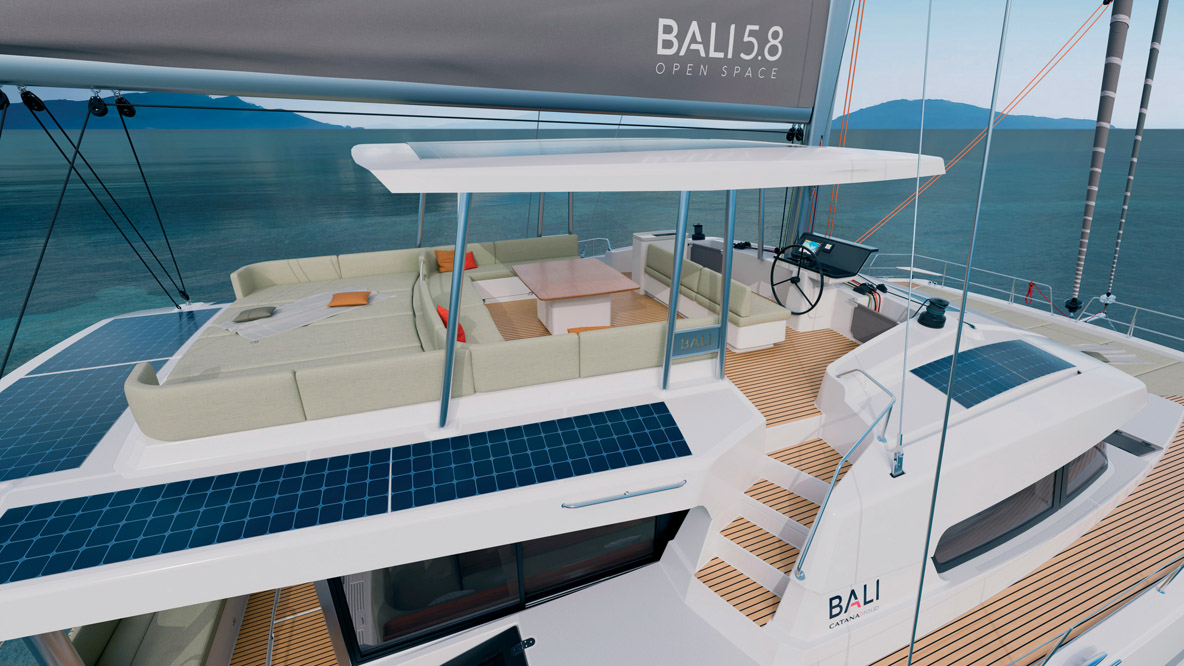
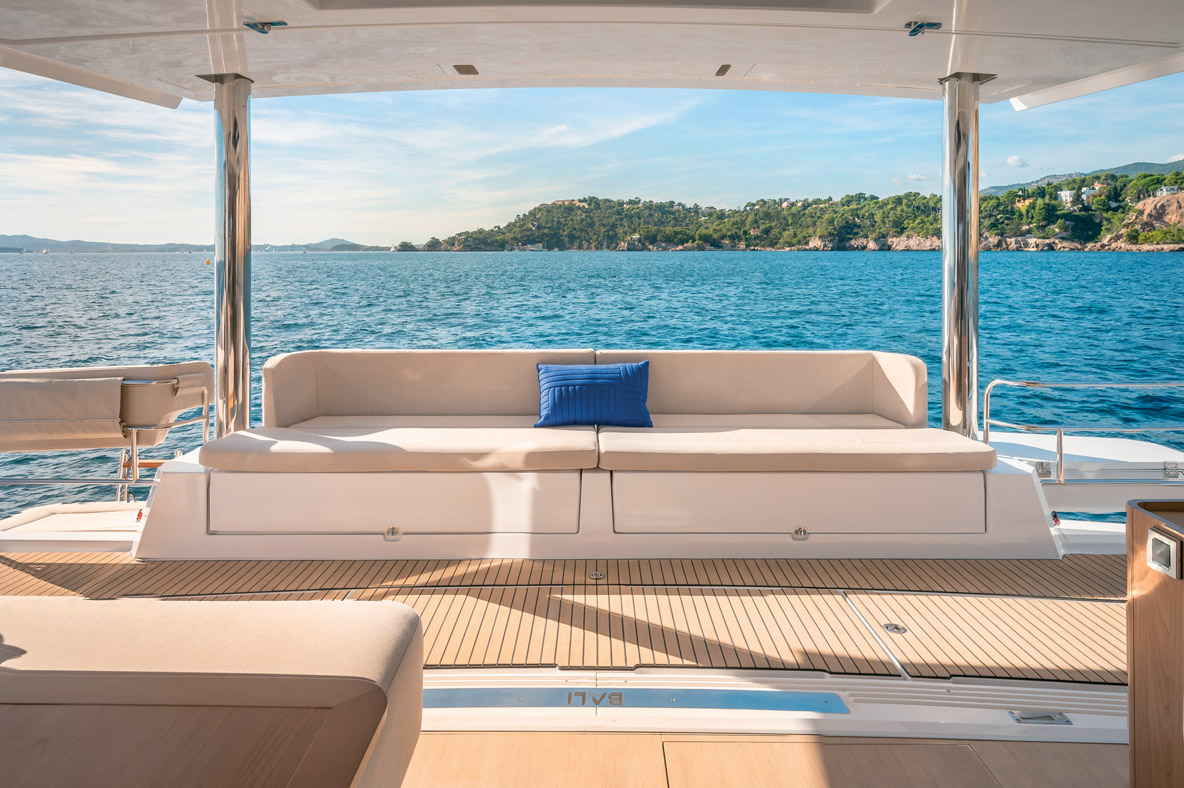
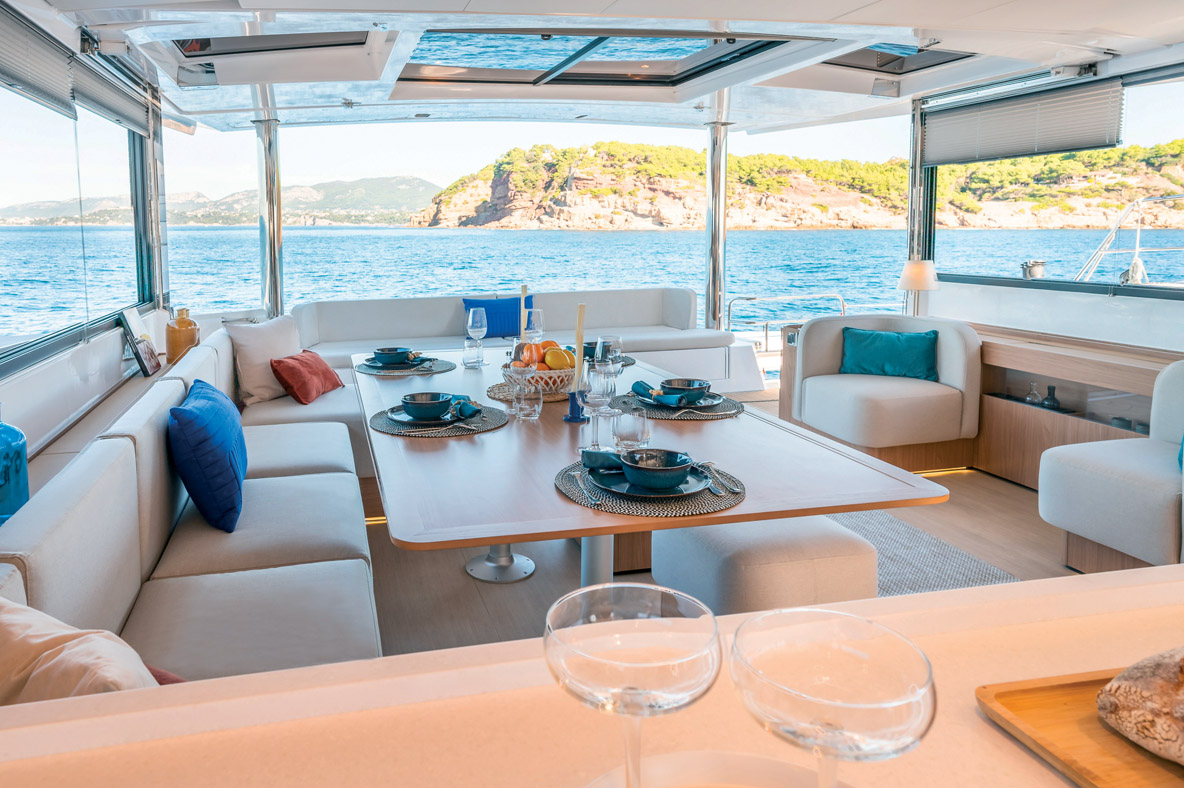
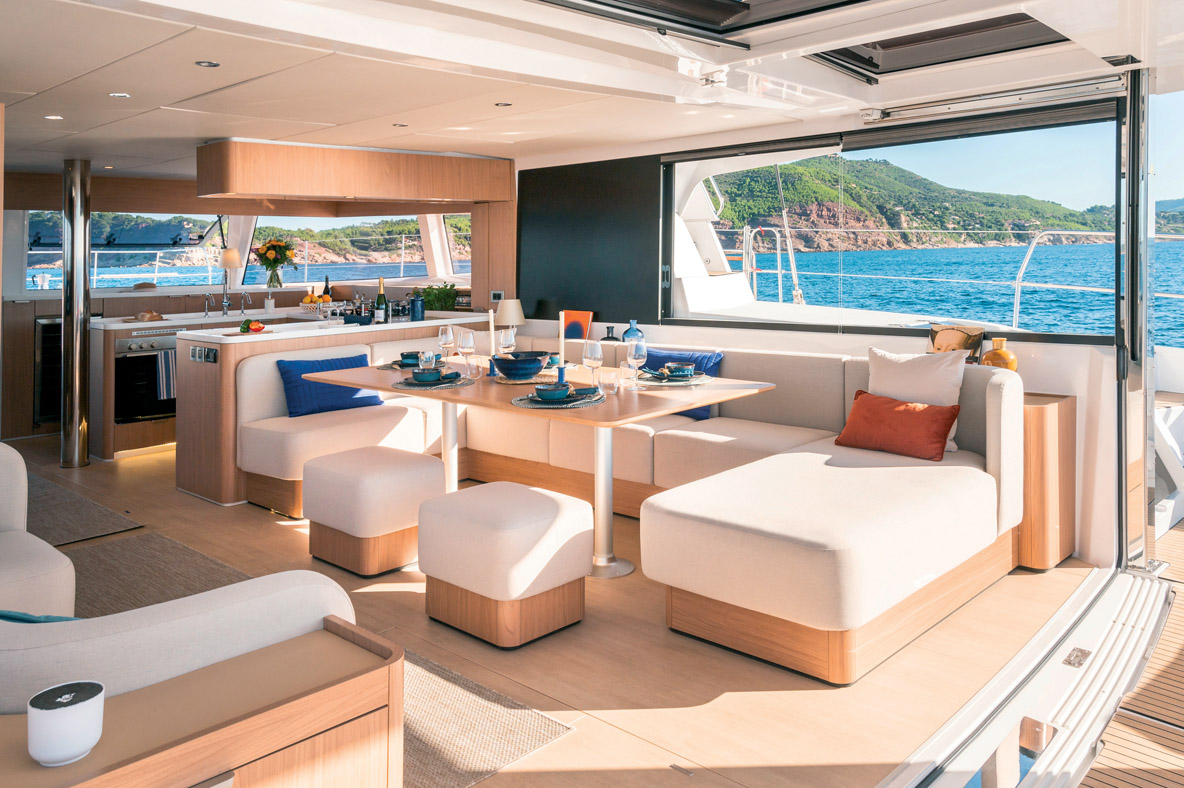
that is all the more spacious and ergonomic because the functions
(lounge, seating and table) aren’t duplicated