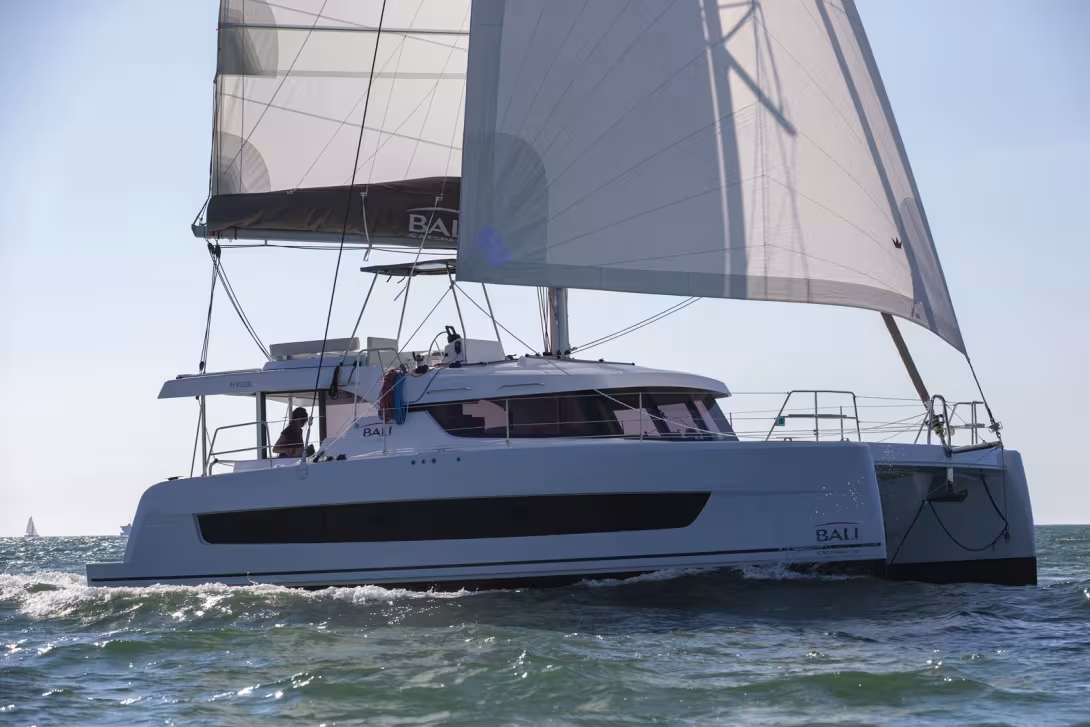
With her flybridge, four cabins and 10 berths, the Catspace offers in 40 feet what many of her competitors struggle - or are reluctant - to present aboard a catamaran of 42 or even 45 feet... Has Bali gone too far? Or has the Catspace understood everything? We look for some answers on our test in the Mediterranean.
Infos pratiques
- Le chantier : Bali Catspace
- La fiche technique
- Découvrez notre vidéo exclusive
- Financez votre Bali Catspace
- Assuez votre Bali Catspace
- Articles autour du Bali Catspace
Test location: Canet-en-Rousillon
Wind: southeast to southwest 5 to 30 knots
Sea state: smooth to moderate
The tale of a new brand
Since the 4.5 was first presented at the 2014 Barcelona boat show, the Bali silhouette has become a familiar feature on the water, especially among charter fleets where they are very popular. Initial doubts over the fully-decked nacelle have subsided and the range continues to grow, spurred on by strong sales. The 4.1 is ending her career, soon to be replaced by a 4.2, while the 4.6 will take over from the 4.5. As for the very recent Bali 4.8 (see the full test in MW171), she will be presented to the public at this seasons boat shows. The largest model and the first powercat in the range - the 5.4 and the Power 43 - have seen slightly more modest distribution, but they have found their audience. But getting back to the Catspace - she was presented at the 2020 boot Düsseldorf but was unable to make it to the International Multihull Show at La Grande Motte in the South of France because of the international health crisis. So, we had to wait until June 2020 to finally discover this original 40-foot boat, mainly aimed at charter.
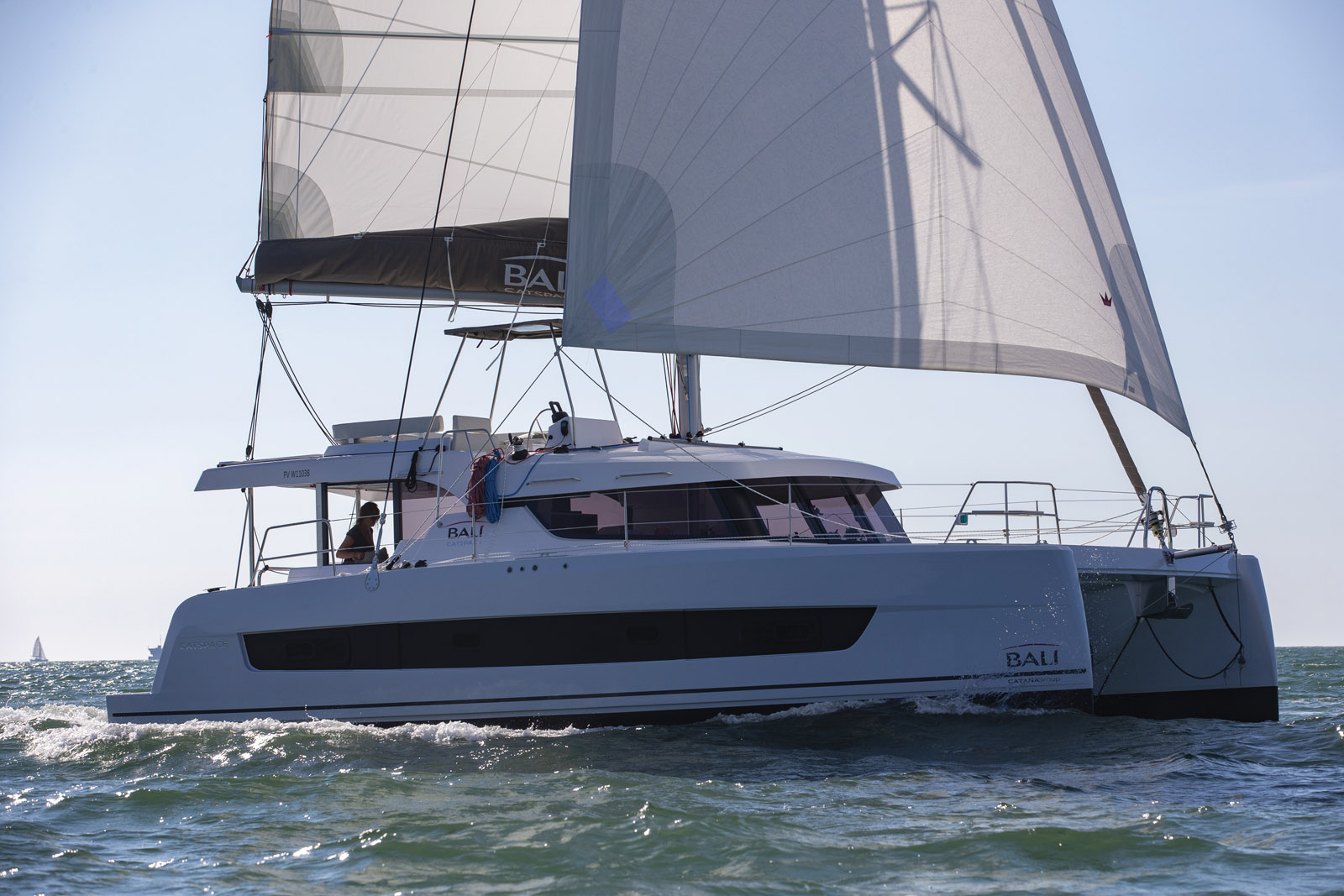
The gennaker offers an extra 236 sq ft of sail area than the 323-sq ft self-tacking jib.
Hull #1 - Tried and tested and approved!
Balis are built on three production sites: the 4.1 and Catspace are built at the factory in Tunisia; the medium-sized units in Marans (north of La Rochelle, on France’s Atlantic coast); and the largest in Canet-en-Roussillon, on the Med coast. The first Catspace was transported to Genoa, Italy to board a freighter bound for Rotterdam in Holland, from where she motored up the Rhine in Germany, to Düsseldorf. The return trip back to La Rochelle was also completed under engine, before having the mast stepped and then sailing around Spain, towards Canet-en-Roussillon. Certainly a good shake-down trip!
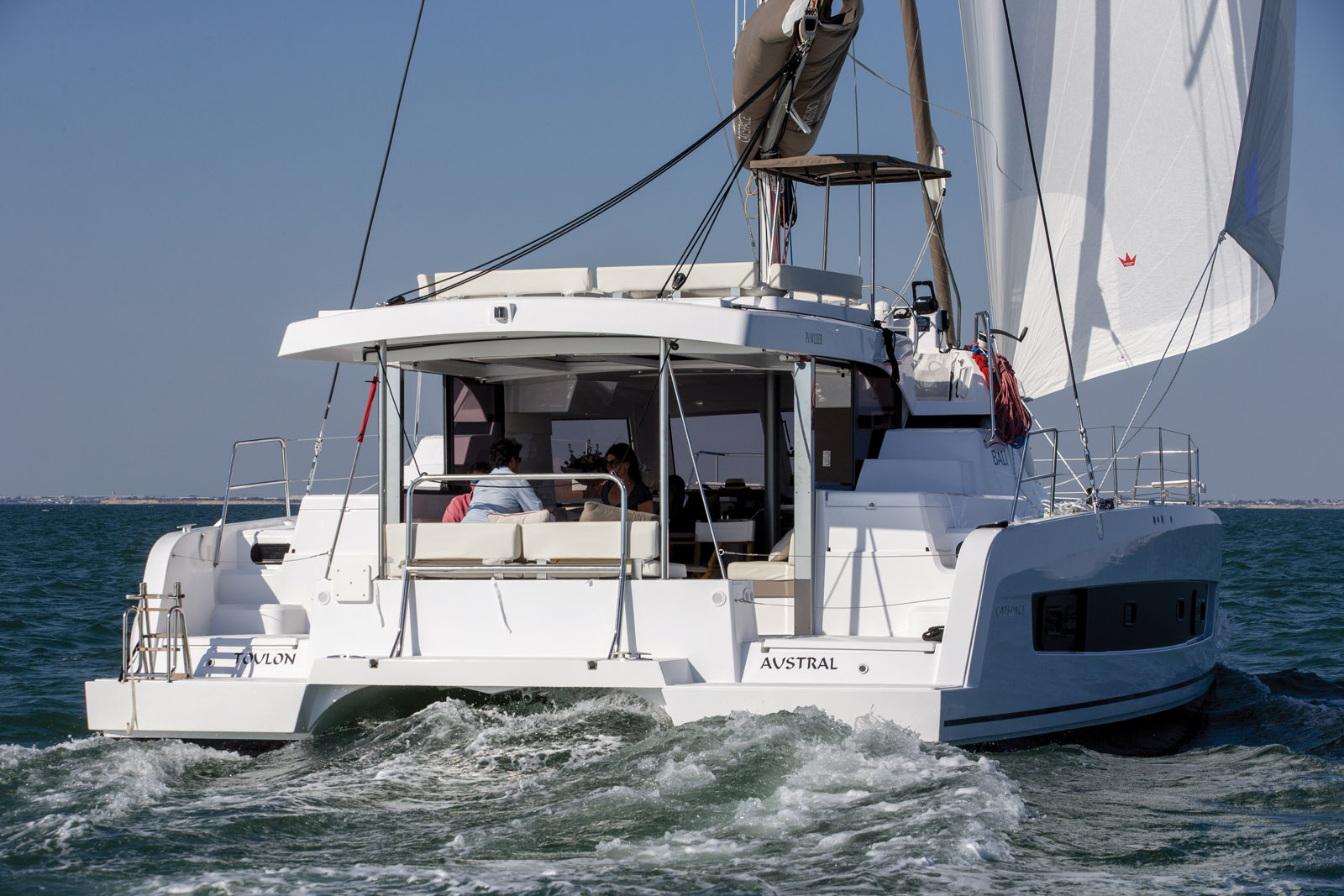
Sugarscoops, wide platform and davits for the dinghy: everything you ever need at anchor.
Bali, a concept and codes
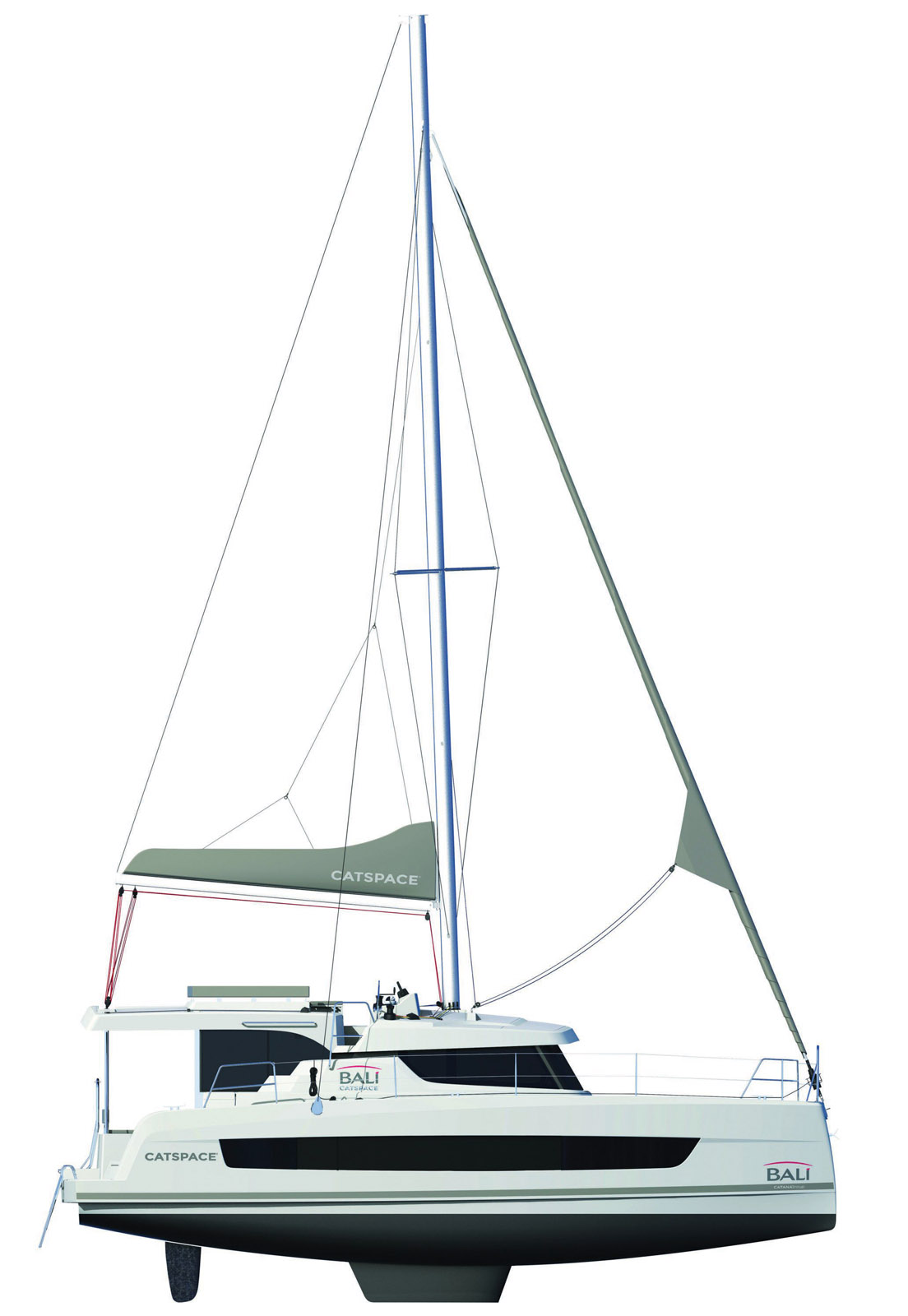
All the Balis share a common silhouette, of course, but above all an innovative philosophy of interior design. It was Xavier Faÿ who drew up Olivier Poncin’s specifications for the first examples, with the help of Hervé Couedel for the interior design. The new Catspace has been entirely designed by Samer Lasta Design. The Bali DNA was defined from the outset around five major factors, sometimes conflicting, but it was a gamble that paid off! Here are the elements that make up family’s identity: the tilting/ pivoting door that allows the aft bulkhead to be completely opened up, the moveable side windows, forced ventilation via a sliding panel in the windshield, the layout of the forward cockpit as a relaxation/sunbathing area, and lastly, the ease of handling. For the Catspace, the idea was to integrate all these features on a 40-foot (12-meter) catamaran by going as far as possible in the search for new living spaces - adding a flybridge and integrating four large double cabins (two of which are laid out athwartships, with a view of the water). Challenging specifications…
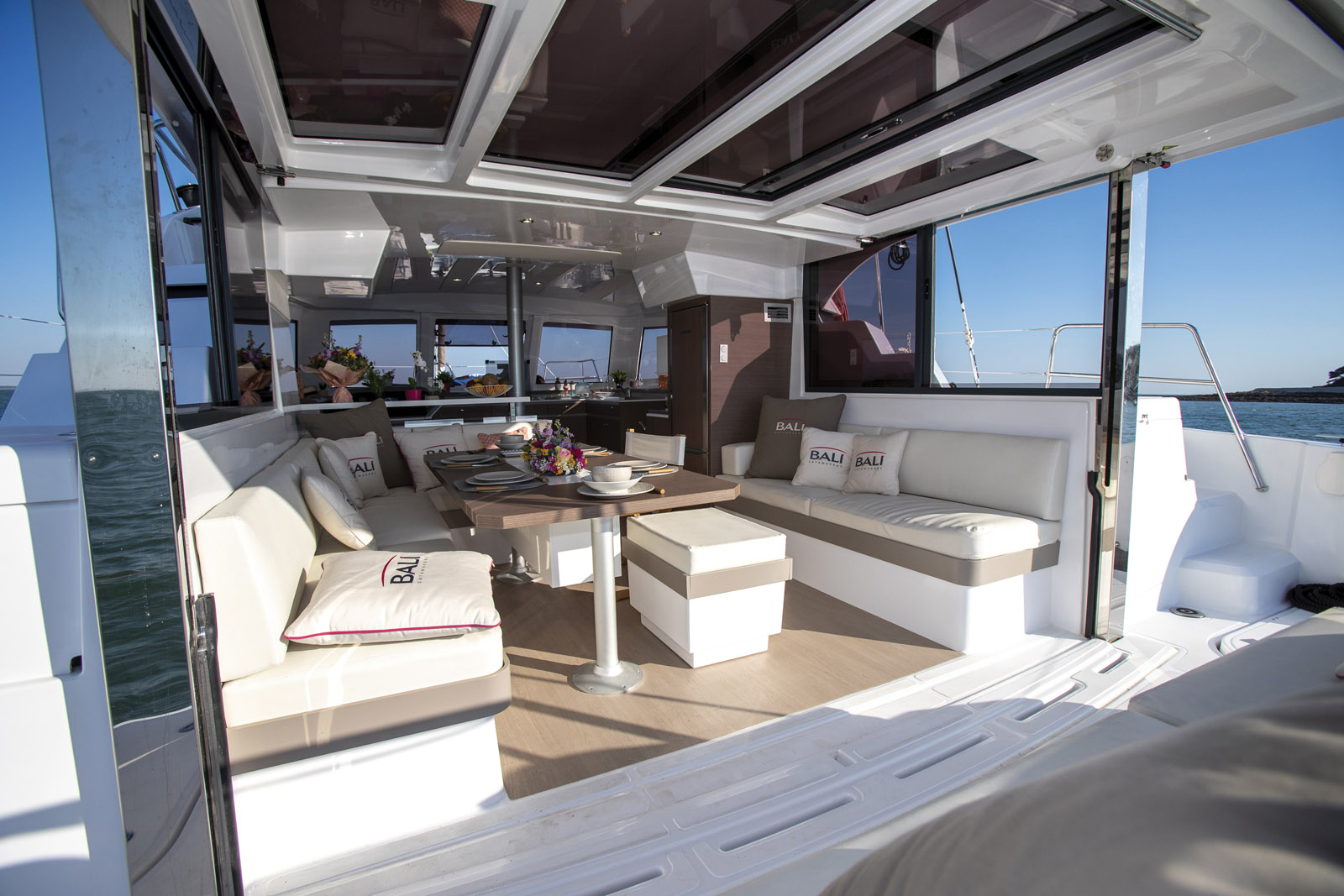
Step aboard a Catspace and you discover a multihull entirely dedicated to recreational use by a family or a crew of boat buddies.
100% pleasure, 100% practical
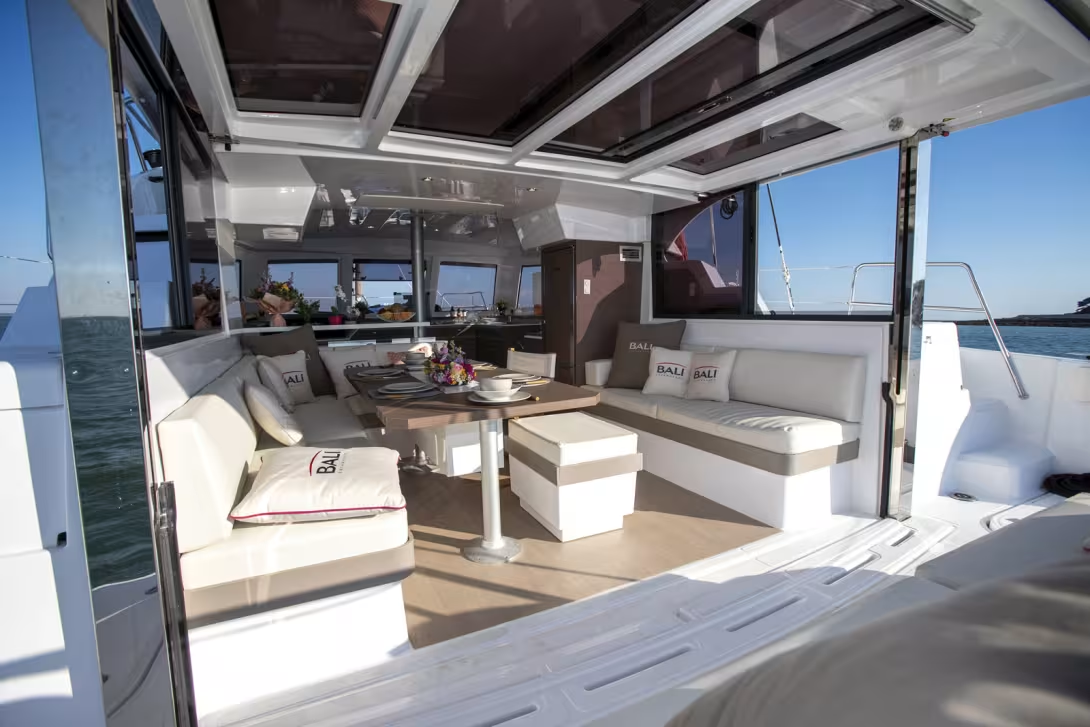
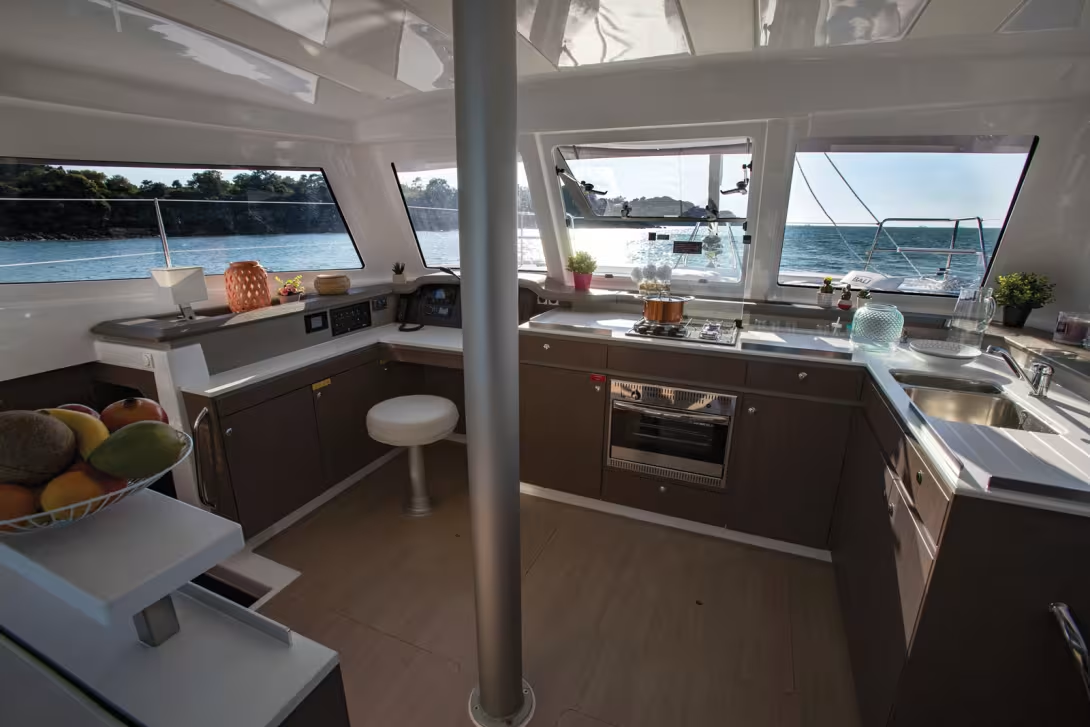
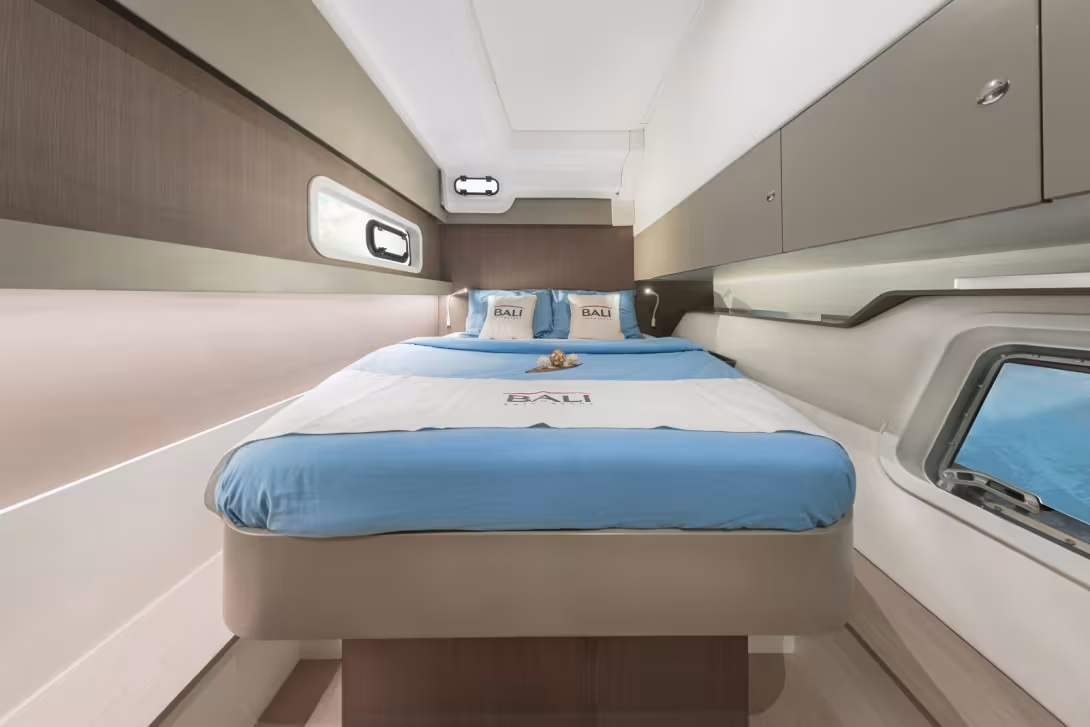
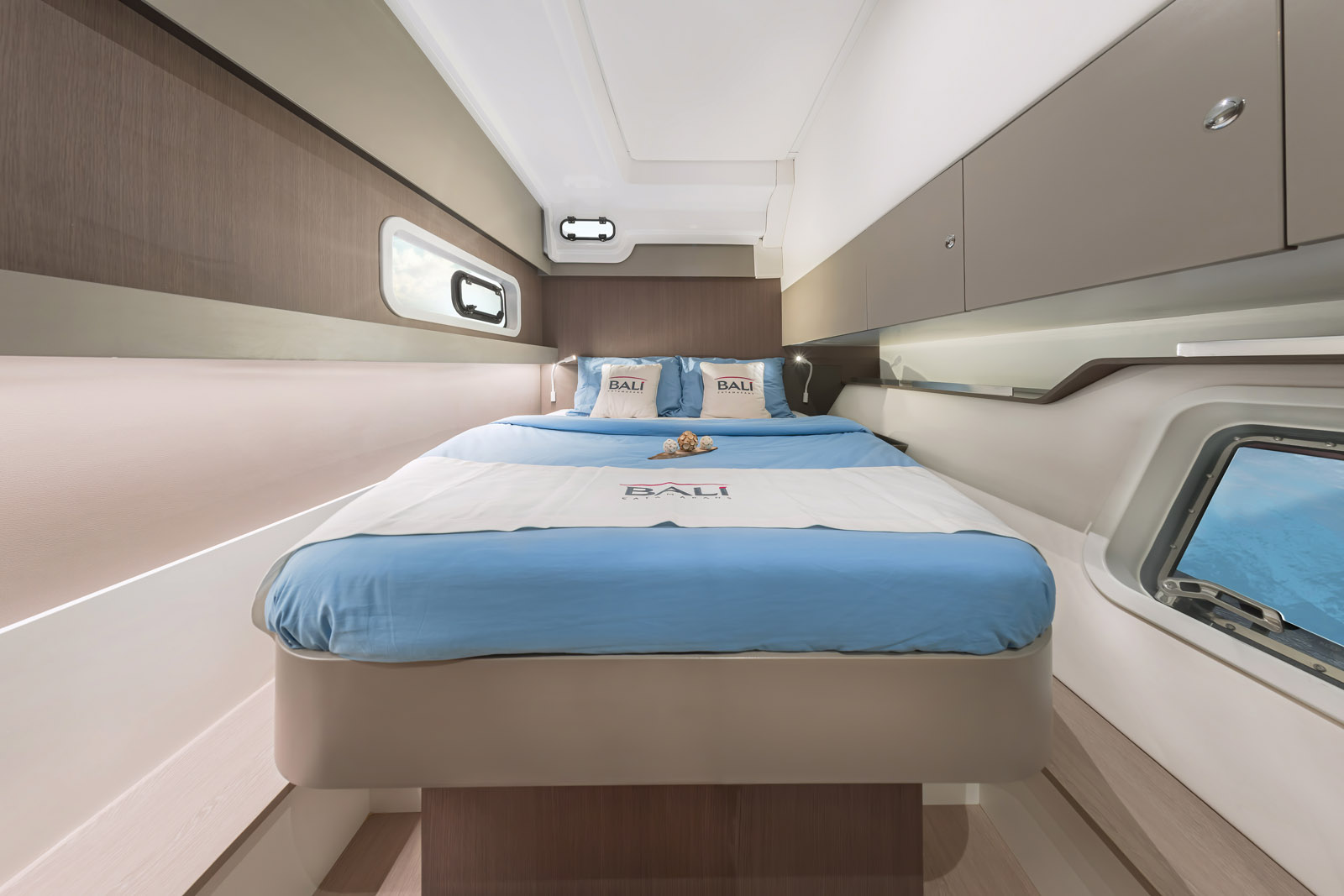
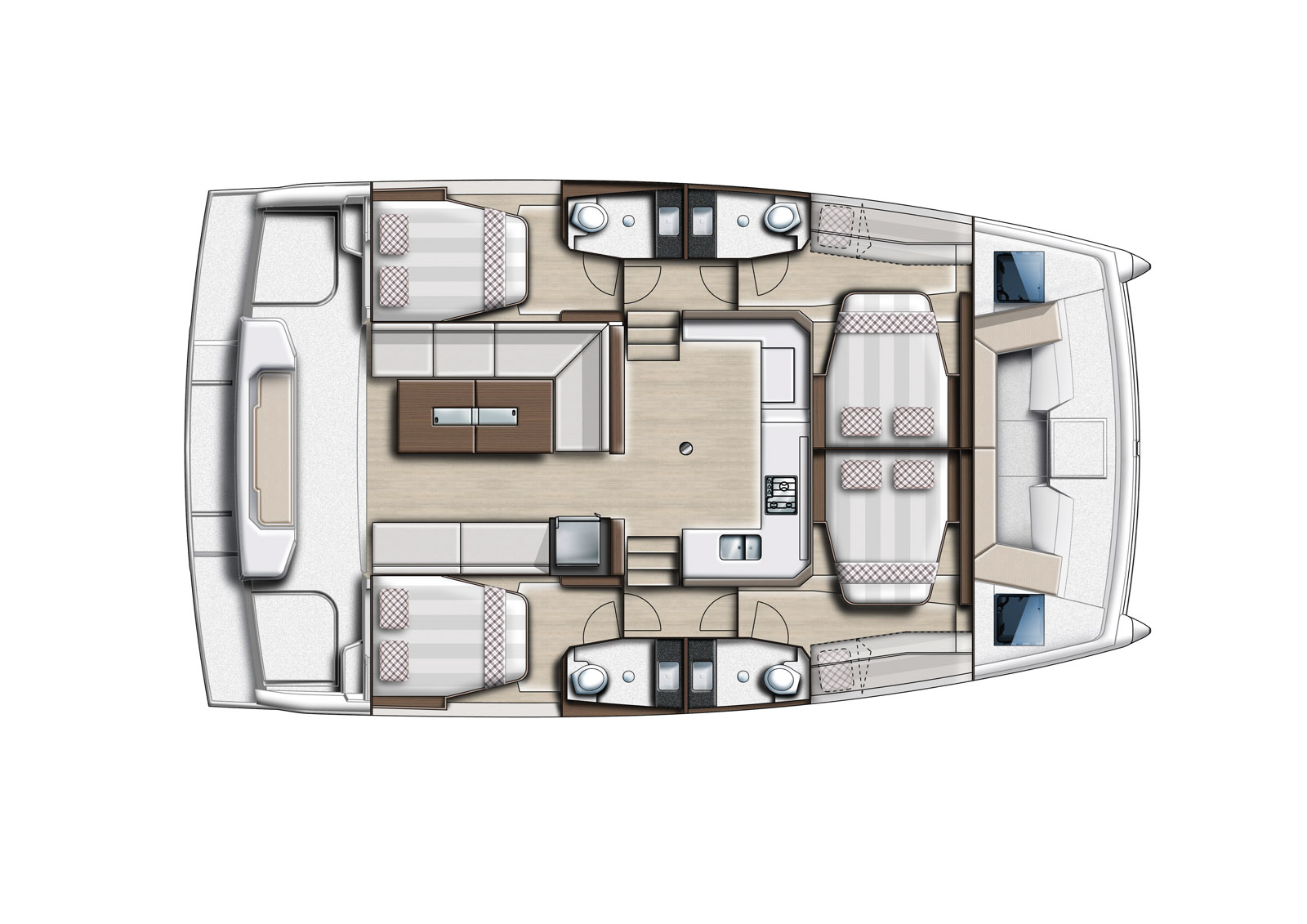
Step aboard a Catspace and you discover a multihull entirely dedicated to recreational use by a family or a crew of boat buddies who don’t want to be encumbered by a 45 or 50-foot catamaran. With her two fitted-out forepeaks, the Catspace can accommodate 10 people, offering everyone a comfortable and intimate space. The four double cabins equipped with toilet and shower compartments are quite amazing in terms of volume and comfort, given the length of the hulls. The modular saloon, with its hinged door (easy to open and close manually) and sliding side windows, remains cool and ventilated at all times as long as you adjust the height of the forward opening. We have good reason to wonder if the design team and the naval architect hired an ergonomics expert because all living spaces perfectly meet the required function... and all this in only 40 feet, remember! There’s a proper desk/chart table, a smart and well-equipped, forward-facing galley, a very clever pass-through bar, lots of storage space and a table that can seat eight with direct access to the ‘terrace’. No one will feel cramped in this friendly and comfortable dining area. The very large capacity fridge-freezer is able to provide the expected service.
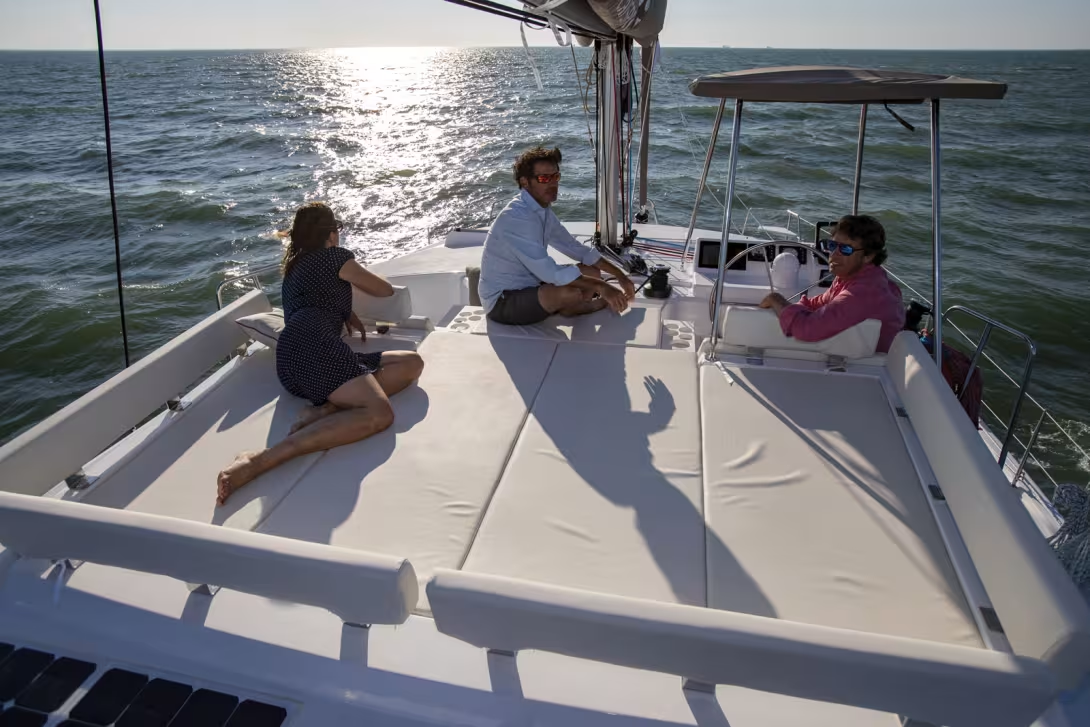
The perceived quality is excellent, the materials are perfectly adapted to the use, the electric lighting is efficient - it has legible and simple controls. The cockpit houses a large bench seat facing forward and another on the starboard side. Access to the flybridge (from both sides) is made safe by wide steps and a handrail. Up top, two bench seats accommodate the helmsman and some of the crew. A large sunbathing area opens out on the bimini, making a very pleasant spot in reasonable weather that is nice and safe thanks to cushions around the bulwark. The forward cockpit offers considerable space: it’s great for lazing around, even in a breeze. At anchor, this will be a sought-after spot.
 |
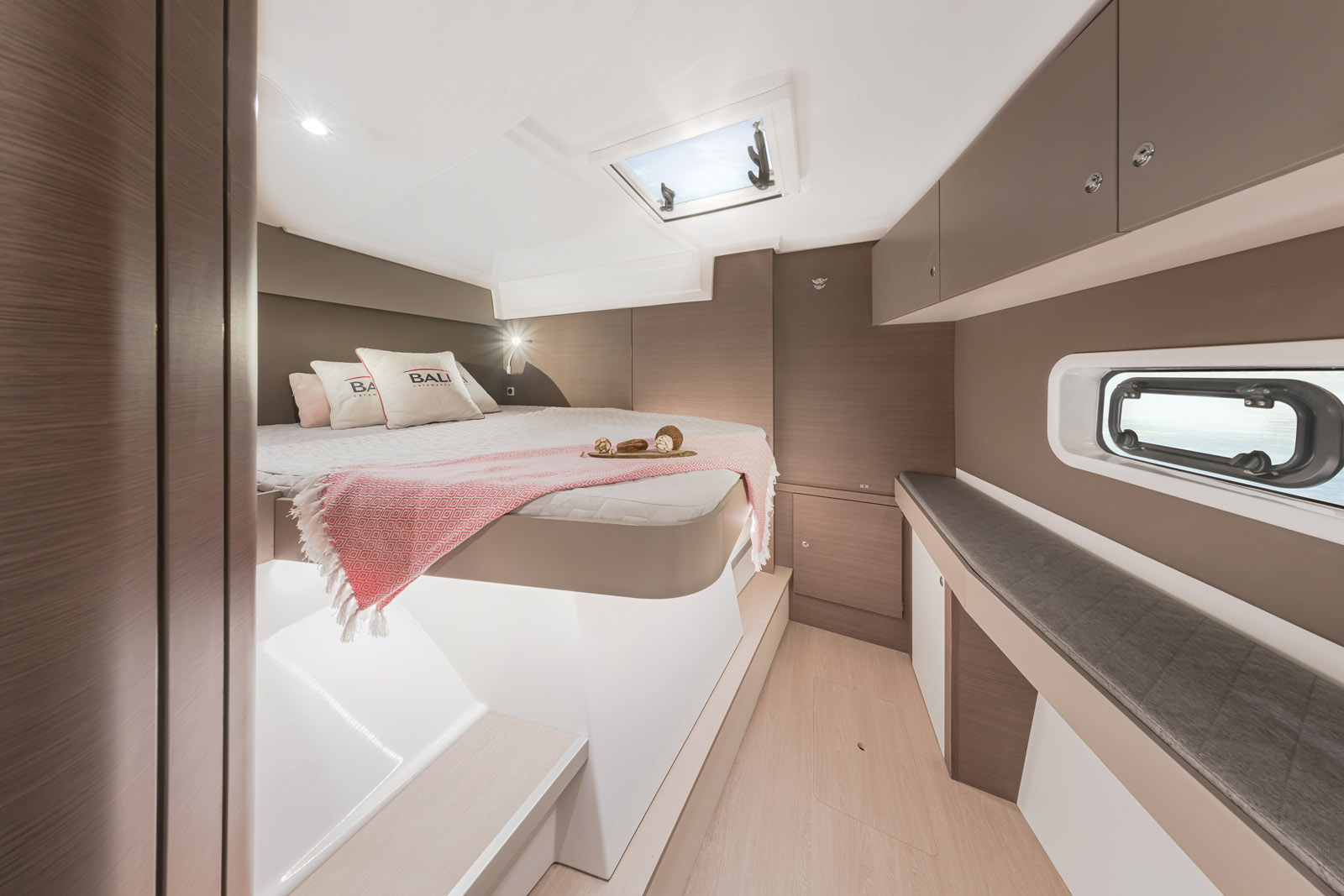 |
The builder has managed to fit four cabins - the forward ones are laid out athwartships - and the same number of heads compartments into just 40 feet of hull.
An Owner’s version with three cabins is also available
An easy-to-use multihull
Access in the engine compartments is good: there is space around the engines themselves and the saildrives for all the regular maintenance. The nice access also makes it easy to quickly understand the different equipment. The steering quadrants, the couplings for the aluminum linking bar, the starter battery, and fuel valves and filters are all properly accessible. The service battery bank is housed under the galley floor in a dedicated locker. Maneuverability under motor is as good as possible taking into account the windage on this type of catamaran. We motored successfully out into the breeze and crossed the (tricky) entrance of the port of Caneten-Roussillon in 25-30 knots of southerly crosswind. The 30 hp engines and fixed two-bladed propellers are sufficient, but for private use, the option of threebladed, folding propellers (more torque, lower rpm, no drag under sail) should be chosen. Our one-day test took place in typical Mediterranean conditions (alternating light airs and strong breeze) with many sail maneuvers. The gennaker is obviously essential for moving with any speed in medium airs. The choice of the mast set back and a generous self-tacking fore-triangle (furling) makes maneuvering easy. The sails on our prototype can undoubtedly still evolve (the main’s top batten needs improving), but handling by a crew of modest experience will be easy. The electric winch is great for hoisting the main and furling the solent. The helm isn’t very ‘talkative’ and lacks a little directional effect in the waves, but this is a common shortcoming with hydraulic steering. Under autopilot, the Catspace is well balanced and responsive to trim - at least in our 3-person, 50%-laden configuration. Mainsail management by twin sheets is convenient, but you will need to rig a preventer for downwind sailing on longer tacks.
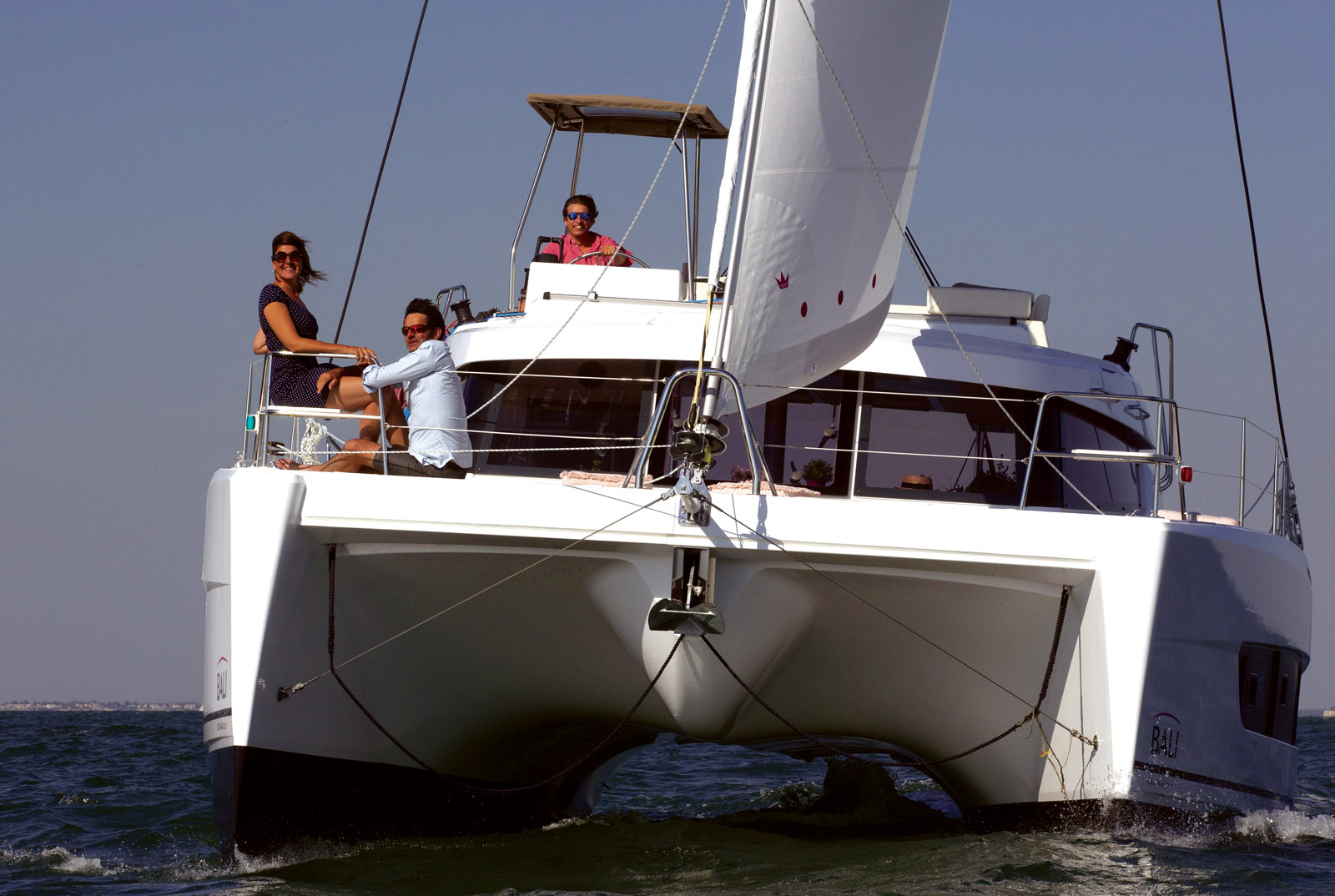
Despite increased windage and a mainsail reduced in area by the flybridge, the Bali Catspace is still capable of very correct performance.
Conclusion
The Catspace occupies a relevant niche within the Bali range. This new model is mainly aimed at charter fleets but can also be used in the three-cabin version for private owners. The typical profile of this owner? A skipper who might want to regularly welcome guests aboard a very open and easy-to-use catamaran. This Bali isn’t going to break speed records, but does go quite well. Given the versatility of her configurations, this compact catamaran is going to be able to adapt to very diverse waters, from Croatia to the Baltic, or from the Caribbean to Australia’s Gold Coast, for some great regional exploration.
The Pluses
+ Super friendly catamaran
+ Ideal platform for an initiation into multihull cruising
+ Intelligent overall ergonomics and user-friendly deck layout
The Minuses
- Hydraulic steering
- Countless options
- Bimini over the helm station could be improved
 |
 |
TECHNICAL SPECIFICATIONS
Builder: Bali Catamarans
Designer: Olivier Poncin
Interior architect: Samer Lasta
Length: 39’6” (12.05 m)
Beam: 21’6” (6.56 m)
Draft: 3’7” (1.10 m)
Light displacement: 20,300 lbs (9.2 t)
Maximum displacement: 28,200 lbs (12.8 t)
Mainsail: 527 / 560 sq ft (49 m²/52 m²) in square-topped version
Self-tacking solent: 323 sq ft (30 m²)
Code 0: 560 sq ft (52 m²)
Asymmetrical spinnaker (option): 970 sq ft (90 m²)
Air draft: 59’10” (18.23 m)
Construction: foam/glass/polyester sandwich (infusion process), vinylester on the underwater hull. Sandwich deck in RTM injection molding.
Engines: Yanmar 2 x 19 or 2 x 30 hp, saildrive/fixed, twinbladed propeller transmissions.
Water capacity: 2 x 92 US gal (2 x 350 l)
Fuel: 2 x 53 US gal (2 x 200 l)
Holding tank: 14.5 US gal (55 l)
Alternators: 2 x 125 A
Batteries: 2 x 130 Ah
Electronics: Raymarine Pack 1 (wind-log-sounder)
Fridge-freezer: 9.4 cu ft (265 l)
Base Price:
- 3-cabin version: € 298,350 ex-tax
- 4-cabin version: € 306,900 ex-tax
Main options in € ex-tax
- Excellence Pack: 48,200 €
- Yanmar 30 hp engines instead of 19 hp: 4,180 €
- Square-topped mainsail with lazy bag and lazy jacks: 4,870 €
- Code 0 complete with anti-twist cable and sheet: 4 960 €
- Code 0 fittings (bowsprit, furler, etc): 5,370 €
- Folding propellers: 3,150 €
- Solar panels 200 W: 3,100 €
- Watermaker 28 US gal/h (105 l/h): 11,950 €
- Delivery in Tunisia: 9,870 €
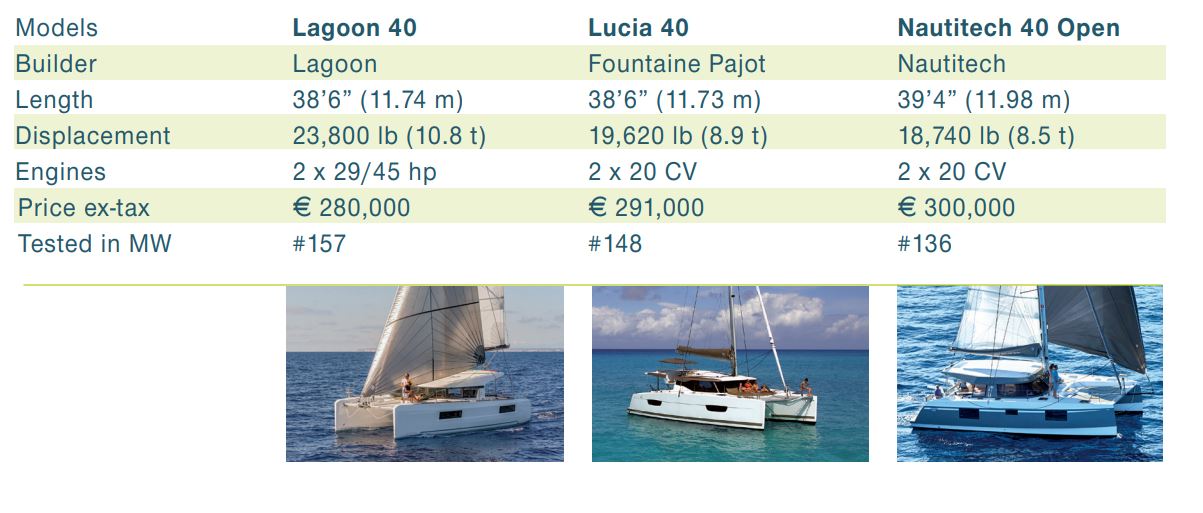
The competition