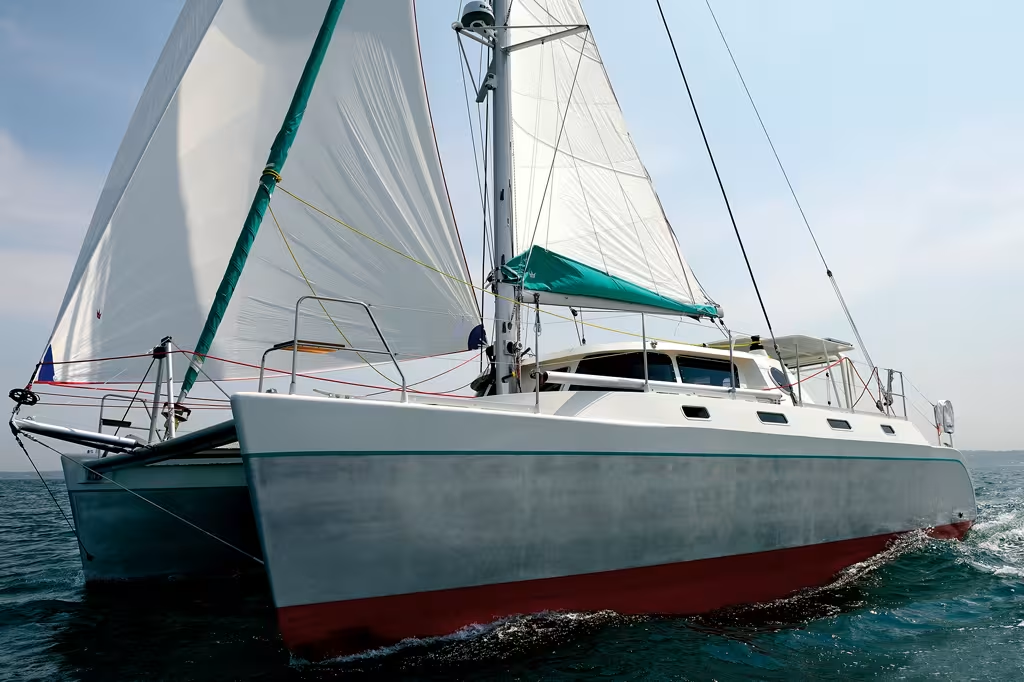
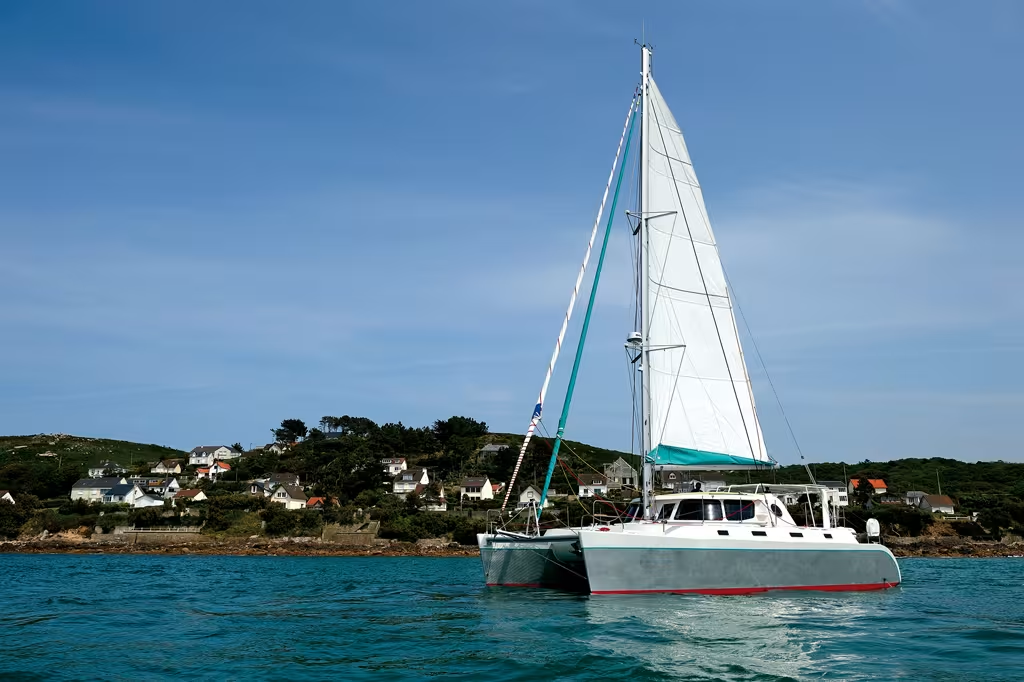
In just two examples, this Marc Fazilleau-designed catamaran has already made an impression on the little world of multihulls, through its happy owners’ long-term voyages. So when, in a market which is highly formatted by the major productions, this atypical design fell into the hands of a French builder which had forged its reputation over 40 years, building aluminium blue-water boats, our curiosity, already aroused, reached fever pitch. A test of Garcia’s Banana 43 in the Channel, at the end of June, in the warm sunshine of Cherbourg...
Infos pratiques
- Le chantier : Banana 43
- La fiche technique
- Découvrez notre vidéo exclusive
- Financez votre Banana 43
- Assuez votre Banana 43
- Articles autour du Banana 43
It's the trick question at any self-respecting boat show for the permanent staff of the essential Multihulls World stand. ‘What is the ideal catamaran to sail round the world in?’ Everyone has their tactics for avoiding the danger of a certainly legitimate interrogation, but one to which there is no absolute answer, or to which there are a hundred different answers. Personally, I like to give them the metaphor of the original Paris-Dakar, in the real African desert. We saw everything and anything arrive on the banks of Lac Rose: from 4Ls to Rolls Royces. We even saw some Porsches excel there! Which just goes to show, anything can make the crossing... ...of the desert, or the Atlantic. It’s just a case of knowing what the driver wants. But what is really worthwhile, is to find out what vehicle the person who lives all the year round in the desert or the brush uses: at that time (and here I’m talking about a time that those of you under 40 will not have known) the famous ‘Land Rover’ was the ‘must’. However, I don’t think I remember it ever having excelled in the event created by Thierry Sabine.
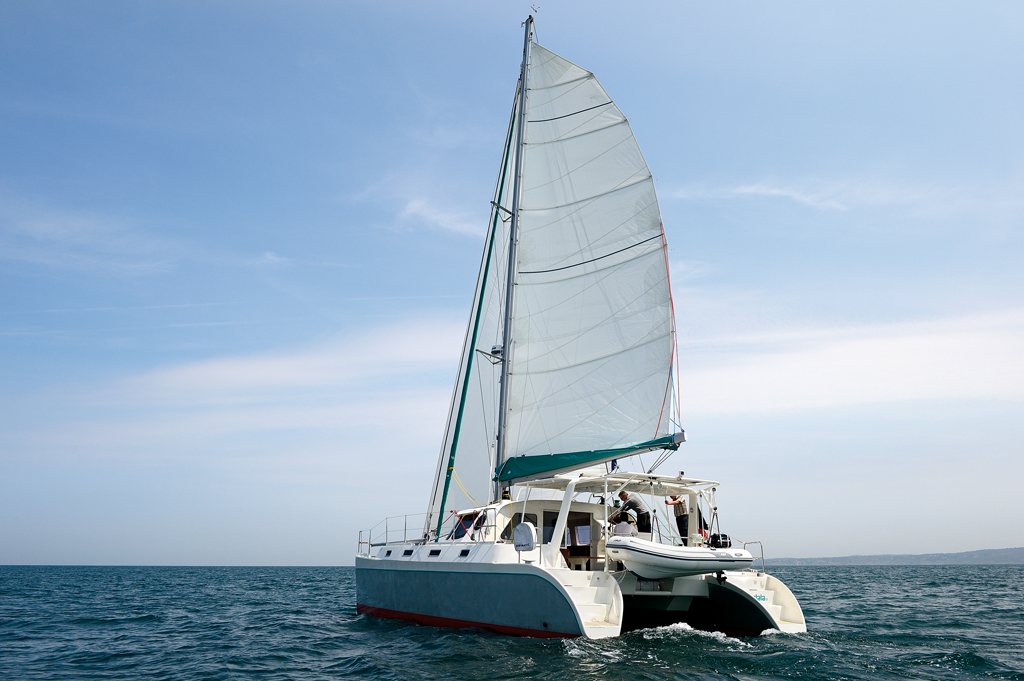
The aluminium cat, an original solution for cruising far and for a long time.
And this is how I see the Marc Fazilleau-designed Banana 43: it’s the ‘Land Rover of the Oceans’. Not built to appeal, to follow the fashion(s), excel, play the tough guy, be chartered for a week in an exotic paradise... No, the Banana 43 has an air of authenticity, simplicity, reliability, unfailing strength, whilst doing its best to avoid the anachronism of rusticity. Accommodating the family and/or friends, sheltered in all weathers, flirting with Polynesian coral or the Cape Horn williwaws, in slippers by the fireside, a free spirit, enjoying the exceptional environment, without worrying about an accident, damage or even the slightest little incident. For this, the first version of the Banana, built by Prometa, showed the way. It’s called ‘Mowgli’, and after having sailed half-way round the world with the family, it sailed to Tierra del Fuego from Australia, a world first for a catamaran sailed singlehanded (see Multihulls World n° 121). An ease of handling singlehanded, which we immediately rediscovered aboard ‘Mandala’, the Banana 43 we were testing. On first contact, from the pontoon close to the boatyard, its silhouette seemed really quite bulky. Forty three feet; here we really are at the bottom of the range of sizes suitable for long-term cruising on two hulls, and you need a bit of volume when you want to live aboard with no time limit. But the Land Rover wouldn’t win any prizes for beauty either. It’s the practical nature which has made it a myth, not only allowing its rather cubic lines to be forgotten, but also raising it to the status of an icon, on which we wouldn’t change anything for the world, not the slightest degree of the bonnet angle or of the slope of the windscreen. Isn’t it a bit the same with the Banana 43, whose lines, and the name of course, are reminiscent of a famous yellow boat? Yes, of course you know it, the one belonging to a famous French singer who didn’t want to get his hair cut, and who indirectly promotes the aluminium cat all around the world, through a profusion of books and dvds. (Antoine, aboard his catamaran, called Banana Split).
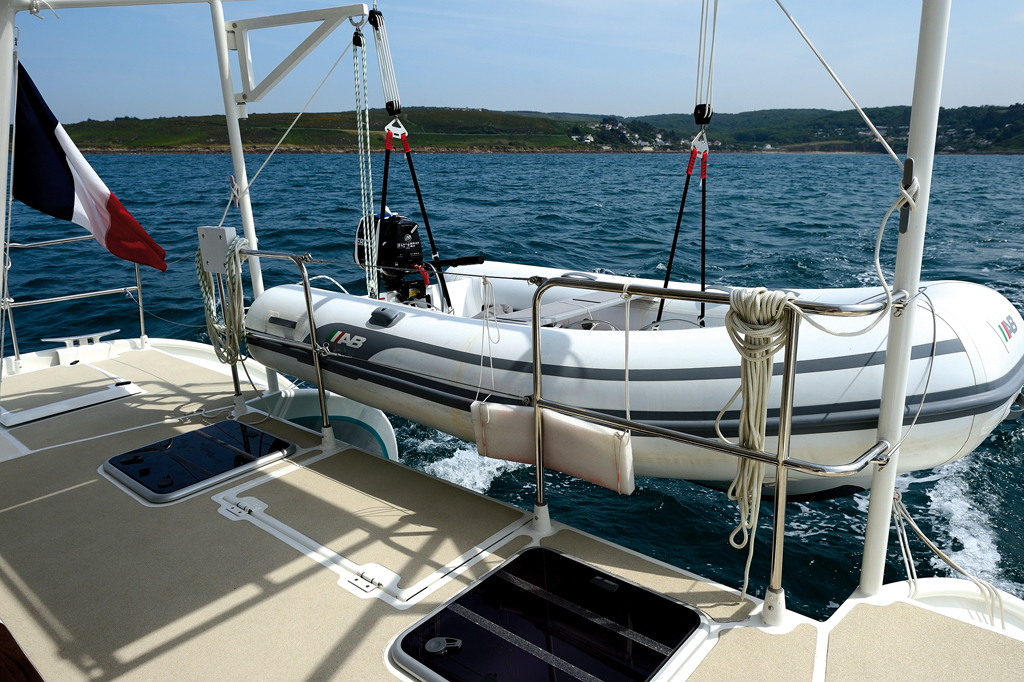
This boat’s construction is very strong, as shown by this support for the solar panels, the davits and the articulated outboard lifting mast…
Aboard
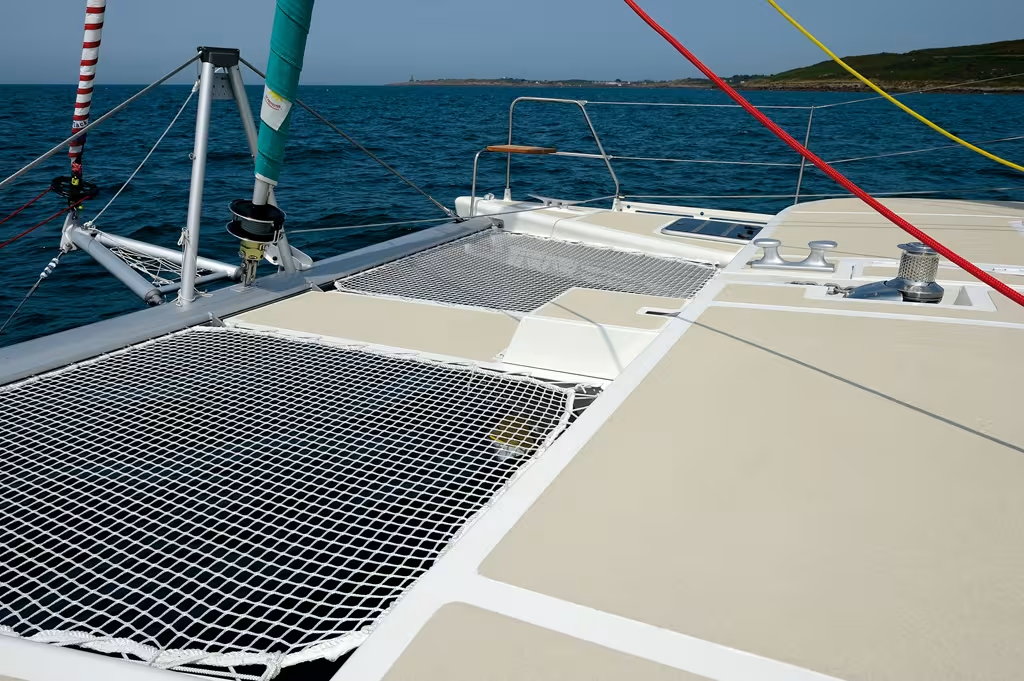
With one step, we climbed aboard. It’s easy, from the pontoon to the sugar scoop, or from a higher quay via the gates in the guardwires on each side. Flexible and effective, the TBS 21 non slip deck paint, associated with impressive aluminium toe rails, immediately set the tone; we were aboard a sailor’s boat. Bernard, the sleeping partner in the project who has now become the owner, very kindly welcomed us aboard. If he seemed to have lost his voice a little, it was through the emotions of the first outings, the completion of a carefully thought-out project, which took nearly two years to take shape. Because otherwise, visibly, he seems absolutely delighted with the services supplied and the boat's overall coherence. Garcia has visibly hung on to its precious expertise, and the quality of the metalwork is quite simply impressive. Associated with the architect’s skilful drawing, to round off the rails and sugar scoops, at first glance they could be taken for round bilged hulls. Not at all, and although thick aluminium was abandoned for homologation reasons, the designer took advantage of this to slim down the boat with respect to the Banana’s ancestors, the Cat Flotteurs. The use of Silium 5384 and a specially designed structure has thus allowed a 20% weight saving on the aluminium part. Access to the cockpit is easy. The foredeck and the deck have been raised by 5cm with respect to the original, which benefits the interior volume. Similarly, the aft platform present on ‘Mowgli’ has been cleverly fitted out with additional stowage lockers, closed by watertight deck hatches. The engine lockers also benefit from a watertight closure, and access is facilitated by a made to measure ladder and a platform, avoiding any damage to the most fragile peripherals from a misplaced foot. Just like all the different on-board systems (plumbing, electricity), these lockers have been particularly carefully fitted out, continuing the standards which have made Garcia’s reputation. This is particularly important concerning electricity in an aluminium hull.
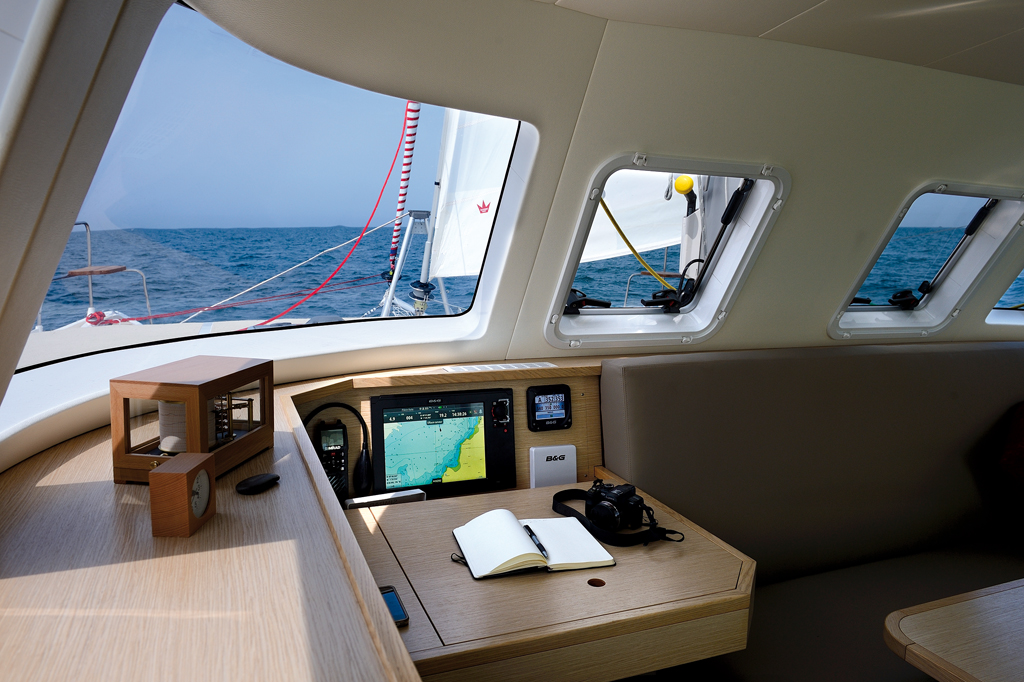
A comfortable saloon, and above all, a real chart table with a panoramic view which is ideal for night watches.
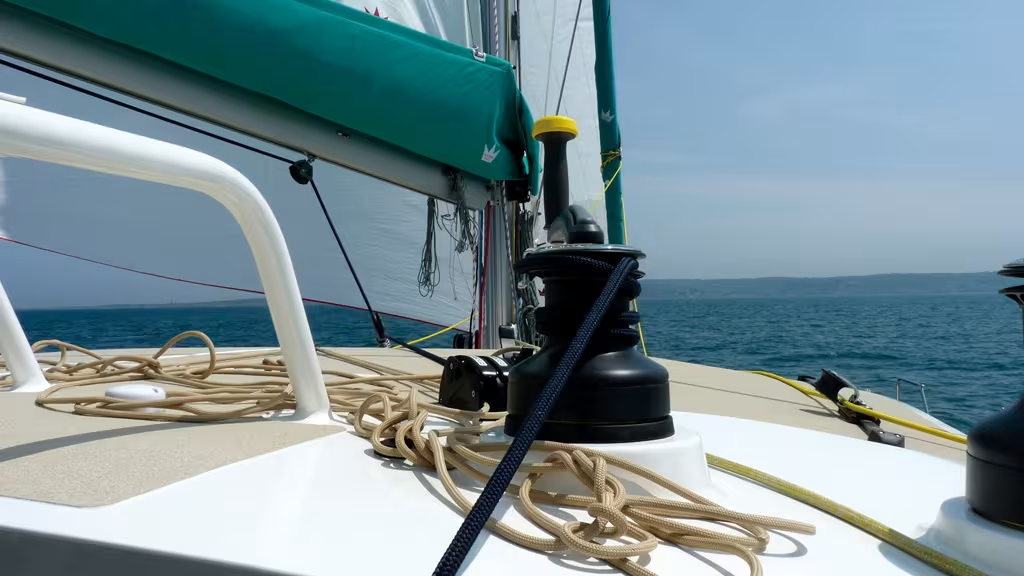
To port, the cockpit has a modestly-sized table, at which only the lateral occupants benefit from a backrests. But movement is easy and we were impressed by the rigid bimini/solar panel support/dinghy davits/articulated outboard lifting mast assembly! It is very strong, as it also supports the mainsheet track and the significant forces which go with it. Very practical, as although a good dinghy with a good engine is the essential guarantee of a successful cruise, this is even truer when the boat becomes a home. And to make things even better, everything is remarkably well-finished. Here, just as on the deck and the coachroof, the paintwork is particularly successful. Antonio, the builder’s technical manager gave a little cough when talking about the number of hours they had to spend on it, but the result is really convincing. The steering position, to which most of the control lines are returned, is positioned to starboard of the coachroof. Moreover ‘Mandala’ is equipped with an electric winch, which we quickly found essential. Result: all the manoeuvres can be carried out singlehanded with no difficulty. Starting with hoisting the mainsail, whose 2:1 arrangement on the headboard is essential to reduce the effort, but doubles the length of the halyard. The only snag: why have the jammers been positioned so far forward? Their position obliges you to stand on the tips of your toes to activate them with an outstretched arm, unless you are built like a giant! A shame! Similarly, we regretted the fact that the steering wheel is too close to the engine controls. I am afraid that you will inevitably trap your fingers when the controls are in neutral. These are the only two slight problems, (which can be easily corrected), in a strategic place for the programme, which brings together all the qualities. Thanks to the cleverly positioned difference in level, at the helm you are either very well protected from the elements, or in sight of the sugar scoops and bows, for precise manoeuvres when entering and leaving a port. These are made easier by the very well chosen 40hp Volvo saildrive engines and manoeuvrability which belies its overall size. At 1800 rpm, we were doing 6 knots on a flat sea, a guarantee of low consumption. At 2500 rpm, the speedo got up to 7 knots, a guarantee of being able to find shelter as quickly as possible, if necessary. All the control lines are within reach and the steering wheel is one of the best. As long as you make sure you are close hauled, with a minimum amount of speed, the boat tacks with no problems. The 17m mast carrying the main and genoa (which will ideally be completed by a staysail on an inner forestay) is strongly supported by generous standing rigging, reassuring in all circumstances. Speed lovers would have perhaps liked a higher aspect ratio and larger sail area, but this isn’t the priority here. The Banana has to stand up to sudden gusts with full main, serenely, and the stockier rig guarantees more open shroud angles and therefore better support.
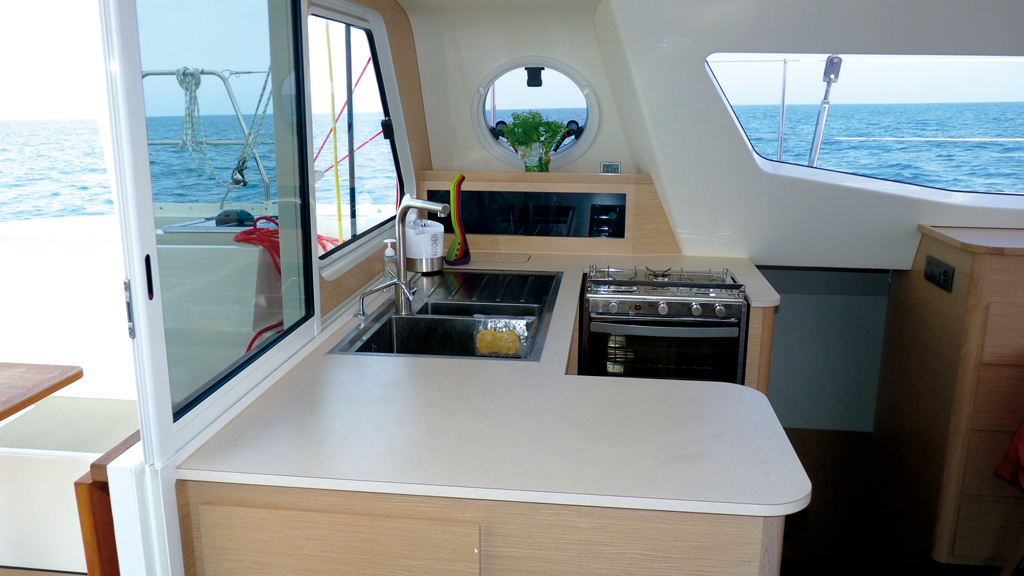
The huge, well-equipped galley, which opens onto the cockpit.
Under sail
The light 6 – 7 knots of wind at first allowed us, despite everything, to make 3.4 knots at 50 degrees to the apparent wind, under full main and genoa. But why hurry when you have the time to cruise serenely? We just had to wait until the anemometer deigned to display two figures (11 knots true), then we bore away a bit (125° to the apparent), unrolled the gennaker, fixed to its articulated bowsprit, and ‘Mandala’ sailed peacefully at six knots. We immediately saw ourselves crossing all the oceans at this soothing, de-stressing rhythm, where the only worry is that of arriving and having to stop. We entered via the sliding glazed door, where we appreciated in passing the absence of a step between the cockpit and the saloon, and sat at the chart table, situated on the port forward side of the coachroof. The panoramic view we enjoyed from this position is a dangerous encouragement to...do nothing! Ah yes, enjoying the sight of the world passing gently before your eyes, whilst keeping a reassuring watch, as Monsieur Jourdain did with prose, without knowing. The saloon, situated to starboard and coherent with the exterior, won’t take twelve guests, that's not its programme or size, but your crew of 6 (8 exceptionally) can eat very comfortably. The galley, turned towards the cockpit on the port aft side of the coachroof, is huge and particularly well equipped, with notably two huge drawer-type fridges. We were just a little surprised at the material chosen for the work surface - as much from an aesthetic point of view (taste and colours...) as from a practical one (heat resistance?), we were not sure about the relevance of the choice made on this boat. The advantage of made to measure construction - a future customer could opt for another finish. On the other hand, we had no objections to the light wood chosen and the quality of the woodwork. It is of course in a more modern style than on the builder’s valiant ‘Passoa’, however it fits well into the prestigious Garcia tradition. The profusion of stowage areas, equipped according to the needs of removable stowage boxes, as clever as they are strong, definitely participates in putting the Banana 43 in the ‘blue-water cruiser’ classification. The starboard aft cabin, with its workshop/additional berth arrangement gives the same impression. In the centre of each hull, a huge double cabin is positioned under the foredeck. Although guests will find the starboard hull amongst the most welcoming, the owner will naturally reserve the port hull, whose aft bathroom has a nice separate shower. The hull insulation is completely invisible but particularly carefully fitted, at the request of Marc Fazilleau, who knows from experience that a desire for the southern latitudes develops when cruising. When we arrived in the anchorage, the huge foredeck proved as practical for manoeuvring as it is for...sunbathing! We didn’t forget, however, to anchor first. The partially integrated, vertical axis electric windlass is fitted above a huge chain locker, which holds enough chain for you to enjoy problem-free nights. Its access on the other hand perhaps deserves a slightly wider opening. The mooring cleats and the bow rollers are in the image of the rest of the boat – strong; you will sleep soundly. And if we wanted to beach the boat, the two strong fixed keels guarantee stability and the protection of the rudders and saildrive legs.
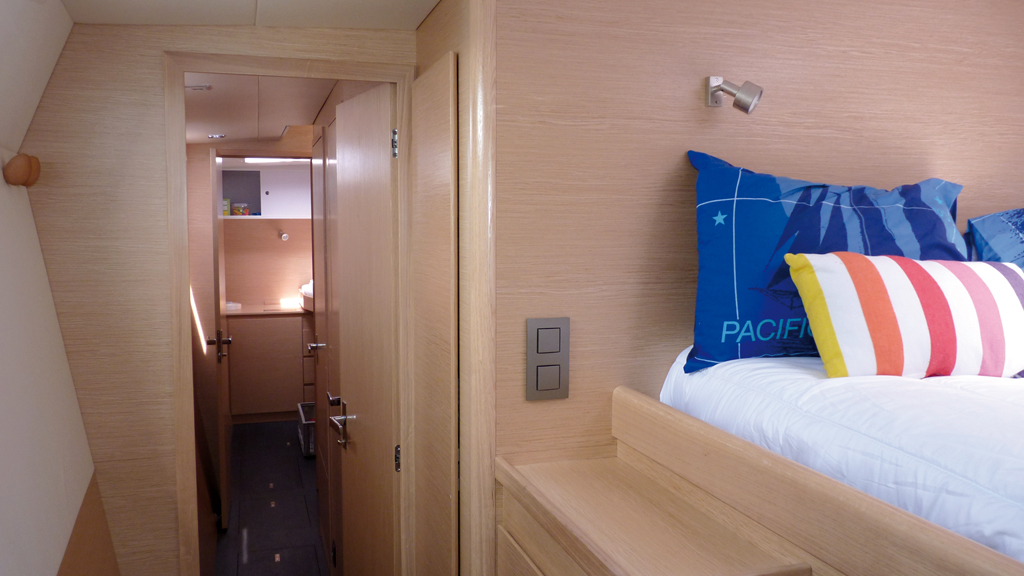
Aboard an aluminium cat, you can have the accommodation you want. The cabins are here situated in the middle of the hulls.
There is no such thing as a universal boat. There are only compromises, corresponding to different programmes, expectations, and owners’ experiences. From this point of view, the Banana 43 is perhaps the missing link for many cruisers, for whom blue-water cruising has for decades gone hand in hand with steel, then aluminium, but whose faith in the monohull (centreboarder if we want to push the cliché to the limit) has been shaken by the advantages successfully put forward over the last thirty years by our beloved multihulls. In this role, we can say that the version being offered here by Garcia yachting perfectly meets the specifications, and that a round the world voyage at any latitude can be carried out serenely. The DNA claimed by this new Fazilleau/Garcia partnership is safety and independence, with no limits on the playground. Although demand for this type of programme only represents a few boats per year, we bet that anyone frequenting the most extreme latitudes will find in the Banana 43, or the projects for its big sisters, a very attractive answer to their preoccupations.
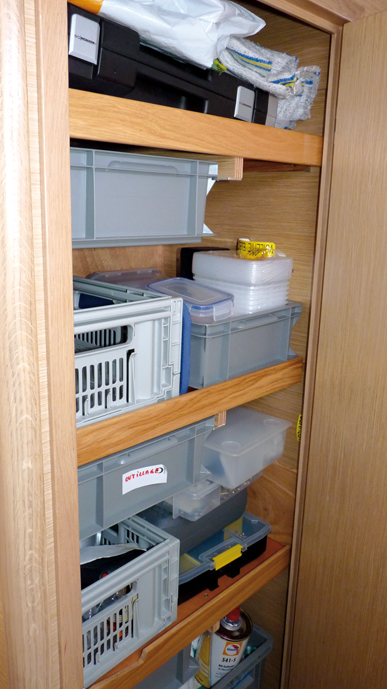
We are aboard a blue-water catamaran, hence the many stowage areas available to the owners.
The plusses:
Overall coherence Finishing level Build quality
The minuses:
Blockers too far forward Helm/engine control interaction Galley work surface covering
Specifications:
Overall length: 13.00 m Waterline length: 11.70 m Beam: 6.50 m Displacement: 10.6 t Draft: 1.20 m Air draft: 19.00 m Mast height: 17.00 m Fuel capacity: 2 x 250 l Water capacity: 2 x 300 l Berths: 6/8 people Engines: 2 x 40 hp Volvo saildrives Architect / Designer: Marc Fazilleau / Prometa Construction: Garcia Yachting