
At the latest Grand Pavois in La Rochelle, at a press conference for the launch of the Greenland 34, Jean-François Fountaine, CEO of the shipyard that bears his name, informed us of the future projects jealously concocted for the year 2000, including a new 43’ catamaran, replacing the Venezia 42. Now it’s spring 2000… two units of this new model have already come out of the workshops in Charente, France. Venezia 42 is dead. Long live Belize 43!
Infos pratiques
- Le chantier : Belize 43
- La fiche technique
- Découvrez notre vidéo exclusive
- Financez votre Belize 43
- Assuez votre Belize 43
- Articles autour du Belize 43
Preamble:
The range of Fountaine-Pajot catamarans had, except for a few modifications in interior design, changed very little lately. Priority was on setting up the range of trawlers. Launched in 1992, Venezia 42 will remain the pioneer of the make’s characteristic “look”. With 123 units built, this middle-of-the-range illustrates the true success of this shipyard, based in La Rochelle. Her replacement obviously had to retain the main principles: the classic 4 double cabins with the possibility of a suite in the hulls, in the owner’s version, the convivial saloon integrating on the same level the galley and chart table, but it also reserves new attractive assets in more ways than one.
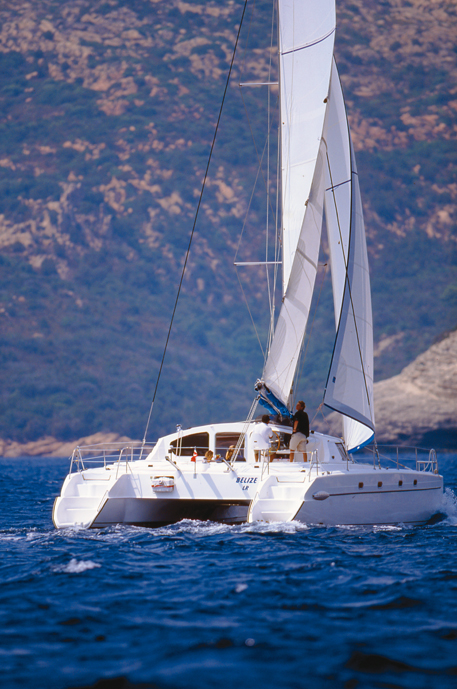
The Belize 43 is replacing the Venezia 42, one of the shipyard’s great successes, in the Fountaine-Pajot range… (Photograph by Yves Ronzier)
Presentation
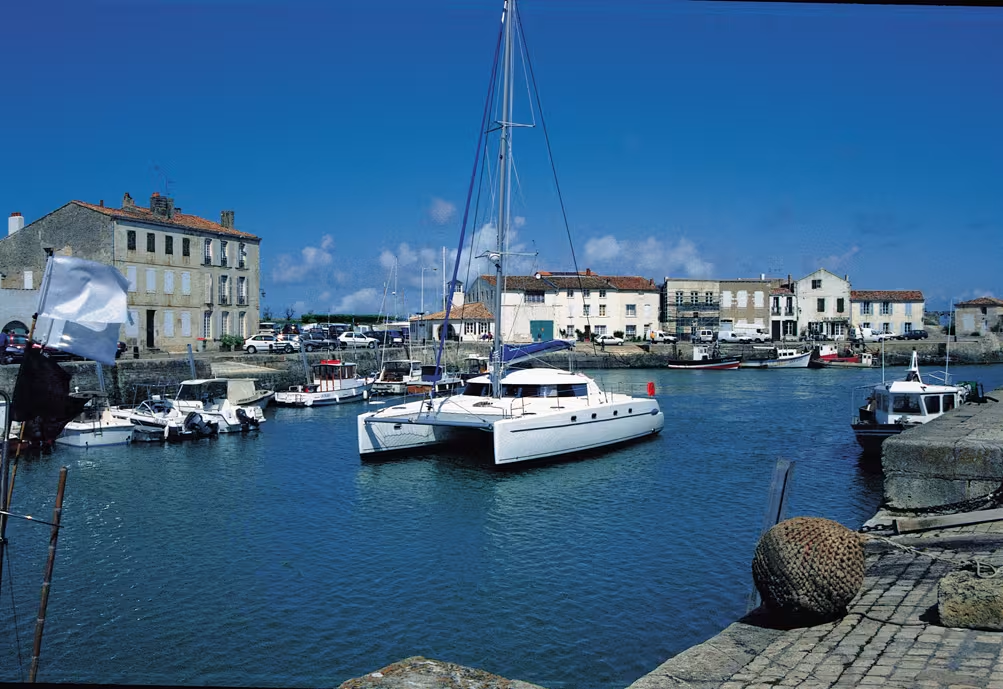
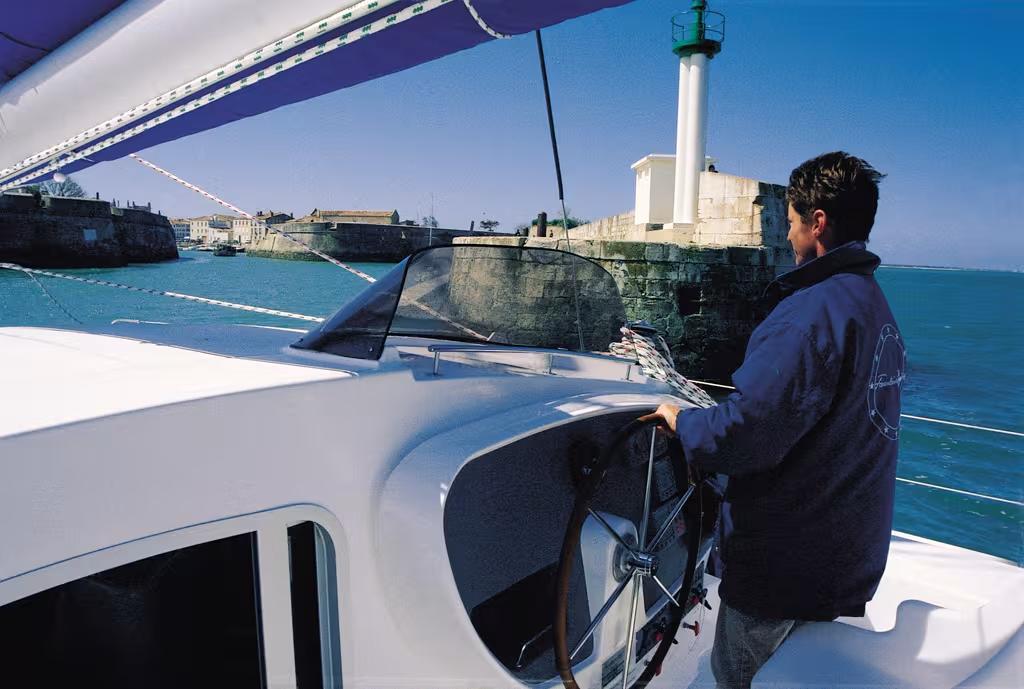
Discovering the Belize 43, as she quietly awaits her new crew, the family spirit is very much present. Her silhouette is striking, however, with its “tenser”, slimmer, “firmer” forms. Olivier Flahaut, who designed her, has been able to make her line remarkably more dynamic, reduce the effect of mass proper to catamarans, tenser. The rounded hatches probably contribute to refining the shape as well as the cockpit free of any running rigging, the flatter deck, the masts taller. Just barely completed, the first Belize 43 went to Le Havre to be shipped for export. Thus, we tested the second unit produced before she left to join the Mediterranean fleet of the Corsican rental company, Calvi Marine. On April 26, there was a train of low-pressure areas along the Atlantic seaboard, weather for squalls, with local gusts and rain in the Bay of Biscay… We climbed onboard immediately and the wind was there, the Belize 43 easily sailed away from the wharf with her two 28CV motors: maneuvering from the central helm station located in the rear of the roof, a position characteristic of all the Fountaine-Pajot range, is facilitated by the excellent 360° visibility.
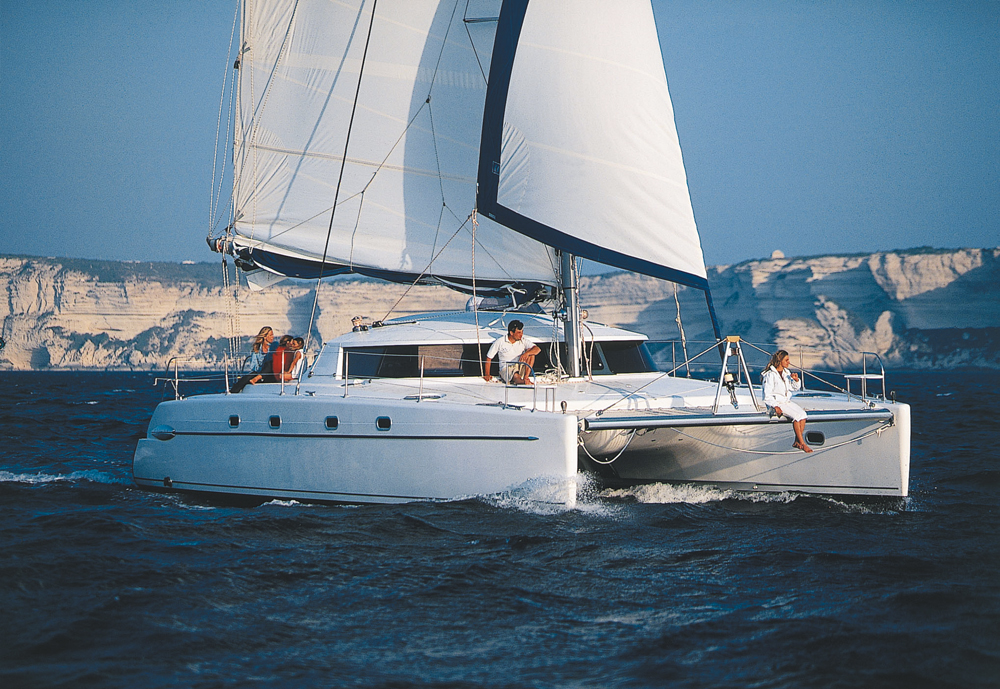
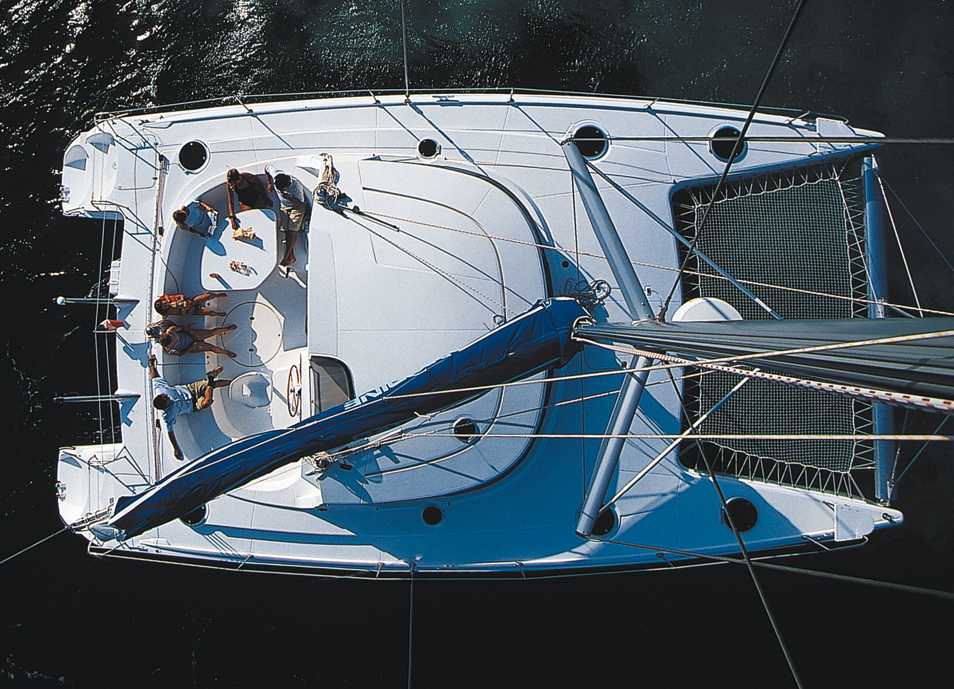
The foredeck of the Belize 43 is very open.
Under sail
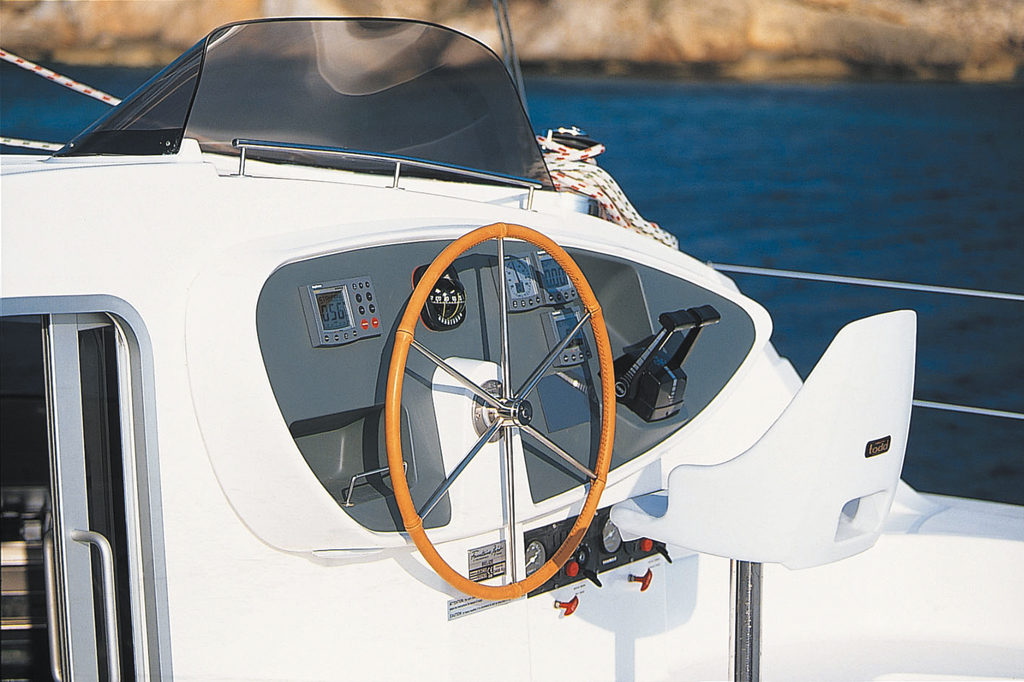
Barely out of the port, the mainsail was hoisted with one reef to “feel” the wind. We decided to head quickly toward Saint-Martin-de-Ré before the tide could surprise us. The wind from SW-W was at 16/18 knots with a few strong gusts at 24 knots. Hosting the sails was done entirely by Jean-Christophe, the young skipper from the shipyard, the Lewmar winches and the mast (Red Label from Z-Spars) and its trolleys have the right dimensions for such solo maneuvering. After a few tacks, we found ourselves in front of Saint-Martin-de-Ré, one hour of still reasonable tide leaving us the time for a well-deserved “picnic” stop. The first miles covered with one reef clearly illustrated the Belize 43’s potential performance. In keeping with the Bahia 46, this new 13‑meter craft was devised by the Joubert-Nivelt team top be more powerful than her predecessor. The Sail area-displacement ratio is very satisfactory: 111 m² for 8 metric tons at mid-load! a higher ratio than for the Bahia 46. Need we recall that she was the big winner over about a hundred cruising multihulls in all classes in the fantastic Ariane’s Cup 1999 rally race in the Grenadines? In the afternoon, the wind remained at a constant 18/20 knots from the same sector, and this time we were able to set off with all the upper sails: windward of Île de Ré, the sea was barely agitated. Getting more accustomed to her, we could feel the different points improved in the ergonomics of the deck. The excellent position of the posts for maneuvering the side winches deserves special mention; each one is arranged on either side on the back of the roof. Unfortunately, the standard equipment offers only a single winch on each side for two distinct running riggings: the mainsail sheet and the genoa sheet and the portside furler line. Two winches would have been welcome for such a unit intended for extended cruising and would have made fast tacking or gibing easier. The very well equipped helm station is a reference: functionality and total visibility. Protected from the passageway of the cockpit, it has retained the typical look of the Bahia 46. There are indeed points in common between these two units, certainly the most representative of the new Fountaine generation.
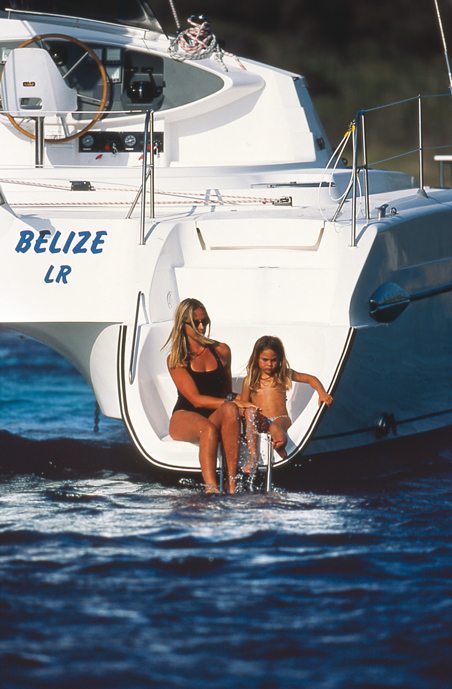
The rear gangway is particularly practical.
The following measurements* were noted: Condition of the sea: barely agitated sea Regimen of rainy squalls + sunny spells Points of sailing Angle True wind App. wind Recorded speeds Close reach 45° 16 knots 19 knots 8.3 knots A 60/70° 22 knots 25 knots 9.5 knots Beam 90° 22 knots 22.5 knots 9 knots Reach 110° 18.5 knots 12.5 knots 7.5 knots Reach 130° 18 knots 12.5. knots 6.8 knots Broad reach 150° 14 knots 12 knots 5.4 knots * boat tested: new, with no other equipment that the regulation safety equipment >>>> = light rigged displacement according to EC standards
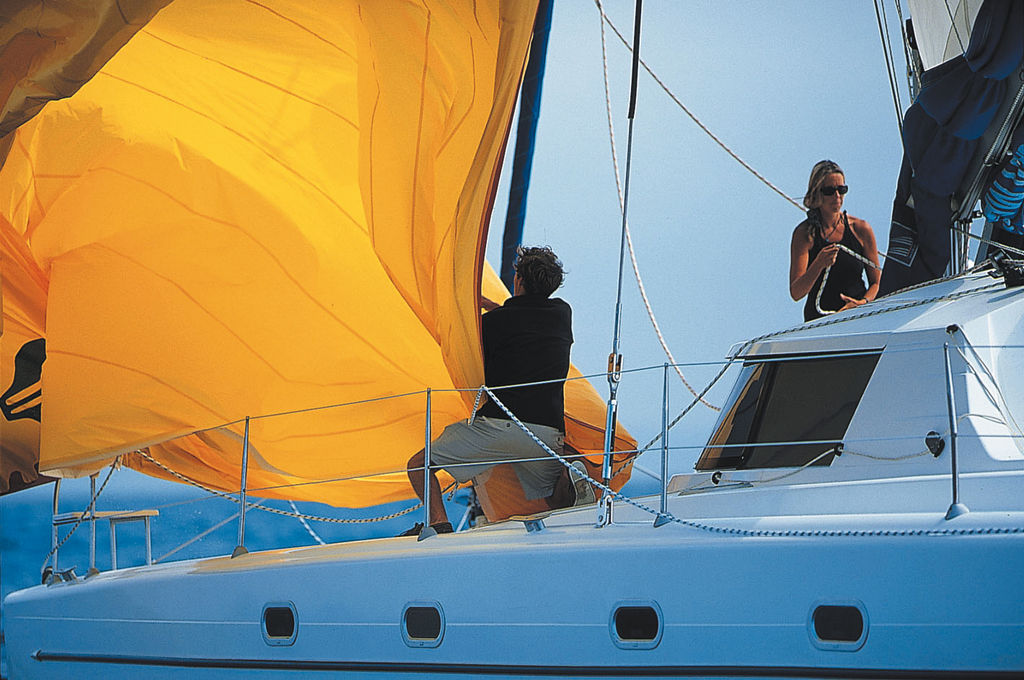
It’s new and practical: this step is welcome to reach the cockpit.
Under spinnaker or gennaker with pole, Belize 43 should easily gain a few extra knots. If the light rigged and maximum load displacement (maker’s data) are respected, unquestionably, this newcomer in the middle-of-the-range so popular with yachtsman (the 12 to 14‑meter segment) should authorize long journeys at good speed. During our test, there was one particular point that presented a problem: the difficulty we had in stabilizing the boat’s trajectory at the speeds achieved (8 to 11 knots). Perhaps this is due to the rudders’ tendency toward a delayed response? The sensitivity of the wheel (very smooth and well geared down: 1.5 turn from one tack to the other), however, is excellent. With gentler breezes (10 knots), the course steadiness is more tangible. The automatic pilot fulfills its mission accurately.
The saloon on the Belize with its bright well-finished features made of douka (Photograph by Yves Ronzier)
The motors
The machine rooms deserve special mention: two broad lazarettes very well arranged on the back of each float. Access is by broad panels. A floor with an opening covers each motor, also providing further protection and soundproofing. It is very easy to monitor the batteries, the automatic pilot, the helm system and fabric (Spectra) lines, chargers, etc. The standard assembly, made up of two 28CV Yanmar 3GM diesel motors equipped with Sail Drive sockets and fixed two-blade propellers. Thanks to the shipyard’s experience, it can be asserted that the power selected will be quite sufficient to satisfy most cruising agendas. Here are the performances, quite conventional for this type of cruiser: Motor speed Speed in knots Cons. l/h (2 motors) 1500 rpm 4.5 knots 4 l/h 2000 rpm 6.3 knots 5.5 l/h 2500 rpm 8.2 knots. 6.2 l/h 3200 rpm 9.5 knots. 9.6 l/h The autonomy is well calculated for a rental agenda (on average, between one and two weeks). With 300 liters of fuel, Belize 43 can easily cover more than 300 nautical miles.
The chart table is really cramped…
Life onboard
The unit tested is midway between the three versions proposed by the maker, which enabled us to realize “in situ” the specifics of each one. For a catamaran oriented par excellence toward rental, the traditional 4 double cabins are respected in the two versions, with the only changes being in the number of washrooms (private or shared) and the arrangement of berths in the aft cabins. The third version is unquestionably the most attractive: one entire hull is occupied by an actual suite occupant with, in addition to the very broad double cabin, has a lounge area with couch and library, a study area and a washroom with separate shower. This “owner’s” version is under construction and should be launched in the sea within a few weeks. For having visited her on the site of assembly, I can at this early stage predict without danger of being wrong, that she should charm more than one candidate for a long cruise, by the handling of the space and the excellent quality-price ratio. For the first time on a cruising catamaran of this size, the sleeping capacity of the aft cabins is arranged so as to have access from both sides. This arrangement, present on the owner’s version and the version with four cabins and two bathrooms, offers full comfort and easy circulation in the cabin; this is one of the Belize 43’s many assets. Like all the other catamarans of this make, the convivial part is gathered under the net: very generous galley, the saloon and the study-chart table area, very stylish, but not very practical for storing all the navigation devices, including a radar screen. The amenities are well-made and very bright, thanks to the use of a red wood, douka. The galleries, 61 cm wide, lead to the four cabins and washrooms in a warm cozy atmosphere.
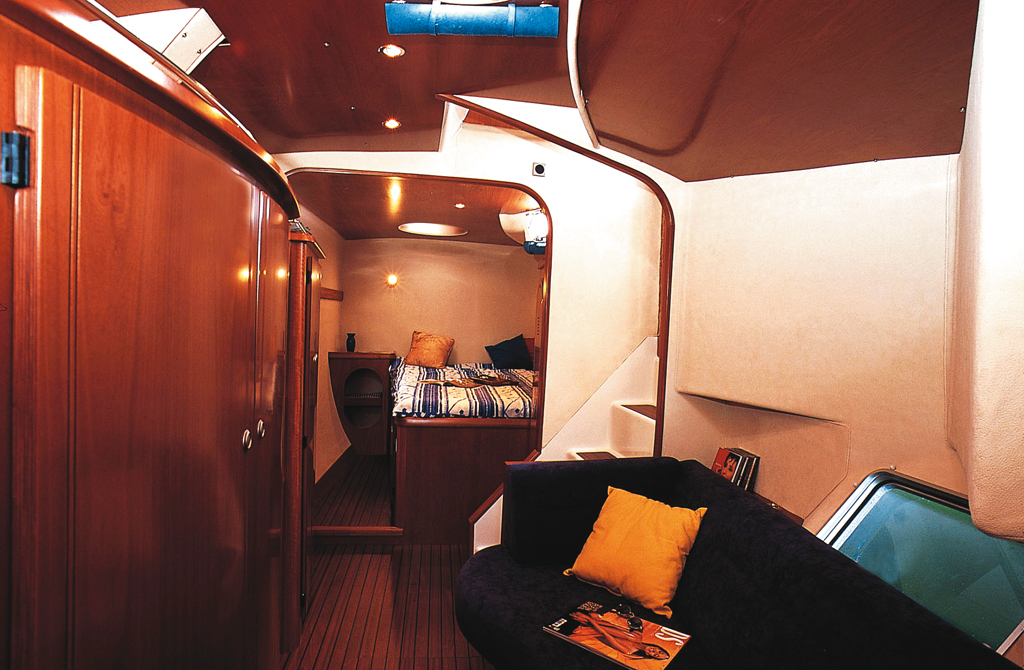
The Belize 43 is available in 3 versions with features to suit different sailing agendas.
In conclusion
This new model is unquestionable proof that the shipyard in La Rochelle have been able to pursue their innovative momentum with more ergonomics and an optimized Performance/Comfort ratio, while remaining loyal to the range’s founding principles: the separation of the areas for daytime activities (the net) from the rest areas and private areas (the floats), a central helm station with complete visual autonomy and the controls for the running rigging and… right next to the living area: the interior saloon and/or exterior cockpit. Belize 43 should be christened at Le Grand Pavois 2000. On this date, more than ten units produced will be sailing: even before her birth, Belize 43 could pride herself on 19 firm orders, surely the result of perfect understanding between an efficient shipyard and the expectations of the public?
SPECIFICATIONS
Designers: M. Joubert & B. Nivelt Interior designer: Olivier Flahaut Builder: Fountaine-Pajot Materials: Hulls of vacuum PVC, isophthalic polyester resin Hull length: 13 m Waterline length: 12.85 m Overall beam: 7 m Draft v. fixed fins: 1.30 m Height clearance: 19 m Light displacement: 7 T Max. load displacement: 10.4 T Fullbatten mainsail: 67 m² (3 reefs) Genoa on furler: 44 m² COMFORT: Berths (2 versions): 4 double + 2 single in front Freshwater: 600 l Diesel fuel: 300 l Motors: 2x Yanmar 28 CV. Sail drive Propellers: fixed T Motor cruising speed: 2,800 rpm Cruising speed: 8.5 knots at 3,000 rpm 12V batteries: NC EC categories*: A B C D EC Max. load 10 12 16 20 0607 3,400 kg *EC Cat. / Number of persons / EC certification no. / Max. load accepted on light boat Certified organization: ICNN – La Rochelle Sailing category: Category 1 / 10 p. according to French regulations
SALES PRICE
A) Export: Euros 256,114 (ex works) B) Ready to sail (plus VAT)** Euros 261,793 (FF 1,717,100) ** “Ready for Sailing” (Prêt à naviguer) is the minimum “standard” applied by the majority of builders on the international market. It includes the complete boat according to the basic inventory of standard features, with: the minimum inboard motors (2 28CV Yanmar or Volvo motors), the minimum set of sails: the mainsail, batten with its trolleys, the furler genoa, common rigging, basic electronics (Loch-speedometer, probe, weathervane-anemometer, special waste-water reservoir according to US and soon European standards, antifouling in place, Category 1 safety rigging for 8 people without the lifeboat, regulation sailing documents and first-aid kit). Transportation, launching and masting in the port if La Rochelle are, however, included. C) 100% full rigging (plus VAT)***: Euro 299,439 (FF 1,964,021.28 FF) *** “Full Pack” according to all the options proposed by the builder (as you will find them with rental companies): with triradial spinnaker, spinnaker sock, lazy bag, gennaker, electric windlass, bimini sun awning, front points with single berths, 220V circuit complete with chargers, complementary batteries, A6000 automatic pilot + VHF + GPS + hi-fi and life raft for 8 pax + Zodiac 340 dinghy + complete Yamaha 9.9CV OB.
The plusses :
Visibility at the helm station Excellent position at the mainsail and genoa winches Transverse communications: in front of the mast and “aft gangway” Generous space in the aft cabins
The minuses :
Response time at the helm Braiding of the trampoline dangerous No steps for access to roof Difficult access from a pontoon: freeboard with no steps, in spite of height
COMPARISONS:
CRITERIA BELIZE 43 FREYDIS 430 OUTREMER43 CATANA 431 PRIVILÈGE 435 Overall length 13 m 12.99 m 13.20 m 13.10 m 13.13 m Waterline length 12.85 m 12.99 m 13.10 m 12.80 m 12.60 m Max beam 7 m 7 m 6.80 m 7.30 m 7.07 m Light displacement* 7 T 5 T 6 T 7.60 T 8.3 T Upwind sail area, std. sails 111 m² 123 m² 102 m² 117 m² 111 m² Skin friction coeff.** 6.717 7.659 7.209 6.510 6.275 Propulsion coeff.*** 5.507 6.539 5.558 5.501 5.247 * = Builder’s data = Light weight displacement)= Light displ. ** = Lwl./ ÷ cubic root of vol.displ. — light (— = D/1.025 ) = Skin friction coefficient *** = ÷ square of sail area/÷ cubic root of vol. displ. — light displ.
Some figures: en cm Fore cabin berths: 203 x (150 / 97) Aft cabin berths: 201 x 145 Table seating capacity: 6 + 3 Galley: 185 x 185 Cockpit area: > 11.25 m²
HEADROOM Entrance to net: 182 Middle of saloon: 191 Front of saloon: 165 Galley: 187 Chart table: 187 Galleries: 190 Fore cabin: 186 Aft cabin: 198 Toilet/Shower: 190 Height under net (half-load displacement): 97
