
The Belize was launched in 2000, as a successor to the placid Vénézia 42, and can be distinguished from its predecessor by its more modern design and ergonomics as well as its improved performance; 130 boats have been built. The Maestro is the owner’s version and its success gave us the chance to have another look at this boat, in a version which is most definitely oriented towards blue-water cruising and living aboard.
Infos pratiques
- Le chantier : Belize 43 Maestro
- La fiche technique
- Découvrez notre vidéo exclusive
- Financez votre Belize 43 Maestro
- Assuez votre Belize 43 Maestro
- Articles autour du Belize 43 Maestro
GENERAL PRESENTATION
The Belize has changed very little since its launch, which gives much credibility to the original choices made and is evidence of the builder’s experience. This 43’ catamaran seems to possess all the necessary attributes to ensure a long production run and to become one of Aigrefeuille’s leading models. The Belize is not a performance boat, but its versatility appeals to charterers and allows it to adapt perfectly to family blue-water cruising! The Maestro version is a development which is comfortable, efficient and really adapted to long ocean voyages. Its also has surprising sea-keeping qualities!
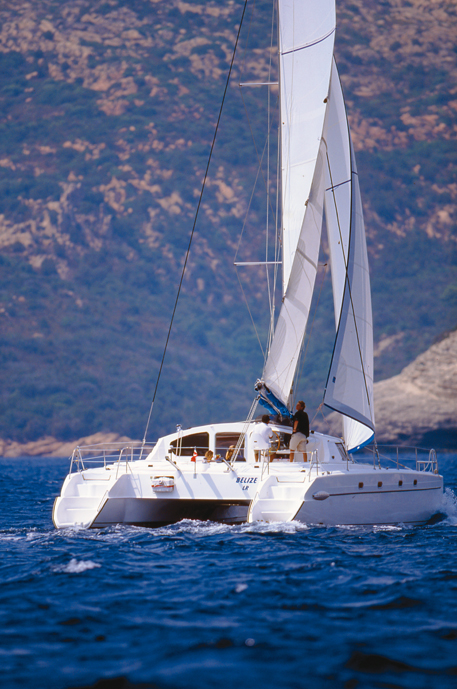
The Belize has not pretensions to being sporty, but her versatility is a major asset
SILHOUETTE
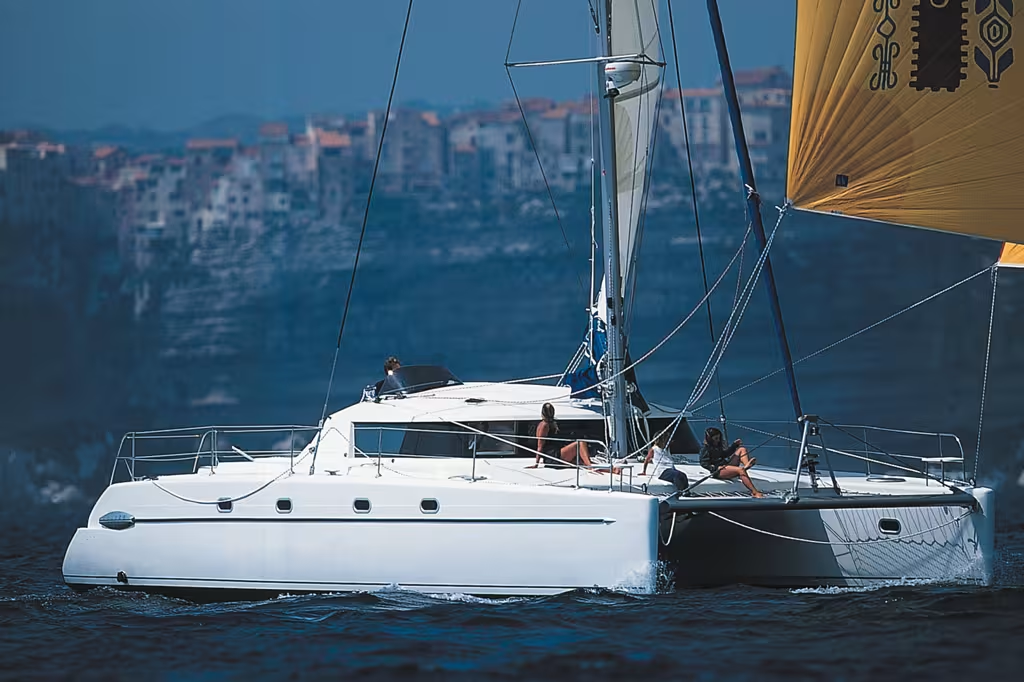
From a side view, the Belize is very appealing and represents a good solution to the difficult problem of proportions: the quite short nacelle is well integrated into the overall lines and the cabin roof means that the boom can be relatively low; the upright bows, moderate freeboard and transom profiles reinforce this positive impression, but the rubbing strake and the builder’s nameplate are a bit too predominant. A customising kit for the hulls, with coloured stripes and a fancy name transfer would be welcome.
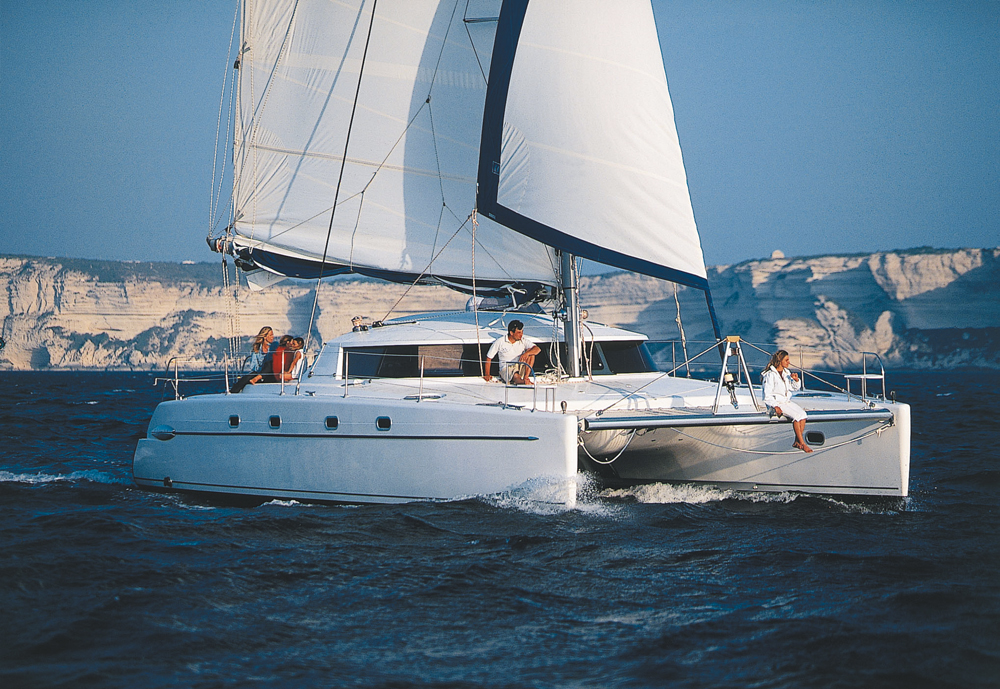
During our test, the Belize Maestro showed herself in really excellent light
ARCHITECTURE AND CONSTRUCTION
Michel Joubert and Bernard Nivelt have an experience in the realm of catamaran design which enables them to juggle skilfully with the thorny equations governing catamarans designed by consensus: the general public must like them, but they will also be judged by more knowledgeable sailors; comfort is constantly improving, but performance must remain respectable; the price must be limited, but any compromise regarding reliability or safety is not acceptable….a complicated situation! Out of the water, the Belize’s nowadays classic lines can be seen: U sections in the central section of the hull, flattening out towards the stern; a fairly submerged forefoot precedes progressive forward sections which are very pleasing to the eye. The lines are flat enough to combat excessive pitching and the fins’ slimness and aspect ratio should give good results. The rudders, the sail drive legs and the two bladed propellors show a concern to reduce drag; the overall wetted surface and general geometry should give the Belize 43 good performance on all points of sailing. Care should be taken, however, not to overload the boat and attention should be paid to weight distribution; the hulls will take the load, but pleasure and efficiency will decrease proportionately. This mass produced model is well built; the outer skins are ‘closed’ by lamination , use of good quality multi-axial tissues and vacuum construction techniques has become widespread. From a structural point of view, the builder’s and designers’ experience has resulted in a boat that is both solid and rigid. Certain parts which are not very visible (internal surface of the transom steps) have no gel coat. The added fins are fitted and laminated into a serious keelson structure; the builder appears to have calculated the consequences of running aground violently, which should not involve more than replacement of the fin. Looking under the nacelle, the outward bulge in the inner sides of the hulls can be noticed (meant to give an impression of space in the hulls), as well as the fluid lines; the tunnel is of the right height, but agility to windward will be strictly governed by the load carried. Use of a foam-glass-polyester sandwich keeps the unladen weight to around 7.5t, which is good, given the standard of accommodation, and comparable with other catamarans in this sector of the market. (Catana 431: 7.6t, Privilège 435: 8.3t, Outremer 43: 6t, Lagoon 440: 10.5t).
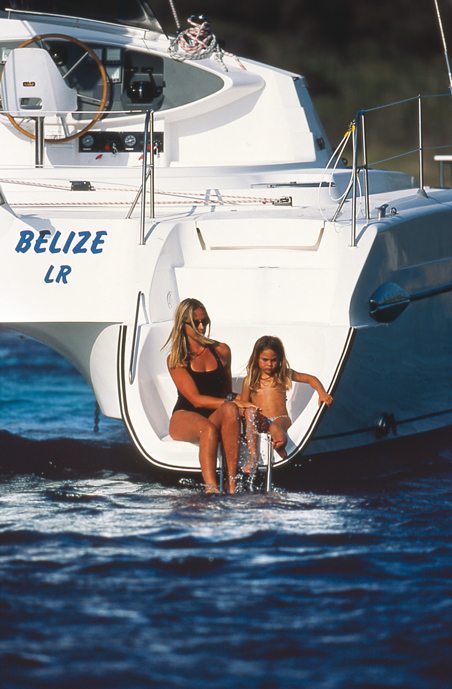
This cat is an invitation to discover warm seas…
LIFE ABOARD
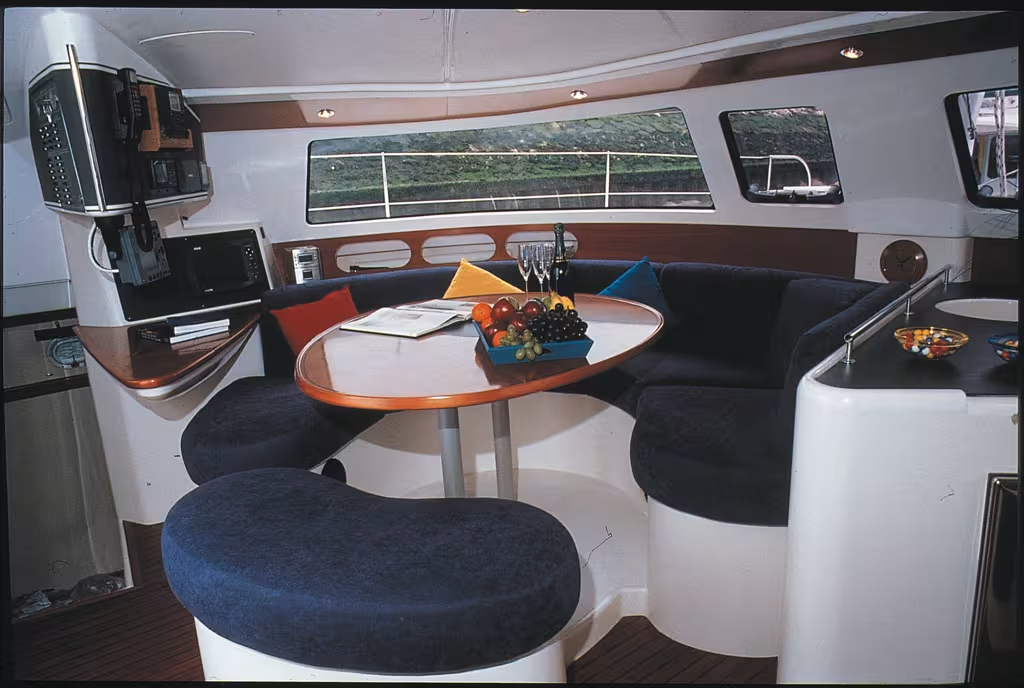
There is nothing revolutionary aboard the Belize, but the rational approaches to the equipment, the volumes and the overall luminosity combine to give a whole which is pleasant and not ‘fussy’. The saloon is welcoming and easy to live in and the galley is very practical. The moulded furniture is ergonomic, functional and finished in gel coat, with no pretence of luxury. There are two good double cabins and a well equipped heads in the port hull, with a crew berth in the forepeak. To starboard is the ‘studio flat’: this private space, which is of an impressive size for a 43 foot boat, is just as comfortable at sea as it promises to be at the boat shows. Sleeping accommodation is luxurious, the sofa is perfect for reading and the stowage is to hotel standards. The heads compartment, with shower, separate w.c. and dressing table merits positive and sincere comment (there is a single berth in the forepeak). The joinery (wood strip floors, furniture, bulkhead surfaces) is of good quality; certain decorative ideas are worthy of note (curtains in chromed leather).
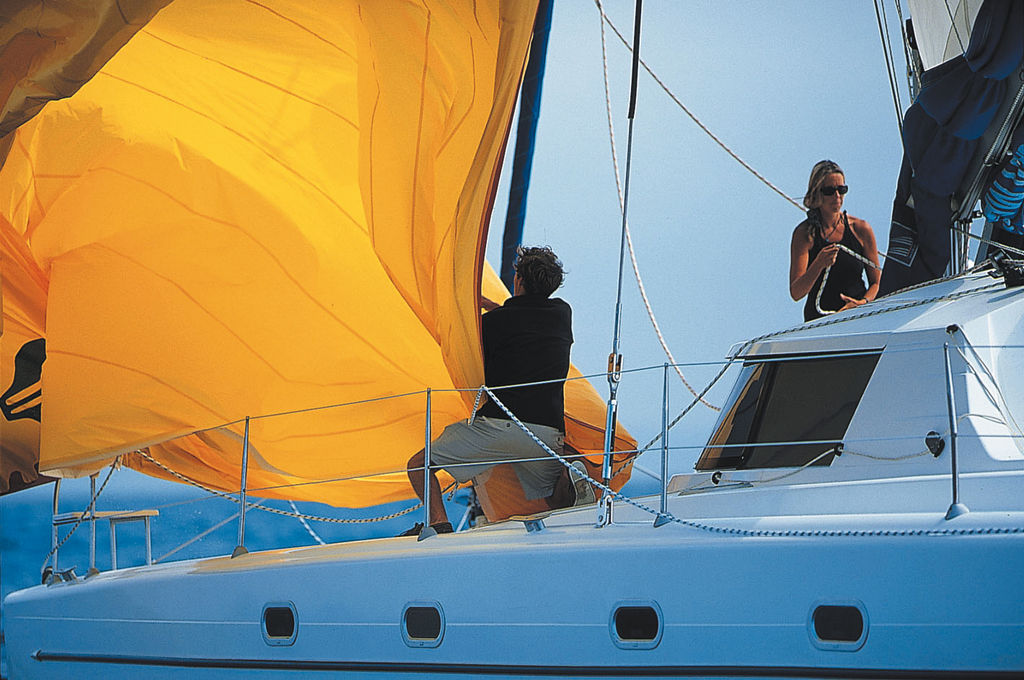
Manoeuvres: the fittings are sufficient and well made…
ON DECK
In use, the designers’ maturity becomes apparent: the sugar scoop sterns are wide and safe, the stainless steel davits are intelligently designed and the manoeuvring areas are open and ergonomic. The side decks are wide and moving around on deck is really comfortable. On the boat tested, the trampolines were tensioned perfectly. A composite beam links the central structural ‘box’ with the forward cross beam, and continues into a rostrum-bowsprit to which a gennaker or assymetric spinnaker can be attached. The deck layout is clear and functional, with the exception of the mainsheet return leads to port and starboard: are they really necessary ? Even if this is a feature that most users approve of, it adds complication and exerts an uncompensated traction force on the gooseneck. The electric windlass controls a very well designed, straightforward anchoring system!
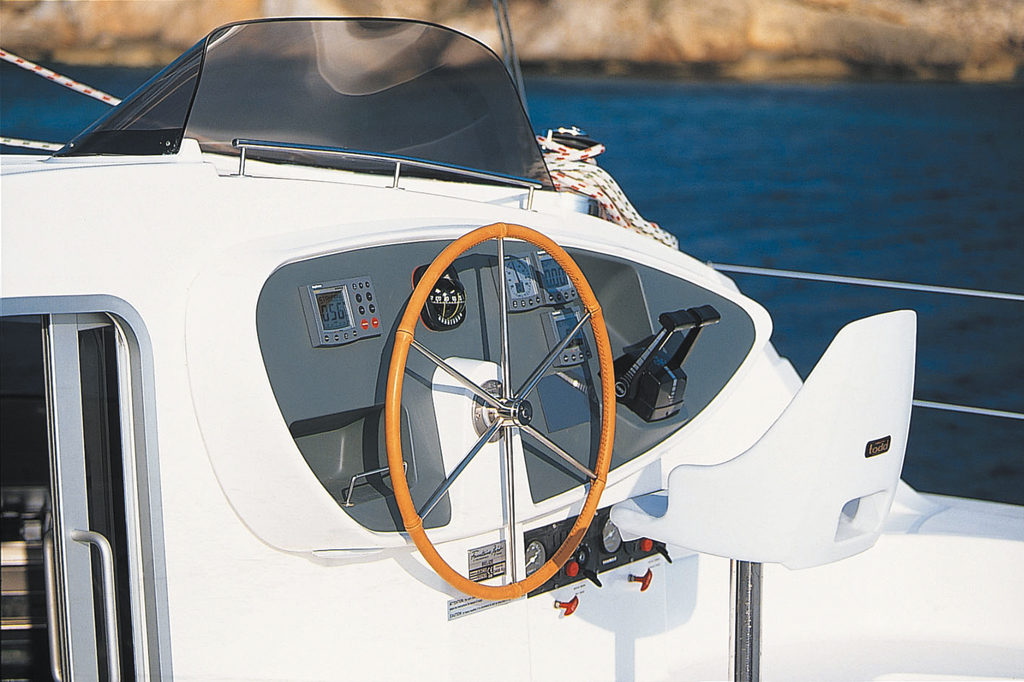
The central helm station is a model of its kind: pleasant and functional!
THE STEERING POSITION
At the risk of surprising some Multihulls World readers, I am going to speak highly of a central steering position! That on the Belize is a model of its kind and has reconciled me a little with this configuration: there is nothing special about the seat, the diameter of the wheel itself, the positioning of the engine controls, but everything works well, comes to hand easily and the centralised layout of the cockpit improves the general result. Overall visibility is very good, the small windscreen will prevent accidental flooding and the bimini top (the middle part of which can be confidently walked on) does not block the view. The steering linkage is mechanical; two Vectran lines (adjustable for tension) and a rigid connecting rod link the two rudder quadrants through the aft crossbeam: simple and reliable!
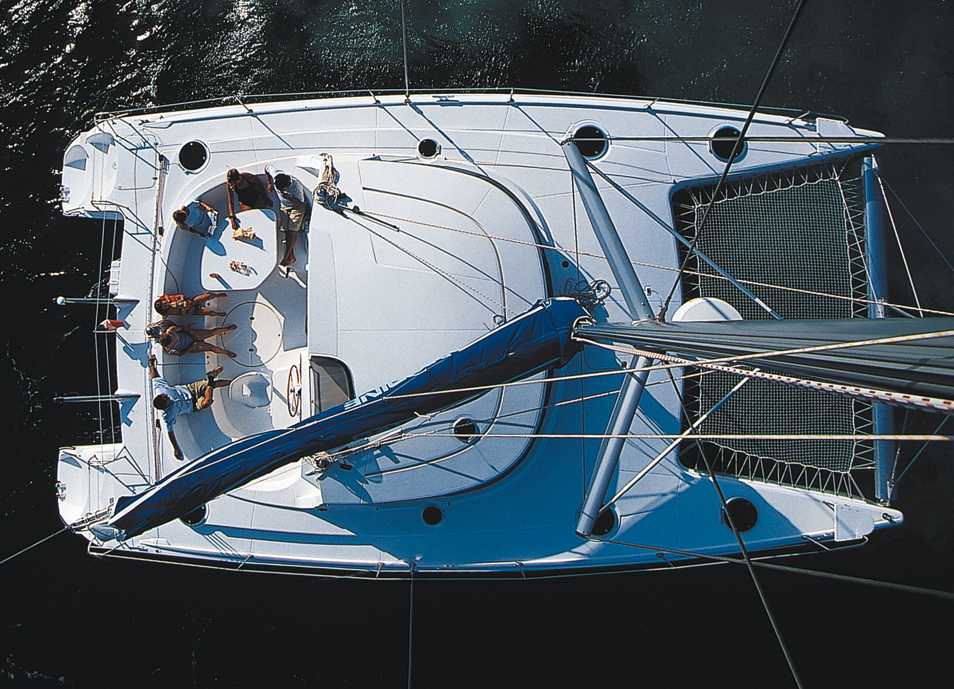
A classic deck arrangement for the Fountaine-Pajot shipyard: well made and pleasant to use
ENGINE LOCKERS AND ENVIRONMENT
Access to the different systems is another sensitive point on a cruising catamaran: aboard the Bélize all of these preoccupations have been taken into account rationally… bravo! Entry to the engine lockers is by an opening panel and the steering transmission , the automatic pilot and the batteries are all easily accessible. Seated on the false floor made of sound insulation material, even the diesel filters are accessible without exposure to the noise and moving parts of the engines. The installation is remarkable. The cocoon thus formed optimises sound insulation.
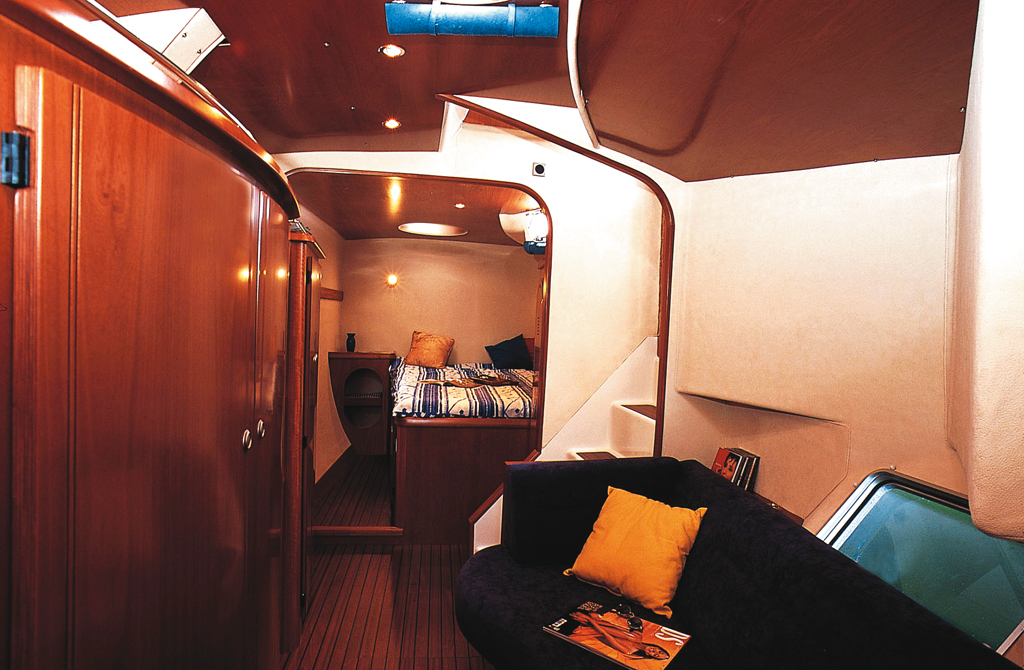
The owner’s hull is a success: beautiful, pleasant to live in, functional and very spacious!
TEST AT SEA
Weather conditions for this two day test were variable in strength (5 to 22 knots) but not in direction (nothing but headwinds). The model presented arrived from La Rochelle by sea and our playground extended from La Ciotat to Cavalaire, tack after tack over about a hundred miles. Our introduction to the boat began with an inspection of the rig and the sails (Incidences). Everything was checked rapidly on this well prepared boat; even the cap shrouds were correctly tensioned, which is rare. There were just two of us aboard, a little water and fuel and a minimum of equipment. The first afternoon gave us the opportunity to get to know the boat in more detail. At sea, the easterly breeze was light and on the nose, but the Belize didn’t perform too badly in these light, choppy conditions; it went easily to windward with the speedo following the variations in the wind strength. Tack followed tack as we progressed against a breeze which remained firmly on the nose. In this kind of weather the Belize showed its geometrical coherence and its good layout. Under autopilot, (what a pleasure to sail short-handed with a hefty Autohelm 7000) then at the helm, I noted that the boat was pleasant and lively to sail (which was a nice surprise!).
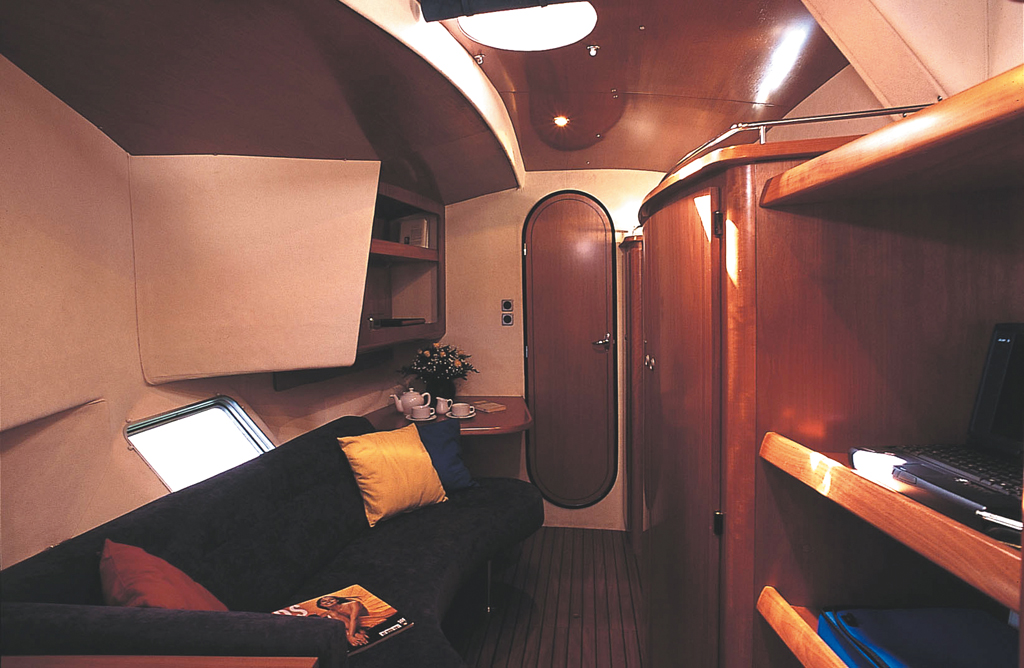
In this space, the “pasha” will feel very much “at home”…
After spending a comfortable night in Hyeres harbour, we set off again; the weather was fine despite a sustained easterly breeze and this early spring day gave us some interesting test conditions: 20 knots with a fairly choppy sea. The only fly in the ointment (which would, however, reveal the 43 footer’s qualities)…was that we would be close-hauled…very close! Manoeuvring under power showed the 27 hp Yanmars to be perfectly adequate, giving good handling and pivoting the boat easily. The absence of a blind spot and the engines’ silence whilst under way made motoring pleasant! This standard of equipment is what we have now come to expect of a mechanical installation aboard a catamaran. As soon as we had passed the jetties, we quickly hoisted the main (thanks to the ball roller sliders and correct tension on the battens) and unrolled the genoa; the Belize accelerated immediately - the course and the wake led to our first suspicions concerning the behaviour of this comfortable multihull! We sailed towards the eastern point of Porquerolles island on port tack and passed it easily after a short clearing tack. Our overall perception of this sail (which could have been tiring aboard certain boats) was very positive, the speed and the lack of leeway meant that sailing to windward in this catamaran was a pleasure! At between 8 and 9.5 knots in 18 knots of wind, the Belize revealed its dynamic qualities and taking several successive bearings confirmed the efficiency of the fins in this load configuration and sea state. The following tack took us further offshore in quite a rough sea: as the conditions deteriorated, the catamaran proved that it was easy to sail and agile, lengthening its stride to punch through the waves, which were now increasing in size. With 20 knots of breeze (sometimes 22, 23) the speedo rarely indicated less than 10 knots at 50° to the wind. Unladen, the Joubert-Nivelt design handled splendidly and with perfect regularity; there was no tiring pitching, a good angle of attack and very few wave shocks under the nacelle. By bearing away a few degrees, the speedo reached the 11 knot mark! The production sails (Incidences) contribute to this performance, their standard and quality meant that we could continue using their power. This ability to sail quickly without trimming or reefing seemed to me to be one of the strong points of this tolerant, efficient boat. Steering was a real pleasure, despite the excessively low gearing (which helps the autopilot); the rudder transmission system (Vectran lines and rigid connecting rod) proved to be excellent; simple and sensitive . The many tacks confirmed the boat’s ability to accelerate after tacking (we came out of the tacks at 5 knots!); full speed was reached a few dozen metres later.
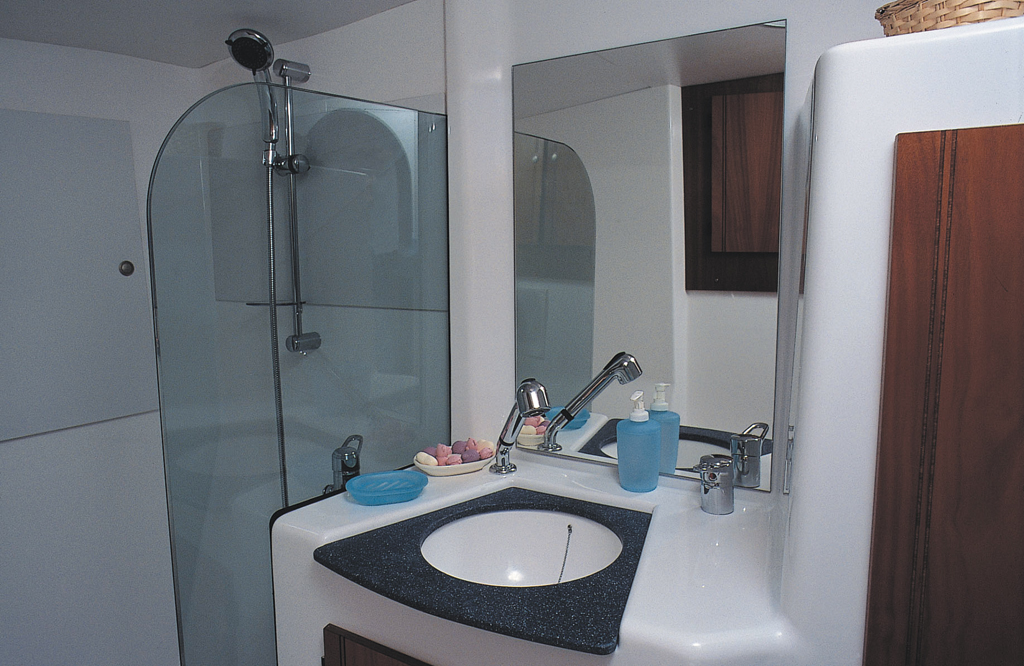
The shower room in the Maestro version: there again, space and comfort
Conclusion
The good results obtained by the Belize during this test must be put into the context of the favourable sailing conditions experienced (moderate breeze + unladen boat); they do however remain representative of this multihull’s sea keeping qualities. It will be less agile when loaded, but an owner who has tried out his boat in this configuration will without a doubt want to conserve its performance and will equip his boat with this in mind (watermaker, gennaker, elimination of dead weight etc…).
The Maestro version
The Belize Maestro’s interior accommodation is a ‘turnkey’ formula for buyers wishing to have a custom version of a well-tried production boat. It would be a good choice for those who want personalised ‘owner’s spaces’ without becoming involved in creating a boat which is too individual, and would be well suited to a family taking a sabbatical year. Short delivery times, a guaranteed resale market and the possibility of chartering rationalise the project.
TECHNICAL SPECIFICATION
Version tested : Belize 43 Maestro Architects : Michel Joubert-Bernard Nivelt Interior design : Olivier Flahaut Builder : Fountaine-Pajot Material : PVC/glass/isophthalic Polyester sandwich, under vacuum Length : 13m Waterline length : 12m Beam : 7m Keel : fixed fins Draft : 1.30m Air draft : 19m Unladen displacement : 7t Mainsail : 67m2 (ball roller sliders) Genoa : 44m2 (furler) Engines : 2X27hp Yanmar Transmissions : Sail-drive and two bladed fixed props Fresh water : 600l Diesel : 300l Price as tested : 310 000 Euros, tax not included (+ 4000 € launching and delivery)
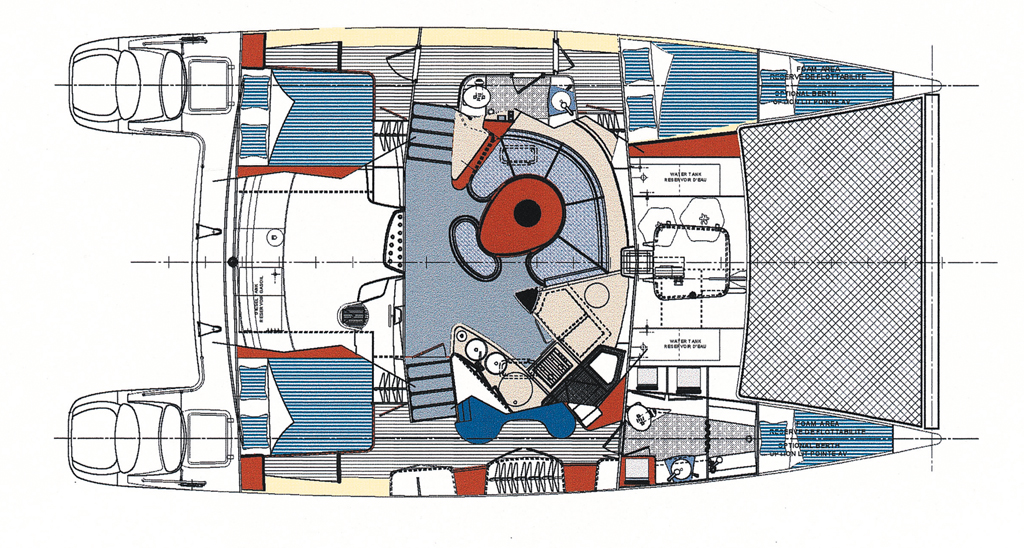
The plusses
General attractiveness. Reliability. Comfortable, seaworthy boat.
The minuses
Forward crossbeam in solid composite material Rubbing strake and makers plate A few assemblies which could be perfected (glued sugar scoop sterns)