
There was a time when the Brits were at the forefront of cruising catamaran production, but decades later this accolade has long since gone to the French, South Africans, Australians and others. So when a new British cat comes along, our interest is sparked. The current trend in cruising cats is bigger and bigger: many manufacturers ranges now start at 45 feet. Big is all very well, but big is expensive to buy, big is expensive to dock, big is expensive to maintain, and so is out of reach for many. Here, we have a "small" boat, yet the advert says two large double cabins, two single berths, heads with luxury shower, additional heads, large galley, large dining table and chart table in the saloon, large cockpit, and so on... Really? On a 33 footer? And all for £139,500? Surely corners have been cut, compromises made? And will it sail? We sent Graham over to the UK to see what the story is with the new Broadblue 346.
Infos pratiques
- Le chantier : Broadblue 346
- La fiche technique
- Découvrez notre vidéo exclusive
- Financez votre Broadblue 346
- Assuez votre Broadblue 346
- Articles autour du Broadblue 346
Origins
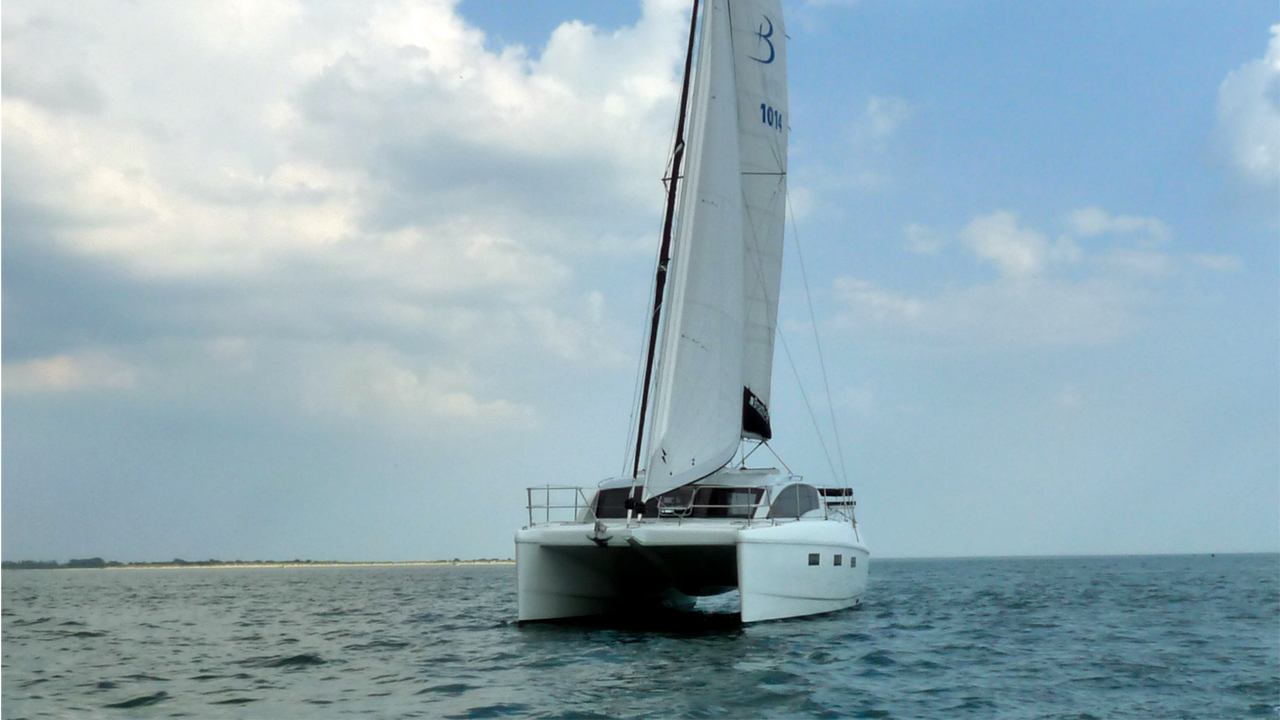
Broadblue has been around a while, with their most prolific model being the 385. Plenty of these have been cruised long distances by liveaboards, and make good average speeds (some boat buddies set out from the Galapagos on theirs the same day as me on my own catamaran, and got to the Marquesas two days ahead of us!). But what about this smaller boat? Well, the new Broadblue 346 is an evolution of, and is replacing, the Broadblue 345. Keeping the same hulls as her predecessor, the deck and interior are new. The hull, deck, engines and interior joinery are completed at Broadblue's factory in Poland, and the boats are then motored to the UK (already a good shakedown, not least for the engine installation), where the mast, rigging and sails are fitted, and finishing work completed.
On deck
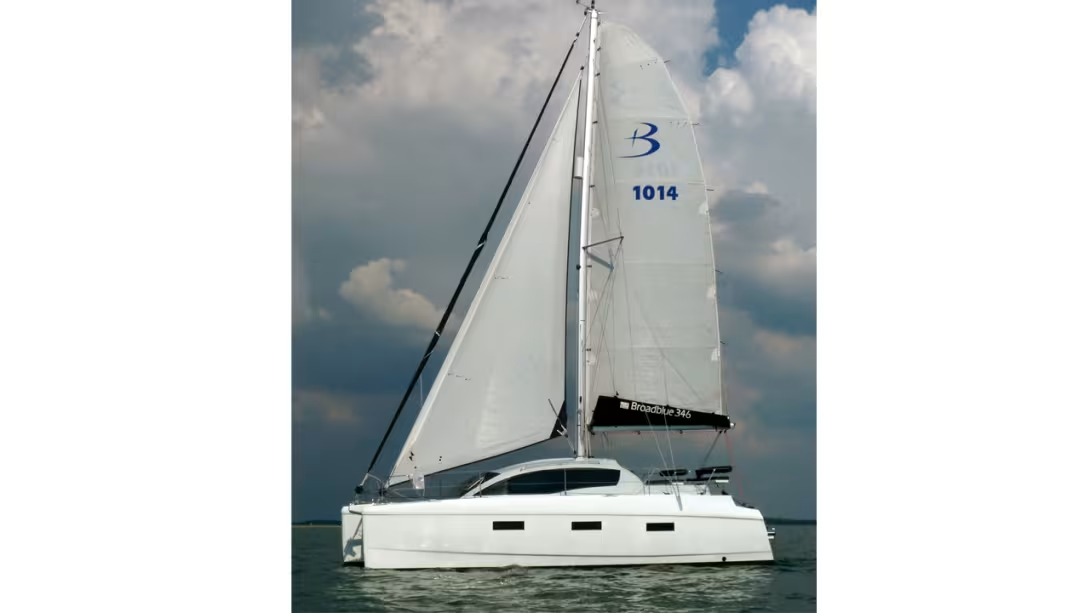
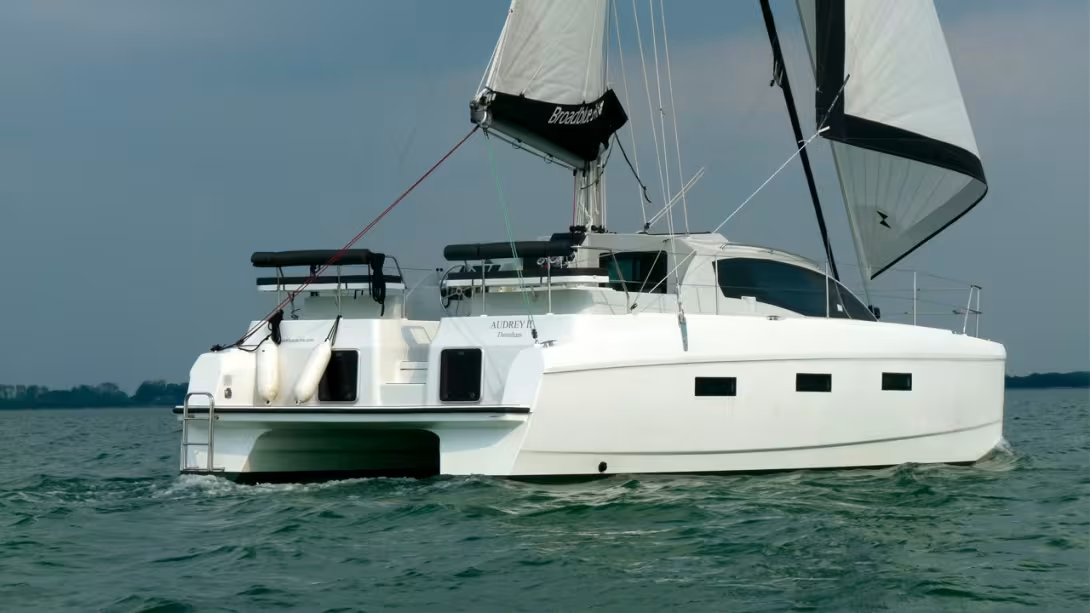
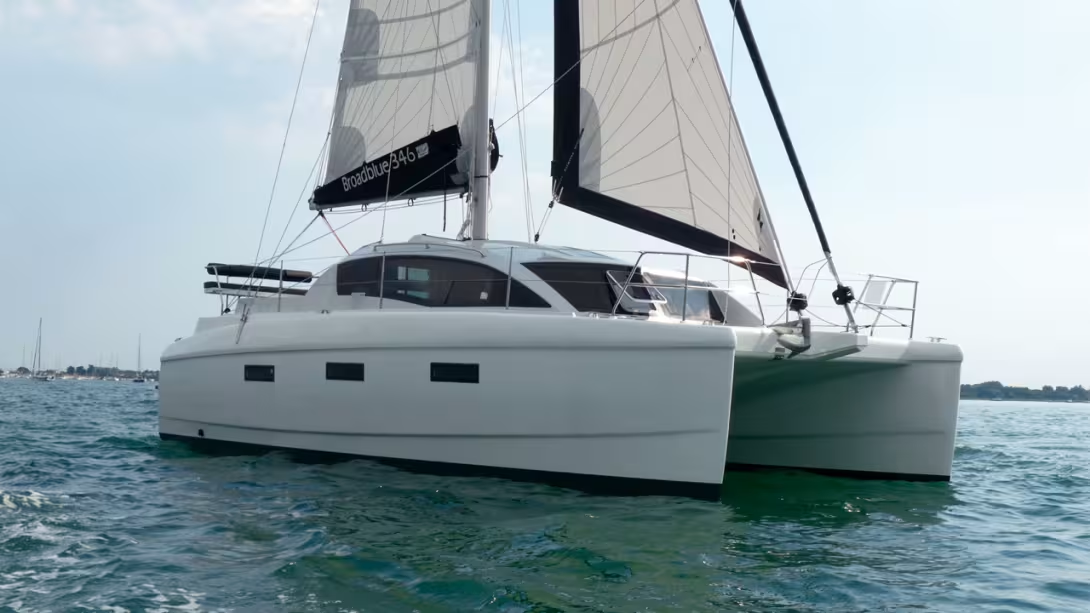
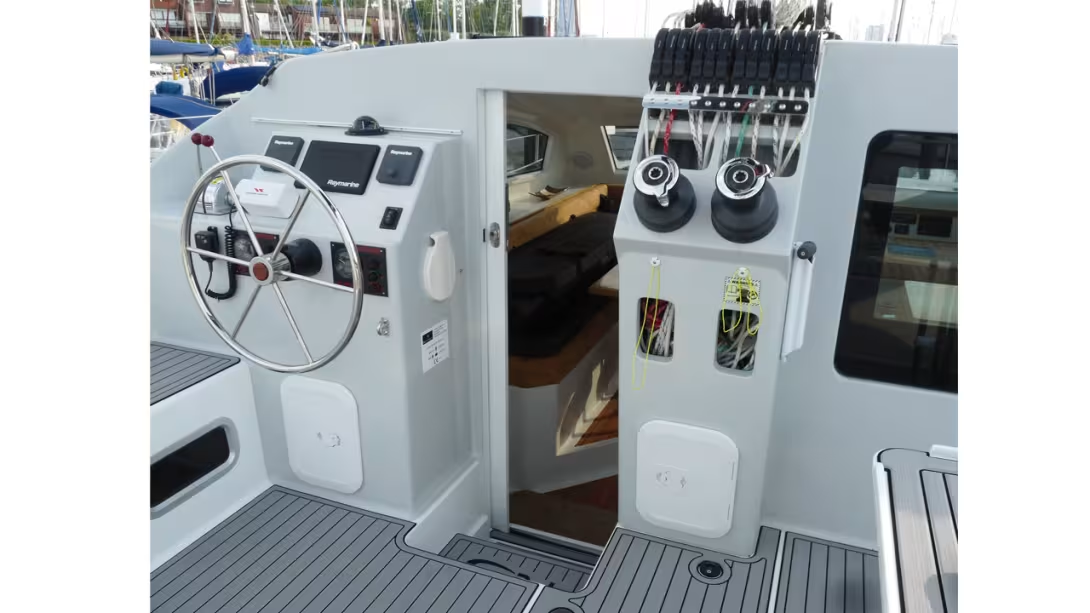
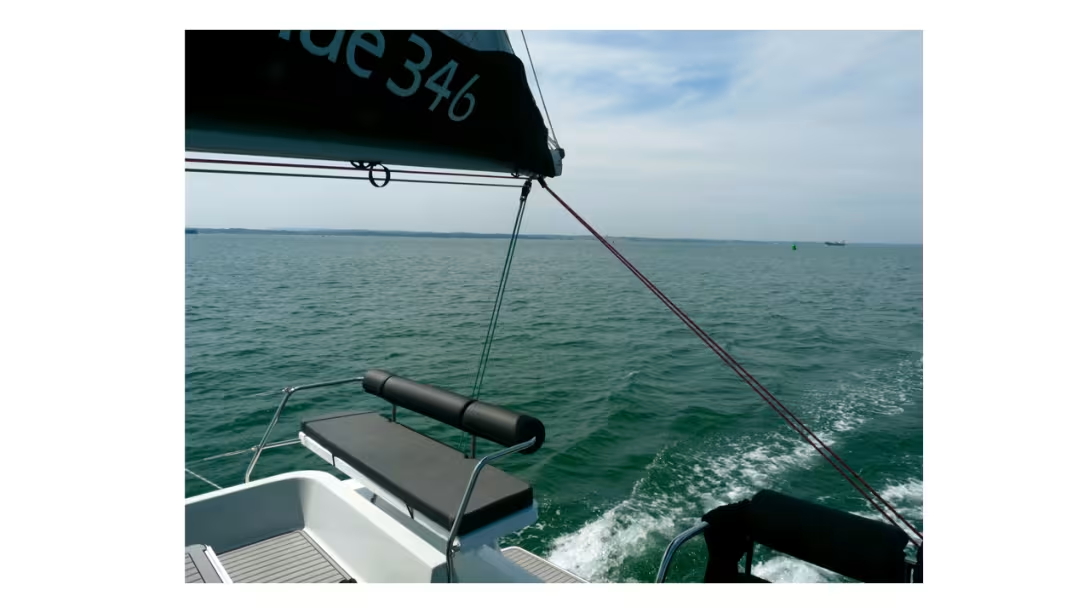
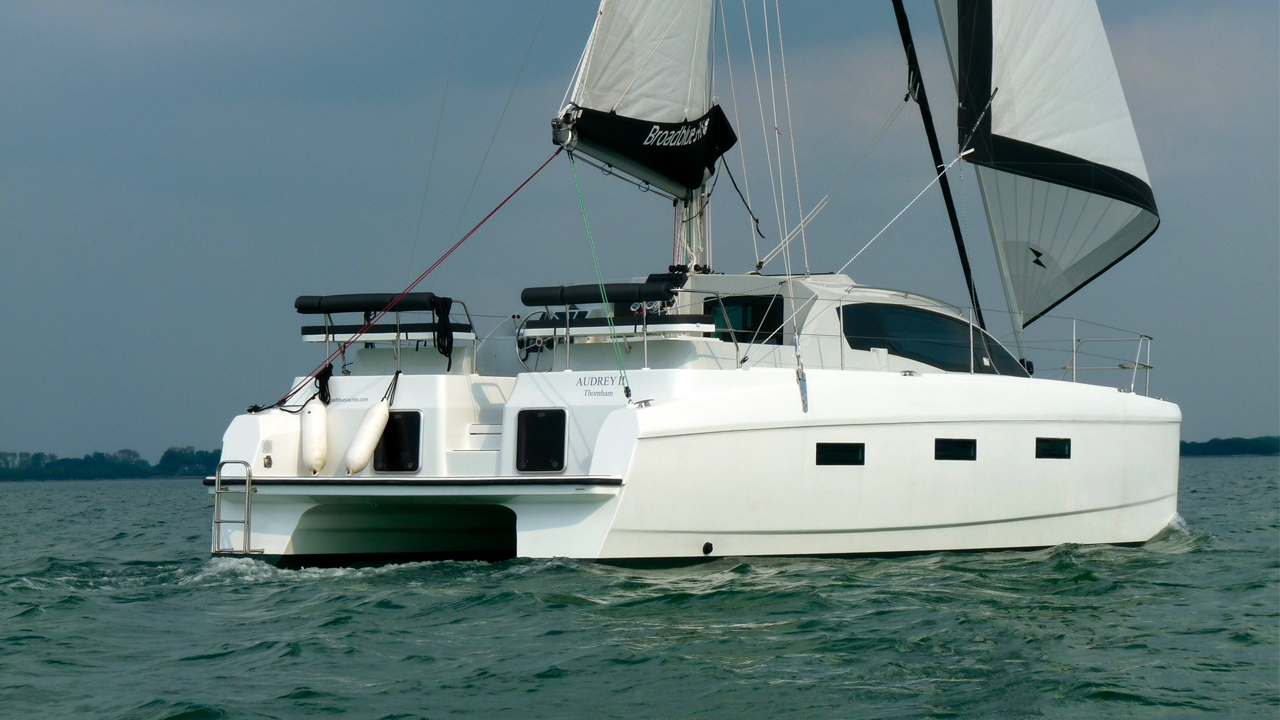
Approaching the boat on the dock, I can clearly see the rig is set at the after end of the coachroof. This is the common denominator of all Broadblue cats, and numerous other manufacturers have recently started to see the advantages of bringing the mast further back. The freeboard appears high but there's no problems stepping aboard onto the wide aft platform in the center of which is access through into the cockpit. But does the high freeboard and short length give the Broadblue a boxy appearance? Well, not really, because this effect is smoothed by the curve of the coachroof and the shape of the windows - which are all real (laminated) glass by the way - and also by the chine in the hull. Well, the advert is correct: it is a large cockpit. There's seating for more people than I would want to have on my boat. A bench wraps around the three sides, with the access aft in the middle; there's a table to starboard, around which six people could comfortably eat, having taken the stools from the saloon, and fitted them into the sockets in the cockpit sole. Later versions will have the bench seat continuing around the third side of the table, allowing for the gas locker to be relocated beneath. To port, the helm station, with 60cm diameter stainless wheel, Raymarine plotter and instruments, and engine controls.
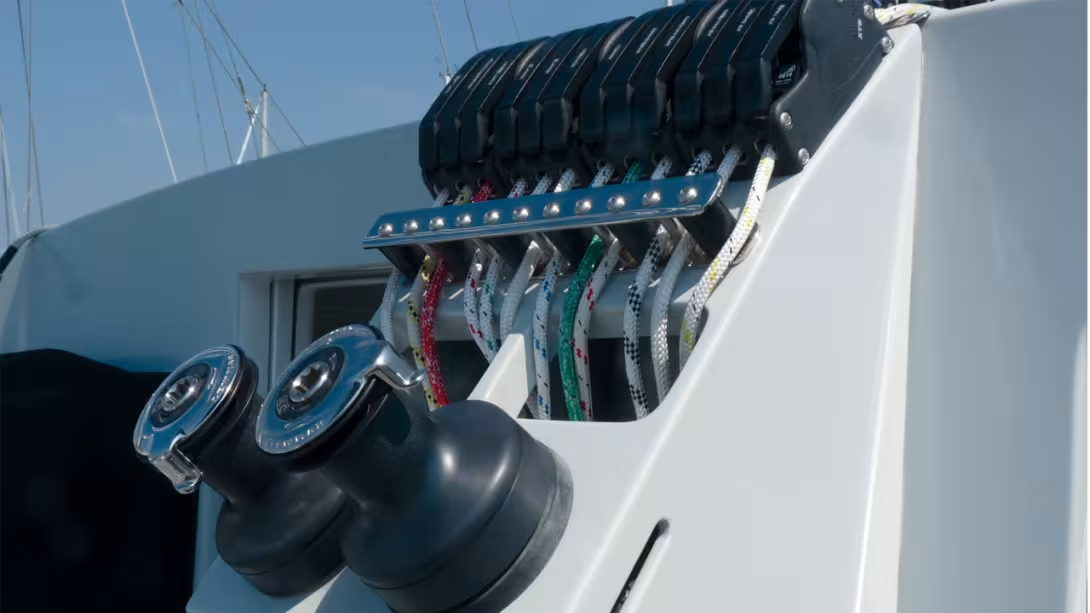
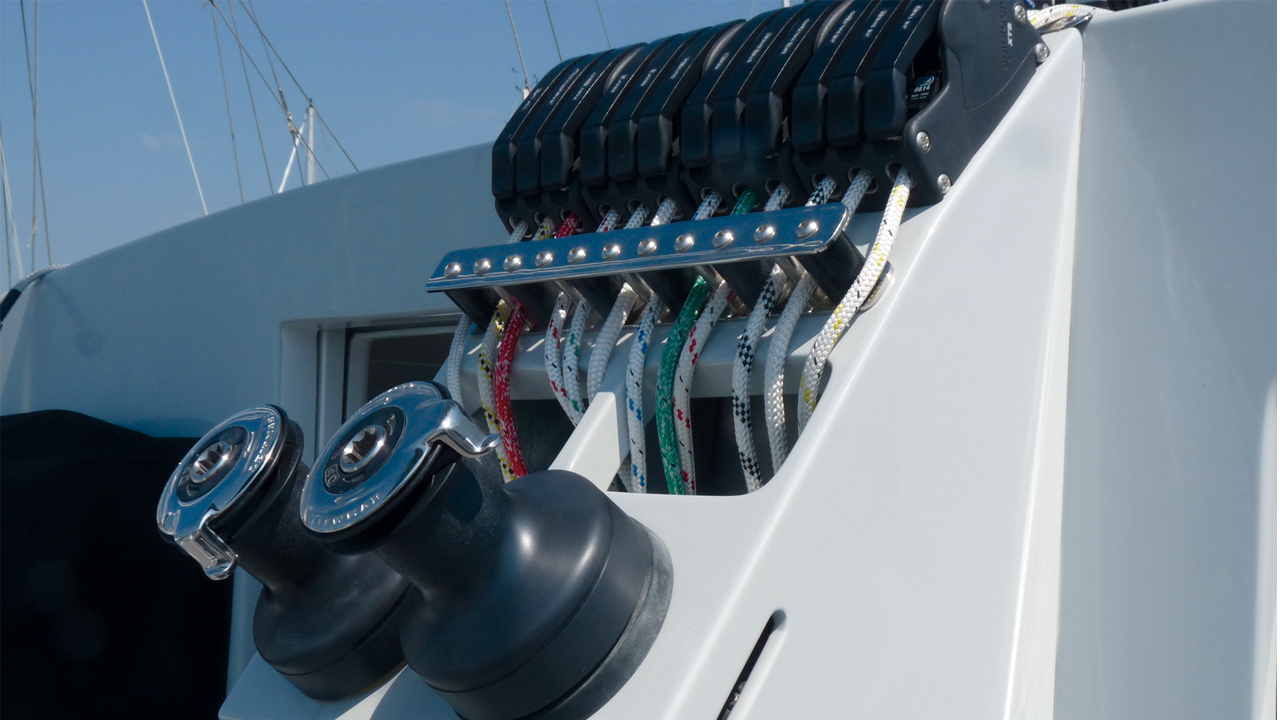
But the pièce de résistance in the cockpit is the sail handling station. Here is a console, just beneath and aft of the mastfoot, which does absolutely everything: hoisting, lowering, reefing, sheeting, trimming - it's all here. In one place. There are a dozen blocks, a dozen clutches and two Lewmar 40 winches, one of which is electric. The sheets for the reacher are lead to the console via Antal frictionless rings. The clutches and winches are angled at 45°, which seems a bit unusual, until Mark Jarvis, Broadlblue's CEO, explains the story. So many elements of this boat have been designed in response to customer feedback, and this particular element was the product of a husband and wife who both wanted to be able to do everything on board. He was 6'3" (1,90 m) tall, and she was 5'3" (1,60 m), so had the winches been mounted horizontally, they would have been either too high for her or too low for him. Putting them at 45° means they are right for both of them; and for most of the rest of us who are in between as well. Our test sail showed how well this all works in reality.
Seadek has been used for the cockpit sole and the aft platform. This is a covering which hasn’t been designed to look like teak, but is comfortable under-foot, and is light in color, so it won’t be too hot to stand on in the tropics or the Med. It’s also significantly lighter in weight than teak substitutes.
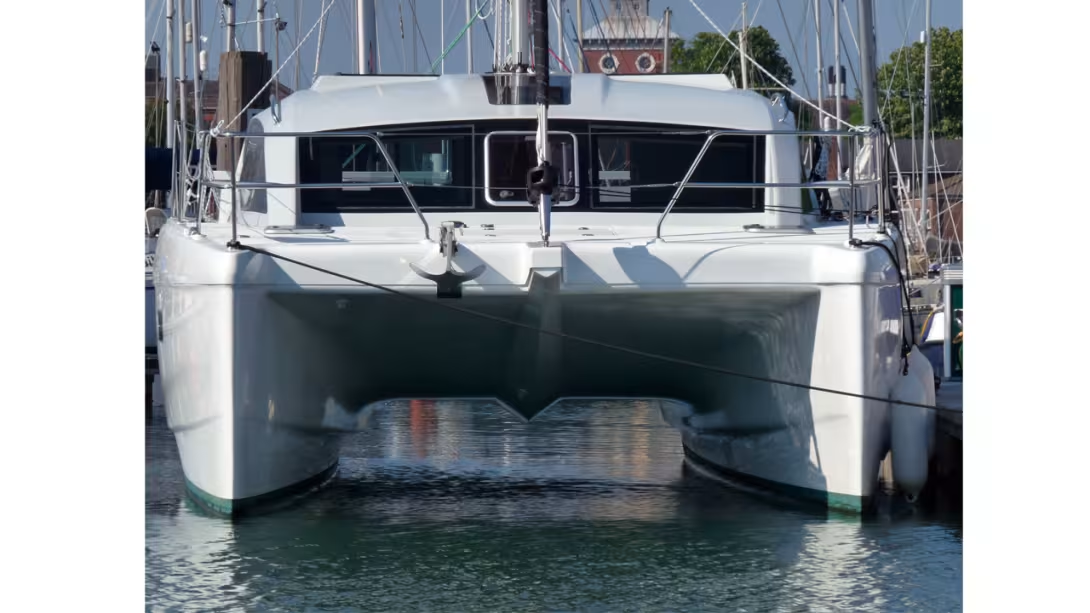
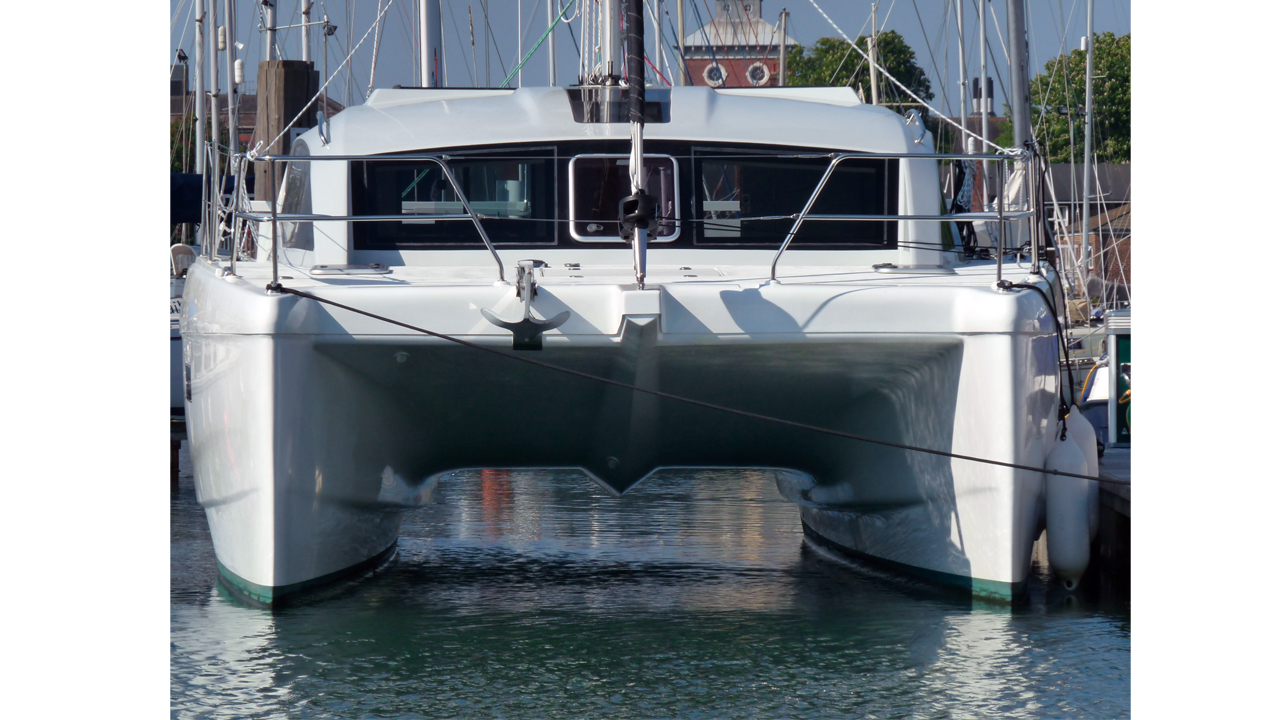
Moving forward, nice, clear sidedecks run the full length of the boat, with a stainless handrail along the coachroof. Something notable along the sidedecks are four (yes, 4) cleats, including a very useful midships one for springs. This boat has clearly been designed by somebody who’s been cruising. Up forward, no trampoline between the hulls, but a solid foredeck. As I mentioned earlier, this boat has high freeboard, which means good bridge deck clearance, which means, among many other things, no risk of being "tripped up" by this solid foredeck. It also provides the location for the Lewmar electric windlass and a vast chain locker, plenty large enough to stow all the fenders and warps.
Down below
Bucking the current trend of having the saloon and cockpit combined into one open, flush-decked space (this wouldn't be feasible here, as the bulkhead supports the rig), there are three small steps down into the saloon from the cockpit, clearly defining the two separate areas and their separate functions. The sliding door appears small (at 1.60m in height, it is), yet somehow this doesn't matter. The bottom of the door is level with the lower step, and the top is almost up to the saloon ceiling, which has 2m of headroom. Very clever ergonomics.
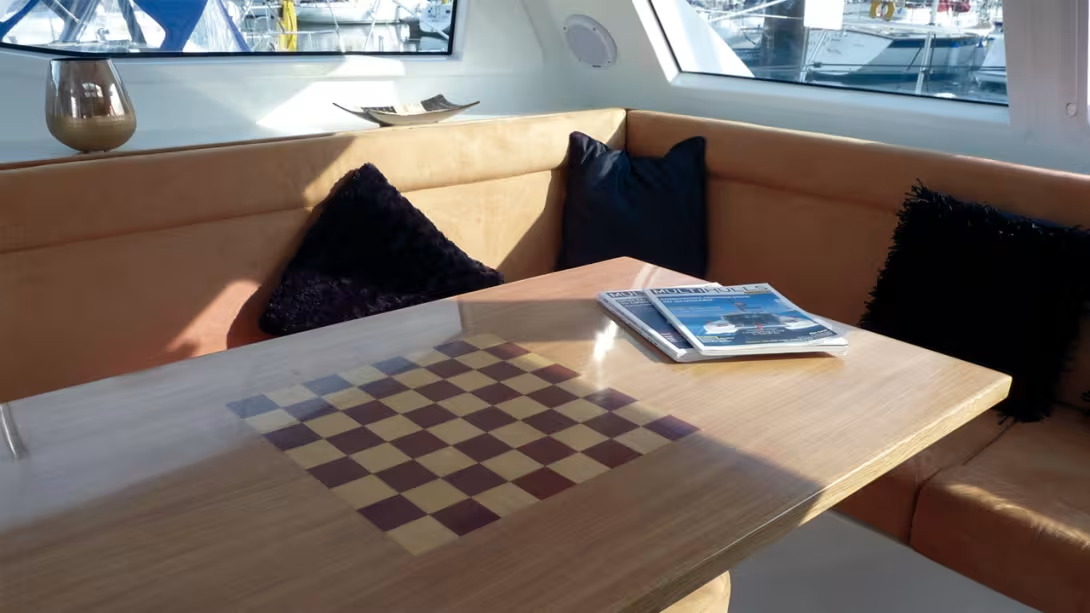
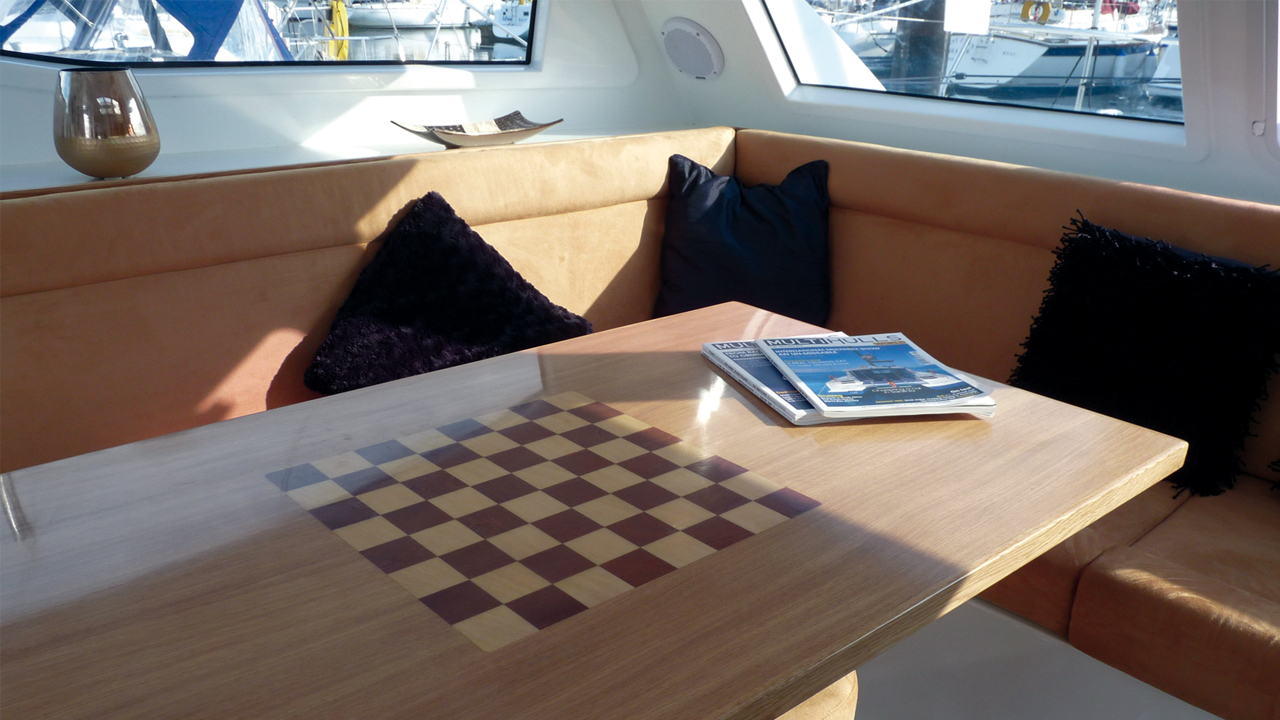
It's nice and light in the saloon, and the first thing that strikes me is the table and dining area. The wooden table top has an inlaid chess board. I'm sold on this boat immediately. The standard of joinery work and cabinetry is what you would expect to find at the other end of the market. Measuring 135cm by 75, and with a L-shaped bench round two sides and two swing-out stools (the ones which can also be used in the cockpit), six to eight people could comfortably eat here.
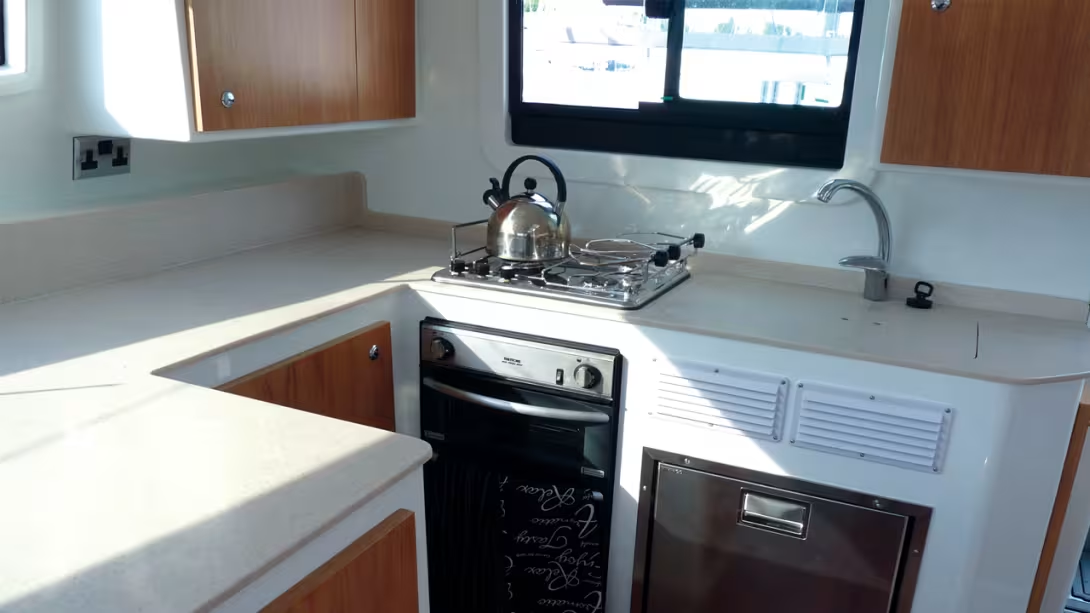
To starboard is the U-shaped galley, which appears to be from a bigger boat. There is ample storage with both high and low-level cupboards, cutlery drawer, a double sink, front-opening, 75 liter capacity refrigerator with small icebox, three-burner hob, and a built-in oven with its own separate grill above, and storage drawer beneath. Wow. The sink and stovetop are against the aft bulkhead, and between the cupboards there is a sliding, toughened glass window measuring 78x57cm. The countertop and splashbacks are in light stone colored ammonite, and there is a double 220V socket for your blender/food mixer/etc. Further storage is provided beneath the bench seat forward of the table, for less-frequently used things or longer term stowing of canned or dry goods. Alternatively one end of this space can be made into a freezer. In fact, it is already insulated with this in mind. Unfortunately some of the cupboard latches seem to stick a bit. Hopefully this is just a question of adjustment, but even if not, it's not a serious issue to overcome.
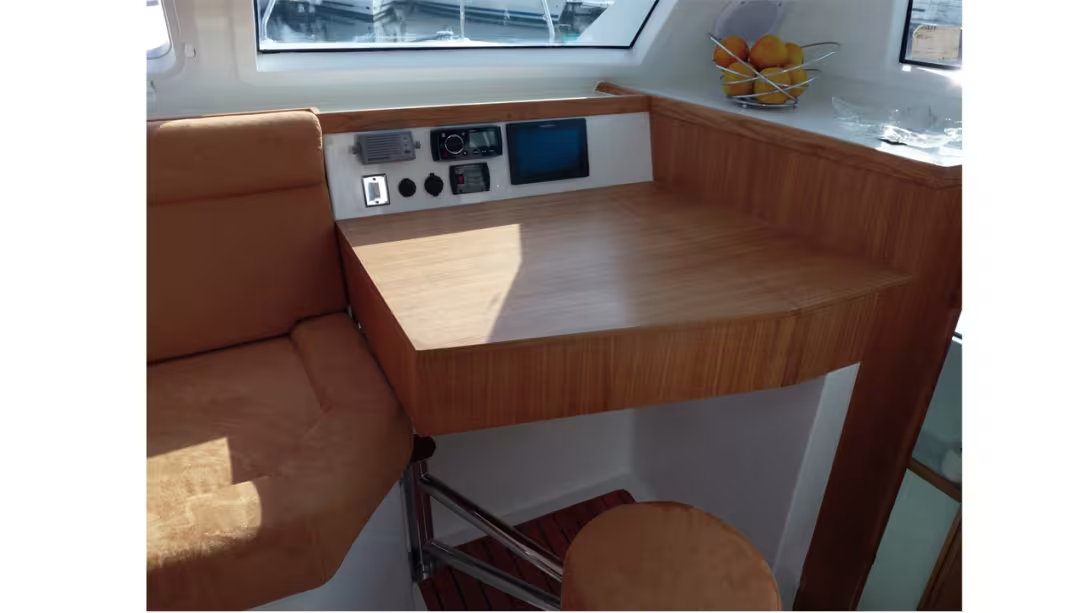
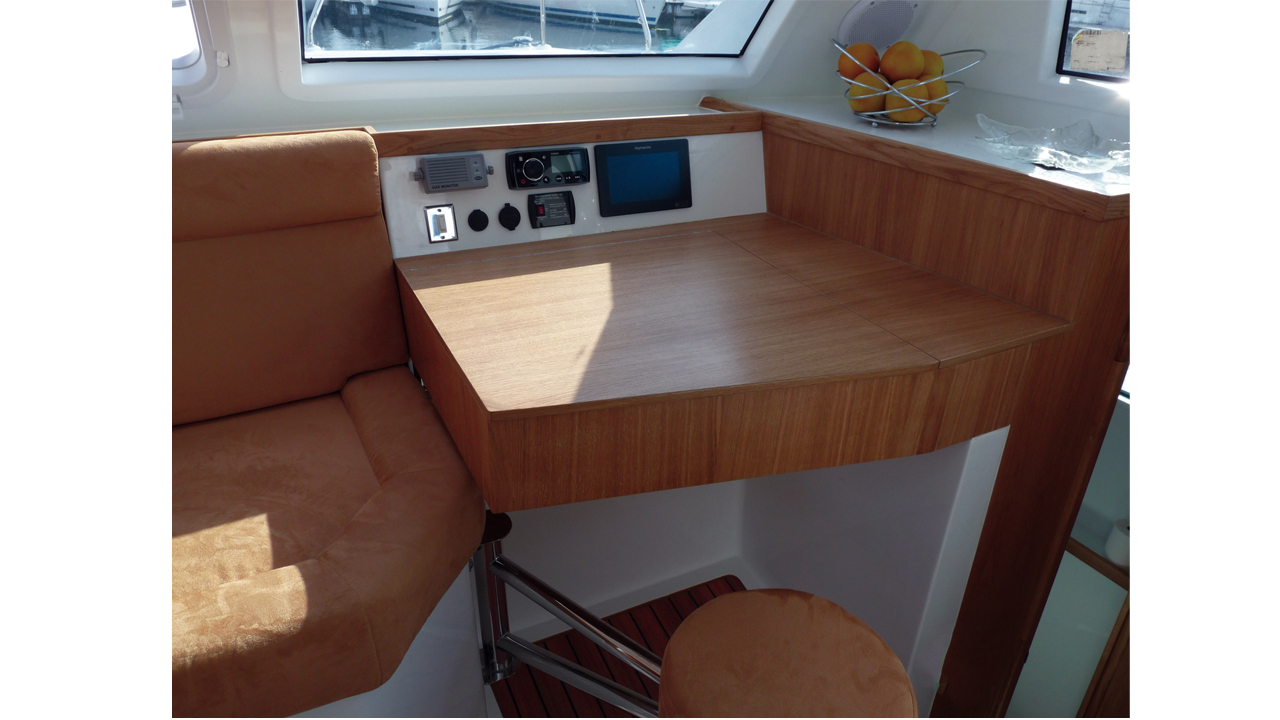
Forward of the galley are the companionway steps down into the starboard hull, and forward of those is the chart table. At 85cmx50 it is plenty big enough to do actual chartwork on, if anyone can remember what that is. And at 13cm deep, it's plenty big enough to stow a bunch of charts in, along with all that other stuff that migrates to end up "in the chart table". But there's more to the chart table than just this: with its swing-out seat and the Raymarine system in front of you, it's possible to control the autopilot and so steer the boat. Given the near-panoramic view from this position, on passage, you could easily keep watch sat here if the weather wasn't conducive to staying on deck. More about that later.
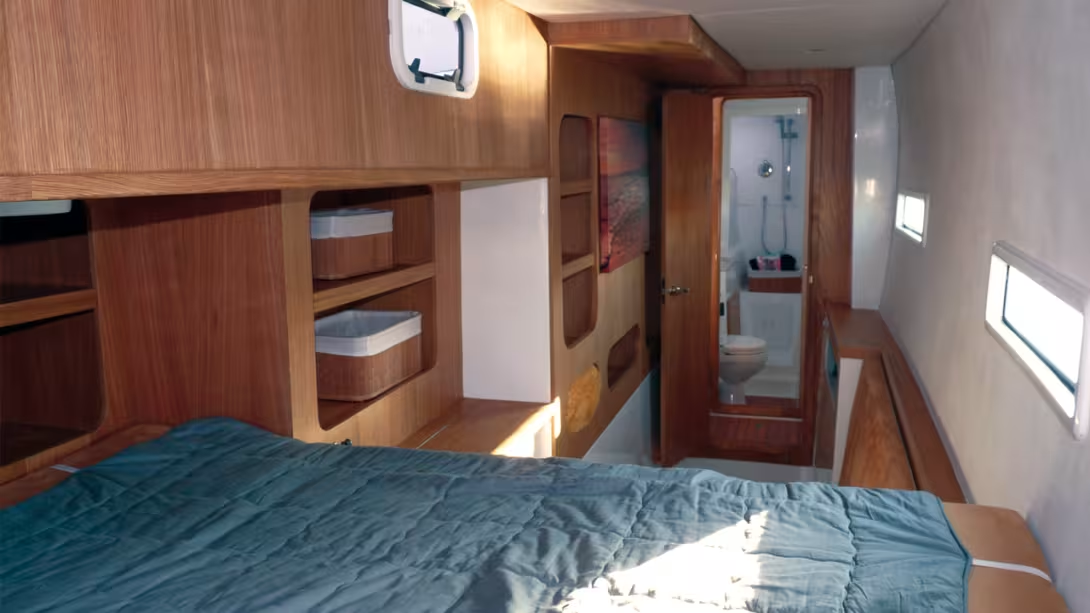
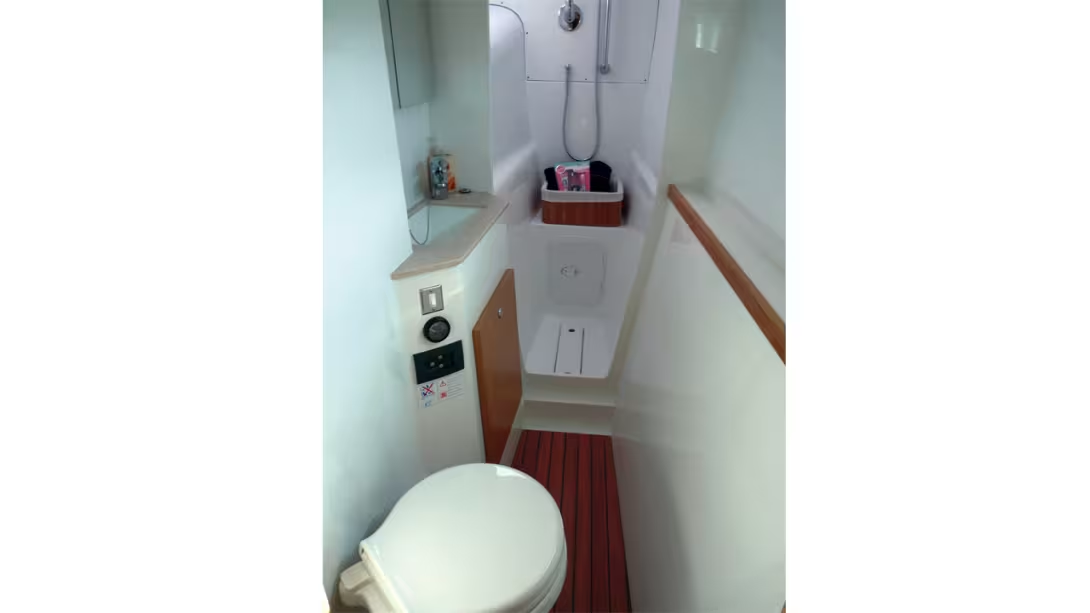
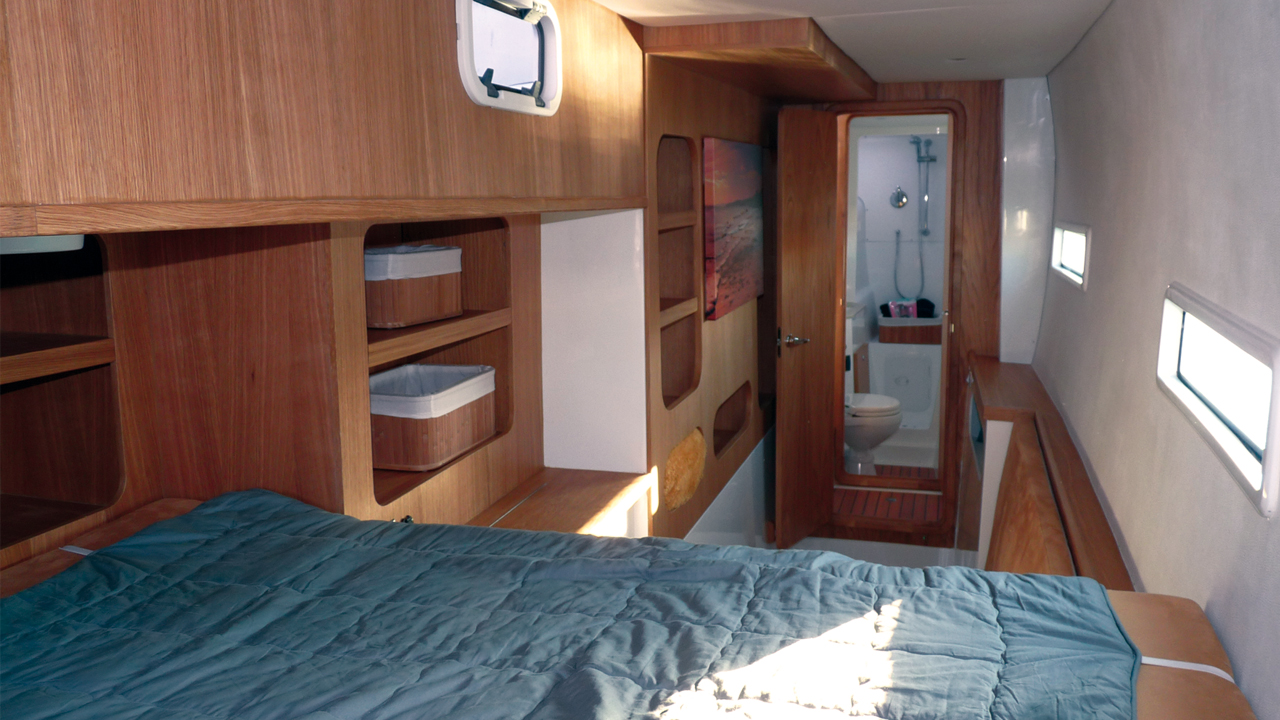
Going down into the starboard hull, you get the feeling of being in the owner's suite of a bigger cat. Aft is the double cabin, with its 2m x 1.6m bunk (yes, that is bigger than your bed at home), but before you get to that, there's a 2.60m passageway, with bench seat down one side and cupboards and shelves on the other, making the whole cabin 4.60 m long. Which, for any readers in imperial, is just over 15 feet. The bunk is high, but using the bench seat to step up, access is easy. Forward of the companionway steps is the heads compartment. Actually, I'm not sure compartment is quite the right word, as it's 2.40 m long! In here, there is an electric WC, hand basin, and separate shower. Above the basin is a cupboard with mirror doors, and the back of the cupboard can be removed to gain access to some of the technical systems. Beneath the basin, I notice some of the wiring for the toilet could do with tidying up and being better secured.
There is an abundance of natural light below, with two long portlights in the cabin on the outboard side, a small opening hatch into the cockpit and a large hatch at the back onto the aft platform. There are plenty of LED spotlights, along with 12V and 220V sockets in the cabins and the saloon, and USB sockets at the chart table.
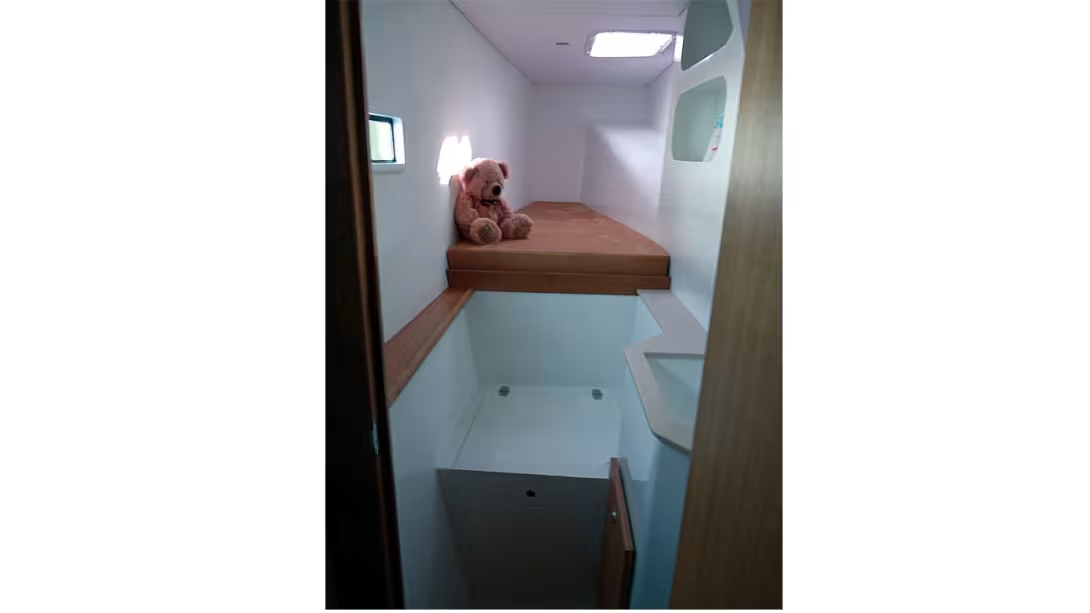
The port hull companionway is located just forward of the main bulkhead, again with three steps down. Aft is another double cabin with the same-sized bed as to starboard, but this time, it lies athwartships as opposed to fore and aft. There is less room than in the starboard aft cabin, but there still a bench seat and plenty of storage space. Forward in the port hull is a single cabin, and although the bunk is quite narrow at the feet, it is plenty big enough, and remarkably, the cabin also has a toilet and wash basin. Between the two port cabins is a passageway, with a large stowage area inboard which could easily transform into another bunk.
In all, more volume and more living space than you’d expect on a boat of this size.
So what’s this boat for?
OK, so at 33 feet in length, a round-the-world program is not really on the cards. Despite being marked CE category A, you might want to think twice about a serious ocean crossing. But Broadblue claim to have the highest proportion of owner-users in the whole catamaran market, and this one is not going to be a charter boat (there’s no sunbathing deck with refrigerator and grill up on the flybridge, etc). I ask Mark Jarvis about the type of customer who’ll buy this boat and what they’ll do with it. He talks about the British sailor who will cross the Channel, get the rig down and spend a summer on the French canals getting down to the Mediterranean. Then a season or two in the Greek islands, then Turkey, and so on. People spend years in the Med.
Now, one interesting thing which had never occurred to me, was about carrying the rig on deck. I’ve done this a few times on monohulls, once with a mast that overhung a couple meters at the bow and the same at the stern. It was a proper nuisance in locks and for berthing, etc, but remember Pythagoras’ theory… if you stow the mast diagonally across the corners, there’s no overhang. At least not on this boat. Combine this with the fact that this boat is significantly shorter than a 40’ shipping container, and you have a boat which can be carried on a regular cargo ship, without resorting to the expense of specialized yacht transporters. Broadblue already have experience of this, with some of the previous generation of the 345 having been built in China and then shipped to the UK for completion, so it can be done. And this opens up possibilities of programs way beyond Brits doing the French canals. I’m thinking ICW, and summers in New England, winters in the Bahamas. What about the Great Loop, if that’s your thing? What about the West Indies?
Technical
Our test boat was fitted with the upgraded 20hp Beta Marine diesel engines, though the standard diesel option would be twin 16hp motors. Transmission is via saildrive, with two-bladed folding props as standard. A cheaper option, and one which is worthy of serious consideration, is an outboard motor. The long locker beneath the cockpit is designed to be able to take a 20 to 25hp long-shaft outboard which would be electric starting and tilting. With the outboard tilted, the reduction in drag would make a significant difference to performance under sail.
On this boat, both motors running at 3500rpm will give 7.5 knots, but on one engine, 5.5 to 6 knots can be achieved, burning around 1.5 liters an hour. With the 200L tank, this would give a range of up to 650nm. So the French canals that Mark mentioned could be done with just one fill-up.
There are two 85Ah engine starter batteries and two 110Ah house batteries which are in the port hull (the calorifier is to starboard), though there is space for another battery. With room for 2 x 160W solar panels, three house batteries would seem about right for cruising. In general the wiring is neat, well-secured and well-marked.
The fresh water tanks are in the keels, keeping weight centered and low-down.
And how does she sail?
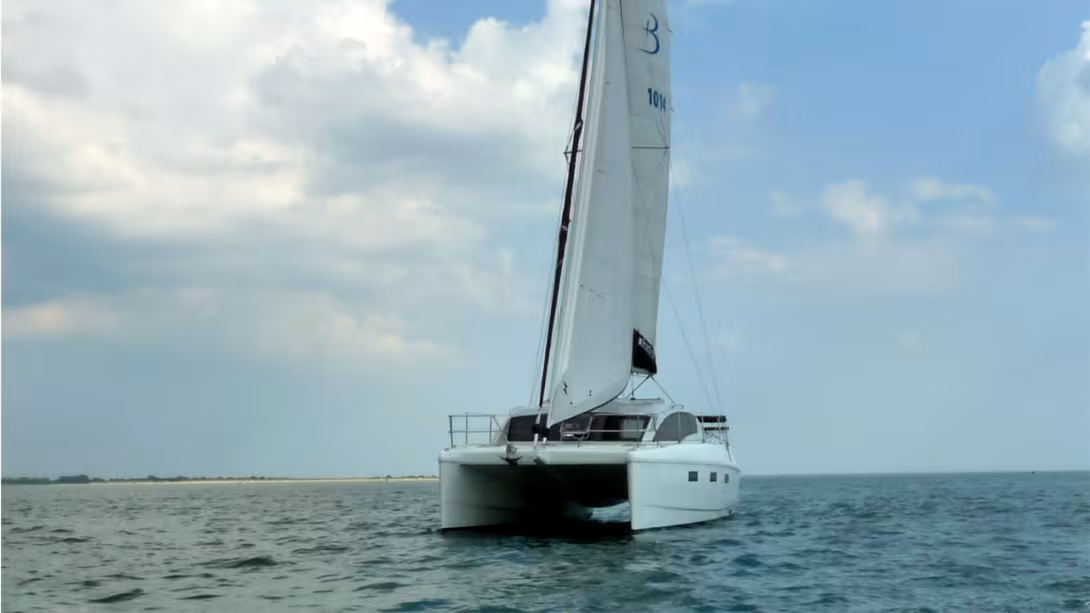
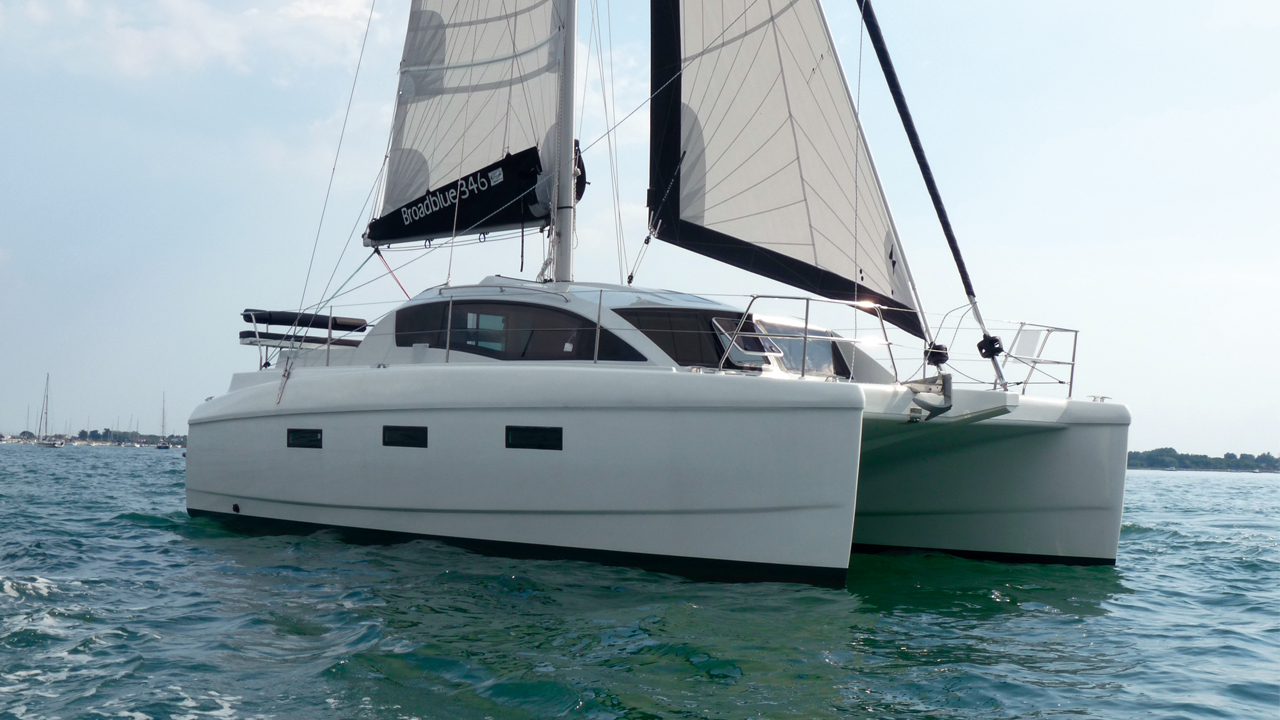
Modern catamaran designs favor fine-entry bows, and here there’s no exception. The hulls have narrow, vertical stems, with the beam increasing all the way aft. A chine allows for a narrower waterline beam, and more volume inside, all this contributing to performance I had not expected to find on a boat of this size:
Thirty-three foot cruising boats plod along at 5 knots, give or take. Or do they? There was high pressure to the north as is typical round here in late springtime, meaning the couple days we had on board on the south coast of England saw some fairly light airs out of the NE, so I wasn’t expecting great things. Getting out of the tight slip in Haslar Marina was easy with the twin 20 hp Beta diesels. Using the electric winch, the main went up with ease, and the self-tacking jib quickly unfurled, and we were soon out of Portsmouth’s huge harbor and into the Solent. The 40m² main by Banks Sails has a fairly square top and big roach. The Selden mast has quite a pre-bend, and this is achieved by having twin diamond stays, a single set of spreaders. Capshrouds, lowers and two forestays make this a very secure rig. In clearer water we swapped the jib for the (optional) reacher, and with the wind now aft of the beam, the Raymarine instruments were showing us making a very respectable 7.3 knots. But hang on, there’s less than ten knots of wind. That can’t be right? But it was.
Coming back on the wind, we tacked up into Chichester Harbour under main and self-tacking jib again. Mark’s local knowledge and the catamaran’s shallow draft allowed us to get close to the beach, making the most of each tack and we were soon into the wide natural harbor, still making respectable speeds to windward. Remember I said earlier about “sailing” the boat from inside at the chart table? This was superbly demonstrated here by Mark, as our tacking up into the harbor was achieved… with no-one on deck!
Heading over to one of Chichester’s anchorages, we dropped the hook at East Head and stopped for lunch. Anchoring was easy, with the windlass being controlled by the two foot-switches on the solid foredeck. There is also a windlass control at the helm station, though I didn’t find the up and down direction of the switch to be intuitive. A small detail which would be overcome with familiarity. The anchor chain leads across the foredeck in a channel with stainless steel plating on the bottom. Over time, I wondered if there’s a risk of the gelcoat sides of the channel getting chipped or scratched with a lot of anchoring. This may be better if the channel was lined in stainless on the sides as well. Another advantage of the solid foredeck is that the hull is very stiff forward, avoiding the need to use a bridle. Aside from the fact that I would opt for a new-generation anchor such as a Spade or Rocna, rather than the Bruce fitted to our test boat, I was impressed by the anchoring setup on the Broadblue.
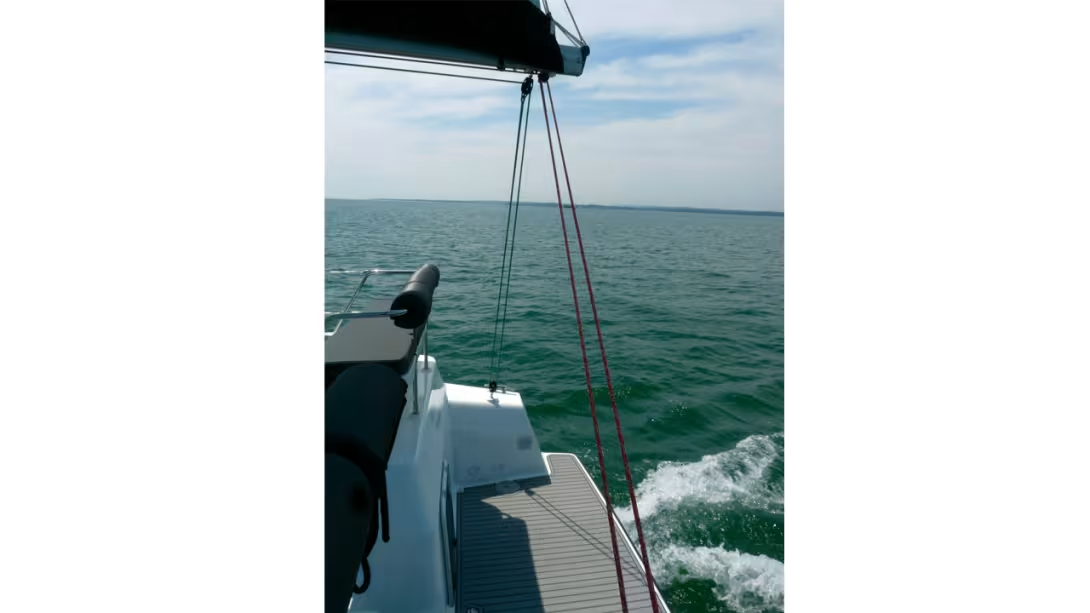
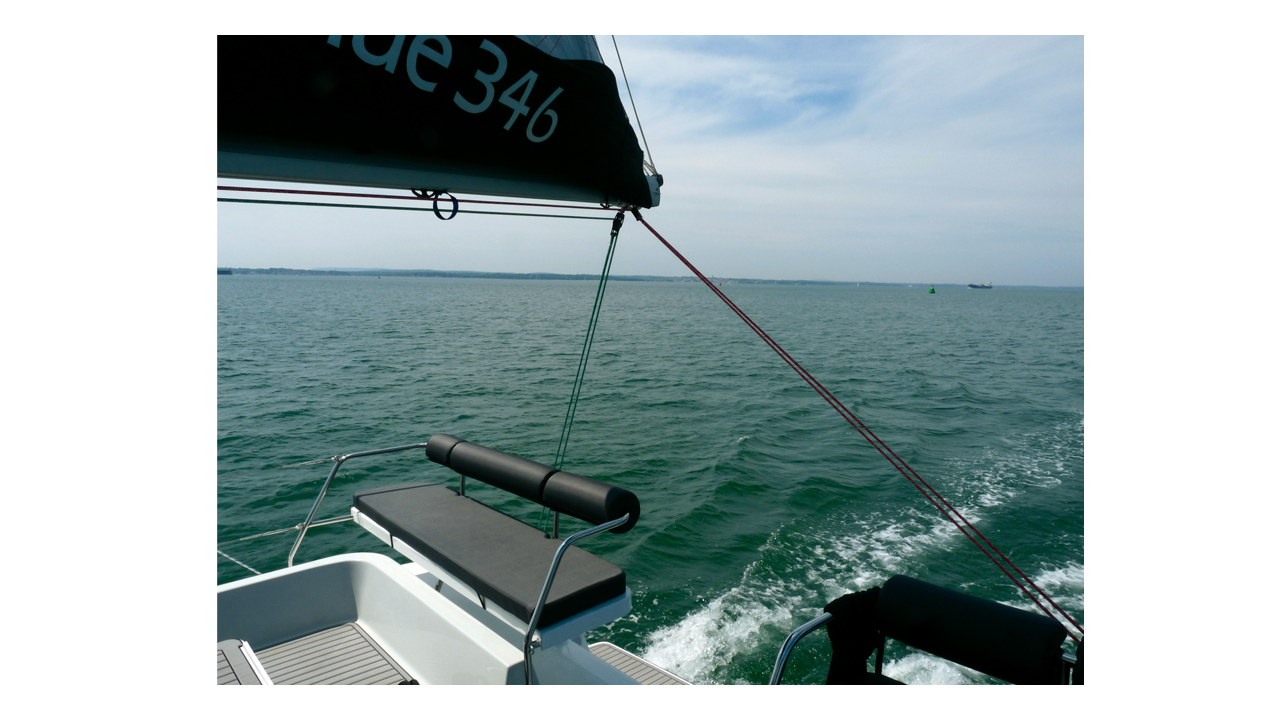
There are no davits fitted to this boat, but with the full-width platform aft, the idea would be to have a dinghy fitted with a Snap Davits-style system, and I think this would work well for cruising. Although we weren’t carrying a dinghy on our test sail, getting on and off our photo boat RIB while under way was both easy and safe via the aft platform. This would also make a great spot for fishing, or simply sitting and enjoying a sundowner at anchor.
Conclusion
After the unexpected sailing performance in these light airs, we spent a very pleasant evening - the galley really feels like it has been designed for cruising - followed by a very comfortable night on board, though I was forgetting that in this part of the world in late spring/early summer, it gets light very early (like 4.30am!), so for cruising around here, I would definitely opt for blinds on all the windows. Was I put off by the size of this cat? Not at all. And bear in mind that the smallest boat in the ranges of some of the most well-known catamaran manufacturers would cost you twice as much money…
So if you're considering a "small" boat, do you really need a 40 or 45 footer? Think about it.
Pluses
-
Unexpected performance under sail
-
Accommodation feels much larger than 33 feet
-
Sail-handling console
Minuses
-
Some wiring needs tidying up (electric heads)
-
Galley cupboard door and drawer latches a bit “sticky”.
-
Not enough blinds
Technical Specifications
Builder: Broadblue
Designers: Mark Jarvis, Darren Newton and Derick Reynolds
LOA 10.2m
BOA 4.85m
Draft 1.01m
Displacement 4,800kg
RCD Category: A (Ocean)
Mainsail area (Std): 28m²
Self-tacking jib: 19m²
Gennaker (Std): 45m²
Spinnaker: 98m²
Fuel: 1 x 200 L
Water: 2 x 250 L
Engine options: 1 x 20 hp Yamaha 4-stroke outboard or 2 x 16hp or 20 hp Beta diesels with saildrives
Rig: Fractional sloop, aft stepped mast and bowsprit for reacher/code 0 sail
Layout: 2 double cabins, 2 single cabins and heads with shower

1 - Rig set at the aft end of the coachroof - a Broadblue trademark
2 - Switching from self-tacking jib to reacher. All very easily done from single sail-handling console in the cockpit
3- Real glass windows give great visibility and great light inside
4- 4 cleats along each side of the deck. Very practical for cruising
5- Hull chine gives narrow waterline beam with increased interior volume
6- Wheel and instruments to port and sail-handling console in the center make this catamaran easy to manage by one person
7- Wide platform aft. Great for fishing, swimming and accessing the dinghy
8- Twin mainsheet system for perfect sail trim
9- Plenty of comfortable seating in the cockpit including around the table
10- Selden aluminum mast held by capshrouds, lowers, twin diamond stays on a single set of spreaders and two forestays make this a very secure rig
