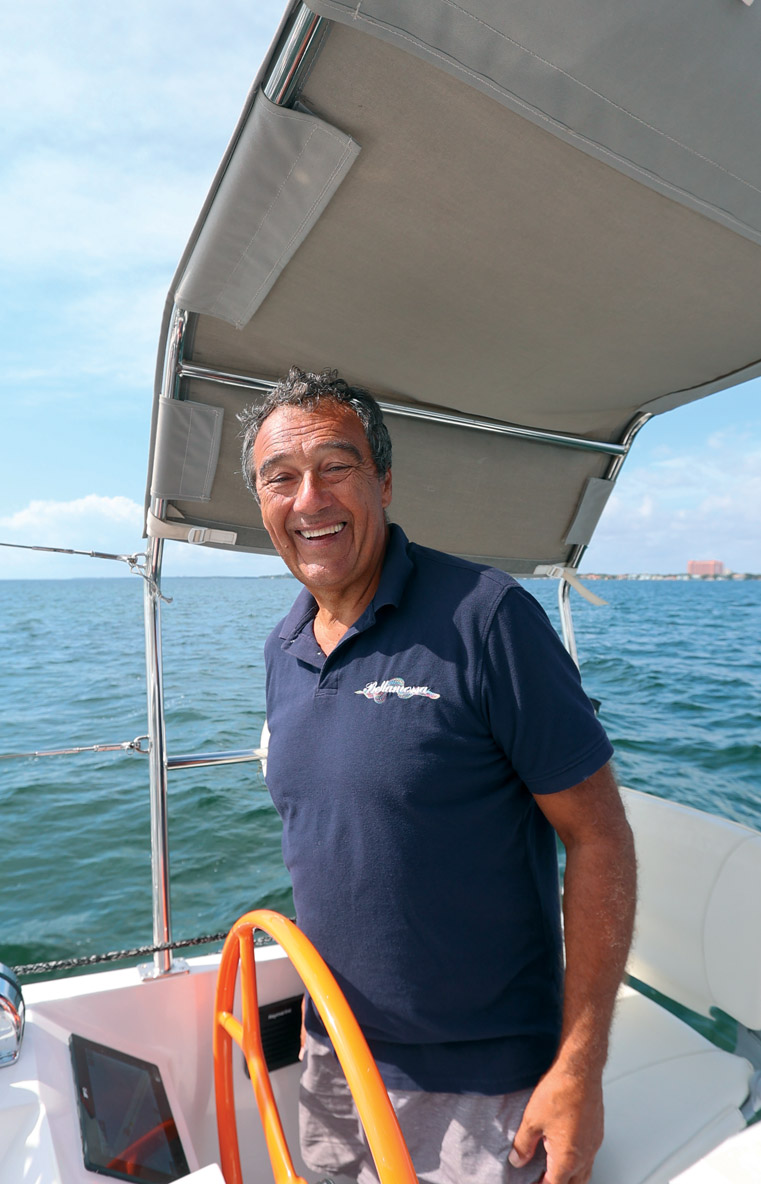
At a time when more and more multihull builders seem to be focusing exclusively on boats over 50 even 60 feet, Italian shipyard Comar Yachts has unveiled a 38-foot catamaran capable of crossing oceans while offering comfort, livability, and performance. We had the opportunity to experience this impressive combination off the coast of Miami with Massimo Guardigli, both the brand’s CEO and owner of this C-Cat 38.

Infos pratiques
- Le chantier : C-Cat 38
- La fiche technique
-
 Découvrez notre vidéo exclusive
- Financez votre C-Cat 38
- Assuez votre C-Cat 38
- Articles autour du C-Cat 38
Conditions: 10-15 knots of easterly wind, calm sea
You may not be familiar with the Comar Yachts brand, but this shipyard, founded 65 years ago, has written some of the most beautiful pages in sailing history. It is responsible for the famous Comet monohulls, ranging from 52 to 100 feet.
Since then, the manufacturer launched its range of catamarans in 2015 with the C-Cat 37, in collaboration with Marc Lombard Yacht Design Group. This was followed by the C-Cat 48, and very soon there will be the C-Cat 56 and 65, involving renowned architectural firms such as Enrico Contreas and Yacht Design Collective.
The idea behind the creation of these catamarans is to produce comfortable, highly livable multihulls without sacrificing performance. This philosophy is not just words, as Massimo spends a good part of the year aboard his own boats, which allows him to constantly improve his designs.
A Modernized Version of the C-Cat 37
LIn fact, the C-Cat 38 was not started from a blank slate. It is a modernized and improved version of the famous C-Cat 37. This new model was designed in collaboration with Marc Lombard Yacht Design Group, but the shipyard’s design office also made a significant contribution. Slightly longer than its predecessor (by 73 cm / 29 in), the C-Cat 38 has been designed to be a compact catamaran capable of accommodating a family on board, but also to be self-sufficient on long crossings, all without sacrificing performance. An ambitious challenge, but one that already seems to have been met, as the catamaran, skippered by Massimo, won the 2024 Atlantic Rally for Cruisers (ARC) in its category. The skipper/sailor and his partner – who is also involved in the smooth running of Comar Yachts – have already spent several months aboard their C-Cat 38, fine-tuning every detail.
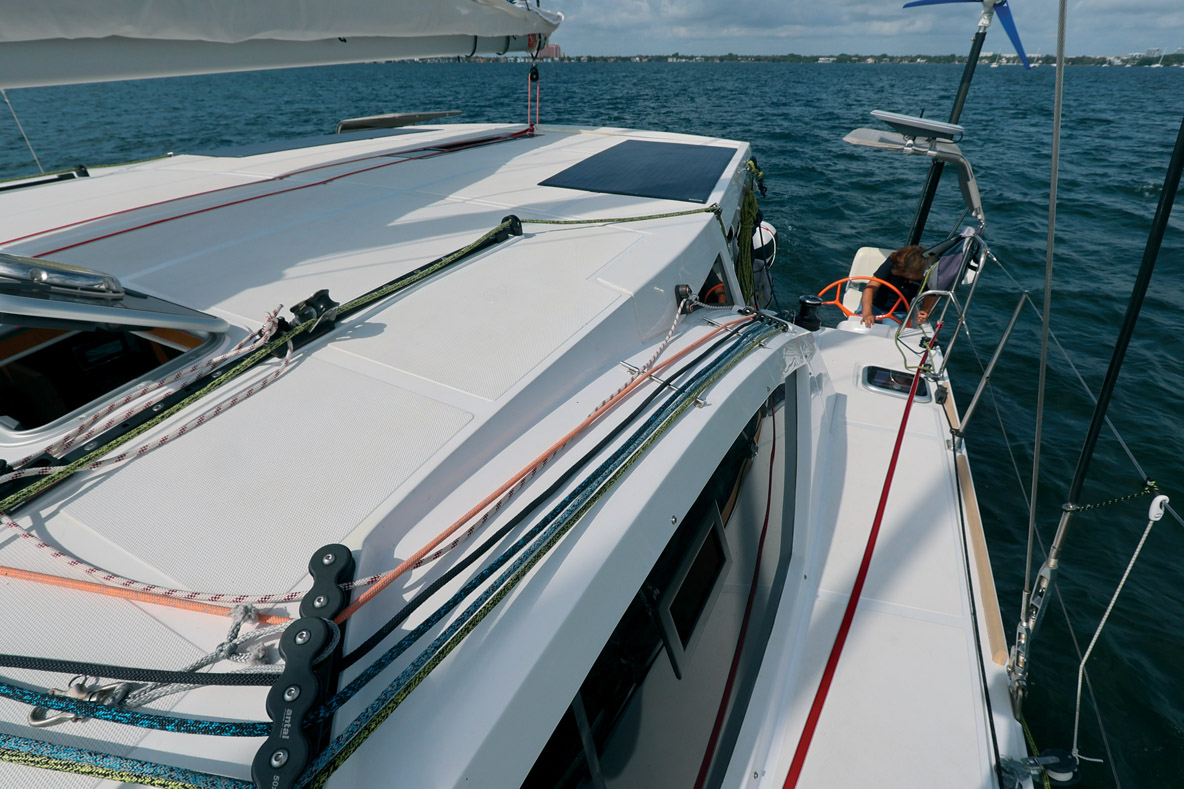
In terms of aesthetics, the C-Cat 38 has been beautifully designed, which is no surprise from an Italian shipyard. Relatively compact, the multihull displays a modern line with fairly high hulls above the water, inverted bows, three long, beautifully designed side portholes and a slightly rounded deckhouse for a stunning effect. What’s more, the living area is extended by a slim bimini top that accentuates the aerodynamic profile while providing effective protection for the cockpit. The catamaran also benefits from two long sugarscoops and fairly good bridgedeck clearance, which is a real advantage in rough seas.
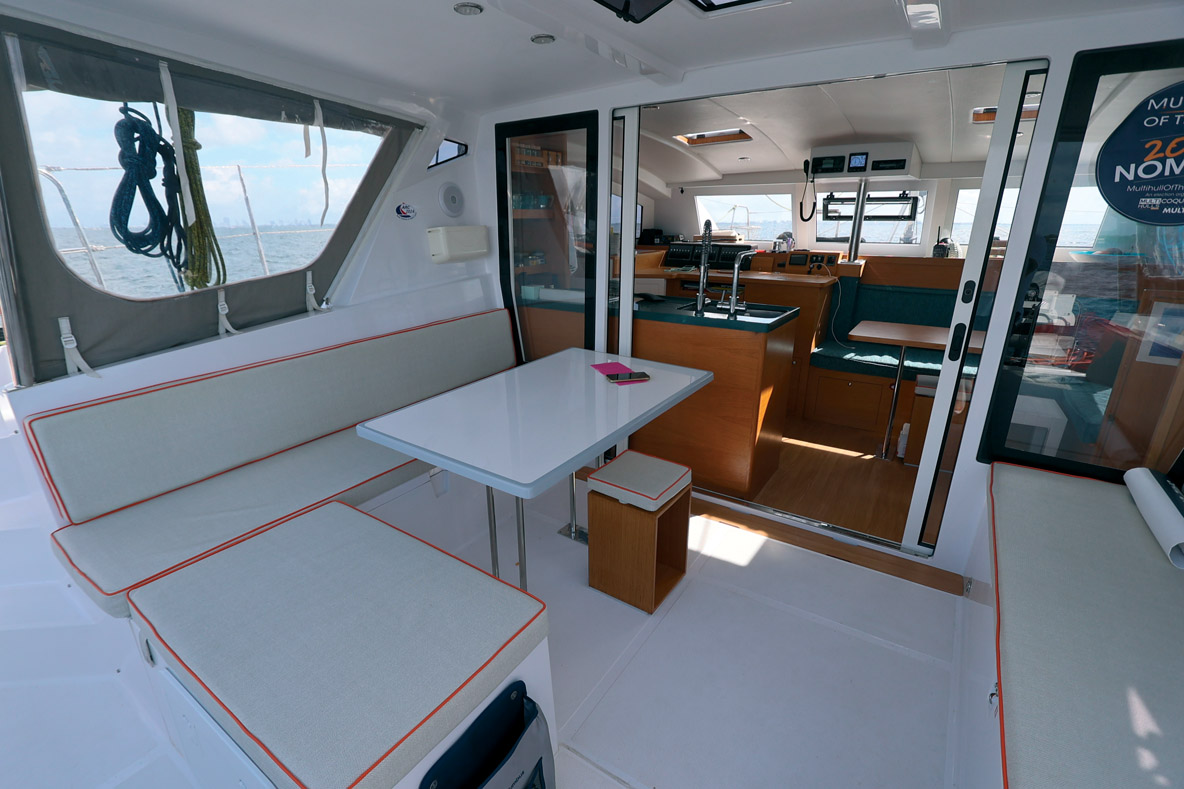
Access to the boat using the extended sugarscoops is easy, with only two steps to reach the cockpit. This passage can be blocked by a guardwire, but nothing more, so you will need to be particularly vigilant if you have young children on board. Due to its length, the cockpit is not huge, but it is more than adequate for a boat of this size. The layout is very clever, with a long seat on each side, a small return at the stern and a movable stool, which means that seven or eight people can easily sit down. A good-sized table is installed on the port side and, thanks to the side covers, this area is particularly well protected. An opening skyroof also allows a little more light and fresh air in and gives a view of the rig, which is a nice touch.
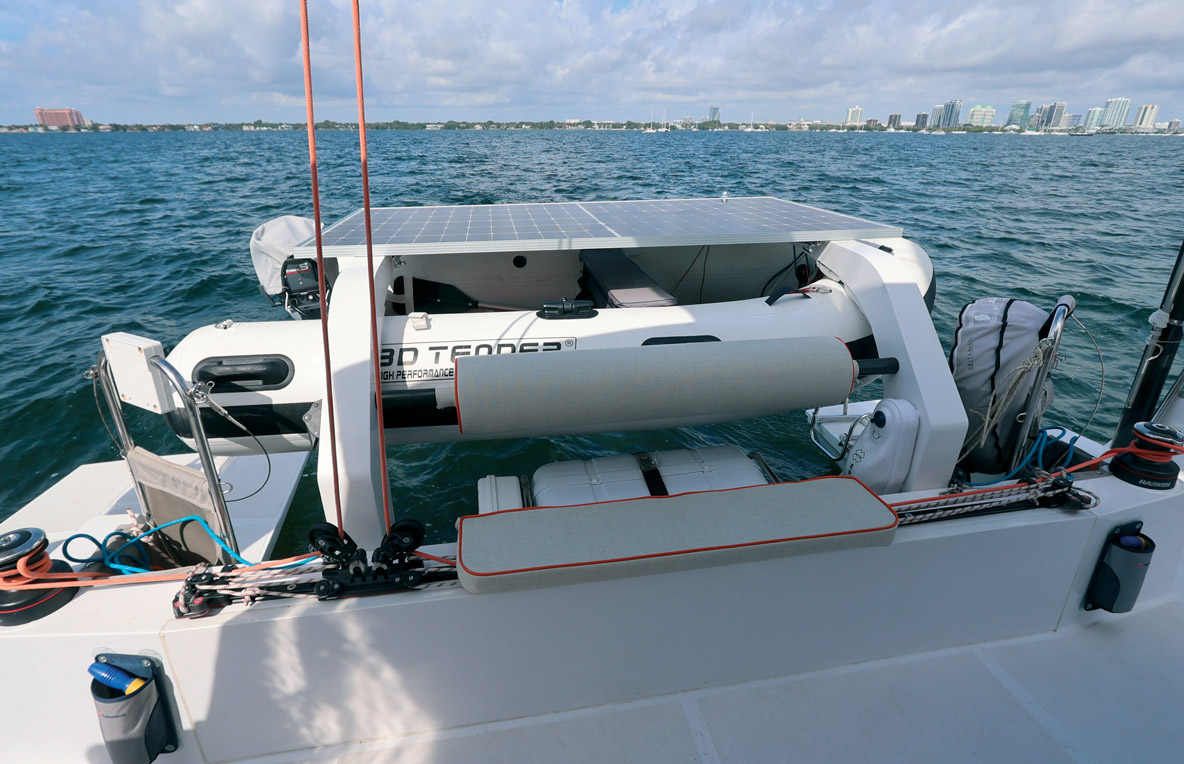
The rear of the cockpit is dedicated to movement between the two steering positions and features a small bench seat with a comfortable backrest on the transom, a great place to sit while sailing. Just behind, two sturdy davits allow a 3.5 m (10 ft) dinghy to be hooked up and launched using an ingenious pulley system. Massimo has installed two solar panels on top of the davits, an ideal location for capturing solar energy, but also a way of sheltering the dinghy. Again, this is a clever touch.
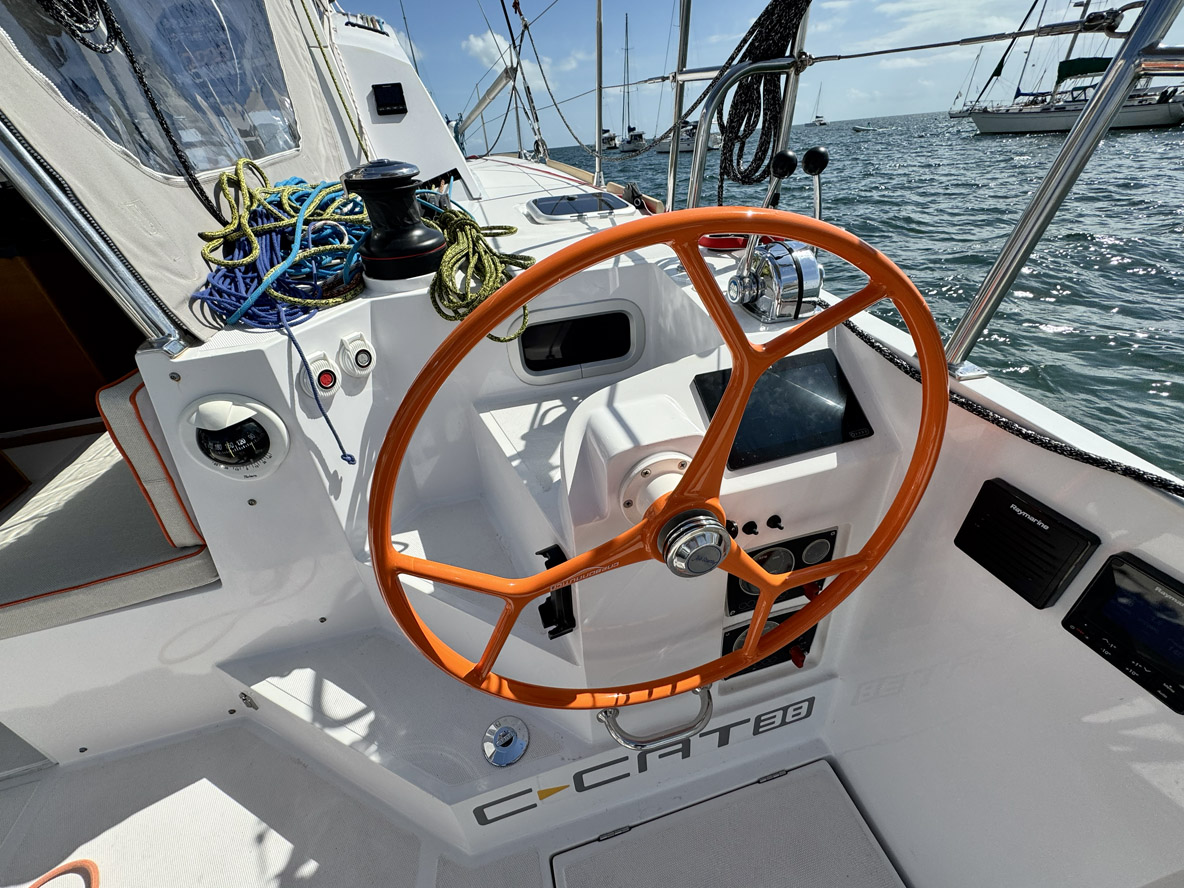
To free up space, the designers have installed the steering positions completely to the sides: this layout ensures excellent visibility of the sea and the rig. Each steering position is equipped with a comfortable seat and a small bimini to provide shelter from the sun or rain.
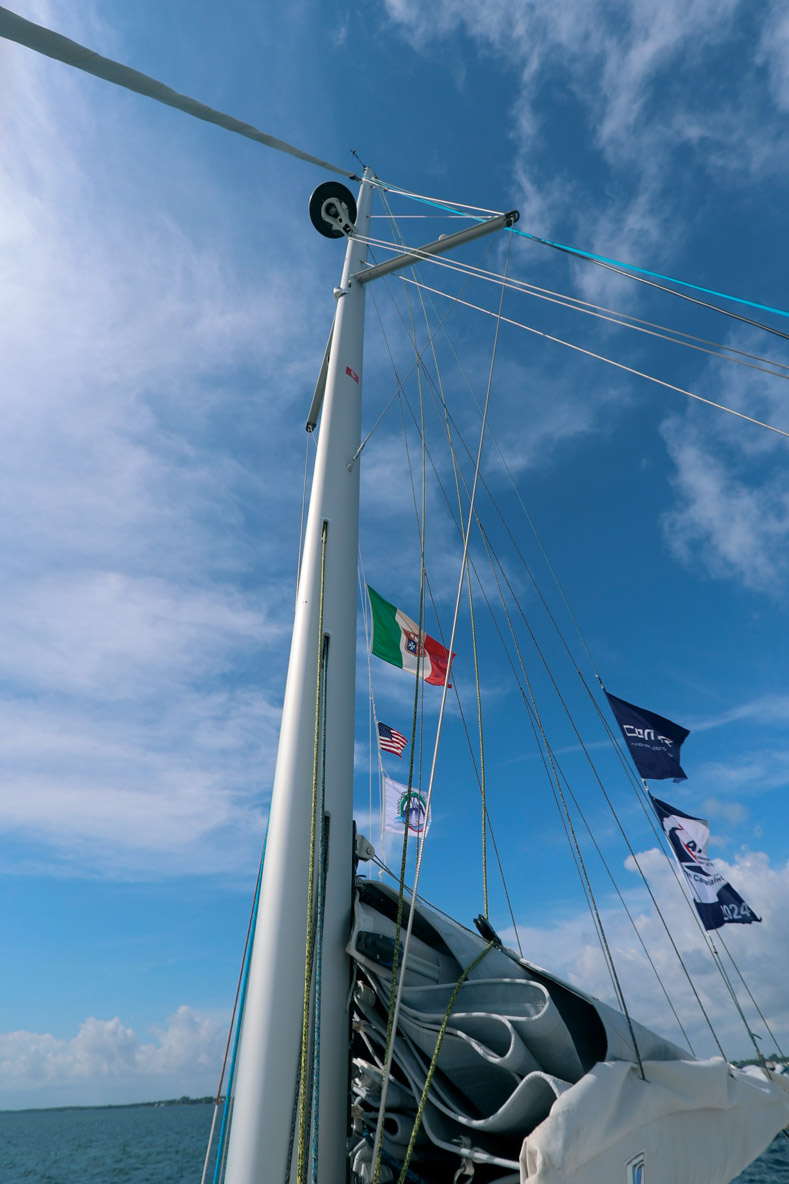
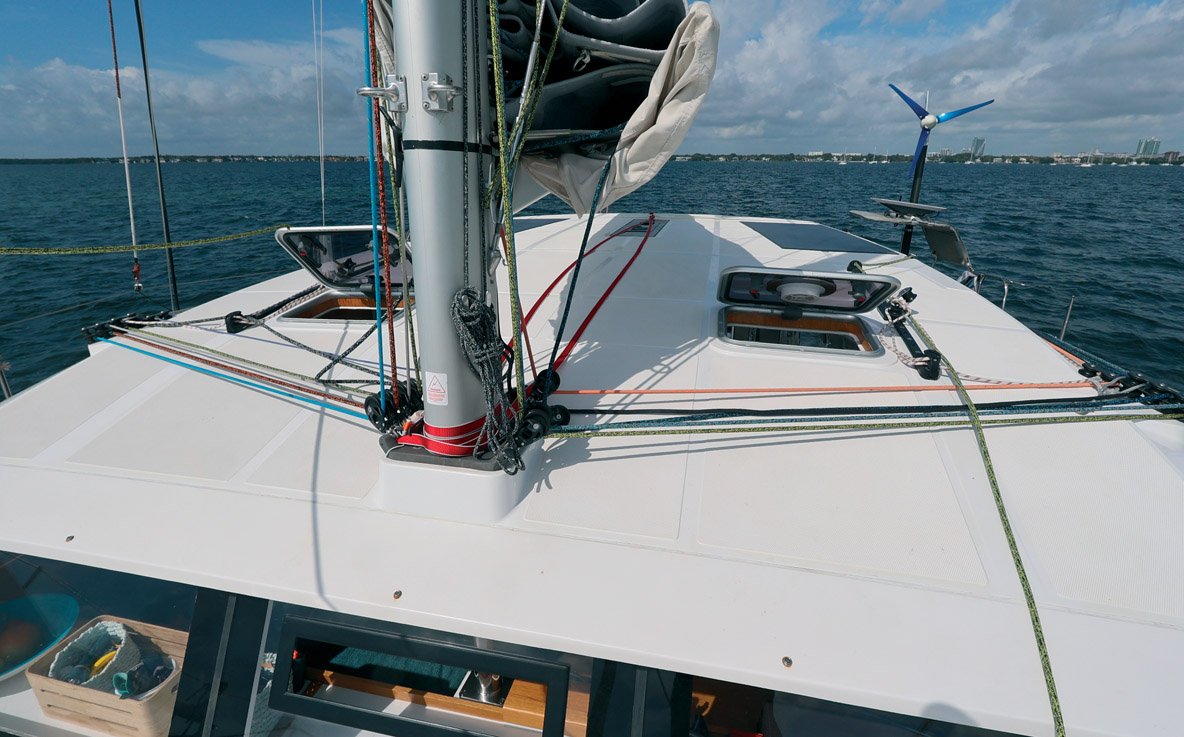
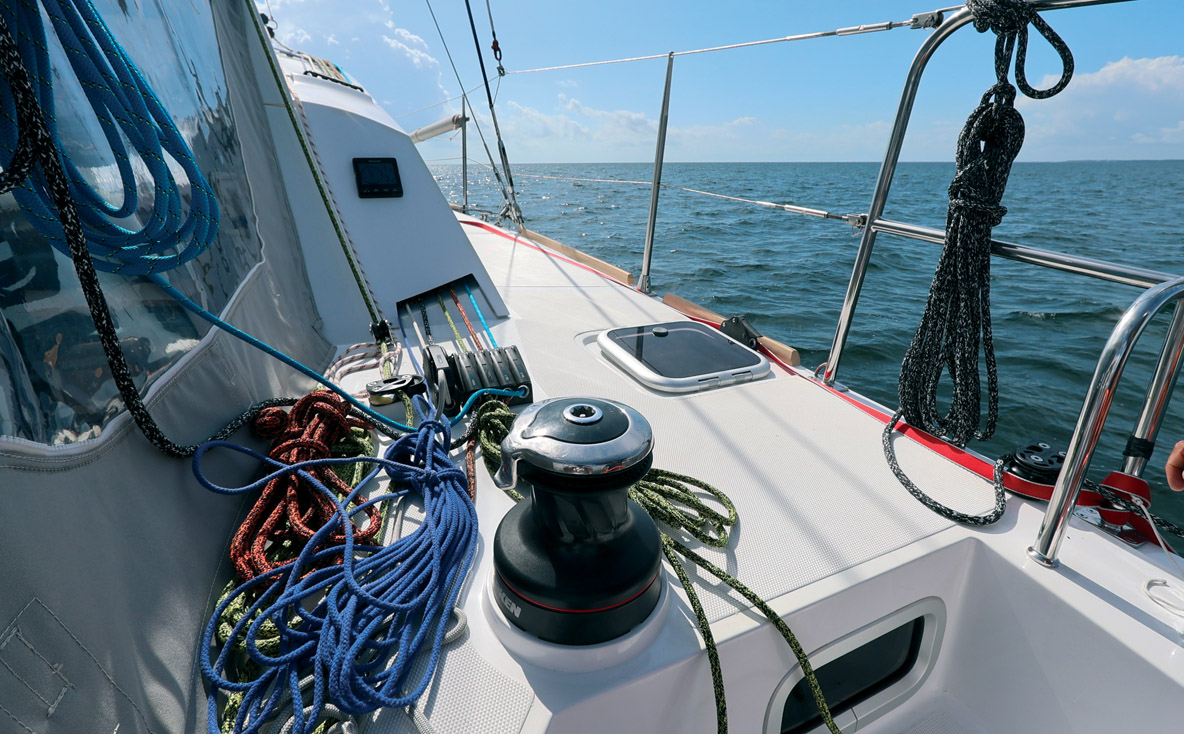
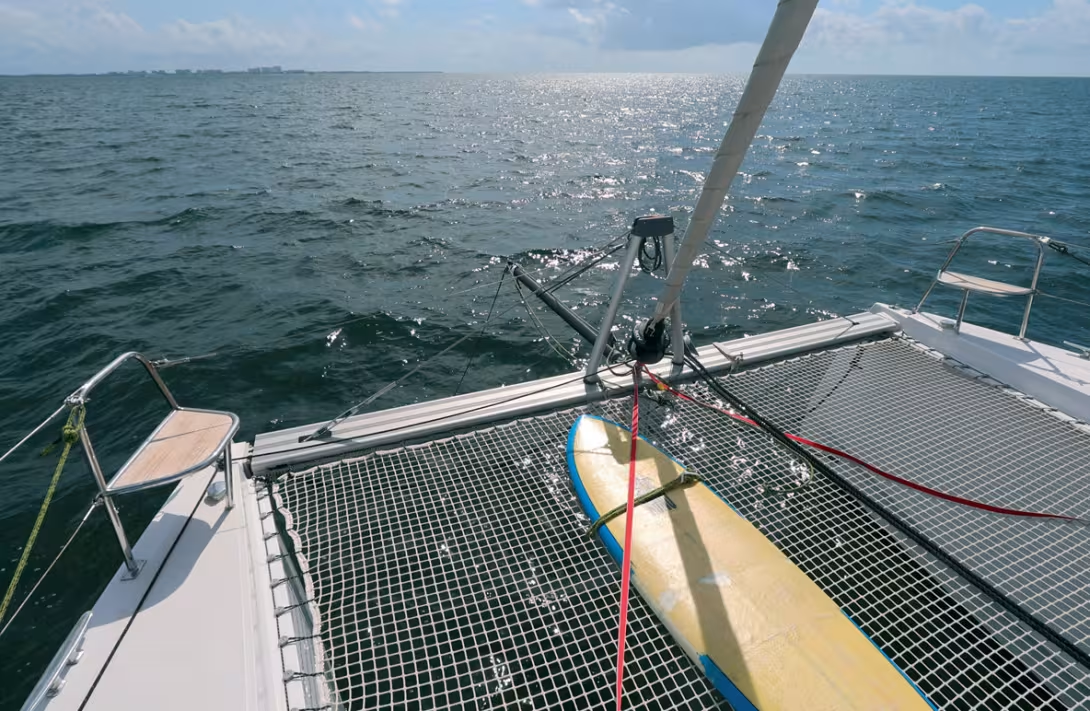
To get to the foredeck, there are wide, uncluttered side-decks. Although all lines are handled from the cockpit, they are guided and well protected, so they don’t get in the way. If we were being picky, we would have liked the deck hatches to be completely flush, but that’s a minor detail. Another good point is that the lifelines are quite high, which is obviously reassuring. As on many modern catamarans, the foredeck combines a trampoline section to save weight, while the section attached to the nacelle is rigid and contains storage lockers. This is where Massimo has installed his watermaker system, but there is plenty of room to imagine other possibilities. Each hull also has a locker for sails or fenders, while the forward beam supports the forestay and genoa furler. This is also where the carbon bowsprit is located for setting the spinnaker. Access to the mast foot is fairly easy thanks to a small step, and it is also here, on the coachroof, that additional solar panels have been installed.
A Very Well-optimized Interior Space
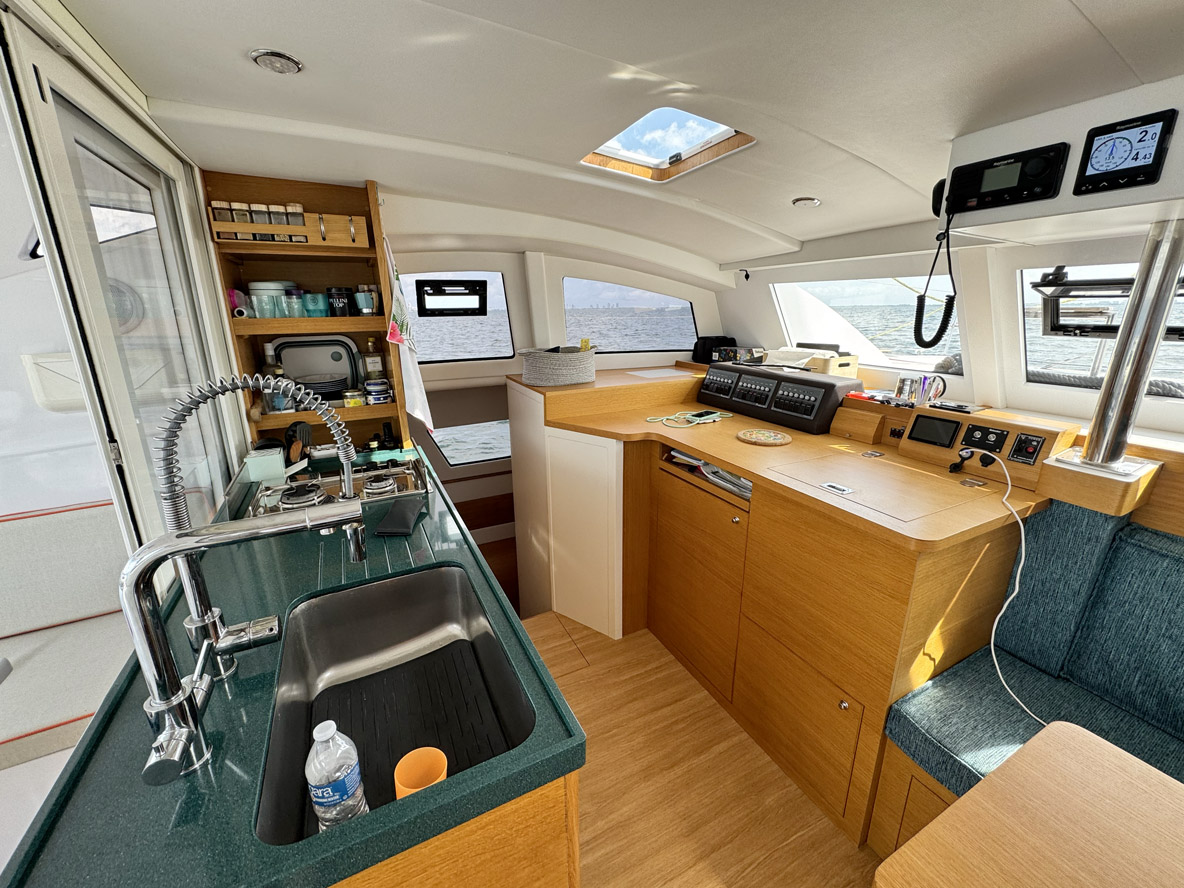
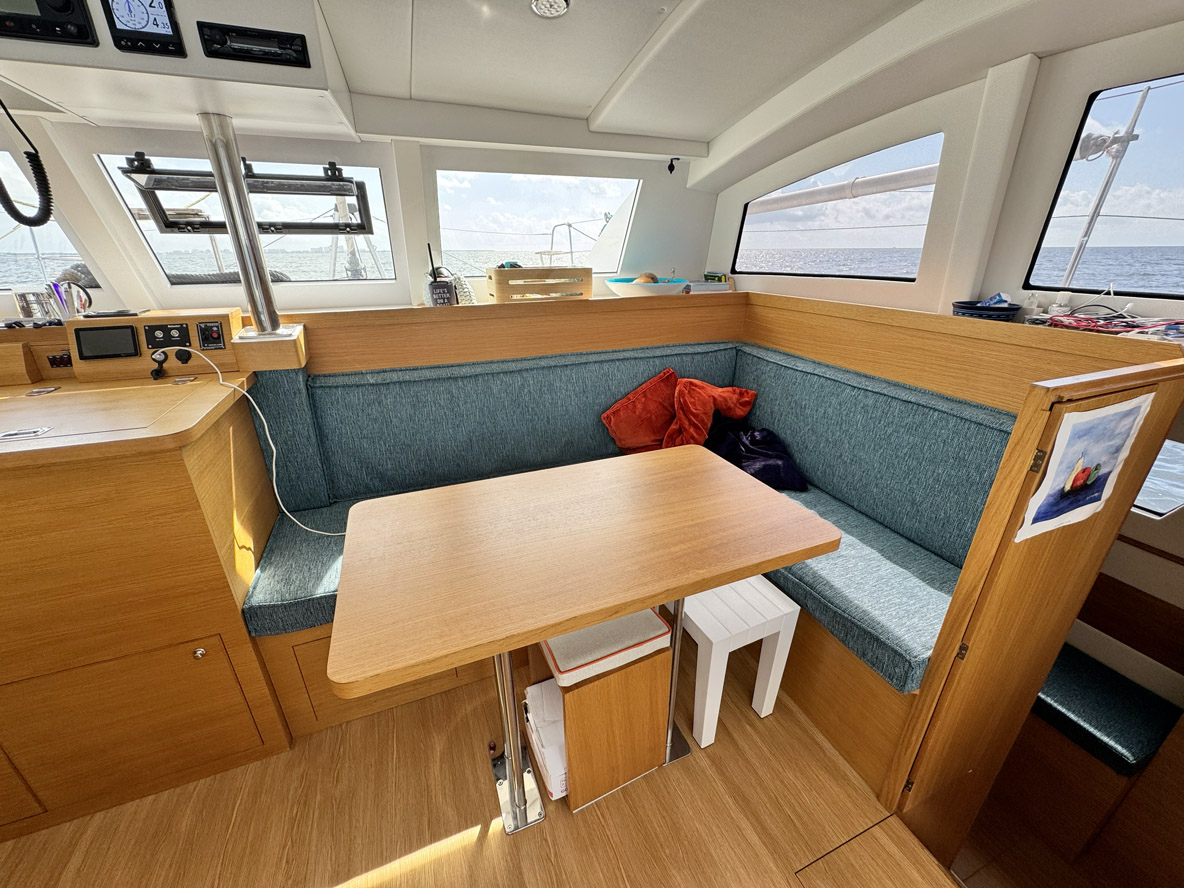
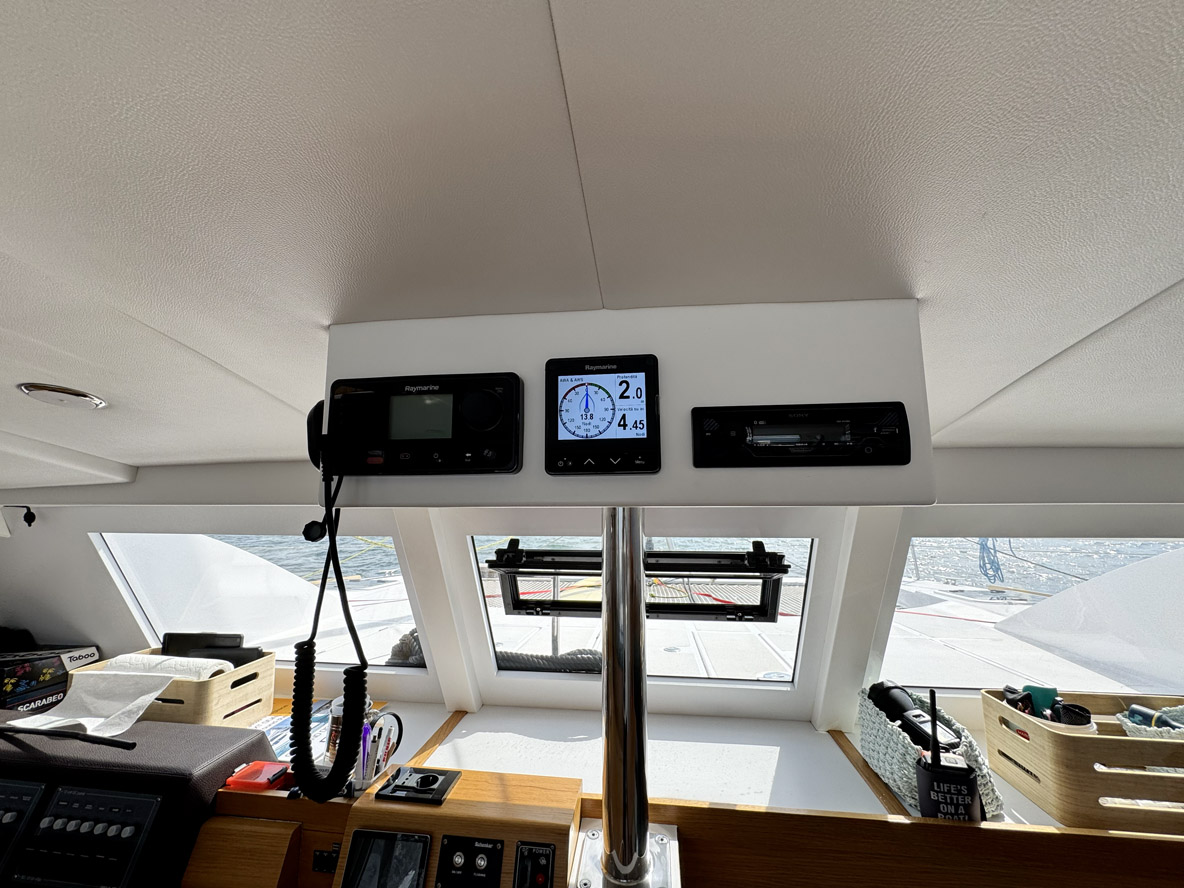
From the cockpit, a large sliding door provides access to the interior saloon. Again, it is important to remember that this is a 38-foot catamaran, so space is somewhat limited. However, there is a small dining area on the starboard side with a table that can seat four or five people. The port side is dedicated to the galley and navigation station with electronics; the equipment is sufficient to control all the necessary parameters while cruising. The layout is full of clever features, and every nook and cranny has been used to provide storage space, shelves, or to install additional electronics. Although not very large, the galley has all the essentials, including a sink, a cooktop, a refrigerator, and storage space. Thanks to the large windows all around, the galley is very bright, and portholes opening forward, in the ceiling, and on the sides provide effective ventilation.
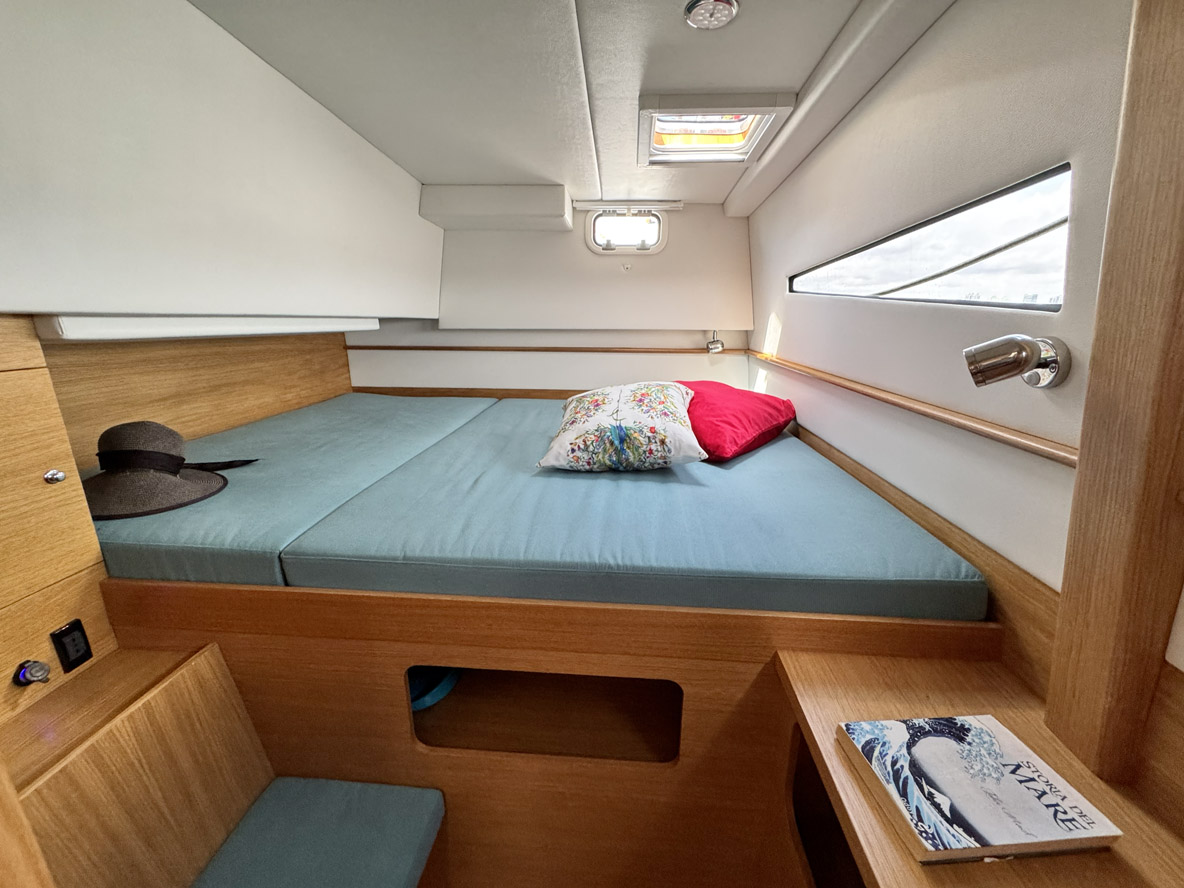
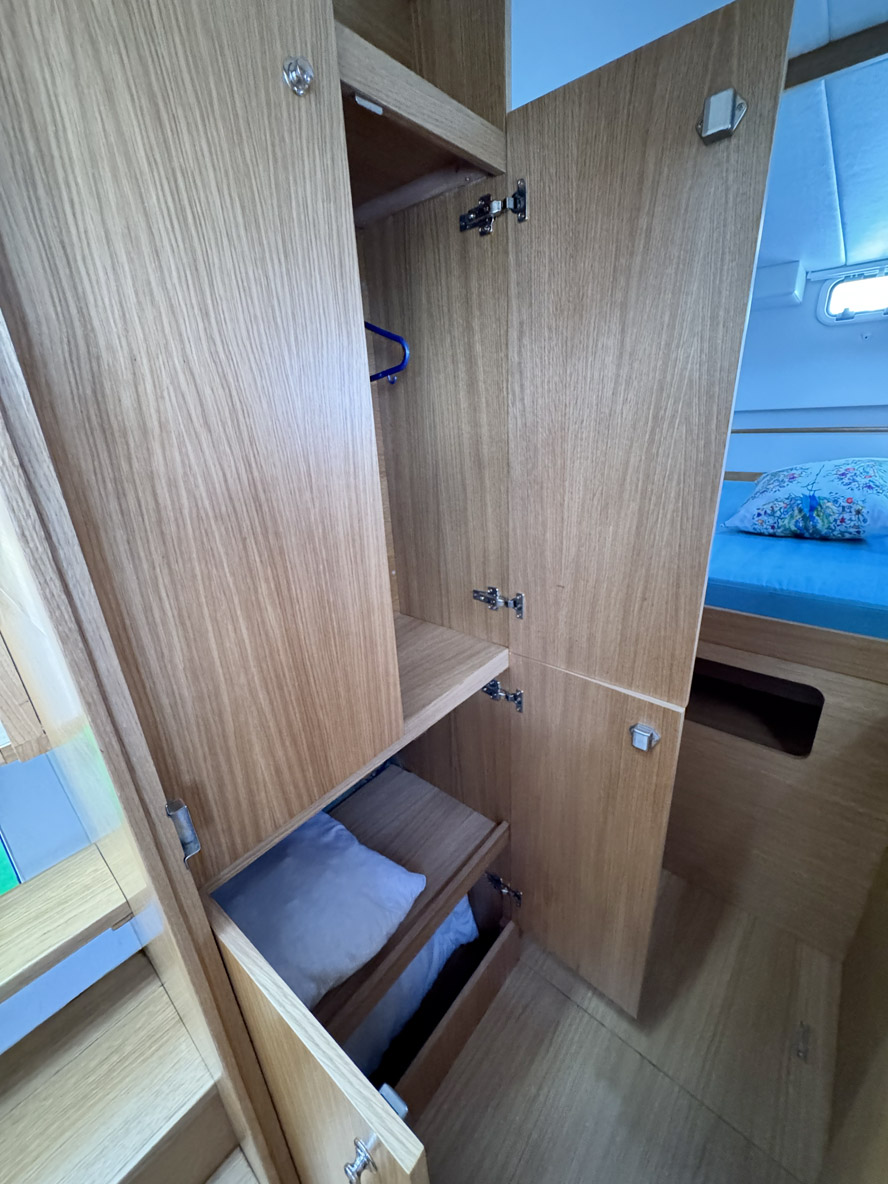
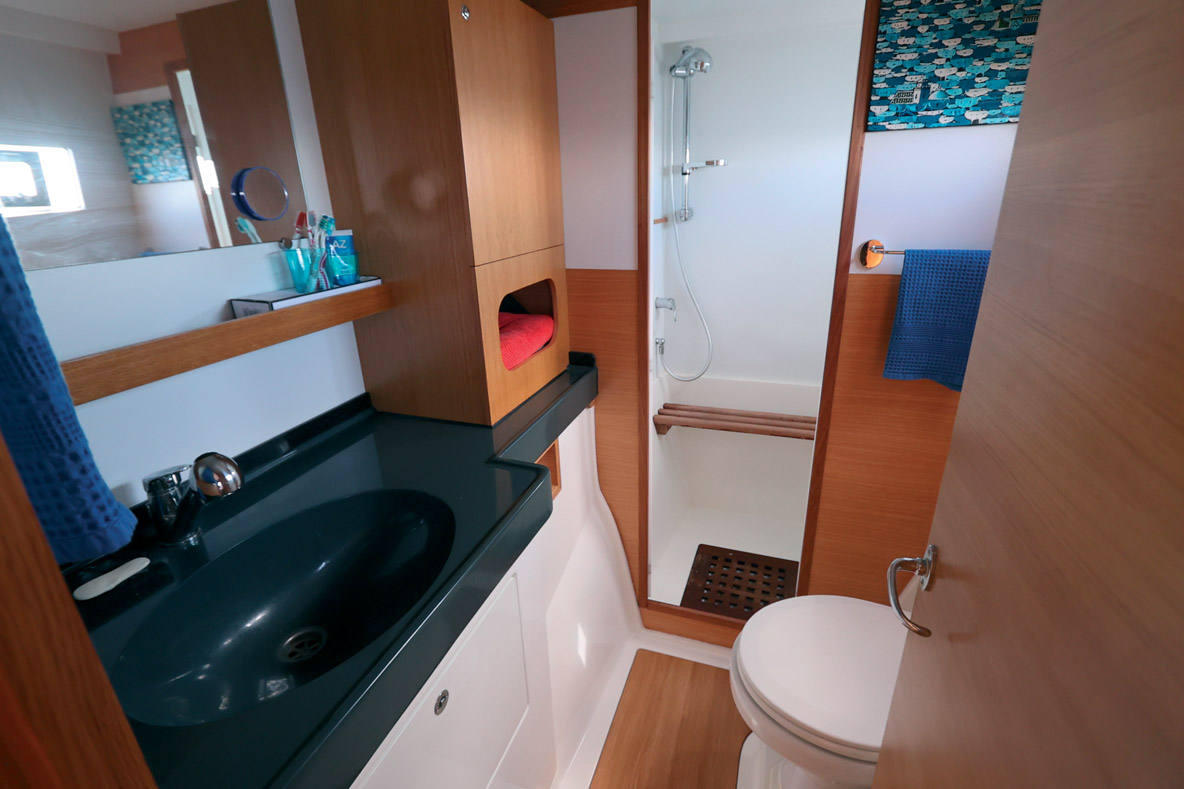
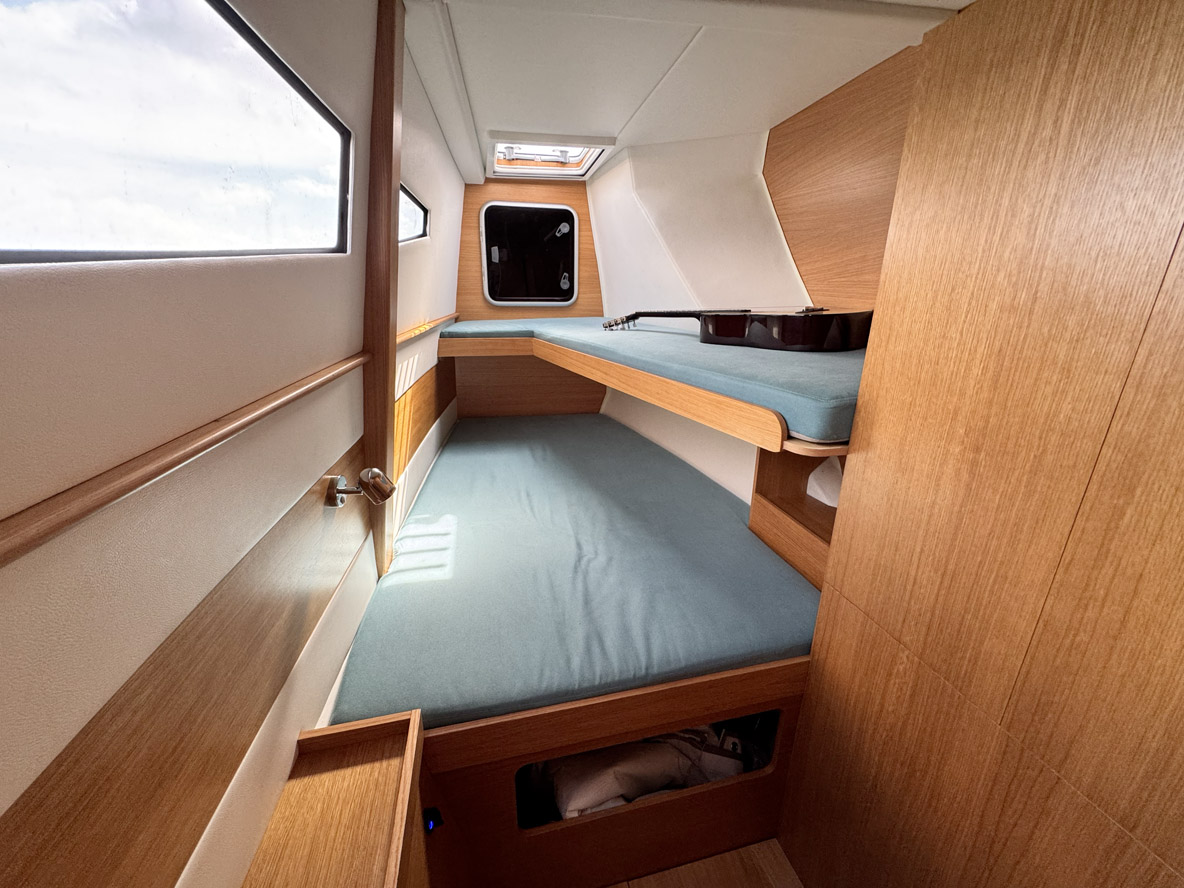
The pleasant surprises continue in the sleeping area. Despite its size, the C-Cat 38 is available in 2, 3 and even 4 cabin versions, opening up this catamaran to the charter market. The model we tested was an Owner’s version, with two cabins on the port side and the starboard hull dedicated to the Owner’s cabin. On the port side, there is a double berth in the aft with plenty of storage space around it, while the forepeak has a single berth (but a good width) and a second bed above, an ideal configuration for children. The bathroom is located in the middle and is shared by both cabins. In addition to plenty of storage space, these areas are very bright thanks to the long hull port-holes and benefit from good ventilation.
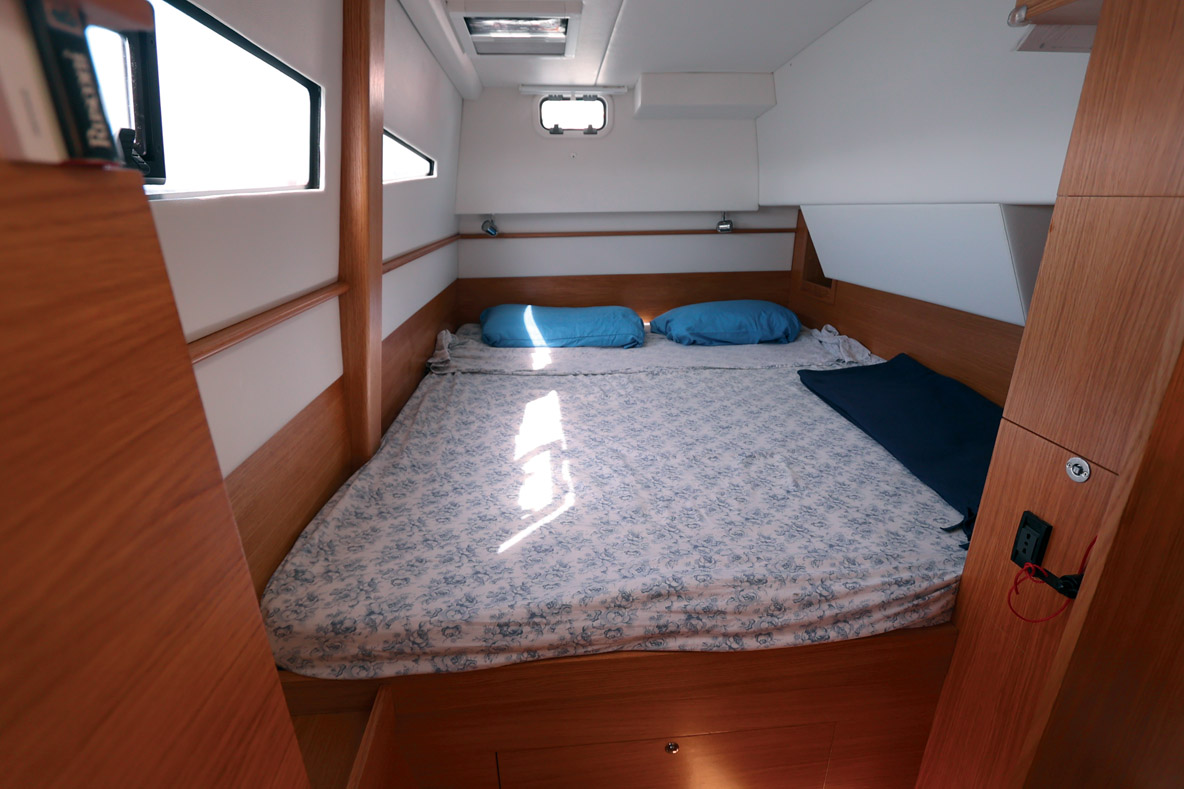
The owner’s cabin occupies the entire starboard hull with a queen-size bed at the rear, while the corridor features storage spaces and a small seat. Finally, at the bow, there is a large bathroom with a sink, toilet, and a good-sized shower. As on the port side, light and ventilation are optimal, and the impressive storage space is much appreciated.
Overall, although this is not a luxury catamaran, the construction seems solid, the finishes are of a good standard and the equipment is more than enough.
A Very Light and Well-canvassed Sailboat
Compared to its predecessor, the C-Cat 38 benefits from new, optimized hulls that give it 0.9 knots more speed than the C-Cat 37 in 10 knots of wind. The catamaran has two optional lifting daggerboards. Massimo’s 38 makes do with keels... the catamaran’s weight is limited to 5.6 tons, which is 2.3 tons less than an Aventura 37 of the same size. Also worth noting are the displacements of the Bali Catsmart and the Excess 11, at 8.9 and 9 tons respectively – but these two models are much wider and more livable. Add to this light weight a 14.22 m (46’8” ft) mast (an even taller mast can be ordered) and a more powerful sail plan, and it’s easy to see how much fun this boat can be to sail. The unprecedented sail area/weight ratio of 13.95 m²/t with the standard rig only reinforces this impression...
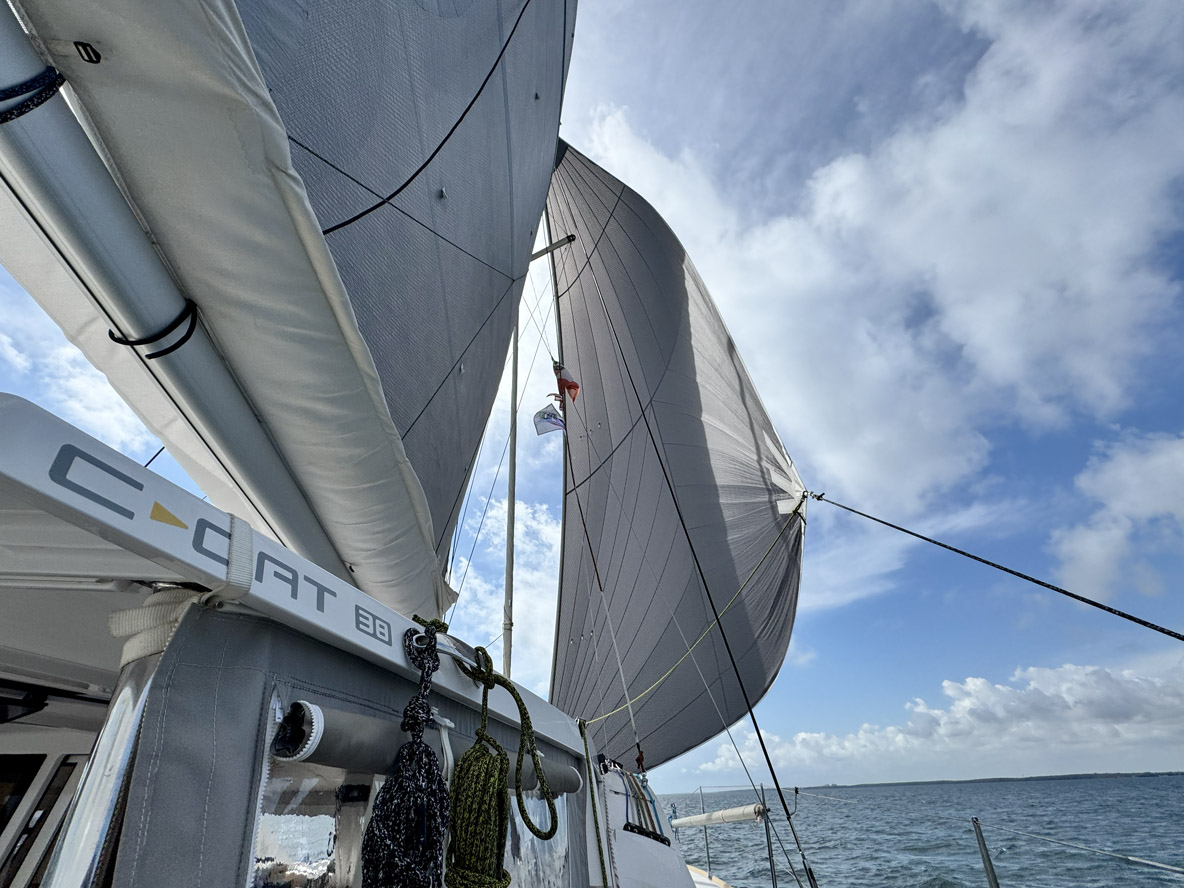
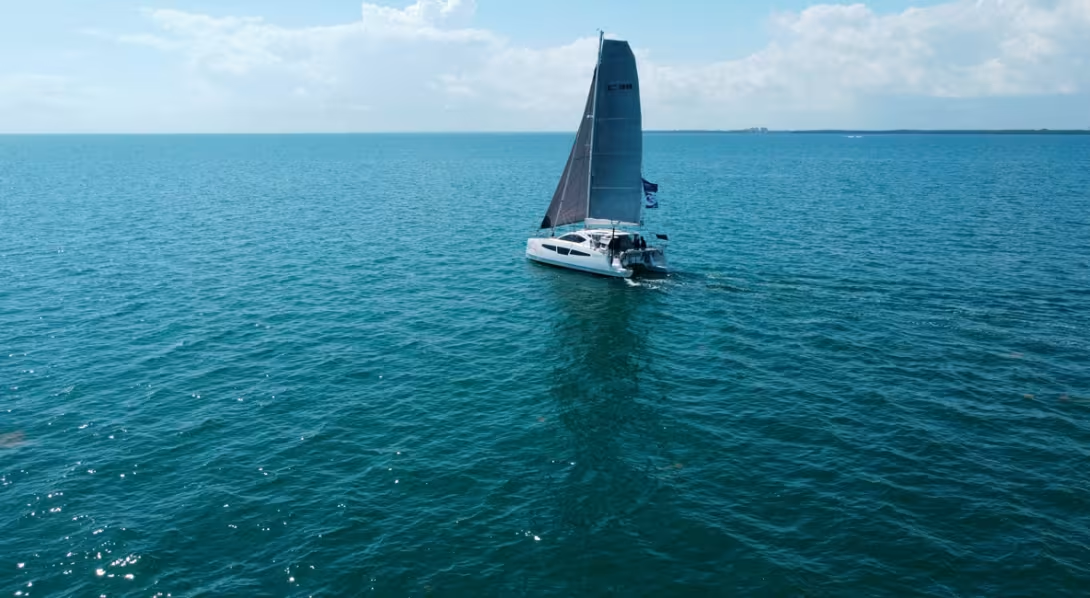
It doesn’t take long under sail to realize this: from our first tacks off Miami, it’s clear that the C-Cat 38 is a real fighter. This model will not disappoint even the most demanding sailors. Equipped as standard with a set of Speed Sails, the catamaran really doesn’t need much wind to get going; while still sheltered, we set the sails and, as soon as the engines were cut, the multihull accelerates where many of its competitors would take a while to get going. On the day of our test, the conditions were fairly calm, with winds gusting between 10 and 15 knots, but this didn’t seem to pose any problems for our swift C-Cat 38. Under mainsail and genoa, with 10 knots of wind, the catamaran was already traveling at 6.5 knots, and it reached nearly 8 knots when the wind picked up a little to 14 knots. We tried several points of sail, and it was on a fine reach, at 60°, that the C-Cat performed best. Hoisting the Code 0 even allowed us to feel the acceleration in a way that is quite spectacular for a cruising catamaran. Thus rigged, the 38 has no trouble exceeding 10 knots in the same wind conditions. We didn’t have the opportunity to hoist the spinnaker, but the shipyard mentions an average speed of 14 to 15 knots. According to Massimo, his Bellamossa has already reached 20.5 knots, a remarkable figure for a 38-foot cruising boat. In general, in average wind conditions, the C-Cat is capable of maintaining a speed of 8 to 9 knots, which is very satisfactory for cruising. In addition to its performance, we really appreciated the ease of handling of this multihull. Comfortably seated at the helm, the skipper enjoys optimal visibility, and all the halyards are within easy reach. Whether tacking or gybing, everything is done smoothly, even without a self-tacking jib. In short, this is a catamaran that is easy to handle with a small crew or even solo.
For windless days or for maneuvering in a marina, the C-Cat is equipped with a pair of 20 HP inboard engines and two 26-US gallon (100-liter) fuel tanks. Even though the fuel is also used by the generator, this provides a long range. Designed for passage-making crossings, the catamaran has two 79-US gallon (300-liter) water tanks and, if you opt for a watermaker, you will have an almost unlimited supply of water
Conclusion
With the C-Cat 38, Comar Yachts demonstrates its excellent know-how when it comes to producing a compact, lightweight, and highperformance catamaran. At a price that is only slightly higher than its competitors, it offers many first-time buyers the opportunity to enter the world of cruising multihulls without having to settle for a used boat. With a starting price of less than € 500,000 ex-tax, fully equipped and ready to sail, the C-Cat 38 is positioned against 40-foot used catamarans and remains much more affordable than the new multihulls 5 or 6 feet longer that made up the largest sales segment just three or four years ago.
Clever layout
Perfectly optimized catamaran
Hatches not flush
Technical specifications
Architect: Marc Lombard Yacht Design Group
Length overall: 38’6” (11.73 m)
Beam: 19’2” (5.84 m)
Draft (keels): 4’3” (1.3 m)
Draft (daggerboards raised): 3’23” (0.98 m)
Draft (daggerboards lowered): 7’4” (2.24 m)
Displacement: 12,345 lbs (5.60 t)
Mast height: 46’8”/48’11” (14.22/14.92 m)
Air draft: 55’7”/57’10” (16.94/17.63 m)
Mainsail: 487 sq ft (45.3 m²)
Genoa: 353 sq ft (32.8 m²)
Gennaker: 861 sq ft (80 m²)
Code 0: 602 sq ft (56 m²)
Standard engines: 2 x 20 HP
Water: 79 US gal (300 l)
Fuel: 2 x 26.4 US gal (2 x 100 l)
CE certification: Category A
Price: From € 380,000 ex-tax
Ready to sail: € 470,000 ex-tax