Following on from the C-Cat 37, a compact catamaran that was unanimously acknowledged to be very successful, the Italian builder is now launching a much more ambitious 48-foot model. Performance and comfort are the order of the day: we’re now in the realms of Outremer, Catana, Balance, HH, Seawind or Ita. These are all cruising multihulls that uphold the pleasure of sailing... on all points of sail, thanks to their daggerboards!
Test location: Fiumiccino (Ouest de Rome)
Conditions: 5 to 18 knots of wind - Calm to moderate sea state
Infos pratiques
- Le chantier : C-Cat 48
- La fiche technique
-
 Découvrez notre vidéo exclusive
- Financez votre C-Cat 48
- Assuez votre C-Cat 48
- Articles autour du C-Cat 48
An existing boatbuilder freshly converted to multihulls
Comar has been an internationally known brand since 1971: the shipyard based at Fiumiccino shipyard, west of Rome, on the banks of the Tiber, has produced thousands of great monohulls, with a range from 21 to 100 feet. Collaborations with the Finot Group for the Comet 11-13- 14 or Valiccelli series proved very successful. The Genesis 43 and the Phoenix 50 also won many fans, and the reputation for quality of Comar boats was established. However, the shipyard experienced difficulties during the crisis of the 1990s. In 1998, when Massimo Guardigli took over Comar, things started to look up for the yard, they began offering a range of custom-built monohulls alongside their production boats of recognized quality, such as the Comet 38, 50 and 65 – all Bruce Farr designs. The C51 Sport, an aggressive cruiser-racer, has seen great success on the race course. But as the monohull market became more and more competitive and the demand for multihulls grew, Massimo and his team decided to reorient the entire shipyard towards a new brand: C-Catamarans.
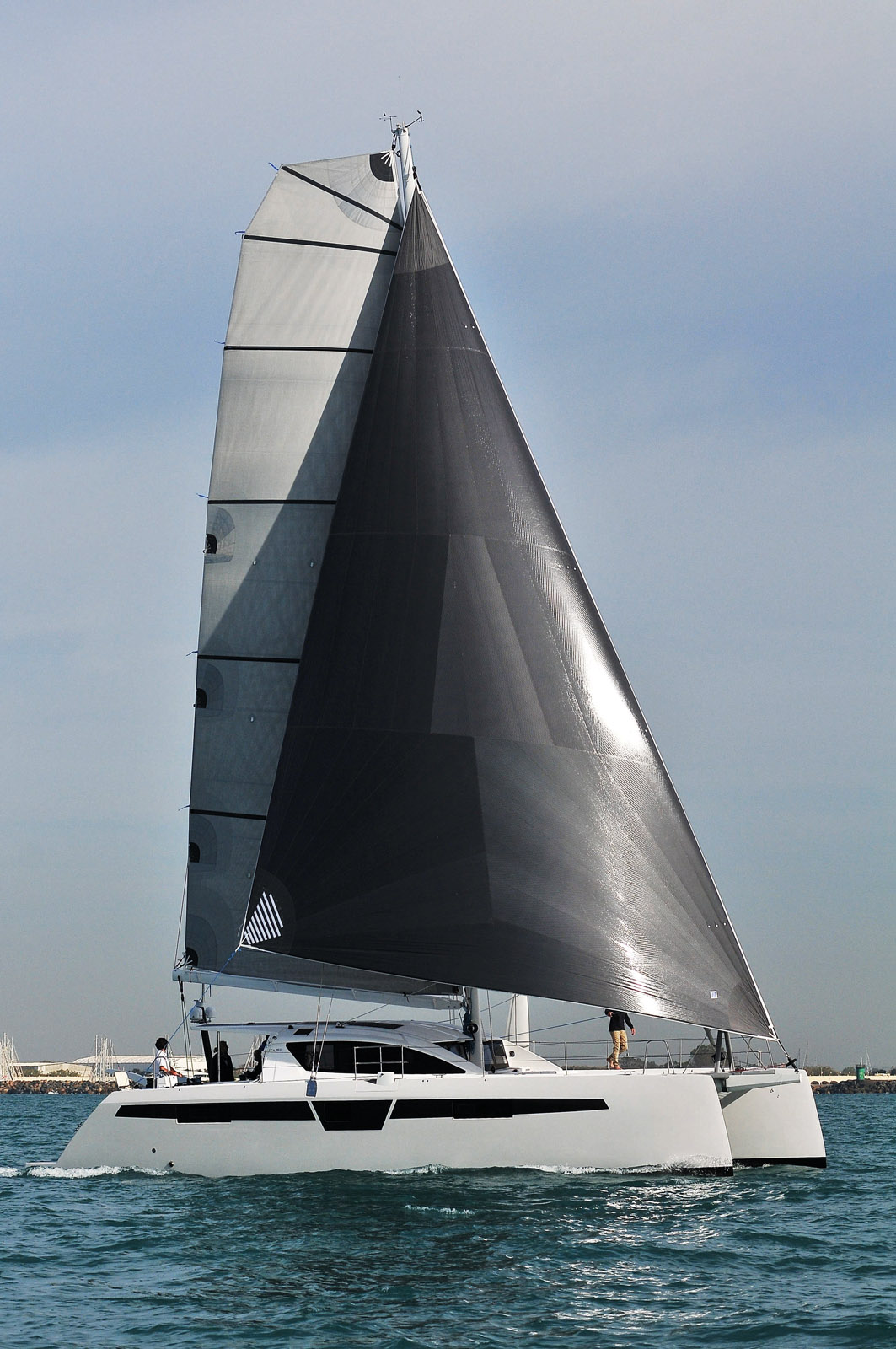
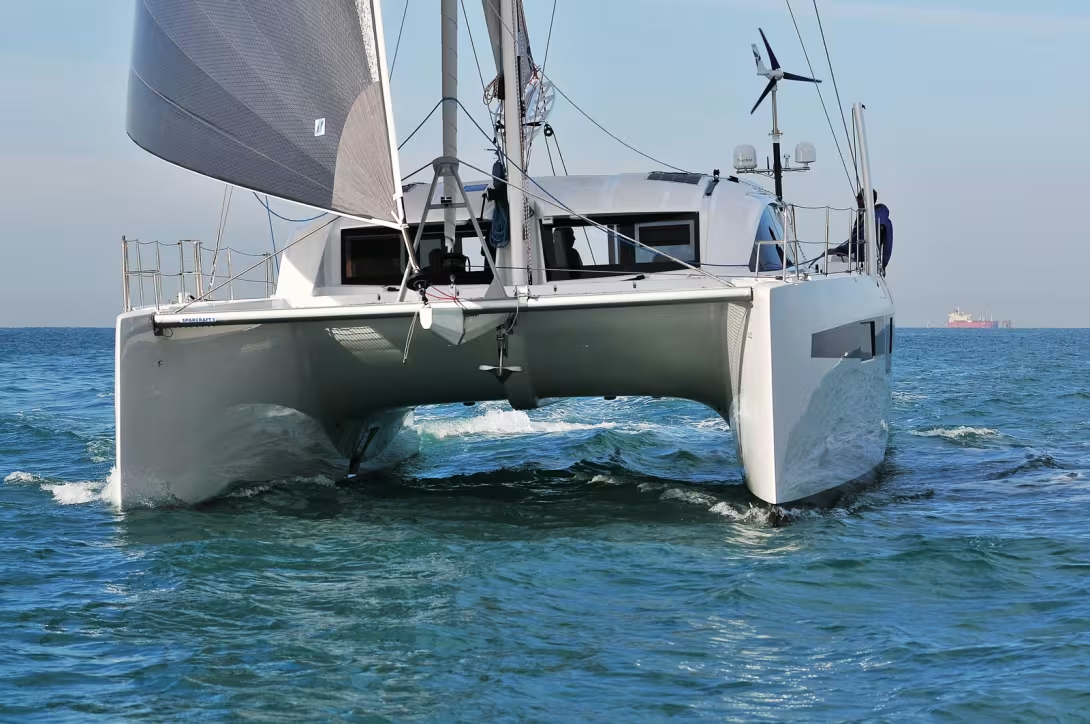
The sail plan is pretty sleek (a 65-foot mast on 48-foot hulls). No need to over-prescribe with a light displacement of just 8 tons!
Shipyard tour
The builder has a traditional industry setup on the banks of the Tiber, making for easy launching. The shipyard has seen the realization of units of all sizes up to 100 feet in length. One particular feature of C-Catamarans is the in-house manufacture of all the equipment installed on board (metalwork, interior/ cabinetmaking, deck hardware) with the exception of highly technical elements such as winches or rigging, etc. This all-trade approach is becoming rare: we were able to verify the quality of this work on site. The transition to infusion on a foam sandwich and glass/ carbon/vinylester-epoxy matrix posed no problem for this team with an integrated design office and know-how in composite materials.
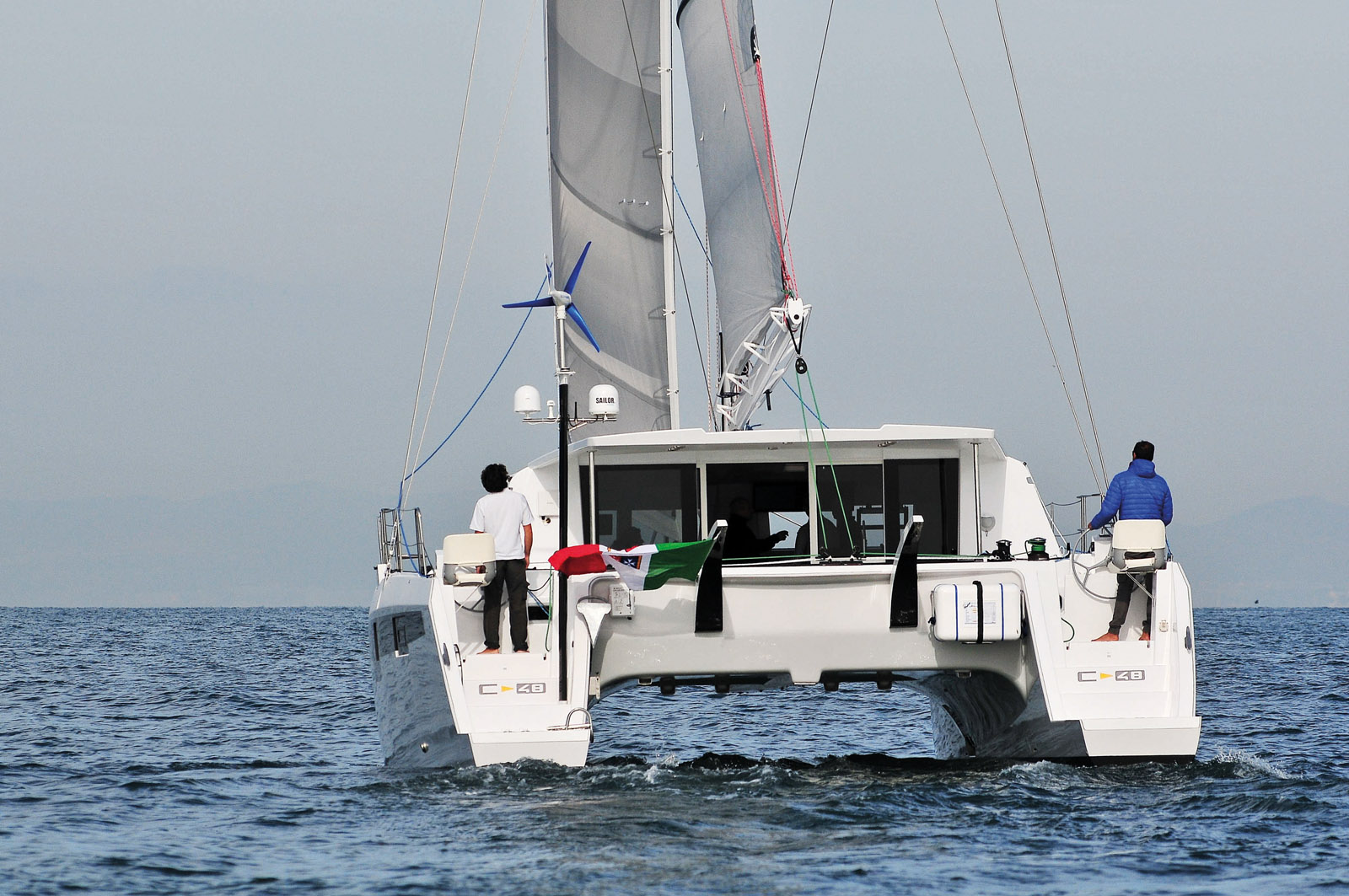
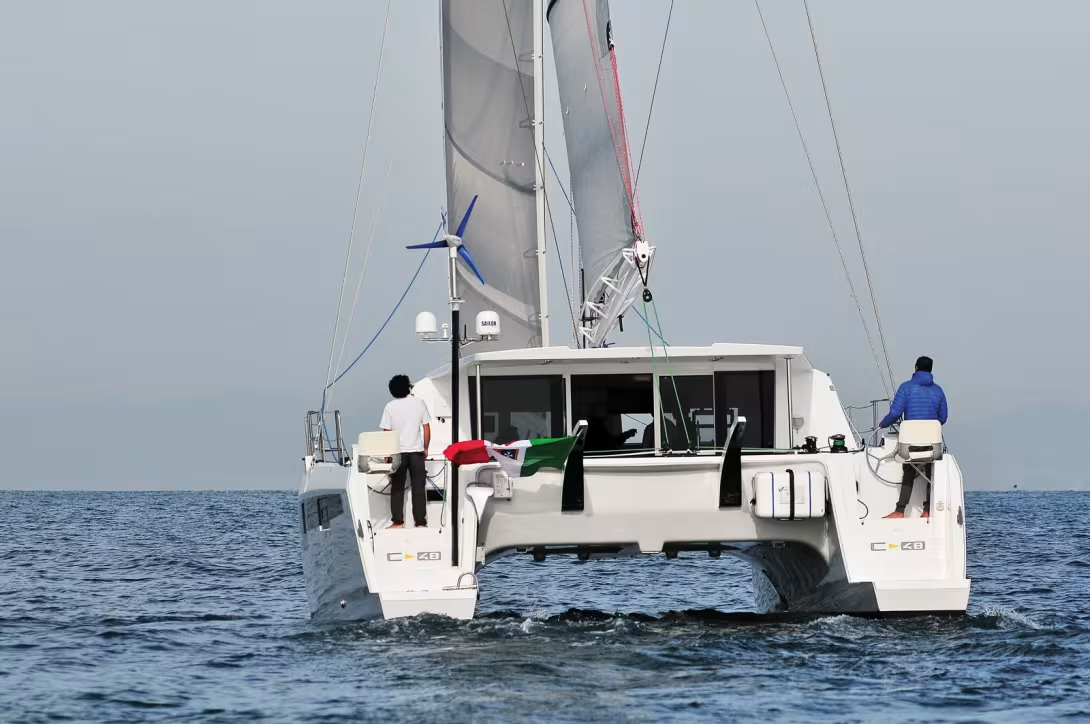
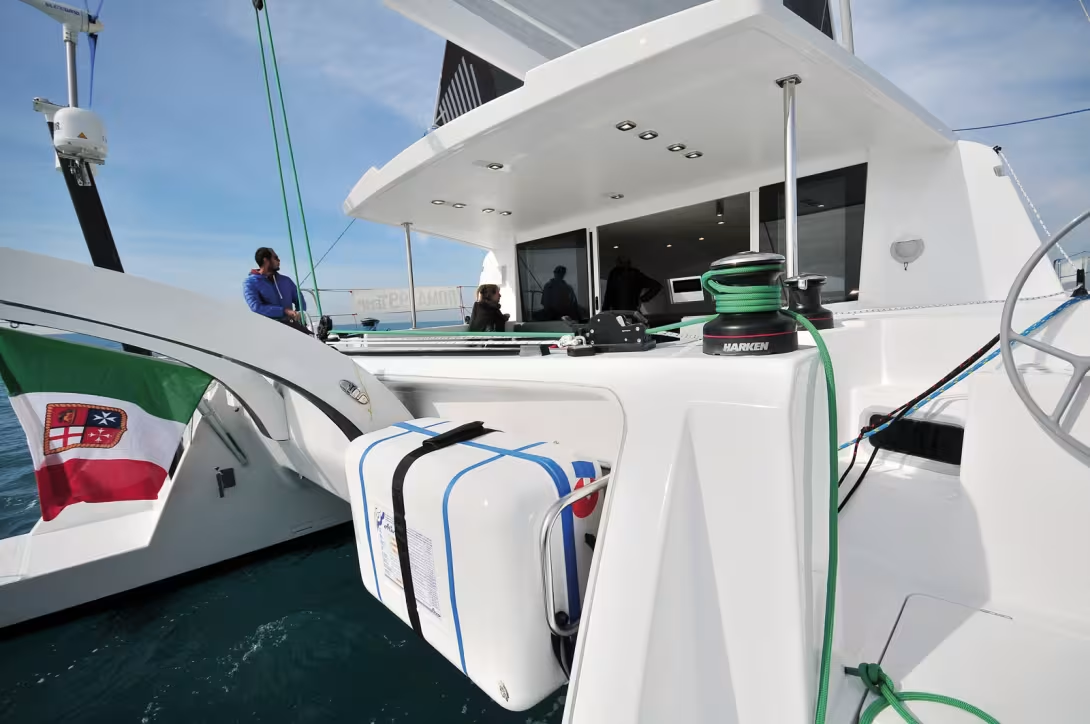
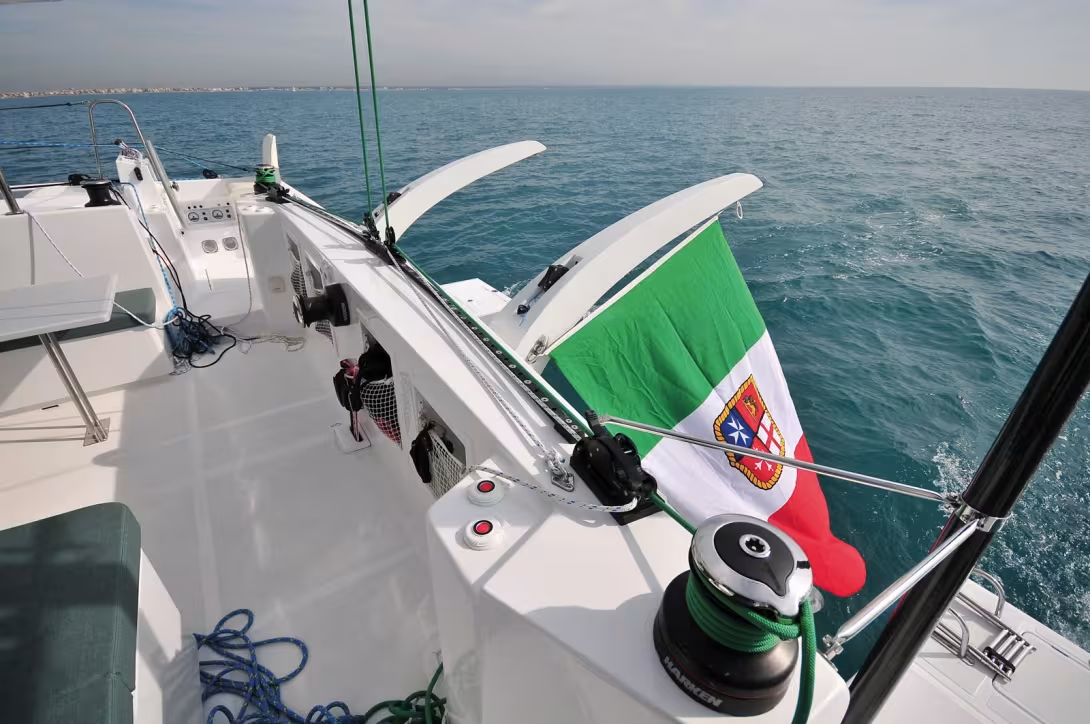
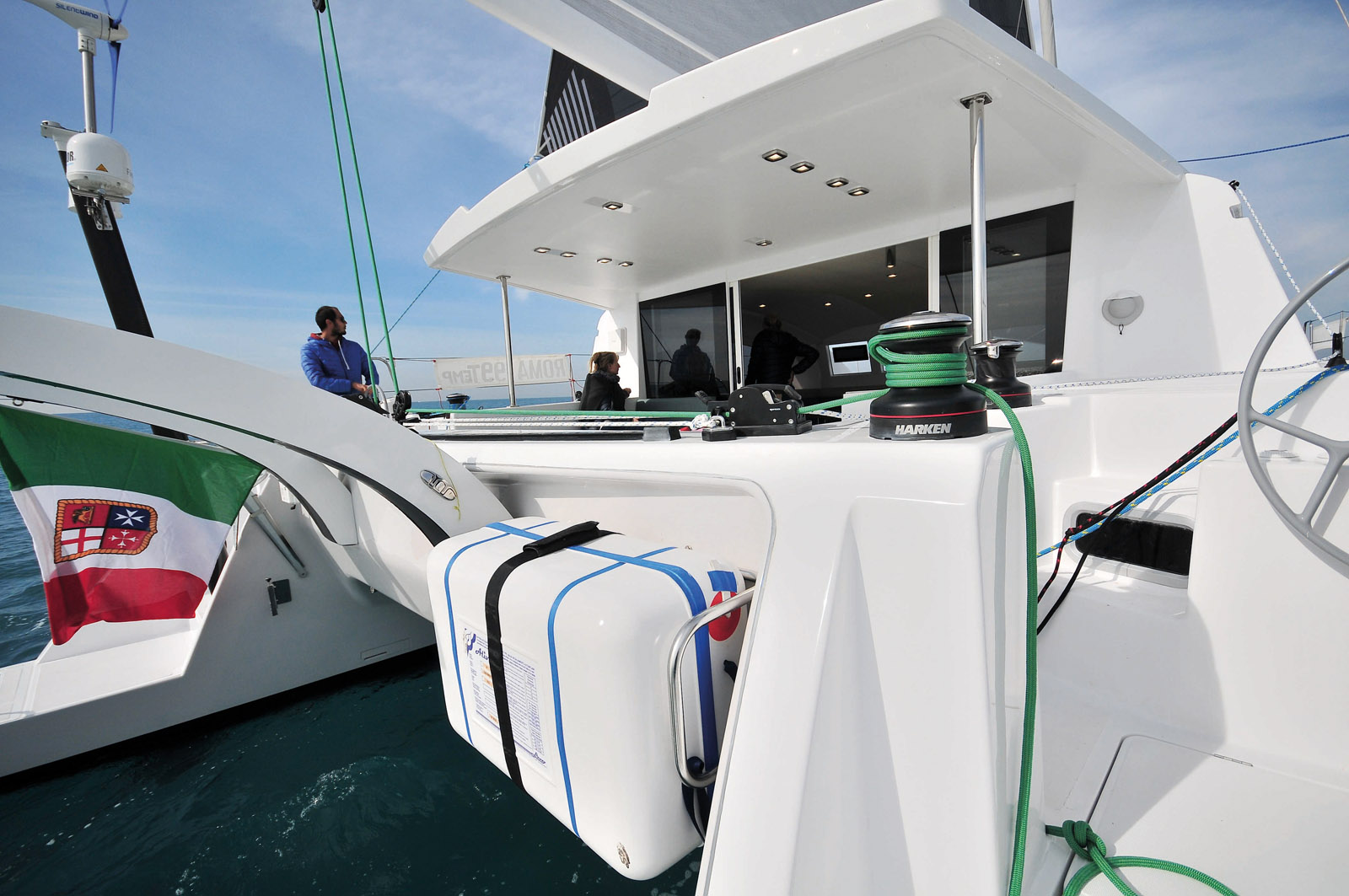
The steering wheels are on the hulls, so the helmsman can enjoy a good view, both of the water and the sails.
An attractive silhouette
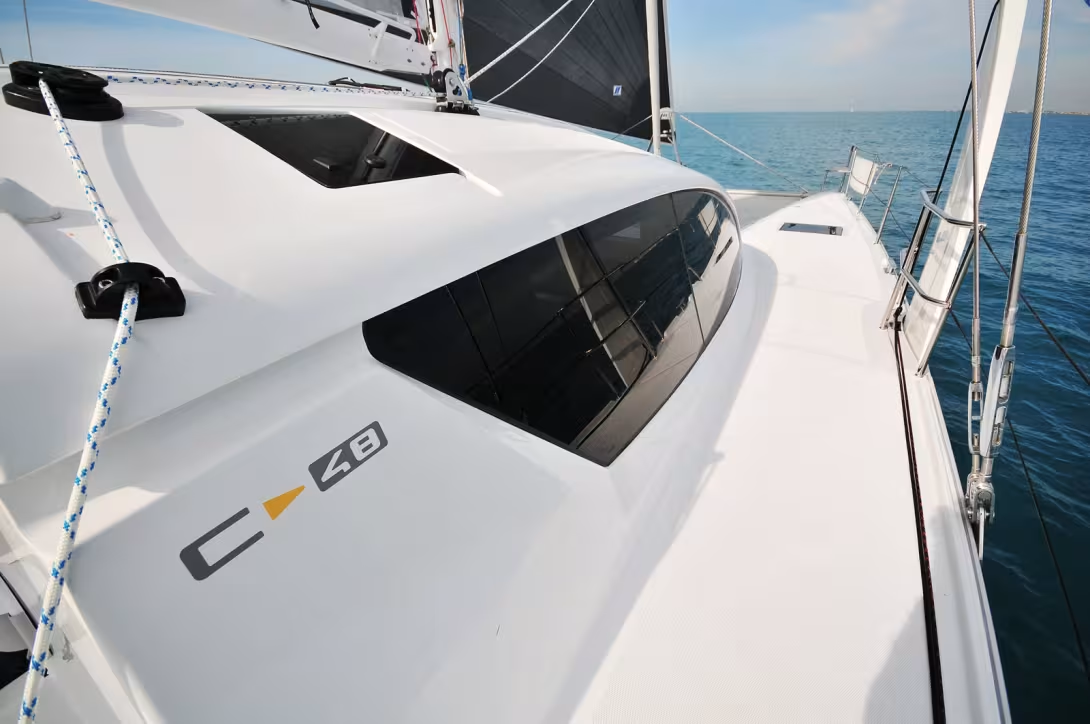
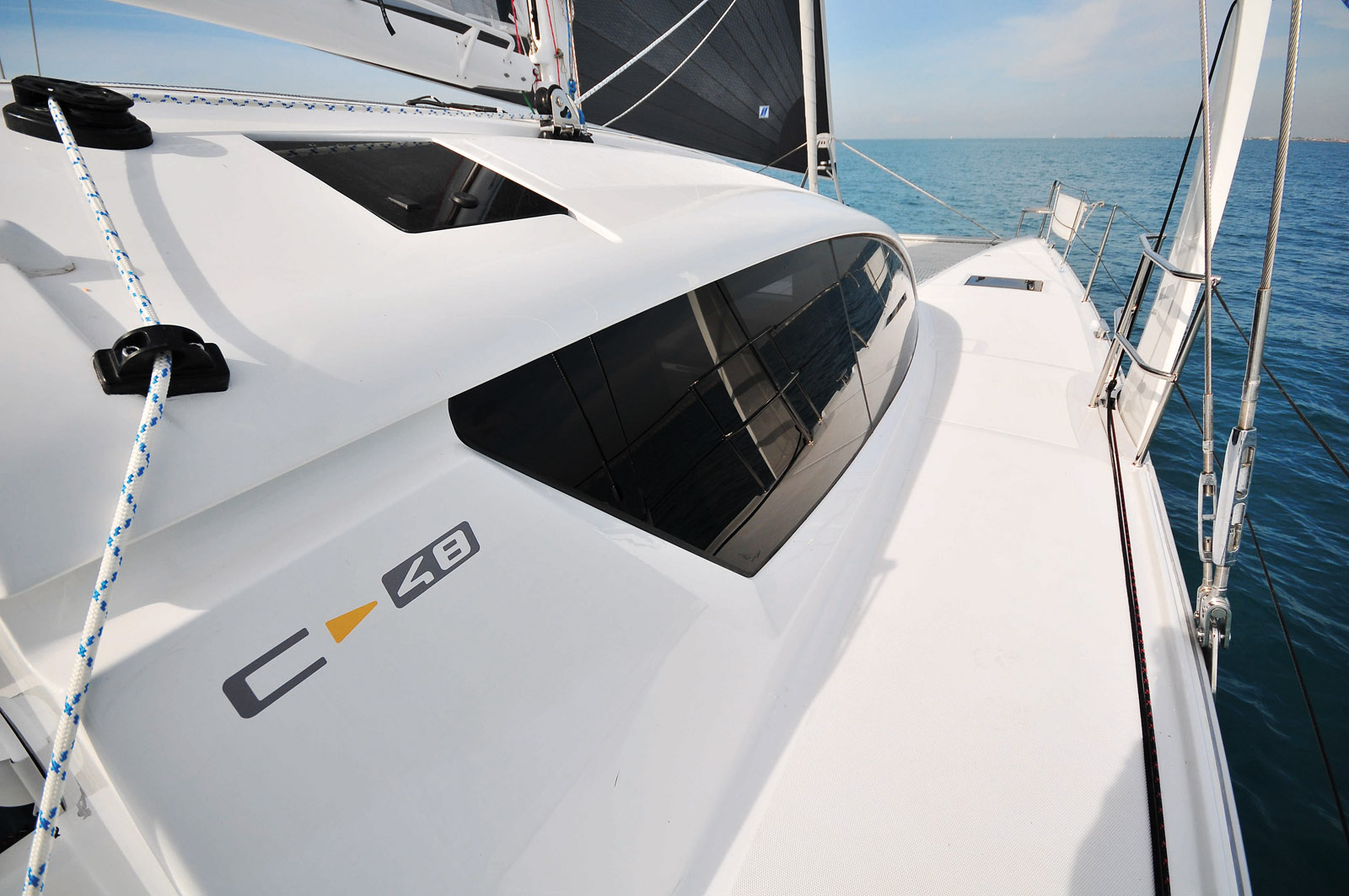
Let’s be clear, François Pérus has a good eye, and he knows how to transcribe his vision to the drawing board. The C-Cat 48 elegantly integrates the codes of the YDC - the Yacht Design Collective, a naval architecture design studio based in Paris and the Gulf of Morbihan in Brittany. The team has assimilated all the best influences and they know how to create lines as racy as they are flattering. Nothing is excessive, everything is in the right proportions. The coachroof is sharp, despite a vertical windshield - a logical configuration for visibility and protection from the sun, something now appreciated by all builders. The side pillars merge skillfully with the roof and an airy bimini. And the vertical topsides remain elegant. As for the bows, they are discreetly inverted, and the bowsprit is integrated into the compression beam. The sail plan contributes to the signature of the boat by giving it a sporty look; the good-looing, fixed carbon mast with low chord and two sets of spreaders is superb. Through my 200 mm lens, the C-Cat 48 offers a real dynamic look and takes the light well. Even in little 2 wind, under code 0, this comfortable multihull is clearly a high-performance cruiser - the long wakes bear witness to the speed of the platform.
 |
 |
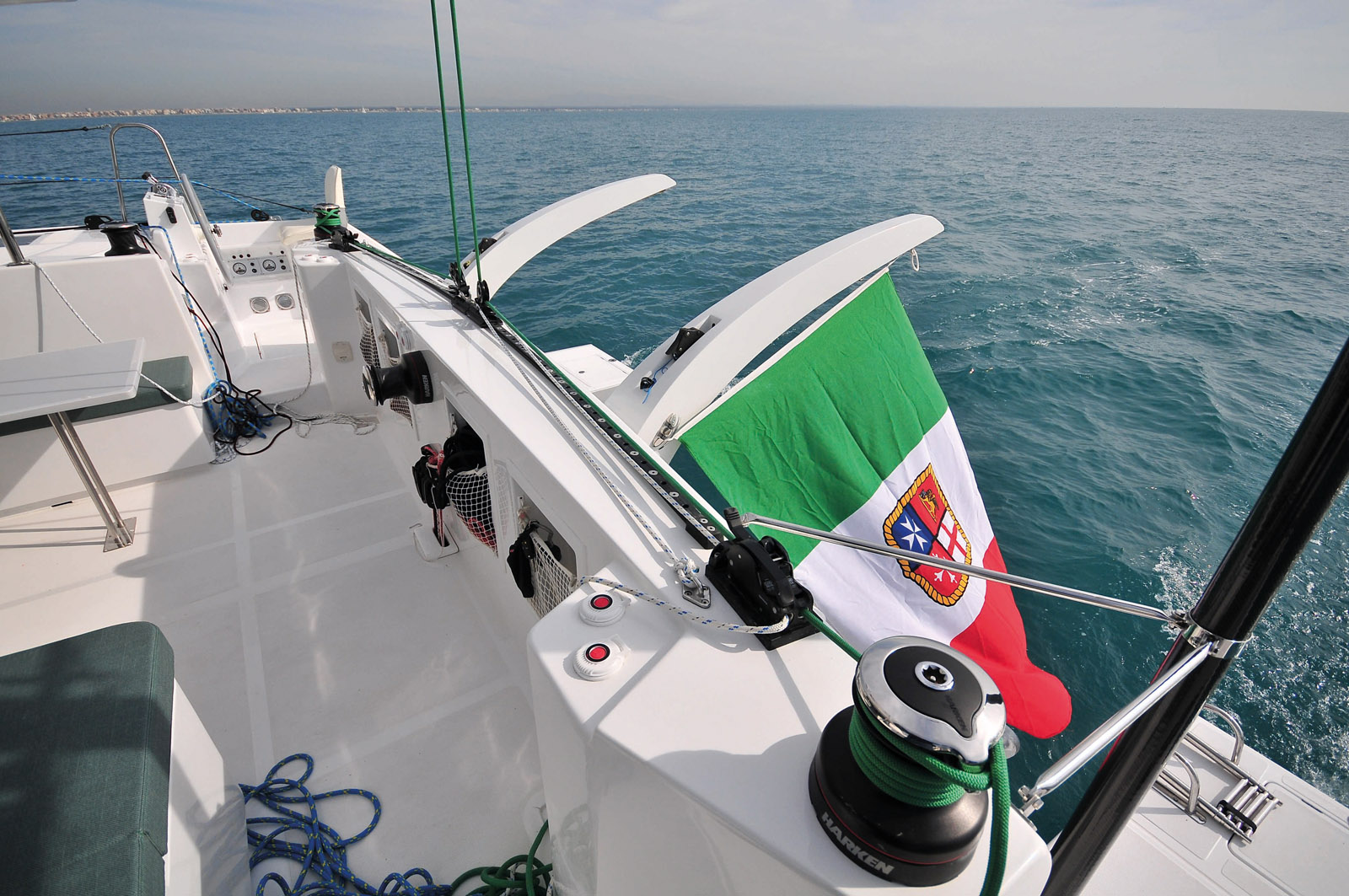 |
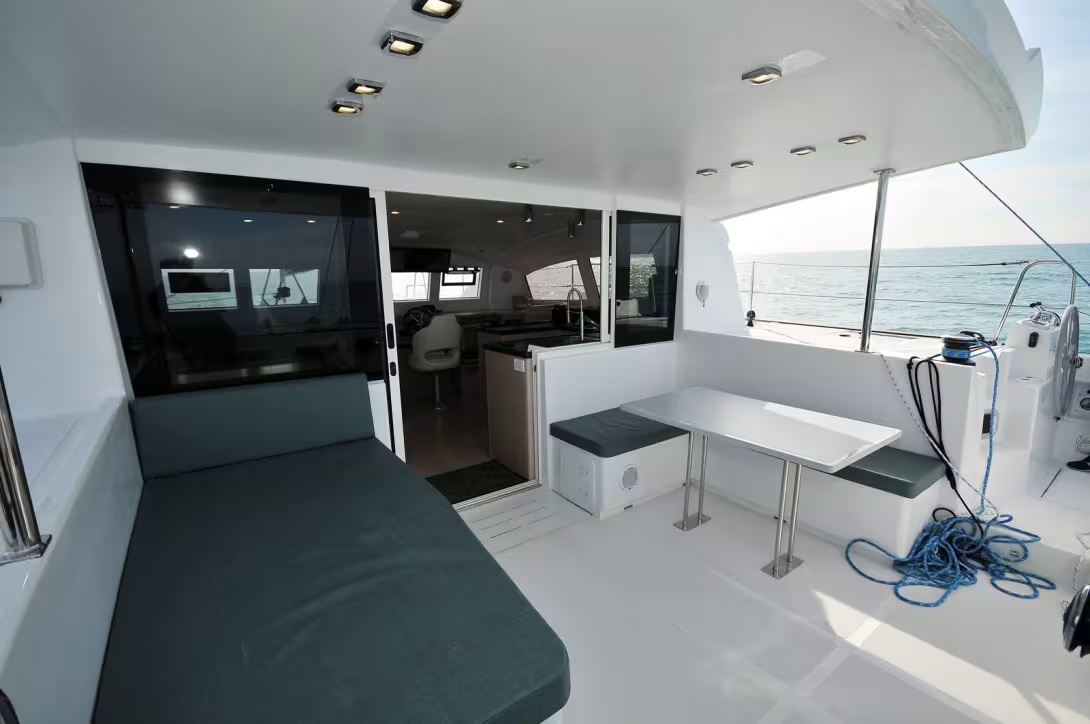
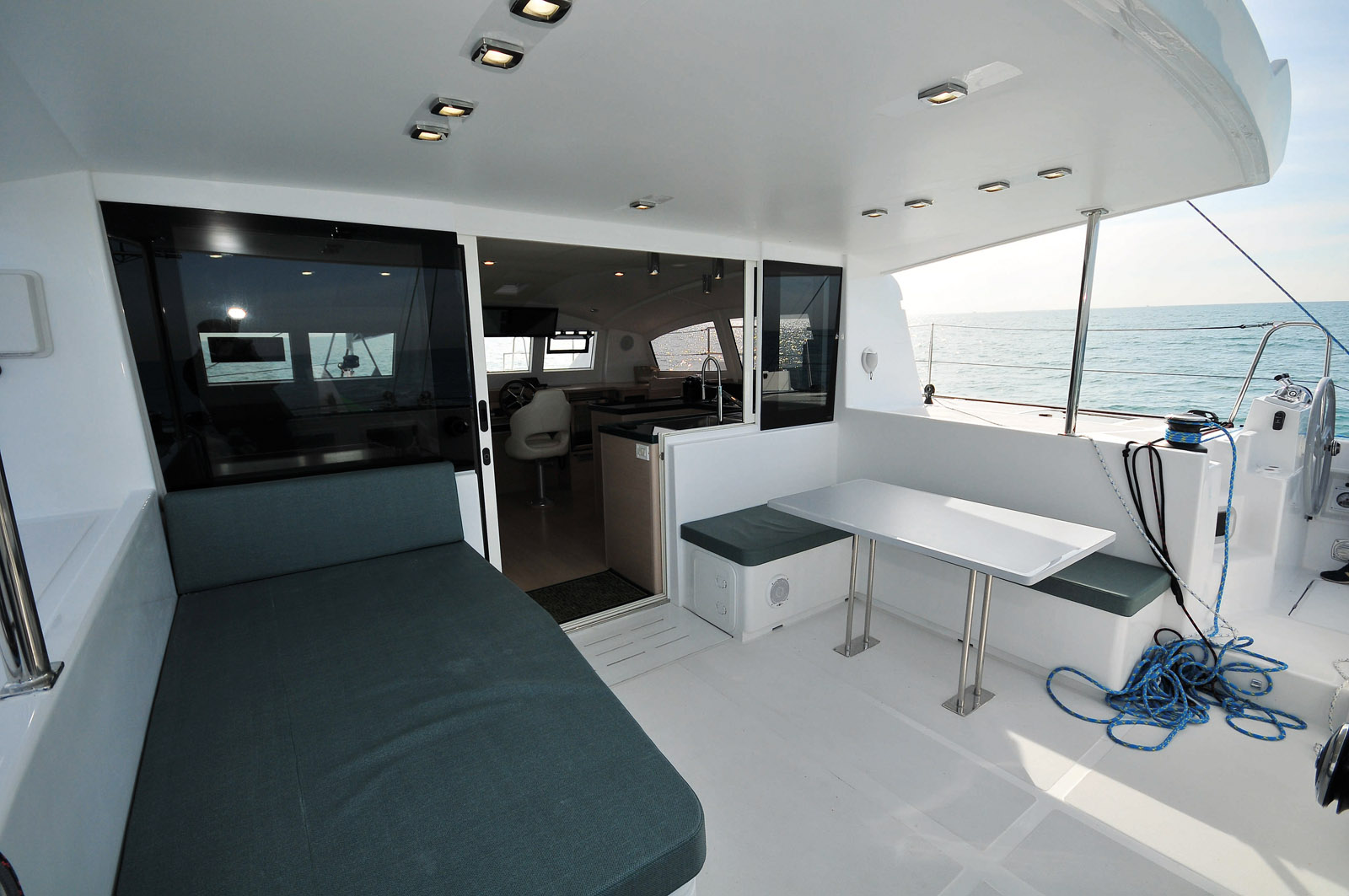
The cockpit houses a table but also the maneuvers, such as the traveler driven by two electric winches.
Interior design: Clearly an Italian label!
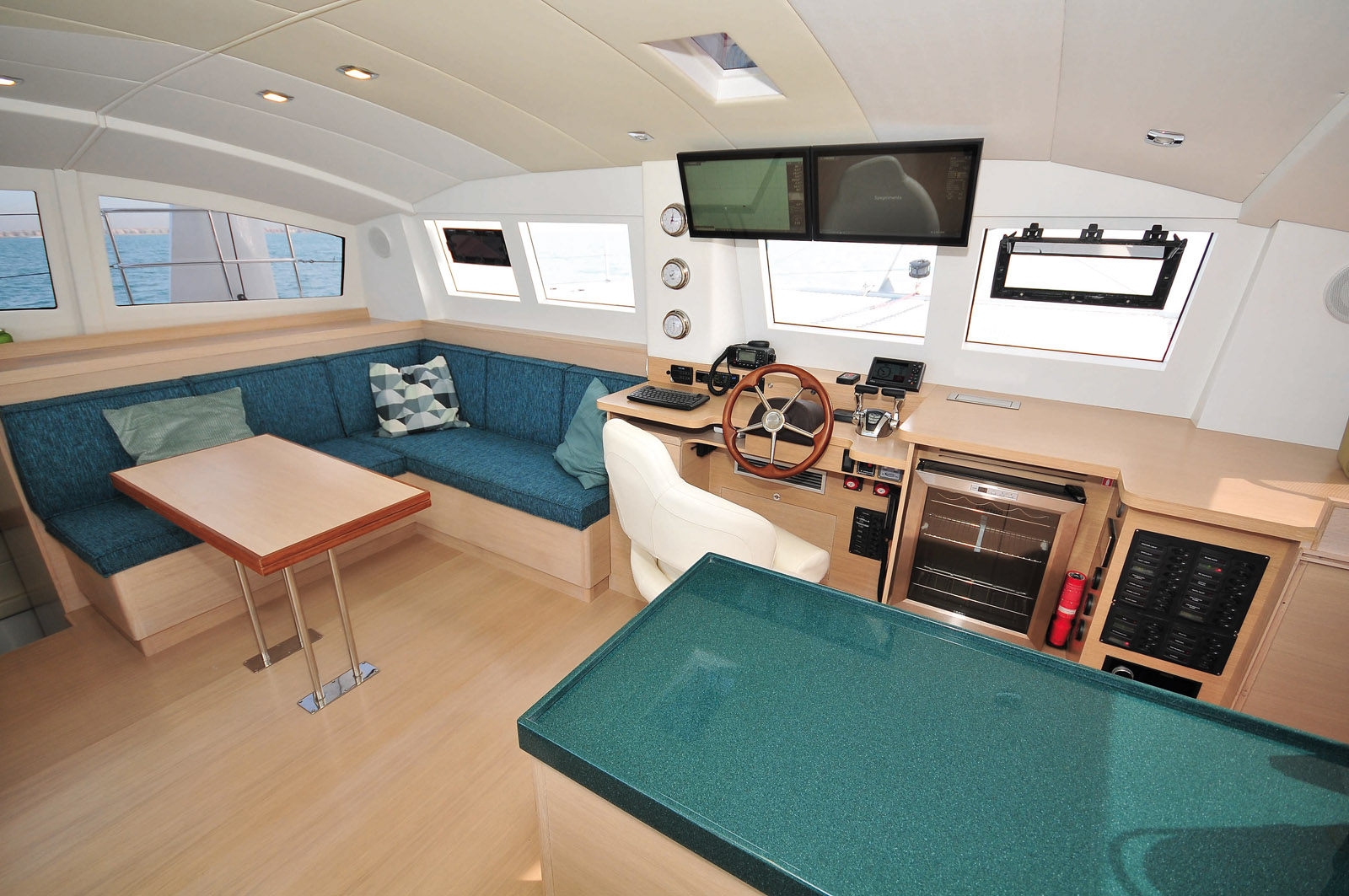
The modern Urban Chic style has now been adopted on almost all production multihulls – it’s a pleasant compromise between trendy design, accepted ergonomics and contemporary materials. The execution of this essential concept by C-Catamarans is irreproachable. Without rewriting the rulebook, the Fiumiccino shipyard has brought a seductive Italian touch, enhanced by remarkable build quality. Their philosophy is to be open to customization, so it is possible for the future owner to actively participate in the creation of “their very own catamaran. Our test boat, for example, featured a choice of very light wood species and superb, well-crafted upholstery. The U-shaped galley worktop is made of dark green Corian, tastefully contrasting with the beautiful blue upholstery, all beautifully done! Very well equipped for a demanding life on board program, this first model is a little heavier than the examples that will follow (thanks to air conditioning, heating, generator, etc.) The shipyard claims they will be able to improve the figures by more than 1,750 lbs (800 kg) on future platforms. This owner’s version is more than convincing: we particularly liked the way the light works, the interiorexterior accessibility of the galley, and the overall build quality of manufacture.
 |
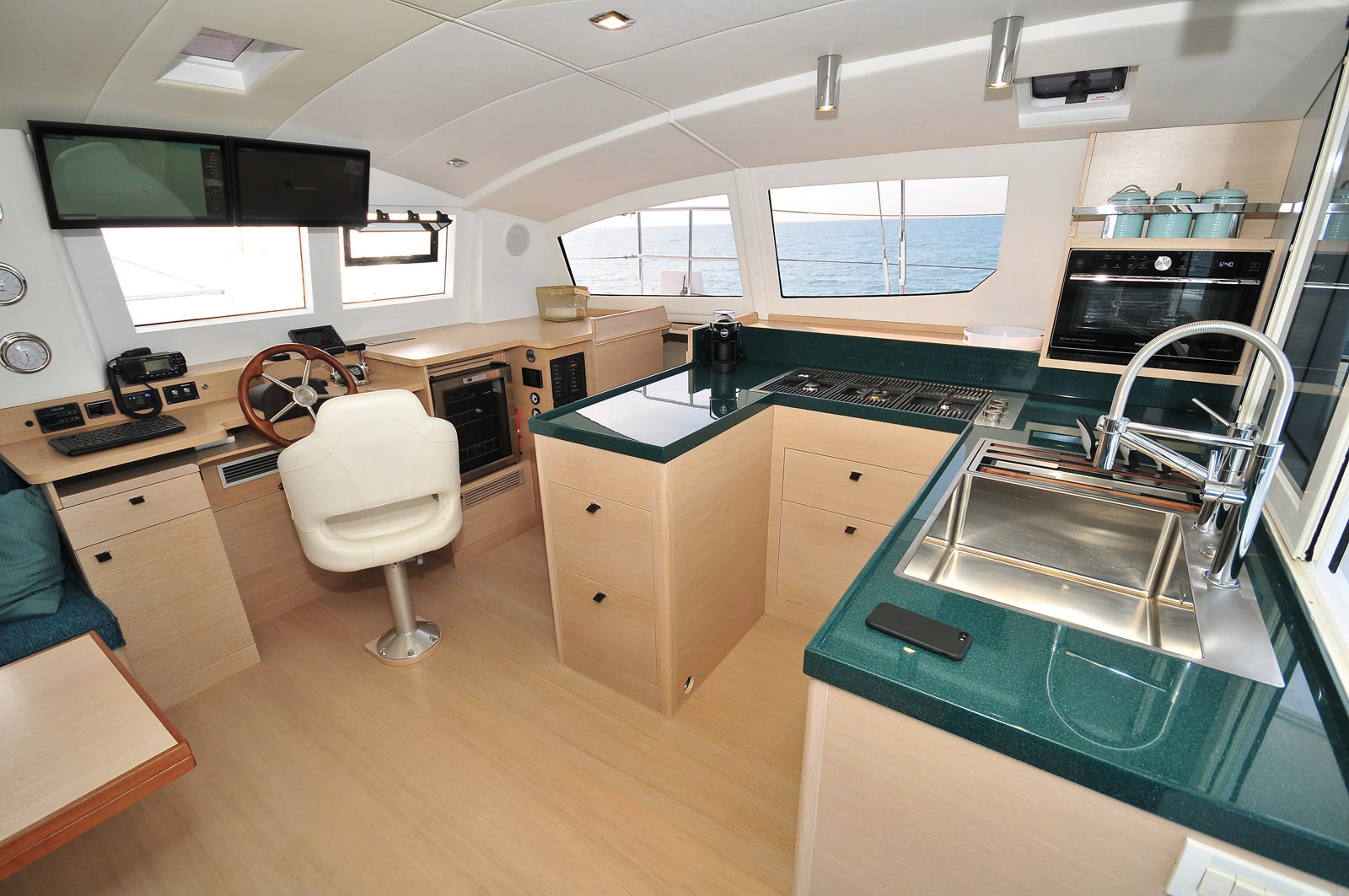 |
Despite its limited volume, the C-Cat 48’s nacelle creates a very pleasant living space.
Technical aspects
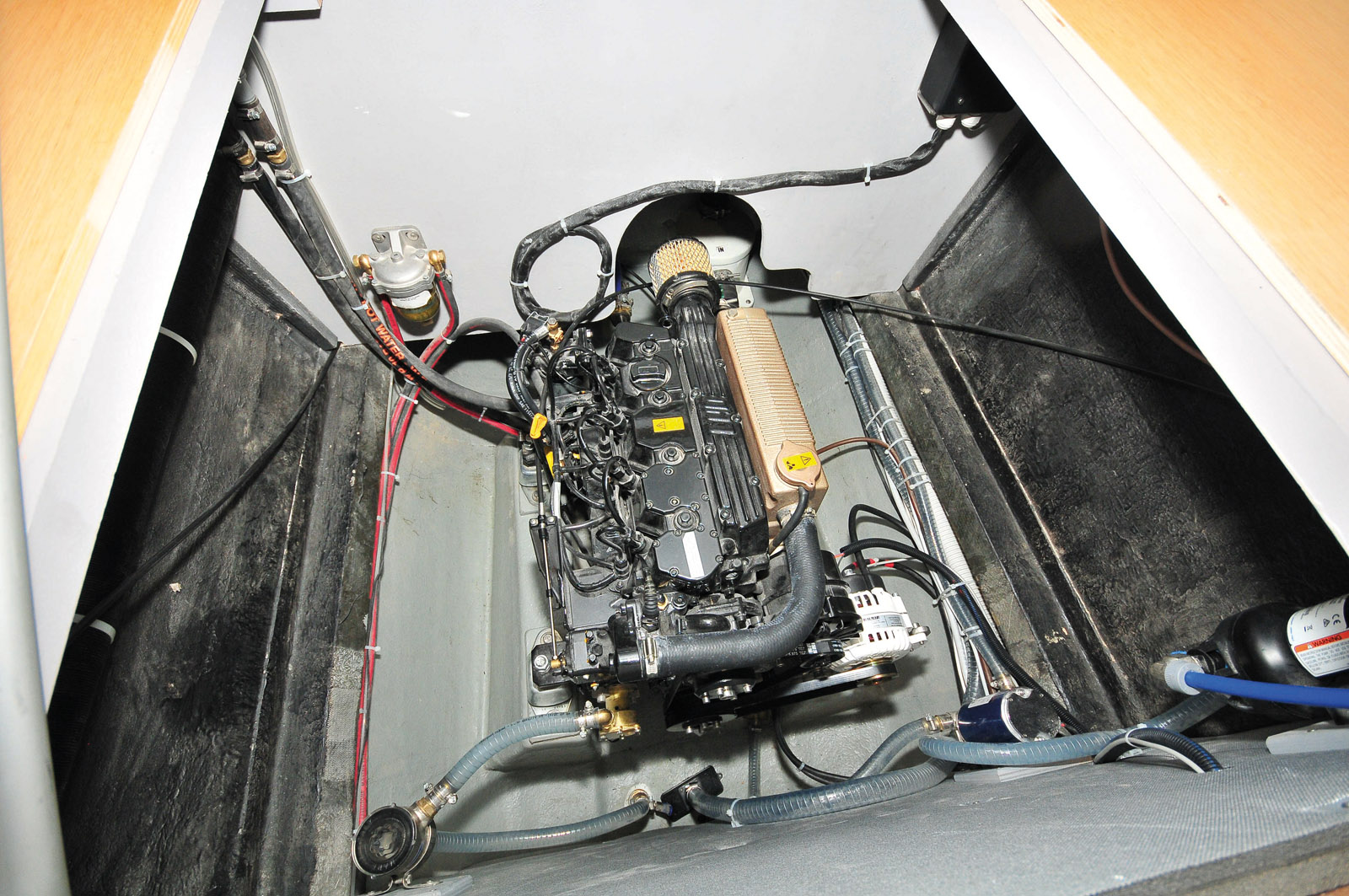
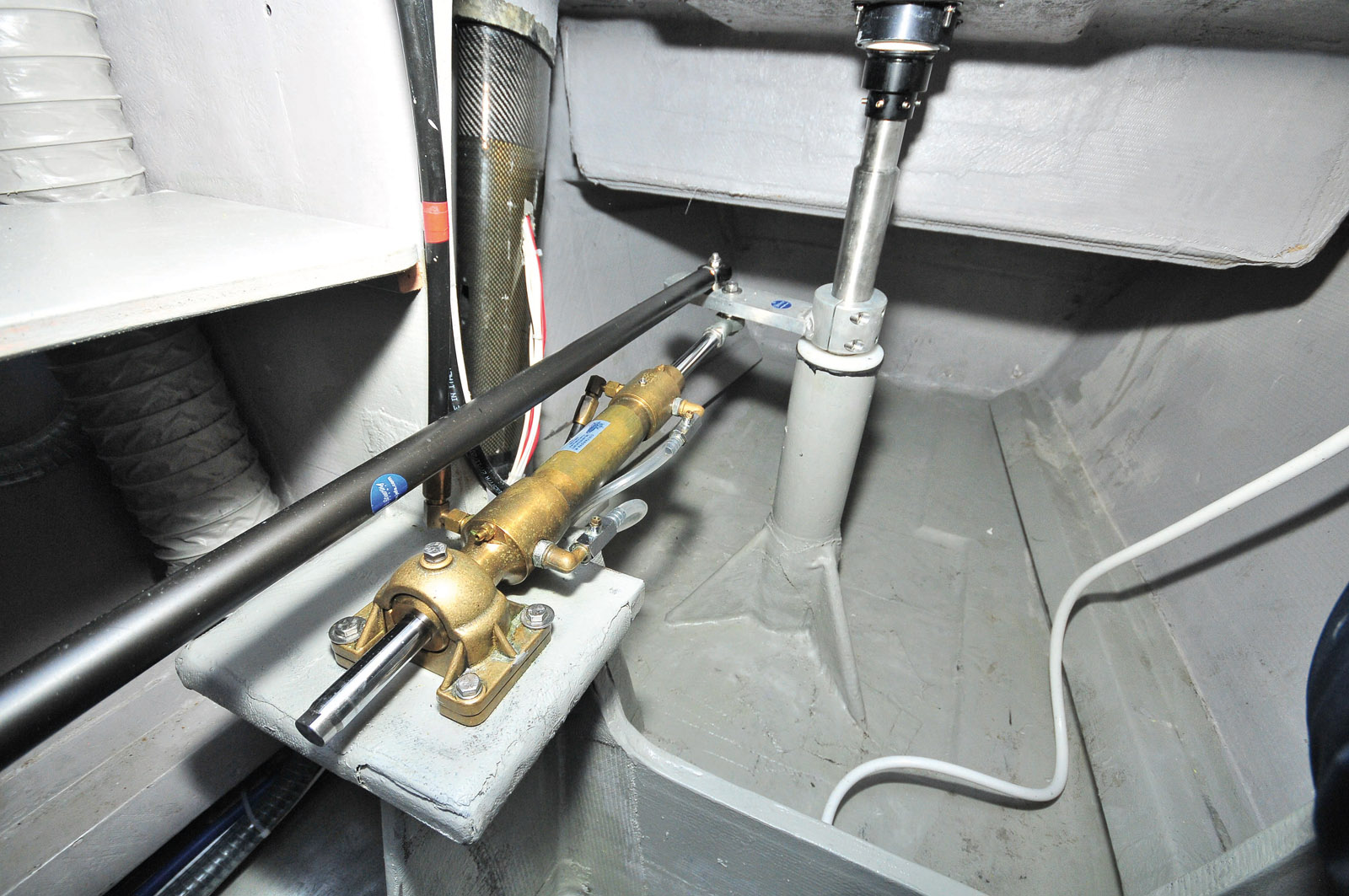
The location and accessibility of all the technical elements are intrinsically linked (along with the intrinsic quality of the equipment and the care taken in its assembly) to the reliability of a multihull when blue water cruising. On board the C-Cat 48, good mastery of these aspects is evidently a constant preoccupation, aimed at improving the details. Plastic plumbing, electrics, cable routing and peripheral boxes are all seriously installed. The twin 35 HP Lombardini engines are standard, with shaft drives (a very relevant option) on our test catamaran. There is plenty of room in the engine compartments under the aft bunks - this arrangement allows the motors to be installed further forward in the hulls for better weight centering. The Jefa steering transmission offered is of course irreproachable, but the owner of this hull #1 wanted a hydraulic inter-rudder linkage. Later models are to be equipped with a mechanical linkage, which I think is preferable. Congratulations are also due for the installation of the rudders, the quadrants and the very wellsecured rudder tubes.
 |
 |
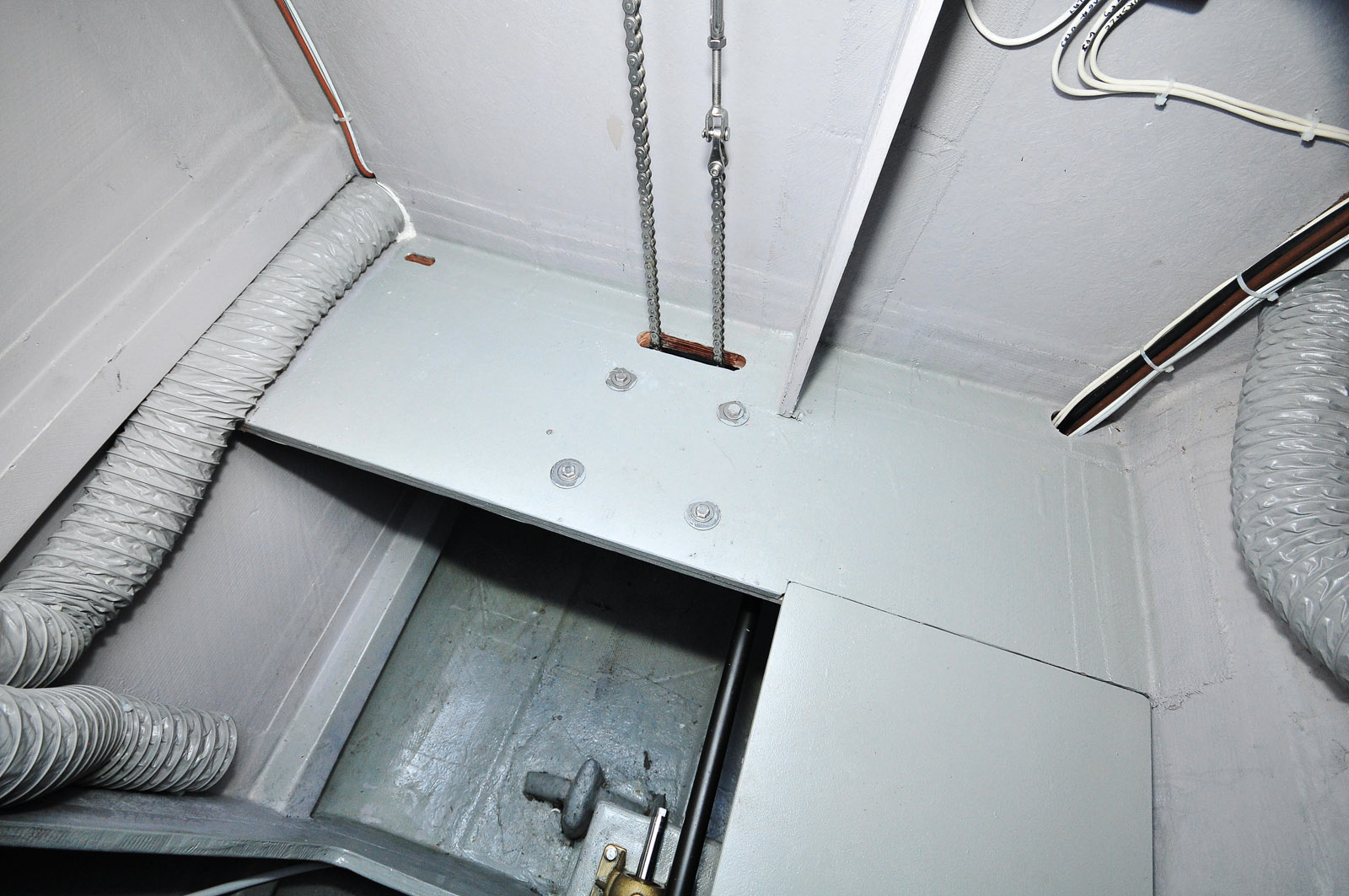 |
The technical installations are neat. The manufacturer has opted to use 35 HP Lombardini motors, with shaft-driven propellers available as an option.
A word from the architect - François Perus

A graduate of ENSTA Bretagne, an engineering school based in Brest, France, Fran ois P rus took the naval architecture module in Paris before collaborating with Berret-Racoupeau Yacht Design, then moving to Asia to work with Tony Grainger. In 2013, after these formative years, the young designer returned to France where he and Romain Scolari founded the Yacht Design Collective. The naval architecture firm has asserted its international ambitions: Designer of the Slyder 47 and the Ita 49, YDC also collaborates with Corsair/Seawind – to them, we owe the Pulse 600 and the Corsair 760 and 880 and 760. YDC’s philosophy is to successfully create a path between sport and comfort.
"We followed a virtuous circle in the design of the C-Cat 48 in order to achieve a simple and lightweight catamaran - the two going hand in hand! Careful weight centering, one-piece sandwich construction (nacelle/hulls), taut lines and an aerodynamic silhouette all contribute to building a seaworthy and responsive multihull. The lowered and aft-set helm stations communicate well with the rest of the catamaran: they allow for good visibility of the sails and the entire deck, while having all the lines within reach. Simple and safe for enjoying multihull sailing!"
Two days of testing
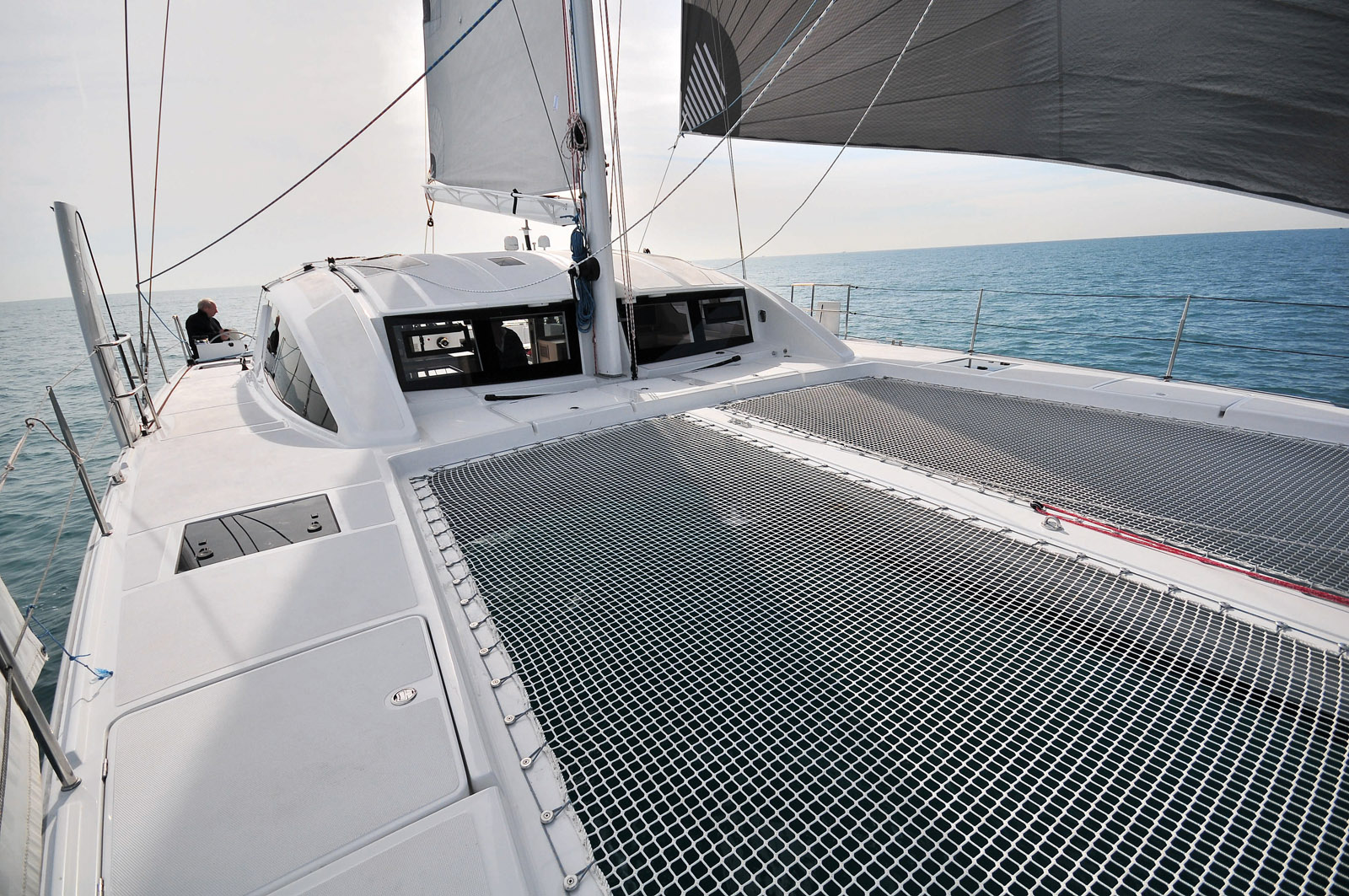
Our first test session took place with an ESE’ly wind of 5 to 10 knots and a flat calm sea. I’ll get straight to the point: the C-Cat 48 is a marvel in these light conditions. Sure, it’s not a racing multihull, but it is pleasant to note that a catamaran so comfortable inside can be fast while the wind barely ruffles the helmsman... The contained displacement, the refined aerodynamics, the fine-entry bows and the generous sail plan explain these very positive results in light-medium airs. On our first trip out outing, we had rigged the genoa on its endless line furler. At 570 sq ft (53 m ) and being overlapping, this headsail allows the C-Cat 48 to remain maneuverable and lively on all points of sail. Of course, the sail of the day was the gennaker: thanks to this 1,400-square foot (130 m ) non-deformable membrane sail - just like the main - the pace of our catamaran remained constantly dynamic at all angles, with a firm and sensitive helm. I would add that it was a pleasure to be moving so quickly on this stretch of water, crossing paths with other boats... under motor. The following day saw more sustained conditions - 12 to 18 knots and a moderate sea. The chop we encountered highlighted the very good wave handling of this catamaran - the generous bridgedeck clearance and the well centered weight contribute to this excellent behavior. With the staysail hoisted, we were a bit under-canvassed while waiting for a front that was finally delayed. However, we easily reached speeds of 9 to 10 knots. The 48’s behavior is pleasant at the helm, which remains precise despite the inertia of the associated rams and the autopilot. An discussion with Massimo Guardigli confirmed the need to change the propellers - which has since been done. The objective is of course to reduce drag, and thus increase speed under sail. On a close reach, we didn’t exceed 11 knots, but could have gone up to 13, had we reinstalled the genoa. A special mention is needed for the deck layout: everything works perfectly with an ergonomic maturity that would never betray the fact that this is hull #1. The traveler, served by two electric winches, is very pleasant to adjust. As for the ergonomics of the helm stations, they are excellent.
 |
 |
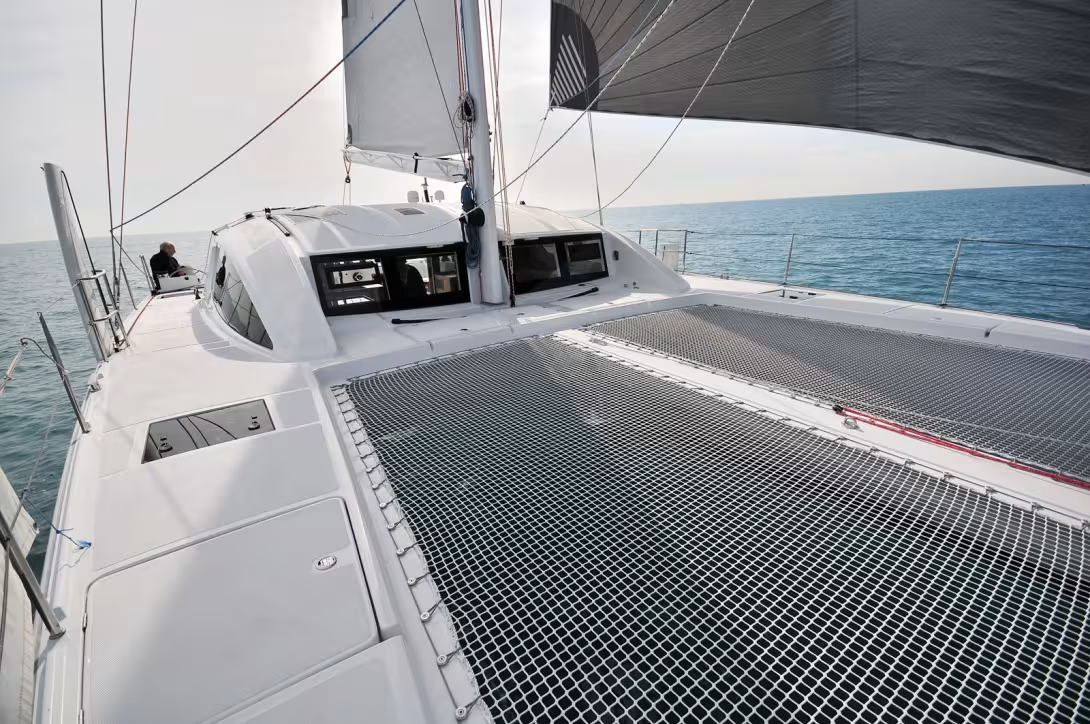
Plus de surface pour les trampolines, c’est moins de pontage en dur, et donc moins de poids…
Les dérives, particulièrement excentrées, ne gènent pas du tout les déplacements sur les passavants.
Conclusion
What a pleasure to discover this boat! The inspired design by Fran ois P rus is served by serious construction. Being lighter, forthcoming units will perhaps not need the luxurious options on our test model (carbon mast, membrane sails) for such good results on the water. The C-Cat 48 perfectly meets the objective of her designers: to create a comfortable, elegant, high-performance catamaran that can be managed by a family crew.
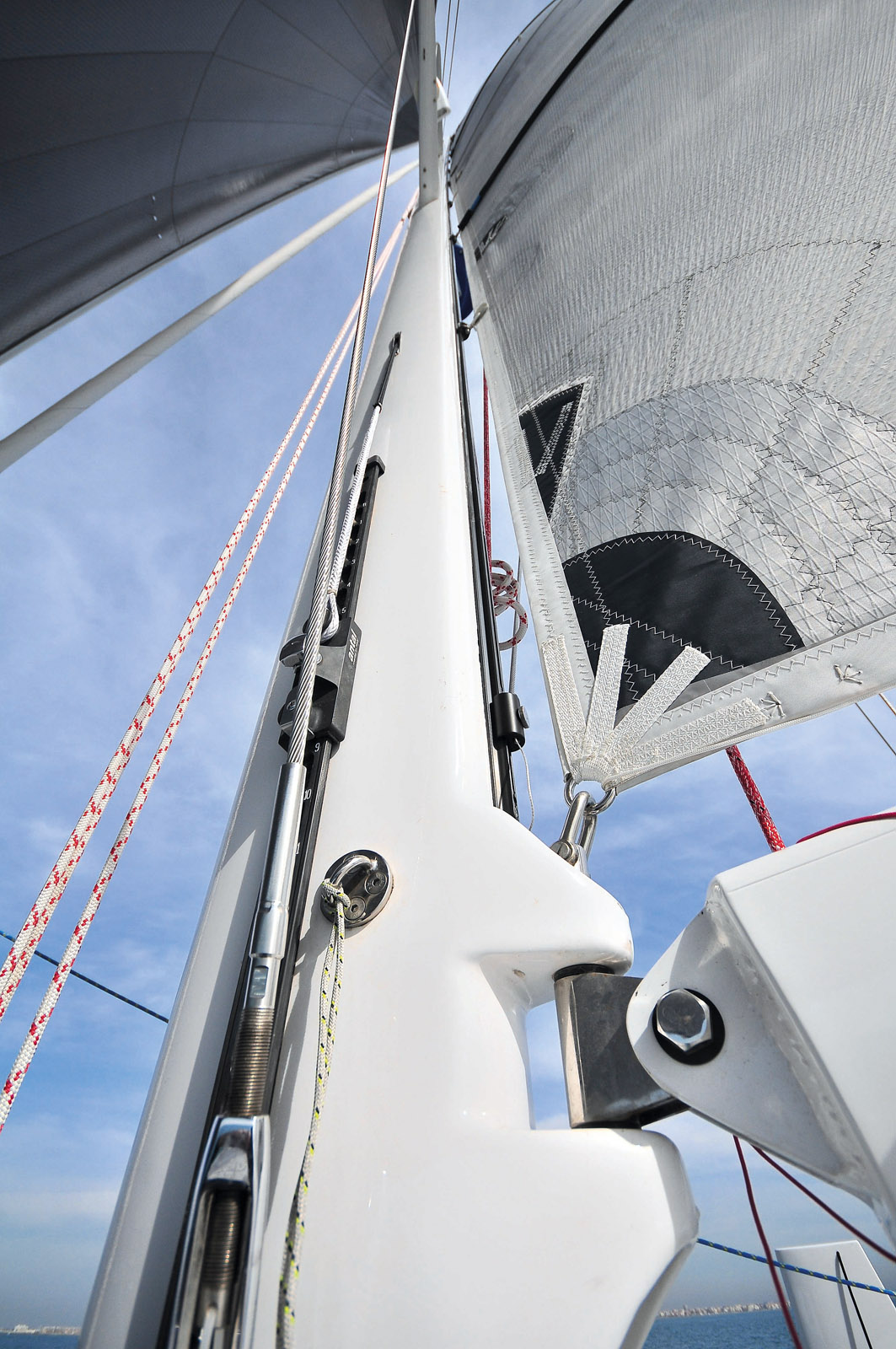
The fixed carbon mast is an option: the spar has a slight pre-bend and two sets of aft-swept spreaders.
The Pluses:
+ Elegant silhouette
+ Pleasing behavior
+ Build quality
+ Dialogue between client & shipyard
The Minuses:
- Finishing could be improved on certain technical cuts
- Shipyard needs to establish a reputation in the realm of multihulls
- Displacement a little higher than announced
TECHNICAL SPECIFICATIONS
Builder: C-Catamarans
Naval Architect: François Pérus/YDC
Material: Vinylester-epoxy in infusion
Length: 48’7” (14.80 m)
Beam: 23’11” (7.30 m)
Light displacement: 17,650 lbs (8 t)
Maximum laden displacement: 28,650 lbs (13 t)
Draft: 22”/7’3” (0.57/2.20 m)
Air draft: 68’10” (21.00 m)
Mast length: 64’8”(19.70 m)
Mainsail: 860 sq ft (80 m )
Genoa: 570 sq ft (53 m )
Self-tacking solent: 410 sq ft (38 m )
Code 0: 970 sq ft (90 m )
Gennaker: 1,400 sq ft (130 m )
Max-size spinnaker: 1,720 sq ft (160 m )
Motors: 2 x 35 HP Lombardini sail drives (propeller-shaft option)
Fuel: 2 x 37 US gal (2 x 140 l)
Water: 80 US gal (300 l)
Price of the standard 2-cabin version: € 656,000 ex-tax
Main options in € ex-tax:
3-cabin version: 9,300 4-cabin version: 14,250
#1 Pack – square-topped main, batten cars, davits, charger, hot and cold exterior shower: 16,950
Full Raymarine electronics: 14,655
Ground tackle and windlass: 3,945
Safety equipment: 3,970
Carbon cross beam: 25,600
Carbon mast, daggerboards and boom: 88,500
Carbon davits: 12,000
Genoa: 4,900 Square-topped mainsail and self-tacking solent: 9,950
Launching, antifouling and 15 days’ berthing in the shipyard’s private marina: 9,750