
Boat test from the Multihulls World #52 (june/july 2000)
Infos pratiques
- Le chantier : Catana 401
- La fiche technique
- Découvrez notre vidéo exclusive
- Financez votre Catana 401
- Assuez votre Catana 401
- Articles autour du Catana 401
The “smallest” Catana is taking advantage of the shipyard’s experience and the solutions tried and tested on other models to position herself with many assets in the 40-foot niche.
If the general trend on the market is for larger units, the size of some 12 meters enables the owner to consider cruising on the high seas or in summer, while keeping harbor and maintenance costs under control. This length also provides for appreciable comfort and remains maneuverable with a small crew.
The 401 fits in perfectly with this standpoint, although the purchase price may seem dissuasive at first. True, if you compare the finishing, the quality of the amenities and fittings, as well of course as the manufacturing processes, the price is justified. To settle this issue once and for all, you will have to shell out Euros 396,100 plus VAT (some 3.1 million French, VAT included) for Catana 401 ready to sail. For this amount, you will have the choice between ten different versions of features, at no extra cost.It seems the yachting market is very healthy indeed, since to date there are already five units on the water, and no less than seventeen more under order.
We tested Teresa III, the first in the series. She ploughs the Mediterranean as a rental boat from Canet-en-Roussillon, where the Catana factory is based. Catana have just doubled their production capacity with the construction of a new building and a third is already planned for the end of the year.
FEATURES
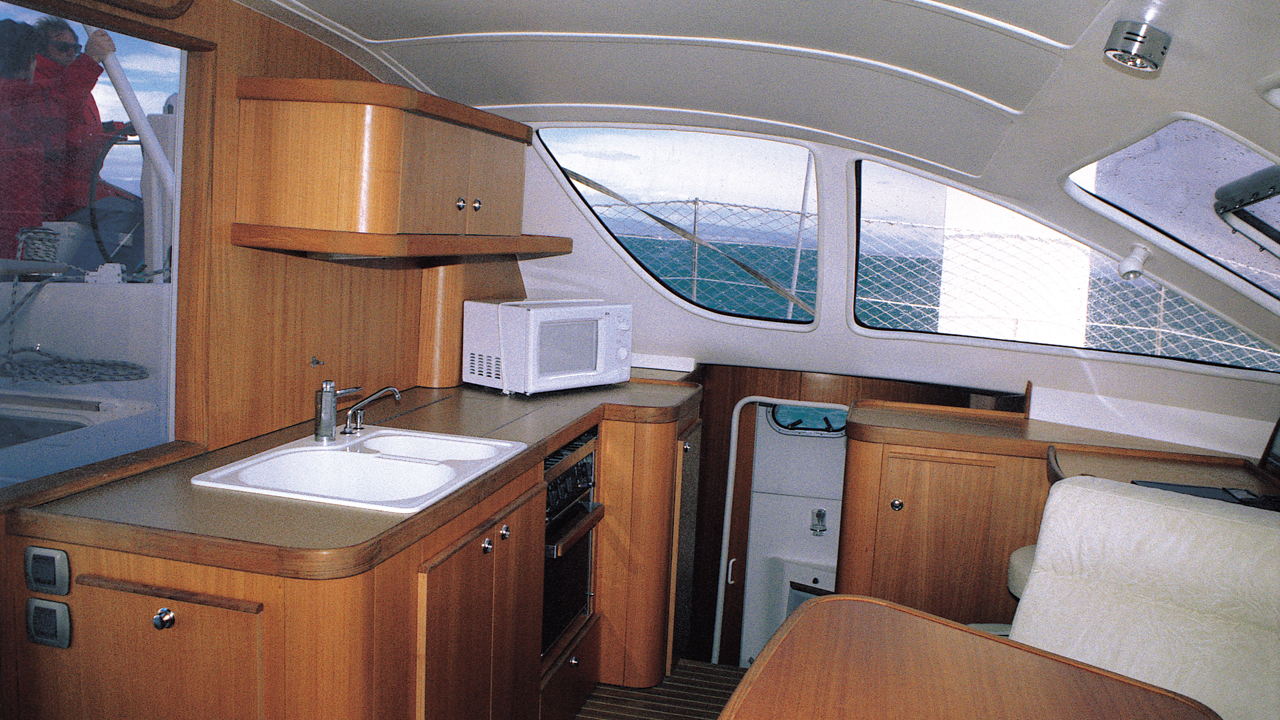
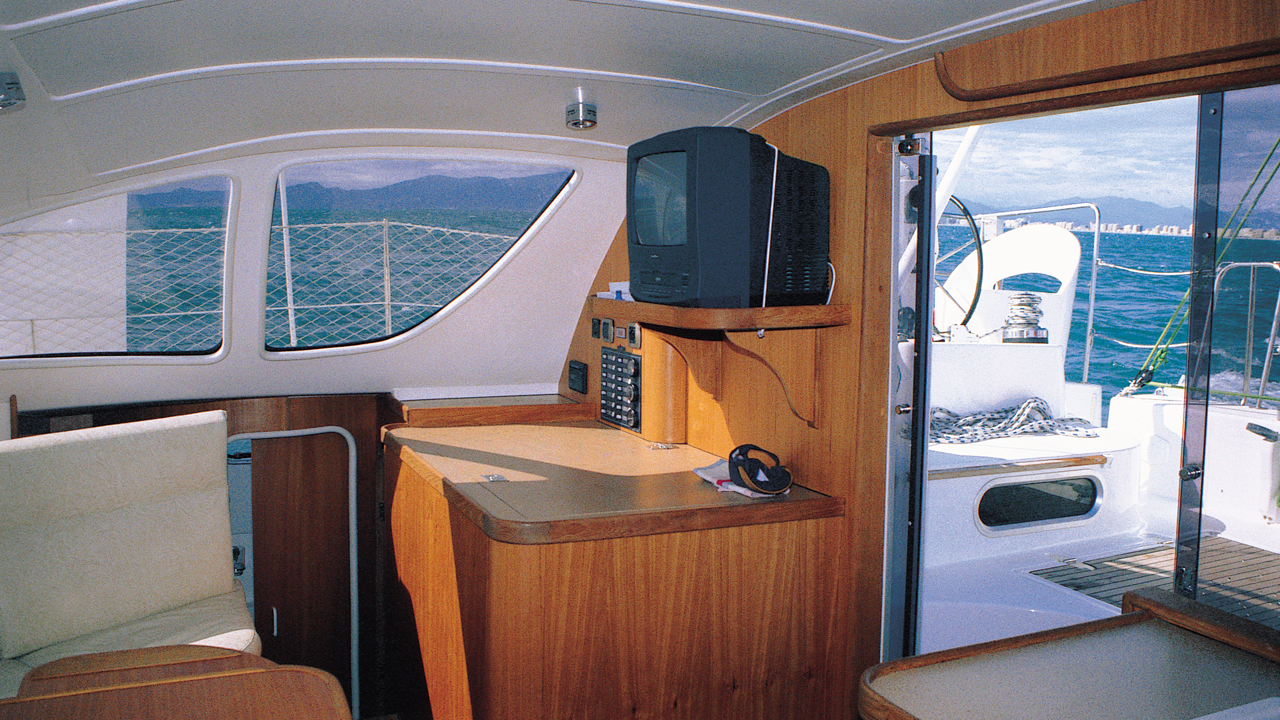
Because she is used for rental, Teresa III has four double cabins, the maximum number of berths of the ten versions proposed. Each hull has a double cabin fore and aft, separated by a bathroom. The chart table, which is close to the front, holds all the electronics, now common on this type of unit: Furuno M821 radar, GPS/Chart Brookes & Gatehouse LCD Plotter, Brookes & Gatehouse Hydra navigation unit, VHF Shipmate RS 8300, Navtex Nav 4 ICS weather decoder. On the side, the open U-shaped saloon makes it possible to take meals around a folding table with two flaps, and drawers and bar built into the base. The galley is on the opposite side, on either side of the access to the cockpit. to the left, there are many storage features, Formica counter, double sink, stainless steel 3-burner stove, traditional and microwave oven and, to the right, the 200-liter refrigerator. All the features, as well as the floors are made of foam sandwich. The walnut veneer eliminates the need for upkeep and the use of solid teak in all the trims enhance the looks and cozy feeling. The finishing is beyond reproach, the saloon is very light and airy, thanks to two portholes that can open in front. The lighting in the cabins is also particularly well done, with broad portholes (900 x 300 mm) with a breathtaking view on the sea. It should be noted, however, that if you are 6 feet tall, it won’t be easy to descend into the hulls; this will require some contortions since the roof forces you to bend down your head. We found that the best solution was to go down backward. It’s probably a matter of getting the hang of it. Once you’re down in the hull, in our version, you are in the moulded bathroom. You’ll have to remove your watch jacket to get in. Like the access, the size of the washbasin is amazingly tiny. And watch out if you want to take a shower: it’s for small frames only! This problem doesn’t exist in the owners’ versions.
ON DECK
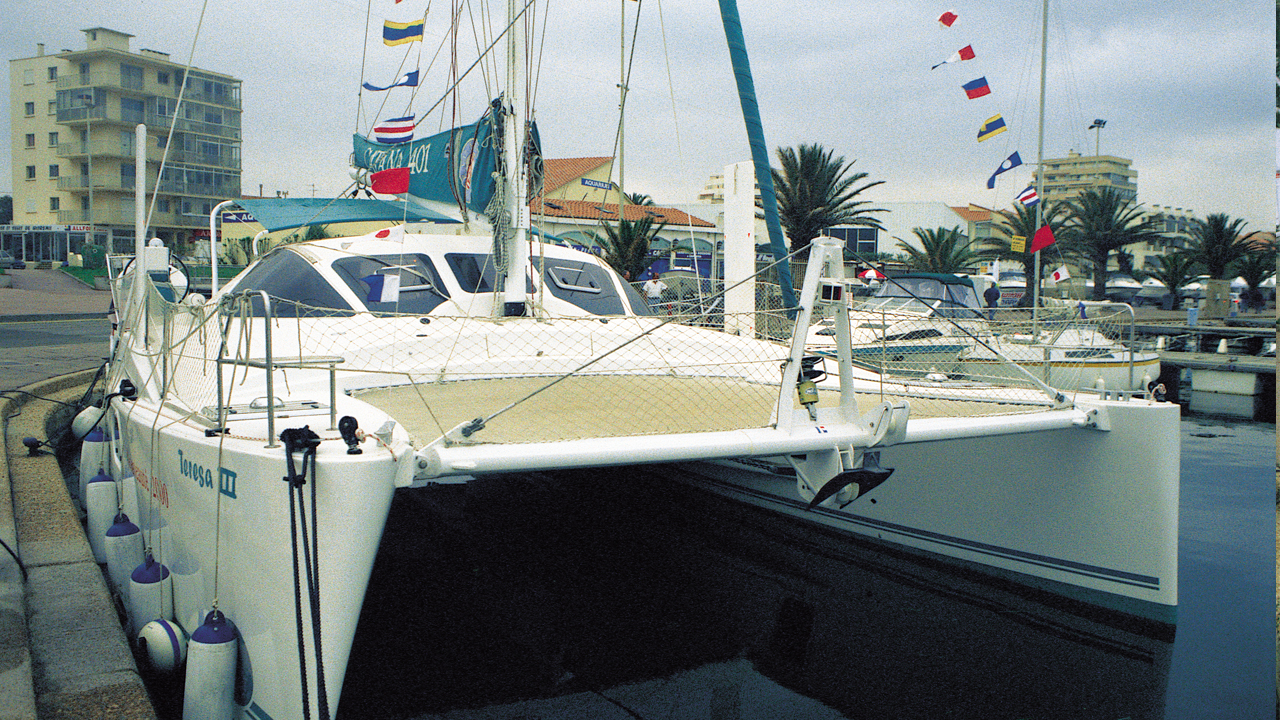
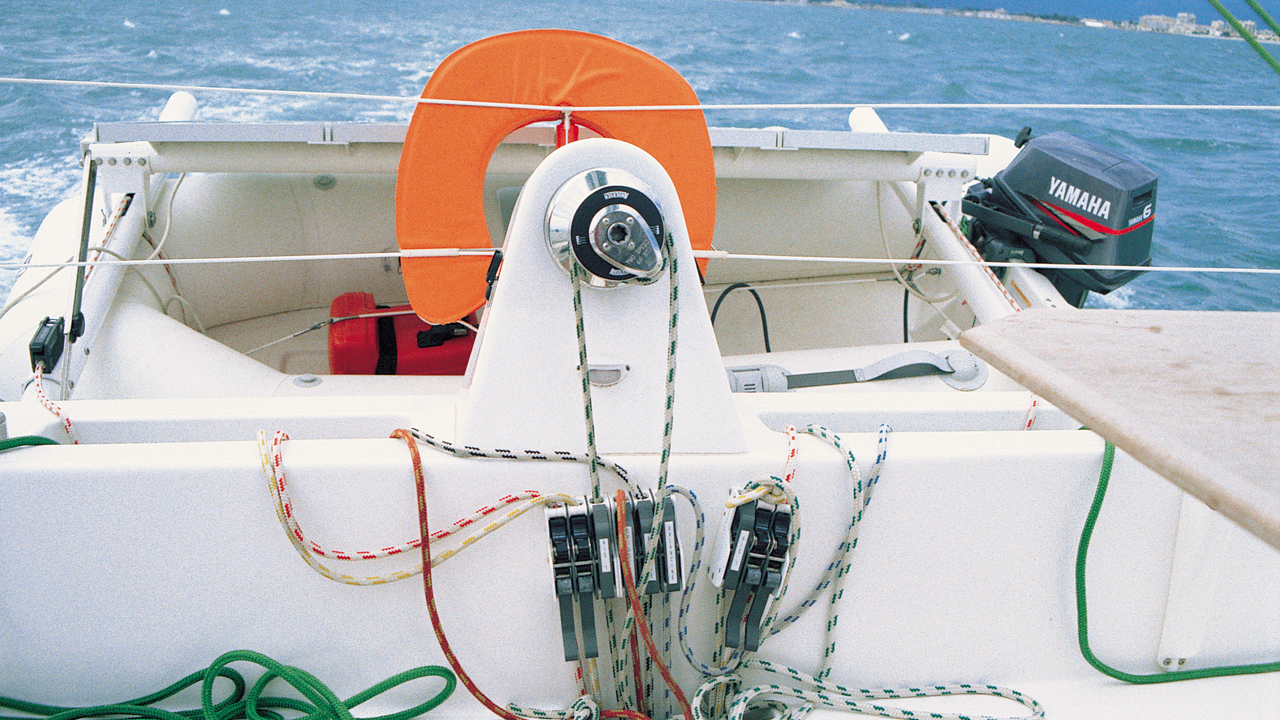
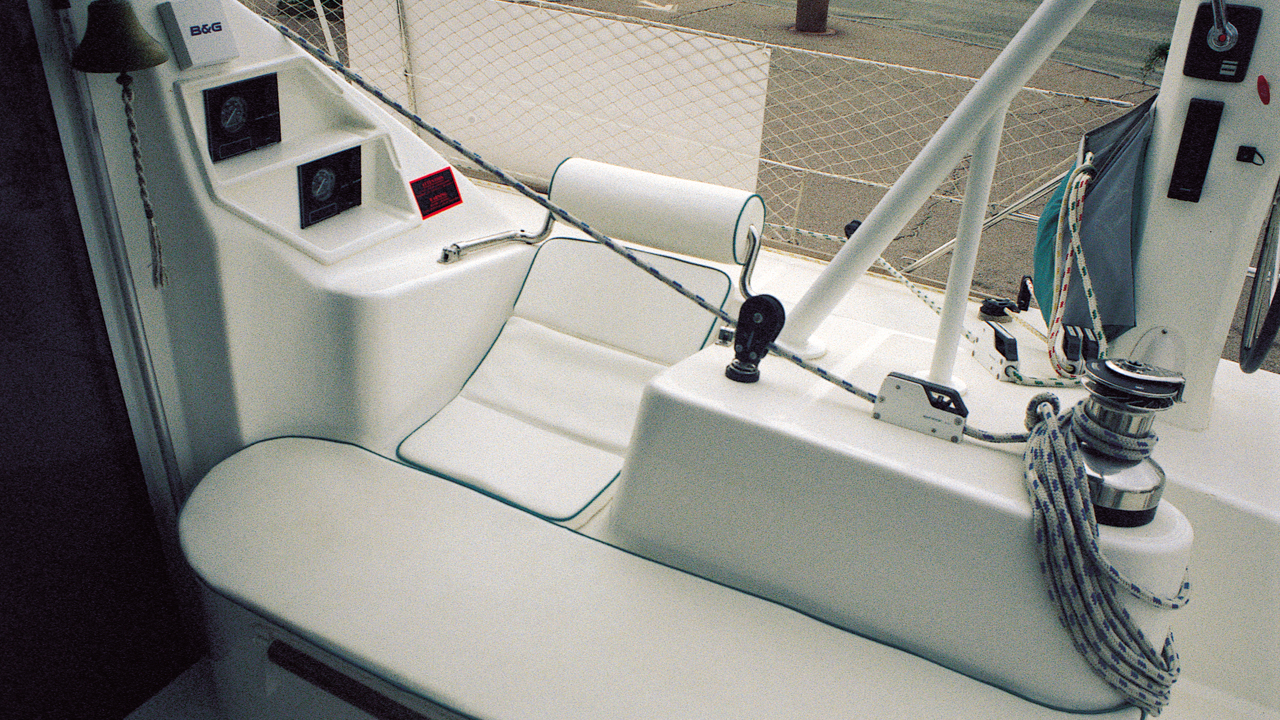
Now adopted over the entire range, the deck is completely free of all running rigging. All the halyards cross the deck at the mast foot, pass under the boat in an omega, which preserves them from salt corrosion, to reappear behind the cockpit on a two-speed Andersen 46 ST electric winch. It is functional, attractive and very practical. Reefing and hoisting the mainsail becomes child’s play. On each side, the genoa sheets and the centerboard controls reach Spinlock clamps for releasing the 2-speed Andersen 46 ST electric winch. all the Frederiksen ball-bearing blocks. The double mainsail sheet returns to two Andersen 40 ST winches. The energy needs are distributed by 4 115 AH service batteries, plus two 60 AH motor batteries, for a total of 580 AH. Each stem has a teak seat from which you can enjoy every detail of the show put on by the dolphins who will surely dance around you. Two large trunks in front, easily swallow up the fenders and other mooring ropes. The anchorage passes under the trampoline to return on a 1400 watt electric windlass fixed at the mast foot in a trunk. The chain and emergency anchorage are also stored there. Although a priori, because of the arrangement of the running rigging, you have nothing to do on the top of the roof, except perhaps maneuver the zipper of the lazy bag or store the mainsail inside it, it is best to do so in sheltered waters. Indeed, climbing up there from the front may be dangerous since there is nothing to facilitate the access (no steps or railing, rounded shape of the roof), with a little moisture, it can become acrobatic.
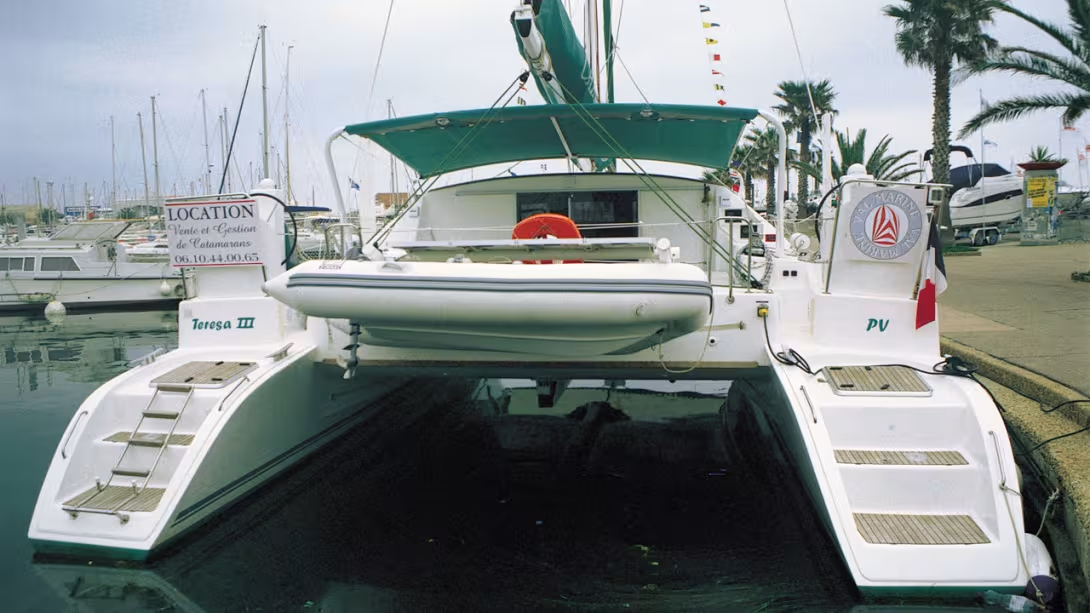
The two helm stations are a model of comfort. The repeater fixed in the middle of the roof has very large figures, which make it very visible from the helm, the view over the front is completely open. The starboard station receives the motor controls. On each side, part of the benches in the cockpit can be transformed into a reclining chair thanks to the modular back. Although it may be fine for tanning, this becomes a trap when you go from the deck to the cockpit. First of all, you must walk over the genoa sheet across the passage, and around the hole formed by the easy chair. It is necessary to take the greatest care and, especially, sufficient time to avoid these two pitfalls. She is also available with a white lacquered carbon mast by Espace Composite as standard equipment. The boom, by JP Maréchal, remains aluminum. The rear of the cockpit has two davits, also carbon, supporting a 3.10 m Zodiac de equipped with a 4CV Yamaha OB motor. Behind each helm station, an aperture in the coaming provides access to the transom with broad steps made of teak and a swimming ladder. There is no problem with circulation.
AT SEA
Starting up the two 30CV Volvo SailDrive diesel motors with folding three-blade propellers, means checking the tachometer to make sure they start or checking that the coolant flows well, since there is no noise for detecting its operation. The insulation, both inside and outside, is remarkable; at 2000 rpm, the noise in the hulls is imperceptible. The power of the 2 x 30CV motors is present for maneuvering in the harbor. Using only the controls, without touching the helm, handling the 401 is almost disconcerting, so we can slip between the two 471s on either side. The Tramontane wind was present for this test, with the weather forecast promising a NW wind at 15/22 knots. We hoisted the 52 m≤ mainsail as we left the harbor. With the motors off, we were at 9 knots under mainsail alone at 100° of the wind. As always with the Tramontane in this region, the sea was somewhat choppy along the coast and there were occasional violent gusts. With the 42 m≤ genoa jib completely unfurled, the speedometer rose to more than 10 knots at 45° of the wind.
The passage in the water was frank and only exceptionally did the spray hitting the cockpit ever reach the person at the helm. Comfortably seated, the perfectly flexibility of the helm means you don’t get tired, even in heavy weather. The gusts were getting stronger, 27/30 knots, and the 401 fully sailed instantly accelerated. Reaching a little at 90°, the rear rose slightly and there we were, sailing at over 20 knots in outstanding comfort and in all security. The stems rise up: sheer joy! The return upwind, to preserve a good heading, leads to taking a reef in the mainsail and 4 spins in the genoa jib. With 25 knots true wind, the speed is 97 knots, which means you can cover quite a bit of ground, always in considerable comfort and safety.
CONCLUSION
Sailing the Catana 401 shows her to be very fast with frank accelerations. She is easy to handle, both under sail and with motors. The gentle steering and comfort make it possible to at the helm for long hours without fatigue. Unquestionably, this boat is very lively, efficient and safe. The construction, appointments and finishing are all very well made; the final result is top-of-the-scale, except for a few bloopers mentioned above, which makes the Catana 401 a real success.
Specifications
Overall length: 12.50 m Waterline length: 12.00 m Beam: 6.70 m Light displacement: 6,200 kg Draft: 0.70/2.00 m Motors: 2 x 30CV Water: 400 l Desalinator: 500 l/j Fuel: 200 l Rating: 27 Tx Designer: Christophe Barreau Builder: Catana SA - ZT - F 66142 Canet-en-Roussillon Cedex (France) JC M22
