
A storm lashed the leisure sailing industry during the winter of 2009; despite this, the multihull segment seems to have stood up well and is showing, across all sizes, comforting vitality. After having battled in the backwash from the Poncin group’s economic difficulties, Catana is re-launching a homogenous range and re-interpreting its expertise.
Infos pratiques
- Le chantier : Catana 47
- La fiche technique
- Découvrez notre vidéo exclusive
- Financez votre Catana 47
- Assuez votre Catana 47
- Articles autour du Catana 47
A dynamic 2009 collection
After a period spent looking for its positioning, targeting big boats, Catana seems to be re-centring on the 40 – 50-foot segment, which has always made up the essential part of its production volumes; the success of the 65’does not belie this strategy, the 92’ remains marginal. The 41’ presented at the 2008 Grand Pavois is a recent catamaran whose development is just beginning, the 50’ has just been re-thought and lightened, the 65’ continues its promising trajectory (an owner has put his up for sale after an Atlantic triangle and ordered a ‘custom light’ version, with carbon deck and appendages – it’s a good sign!). Today we are going to discover the 47’.
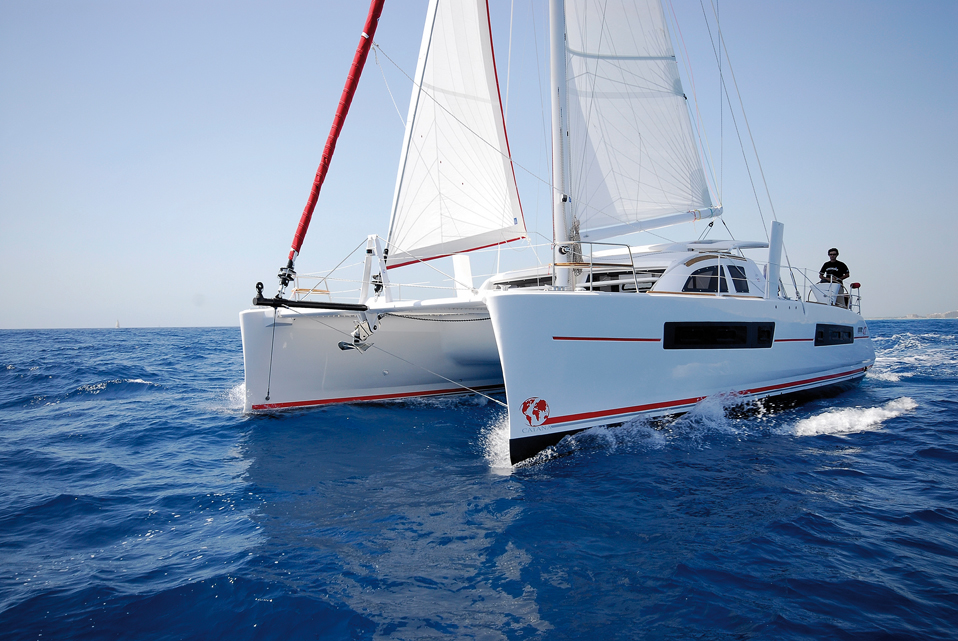
The ‘Catana’ lines can be recognised at first glance.
A modernised construction process
The whole of the range is now built using the infusion process. The company wants to use this technological change to extend its quality demands and save weight on the platforms. The first hulls, observed at the stage where the tissues are laid in the female mould, illustrate this care. Two complementary positive elements are worth noting: the abandoning of Nidaplast in the bulkheads, in favour of Airex foam, and the return of monolithic for the bottom of the hulls. This last arrangement rationalises storage ashore and will prevent the little delaminations linked to this handling; the builder however advises against voluntary beaching. The Twaron process has been retained; it aims at applying Kevlar in the impact zones, to avoid puncture of the internal skin of the sandwich. Impregnation of this tissue (always tricky) with vinylester resin will be assisted by infusion.
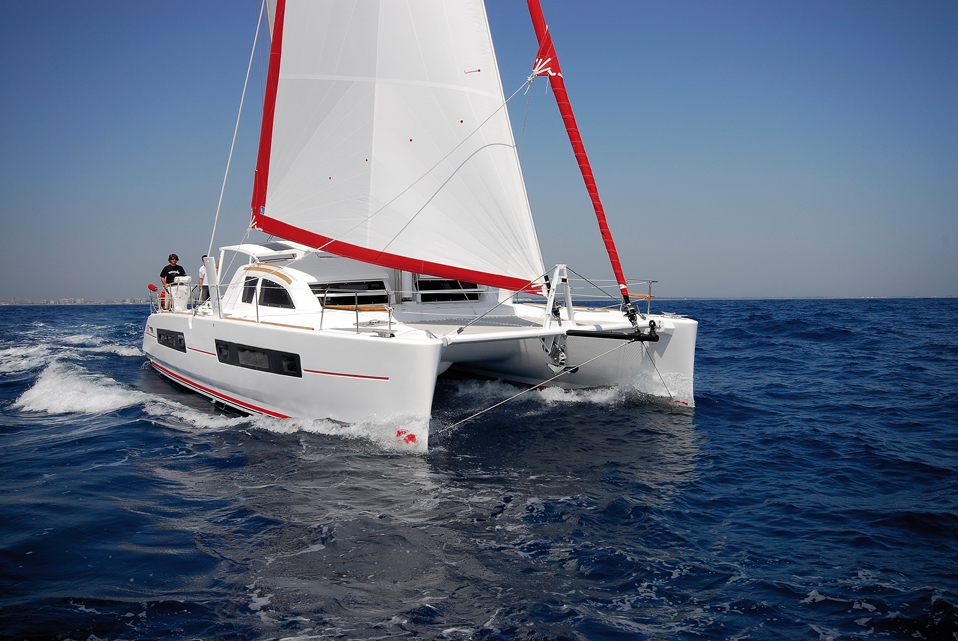
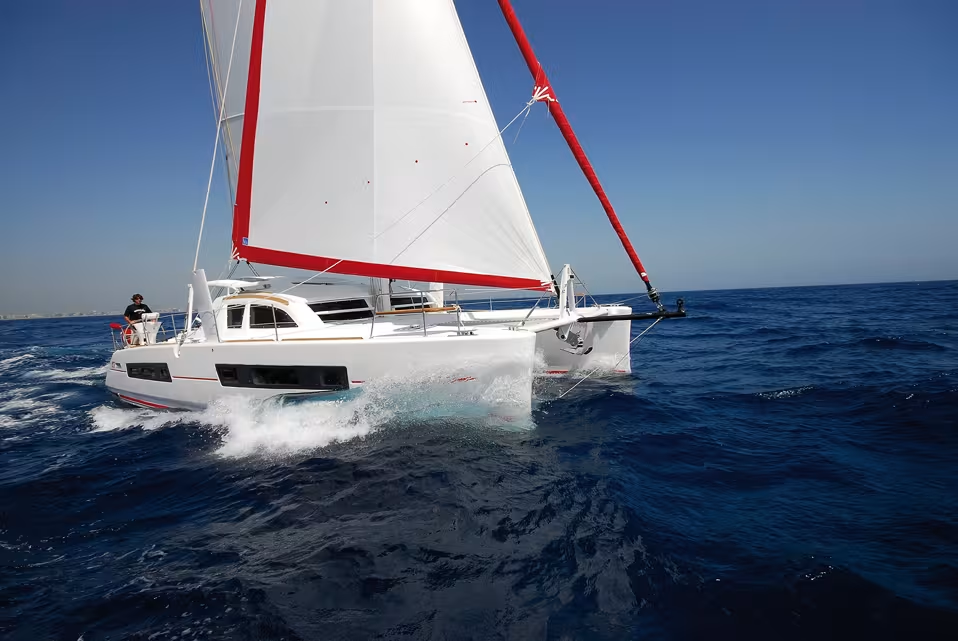
Like all the Catanas, the 47’ is more suited to moderate to strong winds and passes easily through the residual swell.
The joinery workshop reintegrated into the Canet-en-Roussillon factory
For several years now, the builder has sub-contracted the realisation of the accommodation modules. This development was made possible by the precision of numerically controlled tools; Catana is taking back this key expertise, without a doubt a good decision, which will allow the composite and joinery work to be brought together on, the same site, and to translate in a concrete manner the importance the brand attaches to its ‘signature’. When I visited, installation of the machines had almost been completed.
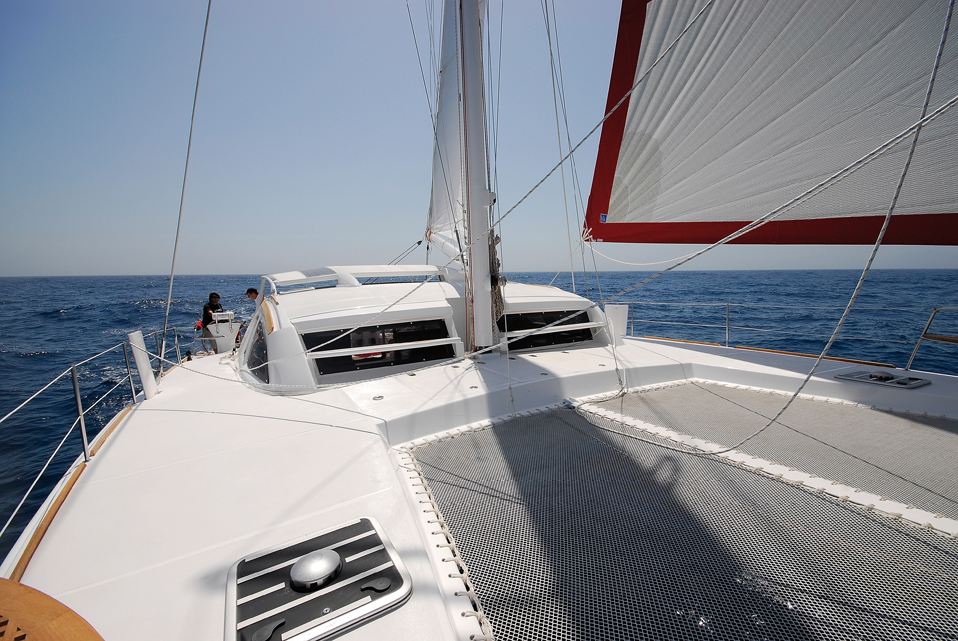
The ergonomics of a big catamaran; fluid and reassuring areas.
47 against 471
The 471 has for a long time been the favourite of the brand’s fans and those who know it well tell tales of their ‘legendary surfs’ by the fireside; the many top places conquered in amateur transats (Alizés, Passionnés...) moreover add to this justified image. The 47’ therefore benefits from the credit granted to its predecessor, but owes it to itself to be equal to its older sister. If you compare precisely the two boats, whose vintages are 12 years apart, you will quickly be convinced that beyond the restyling and ergonomic developments, the general characteristics and the geometry are very close.
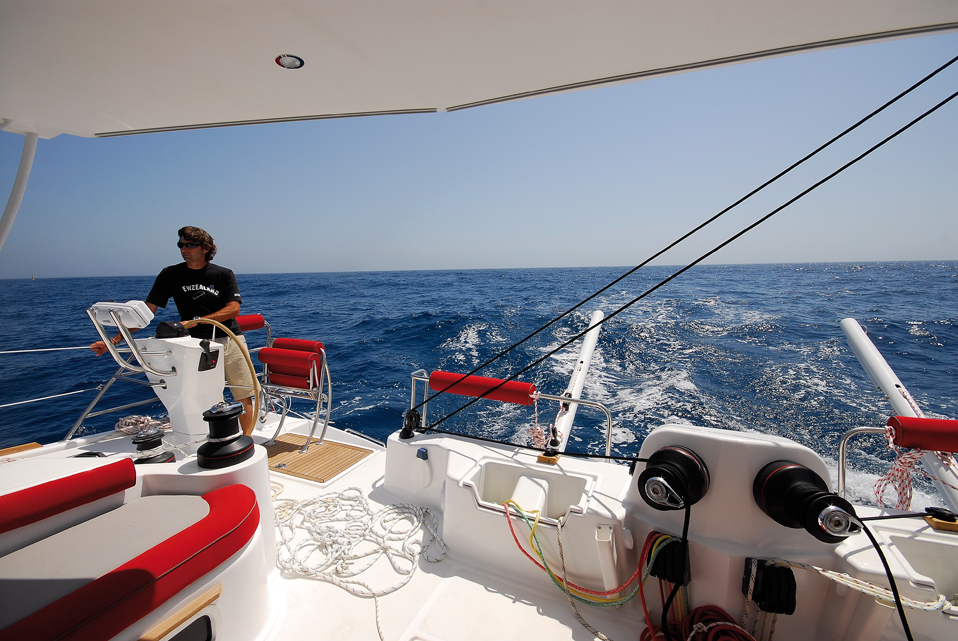
Aft steering positions and centralised control line console, the distinctive signs of Catana cockpits.
A moving commercial strategy
Consulting the archives, it can be seen that the 472 Caligo cost 840,000 euros, exc. VAT in 2000! Of course this prestige version included a computer, flat screens and a microwave in its inventory, but today, this panoply no longer impresses anyone, a laptop with Maxsea performs better than a ‘marinised’ tower from that period, and flat screens have come down from their technological pedestal and are being sold everywhere at knock-down prices. Catana’s choice in offering a top-quality basic version, (without the rigid bimini, generator, carbon mast,...) seems relevant; it is intended for those who have a budget they can’t exceed and who are ready to put time and effort into personalising their boat’s equipment. The ‘Ocean Class’ model reaffirms the builder’s ‘Grande Croisière’ standard (full electronics, carbon mast, watermaker...). Catana is even offering a list of ‘custom’ options, (glass-carbon composite forward crossbeam, carbon bimini, steering columns and deck in the same material), aimed at producing lighter, exclusive boats. This variable geometry strategy back to back with a flexible, modern production tool should attract a renewed clientele.
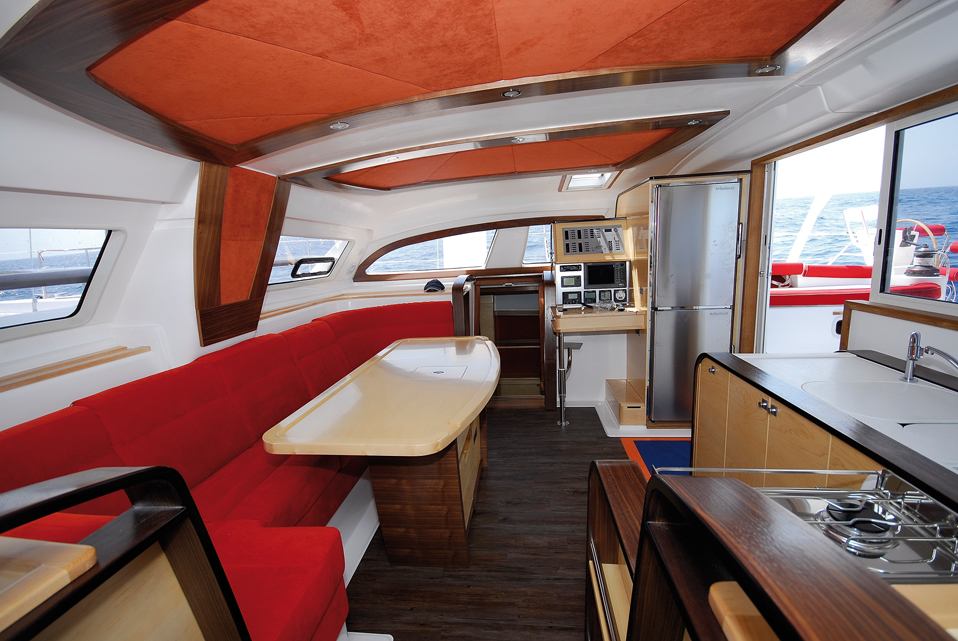
Inside, the light is superb, the saloon comfortable and the galley and cold storage volumes are perfect...
Classic architecture
The 47’ has the same overall dimensions as the 471, but brings several developments. Christophe Barreau has resisted the temptation to enlarge the hulls so as not to increase the wetted surface area; he has skilfully concealed a small progressive ‘step’ in the hull side which allows a few precious centimetres to be gained inside the hulls. The nacelle is high above the water, the hulls are typical of the architect: bulbous, flared bows, slim forward sections... The restyling of the sheer line and the lateral illumination improves the perception of the very vertical hull sides of the 471 generation. The coachroof follows current trends and improves the internal volume, whilst remaining reasonably proportioned.
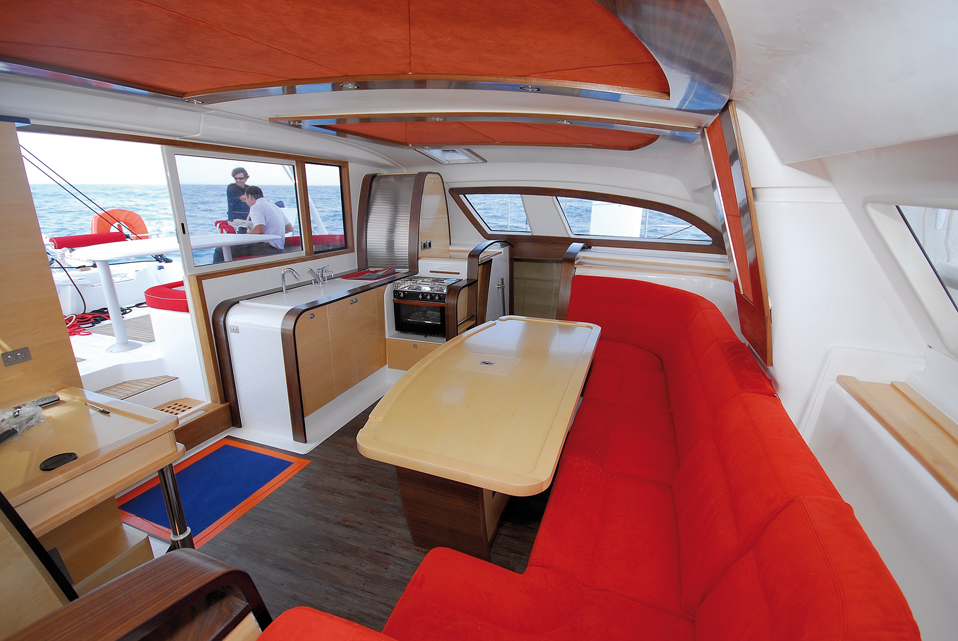
The version we tested was a demonstration model... Hence the different types of wood used. You either like it...or you don’t!
A beautiful fast cruising catamaran
The Ocean Class version put at our disposal is the first example of the series; it only called on the tester’s indulgence on minor points. It is moreover amazing to note the maturity of the designers and builders who manage to deliver perfectly finished prototypes. This demonstration boat’s design uses varied dark and light woods (walnut, oak, maple) and offers innovative volumes. Personally, I have some problems with the mobile stowage (under the saloon table) and the metallic shutters on the crockery lockers, but the exercise shows a palette of real expertise. The lighting is superb and the saloon, comfortable. The galley and cold storage volumes are perfect, but I regret that the navigator does not have a real reclining seat at the chart table, aboard a boat of this class!
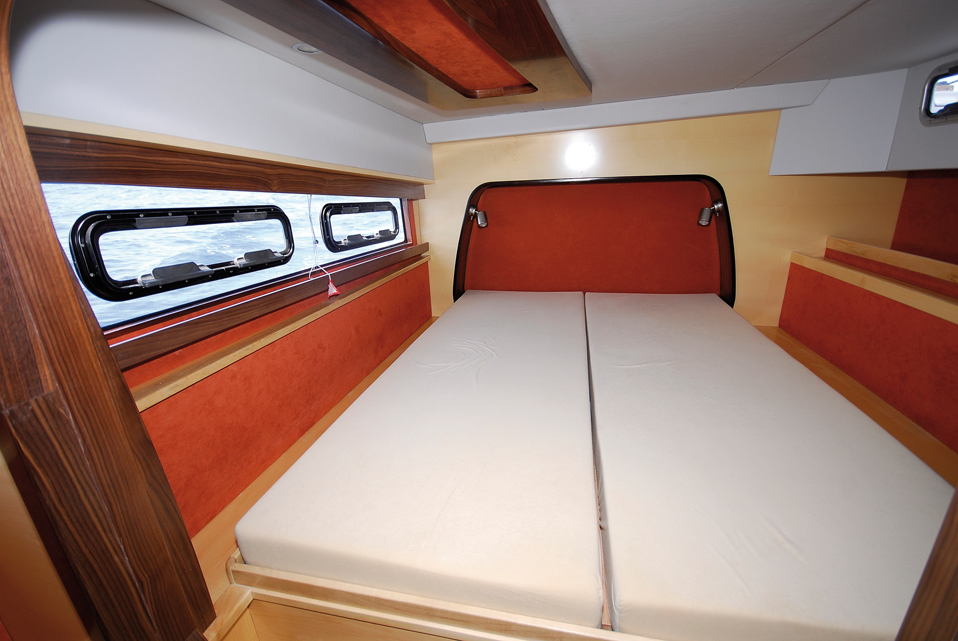
Cabin with a wonderful view over the sea...
The Catana 47' on the water
On climbing aboard, we find all the equipment which made the previous vintage such a success; aficionados of the make will therefore not be disconcerted; however, it is a completely different boat from the 471. The steering positions, moved to the back of the hulls, have folding seats which offer a good level of comfort and safety. The wheels, linked by Lewmar angle transmission to rigid track rods, form a reliable and pleasant-to-use assembly. Movement around the boat is optimised by the deck surfaces with no hatches, and the small differences in level with the cockpit. The grouping of the control lines in the central area is always popular; we regret just the absence of vertical visibility over the mainsail volume. At the helm, the boat can be manoeuvred easily with its two engines; there is lots of torque and power, well delivered by the Jprop propellers. During our test, carried out in 11 – 16 knots of south-westerly breeze, the 47’ showed good balance on all points of sailing. Happier in moderate to fresh breezes, like all the Catanas, it passed easily through the residual swell, helped by the bridgedeck height and the slim forward sections. The generous sail plan remains very easy to handle (with the two electric winches on the cockpit console). The permanently-rigged gennaker on its furler adds a little weight and windage forward, but when cruising, the simplicity of use is more important. The boat shows good longitudinal and lateral stability; you can let go of the helm for several tens of seconds without the boat going off course. Over all points of sailing, the Catana 47’ is fast for a comfortable cruising boat (between 7 and 11 knots in the range of our test). The square-headed mainsail gives a welcome bit of extra area, and presents no disadvantages in use thanks to the automatic stowage (by textile tackle) in the lazy bag when the sail has been lowered. Care simply has to be taken to free the sheet a little before tacking, to facilitate pivoting.
CONCLUSION
The Catana 47’ is a seaworthy and elegant catamaran. The platform’s qualities are real and allow it to keep up with its older sister in the strong winds and rough seas offshore. This model’s maturity will involve balancing the style of the accommodation, but the availability of the joinery workshop, as well as the overall care taken with the construction should contribute to its success. The simple, lighter ‘custom’ version will not be handicapped by the aluminium mast (excellent quality: Maréchal); a correctly-sized electric winch will be almost essential when short-handed aboard this powerful catamaran.
The plusses
- Overall concept
- Improved construction quality
- Balance and seakeeping qualities
The minuses
- Slightly ostentatious style of the accommodation
- Engine sound insulation and watertightness of control panels could be perfected
- Mainsheet block swivels
SPORT : 3/5 COMFORT : 4/5
The competitors
| Model | Architect | Builder | Sail Area in m2 | Unlaiden weight in t | Price exc. VAT euros |
| Freydis 46' | E. Lerouge | Tournier Marine | 127 | 9 | 415,000 |
| Nautitech 47' | Mortain/Mavrikios | Nautitech | 115 | 11.3 | 440,400 |
| Outremer 49' | Barreau/Neuman | Outremer | 132 | 9.5 | NC |
| Fast Cat 455 | Lavranos | African Cats | 125 | 7 | 560,000 |
TECHNICAL SPECIFICATIONS
- Architect: Christophe Barreau
- Builder: Catana
- Material: Foam/glass/vinylester sandwich, Kevlar reinforcements, infusion process
- Length: 14.02m
- Beam: 7.60m
- Unladen weight: 11t
- Daggerboards/keels: daggerboards
- Draft: 0.75/2.80m
- Air draft: 21m
- Mainsail area: 88m²
- Genoa: 53m²
- Gennaker: 80m²
- Mast: 19.50m, aluminium Maréchal for the basic version, carbon for the Ocean Class version
- Engines: Yanmar diesel 2 x 39hp
- Transmission: Sail drive
- Water: 670 l
- Diesel: 600 l
- Used water: 55 L
- Price, exc. VAT: 529,600 euros in basic owner’s Custom version, with 5-year structure guarantee 720,175 euros in Ocean Class version (full ocean cruising equipment).