
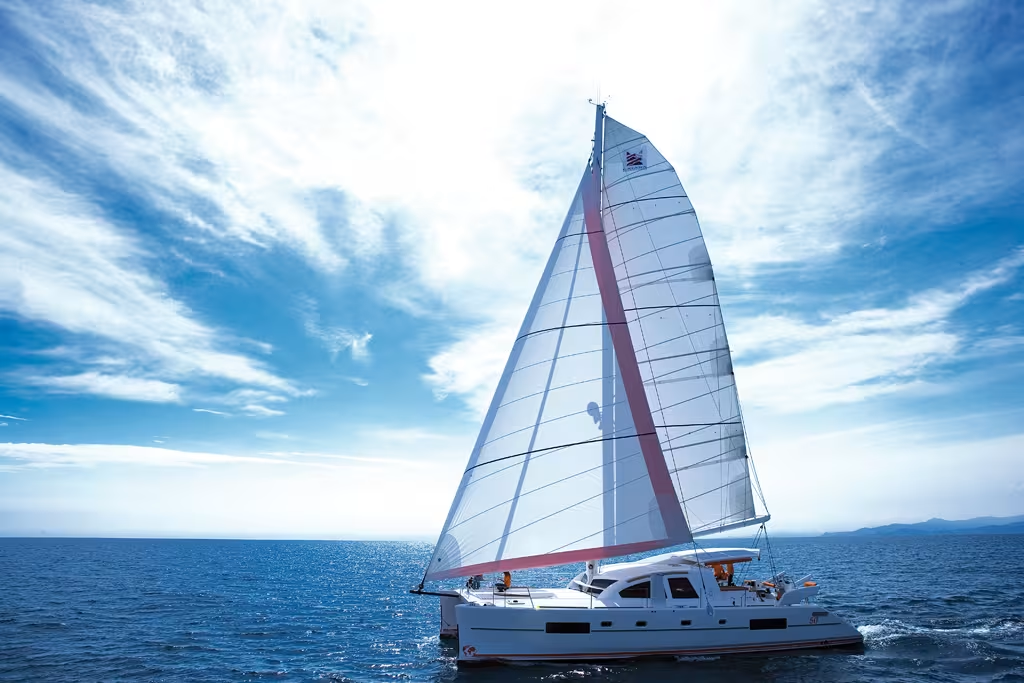
After briefly taking in a reef in 2004, the builder with the effigy of the Japanese sabre (the katana is the samurai’s emblematic weapon) has regained its fighting spirit and is once again feeding a prestigious image; the range seems to be grouped around the 50’ model, between the 43’ and the future luxurious 65’. The brand’s customers continue creating the legend behind Bruno Nicoletti (twice around the world via the southern latitudes, with a 44’ and a 470) by visiting Antarctica (DOUBLE MAGIC, a 431') and Patagonia (WILDLIFE, a 47'), we have even heard talk of a Catana custom (nearly 90’ long!) in the North-West Passage.
Infos pratiques
- Le chantier : Catana 50
- La fiche technique
- Découvrez notre vidéo exclusive
- Financez votre Catana 50'
- Assuez votre Catana 50'
- Articles autour du Catana 50'
Participatory specifications
During the development of the overall project, a survey of the brand’s owners allowed numerous opinions, suggestions and feedback to be gathered. From this basket compiled by the in-house masterminds (architect, research and development, marketing), came a synthesis which was representative of Catana’s values, enriched with the new trends: an up-market description making the first models appear Spartan.
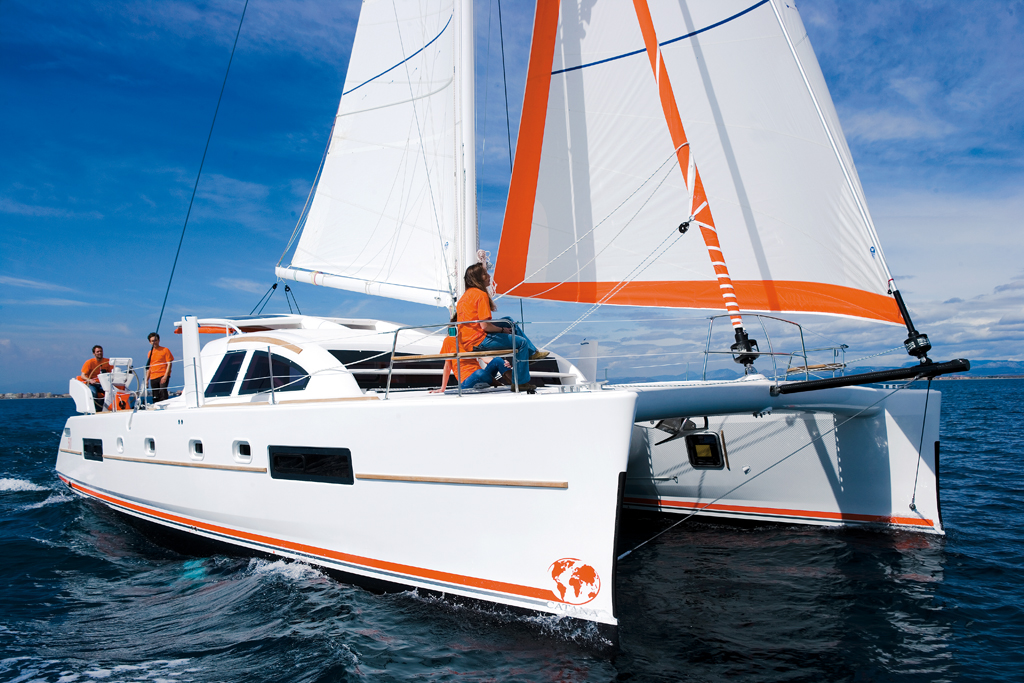
Very beautiful lines for the latest from Catana.
A Sybarite’s boat
The ambition of producing an owner’s catamaran offering the services of a small yacht, whilst pleasing everybody and remaining anchored in the builder’s philosophy, is clearly displayed. Analysis of the standard inventory evokes the old upgrade version 2s (472-582). The idea of a multihull to live aboard at all latitudes - strong, seaworthy, with a long range and capable of motoring or sailing in (almost) any weather - seems to be the pivot of the 50’ project. To achieve this aim, excellence must be the target in all aspects; I invite you on a detailed visit.
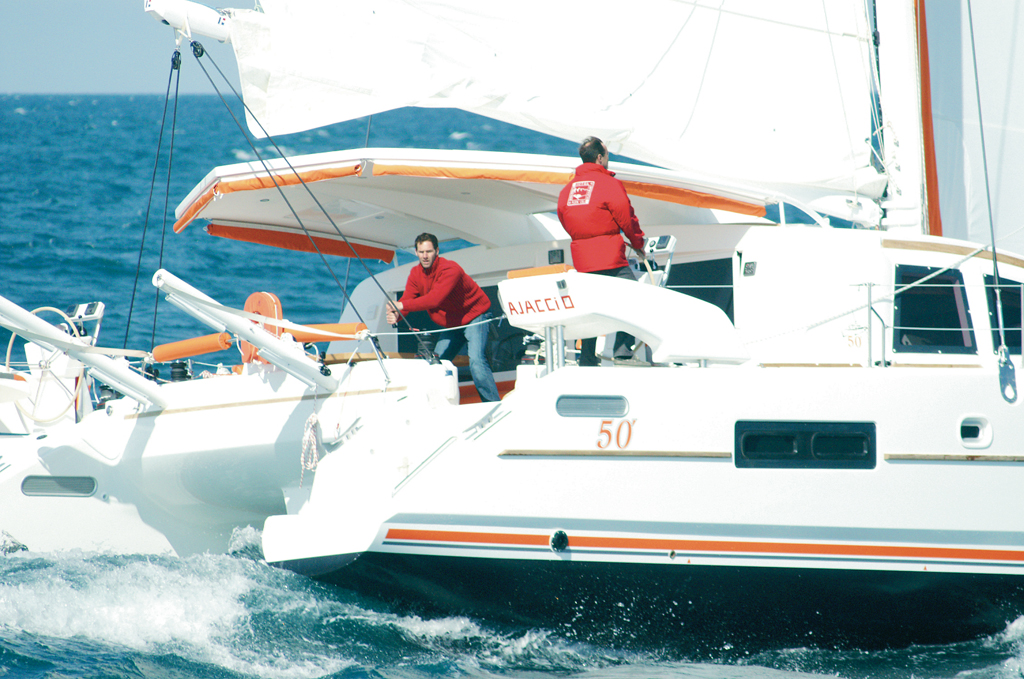
During our test, the conditions were rough: a real pleasure!
A modern catamaran rig
The 21.5m carbon tube (one set of swept-back spreaders) is superb. This profile has been well tried and tested; it can be used as a rotating mast, but Catana tradition has rejected this solution. The ‘stick’ supports a mainsail with an impressive area (98m2), completed in light weather by a 100m2 code 0 (reinforced gennaker, quite flat, on a carbon bowsprit)! This power must not disguise the company’s thoughts on strong wind sailing: from 15 – 18 knots of true wind, the general purpose configuration is 1 reef – jib (then 2 reefs, full jib). The sail plan’s balance is then very tolerant and will allow sailing in heavy weather, avoiding as much as possible the tedious reductions of the genoa and adjustment of sheeting points; the jib (on a rod forestay) is attached to the forward crossbeam. In use, this catamaran has the reactive behaviour of a cutter, rather than that of a sloop with a bowsprit. The Kevlar cap shrouds complete a well thought-out package, whose users will appreciate the variable geometry.
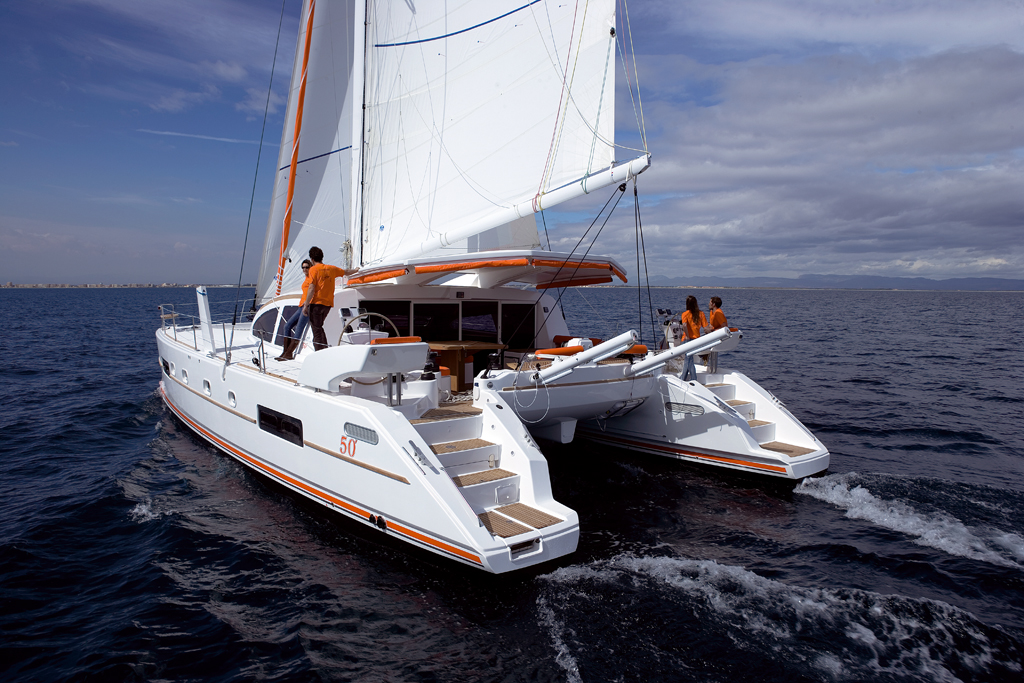
The 50’s hull works wonders: comfortable and fast!
Top-of-the-range fittings for rapid intervention.
Since the 431, the company has led all control lines back to the cockpit, to an electric winch. At first, this arrangement was controversial (two 90° returns) before later being endorsed by the users. It has therefore been retained aboard the 50’; the same is true for the removal of the mainsheet track in favour of two block and tackles on dedicated winches. The choice of Harken for all the fittings (winches, blocks, roller-reefing) is to be applauded; this is a guarantee of long life and reliability.
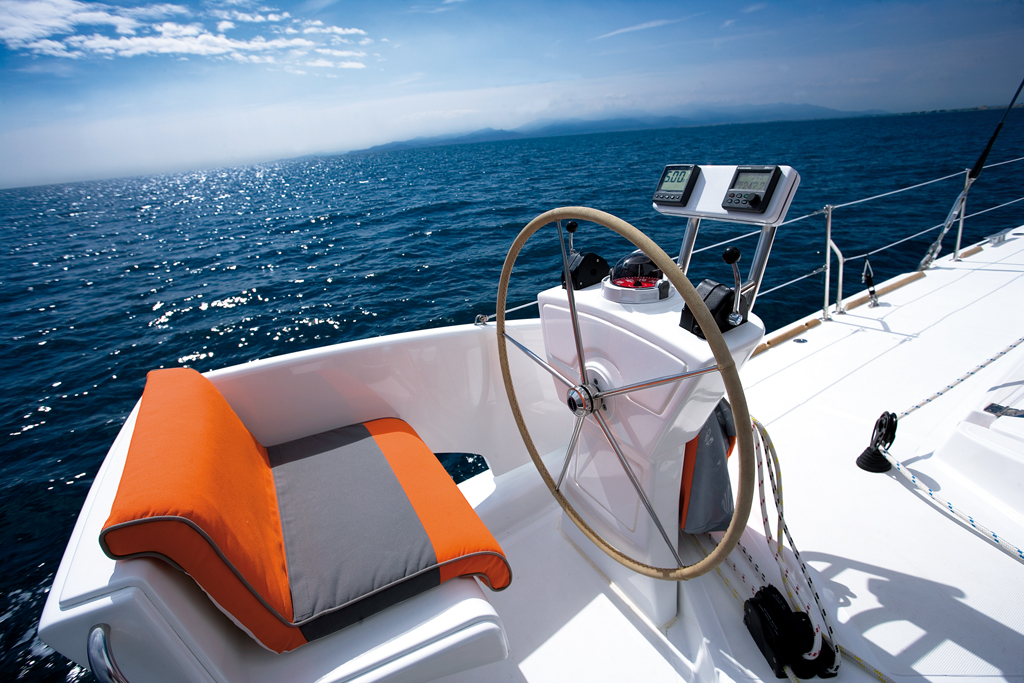
The steering position, from where even the electric winch can be controlled: a must!
Generous propulsion
The choice of 75hp, 4-cylinder Volvos (Yanmars possible) shows the wish to give the 50’ ample engine power to cope with any circumstances. The versatility of these engines and the excellent three-bladed folding propellers allow the optional mountings (and the related problems) to be avoided by offering just one perfectly adapted piece of equipment. The torque available will allow precise manoeuvres in windy areas (picking up buoys, crowded marinas) and will make the trips off the beaten track that certain of the company’s customers seem to be partial to, safer. The others will appreciate being able to cross anticyclones at an average of 8 knots. The high level of requirements for this boat means that the mechanical accessibility has been carefully-designed (ventilation, seawater intake, filters, circuit breakers); additional suggestion: why not fit anti-splash cowlings on the alternators?
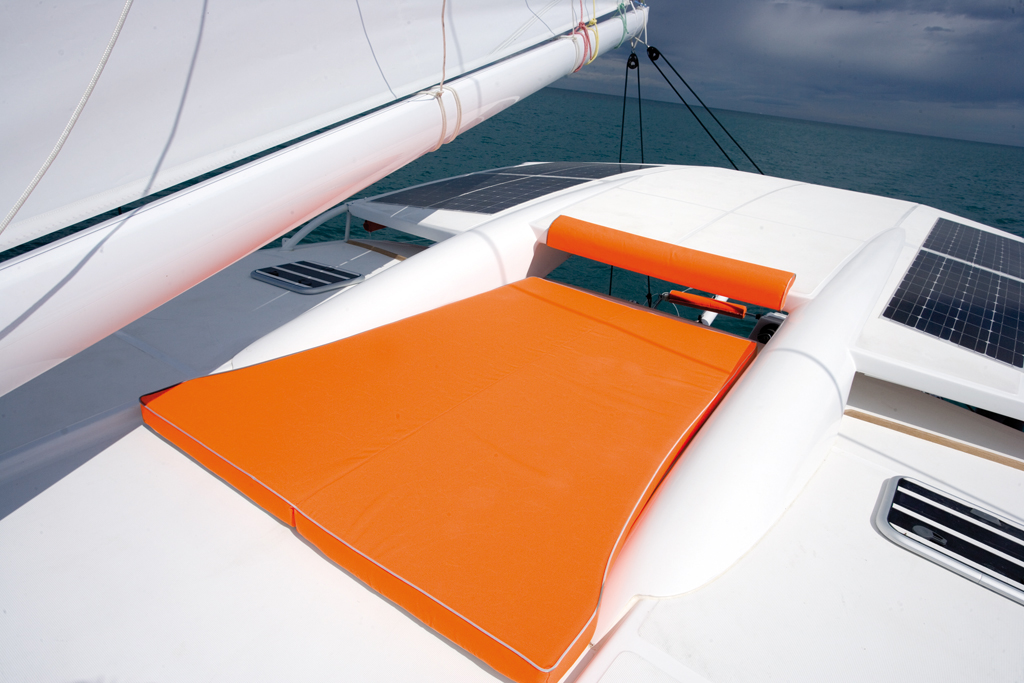
The sunbathing area on the rigid bimini, between the solar panels…
Assisted controls and steering by rigid rods
The sometimes rough gearbox–throttle controls have given way to an electromechanical system which is incomparably smooth and allows installation both port and starboard. The wheel – rudder transmission is entrusted to rigid rods by ball joints and Whitlock angle transmissions; this architecture is neither the lightest nor the most economical, but it is the most reliable!
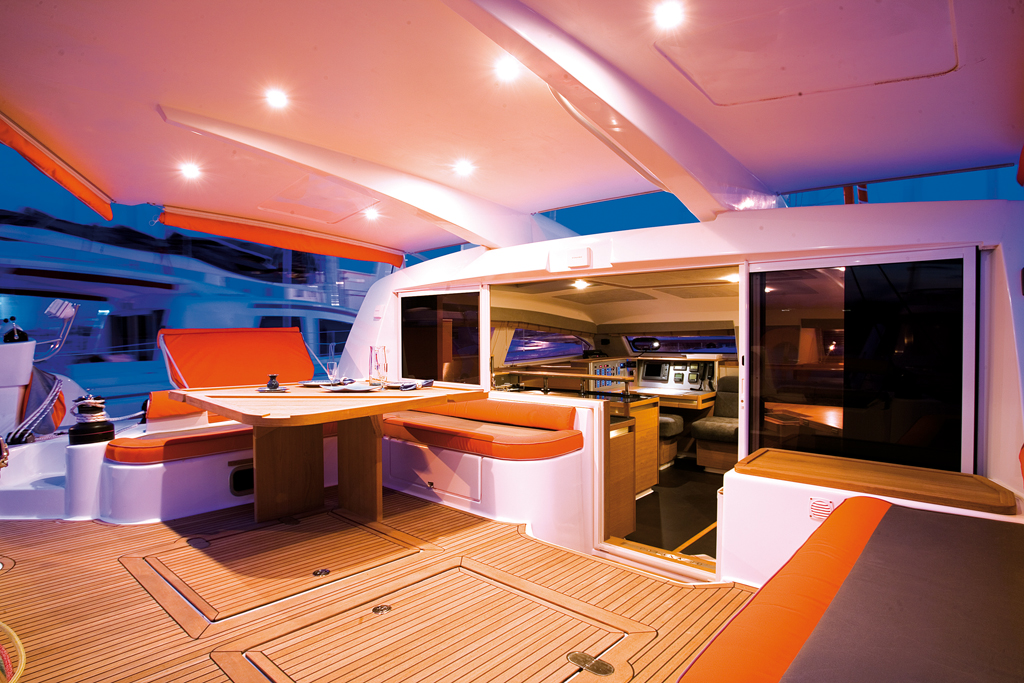
The cockpit is really pleasant and has many features; the fruit of the builder’s experience.
An unusual level of technical equipment for a production boat
700A/h, 24V Sonnenshein battery bank, Onan 7Kva generator (is this not too much? there are already 400W of solar panels!), full electronics, electro-hydraulic automatic pilot, 2000W Lofran windlass, 60m of stainless steel chain (12mm) and 80-pound Wasi anchor! The care taken with these ‘secondary’ areas (which are sometimes under-evaluated), reinforces the boat’s credibility. The ablutions are supplied via a reverse osmosis ‘factory’ producing 240l/h! The other side of the coin is that such a boat should not be put in the hands of negligent or inexperienced crews, otherwise the maintenance bill could be very high.
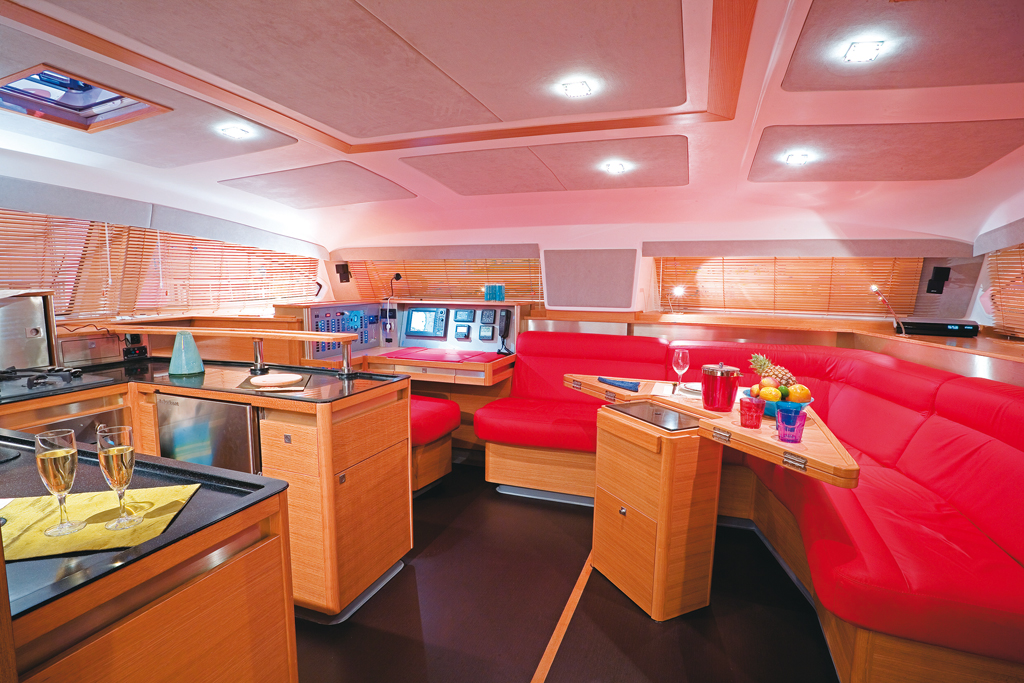
As always at Catana, the accommodation is both practical and pleasant to live in. And the finishing – top quality!
Welcome aboard
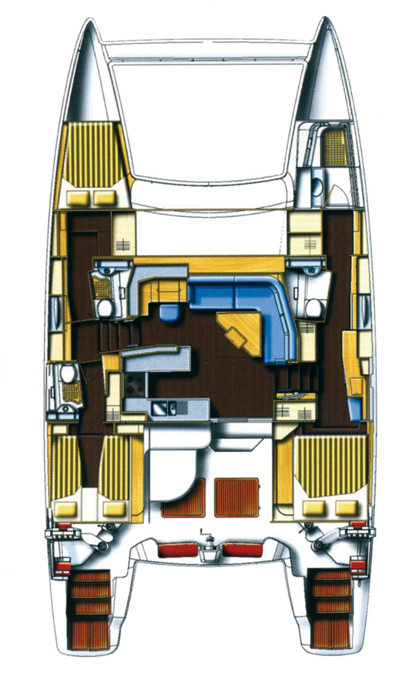
Access to the cockpit (completely covered in teak) is easy, thanks to the wide sugar scoops and the openings in the aft crossbeam; this area has many features resulting from the experience of demanding crews. The exterior saloon, to port, is deployed around a teak table, and just like its opposite number, offers backrests which can be converted to relax mode - very much appreciated! The aft manoeuvring area turns into a forward-facing bench seat; the excellent quality high-resilience seating is comfortable and pleasing to the eye. Textile panels, from the rigid bimini allow the cockpit to be closed, thus prolonging its vocation as an all-weather veranda.
Interior accommodation
The enlargement of the cabin roof and the volume of the hulls generate an amazing amount of living space. The general design is continued by Alcantara seating; African rosewood floors (dark tint optional) contrast with the overall light note of the joinery work. The Corian and brushed stainless steel show the trouble taken to create an attractive, practical galley, with a high level of equipment: waste disposal unit, microwave, stainless cold cupboards (positive-negative, chilled by exchangers)… The washing machine and the hifi-video system complete an impressive arsenal.
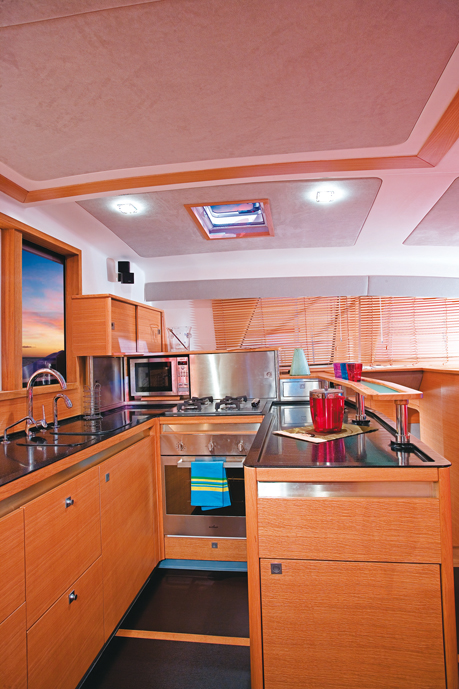
Corian, brushed stainless steel express the wish for an attractive, practical galley with a high level of equipment…
Reassuring build quality, but a bit heavy
The polyester phase is produced in female moulds at the Canet-en-Rousillon factory; the process makes widespread use of the foam/glass/polyester sandwich (vinylester below the waterline with a Kevlar skin on the inside). The addition of a structural forward crossbeam in glass/carbon composite, combined with a double beam bulkhead, increases the rigidity of the whole boat. Build quality is obvious, but a targeted effort should allow weight to be saved without harming the strength (rigid bimini, removal of cockpit diesel tank, use of sandwich in the accommodation…).
Remarkable comfort and manoeuvrability.
For two days, the test sails continued, with a choppy sea, squalls and a south-westerly wind varying between 12 and 20 knots. Manoeuvring qualities under power were obvious, despite the boat’s windage, as was the silence of operation (a plus for a boat intended for long stays aboard); I appreciated the feel of the digital controls! Outside the channel, the conditions were quite rough! Ideal weather for tangling the mainsail battens and the lazy jacks… But managing the electric winch at the steering position turns the usual slalom into a formality; not once did we have to re-lower the headboard or get rid of riding turns! The choice of ‘ratio’ is made easy by the availability of the sails and the assistance of the control line winches our test boat was equipped with. Under automatic pilot, an attentive crew member can hoist the mainsail, sheet in 100m² of code 0 and fine trim everything in a few minutes! In 15 – 17 knots of wind, the speed settled at around 12 knots on a beam reach. The daggerboards slide perfectly in their cases; an intermediate position (50% each side) is best in these conditions. In the afternoon, the south-westerly freshened to 18-19 knots, this would be the most interesting test, as there were just two of us aboard and we had to present the 50-footer with different sail configurations for the photographers. Taking a reef just needed a bit of organisation and skill to operate the piano correctly: free the sheet completely, then the halyard, take in the tack and the pennant, harden in; all this can be done in record time and with great economy of means (no effort, no movement), but be careful of the power available! With 1 reef and the jib, the sail plan was particularly homogenous and the rig presented an ideal triangulation of the cap shrouds and the jib forestay. Sailing close-hauled was pleasant, despite a lively chop; the slim forward sections and generous sail area allowed the boat to pass through the swell at 9 – 10 knots. As usual on the Catanas, pointing ability was quite satisfactory. The shape of the sails (North) was superb (a special mention for the Code 0), but it is a shame that a more developed cloth (Hydranet radial?) was not used for the mainsail; the foot was also a bit short. After a few tacks (kid’s stuff with the self-tacking jib!) we bore right away and unrolled the code 0; the speed climbed to 13 knots, steering remained precise and sensitive, the rudders’ directional effect allowed precise manoeuvres in the waves. Inside, there was no cracking from the structure; the silence in these already quite rough conditions was remarkable.
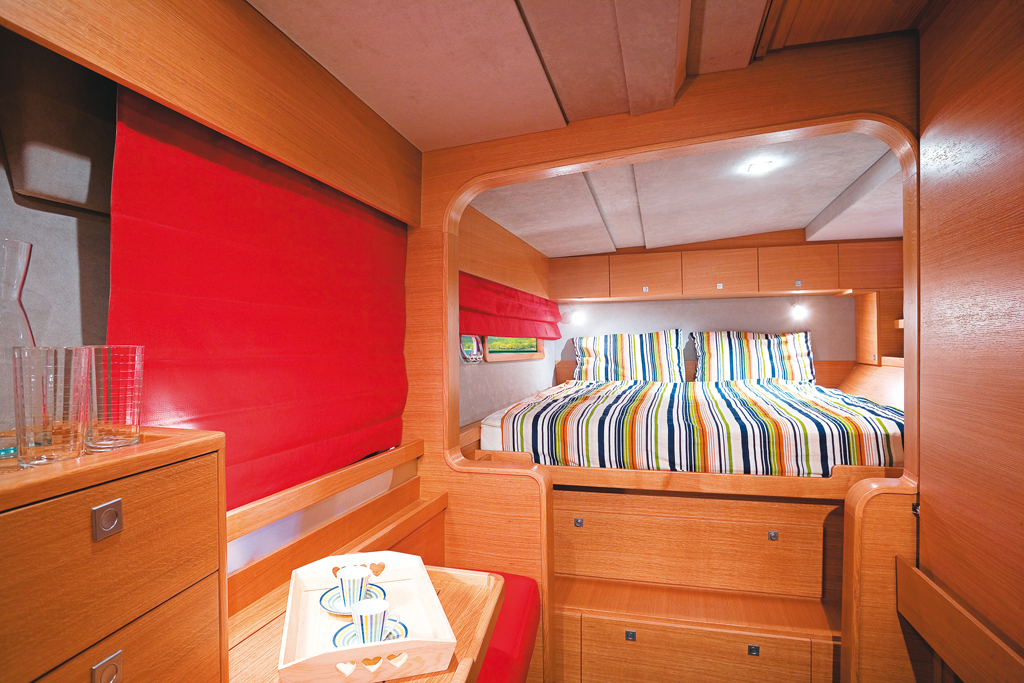
With cabins like these, you could go to the other side of the world with no problems…
CONCLUSION
The Catana 50' is a successful blue-water cruising catamaran; it offers a calm synthesis of tried and tested solutions and offers a rich amateur a compromise between comfort and behaviour suited to life aboard and ambitious programmes. The level of quality reached by the first models should allow the series to sell well; full maturity will mean a check on the weight of the less important areas. The boat sails well, the geometry is right; the combination of rig and fittings is a real success and will correspond to the brand clientele’s expectations.
The plusses
A coherent comfort-performance combination, top-of-the-range equipment. Practical sail plan. Remarkable engines.
The minuses
No fixed mainsail barber hauler (adjustable from the cockpit, essential for tightening the leech downwind). No protection of ‘hot spots’ on the halyards (mainsail and code 0 jammers). Scantlings of the stainless steel bowsprit articulation plate a bit light.
TECHNICAL SPECIFICATION
Builder: Catana Canet-en-Roussillon (66) Architect: Christophe Barreau Material: foam/glass/polyester sandwich under vacuum, with internal Kevlar skin below the waterline. Approval: CE category A (high seas) unsinkable Length: 15.20m Waterline: 15m Beam: 7.20m Unladen weight: 16.6t Max. displacement: 21.2t Draught: 1.2/2.95m Air draught: 23.70m Mast height: 21.50m Mainsail area: 98m2 Jib area: 36m2 Code 0 area: 100m2 Mast: Carbon fixed self stayed by Alucarbon Rigging: Kevlar cap shrouds, jib forestay in rod, Code 0 forestay in single strand Engines: Volvo 2 x 75hp saildrive, three-bladed folding propellers Water: 2 x 400 l Diesel: 2 x 430 l + 1 x 215 l Hot water: 2 x 55 l Black water: 3 x 55 l Grey water: 1 x 80 l +1 x 10⁶ l Watermaker: Aquabase 240l/h Generator: Onan 7kvA Solar panels: 400W Price ex. tax: 920,000 euros
Crossing Canet-en-Roussillon/Tunisia aboard TIMAIOS, Catana 50' N°3
Three of us (my wife, a friend and I) left for the delivery trip from Canet to Tunisia at the end of April. The usual Tramontane – Mistral hit us as we crossed the Golfe du Lion, blowing into our three reefs at 35/40 knots. Almost sailing by the lee, we chose to run before the weather with very little sail and no foresail; the speed varied between 9 and 12 knots, 15 when we surfed. Despite a rough sea (3-4m) with a few breakers, comfort aboard remained very satisfactory. We stood our night watches inside, with the help of the radar and the GPS chart plotter, and didn’t notice any particular impacts against the nacelle, or noises from the structure. Twice during the night we broached across the waves. With the daggerboards raised, we had a fright, but there were no serious consequences. After a stop at Porto Cervo, we continued with a ‘summer cruise’ in the lee of the east Sardinian coast then after another storm from the north-west, we finished in the middle of the night off Cap Bon surrounded by traffic. This lively delivery trip with a new boat was imposed on us by professional demands; whilst not recommending the formula, it allowed us to gain confidence in the new boat and to appreciate its comfort and safety. It is stiffer than our previous Catana 47’ and sails well (an average of 8.5 knots over the whole trip) whilst being more comfortable.