In 2013, the Catana 59 designed by the in-house design team in association with Marc Lombard caused something of an internal revolution, as the 47 and 42 foot models were the only ones still in the range which had been drawn by Christophe Barreau. The spinoffs from the 59 had carried on and we now have the 53 which we expect to see in the spring of 2017 along with the recently launched 62. We had the chance to try out this big cruising catamaran in testing conditions (big wind and big seas) during a dynamic delivery of 140 miles across the Golfe du Lion in the Mediterranean.
Infos pratiques
- Le chantier : Catana 62
- La fiche technique
-
 Découvrez notre vidéo exclusive
- Financez votre Catana 62
- Assuez votre Catana 62
- Articles autour du Catana 62
A capable model
Despite being a descendent of the 59, the Catana 62 is a new boat. She has absorbed all of her predecessor’s experience and has evolved with significant improvements in terms of dynamic characteristics, centering of weight and the construction process itself.
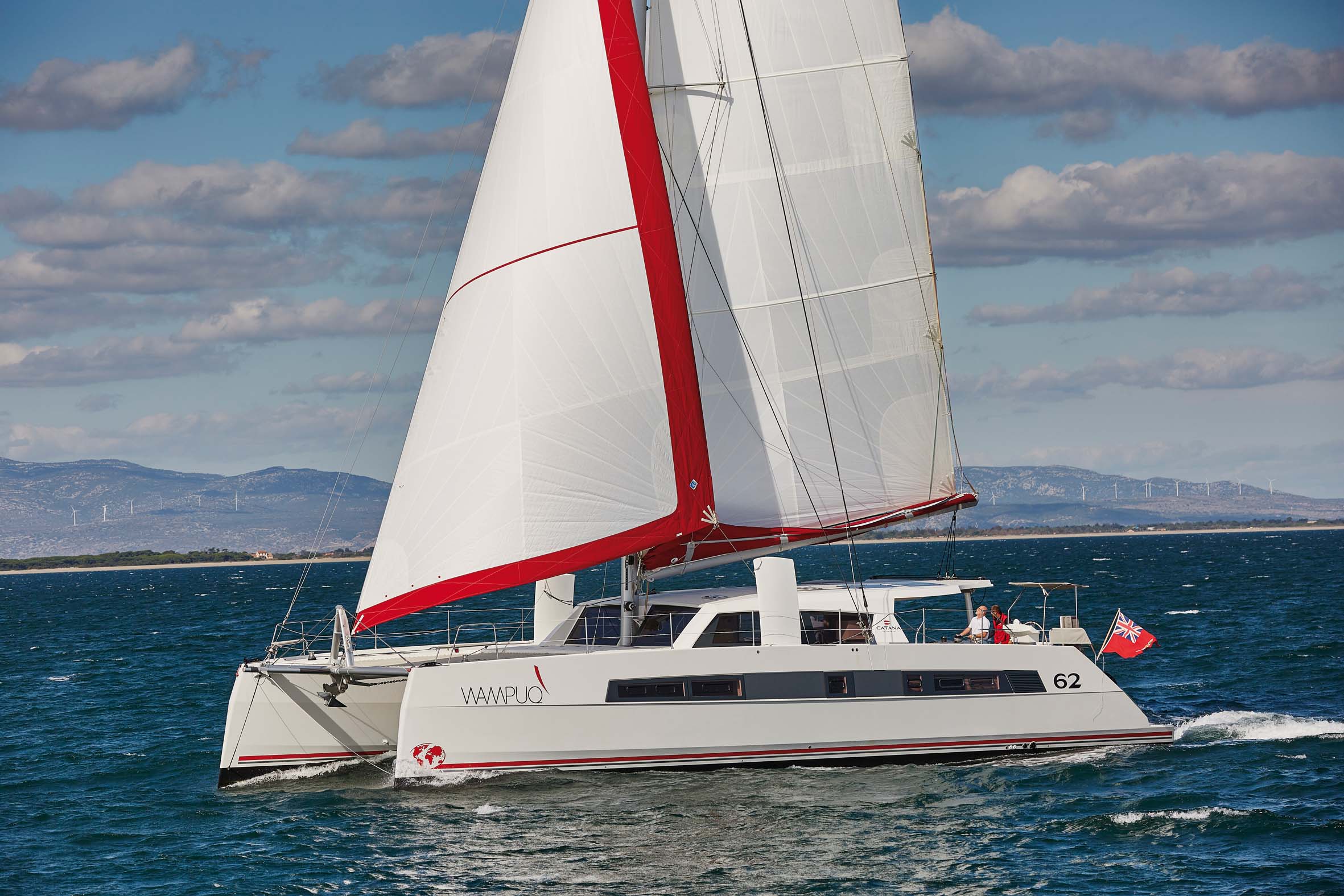
Nice lines
With an extra 90cm of length, the 62 fully expresses the power of this design, with a high freeboard, very good bridgedeck clearance, a light sheer at the deck-edge and a generous sailplan. The muscled-up appearance indicates this adventurer’s vocation, and the lines which seemed audacious four years ago can now be better appreciated. The profile shows this boat’s strong personality, characterized by slightly inverted bows and the straightness of the topsides being broken by a rib which runs longitudinally, highlighting the strip where the portlights are found.
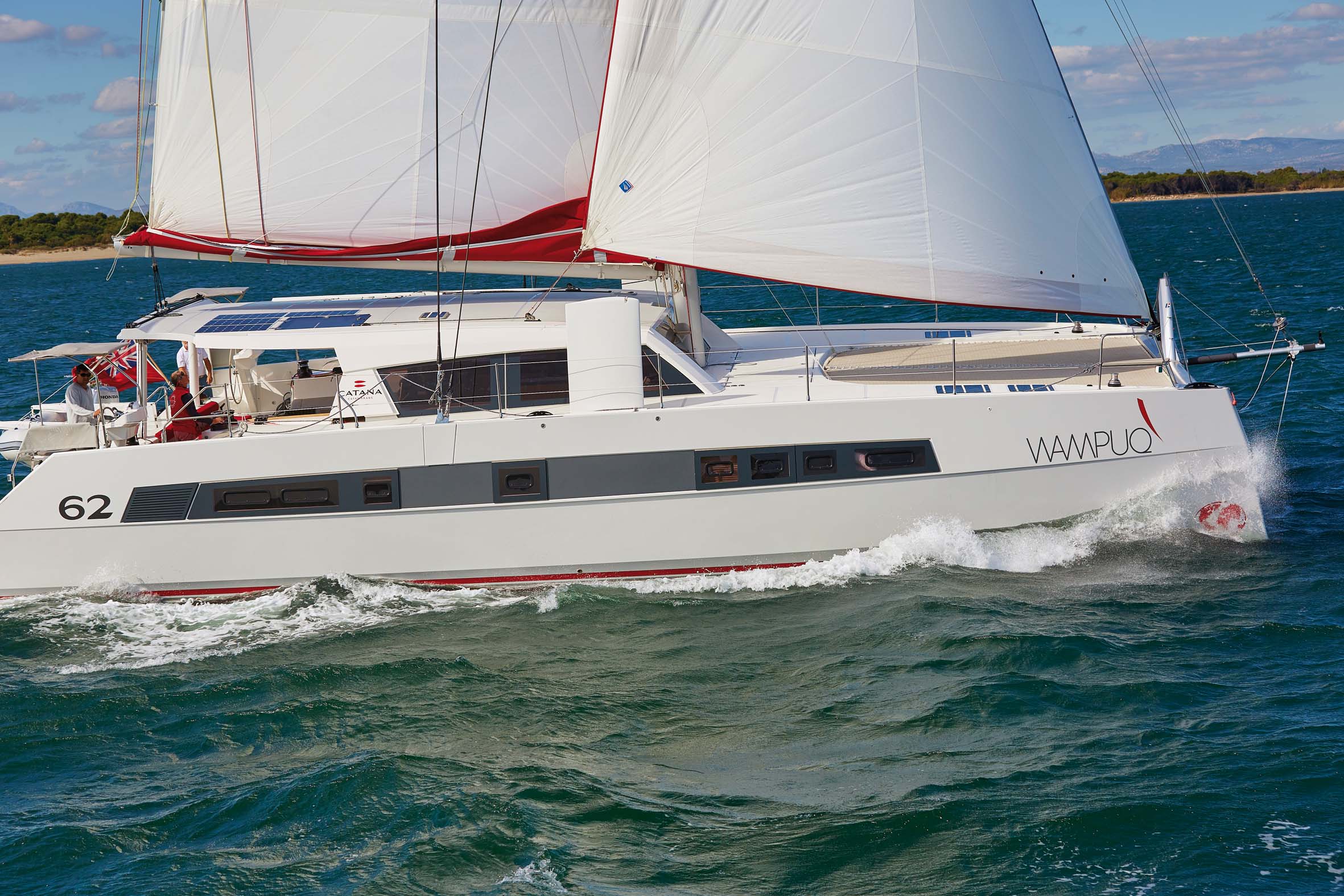
An exacting build
The production facility at Canet en Roussillon in the South of France is a vast and modern factory. The amenable climate in the Perpignan region limits extremes of temperature and provides long periods of natural conditions favorable to composite curing. The 62 is built in one main mold, comprising the nacelle and the two inner half-hulls; the two exterior half-hulls being welded together by laminating the joint down the line of the keel. From outside to inside, the procedure of laminating the sandwich is as follows: the chosen gelcoat is first applied to the molds before the multidirectional glass cloth. Next comes the 80kg/m³ foam, and then the internal skin (also in multidirectional glass) with Kevlar Twaron Impact cloth applied to the more exposed areas. The whole is then infused with vinylester resin which protects the composite from hydrolysis. The lower areas are in monolithic laminate, being both easier to build and stronger where it’s required. The bulkheads, in airex/carbon infused on marble are fixed to the rest of the platform with internal corner joints (manually laminated with strips of cloth to seal them); openings for doorways and plumbing and cable runs are cut during fabrication, allowing the skins to be closed over, avoiding any future delamination and so guaranteeing longevity. The carbon frames then help to stiffen the hulls; and the deck assembly (with the coachroof also in carbon) closes this “box” mechanically by gluing and laminating, making the whole structure very resilient.
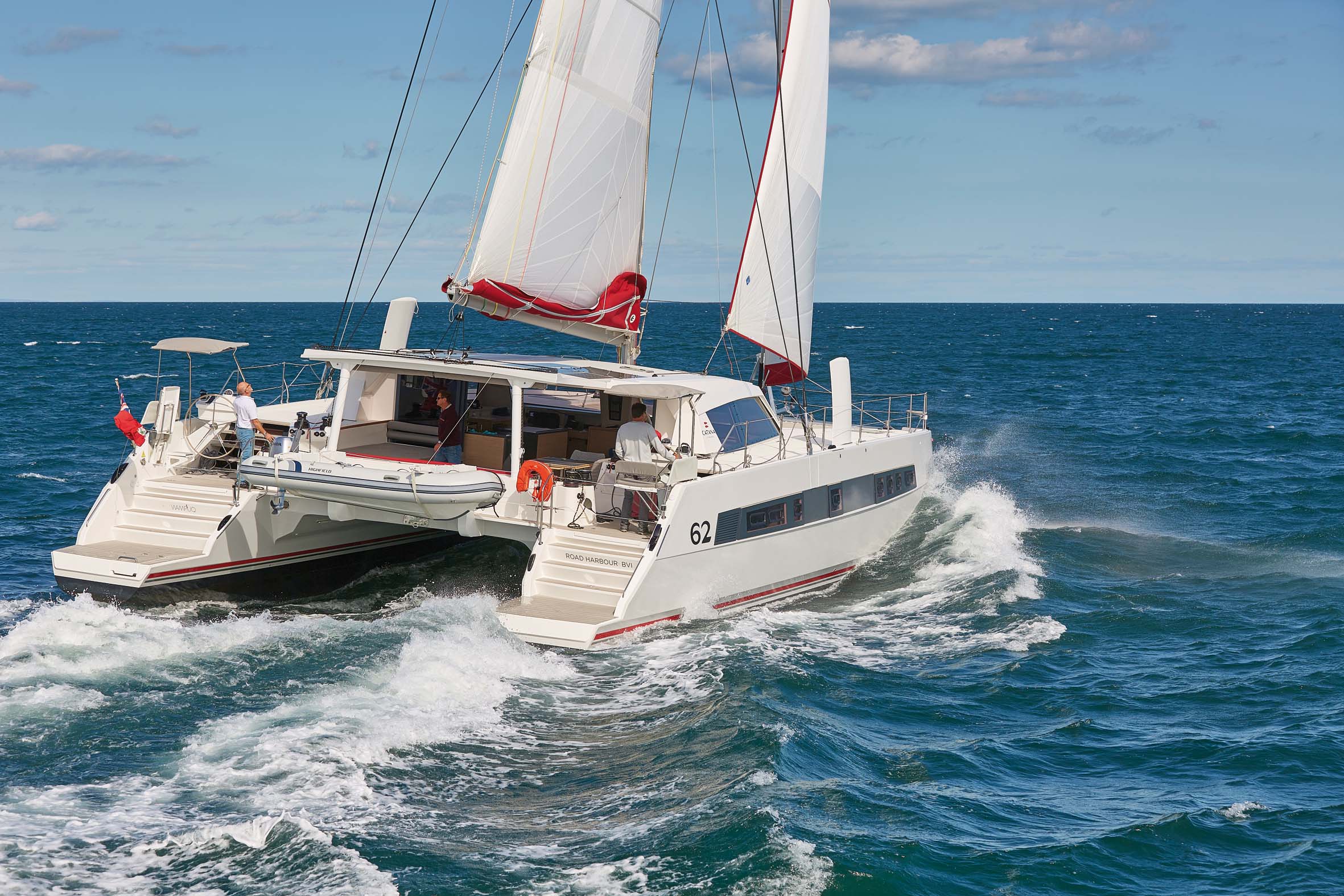
Choice of power: Easy or Performance?
The 62 includes some of the builder’s recent equipment modifications: she’s delivered in a “sailaway” version, ie. ready to use, with launch and handover included. The mast on the Easy version we tested is of top quality, and is made by JP Maréchal. It has a single set of spreaders and no runners, held laterally by fiber rigging (optional) and longitudinally by a stainless forestay. A self-tacking solent is standard, but this owner has chosen an overlapping genoa. The bowsprit and stormlite gennaker by Incidences (like the Dacron main and foresail) are part of the Easy pack. A more radical Performance version is available with a fixed carbon mast by Axxon, fiber rigging, carbon compression beam and an optimized sailplan (mainsail, gennaker, code 0, genoa on a structural stay with all-or-nothing furler and solent on a removable forestay). A neat selection, all in D4 membrane for some fun with a crew!
Interior: A big contemporary cruising multihull
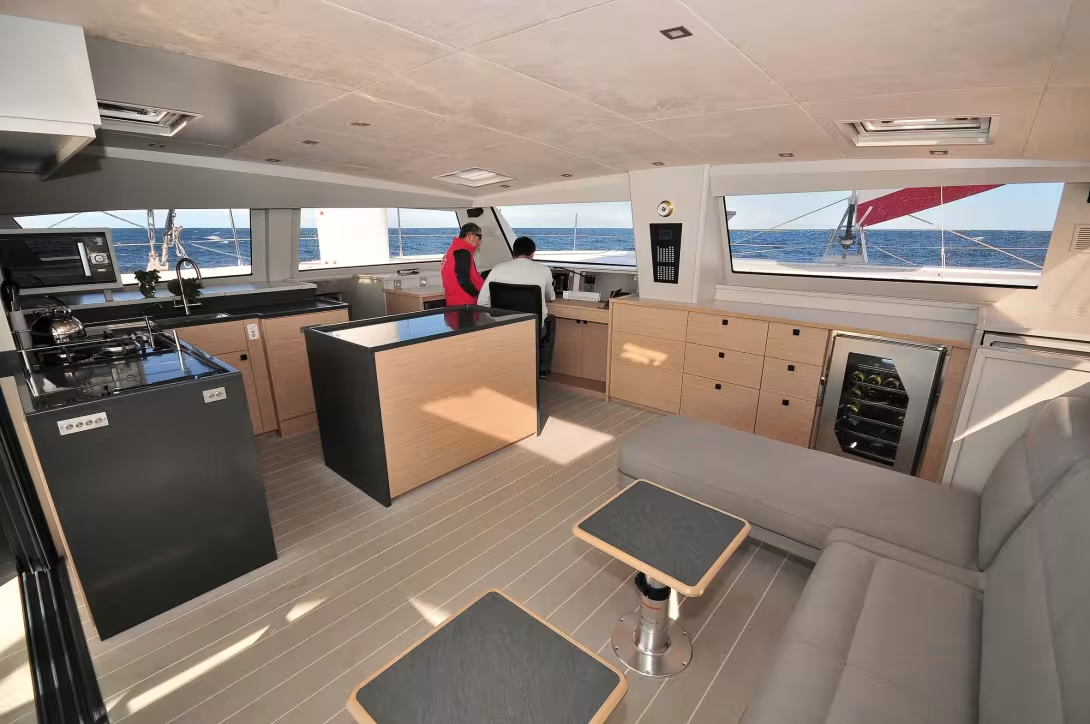
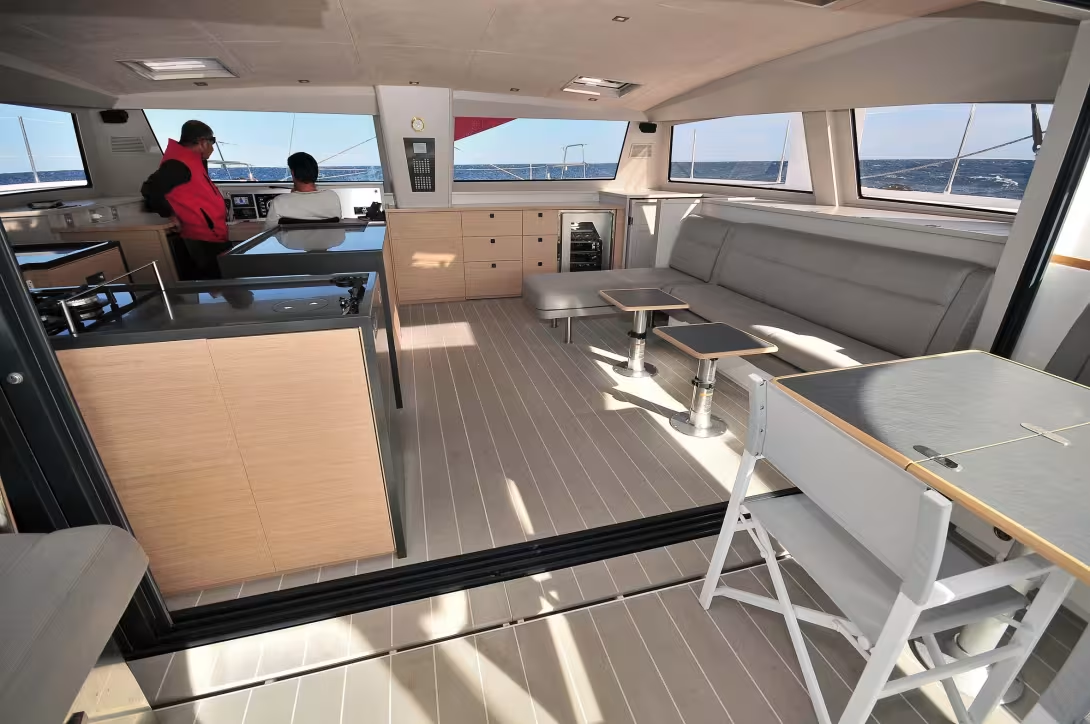
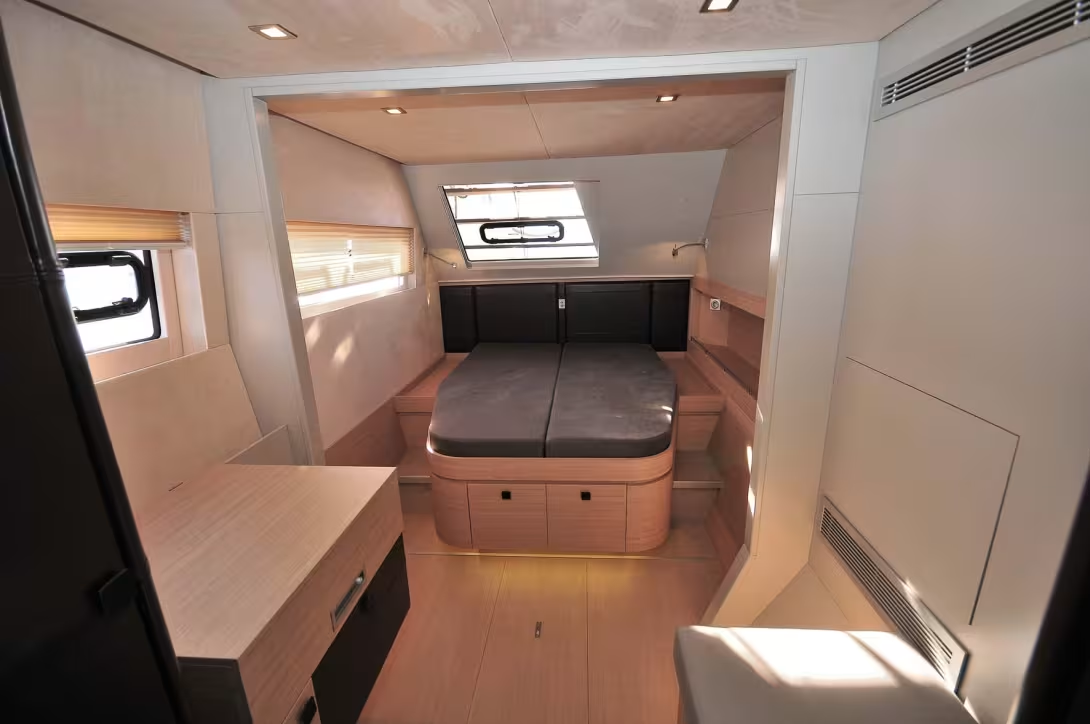
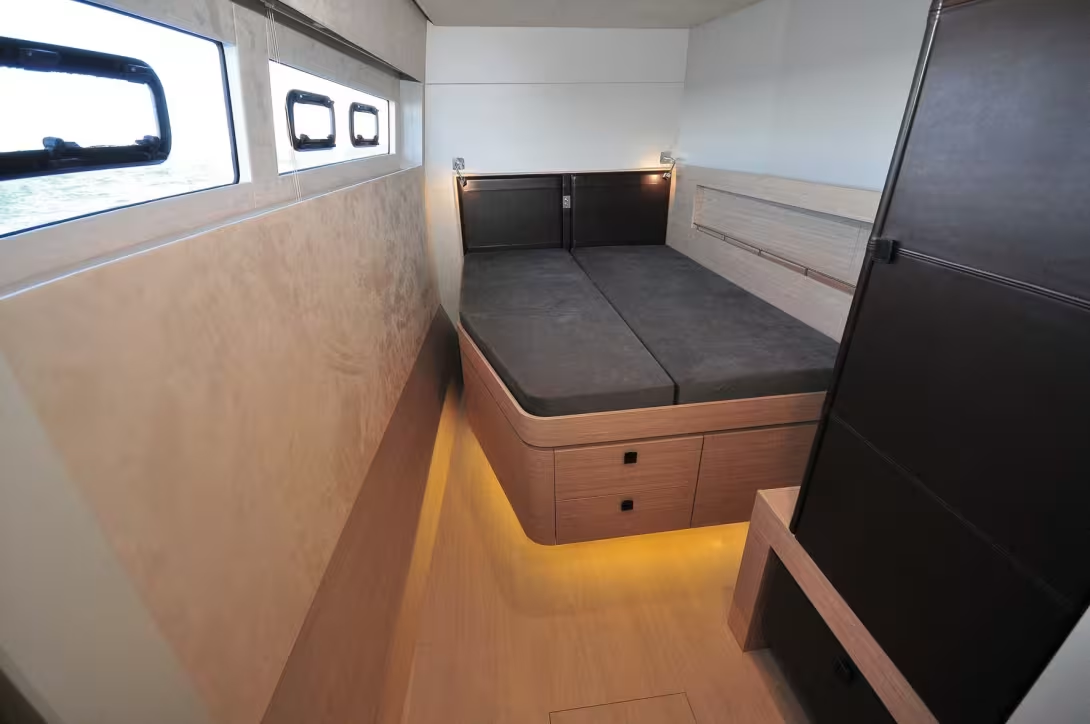
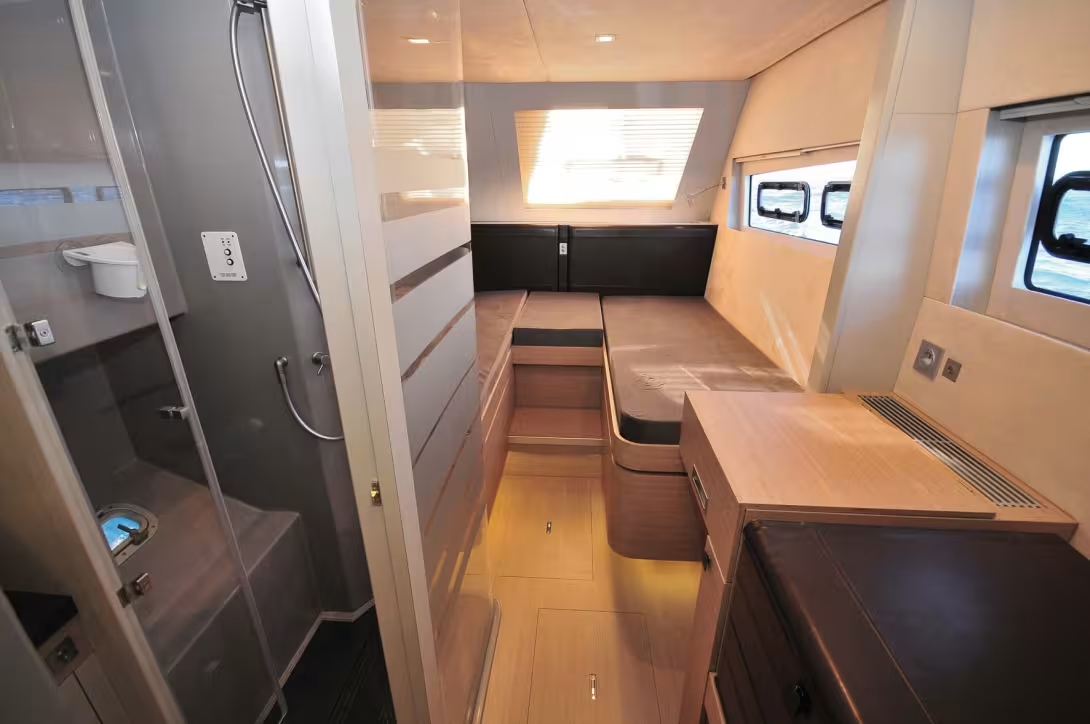
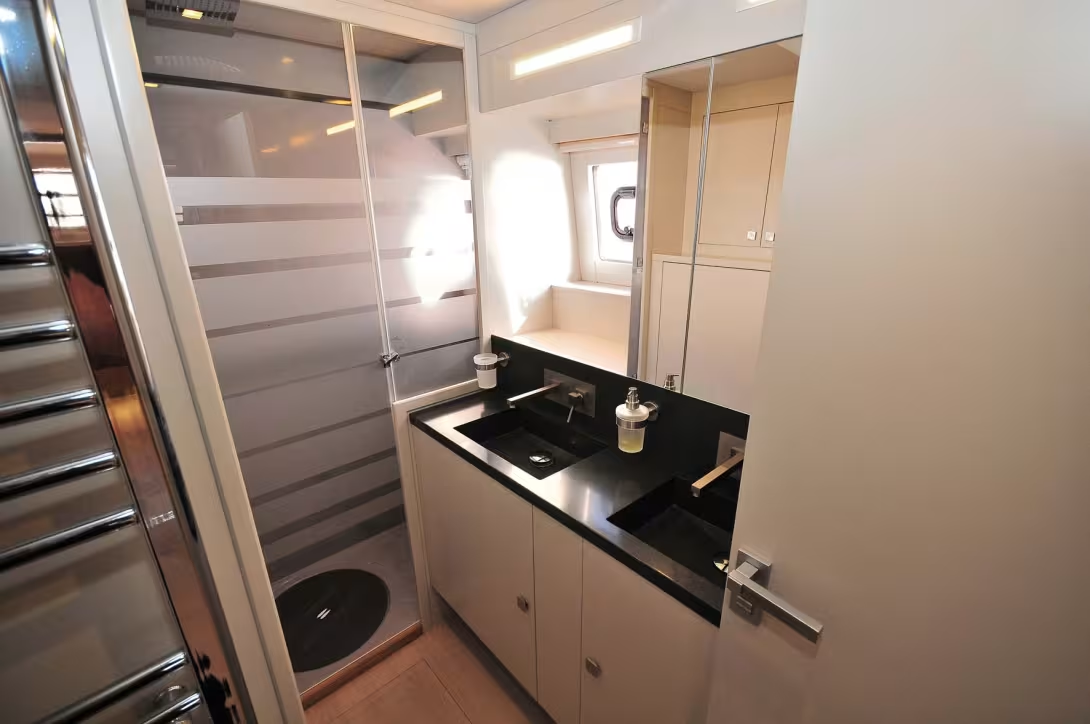
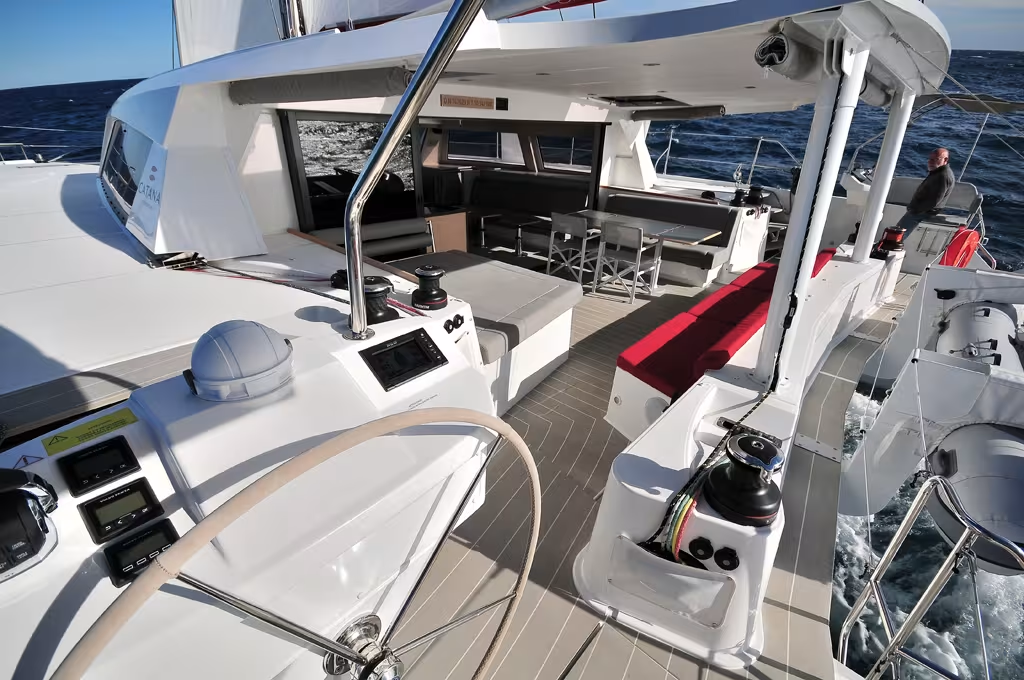
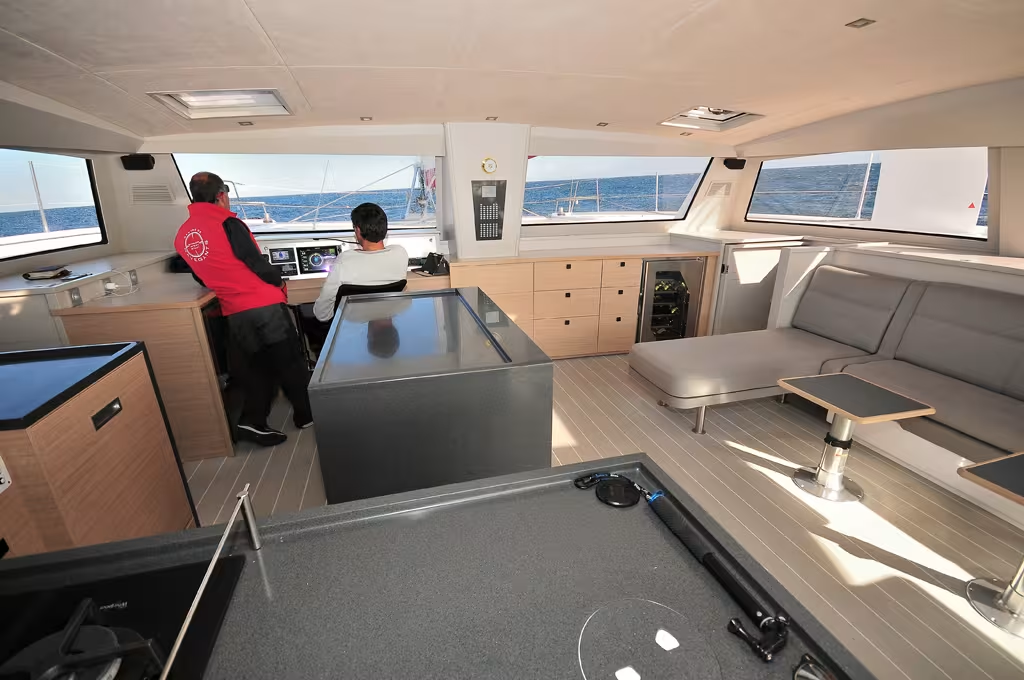
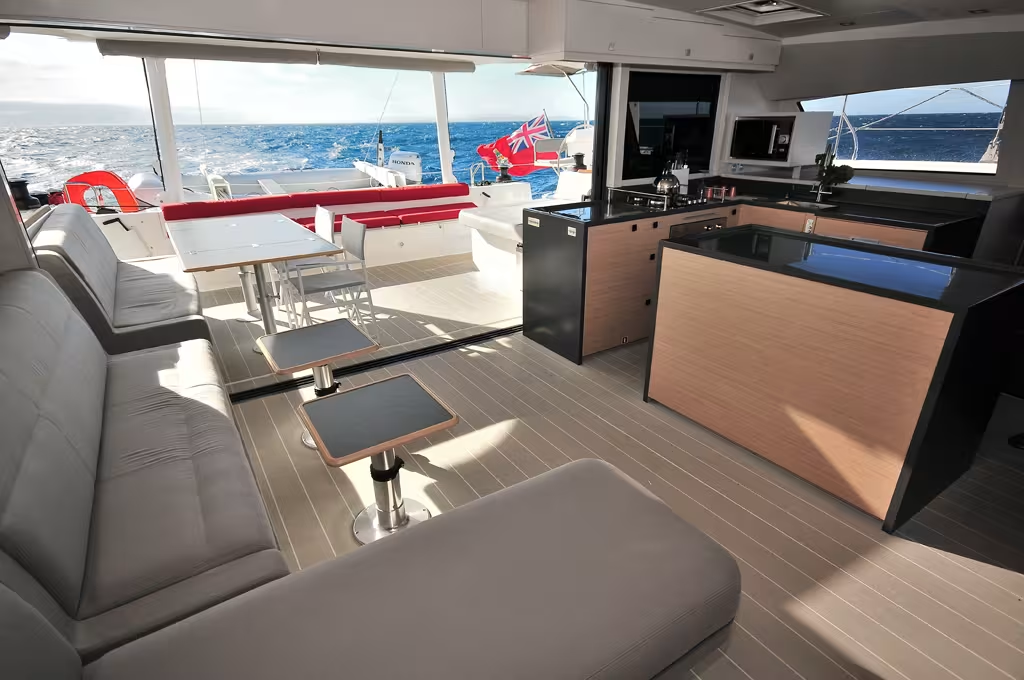
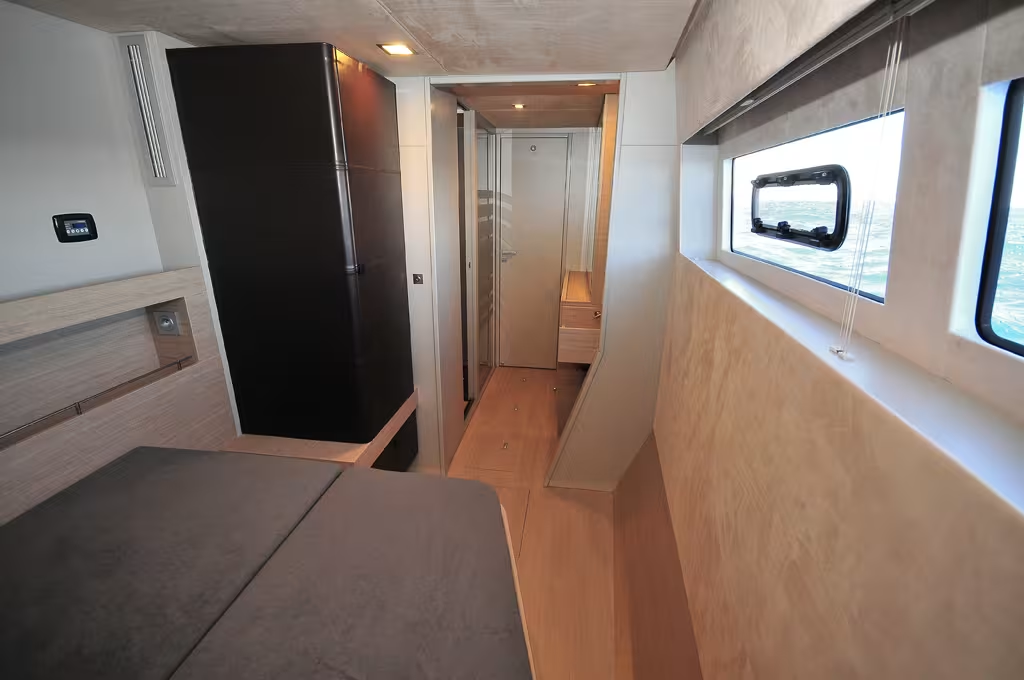
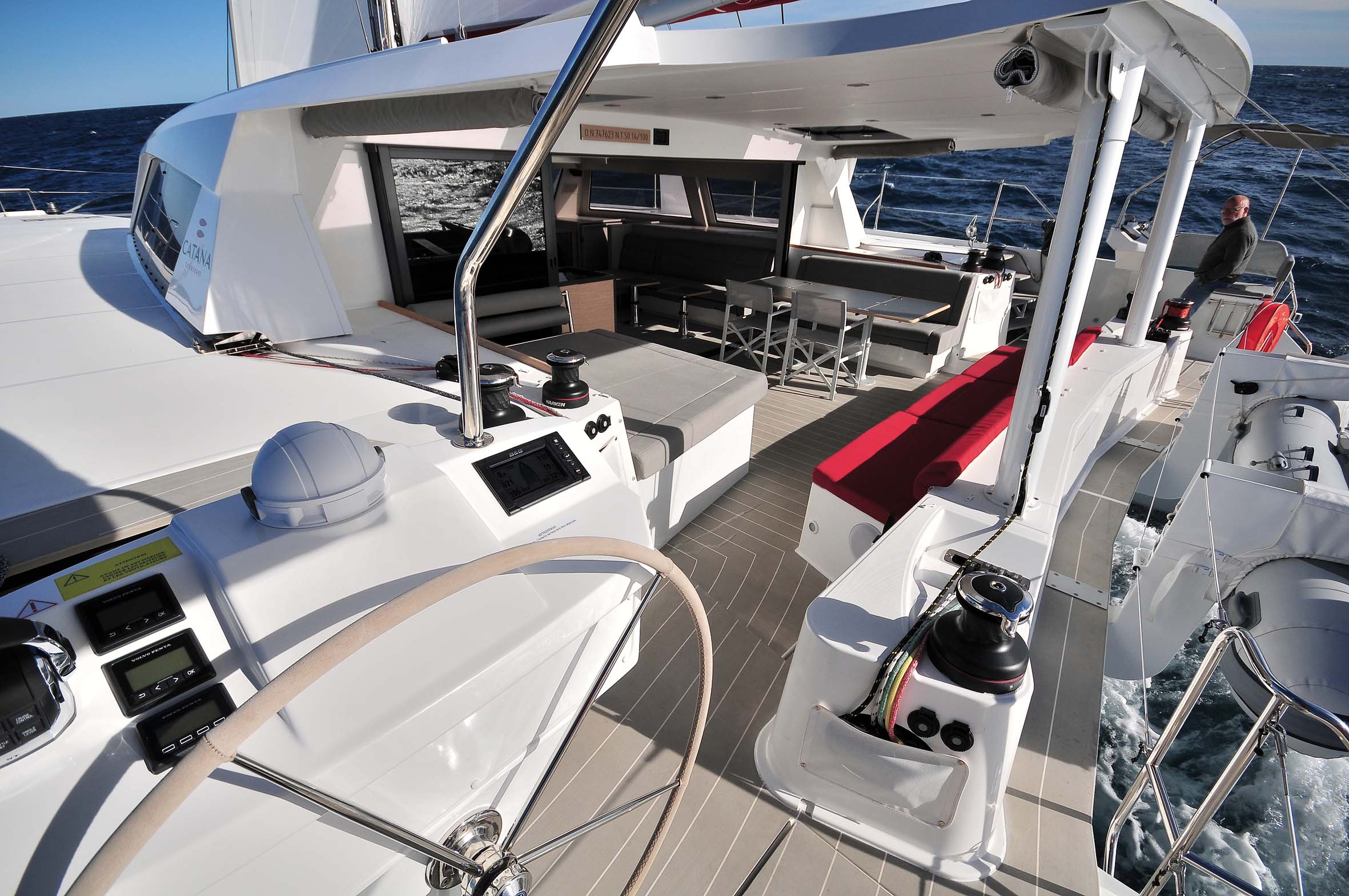
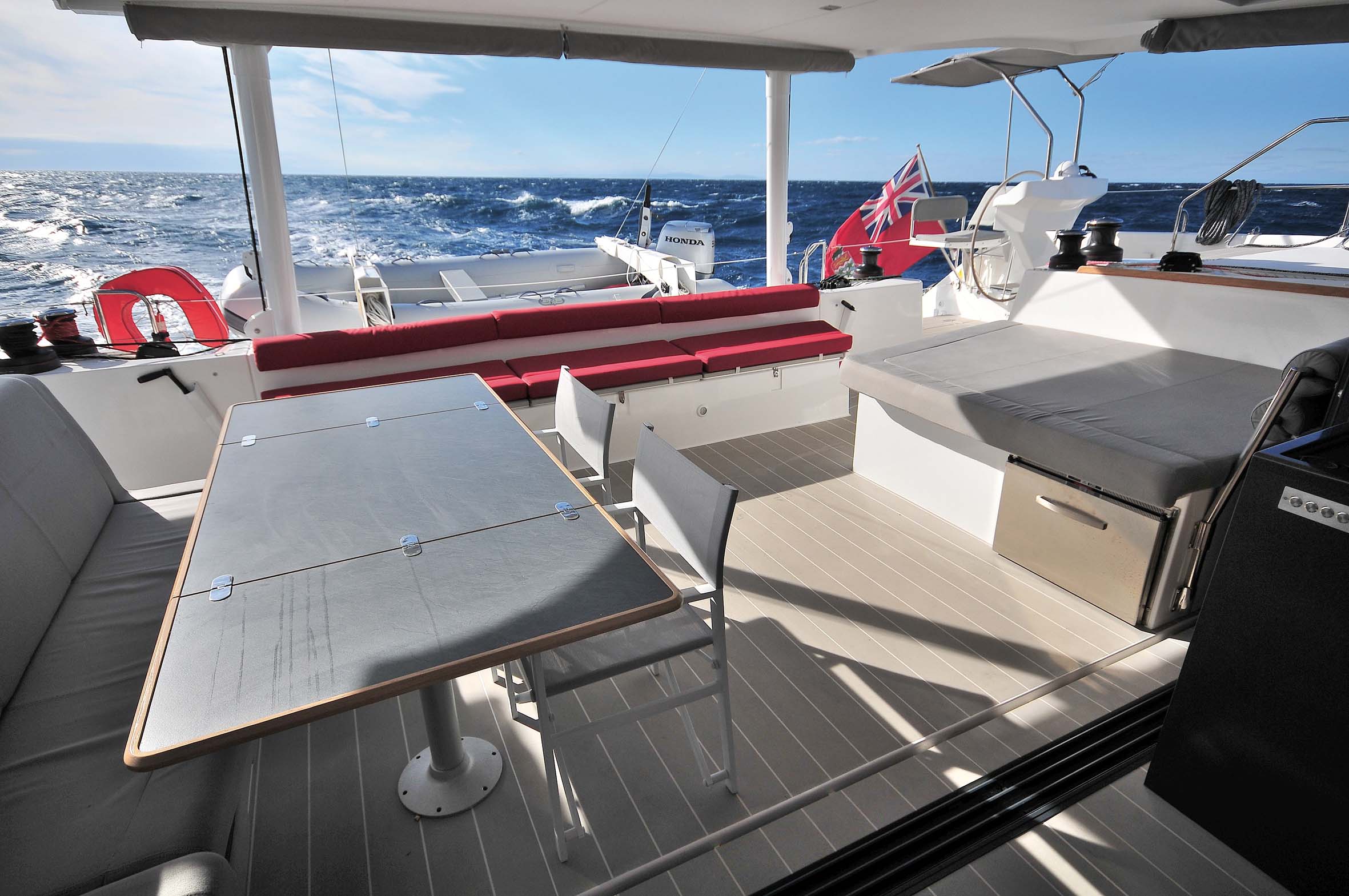
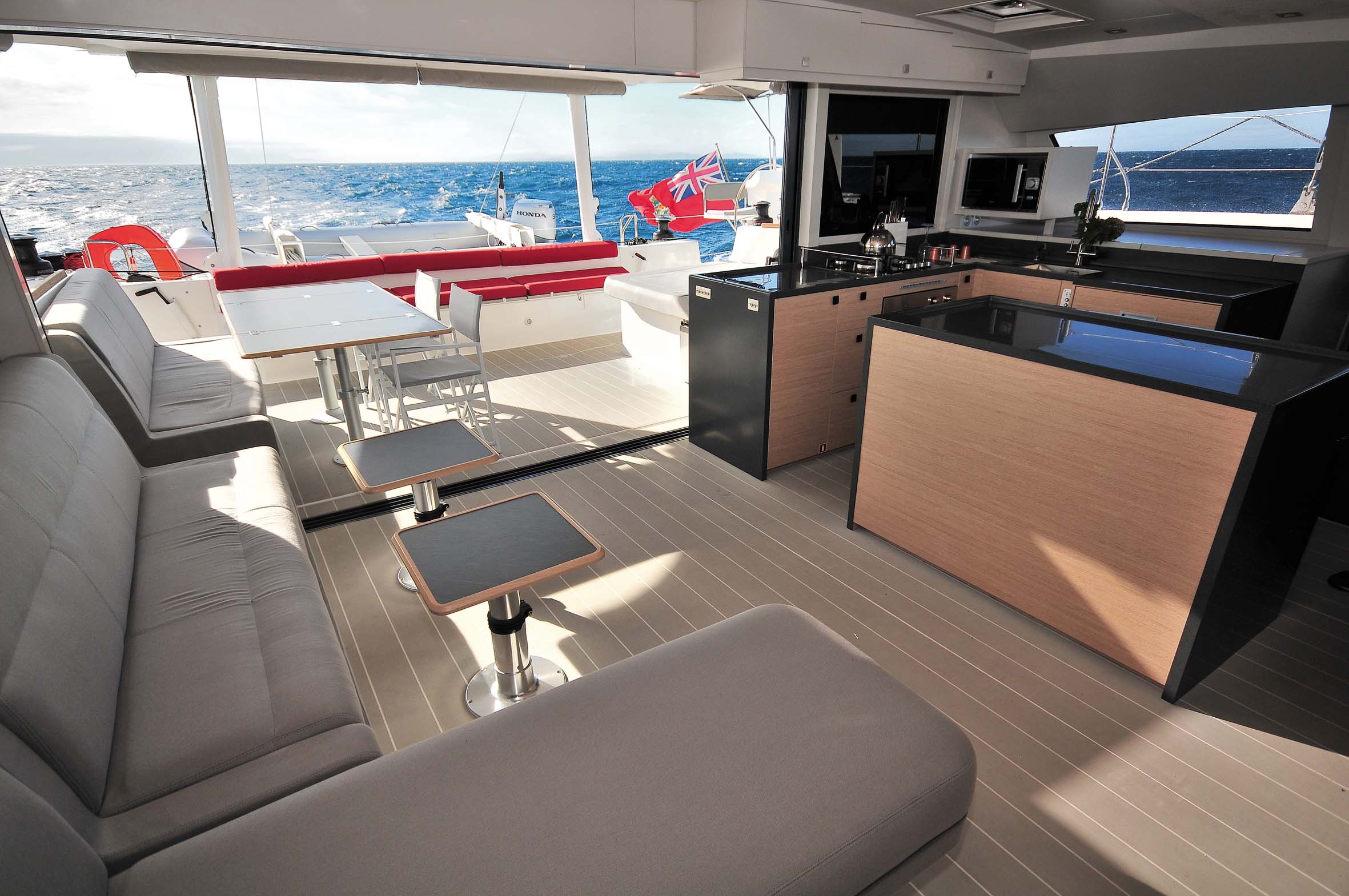
The Catana 62 isn’t looking to maximize the habitable volume (the nacelle is the same as that of the 59), but it does make the most of the extra meter to optimize its dynamic qualities, centering of weight and the potential to carry more load. The cockpit is well protected by a structural bimini, into which is integrated the mainsheet track (the double purchases for the sheets fastened to the aft beam should be seen again soon), and is home to a wide aft bench seat and a big sunbathing lounger (perfect bed for watch keeping!) There is also an outdoor dining area. The 6 to 8-person table has tubular legs and can be quickly reinstalled inside should conditions require that. Picking up on the open-convertible trend, the three-section glazed door folds up almost completely behind the sun lounger, creating an impressive cockpit-saloon space. The XXL-sized sugarscoops are comfortable and safe for boarding from the dock or the dinghy: they are covered (as is the entire cockpit and saloon) with an excellent rot-proof synthetic covering, which is impact-resistant, non-slip and does not heat up when in the sun. A sensible choice which appeals to me! The galley of our 62’ test boat is built in an L-shape with a large central island which houses two refrigerators (a U-shaped version is also available). The generous four-burner hob is of a very high standard, with side protection and pot holders. The exacting chef also has a superb oven at his disposal. A large sink, select faucets, and abundant worktops and cold storage allowed us to enjoy cooking even with a steady 30-35 knots and attendant sea. Following the abandoning of traditional woodwork, and it’s over-use of rare raw materials, unsuited to catamarans, the Catana style has been re-thought, evolving towards understated “contemporary, functional luxury” of a very high standard. In the cabins, the choice of materials is subtly rational, favoring ease of cleaning and resistance to knocks (composite floors, suede ceilings, imitation leather linings, and leather upper-style upholstery). The bathrooms have been the subject of a particularly careful design, and include towel warmers, draining shower trays, double basins, remarkable natural and electric lighting and ventilation. In the owner’s version at our disposal, the starboard hull was home to the big suite, with the two guest cabins to port. They offer the same standard of comfort with bathrooms and private toilets, all with a very high level of quality.
A first-class engine room!
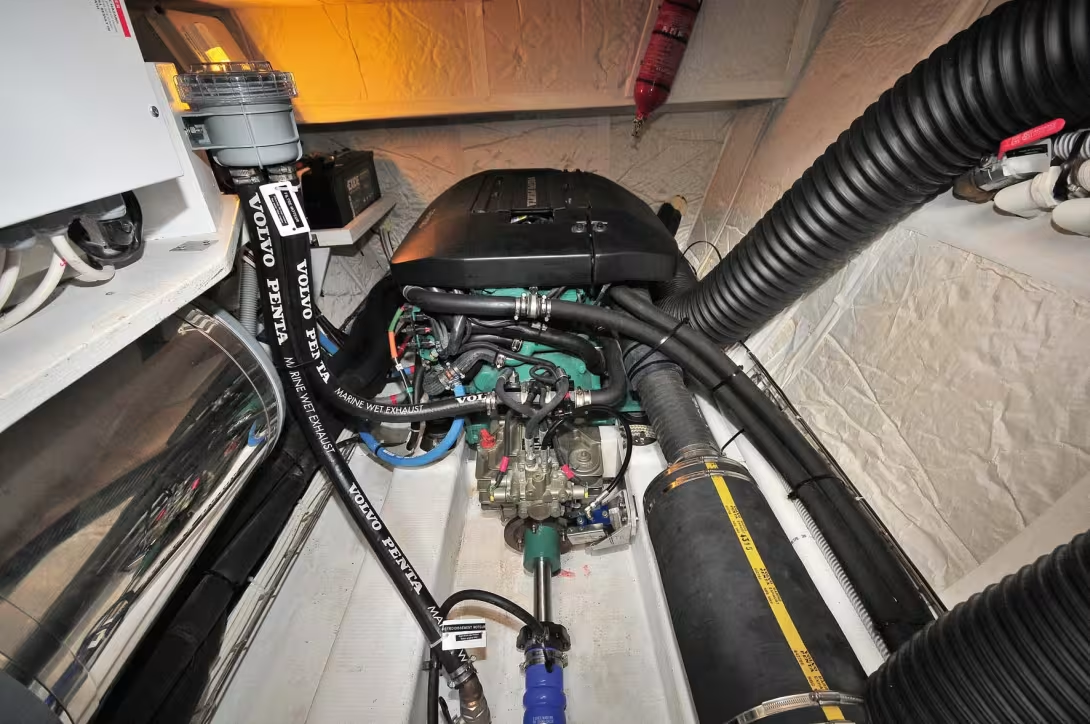
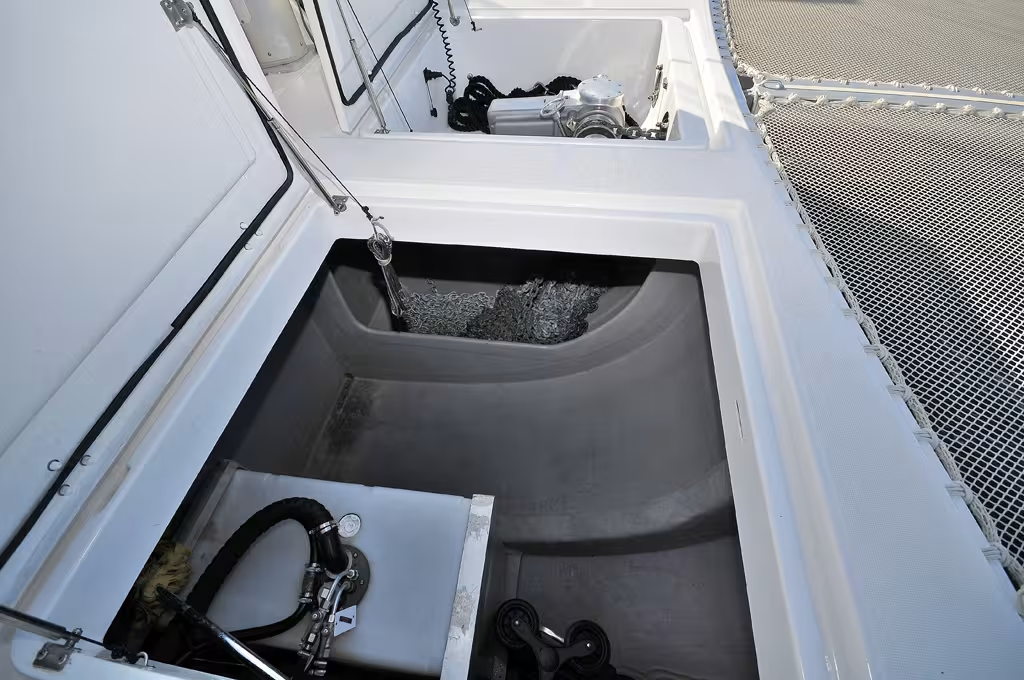
The two 110hp Volvo D3 turbos are modern, compact motors, each equipped with electric controls as standard. These 2.4 liter, 5-cylinder units weigh 297kg each and the propellers are shaft-driven (with brake discs for locking them under sail). Theoretical consumption is 8 l/h per motor at 2,000 rpm, giving a running time at this speed (around 8.5 knots) of 53 hours. Reliability, longevity and the smooth running of a marine engine are directly linked to its installation and its accessibility: maintenance depends on it. Here, the engineer can relax! Mounted on solid engine beds which spread the load across the wide, high engine room, the motors are set well forward in the boat (600 kg centered!) and their monitoring is made easy by the clear layout of the installation (starter battery, gearbox, stuffing box, expansion tank, raw water seacock and filter, all immediately to hand. An automatic fire extinguisher is fixed in position; carefully designed, effective insulation is on the sides, bulkhead and ceiling. Brilliant! The fuel tanks are located in a locker by the forward beam and can be removed and are fitted with inspection hatches - indispensable if your fuel becomes polluted. A great addition!
A passage with drums beating!
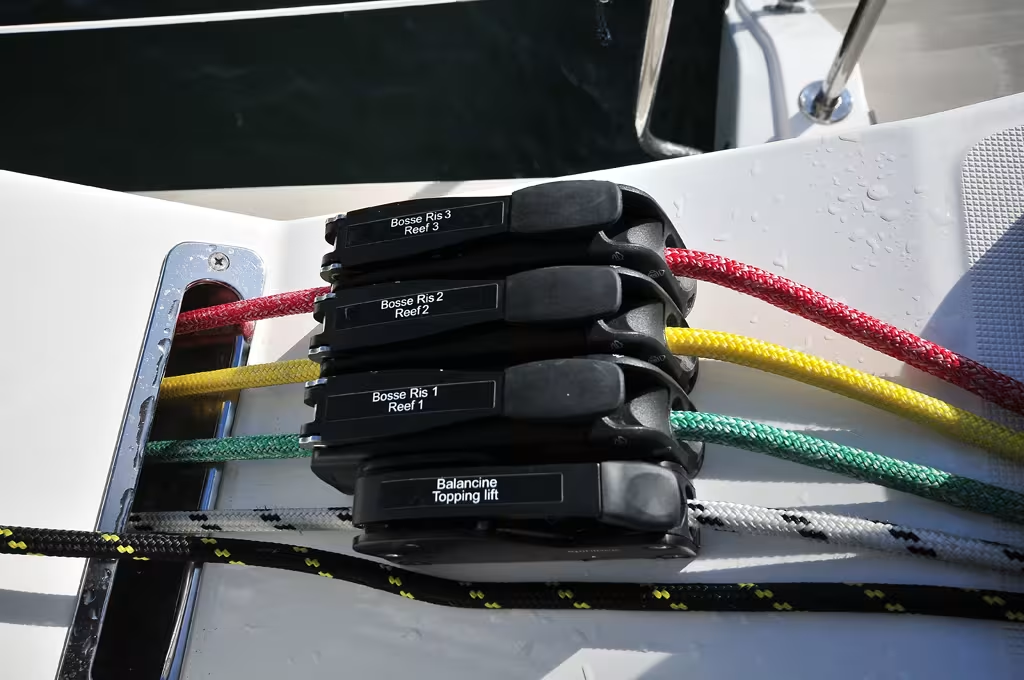
You hear all the time about such and such a boat making 10-knot averages, but they are often unable to back up these claims! The objective of 240 miles a day is a compelling one, but one rarely achieved, since, like all averages, it implies long periods of slipping along at speeds of 30 to 50% in excess of the final score! With the Catana 62 we would cover 135 miles in 12½ hours, which corresponds to an 11-knot average! The moderate NW wind should stay with us from Canet en Roussillon as far as Toulon without dropping, so we set off under full main and genoa on port tack with 18-20 knots of Tramontane wind. The speed settled immediately between 11 and 13 knots on a reach, with a nice sea with a few little waves. With 50% of leeward daggerboard down (they are curved to fit better in the hulls), the balance of the helm is perfect and our sizable limousine stays comfortably on track. The 18.70 meter hulls slide along consistently and with ease, and the autopilot keeps up without stumbling, thanks to very directional rudder blades. The general comfort of the boat negates the feeling of speed, and it’s at the helm where you become aware of how fast this multihull is going, now surfing regularly on the fast-developing swell (a specialty here in the shallow depths of the Golfe du Lion). The instruments are regularly showing 13-15 knots, and a look back at the wakes confirms this. The wind picks up to 25-28 knots without us feeling the immediate need to reduce the main (120m², all the same!). However, at dusk, before we pick up the first lights of Marseille, a few surfs over 17 knots lead us to put in the first reef. I head up a bit to lose some wind from the main, and the reef is handled from the starboard console on the aft beam (for tensioning the reefing line): the halyard is eased from the port side sail controls. Night falls and our speed picks up! Off the Planier lighthouse, we are hitting an average of 12.5 knots, and it’s time to test the galley installation with a proper meal served at the cockpit table. Well-ballasted with offshore grub, we dress for the remaining 30 miles. It soon becomes necessary to reduce the genoa by 30% as the Mistral is gusty. At the helm, we are piloting over rough terrain (oddly, the forecast predicted nothing over 25 knots, but this region is subject to local phenomena). We’re riding along now at 16-17 knots in a heavy sea which is breaking quickly. On the helm I am beginning to work hard with the intense following surf, picked up by gusts of 35-38 knots (touching 40). The waves break and the double wake shows our speed. Several long surfs at 20 knots lead us to take in the second reef and reduce the genoa to 60%: we’ve already got Toulon in sight!
Conclusion
The wind and sea state were perfect for our test: they allowed our Catana 62 to show off her blue water cruising qualities. Despite her size and sail area, the boat remains, in this version, manageable by a short-handed crew of 2 or 3 competent sailors. Sail handling is made easy by an effective deck layout and powerful, well-placed electric winches. A forward-planning crew would anticipate reefing better than we did, to maintain tranquility, but for the sake of our test, it was useful to push the limits a little bit. This luxurious adventurer showed herself to be tolerant when there was too much wind, a characteristic which allowed us (within reason) to delay sail reduction when we felt necessary. The 62 Easy version is fast in all conditions (light airs, medium conditions, and in a breeze) and her geometry allows her to calmly take on difficult seas. The purpose of this trip had been to deliver the boat for the owner; the fuel and water tanks were full at the start, and full safety equipment was loaded, aa well as a large dinghy. This model is equipped with reversible air conditioning and a generator, yet remains at the advertised weight. Despite this not being light, I was pleasantly impressed by the performance and comfort during this sail in heavier conditions.
Technical specifications
- Naval Architect: Chantier Catana/Marc Lombard
- Builder: Catana
- Construction: Polyvinylester infused foam/glass sandwich with reinforcing and other carbon elements, using the Twaron Impact process (with Kevlar internal skin) for the underwater hulls
- Length: 18.68m
- Beam: 9.49m
- Light displacement: 19.2t
- Draft: 1.56/3.75m
- Mainsail area: 121m2
- Genoa: 82m2
- Solent: 63m2
- Gennaker: 121m2
- Motors: 2 x 110hp shaft-driven
- Diesel: 2 x 430 liters
- Water: 2 x 400 liters
- Price ex-tax in Sail Away version (delivered, equipped, ready to sail): € 1,559,722
- Options in € ex-tax 65l/h watermaker with 8 x 90W solar panels: €18,162
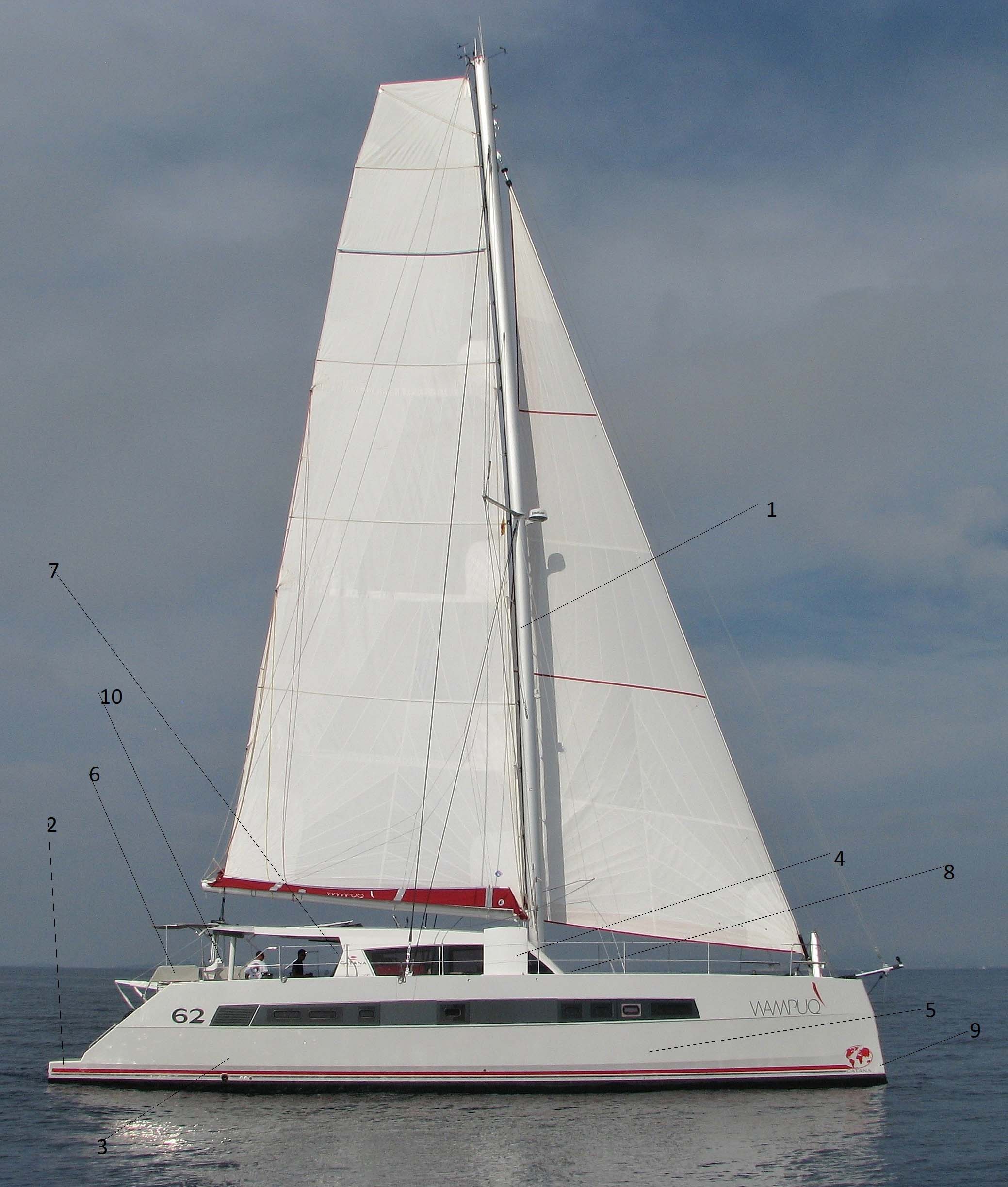
1: The aluminum mast by Maréchal on the Easy version is of superb quality. It is a high inertia profile, equipped with a single set of spreaders without runners, and is held laterally by a pair of capshrouds and 2 lowers.
2: The long sugarscoops improve the stride and flow of water from these powerful hulls, while helping center the weight
3: The motors are set well forward in the hulls, contributing to the good overall balance.
4: The curved daggerboards which are produced by an appendage specialist integrate better with the accommodation inside the hull and provide a maximum lift of 500kg at 15kts
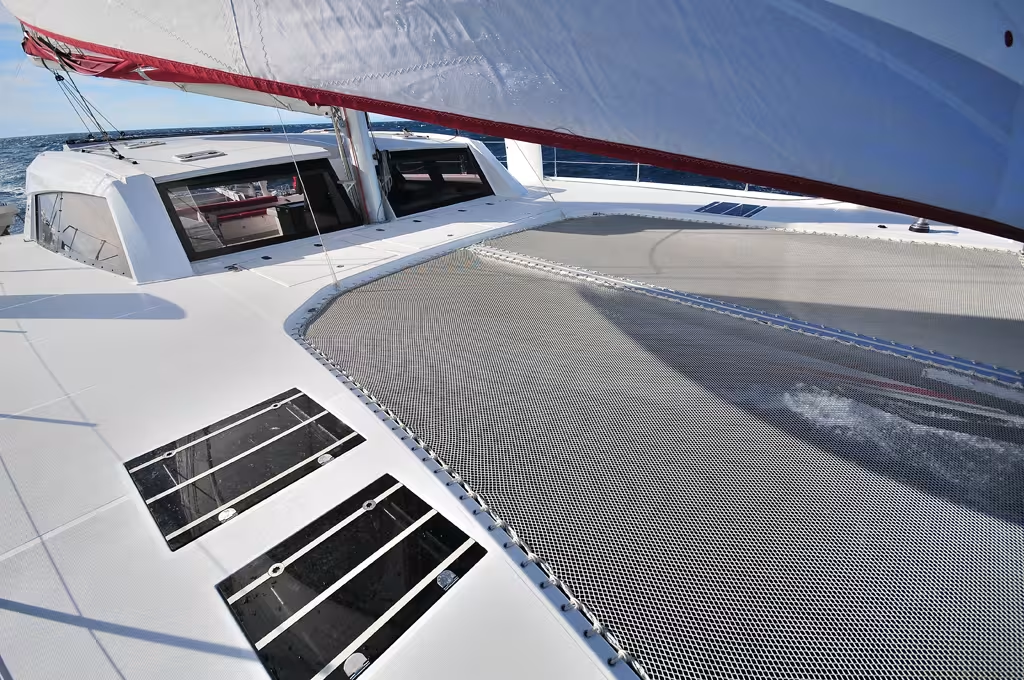
5: Higher topsides, generous bridgedeck clearance and inverted bows all combine to give a gentle and spray-free passage through a choppy sea
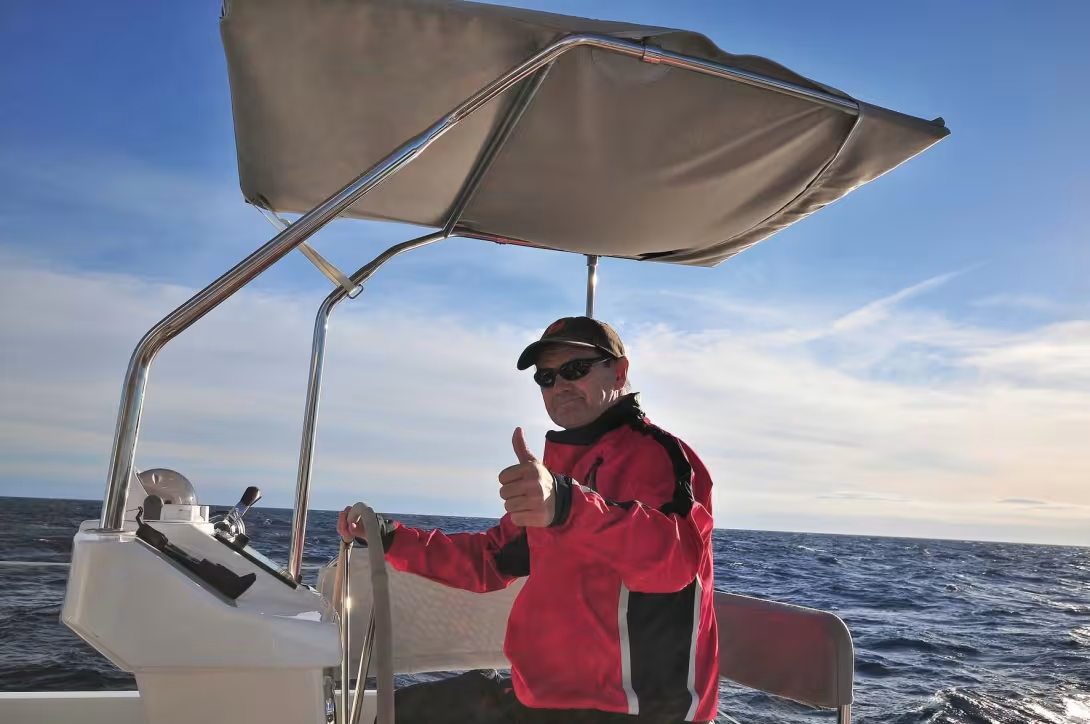
6: The helm stations are well sheltered and ergonomically designed
7: The cockpit is well protected from wind, rain and sun, and joins with the interior thanks to the almost completely opening bulkhead
8: The fuel tanks are very accessible and the anchoring station is well-proportioned with a 2300W 24V windlass, 80m of 12mm chain and a 50kg Delta anchor
9: The fine-entry bows and long hulls which are free of any fittings allow the boat to keep up a good pace in a choppy sea
10: On this version with the mainsheet traveler on the bimini, the mainsheet and reefing lines come back to consoles on end of the aft beam. A version with two mainsheet purchases and no traveler is planned.
Plus
- Handling in a breeze
- Average speeds
- Comfort at sea
- Fun to helm in lively conditions
Minus
- Design of the forward windshield
- Helm station sprayhoods flap in the breeze
- Fixed rudder blades
- Maneuvering is delicate in a strong wind with no bowthruster
|
Builder |
OUTREMER |
OQS |
O YACHT |
|
Model |
5X |
Ocean Explorer 60 |
Class 6 |
|
Upwind sail area in m² |
186 |
198 |
227 |
|
Light displacement in T |
12.7 |
17.4 |
17.7 |
|
Basic price in € ex-tax |
1,065,000 |
3,000,000 |
1,860,000 |