
“Finally!” That was the first word out of the editor’s mouth when the news broke just over a year ago. Unveiled at the International Multihull Show, the Ocean Class inaugurates a new Catana range. We were able to discover this fast-cruising catamaran a few weeks later - to our great delight!
Infos pratiques
- Le chantier : Catana Ocean Class
- La fiche technique
-
 Découvrez notre vidéo exclusive
- Financez votre Catana Ocean Class
- Assuez votre Catana Ocean Class
- Articles autour du Catana Ocean Class
Test location: Canet-en-Roussillon, France
Conditions: 15 knots of wind, slight to moderate sea state
It’s been six years now since the last Catana, the 53, was launched... And for a few years, the range has been limited to this one single (albeit very successful) model. But to be honest, the length of this period with no new Catana models probably feels much greater for any fans of serious cruising – and that includes us of course. Let’s not forget that in the meantime, the Bali brand has multiplied its new models, leading some to fear that the Catana name, although at the origin of the group, might become the collateral damage victim of the success of its youngest offspring. In the end, this isn’t the case. It was only the time needed for the historic brand to reinvent itself and find the time to do so. Ultimately, as you can see, we’re in no way denying the pleasure of sailing aboard this Catana with its enhanced DNA. It’s all about sharing the experience with you.
On the program: fast, blue water multihull cruising
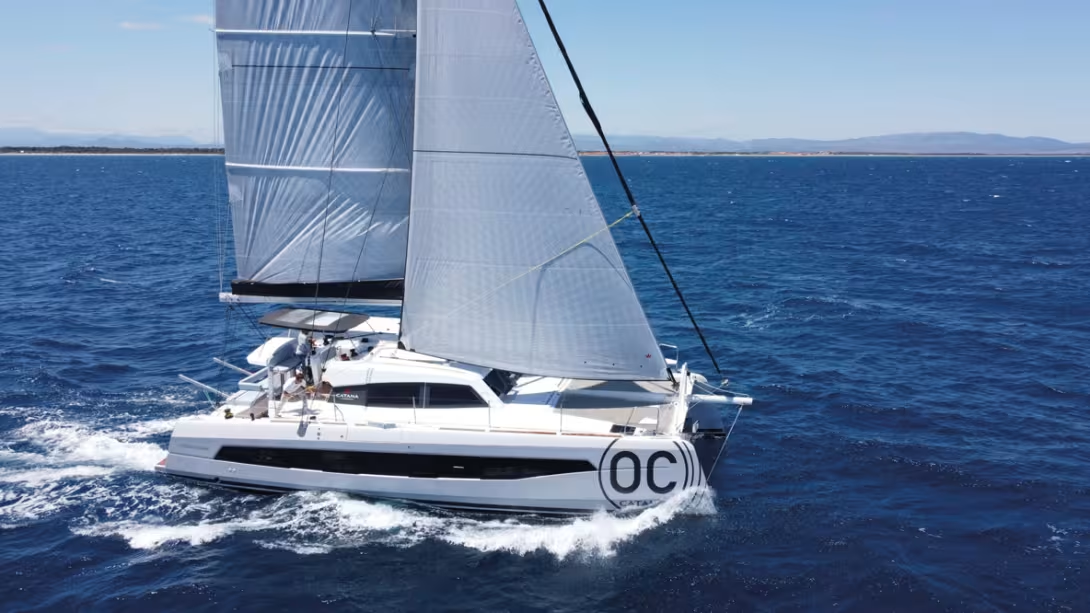
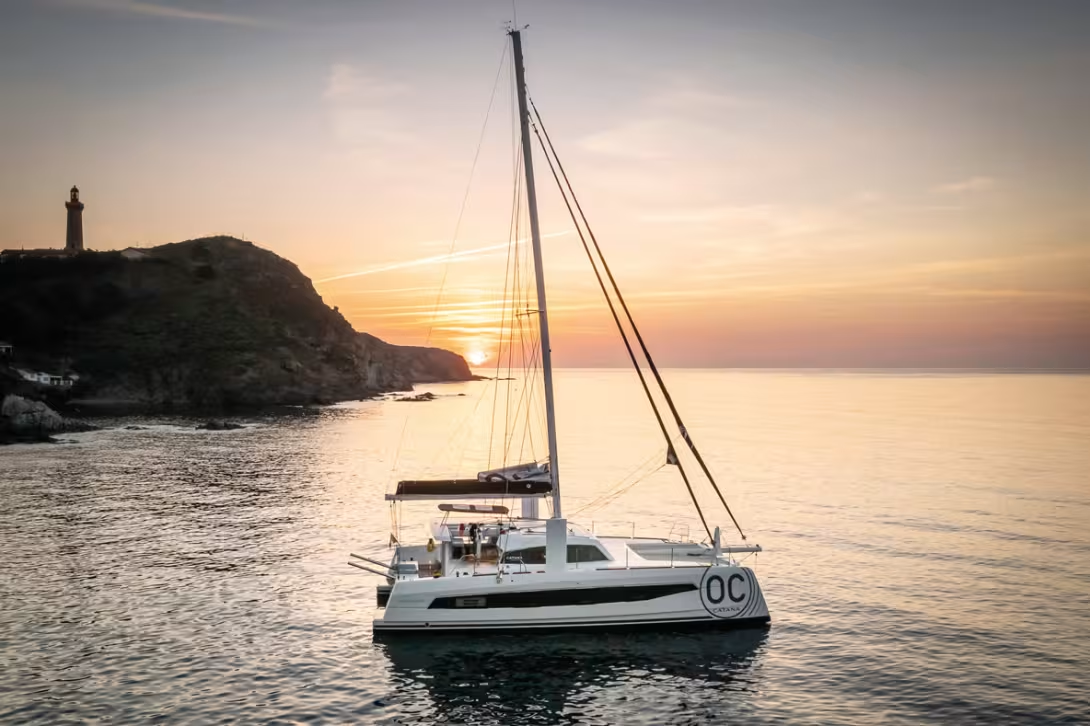
It’s rare thing in the marine industry that the name of a model is not associated with its length, either in feet (most often) or in meters. But there is no risk of confusion with the Ocean Class, whose name alone aims to express the quintessence of the multihull blue water cruising. But as at some point we have to discuss size, let’s specify that the length of the hulls is around 15 meters (14.99 m to be precise), which is 49 feet. This is logical in relation to the 53 and clever in terms of positioning, particularly in relation to the Outremer 51 - the extended 49 in all reality, whose design is already more than ten years old. The Catana team claims to be targeting a slightly less sporty clientele than Outremer Yachting, but it is hard to imagine that the products from their eternal Mediterranean coast rivals were not taken into account during the reflection process undertaken by Olivier Poncin and his teams during the design phase of the Ocean Class. The shipyard at La Grande-Motte (Outremer) is often used as a basis for comparison in the discourse. It doesn’t matter, though. It’s about the search for the best possible compromise between performance, safety and comfort that has prevailed. Fans of the Catalan brand can be reassured - the Ocean Class is indeed a proper Catana at heart.
Ocean Class backstory
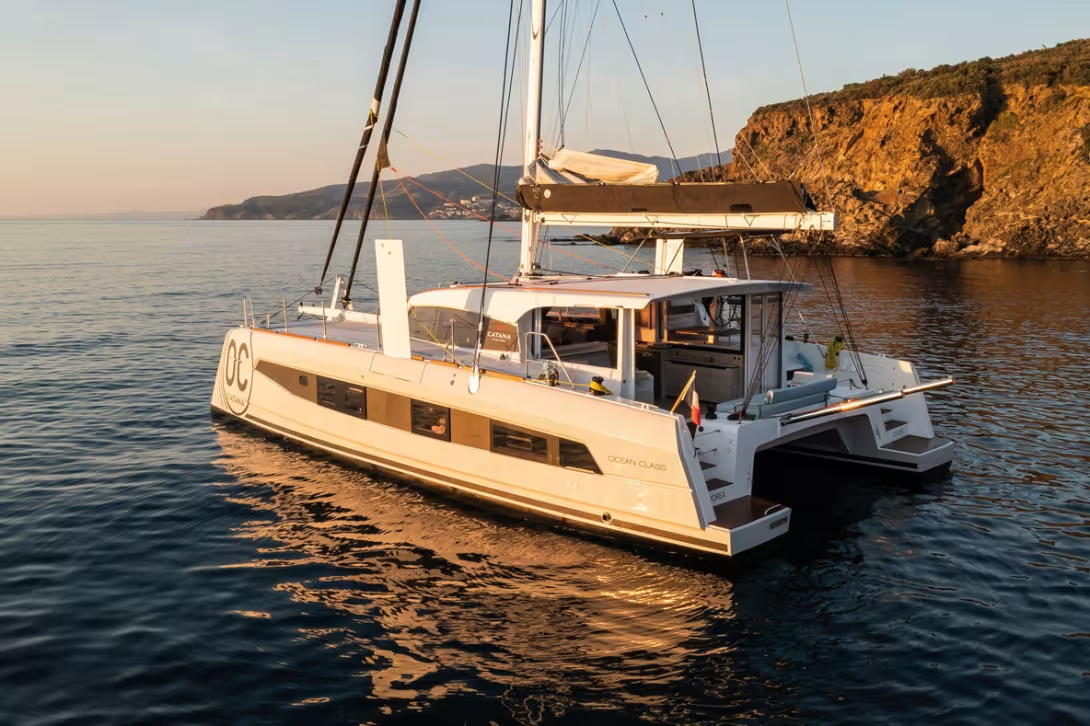
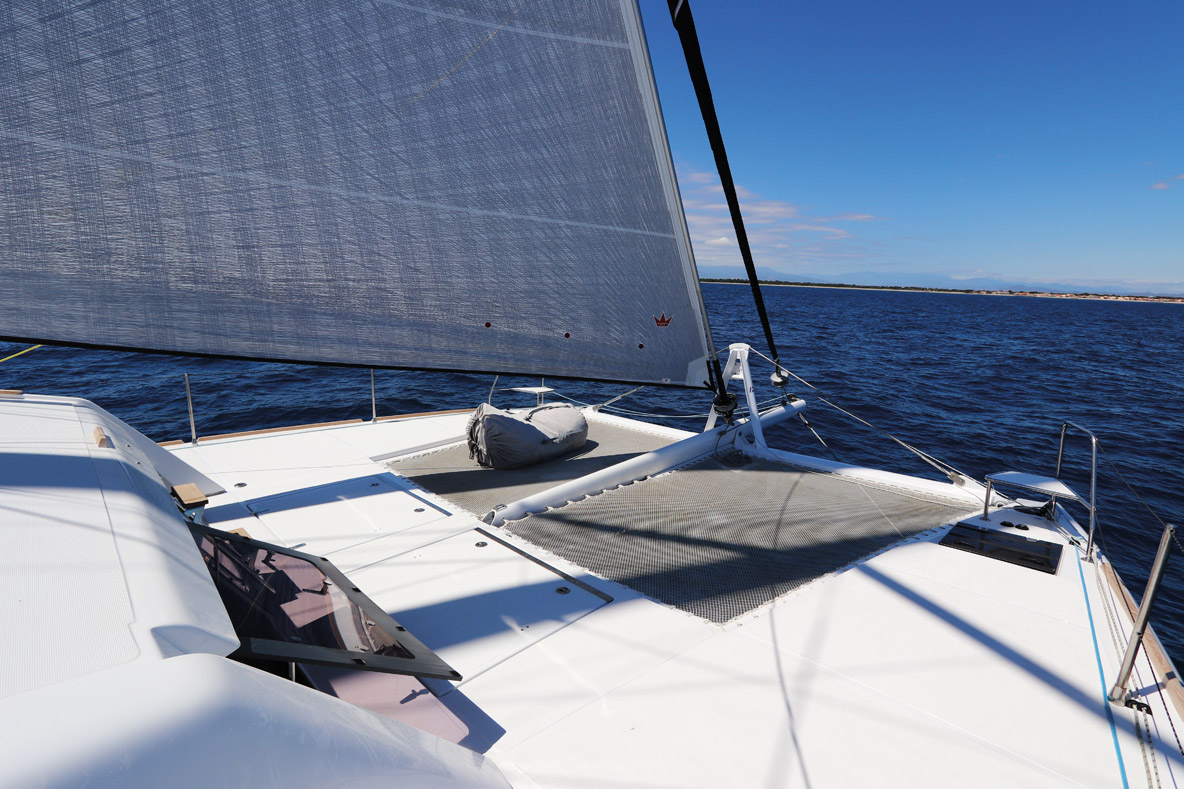
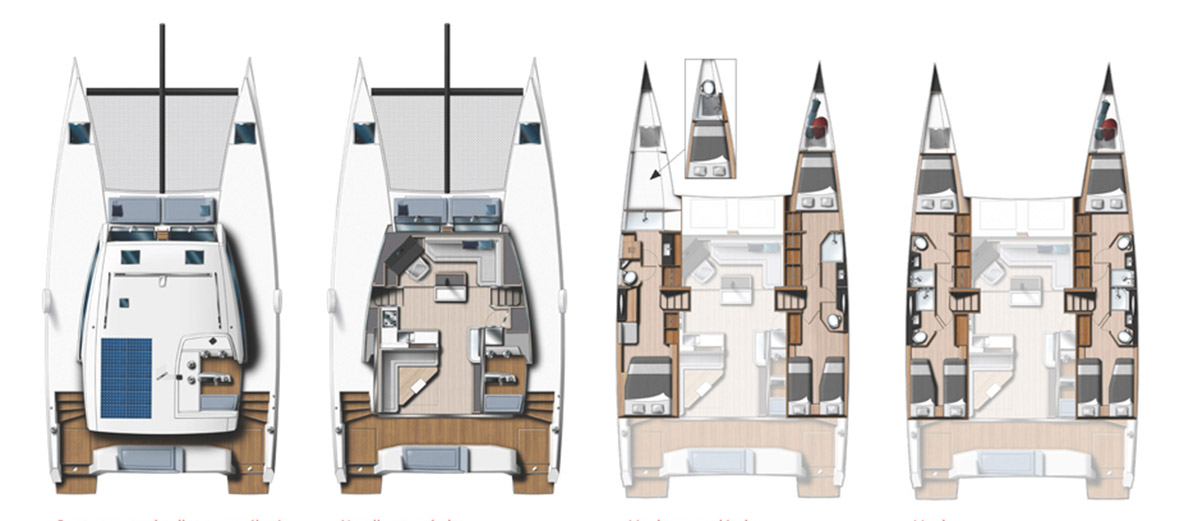
This starts with the design, with a very particular geometry: Here, we find the sloping and asymmetrical bows that stood out on the very Catana designed by Australian Lock Crowther. The hulls are much finer than those of a model dedicated to pure cruising or chartering. The nacelle is shorter, leaving room for a large trampoline between the bows. The weight calculation obviously comes out lighter, with an announced displacement of 13.5 tons lightship. This configuration also has the advantage of shifting the center of gravity aft. Having enjoyed the privilege of a detailed tour of the shipyard, we can attest to the fact that Catana is true to its reputation and takes construction very seriously. The lineal foams used for the sandwich have saved almost 900 lbs (400 kg) compared to the usual square ones. There’s plenty of carbon in evidence, though not to excess, only where it allows to offer a significant gain in rigidity: main bulkheads, daggerboard reinforcements, chainplate reinforcements, etc. The overall implementation has been the subject of much attention to ensure a perfect stiffness to the platform. A pledge of performance but also of audible comfort. The main bulkheads have a corner angle that serves as a gluing plane, meaning the parts are assembled without lamination. This is an obvious time-saver and also saves on finishing touches, and thanks to the qualities of the latest generation of structural glues, it ensures perfect consistency throughout. The foam sandwich floors and furniture, manufactured in the group’s in-house carpentry shop, also help to keep weight down to a minimum while reducing noise and vibration.
All change, but everything stays the same…
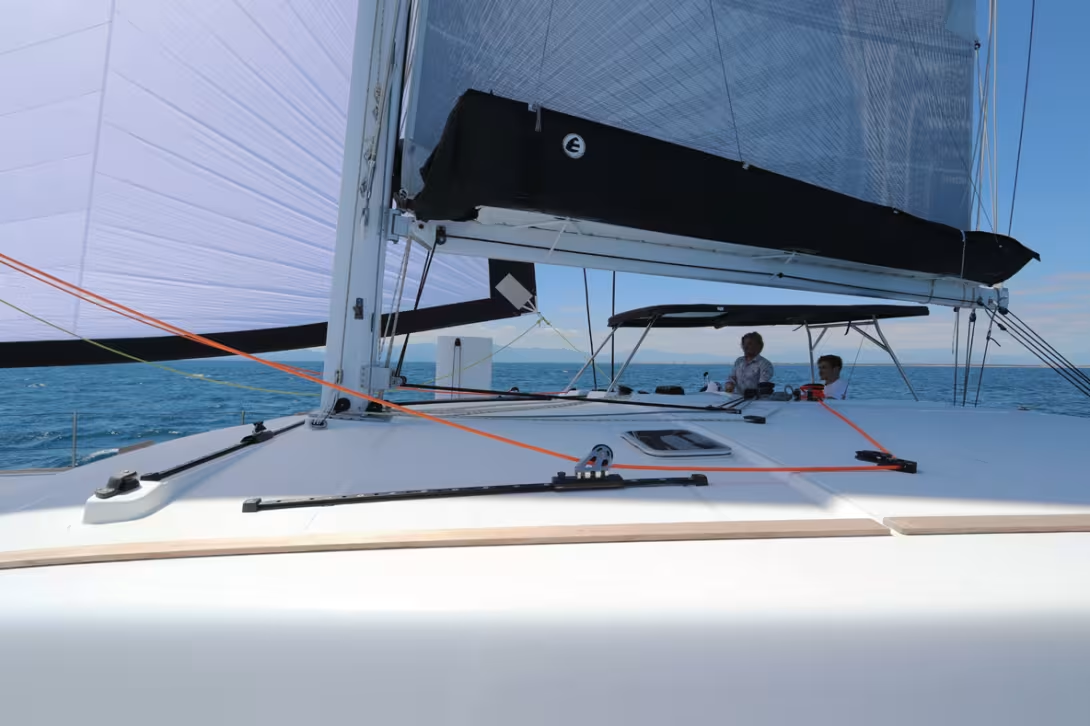
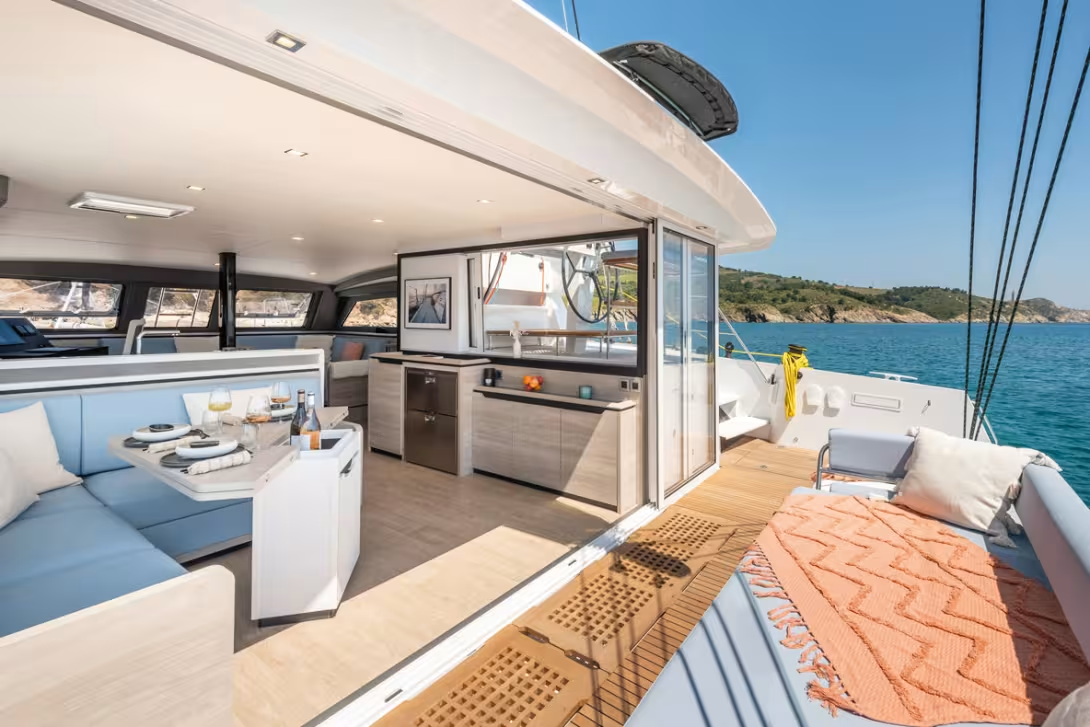
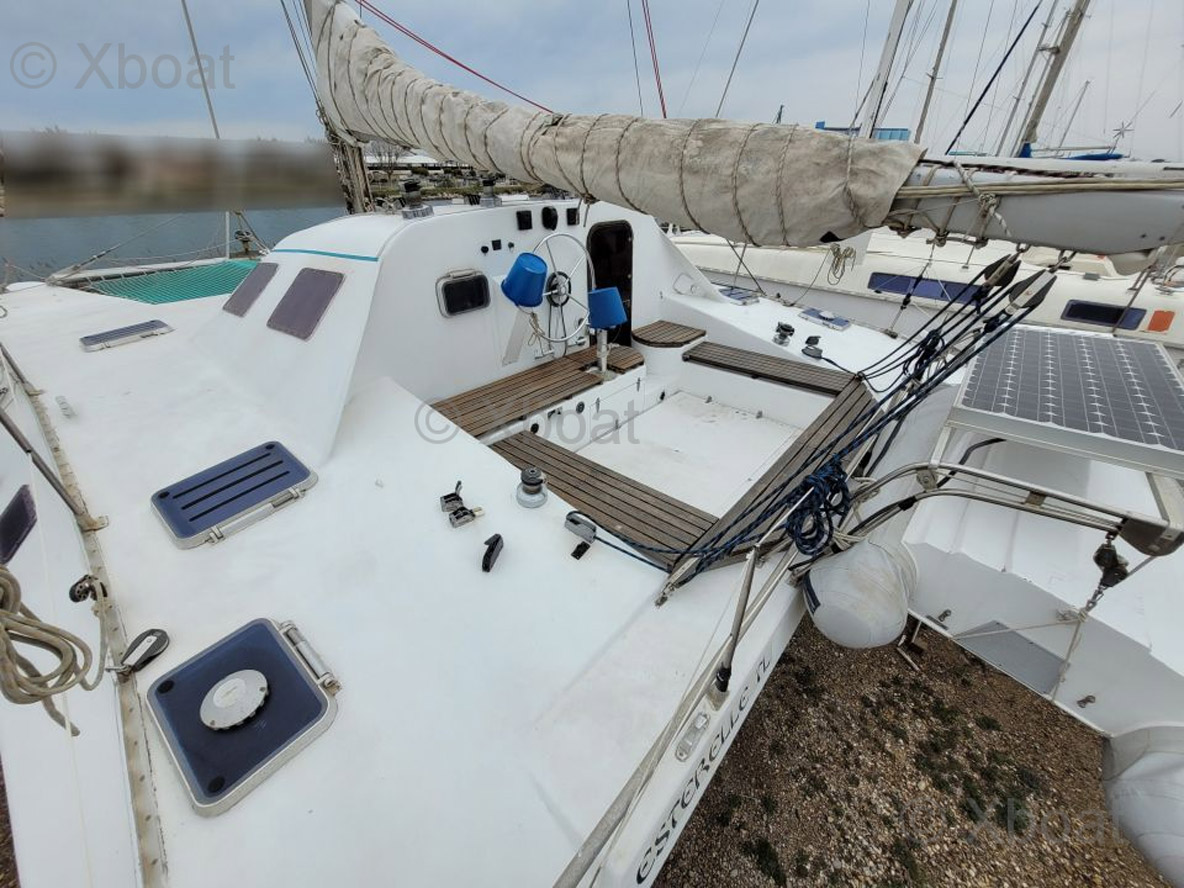
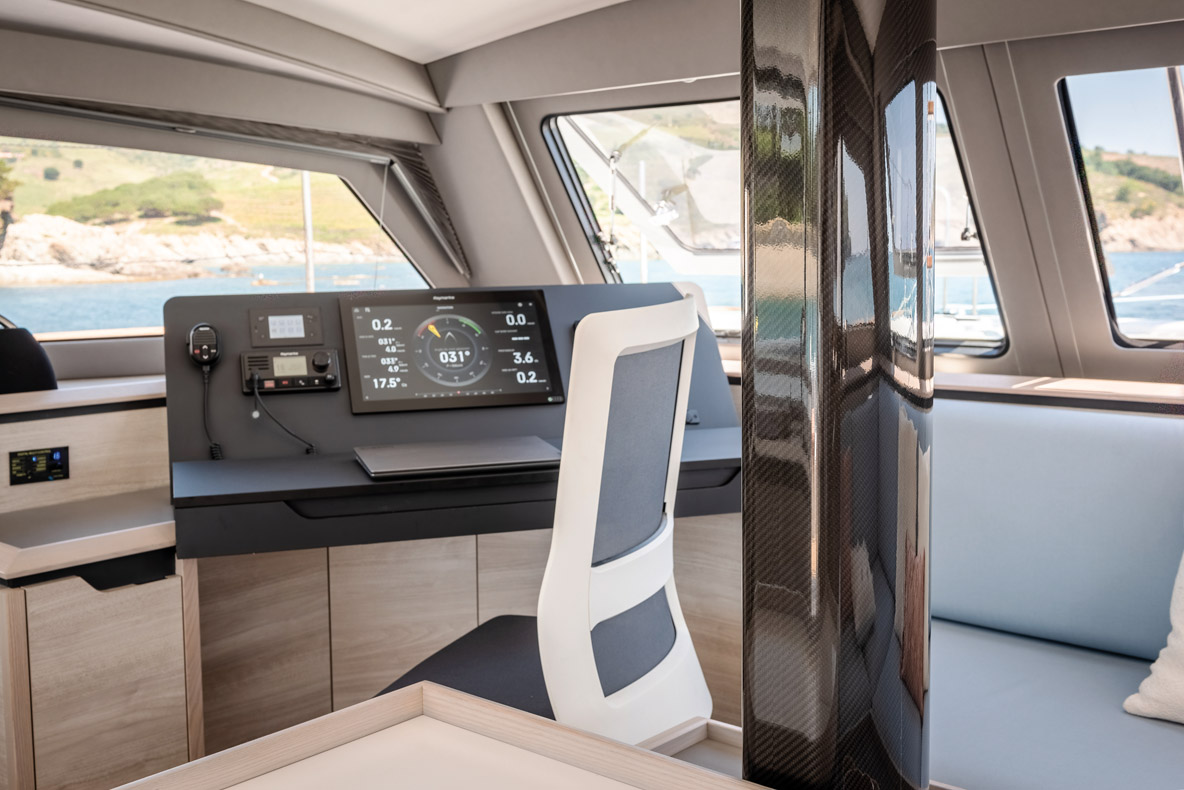
From the pontoon, the difference in volume compared to the two Bali 4.8’s of equivalent length that lie either side of the Ocean Class is striking. Less freeboard, no flybridge, a smaller roof for the Catana: no risk of confusing the two cousins. Only the lack of a cockpit / saloon bulkhead brings them closer. But the Ocean Class has large sliding windows (10’8”/3.25m on the stern and 5’9”/1.75 on each side), whereas the Balis are equipped with their famous tilting door. The latter option was not chosen because the weight of the mechanics and structure of this element was beyond the scope of the Catana’s specifications. This link in the general layout, which may have been off-putting to some overly hasty visitors to the last International Multihull Show, in no way betrays the Catana spirit. Quite the opposite, in fact. It contributes to offering maximum space and comfort, but with well-managed weight because it avoids duplicating the saloon + cockpit functions. Another point that surprised the most fervent “Catanistas” from the first glance at the newborn: the twin aft helm stations have disappeared in favor of a single maneuvering station forward of an equally singular helm station. This formula, already validated on many recent catamarans, shakes up the established rules after more than thirty years of double aft helm stations! The builder has dared to make a change... which is not really a change at all according to the shipyard’s managers, who argue that the first Catana, a 40-footer designed in 1984, had a single helm and maneuvering station against the coachroof bulkhead. We verified this argument, with photos, and the Catana guys are right! And the test of this new/old helm station is objectively convincing. While it may be true that the visibility of the sailplan less than optimal on both sides, it is nevertheless perfect for the genoa when on port tack, and the mainsail when on starboard. As for the view of the bows and the sugarscoops, this is ideal. And what about the centralization of maneuvers? No need to run from one side of the cockpit to the other, everything is at your fingertips at the helm and maneuvering station. You can run the boat solo without any problem thanks to the autopilot, or as a couple, and without getting in each other’s way, or even comfortably converse with others while keeping watch. You’ve also got fingertip control for playing with the long daggerboards, that are now motorized, varying the draft from 4’6” (1.39 m) to 8’3” (2.52 m) and adjusting the double mainsail sheet, two historical and differentiating elements of a Catana that are found on the Ocean Class. It must be said that the efficiency of the daggerboards for upwind sailing and the advantage of removing these appendages downwind or in heavy seas are not debated. As for the absence of a traveler, it brings ease of trimming and safety - try it and you’ll want one!
Regularity under sail... in allegro mode!
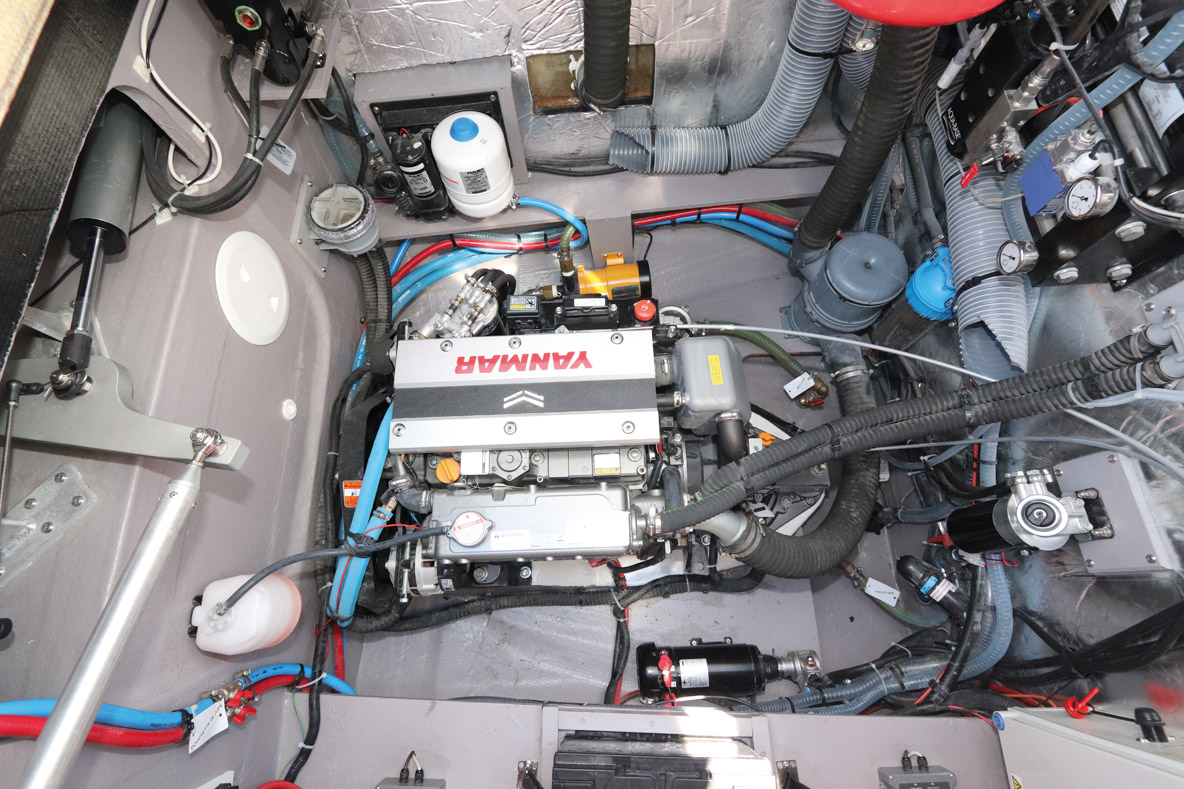
Coming out of the port of Canet, the breeze was a bit slow, but the thermal would soon kick in. We took advantage of this to give the two 57 HP (option) Yanmar motors a bit of a test, and we reached 7.1 knots head to wind in cruising mode (2,200 RPM). By pushing the throttles down, we exceeded 9 knots on a flat sea, but this isn’t the point of a catamaran which works much better under sail than under diesel. We quickly moved on to test the full sail wardrobe, or almost, as the halyard snap shackle (of a brand that we will not name) managed to break, preventing us from hoisting the large asymmetric spinnaker. As a consolation, the mainsail was up, and the genoa unfurled. They are both signed Elvstrøm in Proradial cloth. The mainsail would deserve some adjustments to the luff and/or in the batten tension. The triangulation of the genoa is perfect. Benjamin Monier, the Catana sales manager, was our skipper for the day. He drew my attention to an option that seemed interesting - even if our test version was not equipped with it. Membrane technology allows them to offer a genoa with a cover which, once partially furler and the sheets repositioned, becomes a self-tacking solent. Sailing under reduced sail is not our goal today. Under main and full genoa, we set off upwind, up to 40 degrees off true. As is often the case in the Mediterranean, the sea was short and not very well organized, while the wind quickly rose to 15 knots. We rarely dropped below 8 knots, and bearing away a few degrees, we were in excess of nine. Tacking was easy, at almost constant speed, while sailing up towards Leucate. With its standard aluminum mast, the catamaran was very stable and never got caught up in the rhythmic pitching characteristic of catamarans that are less concerned about their weight. Downwind, with the gennaker unfurled, the log was showing double figures and even went up to 12 knots in a surf - you place the bows where you want thanks to the precision of the wheel. Still being run in, the catamaran has already reached 15 knots in a steady breeze (over 30 knots) with a more than cautious sail area, i.e. 3 reefs and partially furled genoa. We feel that the Ocean Class has the potential to reach 18-20 knots, but is this really the goal? More than the top speeds, potential sources of anxiety (noise, risk of loss of control...), the Catana Ocean Class seems rather configured to offer regular averages around 10 knots, without stress. This will delight long-distance sailors who will be able to plan ocean passages at between 200 and 240 nautical miles per day, which is up to 50% more than a standard multihull. This difference will have a huge impact on the final crossing time, with less fatigue for the crew and reduced exposure to weather risks.
Having speed does not exclude comfort
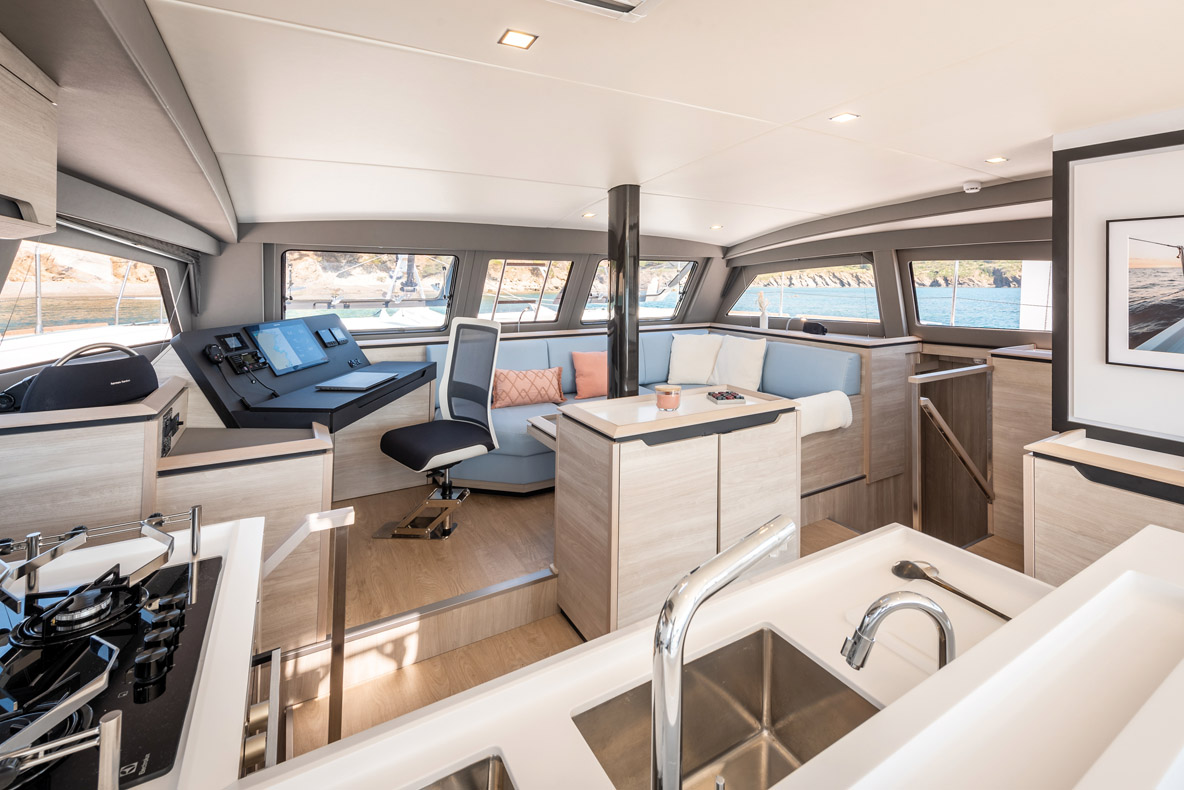
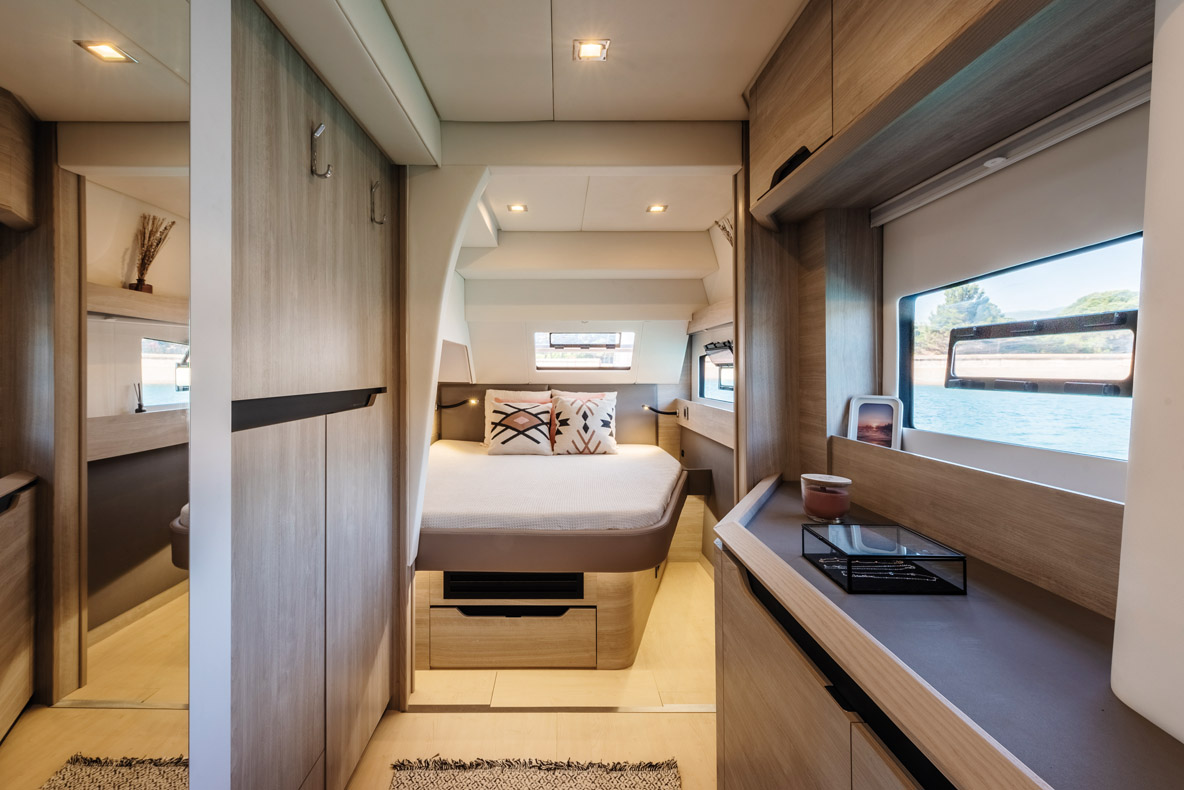
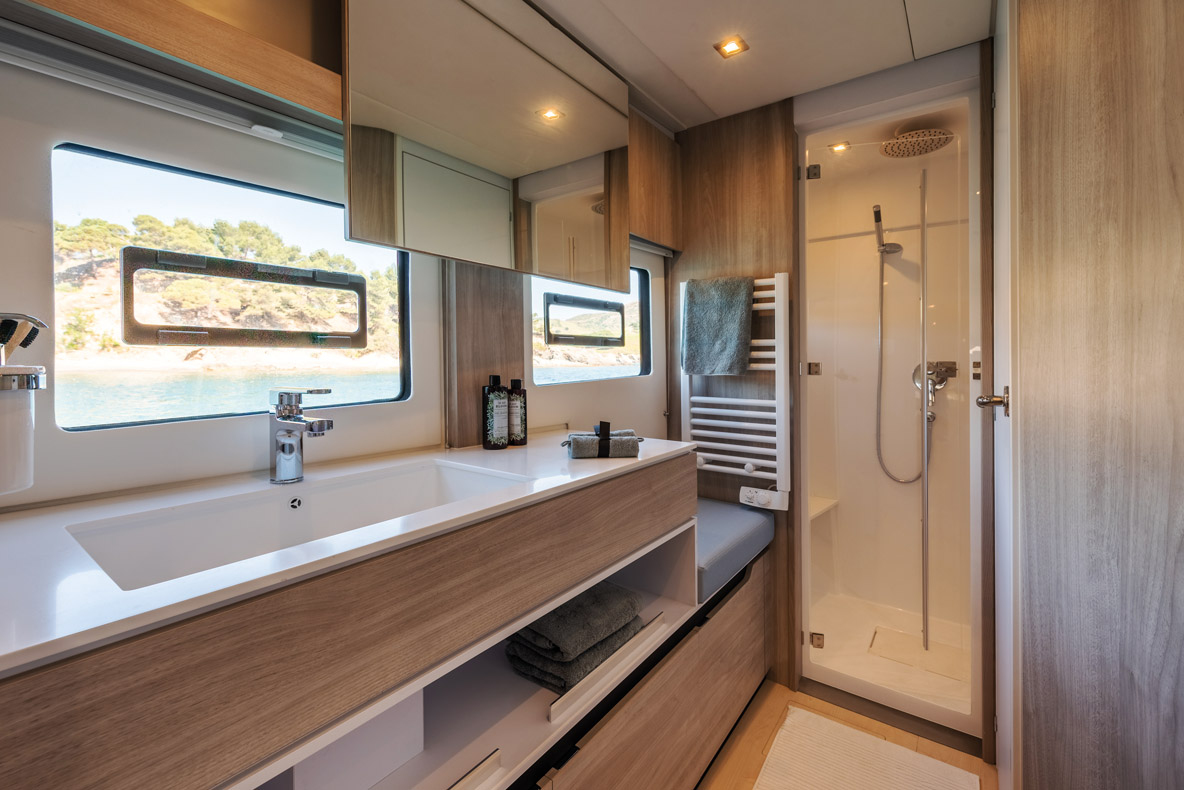
The crew will arrive on the other side of the ocean in even better shape as comfort on board remains a quality that Catana values. Because the “enlarged living area”, to use the official terminology, does not mean a decrease in the level of comfort provided by the Ocean Class. The upholstery is plush, the galley perfectly equipped, and the in-house woodwork very well done. In front of the mast foot and thus of the saloon/galley unit, the chart table sitting at 45 degrees to the direction of travel might seem surprising. Its large dashboard houses all the electronics that a modern multihull is bound to have on board. But this orientation allows you to keep an active watch from the small L-shaped salon on the starboard side while keeping an eye on the instruments. The two large opening panels in the forward face of the coachroof allow for extremely efficient natural ventilation. At least at anchor, because under way in challenging conditions, you’re going to have to remember to close them before the spray reaches the interior. The layout of the hulls is quite traditional, with an owner’s suite on the port side and two cabins to starboard. In the latter, even if two totally independent bathrooms are still possible for those who would like a charter-type service, we liked the large shower and washbasin on one side and an independent toilet and basin on the other. This “communal” layout is perfectly suited to cruising with family or friends. Even more than in the nacelle, we noted the quality of the woodwork and lighting in the hulls, the concern to maintain access to the equipment and fittings everywhere, and to offer a maximum of storage space. This is a crucial point on a cruising catamaran, even if you have to be careful not to overload it.
Concluding with a few green aspects…
By integrating 1,800 Wp of solar panels and by proposing a bioreactor to treat waste water and to reject only neutral elements into the environment, the Ocean Class brings its share of green innovations. But its biggest ecological argument is to sail as fast as the wind as soon as there is 5-6 knots. Small evolutions will further improve this already very attractive “zero” number. The gooseneck will be lowered by about thirty centimeters, facilitating even more access to the head of the mainsail and allowing for a little bit more sail area. The underside of the maneuvering station will be reinforced, and its floor lowered while maintaining a peripheral view on all four extremities of the catamaran. Finally, a few design touches will make life on board easier, including, among others, the removal of the armrests of the saloon bench seats that were obstructing the passage when entering or leaving the table and the addition of solid furniture posts near the bay window to improve their durability. The consistency and high level of performance of this Ocean Class is reminiscent of such an iconic model as the Catana 471. Will the OC be as successful as the shipyard’s best-seller? If we believe the production objectives (one catamaran per month from January 2023), the answer is definitely yes!
technical specifications
- Builder: Catana
- Overall length: 51’8” (15.75 m)
- Hull length: 49’2” (14.99 m)
- Beam: 26’2” (7.98 m)
- Draft: 4’6”/8’3” (1.39/2.52 m)
- Light displacement: 29,760 lbs (13.5 t)
- Mainsail: 990 sq ft (92 m²)
- Solent: 538 sq ft (50 m²)
- Motors: 2 x 45 HP or 57 HP saildrive
- Fuel: 2 x 10⁵ US gal (2 x 400 l)
- Water: 2 x 10⁵ US gal (2 x 400 l)
- Base price: € 912,900 ex-tax
- Price of the model we tested: € 1,270,000 ex-tax
- Main options in € ex-tax:
- White lacquered carbon mast: 85,200
- Aluminum beam and carbon longeron, white lacquered: 15,150
- Genoa instead of solent: 7,980
- Code 0: 11,650
- Gennaker: 13,300
- Asymmetric spinnaker with sock: 9,200
- 2 electric Performa winches: 10,990
- Yanmar 57 HP instead of 45 HP: 5,910
- Watermaker 27 US gal (105 l)/h: 13,990
- Air conditioning in hulls (3 cabins): 16,170
- Air conditioning in nacelle: 14,900
- Webasto heating (3 cabins + nacelle): 13,100
- Solar panels on the coachroof (1 770 Wp): 32,250
- Premium electronics pack: 35,420
- Preparation, launching and commissioning: 14,580
- Ergonomics of the helm and maneuvering station
- Numerous storage spaces
- Lively behavior at sea
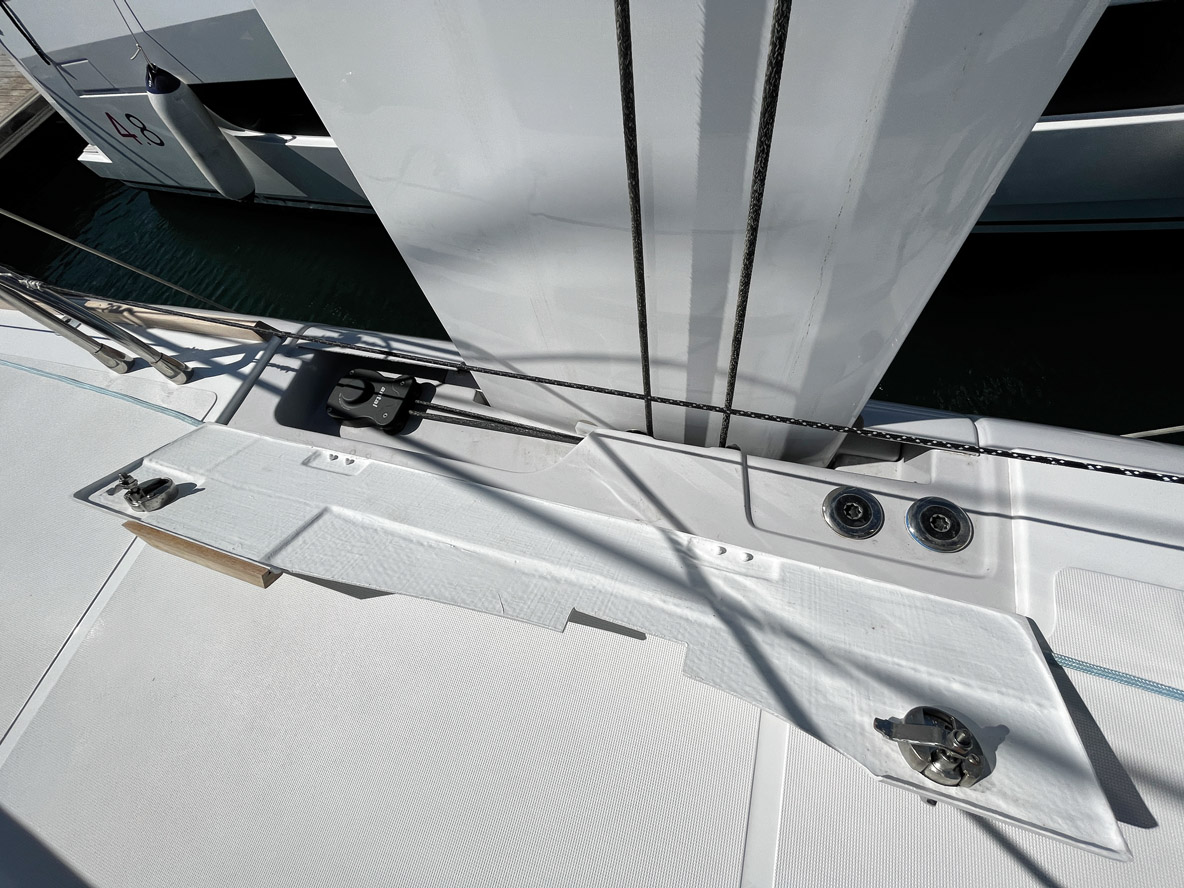
- Daggerboard panels that hide the filler necks on deck
- Some of the furniture angles are a little too prominent
- The footrest at the helm seat is in the way when standing
- Opening/closing the aft window could be improved