Since 2004, Catathai have been building small production runs of catamarans in Phuket, customized according to the wishes of their owner. Among them, the Catathai 40 is not lacking in interest...
Infos pratiques
- Le chantier : Catathai 40
- La fiche technique
- Découvrez notre vidéo exclusive
- Financez votre Catathai 40
- Assuez votre Catathai 40
- Articles autour du Catathai 40
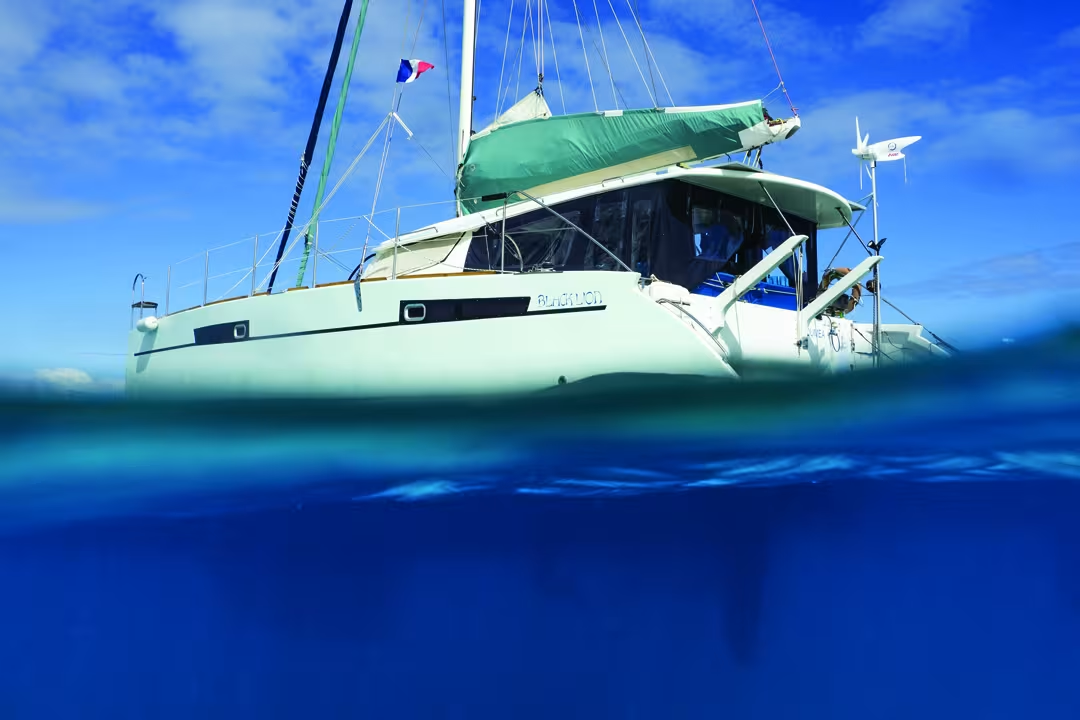
A sleek and functional look, very neat construction, and light on the weighing scales: that's how the Catathai 40 is. This is a catamaran that you either love or you hate, very far from the marketing standards of the major yards. The first model was launched in 2010 and was immediately subjected to intensive sailing - 43 weeks in the first two years. And number 2, Black Lion, owned by Cyril and Magalie Jagot, doesn’t stand still either; they sail a lot too. So there’s a common theme with Catathai catamarans: they all eat miles, over and over again! However, to find one, it is likely towards the Indian Ocean or the Pacific that you’ll have to go. According to Gilles Reigner, the 40s are all to be found either in New Caledonia, French Polynesia, Malaysia, Reunion Island... or Thailand, of course. Note: the Catathai 40 is in constant evolution; the latest models, for example, take advantage of significantly wider hulls for more interior volume and a load capacity increased by a ton.
An original construction
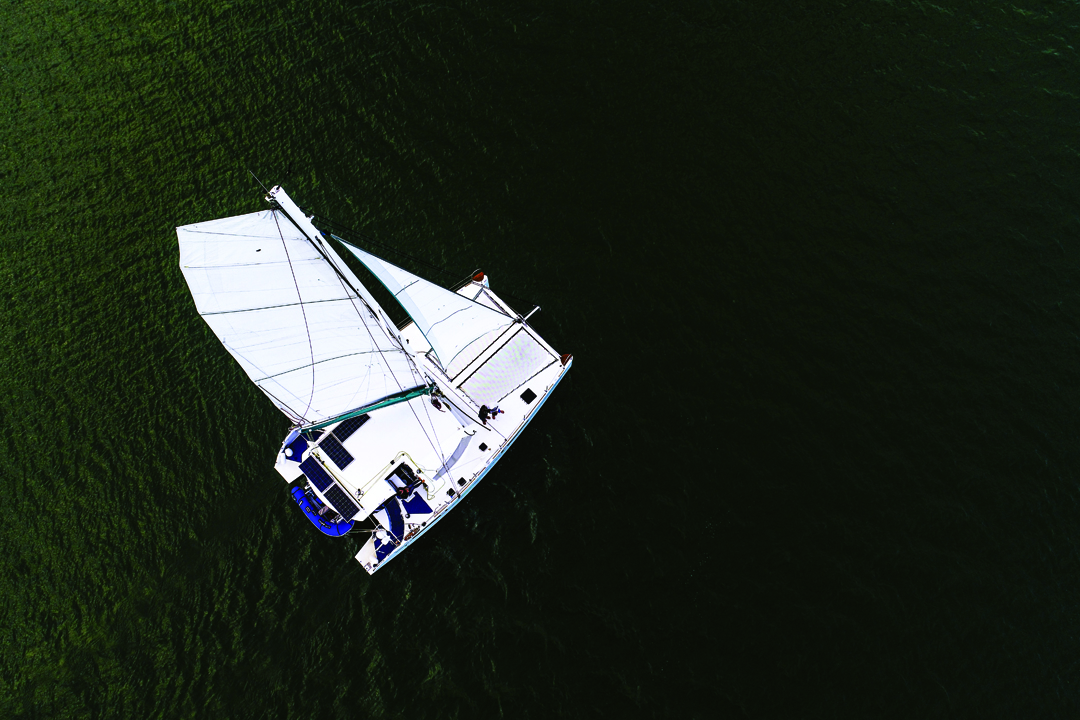
The construction of the Catathai 40 is original, since there are only molds for the undersides of the hulls. The planking is then built separately on a bench and then applied and glued, much like it would be with a plywood construction method. The result: No expensive molds and perfect control of each part. But the disadvantage of this process is the implementation time, and above all, the very many hours of sanding required.
An original construction technique that allows the 40 to be particularly light - less than 5 tons while the comfortable catamarans of this size are usually nudging at 10 tons.
A performance catamaran, especially in a breeze
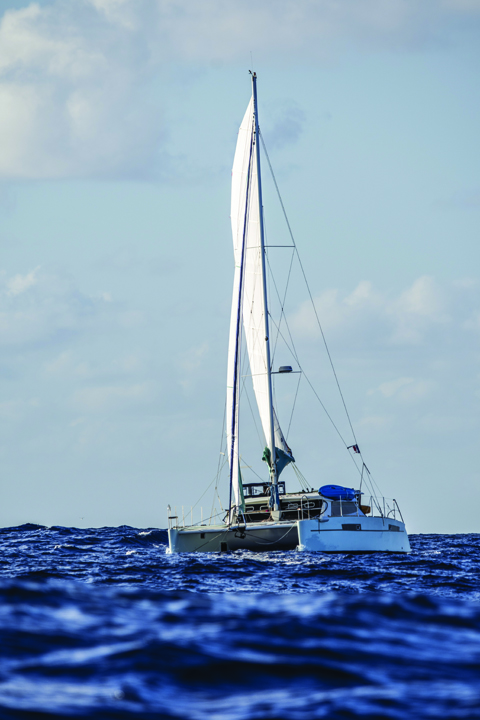
Well-canvassed with its square-topped main, self-tacking solent and a small gennaker, the Catathai 40 has a very modern sail plan. This model moves rather well in light airs and also in medium conditions. But close-hauled sailing is not her strongpoint. "The skegs are too short," says Magalie. As a result, the boat suffers with quite a lot of leeway. This is also a problem at anchor because in adverse winds and currents, it easily makes swings around...". But if we ease sails a little, speed picks up to 8 knots in 13 knots of true wind. And the averages will be well above 10 knots with 20 knots of wind. The beautiful, stepped hulls are finally expressing themselves! "Above 15 knots, we put in a reef," advises Magalie. It becomes more important to balance the weight and especially not to overload the boat so that she keeps her qualities. The sporty character of the Catathai 40 dictates that you shouldn’t miss an opportunity for a bit of a sprint, but this enthusiasm doesn’t stop the surprising comfort she provides when sailing.”
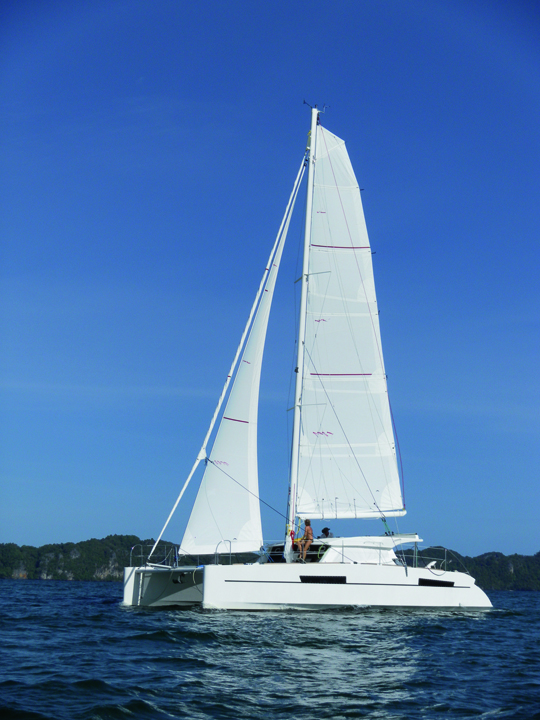
A simple and efficient deck layout
The cockpit is very safe when under way, with a passage allowing you to reach the very beautiful and wide sugarscoops. Ideal for fishing at sea or enjoying the anchorage. The cockpit table can seat six guests very comfortably, and is well-protected by the rigid bimini. This is equipped with a clever rainwater recuperating system. From the elevated helm station, you have a good view of the water and the sails, while being well-protected from the sun by a protective canopy. Easy to handle solo, the deck layout of the 40 is cleverly designed: all sailing maneuvers are led back to the helm station - except for reefing, at the foot of the mast.
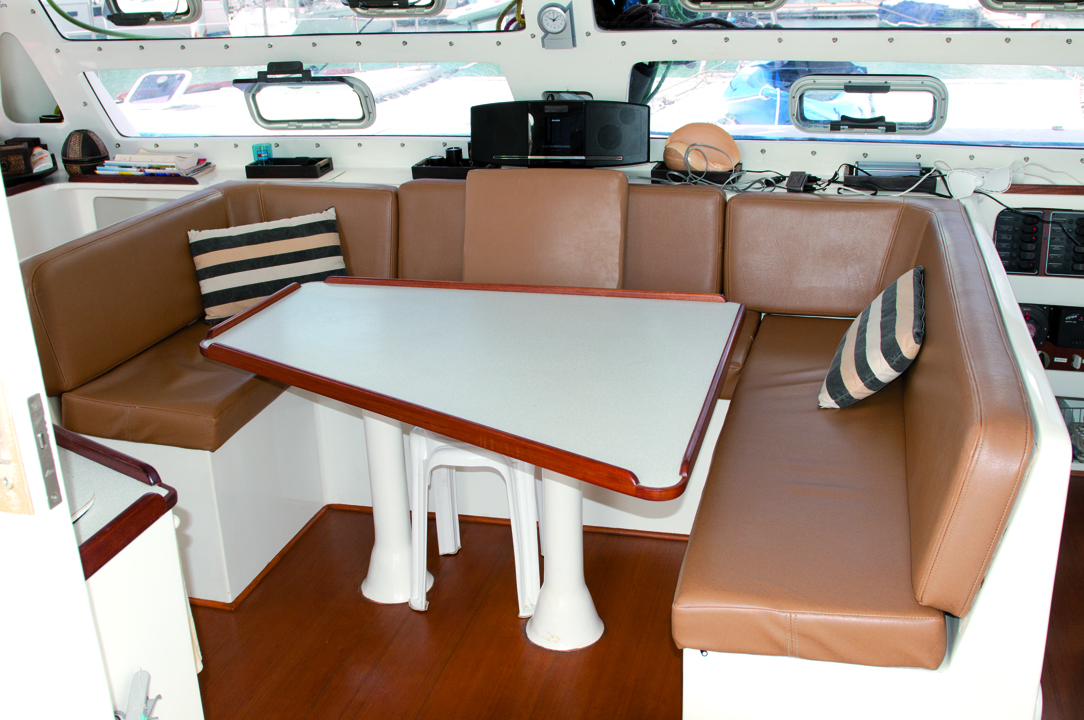
A la carte interior layout
The layout is simple and functional. Even though there is no headlining or ostentatious woodwork, the result is rather pleasant, bright and yet warm. The nacelle is particularly comfortable, with a beautiful table, a galley worthy of the name, and even a generous-sized chart table. We especially appreciate the many storage spaces both in the hulls and in the saloon. The forward face of the coachroof has six opening hatches, to provide good ventilation inside. But in tropical sunshine, you have to close the large bay windows to keep the boat a little cooler. If you visit a three-cabin version, you will discover on the port side a beautiful double cabin at the stern and a large bathroom at the bow. The starboard hull is for guests, with two double cabins and a bathroom in the middle. These cabins are accessed by two separate companionways, either side of the chart table.
Conclusion:
Simple, intelligent, the Catathai 40 is a catamaran that conforms to a minimalist vision in the spirit of the times. As soon as you step aboard, you can feel a different atmosphere: here, no frills, but practical and tangible. You immediately perceive that the builder has sailed a lot, and has anticipated anything that could cause problems when you’re a long way from the busy marinas and their boatyards. The 40 can take you to the far side of the world, or show you some of the most beautiful tropical islands. It's up to you to find the tempo....
Points to check:
Generally speaking, catamarans that sail the most are perfectly maintained and this model is still quite recent: not much to fear in terms of key factors - structure, rig, and engines. Magalie, aboard Black Lion, has decided to do away with the square top for her new mainsail to make it easier to get ready to hoist (no need to climb two meters/six feet above the deck). Another point they’ve modified: the hydraulic steering system. This previously forced the crew to make several turns of the wheel to adjust their course.
Technical specifications:
Builder: Catathai
Naval Architect: NG Yacht
Construction: Divinycel foam sandwich and vinylester resin under vacuum
Length: 11.99 m (39’ 4”)
Beam: 7 m (23’)
Displacement: 4.8 t (10,600 lbs)
Draft: 1.2 m (3’ 11”)
Mast height: 17 m (55’ 9”)
Mainsail area: 96 m² (1,035 sq ft)
Self-tacking: 33 m² (355 sq ft)
Gennaker: 76 m² (820 sq ft)
Spinnaker: 106 m² (1,140 sq ft)
Water capacity: 500 l (130 US gal)
Diesel capacity: 300 l (80 US gal)
Cabins: 2 to 4
Motors: 2 x 29 HP
Production: 6 units since 2010, one currently in build
Second hand price: from € 180,000 ex-tax