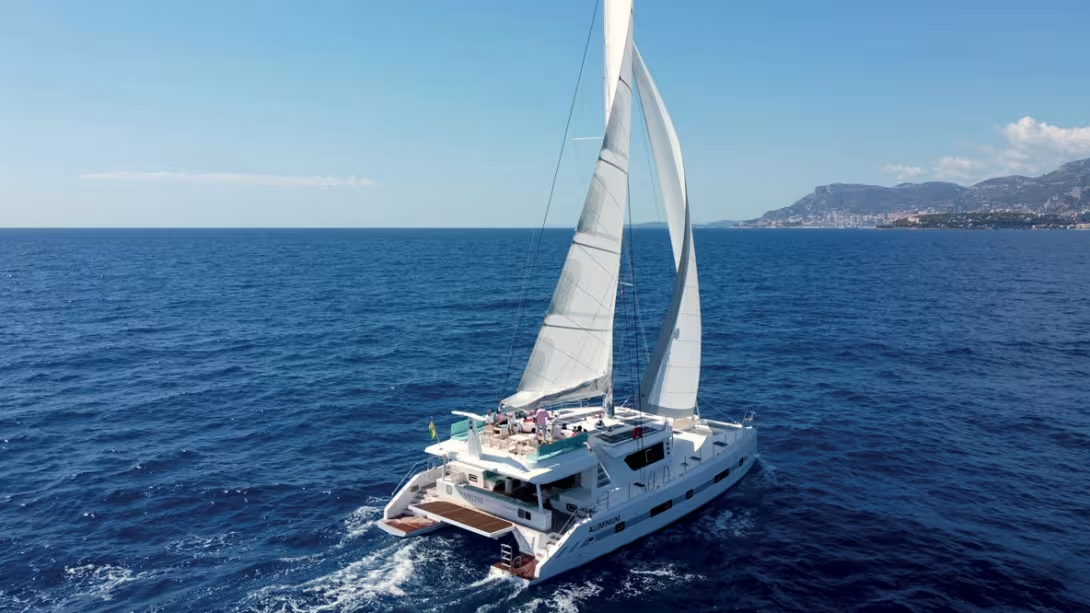
Presented for the first time at the Cannes Yachting Festival back in September, the CK70 impressed show visitors by the volume offered and the standard of finish. Add to these qualities the choice of aluminum construction: this material is perfectly suited to extreme sailing programs and upstream of the build, allows almost infinite customization possibilities. We got the chance to test this serious blue water boat off Menton, on the French Riviera.

Infos pratiques
- Le chantier : Squalt CK70
- La fiche technique
-
 Découvrez notre vidéo exclusive
- Financez votre CK70
- Assuez votre CK70
- Articles autour du CK70
Conditions: Wind 10 to 12 knots, sea state slight to moderate
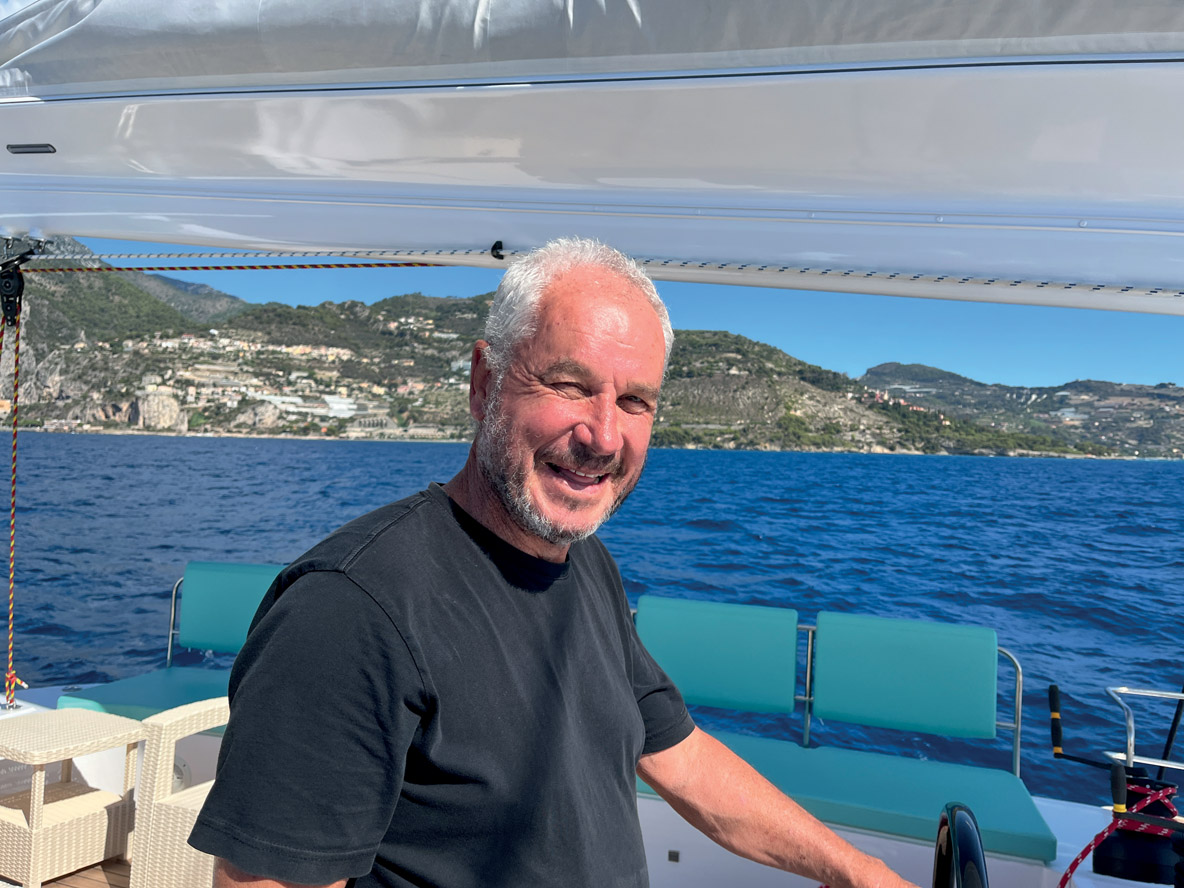
Our appointment was set for the week following the show: the big catamaran hadn’t gone far - it just ventured some 30 miles to the east, within touch distance of the Italian border. A very short hop for indeed for a multihull that had just crossed the Mediterranean: this CK70 was built in Bizerte, Tunisia, by Squalt Marine International. The shipyard occupies three-quarters of an acre (3,000 m²) and is right next door to the Aventura Catamarans yard and employs around 40 people. It is managed by Claude Kermoal, a well-known figure in the marine industry - both in the boatbuilding and charter sectors. Our man has already built more than 20 aluminum catamarans, was part of the Catlantech adventure, organized charters in Dubai, worked in Vietnam, was part of Alumarine... in fact, a career almost entirely dedicated to multihulls. Claude recollected: “The first time I set foot on a catamaran was in 1982, aboard Elf Aquitaine, which had just won the Route du Rhum with Marc Pajot at the helm.” Claude has been living in Tunisia for the past 6 years, and the CK presented today by the builder – the name simply comes from his initials - is the third (and also the largest) in the range to be launched thus far.
A royal welcome!
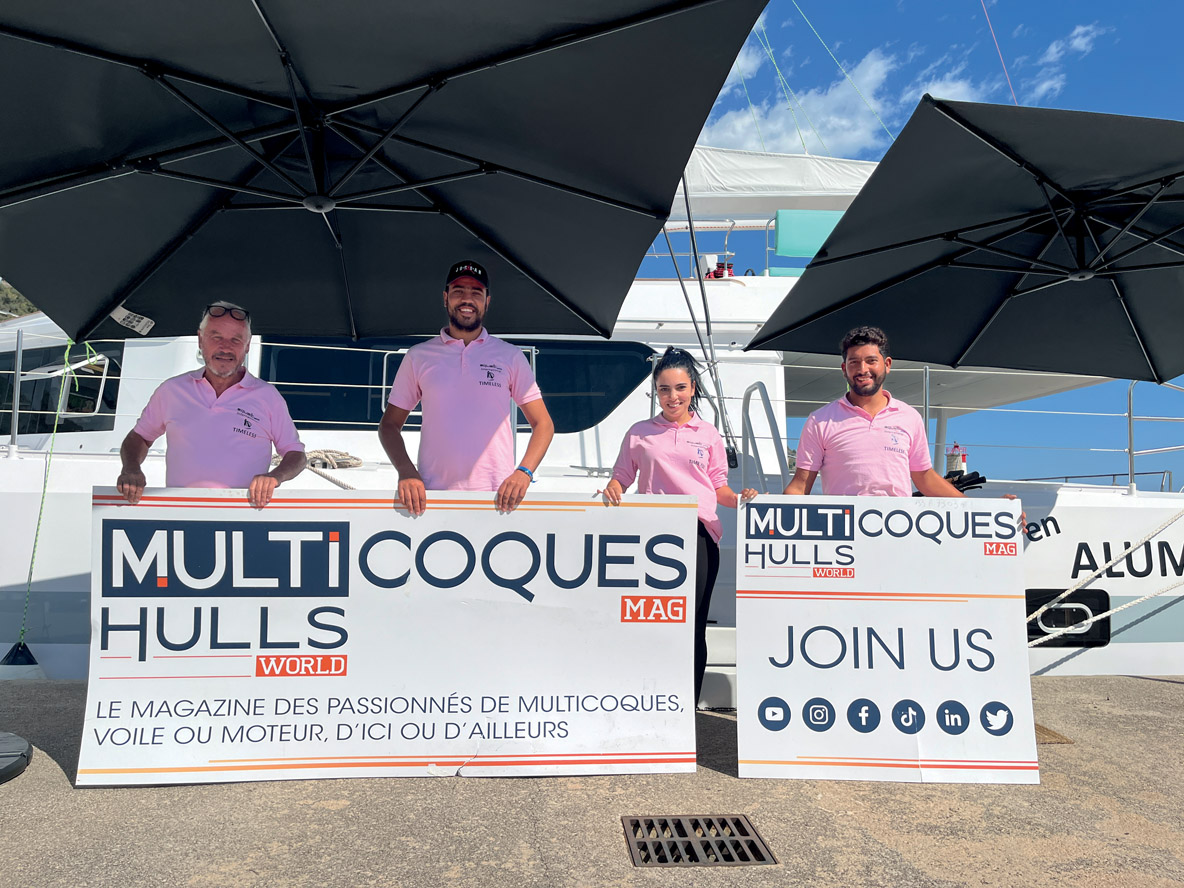
At the Cannes Yachting Festival, the Multihulls World team got a good measure of just how great the Squalt Marine International team is, as the CK was moored right in front of our booth. And just a few days later, that same team surprised me, having taken the visuals from our booth after the show and set them up in Menton, in front of their catamaran! In short, the welcome could not be more friendly. Claude loves good food and is an excellent cook, but first, we’re going to talk about his large multihull... Let’s make it clear that this giant with two aluminum hulls presented here is an “extended version”: at the outset, the design was limited to 64 feet, then a new version was extended to 67 before going up to 70... And this is the advantage of building without molds: each multihull can be designed as a single unit. The manufacturer doesn’t fail to point out that the CKs are infinitely customizable. This means they lend themselves to the most particular programs, whether explorations, expeditions, scientific studies and scuba diving, among others, or more simply for a liveaboard family who want to do some charters. The overall silhouette of this catamaran is massive with imposing and vertical superstructures, but design efforts such as the form of the bows and the decorative side stripe that takes up these angles deserve to be praised. To further improve the result, the quality of paint application deserves to be improved.
Protected aft cockpit, exposed flybridge
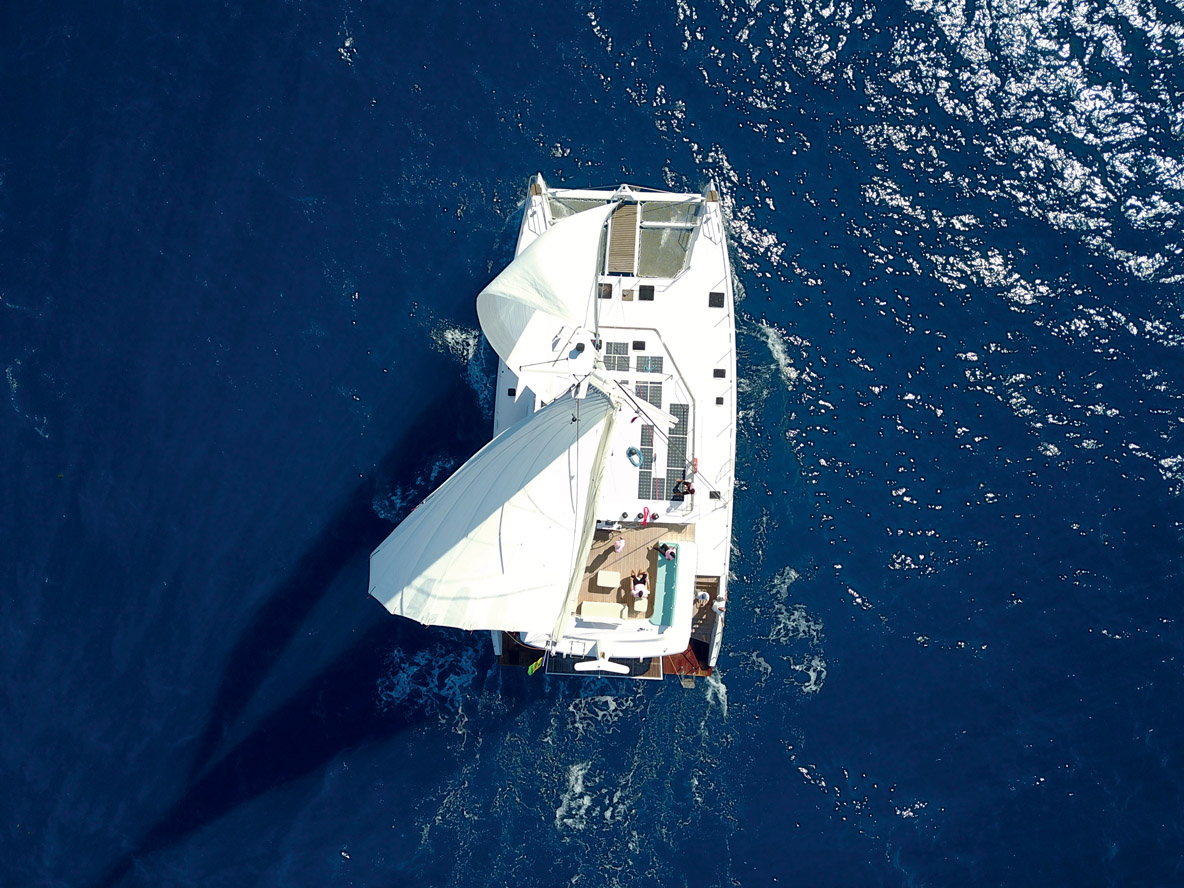
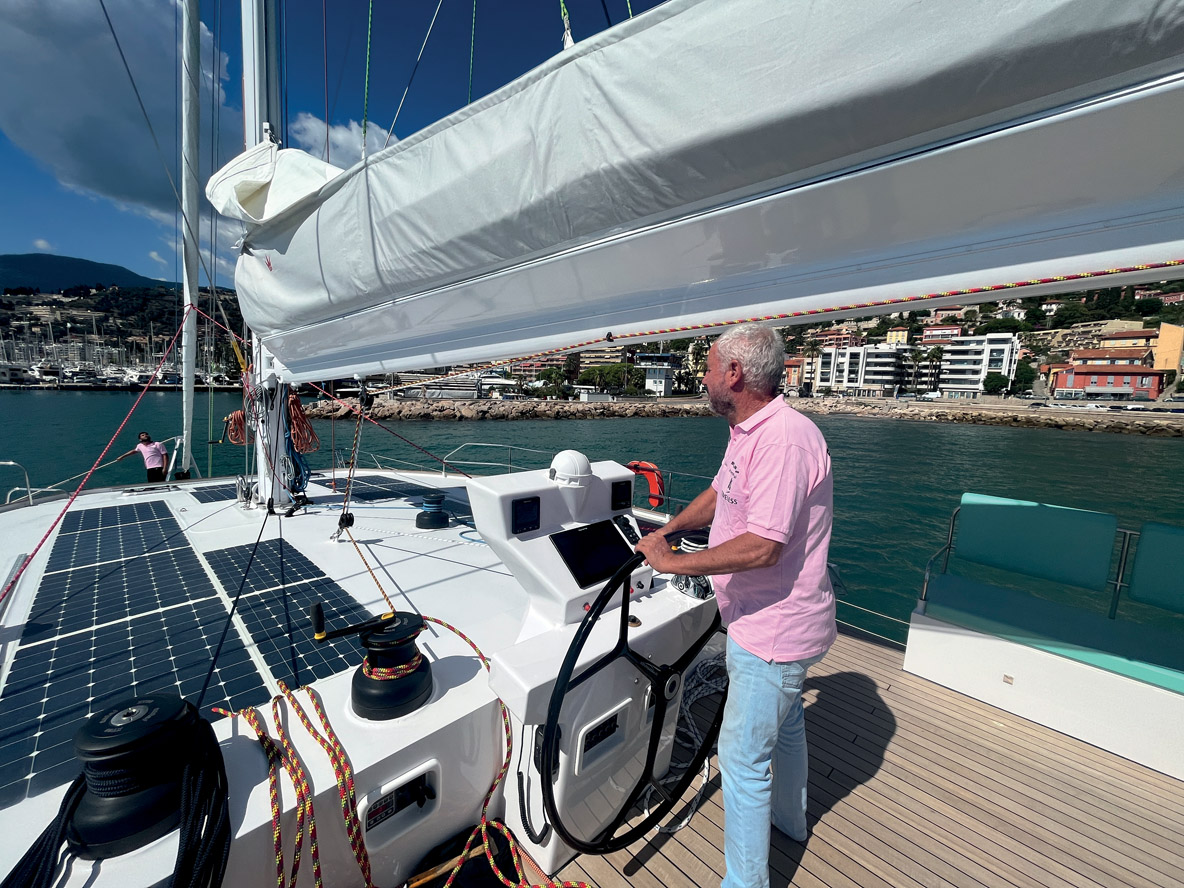
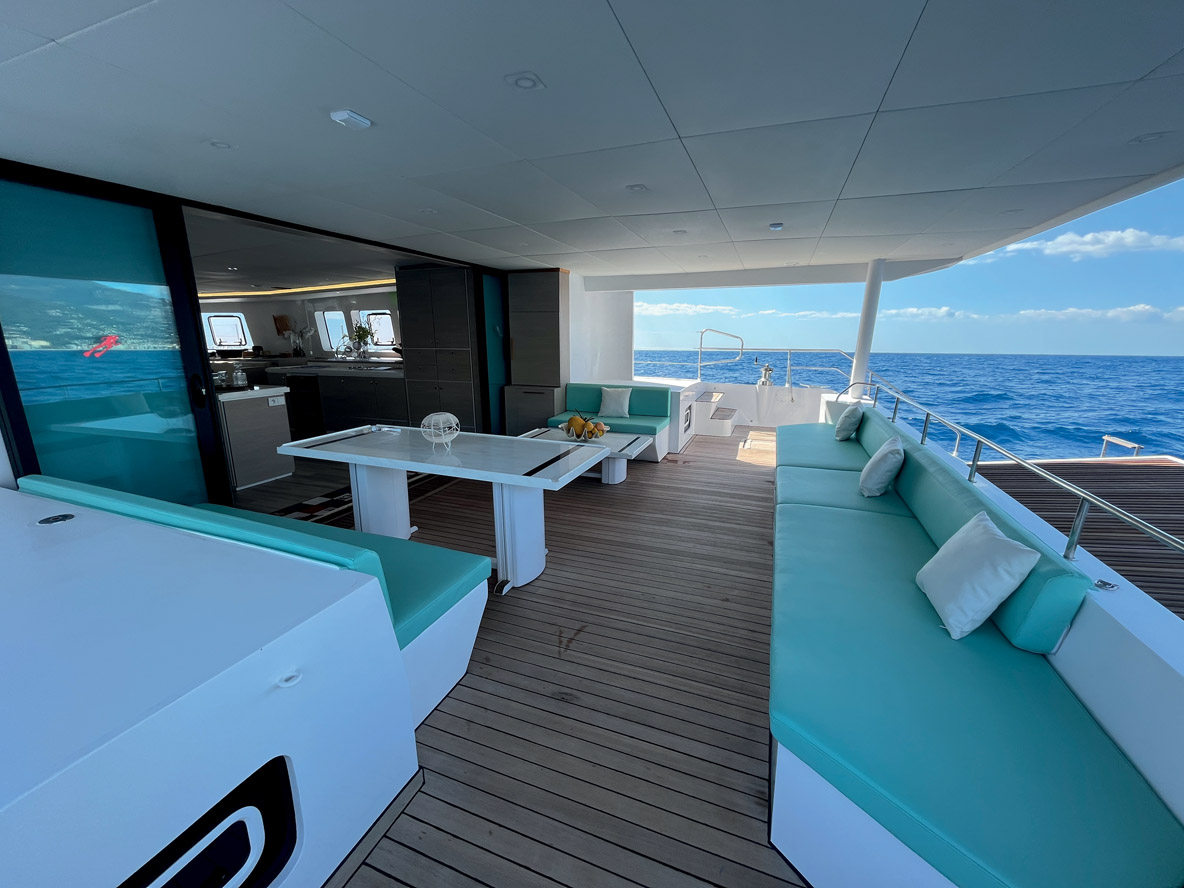
The deck plan, with a surface area almost equivalent to that of a tennis court, is logically easy to move around: the side-decks are wide, as is the foredeck. One point that needs looking at is that the non-slip surface is not very effective. Handrails run all along the coachroof and up front, the trampolines are bordered by a stainless-steel rail, which is very practical for securing downwind sails to, or even a pair of paddleboards. The aft cockpit is particularly well protected and features a table and plenty of seating. At the very back, the two extended sugarscoops sit either side of a hydraulic platform. The flybridge is accessed via a staircase on the starboard side, and is used as a command post (helm and sailing maneuvers), but also as a lounging area since the entire aft part incorporates bench seats, armchairs and table. In mid-September on the French Riviera, the sun was not that high and the air temperature was mild, so the flybridge was gladly occupied by the crew. But it would be a different story on a chilly night, or under tropical sunshine, and of course in heavy weather... The “upstairs” is indeed a terrace that’s not protected at all, not even by a small windshield. This configuration has nevertheless the advantage of not overloading the silhouette and keeps the boom not too high. Forward of the helm station, the solar panels leave a passage to access the mast - some sail-handling maneuvers are caried out at the mastfoot. The helmsman benefits from a perfectly clear view of the sails and the water - except for very close to the stern.
A villa on two hulls
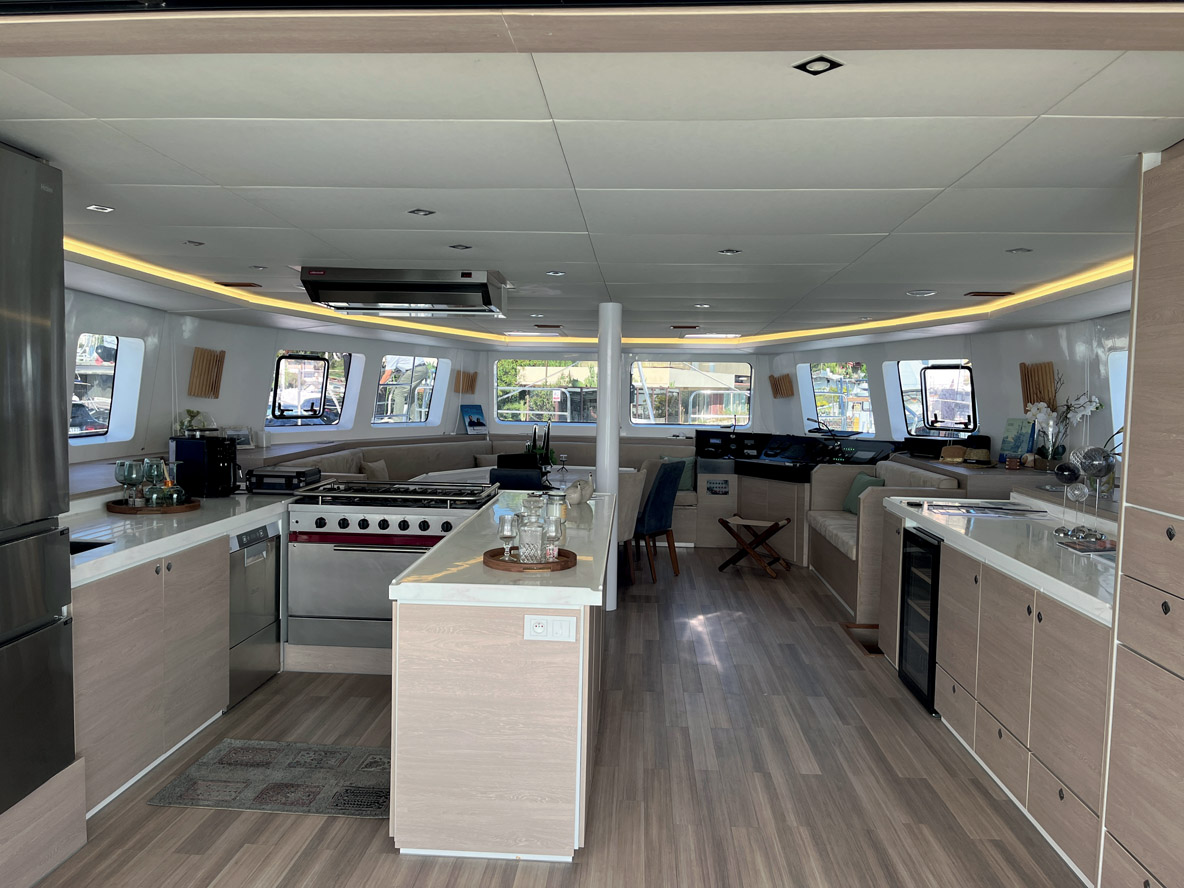
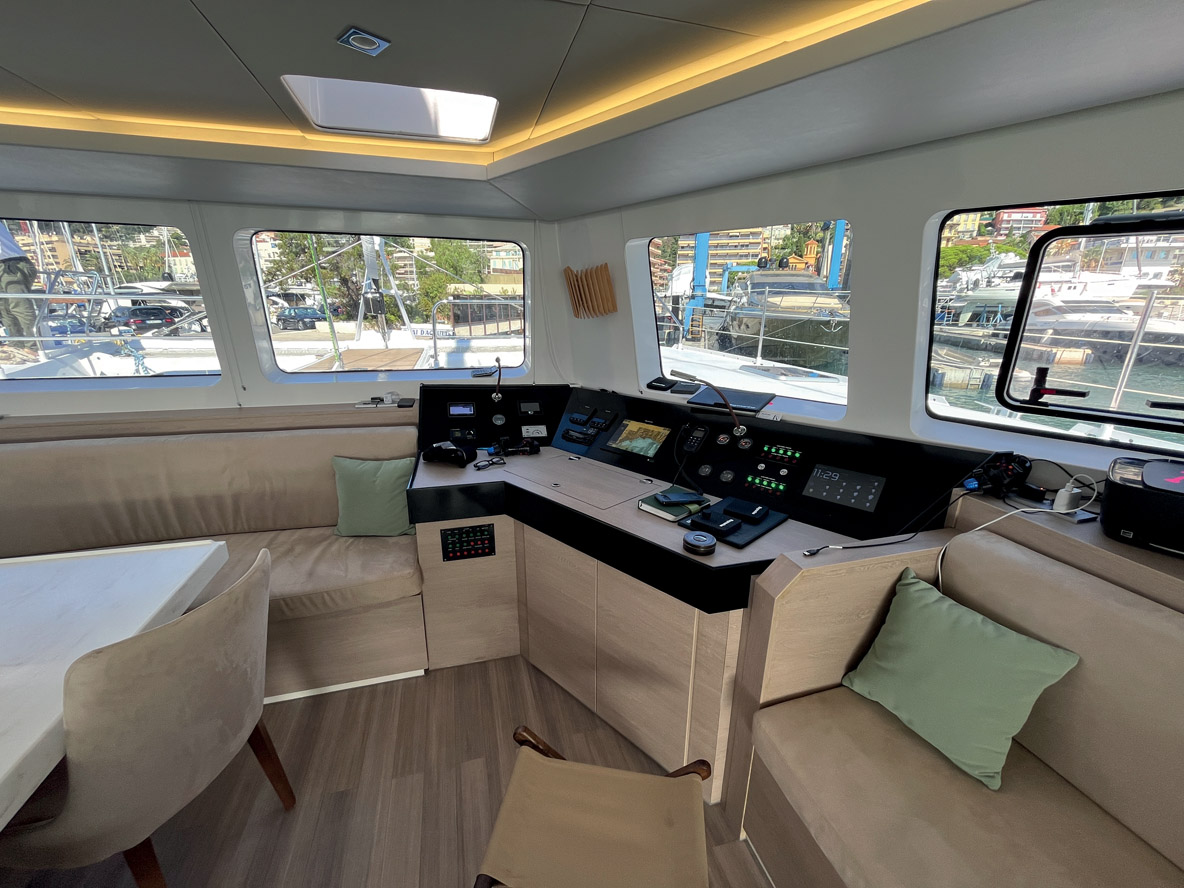
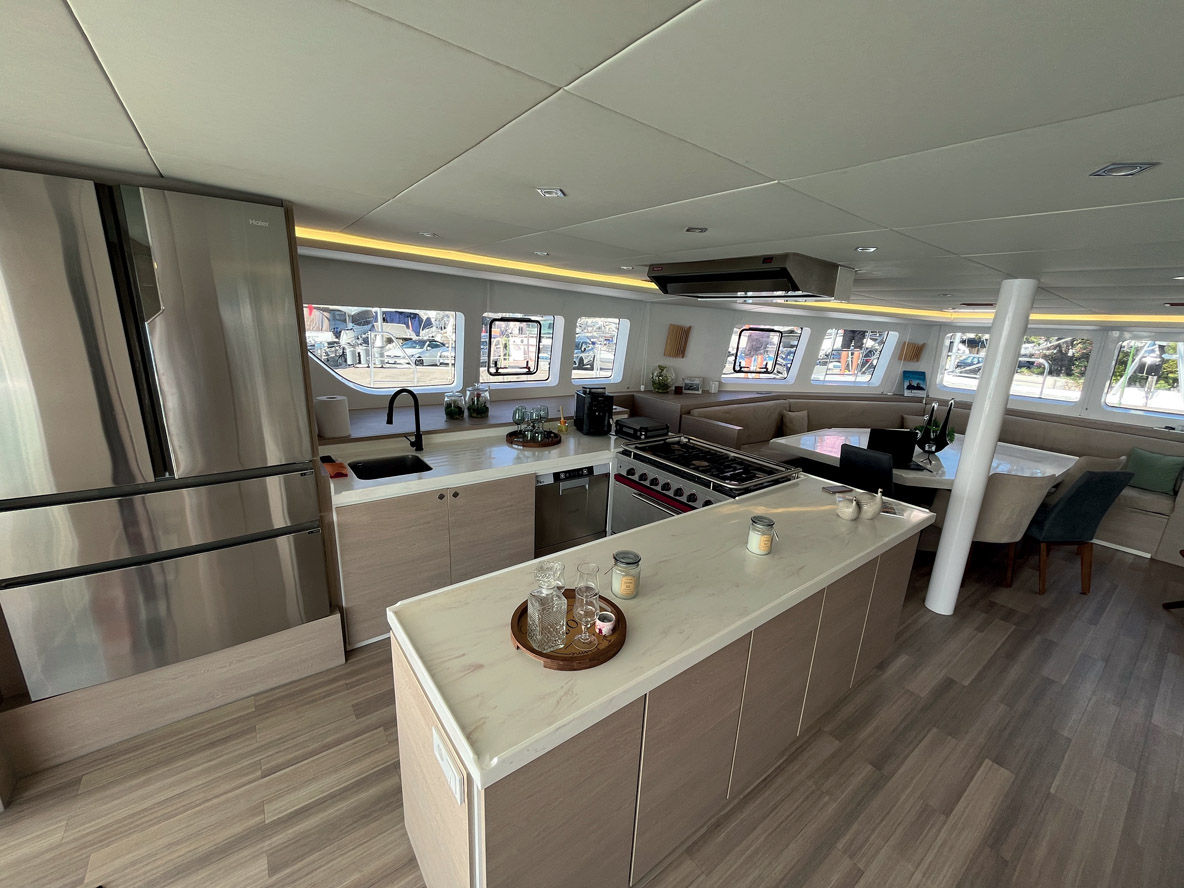
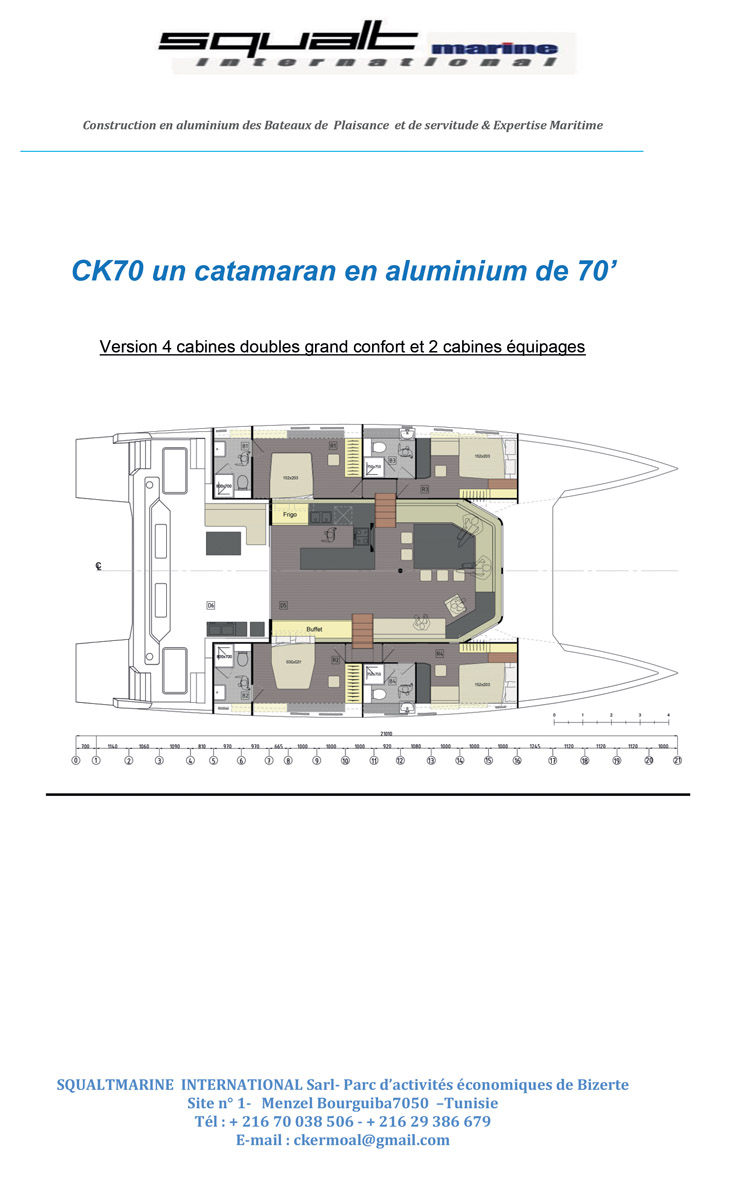
The nacelle offers an immense volume, enjoying great headroom throughout – nowhere is it less than 6’10” (2.1 m). With its vertical windows, this panoramic living space is completely open to the cockpit and is especially surprising in its depth. At the back, on the starboard side, a huge table can seat a dozen guests in the other starboard corner, a vast chart table is arranged diagonally. To port, at the cockpit end, the builder has opted for a gigantic and fully-fitted, U-shaped galley. The choice of materials, the quality of the finish and the care given to the lighting are all clearly evident: this is beautiful craftsmanship.
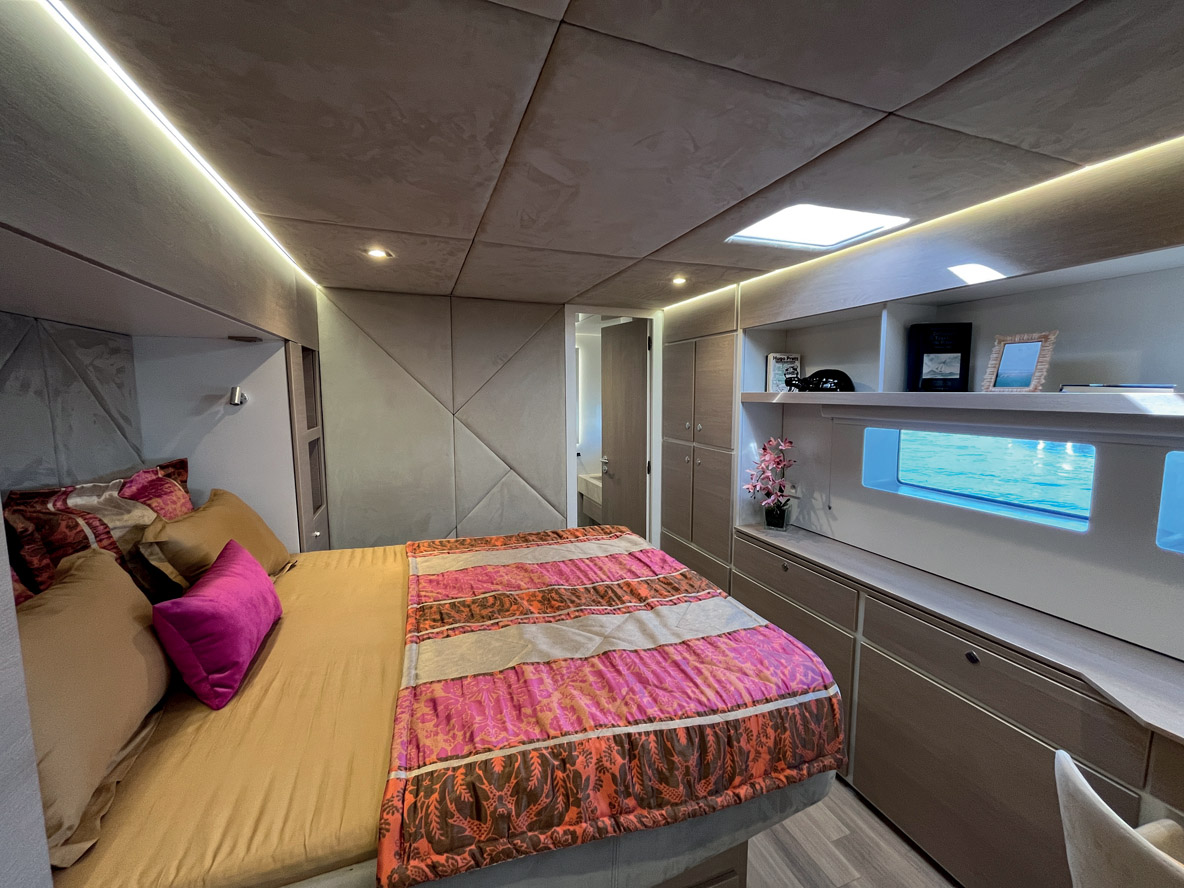
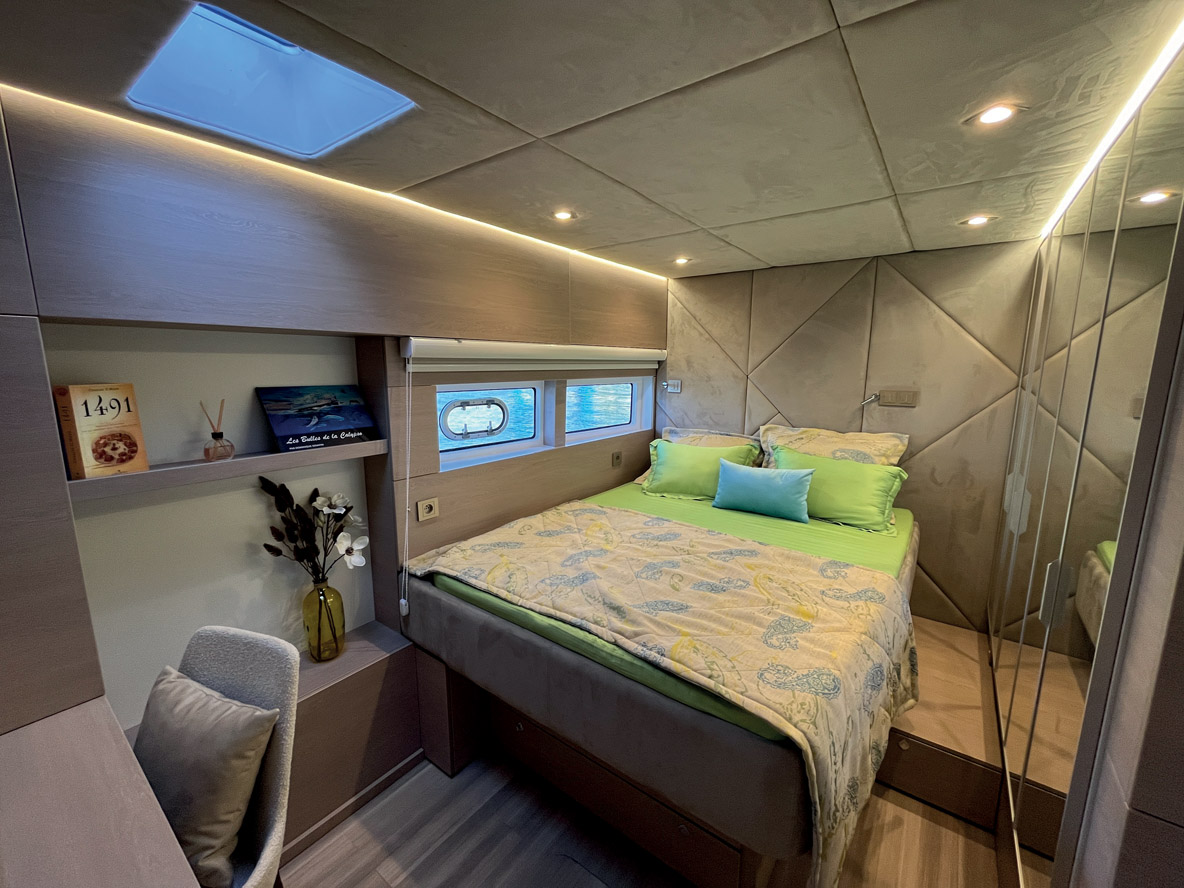
Given the available width, access to the hulls curiously features asymmetrical companionway steps a bit like the half-steps found on small trimarans. The layout offers 4 cabins by default. Aft, the bed is 4’11” (1.5 m) wide but positioned at 36” (92 cm) from the floor, it’s a little high. The headroom is 6’11” (2.12 m), and there are two opening hatches and plenty of storage. Up front, the beds are set fore-and-aft, with the bunks being almost right up against the outer hull, which complicates access a little, especially since the mattress is 33” (83 cm) from the floor. The operation is easier on the other side, where you can take advantage of an island bed configuration. The forecabins also feature two natural ventilation hatches.
A lover of breeze…
The conditions of the day saw winds of 10 to 12 knots and a slightly confused sea with chop and cross swell. Obviously, on a catamaran with a hull of more than 70 feet in length and 33 feet in the beam, these conditions that would be tossing a 35-footer all over the place, translate into... not very much! It’s no bother to hoist the mainsail from the maneuvering station on the flybridge by the large central steering wheel. We then unrolled the solent and settled down on a close reach to study the adjustments and then check out the behavior of the CK70 on other points of sail. We were making 6 knots at 50° off the true wind and up to 7.2 with the wind on the beam. Beyond that, downwind, the speed decreased a little in line with the apparent, as there wasn’t a downwind sail on board. These somewhat disappointing performances must be put into perspective by the poor condition of the hulls, already well colonized by green algae, and a relatively modest sail plan. In fact, the sail area to weight ratio is 6.58 m²/t, a very reasonable value that doesn’t bring the displacement into question: the 38 tons of the CK70 are to be compared to the 35 tons of the Alegria 67 and the 40 tons of the Lagoon SIXTY 5. At the helm, we could feel that our big catamaran only wanted to lengthen its stride, but... it just needs a little more wind!
Conclusion
Describing a catamaran as well-placed in terms of price could be qualified as indecent when we’re looking at a budget upwind of 2 million euros, but you’ve got to compare the CK70 to its competitors - and there are some! In this category of large 70-foot multihulls, many models simply advertise a discreet “price: on quotation” but the Lagoon SXTY 5 is priced at € 2,064,000, the Alegria 67 at €2,467,000 and the NEEL 65 at €2,800,000, all before tax. The CK70 not only offers a very low price compared to these three standard models, but it also comes with exceptional equipment delivered without options. This aluminum catamaran is therefore a particularly interesting alternative for an à la carte, blue water project. We’ll obviously be following with great interest the genesis of the next CK: a 56-foot model has been announced!
A la carte layout and finish
Plentiful basic equipment
No protection on the flybridge
Beds too high
TECHNICAL SPECIFICATIONS
Design: Claude Kermoal
Material: aluminum 5083 H 111
Overall length: 72’10” (22.2 m)
Hull length: 69’3” (21.1 m)
Beam: 33’10” (10.32 m)
Draft: 5’ (1.5 m)
Mast length: 85’ (26 m)
Displacement: 83,750 lbs (38 t)
Mainsail: 1,291 sq ft (120 m²)
Genoa: 1,400 sq ft (130 m²)
Fuel: 2 x 845 US gal (2 x 3,200 l)
Water: 2 x 475 US gal (2 x 1,800 l)
Engines: 2 x 140 HP
Price: € 2,150,000 ex-tax
Main options in € ex-tax
6-cabins, 6-bathroom version: 28,050
Saloon convertible into a bed: 2,700
Interior and exterior blinds: 5,371
Diesel water heater: 18,220
Electric engine controls at the chart table: 1,350
Folding propellers: 4,396
Watt&Sea Hydrogenerator: 6,740
720A lithium-ion battery with Victron charger and 24V 190A Balmar alternator: 14,000
Fabric dodger for helm station: 2,720
Aft cockpit enclosure: 5,360
Marine deck covering on side-decks: 32,000
Hydraulic aft platform: 38,000
Carbon mast: 117,106
Furling staysail: 15,966
Hydranet upgrade and tri-radial cut for mainsail, genoa and staysail: 17,488
Deck hardware for downwind sails: 16,563
Code 0: 14,250
Gennaker: 11,357
Asymmetric spinnaker: 7,117
Electric winch: 4,833
Commissioning, tests and handover: 10,450
Safety pack: 7,408
380 V Dive compressor: 8,138