
Imagine a multihull capable of hitting 20 knots, of accommodating the family for a few nights at a time, and of being put away and forgotten about for the winter. Doesn't that sound tempting? Well, start trawling through the classifieds and look for a Corneel 26!
Infos pratiques
- Le chantier : Corneel 26
- La fiche technique
- Découvrez notre vidéo exclusive
- Financez votre Corneel 26
- Assuez votre Corneel 26
- Articles autour du Corneel 26
Corneel. The name has a nice ring to it, but where does it come from? It’s a combination of Bruneel - yes, Eric Bruneel of Neel trimarans fame - and Cornic. In the early 1980s, the two men launched a sports cat, the Corneel 18. This first boat went well. They approached Fountaine Pajot to build the boat. They would finance the tooling themselves. Back then, the yard was building dinghies, racing monohulls and was just starting out in multihulls, with the Louisiane. It was an immediate success: a hundred 18s were sold. It came at a particularly good time for Eric, who had had the idea in the back of his mind for a long time: “I wanted to build a day-boat catamaran which was lively and fun. With Jean-François Fountaine and Michel Joubert, we had focused on a very rounded look with rocket-shaped coachroofs, and mast sections for the beams holding the hulls together”. Launched at the La Rochelle Boat Show in 1985, at a price of 160,000 French Francs, including tax (around €42,000 in today’s money), the Corneel 26 was rewarded the following year with the title “Boat of the Year”. “We were building one a week!” laughs Eric. This was a catamaran which charmed its crew right from the word go: to start with, it was very basic - all the fittings were at the foot of the mast, and there was no boom. No daggerboards either: “Certainly not!” exclaimed the designer, “The top of the skegs, which formed the floors, was stratified while the internal volume was in foam. This lends itself to taking the ground, and is resistant to breakage. And it has remained the same for the Neel 45.” The Corneel 26 can also be dismantled - a great idea, but not so easy in practice, warns Jean-Marc Le Goueff from Multisailing. A fiddly operation as part of winterizing, but one which could be done if you were buying one a long way from your home waters.
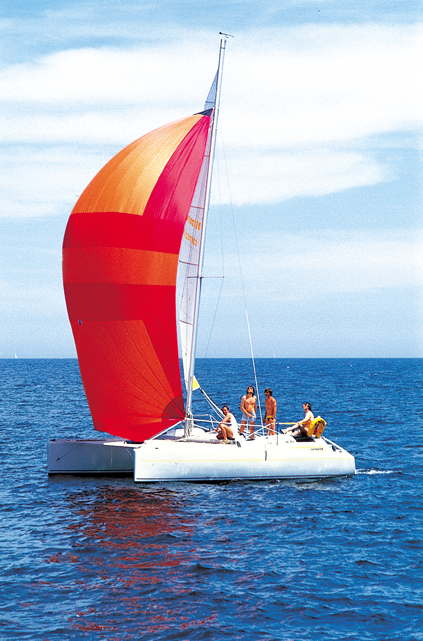
Very fine hulls set the tone: speed is the priority! As for comfort… we’ll see later
A jet-fighter
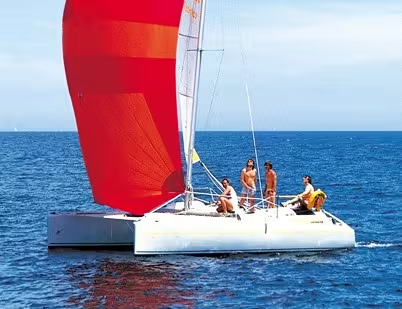
Hoist the main… and you’re off! The Corneel 26 slips through the water with ease, quickly getting up to 15 knots in light winds, raising the windward hull, if not flying it completely. Builds that feature vacuum-glued sandwich with woven-roving cloth, offering a rigidity and minimal weight ( less than one tonne ) are no strangers to such spirited behavior… Everyone who knows this boat is of the same opinion: the 26 sails at ease on one hull. Long runs with averages of more than 18 knots are not unusual. But don’t let yourself get carried away… a few Corneels have been known to capsize. This pure adrenaline sailing can only be done with your hand on the mainsheet. A tip which is even more relevant to the Sport version. With its wing-mast and an extra 8m² of sail area, the 26 really becomes very sporty. The feeling on board is similar to that of a Kat 28… The proof can be seen with the following figures, achieved in 20 knots of wind: 7.5 knots of boatspeed at 45° to the wind, 11.8 knots at 70°, 16 knots at 90°, 14 at 110°, 20 at 130° (with asymmetric spi) and 12.5 at 180°, still with the kite… Note here, the benefit of gybing downwind in open water. As for the “S” version, this achieves two knots more on all points of sail. In spite of the relative protection from the two hulls, the hard cockpit gets generously doused by the spray in a good wind. Sailing the Corneel 26 is obviously not always this exhilarating. It really is a boat that is more suited to summer weather. The boat’s slight inertia means that the crew has to keep up a fair amount of sail for tacking and getting through a chop. The outboard motor and its hinging bracket, which is fitted with an anti-spray deflector, take over from the sails when the wind dies.
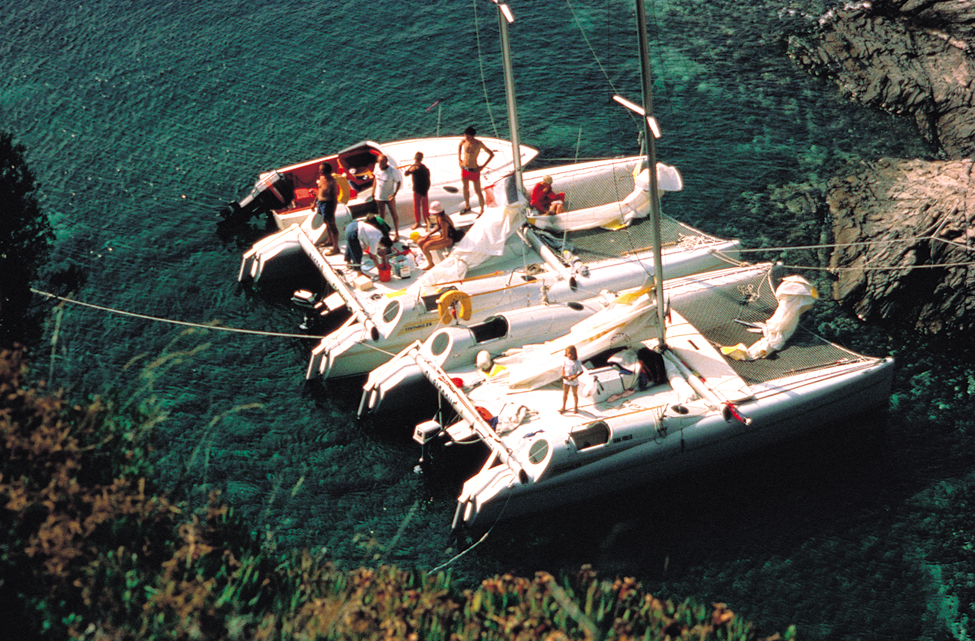
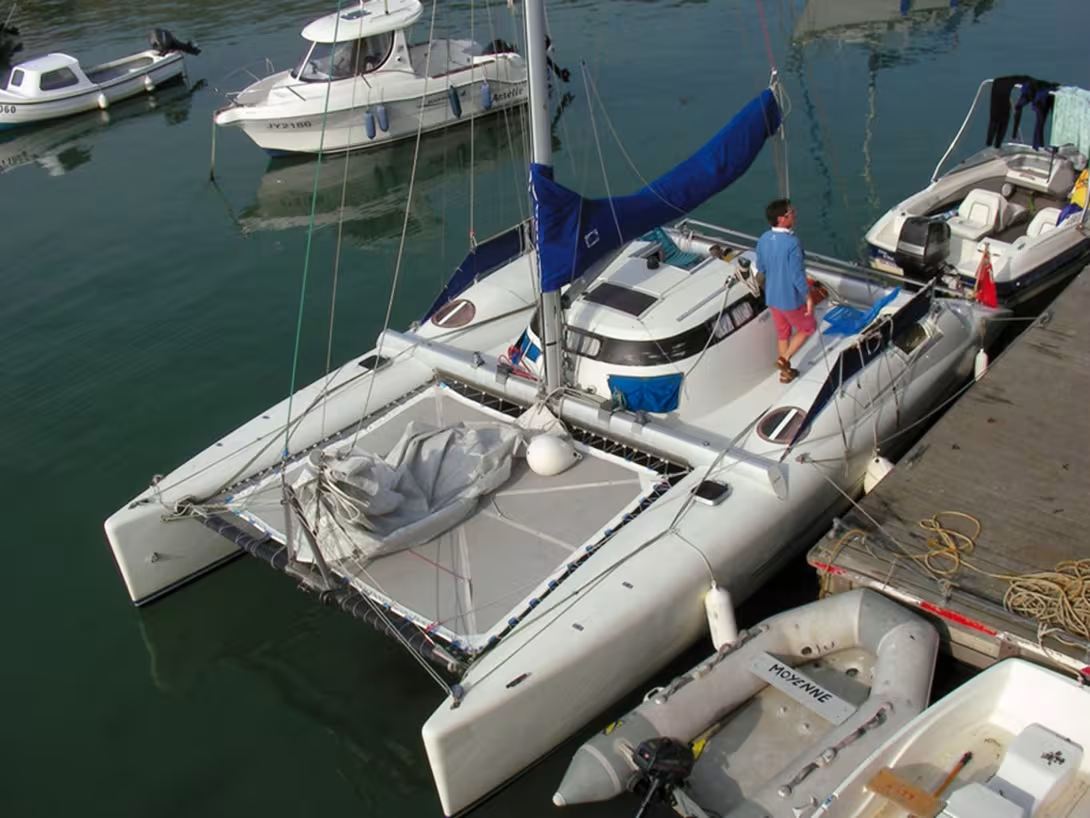
With fixed keels limiting the draft to 70cm, the Corneel 26 can be beached and even dried out over the course of a tide.
Interior Comfort
The fitting out is somewhat rustic: two single bunks in each hull, with a mini nav-station to port and a small galley to starboard. Headroom, however, is not as low as you would think, at one meter forty-five. It was really conceived for coastal rally-type sailing. At anchor, the large cockpit and the trampoline serve as great relaxation areas. An igloo-style tent can be pitched there, and the yard offered their own fabric enclosure. In 1988, aware that the boat lacked both a salon and a double bunk, Fountaine-Pajot launched the Love version, with a central nacelle. This consisted of a 1.9m by 1.35m bunk which folded up to make the salon, housed in a kind of bubble, which wasn’t too pleasing on the eye. “We were a little disappointed by the look… we should have listened to Michel Joubert, who was suggesting an igloo-type structure which would have been more suitable”, recounts Eric Bruneel. But because these models were more habitable and gave a certain amount of privacy with their three distinct living spaces, they enjoyed good success and are still very sought-after today. “In 1985”, remembers Eric, “the Corneel 26 particularly appealed to owners who lived on the coast, and who wanted to escape on to the water for a few hours”. It seems the market quickly became saturated… meaning that today, for ten or twelve thousand Euros, you can find a good second-hand boat for sailing and generally having fun out on the water!
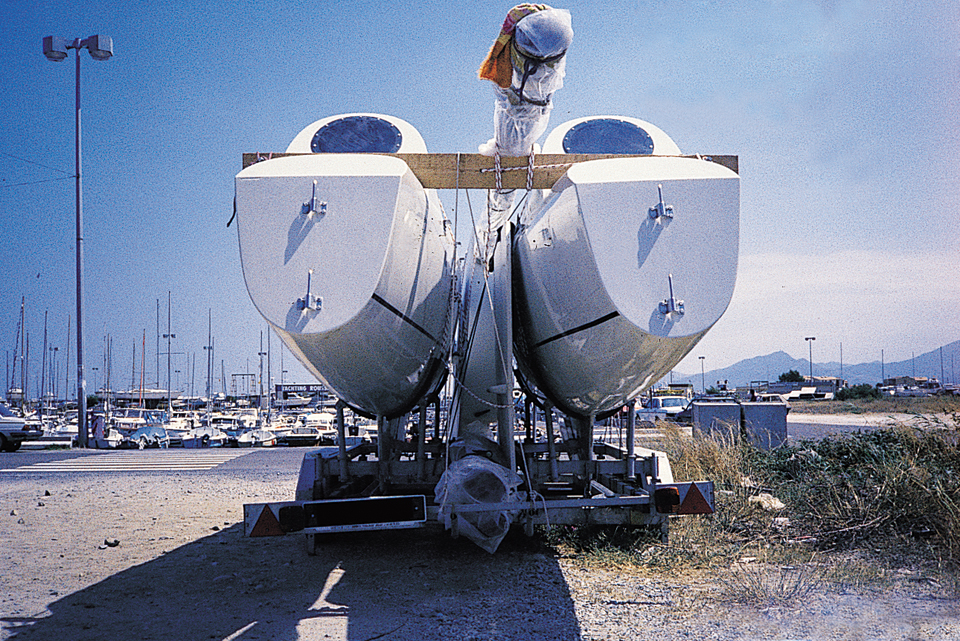
Ultra-simple, the deck layout has efficient fittings, with two fixed clutches on the aluminum beams and at the foot of the mast, and the cat can be dismantled for transportation.
Pluses:
Habitable catamaran which is exhilarating to sail
Solidly built
A design which is still in touch
Minuses:
Care required in strong conditions
The Love version is not very elegant
Rigidity of the stanchions, rudder linkages and the standard of finish might need attention
Points to check
Thanks to very simple construction and a lack of daggerboards, there is nohing to worry about as regards the hulls. The same goes for the aluminum beams: the mast sections which were used don’t seem to suffer from electrolysis. On the other hand, there are a few elements which don’t meet the builder’s usual standards… the inclined stanchions on the early models allowed more room, but easily caught on things, ending up bent. The original helm linkages were frankly rudimentary, and the standard of finish was not great. Nothing serious though. With a few weekends’ work, a Corneel 26 can be made shiny and lively again. You’ll have more fun if you change some of the fittings - new blocks with bearings, good quality halyards and new suit of sails.
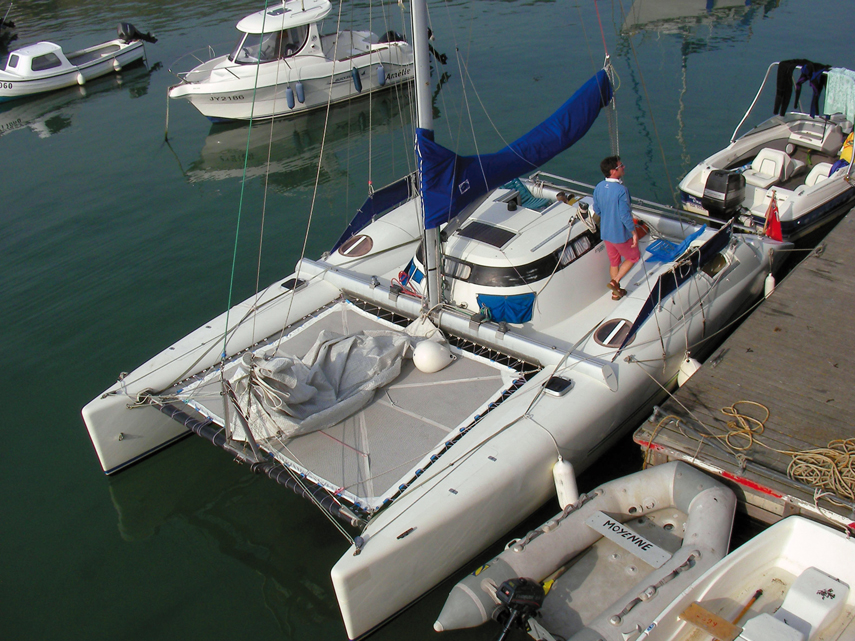
Entry inside is via the middle of each hull. But the Love version offers a solid central nacelle.
Technical specifications
Hull length 8.00 m
Waterline length 7.88 m
Beam 4.50 m
Draft 0.70 m
Weight 980 kg
Upwind sail area 36.05 m2
Mainsail 23.80 m2
Genoa 12.25 m2
Berths 4 or 6
Motor 4 to 8 hp outboard
Construction Balsa sandwich polyester
Naval Architect Joubert/Nivelt
Builder Fountaine-Pajot
Production run 60 built from 1985 to 1990
Second-hand price starting from €10,000 ex-tax
Tested in Multicoques Mag n°6 (July 1986)
