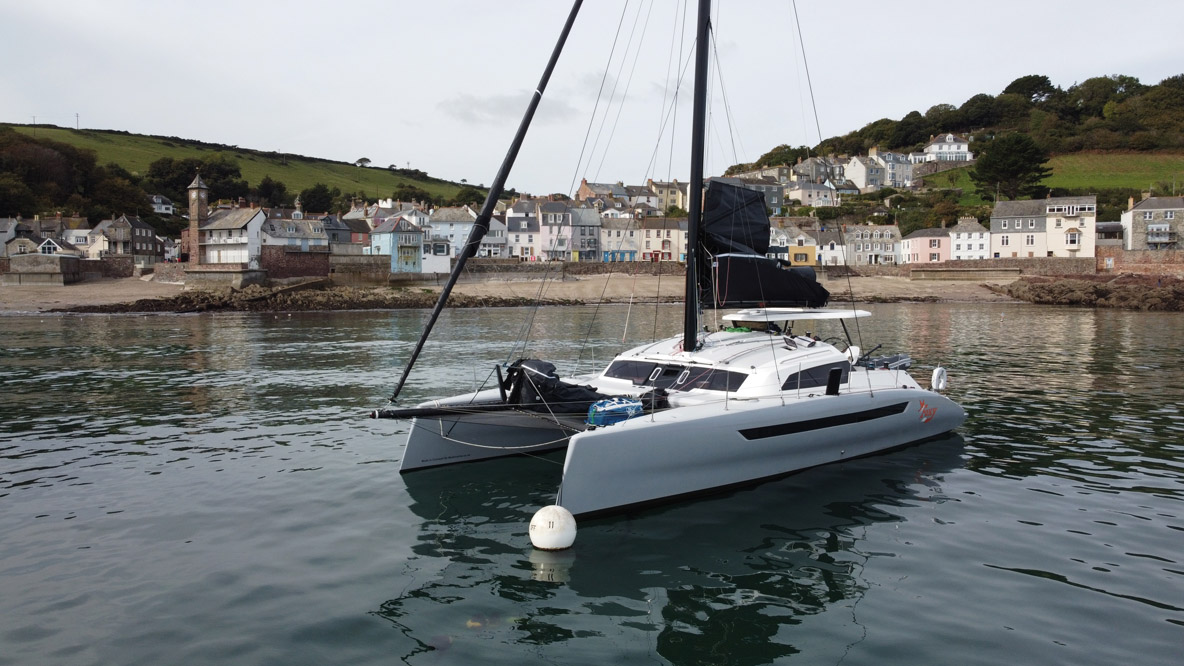
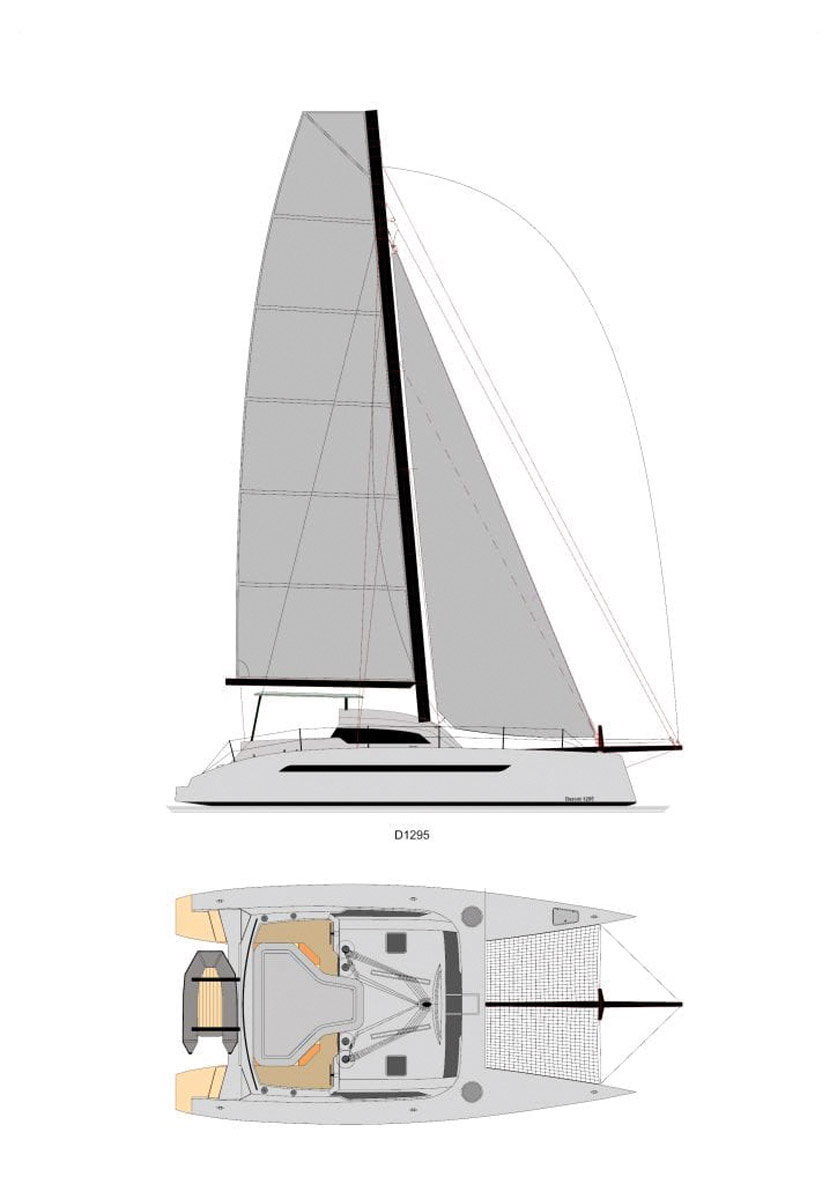
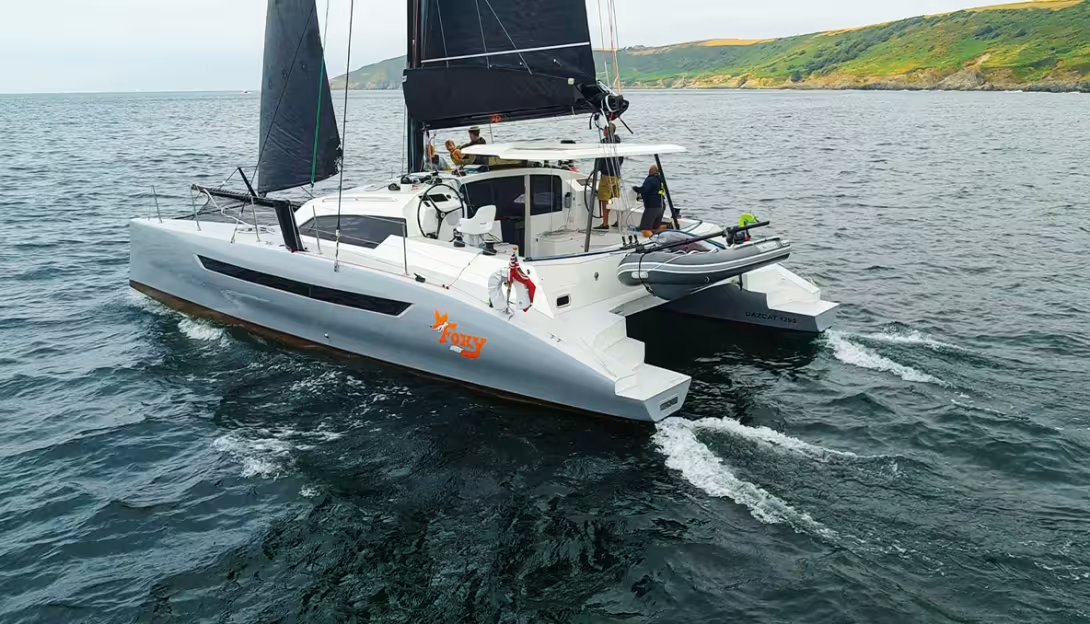
While the British might have been the pioneers of the modern cruising multihull, since the mid-1980s the idea of “Britannia Rules the Waves” has lost some of its impact in the production of cruising catamarans and multihulls. France in particular, but also South Africa and the United States have largely taken over. Has the UK abandoned the market we’re interested in? No, not quite, as you can see in our Buyer’s Guide in this issue. Among the multihulls that are still hanging in there is the Dazcat, based in Torpoint, a small village in Cornwall. At the head of the band of English die-hards who run the yard, architect-boatbuilder Darren Newton offers some truly different catamarans. We got the chance to try out his latest creation, the Dazcat 1295.
Infos pratiques
- Le chantier : Dazcat 1295
- La fiche technique
-
 Découvrez notre vidéo exclusive
- Financez votre Dazcat 1295
- Assuez votre Dazcat 1295
- Articles autour du Dazcat 1295
Conditions: 5 to 8 knots of wind, slight sea
It’s been said that in medium conditions, all boats are good, and that only in light airs or heavy weather that successful boats really reveal themselves. The particularly calm weather we experienced on the day of our test should allow us to validate the adage (the light airs version) and discover whether the excellent reputation of the Dazcat is indeed justified. However, when we were planning this test sail in the English Channel in mid-October, full foul-weather gear and boots were expected to be the only outfit option: we were anticipating wind! But nature likes to remind us that she is still in charge: while the seasonal temperature could best be described as fresh, the waters of Plymouth Sound were holding their breath - its surface, the proverbial millpond. The conditions have no impact on the great mood of the team that welcomes us aboard though. There was the pair at the helm of the benchmark British multihull, Darren Newton (the “Daz” in Dazcat), and Simon Baker, accompanied by the lively Oriel Butcher, whose role is not dissimilar to that of an orchestra conductor on the day of our test. She was also to prove to be an excellent chef when it came to our lunch break.
A family boatyard
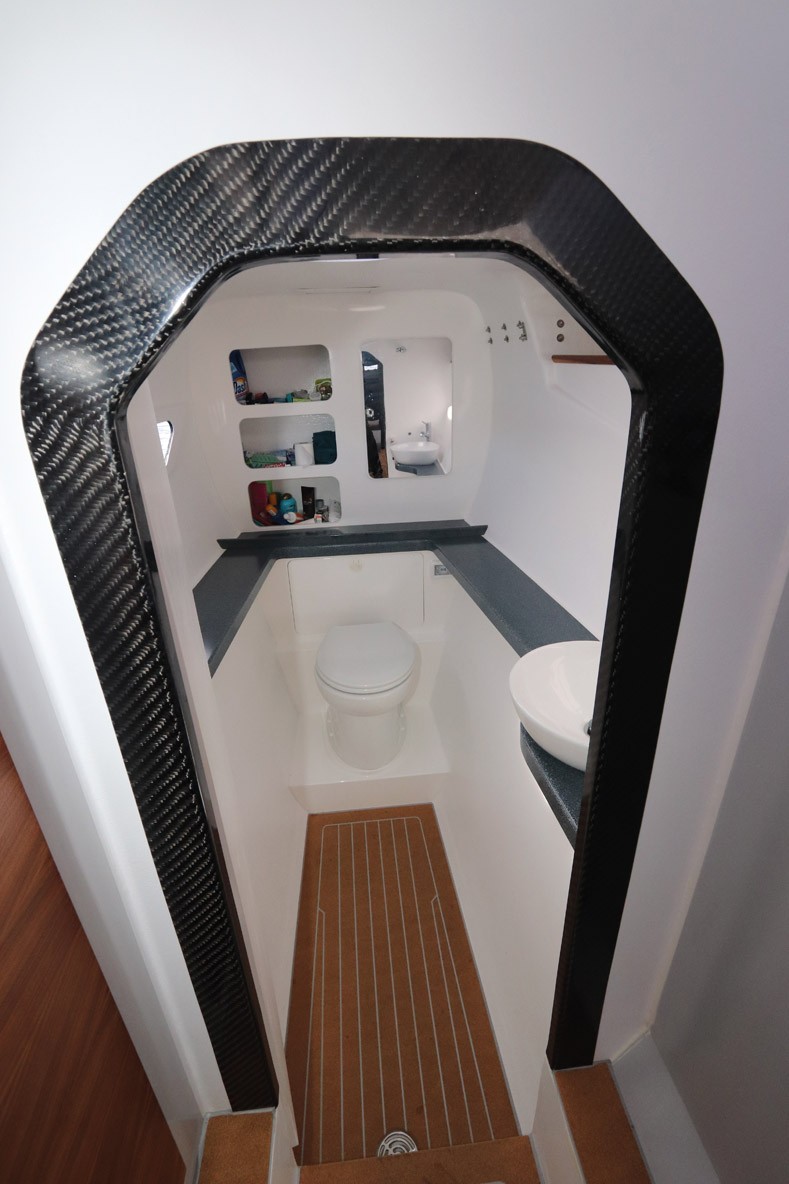
It takes a whole day to get a feel for the philosophy that drives this team. Against the tide of an entire industry, or even society, they want to take the time to do things right, even if that means doing less, or at least not more. We are dealing with a team that’s like a family, that grows by one new member with each new owner. With 36 boats built in the 35 years the company has been in existence, the contact has remained direct with each one of them, and the team would never conceive of doing otherwise. So, we’re aboard hull #3 of the Dazcat 1295, the first example having splashed back in 2017. Because before releasing a catamaran that’s at the peak of Daz’s art, there’s a whole year of construction, 14,000 hours of cumulative work. To qualify Multimarine Manufacturing, the entity in charge of building Dazcats, Darren Newton prefers the word “workshop” to “yard” – but really, don’t talk to him about a factory. Here, if cruising multihulls are built like racing boats, it is to last, not to show off. Carbon is used only where it is really useful: the two main bulkheads and the roof, the rudders and the daggerboards, even though the owner of Foxy has allowed himself a little indulgence with varnished carbon door frames. It’s a nice touch, and means less weight as there are no doors! As a result, this ultra-lightweight chassis, even when fully loaded for racing and cruising, barely exceeds 12,000 lbs (5,500 kg). But this lightness is obtained by a continual search for simplicity rather than by the use of exotic and/or expensive materials. To borrow a famous French saying from Antoine de Saint Exupéry, Dazcat could easily have a sign hanging over the door explaining that “It seems that perfection is reached not when there is nothing more to add, but when there is nothing left to take away.”
Careful weight centering and a carbon rig
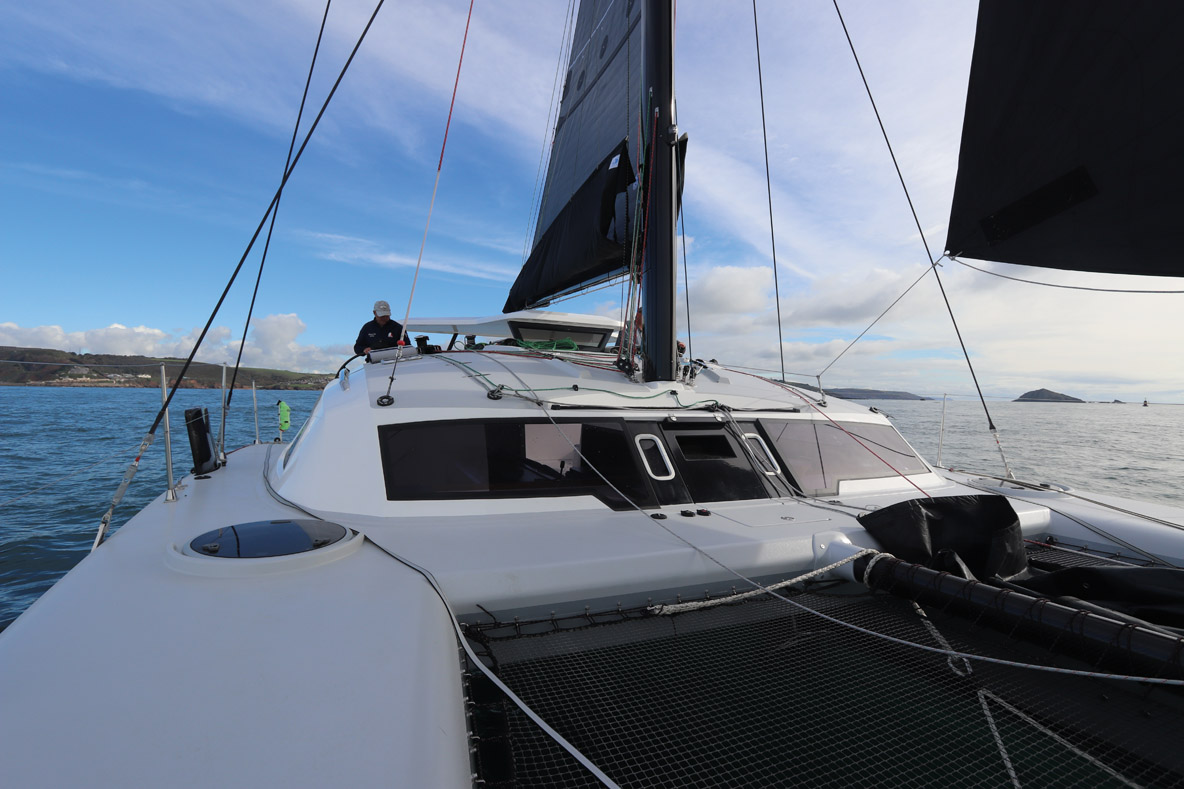
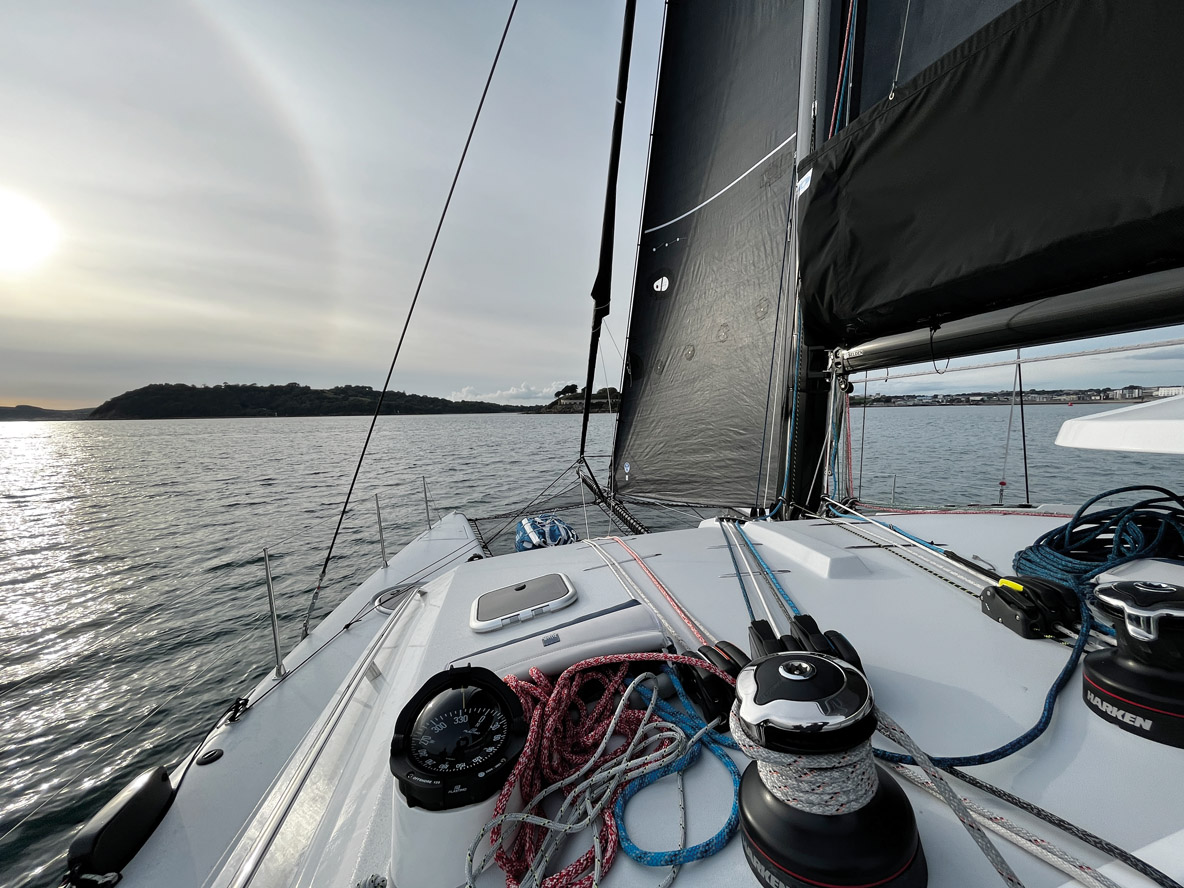
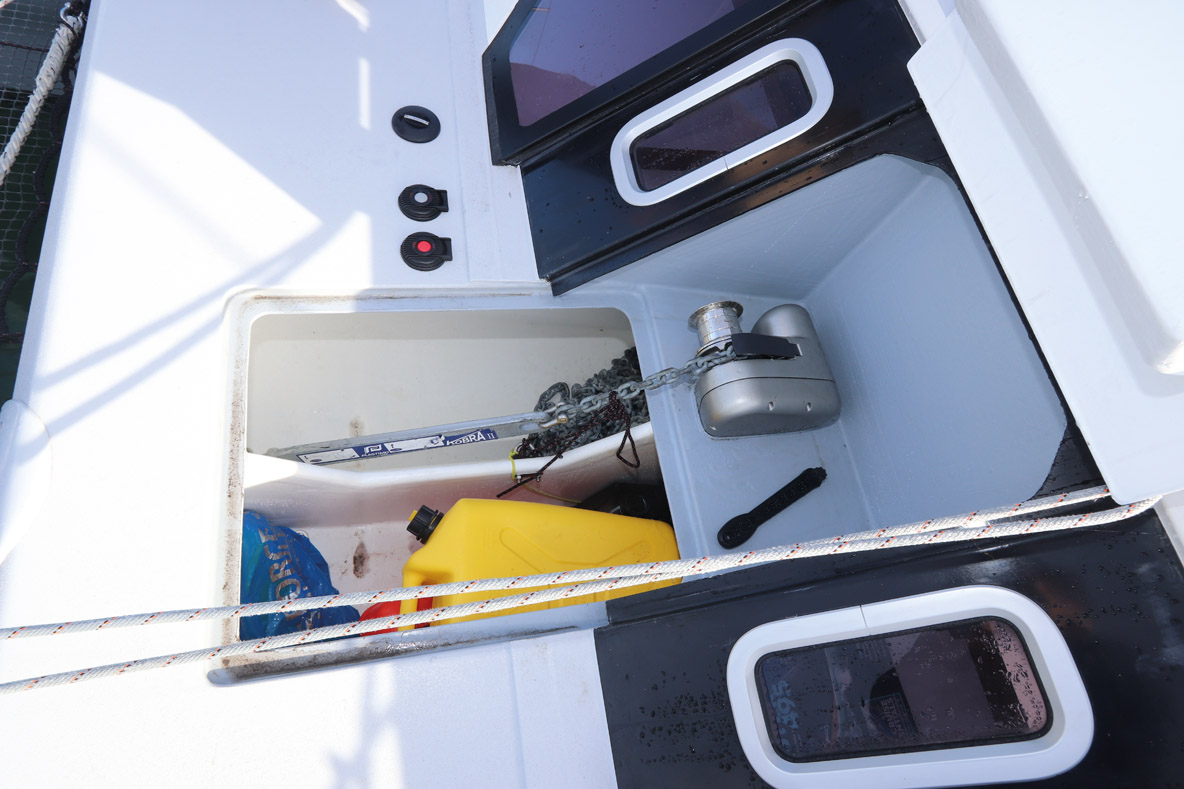
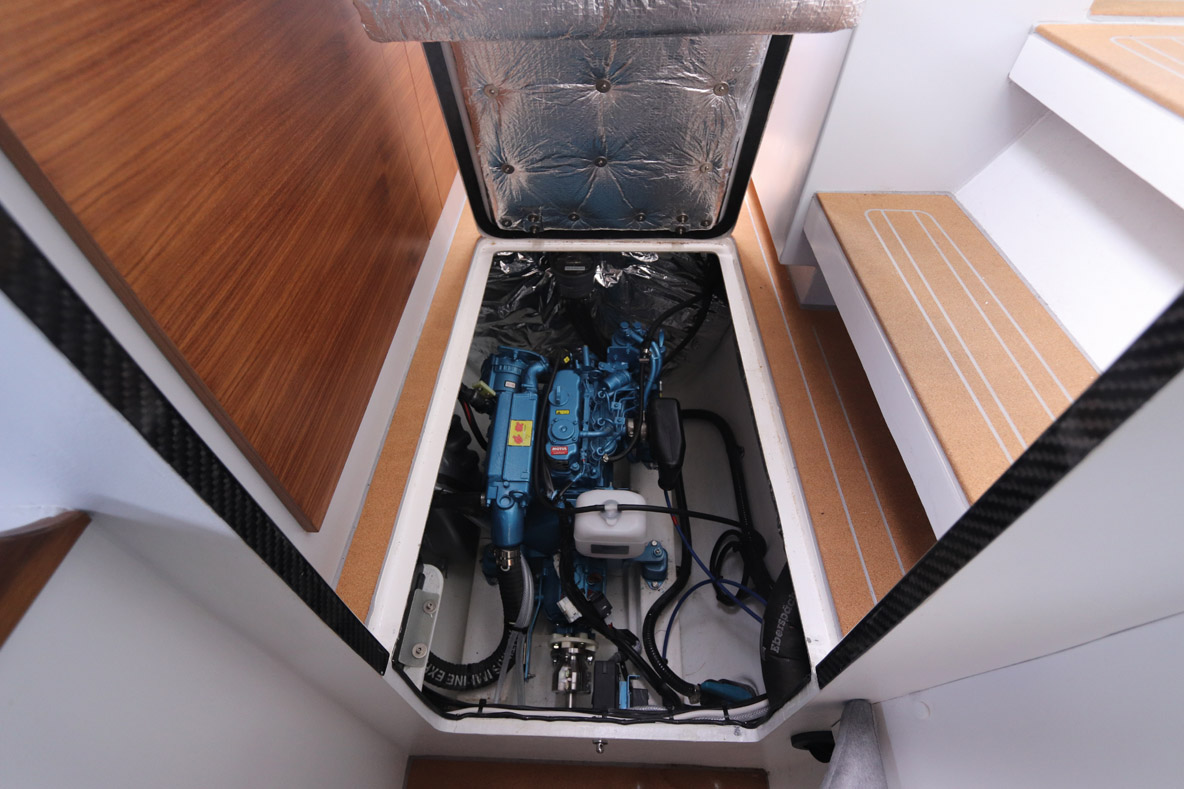
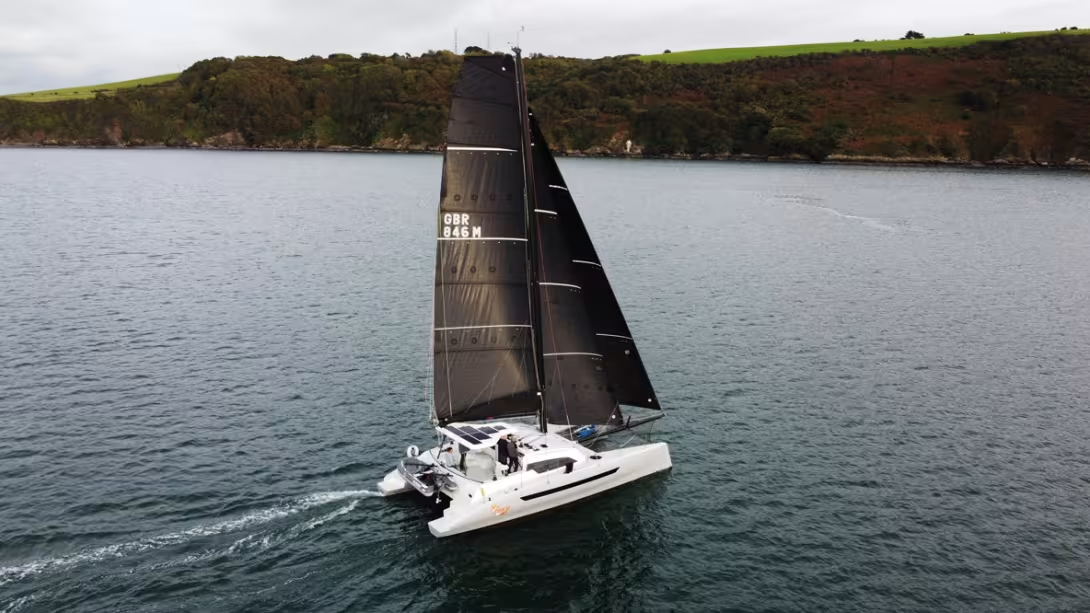
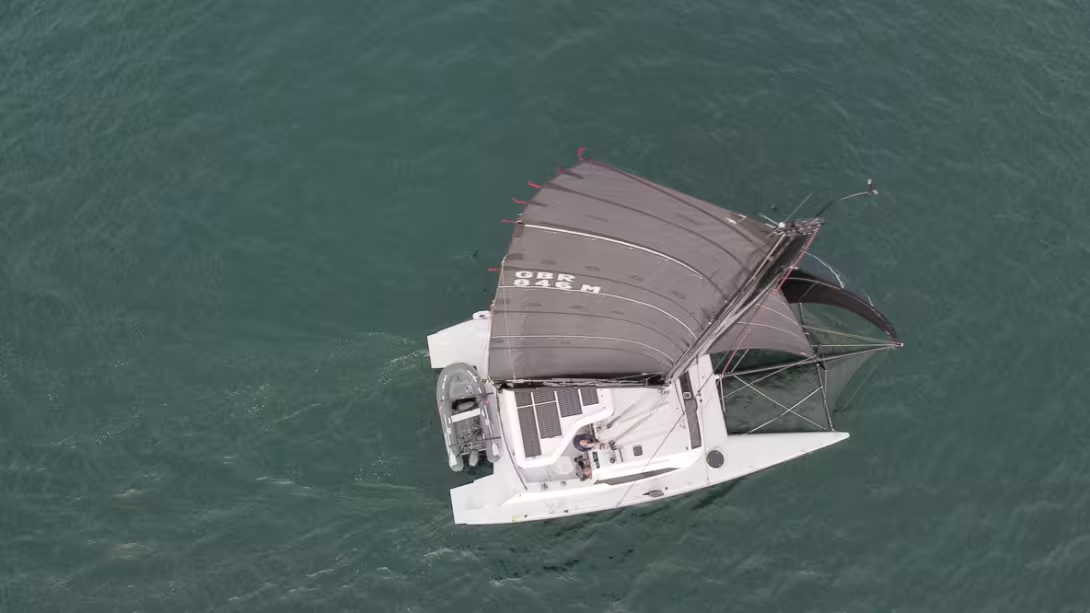
The catamaran is so stiff that it doesn’t need a forward beam: less weight up front induces less pitching and reduces the risk of the bows burying. In fact, all the weight is grouped together in line with the coachroof: the anchor and its chain, of course, but also the tanks, and even the engines, which dare to be positioned centrally, something so beneficial to the boat’s behavior at sea. The performance is also in the details. Like the mast for example: 400 lb (180 kg) for the carbon tube itself and 33 lbs (15 kg) of fiber rigging supporting it. The profile chosen is a fixed mast, without spreaders, with integrated fiber rigging terminals, all creating a combination of lightness and aerodynamics. The tension of the capshrouds and the lowers, unusually angled towards the front, is aligned with the load corresponding to the moment when the catamaran just starts to feel the weight coming off the windward hull. Thus, at no time is there any slack in the rigging to leeward.
Obviously, we weren’t going to be flying a hull on the day of our test. We headed out from the marina at Plymouth Yacht Haven playing with the two 21 HP motors to escape the labyrinthine pontoons. To reach the open water, in the long channel, we picked up to the pace to 2,800 rpm and the log reached 7.5 knots, confirming that there is no need for more power when you are light with little windage... we love a virtuous circle! With his mischievous smile, Daz tells us that with the T-shaped foils on the rudders, we’d be going a knot faster.
Unique helming sensations
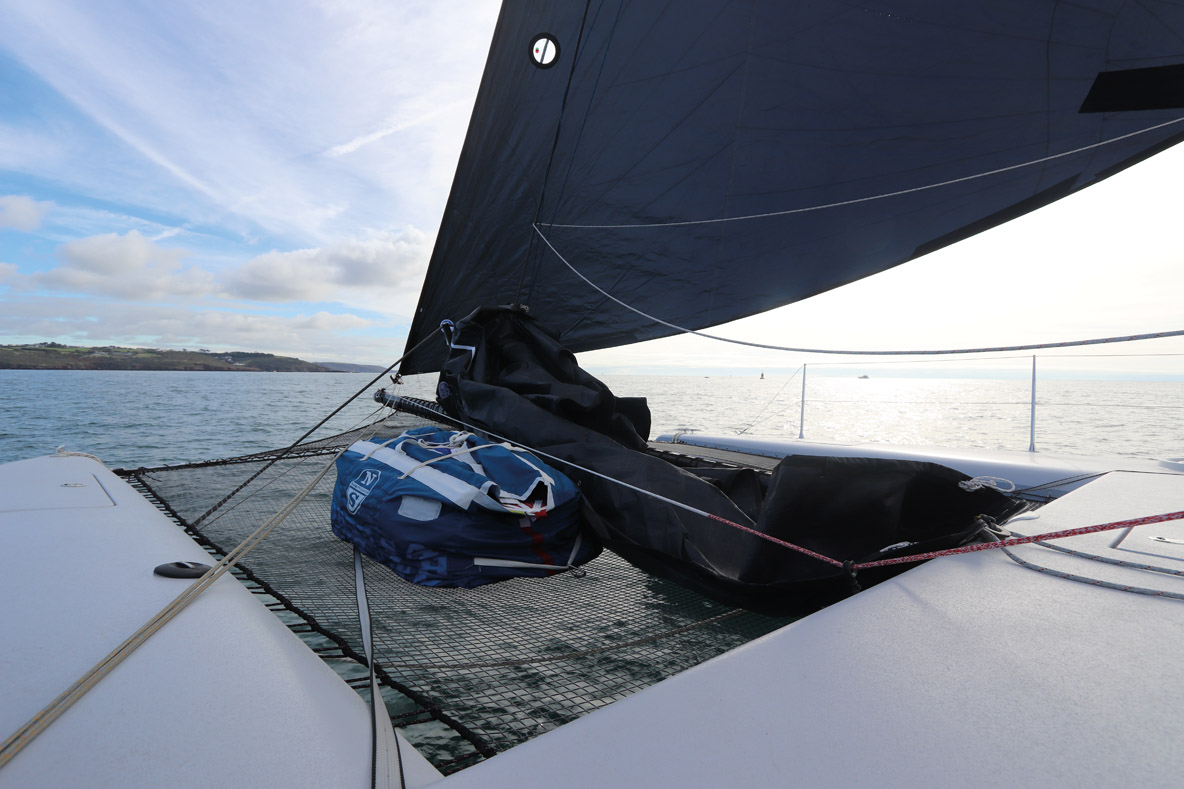
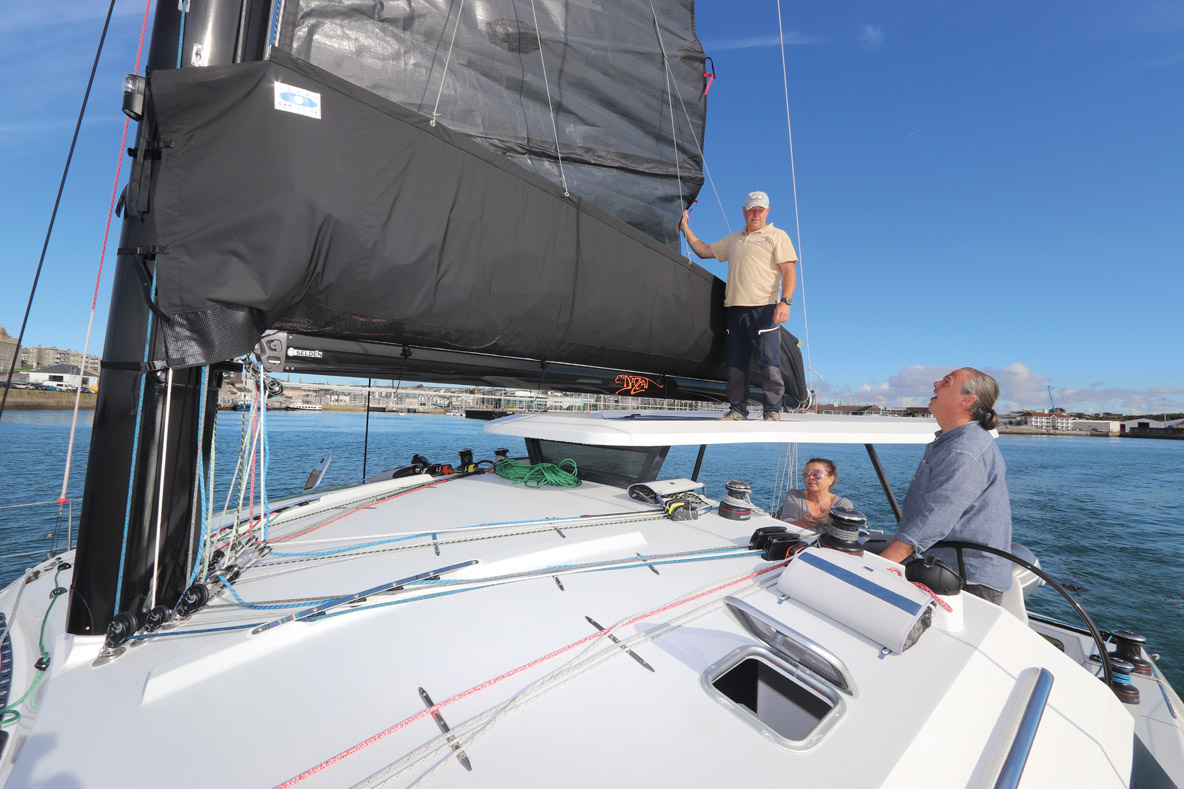
But we’re here to go sailing, so let’s get them hoisted! First the mainsail: the halyard returns to the port helm station and a Harken electric winch makes the maneuver particularly easy. Simon just helps to slip the first battens between the lazyjacks, but with the coachroof and the boom both equally accessible, everything is very simple. We hadn’t even trimmed the sheet yet and I already noticed the curved track on the aft beam, combining aesthetics and efficiency. Given the light breeze, we weren’t going to stay long with just the self-tacking solent on snap hooks as a foresail. Note, however, that this sail does without a furling system. Sensible, when you consider that with the weight and the windage associated with it, it would serve no purpose for a sail that can only be flown in all or nothing mode. In addition, there is a large trampoline to receive it. But with the wind oscillating around 5 knots, we unfurled the large gennaker at the end of the long carbon tubular bowsprit which also acts as a compression beam. This spar holds an original V-shaped martingale, which offers more efficient angles to the rig and a lower anchorage point on the hulls. As soon as the sails are hoisted, the magic happens: 6.4 knots on the log in 6 knots of wind at 60 degrees to the catamaran’s axis. Better still, the helm is the smoothest, most responsive and most sensitive that I have ever had between my fingers on a catamaran. Naturally, we are keen to discover the ingredients of this magic recipe. The feel of this boat is reminiscent a top racing monohull, minus the heel - or the most balanced of trimarans, plus the habitability. But there’s no cult of secrecy with Daz or Simon: they successively mention the unmissable fiber lines, nicely profiled carbon rudders - with less elongation than we would have imagined, i.e. 34½” x 16” (900 x 400 mm), and above all, an in-house carbon rudderpost with a significant diameter (3.4” / 86 mm), served by Jefa Steering self-aligning bearings. The combination of all these elements, their precise assembly and fine tuning provide a truly unique feel at the helm.
6’3” to 6’7” of headroom and a panoramic view
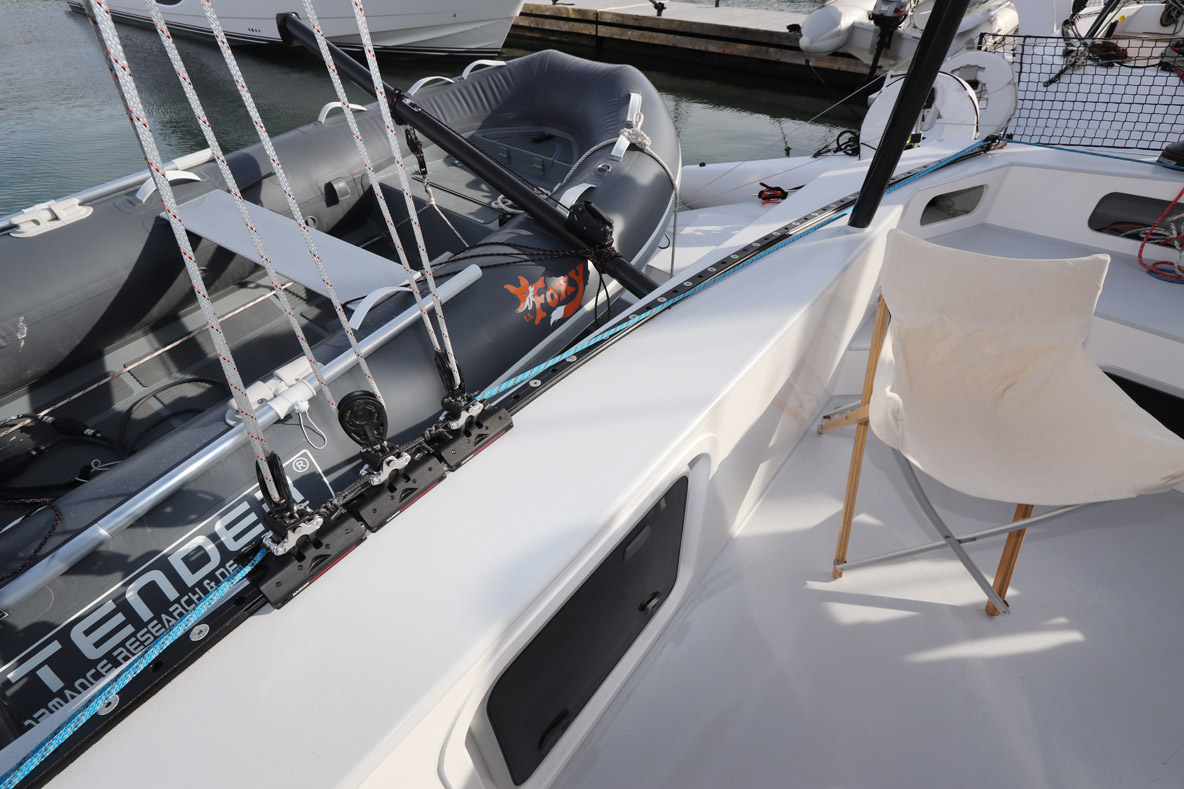
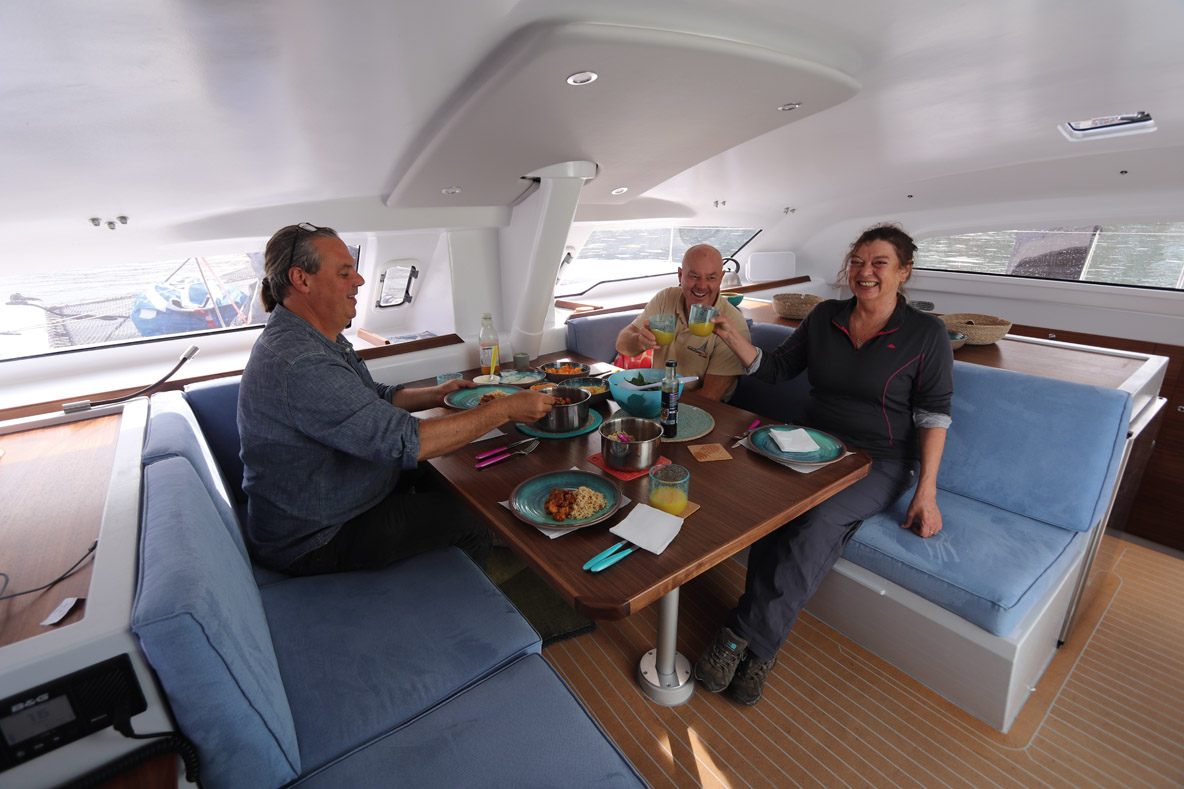
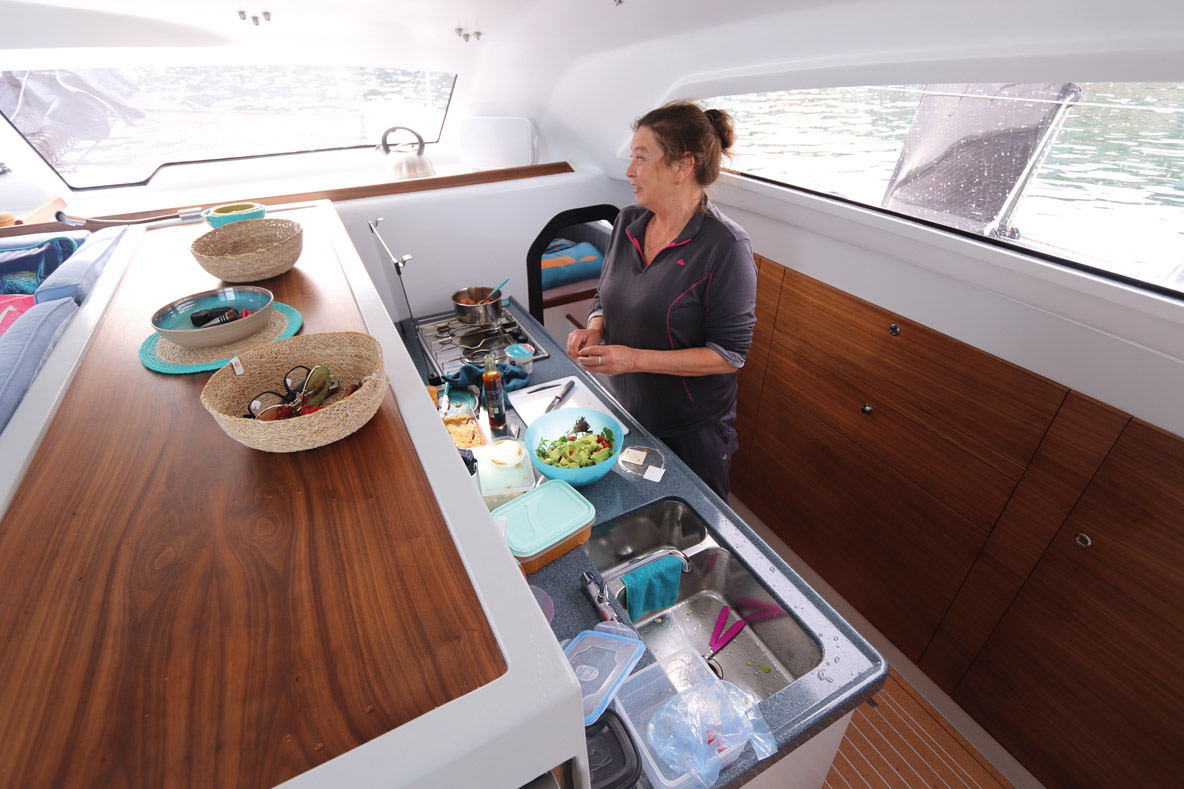
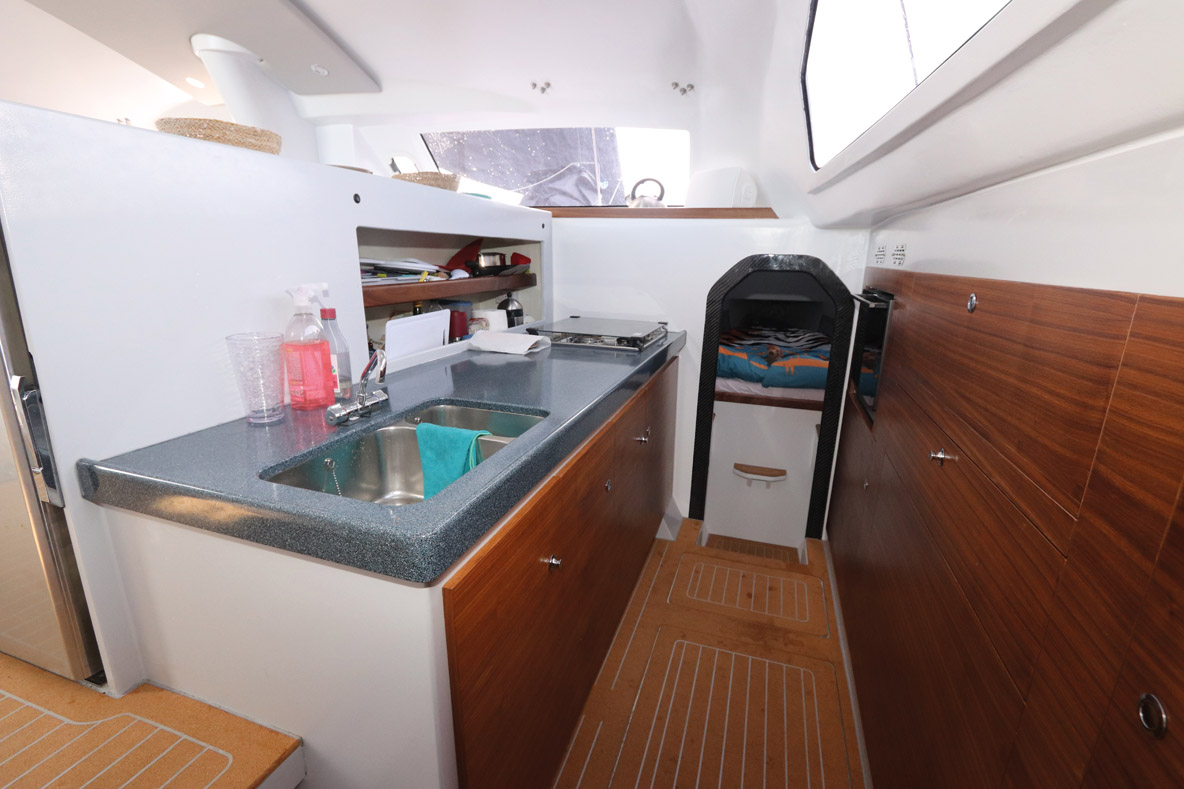
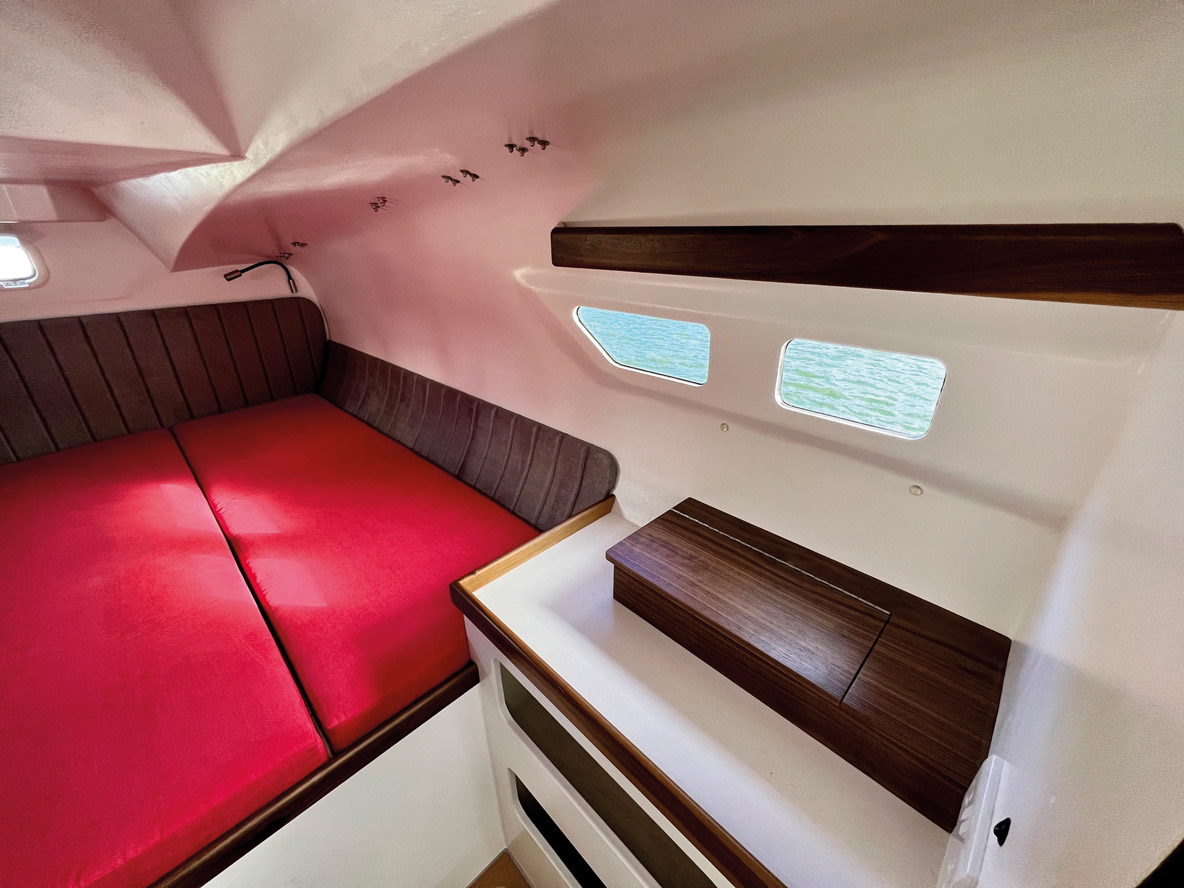
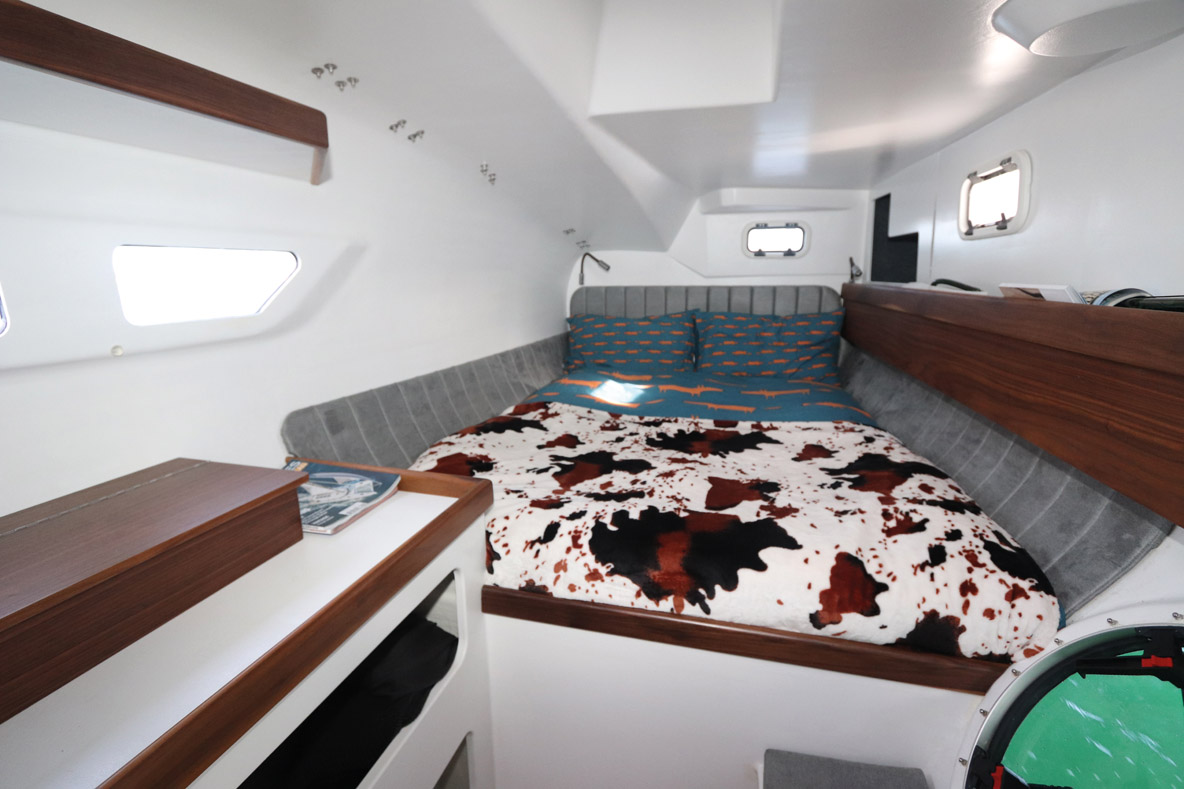
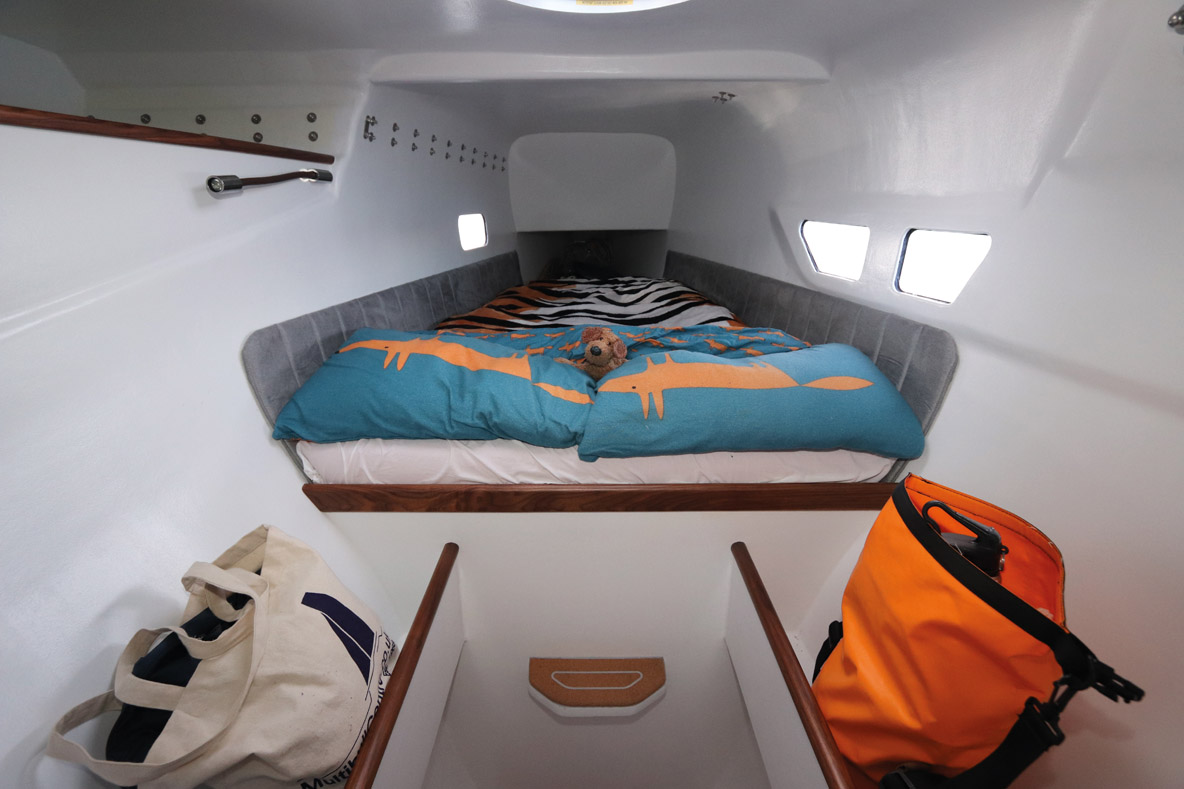
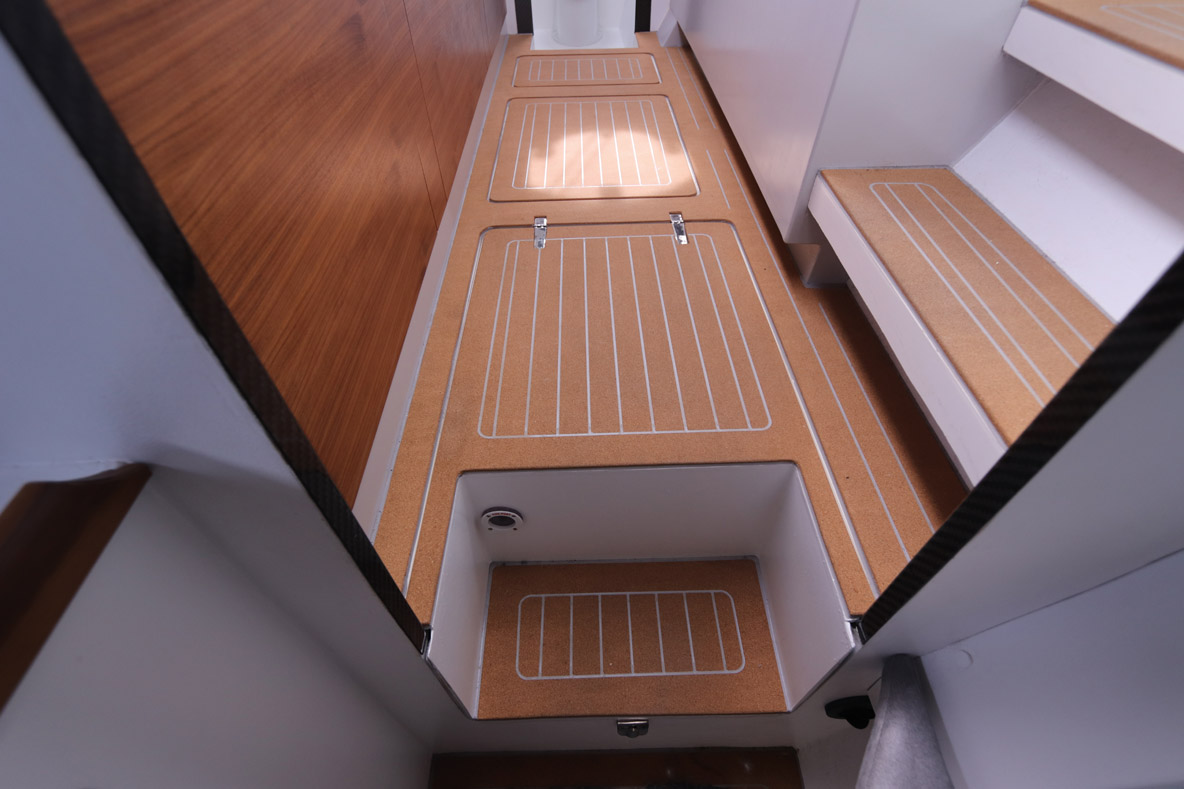
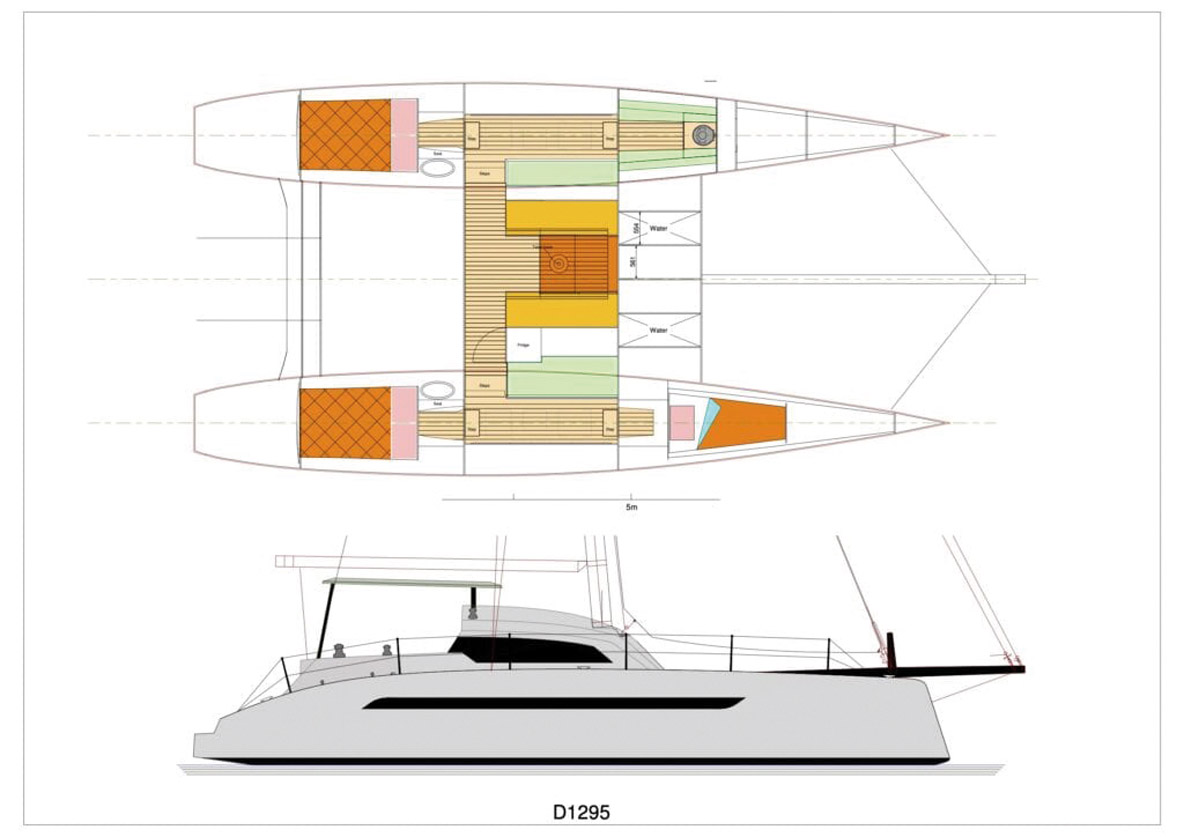
As the day advanced, the wind really fell away to zero. We headed in the direction of Cawsand Bay to stop for a lunch break. Even though the sun had pierced through the mist, the temperature remained cool. The cockpit, despite the two “Director’s chairs” promptly put out, is not really intended for the exercise. Oriel had disappeared inside a while earlier, and this chef who excels as much in marketing-communication as she does at cooking, where she had begun creating a scent that was alerting our taste buds. A few years aboard superyachts clearly made their mark on Oriel, and here we were, gratified by a gastronomic meal aboard a multihull that goes faster than the wind... absolutely royal! The galley has a special place aboard the Dazcat 1295. Neither installed in the nacelle, nor lost at the bottom of a hull, it takes advantage of the entire length of the roof to be installed to starboard, at mid-height, its raised floor housing the engine. If the geometry seems audacious, the result is quite convincing: the headroom is 6’7” (2 meters) and you’ve got a panoramic view without having to bend down or stand on your tiptoes. You’re in contact with the saloon (with 6’3”/1.9 m of headroom) while keeping your little galley secrets or dirty dishes somewhat hidden from view. Lastly, you benefit from a long work surface and plenty of storage space along the topsides. What more could you ask for? To be served at the saloon table for example. At 40” by 60” (100 x 153 cm), the table is not huge, but remember this is a three-cabin boat and the table is plenty big enough to accommodate six adults without any problem. And this is all the more so as the mast compression post has been cleverly tilted forward, allowing the mast to be stepped further aft, without that having any impact on the interior layout. All the furniture is of course made in foam sandwich, and the types of wood used are left to the owner’s discretion – here, a cork floor covering saturated with resin. The overall esthetic thus created seems a bit dated, perhaps, but the material is so light, pleasant underfoot, and ecological, that all is forgiven. The two double aft cabins are identical with their 55” x 79” (140 x 200 cm) beds. The one forward to starboard is slightly narrower, at 53” x 79” (135 x 200 cm). As for the only bathroom, forward to port, this is probably the only place where you’re paying a little for having narrow hulls, between the slightly steep access (an additional step would solve the issue) and the absence of a separate shower space.
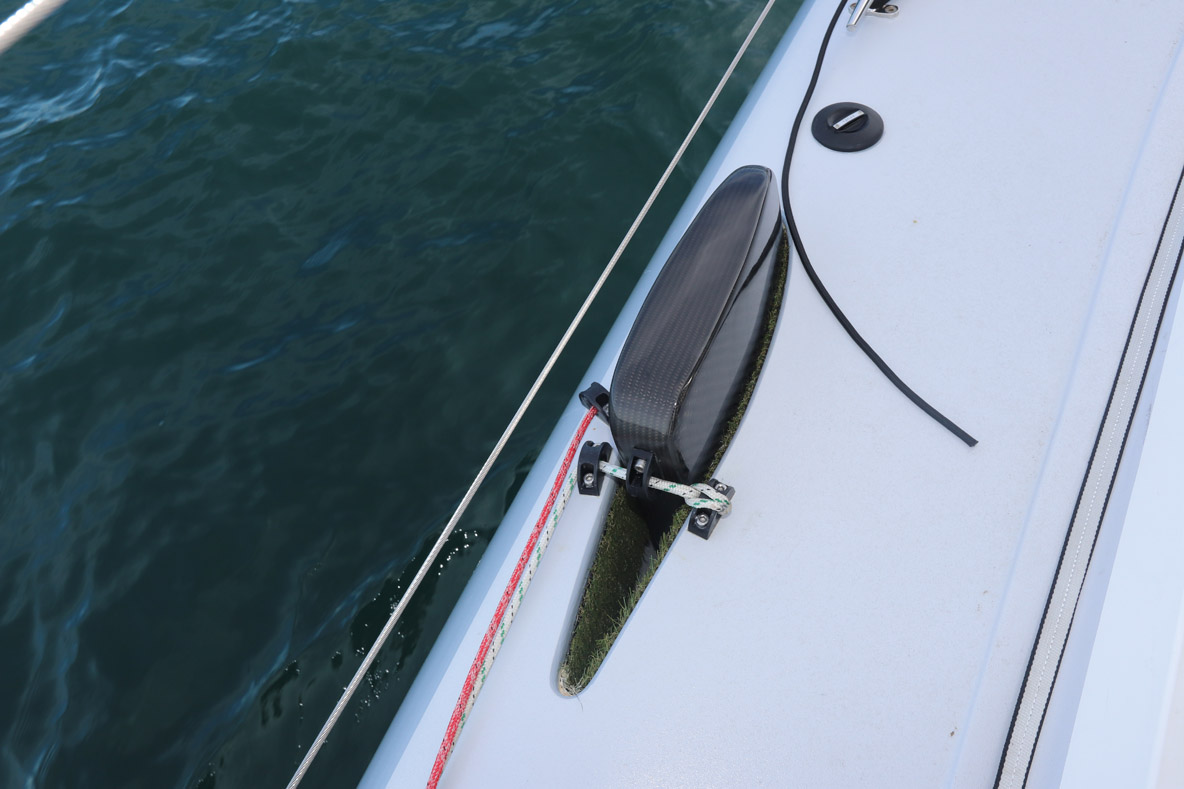
In the afternoon, the wind seemed to want to stretch its legs just a little: we raised the anchor and left the picturesque anchorage. We hoisted all the canvas back up and lowered a daggerboard in its well… lined with synthetic grass. You had to be British but above all extremely clever, and in search of simplicity, to find this devilishly efficient idea for sliding the precious appendage into a well that is always either too tight or not tight enough. The wind oscillated between 7 and 8 knots, and we did the same, on reaching tacks at 90 degrees to the true wind (50° to the apparent). In the 10 knot “gusts”, Foxy exceeded 9 knots with always smooth and precise steering. We crossed the wake of a big powerboat and our bows went up and then down and then... that was it. No more pitching followed as it is usually the case on cruising catamarans. Despite the slender bows and their low height (which makes the cleats easily accessible when docking), any longitudinal movement is dampened almost instantly thanks to the rigorous centering of weight. Handing over the helm under these circumstances was a real heartbreaker – with regret, we were forced, after dusk, to return to port... Daz has succeeded once again in doing what he loves most of all: putting smiles on the faces of the crews who sail aboard the catamarans he’s been designing, drawing and building with relentless passion since 1988. For him, aboard a multihull, performance serves safety: his catamarans may be very fast, but they are above all cruising boats. And despite a good record of achievements on the racecourse, Daz still insists on defending this notion of cruiser.
Conclusion
Ten years ago, we featured an article that included a portrait dedicated to Daz: “Darren is a true artist. One who does not know the meaning of the word ‘compromise’ and achieves only perfection. A demanding craftsman, aiming for excellence in every achievement.” After our day aboard the Dazcat 1295, we can tell you that Daz hasn’t changed one bit, and that his catamarans are even more seductive than ever…
Performance and seakeeping
Composite finish and paintwork
Little seating in the cockpit
No helm protection
Technical Specifications
Architect: Darren Newton
Length: 42’6” (12.95 m)
Beam: 21’8” (6.6 m)
Light displacement: 12,125 lbs (5.5 t)
Laden displacement: 16,535 lbs (7.5 t)
Draft: 2’7”/7’3” (0.8/2 m)
Mast height: 52’6” (16 m)
Mainsail: 645 sq ft (60 m²)
Genoa: 323 sq ft (30 m²)
Spinnaker: 1,560 sq ft (145 m²)
Cabins: 2 to 4
Berths: 6/7
Water: 132 US gal (500 l)
Fuel: 32 US gal (120 l)
Engines: 2 x 21 HP
Price: £ 850,000 ex-tax