
The last time we sailed on a Darren Newton-designed catamaran was back in 2014 when Philippe Echelle joined the crew of the Broadblue Rapier 550 for the Round the Isle of Wight Race. At the time, Philippe described it as an “exceptional catamaran”, so when we got an invite to sail on a Dazcat 1495 cruiser-racer, we jumped at the chance.
Infos pratiques
- Le chantier : Dazcat 1495
- La fiche technique
- Découvrez notre vidéo exclusive
- Financez votre Dazcat 1495
- Assuez votre Dazcat 1495
- Articles autour du Dazcat 1495
The River Tamar is the major tributary of Plymouth Sound, and forms the geographical border between Devon and Cornwall. An unassuming little village named Millbrook is at the head of a creek which runs west off the Tamar, and it was here in 1968 that Pat Patterson established the Multihull Centre. Since then, a significant number of British catamarans have been built and launched from here; designs not only from the drawing board of Patterson, but also from Richard Woods, and now from Darren Newton.
Darren (the “Daz” in Dazcat) became a catamaran addict sailing Hobies as a teenager in Devon in the 1980s and has been designing and building multihulls ever since. In 1993, Dazcat relocated to Millbrook, and in 1999, Multimarine was established to build boats from other designers. In 2012 Dazcat and Multimarine moved into the Multihull Centre when Pat Patterson’s son Pip retired.
And a tour of the yard reveals just how entrenched multihulls are here. Aside from boats currently in build, there are many, many catamarans and trimarans on the hard here being worked on by their owners or by the yard.
The DNA of performance
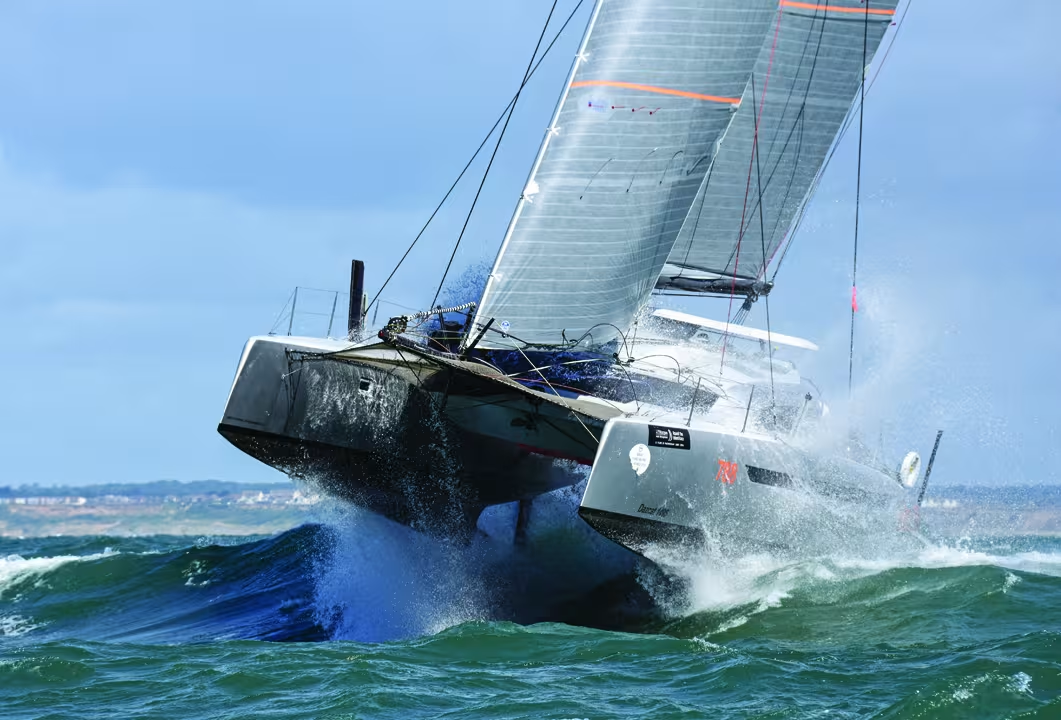
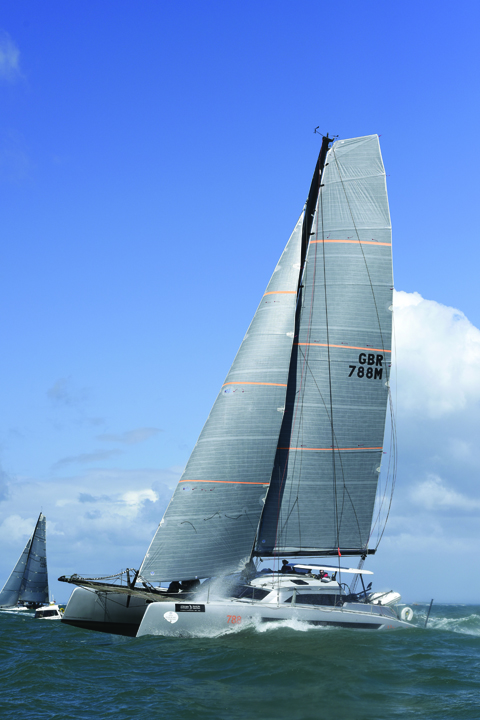
So after a fascinating day touring the facilities at Millbrook, we were off to join Dazcat 1495 Hissy Fit, moored a little further up the Tamar. Owner and skipper Simon (who also happens to be a director of Multimarine) was there to welcome me on board. At first sight, even if you didn’t know which end of the cruiser/racer scale we’re talking about, she clearly looks like a fast boat from her profile: the inverted bows, the daggerboards, good bridgedeck clearance, the tumblehome which indicates a narrow waterline beam, and carbon in evidence everywhere, are all starting to give some clues… The particular attention given to weight centering, which is of vital importance for catamarans, is obvious: the motors are positioned quite low in the center of the hulls. "Like a mid-engined sports car and a low center of gravity," explains Newton.

Familiarization with the deckplan
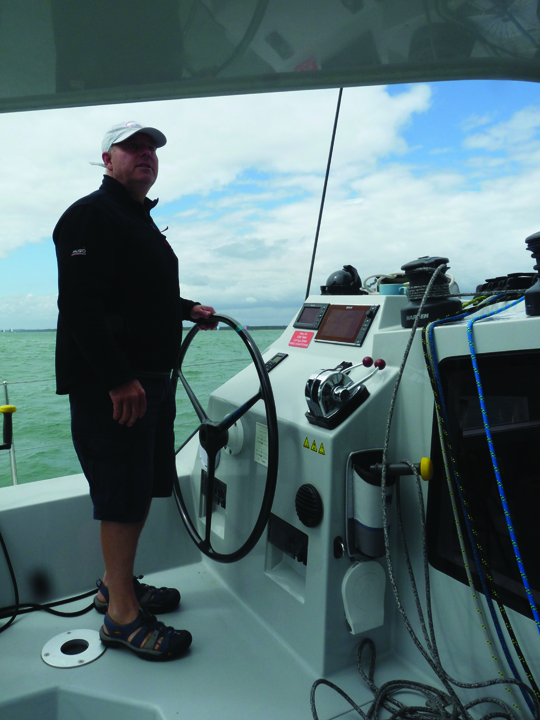
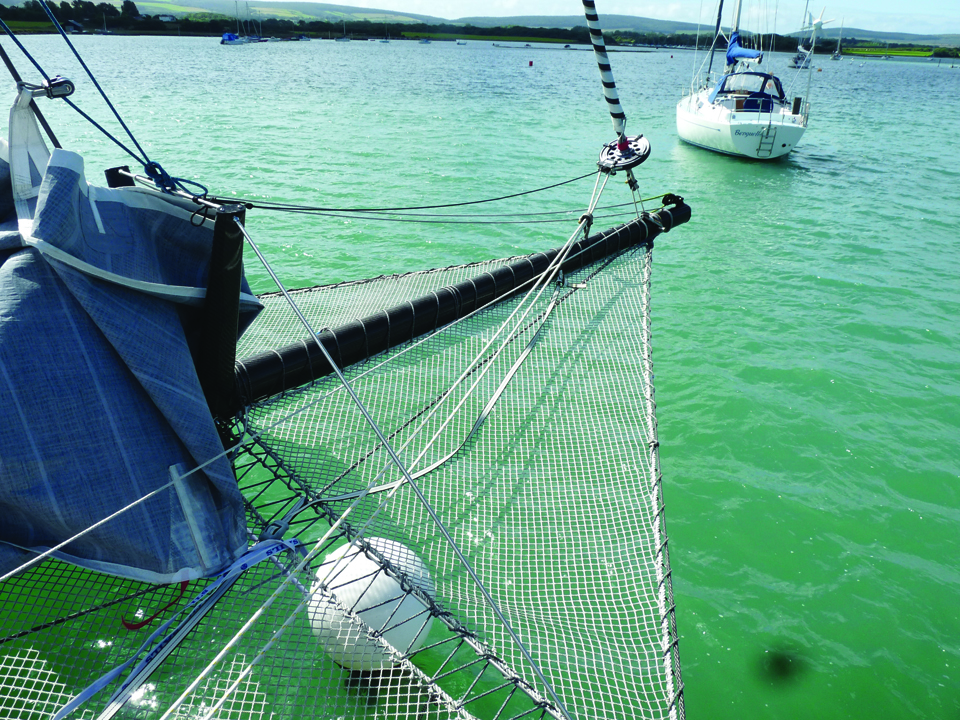
Stepping off the dock and up the wide sugarscoop steps into the cockpit, you are immediately under the shelter of the hard-top bimini. The top of this provides ample space for solar panels, and it has a cutaway area either side forward for the twin helm stations, with carbon steering wheels either side on the aft face of the coachroof bulkhead. The engine controls are located at the port helm station. Each side on the cockpit coamings are two Harken winches, for the runners, daggerboards and sheets for flying sails. Across the full width of the aft end of the cockpit is the traveler, again handled by the cockpit coaming winches, with the sail itself trimmed by a German Mainsheet system from the coachroof. Moving forward along the wide sidedecks you can’t help but notice the carbon daggerboards, the control lines for which are all led aft to be operated from the cockpit. Just ahead of these, the capshroud chainplates, to which are secured the fiber rigging. Further on, and you’re at the foredeck. The dominant feature here is the 7-meter carbon spar, the forward two meters of which extend beyond the bows to form the bowsprit. Either side of this are two triangular trampoline nets, allowing easy access to furling gear, etc at the end of the bowsprit. The track for the self-tacking jib is on the forward face of the coachroof, sitting between the window and the mastfoot. At this level of sailing, there is much to tweak to gain that extra advantage: the many lines for sailing maneuvers all lead back to the cockpit, and on the coachroof at each helm station are two further Harken winches (one of the port side ones being electric), and numerous clutches and jammers for handling all these. I have to confess it took a little while to familiarize myself with all the lines.
Hunting down the weight
Of course, there’s no “down” about it: entering the saloon from the cockpit, it’s obvious the comfortable bench seating round the table can easily accommodate the whole crew, all maintaining a 360° panoramic view. At the forward end of the saloon to port is the chart table, where an excellent B&G plotter and instruments are to be found. In reality, we made little use of the chart table, being as there are B&G repeaters for everything at the helm stations.
In the port hull, a good-sized double cabin aft, with the heads and shower compartment forward. Between these, the deck is raised up a step or two to accommodate the motor, and on the outboard side, a single pilot berth or lounger for off-watch crew. To starboard, the galley (more on that later), another decent size double cabin aft, and forward, having passed through a small heads compartment, a somewhat smaller double cabin, with a narrower bunk than to be found aft. This would be ok for a couple, but maybe a little too cozy for two crew otherwise.
On the version we tested, minimizing weight has clearly been an issue, so there are curtains as opposed to doors on the cabins, and instead of headlinings, the ceilings, bulkheads and hull interiors have a painted finish. Aesthetically this is fine, but does little to reduce noise. An owner looking to do more cruising than racing might want to review these options with the yard.
Galley up? Or galley down?
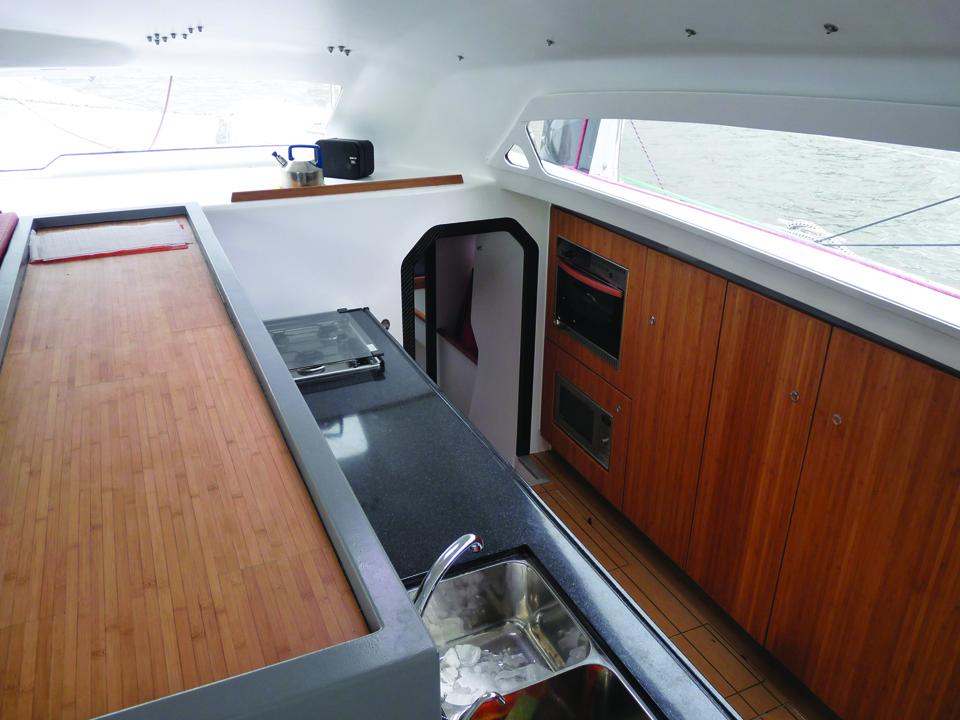
If there’s one subject guaranteed to start a heated debate among catamaran folk, it’s the galley up/galley down thing. There are arguments for one, and arguments for the other, and having sailed many miles with both, I know which camp I fall into, but that’s a discussion for another time. Yet here on the Dazcat, the galley is both “up” and “down” at the same time. Remember the deck being raised in the passageways, with the motors beneath? Well, on the starboard side, this is where the galley is to be found. Here, the cook can be out of the way any traffic through the saloon, yet remains constantly in touch with the rest of the crew, while still enjoying a 360° view of the water. A good-sized, front-opening refrigerator and freezer form only part of the ample stowage in a kitchen which is a delight to use. Between the double stainless sink at one end and the three-ring Eno stovetop at the other, there’s countertop space in the middle measuring over a meter in length. This is made in a Corian-style composite, but is built in-house to Dazcat’s own specifications. Separating the galley from the saloon is a wide serving area, beneath which is yet more storage space. An oven and microwave are also incorporated on the outboard side.
Having the galley in one of the hulls increases the available space in the saloon for seating, dining table and for the chart table. In the galley sole, the engine compartment hatch cover and another couple of steps down either forward or aft from there and you are in you are in the forward or aft double cabins.
Well-designed technical installations, but quite noisy engines
The installation on the model we tested consisted of two 30hp Lombardini engines. These had been selected due to being the lightest in their category at the time of build, although later models are now offered with a pair of Yanmar 3YM30s as standard. Coupled to the folding propellers via shafts, the Lombardinis are very effective, though quite noisy. If not to say very noisy. There two schools of thought here are, firstly, that more soundproofing would help, though of course this would add more weight. Secondly however, this is a sailboat, and one which sails so incredibly well that time spent motoring is minimal compared to most cruising cats, so noise might not be so much of an issue. Access to the motors is easy, beneath the floor in the galley, to starboard, and the passageway, to port. Everything is clearly laid out and all the essentials are readily accessible. The diesel tanks are just forward of the motors, again helping with centering weight and keeping pipe runs short.
On the inboard side of the passageway in the port hull is a very neat electrical installation, with a Plexiglas door in front. However, this is not where all the electrical controls are to be found. On the bulkhead above a small desk at the aft of the saloon (not the chart table, this is forward in the saloon) is a small display panel for just about all the technical systems. This has been designed in-house, and covers everything from pumps to navigation lights to battery monitoring. Very neat. The 100 Ah LiPo (lithium-ion polymer) battery is enough to keep the systems running all night, and is quick to recharge once the sun gets back on the solar panels in the morning, allowing enough power for racing or for family cruising.
Under sail? She’s a rocket!
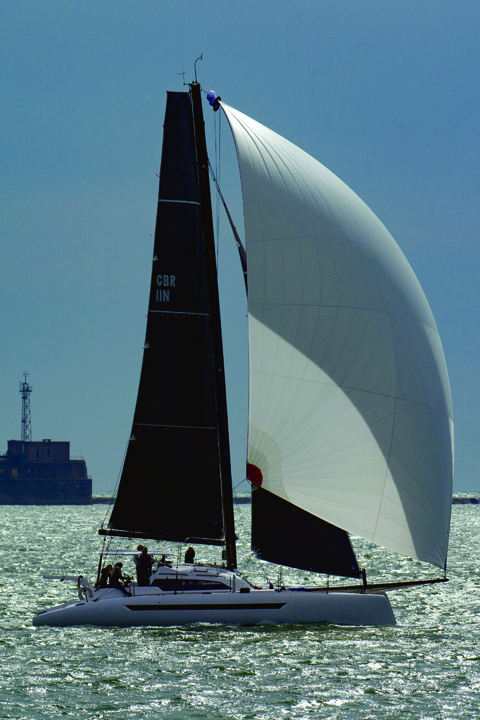
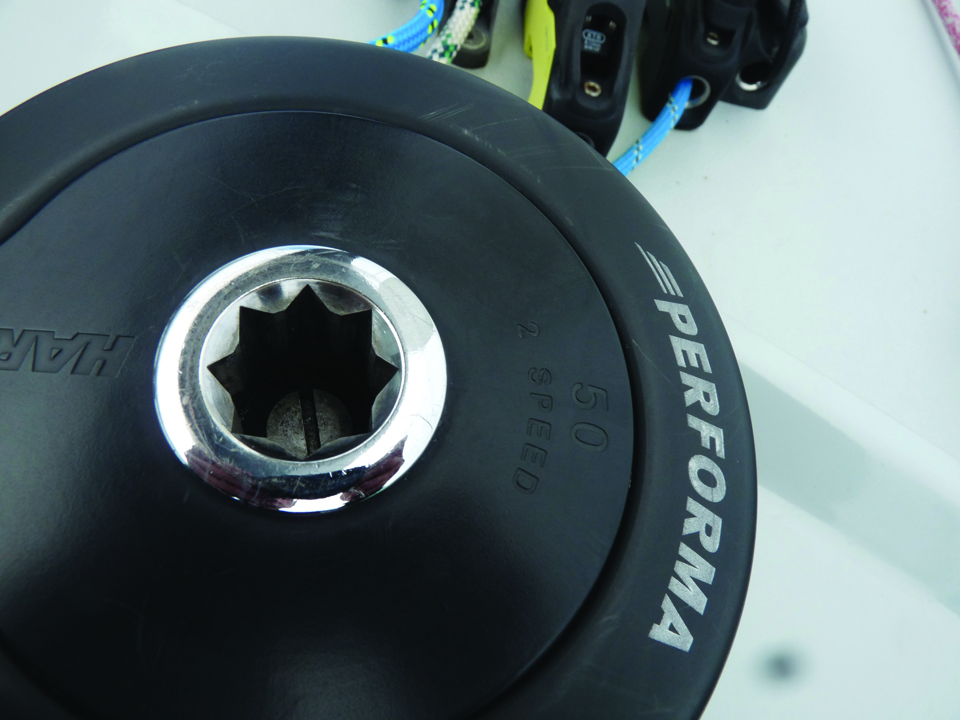
As we motored down the River Tamar, the electric Harken Performa 50 on the coachroof made light work of hoisting the square-topped mainsail, and once out onto Plymouth Sound the self-tacking jib was unfurled and the motors thankfully turned off. With 22-25 knots of southwesterly breeze, we were on a close reach as we dodged the buoys making our way to the eastern breakwater entrance. It had been blowing hard the day before, leaving a fairly confused sea. And this is where you begin to notice the effects of keeping the weight low and central: we were not being tossed around, but instead making a respectable 8-10 knots through the chop, quickly bringing the Mewstone rock abeam where we were able to ease sheets, bearing away with the sea coming more from behind. From here it looked like the wind was going to be on our starboard quarter for the night and the decision was made to hoist the screecher. Once up, it was quickly and easily unfurled on its Karver drum, and the jib rolled away. The wind had been forecast to drop a little, but there was no evidence of this happening yet. Given that we weren’t racing and didn’t want to push the boat hard ahead of the upcoming race, and that we weren’t particularly in a hurry, we set the first reef to ensure a slightly more peaceful ride for the off-watch crew, and settled down for the night at around 9 knots, with 17-18 knots of apparent at about 155-160° from the bow.
Our test sail was effectively a delivery voyage for the start of the Fastnet Race, and as a delivery, we didn’t push the boat hard, using only the main, self-tacking jib and the smaller screecher for this trip. Numerous sail options are available - see the technical specifications, below. The combination of sails we used were all very nice North 3Di.
By the time it was getting light, the Isle of Wight’s famous “Needles” were in sight and we had obviously made good time overnight. Some while later and we picked up a mooring in Newtown. Here, the rest of the crew donned their wetsuits and jumped overboard with scouring pads in hand, to give the hull one last scrub ahead of the start of the race the following day. It’s what racing people do! Now, bearing in mind that I had no wetsuit and that this is the English Channel, I elected not to join in this activity, but instead made myself useful, cooking up a full English breakfast for everyone when they came out of the water, in the galley which I have to say is a joy to use.
With the hull scrubbed and breakfast finished, we continued round to Cowes for a brief stop to complete race entry formalities. Next, our final passage was across the Solent to the Hamble River, where Hissy Fit would be berthing overnight before the start of the race. And on this short leg, the Dazcat really came into her own. The sheltered waters of the Solent were almost flat, despite a steady 20-22 knots of true wind. This was just perfectly lined upon the beam, our boatspeed pushing the apparent slightly forward, and with full main and the screecher we set out, overtaking everything in our path, topping out around 18 knots before needing to slow down for our approach to the Hamble. The helm positions are fairly high, and have no seats (an option I would choose) so somewhat exposed, though this gives the advantage that little spray reaches the helmsman. Even with fiber linkages from the twin helms, the wheel felt light, yet direct and positive. Last time I saw these kinds of speeds on a cat, I’m not sure we were fully under control. On the Dazcat, this was the absolute opposite. I haven’t had this much fun helming in a long time.
Conclusion
I don’t need to point out that while these are production boats, each one is bespoke, with the owners much involved in the design process and certainly in choosing options. This clearly leads to some very special results. While these boats aren’t cheap, you clearly get what you pay for (note that prices quoted are for a boat in the water ready to sail away): there’s an incredible about of skill which goes into designing a fast catamaran, but the one element which isn’t rocket science is weight. To keep it fast, it has to be light: the more equipment fitted, the heavier it gets, with obvious consequences. Much thought and design has gone into keeping these boats light. Combine this with the Dazcat’s hull form, bridgedeck clearance and a powerful rig, and the result is spectacular. This is one very racy cruiser/racer!
Pluses
- FastVery positive feel at the helm
- User-friendly galley
- Bespoke product, with owners very involved in design
Minuses
- Noise down below, especially under motor
- No helm seats (option)
- Price (but you clearly get what you pay for)
The architect’s point of view
The key design principle in the Dazcat 1495 key is to combine comfort and performance for shorthanded offshore cruising and racing. Our lightweight construction custom carbon components keep weight low and central so average speeds are increased while creating a smooth and comfortable ride on board, even in more extreme conditions. This racing design feature translates directly to improving our boats comfort for long distance cruising.
Over 30 years of experience and constant development in design, materials, equipment and construction creates this magic combination that our owners love so much.
Our tailored and highly personalized client service allows our customers to develop a boat that will surpass their expectations in both sailing and design. Each boat also comes with a unique interior finish that works exceptionally well.
Darren Newton.
Technical Specifications
Architect: Darren Newton/Dazcat
Builder: Multimarine Manufacturing Ltd.
Construction: Glass/PVC foam/carbon sandwich in infusion
Hull Length: 14.95m (49’)
Max. Beam: 7.50m (24’7”)
Draft: 1.1m (3’7”) boards up, 2.2m (7’3”) boards down
Lightship displacement: 5,500 kg (12,125 lbs)
Max. laden displacement: 8,500 kg (18,740 lbs)
Mainsail area: 75 m² (807 sq ft)
Self-tacking jib: 40 m² (430 sq ft)
Genoa: 45 m² (485 sq ft)
Screecher: 70 m² (755 sq ft)
Big screecher: 120 m² (1,290 sq ft)
A2 spinnaker: 200 m² (2,150 sq ft)
A3 spinnaker: 165 m² (1,775 sq ft)
Basic price: £935,000 ex-tax
Price of the version we tested: £986,000 ex-tax
Fully loaded version: £1,160,000 ex-tax, though this very much depends on equipment choices.
