
The Danish, Skaerbaek-based builder is continuing the renewal and modernisation of its folding trimarans. The 28' has replaced the 920 family, the 35' has taken its position at the top of the range; the Dragonfly 32' meets pertinently the demands of intermediate programmes, for which the 28' is too small and the luxurious 35', too expensive.
Infos pratiques
- Le chantier : Dragonfly 32 Touring
- La fiche technique
- Découvrez notre vidéo exclusive
- Financez votre Dragonfly 32
- Assuez votre Dragonfly 32
- Articles autour du Dragonfly 32
Quorning Boats: trimaran manufacture since 1981
We described in detail the career of Quorning, father and son, when we tested the 35' (Multihulls World n° 98). This second visit confirmed the observations made in 2007. Jens is completely in control of this open-plan factory on a human scale. He manages the manufacturing and is in charge of conception and design. His training (with Dick Newick, amongst others, where he took part in the construction of ROGUE WAVE and PAT'S) has made him an authentic craftsman, who pays attention to all the elements making up these multihulls with such complex kinematics. He is also an accomplished architect, who has created his own style and draws on a rich past as a top-level racer (European F20 champion) and demanding sailor (his father, Borge was the creator of the first Dragonflies). The organisation of the work is rigorous and methodical; it corresponds to the almost caricatured image of efficiency that we have in Western Europe. The various workshops communicate with each other, but each cell can be shut off by watertight sliding doors. The insulation, heating, ventilation and dust extraction are taken care of by powerful, efficient equipment. The hygiene and safety cultures are obvious in all sections of the activity. Two years ago, the company equipped itself with a new building, exclusively dedicated to lamination. The workers are young, but all have an obvious professional maturity. The manufacturing operations are rationalised and leave no place for improvisation. The tooling is the subject of in-depth studies and meticulous care, so as to optimise the creation of complex parts with no flaws and interior mouldings with sophisticated shapes. The contribution of Steen Olsen, a 3-D virtuoso, is significant; he participates in the whole of the production process and the final quality of these beautiful objects.
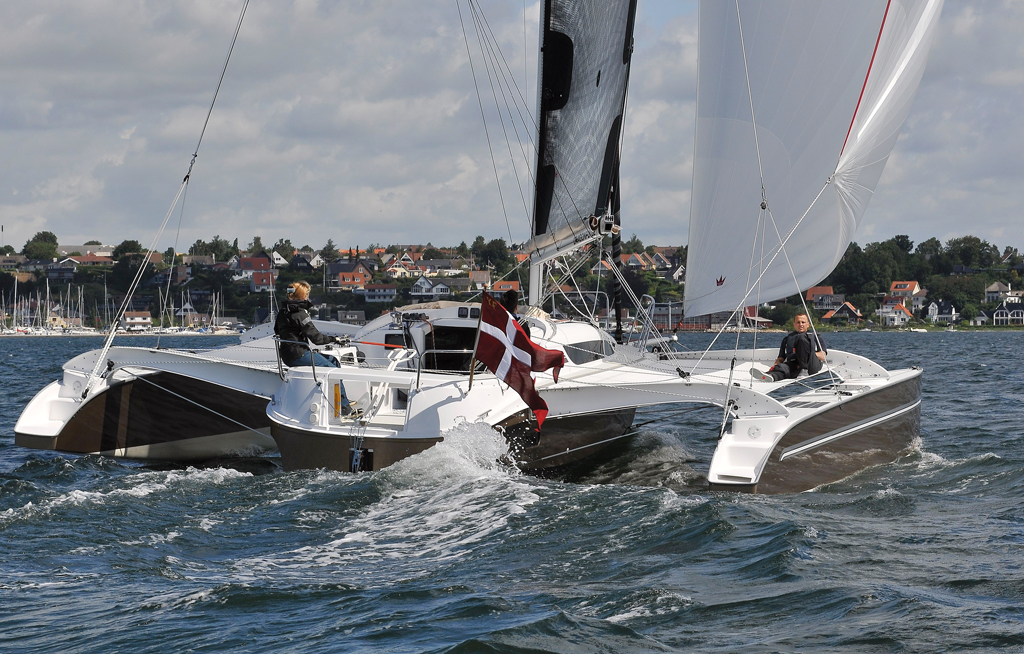
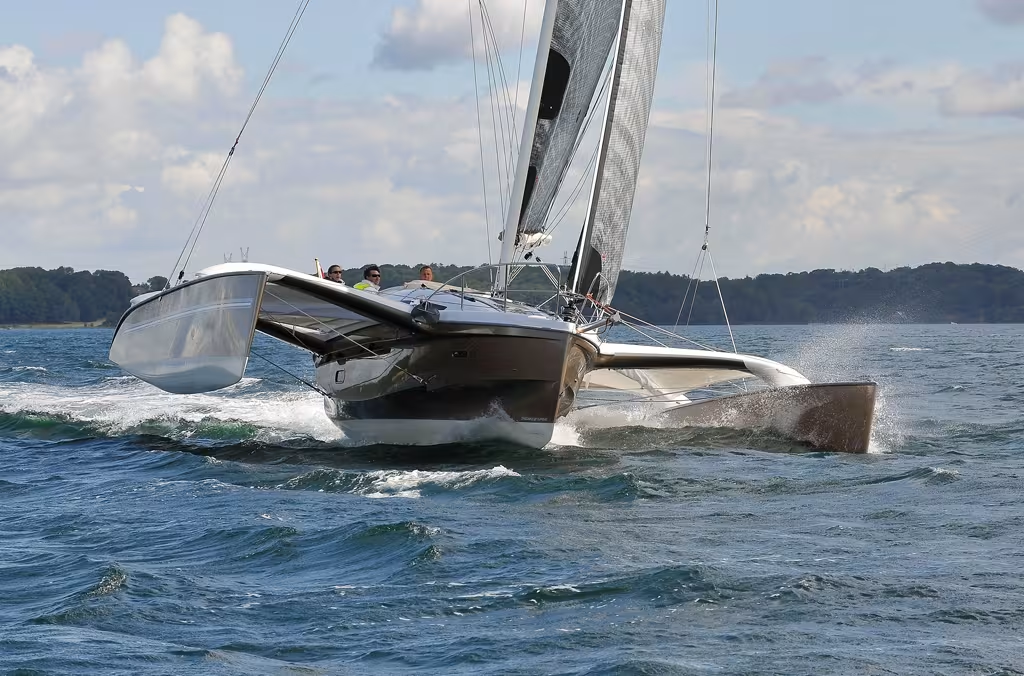
At full speed on runs, or on a discovery trip, the Dragonfly 32' (here the Supreme version) plays on its multiple facets, to the crews' delight.
Discovering the Dragonfly 32'
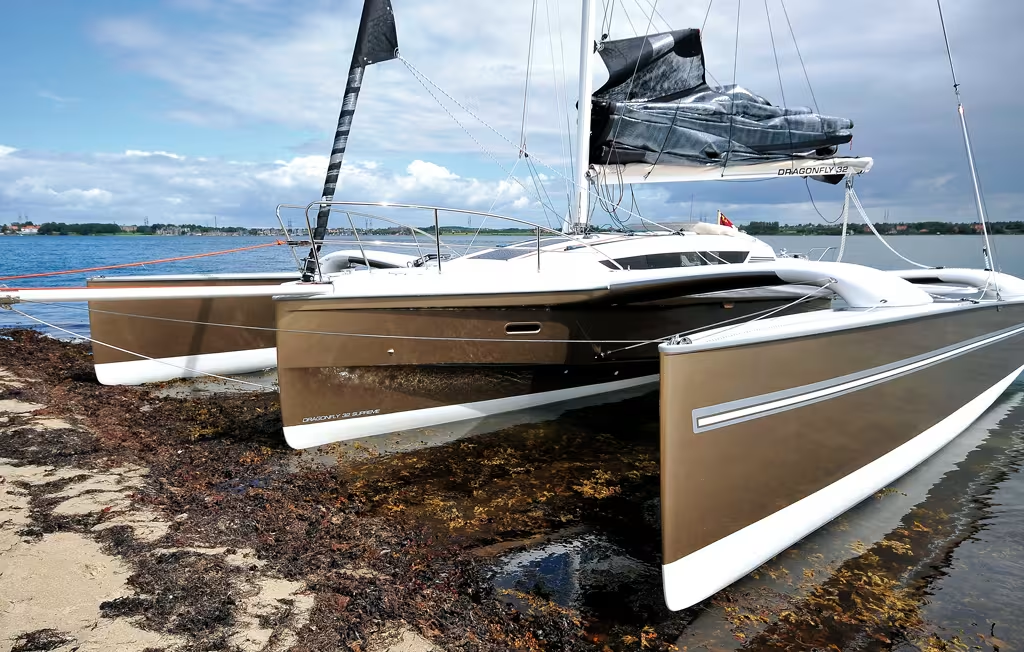
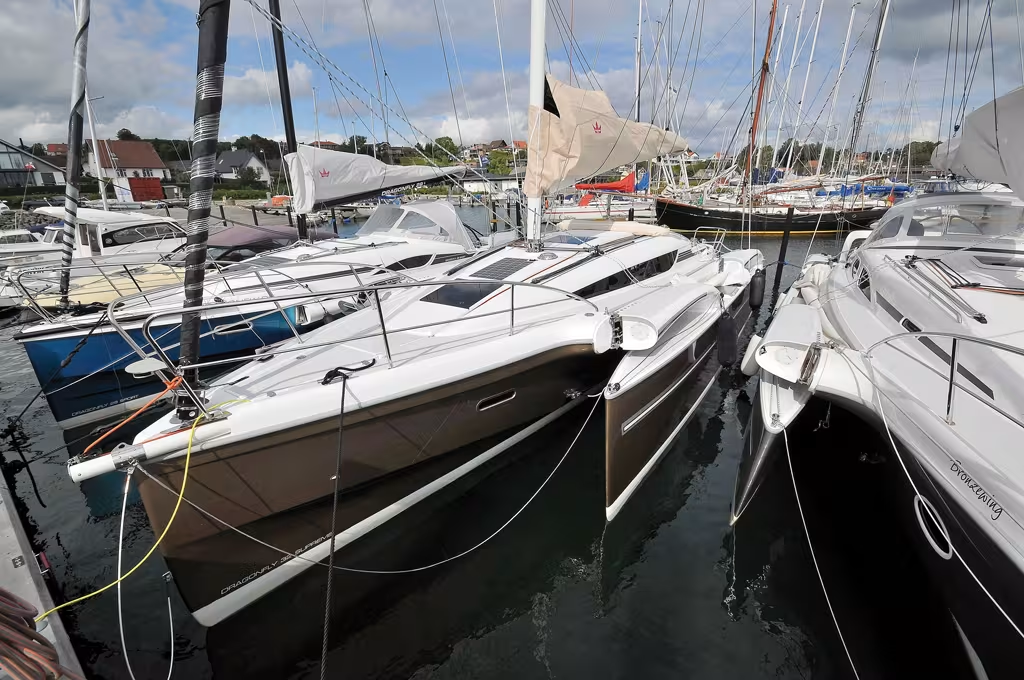
Skaerbaek's pocket-sized marina was the ideal place to highlight the Dragonfly's possibilities as a contortionist. The entrance is narrow and winding, the pontoons are arranged around the fishing port, and the berths are tight! By a stroke of luck, the three models had taken up temporary residence here. The 28' is transportable within towing limits, folds its wings into a housing in the central hull, and falls within the 2.5m limit without dismantling. The majestic 35' retains a certain rake to its floats; the 32' adopts cunning geometry: the narrow floats with high freeboard remain stable in the vertical plane, thus contributing to a compact appearance which facilitates the use of fenders (inflatable or flat) when centimetres count. The beam is limited to 3.6m; it slips into the berth of a monohull of equivalent length. Attention has been focussed on the ergonomics of movement around the boat in its folded position; the tubular stainless steel guard rails make the large foredeck safer; the comfortable gunwhales around the coachroof give easy access to the cockpit. The set-in handrail shows that everything has been thought of and that the small weak points in the 920 generation have been corrected. The design of the coachroof is elegant, and conceals a spectacular amount of interior area for a 10-metre trimaran. The artistic work carried out on the upper ridges and the design of the portholes are without a doubt the keys to this aesthetic success. The crossbeams' dihedral, the fusion of their lines with the overall silhouette and the anchorages of the floats in rotating plates are superb. The forward sections are slim, a progressive V-shape allows the underwater lines to join harmoniously with the very marked longitudinal step which helps the 'ski tip' effect at high speed, whilst providing the desired amount of internal space. The champagne-glass aft sections limit the hull's belly; the final metre is completely flat. The narrow floats offer a new approach: they optimise the passage of the boat through the chop and take the progressiveness of their volume distribution from their vertical sides. This opposition of shapes (flat central hull, narrow but high floats) aims to combat the effects of big seas stopping the boat when sailing to windward.
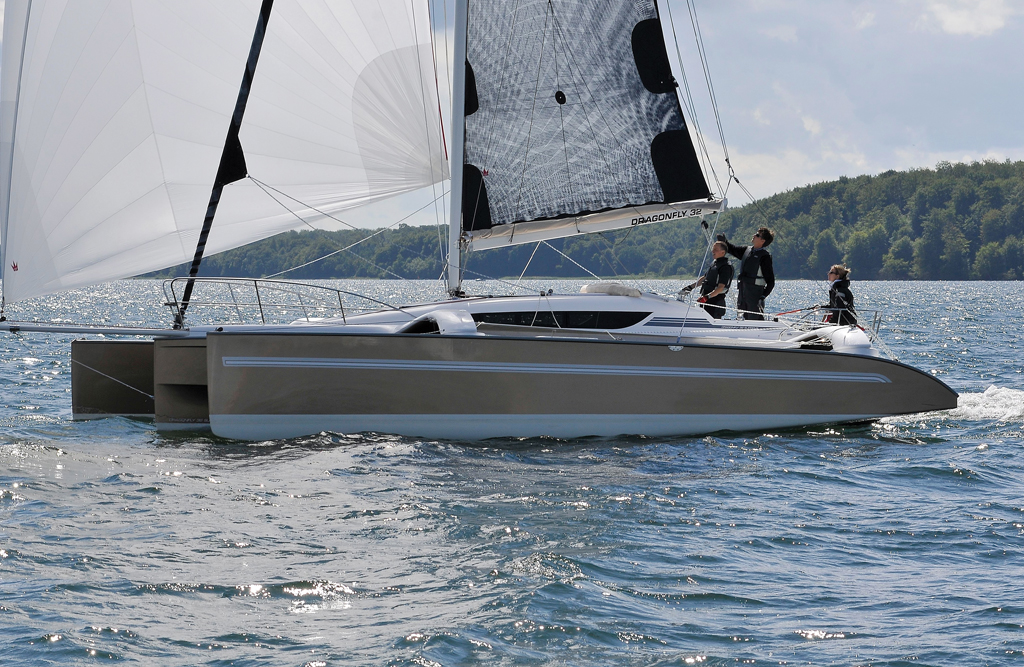
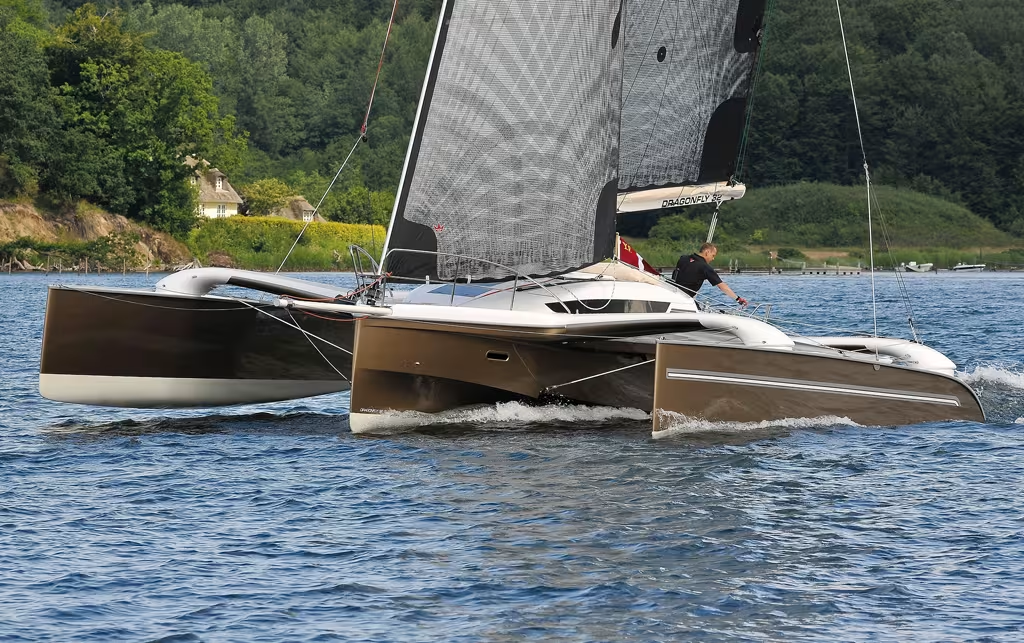
In the Supreme version, the 32 is equipped with superb membrane sails from Elvström.
Crowded ports? Fold the boat!
Quorning pushes its mastery of horizontal axis geometry even further by simplifying the path of the lines. Limitation of the opening of the arms forward is taken care of by a fixed cable, whilst locking in position is dedicated to a powerful block and tackle which is adjustable from the cockpit; two removable bobstays back up the security. This 'all exterior' cross-shaped system (under the trampolines) is rational, it avoids passing the lines in the arms. The generous water stays (Dyform cables responsible for the vertical forces) are oriented in a wider angle. The generous mechanically-welded parts which act as hinges are real works of art, and seem to have further progressed in their design and creation (more supporting material, jointing and overlap, double coupling pin).
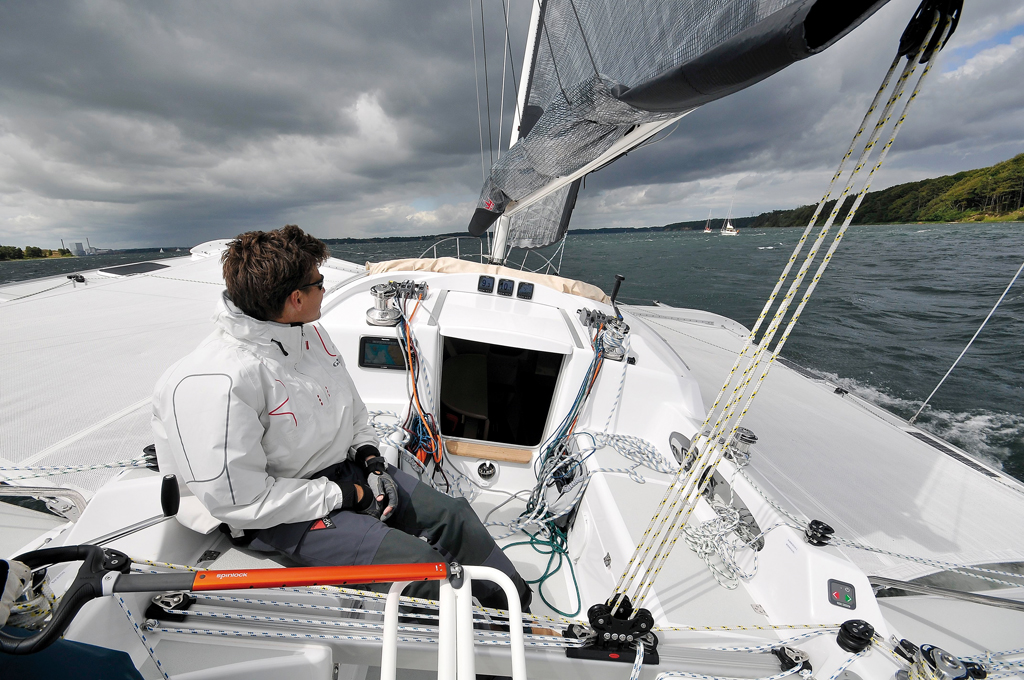
Spacious cockpit, trampolines on the same level, top of the range fittings and generous sail area, the 32 shows all its trump cards!
Interior accommodation: contemporary volume and style
The impression of space is striking (the 32 is very close to the 35!), there is an abundance of working surfaces and the saloon is transformed by the recessing of the centreboard case. This surprising result is the fruit of an intelligent and meticulous 3-D design of the central module and the structural interior moulding. The design of the appendage abandons the quadrant approach, offering depth and a low chord. The reduced dimensions allow a 3rd (convertible) double berth in the saloon. If we add the completely separate forward and aft cabins and a coherent heads, we ask ourselves how the Danes have done all that! The overall style is simplified, compared with the opulent 35', but the traditional quality is omnipresent. The choice of maple for the decoration helps with the impression of light and space. There are numerous cupboards; the lockers are equipped with clever guillotine fastenings which rationalise the stowage solutions and contribute to the overall clarity when sailing. Access to the aft cabin is by sliding the companionway steps; certain claustrophobic people will perhaps regret the absence of a large deck hatch (there are two lateral, opening portholes); the ventilators will be useful in the Mediterranean. Concerning the 'liveability', let's not forget the famous (optional) canvas 'cabriolet', which turns the cockpit into a genuine exterior saloon; an articulated bimini is also available, for the hot regions.
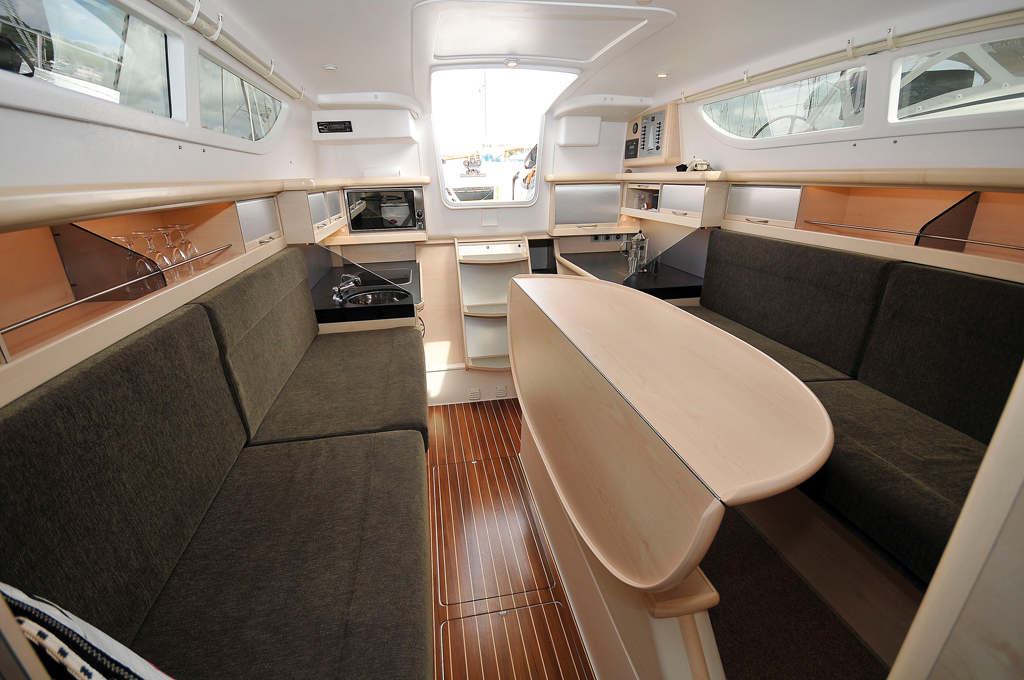
Light, space, conviviality, welcome aboard the Dragonfly 32, a 10-metre trimaran which has everything its big sisters have!
Performance, comfort and agility
Having diagnosed the minor shortcomings of the previous generations (the main one being the limited liveability of the 920 and the 1000), Quorning has continued innovating; it has just launched a surprisingly mature 32-footer. Painting is entrusted to a specialist who has cabins and experience ad hoc; I've seen one example (the n°3) in a breathtaking blue! The photo session carried out with 10 to 15 knots of true wind showed the capabilities. The 32' caught the light well in its superb metallic brown livery, and raked the bay at full speed, with the wakes smoking and the bows cutting through the spray in wild surfs! Observation of the machine through the telephoto lens already gave a lot of information. It was fast; I also liked its silhouette! The sail plan on the Supreme version is generous, as always on the company's sport versions. The Elvström Denmark membrane sails are superb (premature ageing problems with these high-tech sails now seem to have been overcome). The cut, the manufacture and behaviour are excellent; they are visibly very propulsive. Aboard, the first good feeling comes from the cockpit's ergonomics: forward of the mainsheet track, the trimmers have enough space to move around comfortably; the very readable deck plan falls easily to hand. The helmsman is pampered, well-balanced on the tubular footrests. With the wide-handled tiller extension or the 'racket' style tiller in his hand, no obstacle can disturb this comfortable position, which is likely to be occupied for a long time. A (voluntary) beaching showed the trimaran's amphibious abilities (on suitable ground). This aspect of the specifications may seem marginal, yet it is an advantage in numerous situations (crowded anchorages, mangrove swamps, river bars, tiny ports, transport...). As soon as the squall had passed, a burst of 'astern' dragged us off this bucolic beach. The wind freshened progressively during the long tack to windward: 10, 15, then 20 knots of true wind under full main and genoa; the 32' tolerated this sustained point of sailing. A line of squalls at over 25 knots dictated the first reef; the work dedicated to the calculations for the (rolled filament) carbon mast and the rigging arcs was visible, as the profile remained perfectly coherent, without the slightest deformation. The 'ski run' opened up ahead of us, on the best point of sailing for these boats (beam wind, reaching)! The breeze was now strong, 25 – 29 knots in gusts which we followed by bearing away. With between 15 and 20 knots on the speedo, the Dragonfly planed permanently over the lively chop (but with no real seas). The clear accelerations followed the rhythm of the gusts; resorting to freeing the traveller was rare. The narrow floats allow the windward one to rise out of the water under the action of its dihedral, and relieve it from the impact of the waves; the vertical force to leeward increased noticeably and the trim stabilised when the force was acquired. Despite the rough conditions and the high speed, the 32's stability remains very reassuring. The helm's balance, perfect to windward, was occasionally affected by cavitation on our prototype (ventilation of the superb profile at high speed); the builder is correcting this. The ride was interrupted regretfully (what a pleasure these wild rides are!). The orientation of the hills meant we were now sailing close-hauled; we had to tack. What could have become a punishment turned into a lively and exciting stampede. At 10 – 12 knots, and 30° to the apparent wind, tacking close to the shore, the Dragonfly gave us a real demonstration! Some monohulls, close-hauled and grinding the winches, were quickly left behind. The 32' tacked in its own length and accelerated away immediately; the light, precise helm took no effort, the boat went straight ahead! The very strong gusts (35 knots!) were no obstacle, they allowed us to luff more, whilst not touching the mainsheet, which was just under surveillance. By bearing away a few degrees, we immediately hit 15 knots. At the end of the test, we had a final blast, with the genoa unrolled. The deck plan is biomechanically relevant, the powers of the Anderson winches are suitable (one of the two 46s is electric, an option on our test boat) and the Ronstan fittings are remarkably fluid. The mainsail preventers (extended block and tackle to adjust the leech, from a reach to a broad reach) are in place, as are the jib sheet barber haulers. On the Supreme, racers will have no preparation to take care of. The manoeuvre under power (outboard, diesel inboard or electric inboard - our test 32' was an electric version) caused no problems, given the machine's agility, but a thruster could prove useful for intensive use in marinas.
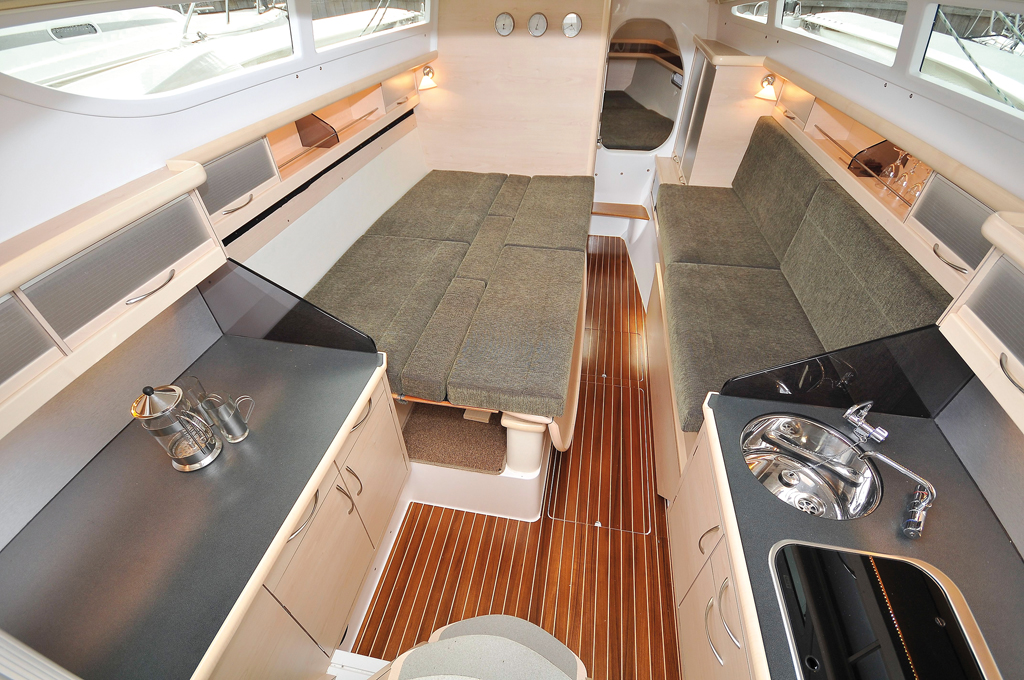
In addition to the two double cabins, the saloon table can also be turned into a double berth. Practical!
CONCLUSION
The 32' is a successful model. It is pretty, the design of the arms makes you forget that this is a folding trimaran. The general spirit of the predecessors is of course preserved, but the concept has progressed concerning numerous secondary points, which makes it even more pleasant to use (useable sugar scoops on the floats, position of aft cleats, access to the trampolines on the same level, liveability, electric motor option...). The Supreme version is overpowered and offers intense excitement in moderate breezes, but the Touring version shouldn't be too far behind in most conditions.
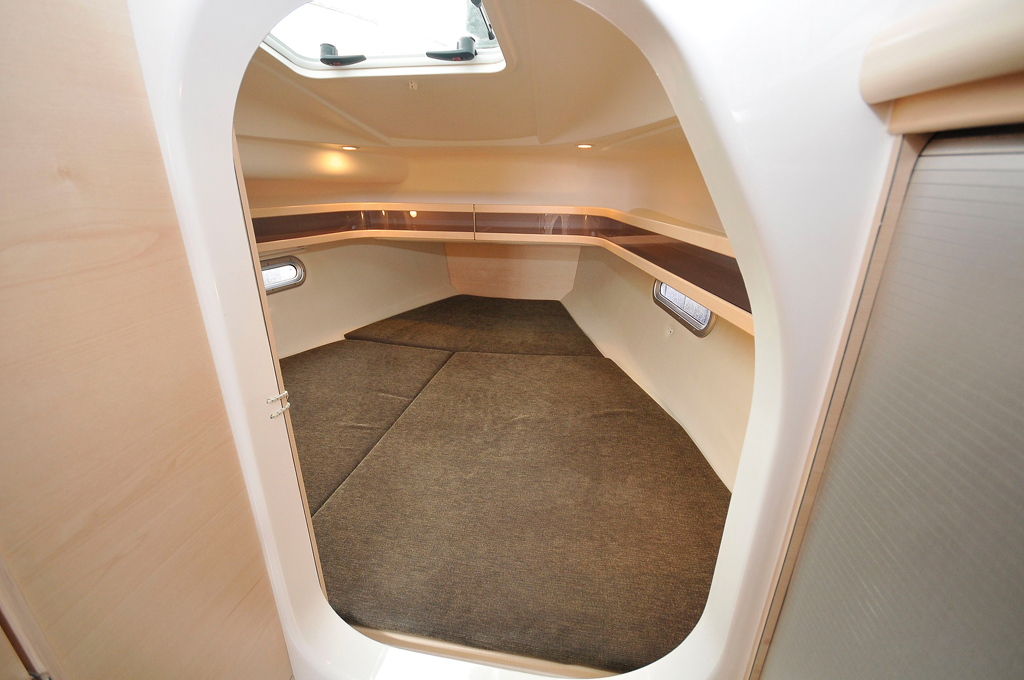
Aboard a trimaran, privacy can also be preserved…
THE PLUSSES:
• Value for money • Pleasure in use • Liveability
THE MINUSES:
• The options increase the basic price • Slightly enclosed aft cabin • Careful technical maintenance essential
THE COMPETITORS
Model Builder Windward sail area in m² Weight in t Price in Euros, exc. VAT Triforsix 34 Tournier 69 3.250 230,000 Corsair 37 CR RS Corsair 74 2.5 262,000 Trimax 10.80 Trimax Yacht 89 2.8 339,700
TECHNICAL SPECIFICATIONS
Architect: Jens Quorning and Steen Olsen Builder: Quorning Boats Length: 9.80m (12m folded) Beam: 8m (3.60m folded) Draft: 1.95/0.5m Weight: 3.3t Mainsail area: 57m² (Supreme), 47m² (Touring) Genoa: 31m² (Supreme), 26m² (Touring) Asymmetric spinnaker: 110m² (Supreme), 90m² (Touring) Code zero: 68m² (Supreme), 50m² (Touring) Retractable bowsprit: 2m (Supreme), 1.75m (Touring) CE Category: A, unsinkable Engine: 30hp 4-stroke Tohatsu extra long shaft outboard 20hp inboard or electric Price: standard version with 25hp 4-stroke Tohatsu outboard: Touring 205,900 euros exc. VAT Supreme 219,900 euros exc. VAT
