Initially designed as a charter boat, the takeover of Dufour by catamaran specialist Fountaine Pajot in May 2018 changed the fate of this 48-footer. Instead of becoming the unwanted orphan of the mighty Fountaine cat empire, its molds and yard space in northern Italy, run by JJL Catamarans in Forli in northern Italy, was bought by Croatian charter company Under the Heavens. We got the chance to test hull #29, the first unit to arrive in Australian waters.
Test location: Sydney, Australia
Conditions: 18 to 25 knots, slight chop
Infos pratiques
- Le chantier : Dufour 48
- La fiche technique
-
 Découvrez notre vidéo exclusive
- Financez votre Dufour 48
- Assuez votre Dufour 48
- Articles autour du Dufour 48
Sailing around the world can have a profound effect on sailors, as it did for monohull dealer Matt Hayes. The former Olympic sailor and successful Sydney boat dealer came to a few conclusions during that 30-month circumnavigation, done on a 56- foot Dufour monohull. “Everywhere we went there were cruising catamarans!”
This fact reflected the strong market for them, both in power and sail varieties. “So when the opportunity came to get this Dufour catamaran dealership, we jumped at the chance,” explained Matt as we talked aboard the first example to arrive in Australia. As a former Dufour monohull dealer, he knows well the flair of designer Umberto Felci, so had confidence in taking on this catamaran, despite the Italian being relatively new to the concept. For this initial model Felci collaborated with his company co-founder Lorenzo Giovannozzi.
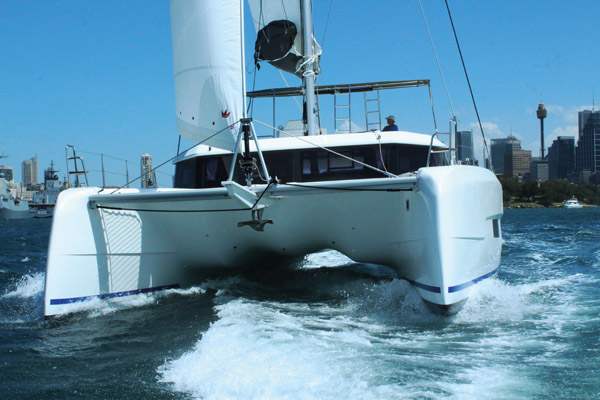
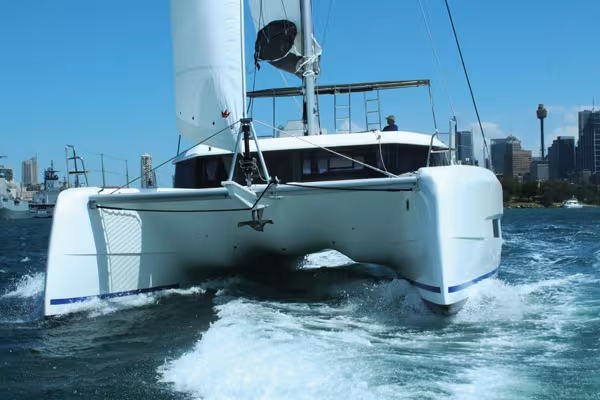
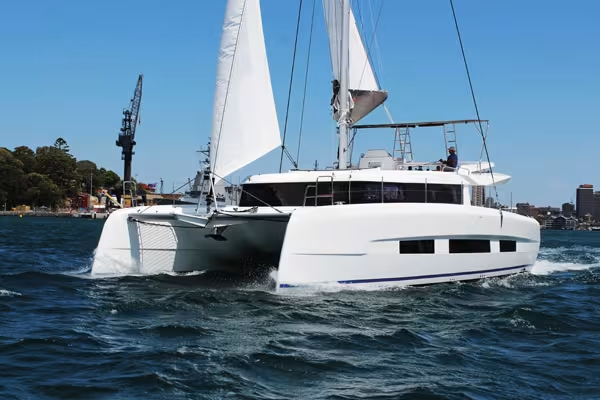
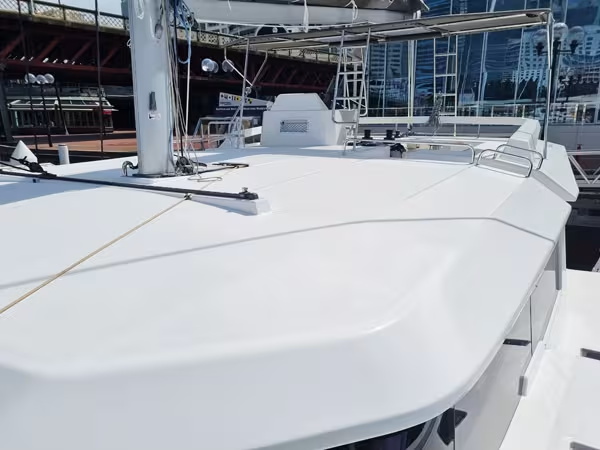
The streamlined nacelle of the Dufour 48 minimizes windage. As for the relatively modest bridgedeck clearance, it guarantees good volume to the cabins but risks slamming in bigger seas.
First shown at Cannes in 2018
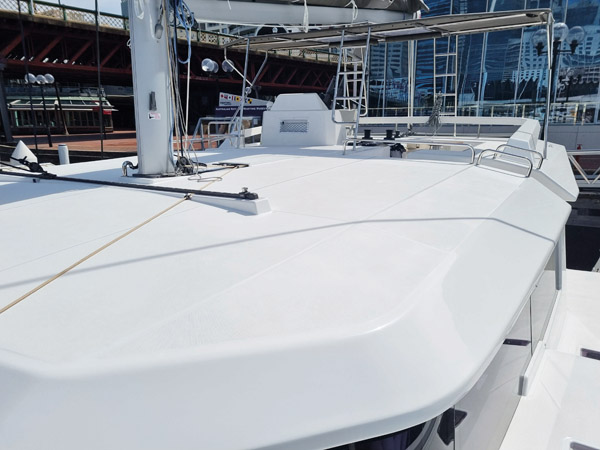
Having seen the first hull at the 2018 Cannes Boat Show, I was impressed by the overall sleek design and general finish. ‘Design flair’ is well worn phrase, yet it certainly applies to this Dufour 48, thanks to a sleek, angular profile which oozes modern style. Lofting it, followed the idea of thirds: with the aft section, nacelle and foredeck equally divided. Cynics might say that Umberto Felci grabbed the upright features of the spacious Lagoons, combined the low-slung flybridges from the Fountaine Pajots, then added a dash of his own monohull topsides. Whatever the consensus, the 48 is a very stylized catamaran. Looking the part, gets you to first base with many prospective customers, including the younger, hipper buyer. Beyond that, there are a few questions to ask about the Dufour 48. Such as the modest bridgedeck clearance and the unusual angle of the raked flybridge. The former blemish means going easy on the loading, but the latter is more about style. And the flybridge certainly proved a functional space during our sea trial on Sydney Harbour.
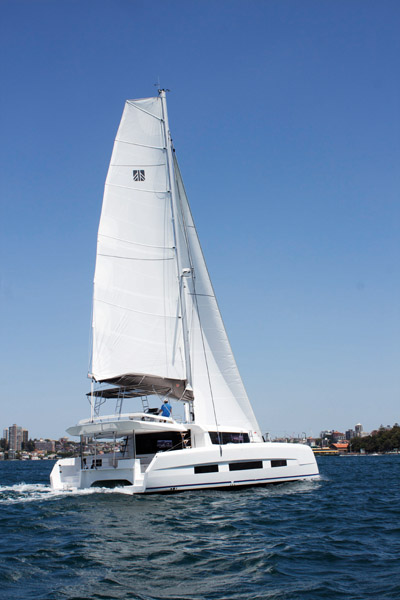
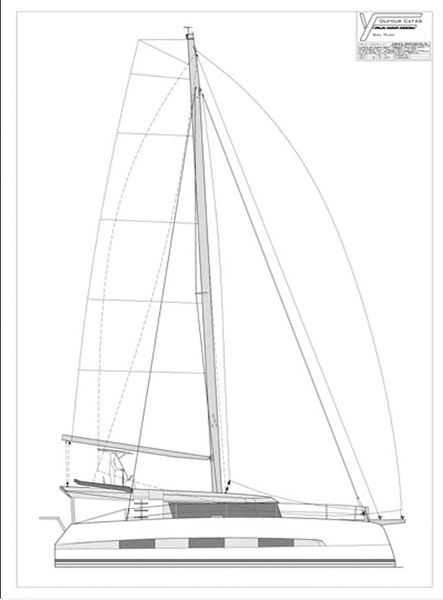
The size of the wetted surface area of a cruising catamaran can require substantial canvas. The bowsprit and downwind sails are welcome!
Rig and flybridge set aft
Climbing aboard the Dufour 48 shows the towering height of the topsides that comes to shoulder height, so the boarding gate midships is ideal, along with a removable ladder. Most noticeable is the midships location of the mast, which dictates that the flybridge is located right at the back. Aesthetically, this may raise a few questions, but from a practical perspective it ideally spreads the sail plan along the 48-foot hull. Dual access to the low slung flybridge is ideal as well, and all sail controls are here, thus leaving the main cockpit free for relaxation. A downside with this layout is divorcing the navigation crew from the relaxation crew; but there are many upsides.
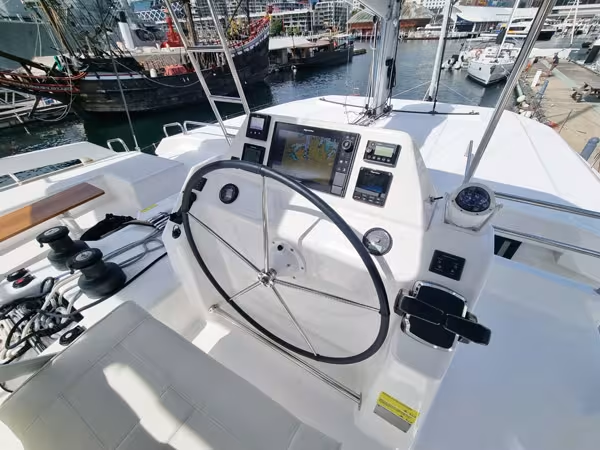
Shoal water navigation, as we often do in tropical locations, is best done from a high vantage point and the sail controls sitting neatly alongside the offset helm show good ergonomics. It also creates space on the port side for the lounge table and benches. Overhead, a canvas bimini gives shade but also restricts access slightly to the boom. The boom is raked upward to clear the bimini and its high, yet reachable by taller crew. Another upside of the aft flybridge is the space around the mast foot which can have dual sun loungers, or for the bluewater couple, several large solar panels.
The starboard offset helm allows all lines to run directly from the mast via jammers to a large pair of Antal electric winches, an ideal low-friction arrangement. Also good is the main track on the flybridge transom with lines r unning forward to near the helm.
 |
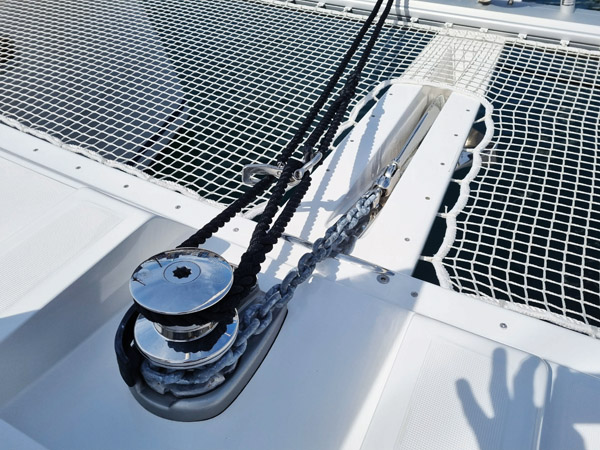 |
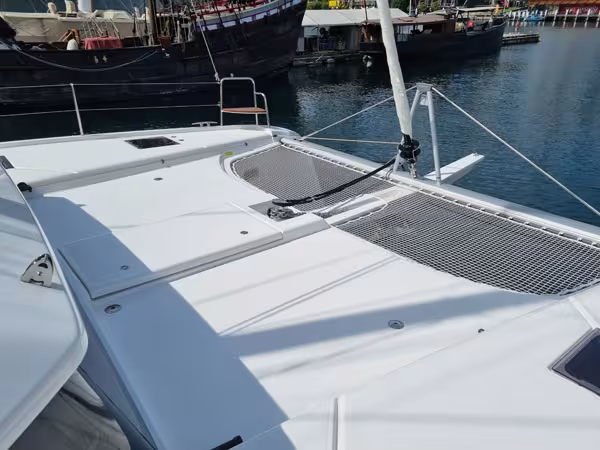
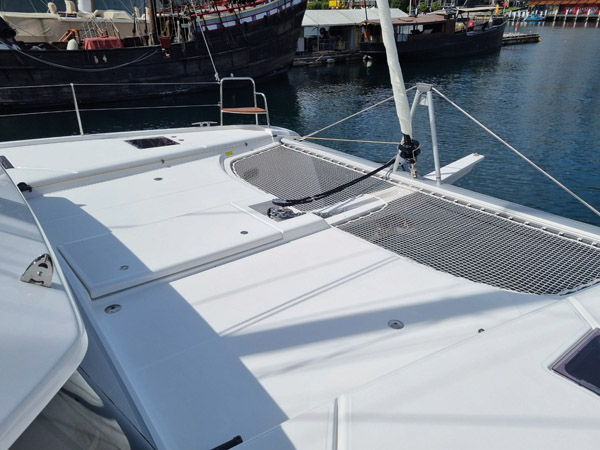
The Dufour 48’s foredeck is well designed with a deep locker for the tanks, accessible ground tackle and a large trampoline to reduce weight closer to the bows.
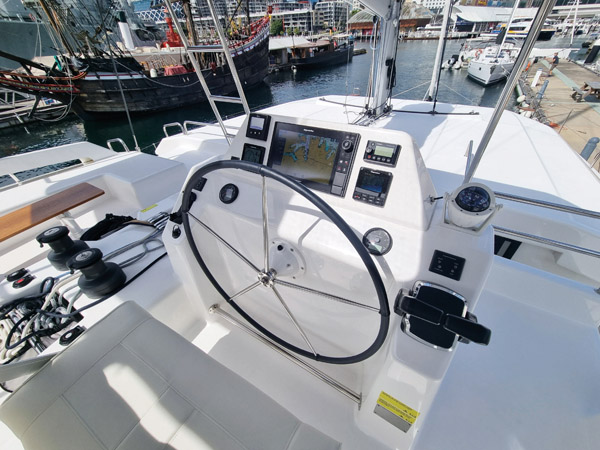
Neat deck plan… and a very large steering wheel
Overall, a good arrangement for a couple to sail with, yet enough room for a crew to operate as well. The sail plan includes a selftacking jib and the large fore-triangle space can fit a generous gennaker. In addition, a Code 0 can fly from the fixed bowsprit – ideal for moving this 15-ton cruiser in light airs. The helm has a double bench and is dominated by the large diameter wheel but given it’s hydraulic, I’d question its dimensions – that are so large my fingers were trapped against the bulkhead at its sides. However, that’s a small blemish on an otherwise good layout that has the 12-inch Raymarine Axiom plotter central and also at eye height are the two gauges for the 60 HP Volvo sail drives.
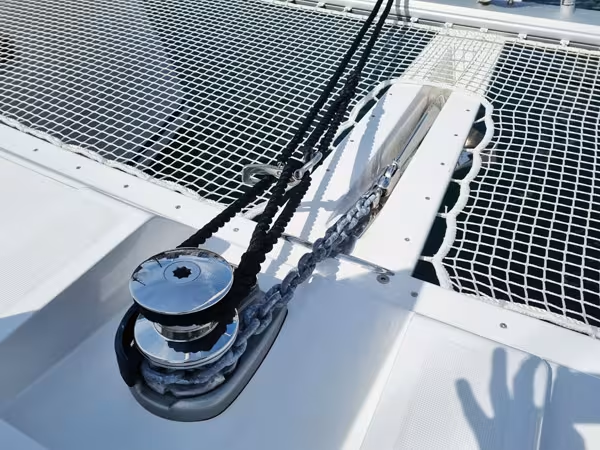
Stepping down onto the main deck, notable features include tall toerails and bulwarks towards the aft; to keep kids nicely secure. Walking forward to the bows reveals a flat foredeck with space for dual sunbeds and adequate trampoline space to minimize weight and wave-slap forward. Here, a deep central locker holds tankage and rode, with the substantial Antal 1,500w vertical windlass-capstan on deck. The chain is in a short open gutter connected to the 100 lbs (45 kg) Ultra anchor located just outside the nacelle, so good weight centralization. The anchor gutter is part of the central spine that extends to become a sturdy bowsprit, intersecting with the alloy main crossbeam, creating a strong structure. Other good points are cleating all round and bow seats to thrill guests when underway.
 |
 |
Le cockpit arrière s’avère fréquentable quelle que soit la météo, puisqu’il est entièrement recouvert par le flybridge.
Le flybridge offre une vue panoramique. Le poste de barre est idéalement placé avec toutes les manoeuvres à portée de main ; c’est parfait pour une navigation avec un équipage complet… mais aussi en équipage réduit.
A perfectly protected cockpit
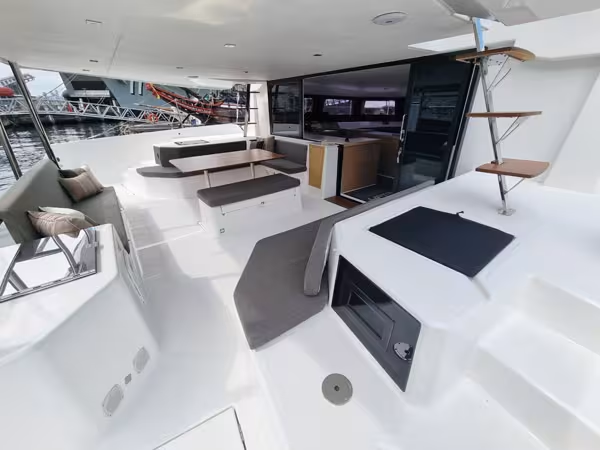
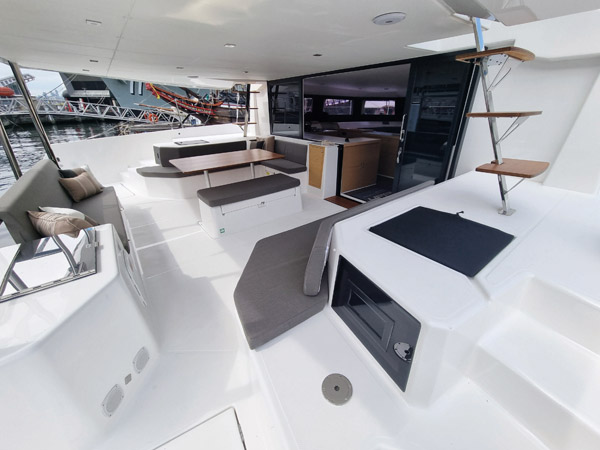
Returning below to the main cockpit, this space adjoining the saloon galley will win over many buyers. Fully protected by the overhead flybridge bulkhead, this is an allweather dining and partying area. Just switch on the electric barbecue at the transom and relax on the generous benches. This apartment style living is why cruising catamarans like this Dufour 48 sell. And of course, the easy water access from molded steps on each side with an electric davit between for the dinghy (or hydraulic platform option). Other good points here include emergency quadrant access on the cockpit sole and generous locker space.
A galley that’s very functional under way
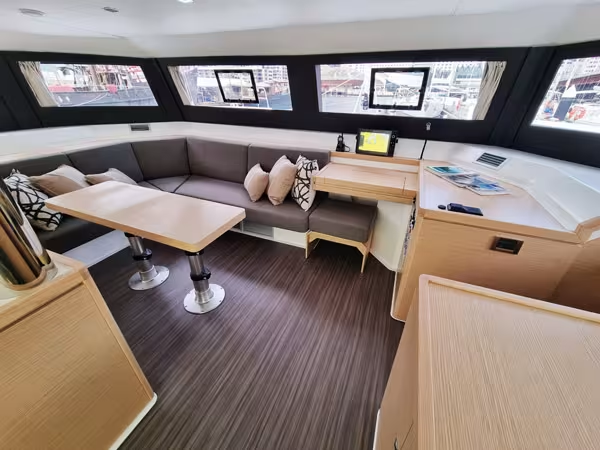
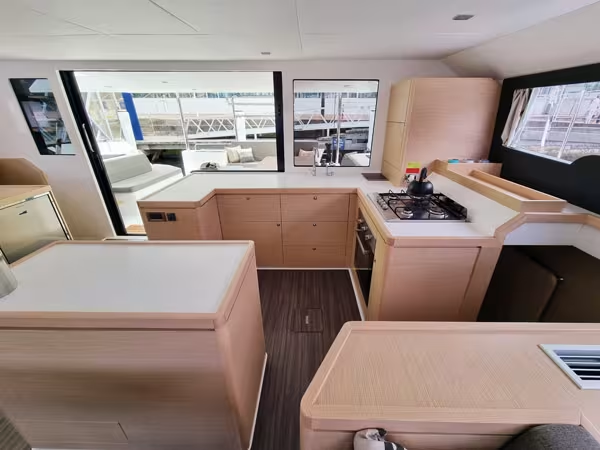
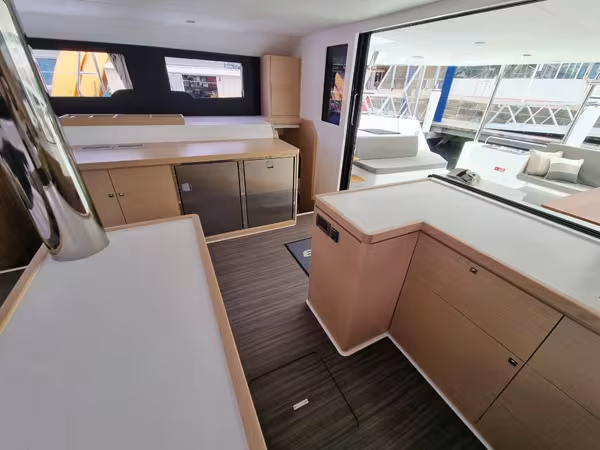
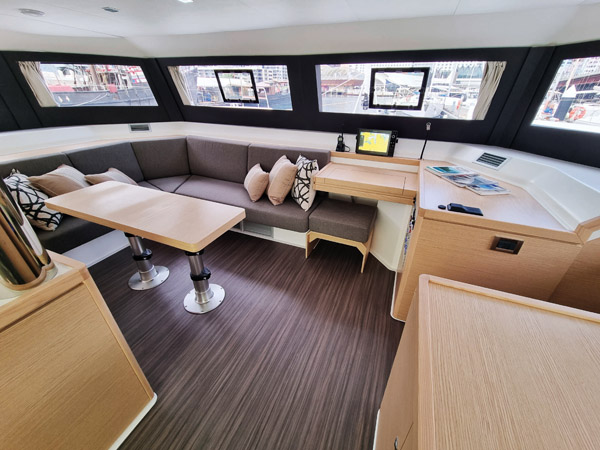
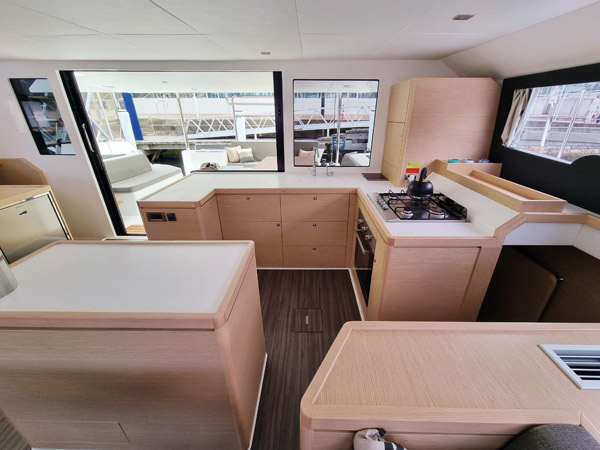
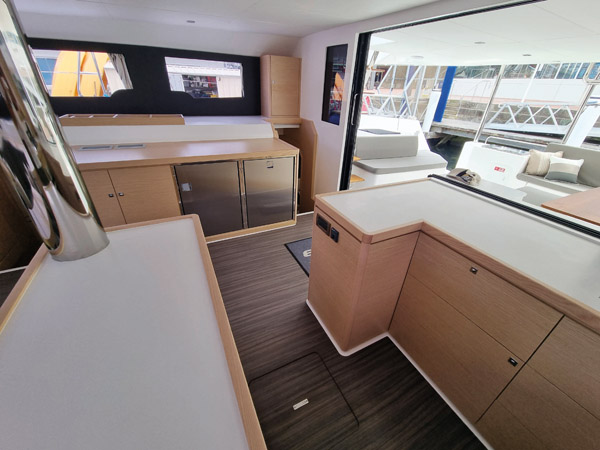
The cockpit seamlessly flows into the saloon, but with a scupper in between, and the galley is here, so ideally placed for serving al fresco diners. Unlike some leading brands, for his 48, Felci chose to avoid the acres of open-plan more suited to marina life than offshore, something I endorse. So, the island workbench supports crew in a seaway and is well anchored by the compression post for the mast. Around it is generous worktop space, a deep double sink, four burner gas hob and oven, plus double refrigerators. Dealer Matt Hayes wisely up-specified some of this to suite the Australian cruising market; so it also includes a washer/dryer in the downstairs utility room, electric heads and a ducted air conditioner. In front of the galley, the lounge wraps around the elevating fold-out dining table, to port. The navigation station sits on the starboard quarter. Here, a second 12-inch Raymarine Axiom plotter allows the skipper to work while giving clear views aft. Simply add a remote control for the autopilot and you are set. The plotter can also show the radar images from the Raymarine Quantum unit on the mast. Other notable features include two large hatches at the front for airflow and the high overall standard of finish, in lightwood laminates with good attention to detail.
 |
 |
 |
The intelligent layout of the furniture optimizes the space inside the nacelle. The saloon is very functional with a large chart table and a comfortable lounge area.
Aft in the saloon, the galley is fully equipped with a cooktop, oven, double refrigerator and even a washer/dryer in the utility.
Three to five cabin layout in the hulls
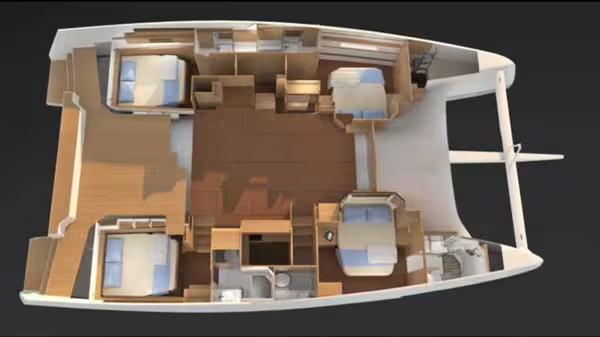
Accommodation options vary from three to five cabins. Our review boat was the charterfriendly version with four ensuite cabins plus utility room and skipper space in the starboard bow. This arrangement can sleep nine and there’s even a day head. Impressive. But of course, overkill for the dedicated cruiser who may opt for the three cabin, with the port hull as one large apartment.
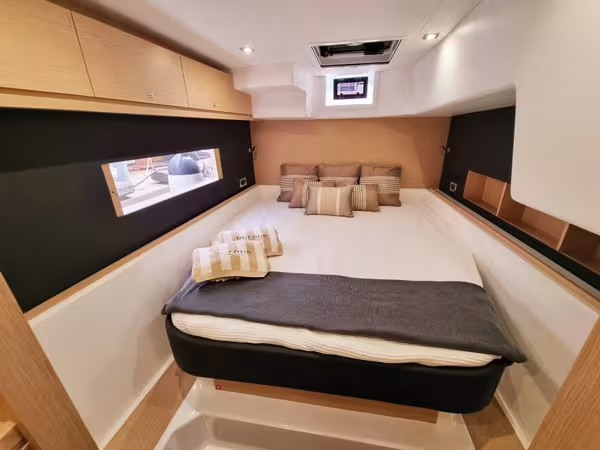
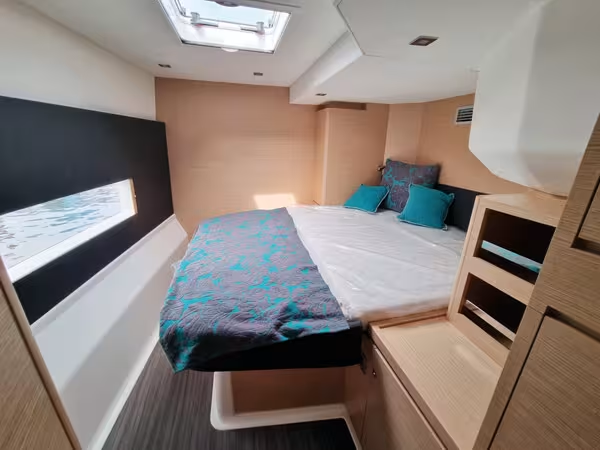
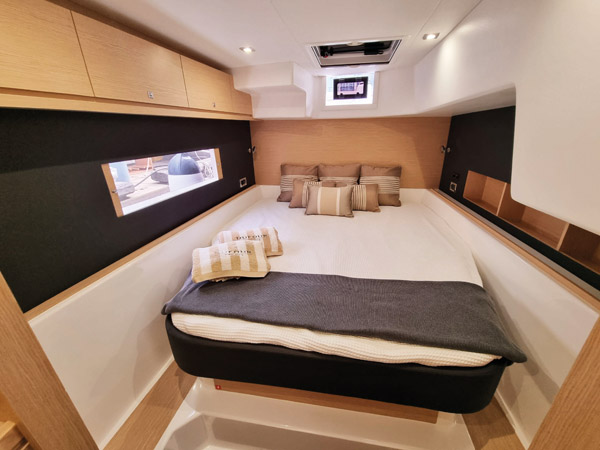
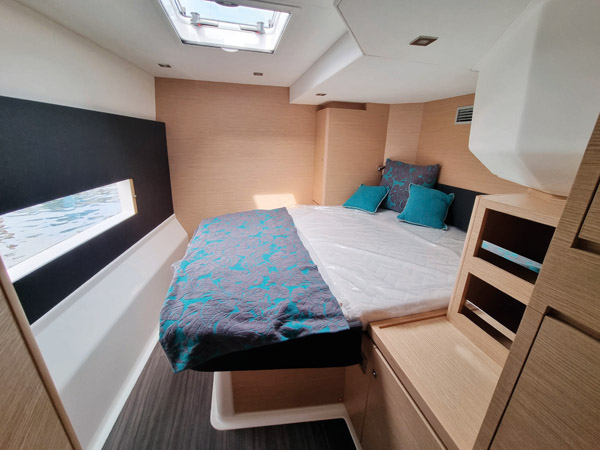
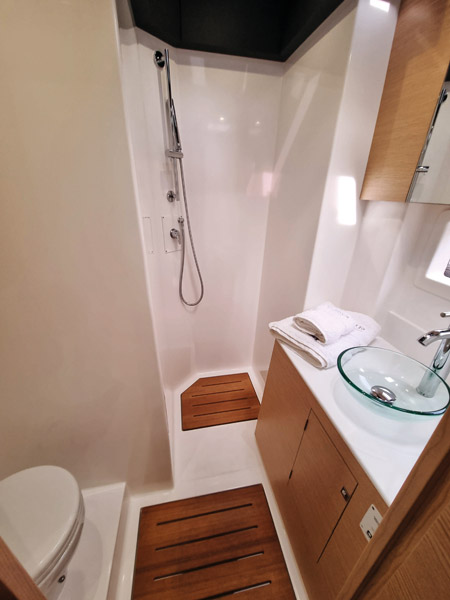
The pick of cabins in our review boat is the starboard one aft, because of its private corridor and location to minimize motion at sea. The large semi-island bed (I measured at 74”/187cm wide) surrounded by locker space and hatches, including an aft facing one, is very good. Equally good is the nearly 6’7”/2 m headroom and the spacious ensuite with electric head. Again, plenty hatch ventilation plus a dedicated escape hatch in the hull. Quality finishes included teak grating in the bathroom, LED mood lighting and the general fixtures and fittings, showing typical Italian attention to detail. The sister cabin on port is similar in size, while the two forward cabins have athwartships beds, generous space and plenty storage, all reflecting the value of these towering topsides.
 |
 |
The intelligent layout of the furniture optimizes the space inside the nacelle. The saloon is very functional with a large chart table and a comfortable lounge area.
Aft in the saloon, the galley is fully equipped with a cooktop, oven, double refrigerator and even a washer/dryer in the utility.
Robust construction
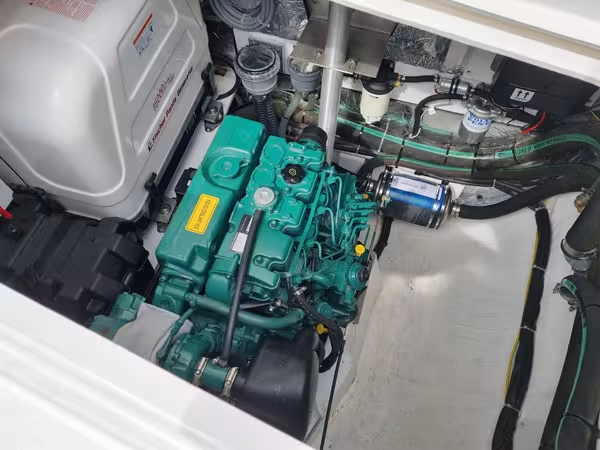
The JJL Catamarans yard in Forli used a monocoque build for the hulls, mini keels and nacelle - for stiffness and laid in solid glass. Decks and saloon are foam infused. All bulkheads are infused polyester or glued marine plywood. There are two opening glass escape hatches on starboard because of the separate cabins – with utility room in between – while on port only one hatch is required. The nacelle has a sculpted underside for wave deflection and the plumb bows maximize the waterline, and interior space. Looking aft, the bridgedeck clearance is modest, which I measured to be 24”/60cm on hull #29. The tall hulls mean the engine rooms are spacious and the Volvo saildrive is fully accessible on the starboard side, including filters and electrics – all elevated in case of water ingress. On port, it’s a bit crowded because of the house batteries surrounding it. Ideally, these heavy gel batteries should be centralized in the saloon to improve trim, and similarly with the 11kW generator which would be better placed in the foredeck locker.
 |
 |
The four bathrooms have electric toilets, good ventilation and a beautiful teak finish.
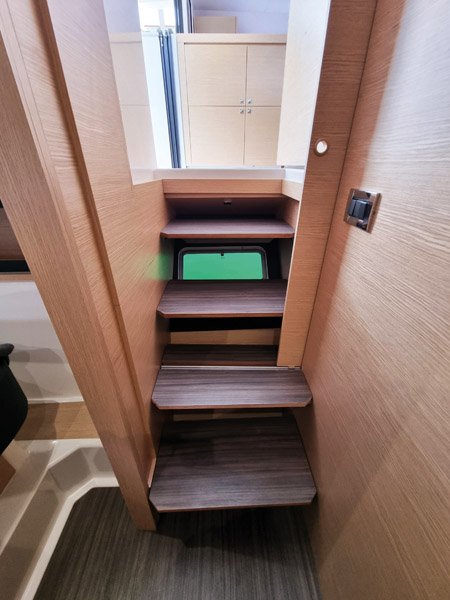
Each hull is equipped with an escape hatch to ensure evacuation in case of capsize.
Sydney by sail
The first test for the Dufour 48 was extricating itself from the pontoon at Sydney’s Darling Harbour with a strong side wind pinning it there. I’ve seen these kinds of tall flybridge cats with mini keels spun round by strong winds, so I admired dealer Matt Hayes composure as he gently worked the throttle leavers fore and aft to nudge the bows off first, then get us clear. The cat characteristic of two engines to pivot on, plus the flybridge stance of the Dufour 48, aided this maneuver. Once clear, I took control to feel the transmission and the hydraulic wheel, pushing the motors to full throttle. Done without hardly a murmur from the four-cylinder Volvo sail drives or their transmissions and aided by those fixed three bladed propellers, we reached an impressive 9.1 knots as the props spun at 2,900 revs, before slowing to a cruising speed of 8.2 knots at 2,200 RPM.
A strong north-westerly was blowing, so I sought some shelter on the north shore before clicking the Antal electric winch to hoist the square-topped Elvstrøm Dacron mainsail. The two-speed Antal made short work of this, aided by the lazy jacks and the skylight in the bimini for viewing; before I turned our bows towards Taronga Zoo. My favorite night anchorage, where the animal sounds lull me to sleep. However, the 25 knot gusts and thrill of sailing the first Dufour 48 quickly moved my mind back to matters in hand. Unlocking the jib furler, it ran out before I trimmed it and then largely forgot about it thanks to its self-tacking track. As the wind gusted to past 30 knots at times, I checked that the jammers on the main track could be released quickly. While the main sheet and winch firmly controlled the alloy boom and the Dufour 48 majestically sailed on without complaint, aided by the smooth Harbour waters. The Raymarine showed a speed of 9.2 knots as I pushed fairly hard on the wind at 55 degrees with the true wind speed dropping to 22 knots by then, which was just a tad under her polar chart.
Tacking was equally successful, simply requiring a couple of turns of the wheel and the momentum of the 15-ton hulls pushed us through the wind easily on our new course with about 100 degrees of arc. Easing the mainsail to go off-the-wind on a beam reach slowed us to 7.2 knots as the sheltered north shore reduced the wind to 18 knots. Looking astern the maelstrom from our wake told the tale of our two large, fixed propellers that were dragging a bit, perhaps costing us up to two knots. A slight blemish on an otherwise well-behaved cruiser that will definitely take you where you want to go and treat you sweetly once there, such is the Dufour 48 catamaran.
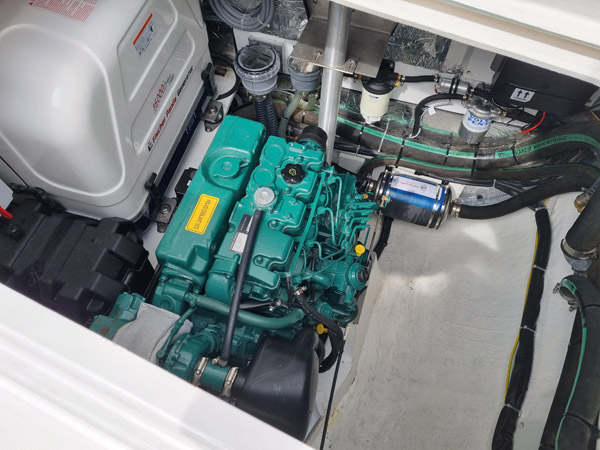
In the starboard hull, the Volvo saildrive 60 HP 4-cylinder engine with access for maintenance from above and next to it, an 11-kW generator.
Conclusion
The Dufour 48, features Italian style with a French touch. It remains, more than three years after its launch under the colors of Dufour Yachts, an interesting boat in the 45/50-foot cruising catamaran market. The only question mark at the time of writing is that the builder and charter company are financed by the Fozzy group, one of the largest industrial groups in Ukraine. The current situation in the country may well impact the future of the Dufour 48. It’s a state of affairs which is decidedly turbulent... creating geopolitical uncertainty that may well put other projects on hold: the Ukrainian group’s significant resources suggest that several new models will be produced, including a 44-foot sailing yacht and perhaps a power version at a later date.

TECHNICAL SPECIFICATIONS
Builder: JJL Catamaran (Italy)
Architect: Umberto Felci
Overall length: 48’3” (14.70 m)
Waterline length: 46’3” (14.10 m)
Beam: 26’3” (8.00 m)
Draft: 4’3” (1.30 m)
Air draft: 72’10” (22.20 m)
Light displacement: 32,970 lbs (14.9 t)
Mainsail: 818 sq ft (76 m²)
Self-tacking jib: 517 sq ft (48 m²)
Code 0: 969 sq ft (90 m²)
Gennaker: 1,184 sq ft (110 m²)
Engines: 2 X 60 HP Volvo saildrive
Fuel: 235 US gal (900 l)
Water: 185 US gal (700 l)
CE Category: A-Ocean
Price: from € 645,000 ex-tax