For our anniversary issue, we wanted to present an exceptional catamaran. We chose the Eleuthera 60, the flagship of the Fountaine-Pajot fleet…
Infos pratiques
- Le chantier : Eleuthera 60
- La fiche technique
- Découvrez notre vidéo exclusive
- Financez votre Eleuthera 60
- Assuez votre Eleuthera 60
- Articles autour du Eleuthera 60
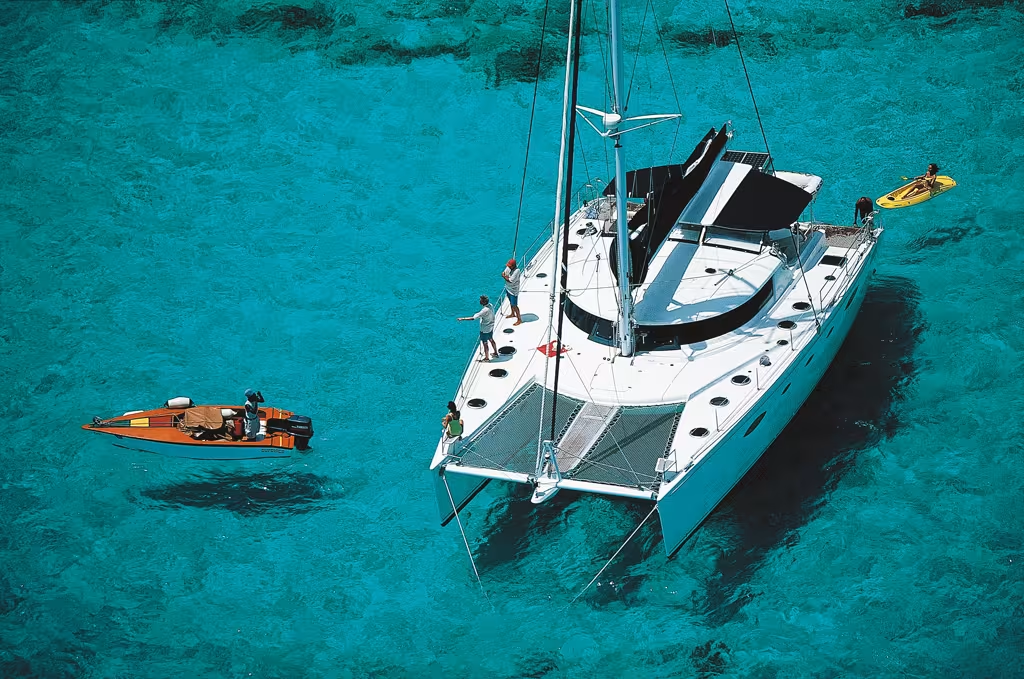
There was a time, not too long ago, when a 50’ catamaran was a big boat. But each year, at boat show after boat show we discover new models, always just that little bit longer. Most of the big builders now have a big catamaran of around 60’ in their catalogue. At first sight, the scale of the Eleuthera is surprising. From a distance, its size is not obvious; it was not until a Bahia tied up alongside that it became really apparent, the 46-footer appeared very small! From the first glance, the practiced eye will recognise both the ‘Fountaine-Pajot’ look, and the builder’s trademark, the Eleuthera’s cabin top, which is both aesthetically pleasing and provides protection against the greenhouse effect. On the other hand, the hulls are revolutionary. The rather round lines and more ‘feminine’ form of the Joubert / Nivelt boats have given way to a Berret / Racoupeau hull design with tighter, more modern lines, as seen on the Marquises; the lateral opening hatches along the hulls have been replaced with very harmoniously-shaped oblong portholes. On deck, ventilation is obtained by round hatches, as on the Lavezzi. Generous freeboard makes a ladder essential for climbing aboard from a pontoon. At the stern, the transoms are so wide that walking down the steps to go swimming or to board the dinghy is like being an award winner at the Cannes festival! The davits are made of fat stainless steel tubes and hold the inflatable, which can be raised, with or without its outboard motor, using a small winch.
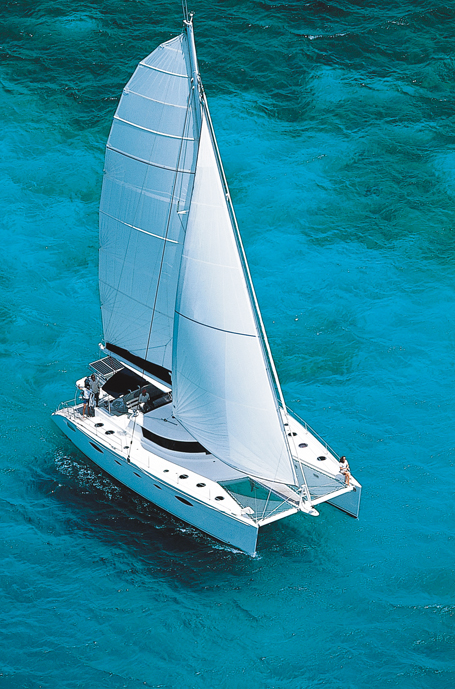
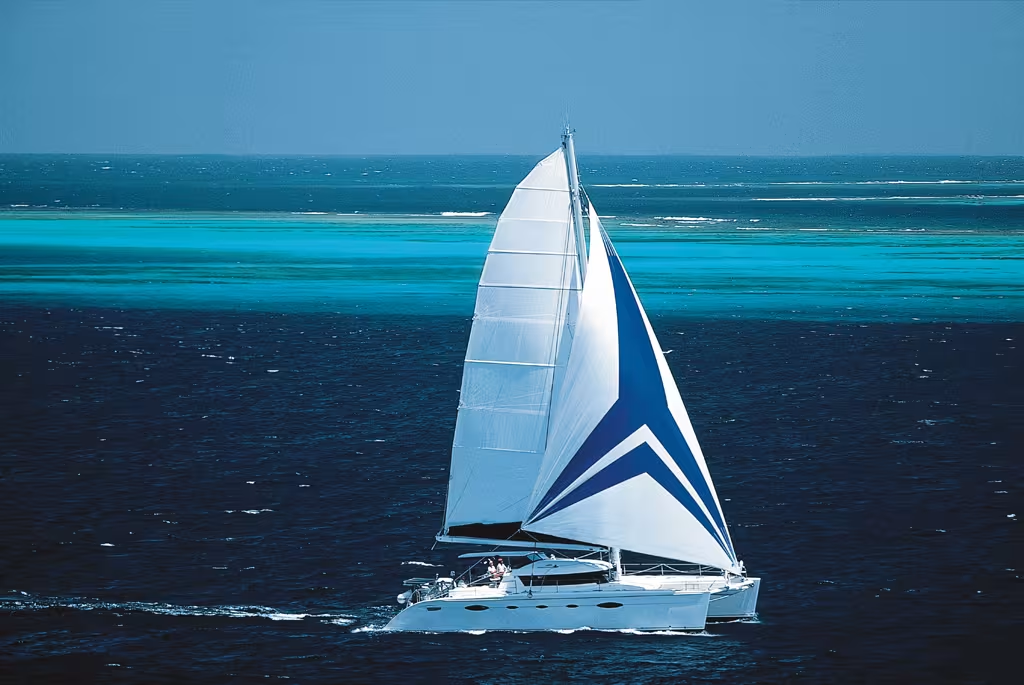
The Eleuthera is very comfortable under sail, and is creditably fast.
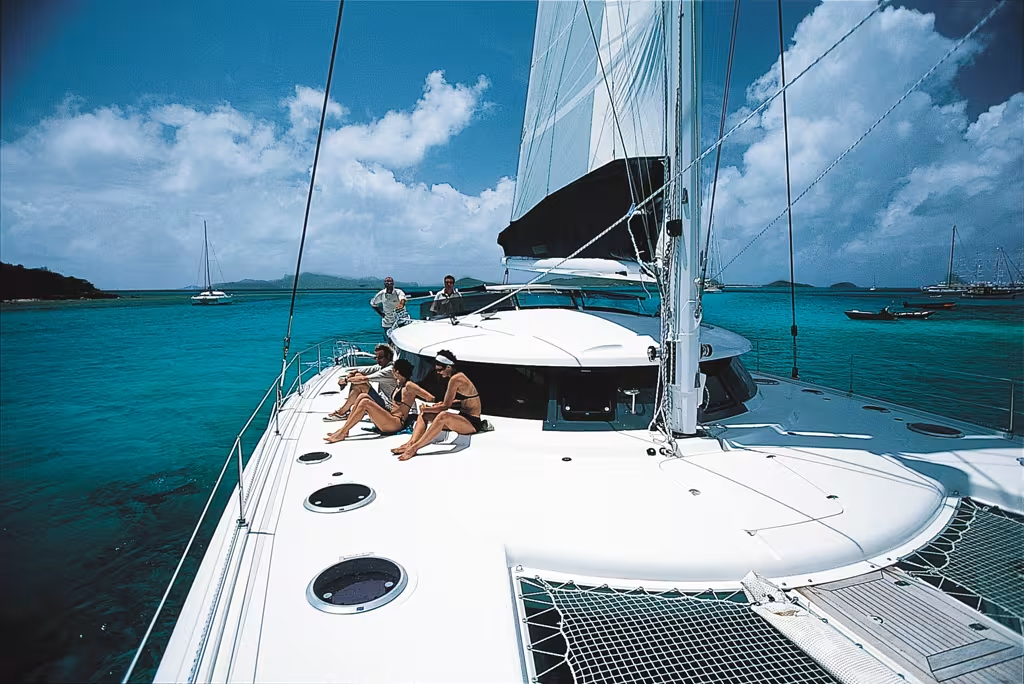
The cockpit is arranged around the companionway entrance. Benches and an attractive oval table, both in teak, can accommodate eight guests, more if extra stools are added, and on either side there are small seats, ideal for more intimate discussions. It is possible to find privacy everywhere and the centres of interest of the people aboard do not interfere with each other, whether they are sailing the boat or just lazing around. There is no shortage of sunbathing areas on the huge deck (more than 150m2!), even if, on the day of our test, the temperature left a little to be desired… The deck plan has been designed to allow users to move around in optimised and simplified way. The anchor warp is stowed at the mastfoot, in the locker; just forward of this, a teak-covered hatch in the longitudinal beam opens to reveal the anchor and also makes rigging and adjusting the spreader easier.
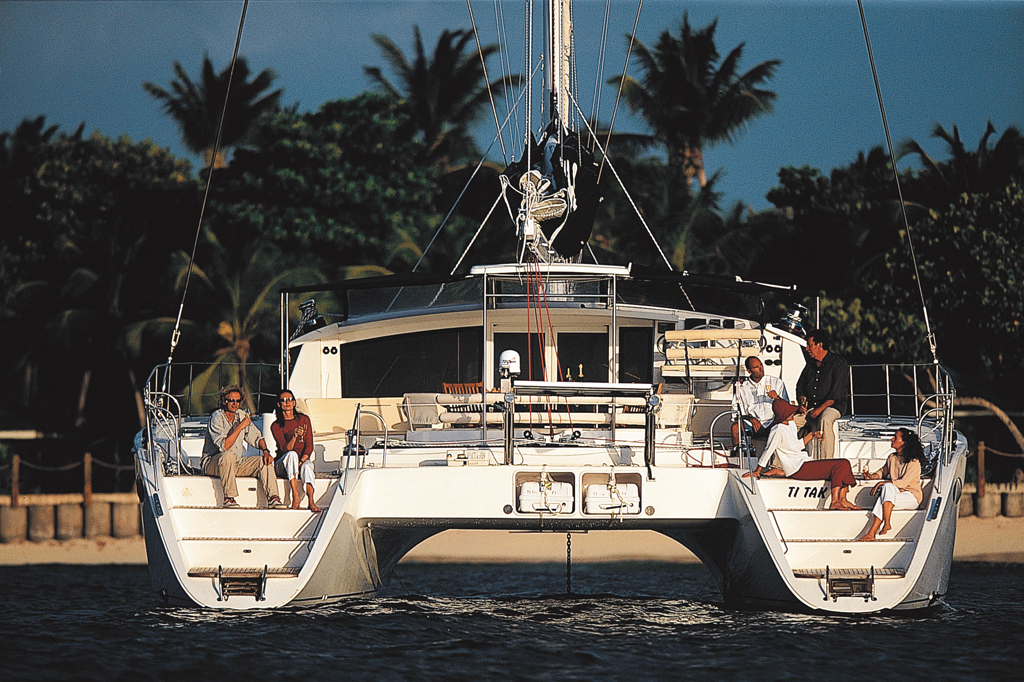
A 60-foot yacht, aboard which you can envisage sailing to the other side of the world…
Exploring the ‘Pertuis’.
Despite the boat’s (theoretical) 18 tons, the two engines enabled us to get away from the quay with no particular problems. Its overall dimensions must always be borne in mind, however. But visibility through the small windscreen from the two-seater steering position is good and there are very few blind spots to be taken into account. In addition the helm’s position high up allows him or her to dominate the situation. Not all the control lines are led back to the steering position; they are spread around the cockpit. On the test day, we were lucky, the sun was shining and the breeze blowing at around 20 knots. We turned head to wind to hoist the mainsail. Access to the cabin roof is made easier by a step; further aft, the 1.5m wide rigid bimini only covers the central part of the boat and is ideal for removing the mainsail ties; it is extended towards the exterior by a foldaway cloth-covered framework above the helm. Forget about hoisting the mainsail by hand, with such a huge sail area it is much easier to press the button on the electric winch, (fitted as standard), and watch it gently climb between the lazy jacks. During this operation, it is essential to keep the boat head to wind using the engine controls.
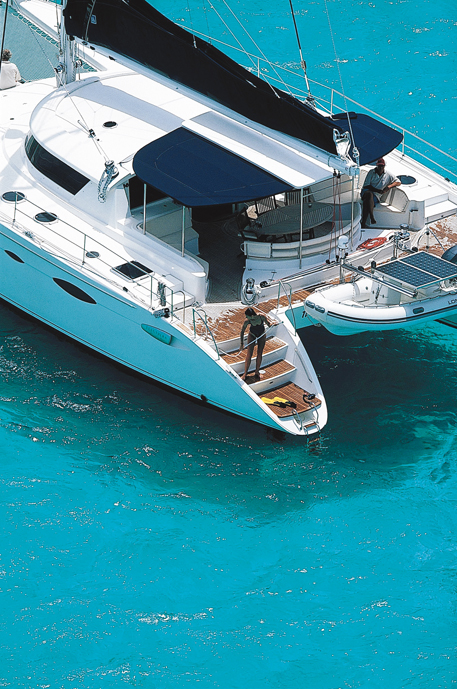
Huge sugar-scoop sterns, cockpit covered by a rigid bimini; the Eleuthera is perfect for the tropical sunshine…
Once the main was hoisted, we unrolled the genoa; sheeting in was easy as the winches are well-positioned on either side of the cabin top and can be used comfortably from behind or to one side. The mainsheet track and sheet are fitted at the after end of the cockpit; aft of this again is a clear space which could be very useful when it comes to gybing. At 140° to 17 knots of true wind, we were sailing at 7.7 knots. At 120°, 8.3 knots and at 90°, we reached 10 knots. The Eleuthera is not a particularly fast boat; the big waves following us were confirmation, if we needed it, that we were displacing a lot of water. In addition, with the hydraulic steering, the helm does not have much ‘feel’, as is the case on many cruising catamarans. Apart from its size, the Eleuthera is a sensible boat whose vocation is above all, comfort. The land breeze strengthened a little, the conditions were ideal; with a calm sea and about twenty knots on the quarter we were now sailing comfortably along the west coast of the Ile de Ré at around 10 knots. Just off Chassiron, a couple of dolphins paid us a visit, quite a rarity in the waters around La Rochelle. We called them, but to no avail, they wouldn’t condescend to come and swim a few strokes between the hulls of our big catamaran. Sitting on the small stools which equip both pulpits, we would have been able to chat to them and at the same time take in the impressive size of the boat. It was February and the sea was calm, but the further we advanced, the more we started to feel the Atlantic swell. Despite the cold, we were very happy to be on the water. Close-hauled, the long undulation made us bob up and down. We bore away towards Oléron, then gybed. The traveller was hauled in to the centreline and we appreciated the passage aft of the mainsheet track to get from one winch to the other. On the other hand, when it is eased out to its maximum, the traveller is against the stop and makes it impossible to operate the jammer (a model which opened in the other direction would have solved the problem); the winches are also too low to work at. From a broad reach to a beam reach the difference in speed is small; we remained at a steady ten knots or so. The wind dropped to about 10 knots and I was surprised to see the Eleuthera continue at 5 knots; surely a good point, as at sea, light winds are more common than strong ones. The breeze died once and for all and we started the engines. When furling the sails, we noticed that the genoa reefing line returns to a jammer on the outside of the port hull, with no dedicated winch. This is not a very practical arrangement, especially as even with the sheet eased, rolling up the genoa (70m2), needs a winch. The crew is thus obliged to cross the side deck and use the mainsheet traveller winch. We returned towards les Minimes under engines; at 3000 rpm we were at 10 knots, the same speed we had sailed at earlier.
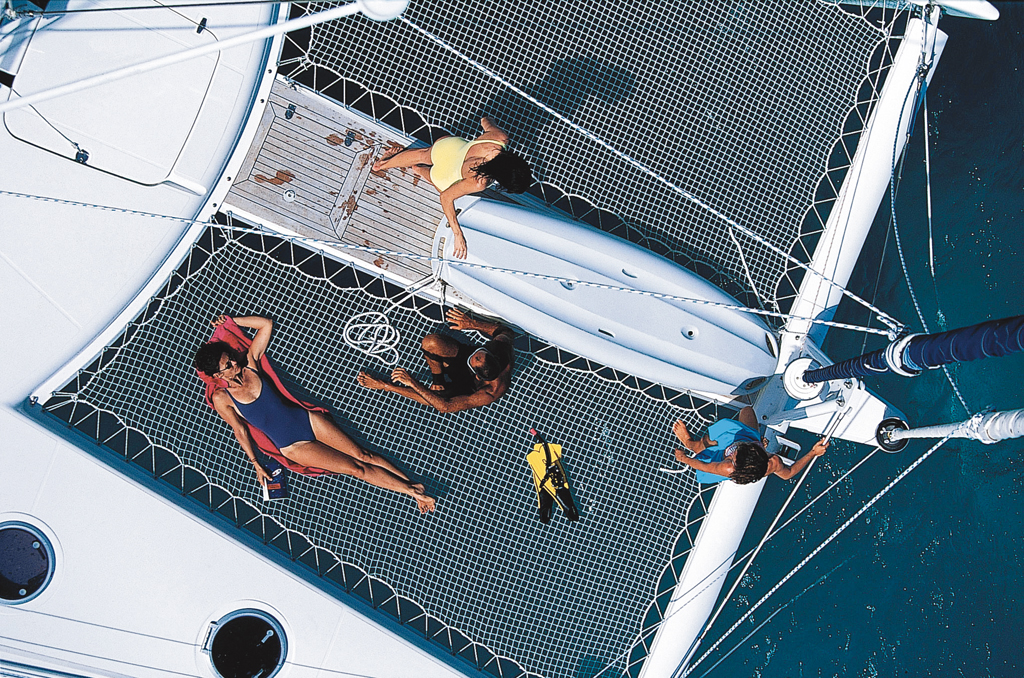
Life aboard is quite simply wonderful…
An interior which is, to say the least, comfortable.
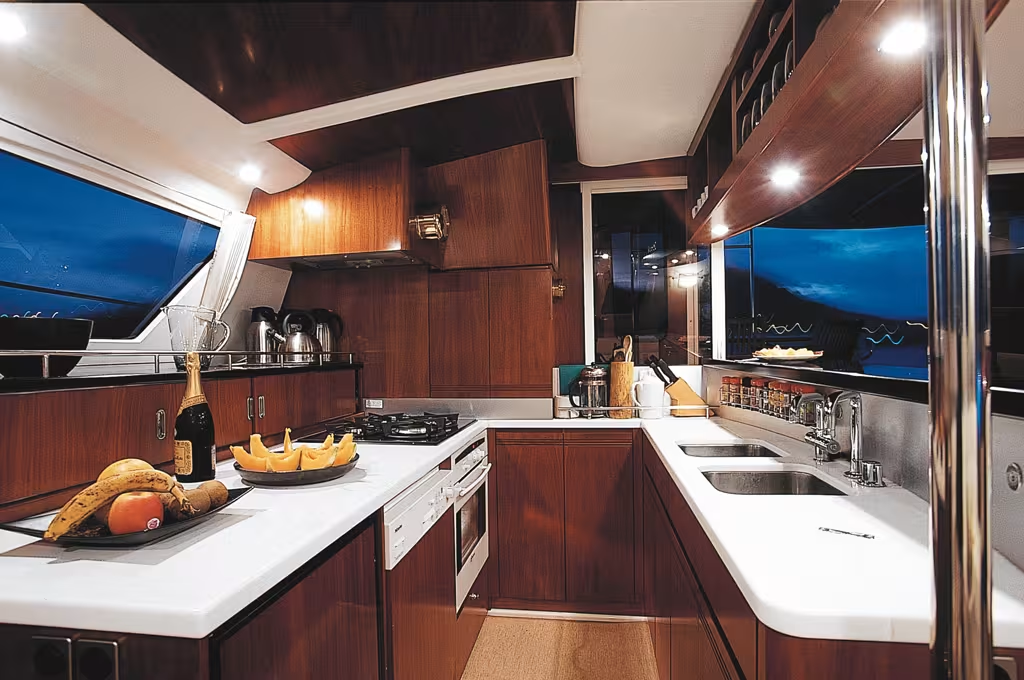
Let’s have a look at the interior. As you might guess, a 60’ catamaran yacht’s accommodation is not the same as that aboard a 60’ trimaran… Access to the nacelle is via two steps; it is divided into four distinct areas. On entering, to port is the saloon table, whilst opposite, to starboard, there is a cosy, convivial bar which closes off the galley. Forward of this is the very pleasant small saloon and finally to port, the chart table. Two portholes forward provide ventilation in the nacelle, with two smaller additional ones above the cabin top. When standing, exterior visibility is very good; on the other hand once seated, especially at the saloon table, there is no longer a view of the sea. This is a real shame as it would only take a few centimetres extra height to be able to see outside. This point will be modified in the future. In the galley it is unfortunate that there is no serving hatch to the cockpit, as this is very practical when sailing in the Tropics. Other details could be improved, such as the closing system for the small sliding lockers; it is difficult to open them. There is sufficient stowage space, but no more; on the ‘Orchestra’ version that we tested (one owner’s cabin and three guest cabins) it is completed by the volumes in the starboard hull. Going down into the hull, the fridge and freezer are opposite. The forward cabins are symmetrical and have a small table with a mirror; the berths are 2m long by 150cm at their widest part and 105cm at the foot. Headroom everywhere is, of course, amply sufficient. To port, the aft cabin is truly majestic; the immense bed (150 x 200 cm) is accessible from the sides, in common with that in the starboard hull. The space which is given over to the cold storage on the other side is here occupied by the heads and a separate shower; this gives a really big cabin: 250cm at its widest, 450cm at its longest – over 11m². When all the doors are open, the impression of space is striking. Having visited it when it was under construction, I can assure you that the ‘Maestro’ version, intended for private owners, is truly…magnificent. It is a stretched version, with a saloon which takes up half the boat’s length.
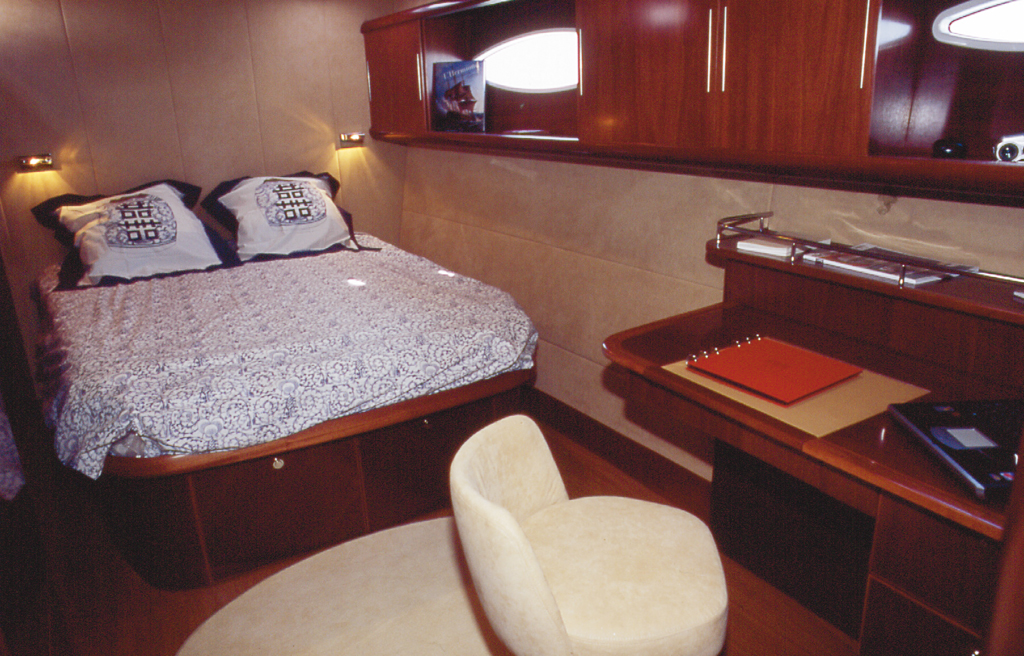
The bedroom – it’s hard to call it a cabin aboard this kind of vessel- is at the same level as the rest of the boat, and well-designed!
In conclusion.
The Eleuthera 60 is undeniably an attractive boat, both voluminous and comfortable. Of course, you would not invest in such a catamaran for the pleasure of pure sailing; this is not its programme. It is, however, a quite versatile boat, with five versions offered, from the owner’s (‘Maestro’) version for ocean cruising, to the charter version (‘Quintet’) with its crew’s cabin, via the ‘Orchestra’ version we tested, the ‘Concerto’ and the ‘Quatuor’. This boat is the replacement for the ‘Marquises’, the former ‘flagship’ of the Fountaine-Pajot range, and will above all allow the builder to compete with the other big boats from their competitors. Apparently, the big catamarans (for which you will have to spend at least a million euros), are selling well…
I liked:
- The anchor stowage in the longitudinal beam. - The uncluttered deck. - The rigid part of the bimini.
I liked less:
- The saloon seating in the nacelle, which is a bit too low for a good view outside. - The absence of a dedicated winch for the roller reefing and the gennaker. - The moulding that surrounds the round portholes, which is not in keeping with the rest of the boat.
Technical specifications.
- Architects : Berret / Racoupeau. - Overall length : 18.28 metres. - Beam : 8.57 metres. - Draught : 1.45 metres. - Unladen displacement: 18 tonnes. - Mainsail: 110 m2. - Genoa : 70 m2. - Engines (standard): 2 x 75 HP.