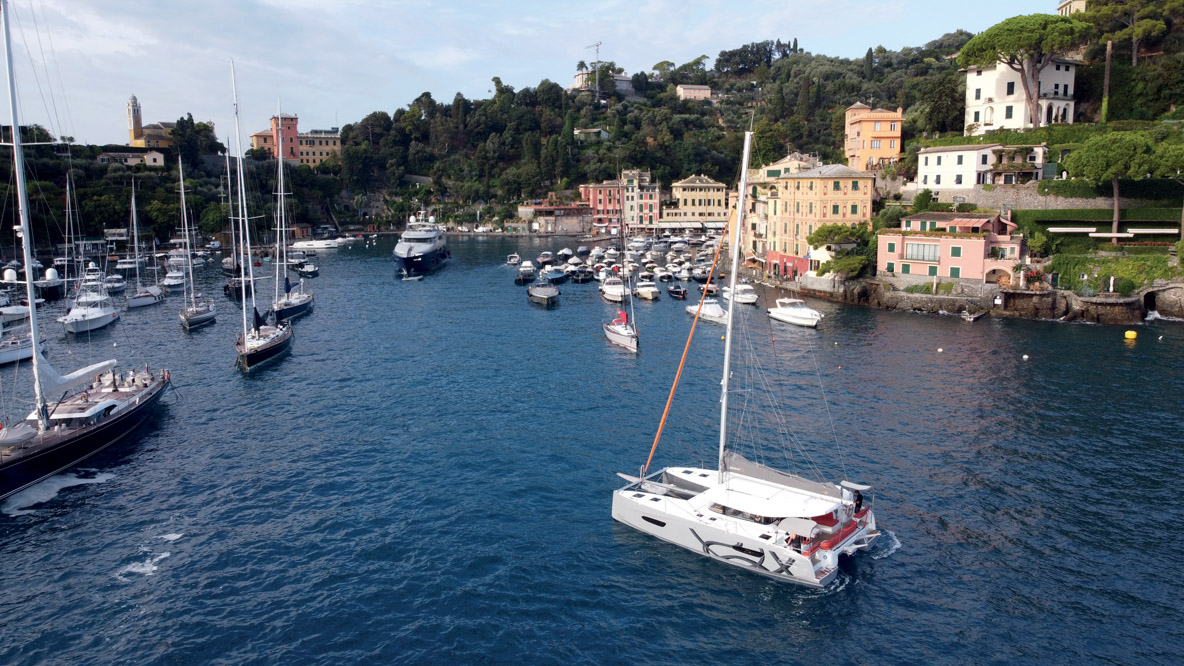
Four years after it was first launched, Excess, the youngest of the Bénéteau Group brands, unveiled its fourth model at the Cannes Yachting Festival. The Excess 14 has undeniably benefited from the enthusiasm of its designers – the architects and the shipyard team have given their all to carve the brand’s unique DNA into the polyester of this catamaran. On a trip between Cannes and Italy, Multihulls World got the chance for a 36-hour test of this new model.
Infos pratiques
- Le chantier : Excess 14
- La fiche technique
-
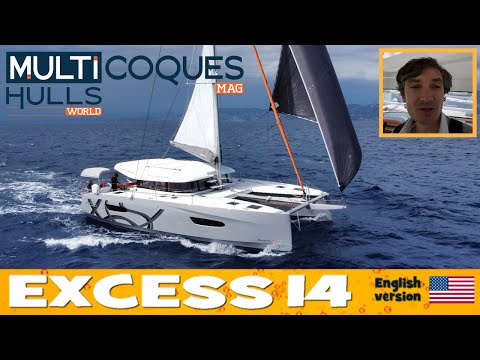 Découvrez notre vidéo exclusive
- Financez votre Excess 14
- Assuez votre Excess 14
- Articles autour du Excess 14
Conditions : 8 to 25 knots of wind, slight sea
Back in 2020, when the Bénéteau Group announced a 33% reduction in its portfolio of brands, one might have assumed that the fate of the young entity was sealed. But that would be without counting on three factors that proved to be decisive over its lack of maturity: the growth of the multihull market, which seems impervious to crises, the success of competitors claiming a rather seductive dynamism, and finally a team as young as it is enthusiastic. The Excess team, led by Thibaut de Montvalon, had no doubt for even a moment of the relevance of the brand’s positioning, which is more focused on performance and sailing pleasure than Lagoon. With the precious support of product manager Hervé Piveteau, an opportunely timed defector from Sun Fast, Thibaut has the ambition to put Excess into orbit... But don’t worry, it’s on the water that we accompanied the duo to discover this new opus that turned heads during its presentation last September.
A 110-mile delivery trip
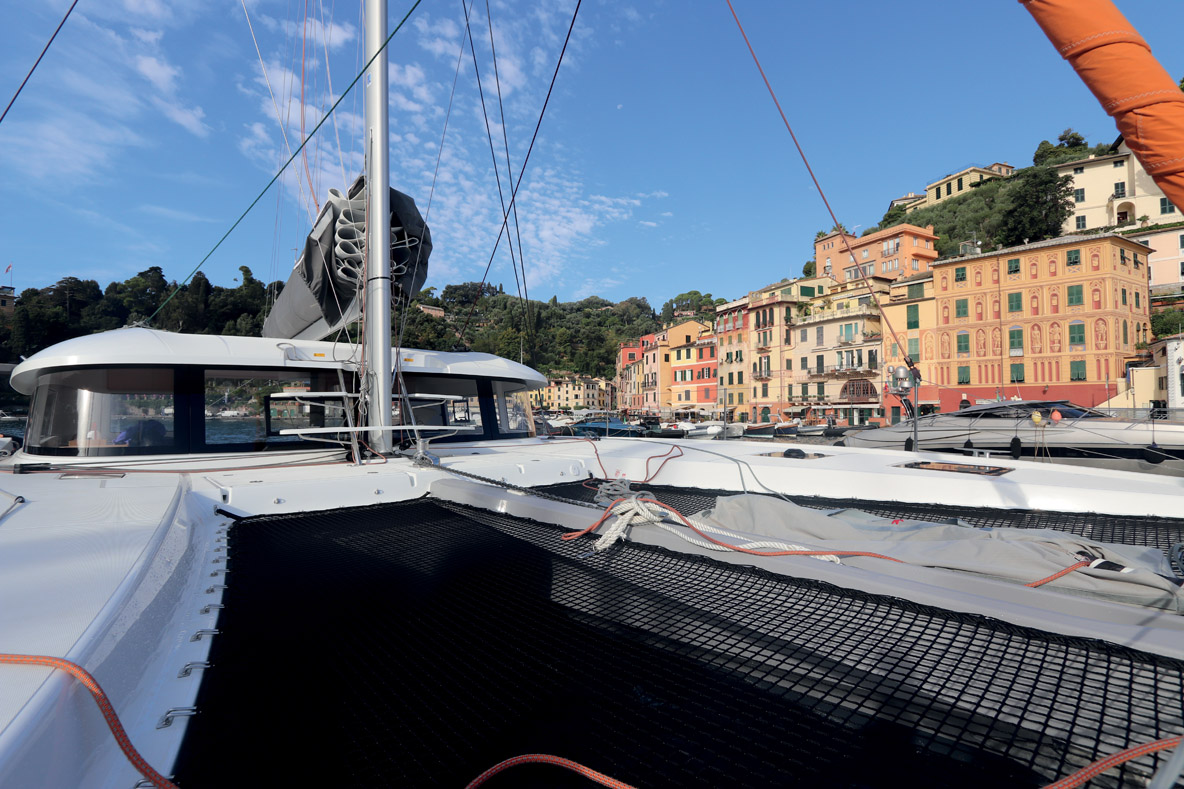
It was in Port Canto, just at the end of Cannes’ famous La Croisette boulevard, that the team gave us an appointment two days after the superyacht sirens sounded, signaling the end of the boat show. The weather was looking tricky, with a stormy low-pressure system on the way. But with two days available to us and just 110 miles to cover, we were able to pick our weather almost à la carte. We began by anchoring the night just off Cannes, at the Lerins Islands, with the superb backdrop of Saint-Honorat and Sainte Marguerite. As we set off, it was a question of having a good night, but also of gently taming the newcomer. A quick morning dip allowed us to have a peek at what the hulls had in store. While the gestation of this strategic model required two years’ worth of work, the design of the underwater hull was the object of all the attention. No less than seven different hull forms were tested in the digital towing tank by the VPLP Design team. The impression given by the great width at deck level completely disappears at waterline level, which instead reveals very refined hulls under their chines. If the bows are straight, as is fashionable, the forefoot sits clear and the nacelle is high above the water, with a minimum of 28 inches (70 cm) of bridgedeck clearance behind a long trampoline. So many features that seem point towards performance. But Hervé Piveteau insisted on lending me his diving mask so I could get a closer look at what was going on underwater. I then discovered the fixed skeg keels that have been the subject of much thought and research. Starting with a standard fin and a draught of 4 feet (one meter twenty), lengthening it by a mere 4” (10 cm) would theoretically create a 15% gain in performance upwind according to the VPP (velocity prediction program). The keels of the Excess 14 go further. The anti-leeway appendages have been refined, their fore-and-aft length has been halved compared to standard catamarans and the draft has been increased to 4’10” (1.48 m), which seemed to be an acceptable compromise for all sailors. VPLP has calculated that this configuration also halves the theoretical leeway of the Excess 14, again compared to a standard catamaran (4° as opposed to 8).
Pulse Line version for more canvas
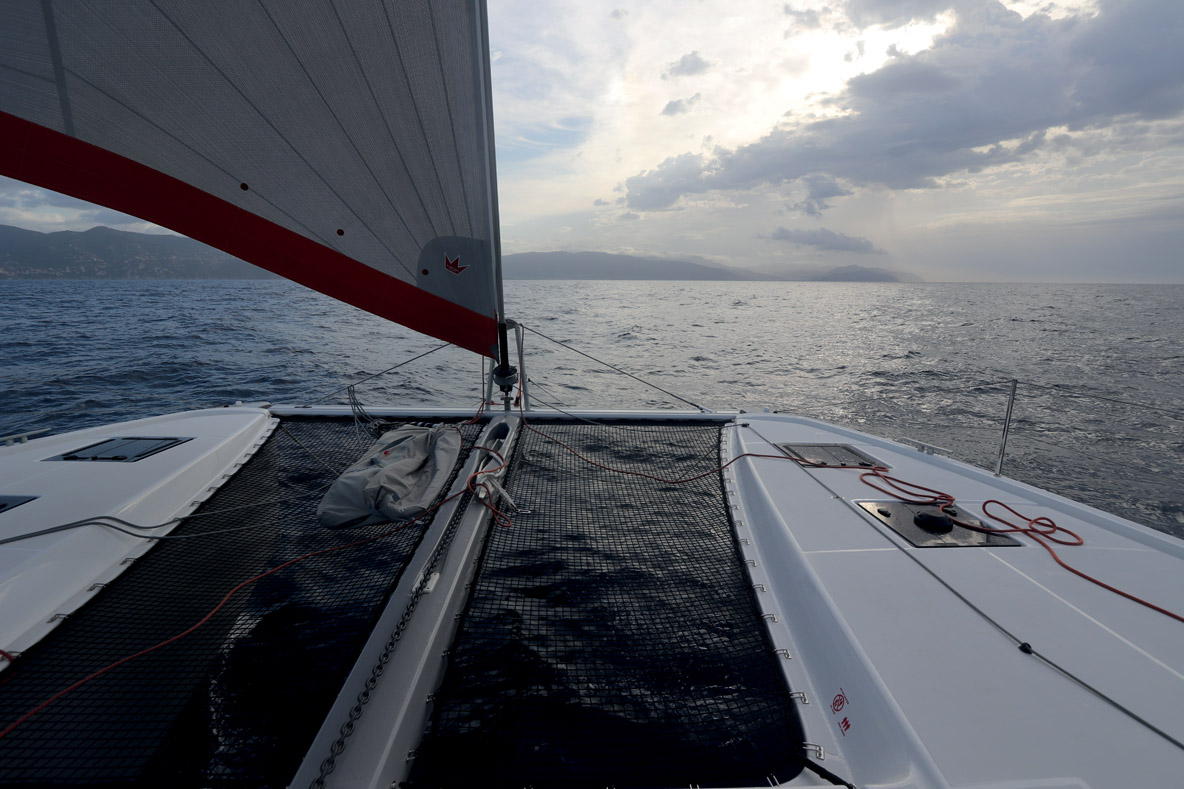
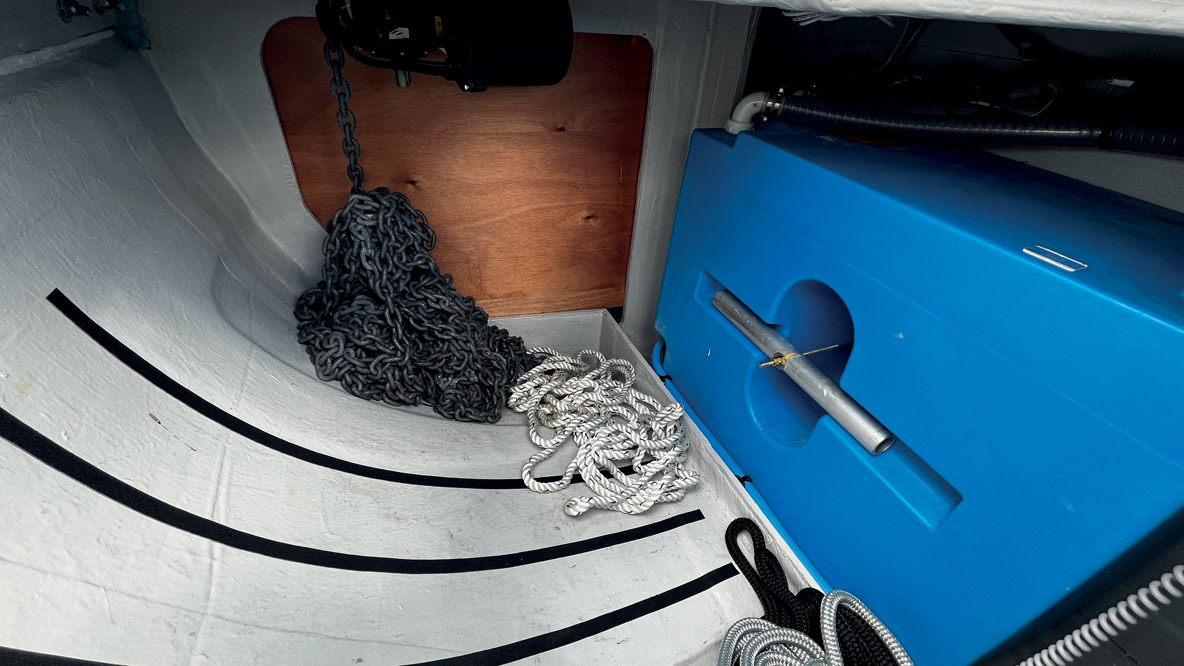
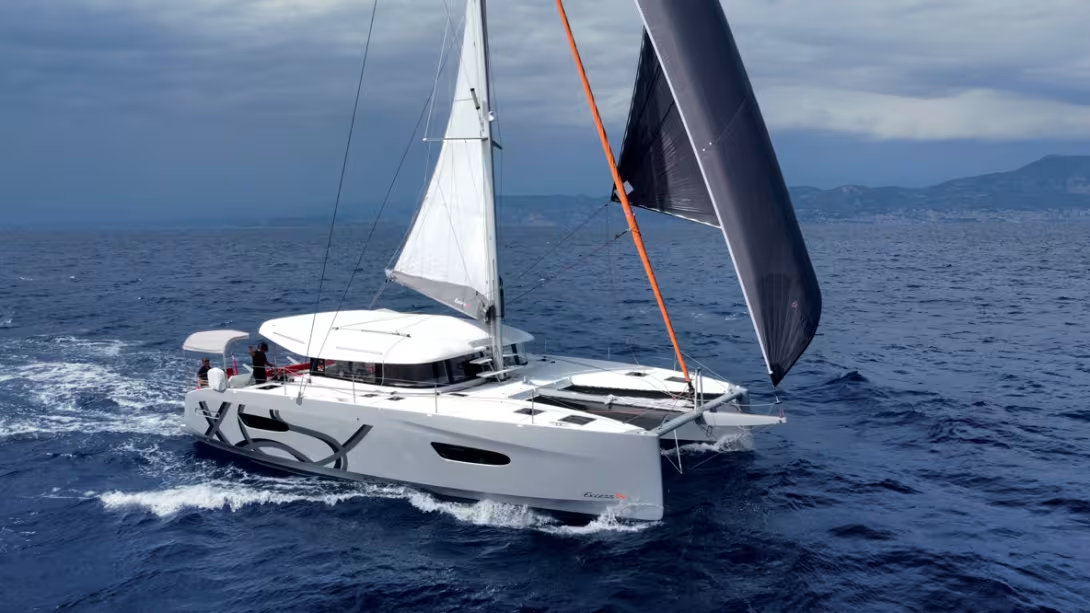
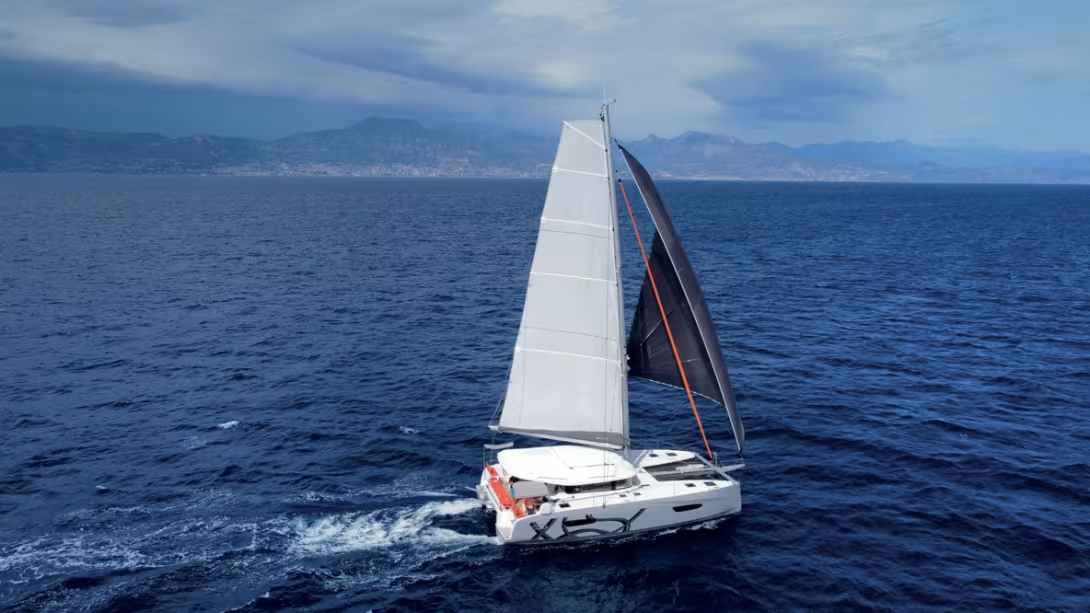
But enough of the theory, let’s look at what happens in practice. With the anchor weighed and the chain stowed in the huge mastfoot locker, which can hold more chain length than you’d want to carry on board, we set an easterly course, bound for Lavagna, just south of Genoa, the port that was to be home to the next boat show where the Excess 14 was on display. In the time it took to hoist the mainsail and unfurl the genoa (both sails bear the Elvstrøm signature and are made of 100% recycled polyester, including a PET mylar film), we were already clear of the anchorage, with it disappearing astern. The rig on this Pulse Line version is 5’7” (1.7 m) taller than the standard version, with the genoa overlapping, and features a bowsprit some three feet (one meter) longer. To reduce the weight, the aft beam is level with the sugarscoops. Counting the davits, the overall length increases by 6½ feet (2 m) from 45’10” to 52’6” (13.97 to 15.99 m), which makes quite a difference in harbor. That said, the objective in terms of sail area has achieved. Upwind, it has already increased from 1,324 square feet to 1,453 (123 to 135 m²). As for the code 0, that has gained 20% in area, swapping its 775 sq ft (72m²) as standard for 925 sq ft (86 m²) in the Pulse Line version. Announced at 12.8 tons lightship, Excess 14 hull #1 would have weighed in at 13.4 tons with its generator and air conditioning – essential features for the US market. When it comes to weight, we can trust Hervé Piveteau’s intransigence born of his experience as a racing sailor, and who has learned a lot from Jeanneau with their Sun Fast range. In 8 knots of wind, the Excess 14 picked up very quickly, reaching 5½ knots on a flat sea at 55° to the true wind. The wide transoms stir up some water at this speed, but studies - also undertaken - have shown that these eddies are only penalizing with less than 5 knots of boatspeed. On the other hand, as we started to nudge 10 knots, the wake became very smooth with the wide sugarscoops then allowing the power to be transmitted, much like the rear tires of a racing car. We were to see this off Menton, as the wind shifted (putting us at 127° from the apparent), and increased (25 knots), and the mass of black clouds encouraging us to carefully roll up the gennaker and resort to the genoa. In these conditions, the catamaran was making 9 knots with a calm wake and gentle noise, seeming to glide effortlessly.
Boom flush with the bimini
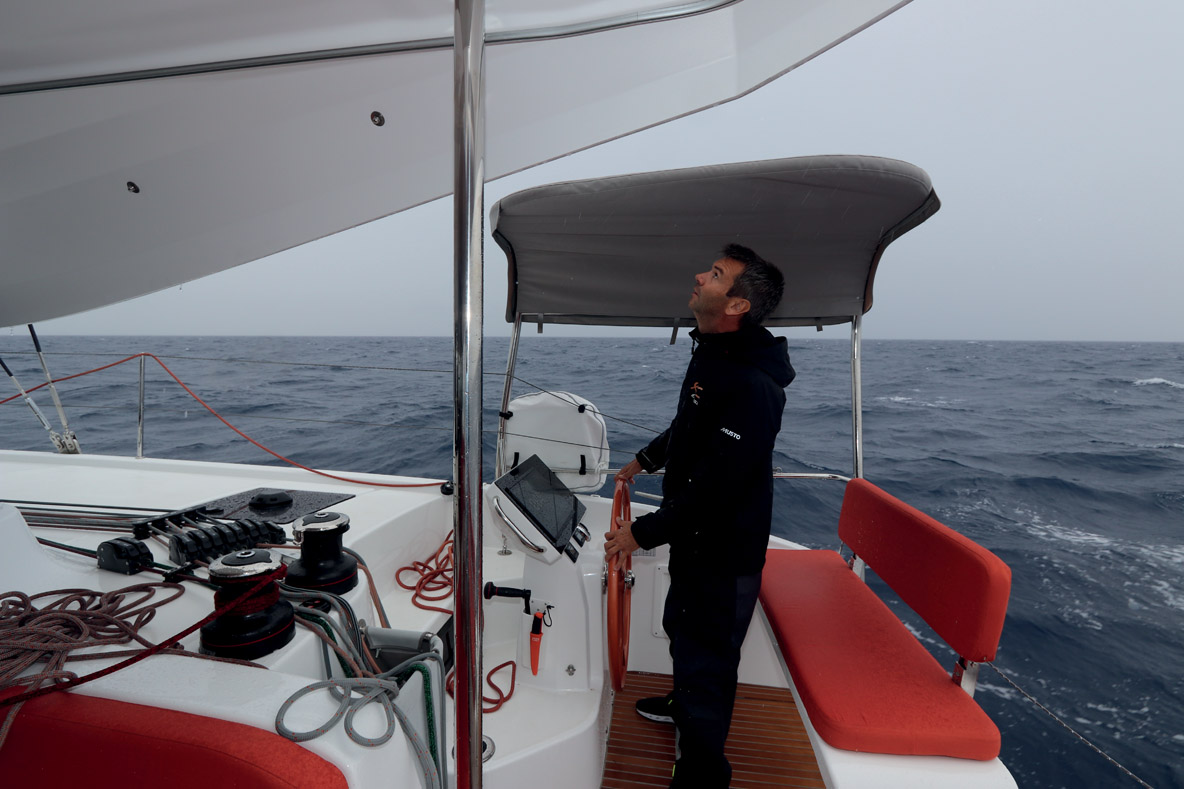
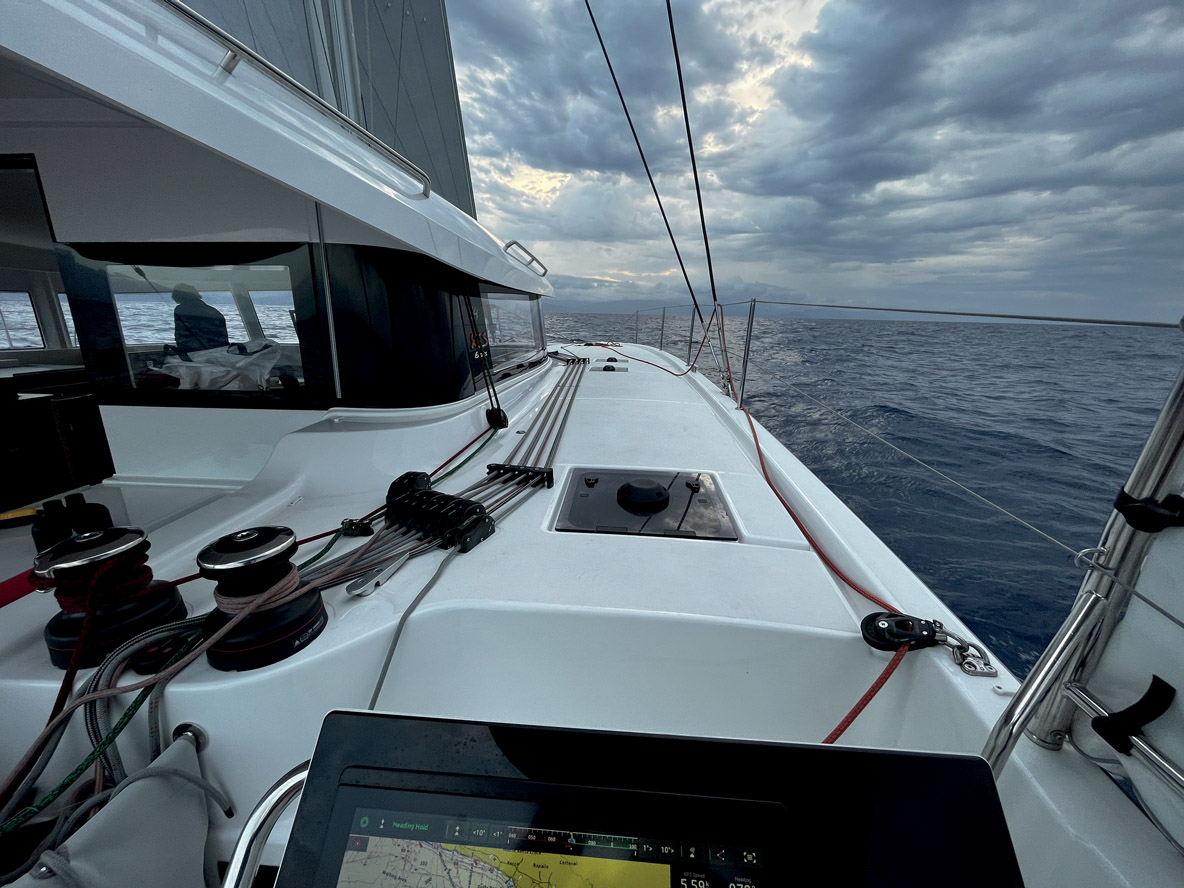
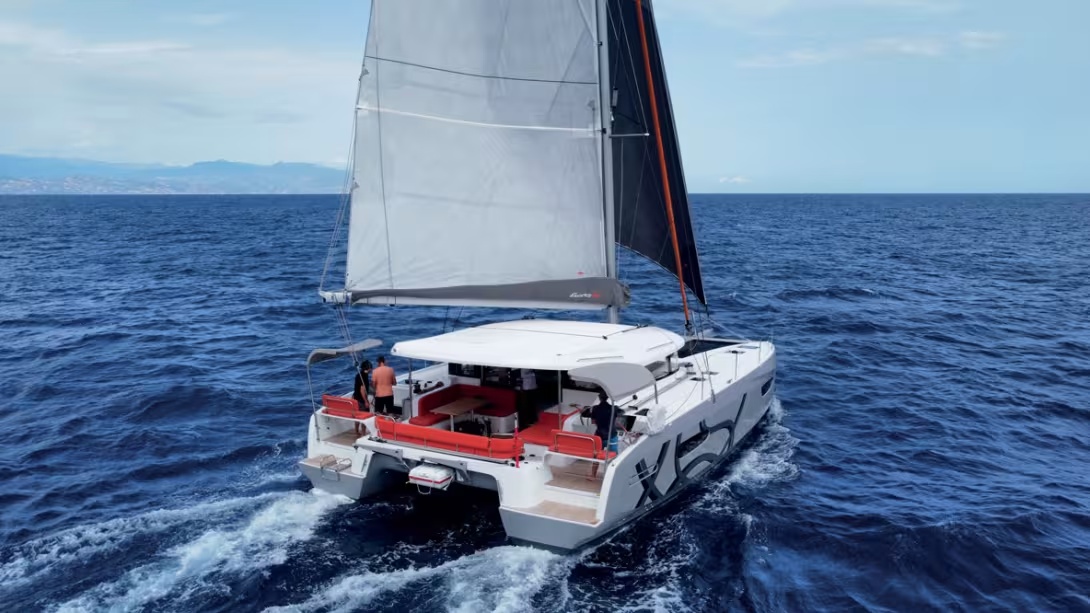
With four of us on board for the delivery trip, we never got in each other’s way in the large cockpit with off-center helm stations. Whether you’re standing for helming or sitting when watchkeeping, visibility is pretty good down the outboard side towards the bow or via the windows to leeward in the saloon. A simple sideways step negates the only blind spot generated by the aft corner of the coachroof. Maneuvers are carried out on the starboard side of the deck, except for the code 0 halyard and its port-side sheet. Simple, accessible and efficient, the deck layout has obviously been designed to favor ease of sail maneuvers, with features like the ball bearing genoa cars that are be adjusted with a purchase line. The action on the rudders is direct and the sensations very good, but the helm is nevertheless somewhat stiff – different rudder bearings should remedy this on future models. Although not particularly esthetic, the small biminis are effective in protecting the helmsman from the sun... and from the rain that we experienced in the afternoon. The vast cockpit offers a rather exceptional overall seating length. Divided into three spaces - aft bench seat, starboard lounger, and table to port - it all remains protected under the rigid bimini. This has been chosen over the convertible version, which is very popular on the other models in the range. The structure remains light because it is not counter-molded. At anchor, this bimini is transformed into a sunbathing area - Excess call this their Skylounge. You just have to shift the low-slung boom across - optimizing the sail plan. The mainsheet attachment strop is secured a soft shackle, allowing it to be easily repositioned. However, its length needs to be reviewed so that the sheet doesn’t run the risk of hitting the helmsman if rolling downwind. In any case, the intelligent use of fiber, also seen for the guardwires, is indicative of the care taken to keep the weight under control. For the record, the diameter of the handrails has even been reduced by a few millimeters!
Transparent surround glazing
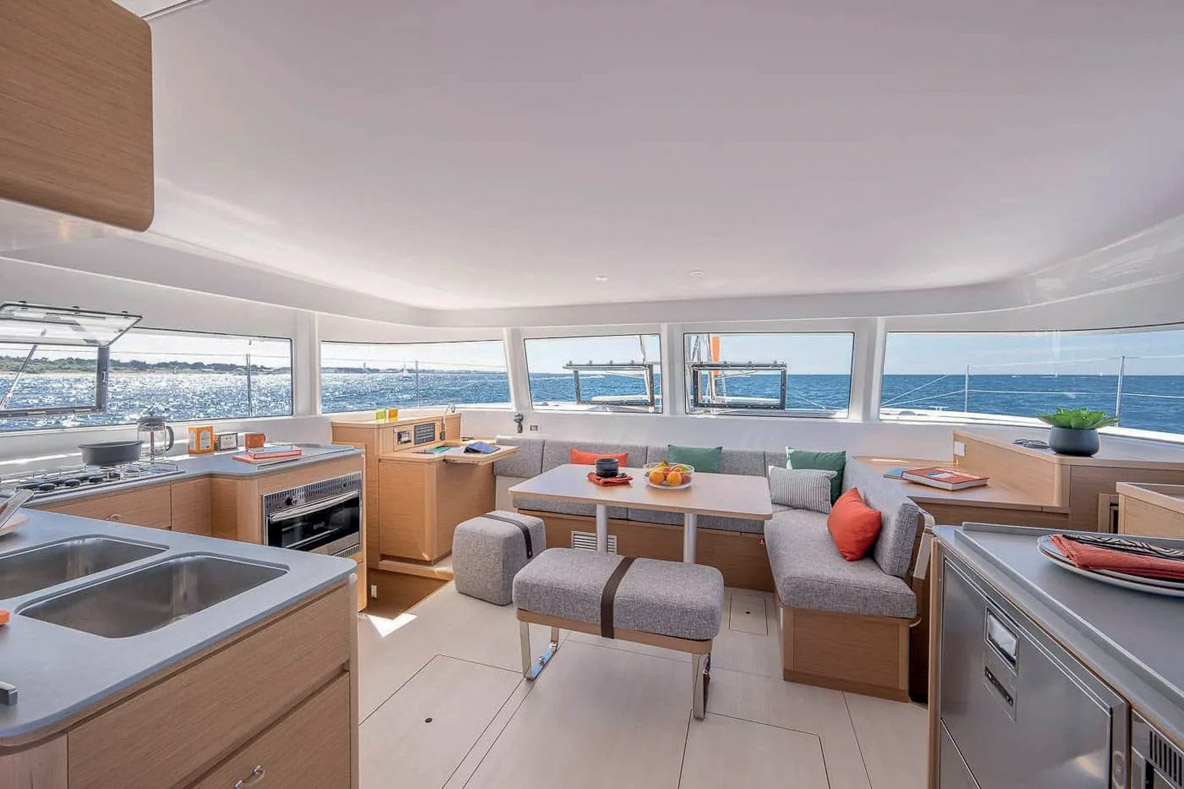
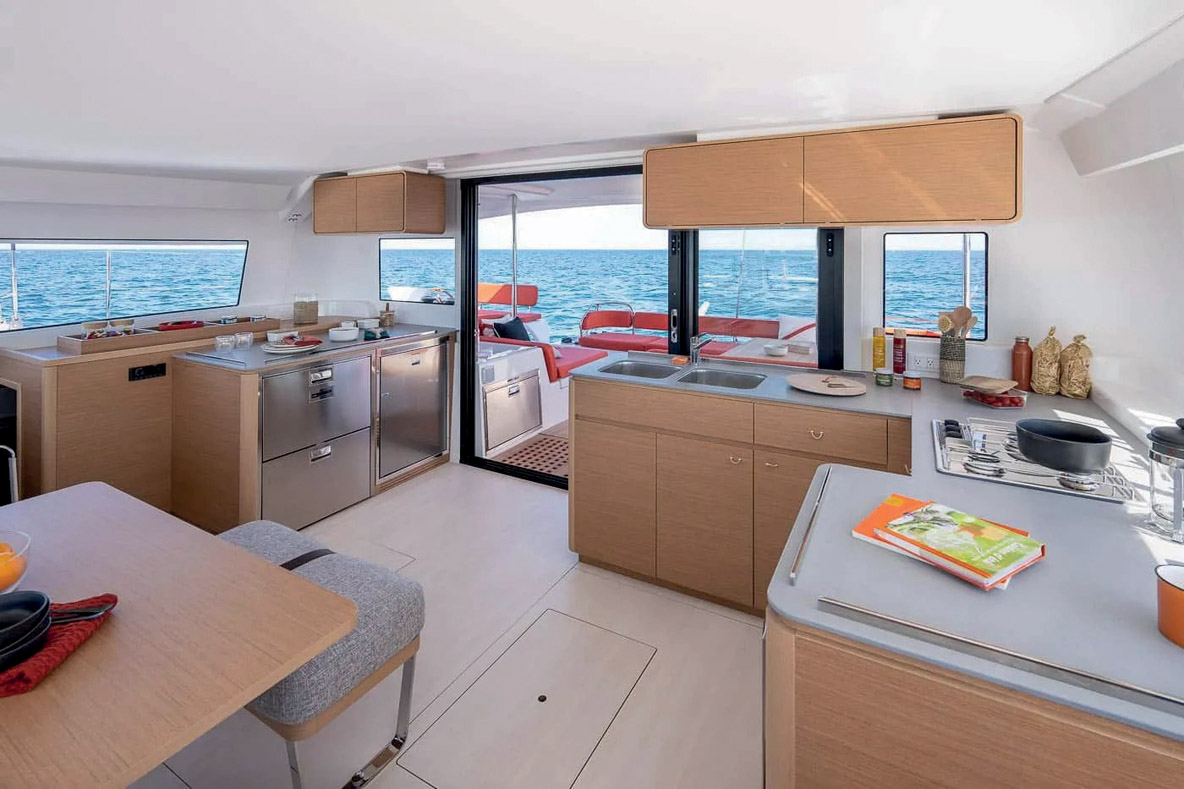
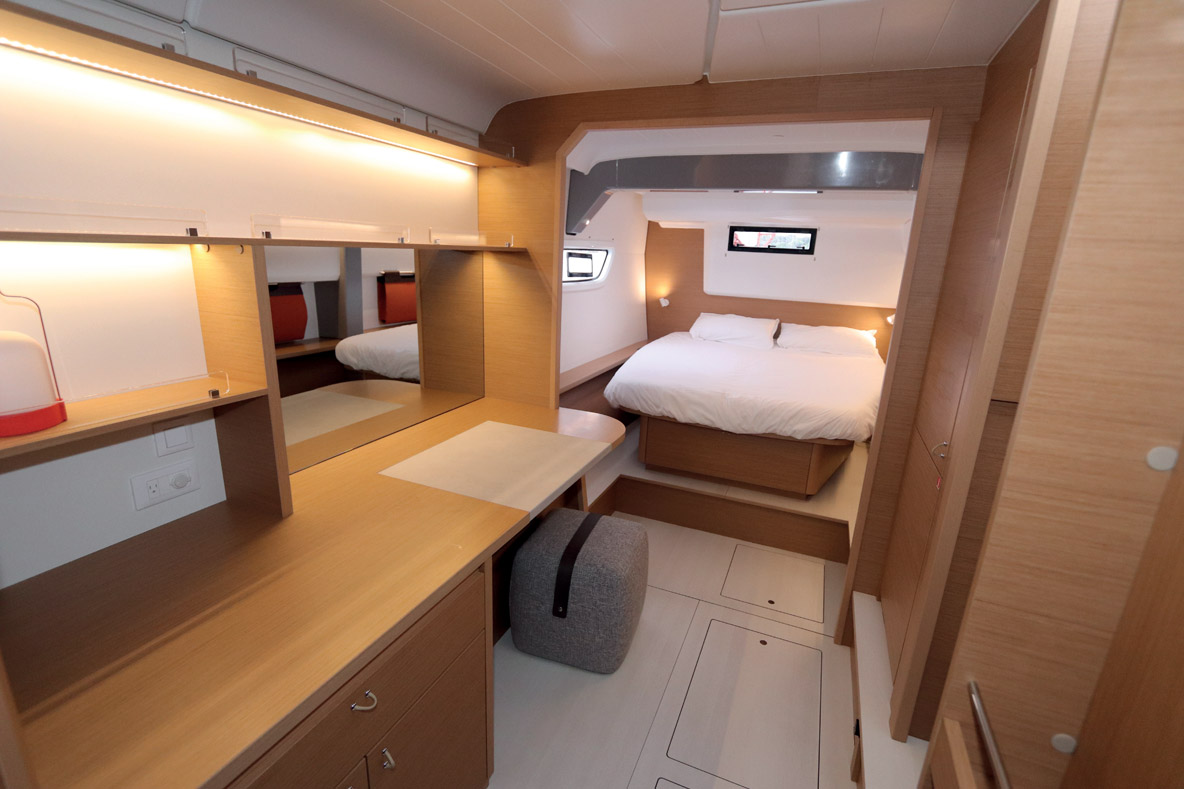
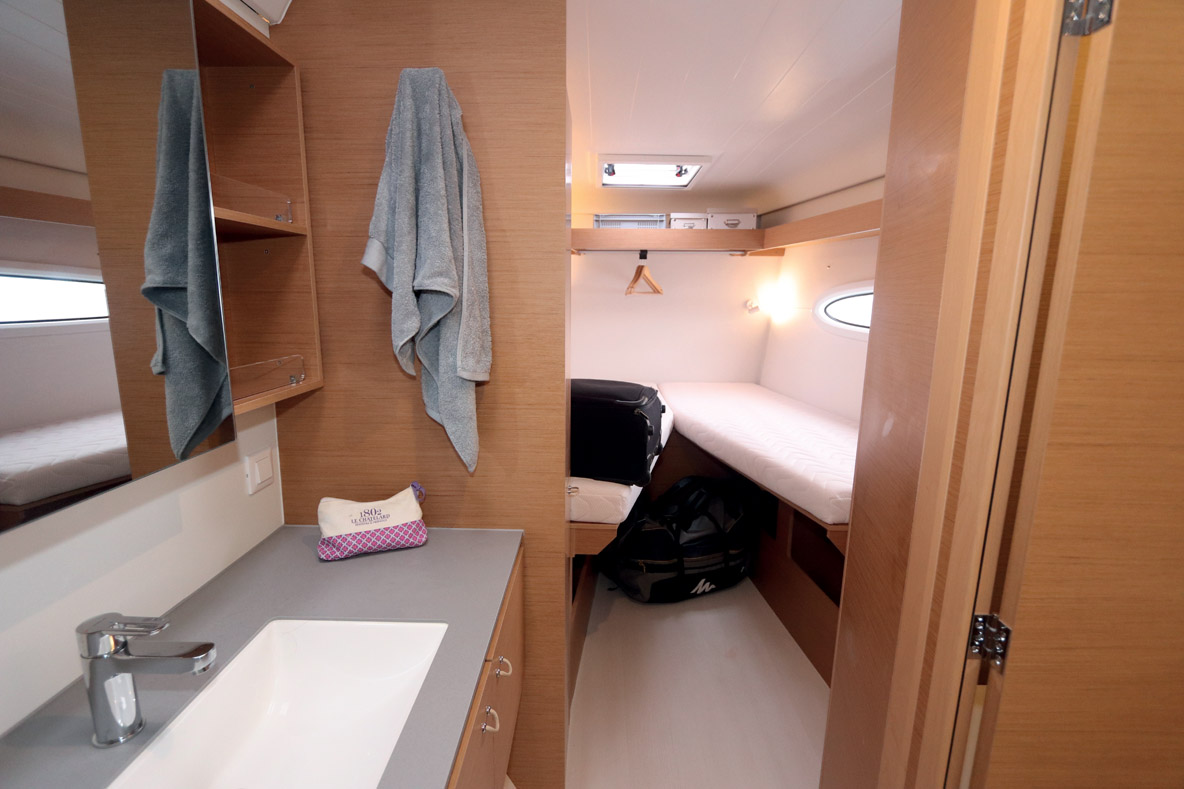
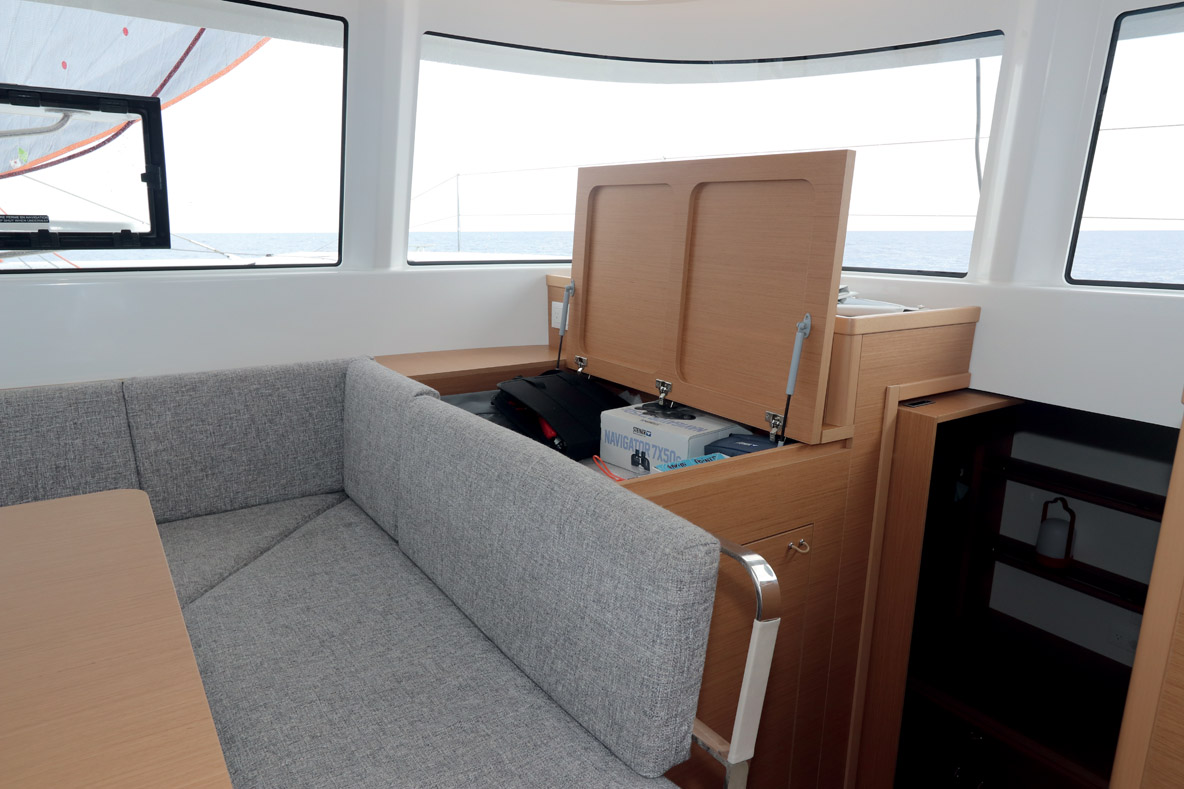
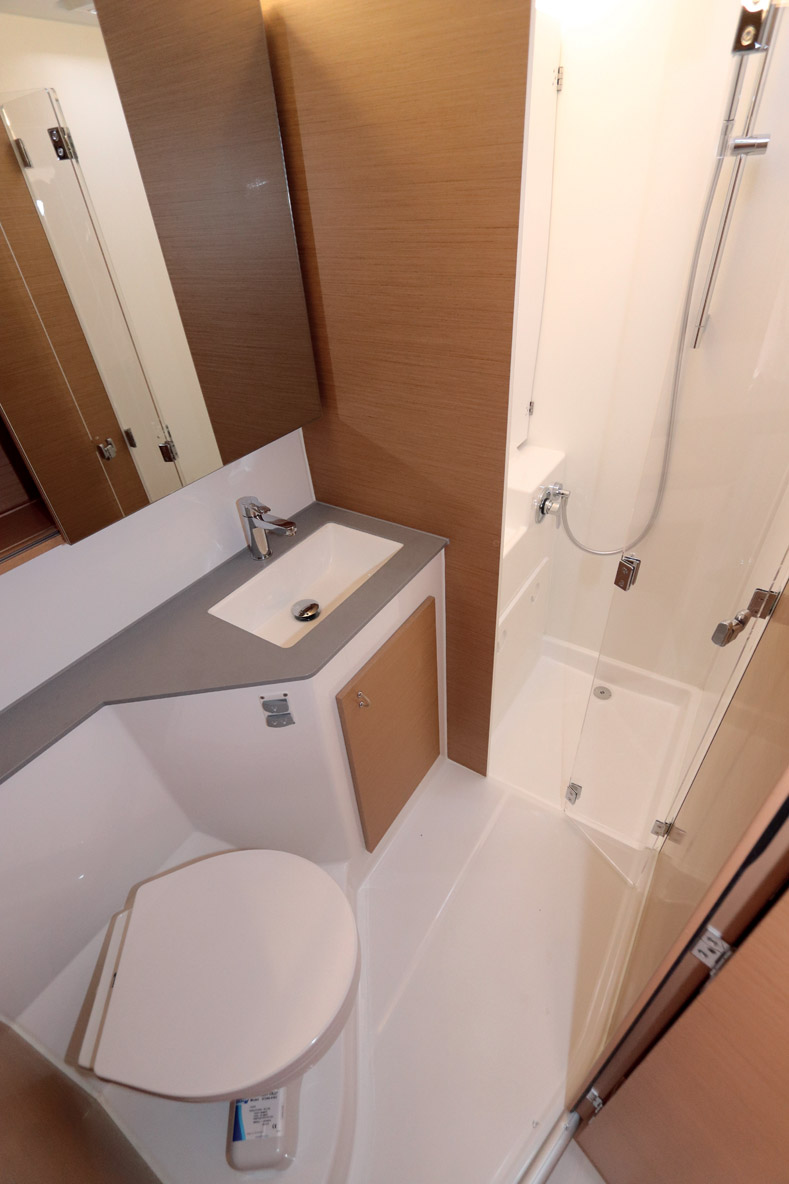
Inside, too, they’ve shed unwanted pounds. The Corian on the galley countertop is only 6 millimeters thick and lifting the section forward to starboard reveals that the wood panels have been hollowed out to make them lighter. Nauta Design has succeeded in translating these hidden details into a light interior style, as seen in the delicately rounded wall units. The choice of completely transparent, non-tinted glazing allows light to enter profusely into this contemporary interior where leather, stainless steel, light woods (honey teak for the furniture, limewashed for the floors) and quality fabrics are combined. The saloon/chart table occupies the entire forward area while the galley is strategically placed at the border between interior and exterior. The galley extends more precisely on each side of the sliding bay window with its chilled compartments to starboard, giving generous dimensions overall. The two symmetrical companionways serve identical hulls in the four-cabin version, equipped with four bathrooms - also identical - with separate showers. Aboard the three-cabin version we tested, the aft cabin, with its 63” by 81” (160 x 205 cm) island-bed, is similar to the one dedicated to the Owner on starboard. There is a small window near the helm station for ventilation. A larger hatch, also opening, sits in the topsides, giving a sea view. In these very bright cabins, we liked the hanging leather storage, as practical as it is elegant. The structure isn’t hidden under layers of false ceilings, but rather highlighted by its “Excess gray”, which contributes to the sporty style of everything. Here, the headroom is limited to 6’1” (1.86 m), but everywhere else it is 6’7” (2 m). In the Owner’s hull, in front of the long desk, the bathroom usefully features a separate toilet. While there is already plenty of storage space at the foot of the companionway, the entire front of the hull, up to the sail locker, is fitted out as a dressing room, with two optional folding bunks. This makes for a pretty suite that occupies this starboard float, and when you add the numerous storage spaces available in the nacelle, for example, this confirms the objective of the Excess 14: to seduce owners who love sailing but are eager for large spaces and even those looking to head off blue water cruising.
Conclusion
With the 11 up until now being the only Excess designed from scratch, the 14 confirms that a full-size catamaran can offer a level of performance and sensations that will appeal to sailing enthusiasts, while still offering plenty of volume. The multiple spaces, the well-separated and well-designed sail handling areas allow you to get the best in terms of performance without impacting comfort or causing stress. These factors are likely to appeal to people with different expectations, who should find a common denominator in the Excess 14. This new model is likely therefore to quickly impose its light and refreshing personality on a market that can have a tendency to be rather materialistic.
Successful owner’s version
Refreshing interior design
Chain lead forward on polyester spar
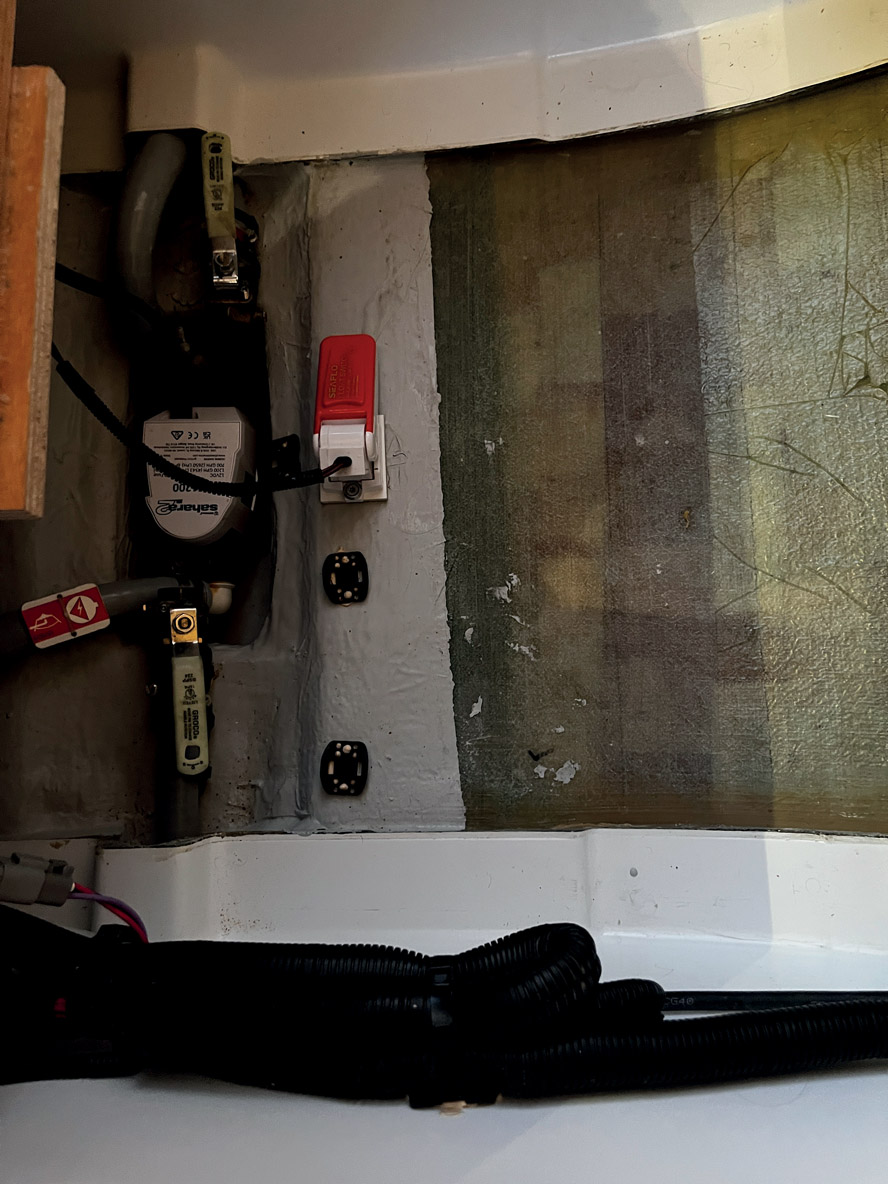
Sill of the bay window is not flush
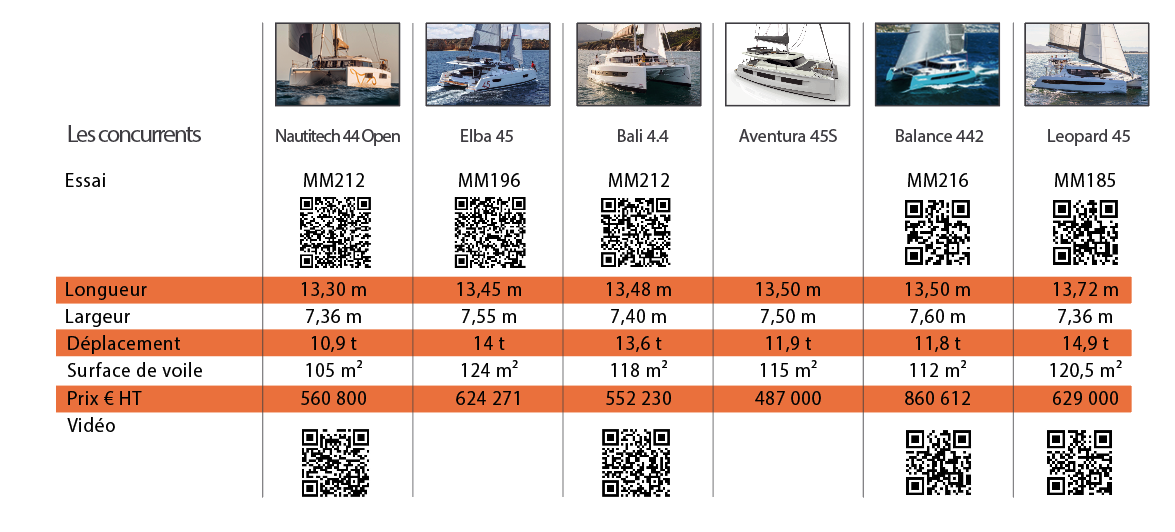
TECHNICAL SPECIFICATIONS
Architects: VPLP Design
Interior: Nauta Design
Overall length (depending on options): 45’9” to 52’5” (13.97 to 15.99 m)
Hull length: 43’9” (13.34 m)
Light displacement [CE]: 28,219 lbs (12.8 t)
Beam: 25’9” (7.87 m)
Air draft (std/Pulse Line): 64’11”/70’8” (19.78 m/21.54 m)
Draft: 4’10” (1.48 m)
Upwind sail area: 1,323 sq ft (123 m²)
PULSE LINE: 1,453 sq ft (135 m²)
Square-topped mainsail: 893 sq ft (83 m²)
Overlapping genoa: 430 sq ft (40 m²)
Code 0 (option) 775 sq ft (72 m²)
PULSE LINE: 926 sq ft (86 m²)
Engines: 2 x 45/57 HP (option)
Fuel: 2 x 53 US gal (2 x 200 l)
Water: 79 US gal (std) + 79 US gal (option) / 79 + 79 US gal
CE Certification: A/10
B/12
C/16
D/20
Base price: € 495,000 ex-tax
Main options:
Pack Sail Away: € 25,500 ex-tax
Pack Pulse Line: € 20,230 ex-tax
Skylounge with access stairs and cushions: € 10,520 ex-tax
Price of the boat we tested: € 710,845 ex-tax