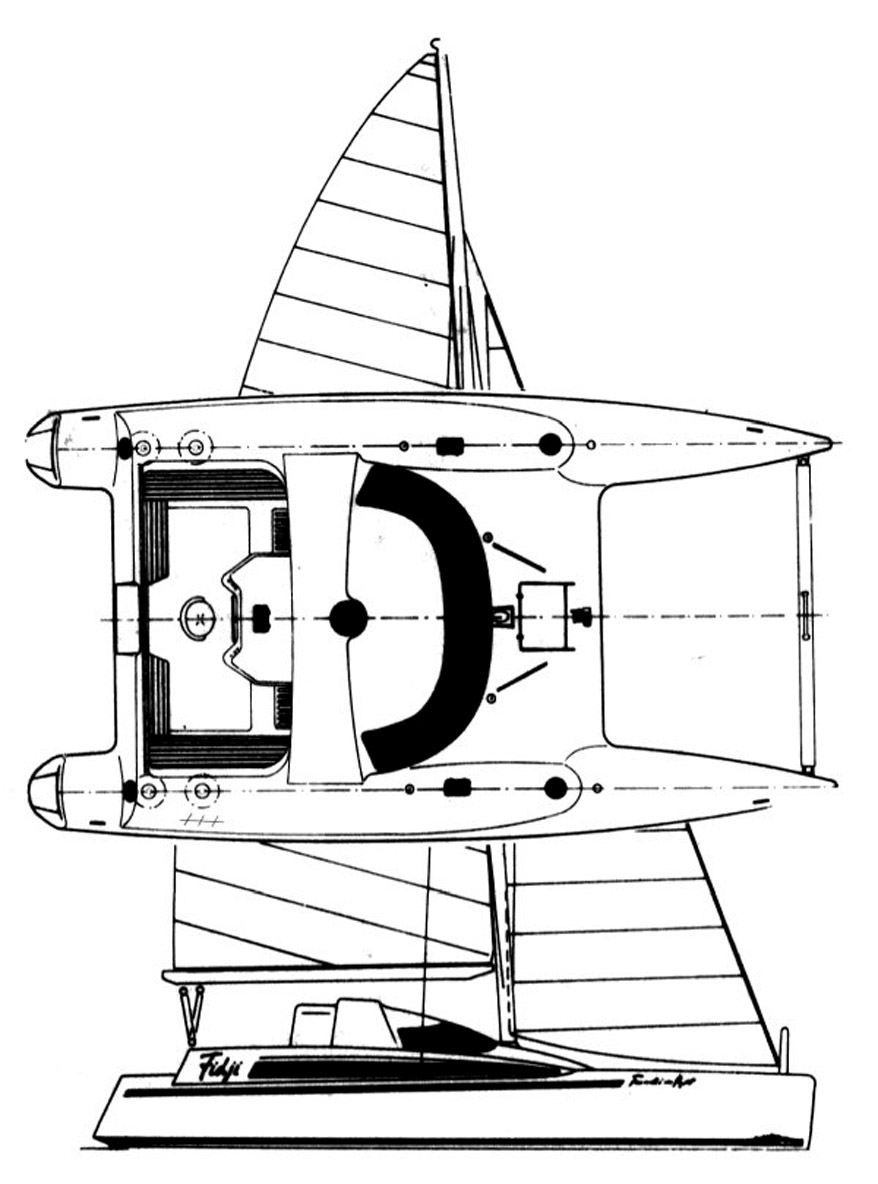
In our review published in 1989 - this article is unfortunately only available in French - we titled it “The Fidji”. At the time, this 39-foot (12 m) catamaran, that had just been integrated into Fountaine Pajot’s 2nd generation range, i.e., the Maldives generation, really shook things up! However, this model was later to become the Fidji 39 when the range really began expanding in the early 1990s, is not a far-fetched machine at all, quite the contrary!
Infos pratiques
- Le chantier : Fidji
- La fiche technique
- Découvrez notre vidéo exclusive
- Financez votre Fidji 39
- Assuez votre Fidji 39
- Articles autour du Fidji 39
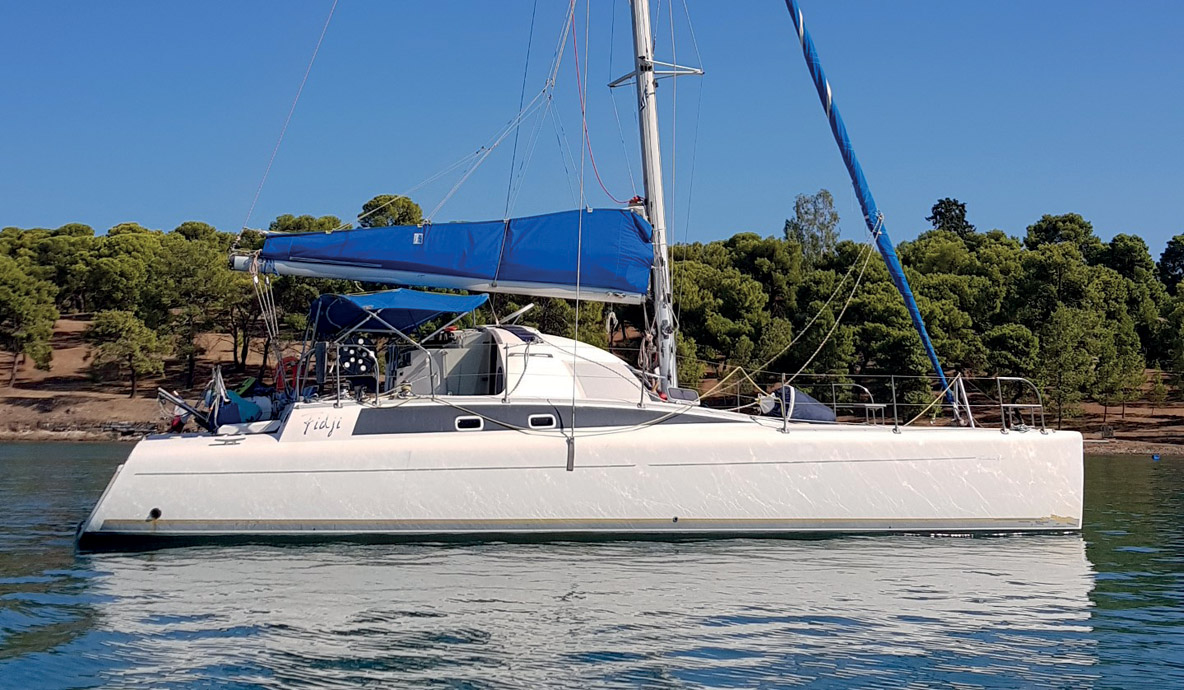
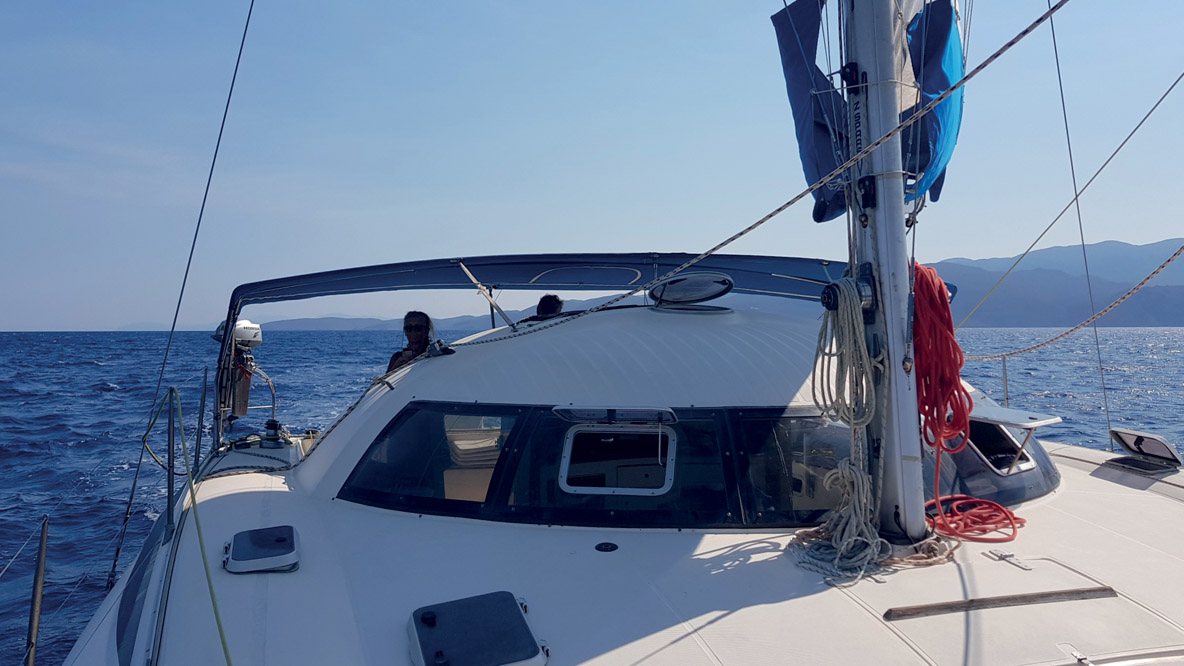
With its reduced freeboard, rounded hull sections and saucer-shaped coachroof, the Fidji 39 is the representative of another era, when people wanted to design fast hulls that didn’t need too much canvas. A time when the coachroof cap and biminis did not exist... Sailors were obviously suffering in the heat under the tropical doldrums, and most owners installed fabric biminis during their first season on board (a feature that was obviously proposed later by the builder) and various means of keeping the saloon cool. We’ll come back to this later.
Very innovative compared to its competitors of the day
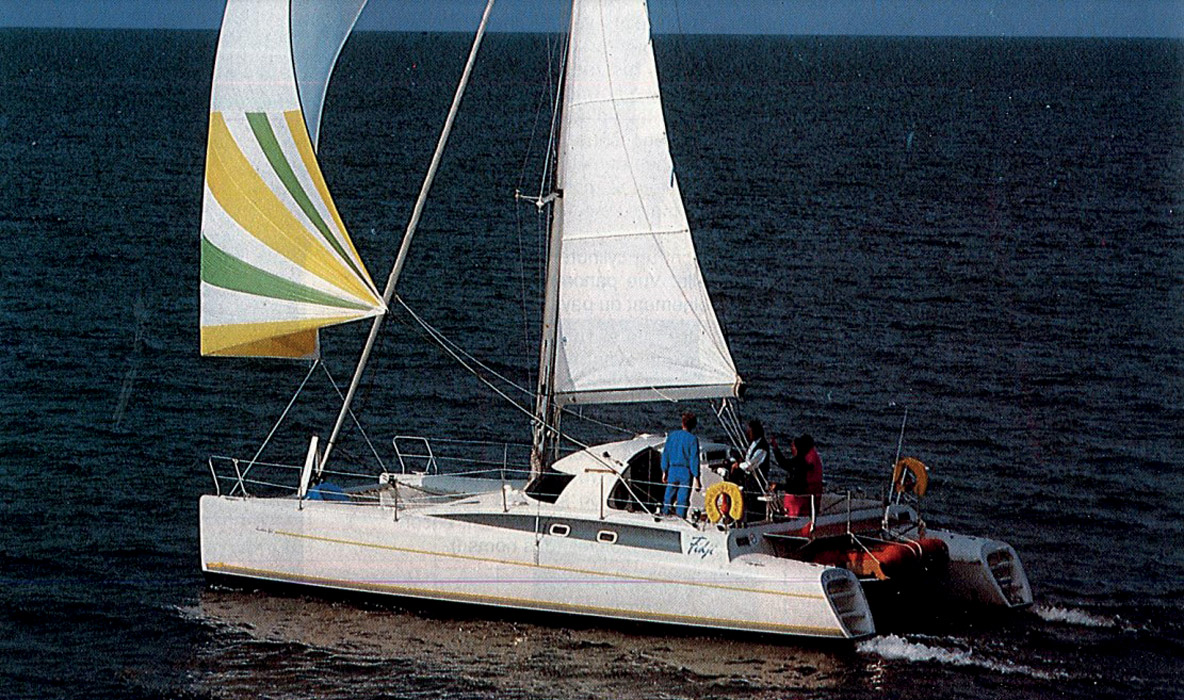
In the multihull market at the end of the 1980s, the Fidji 39 was competing with the Catana 39, the Kennex 380, the Privilège 12 M and Edel Cats (between the 35 and 42). The new Fidji designed by Joubert/Nivelt has an original look, both round and sporty. The rig contributes to this fast catamaran look with a pronounced rake. However, the profile is in fact relatively short. At the time, the shipyards were very cautious about the risk of capsizing - a real risk on board a 39-footer displacing just 6 tons. In fact, if we compare it with today’s catamarans, the Fidji 39 is clearly a featherweight like the C-Cat 37, much lighter than an Aventura 37 (7.9 t) or an Excess 11 (9 t). Obviously, in terms of hull volume, we’re not in the same category as the Excess: the Fidji’s floats are somewhat narrow and above all relatively contained thanks to the freeboard.
Performance potential that just needs a bit of a boost…
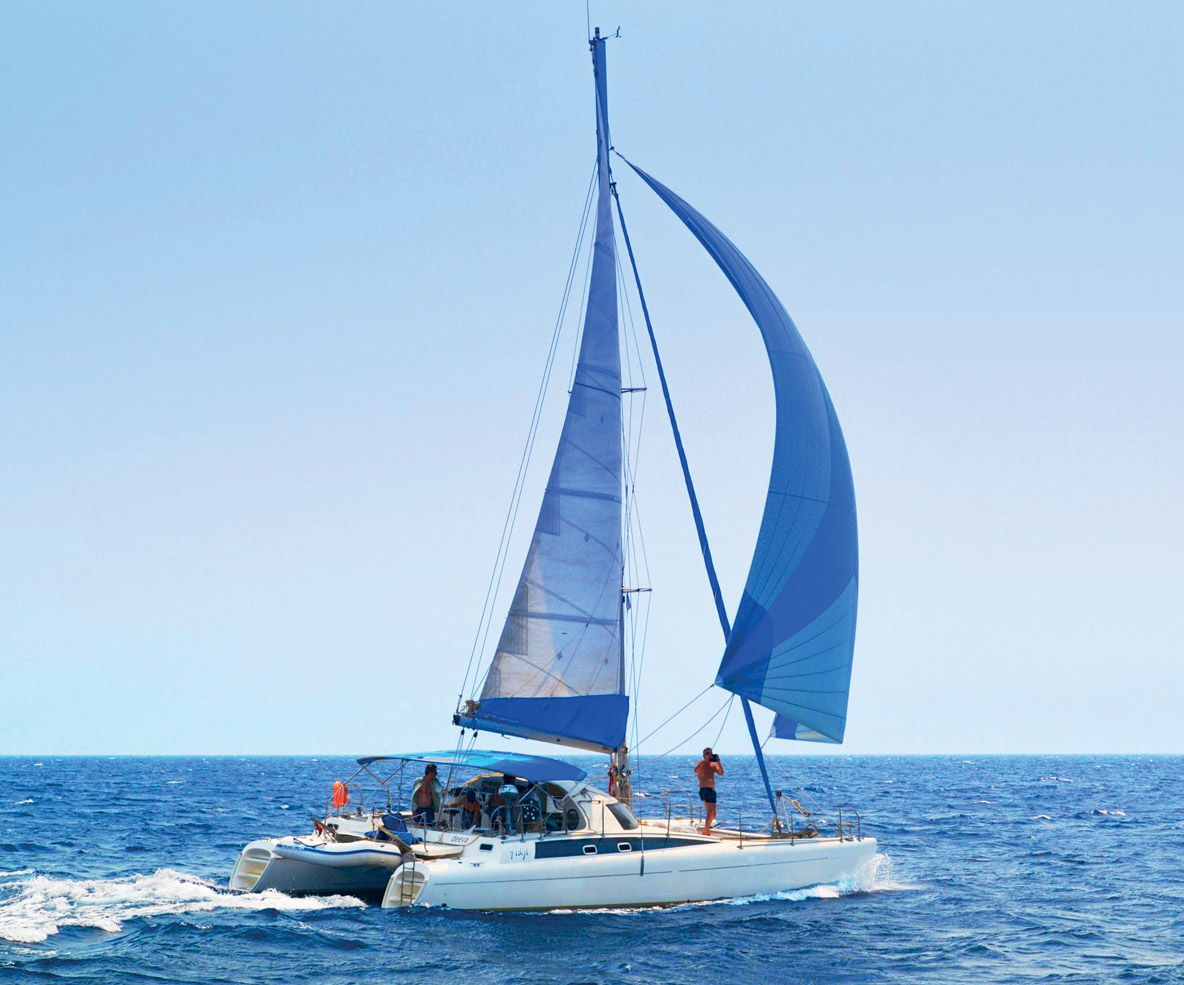
With its short rig, the timid leech of its mainsail and its slightly overlapping genoa, the Fidji 39 doesn’t have the look of a fast catamaran... it is more like a multihull whose wings have been clipped. One example based in Southern Brittany was equipped with a mast extended by 6 feet (2 meters) and this boat seemed particularly fast. In its “factory” condition, the Fidji contended with a sail area to weight ratio of 12.67 m²/t, which is pretty reasonable. In fact, in light airs, the 39 is no thunderbolt. Upwind, making less than 5 knots, it is also somewhat handicapped by its very short skeg keels (these fins are however well suited to taking the ground). But as soon as the wind gets up to 12 knots, the Fidji finally shows its potential and even its taste for slipping through the water when the breeze holds. The satisfactory aerodynamics allow for sailing quite well to windward - and facilitates port maneuvers as well as at anchor. In the end, there’s much temptation to boost the boat with a mainsail with a big roach and a nice gennaker – and the Fidji certainly deserves these!
Central helm station
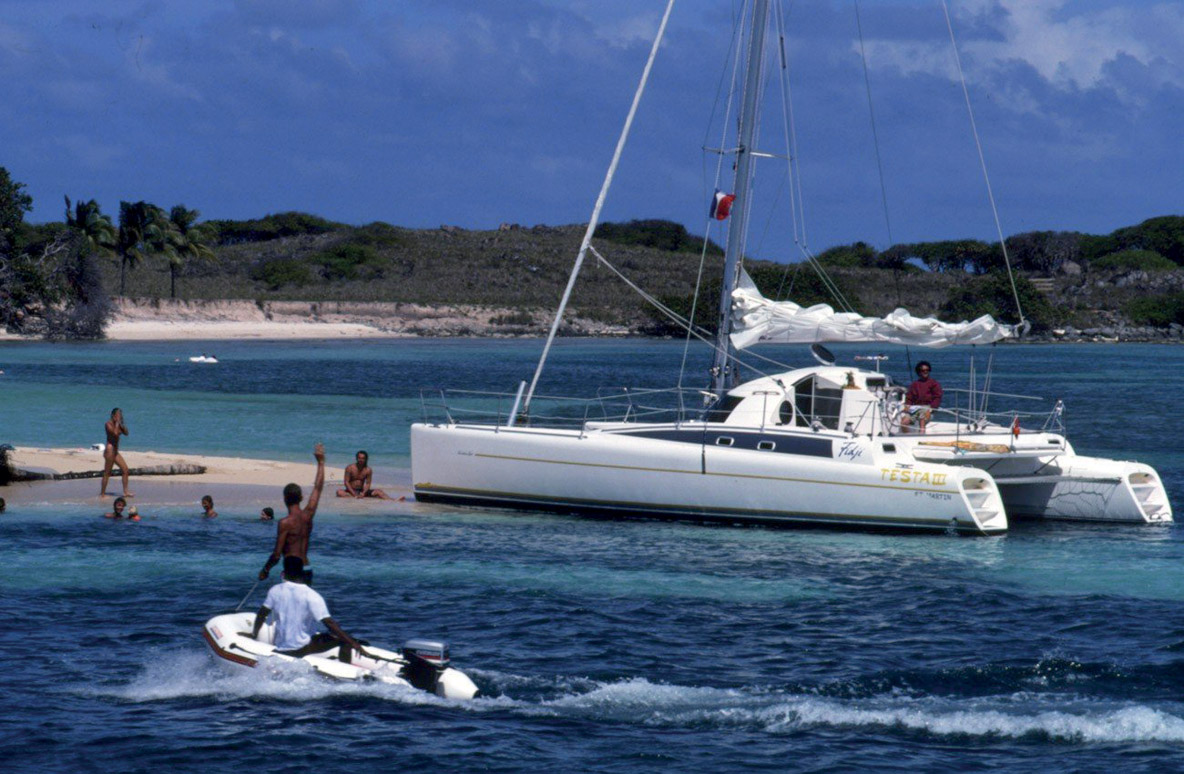
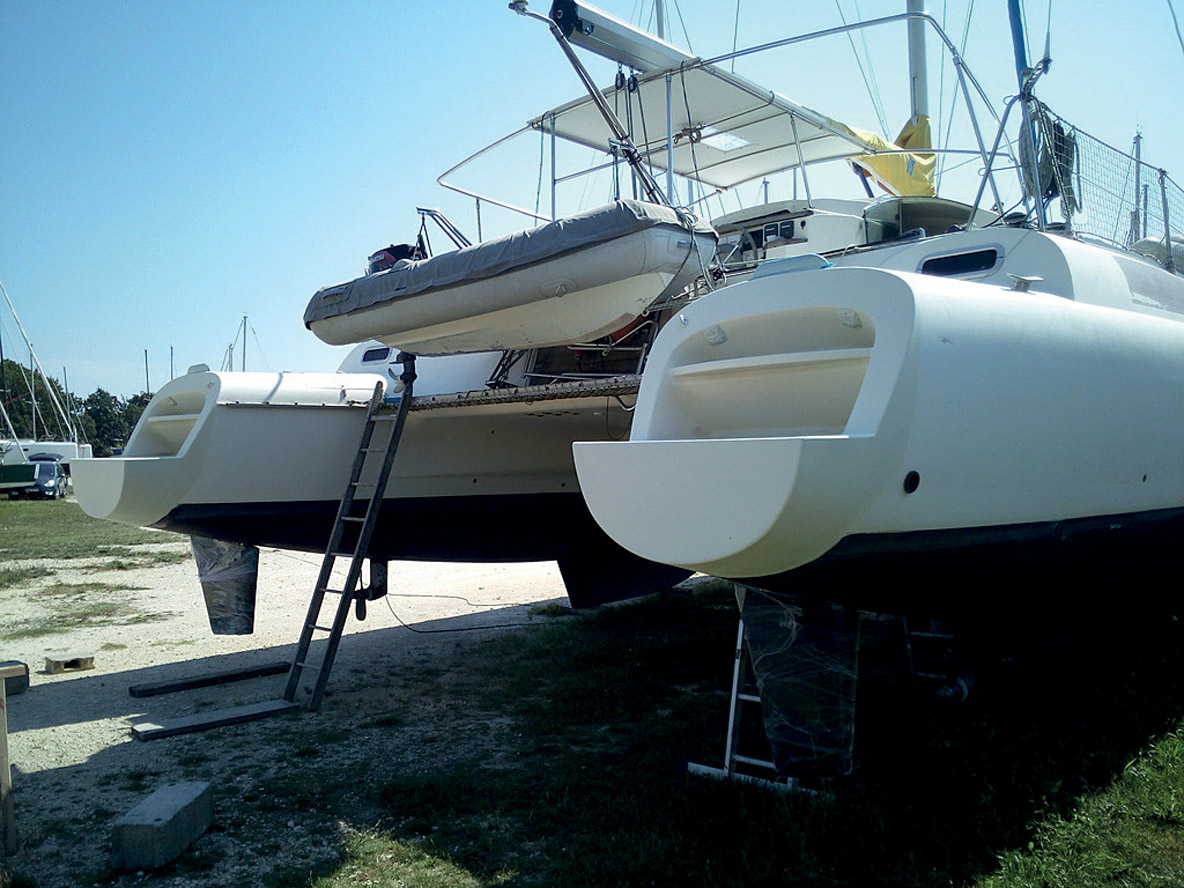
The design of the deck plan is very traditional up front: huge trampoline forward, then slightly rounded deck just hindered by the hatches - not at all flush! The raised side decks are next to the very rounded coachroof, which serves no use as a handhold. A “bubble” design that contrasts radically with the cap-type coachroof that would appear just a few years later from the manufacturer. The step down into the cockpit is the same on each side. The cockpit is set around an original central helm station. There are seats, but no exterior table. Early models, as seen on the manufacturer’s brochures, offered no protection. Now of course, all the Fidji 39s have been equipped with a bimini, most often in canvas on a stainless-steel frame. Some models were equipped with an aft platform and/or extended sugarscoops. Sailing maneuvers are divided into three areas: helm station, port hull and starboard hull. Overall, the deck plan as it was imagined in the late 1980s is minimalist, but it does have the merit of being relatively easy to transform.
Two entrances into the nacelle
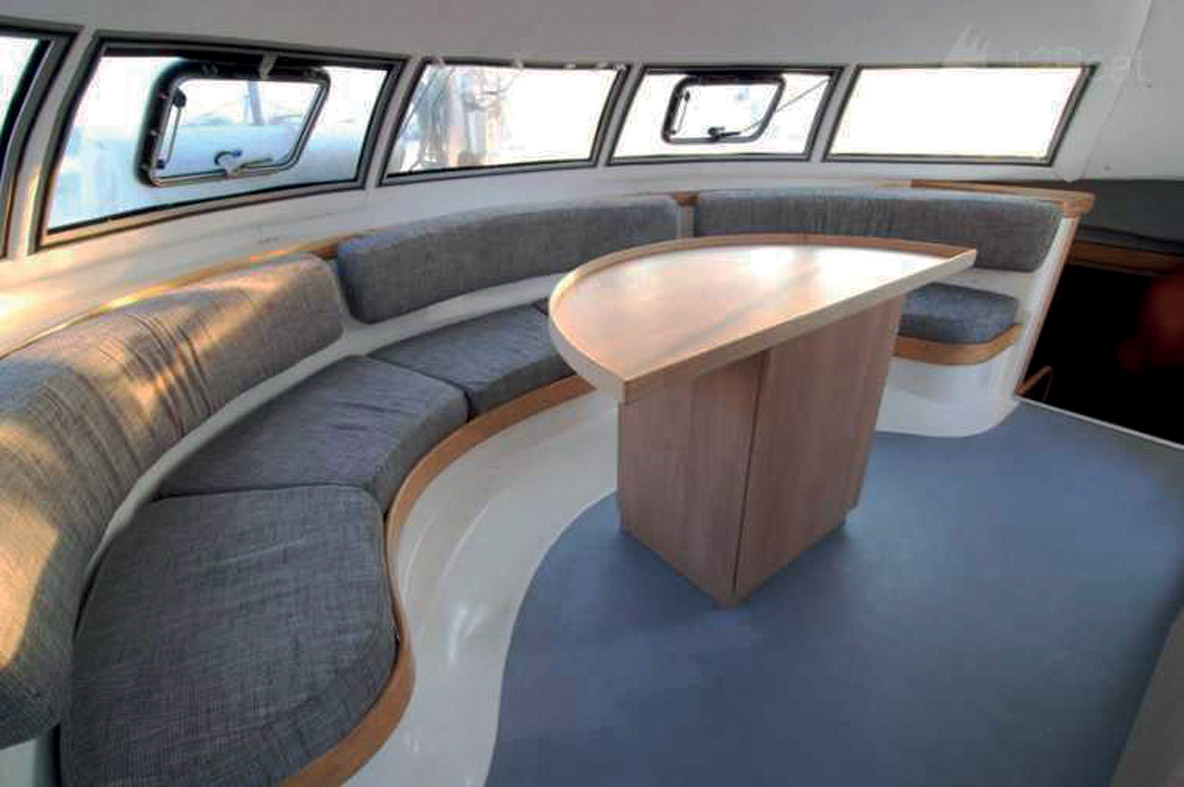
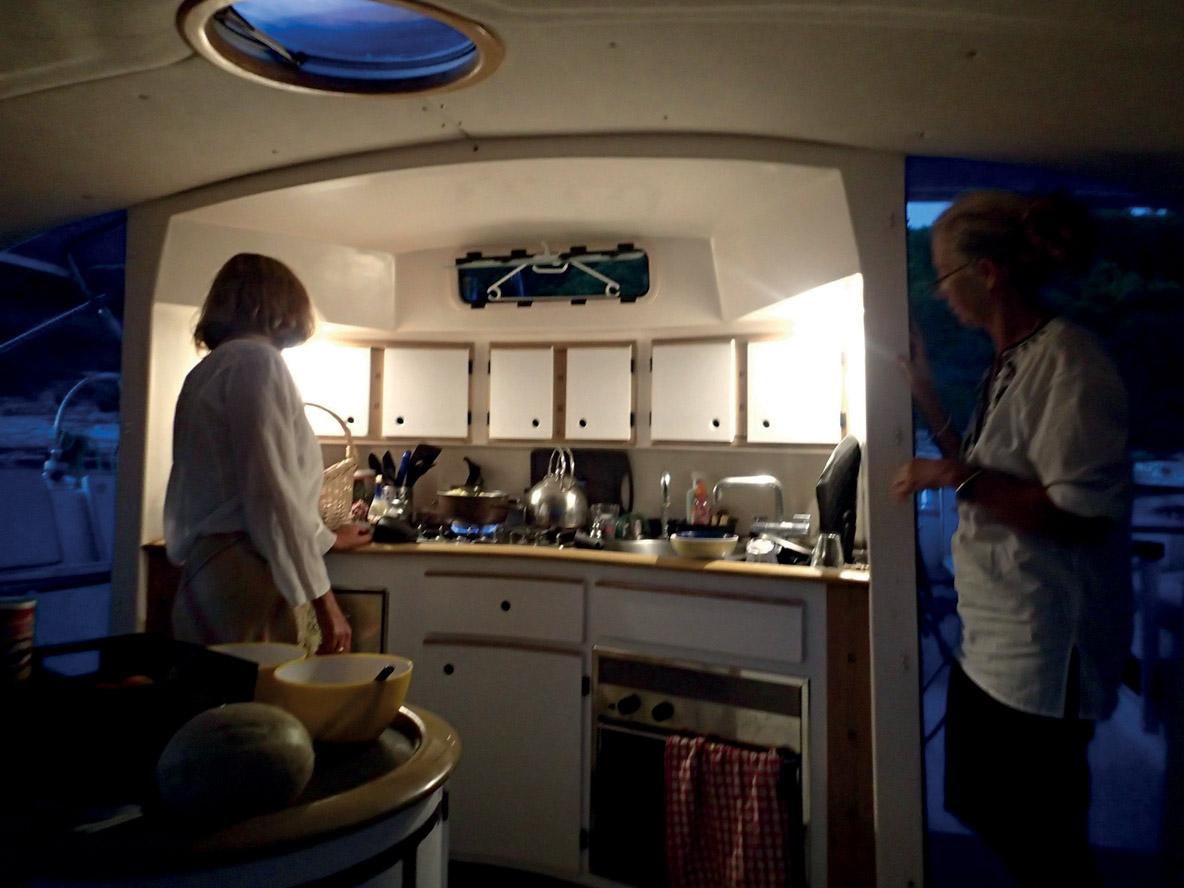
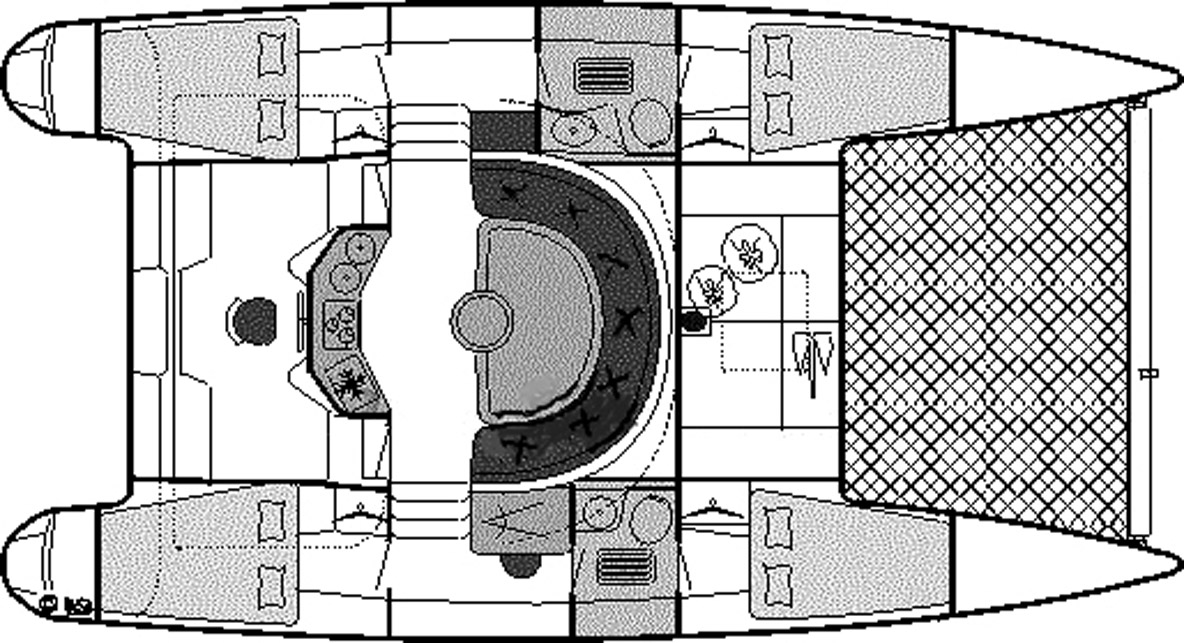
Following the logic of the central helm station, the nacelle has two entrances, one on either side. Inside, the central area between these two doors is dedicated to an alcove-type galley. This layout is original and functional. The overall volume inside is compact: the saloon features a semi-circular table so you can slide yourself in under the forward slope of the coachroof. The standard inclined hatches can be opened, but there aren’t really enough of them to ensure effective ventilation if you’re in tropical waters. Many owners have installed additional hatches to remedy this. We’re dealing with a multihull that is now more than 30 years old, so there should be no surprise in discovering faded woodwork and tired upholstery. The cabins remain relatively succinct: you make do with one heads compartment per hull and the forward bunk is inevitably a little narrow at the feet.
Conclusion
The Fidji 39 had the reputation of being a charter catamaran that sold very well. In reality, with only 35 units built in its 6-year career, this multihull has been pretty successful. As for its charter orientation, this is obviously no longer relevant today on a craft that claims more than 3 decades of good service. To date, the fleet is spread all over the world, which can make visiting one fairly easy, but the low initial production figures logically translate into rather scarce availability on the second-hand market. As a reminder, we consider that a multihull is sold on every 7 years on average and that its availability on the market is only 4 months (it was much higher two or three years ago). So, 5 Fidji 39s come up for sale every year and 1 to 2 are available at any given time. This model is an excellent basis for refit - some have already been through it and what has already been done might not necessarily please you... Clearly, you can make your own opportunities!
Points to check
The limited feedback concerning this model – arising from limited distribu- tion - mentions the dark years of osmosis. Indeed, in the late 1980s, most French boatbuilders experienced very rapid osmosis phenomena (only one to two years) due to a resin formulation that had evolved. All the major shipyards provided a complete after-sales service with peeling and epoxy coating. So this should all be ancient history. The aluminum forward beam is sometimes affected by electrolysis - contact with stainless steel parts seems to be the cause. The second hand Fidji can be presented in very different conditions: either as it was 35 years ago, or refurbished as new... Check obviously: engines, sails, fittings, electrics, plumbing... The structure seems to be in good shape. Still, check the rigidity of the coachroof in the area of the genoa tracks - our boat tester noted that the stresses were significant.
Convincing performance
Central helm station
Insufficient ventilation
Few units on the second-hand market
Technical specifications
Architects: Joubert/Nivelt
Overall length: 39’ (11.89 m)
Beam: 21’ (6.4 m)
Draft: 3’3” (1 m)
Light displacement: 13,225 lbs (6 t)
Mainsail: 430 sq ft (40 m²)
Genoa: 388 sq ft (36 m²)
Engines: 2 x 18 HP
Fuel: 66 US gal (250 l)
Water: 79 US gal (300 l)
Material: foam/polyester sandwich
Production: 35 units from 1988 to 1994
Second-hand price: from € 90,000 ex-tax