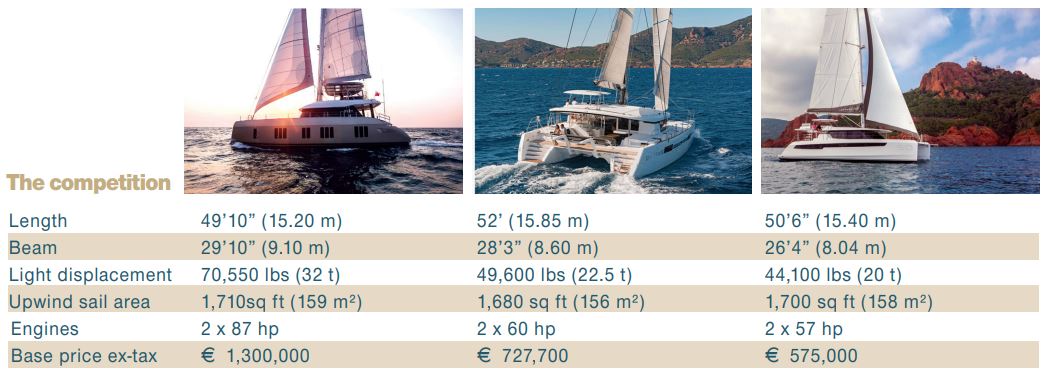
Garcia, the aluminum boat builder with a global reputation, could manage no longer without a multihull in their range. They needed to expand on their selection of monohulls, whose name “Exploration” sums up the program in just one word. The Explocat 52 is therefore an adventurer of the same temperament. The ambition is to widen the options beyond production GRP catamarans: it offers the possibility of venturing further north and/or south. In addition to the safety provided by the mechanical qualities of aluminum, the Explocat 52 benefits from a design and from options that allow it to venture just about anywhere.
Infos pratiques
- Le chantier : Garcia Explocat 52
- La fiche technique
- Découvrez notre vidéo exclusive
- Financez votre Garcia Explocat 52
- Assuez votre Garcia Explocat 52
- Articles autour du Garcia Explocat 52
Test location: Cherbourg, France
Weather conditions: sea state slight; wind 15 knots
In the 1970s, in the heart of the Normandy countryside, far from the sea, the Garcia brothers began building aluminum boats. Talented metalworkers, their beautifully shaped hulls quickly left behind the amateur constructions that had done so much damage to the material’s reputation. Fervent supporters of the monohull, and more precisely of the centerboarder, their short and fruitless industrial adventure with Yapluka catamarans wasn’t going to make them switch allegiance. That said, the brand became part of the Grand Large Yachting group in 2010, and nevertheless put its name to hull #2 of the SC 48, initially produced by Alumarine. Exhibited at the International Multihull Show at La Grande Motte, France, in 2015, it met more with critical success than commercial success. The appeal of the concept and the program were there, but the answer wasn’t completely seductive just yet.
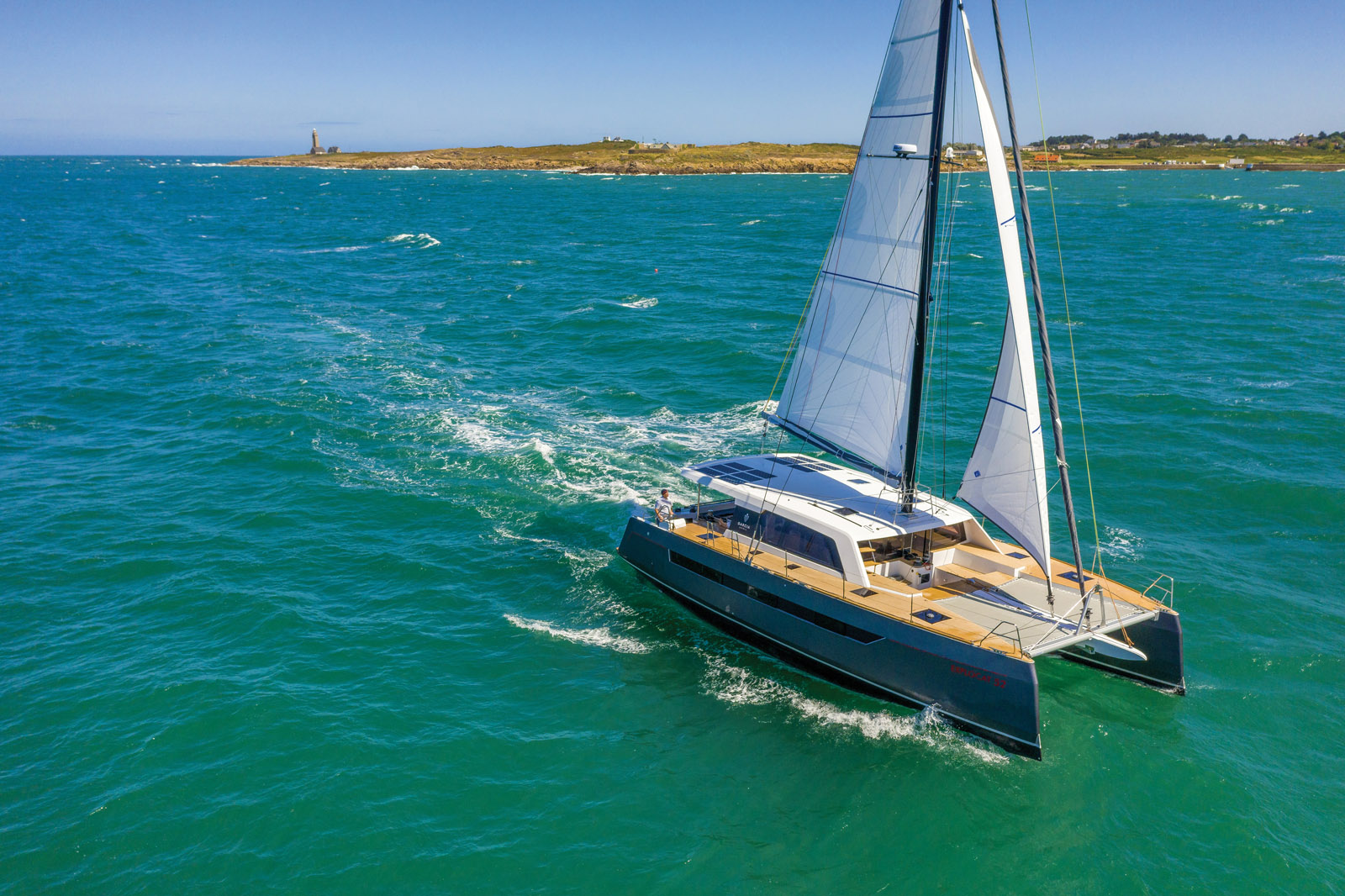
Despite its aluminum construction - except for the coachroof - the Explocat 52 manages to remain lighter than many of its GRP competitors.
52 feet, just the right balance for adventure Five years later, the trident brand is now offering a brandnew catamaran meeting the same specifications. During a long process of design, discussion, modifications and evolutions, the Garcia shipyard, naval architect Pierre Delion, and Darnet Design have completely revised the result. The fundamentals of the specifications remain unchanged: safety and comfort for blue water cruising. But, to meet its public, they have added two constraints: performance and aesthetics. The 52-foot length chosen is a perfect illustration of the balance sought between objectives that might seem, at first glance, divergent. It provides volume and comfort for long-term, self-sufficient cruising, and offers decent performance – yet remains a catamaran that can be handled by a couple. Speed potential is approached in this case not as an end in itself, but as a key safety factor - induced dynamic seakeeping and the ability for the multihull to be active in the face of weather phenomena rather than being subjected to them. It is also a size where aluminum is no longer penalizing in terms of weight. In order to achieve the objective lightship weight of 18.6 tons, a set of scales was on board this catamaran throughout the build. Everything brought aboard was weighed. In the same spirit, the choice was made to manufacture the furniture in foam sandwich. Whatever your program, weight is the enemy of the multihull - we can never repeat that enough times – and Garcia seems to have dealt with it very well.
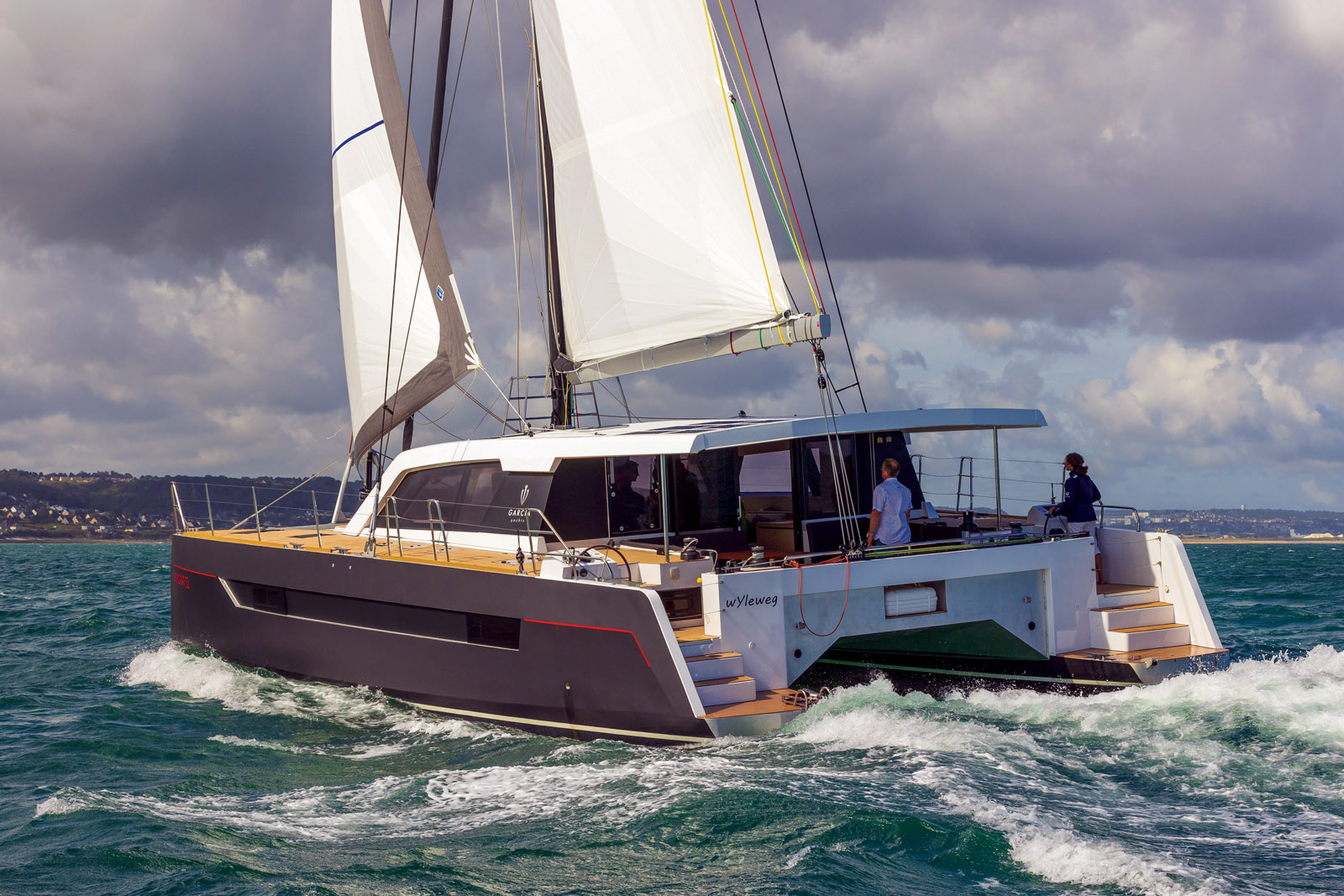
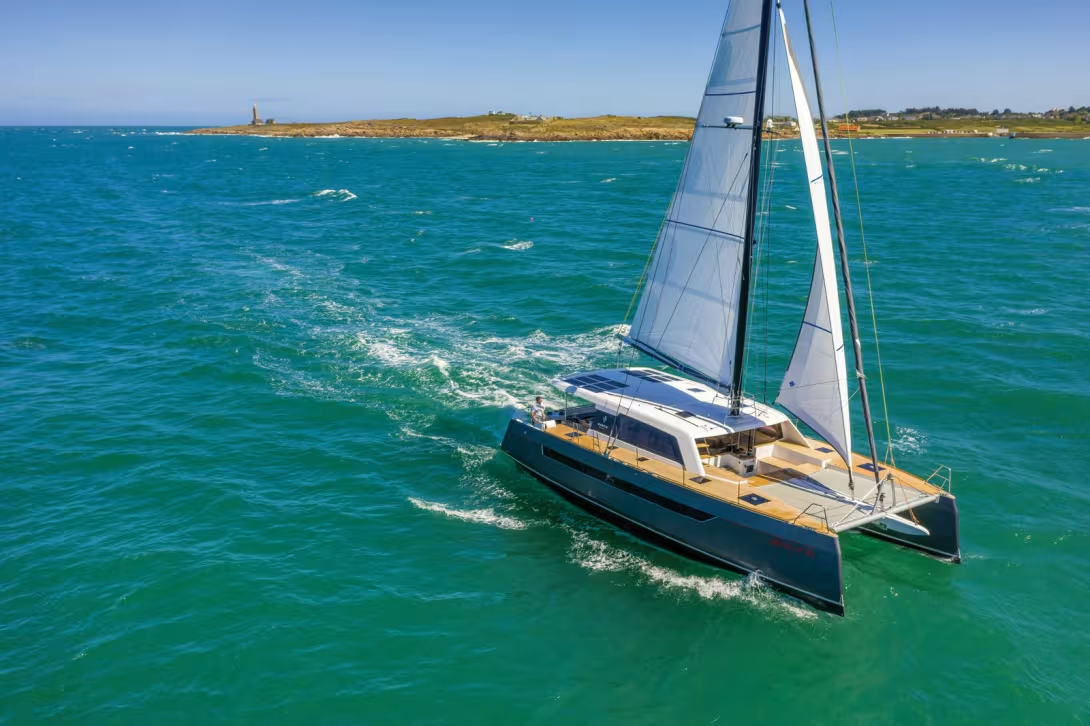
The nice surprise during our test sail: the amazing speed potential of this adventurer.
The builder’s proposal: a raised helm station
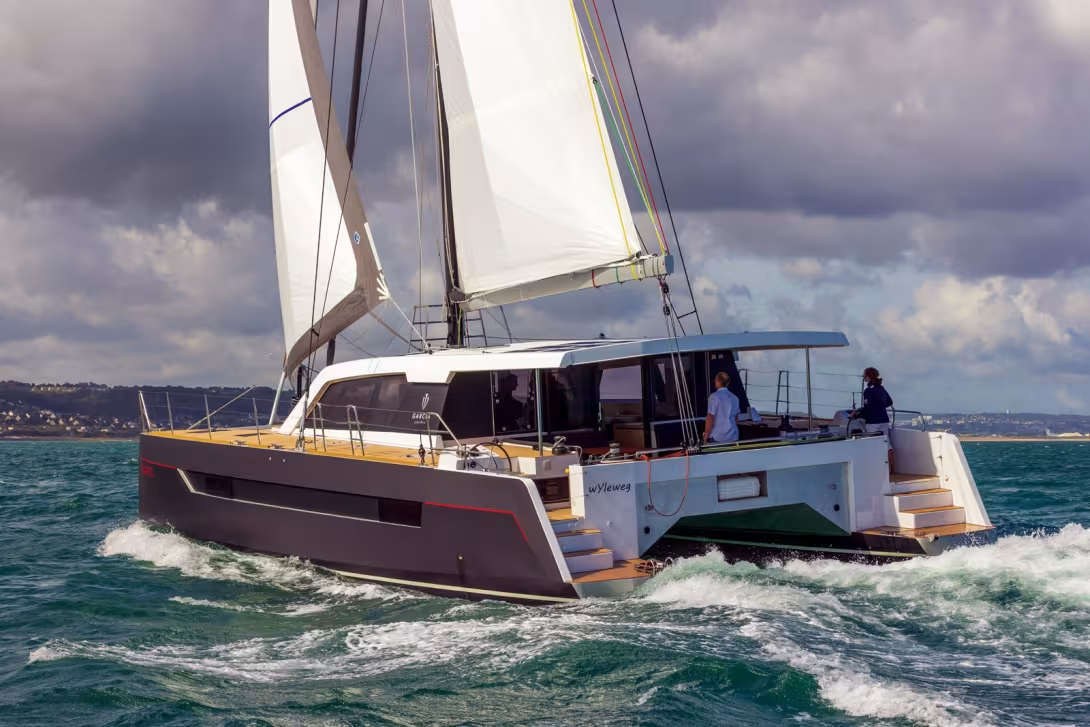
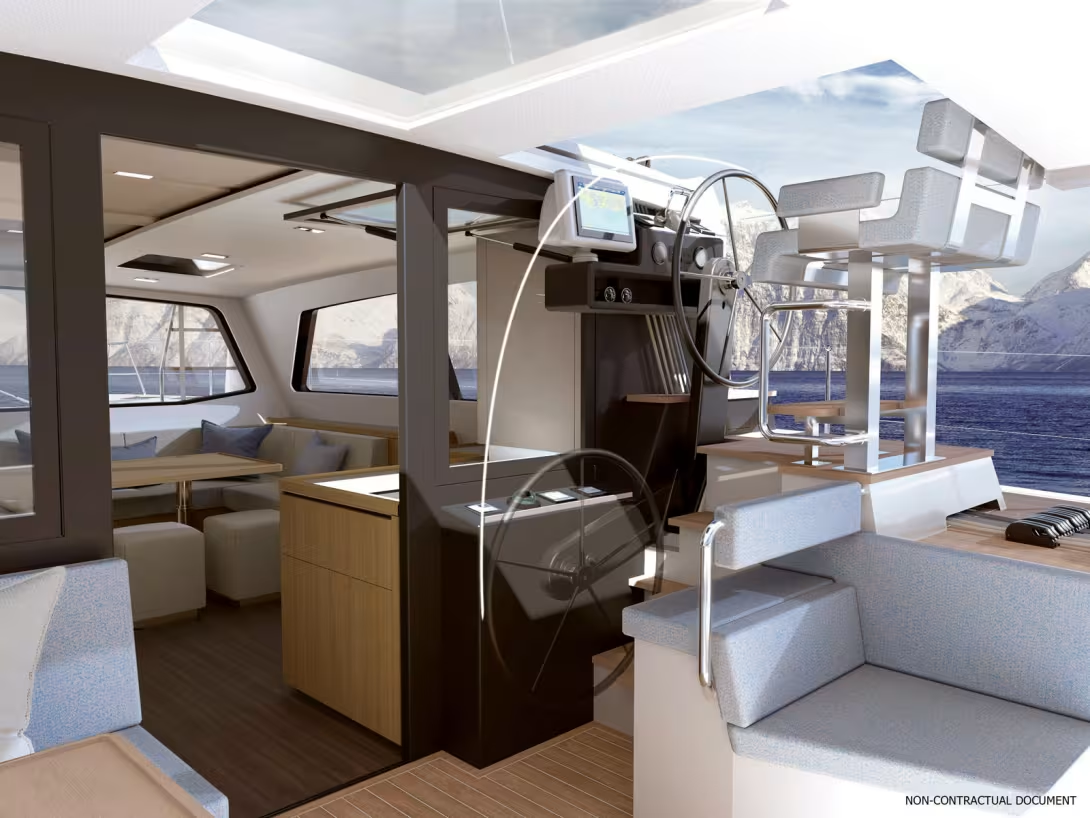
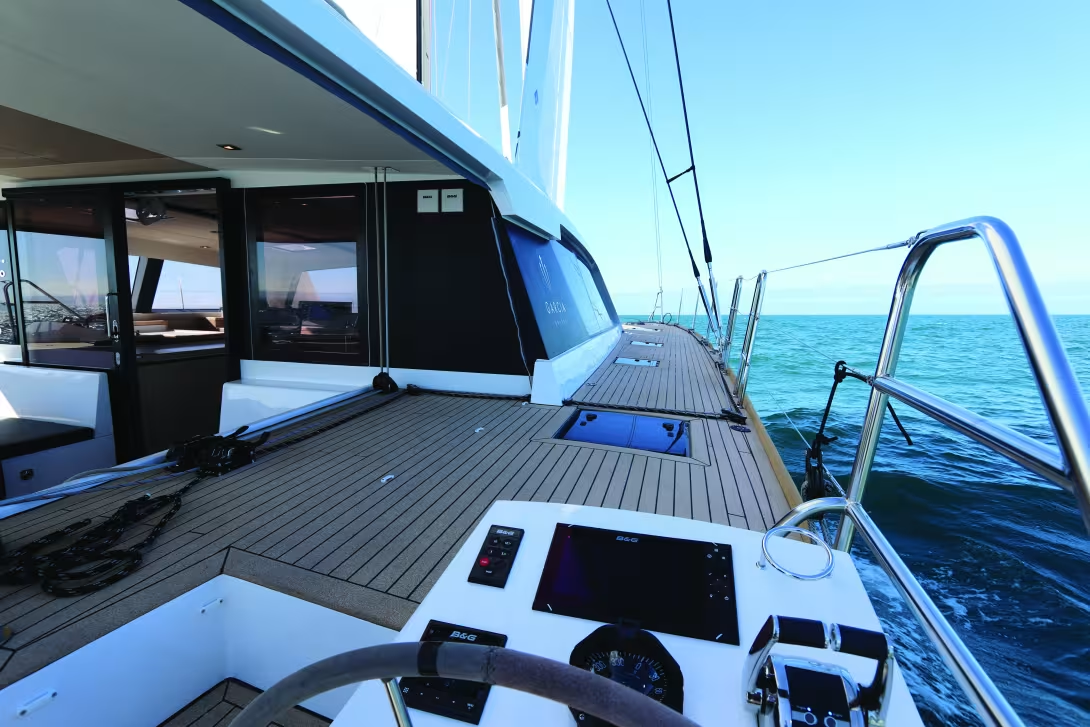
At first sight on the pontoon, your eyes remain at the water’s edge. Solid welded chainplates, designed to shed water that would begin to freeze, confirm the link with the Exploration monohulls. Thanks to them too, where there has never been a marina - let alone a travel lift - a few logs and a good winch will be enough to haul the Explocat 52 ashore! The inverted bows and the line of integrated hatches gently hint at the volume that you guess is significant, as does the freeboard that you can immediately visualize. It is a pity that this hull #1 hasn’t included the real doors cut out of the SC 48’s topsides, aft. We’re informed however, it is indeed an available option, but probably incompatible with the choice of the first owner to position two steering wheels at the stern. We might as well get past this subject first: the original proposal from the yard for a raised helm station on the aft face of the coachroof would seem to us to be much more in keeping with the program. It offers a 360-degree view, the protection provided by the coachroof and the comfort of the double bench seat for watchkeeping. Better still, once the sliding bimini plexiglass has been closed and the steering wheel tilted to cockpit level (see illustration), you can helm and trim the sails wearing slippers and a fleece, whatever the weather. In fact, only the headsail halyards remain at the foot of the mast. All other maneuvers, halyards, sheets and reefing lines, are led back to this extremely well-protected space, in the immediate vicinity of the inner cocoon. This will be seen - very soon - on the number two in the series.
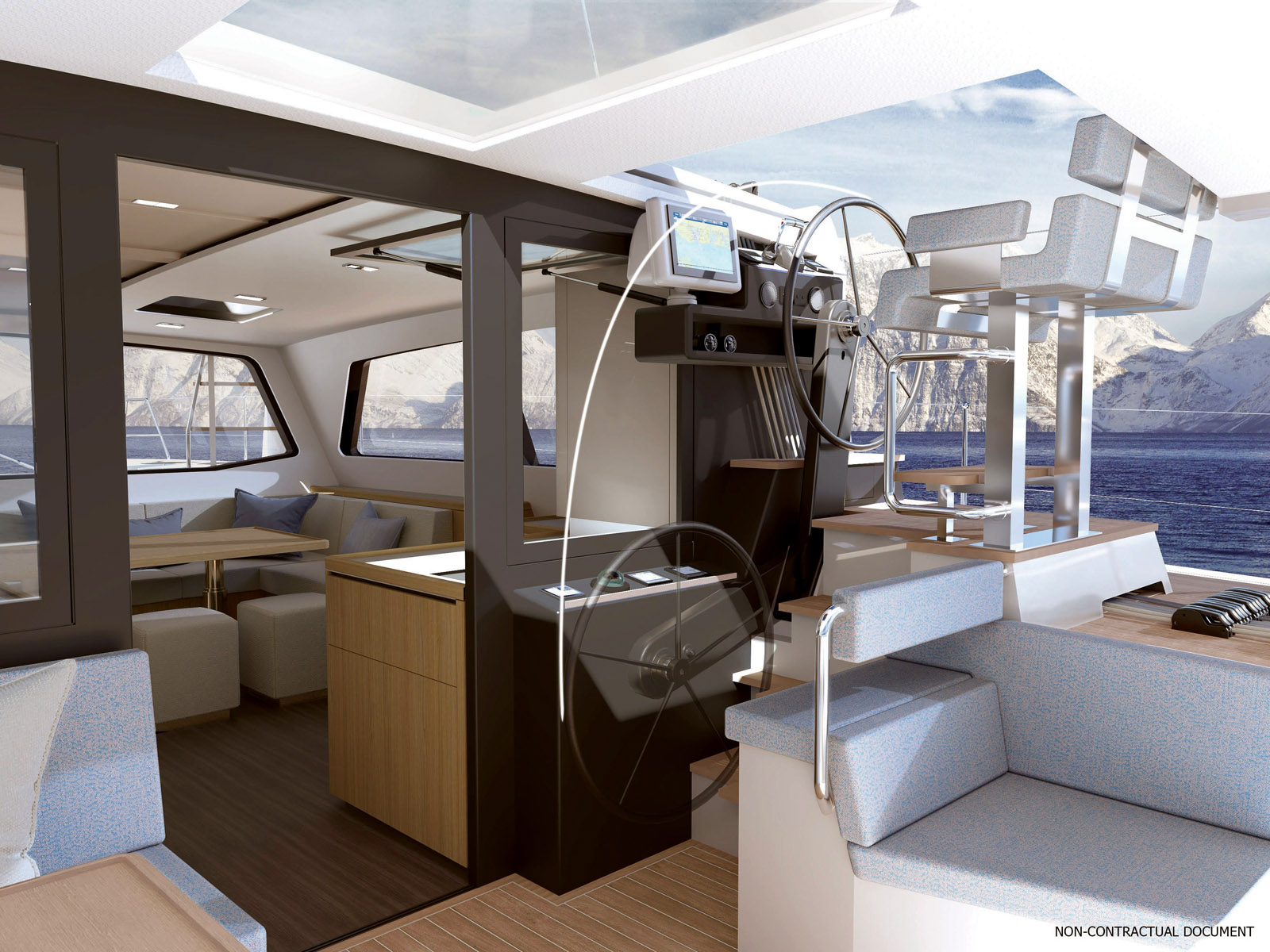
The twin helm station setup is by request of the owner on this first example built. The manufacturer’s preference is for a helm station against the coachroof.
Davits capable of lifting half a ton
Still tied up alongside, a few things draw our attention on deck, confirming that this catamaran is definitely a craft for “all destinations”. The mooring cleats directly welded to the hull - just like the chainplates - are numerous and generously dimensioned. The foot of the mast is surrounded by a large stainless-steel guardrail. Even though all maneuvers are carried out in one of the two cockpits, you will still be safe should you need to intervene at the mast. At the stern, the solid davits capable of lifting 1,100 lbs (500 kg) can accommodate a large and well-engined RIB. More than a dinghy in this case, it is an indispensable expedition companion for transfers, provisioning, diving, and sometimes even assistance. Similarly, for mooring by the stern, nothing has been neglected: the large starboard sugarscoop is equipped with a proper anchor roller.
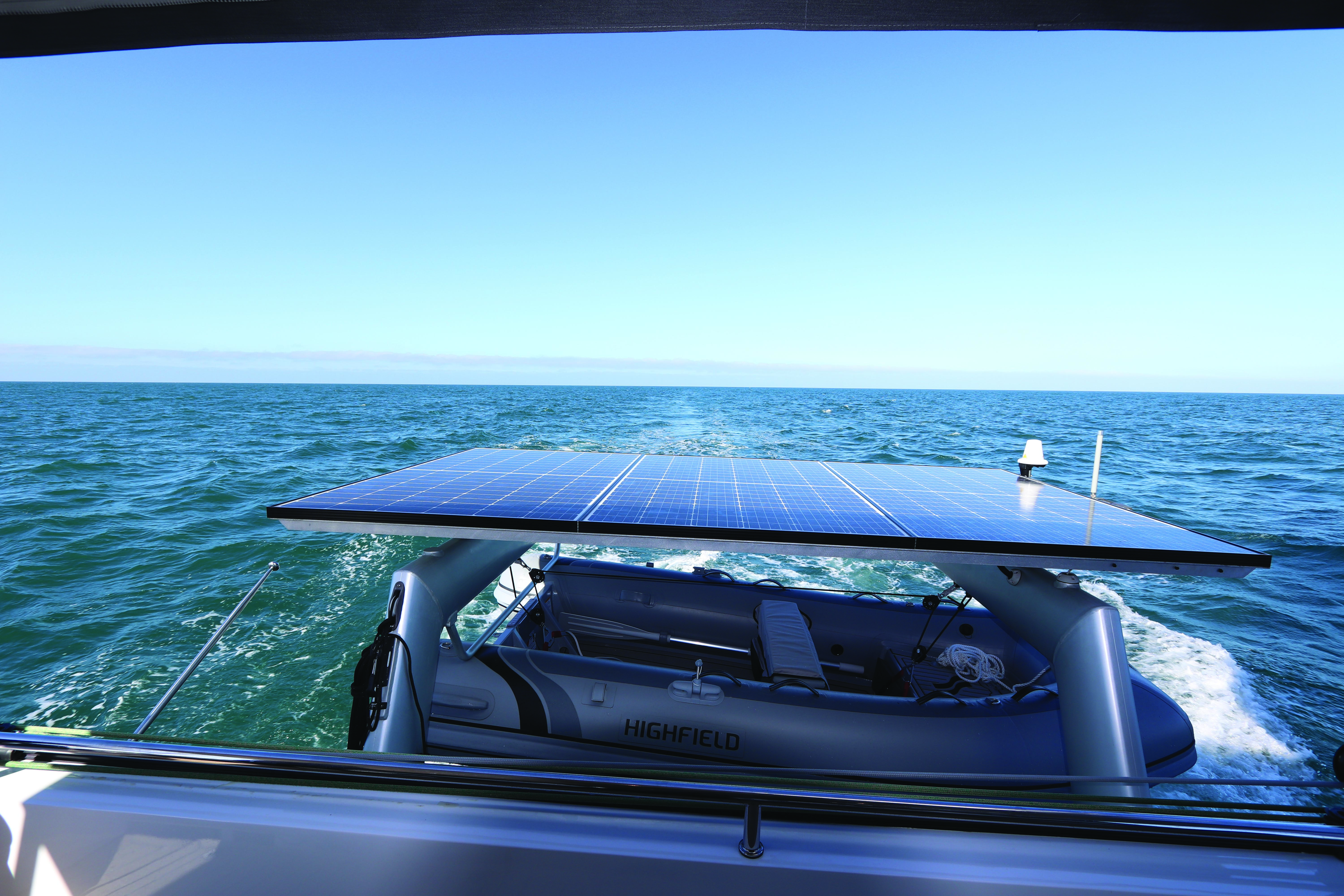
The solar panels have a total power of 2 kW.
9 knots on a close reach
With the engines started, we left the commercial port of Cherbourg. Be careful to hold the helm firmly when going astern. The twin 75 hp Volvo engines (60 hp as standard) take us off the pontoon without effort, despite the headwind. One small deviation from the Garcia doctrine here: saildrives have been chosen over traditional propeller shafts. More compact and therefore better adapted to the layout of a multihull, they are protected by skegs welded beneath the hull. As for the rudders, they have a sacrificial section, guaranteeing the integrity of the hull in the event of an impact. The electric controls for the motors lack a bit of progressiveness and the rudder feel is too firm for our taste, but it’s just a question of adjustments. Heading into the wind, the mainsail is hoisted from the forward cockpit, where you are very well protected. Beyond being the traditional relaxation spot, it will be an ideal position from which to watch out for growlers or to raise the main anchor (and up to 330’/100 m of chain!) in the most isolated bays. With the genoa unfurled, the Explocat 52 gently swayed in a light breeze while we were still sheltered by the long breakwater of the outer harbor. Once out onto the open sea, the breeze settled in at around fifteen knots. We were then more than pleasantly surprised by the sensations. A feeling quickly confirmed in figures: in 15 knots of wind, at 65° degrees off the true wind, the boat was effortlessly making 9 knots. We even got up to 55°, but close hauled, we quickly lost 1 to 2 knots of boatspeed and had to set about finding them again. The fixed skeg keels (5 feet / 1.50 m draft) don’t make the 52 a tacking machine, but they don’t irreparably affect performance either. Compared to daggerboards, they have the advantage of being lighter, do not clutter up the interior, and are more resistant to possible shocks and groundings. In short, once again a logical choice for the type of sailing envisaged.
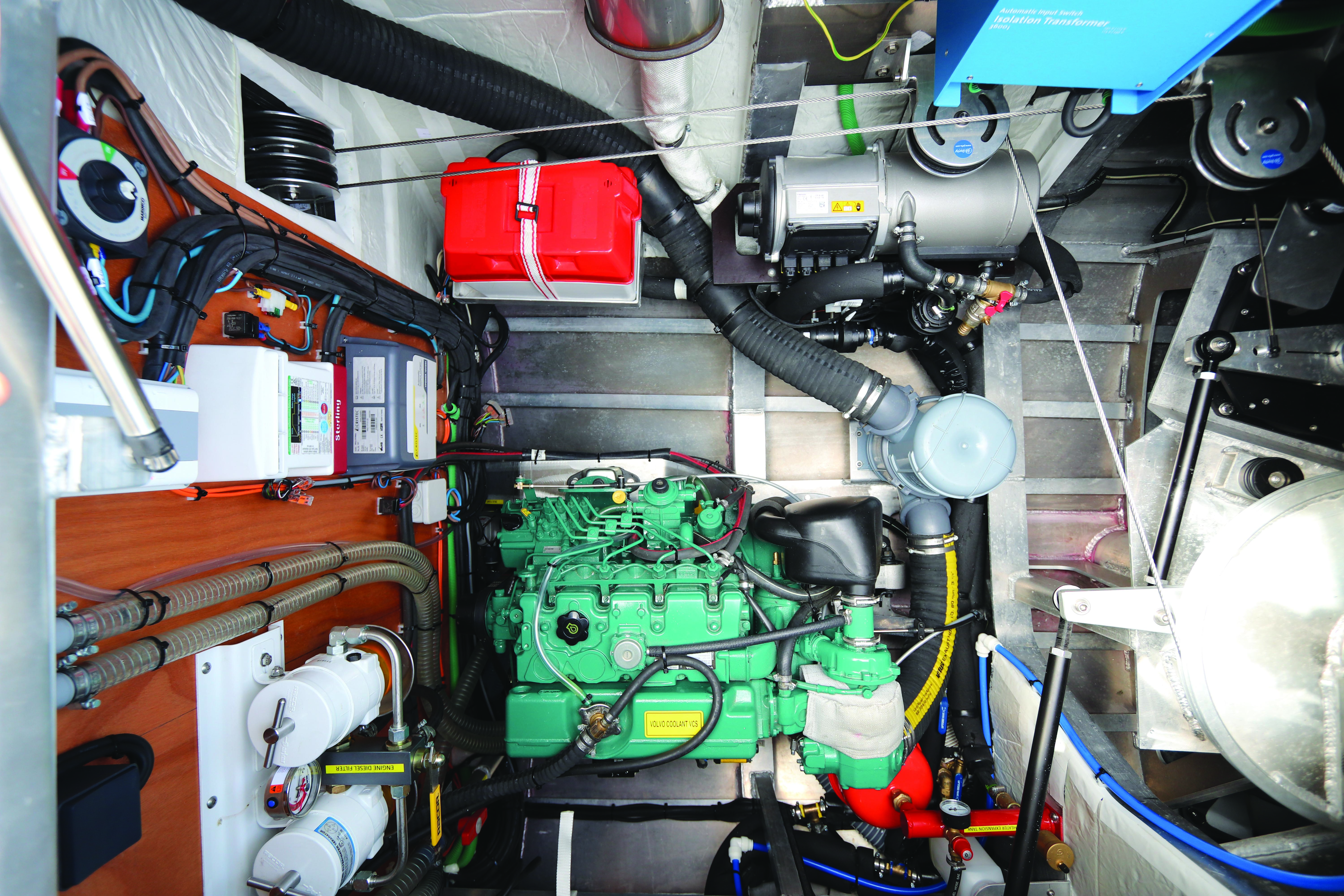
Two 60 hp Volvos are standard equipment. 2 x 75 hp are available as an option.
Careful weight centering
The English Channel, with its winds and currents, is never one to shy away from getting a bit lively: yet we were very pleasantly surprised by the very little pitching we observed and our smooth passage through the water. This excellent seakeeping behavior is explained by the generous bridgedeck clearance – 2’10” (85 cm) minimum when laden - and the careful work carried out on centering the weight. The tanks, for example, are positioned in the middle and at the bottom of the hulls. The optional carbon mast contributes to the same logic. Despite its price tag, this option cannot be over-recommended. For this very first run, the huge forward sail lockers were, apart from the voluminous inflatable fenders, completely empty. They will inevitably be used to hold a variety of gear, but you’ll still need to be careful not to overload them to keep the catamaran’s nautical qualities as healthy as they are comfortable: the less it pitches, the faster it goes and the less it slams!
On many large cruising catamarans, tacking can be tricky. Another nice surprise: aboard the Explocat 52, this is not the case at all. In spite of the staysail which slows down the passage of the genoa (but perhaps this is a bad thing turned good, because the forward sail quickly backs against it) the 52 turns by itself: “like a moped”, enthused one of the helmsmen of the day. Before we eased sails, we agreed to head upwind to give us some searoom for a run. This was our opportunity to discover the inside.
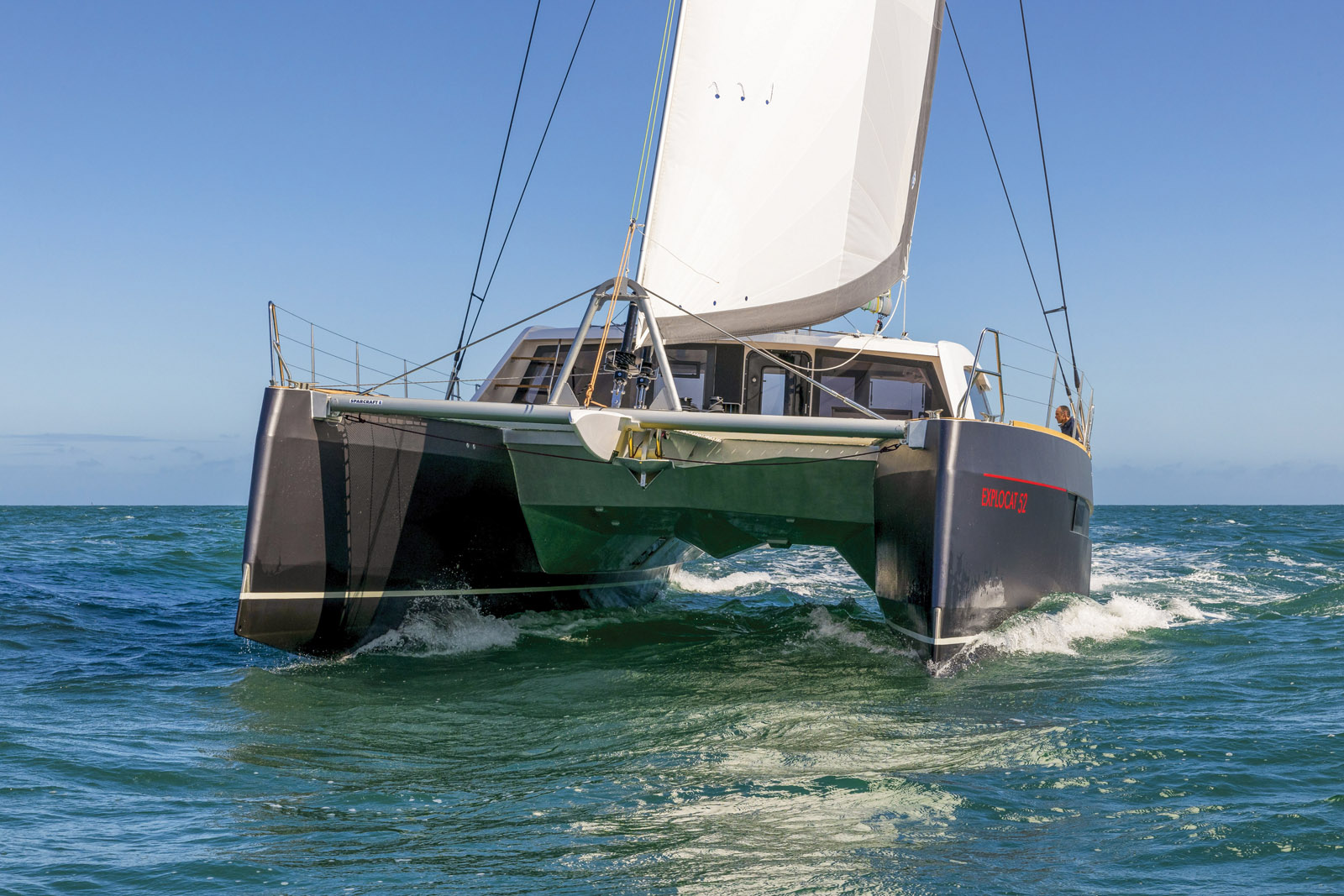
Careful centering of weights results in exemplary seakeeping.
Just like at home
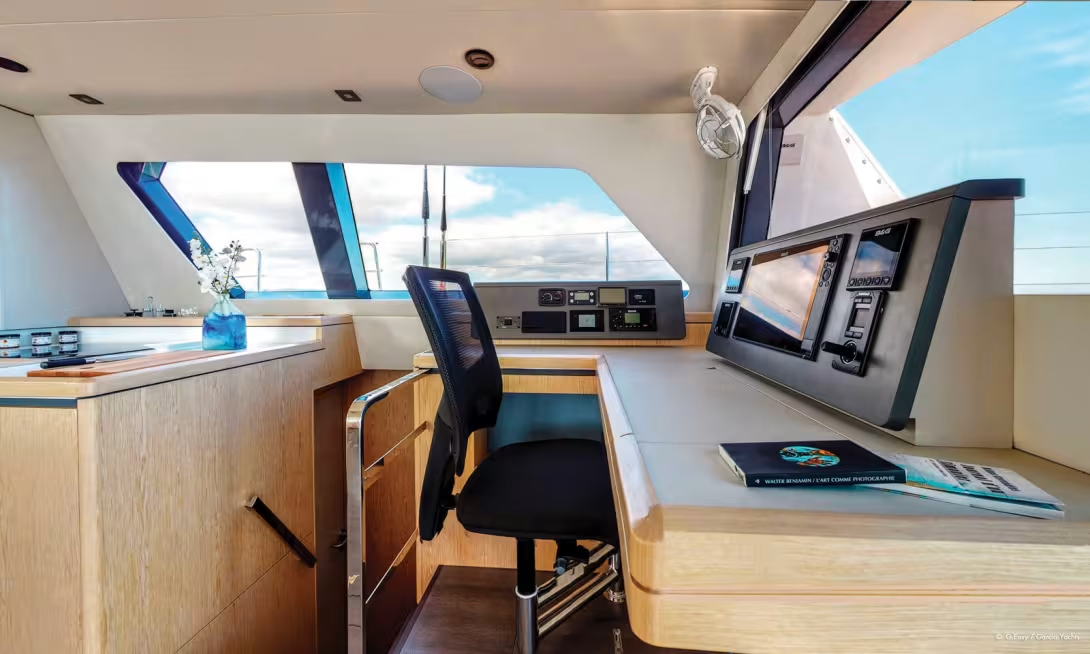
The whole is understated yet chic, highlighting the talent of the Darnet Design team, a regular contributor to the group’s other brands (Allures and Outremer, in particular). While the layout inside the nacelle is not revolutionary, between the U-shaped galley on the port side and the L-shaped saloon forward to starboard, some of the fittings are out of the ordinary. The wetlocker and boot storage, both heated, are among the details that clearly position the Explocat. Similarly, to port of the very sturdy forward watertight door, the traditional chart table has been transformed into a real interior helm station. Benefiting from a truly panoramic view, you can control the helm via the autopilot joystick. Engine control repeaters are available as an option. Comfortably seated on the ergonomic rotating chair, watchkeeping can be undertaken in the warm, with your feet tucked under the radiator. A “just like at home” option equips the whole boat with a heating system, giving an idea of the targeted latitudes. However, ventilation hasn’t been forgotten. No less than eight openings are installed in the nacelle, including a large cockpit-galley window, which should evolve towards being a sliding window in future versions. Hot or cold, in either case, the Explocat 52 is very well insulated. This drastically reduces condensation, limiting ambient humidity on board. The insulation can be doubled from 1½” to 3” (37 to 75 mm) thick. A double-glazing option, well in keeping with the vessel’s aspirations, is also proposed. But this adds an extra 900 lbs (400 kg) of weight.
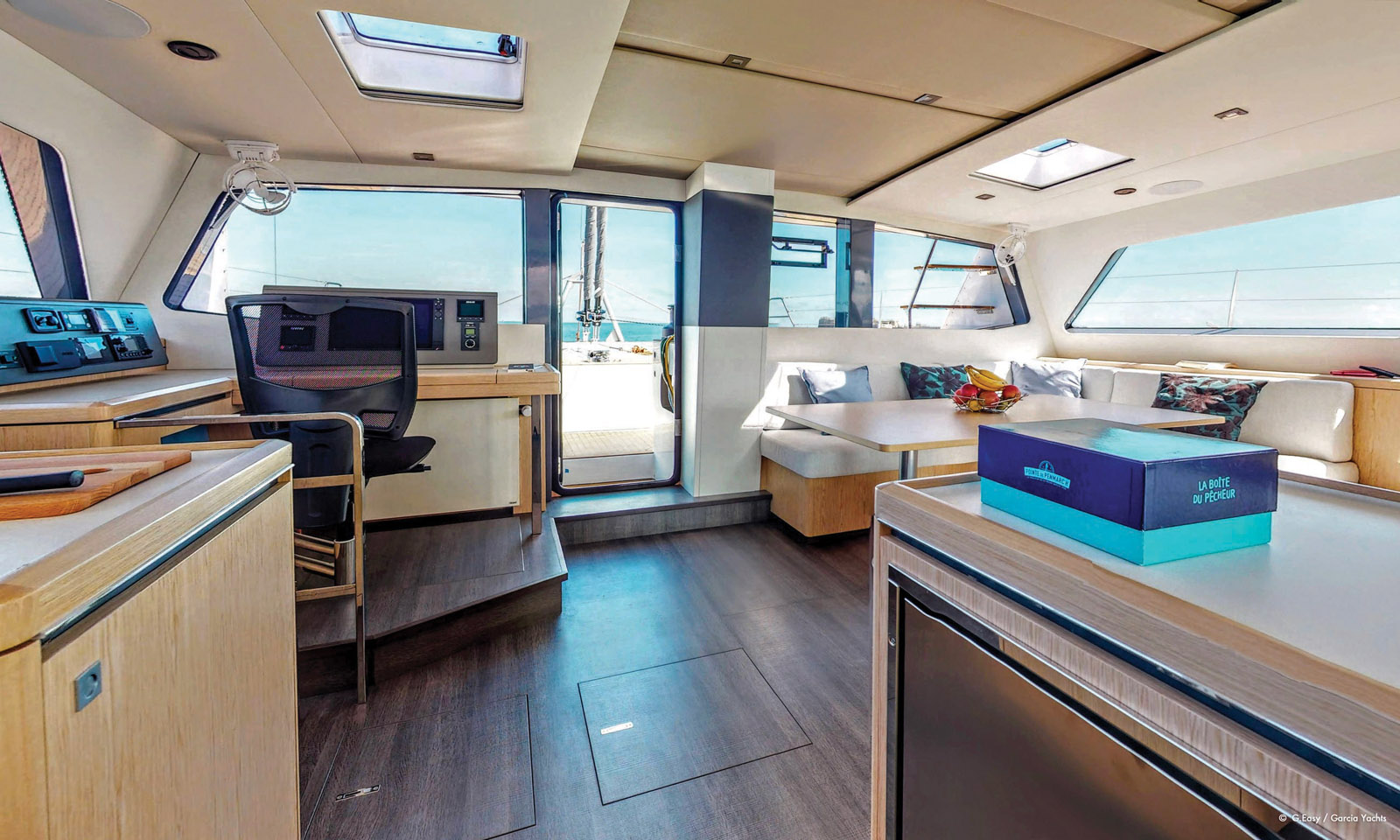
The interior chart table/helm station is very useful when night-sailing or in high latitudes.
Reliable and solid
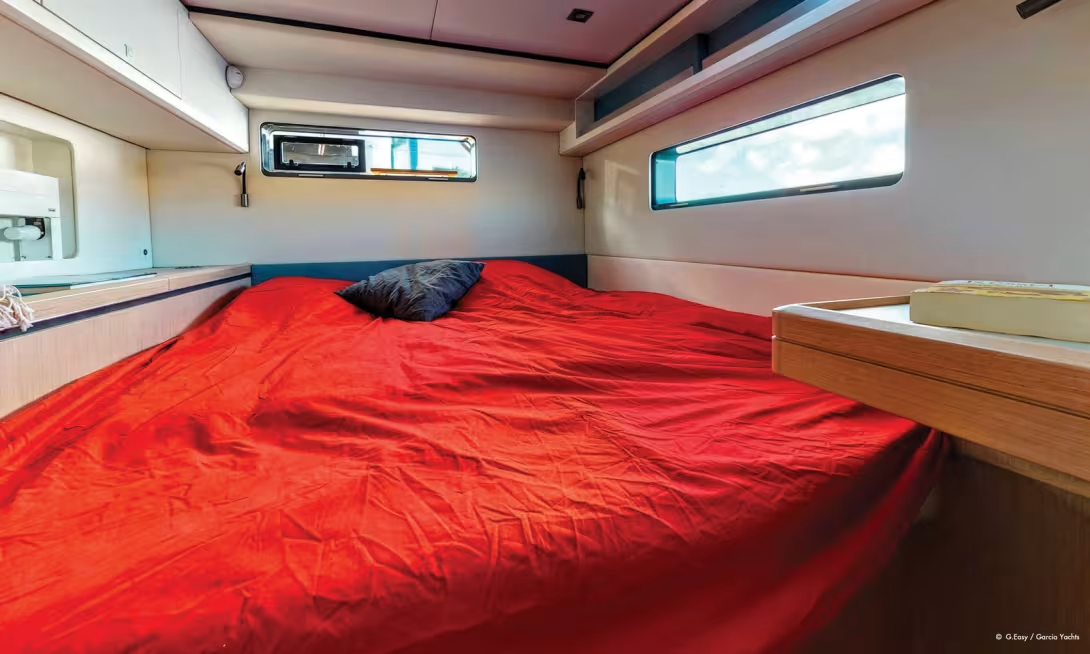
Before we bear away and tease the log up towards 10 knots in a slackening wind, we took a look at the carefully installed systems: clear circuits, fasteners, markings, welded through-hulls rising above the waterline... Nothing revolutionary - at Garcia they always favor experience over innovation at all costs. Priority is given to reliable, solid solutions. The only relevant concession in the 21st century and the diktat of the balance, is the lithium battery technology. As for solar panels, they can accumulate up to 2 kW of charge. It must be said that between the top of the coachroof - the only GRP part of the boat - and the davits, there is plenty of space available for the solar panels! In the hulls, the silence is surprising, an indirect benefit of the thermal insulation which also helps the acoustics. To starboard, the owner’s suite occupies the entire length. Between multiple storage spaces, relaxing sofa, large bathroom with separate toilet, 15lb (7 kg) washing machine, XXL shower cabin and even a desk, there is more space than in a Paris or New York studio! Unless you opt for the four-cabin version, the port hull is dedicated to guests, with several combinations of bathrooms, showers and toilets available.
Conclusion
We take the helmsmen of the Explocat 52 at their word when they tell us they’ve reached 15 knots (13 knots steady speed) in 20 to 25 knots of wind. Pure performance, however, is not the big objective of this Explocat, rather that this pleasantly surprising catamaran is designed above all to push the usual geographical limits of multihulls. Everything has been put in place to achieve this, between choice of materials, architectural orientations and proposed options. Given that the boat is so beautifully presented inside and outside, it came as no surprise to hear that another half a dozen have been sold off-plan since we did this test.
A word from the architect - Pierre Delion
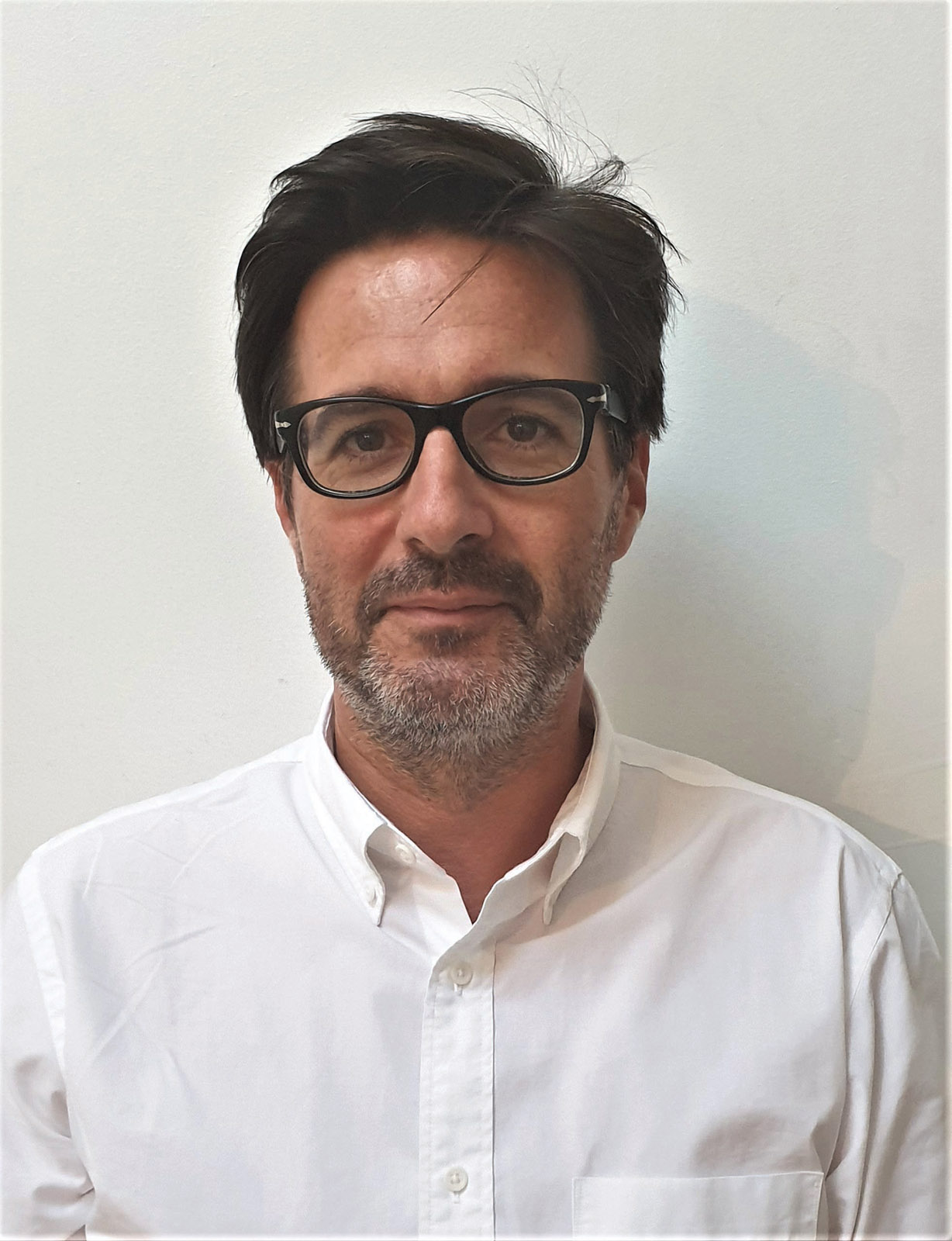
The Pierre Delion Naval Architecture Agency was born from a passion for sailing. By also developing their work with professionals, the team has been enriched by the various uses for boats encountered. Although it’s taken time to get there, the Explocat 52 project “benefited from a rather exceptional alignment of the stars”, Pierre Delion tells us. “Shipyard, naval architect, designer - everyone was in phase, with a coherent set of specifications, and we all worked to produce a quality result.” For him, aluminum is “an obvious choice” for this type of program. “The yard has the know-how for impeccable execution; the architects and designers have taken care of the aesthetics and nobody has ever missed anything in terms of weight specifications,” which is enough to forget the defects generally associated with the material. “Solidity, safety, comfort and performance are as expected, in this first collaboration with Darnet Design.” Let’s bet it won’t be the last.
The Pluses
+ Performances far superior than expected
+ Overall consistency and quality
+ Successful general aesthetics
The Minuses
- Helm a little firm
- Aesthetic but fragile adhesive wrap
TECHNICAL SPECIFICATIONS
Builder: Garcia Yachts (France)
Naval architecture: Pierre Delion
Interior design: Darnet Design
Length: 55’7” (16.95 m)
Beam: 26’11” (8.20 m)
Draft: 4’11” (1.50 m)
Light displacement: 41,000 lbs (18.6 t)
Upwind sail area: 1,800 sq ft (167 m²)
Gennaker: 1,990 sq ft (185 m²)
Engines: 2 x 60 hp (or 2 x 75 hp)
Water capacity: 174 US gal (660 l)
Diesel capacity: 2 x 145 US gal (2 x 550 l)
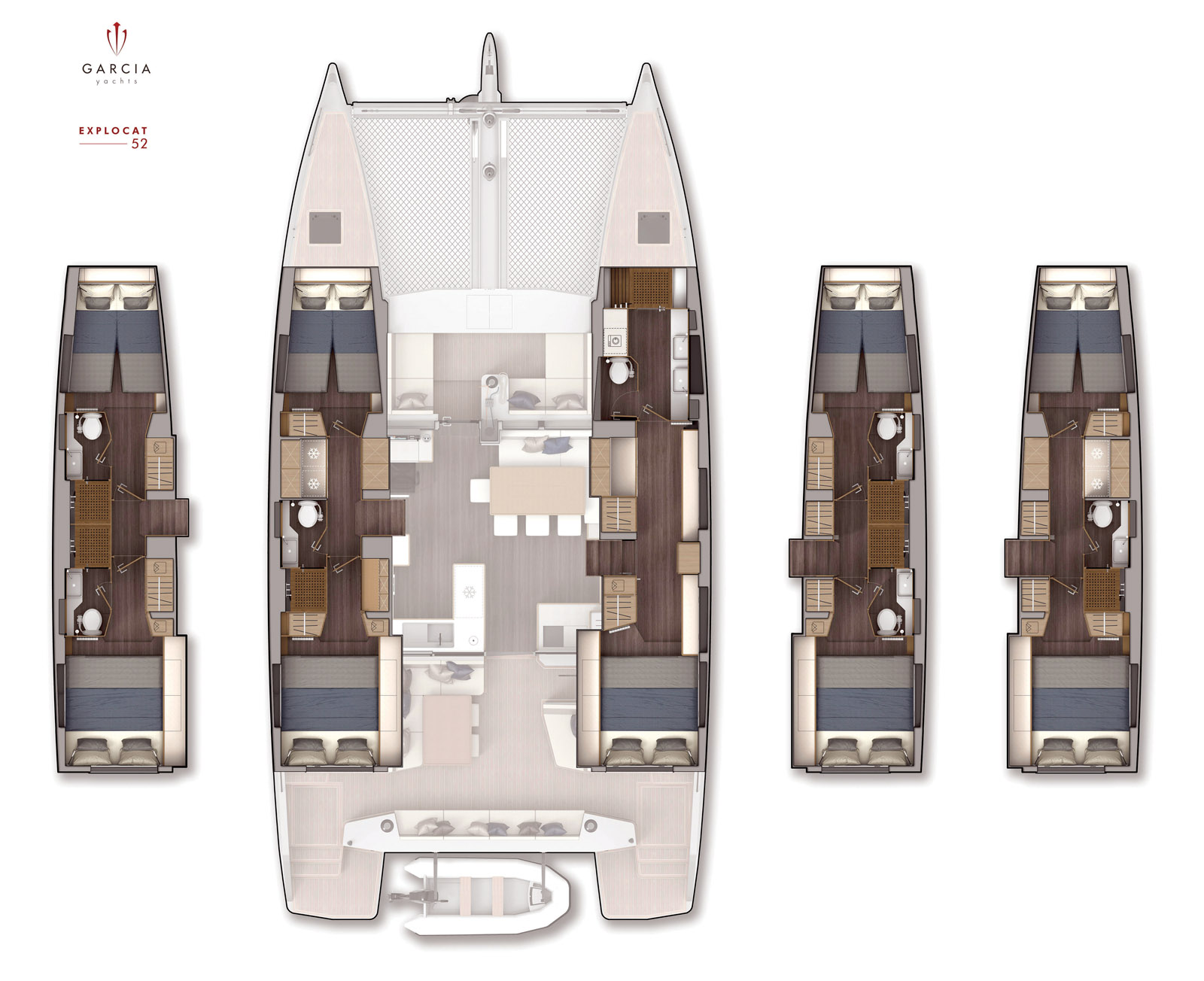
Price of the standard version (3 cabins / 2 bathrooms) ex-tax: € 1,232,700
Price of the model we tested: € 1,438,000 ex-tax
Main options ex-tax:
4-cabin / 3-bathroom version: € 19,000
26.5 US gal (100 l) / hour Watermaker 220 V/24 V: € 14,999
Diesel water heater with air heating: € 15,532
Volvo 75 hp engines instead of 60 hp: € 8,486
Electric motor controls: € 6,472
Helm control at the chart table: € 895
Solar panels 1,080 W: € 5,442
B&G electronics pack: € 34,580
Carbon mast : € 105,060
Staysail on furler: € 14,229
Gennaker and furler € 8,922
Electric Winch 65 ST: € 4,038
Aft cockpit upholstery: € 5,989
Marine Deck coating on side-decks: € 28,560
Preparation, delivery, handover: € 12,051