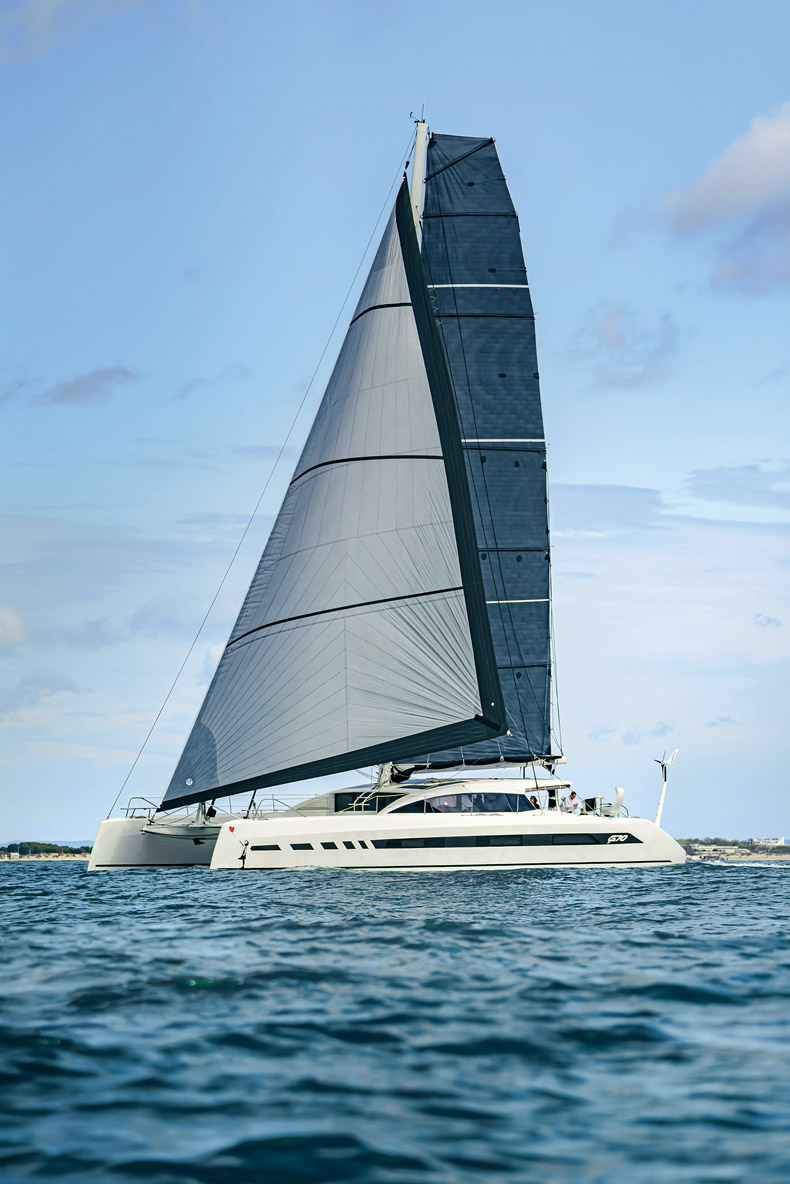
The GP70, previewed at the International Multihull Show 2024 in La Grande-Motte, stands out from its competitors of the same size thanks to deliberate choices aimed at clearly asserting personal use by the owner. The philosophy is clear and precise: this extraordinary catamaran is aimed at a select club of enlightened, wealthy yachtsmen who want to enjoy multihull sailing for themselves. The presence of a skipper or crew will in no way detract from the program, but the general idea is to enable a seasoned couple or a short-handed crew to take control without imposing physically demanding maneuvers. Energy self-sufficiency, top-of-the-range equipment, adapted deck hardware (electric assistance for sailing maneuvers), a powerful sail plan, but exceptional construction... all these elements go into creating top-level performance.

Infos pratiques
- Le chantier : GP70
- La fiche technique
-
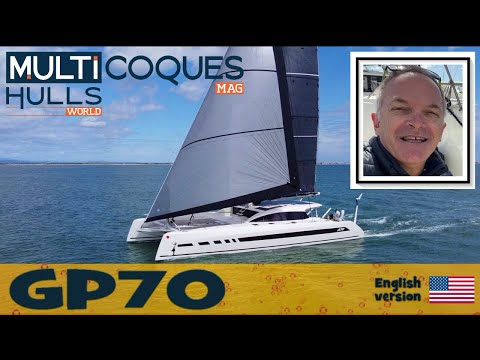 Découvrez notre vidéo exclusive
- Financez votre GP70
- Assuez votre GP70
- Articles autour du GP70
Conditions : 15 to 28 knots, sea state slight to moderate
Despite the difficulty of finding a berth for a very large multihull - and the cost of such a berth - the multiyacht segment is experiencing strong growth, even though production of these XXL units is limited to just a handful of builders worldwide. These superlative multihulls fall into two categories: small series and custom. Sometimes, they fall somewhere in between: the GP70 featured here was built as a one-off unit... but could well attract other buyers!
Design for an attractive silhouette
Designing a 70-foot (21 m) sports catamaran is a challenge, almost an architectural feat, since the purity of lines of a racing machine (take Orange 2 as an example) must be sacrificed to install a coachroof as “elegant” as possible, and that will house all the expected amenities. To be successful, this design must clearly reflect the program’s cornerstones, assert a personality independent of fashion and competitors, and suggest the avant-garde while avoiding the pitfall of over-design. This is how a custom multiyacht can hope to span several decades without becoming dated.
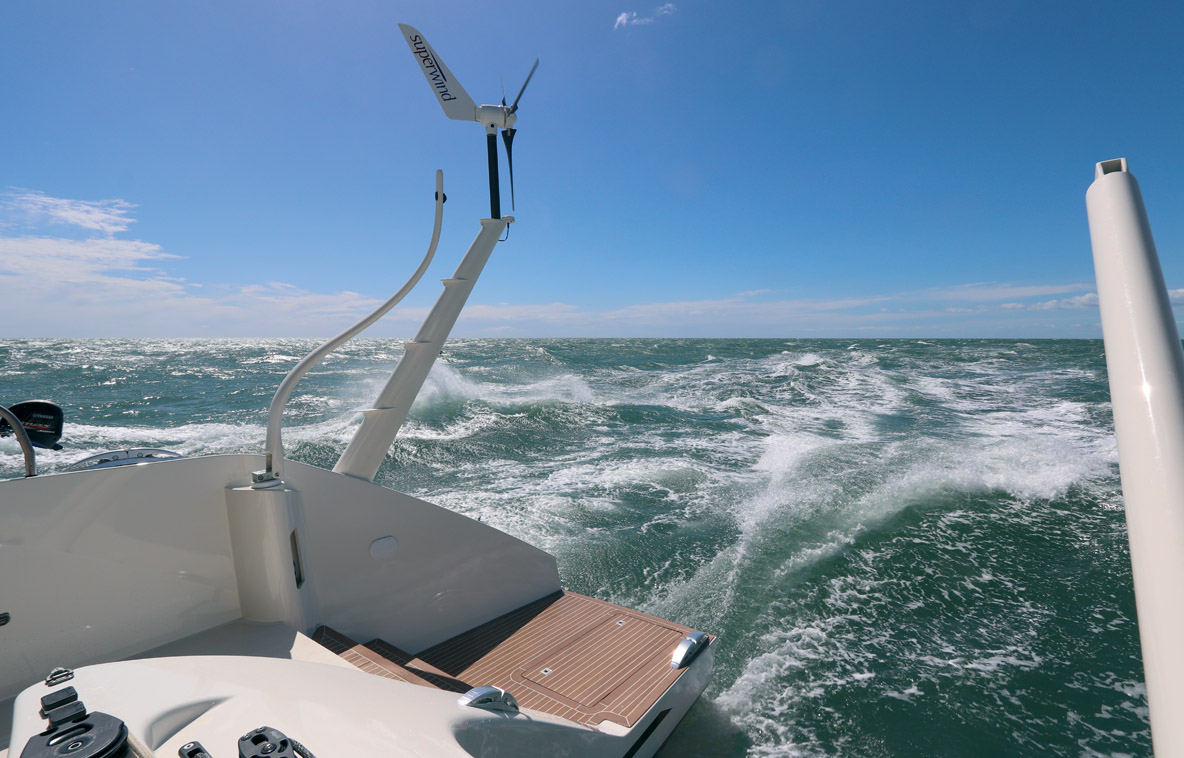
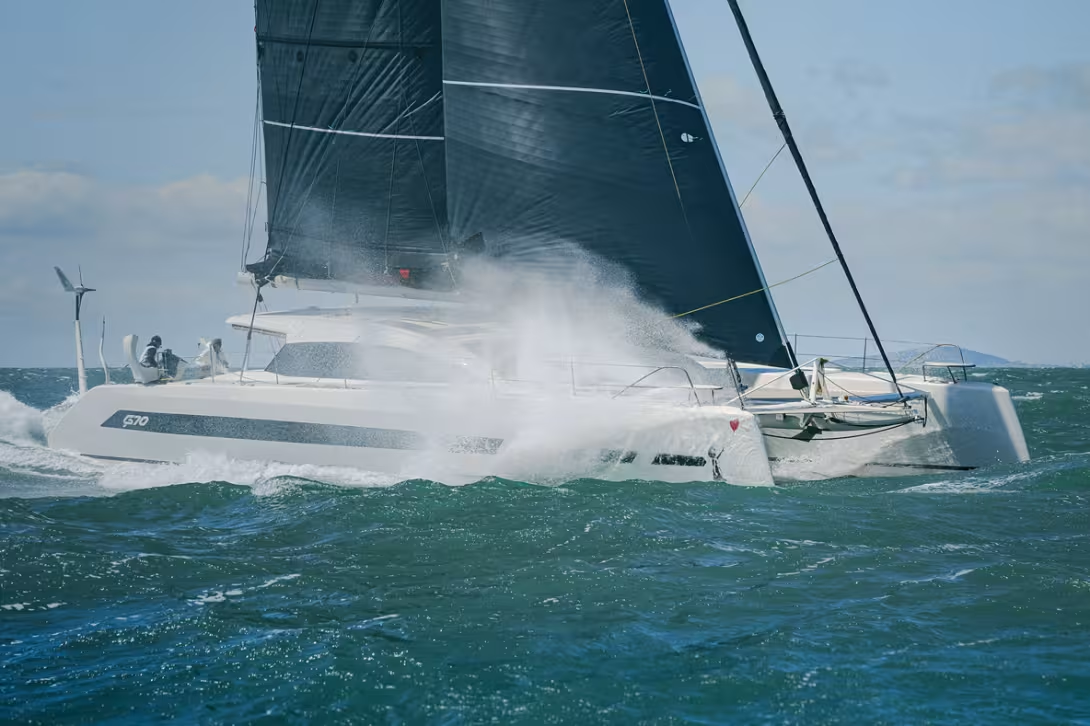
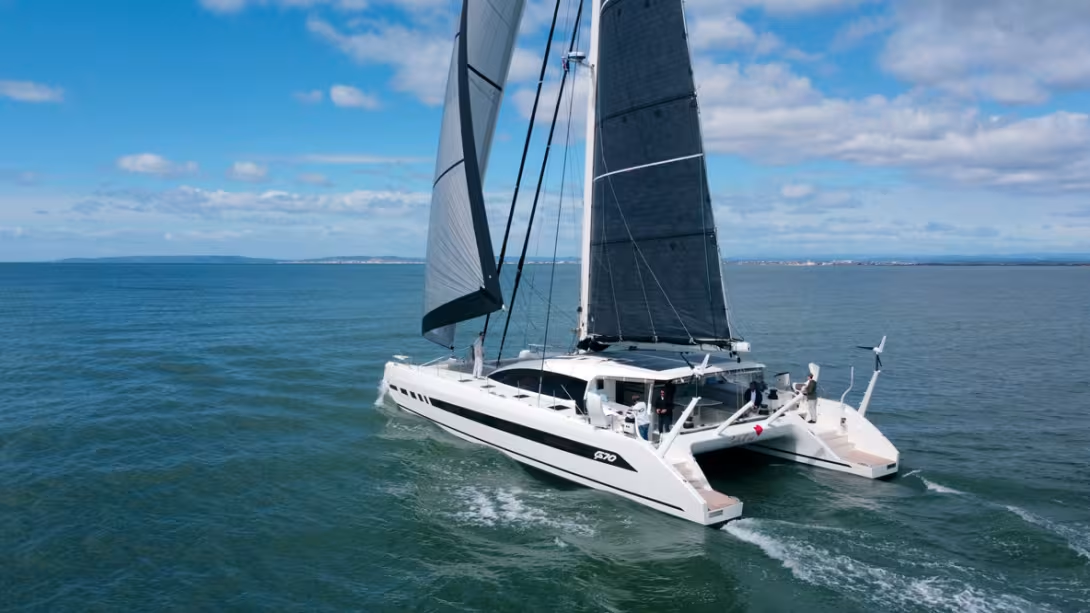
Catch Me is certainly one of these: the overall balance of shapes and proportions is striking, with finely inverted bows, artistically integrated sugarscoops, the cabin windows skillfully concealed in the topsides by a striking black band, not forgetting the attractive wings carrying the wind generators... the care taken in the design of the identifying elements is obvious. The slenderness of the 70-foot hulls, the streamlined sail plan culminating at almost 90 feet (27 m) up, the controlled impact on the overall line of the coachroof with its seductive edges, allow the eye to focus on the silhouette rather than the protruding elements. The VPLP design team composed the score with their customary talent, while designer Patrick le Quément’s smoothing touch came into its own, and the stylistic and technical arbitrations supported by project manager Guy Delage worked wonders.
Construction: excellence everywhere
!
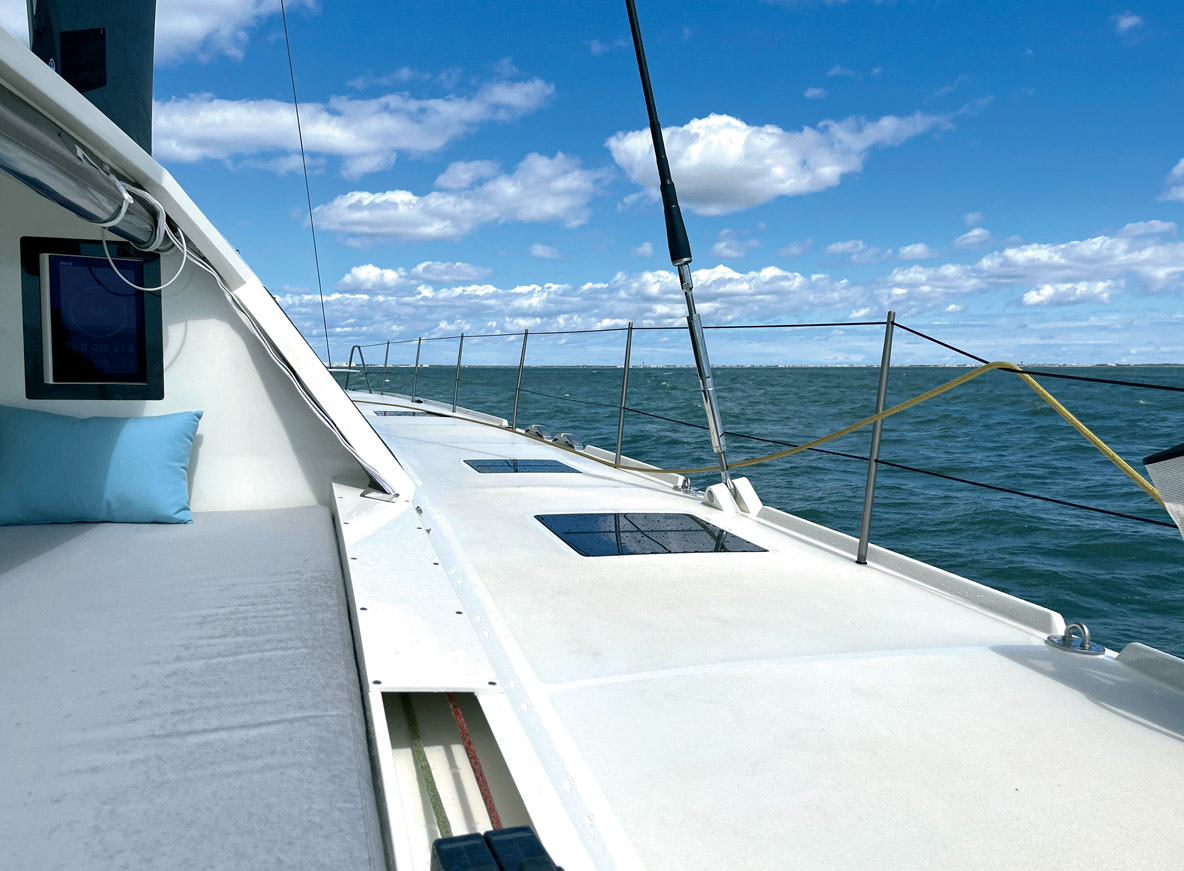
After design, the other major challenge in building a catamaran of this class is to keep to a tight weight specification. The principle is to avoid unnecessary weight in the chassis (while taking safety margins into account), and above all not to spoil the beautiful work by adding excess weight with the interior fittings (which can be in the order of several tons on these big multihulls). It’s easy to say, but complicated to achieve, as all arbitrations are potential areas of conflict between the parties if the real objective is not 100% shared. Wisely, the project management team had the hulls made in glass/epoxy foam sandwich (by Technologie Marine) before shipping these large parts to Trimarine Composites at Setubal, south of Lisbon, Portugal, one of Europe’s masters in nautical and industrial carbon. The advantage of this material is greater resistance to the impacts of cruising, better repairability and less resonance. All the rest of the machine is made from vacuum-packed, post-cured carbon-epoxy. All deck hardware (stanchions, pulpits, pad eyes, etc.) is in titanium.
I
nterior: ne quid nimis
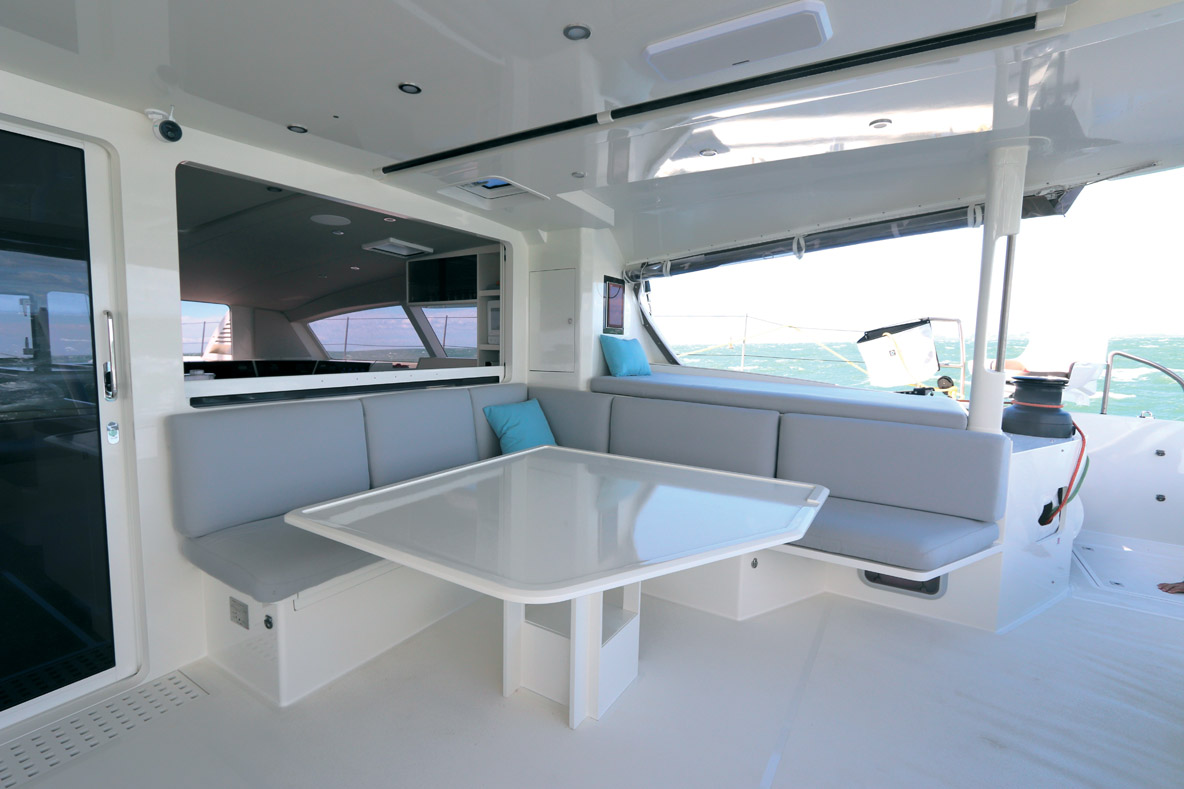
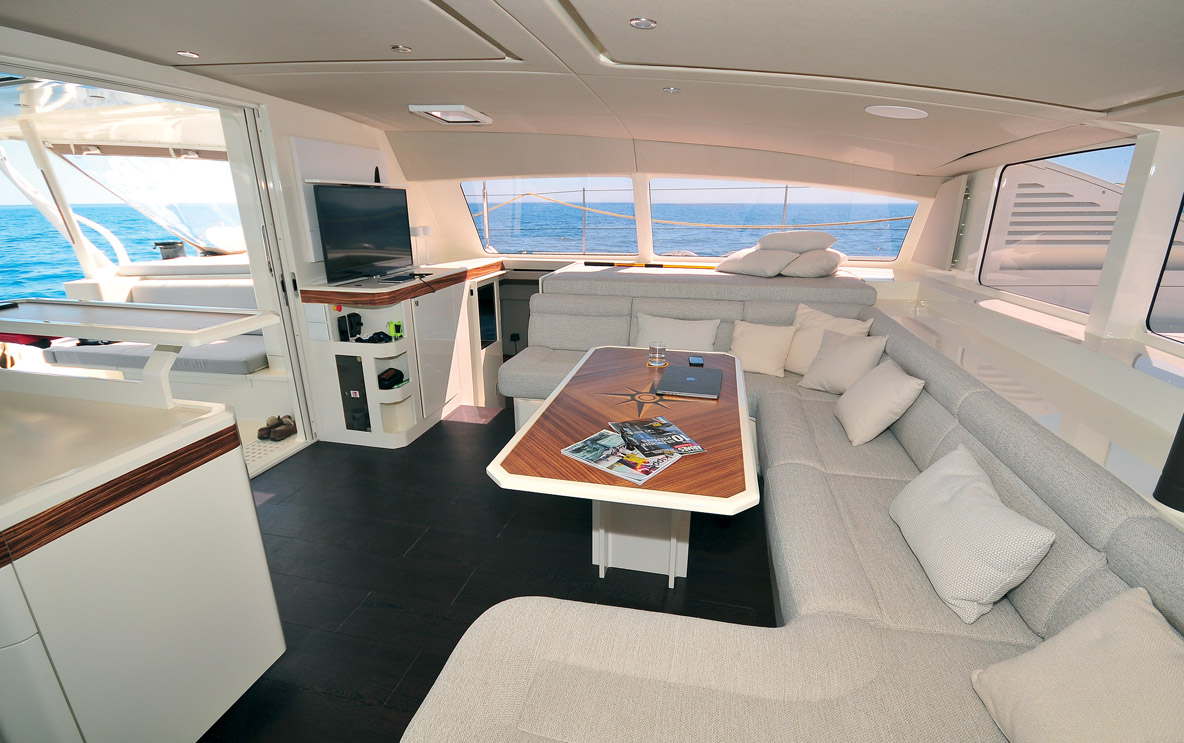
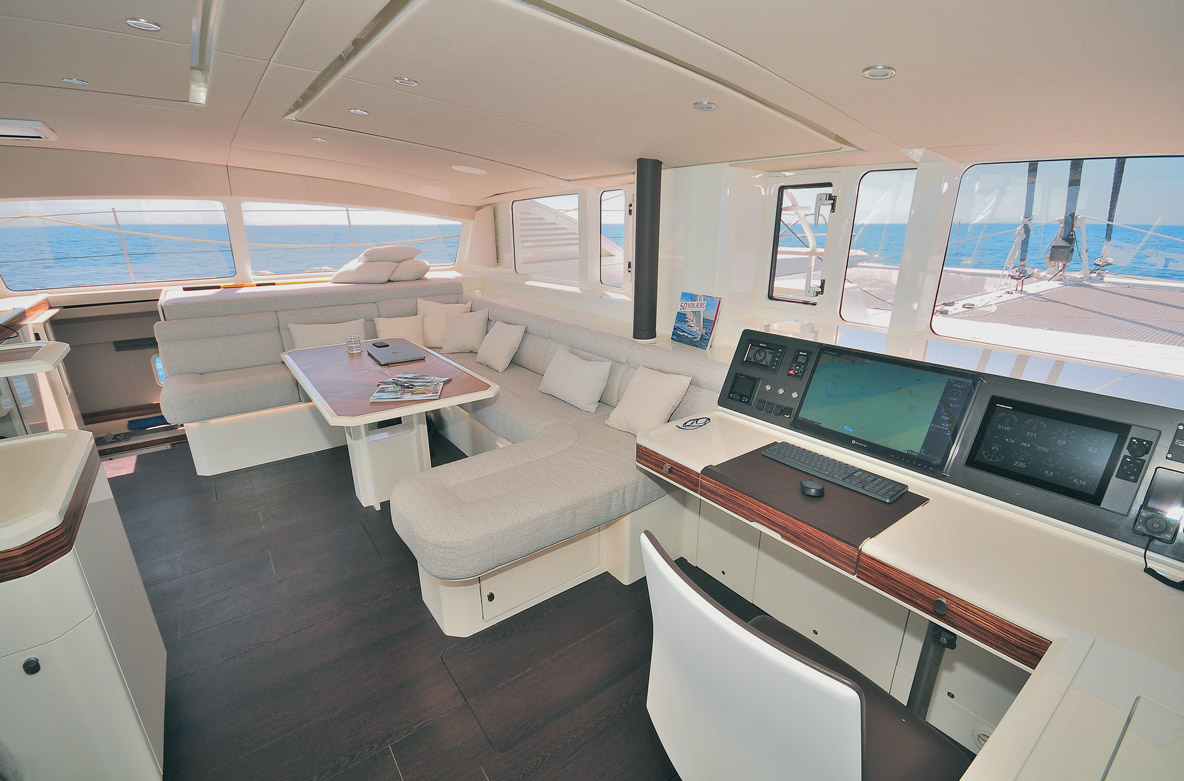
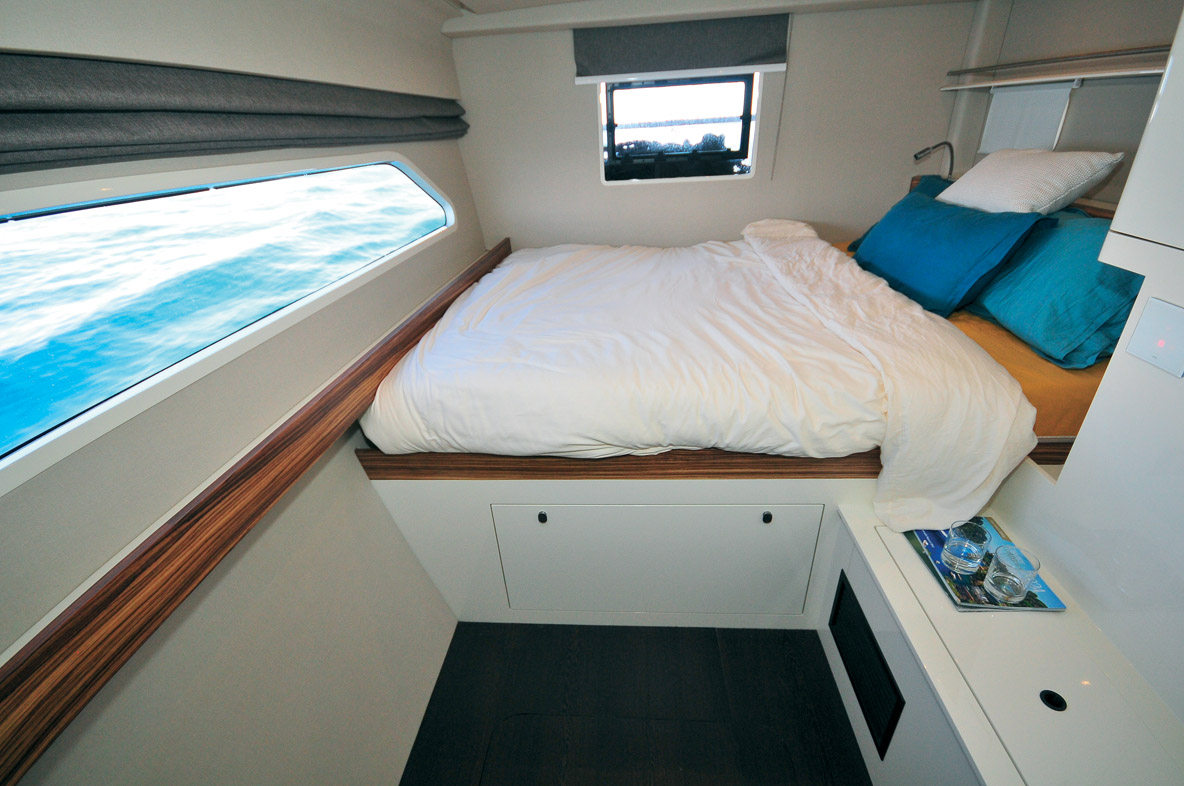
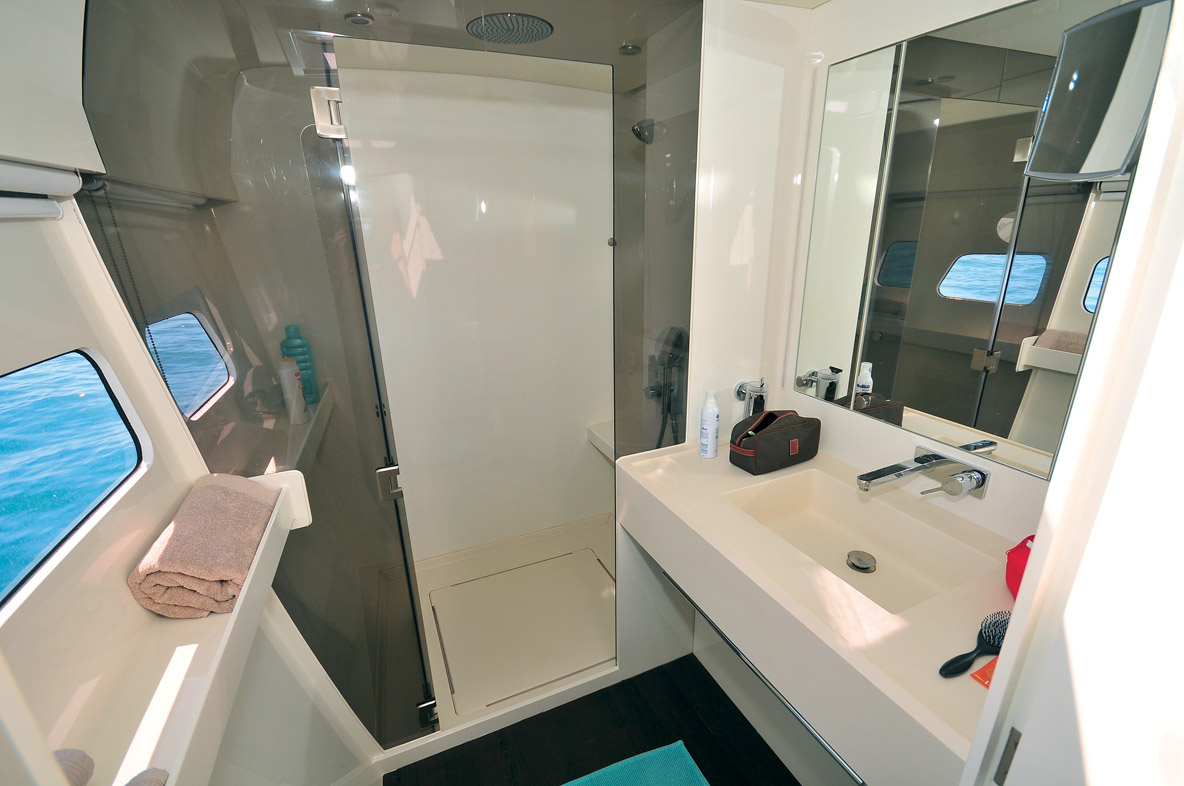
The Latin phrase “Nothing in excess” perfectly sums up the catamaran’s interior style. Volumes are obviously present, but it’s above all the purity of lines and perceived quality that fuel the first impression. All the fittings are made in carbon sandwich using molds. The style is resolutely modern without being cold or boring. As for the splendid Oyster shade paint, it catches the light perfectly, and the magnificent, grained wood paneling (desk, bar, saloon table, cabin fascias) enhances the interior of this art deco vessel with a Scandinavian touch. The port hull is dedicated to the owner, with two single berths in the passageway (one of which is retractable) and a full bathroom (separate electric freshwater toilet). To starboard is a large double guest cabin (with the bed set athwartships) with en-suite bathroom and toilet. Forward is a double cabin (with en-suite bathroom and toilet), convertible into single bunk beds. A skipper’s cabin is located forward in the hull (with its own separate access). On the opposite side, to port, is a sail locker adapted to the volume of sails to be stored. The nav station is perfectly suited to monitoring the boat’s progress, even in sustained weather conditions (as we were able to verify...). A small TV lounge, bar and saloon table provide a welcoming atmosphere for the crew, complementing the outdoor saloon, which is fully covered by a bimini top that blends into the silhouette. The galley is inspired by the designers’ experience and offers perfect functionality with a carefully conceived ergonomic layout (bravo for the top-opening fridge-freezers. Front opening landlubber’s refrigerators should be banned, in my opinion, from any autonomous voyaging program. There’s a large moveable panel that allows direct communication with the cockpit saloon).
Energy and resources: setting a course for self-sufficiency
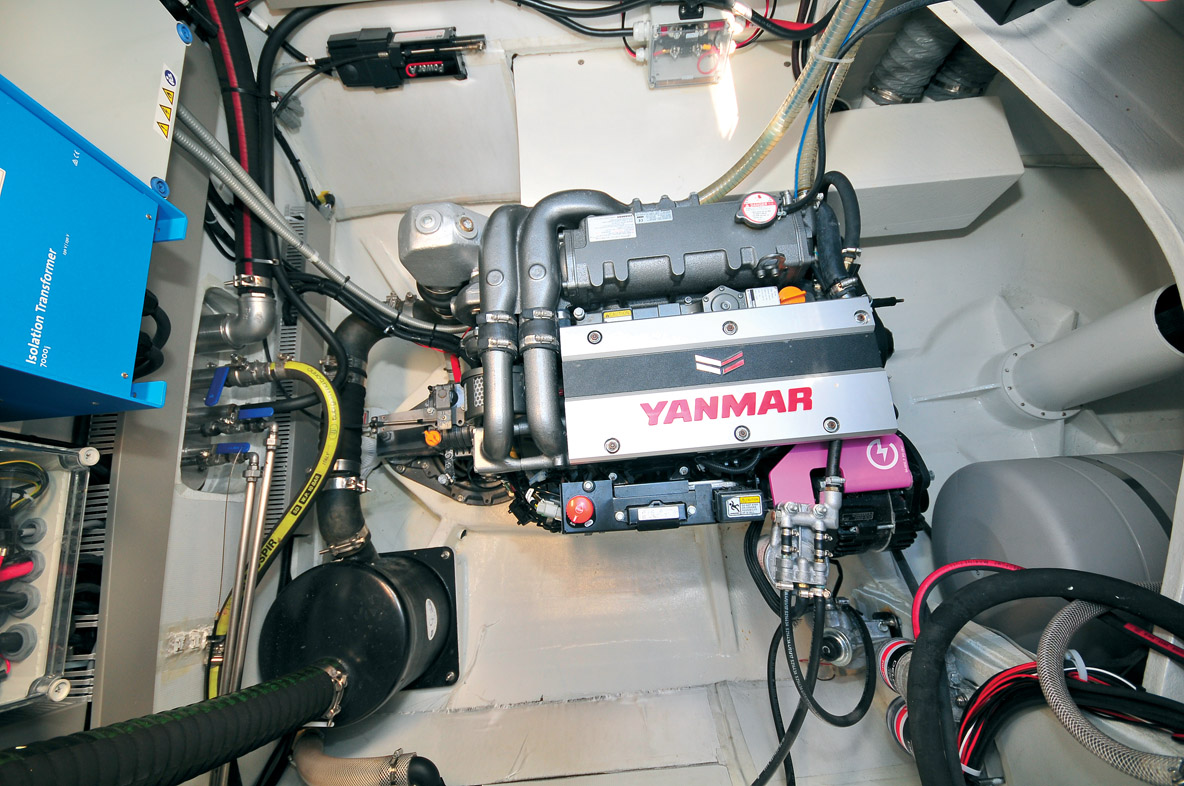
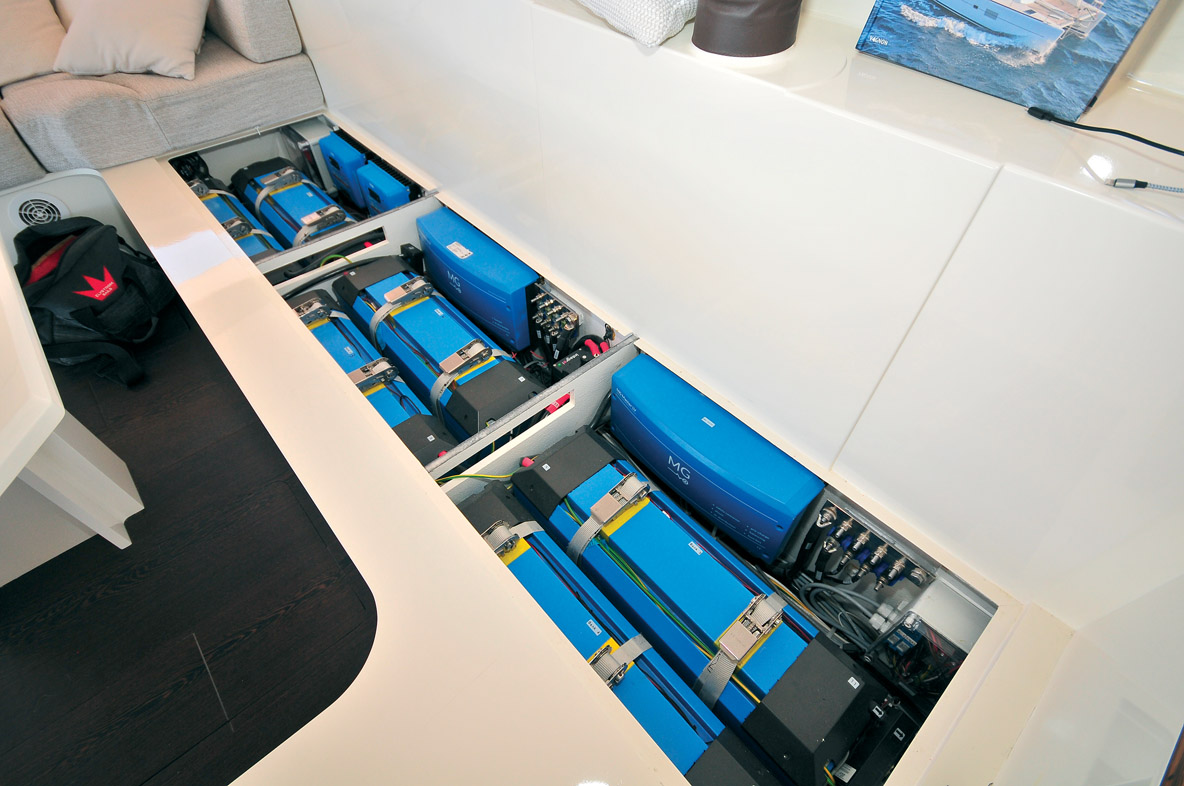
If we consider it an essential objective of a sailing voyage to be able to let go and dispense with any constraints - such as a technical stopover - then electrical autonomy, water supply and equipment reliability are the keys. Integrel is the name of the system at the heart of this, with two generators (large high-tech alternators) coupled to the engines and supplying a bank of 24/48 V lithium batteries and a 48/230 V inverter. The availability of this revolutionary system provides 2 x 4.5 kW at idle and up to 9 kW per engine at 8 knots if required, all avoiding the weight, bulk and nuisance of a generator. The two wind generators provide 80% of ordinary power requirements, with 3 kWp of solar panels providing additional power if required. The water tanks (1,100 liters / 290 US gallons - to be left empty once the watermaker has been confirmed reliable) and fuel tanks (2,000 l / 525 US gal - no need to fill them, this is maximum capacity) are structural, centered and compartmentalized in the bilges. Soundproofing has been meticu-lously designed. Finally, odor prevention and ventilation are top priorities. The electronics (GPS, radar, communication, weather) are complete. Webasto heating and Frigomar air condi-tioning are there to regulate the temperature of the climates encountered.
A rig perfectly adapted to the program
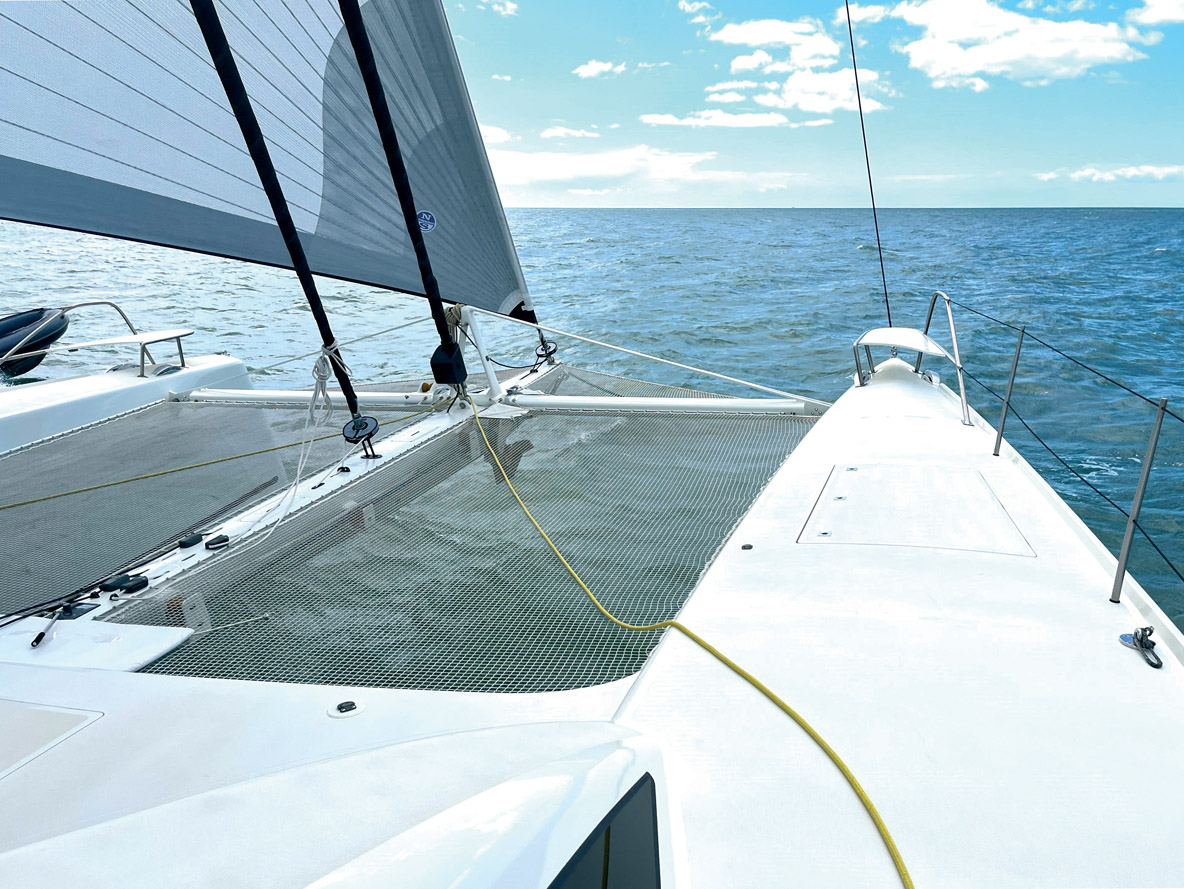
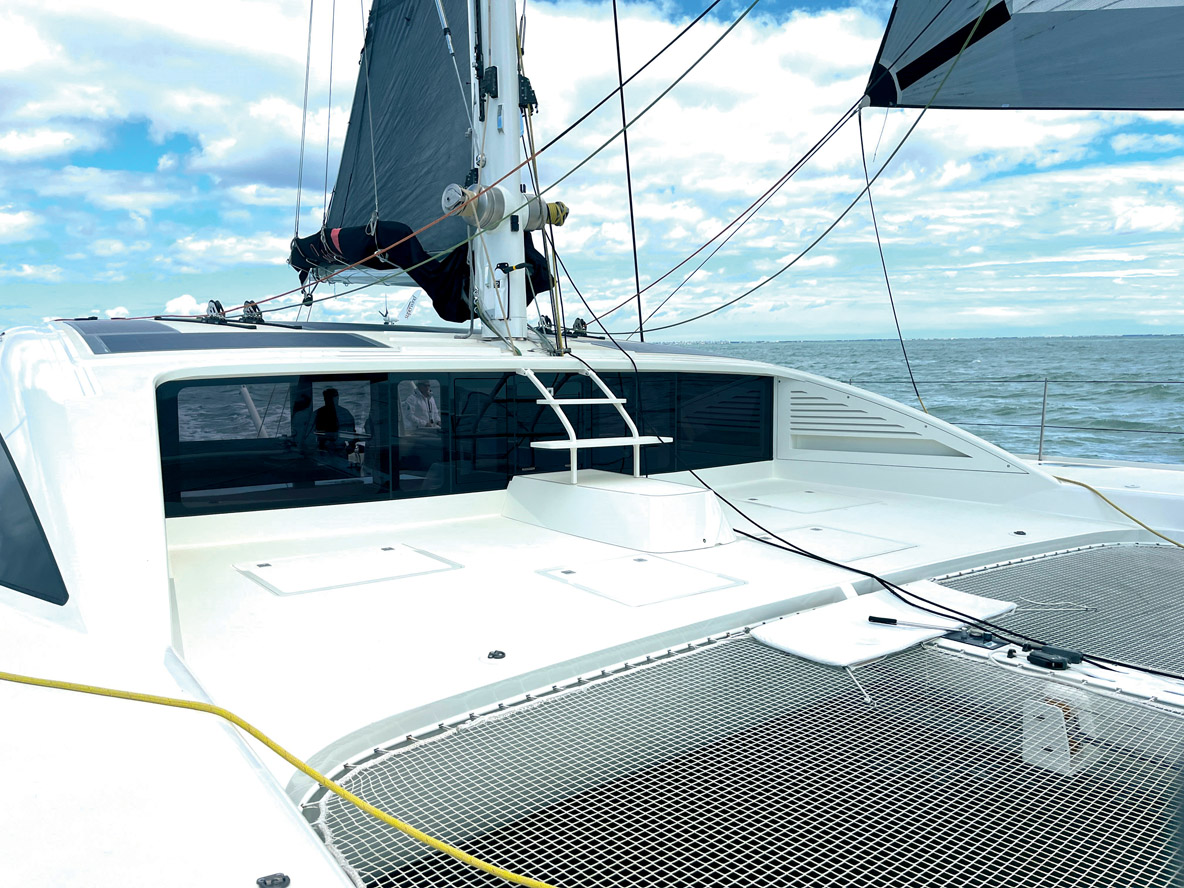
The Axxon mast in high modulus carbon with a single set of spreaders is reassuringly sturdy. The caps are set far back, offering a wide shroud base for maximum safety. The compression beam houses the staysail tack (with hydraulic tension adjustment) and the gennaker furler system, designed to remain on station during the range of use. The solent is secured at the connection with the forward beam, which is a masterpiece in itself, with carbon cathedral post and martingale. This layering of sail area, its availability, and the “racing” quality of the deck hardware are the keystones to using this big catamaran.
Enthusiastic seakeeping behavior
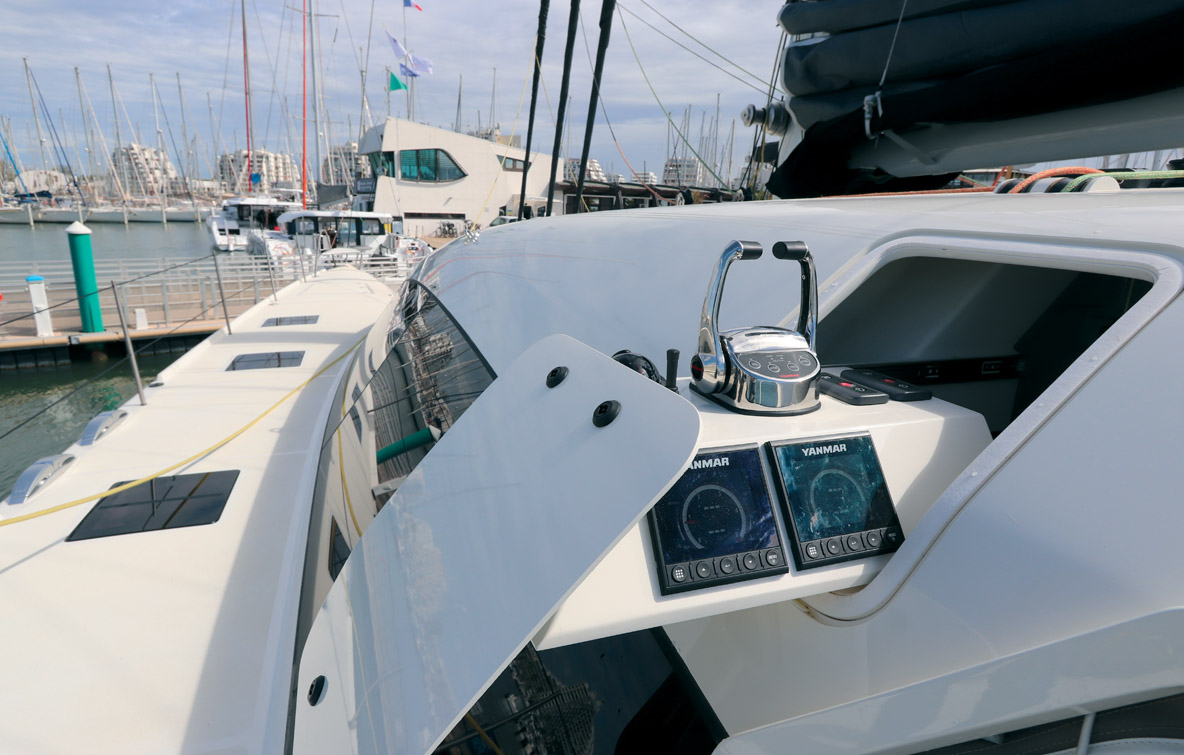
Having got a little more familiar with this XXL multihull, and let’s ignore the price tag, which inevitably runs into many millions, it was time to get Catch Me out on the track and discover the GP70’s true personality, and even her secrets... We set sail from La Grande-Motte at the end of the boat show, after waiting for a 45-knot northwesterly gale to do its thing. The following day, the Tramontane (the local wind that reigns supreme in the western Mediterranean basin) was blowing at 15-18 knots, allowing a controlled departure from the pontoons. The remote helm station invented by Guy Delage and perfectly implemented by Trimarine reveals the intelligence of this system on a large catamaran. The drawers housing the engine and pilot controls are cleverly positioned in a recess in the coachroof, on either side of the cap shrouds. This gives total visibility and perfect maneuverability in the maze of this crowded marina. The power of the twin 80-HP motors is reassuring (though moderate for this size of vessel), and the screw of the folding propellers into the water provides adequate torque, even in strong winds on the beam. We set sail with one reef and the solent for an initial trial run at 10 - 12 knots, only to discover that the forecast NW 25 knots turned out to be more timid. With the full main and gennaker set, we got to grips with the deck layout and sailing maneuvers: furling the large solent was a mere formality for the attentive crew member, thanks to the motorization of the Facnor EC70 furling system. To port, in the cockpit, you’ll find the (very) large Antal 72 winch (electric, like all the winches on the boat). Thanks to its colossal strength and extraordinary diameter, unfurling and furling the 2,045-square foot (190 m²) sail takes around twenty seconds. All the usual maneuvers on the 70 are carried out from the mast step or from atop the coachroof under the fairing. The perfection of the layout ensures easy control, with no mishaps. The traveler, which is often no easy task on powerful multihulls, can be adjusted smoothly on all points of sail thanks to the Antal captive motor. And frankly, I can’t think of a more reliable and efficient helm management system than this wonderful setup.
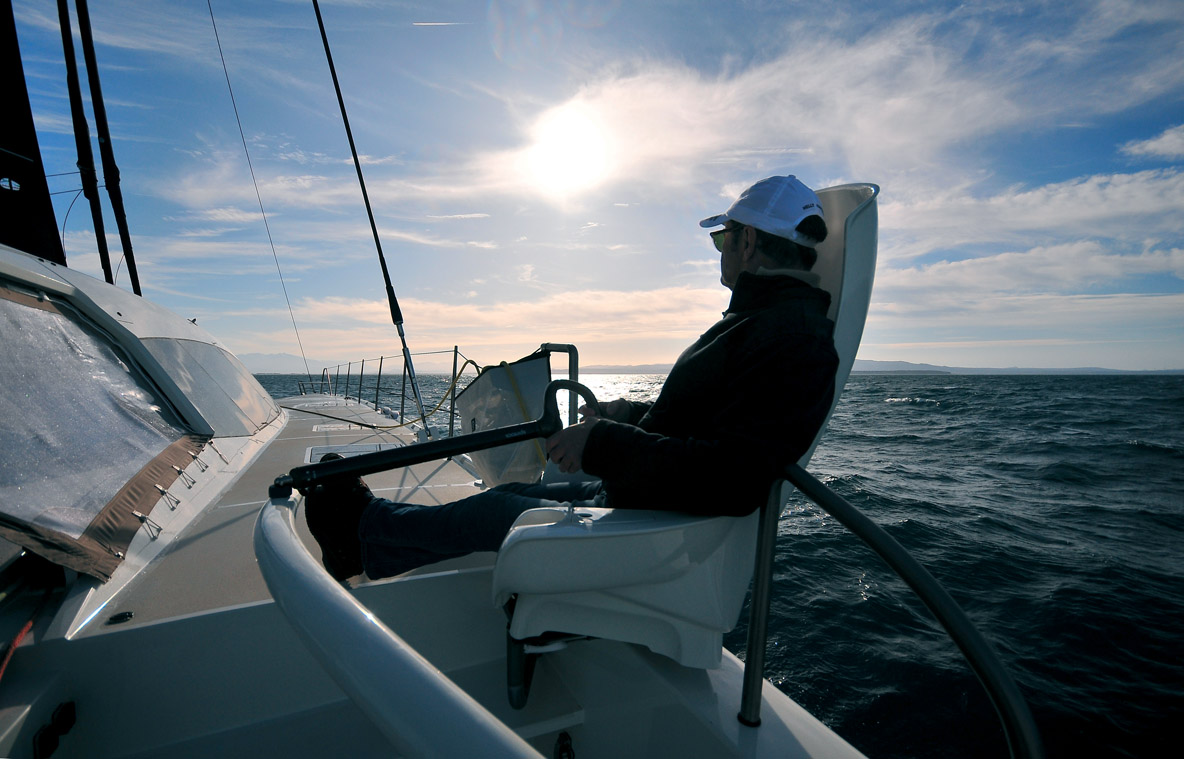
The weather files soon showed us a zone of calm that we’d have to cross under power, though in the end, only one was fired up, and that was enough to take us out at 7 knots in a perfect calm. This episode validated the work done on the installation and insulation. An hour and a half later, the NW swell signaled the return of the breeze and so, under mainsail and solent, then soon under main with 1 reef and staysail that we “attacked” (the word is appropriate!) the Gulf of Lion still shaken by the memory of the 45 knots of the day before and now heckled by a Tramontane strengthening from 22 to 28 knots. It was time to settle into the swiveling, wrap-around helm chairs, where the long tiller (carbon, of course) falls naturally to hand, along with the tiller extension, also in black fiber. Comfortably seated, with all the navigation information grouped on a pivoting console, I applied myself to discovering the machine. To my surprise, the contact with the rudders is precise and light, the directional effect very efficient. For 2 hours, I forgot everything except the pleasure of piloting these 20-meter hulls and getting them through the very bumpy terrain. It’s not Patagonia, but all those who sail this gulf upwind in these conditions learn to respect it. Not just anyone can be a lion... At first between 9 and 10 knots, then at 11 knots, and finally between 12 and 13 knots in the ruts, the VPLP plan accelerates and rises above the mounds. Pleasure at the helm is intense, and communication with the chassis perfect. The sail plan is perfectly adapted to this somewhat rough sailing (1 reef in the mainsail and the 560-square foot / 52 m² staysail). The GP is very fast in these conditions. She’s also lively and agile, very well-balanced and sure-footed, and I bore away for a few hundred meters to safely enjoy almost immediate surfing at 18-20 knots before coming back on the wind again. As we got closer to the coast towards Cap Leucate, the sea calmed down a little and we enjoyed a nice fifteen-mile run in a breezy 16-17 knots of wind before reaching Canet-en-Roussillon. I forgot to mention that we held an effective VMG at 60° to the true wind, and that the GP70’s anti-leeway system is made up of skeg keels rather than daggerboards, and the result is amazing! Also worth noting - we didn’t feel a single slam under the bridgedeck during all those hours of invigorating sailing.
Conclusion
We discovered a high-tech prototype developed with impressive rigor around a fair and harmonious concept. The perfect combination of elements gives this multihull a rare uniformity. The maturity of this recently- splashed catamaran is truly astonishing, given its short running-in period. A dagger- board version is available for even more exclusive use, but that will come at a price of certain constraints (deck space, appendage maneuvering, tricky to take the ground and for storage ashore, fragility in the event of an encounter with a UFO – unidentified floating object) and added weight.
A presentation of Trimarine by Henrique Brites, shipyard manager
The right concept. A superb object totally dedicated to its function
Marine qualities and sailing/helming pleasure
Do we need to mention the money?
Technical specifications
Architects: VPLP Design
Exterior designer: Patrick le Quément
Structural optimization: GSEA design
Interior design: Jean Yves Carteret Linea Concept
Project management: Guy Delage
Hull material: Corecell foam/glass/epoxy sandwich with carbon reinforcements
Material nacelle/coachroof/structure/mast/boom/compression beam/forward beam/cathedral and martingale: epoxy carbon or epoxy carbon foam sandwich
Length: 69’ (21 m)
Beam: 32’ (9.75 m)
Draft keels: 5’3” (1.6 m)
Draft daggerboards: 4’7”/9’10” (1.4/3 m)
Light displacement: 38,600 lbs (17.5 t)
Laden displacement: 46,300 lbs (21 t)
Mast: AXXON high modulus carbon
Sails: NORTH 3DI
Mainsail: 1,420 sq ft (132 m²)
Solent: 958 sq ft (89 m²)
Staysail: 560 sq ft (52 m²)
Code 0: 2,045 sq ft (190 m²)
Spinnaker: 3,230 sq ft (300 m²)
Engines: 2 x 80 HP Yanmar, saildrive transmission
Price: by quotation