Based in La Rochelle, on France’s Atlantic coast, the Chantier de l’Arsenal shipyard is best known for its day charter catamarans. These 60- to 90-foot units, known as Day 1s, have already seen fifteen examples sold worldwide. The manufacturer is also interested in electrically-powered utility catamarans, and last September launched its very first recreational multihull. An eco-responsible approach has accompanied the entire project, which is why the GreenCat 52 has pride of place in this Forever Green Special Issue...

Infos pratiques
- Le chantier : Greencat 52'
- La fiche technique
-
 Découvrez notre vidéo exclusive
- Financez votre Greencat 52
- Assuez votre Greencat 52
- Articles autour du Greencat 52
Conditions: Calm to slight seas, 10 to 15 knots of wind
A catamaran like no other: it’s not often that a professional boatbuilder ventures to build a one-off, and an eco-responsible one at that. Philippe Renaudeau is a specialist in yacht design and large-tonnage vessels, but his primary passion is sailing. He set about designing a catamaran that was light, uncluttered, relatively traditional in terms of deck layout and interior, and finally, eco-responsible: “This multihull, intended for offshore cruising, was initially to be built in epoxy plywood. I wanted to break away from fashion and have a lightweight unit. For me, this means I can sail faster and get to safety more quickly if necessary. What’s more, there’s less stress on the rig and structure.” At the same time, there was a couple looking for a catamaran suitable for a round-the-world trip for two, that would be easy to handle and feature an Owner’s hull... it was Michel Vermeulen who received their very first request, “in a three-line e-mail”, he laughs. This marine industry professional made the connection with the architect and the Chantier de l’Arsenal, and the project got underway! Broadly speaking, the GreenCat 52 remains faithful to the original plans, except that the construction process has evolved from wood-epoxy to the One Shape® technology developed by the builder. This process consists of assembling PET sandwich/foam panels that have been digitally cut and then curved before assembly. This technique offers a huge advantage for one-off construction or small production runs, since it eliminates the need for costly molds. The use of recyclable materials and the absence of molds demonstrate the eco-design process to which Chantier de l’Arsenal adheres - the builder also uses flax fiber and is looking at biosourced resins.
A classic but proven deck plan
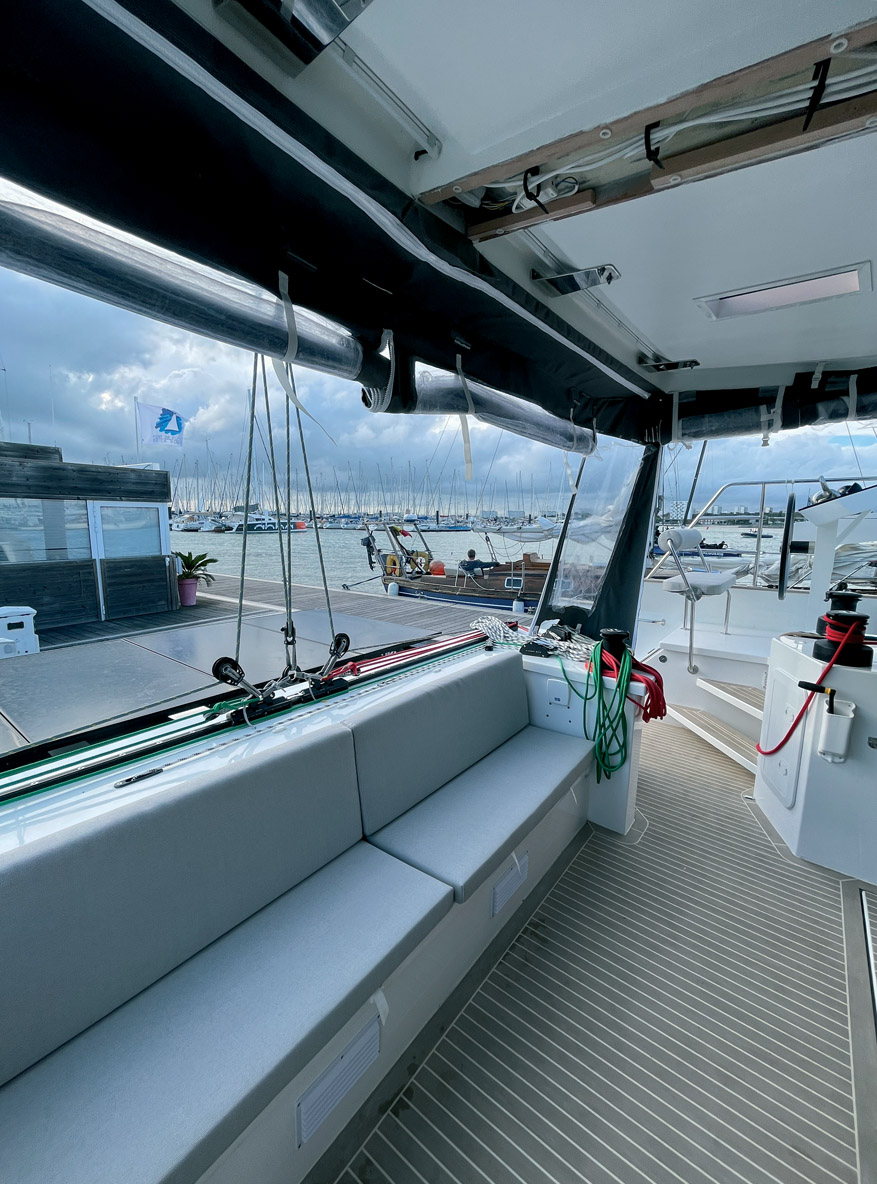
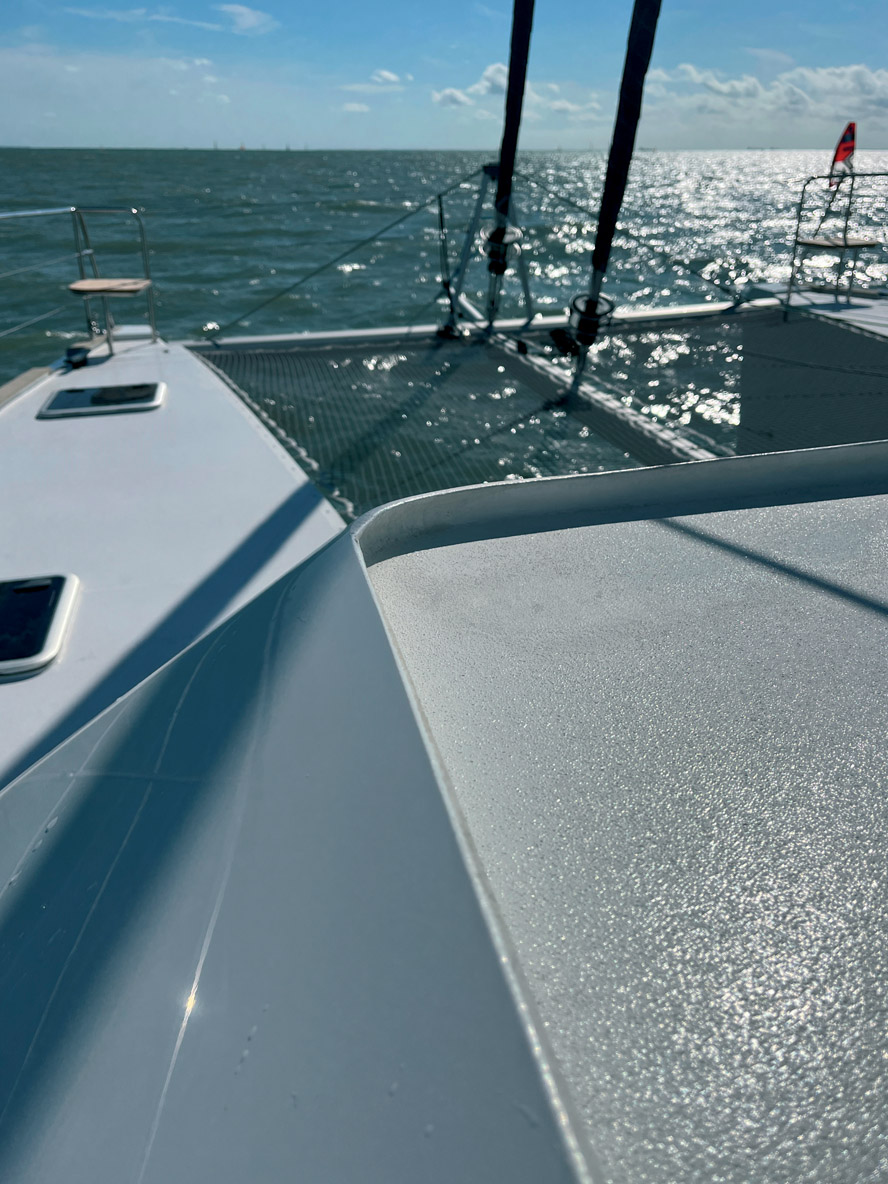
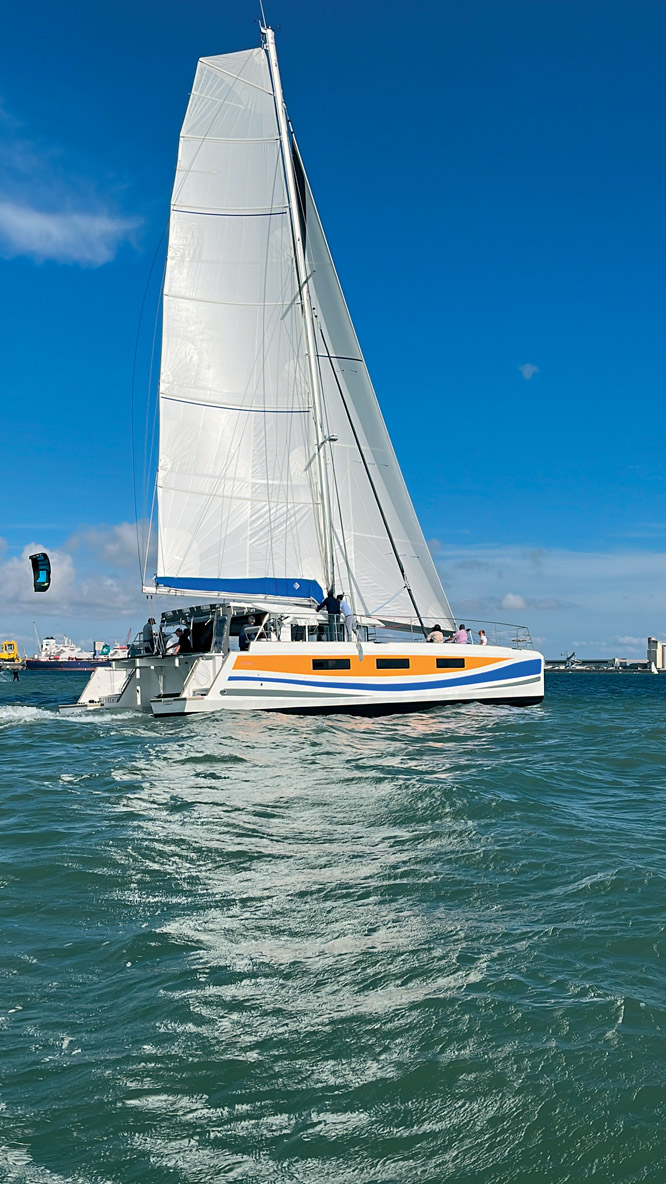
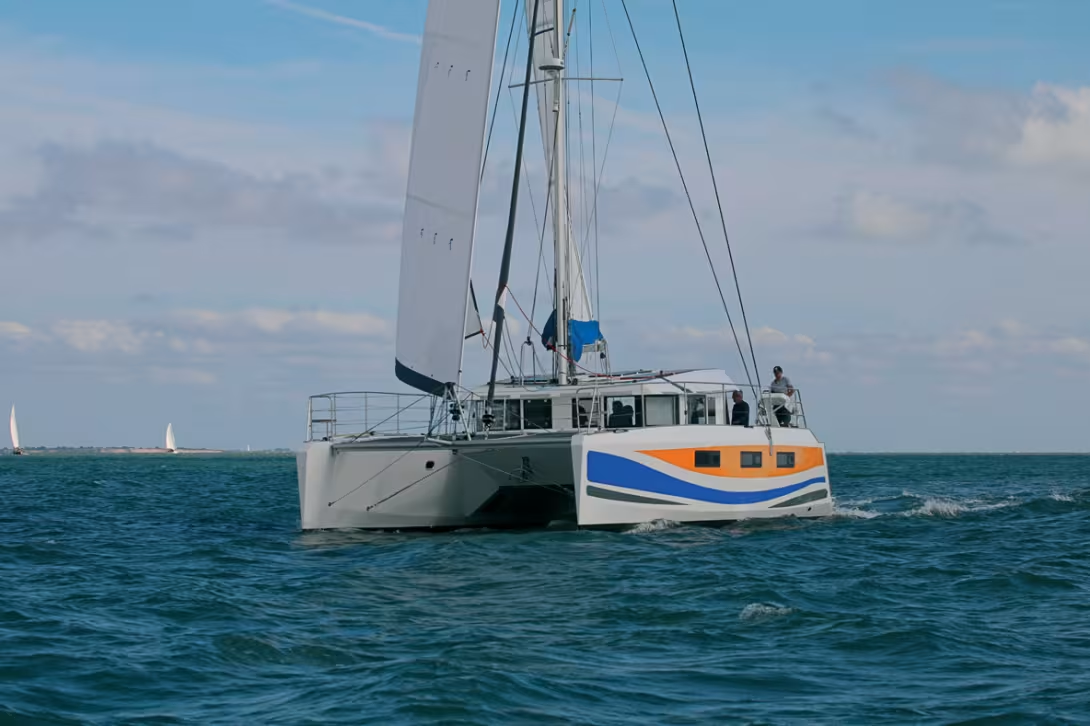
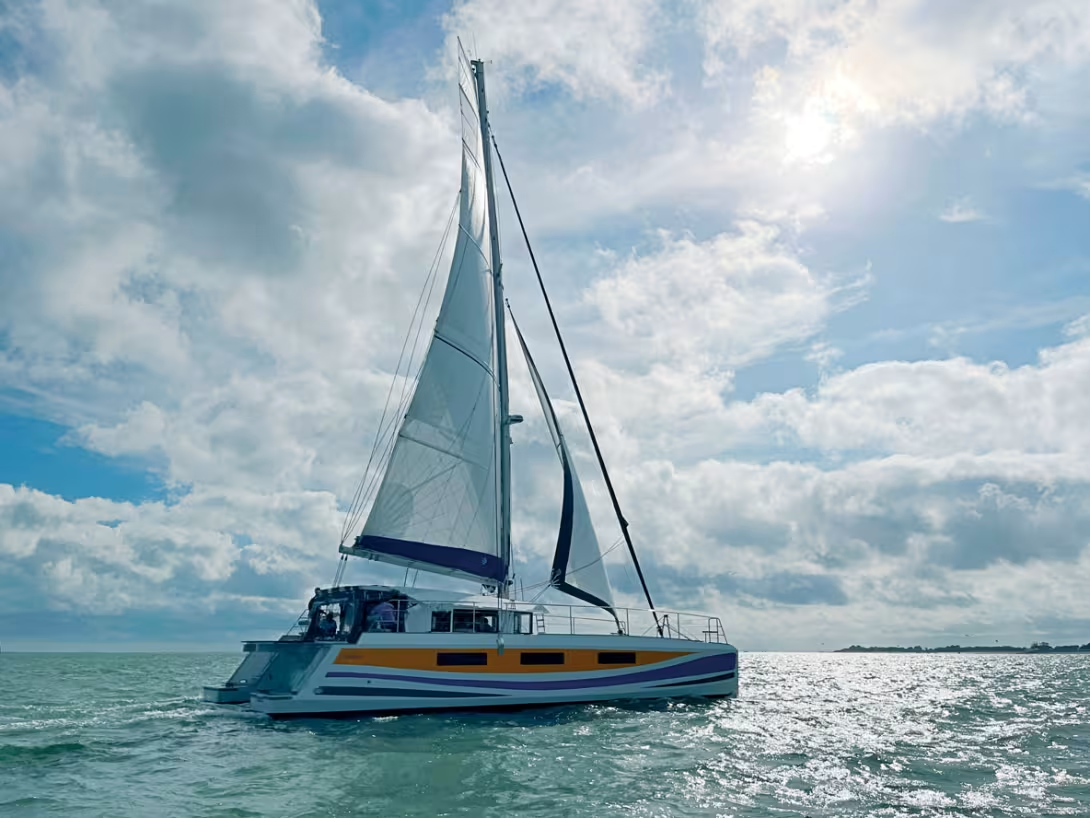
Our rendezvous was arranged in La Rochelle: weather conditions were excellent, with calm seas and a steady wind of between 10 and 15 knots. On the dock, we discovered a catamaran whose livery might seem surprising, with waves of color on the outer sides of the hulls, but that’s precisely the point of a one-off build: you can do what you want! The lines are both sober and modern, with vertical bows and coachroof front. The superstructures are set well back, giving way to large trampolines at the foredeck. The anchor and chain stow far enough back to take real account of weight centering. Aft, the cockpit is relatively short, with just one large bench seat, 2.27 m (7’5”) long. On the other hand, access to the vast sugarscoops is particularly wide, making it easy to get aboard from the dock, climb into the tender - and of course enjoy a swim at anchor!
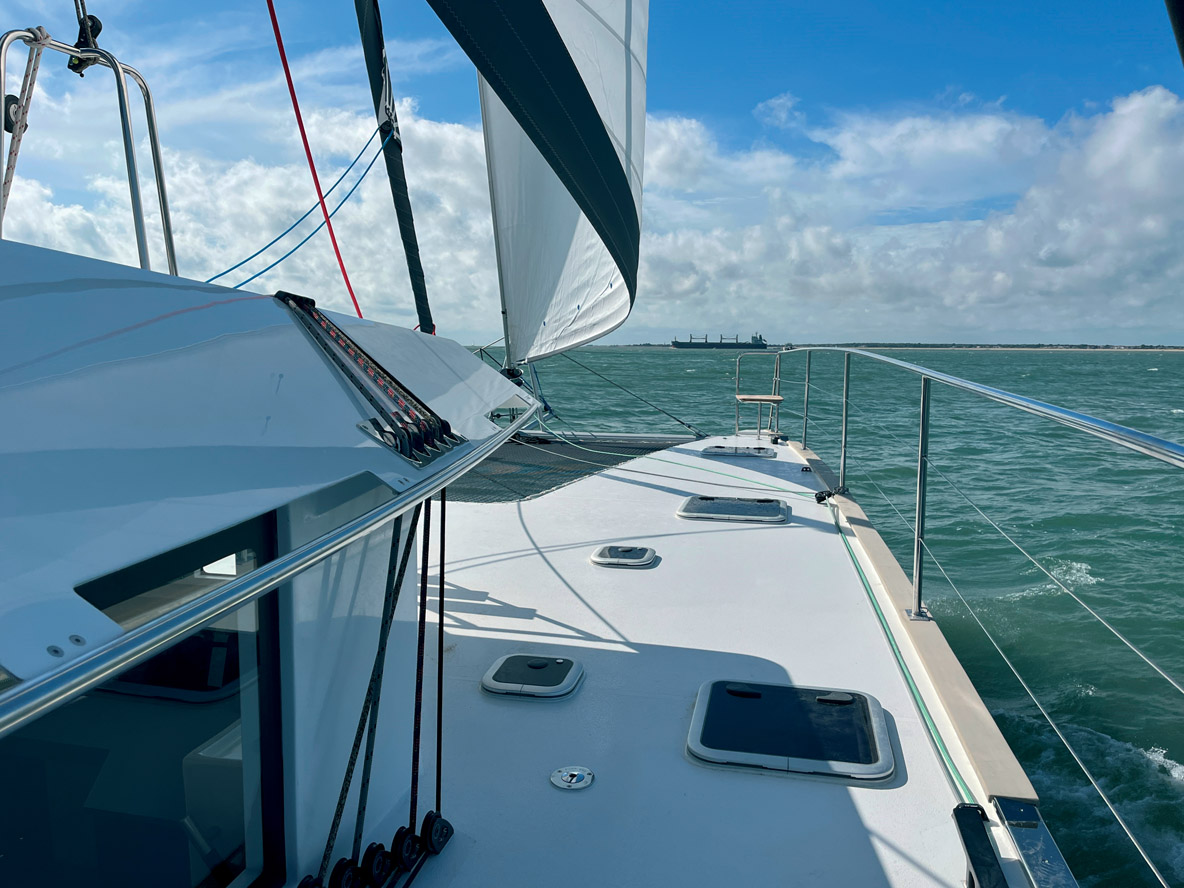
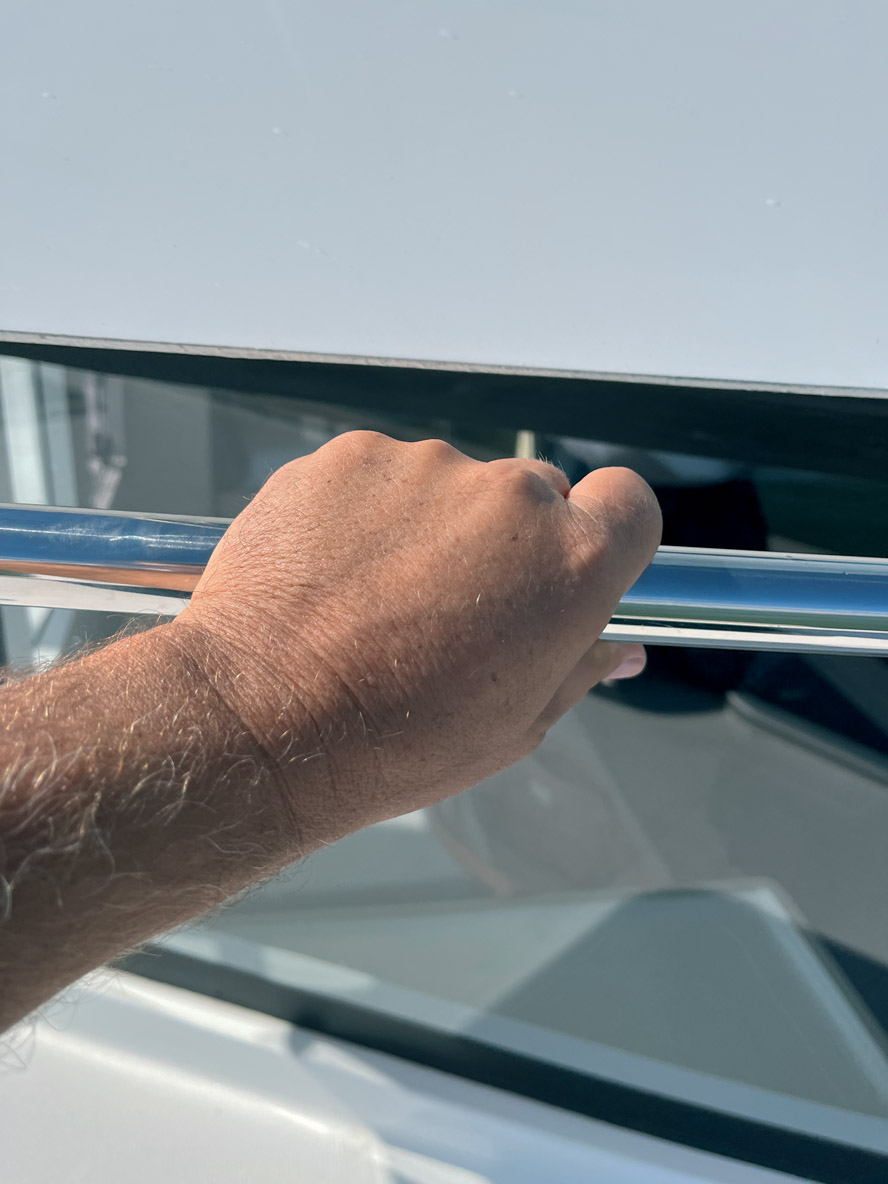
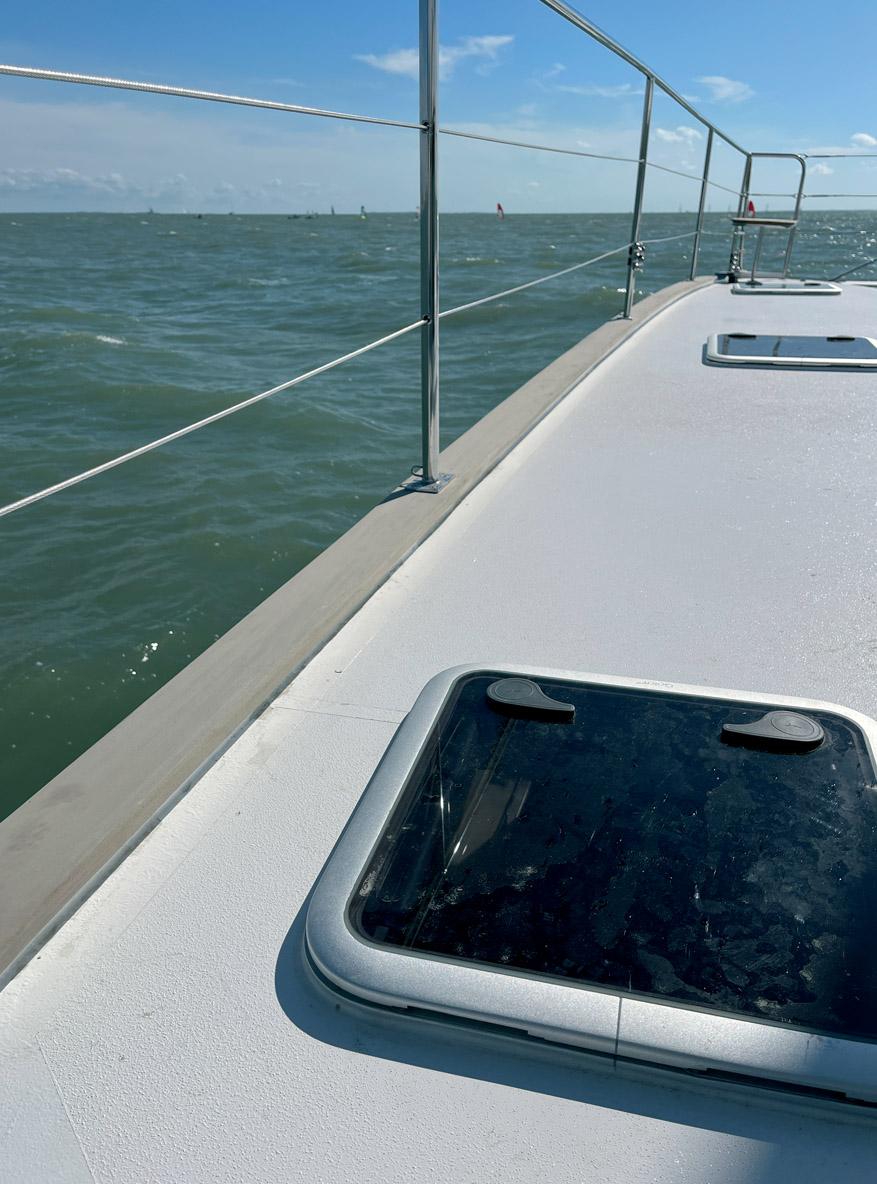
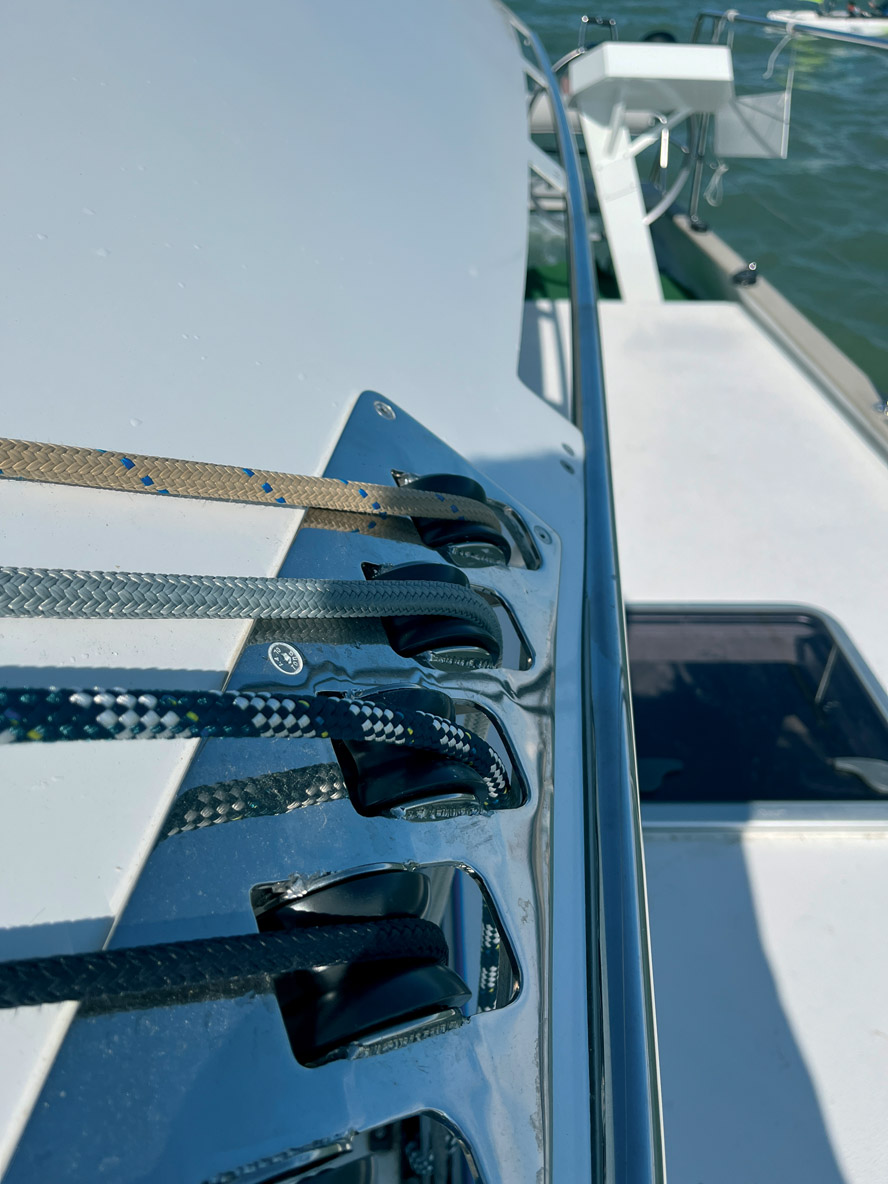
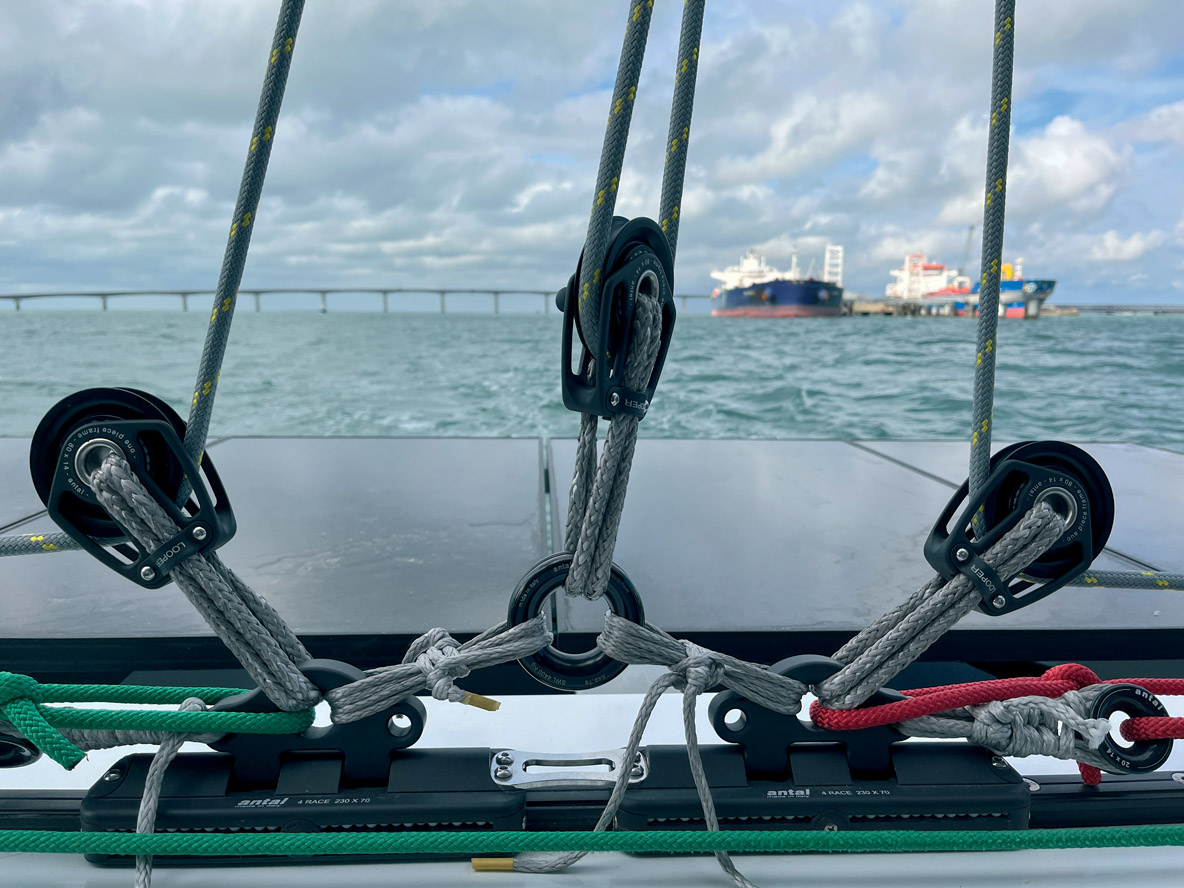
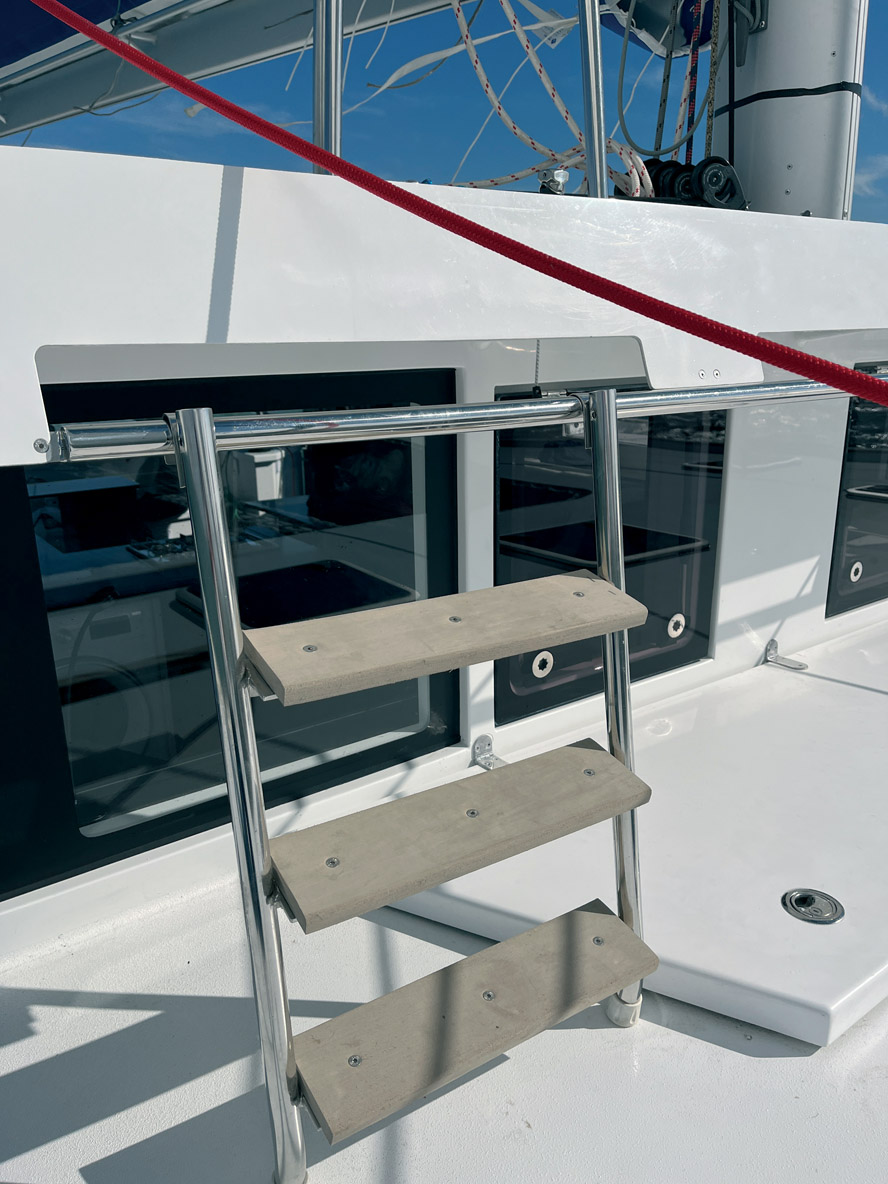
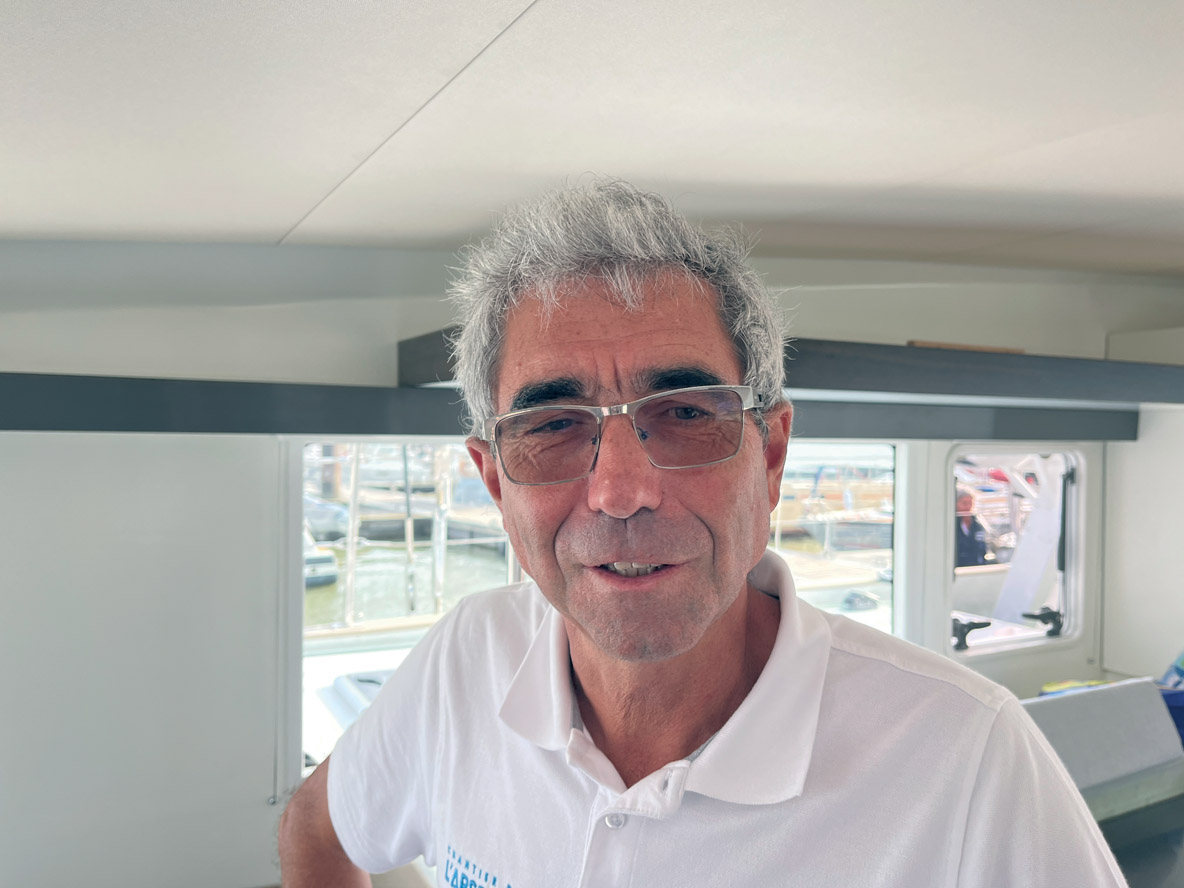
We were greeted by Laurent Da Rold, the owner of the Chantier de l’Arsenal shipyard; the mooring lines were cast off and the electric motors (2 x 25 kW) fired up. The system was a little noisier than expected, but still much quieter than two internal combustion engines. The interface is clear, and the catamaran is easy to handle. You can reach 8 knots, but that’s clearly not the objective - which is rather to ensure satisfactory hydro-generation under sail... There are two helm stations - one at the after end of each hull - and almost all sailing maneuvers are led back to the cockpit via clever deck organizers. The crew busied themselves hoisting the mainsail, and in the absence of a flybridge, it offers maximum surface area with a lowered boom. Sheet and traveler are adjusted from the aft beam. Up front, there’s an overlapping genoa and a staysail, both of which are furler-mounted. Circulation on deck is excellent, thanks to wide 1.31 m (4’4”) side decks and high toerails. The stainless-steel tubular handrails at the top corner of the coachroof are equally impressive. The picture would be perfect if the 90 cm (3’) high stanchions were more rigid, the deck hatches flush and the mobile ladder used to climb onto the coachroof redesigned (or at least lengthened) to offer more angle and perpendicular steps.
A wake just waiting to stretch out astern
After some trial and error before achieving a nice mainsail profile, the GreenCat 52 proved to be gentle on the helm (though we’d ideally prefer it if it were further away from the console) and, above all, fast. A speed of 7 knots upwind, at 45° to the true wind, is easily exceeded if the breeze is right, and we were able to reach peak speeds of over 10 knots with just the mainsail and genoa as soon as the sheets were eased a little. The wake gets longer, and the catamaran gives us a very pleasant sensation of gliding through the water. Even though the GreenCat is not so light (14 t lightship) and remains moderately canvased (146 m²/1,571 square feet upwind), it manages to offer a sail-to-weight ratio of just over 10m²/t. So it’s more likely to be found in the high-performance catamaran camp than among the comfortable catamarans. However, the limits of the exercise can be seen when the wind drops below 10 knots: in these conditions, the GreenCat 52 noticeably reduces the pace.
A watch-keeping bench seat in the saloon
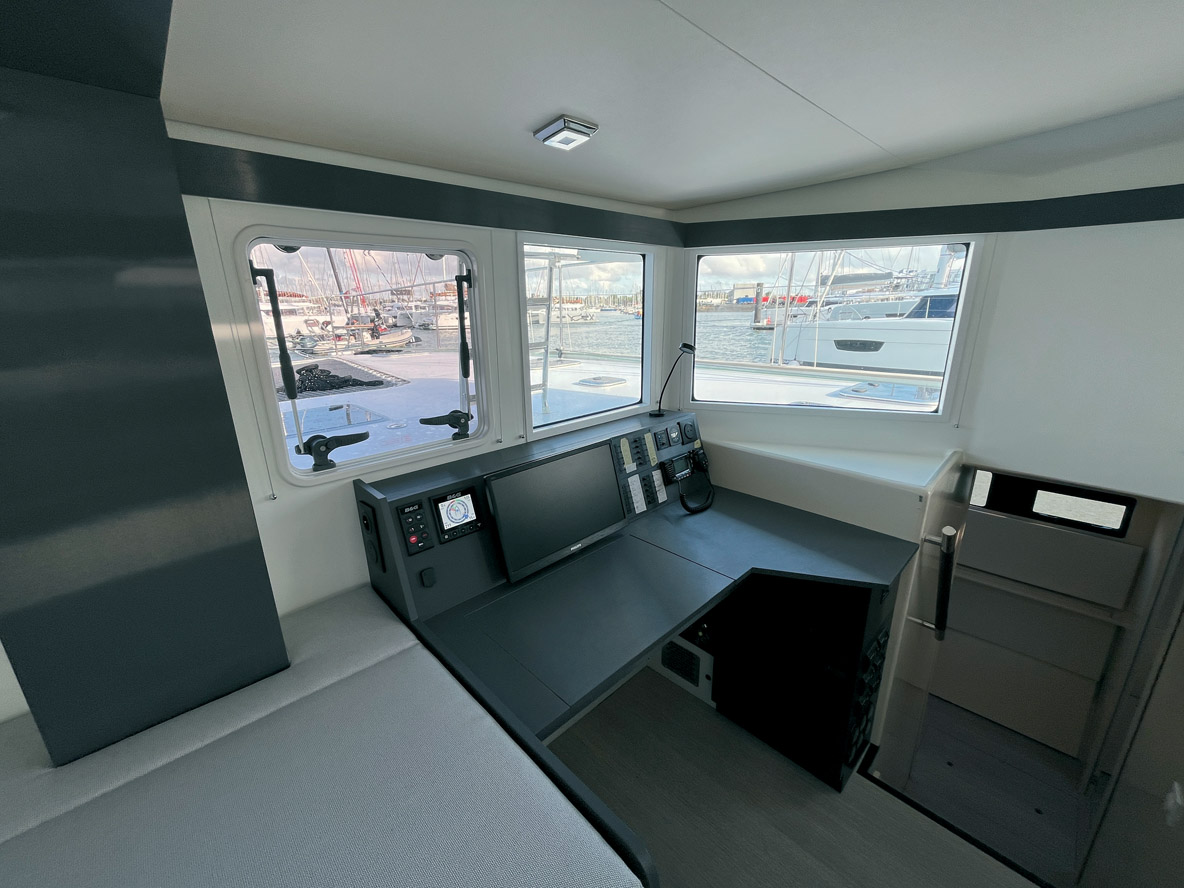
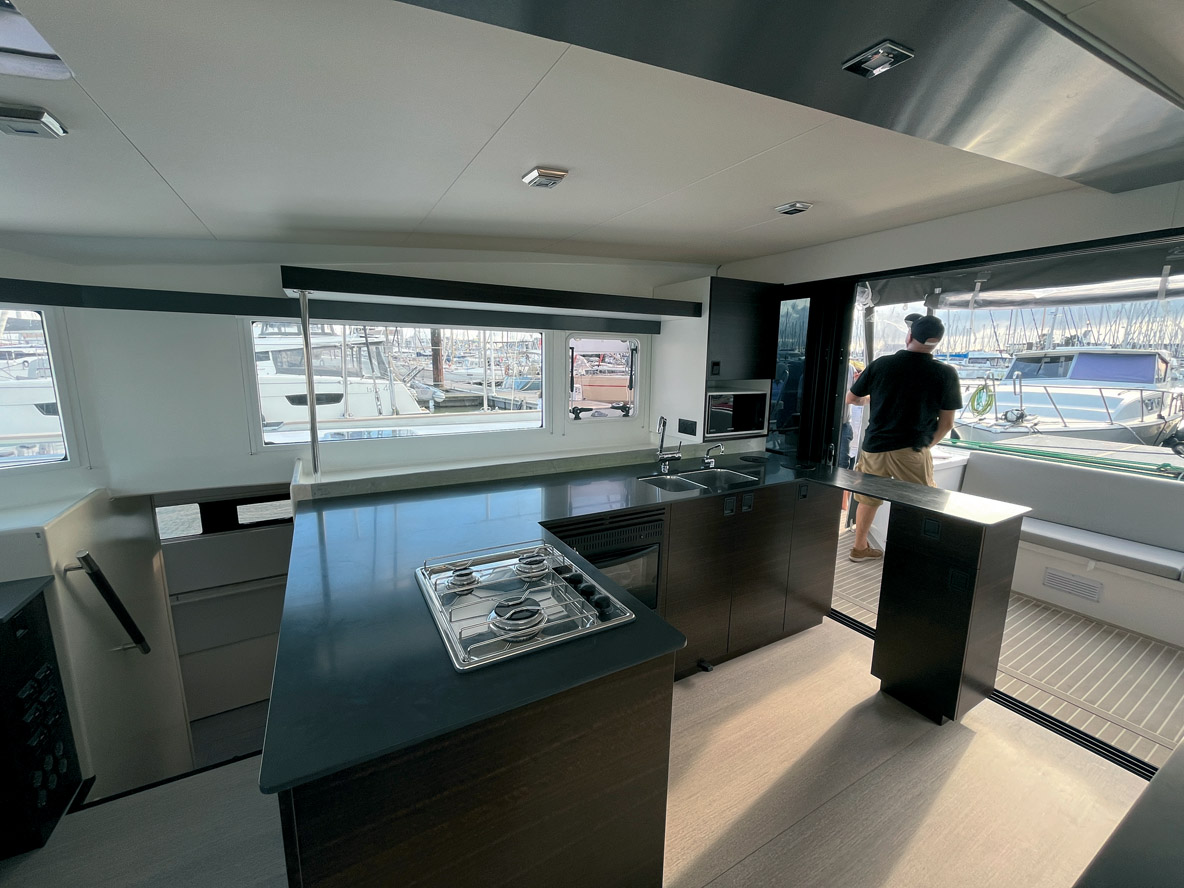
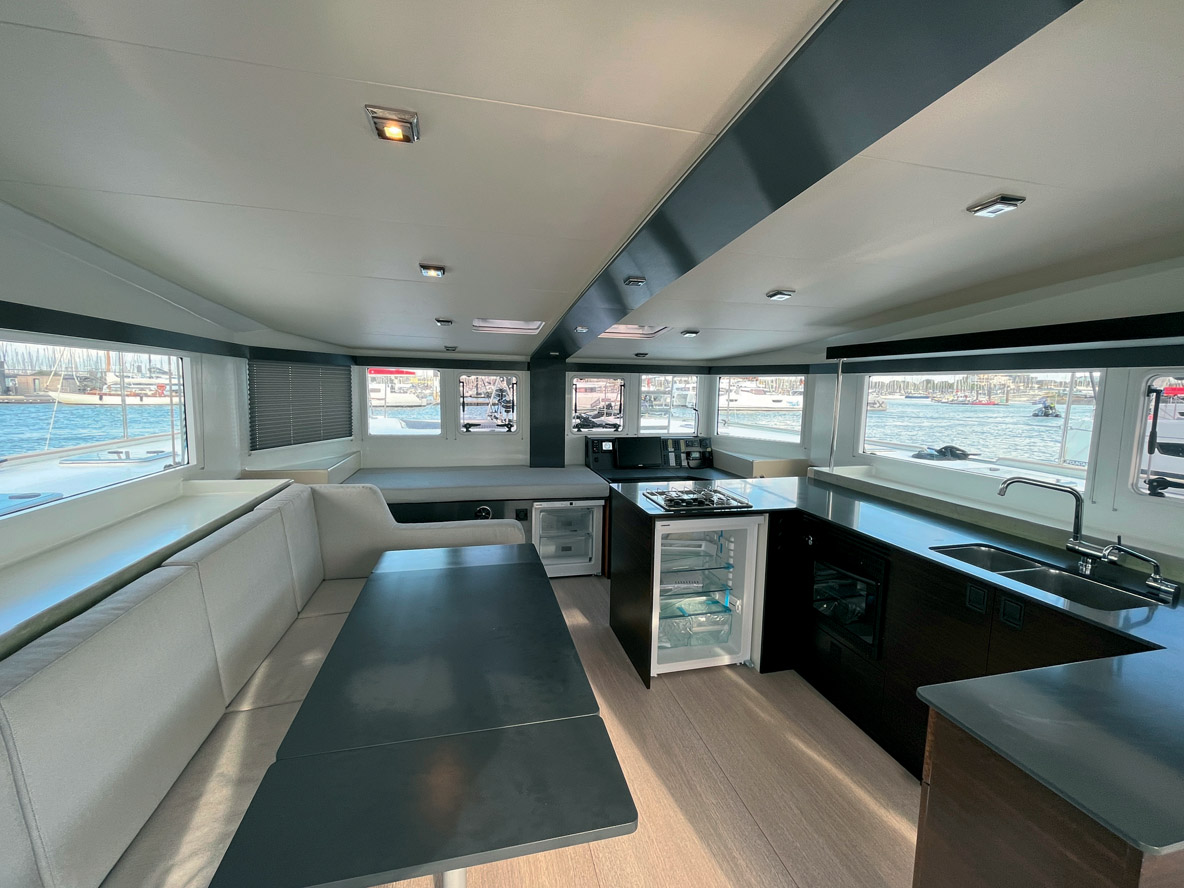
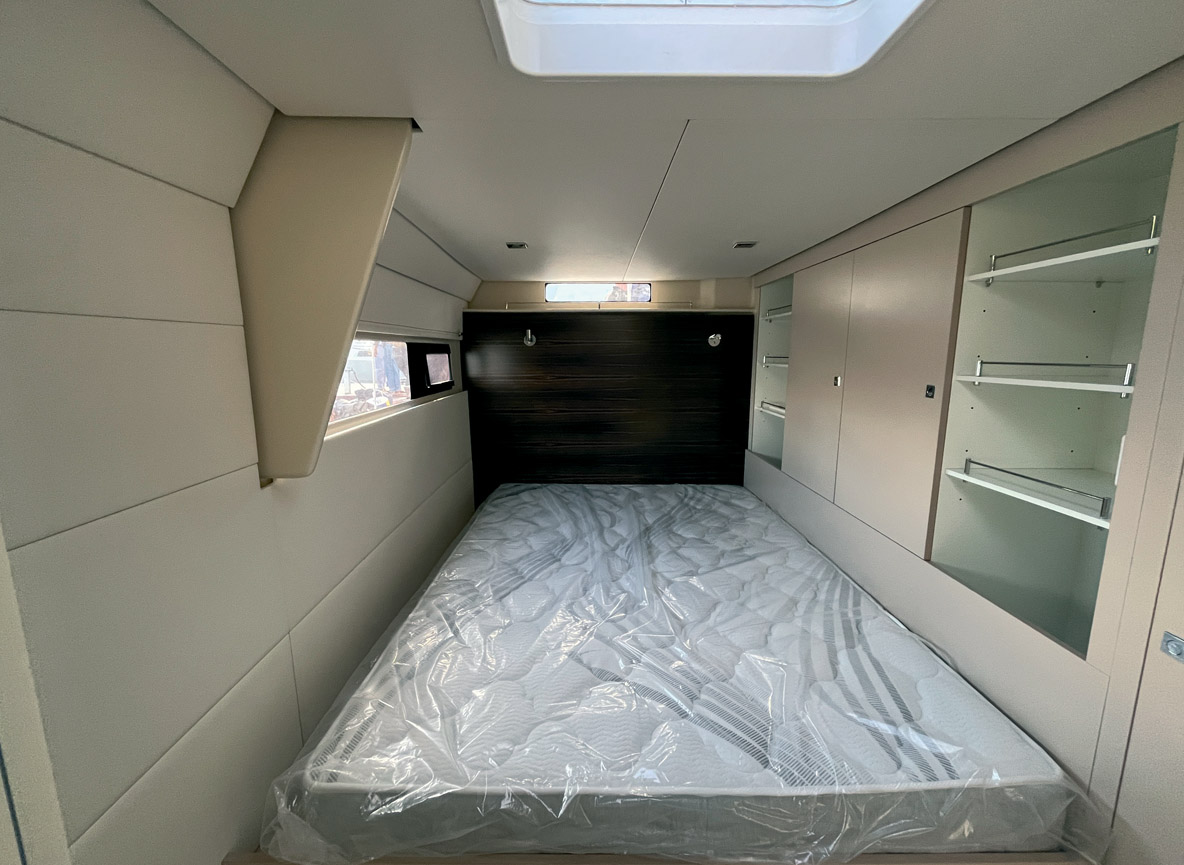
In the nacelle, the architect has thought big, with a headroom of 6’10” (2.09 m). There are also generous openings to the cockpit (6’2” x 7’6” / 1.89 x 2.29 m), which is quite appropriate since the principle is to offer an inside/outside saloon, a little like you’d find aboard a Bali or Nautitech. The saloon is offset to port. The table is modular: it is 27” (0.69 m) wide and can be extended from 40” to 66” (103 to 169 cm). The table legs could do with a little more rigidity. Opposite, the vast, fully equipped galley forms a very open U-shape. At the far end of the nacelle is a 6’3” x 3’ (190 x 90 cm) berth and a large four-foot (120 cm), forward facing chart table. The cabins are unsurprisingly housed in the hulls, both forward and aft. All cabins have two air vents and plenty of storage space. You may be surprised by the relative narrowness of the berths (55”/140 cm). This is a standard domestic size for shore-dwellers, but most boat manufacturers have been offering much more for a long time now. Among the minor imperfections that can easily be rectified are the unsuitable door handles and the absence of a latch to keep the door open. But the GreenCat 52 is certainly a comfortable multihull to live aboard.
Conclusion
It’s always pleasant and interesting to discover a multihull born of personal specifications and not subject to marketing diktats and/or the imperatives of mass production... On this GreenCat 52, the entire design has remained open and modifiable. And yet, despite the innovative propulsion and construction system, the layout and deck layout remain traditional. This model is the perfect complement to the New Windelo range, which features a forward cockpit. The shipyard is ready to launch a small production run... and Philippe, the architect, has every reason to hope of one day finally being able to order his own catamaran!
Convincing performance
Numerous clever deatures
Relatively narrow bunks
Perfectible finish
Technical specifications
Architect: Philippe Renaudeau
Length: 51’8” (15.75 m)
Beam: 24’1” (7.34 m)
Draft: 4’7” (1.4 m)
Light displacement: 30,865 lbs (14 t)
Laden displacement: 38,800 lbs (17.6 t)
Sail area: 1,571 sq ft (146 m²)
Drivetrain: 2 x 25 kW
Water: 105 US gal (400 l)
CE Certification: A10
Price: on request
www.chantierdelarsenal.fr