
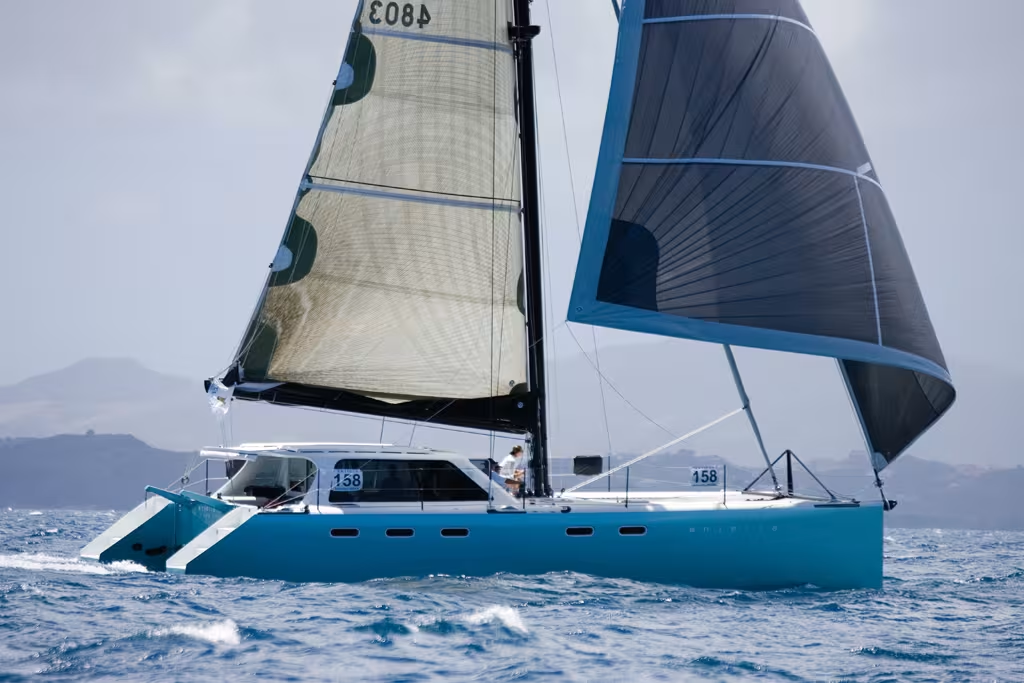
The Gunboats have worked out a marketing programme in their own image – rare and stylish! They gather together in Chesapeake Bay, or during Antigua week, but are not often seen at the boat shows. They can be seen in Miami, but not yet in Europe! Peter Johnstone invited us to a furtive test of the latest 48’ off Saint Tropez – let’s discover this exceptional catamaran together!
Infos pratiques
- Le chantier : Gunboat 48
- La fiche technique
- Découvrez notre vidéo exclusive
- Financez votre Gunboat 48
- Assuez votre Gunboat 48
- Articles autour du Gunboat 48
War machine?
The name Gunboat borrows an evocation from the military world which smells of gunpowder, but the only cannon concerned is the starting gun and the only weapon these very civilised machines possess is their speed! Peter Johnstone (the son of the creator of the JBoat!) is a top racing sailor and an enlightened catamaran lover, who wanted a very fast, comfortable catamaran for himself and his family, which could be sailed short-handed: this was to be TRIBE, the first G.60’.
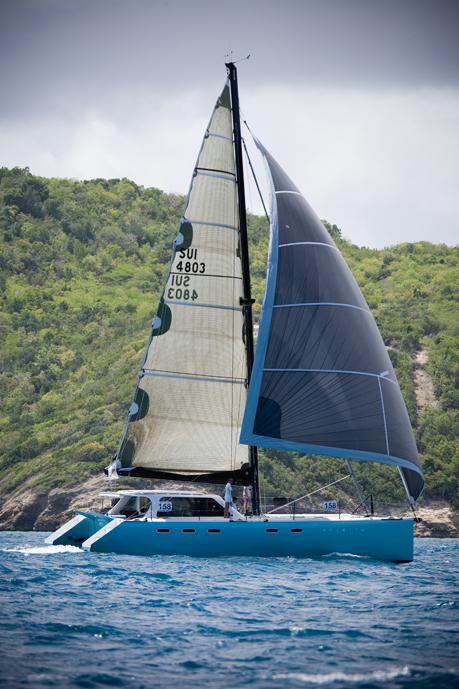
Lines that are recognisable amongst a thousand others: this is the Gunboat!
Or social ‘must’?
The north-east of the United States is full of exceptional anchorages and rich sailors! Sailing conditions are pleasant there in summer, and Florida and the Caribbean are within delivery range from October onwards. This area is the brand’s cradle. Even with a weak dollar, US labour costs remain expensive and as Peter’s demands concerning quality are rather exceptional, South Africa seemed to be a suitable answer. The Gunboat factory (around a hundred workers nowadays) was therefore set up in Cape Town.
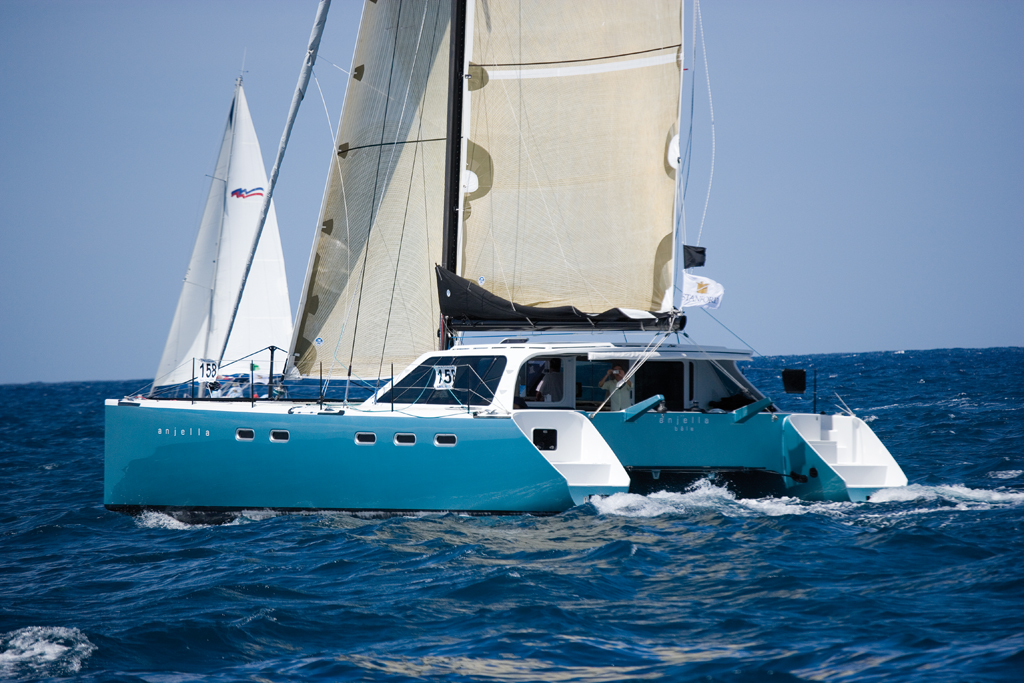
The Gunboats like to meet up (on selected stretches of water) to race: one of the charms of this prestigious club.
Architecture: from Gino Morrelli to Nigel Irens
From 48’ to 90’, via the 66’, the 62’ and the first 60’, all the ‘Guns’ were created on the Californian coast, in the offices of Gino Morrelli and Pete Melvin. As far back as 1983, Gino and a certain Alain Petit-Etienne launched themselves into the construction of the 1st catamaran in carbon (in a barn in Picardy)! Since then, the Huntington Beach office has been the origin of very many multihull creations: PLAYSTATION, STARS AND STRIPES, HAPPYCALOPSE, ALINGHI, an endless stream of class As, the Moorings 4000... At the moment, 150’ and 200’charter catamaran projects are being created! The only alternative to the American signature, Nigel Irens, is designing the next 78-footer, much-awaited by the company.
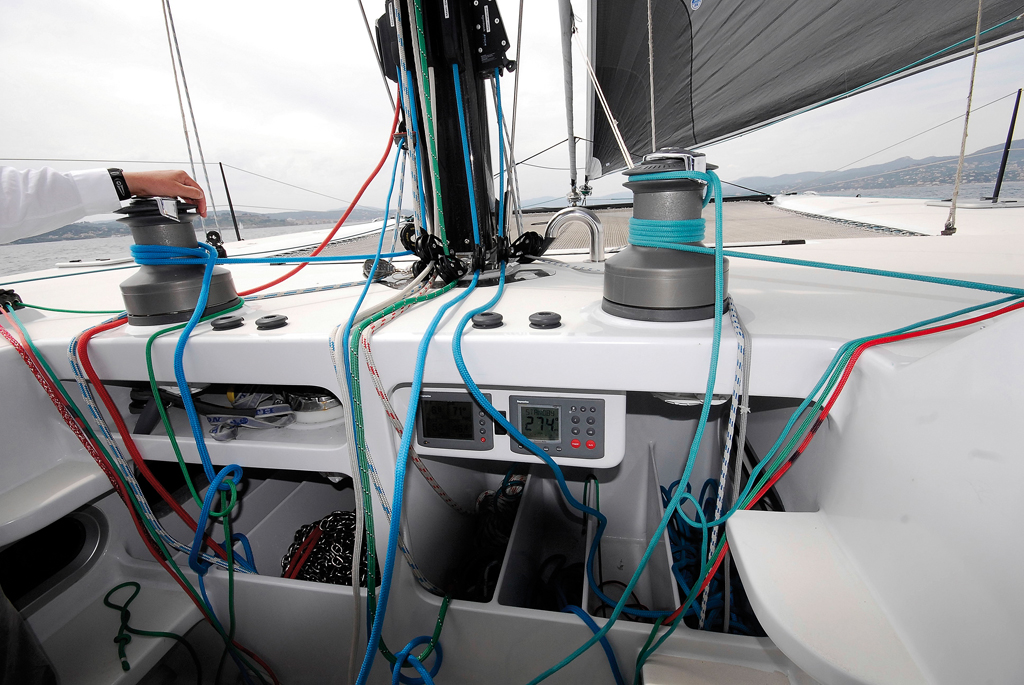
The Gunboat cockpit: excellent ergonomics, but a radical choice!
Construction: carbon-Nomex or nothing!
The ambition for speed and the wish to establish a reference in cruising catamarans led to the choice of carbon-Nomex for the whole of the production. This up-market choice offers advantages, allowing a stiff, light chassis to be obtained (the forward crossbeam weighs 12 kg!), but also presents a few constraints: having to resort to hand-picked suppliers, a high-tech process and expensive products. Nomex is a honeycomb structure; the resulting carbon sandwich does not appreciate mistreatment when cruising or rough handling by boatyards! In this respect, the cost of purchase and repair are dissuasive, but this is also a question of culture: the boat is generally not the only restricting ‘beautiful object’ used by these owners!
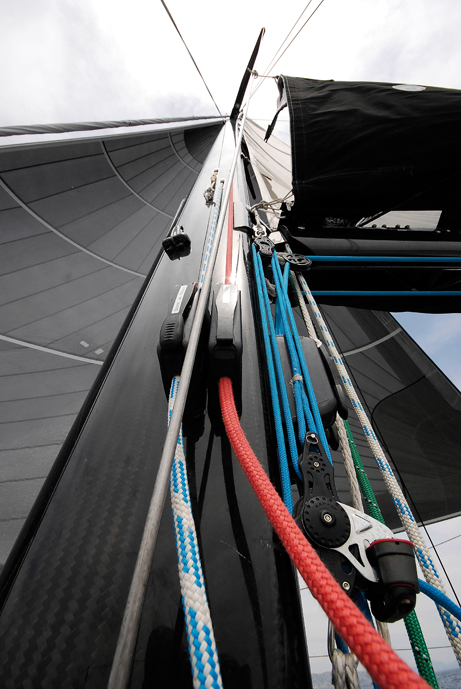
This is the trimmer’s perception of the mast from his cockpit – not bad, eh? But why does it not rotate?
Silhouette: class!
Let’s be clear, the level of finishing on the Gunboat 48’ is exceptional! Its presentation after sailing 20,000 miles clearly shows the build quality and the care taken. Immaculate metallic lacquer, artistically sanded and prepared fillers – the cosmetic aspect of the internal and external skins rivals the perfection of the mythical car body workshops. The unusual way in which the Gunboats catch the light is related to this desire for perfection.
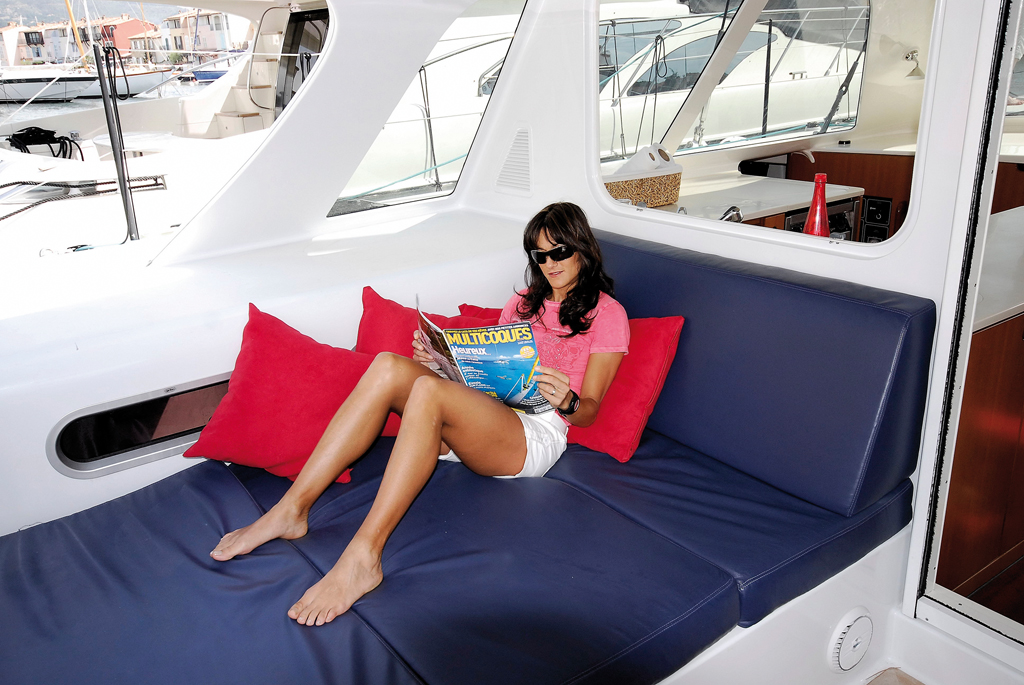
The Gunboats’ cockpits take advantage of the absence of steering positions…
An elegant design and some original choices
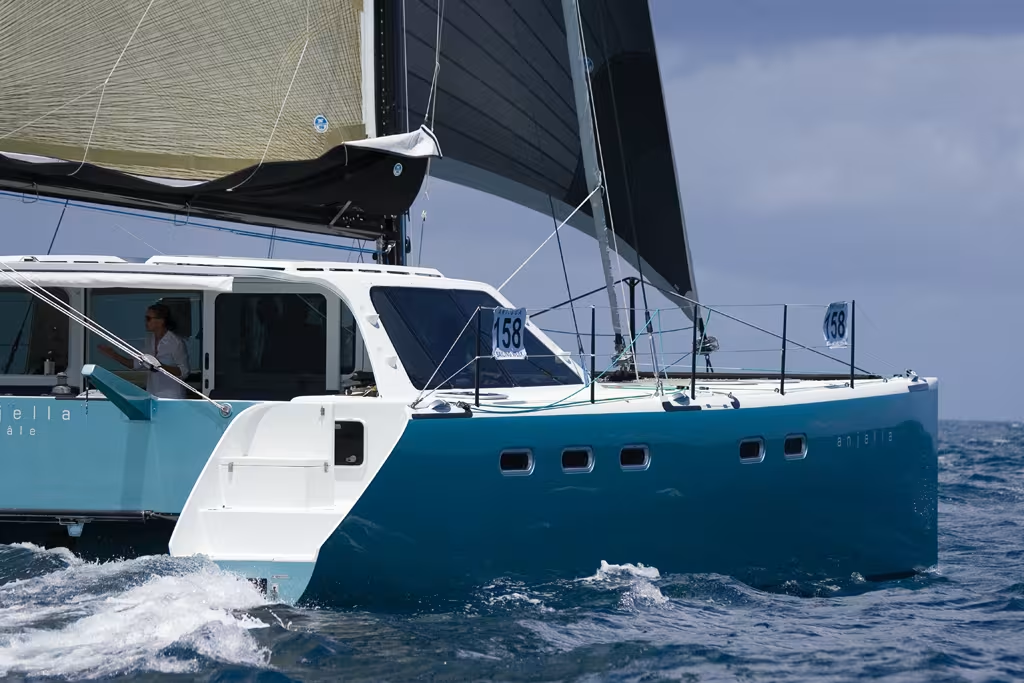
The geometry is classic, the forward sections are slim; the very progressive gain in underwater volume is developed to hull sections which are quite rounded at the stern. The wetted surface area is low and the weight distribution is optimised (engines under the central berths). The cabin roof is well aft and encroaches on the cockpit, but nevertheless preserves a good living space. Under way, the daggerboards retract into their cases, and the rudders, consisting of slim carbon profiles, slide in sleeves which are accessible from the sugar scoops. The moderate beam contributes to the light displacement and the Gunboats’ characteristic posture in strong winds: weight taken off the windward hull! This does not however threaten their stability – when cruising, sail must be reduced and when racing, someone must look after the mainsail. The proportions are harmonious; the cabin roof may seem a little cubic and the sides steep, but this is the price that has to be paid on a ‘little’ 48-footer. Don’t bother looking for the steering positions – there is only one...sheltered by the cabin roof!
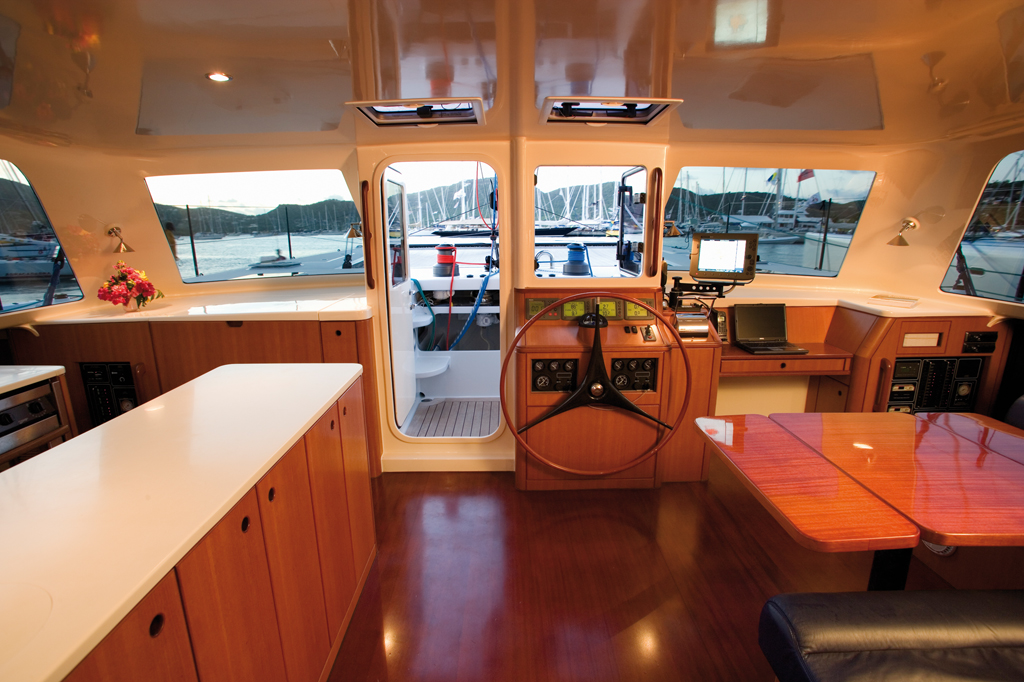
In front of you, the (interior) steering position, and ahead of the cabin roof, the working cockpit...
A remarkable rig; an original deck plan.
Aboard ANJELLA, the trained eye will search in vain for bad taste: mast, boom, forward crossbeam and bowsprit are from Marström (carbon)! Textile shrouds, optimised running rigging (sleeving, reduction in diameters, optimisation of fibre modules), North 3DL sails... Only the old-generation solar panels, on an aluminium/glass frame, look a little out of place and make access to the cabin roof tricky. The care taken with the work is reassuring, everything is original and appears new after the equivalent of 3 Atlantic crossings. The sails are stored on textile anti-torsion furlers and the ‘working’ cockpit is at the mast foot.
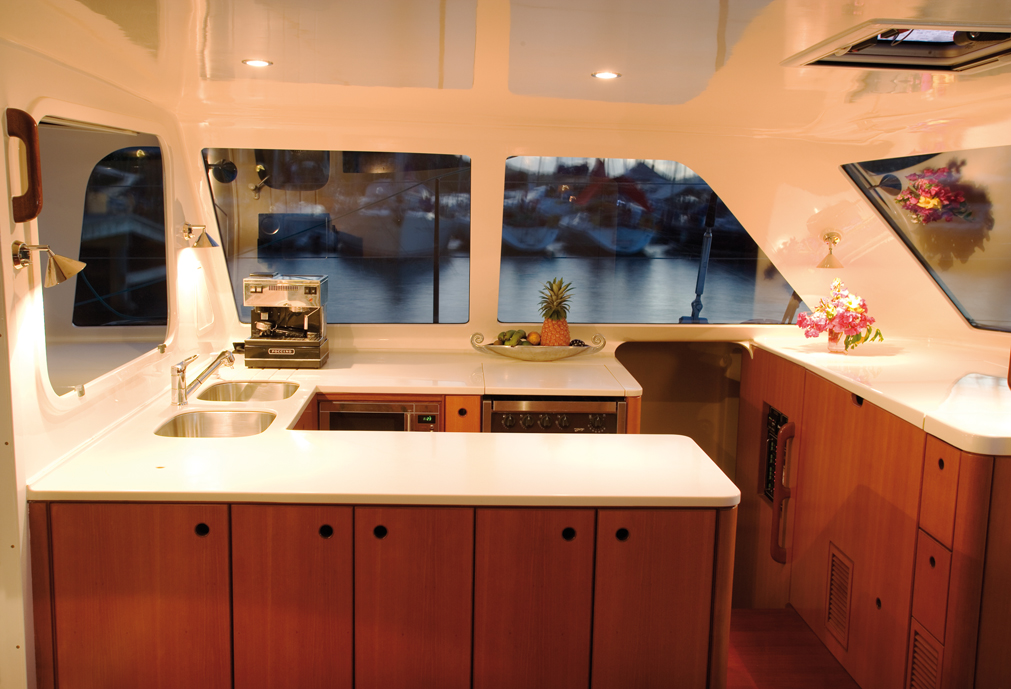
Anjella’s superb galley! But why use Corian, which is so heavy?
Accommodation
There is little to be said; the builder has worked very hard to limit the sometimes extravagant demands of the customers to what is reasonable, and respect the boat’s weight specifications! The 48’s 3 double cabins illustrate perfectly the builder’s talent and mastery (on an entry-level model)! With the characteristic features of a fast day-sailer, the 48’ has all the qualities for a stay aboard or an ocean crossing. As for the quoted power of a Rolls Royce’s engines, the Gunboat’s comfort is ‘sufficient’.
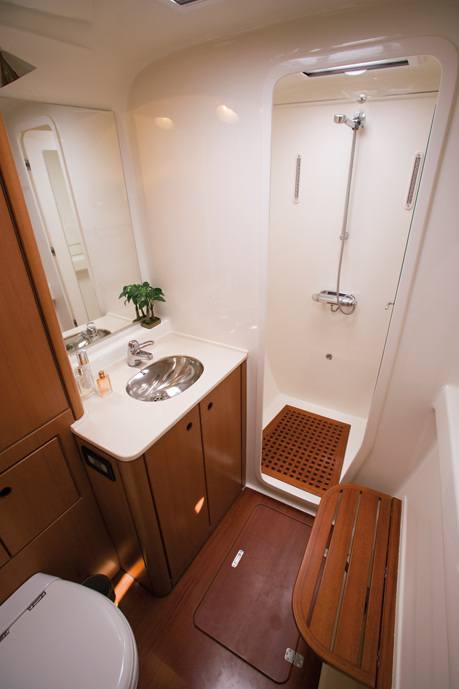
Contemporary designs, wood facing and high-tech, lacquered surfaces: the GUNBOAT signature!
A cruising catamaran with quite a punch!
The Gunboat 48’, like all the builder’s models, is a (very) fast catamaran in strong winds, capable of purring along at a constant 20-25 knots in certain conditions, if it is well sailed! Its potential in light airs is just as real – this versatility justifies the sacrifices agreed on during its design and construction. Sailing in light airs is an experience which gives immense pleasure to enthusiasts, but alas, few boats reach this Nirvana, and they are generally quite radical prototypes or small boats! The Gunboat, however, joins this elite group. It accelerates with the slightest gust and sails at 110% of the speed of the wind without fuss; the profiles must be adjusted, of course, but the central cockpit encourages this kind of exercise. Ahead of the cabin roof, accessible via a door, we find the nerve centre of the Gunboat: all the control lines are led here to two powerful Lewmar electric winches; halyards, Cunningham, furlers, sheets...everything! The automatic pilot controls are within reach, the control lines are stowed in numerous ‘pigeonholes’, even the stainless steel anchor chain can be found here. After having played with this ‘control centre’ for 2 hours, and despite preconceived reservations, I appreciated the audacious ergonomics, which leave the aft cockpit completely free. It is quite exposed, but refuge in the saloon is not far away! Those who know the Gunboats well confide that in certain conditions with waves on the beam, they are likely to ship a little green water, but their agility (they ride over the waves well) allows this arrangement to be retained. The position of the helm, behind the cabin roof windscreen, left me perplexed, as it filters perception too much and does not assist visual monitoring of the mainsail. In light airs, it is quite frustrating to feel such a beautiful chassis under your feet without being in contact with the appendages via a tiller or an external steering wheel. On ANJELLA, a 2nd wheel is fitted to the cabin roof bulkhead, but I did not find this beneficial. The sail plan is superb; the only surprise is the absence of a mast rotation system. Under jib and main, the 48’ sails to windward remarkably in these conditions, and the interaction between the sails is very sensitive. With the code 0, in a beam wind, the ‘Gun’ sets off at 9 knots (in 7 knots of wind!). The first reef is taken quite early (when cruising), but the self-tacking jib works wonderfully, being effective from 0 to 30 knots of wind, without reduction. Another 48’ has just arrived on the Costa Brava; I won’t fail to tell you about my observations in strong winds, a little later.
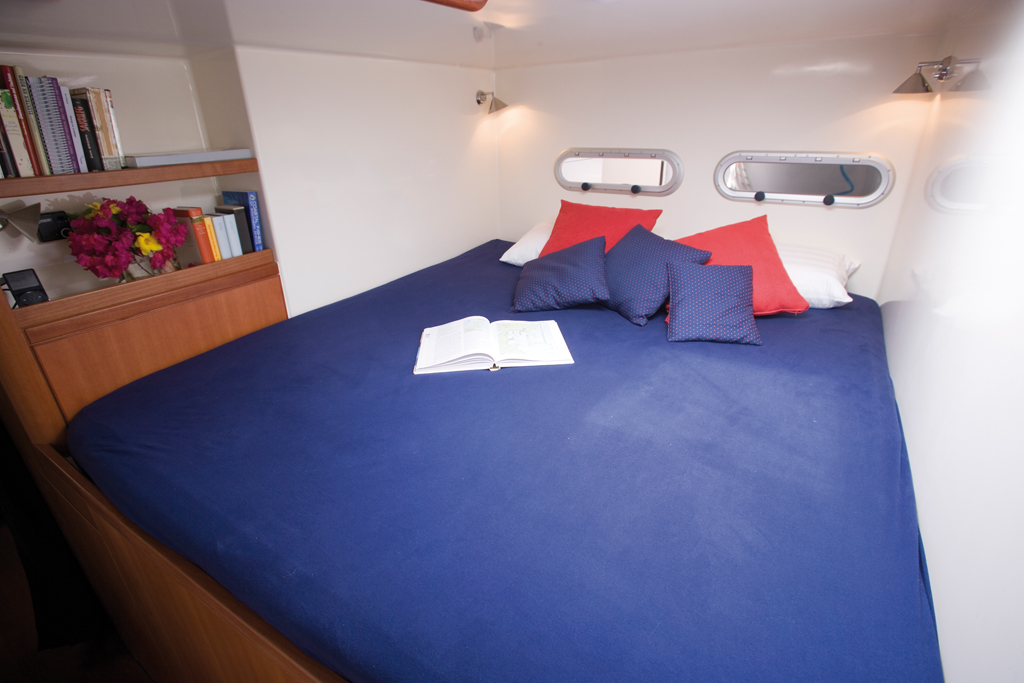
The Gunboat is not just fast, it is also a cruising boat offering all comforts...
CONCLUSION
This catamaran has real charm; it has all the qualities of a beautiful object and will become a collector’s item. Despite its sophisticated construction, it is a reliable multihull, and its seaworthiness is unequivocal. The 48’ remains an attractive concession to reasonable size, agreed on by a brand which builds exceptional boats. The 62’ will be giving up its place to the 78’, whose production, associated with that of the 90’, will form the greater part of Gunboat’s activity in the coming years. This positioning, which is unique in the world, (very big, very expensive, very fast) corresponds to deliberately elitist marketing, a position which Wally Yachts has already adopted in another segment. Will the Gunboats open the first multihull class in the ‘Voiles de Saint Tropez’?
SPORT 4/5 CRUISING 4/5
The plusses
• Rigorous design • Performance • Style and quality
The minuses
• For enlightened users • Care essential • Not comfortable in all harbours
THE COMPETITORS
Model Builder Architect Price exc.VAT Dazcat 15 Dazcat Darren Newton NC Novara 50 R KKG Martin Maï NC Sig 45’ Hugo le Breton Van Peteghem/Lauriot Prévost NC
TECHNICAL SPECIFICATION
Architect: Gino Morrelli/Pete Melvin Builder: Gunboat Length: 14.74m Beam: 7.39m Weight: 8t Displacement: 10.20t Windward sail area: 127m² Downwind sail area: 236m² Engines: 2 x 40 hp Volvos, custom transmissions via shafts Daggerboards: carbon Draft, daggerboards raised: 0.60m Fuel: 2 x 246l Water: 2 x 190l Material: epoxy/Nomex/Aramid/carbon composite under vacuum and epoxy/foam/carbon with Kevlar reinforcements Price: 2,200,000$/ 1,435,000€ exc. VAT
