The GUNBOAT 62, Peter Johnstone’s synthesis of racing catamaran and blue water cruiser, has been sailing the world’s oceans since he launched Tribe, his personal prototype of the design a couple of years ago. Since that time, 3 more 62s and a 48 have been built, a remarkable accomplishment considering the world’s economy, and the state of war in the Mideast. In this article, we give a tantalizing glimpse of Mr. Johnstone’s collaboration with designers Morrelli & Melvin.
Infos pratiques
- Le chantier : Gunboat 62
- La fiche technique
- Découvrez notre vidéo exclusive
- Financez votre Gunboat 62
- Assuez votre Gunboat 62
- Articles autour du Gunboat 62
General Appearance.
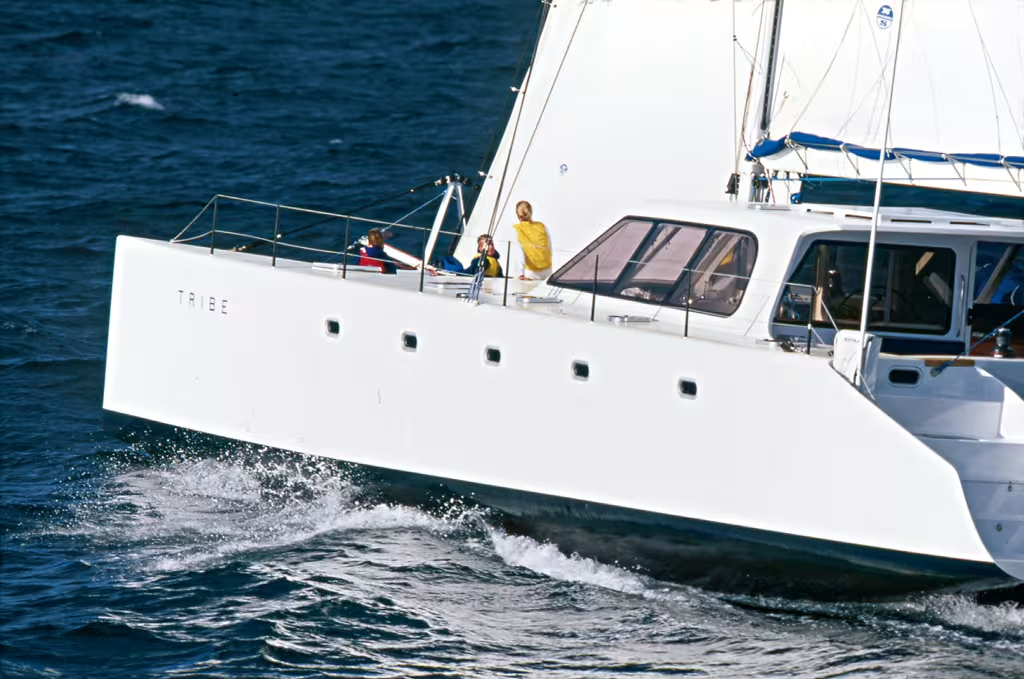
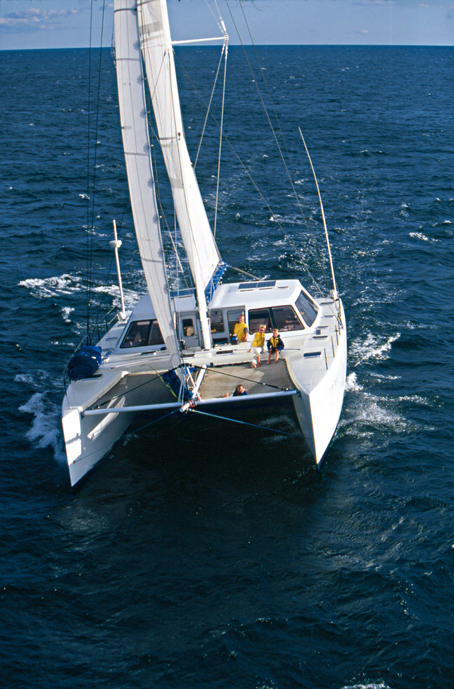
A distinctly more angular outline than many of the cruising cats in its size category is the GUNBOAT 62’s most distinguishing feature. With plumb bows, level decks extending to short sugar scoop transoms and a flat top bridge deck, the GUNBOAT 62's lines are distinctly different from the elliptical outlines of the majority of other contemporary catamarans, especially those made in South Africa as is the GUNBOAT 62. Walk-through doors from the front of the salon to a working cockpit just behind the mast are the second distinctive feature of this catamaran. This construction alone subverts an inverted bowl shape bridge deck outline. Mr. Johnstone continues a vertical and angular theme in the nearly vertical windows and square corners of the bridge deck roof and sides. The lines of the bridge deck follow those of the hull to give a consistent and balanced appearance. Placement of the working cockpit forward of the salon imposes new proportions on the overall layout of the GUNBOAT 62 compared to many more abundant cruising catamarans in this size range. Starting from the bows, mesh trampolines are larger in size than those on other catamarans, and the distance from the bow front of the cockpit is even greater in proportion. The working cockpit, level with the salon sole is approximately 6 ft (2m) square. This space was taken from the salon area one might expect in other catamaran designs. The salon is at least as large as one would expect on any other cat because it extends aft proportionally more. In addition, the salon roof extends about half the width of the hulls, providing additional space off the sole of the salon. In the proportional tradeoff, it is the aft cockpit, the “back porch” that sacrifices area in proportion. That is not imply the cockpit is cramped. Lacking a helm, which is inside the salon, it has as much useful area for eating and relaxing as any catamaran with a more familiar layout. The back porch’s transom extends completely across the rear of this space without any walk throughs. A dingy davit and small dive deck are outside the transom between the hulls.
Gunboat 62 catamaran, a real cruiser/racer…
Details of the Layout
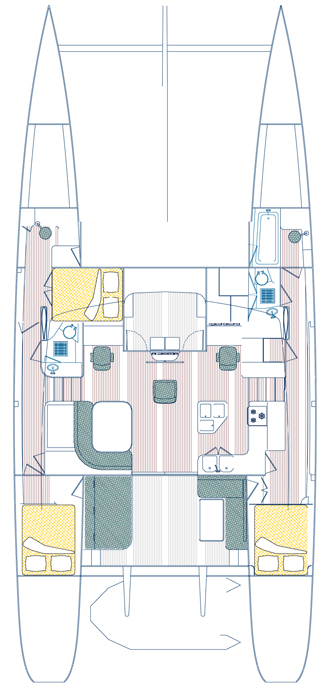
The GUNBOAT 62 has many design differences from the ‘standard’ cruising catamaran of its generation. Each hull has a sugar scoop transom with 4 steps that lead quickly to a deck over the hulls. This deck is about 30 inches higher than the sole of the aft deck, salon and working cockpit just ahead of the salon. In this respect, living areas of the catamaran are like the hole in a dough nut. On Tribe, there are no steps out of the hole to the higher decks over hulls and trampoline. (Mr. Johnstone, who traveled extensively with his children while testing the prototype, commented that the lack of steps was a concession to keep his active children away from the edge of the catamaran. All subsequent GUNBOAT 62s have steps to aid climbing to the hull decks from the salon level.) The aft deck has drains through the sole to lead wave and spray water away from the salon. Inclusion of the helm in the salon, between the doors to the working cockpit and mast and its sail controls, is the most distinctive feature of the GUNBOAT 62's interior layout. . A nav station is right of the forward door, and includes a chart table in the right front corner of the salon. Instruments and indicators are mounted ahead of the helm on a broad shelf between the wheel and the front windows. A laptop computer running navigational graphics stayed on this table throughout the cruise. Thus, in the GUNBOAT, navigation and its tools are the first feature of the salon.
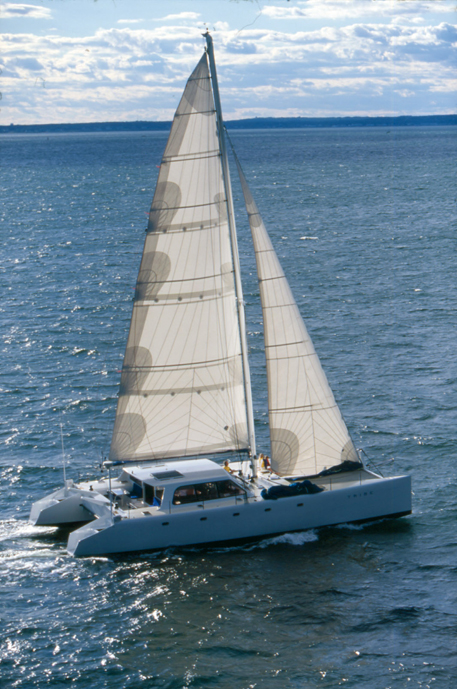
Harmonious lines designed by Morelli/Melvin.
The well-equipped galley occupies the left side of the salon, extending from behind the helm to the aft bulkhead of the salon.. It has all the functional conveniences of any cruising catamaran, with a propane refrigerator, freezer, stove and water heater. The galley has a modular feel. The sink is against the front bulkhead, nestled in an alcove between the door to the working cockpit on the right and the hull on the left. The stove is on another counter along the port hull. An island counter holds the refrigerator/freezer and additional storage. Tribe possesses a distinct feel for elegant, utilitarian simplicity in the fixtures, distinctly lacking the “condo” finish of many large cruisers made for charter fleets. (The GUNBOAT 62 is made to an owner’s specifications and the choice of interior features may yield a distinctly different feel from Tribe.) A large dining table with sofa seating is against the island counter and wraps around the aft end of the rectangular table. This table allows seating for at least 6 people. The polished gel coat finish of interior structural surfaces combined with wood veneers and solid wood trim provide a yachty feel, easy maintenance, and are light weight. This layout does not immediately give an impression of wide open space in the salon that other designers create by placing furniture around the perimeter of the salon. However, on a 62 ft catamaran, there is inherently more than enough space in the salon. The effect of the GUNBOAT’s layout is to direct the attention and view of sailors forward and allow panoramic vistas. The subtle change in the layout makes sailing much more engaging. One does not have the impression, while cruising, of sitting in the back of a bus watching scenery withdraw because a voyage is always leaving somewhere. It is way cool.
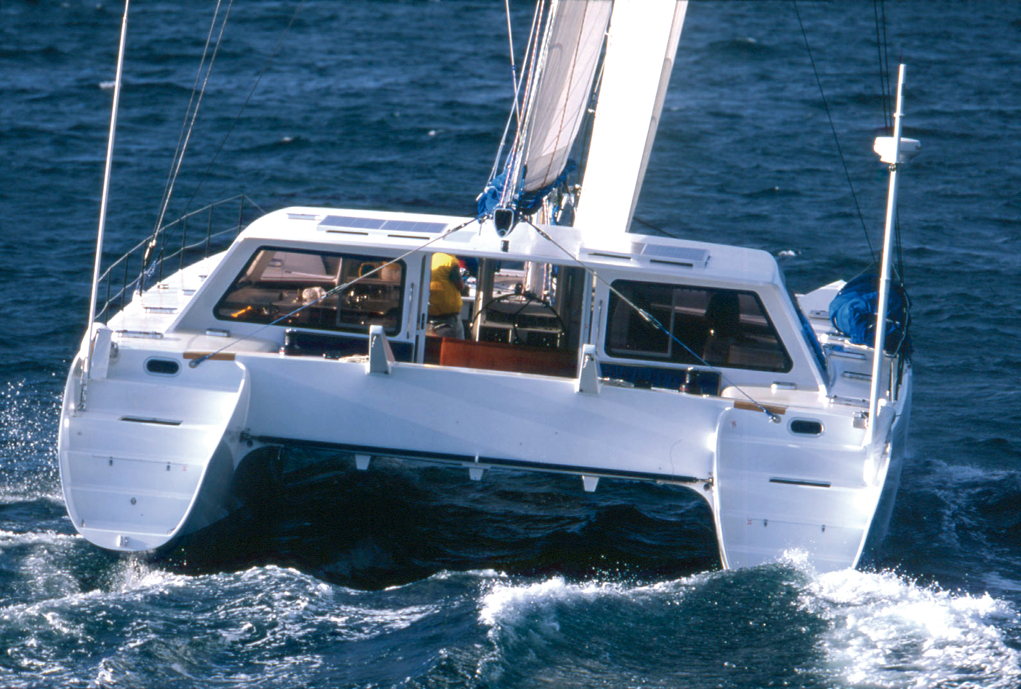
Fast and comfortable, the Gunboat 62’s success.
Hulls
The hulls are narrow, high aspect in vertical cross section and, like the salon have 2 m headroom. Each hull has space for 2 staterooms, one fore, the other aft. As with the salon, Tribe’s interior details are a combination of wood veneer furniture and solid wood accents and a simple, no nonsense implementation of details. The children’s compartments included pipe berths with cushions for beds and open bins for toys and cherished possession. Each stateroom had a LCD screen DVD player over the bunks for relaxed viewing. A walk-through head is mid ships in each hull, with a closed head, lavatory and shower. Weight saving curtains rather than a solid bulkheads with doors provide privacy with this arrangement. On Tribe, the Johnstones converted one of the staterooms in the master suite to a library, and added extra galley storage mid ships because they planned extended blue water cruising. One could easily add more to a GUNBOAT 62 to give greater privacy or convenience and Mr Johnstone commented that he expected others would. For his family, committed to fast sailing and racing, the plan in Tribe is understandable and workable.
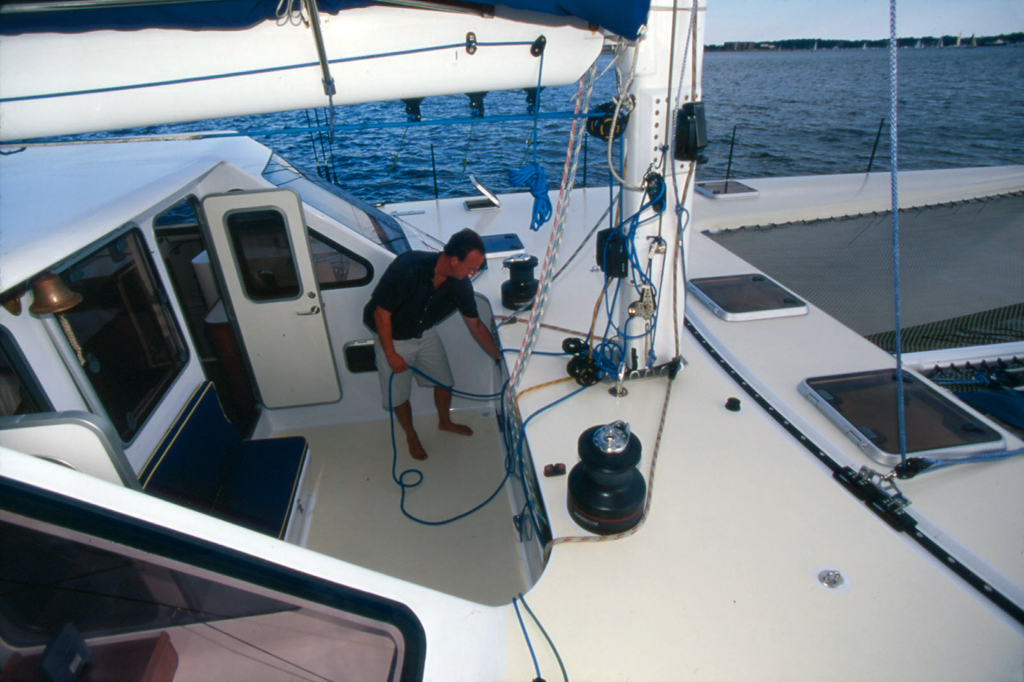
Here is the famous forward cockpit, forward of the cabin roof ; it receives all the control lines.
Sails and Rigging
The GUNBOAT 62 has a powerful fractional sloop rig sail plan, that includes, screacher and spinnaker on Tribe. The mainsail is generously sized.. The traveler of the self tacking jib is fixed just forward of the mast’s base. All sails, built by North Sails, are low stretch, high strength fabrics more commonly found on racing boat rather than cruisers. Based on Mr Johnstones’ comments about a couple years of cruising, they prefer to keep the sails in the fully rigged configuration. But when other priorities take precedence, the mainsail rests on a stainless supported stack pack when not in use. Tribe has no furler-mounted head sail. Sail bags attached to the trampoline hold the foresails, including a jib, the reacher and spinnaker, when not in use. The non-rotating carbon fiber mast, built by Marstrom in Sweden, is 76 ft tall (83 ft off the water’s surface). It has a single spreader that supports a dual set of diamonds to reinforce the mast. Placing the mast on the foredeck gives additional opportunity to lower the boom closer to the roof of the salon compared to the options available if the mast were on or near the top of the salon. Standing rigging is PVC sheathed Kevlar and Spectra lashings. Occasional stainless steel substitution occurs where necessary for abrasion resistance or other requirements. Diamond wires, for example, are stainless steel rod. Easy access is the most significant aspect of the GUNBOAT’s rigging. It is less than 3 steps from the helm to the front, working cockpit and access to all sail controls. When sails need adjustment, these can be made literally in less than a minute. Stowing sails requires a further movement to the trampoline to stow sails in sail bags. Quick, effective response is a racing philosophy, but its implementation through a front cockpit complements go-fast cruising with convenience that even the casual sailor will appreciate profoundly. Use of a hank-on jib clearly moves the GUNBOAT’s center of gravity further aft than cruising catamarans’ and the working cockpit center of sailing controls strongly reinforces a different kind of convenience. Each sailor or cruising family will have to decide if this is less, equal to or more workable than the usual furling genoa arrangement.
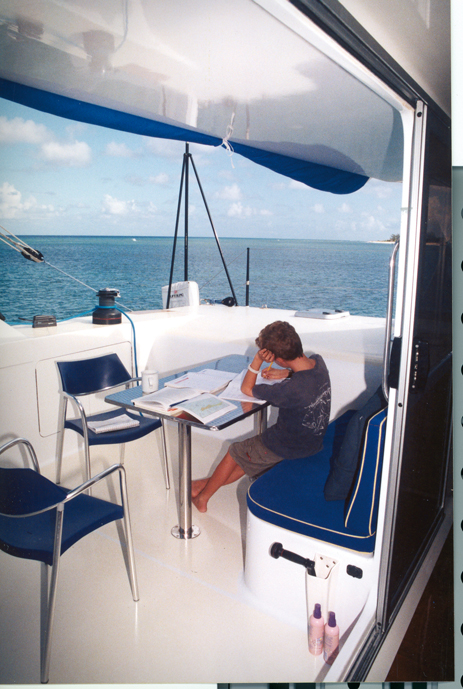
The aft cockpit is rather smaller than on the other catamarans, but sufficient for relaxing…
Hull Construction
The hulls are laminated with Kevlar covered core-cell foam and post cured epoxy resins. Carbon fiber is used in selected areas where additional strength and rigidity are required.. Hulls, decks and pilothouse are monocoque construction (molded without joints or seams.) This construction is typical of racing boat components and is far less common in cruising sailboats. The GUNBOAT’s hulls have elliptically shaped bottoms. Each hull has a retractable carbon fiber / epoxy dagger board. The Henderson lifting rudders are similarly constructed. They are mounted in a cassette visible through one of the transom steps. Like the center board, mounting the rudder in a cassette allows it to be raised and lowered. With the dagger board lowered, the GUNBOAT draws about 9 ft (2.75 m) of water. With both the center boards and rudders raised, the catamaran draws only about 2 ft (0.6 m). Weight reduction to enhance speed and performance handling was an overriding goal of both hull and rig construction. Consequently, in this regard, the GUNBOAT 62 has little in common with most other production cruising catamarans.
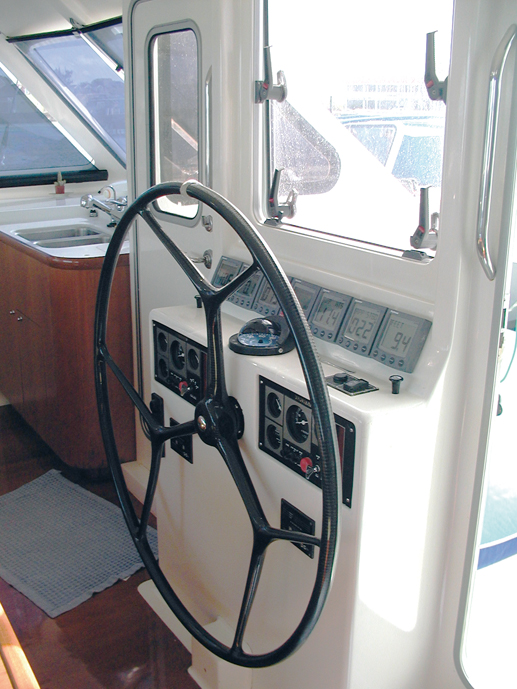
The interior steering position. Pleasant and offering exceptional visibility.
Auxiliary power systems
The GUNBOAT has a pair of Volvo 56 hp diesel engines in each hull that power the boat at an easy 8 kn with a top speed of 11kn. Electrical power is provided by a high-output alternator on each engine and a set of four Siemans 120w solar panels on the pilothouse roof. Owners whose electrical needs require more power can add generators or batteries.
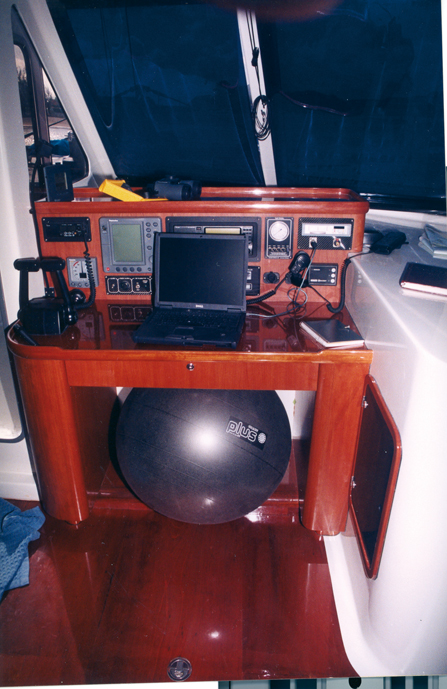
The chart table is complete and very practical.
Test Sail
I cruised with Mr. Johnstone and his son, Nick, from St. Thomas, US BVI to San Salvador in the Turks and Caicos, Islands, a blue water voyage of about 600 miles. This catamaran is not billed as a single-hander, but the sail controls and deck layout make it nearly so. With no assistance, Mr Johnstone raised the anchor with a windlass, secured it, and then we motored from the anchorage on the south side of St. Thomas. Once north of the Islands, we raised sail and continued under sail. A Harken electric winch enabled Nick to raise the main sail. Mr. Johnstone raised the screacher with no assistance. His son set the screacher sheet with the electric winch while his father set the heading with the autopilot. The first impression of sailing the GUNBOAT is easy speed without much effort. It is sufficiently large that 3 - 5 ft swells have little effect on the catamaran’s motion. Yes, we could feel the sea but the catamaran moved smartly and comfortably over the back of tradewind generated swell. The catamaran is high off the water so almost no slamming during this trip occurred. Wind velocities were typically 8-12 kn until the second evening, when they rose above 20 kn in gusts for the last 2 hr of the voyage. For most of the cruise, the Autohelm did the steering with no need for supervision. As long as the wind’s apparent velocity remained below 18 kn, no attention from the watch was needed. The watch’s primary responsibility was to look for solid objects on the course. During the final few hours of the cruise, as we approached San Salvador, the wind rose to over 20 kn as the Bermuda High reasserted itself over the area. The boat speed rose to, , to 26 kn during one strong gust lasting about 30 seconds. Under these conditions, the helmsman steered off the wind a few degrees (again using the Autohelm in a manual over ride) to smoothly and easily reduce excess force on the sails. The rapid response of this 62 ft catamaran both to the wind and to adjustments from the helm was fabulous. This was a thrilling episode during the trip and an unforgettable final 2 hours of the experience on Tribe.. It was completely unexpected, especially following nearly a day of leisurely blue water cruising that seemed more like the Intracoastal waterway on a nice Florida day. It was so much like sailing a beach cat, feeling the spontaneous acceleration with the wind gusts and correction from the rudders.
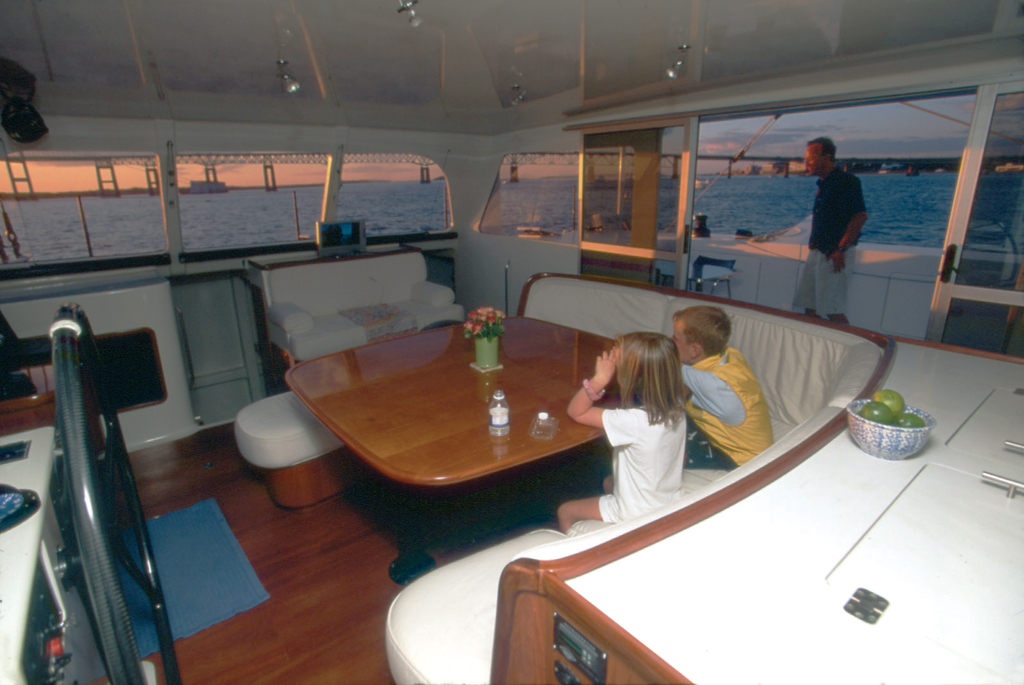
The interior is really cosy. A plus for the Gunboat.
Concluding Comments
As a preliminary comment, please note that the name comes from racing: The GUNBOAT is the first to cross the finish line; it gets an audible signal, traditionally a gun. (Subsequent finishers get a flag signal.) It does connote a military allusion. The GUNBOAT 62 is a big boat in a small class of high performance cruisers that have often more in common with racing catamarans as with mainstream luxury cruising cats. If you classify on the basis of difference, The Gunboat 62 is a geek sailor’s dreams come true. A true geek would express the Gunboat 62's appeal as follows: sleek - chic = big thrills The GUNBOAT, however, has a lot to offer the merely enthusiastic sailor seeking a pure and thrilling sailing experience. That means wanting to spend the time and attention to sailing this catamaran rather than relaxing on it at anchor. At price of well over a million dollars, this boat is priced as a status symbol or tabernacle of the ego. A purchaser seeking this gratification in a catamaran purchase would be rewarded buying a different one. The GUNBOAT 62 is an action hero. It does not impress by its looks, but rather than in the way it moves. It can leave you breathless.
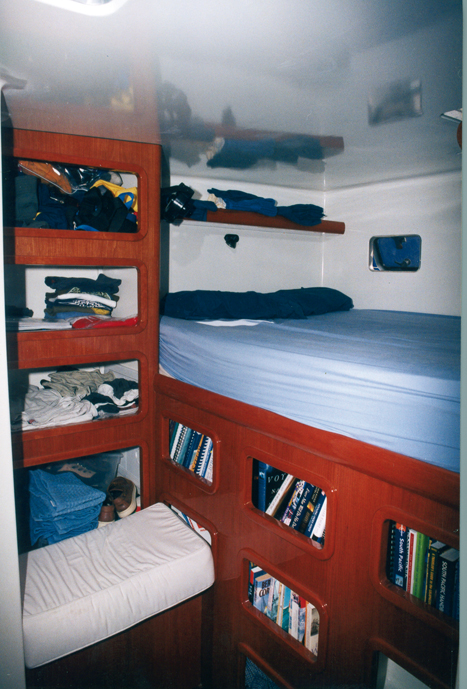
The cabins are very pleasant and have lots of stowage space.
SPECIFICATION
GUNBOAT 62 LENGHT 18,90 m BEAM 8,60 m DISPLACEMENT 12 T DRAFT 0,70/2,60 m MAINSAIL 117 m2 GENOA 58 m2 GENNAKER 135 m2 SPINNAKER 204 m2 WATER TANK 2 x 380 l FUEL TANK 2 x 475 l MOTORS 2 x 56 CV DESIGNER Morrelli & Melvin