With just thirty example built (from 48’ to 90' in length) since 2001, the extravagant American brand created by Peter Johnstone, knew how to create something mythical! Successive relocations (South Africa, China, USA) combined with various technical and commercial tribulations threatened to put a stop to this great adventure, but then the French group Grand Large Yachting (Outremer, Garcia and Allures) acquired it in 2016. Some thirty months later, the first new generation 68' Gunboat was launched! We took the opportunity of a weekend around the Iles d’Hyères (off France’s Mediterranean coast) to discover this exceptional multihull.
Infos pratiques
- Le chantier : Gunboat 68
- La fiche technique
-
 Découvrez notre vidéo exclusive
- Financez votre Gunboat 68
- Assuez votre Gunboat 68
- Articles autour du Gunboat 68
Gunboat: a Phoenix Brand
The first chapter in the Gunboat story was set in South Africa (at Harvey Yachts), a country of maritime tradition, nautical competence, Anglo-Saxon culture... and low-cost labor! The Morelli-Melvin signature was a guarantee of notoriety and the first video of a G62 literally pulverizing a fleet of racing monohulls on their startline caused a sensation! These transgressive Nomex carbon catamarans, dressed in flashy colors and christened with evocative names, wreaked havoc in the upscale yacht clubs on the US east coast. Their annual migrations to St Martin or the St Barts regattas gave rise to spectacular yuppie contests in which a few mercenaries from the podiums of ocean racing or the America’s Cup gladly joined them. Some of them completed remarkable round-the-world trips at very high speed! Years later, the new subcontracting set up at Hudson Marine went wrong, the distance from the decision-making center, and from customers, and cultural misunderstandings with the teams in southern China caused major problems and precipitated a move too late to the new factory in North Carolina.... not yet technically ready to restart production, filing for bankruptcy was ultimately inevitable!
The rebirth of a "Must-have"
With such an incredible brand image, the exception is the rule and you can’t stop to ask yourself questions midstream! Construction principles, design, silhouette, equipment, performance, everything, absolutely everything must be right at this level of High-Tech! The American side of things is still there, through the Newport offices, but the manufacturing and design are French. The "good fairies" gathered around the project are the Parisian and Breton teams of VPLP, the "fastest naval architects in the world", who also design the leading fleet of family cruising catamarans: Lagoon. For the exterior design, there are two standard-setting signatures: Patrick Le Quément and Christophe Chedal-Anglay (who also designs the interior); for manufacturing, an ultra-modern factory was built in a few months around a design office that occupies a prominent position. The location, close to the water, and close to the Outremer workshops (another brand of the same group), allows all the technical phases to be carried out under exceptional cleanliness conditions and for all the quality parameters (temperature, humidity, dust) to be controlled. Other leading partners are involved in manufacturing or subcontracting (Lorima, C3 Technologie, Fibres Mechanics, Hall Spars, Power Product Marine Solutions, among others). A broad pre-design consultation was conducted with Gunboat owners and skippers (Travis Mc Garry has captained 4 Gunboats!). In terms of style, it was necessary to "aim for the right thing", of course, but also to anticipate customization requests in order to reduce them to a choice of acceptable options which don’t damage the concept by blurring the perception of the product. Defending this rigor against buyers used to getting everything they want remains a central issue: are we discussing the philosophy and performance of a Bugatti Chiron or a Ferrari 812 Superfast?
A timeless silhouette
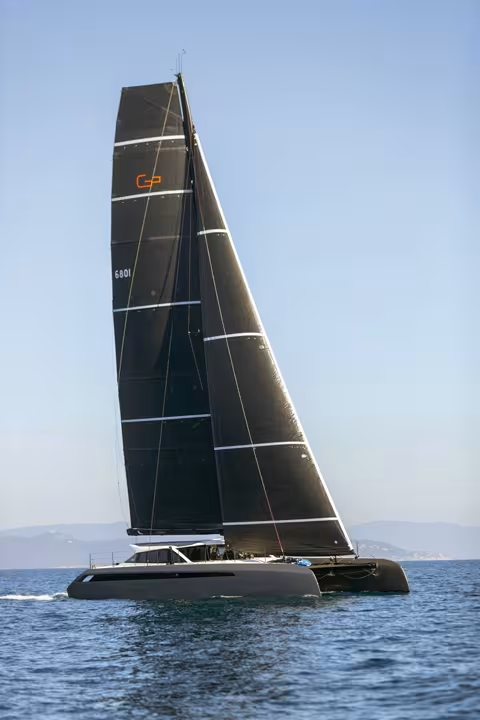
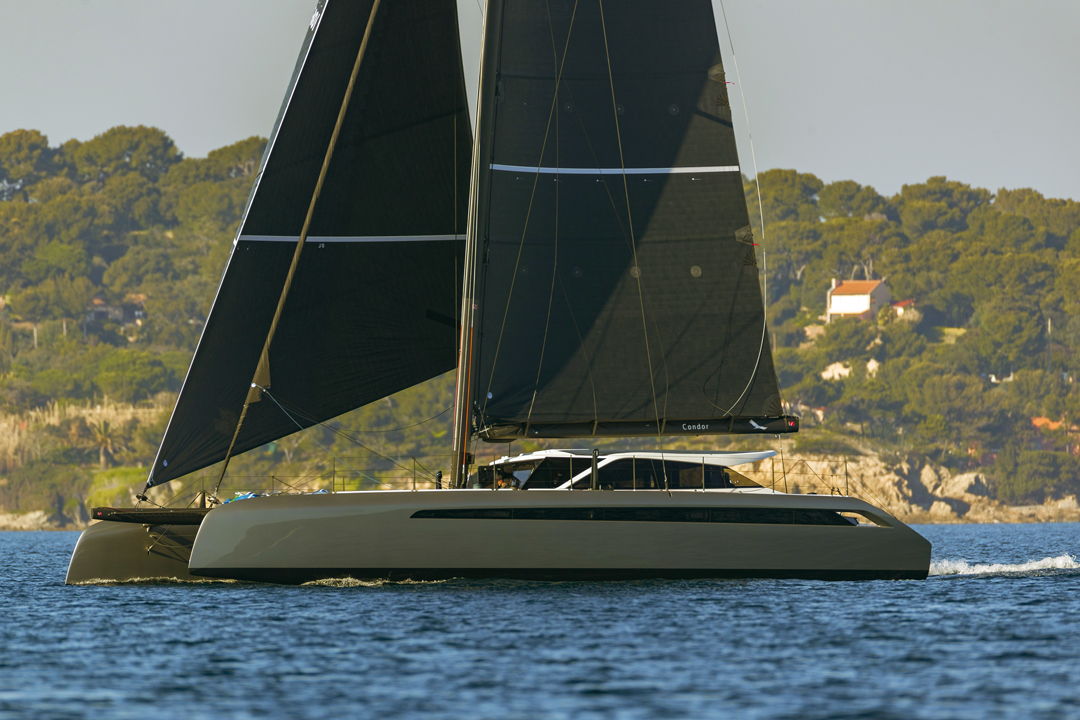
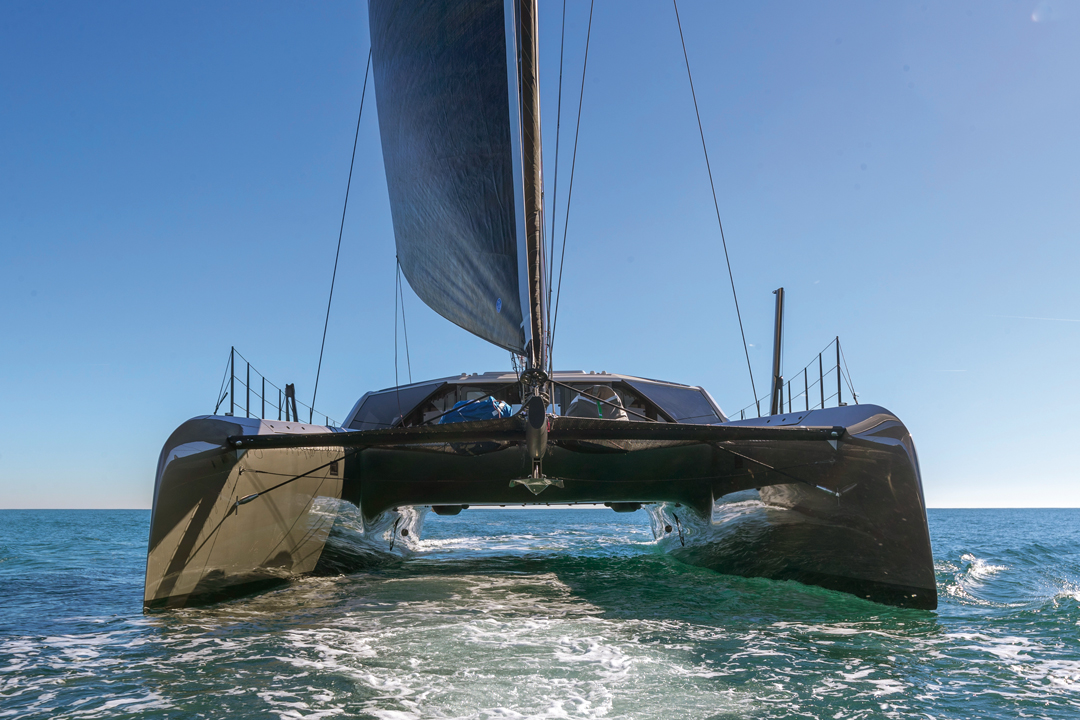
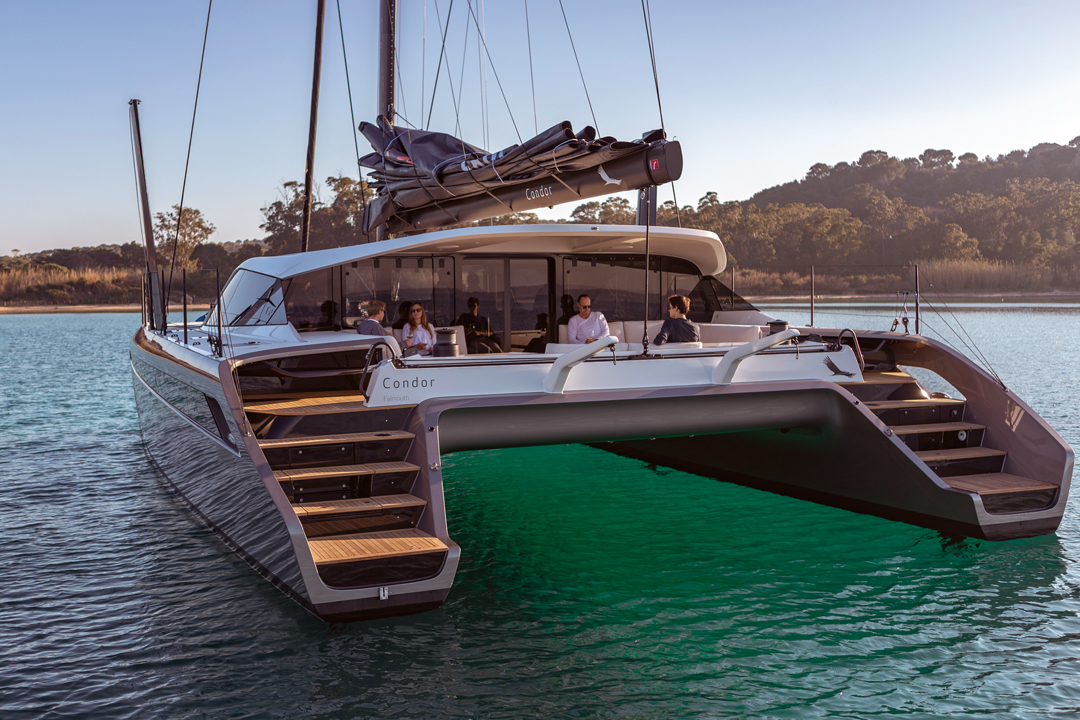
If you’re a fan of understatement and restraint, run away now, because I am afraid I will have to draw on every one of my superlative resources to try to convey the emotion of this boat. Everyone knows that catamaran design is a delicate thing ("they are not boats" said Eric Tabarly!); let's still try to describe it as factually as we can (it is possible that my eye and my pen will take me a little beyond this laudable vow of ethical reserve!). I discovered the G68 at anchor alone in a large bay on the island of Porquerolles, the first impression (from a distance) was that of a smaller boat than I had anticipated, this effect is due to the general lines and the perfect balance of proportions. As we approached, the powerful black rotating rig, which culminates at 32m (105’), draws the eye towards other observations. The mast is stepped much further aft than on the 1st generation Gunbooats; it takes the coachroof with it and hides the central (though spacious) cockpit: a nod to the recent Ultime machines. The hulls appear just as they are: very long and very thin (seen from below or above, they look like the central hulls of racing trimarans). The seductive power of this silhouette lies partly in the restrained elegance of the lines; no design torture here in these magnificent rocketships, these skillfully shaped bows, this delicate forefoot. The open sugarscoops are sublime. The design of catamaran coachroofs often ruins the best projects because the road to hell is paved with good intentions and by trying to reconcile the irreconcilable, the design teams, instructed by the marketing departments, sometimes commit the irreparable! Far from these concerns is our Gunboat 68. Long live the freedom of creation of haute couture! The slope of the windshield, the design of the pillars, the finesse, the fluidity, the artistic form of the coachroof highlights such lines as produced by Zagato on his legendary ultra-sporty coupés such as the Mostro concept car powered by Maserati or the Aston Martin Vanquish. The look of the 68 is exciting! It sets new avant-garde standards in the world of Multiyachting, born of the racetrack.
La renaissance d'un "Must"
Avec une telle image de marque, l'exception est la règle et il ne faut pas se poser de questions au milieu du gué ! Principe constructif, design, silhouette, équipement, performances, tout, absolument tout doit être au service de ce credo High Tech ! L'implantation américaine reste réelle au moyen des bureaux de Newport, mais la fabrication et la conception sont françaises. Les "bonne fées" réunies autour du berceau sont les équipes parisienne et vannetaise de VPLP, le "cabinet le plus rapide du monde", qui conçoit aussi la flotte leader des catamarans de croisière familiale : les Lagoon. Au design extérieur, on retrouve deux signatures références : Patrick Le Quément et Christophe Chedal-Anglay (qui réalise également le design intérieur) ; pour la fabrication, une usine ultra moderne est bâtie en quelques mois autour d'un bureau d'études qui occupe une place prépondérante. Cette unité, proche de l'eau, est voisine des ateliers Outremer (autre marque du groupe), elle permet la réalisation de toutes les phases techniques dans d'exceptionnelles conditions de propreté et de contrôle des paramètres de qualité (température, humidité, poussière). D'autres partenaires de premier plan sont associés à la fabrication ou à la sous-traitance (Lorima, C3 Technologies, Fibres Mechanics, Hall Spars, Power Product Marine Solutions…). Une large consultation préalable à la conception a été menée auprès des propriétaires de Gunboat et des skippers (Travis Mc Garry a été boat captain de 4 Gun !). En termes de style, il fallait "viser dans le mille", bien sûr, mais aussi anticiper les demandes de customisation afin de les réduire à un choix d'options de personnalisation acceptable qui n'obère pas le concept en brouillant la perception du produit. La défense de cette rigueur face à des acheteurs habitués à tout exiger reste un enjeu central ; discute-t-on la philosophie et les performances d'une Bugatti Chiron ou d'une Ferrari 812 Superfast ?
Quality exterior perception
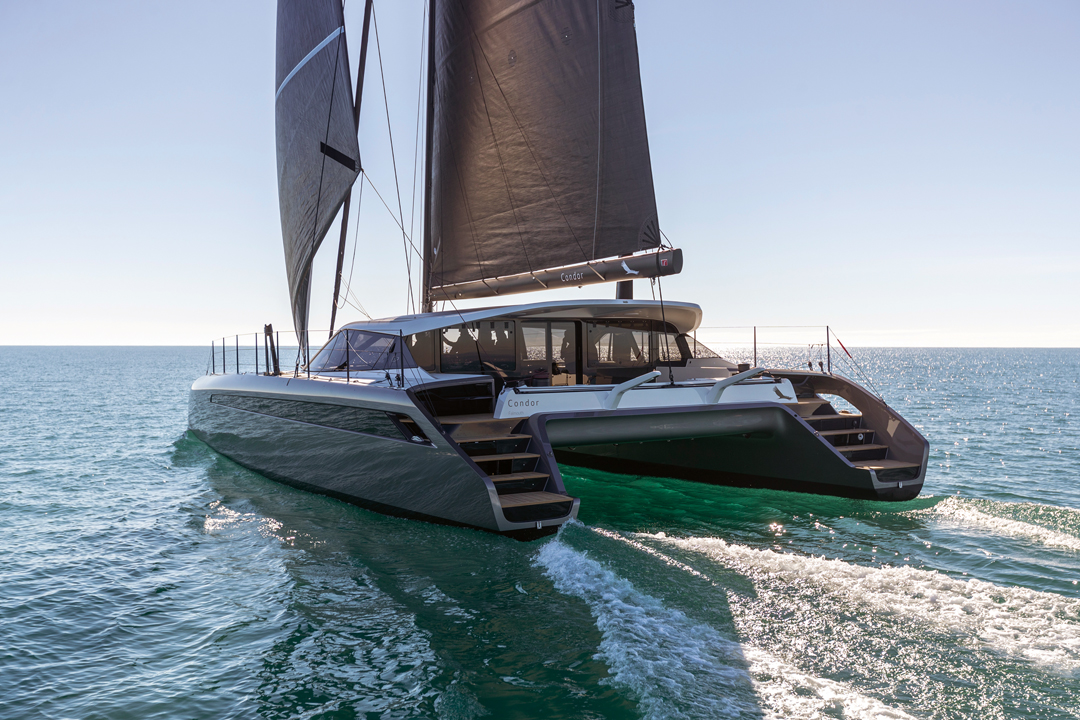
To come up with this inspired design, nothing was left to chance. Sometimes to obsession, though! The eye, amateur or expert, perceives the soul of the boat at first sight; the neurotic excitement of the observer will push him to almost indecent detailed observations, but this big catamaran doesn’t simply have a "good profile", it is beautiful from every angle! The light passing through the smoked tempered glass enhances the perception of the magnificent coachroof; the depth of color (a dark metallic silver) of the fantastic AwlcraftSE paint system is a spectacle for the eye; the almost physiological finesse of the hull-nacelle connections, and the majesty of the sail plan all deserve acclaim. Beyond that, it is the very ease of this multihull, its speed, and its almost animal-like mobility that makes it look alive and admirable!
A very high standard of construction
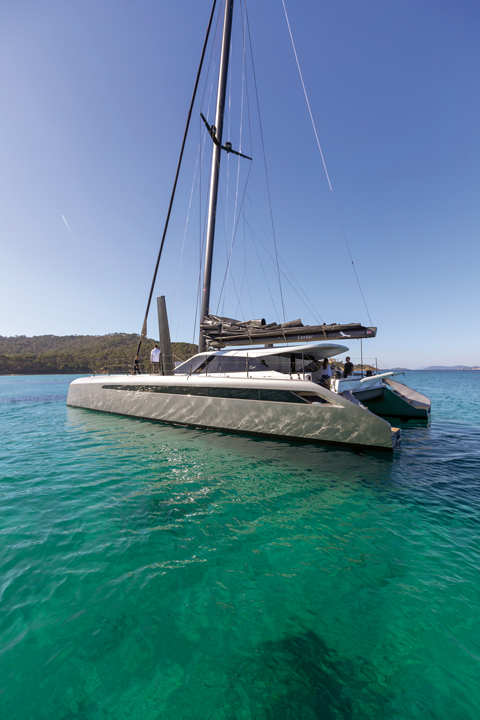
The stratospheric performance of large modern multihulls has reversed the possibilities for going around the world by bringing together 3 basic conditions: designers, builders and sailors of genius! The manufacture of a Gunboat does not constitute such a leap into the unknown, the 68 remains a cruising boat (whose objective is to be the fastest of its time!), but the release of the prototype sets out the whole challenge and fixes the DNA of all future models, so they needed to draw on the recipes of excellence from ocean racing! The structural chassis has to guarantee mechanical strength that is resistant to the power of the machine and the stresses of enthusiastic crews, who will certainly use it 100%. Only carbon can meet this level of requirement; it is used here in a prepreg formulation, combined in a sandwich with thermoformed Airex Gurrit foam (80 and 110kg m3) in an infusion-epoxy and post-curing process! The bulkheads are specially subcontracted to Fibres Mechanics in Southampton, they are produced under the North Thin Ply technology license. This high-tech process allows an applicator robot (as in the sailmaker’s 3DI system) to organize countless networks of oriented black fibers of unknown density and mechanical strength (used on racing bike frames, racing skis or Formula 1 car chassis). The hull and technical installations of the G68 have been designed for an extraordinary longevity and possible rational retrofits.
Appendages and steering system
Here again, the (apparent) simplicity of the racing solutions has been used, the in-house design office, partner Mer Agitée (Michel Desjoyeaux), specializing in the development of competition prototypes and C3 Technologies joined forces to create a complete control system based on Jeffa steering gear and carbon linking rods. This architecture had to be as direct as possible between the central steering station and the rudders, while allowing simple disconnection of the pilots (one on each side in a dedicated unit on the aft beam) and the option of removable tillers! It was therefore necessary to design the aft beam around this setup! The engineering of the rudders is the subject of discretion on the part of Gunboat, but I was still able to access these little wonders: they are sliding profiles in an articulated sleeve cassette (only 25kg/55 lbs per pre-preg carbon unit with positive buoyancy for easy lifting). Simple and beautifully made; there is even a rake adjustment (vertical incidence) by worm screw for those who want to equip their rudders with foils! The ultimate detail: when the rudders are pivoted, a system of covers prevents cavitation by the entry of the water under the free surface. The carbon/pre-preg daggerboards slide magnificently allowing very fast up and down maneuvers from the central cockpit when tacking. The choice of straight appendages offset from the hull axis was chosen after a wide study of different profiles.
A traditional engine, an innovative transmission
The 80hp Yanmars are obviously located in the center of the boat (just like all the systems: batteries, chargers, inverters, air conditioners, refrigerators), but the sail drive transmission is tilted inwards to relieve the disturbed flow over the rudders, and to reduce the draught. This system does not allow for taking the ground easily, but an option with a removable articulated drive shaft in the hull also exists.
The first sensations on board
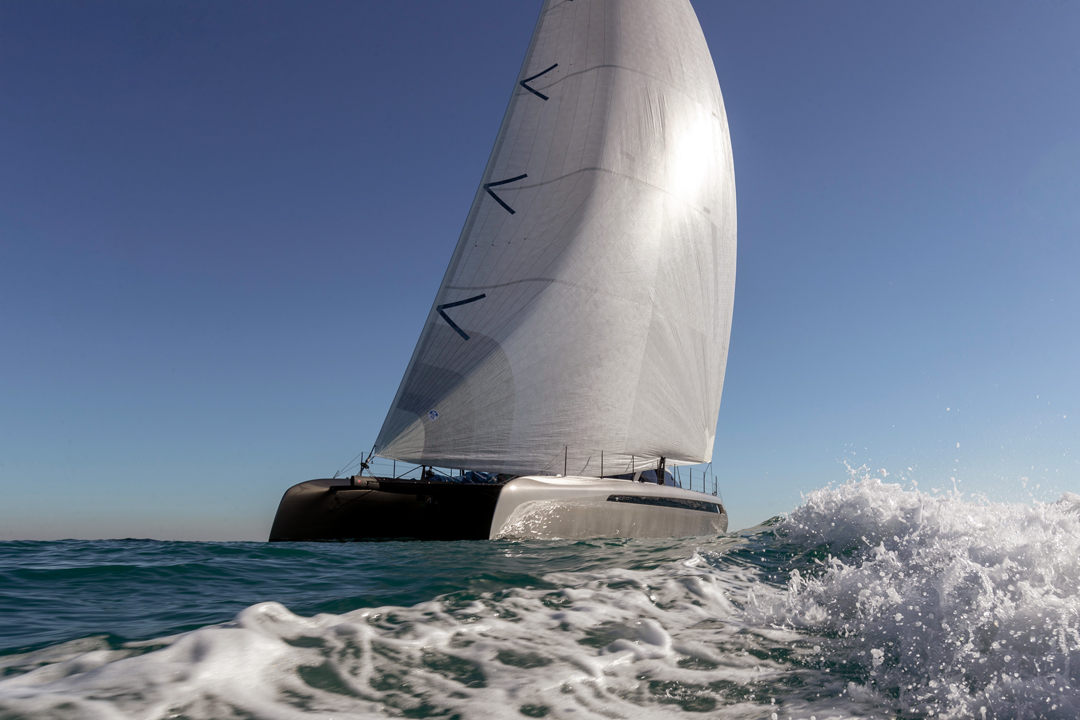
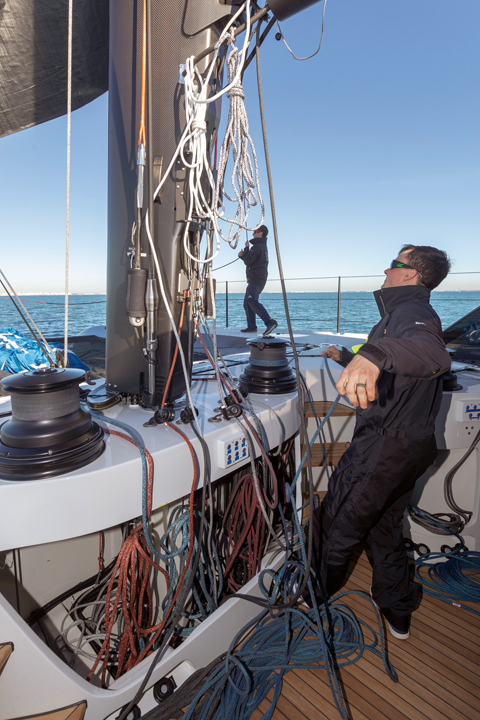
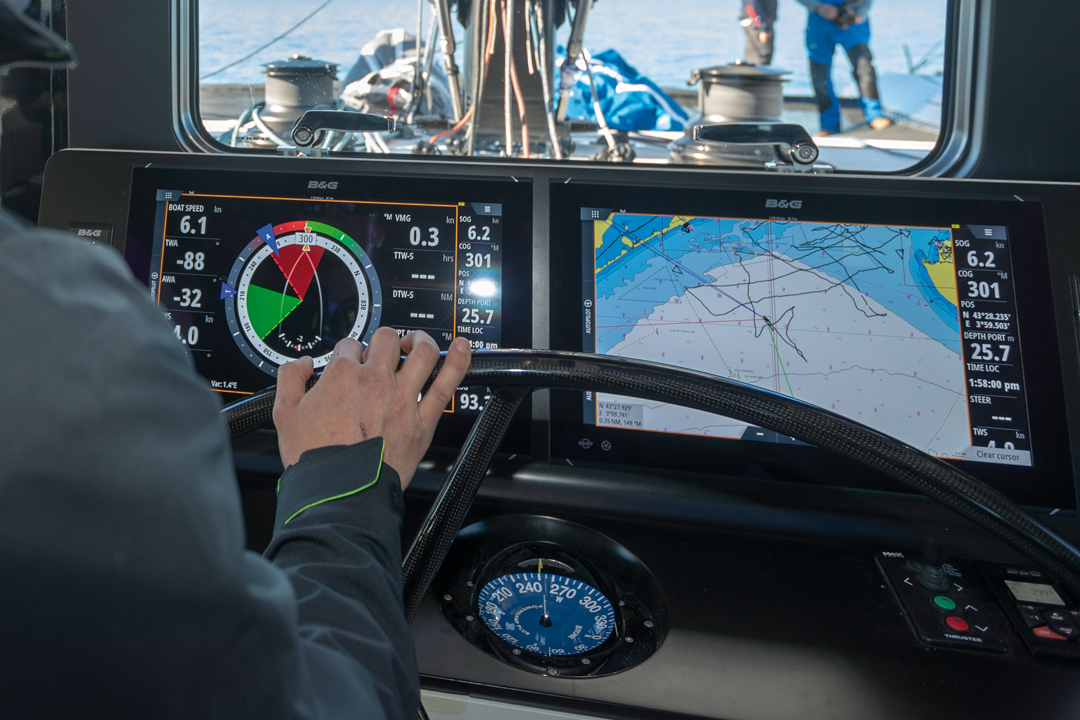
Condor is a sailing machine that skillfully blends the power of a racing prototype with the comfort of a luxurious urban chic marine loft; it has reversible air conditioning, but the efficiency of the electrical installation (production, storage, conversion, transport) makes it possible to do without a generator. The sandwich insulation, ventilation provided by the forward doors and the sliding window guarantee true thermal comfort at all latitudes. Some of the furniture can be dismantled to meet the racing/cruising specifications, so, at the end of the regatta, the central galley island, the forward cockpit locker, the aft cockpit furniture, the lounge tables can be reinstalled in time for the party! The machine then turns into a comfortable nautical lounge-bar with its generous upholstery, BBQ and chilled storage, not to mention the 4 comfortable suites and crew accommodation. We set out from the anchorage under the discreet thrust of the 80hp Yanmars coupled to three-bladed folding propellers. The central cockpit architecture popularized by Chris White on his Atlantic boats and taken over by Morelli-Melvin for the first Gunboats has been preserved because it is very relevant for this type of program, which can alternate between demanding racing and owner use with a very small crew. The proximity of the helmsman to the mast base, the grouping of all operations around this really ergonomic central technical area, the perfect visibility for the crew allow remarkable fluidity and communication in fast sequences. The hydraulic assistance of the mast rotation and the power of the 4 mega Harken electric winches promote incomparable availability and reactivity. Both the mast base and the side coamings are covered with Cousin-Constrictors clutches that are easy to conceal and so effective. The accesses to the forward deck, on either side of the sailing cockpit, are remarkable and allow the crew to act super-fast. After a series of hoists and drops (one of the goals of the day was to make the first dynamic photo report); we hoisted the 433m² (4660 sq ft) A2 asymmetric spi: a wall of canvas. Especially since the lowered cathedral of the central beam allows it to be taken flush with the deck! At the helm, I was positively impressed by the ergonomics that I had been unsure about. No blind spots, the vertical vision of the profiles is excellent thanks to the large electric sunroof, the work of the helmsman is easy, upwind and downwind, thanks to the large diameter wheel. The peripheral visibility is good, and the sensations are precise, even incisive! The directional effect of the rudders is very powerful, and the placement of the bows is done to the fraction of an inch. The dynamic perception of the contact between sailplan and structure can be felt underfoot, as can the excessively delicate touch on the water. The driving pleasure at the helm is real and implies there would be high-level sensations at the tiller. The Harken-Antal automatic traveler is a marvel of efficiency (especially coupled with a mainsheet management system with a ram inside the boom), but the deck layout has been optimized to be able to handle the boat "at the limit" on one hull, with a crew: we can therefore disconnect it and switch back to semi-manual mode on the electric winches of the aft beam for faster reactions. The glide of this very powerful catamaran is magnificent, in a range of 8 to 12 knots of wind, the indicated boatspeeds are often higher than 120% of those of the true wind, the wakes are always boiling, yet are delicate and the boat swims like a trimaran producing no waves.
Conclusion
The word conclusion has no meaning when stepping off a multihull like this: the story of this sensational machine is just beginning, and it is easy to imagine that it will be making headlines out on the water. The available power, the quality of the lines and the construction will allow it to make the dark fiber roar in the Caribbean tradewinds, in Porto Cervo or during the Multihull Regatta in Palma de Mallorca. The crossing of cultures seems to have miraculously taken place, the 68 has the strength and DNA of a great Gunboat, but there is more, its seductive power is awesome! It requires an exceptional budget, sustained maintenance and enlightened use, but it is so beautiful that it has already entered the world of "Making a better future with knowledge of the past" (Karl Lagerfeld).
The essentials
- A silhouette that will set multihull naval architecture standards
- Outstanding power and handling
Pluses
- Top-level deck plan
- Exceptional sails and rig
- Amazing perception of quality
Minuses
- Choice of saildrive transmission
- Why not a combined hydraulic system for winch assistance?
TECHNICAL SPECIFICATIONS
Builder: Gunboat
Naval Architects: VPLP
Exterior Design: Patrick Le Quément/Christophe Chedal Anglay
Interior Design: Christophe Chedal Anglay
Construction: Post-cured thermoformed/epoxy infusion process carbon/foam sandwich
Length: 20.75m / 68'
Beam: 9.10m / 29'10"
Draft boards down: 3.76m / 12'4"
Draft boards up: 1.20m / 3'11"
Air draft: 27.5m/ 90'2" for the standard mast; 31.5m/103' 4" for the racing mast
Displacement:17.8t / 39240 lbs. Maximum 23.8t / 52,470 lbs
Bridgedeck clearance: 1m / 3'3"
Mainsail area: 142m² / 1,528 sq ft or 175m² / 1,884 sq ft in racing version
J1 jib: 90m² / 969 sq ft or 110m² / 1,184 for the racing version (R)
J2 Solent: 66m² / 710 sq ft or 77m² / 829 sq ft R version
J3 staysail: 49m² / 527 sq ft or 54m² / 581sq ft R version
Fr0: 131m² / 1,410 sq ft or 155m² / 1,668 sq ft R version
A3 asymmetric spi: 230m² / 2,475 sq ft or 260m² / 2,800 sq ft R version
A2 asymmetric spi: 325m² / 3,500 sq ft or 433m² / 4,660 sq ft R version
Fuel: 2 x 378L / 2 x 100 US gal
Water: 2 x 378L / 2 x 100 US gal
Lithium batteries: 720Ah
Charging: Flexible solar panels on coachroof 2 or 3kW, 2 x 150A/24v alternators
Motors on the boat tested: 2 x 80hp Yanmar with offset saildrive transmission
4 black water holding tanks + 2 x 50L water heaters
Toughened glazing in coachroof
Price: around € 6M
Principal options on the boat tested:
Lengthened rotating mast (29m / 95'2")
Bowthruster in port hull
Air conditioning
3kW solar panels
Helm seats and tillers
Instant boiling water in galley
A word from the naval architects
Vincent Lauriot Prevost:
As Marc points out, this is a bit of a first for VPLP. It is rare for a naval architecture firm to have the chance and the ability to combine the profession of cruising boat designer with that of racing boat designer on the same project. The choices of sail plan, structural design, hull shapes, appendages and performance predictions are the result of our latest research into racing multihulls and are permanently, throughout the project, directly linked to those of a cruising boat where design, ergonomics, comfort, volumes, space and practical aspects of technical network integration are major elements of the specifications. With the Gunboat 68, we were able to design a luxurious and comfortable racing boat, or, seen from the other side of the coin, a luxurious and comfortable cruising boat with outstanding performance.
Marc Van Peteghem:
This has been a new experience for VPLP and an extremely rich one that we would willingly repeat with great pleasure. This project has definitely brought Paris and Vannes closer together and it has been great! The G68 has really been developed between the two agencies (in Vannes and Paris) by trying to make the best synthesis of mutual expertise; we have professions that each have their own specialty; knowledge of production runs, and a team of engineers dedicated to performance and now also to the structure that work for the two agencies. Two highly talented designers, a shipyard determined to take up the technological challenge of the quality of construction, guaranteeing respected weight specifications and a standard of finish that rises to meet the challenge. In short, everything was in place to make an extraordinary boat. Seatrials are still to take place in a good breeze but for the moment we are happy naval architects!