The Helia 44 made a strong impression when it was presented at the recent boat shows. The praise heard on the pontoons seems to indicate that Fountaine Pajot has hit its target. Of course, we wanted to confirm these good impressions on the water...
Infos pratiques
- Le chantier : Helia 44
- La fiche technique
- Découvrez notre vidéo exclusive
- Financez votre HELIA 44
- Assuez votre HELIA 44
- Articles autour du HELIA 44
Helia: a light in a period of financial crisis?
For a major player in the multihull world, 44 – 45 feet makes up the centre of a coveted target, covering potential sales of several hundred examples per year, spread over the whole of the world's production! These values may appear small, but they reflect the reality of a niche market which is protected from saturation. The strict framework defines the stakes; the economic environment and the competition mean they can't afford to make mistakes! In 2012, European sales have stagnated, but exports to Russia and Australia have worked well for the Aigrefeuille-based builder. As the positioning of the range around 13.5m was crucial, the successor to the Casamance (which appeared in 1985) and the Orana had to be high-performance in 'all' the categories: silhouette, interior style, quality, ergonomics, production engineering and of course, handling… A challenge in view!
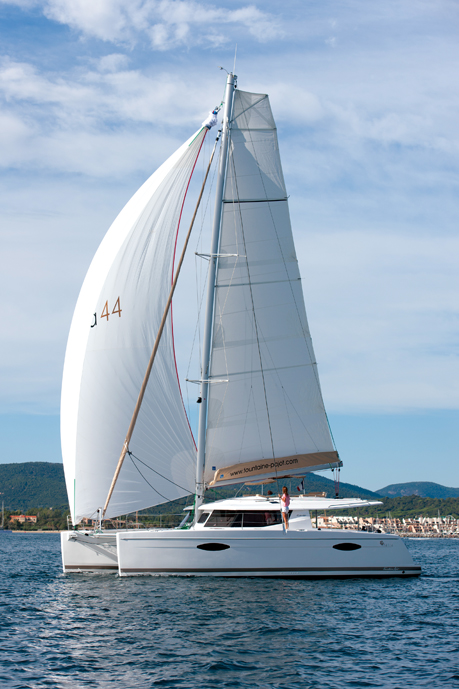
The Helia is a modern boat, meeting the expectations of today's sailors. A success!
An almost forty-year saga!
To begin with there is an architect's pencil. His experience and intuition guide him in the creation of a coherent shape which expresses his style and in which the carpenters integrate the answers to the elementary needs of daily life. Little by little, the salesmen have noted 'serious' trends in the expectations of the future clientele (especially concerning the internal area and decoration), it was therefore necessary to make the best possible use of the platforms' potential! The R&D departments therefore played a bigger and bigger role in the definition of the final project. Torn between the constraints of naval architecture, the demands of marketing and those of production, life has not been a bed of roses in these departments over the past decade! The arrival of interior designers and vacuum infusion techniques, and the recent, restricting provisions in the fields of hygiene and safety have redistributed the initial data. The huge possibilities of computer-aided design tools completed this revolution. Those who weren’t thrown by the upheavals of the period reinforced the international reputation of their brands, and are today distributing suitable machines which meet the complex requirements of the new aficionados the catamaran's advantages have created.
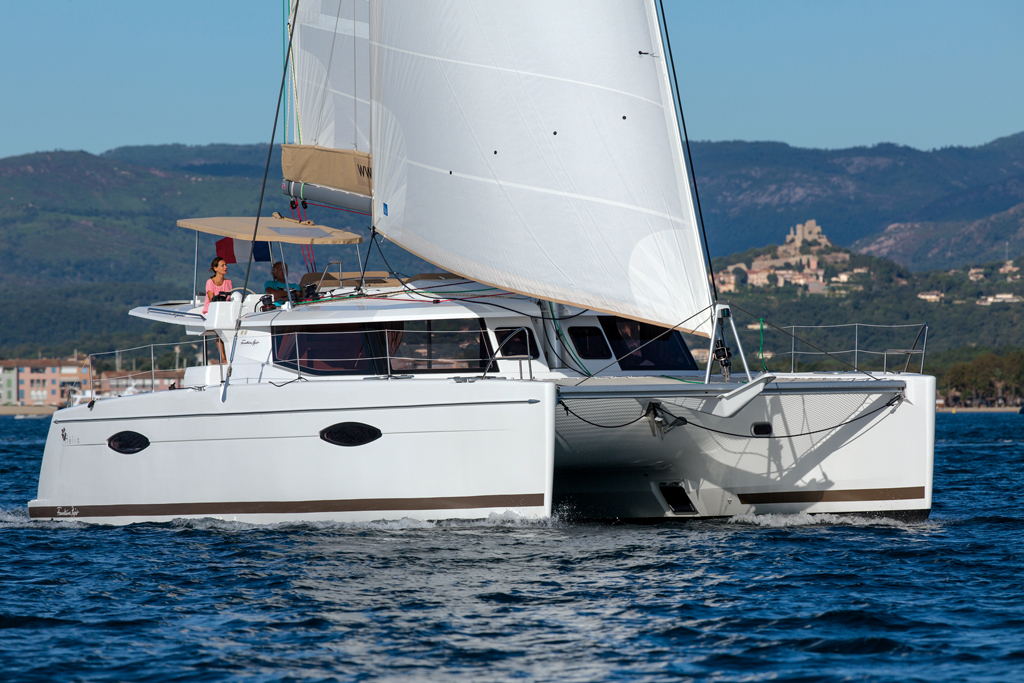
A cruising catamaran suited to family use, with coherent performance and remaining very tolerant: what more could you ask for?
A silhouette, a style
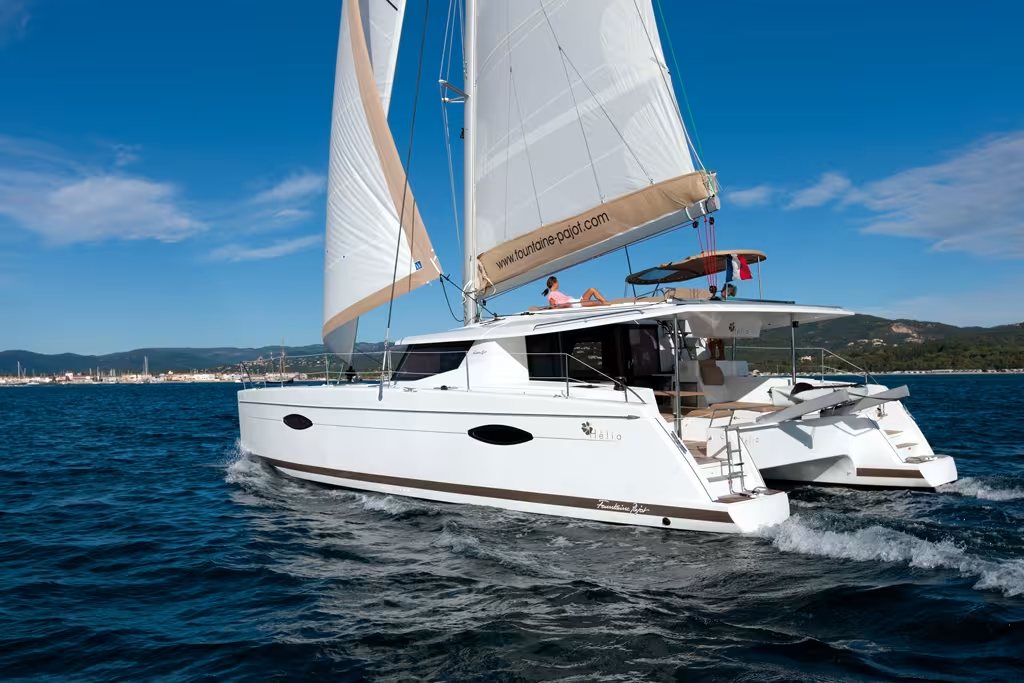
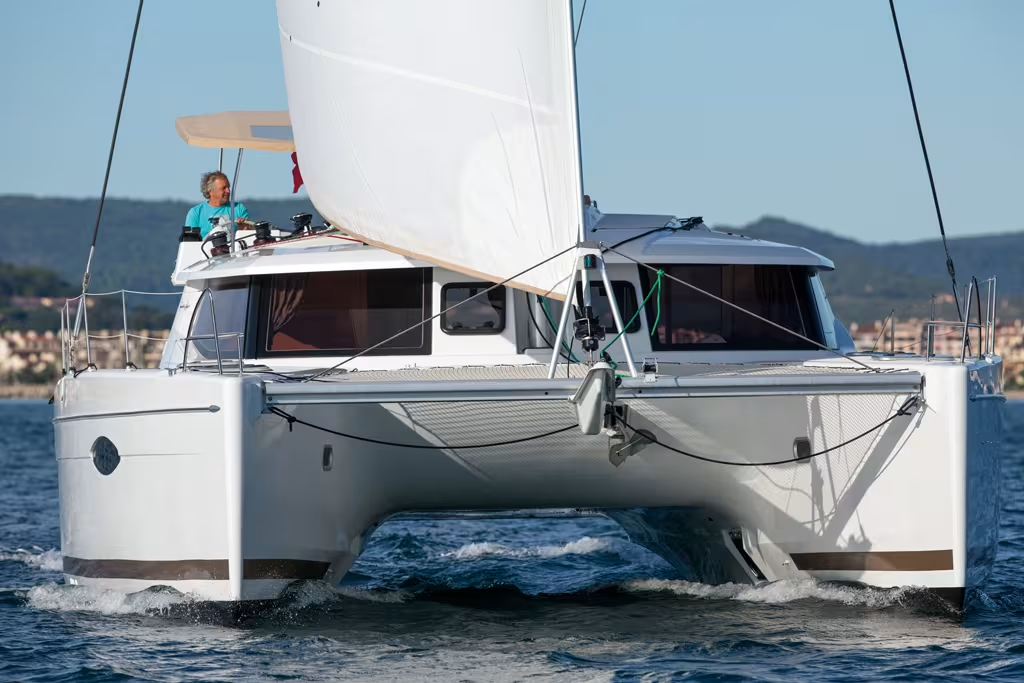
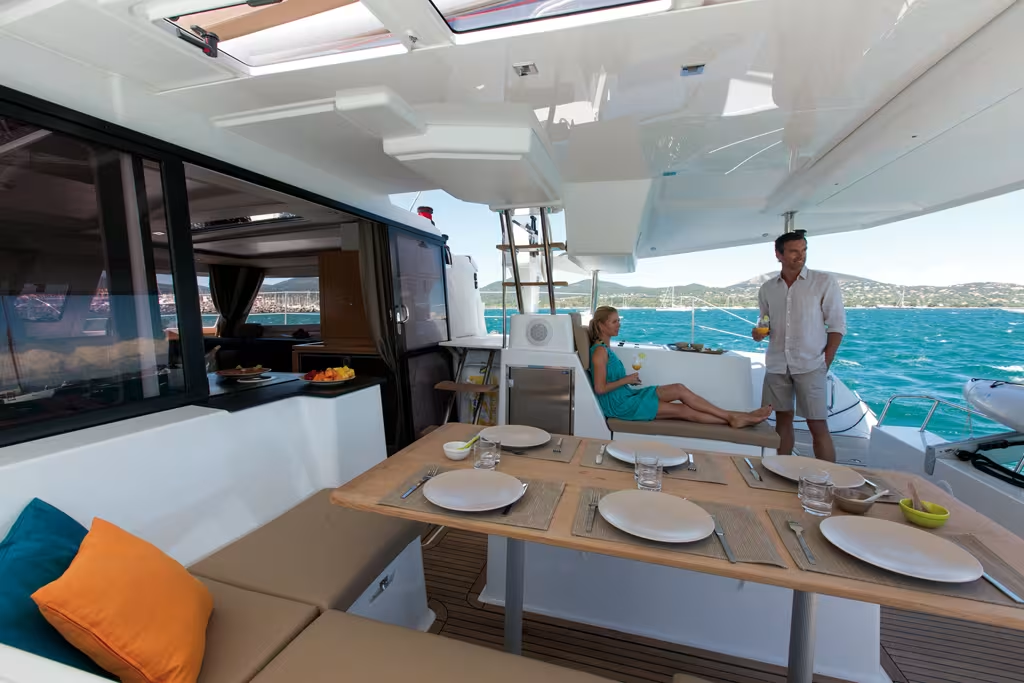
The Helia is representative of this revolution; it is the fruit of a contemporary, multidisciplinary and rational approach. Olivier Racoupeau, now at the controls of the office founded by Jean Berret, is surrounded by a young team which has a perfect command of the latest generation of computer tools; it is at the origin of 5 models in the Fountaine Pajot range (Salina, Eleuthera, Galathea), including the two most recent ones (Sanya and Helia). Isabelle, Olivier's wife, is an interior designer. Modern catamarans have amazing internal volumes and are therefore quite corpulent. The challenge consists of taking on board this orientation and interpreting it within the cultural codes of the brand. The Helia bestrides the exercise with talent; its coachroof is well proportioned, with a rigid aerial dome and a clever windscreen design. The 'whale-eye' hull portlights are in keeping with the very vertical hull sides with clean edges, which contribute to the refined overall lines and also elegantly provide the expected freeboard. The streamlined sail plan asserts an ambition for good performance. Aboard, the Helia sends a clear welcome message: multiple wide open accesses, cockpit and saloon on the same level, amazing volumes in the cabins...even more surprising - the conviviality areas (lounge deck, helmsman's seat on the semi-flybridge, exterior saloon) merged with the boat's personality from the design stage; their location has become 'natural'. Movements are particularly fluid; they participate in the immediate comprehension and the readability of this multihull. The fact that ergonomics have really been taken into account, and the interdependence of the functionalities, feed the pleasure of being aboard a 'reassuring' machine. Isabelle Racoupeau's interior design is a success (choice of materials and volumes, indirect LED lighting, lighting shafts); associated with a noticeable build quality, it provides a sober, consensual and cosy atmosphere, suited to the nautical environment, a genuine style which we didn't necessarily expect in a production model.
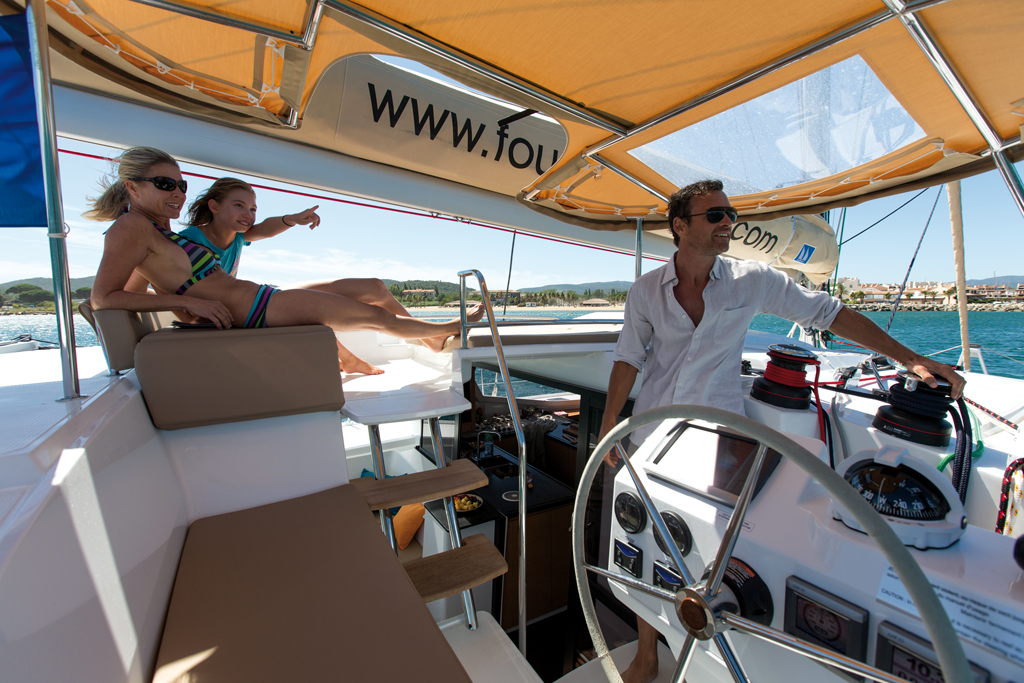
The raised steering position is as convivial as it is practical.
Architecture and construction
The overall spirit is close to that of the Sanya 57; the hydrodynamic equation is very close. Here it is a question of passing 13.3m hulls with a displacement of 11 to 12 tonnes through the water. The sections have to remain soft, to encourage good average speeds, whilst retaining volume forward and aft to fight against pitching, which always disrupts performance and comfort. The hull's longitudinal rib acts as a stiffener, and also creates a noticeable enlargement of the useful beam, just where it is desirable (about thirty centimetres above the waterline). It also plays the role of a water deflector with good, progressive vertical damping. The bridgedeck joint is soft, the frontal tip doesn't use any tricks which dissipate the energy of the waves; the entrance to the tunnel is fluid and open, a harbinger of a harmonious passage through the water. The platform is manufactured in four main stages: the application of a gelcoat of a controlled thickness in the mould, positioning the multidirectional glass tissues making up the internal and external skins, then fitting the pre-cut foams and the infusion, using vinylester and polyester resins. The Helia has a particularity concerning the manufacture of its deck, which is the biggest part currently produced using RTM (Resin Transfer Moulding). This element is in fact derived from total injection in a male-female mould. This avant-garde technique calls on large-scale industrial investment, but does away with interior moulding; the weight saving is considerable! It also allows assemblies to be manufactured with improved mechanical characteristics in better hygiene and safety conditions.
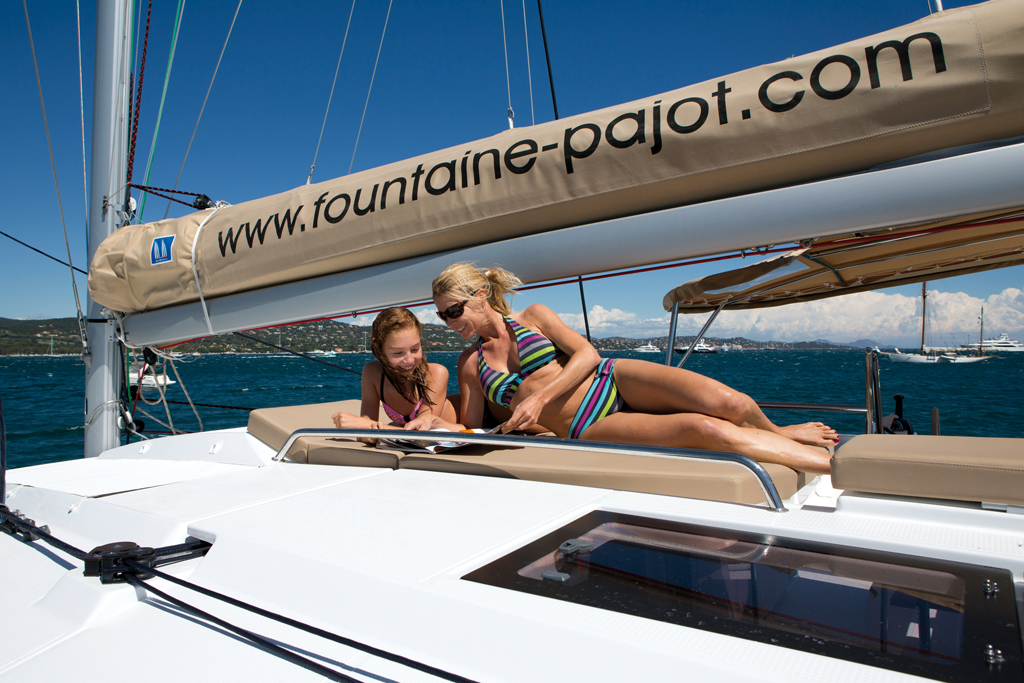
For a 44-footer, we find numerous conviviality areas, including the now traditional lounge deck on top of the bimini.
Sea test
No wind for the delivery trip planned before the Cannes Boat Show, and a nasty gale originating from hurricane Nadine at the end of the Grand Pavois in la Rochelle…the Helia 44' finally gave in faced with our perseverance, and consented to give us a nice windy sailing day at the end of October! Familiarisation was pleasant and easy; this size of multihull opens the doors to the ocean without imposing too much effort to prepare it for a day sail, or requiring exceptional skills when manoeuvring. The nav. station is offset to starboard; the visibility remains good, but the help of a crew member is occasionally needed, for a better view of the opposite port hull. The 2 x 40hp engines are powerful enough; the replacement of the fixed, three-bladed propellers with folding Volvo ones is essential (2 knot gain in speed downwind; the option only costs 1900 euros!). Faced with the chop in the Pertuis, the engines couldn't be faulted; they allowed manœuvres in (almost) all conditions. At 8 knots, a fast cruising speed, we motored smoothly, with no frontal impacts or pitching. The square-headed mainsail is fitted with Incidence's laced tack system, and therefore doesn't need to be detached before being stored in the lazy bag; however access to the boom from the coachroof is perfect. The electric winch easily takes care of hoisting this 70m² sail. The overlapping genoa, whose line is returned via the side deck close to the nav. station is just as manageable, both when unrolling and when tacking. The absence of winches at the mastfoot removes the trap for lines which sometimes makes use of this system debatable. Here the spreader protection and the fluidity of the sheet's path optimise an efficient and practical system (tacking singlehanded is as fast as with a self-tacking jib). We set a course for the Ile d'Aix; the close reach revealed a boat which is quite nimble, comfortable and rather fast. The south-westerly breeze seemed to want to get up to over 25 knots in the gusts, so we took in the first reef, whilst continuing on our course under jib alone. With the traveller freed off completely, the mainsail comes down with no effort, and can be tensioned from the manoeuvring station by a continuous line system ('automatic' reefing). The work on the turning points (Teflon-coated rings) has borne fruit; the path of the lines is remarkable, avoiding friction and wear points; the reduction was accomplished singlehanded, in less than a minute, without exposing any crew members to danger. This point is important for the programme! With the traveller hauled back in, we sailed back at over 8 knots, at 50° to the apparent wind. Another tack near Oléron, heading for St. Denis, the breeze was steady; we re-hoisted the full main with the same ease. Full sail in 25 – 27 knots of apparent wind (in normal use, we would have reefed earlier!), and the most instructive leg of the test began: the speed was high (over 9 knots), but I had to check this on the GPS, as the boats trim was so stable and the handling so manageable. The short chop crossed the swell arriving from the open sea; the Helia's attitude was amazing: it reared up slightly, supported by its middle and aft volumes. The forefoot, clear of the water, greedily swallowed up the most energetic waves; the catamaran sailed cleanly, without slamming or pitching – remarkable for such a compact cruising boat! There will be a limit to this; the Pertuis in a force 5 is nothing like Cape Creus or St Vincent in bad weather, but the exercise demonstrates the 44's abilities. By bearing away slightly, we reached a stable 10 knots. The swell became more pronounced; the gybe was made easier by sensible positioning of the centre of effort of the sail plan; passing through the eye of the wind was executed without brutality, with the traveller centred and the mainsheet taut. We unrolled the gennaker, prepared on the previous reach, and attached it to the structural bowsprit. The first surfs showed a platform which immediately lifted its tips and adopted a safe position (supported aft); as the energy of the waves was not enough to trigger long surfs, the reach continued at 11 – 12 knots with edifying directional stability. For this catamaran, my preference would be for a code 5 or a furlable asymmetric spinnaker, which would generate more power than a code 0 type gennaker.
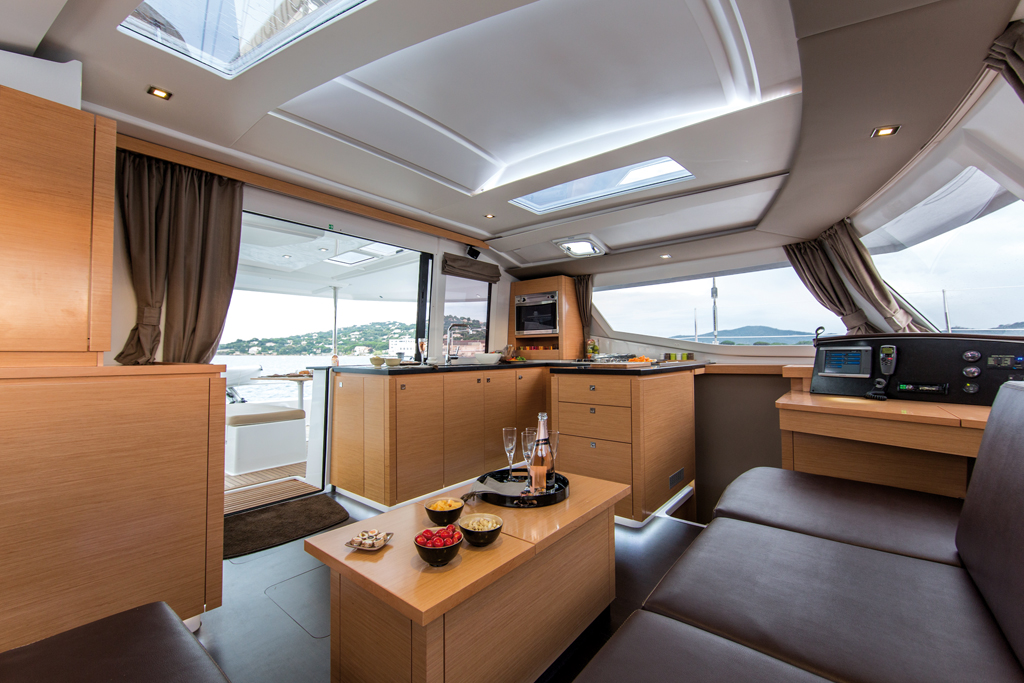
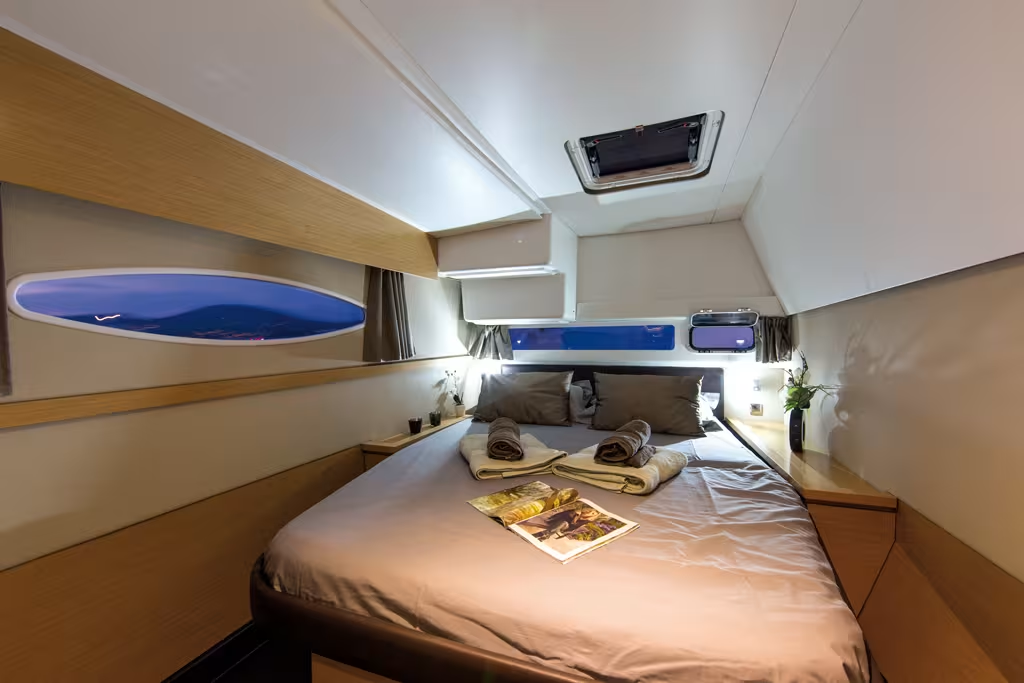
The interior is successful, with nice light sources on the top of the coachroof and particularly appealing volumes and areas.
CONCLUSION
The Helia is a successful cruising catamaran, cleverly adapted for inevitably multipurpose family use. Its performance is coherent, thanks to a generous sail plan, but it remains very tolerant. It sails smoothly, its deck plan is really efficient, and the nav. station (helm - seat – control lines) is worthy of praise (the electric winch is essential). The well-designed canvas shelter provides remarkable additional comfort and completes the cockpit insulation (optional). The overall ergonomics and the positioning of the fittings make it very pleasant to use; the overall quality combined with its dynamic behaviour and tasteful interior decoration are the attractive features for future crews.
The plusses:
• Mature concept • Pleasure in use • Product quality
The minuses:
• Inadequate aft guard rail (raised on the future models) • Steering gearing (modified on future models) • Creaking in the area of the 'picture window'
THE COMPETITORS
Model and builder Windward sail area in m² Weight in t Basic price in € exc. VAT Leopard 44 138 14.9 335,000 Nautitech 441 98 9.2 407,800 Lagoon 450 134 15.5 359,000 Privilège 445 114 9 488,600
TECHNICAL SPECIFICATIONS
Architect: Olivier Racoupeau Interior design: Isabelle Racoupeau Builder: Fountaine-Pajot Length: 13.30m Beam: 7.40m Unladen displacement: 10.8t Mainsail area: 70m² Genoa: 45m² Engines: 2 x 40hp saildrives or 2 x 55hp as an option Versions: Quatuor 4 double cabins or Maestro owner's version, 3 cabins Water: 2 x 375L Diesel: 470L Price: Basic: 348,000 euros exc. VAT, Maestro version with ocean cruising equipment: 378,000 euros exc. VAT Main options, exc. VAT: - folding 3-bladed propellers: 1,912 euros - 60 L/h watermaker: 10,000 euros - solar panels + eco-cruising display: 6,100 euros - 500W hydro generator: 8,100 euros - electronics and autopilot: 10,783 euros - gennaker + fittings and bowsprit: 11,500 euros - automatic 1st reef: 851 euros
A WORD FROM THE ARCHITECT
My first collaboration with Fountaine Pajot dates back to the Marquise, in 1991; we have therefore developed a certain mutual acquaintance! Catamaran design and manufacture has changed a lot in 20 years; today we take an overall approach from the start of the process and aim for homogeneity of the product, rather than 'piling up consecutive layers of work'. This means for example that the decoration is completely integrated into the definition of the project. I defend the idea of separation between the design and the technical study. Our teams are even different. The R&D department has to look after the industrialisation and the architect has to bring as large a part of the creation envelope as possible into his design. Our philosophy aims to offer an honest catamaran which will give its users pleasure. This means balanced handling and good sailing on all points. I am also attached to an added technical value which is not just a question of performance, but also a feeling of quality, silence and comfort; we wanted to put these orientations into effect with the Helia 44.