The Hudson Yachts group has just launched an HH ocean cruising catamaran which differs from previous models that were resolutely speed-oriented. This HH Ocean Class 50 is designed for family blue water cruising. But as a bonus, finely-tuned and an exceptional standard of finish.
Infos pratiques
- Le chantier : HH 50 / 50 OC
- La fiche technique
- Découvrez notre vidéo exclusive
- Financez votre HH Ocean Class 50
- Assuez votre HH Ocean Class 50
- Articles autour du HH Ocean Class 50
Test location: Badalona, Spain
Conditions: sea state slight, wind 8 to 15 knots
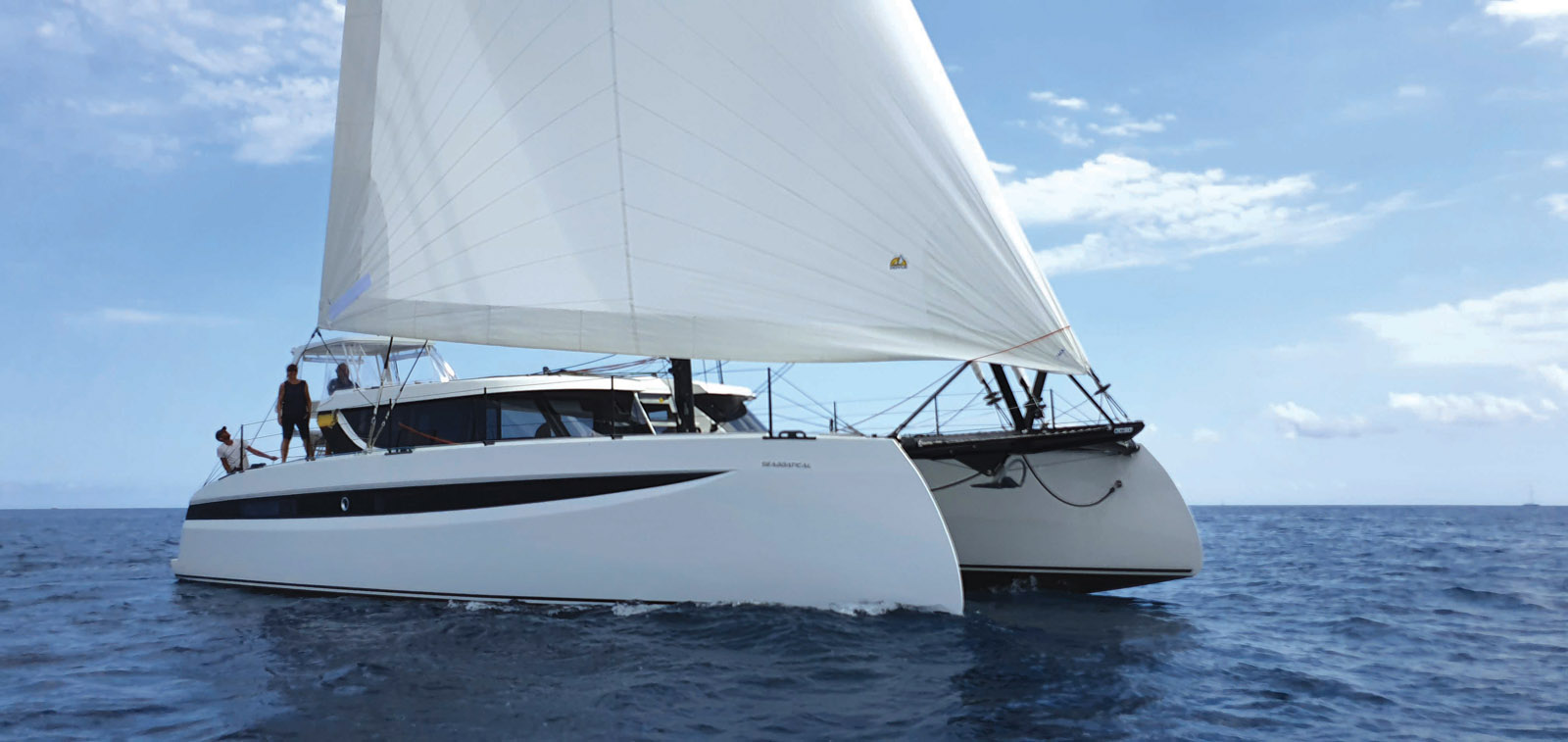
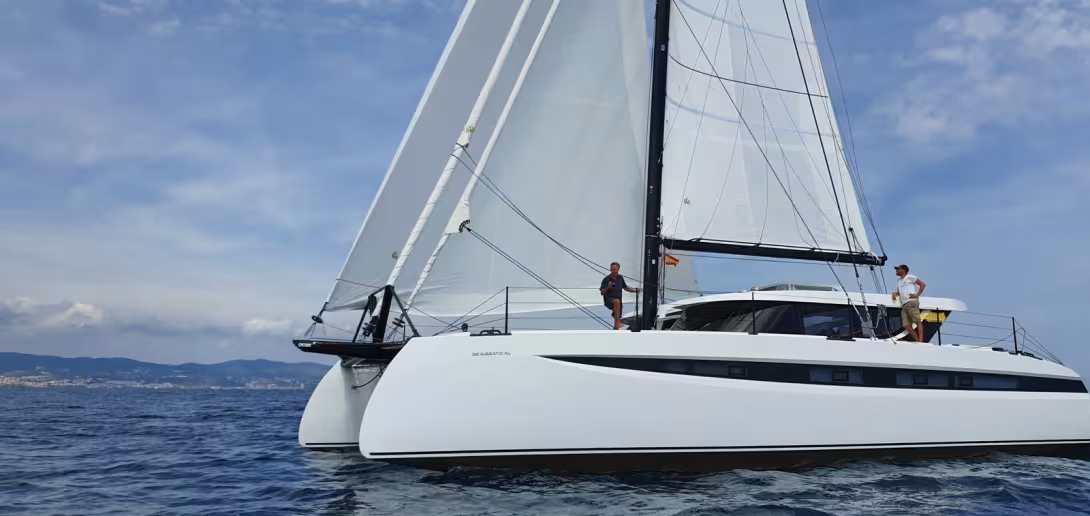
Since 2016, HH has gotten us used to admiring their magnificent high-performance full carbon catamarans on the water: no multihull sailor can forget the extraordinary performance of the HH66 and 55! Today, we had the pleasure of sailing the first model from a new range called the Ocean Class - not without the influence of the first owner. This 50 has just been delivered in Europe to her client who plans to cruise the Mediterranean when he retires. Let’s look at the backstory to this first OC adventure: Eric, a lively 70-year-old based in the United States, was first attracted by the HH55. He quickly realized that the specific features of this model were too performance-oriented and only somewhat suited to his specifications – short-handed cruising. But his desires were finally heard by the shipyard (see inset), making him a pioneer in developing this new series. At first glance, there’s an air of belonging to the HH range which is very perceptible: that rare elegance is still clear to see. But the comparison can go no further in terms of features. Let’s start with the construction: the all-carbon aspect is now reduced to the structural frame, with the hulls now being vinylester-infused fiberglass/foam. The daggerboards are replaced by fin keels and the carbon mast is replaced by a custom Sparcraft aluminum mast, painted black. The sail plan is equivalent to the HH 50, but the “blue water” adaptation of the whole system increases the catamaran’s light weight by one and a half tons. A single helm station, allowing single-handed maneuvering, instead of the two symmetrical ones, and a set of Doyle sails in Dacron (very nicely cut) finally convinces us of the intended market positioning. It is indeed comfortable and fast, but easy, cruising, aboard an elegant catamaran capable of providing real sensations to its owner under sail.
 |
 |
 |
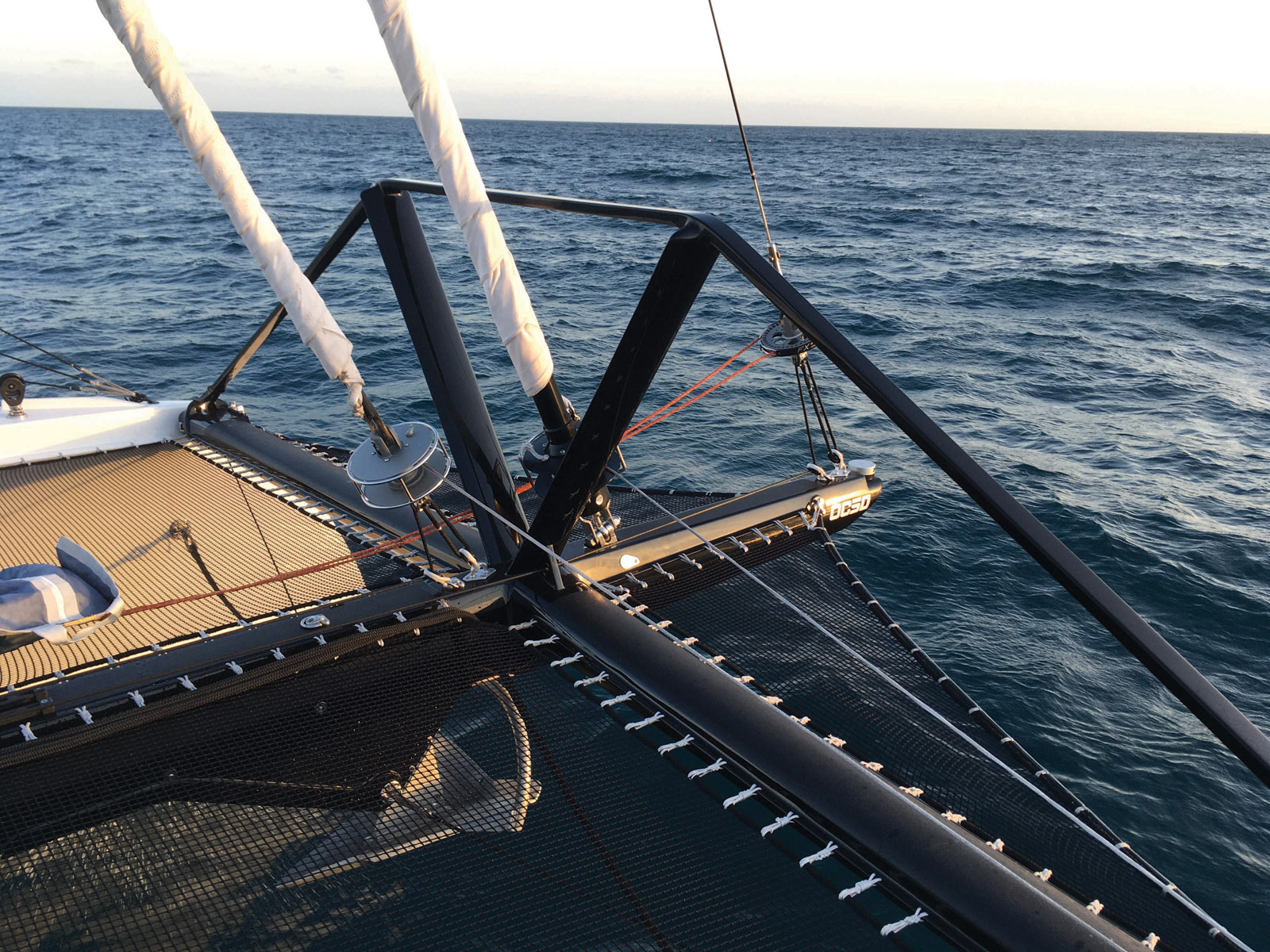
Left: the forward beam is a magnificent piece - it integrates anchoring, sail tack points and trampoline attachments. The martingale, also in carbon, is aesthetic and very functional.
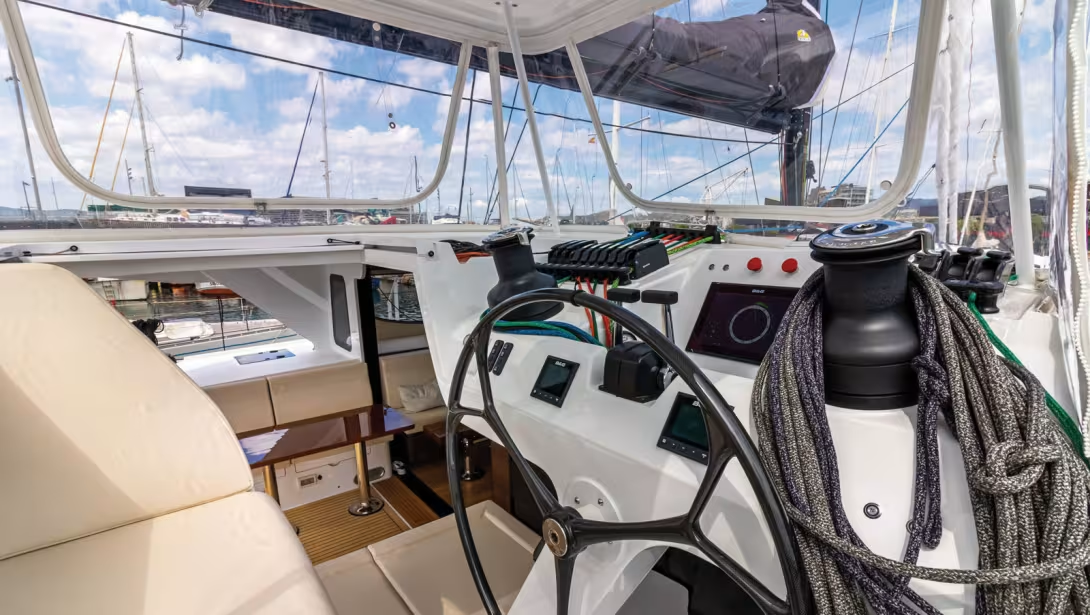
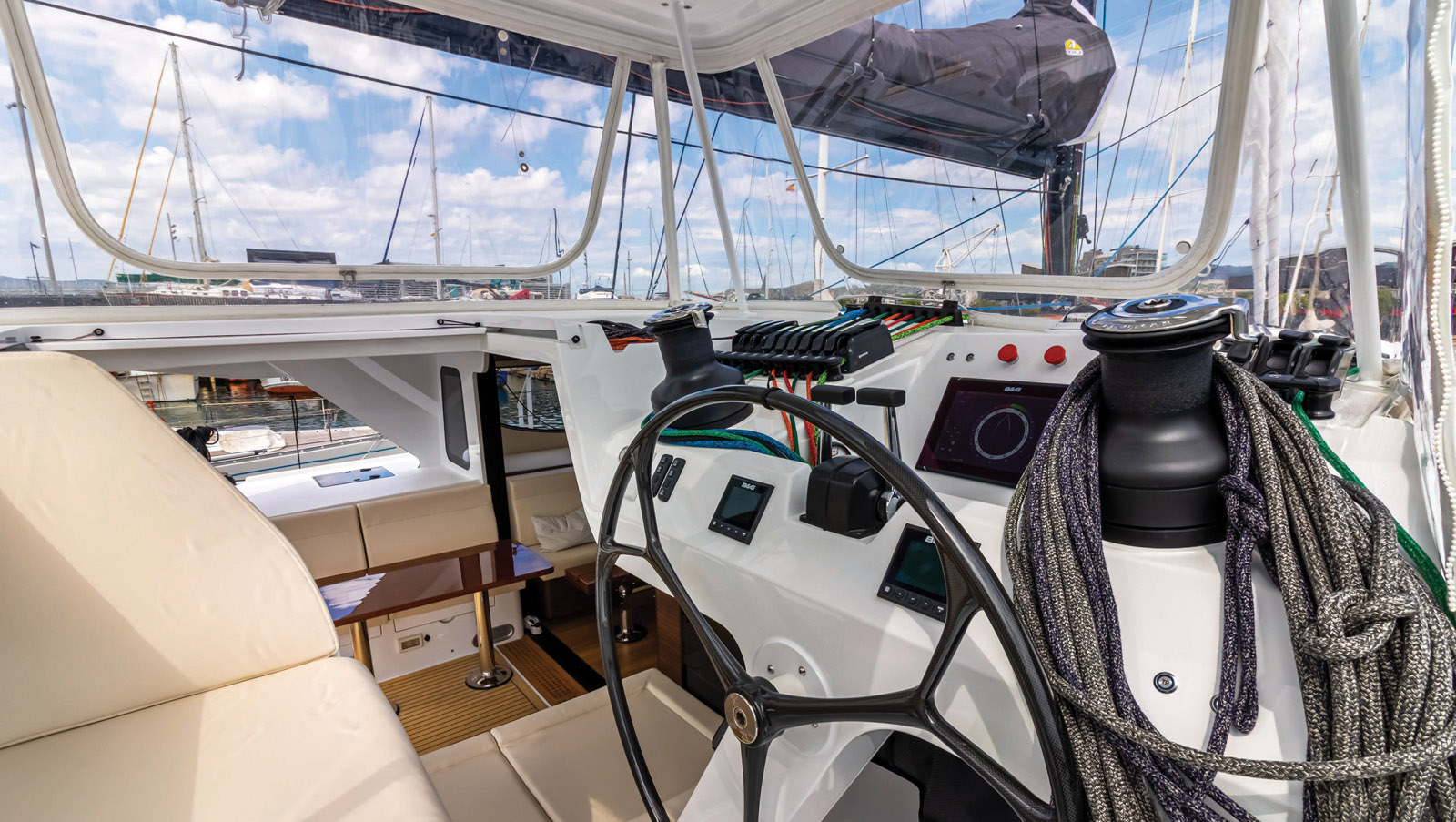
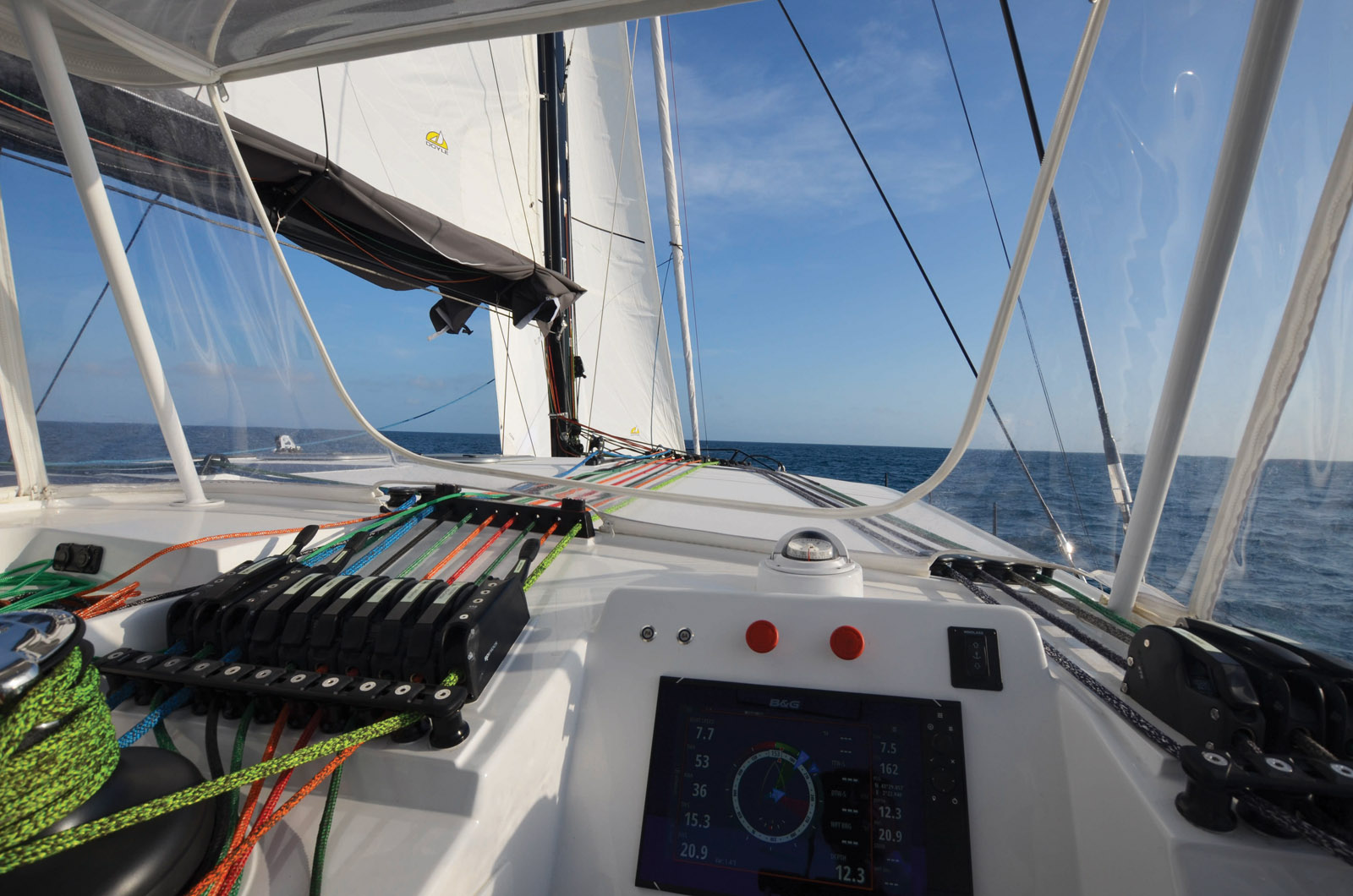
Centre & Right: most sail maneuvers are concentrated at the single helm station, but it’s a pity that the furling lines and sheets for the downwind sails don’t return here. A point to be reviewed.
The build quality is clearly evident!
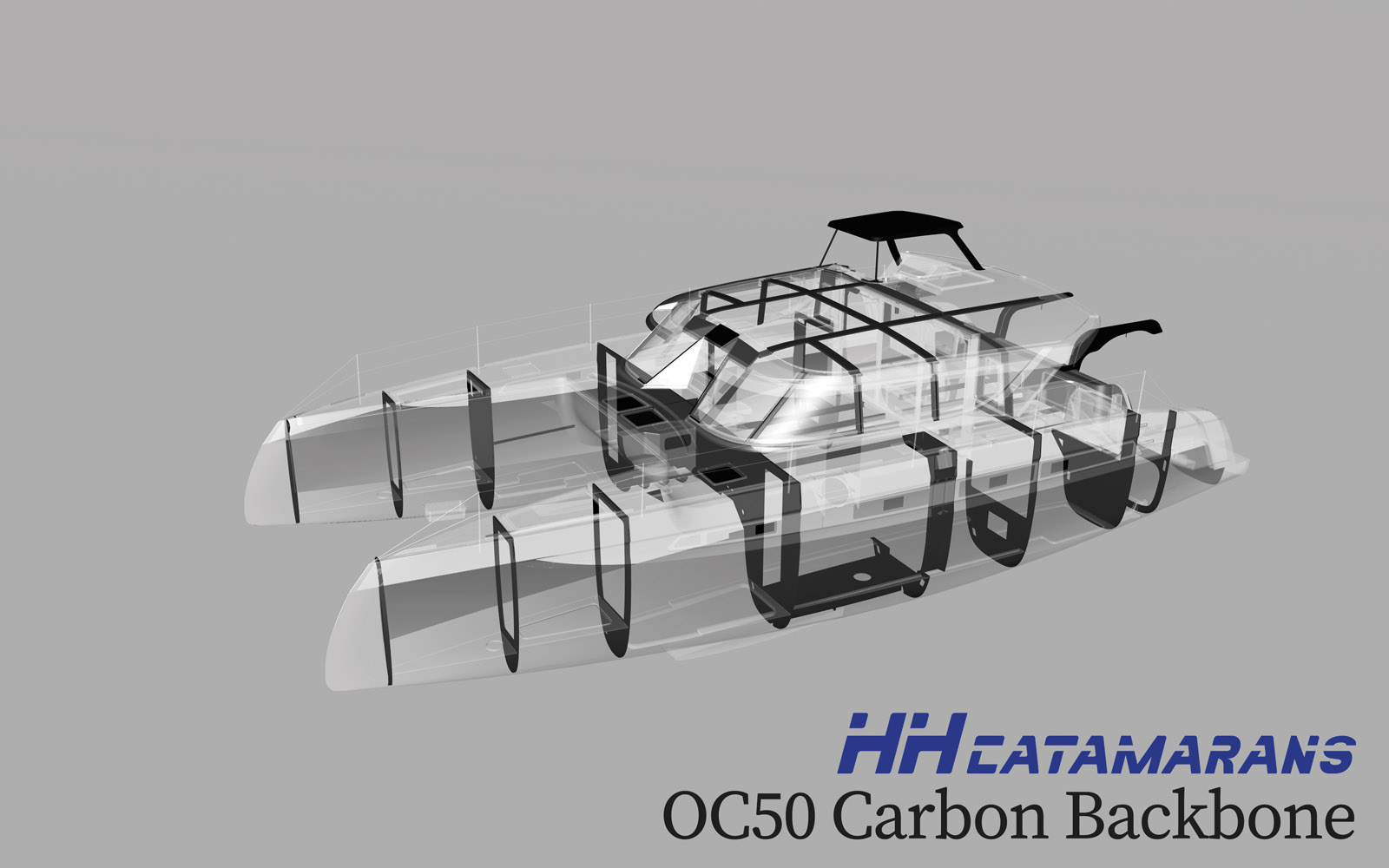
All you have to do is climb aboard and look and/or touch the boat to take the measure of the quality of construction. Everywhere, perfection is right in front of you! The implementation of the infusion for the hulls and superstructures is irreproachable. The weight calculations have been mastered at just 13 tons, which is not exceptionally light for a 52-footer. But the vinylester/fiber sandwich with carbon reinforcements is filled with closed-cell Corecell foam, known for its strength. The whole thing is therefore secured on a carbon composite frame made up of a network of frames and stringers. The fuel tanks are made up of a double hull bottom. This welterweight is therefore playing in the realms of the very strong. All non-structural bulkheads and floors are made of glass/foam composite. Just lift up a floor panel or locker lid to see the extreme quality of the finish. All the furniture is subjected to the same rigor and the dark matt walnut veneers (other choices are available) are assembled on foam panels in remarkable cabinetwork. Even though the mast is aluminum, the forward beams and the martingale are in carbon. The degree of finishing of these specific parts is beyond the norm. For example, the longitudinal beam houses an internal slide for ground tackle, with a chain-washing system integrated into the profile. It is extended at the bowsprit and the tack chain plates of the headsails are an integral part of its structure. Custom carbon tender davits, fiber standing rigging, Antal deck hardware, curved coachroof glazing - everything is of the best quality available and the assembly borders on perfection. Assembly, mast stepping, rigging and adjustments were all done at the factory in China before HH OC50#001 was disassembled in preparation for transport to Spain aboard a container ship.
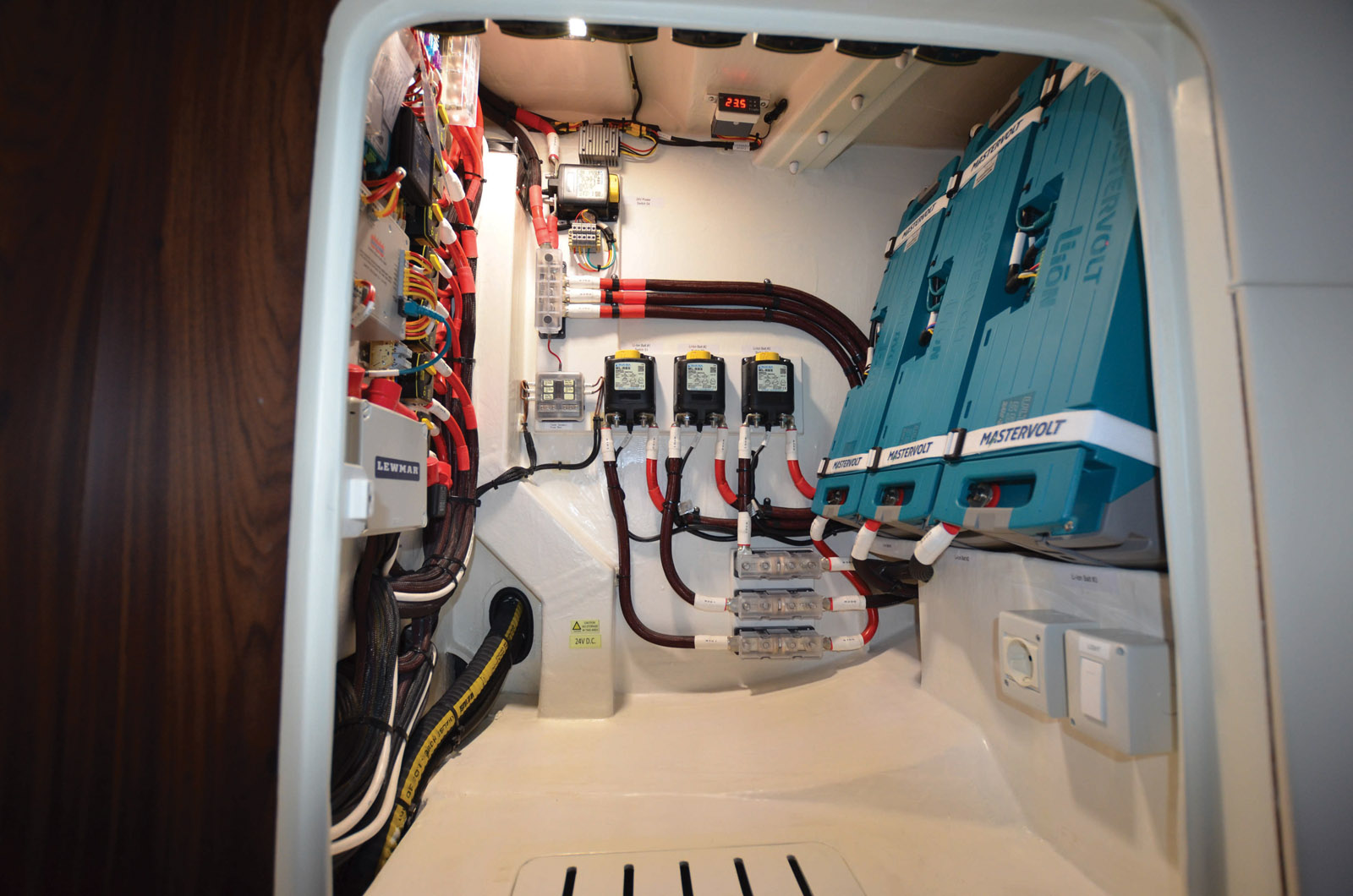
An electrical technical compartment on each side: a specific customer request.
Performance without the drawbacks
In order to facilitate sail maneuvers as much as possible, architects Morrelli & Melvin have worked on a compromise between use and performance that is more suited to blue water cruising. The skeg keels, while quite long and deep, are equipped with fins. The self-tacking jib is larger than on the all-carbon HH and the rudders are shorter. Being able to anchor within the confines of an atoll is now an option – being christened Seabbatical lends itself perfectly to this. The sail plan is only moderately slender to facilitate handling. For this purpose, the mainsail traveler is automated, and all other lines return to the helm station - except for the sheets and furling lines which are handled from the cockpit. Though this arrangement is suitable for two people, a swivel block to return these maneuvers to the helm station would have seemed a useful alternative for the solo sailor. In response to this reasoned configuration, the finesse of the hulls and the inverted bows - whose forefoot is out of the water by over two feet (70cm) - suggest that the averages should be pretty good, as we will see on the waters off Badalona, north-east of Barcelona.
 |
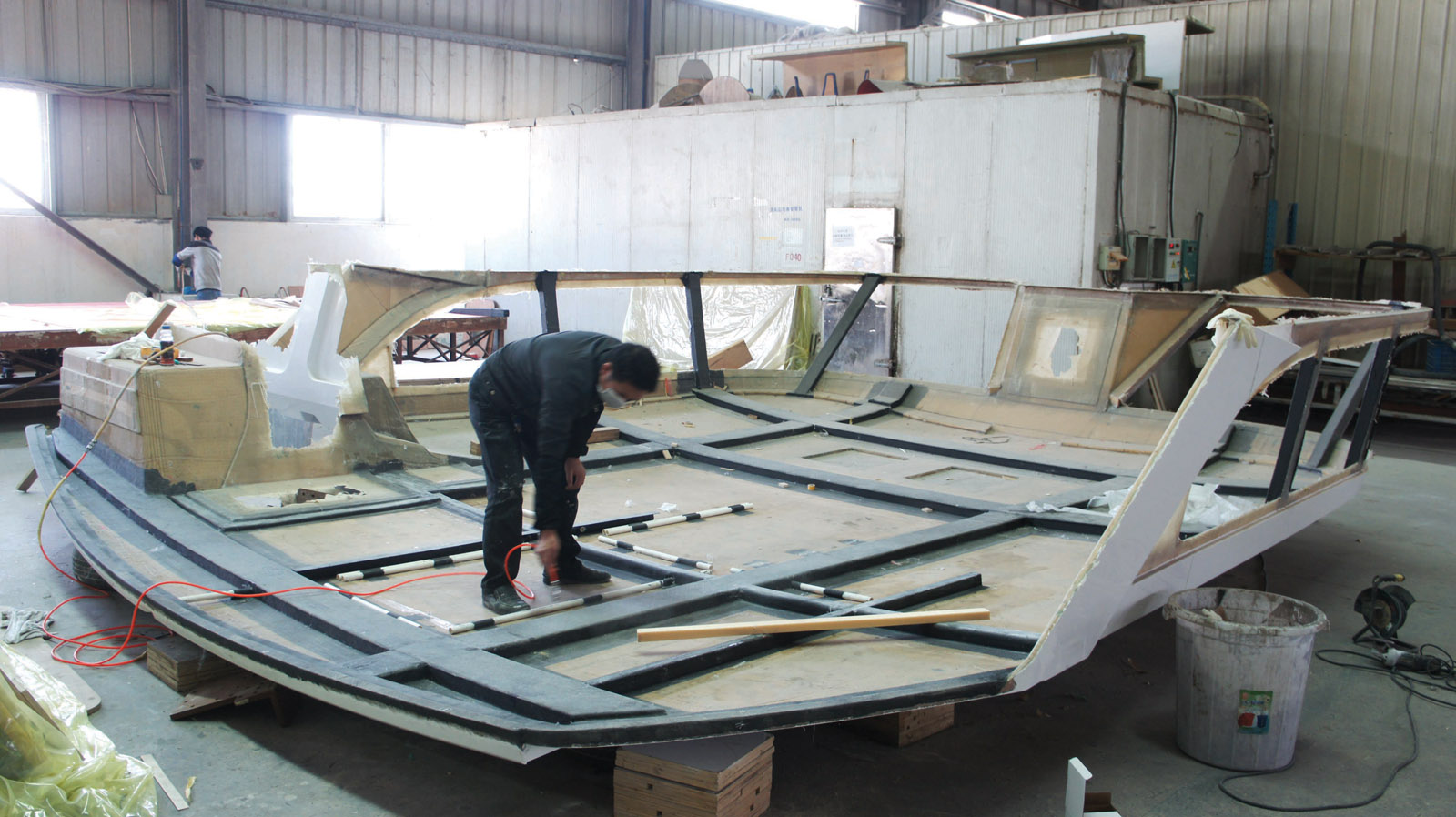 |
The hulls and superstructures of the Ocean Class are made of a glass/thermoformed foam/vinylester sandwich.
A carbon frame takes up the forces. The shipyard’s expertise in the mastery of composite materials is excellent.
Luxurious interiors
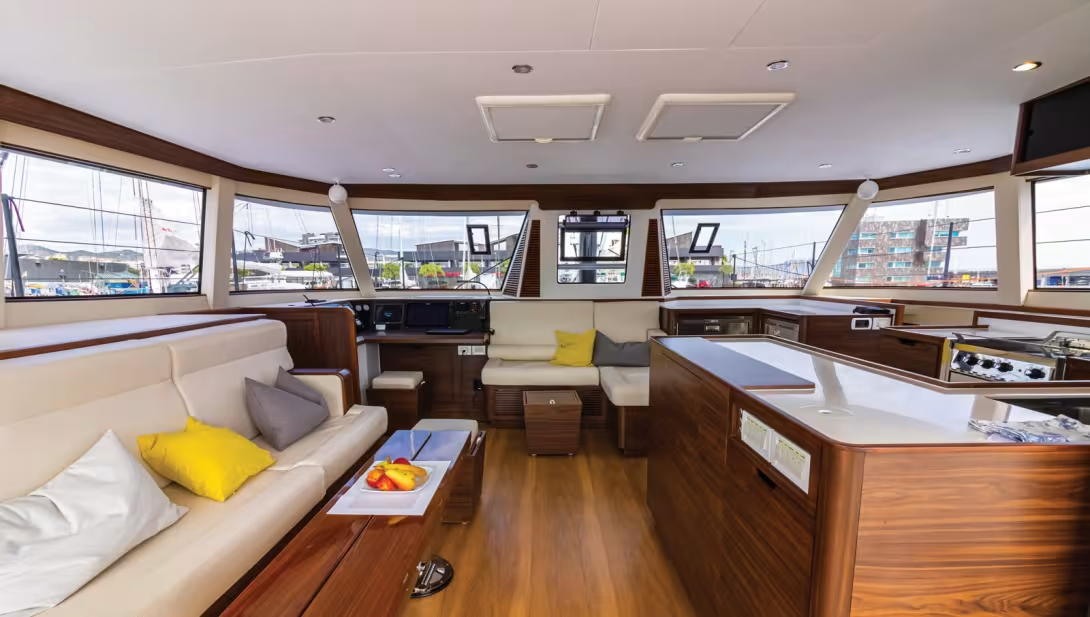
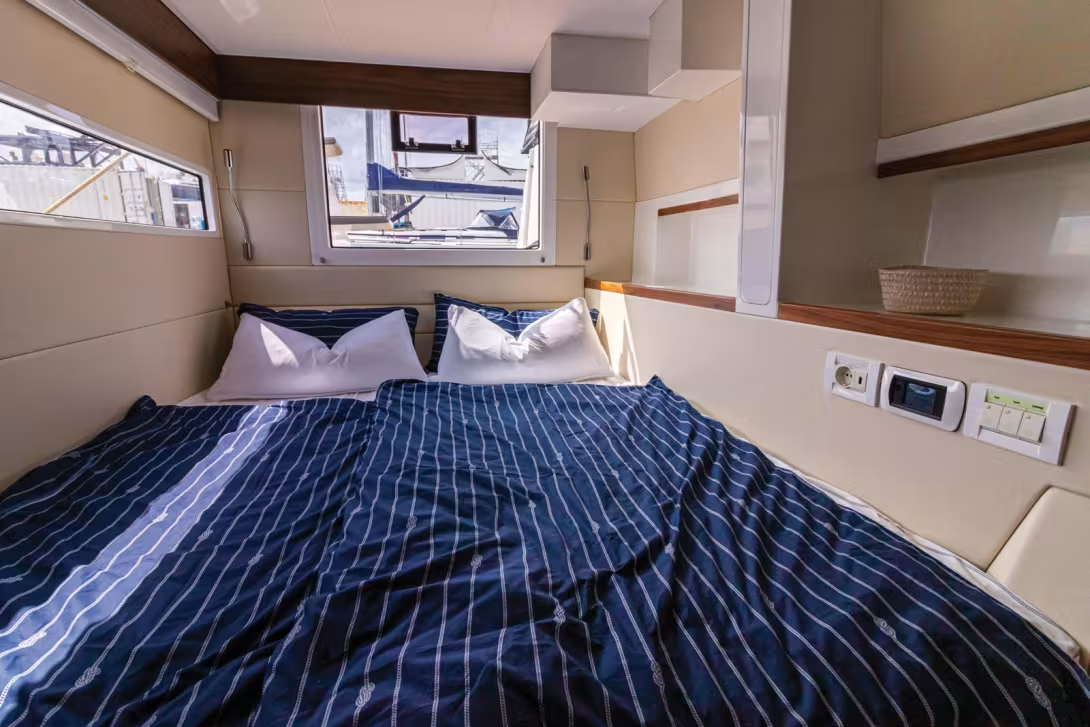
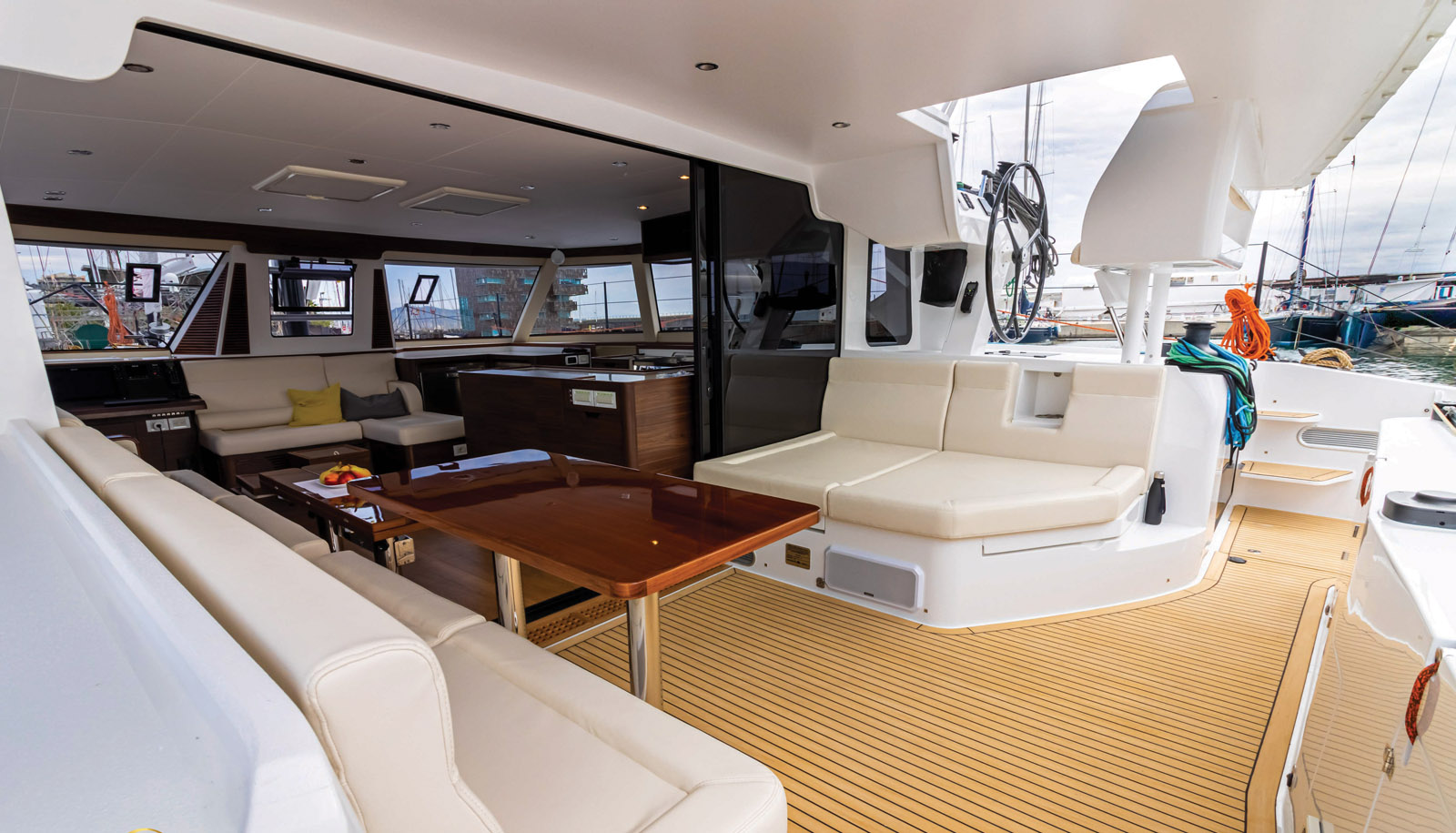
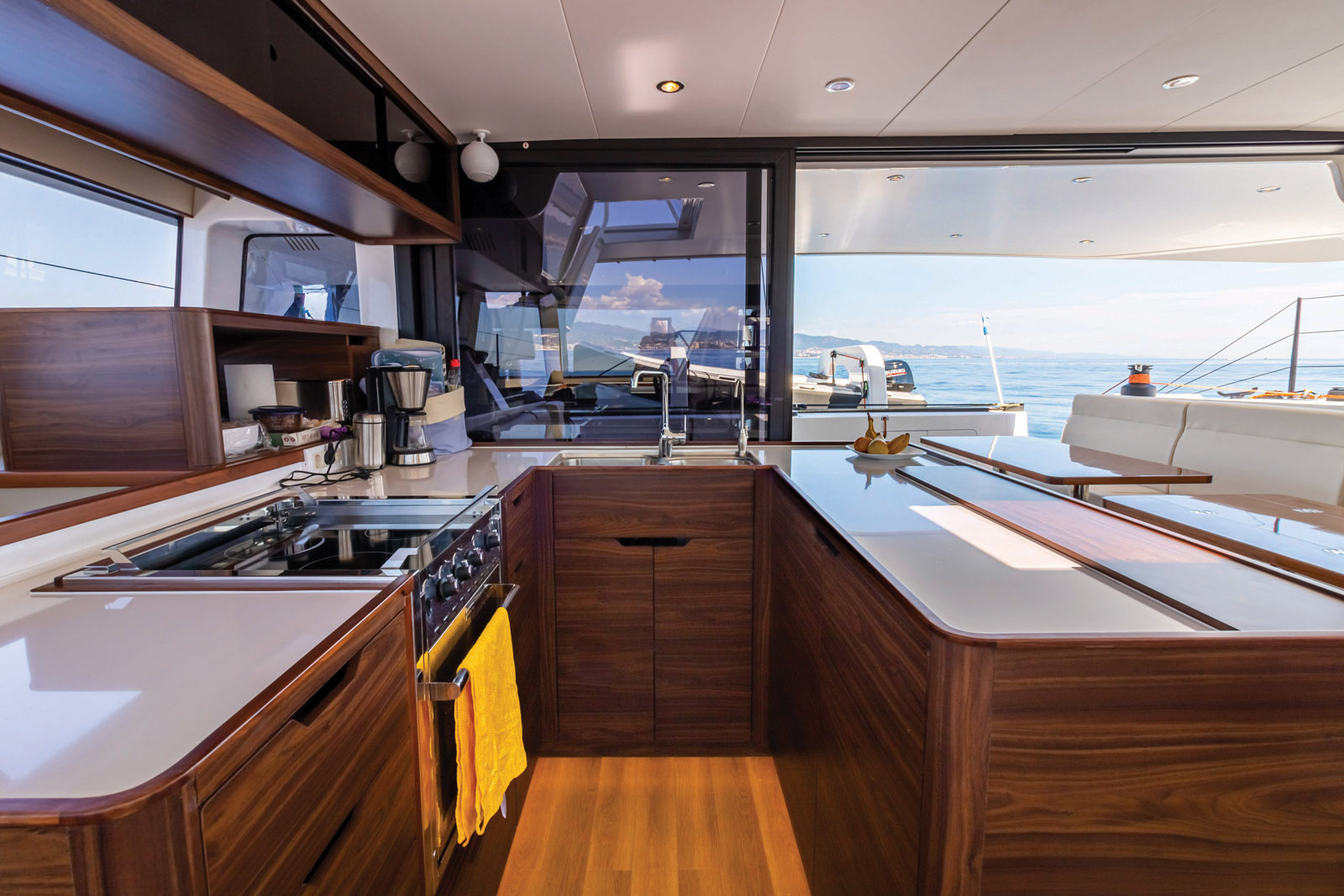
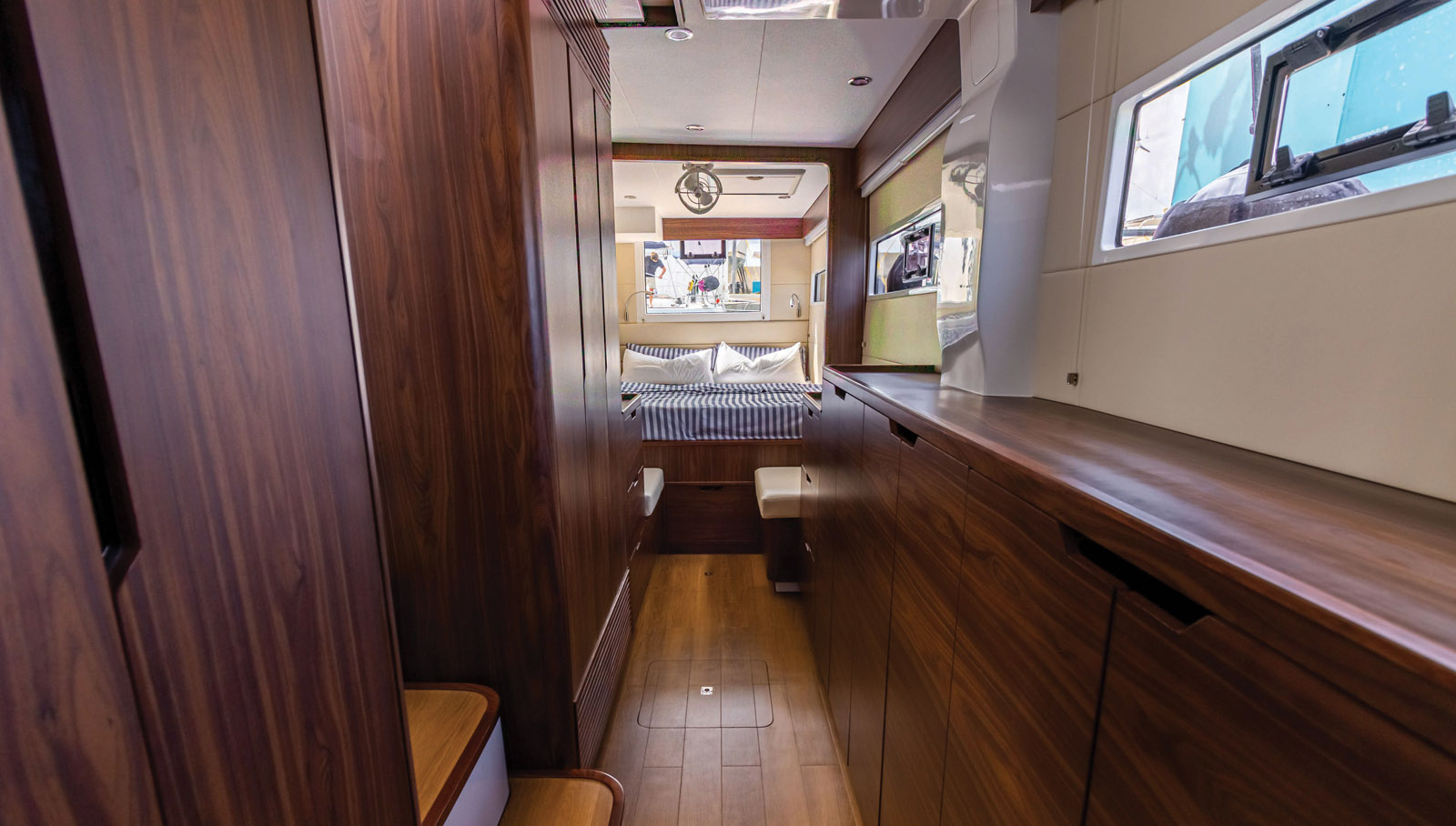
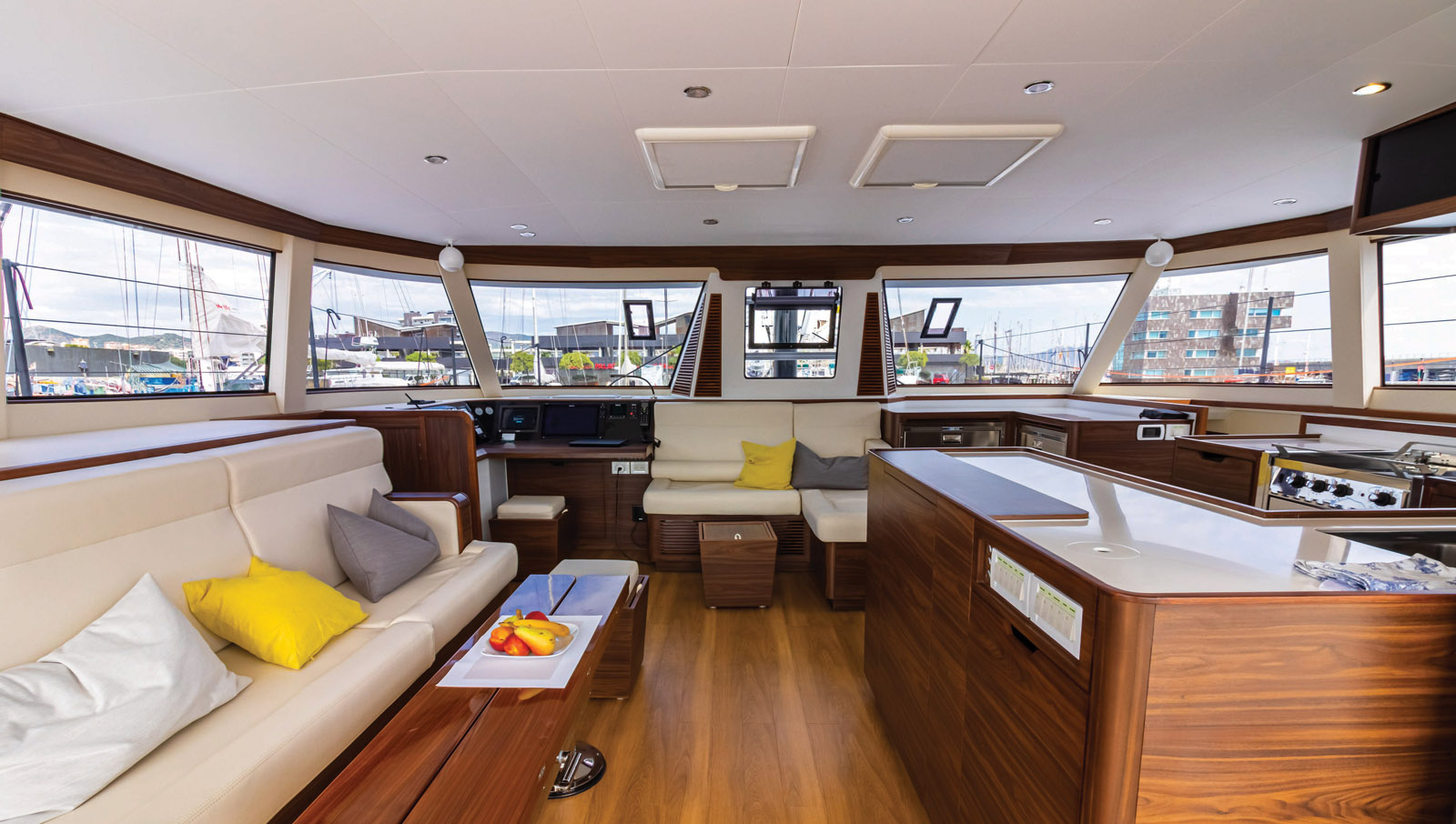
The layout is traditional with the starboard hull dedicated to an Owner’s suite; the port hull is equipped with two guest cabins. With the hulls being narrow, the bunks fit between the topsides. But the cozy atmosphere generated by the quality of the woodwork, the headlinings and the blackout blinds is omnipresent – you feel comfortable in an exceptional boat. The saloon opens halfway across the width to the cockpit, allowing for easy circulation. It is possible to set up a large table lengthways, half inside, half outside, for ten or twelve people. The very deep U-shaped galley provides a work surface and storage space consistent with a blue water cruising program. The nav station faces forward, with a small adjoining lounge area. The refinement of the finishes, like the stylish air conditioning vent integrated into the walnut mast surround, contributes to a sense of well-being that is only found on much larger and heavier luxury units. The cockpit is very ergonomic. A beautiful lounger is also available at the helm station. The equipment goes hand in hand with the general atmosphere, which invites you to live aboard in comfort. Generator and solar panels sufficient to recharge a well-sized battery bank (4 kW), storage drawers, multimedia... nothing has been left out. However, the owners didn’t fall for a dishwasher. It should be specified that the yard cleverly indicates the weight of each item of equipment on the options list. A good way not to deviate too far from the light displacement.
 |
 |
Left: The cockpit and saloon communicate through a large opening covering half the available width. The ergonomics have been particularly well designed.
Right: The U-shaped galley, which occupies the entire starboard side of the saloon, is huge. The catamaran is designed living aboard during long passages.
 |
 |
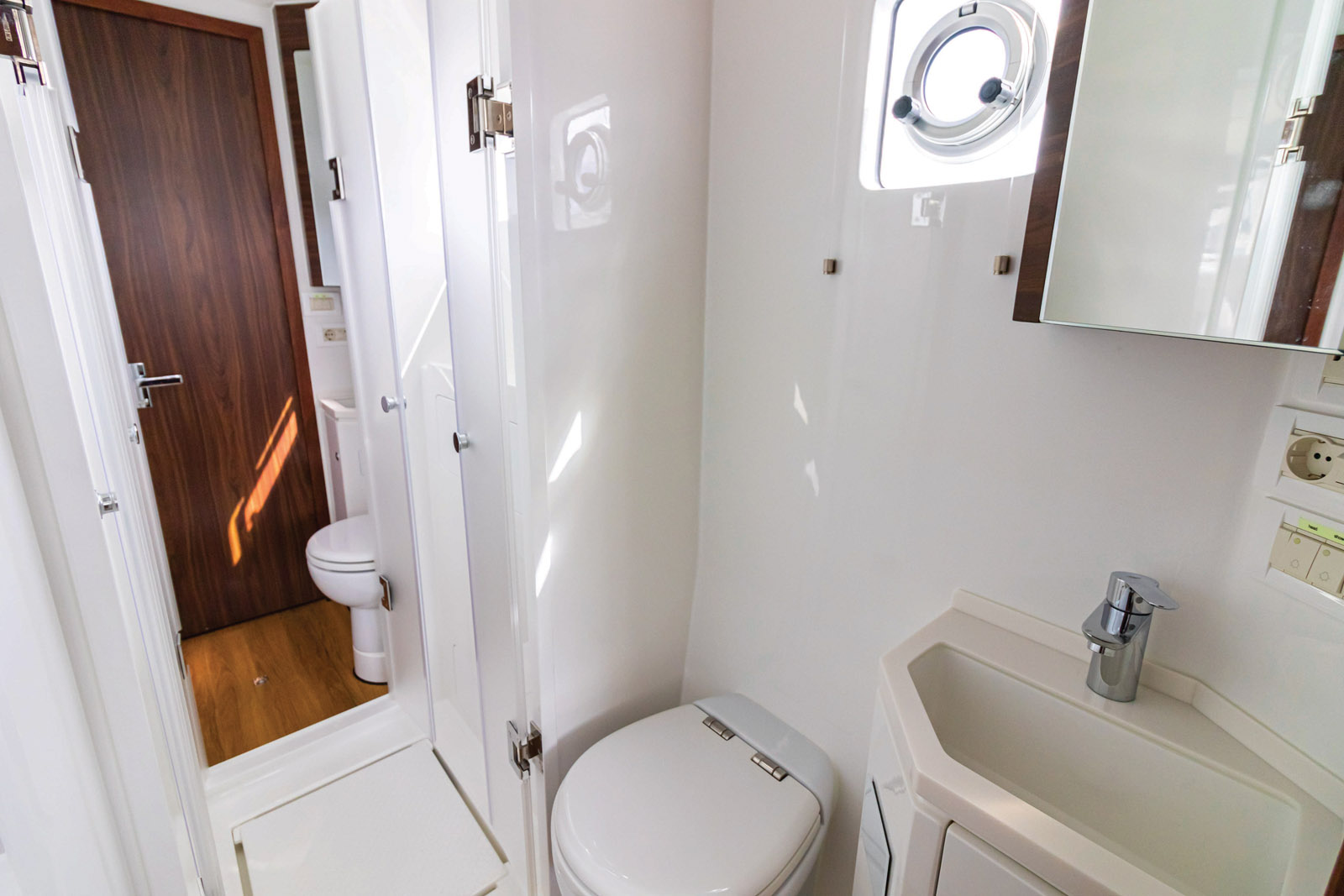
Left: the bathrooms of the guest cabins share a common shower cubicle. The entire hull is very bright thanks to the portholes running along the topsides
Right: several choices of wood species are available. Here the matt dark walnut of the hanging lockers and dressers in the Owner’s cabin contrasts with the white headlinings
Glide effortlessly over water…
A breeze of 8 knots picking up to 15 was inviting us to a perfect trip out under sail. The square-topped main horn, the self-tacking jib or the solent are hoisted and unfurled without difficulty using electric winches. The OC50 takes off very easily and approaches the wind speed, whatever the point of sail and whatever that wind speed is. In moderate winds of eight to nine knots were sailing under Code 0 then under a Parasailor at around seven knots and from 70° to 150° with this spinnaker. The wind then became established at 15 knots, and during our upwind legs, gave us a good 7.8 knots at 30° off the apparent on either tack. Unusual values for a cruising catamaran. The helm, with the Jefa system, is very smooth and responsive. We noticed a slight bit of weather helm, but adjustment of the rudders can certainly remedy this. The ability of Ocean Class to maintain good averages is also the result of good balance - the feeling of comfort is omnipresent and the feeling of gliding across the water is never far away. We didn’t have the chance under sail, but the boat planed nicely under engine down the wave generated by a cargo ship on her way into port confirmed the strong potential for great offshore fun. As for maintenance, access to the engines and rudder blades are somewhat obstructed by a structural linkage, but the yard will have no trouble rectifying this issue.
Conclusion
It was wonderful to discover this HH for blue water cruising. Very homogeneous, she will be easy for a couple to sail. Good speeds with total peace of mind and in any circumstance is on the program. Some parameters can be adjusted according to the buyer’s specifications - the shipyard is ready to listen. The price is significant, but this luxury catamaran presents an exceptional quality of finish. Gelcoat, woodwork, deck fittings, technical compartments, the attention to detail is impressive. The most prestigious European monohull brands have perhaps found their alter ego on two hulls.
HH, a yard that’s ready to listen
When the HH66 was launched (see MW152), we presented the fantastic production tooling at the Hudson factory in Xiamen, which specializes in the production of carbon composite equipment. Its association with Paul Hakes led to the launch of this brand of exceptional catamarans. Eric, the owner of this Ocean Class 50, hadn’t found the answers he was looking for during his first meeting with them. His purely cruising objective left Paul Hakes dubious, as he’s usually involved with more radical catamarans at the performance level. But the exchange went well... Eric came back, and finally won the case for an exceptional cruising catamaran. After all, the market is certainly a much bigger one for this type of a use than pure performance. Eric, a former electronics engineer, has made a major contribution to the development of HH’s “cruising” product. Listening to him, the teams from the shipyard have built a real semi-custom yacht because this customer had his requirements. The electrical circuitry was organized according to his recommendations.
The alternating current panel is located in a forward port compartment, accessible from the bathroom. The direct current side is grouped in the same compartment, but to starboard. It is easy to intervene on the components, with less risk of error. The shipyard spent a lot of time on very useful finishes. The forward compartment has been fitted out to receive dive tanks and compressor. Everywhere on board, hose connections for fresh water have been installed: they allow for rinsing any part of the catamaran, even at sea. Small miniature through-hull covers allow you to leave cables and hoses in place, even if they aren’t in use. At the saloon-cockpit divide, a section of bench seat can be inserted against the bay window. The number of these little details that change life on board is impressive and proves the “custom” capacity of the shipyard in the realization of each boat. In fact, this feature was at originated at the request of the customer, for whom this is his first boat. Eric felt well supported in this project.
The Pluses
+ Very high build quality and standard of finish
+ Easy and comfortable performance
+ Flattering aesthetics
The Minuses
- Slight weather helm
- Cramped engine compartments
- Requires precise specifications
DESCRIPTIF TECHNIQUE
Constructeur : HH Catamarans
Architecte : Morrelli & Melvin
Longueur hors-tout : 15,79 m
Longueur de flottaison : 14.89 m
Largeur : 7,44 m
Tirant d’eau (quillons) : 1,56 m
Tirant d’air : 21,88 m
Franc bord : 1,73 m
Déplacement lège : 13 150 kg
Déplacement en charge : 17 000 kg
Grand-voile à corne : 82,80 m²
Foc autovireur : 44,50 m²
Solent : 56,80 m²
Gennaker : 101,80 m²
Spinnaker : 135,50 m²
Motorisation : 2 x 40/55 CV Yanmar
Prix de base : 1 300 000 $ HT (1 140 000 € HT)
Prix du bateau essayé : 1 694 700 $ HT
Toit ouvrant Webasto : 14 000 $ HT
Bimini carbone : 10 400 $ HT
Panneaux solaires 1 480 W : 20 200 $ HT
Pack GV-foc Doyle : 31 200 $ HT
Batterie Li ION : 16 800 $ HT D