HH, a newcomer to the elite world of ultra-top of the range catamarans, intends to combine incredible performance and luxury interiors thanks to exclusive cutting-edge technology. These boisterous catamarans really do have some spectacular characteristics: but do they live up to the hype?
Infos pratiques
- Le chantier : HH66
- La fiche technique
-
 Découvrez notre vidéo exclusive
- Financez votre HH66
- Assuez votre HH66
- Articles autour du HH66
Highly personalized, exceptional machines
The 66 presented at the Cannes Yachting Festival was the first in the series. Five boats are currently being delivered. Hull number 2, Night Fury, underwent seatrials in November and as you read this, it’s highly likely that hull number 3 will be completing hers (a super-charged model with an extra 3 meters added to the rig, and the bowsprit extended by 1.4 meters). Lighter and more powerful, she should be lifting a hull from 16 knots true! Numbers four and five are almost complete - number five has tiller steering as well as an interior helm station, aft of the mast cockpit. These different versions clearly demonstrate the yard’s approach: Permit enlightened and fortunate owners to play with the project by personalizing their platform to an extraordinary degree. This strategy is reminiscent of the first generation Gunboats! Tooling for the 55 footer is now finished and production will begin. Next up is a project for an 77 footer.
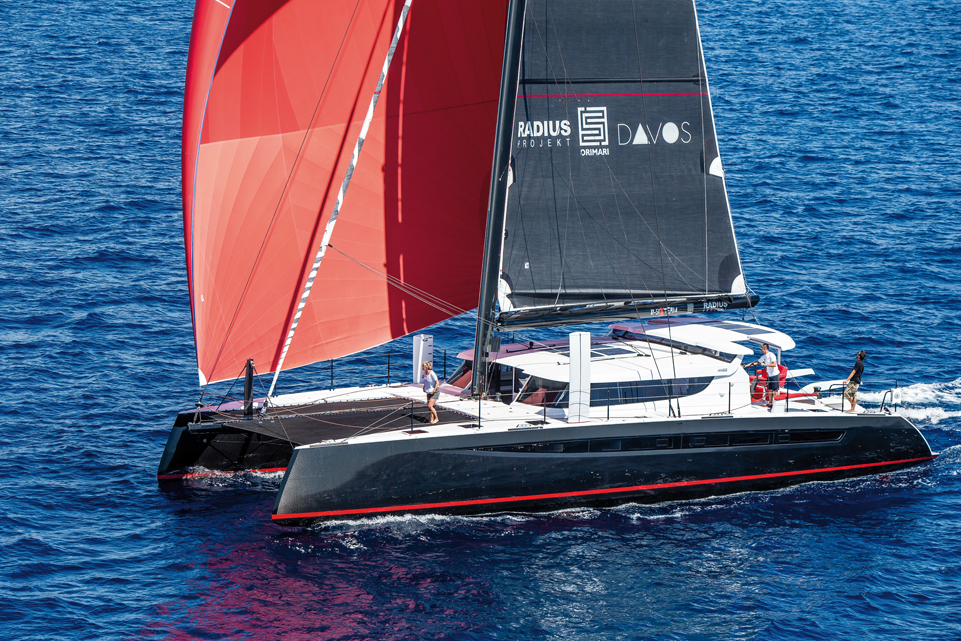
A wonderful profile! The design of the 66 shows an elegance which is almost classical. There is no pretense, but the power of this catamaran is plain to see
HH (Hudson & Hakes): a fusion of skills
New Zealander Paul Hakes has been recognized as a specialist in the construction of racing boats since the early nineties (Imoca 60, TP52, Class 40, Maxi mono, and more. He even collaborated with Cookson Marine on Playstation and Steve Fosset’s 125’ Morelli/Melvin catamaran). His Hakes Marine yard in Wellington has worked on several challengers for the America’s Cup. In 2009, the workload dropped dramatically, with the global economic crisis leading to a huge reduction in orders for racing boats in the region. Hakes Marine shut down their Wellington site in 2012 and joined forces with Hudson Yacht. Paul was joined by a number of his team, and became president of the new HH Catamarans yard, created with Hudson Wang. Of Taiwanese origin, this captain of enterprise is a world leader in several sports equipment sectors, and has brought his industrial and commercial know-how to HH, along with the financial backup. This means that this young and very ambitious brand has an amazing tool at its disposal: the ultra-modern factory at Xiamen.
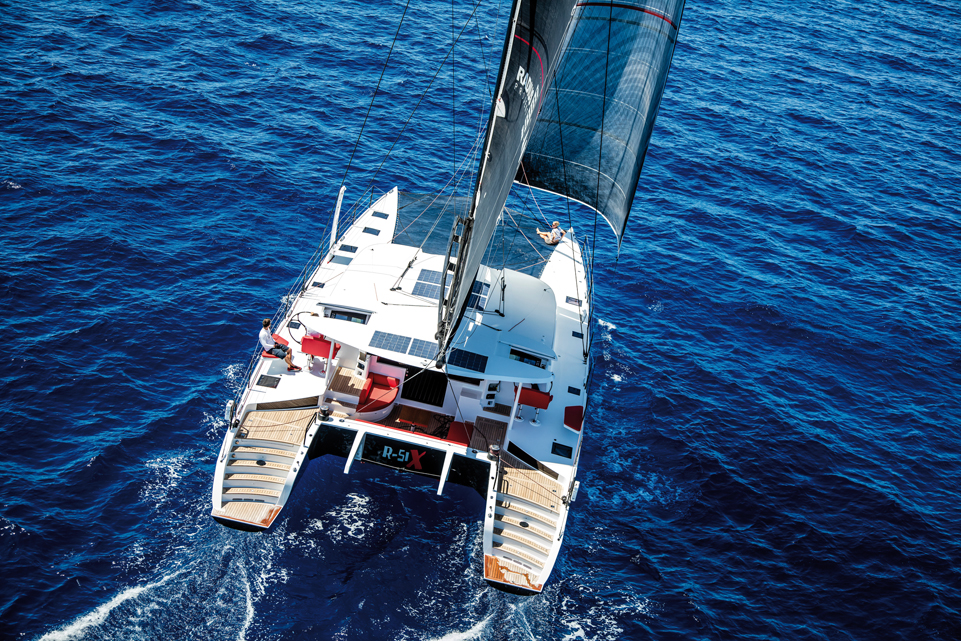
A catamaran that wants it all, and wants it now! Fast, light, yet also luxurious and comfortable
An XXL-sized production facility
Hudson Yacht carried out work for monohull J/Boats, the luxurious Pearl motoryachts and 2 years ago purchased Jaguar power catamarans. The yard, located in south-eastern China, not far from Taiwan, has also built the five HH42 IRCs which are currently winning podium positions in races all over the world. It built the last Gunboats for Peter Johnstone before the dispute between the two former partners led to production being transferred to North Carolina (Gunboat subsequently filed for Chapter 11 bankruptcy and in early 2016 was purchased by the French group Grand Large Yachting, owners of Outremer Catamarans). The Hudson yard is undercover, on several hectares and has direct access to the sea for boat launching, a 25m x 18m testing tank, several triple and 5-axis CNC milling machines, a 100° curing oven which is 25 meters in length, two 25 meter air conditioned and air-filtered rooms for infusion and post-curing, a special area solely for low-temperature storage of pre-impregnated cloth, a 4000m² metalworking shop and two spray booths. All of this represents an enormous investment!
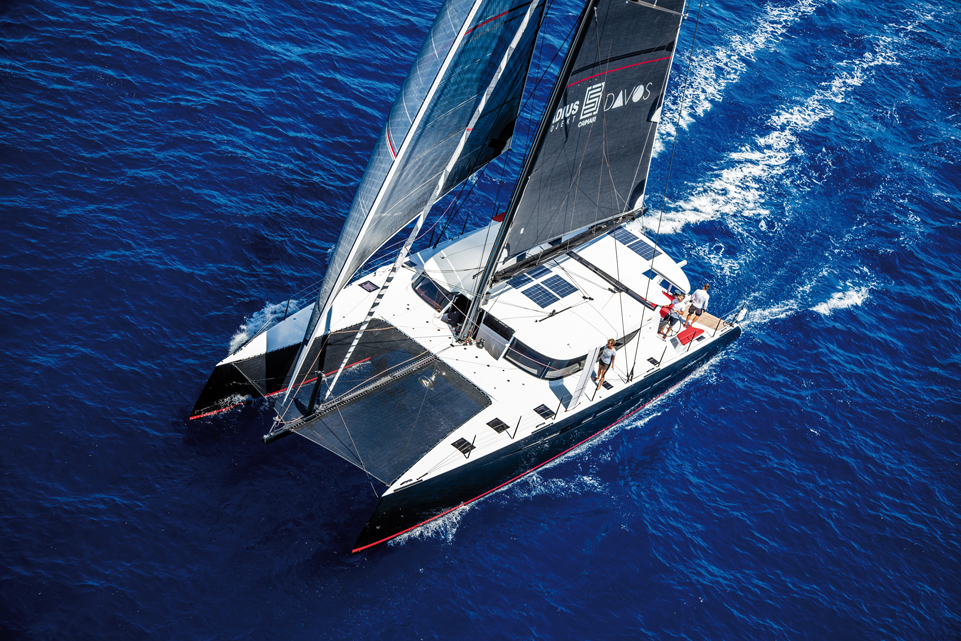
Carbon reigns supreme on the HH66: Sails, spars and hulls all include the magic black fiber
Prestigious and committed naval architects
In 1982, when Gino Morelli was 22 years old, he and Alain Petit Etienne built the first carbon fiber racing catamaran, “Région de Picardie” in Oise in northern France. Along with Pete Melvin (an engineer who defected from the aeronautical industry), he was later to create one of the world’s most prolific naval architecture teams in the catamaran sector. Their creations are too numerous to name them all, but include the Olympic Nacra 17s, Stars and Stripes, Playstation, several Leopards, most of the Gunboats, the Team New Zealand AC72, and more. The Morelli/Melvin team seems to have really thrown themselves into the HH range, which Gino himself defines as the pinnacle of 25 years’ experience of ultra-fast cruising catamarans. Quality control on site, seatrials, first races and even marketing at boatshows, Gino is to be found wherever there is HH!
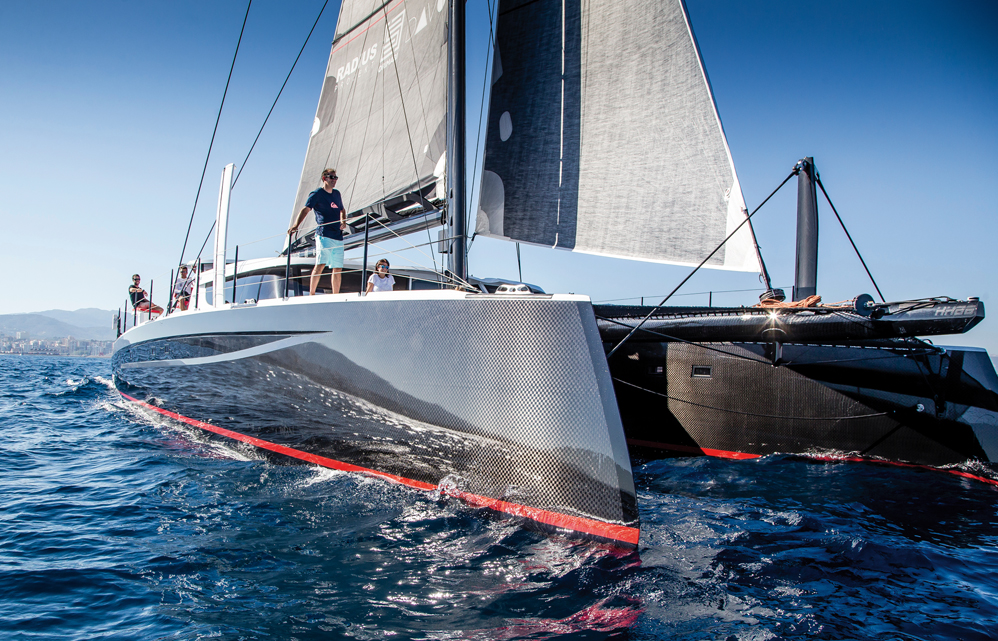
The trim leaves the TeXtreme carbon by Oxeon exposed. The 0/90° weave is used to great effect
The aim: standard-setting build quality
Paul Hakes summarizes by saying, “If you want to build a top boat, start by building a top factory”! Hudson’s site in Xiamen is fully autonomous, and everything is built in-house (composites, metalwork, cabinetry). HH has every industrial tool you could wish for available to its own very international design team (New Zealand, Chinese, French and South African). The majority of the technical department is Anglo-Saxon: some of the expats from Gunboat have joined the 66 project. There is nothing revolutionary about the construction process, but the desire to achieve excellence is evident at every stage of production. Paul Hakes has not retained Nomex carbon for the core, but has replaced it with aramid honeycomb which has a smaller gluing surface and the use of 80kg/m³ PVC foam is better suited for a cruising multihull. The carbon TeXtreme® cloth is by Swedish firm Oxeon. The evenness, fineness and lay-up allow for an exemplary finish and optimize the mechanical qualities while reducing weight (reasons why it is largely employed in the aeronautical industry). What’s more, these fibers infuse very well, an important characteristic for epoxy composites which are more delicate to work with than polyester. The post-curing significantly augments the TG of the resin (the transition temperature above which characteristics begin to degrade), by maintaining it around 80°C. The curved daggerboards (6m in length, of which 4m can be submerged, shaped for lift) and the rudder blades equipped with little T-foils are built in pre-impregnated, high-modulus carbon to maximize mechanical resistance. The basic mast extrusion comes from Southern Spars, and is equipped and prepared by HH.
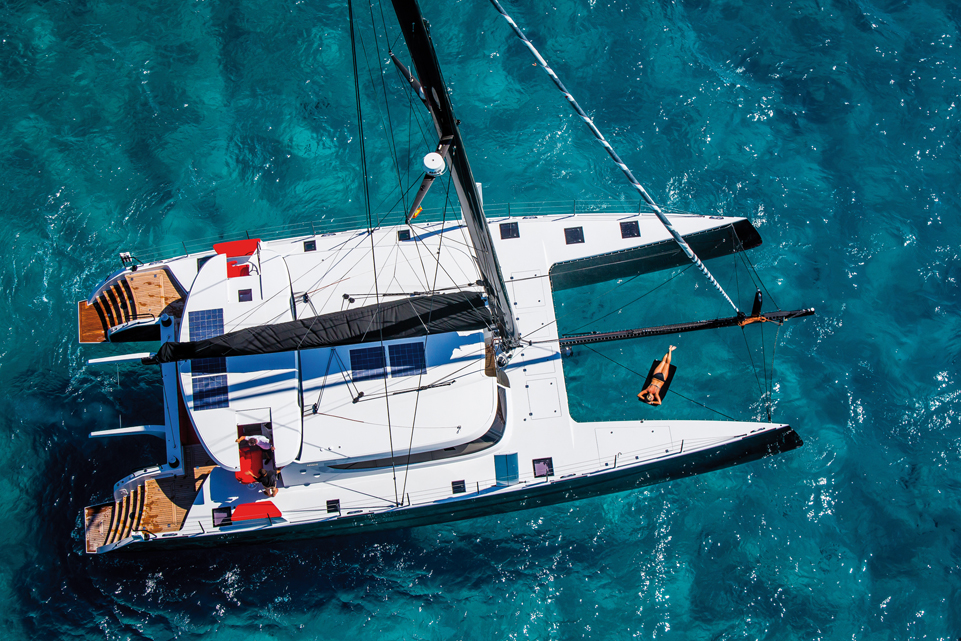
At anchor, the 66 footer is really neat, transforming into a luxury water-sports platform
A multihull with luxury performance
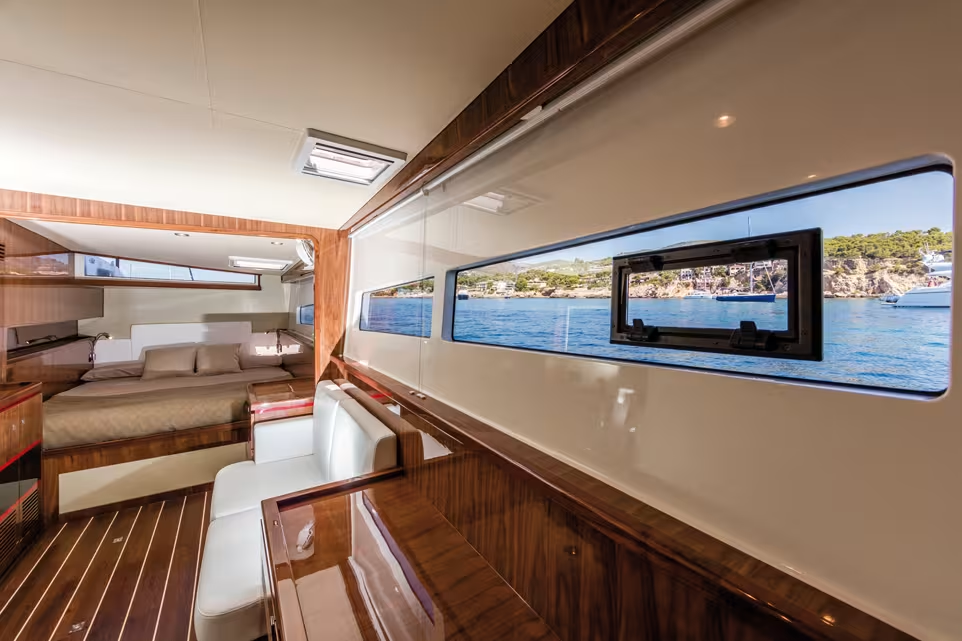
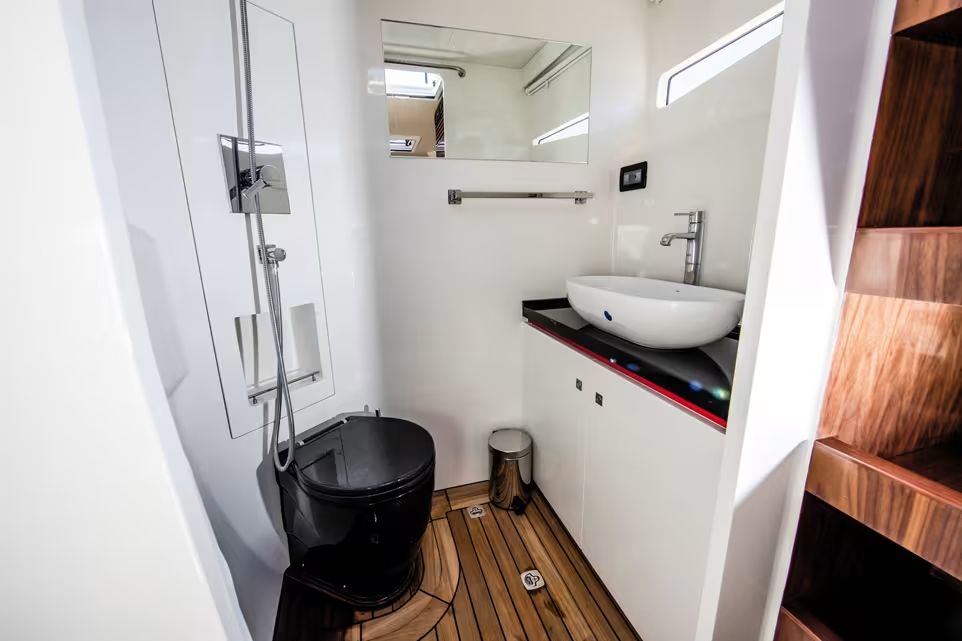
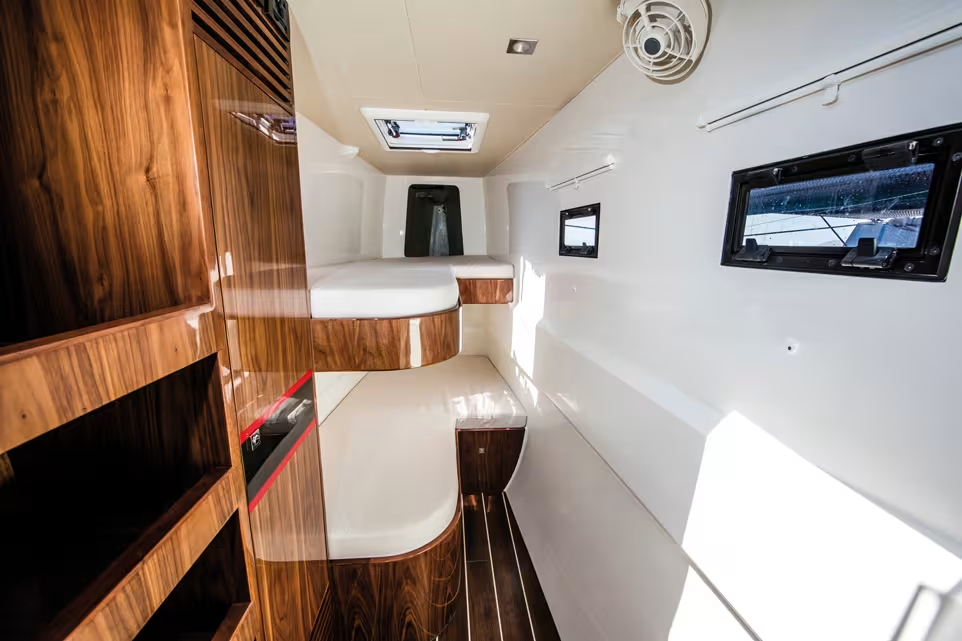
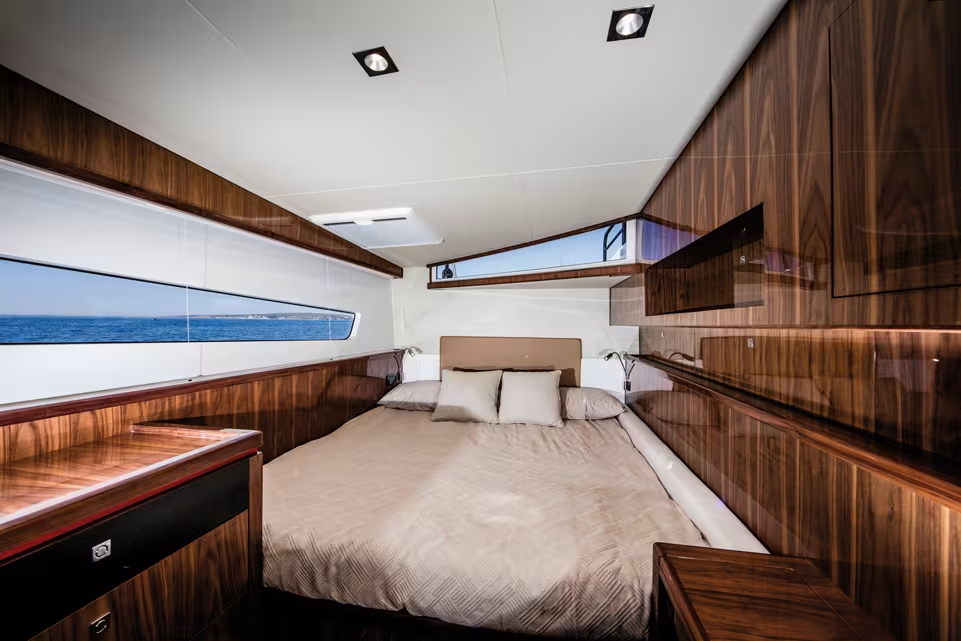
RSix has a laden weight of 20 tonnes (for a length of 20 meters and with an upwind sail area of 217m²). She carries, however, every possible item of comfort (air conditioning, generator, watermaker, abundant electronics and refrigeration, generously-sized dinghy and a washing machine), and there’s nothing Spartan about the spectacular cabinet-making. The skill of the craftsmen here speaks for itself: the choice of walnut (laid on sandwich panels) and the combination of carbon trimmed with bright red edging is absolutely splendid: the finishing is exemplary. The red leather stands out in the dining area, highlighting an elegant, sporty atmosphere, with its table edged in polished walnut, and with contemporary carbon fiber chairs built by HH. It really is beautiful! In this 3-cabin version, the port hull is a dedicated owner’s suite (with crew accommodation right forward). The precision of the assembly serves to show off the fluidity of the style and the harmonious blend of materials. The same standards are evident in the two guest cabins in the starboard hull.
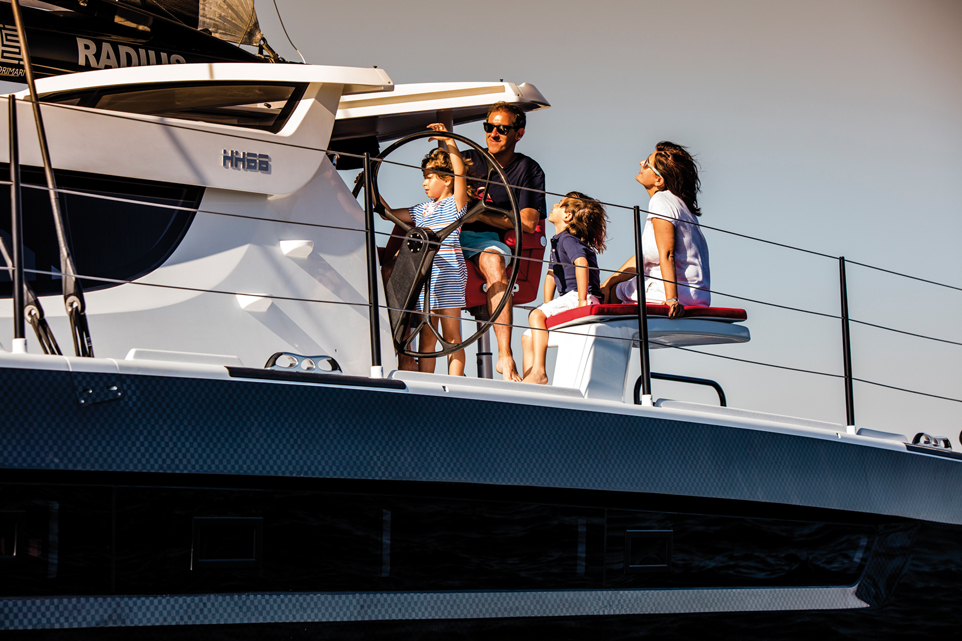
Helming the HH66, child’s play? Maybe! Note the 3 levels of guardwires and the area around the steering wheel (on a movable pedestal) with its wide seat and offset bench
Outstanding profile and presentation!
The overall lines of the 66 are very attractive, the inverted bows are elegant, the proportions of the coachroof skillfully designed, the shape of the toughened glass panoramic windshield superb, with the hard-top bimini cleverly linking it all. The polished black hulls artistically capture the light, reflecting the perfect checkerboard pattern of the polished carbon (a 0/90° weave). The scarlet band around the waterline highlights the beauty of the whole machine. On deck, the quality jumps out at you: the composite, the lacquered finish, the window seals all bear witness to millimeter precision, and the grip of the non-slip deck is remarkable. The stainless fixing for tensioning the trampoline is subtly disguised in the topsides, as are the terminals for the martingale stay. The cockpit salon is magnificent. Surrounded by practical side-decks, it is simple and functional. Great for relaxing, yet designed to be easy to move around if you’re in racing mode.
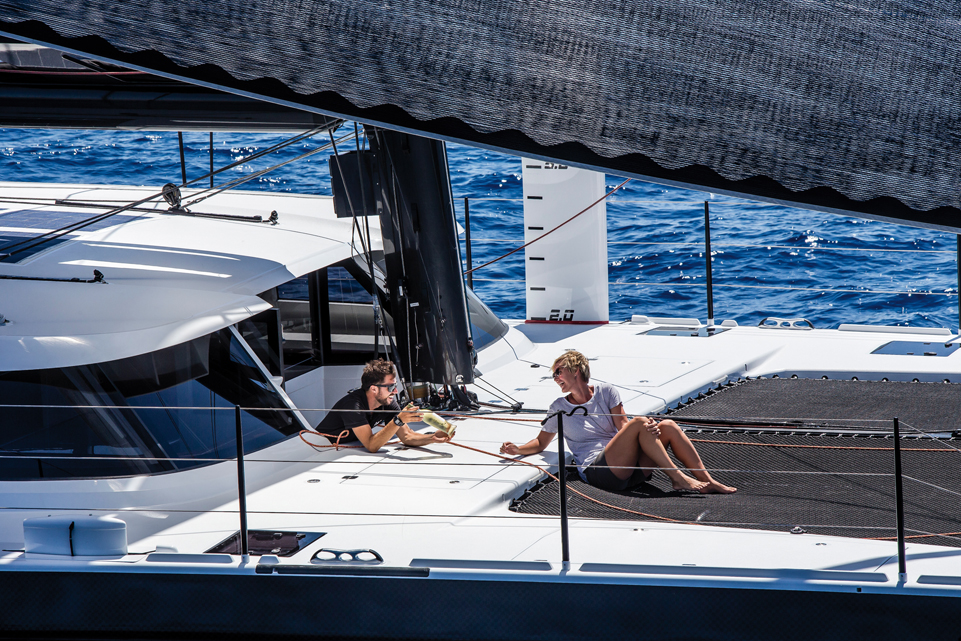
The central cockpit shows off its potential on this catamaran, with direct access forward being a great secondary benefit
A cutting-edge deck layout
Crew safety is ensured by neat brushed carbon stanchions with three levels of fiber guardwires. All the cleats are retractable so they won’t catch on the sails. The sail-trimming cockpit is at the mast, making best use of this position for a fully-crewed multihull (ease of operations, significant reduction in lengths of lines and fewer turning blocks). The helm stations are logically positioned aft of the coachroof bulkhead and have the benefit of pivoting steering pedestals to adapt the helmsman’s angle of view. There is a proper sail locker, with a panel which opens to reveal a 2m long space with access via ergonomic steps (not some flimsy ladder). The stowage of the sails can therefore be properly organized. Excellent! The magnificent (fixed) Southern Spars mast has a single set of spreaders, with Kevlar rigging by Future Fibres attached by spliced loops to the hidden chainplates. The boom with its fins (with non-slip paint on the treads) is of an elegance rarely seen. Reefing is done using the really modern system of Karver hooks, indispensable on boats of this size. The quality and setup of the deck hardware is exemplary. The 2 mainsheets are hydraulically assisted and the mechanism for the daggerboards is electric. Blocks are all secured with loops, in a seamanlike manner.
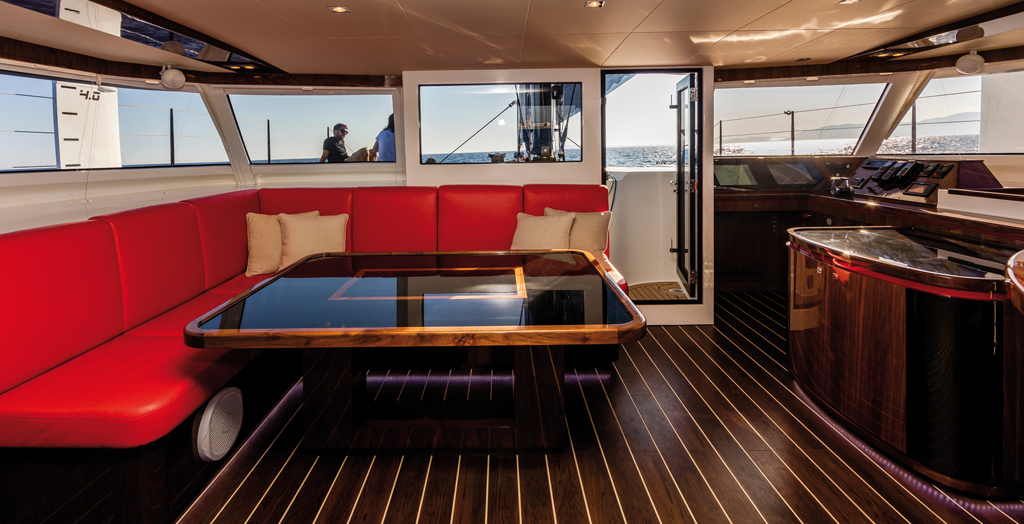
The quality of light which passes through the laminated glass windshields is remarkable
Amazing dynamic qualities
We would have loved to have galloped along with this stallion in a good breeze, but unfortunately, and in spite of our best efforts, our chance to get to grips with this extraordinary machine coincided with light airs. We called upon Aeolus by all available means, spent two days on board, a week apart, and the wind never got over 9 knots! The crew generously showed off the boat however, so that we could appreciate her qualities. The 138m² mainsail by Evolution Sails (NZ) is splendid, with its carbon membrane giving a look worthy of a racing multihull, and the Code 0 is spectacular. The catamaran sets off the moment the sails are sheeted in, and quickly reaches her target speed as we came out of the Baie de Cannes, giving the impression of more than the southeasterly wind topping out at a confirmed 8.5 knots! However, our boat speed was just slightly higher than the true wind speed. Impressive for a 20 meter catamaran! This corresponds with the predicted speed expected with a displacement around 20 tonnes. The 66 is capable of achieving and maintaining a boatspeed equal to or above true windspeed up to 25 knots (theoretical target in perfect conditions between 80° and 110°)! Taking up my position to leeward, I pivoted the pedestal and helmed from the outboard bench seat on the side deck. This was a very comfortable, strategic position from which to concentrate in these light airs and observe (almost incredulously) the readout of boatspeed and windspeed on the screens. The feel of the helm is precise and will be further improved as the linkages from the wheels are optimized. This magical catamaran never hesitated, going through the light waves defiantly. A very clean passage through the water, moderate beam, good bridgedeck clearance, fine lines on the water and power all combine to give an outstanding result. Upwind, the solent sheet comes back to both of the helm stations (to a large Lewmar electric winch), so trimming can easily be done by the helmsman. This multi-purpose sail is kept on an all-or-nothing furler and is hoisted on a fiber stay. A heavy weather staysail can be hoisted on a flying fiber stay. Control of the mainsheet, without traveler, is fully “push-button” via two sheets which are hydraulically assisted. A good solution, which allows the generous power to be managed (especially when gybing) either alone or by two people. The only downside is that the control buttons for this major action don’t stand out sufficiently enough on the control panel, requiring a systematic visual check by the helmsman. As proof of her abilities, RSix finished first after three days of racing against other exceptional machines during the Multihull Cup in Palma, Majorca (ahead of three Gunboats ranging from 62 to 66 feet, the Banyuls/MacConaghy 62 and the breathtaking Irens/Green Marine 78 footer, Allegra!
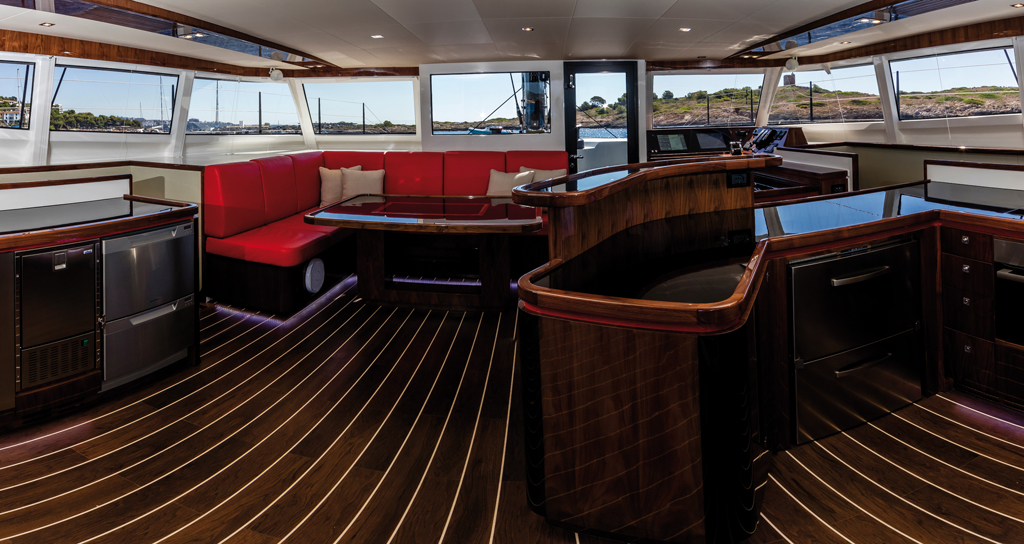
The blend of walnut, carbon and red leather gives a luxurious personality to the interior of this 66 footer
Conclusion
The arrival of the HH66 has really made a mark in the small world of GT cats: she is well worth a look, and the forthcoming models are sure to be taking pride of place on the Caribbean and Mediterranean circuits. The first example is a worthy ambassador of these high ambitions.
Plusses
- Superb lines, very well-built
- Exceptional quality of fittings
- Remarkable interior and exterior finish Performance
Minuses
- For western owners, the yard is a long way away
- Why not make all the winches hydraulic?
- Control buttons at the helm station are not very intuitive
- Are teak and Corain appropriate?
- Saildrive transmission
Designer note by Gino Morelli
We are very pleased with the work done by HH Cats to execute our Morrelli Melvin 66ft Performance cruising cat design. The challenges of building a high performance carbon fiber boat with a luxury interior and amenities required by our discerning clients is a tough. We essentially have to design race boats in disguise! Making the boats fun and responsive in light air while carrying the payload and toys drives both the design/engineers and boat builders to come up with new and clever build techniques. These near America's Cup level techniques encompass not just "Infused" epoxy composites construction, Prepreg carbon high aspect curved "C" daggerboards and "T" rudders but leading edge electronics, battery storage, solar panels and air conditioning and plumbing systems that are light, reliable and maintenance friendly... Our first corrected and elapsed time victory in the Med Cup this summer shows we are on the right track finding the right combination of performance and luxury!
Technical Specifications
- Naval Architects: Gino Morelli and Pete Melvin
- Builder: HH catamarans
- Construction: Post-cured carbon epoxy infused sandwich / daggerboards and rudders in prepreg carbon
- Length: 20.10m
- Beam: 8.70m
- Draft: 1.54m/4m
- Unladen weight: 17t
- Maximum laden displacement: 23.5t
- Bridgedeck clearance: 1m
- Southern Spars mast length: 25.40m (air draft 27.70m)
- Mainsail area: 138m² Solent: 79m²
- Staysail: 42m²
- Reacher: 155m²
- Assymetric spi: 265m²
- Motors: 80hp Yanmars with saildrive transmissions Three-bladed folding propellers
- Batteries: 720A Lithium/ion Generator: 12KVA
- Solar panels: 1000 W standard, to 3500 W
- (optional) Fuel: 2 x 375L Fresh water: 2 x 300L Air conditioning: 84000 BTU Bow thruster Price: $3,700,000 ex-tax
Details du bateau :

- : The negative angle of the inverted bows gives an attractive appearance. The fine-entry bows, the larger elements set further aft and the absence of a forward beam all contribute to a reduction in both weight and pitching
- : The recess in the carbon topsides is perfectly styled, and allows the hatches to integrate discretely
- : The Southern Spars mast tops out at 27.7 meters and supports 217m² of sail area upwind
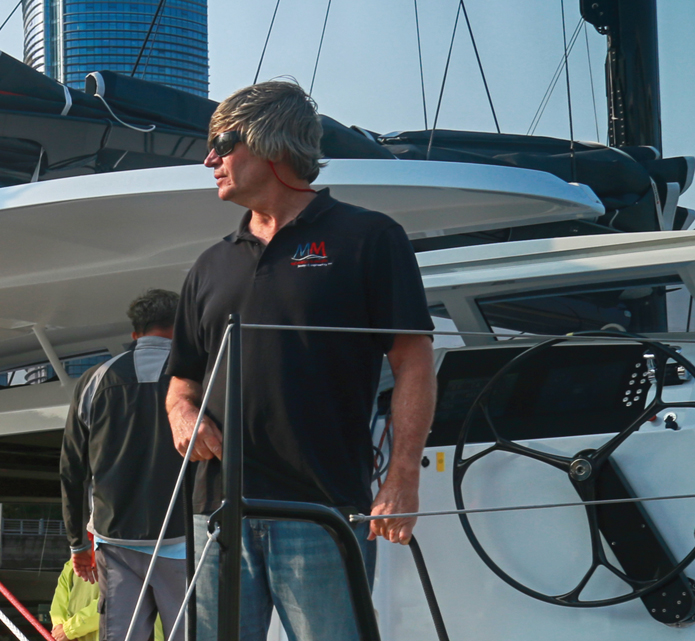
- : The helm station has several remarkable characteristics which show the amount of work which has gone into the design of this critically important area. Sheltered by the windshield, and under a removable sprayhood, the wheel is mounted on a pedestal which can pivot outwards to 90° for light airs or for racing
- : The fixed windshield offers great visibility and perfect protection from any spray
- : The boom with fins is splendid. It conceals the Karver system for reefing with hooks, which allows for tension to be released, sail area reduced and for smaller-diameter reefing lines. A superb setup!
- : The Future Fibres lowers and capshrouds have Spectra sheathing of course, but are also covered with anti-chafe protection in rigid carbon. The terminals are lashed to stainless chainplates integrated into the deck
- : Not only a convivial seating area, this small lateral bench on the side-deck also serves as an excellent helm seat when the steering pedestal is pivoted
- : The compression beam integrates a vertical monopod support by way of an A-frame. This is made of carbon, and triangulates the forces with a Kevlar martingale stay. The geometry allows there to be no transverse forward beam
- : The famous central cockpit is very appropriate here, simplifying and lightening the deck layout