
Maximum living space, stability and low fuel consumption are the keywords to describe the Highland 35. These are the important advantages which definitively launched the power catamaran industry. And today, this powercat could be a great deal!
Infos pratiques
- Le chantier : Highland 35 Pilot
- La fiche technique
- Découvrez notre vidéo exclusive
- Financez votre Highland 35
- Assuez votre Highland 35
- Articles autour du Highland 35
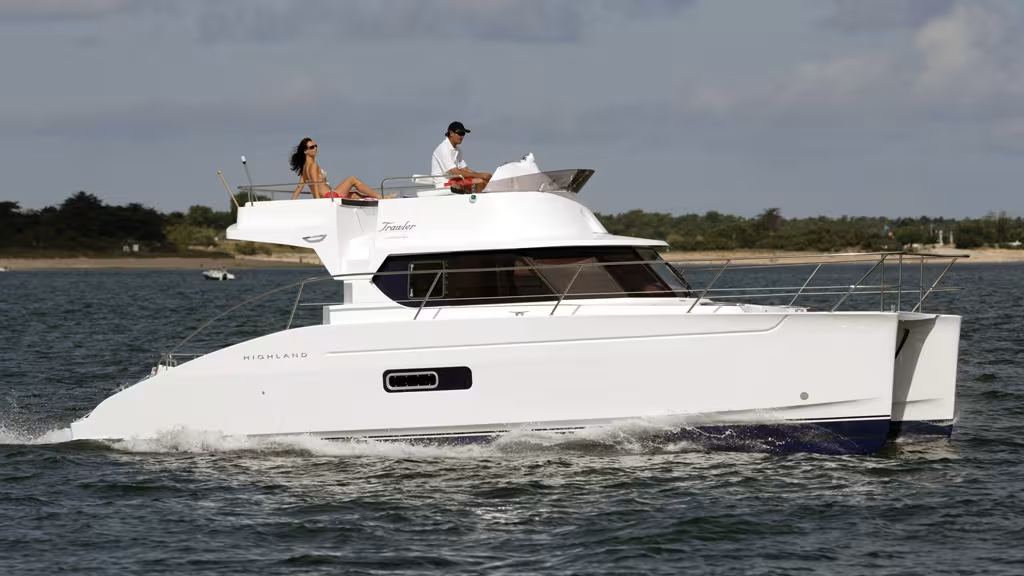
Successor to the Greenland 34, with which Fountaine Pajot launched themselves into the 10 meter power catamaran market in the early 2000s, the Highland 35 became the entry-level boat in a full range, which included the Summerland 40, the Cumberland 44 and the Queensland 55. If the biggest models are catamarans with imposing dimensions, the kid-brother with his 10.35 meter overall length and especially a beam of 4.40m is the go-anywhere, super-versatile boat par excellence. The buyers were not mistaken: with 68 units built between 2005 and 2011, it has brought happiness to many former sailing enthusiasts but also and especially to boaters eager for autonomy and comfort, as well as charter bases looking for something economic to operate and especially easy to maneuver short-handed while having record habitable space. A catamaran that offers the ability, (thanks to a beam of only 4.40 m), to return to port in the evening! From the beginning, it was available in two versions: DUO (two double cabins and two heads compartments) or TRIO (two double cabins in the starboard hull and a large one for the owner to port).
A good range
Thanks to its two Volvo Penta D2 diesels at 75 or 110 hp each, the Highland can cover many nautical miles. The two motors are in engine compartments independent of the living area. The advantages are numerous: ease of maintenance, better accessibility and also silence in living spaces. In terms of cost of use, it is really very economical, and at a cruising speed of 6 to 7 knots consumption is 5 liters per hour, whichever engine option is fitted. This gives a range of 1,000 miles. Perfect for avoiding the fuel dock after a long crossing and being able to enjoy anchorages where, in a good catamaran, it is much more pleasant to be than on a monohull. As soon as you go into fast cruising mode the difference between the two engines becomes apparent. At 12 knots with the 2 x 75 and at 16 knots with the 2 x 110 hp, the range drops to 450 miles with a consumption of 12 l / h. Finally, at maximum speed the version with "small engines" will reach 16 knots while the 2 x 110 hp version will reach almost 20 knots, swallowing respectively 18 and 21 l / h. More than its pure performance, it is the Highland’s easy ability through the water at high average speeds which is really nice. A must when you are swapping from a monohull...
Easy helming
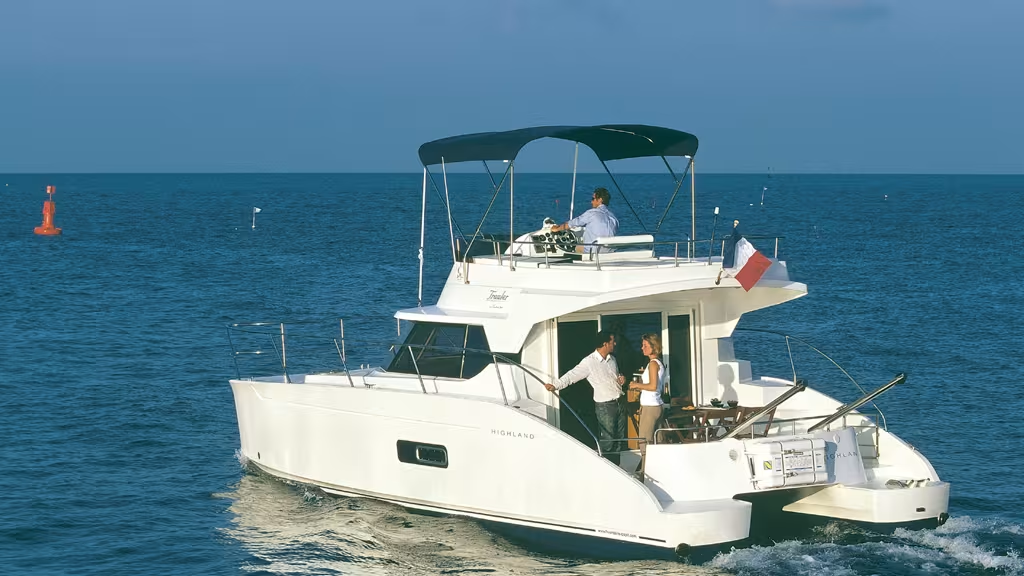
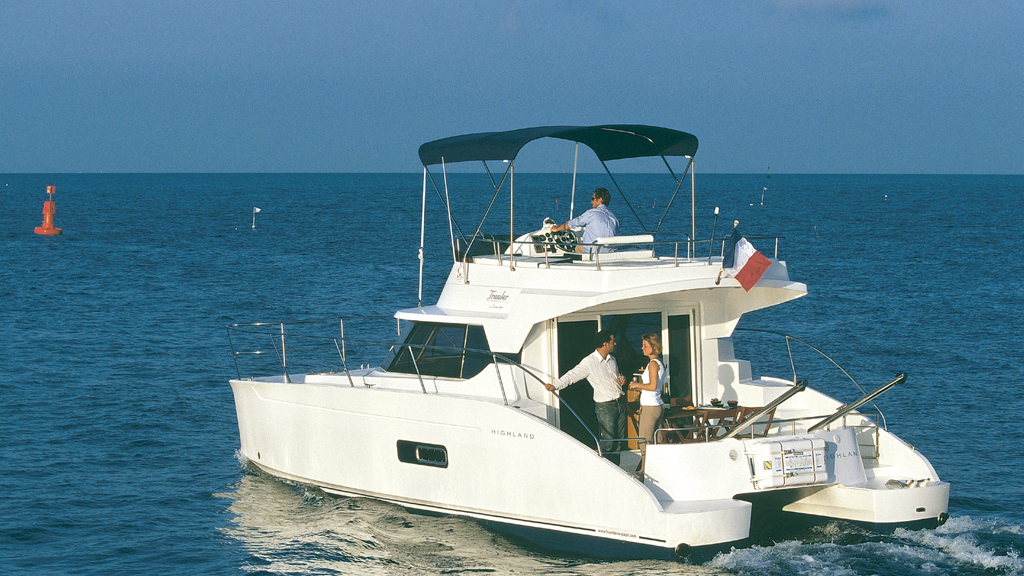
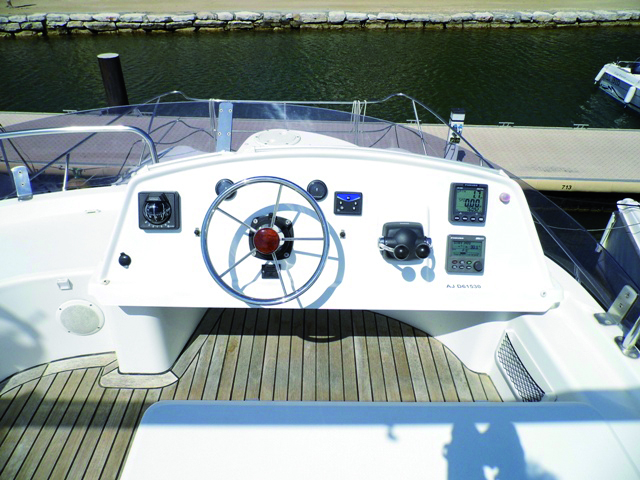
Equipped with two helm stations (on the flybridge or inside), the Highland 35 Pilot remains pleasant, regardless of the weather conditions encountered. The first, fully equipped, helm station on the flybridge is ergonomic and well protected by a plexiglass windshield and a bimini for the sun and optional transparent side panels for rain. The second, interior helm station, can be the master position, compared to that of the flybridge, and offers a seat, steering wheel and console. Another option is an annex to the flybridge, where there is a cabinet and a fridge in place of the seat, and just the throttles and the autopilot instead of the steering wheel. Navigation instruments (log, radar) can be fitted at either helm station. The skegs supporting the propshafts are attached to the arches in the hulls and provide increased safety in the event of any unfortunate encounters with shallow waters.
Maximum living space
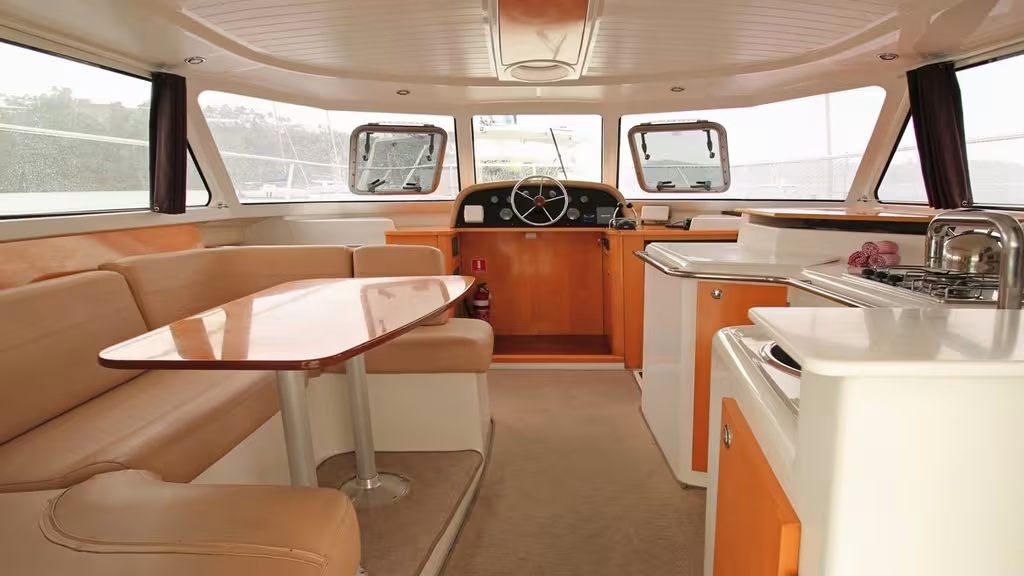
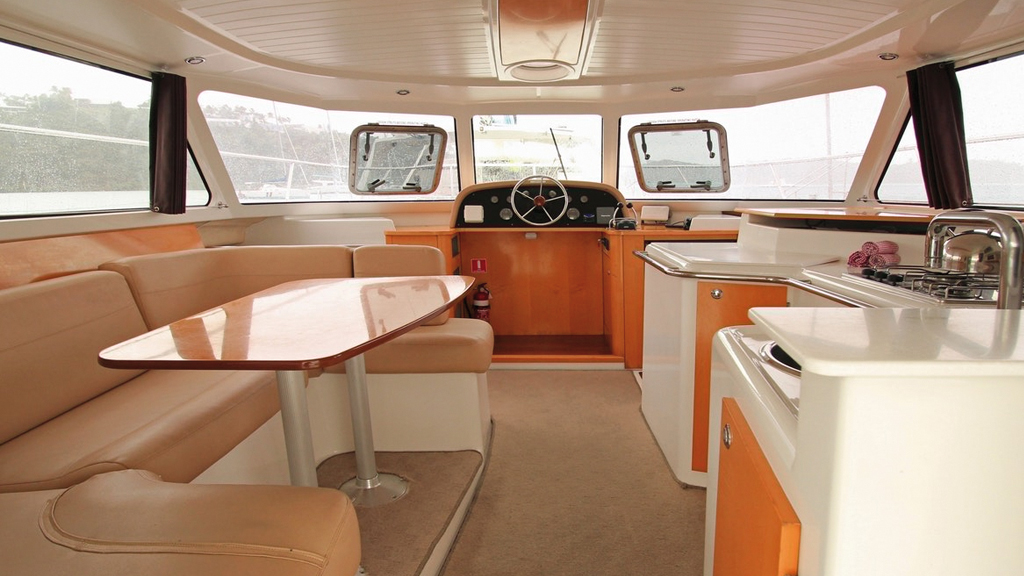
Well-defined living areas for any time of the day characterize the Highland 35. The main deck is accessed via a protected cockpit of over 9m², offering a nice area for eating outdoors, which gives direct access to the saloon. In the shelter from the sun and the wind, you can lunch comfortably with easy access to the galley, which isequipped with a hatch opening directly to the cockpit via a sliding window. The layout of the saloon is simple and efficient, with a U-shaped bench around the table, and a kitchen equipped with sink, hob and oven on both sides of a central aisle. This leads to the side access for the cabins and helm station chart table / desk. Everything is bright, with sycamore woodwork, and feels very pleasant thanks to the panoramic sea view. This friendly place is ideal for passing and also offers ample storage space for cruising. The only regrettable things are that the system of ventilation via the anchor locker is not more efficient, and that the oven, contrary to that on the Greenland, is electric instead of being a proper marine cooker. The Highland also benefits from a huge flybridge, equipped with, in addition to the cockpit, a seating area for 6 people. The evolution compared to Greenland is a large sunbathing area with thick mattresses (2.20m x 1.40m). Whether under way or at anchor, this cozy and comfortable spot with panoramic views is easily accessible, thanks to the boat’s stability.
Conclusion
Despite its small size, the Highland 35 is a great compromise for coastal or semi-offshore cruising as there are many advantages. For life on board, it has stability, multiple spaces and interior volume, for passage-making. It goes well through the water, sedately, yet with good performance. Finally the versatility of its different versions and combinations make it possible to find the boat that really corresponds to your needs!
Technical specifications:
Builder: Fountaine Pajot
Naval Architects: Joubert-Nivelt
Price new 2010: €288,251 inc. tax with 2 x 110 hp Volvo D3 motors
Secondhand price: From €130,000 to €200,000 depending on year/equipment
Length: 10.35 m
Beam: 4.40 m
Draft: 0.95 m
Light displacement: 6,300 kg
Maximum load: 3,200kg
Motors: Volvo Penta 2 x 110 hp or 2 x 75 hp
Fuel: 2 x 400 l
Fresh water: 300 l
Cabins: 2/4 – 3/6 berths
Maximum speed: 19 knots
Cruising speed: 15.5 knots
Fuel cons. cruising: 26 l/h
CE category: Cat. B/8 persons – Cat. C/12 persons
+
The fact that it is not too beamy makes it possible to find dock space just about everywhere and to maneuver easily
The living area is almost twice that of a monohull trawler of the same length
Excellent range and economy. 5 liters per hour at 6 knots
-
The ventilation system is not very efficient and requires improvement
The galley cooker will not motivate the "cook" to do wonders
The forward cabin bunk in the Trio version is a bit narrow and is better suited to a single adult or two children
POINTS TO CHECK
The hulls, the nacelle and the coachroof were molded in foam / glass / polyester sandwich in infusion and the lower hulls in monolithic. The boat, well-built by the yard with their thirty years’ experience, does not present any problems of aging over time, except for any accidental damage which may have been badly repaired. Beware, however, of the number of miles traveled by certain boats. A serious look at the motors is essential, and carefully check the maintenance that they have received during their life. For the rest, the wear and tear of the fittings and the deck hardware, which is somewhat undersized, will have to be given special attention, but the overall reliability of the boat has never been the subject of negative comments.
