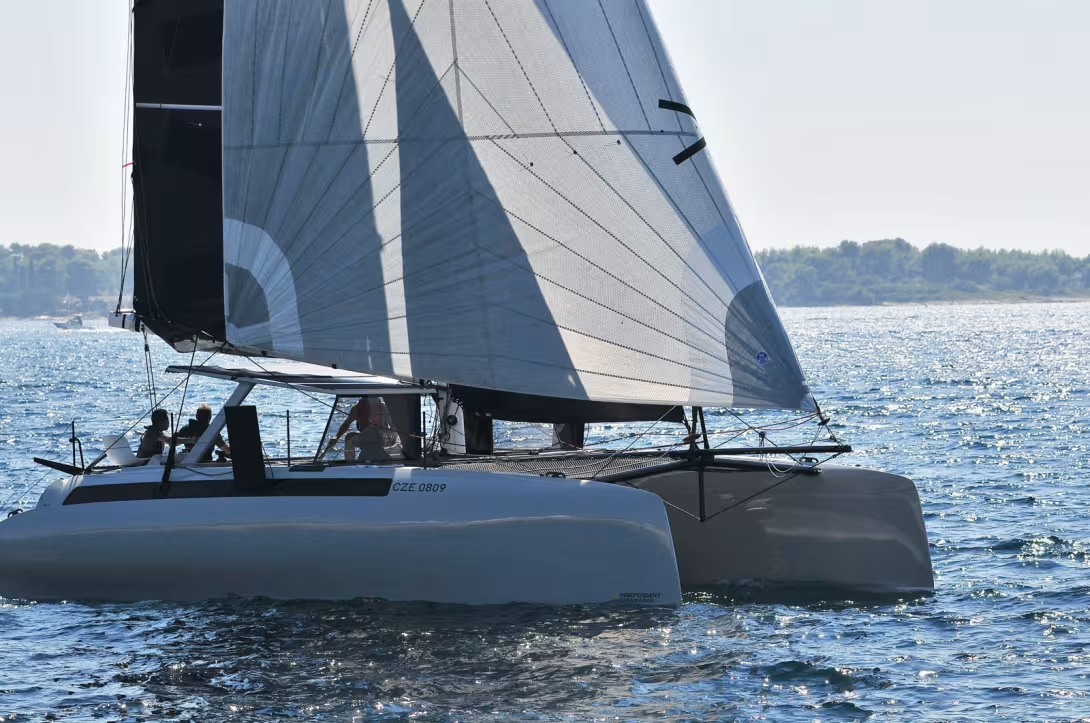
Is multihull blue water cruising, as we have known it for a quarter of a century, suffering its first setback with the global pandemic? Is it time to imagine and opt for another, simpler form of boating? From their base at Lake Lipno, in the southern Czech Republic, the team at Independent Catamaran has been looking into the subject. With their IC 36, a very clever, semi-open cat, the small shipyard has made a remarkable entry into the rather exclusive circle of slightly offbeat but highend builders. We got the chance to test this attractive boat during the Cannes Yachting Festival, where it was on show to the public for the very first time.
Test location: Cannes, South of France
Conditions: wind southeast 10 to 15 knots, sea state moderate
Infos pratiques
- Le chantier : IC36
- La fiche technique
-
 Découvrez notre vidéo exclusive
- Financez votre IC36
- Assuez votre IC36
- Articles autour du IC36
There (really) is something new in the East!
It’s a fact: for two years now, the threat of Covid-19 has simply condemned many cruising areas. Condemned them for unpredictable periods of time, reducing them to no more than quarantine anchorages. However, a blue water program that might involve transatlantic or transpacific passages and Indian Ocean discovery still remains the zigzagging Grail for many unrepentant globetrotters. A quest for new, turquoise horizons is being reflected in an explosion in demand for top-of-the-range liveaboard multihulls from 45 to 60 feet - builders are showing order books with 2 or even 3-year waiting times. But another trend is emerging: one of boating that consumes less air transport, is less arrogant, more sporty, more “local” (in the regional sense of the word) and less dependent on expensive infrastructure. The IC36 fits into this mindset - we could use the term “degrowth” here, but the very high-end build quality of this catamaran translates into a high price. This beautiful and seductive machine can be dismantled, transported on a semi-trailer or slipped into a 40-foot shipping container. The IC36 can winter ashore as well as cross the Atlantic, visit large inland waters (the Great Lakes, Lakes Geneva, Balaton, Constance...) or cruise the Baltic and the Mediterranean at high speed. The comfort factor hasn’t been left out, though, as we shall see: in marketing terms, the IC36 abandons the urban-chic diktat of big boats in favor of a sports-cruising concept. But these excellent arguments still need to win over multihull enthusiasts, who are often particularly sensitive to how much volume is on offer.
A combining of talents
Jaromír Popek, born in 1976, is the intellectual and financial driving force behind Independent Catamaran. He has been a sailing enthusiast for 20 years and is dedicated to design, architectural development, and business. Tomas Jonas Janda was born in 1972 and is a naval architect. His first catamaran was designed and built over 4 years (starting from a design made from Lego bricks!). His second multihull (30 feet / 9 meters long) was built during his time at university - Tomas bet on being able to cross the Atlantic on his own sailboat). Following a tour of Europe and a transatlantic crossing on this catamaran, he and his father built more than 30 multihulls ranging in size from 20 to 36 feet (6 to 11 m), all dismantlable and transportable. Joining forces with Janda, Popek got involved as an investor and the project manager for the IC36. Their experience of many years of coastal and offshore sailing was used to develop an original and successful approach to the fast-cruising catamaran. For the interior and exterior design, the pair were joined by Roman Vrtiška and Valdimir Žak. These guys are young designers who graduated from the universities of Prague and Aalto (Finland) where they’ve received numerous awards for their work in interior architecture and product design.
 |
 |
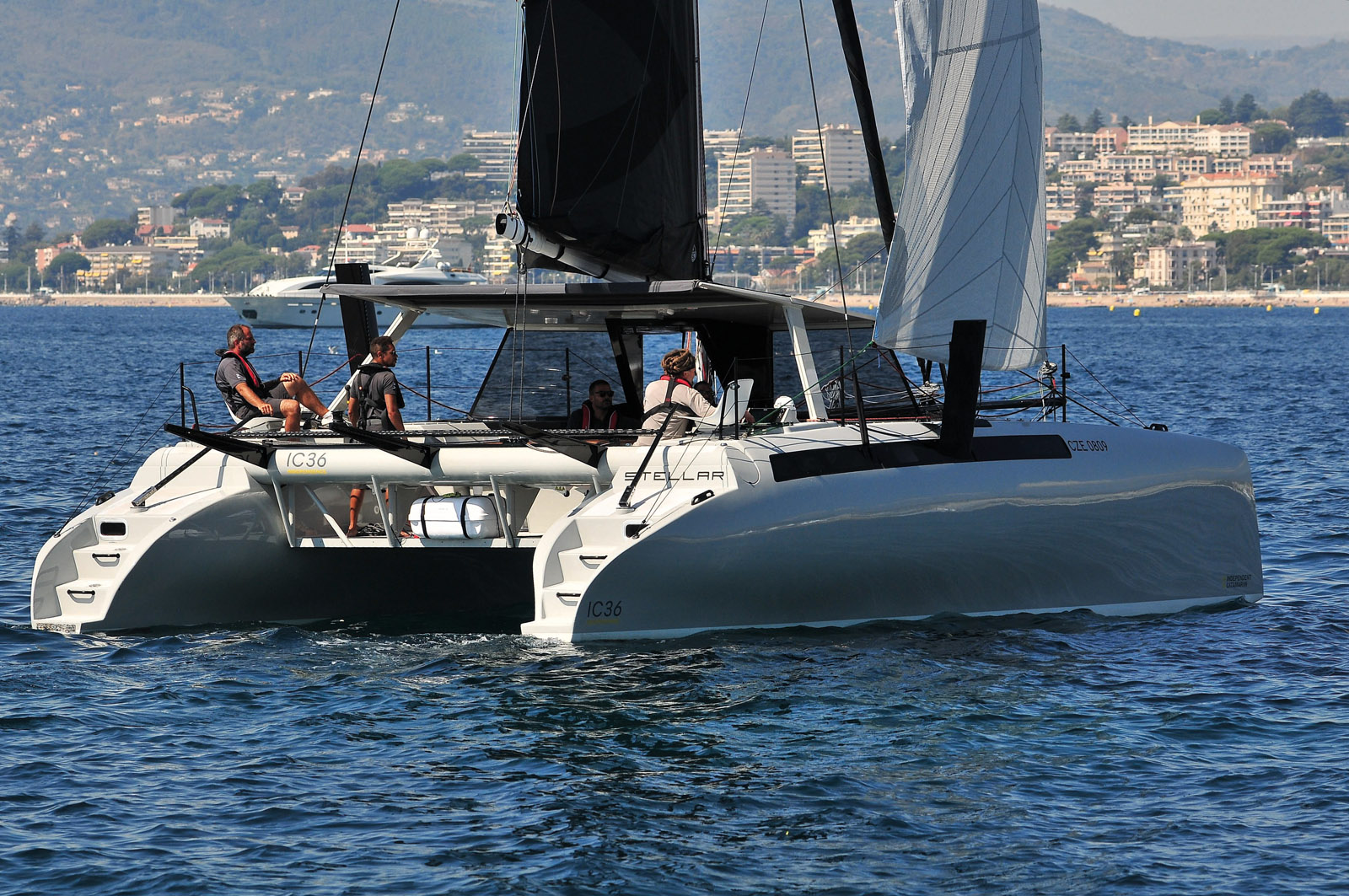
The slightest breeze produces very sharp acceleration - absolute joy at the helm.
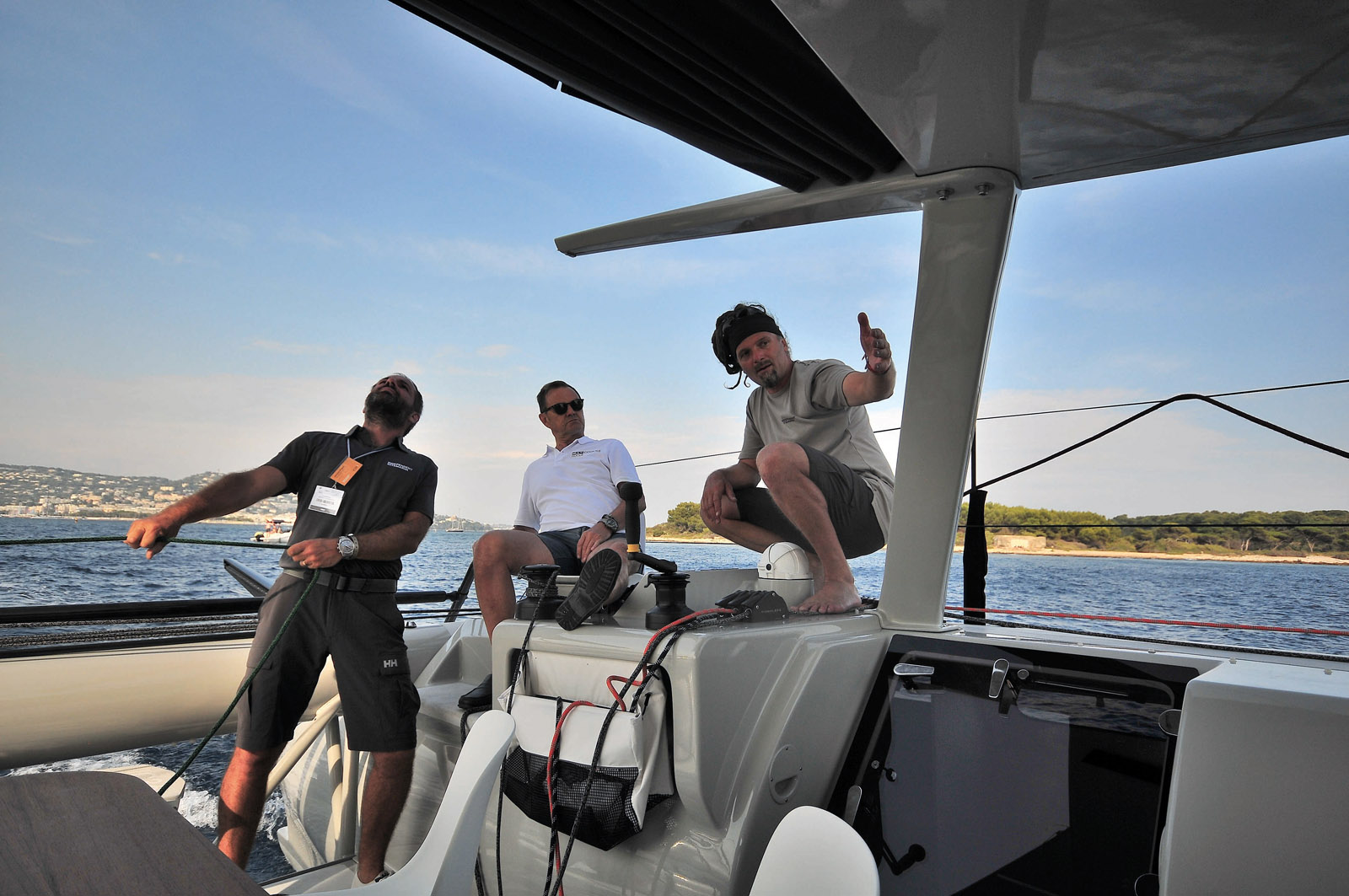
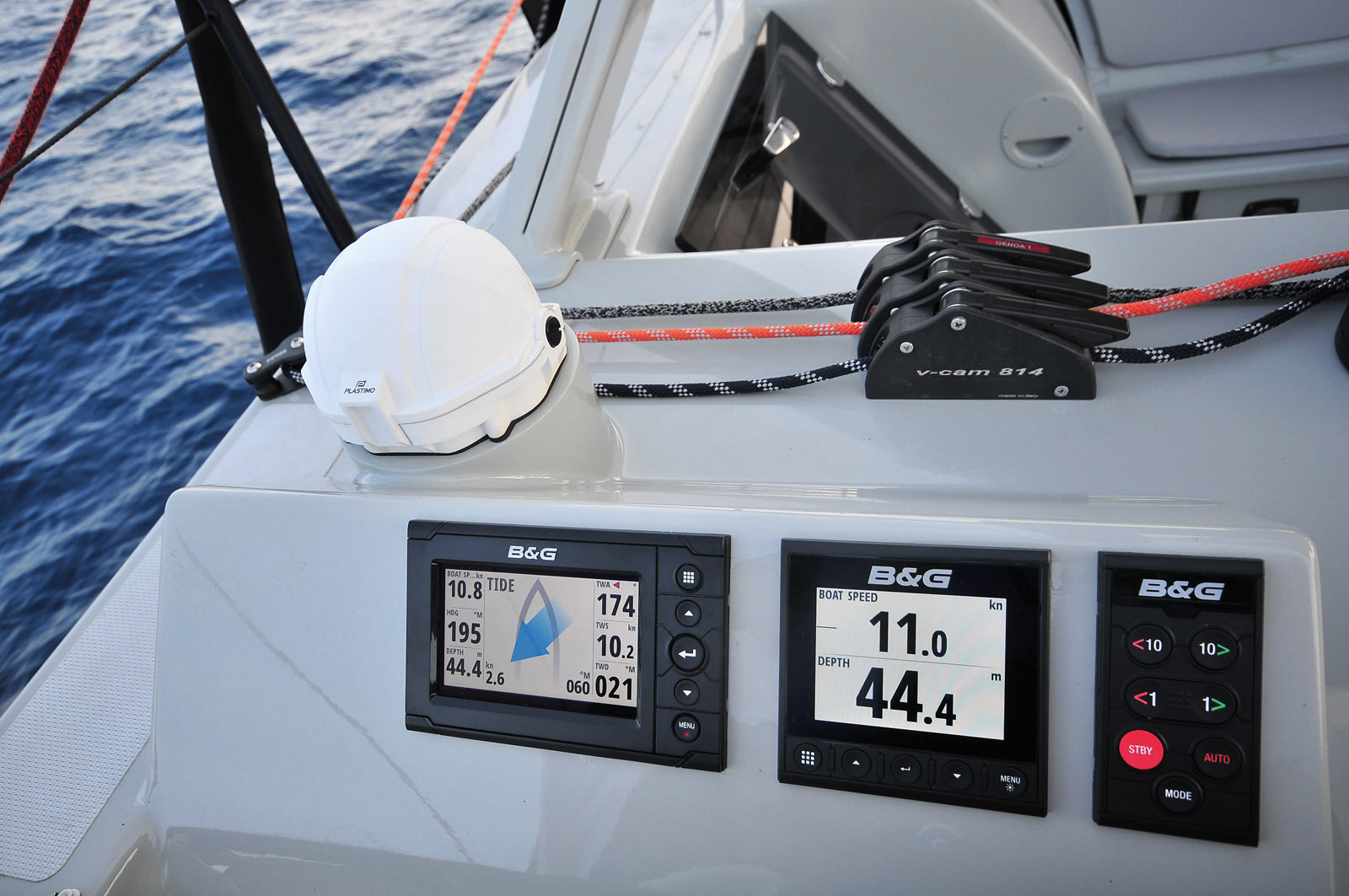
High-end deck fittings allow the IC36 to be perfectly trimmed, so speed in excess of 10 knots are a mere formality!
Very high-end construction
Beyond the obvious appeal and the originality of the concept, what strikes the visitor to the IC36 is the exacting quality and the care taken in the manufacture and equipment. This is closer to the level of a racing prototype than a cruising catamaran. The one-piece carbon central beam is embedded in the hull reveals. The large-section, tubular aluminum aft beam is magnificently lacquered. As for the full carbon forward cross, this integrates the A frame, the martingale in rod and the compression beam. The composite work is admirable, to the standards of the best and what is not visible is done to the same level (engine compartments for example). The trampoline attachments on the laminated rods are fitted with small Wichard snapshackles to avoid tedious lashings – now that’s clever!) The rotating mast and the boom are from Pauger, as are the superb carbon struts supporting the Targa roof (they transform this sport convertible into a cocooning multihull once you’ve fitted the fabric enclosures). These particularly refined elements, together the boat’s magnificent aesthetic presentation, send a clear message to the attentive observer - this IC36 is approaching perfection. The equipment on the version presented and that we’ve tested here is just superlative.
 |
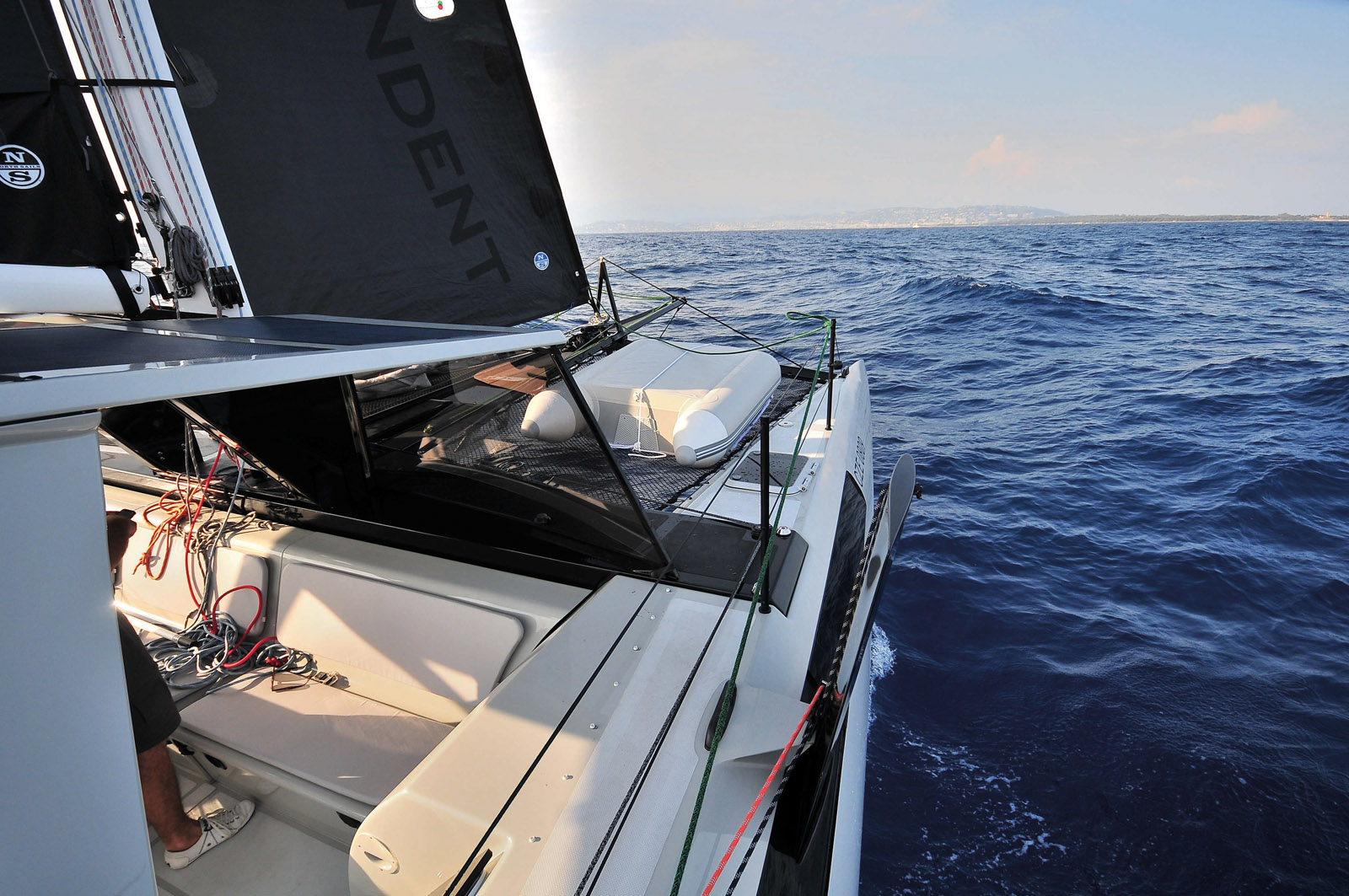 |
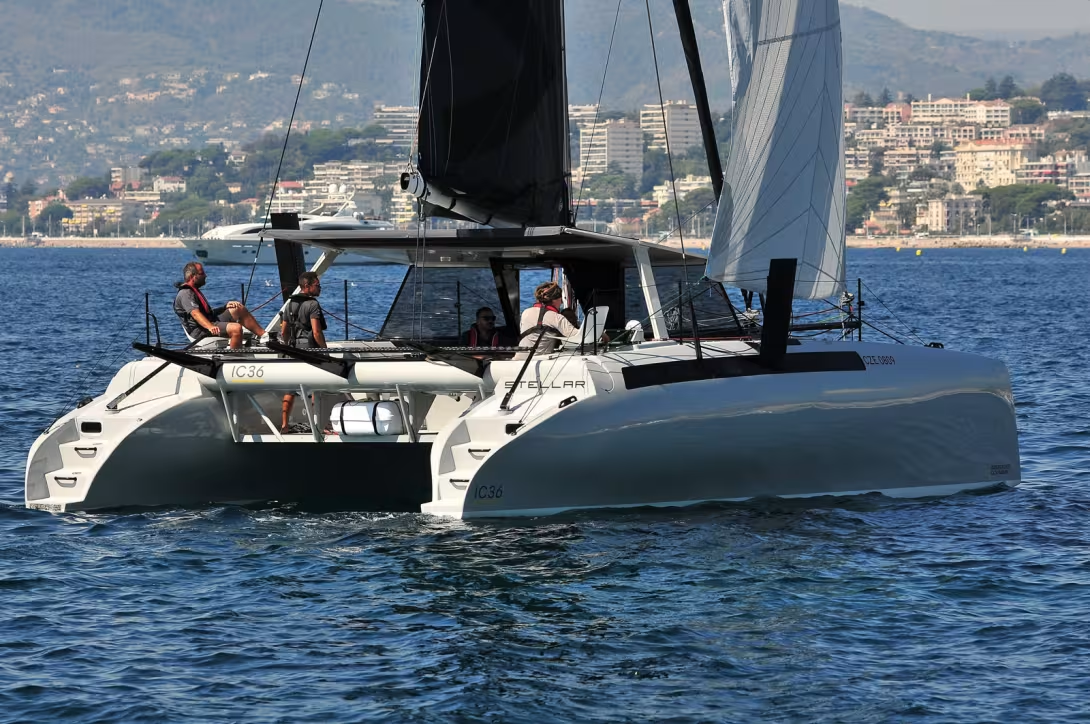
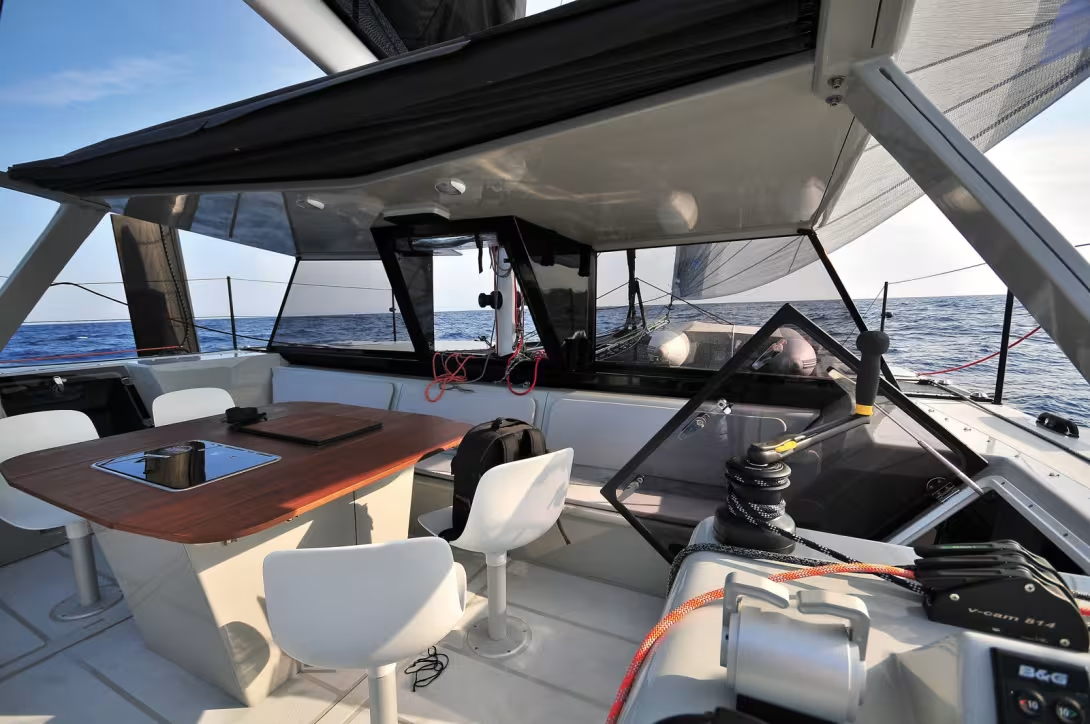
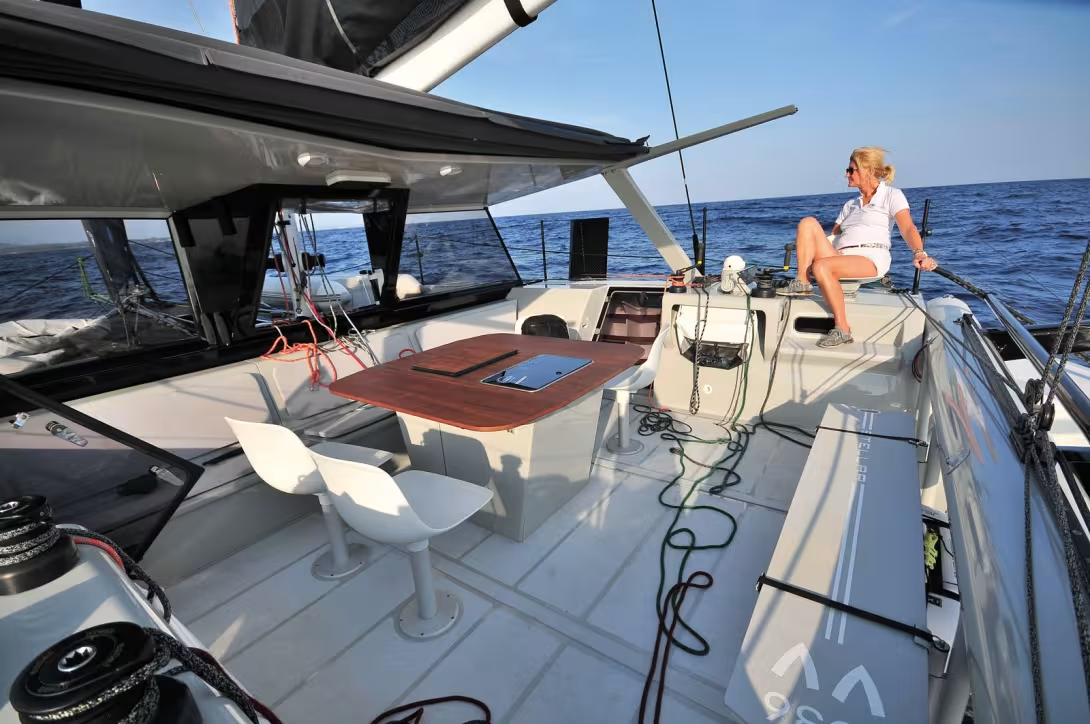
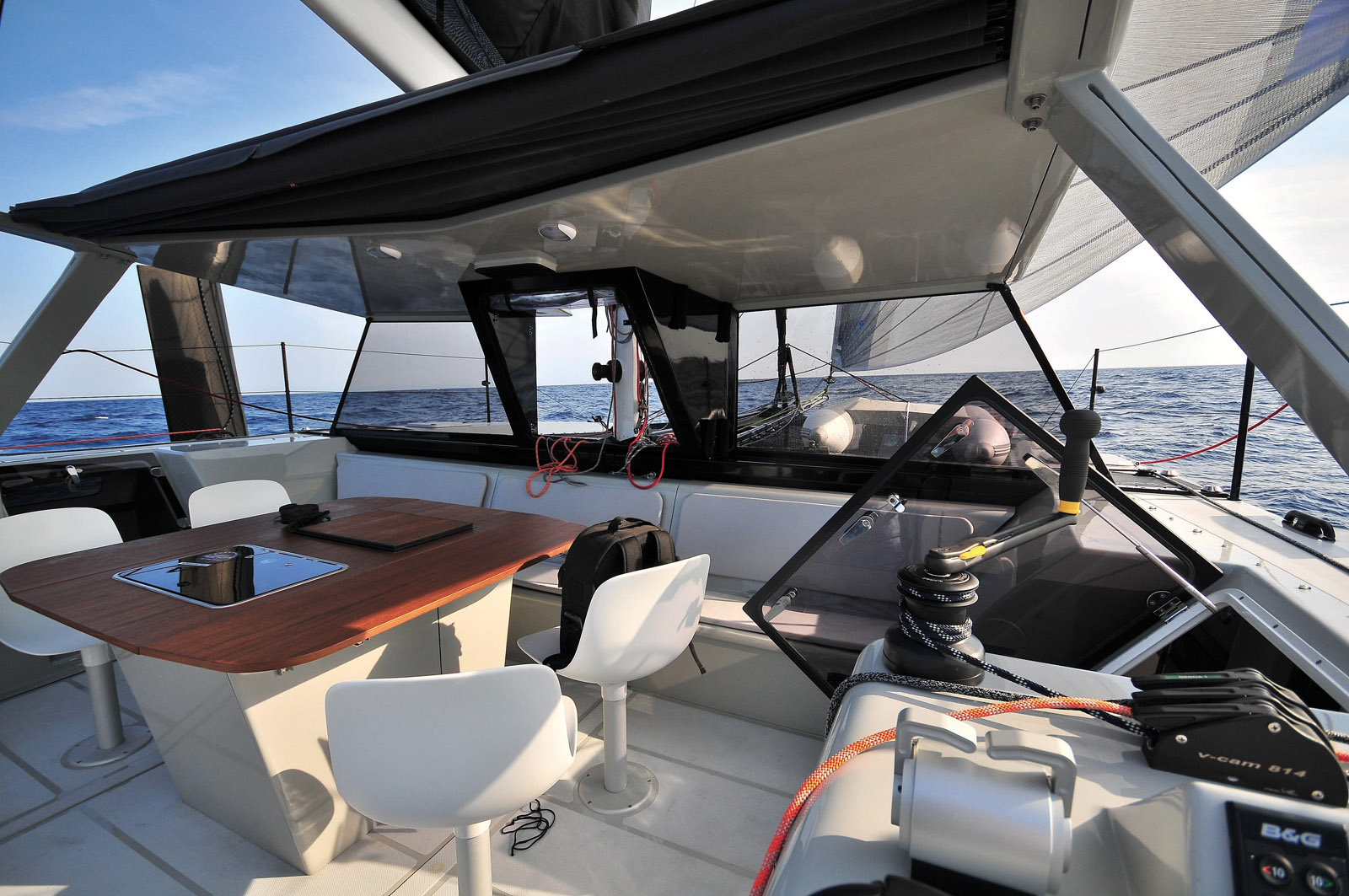
The cockpit also serves as a galley and saloon, with a system of removable cockpit-enclosure-type covers protecting this living area at anchor and/or in port.
Successful design for ergonomics and performance
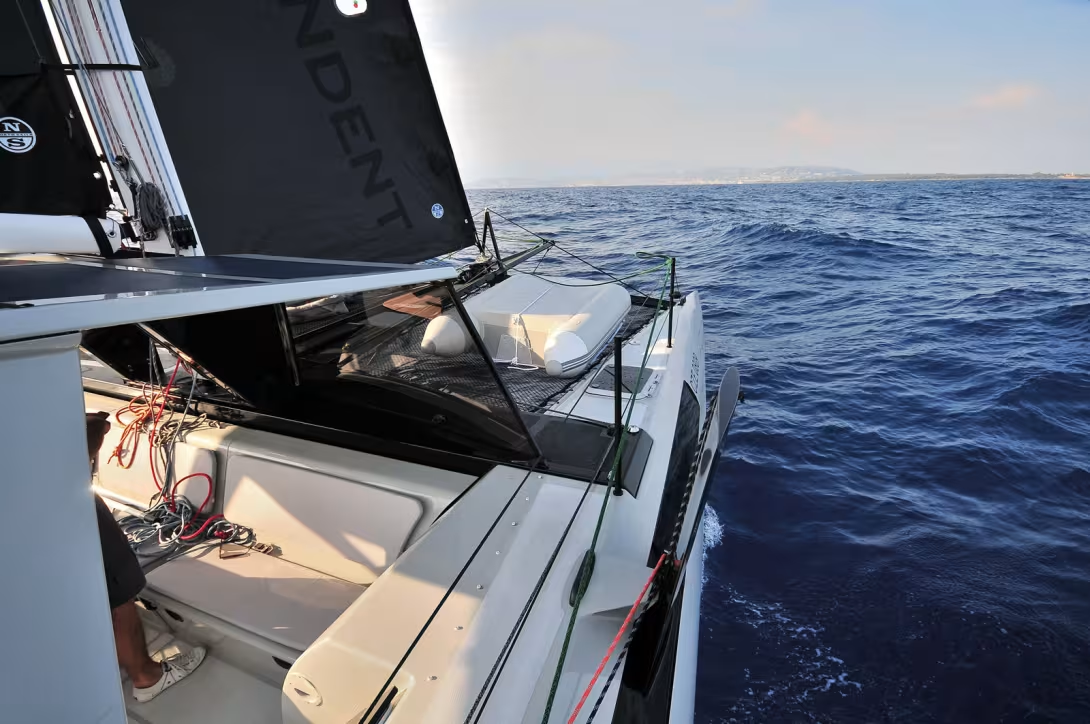
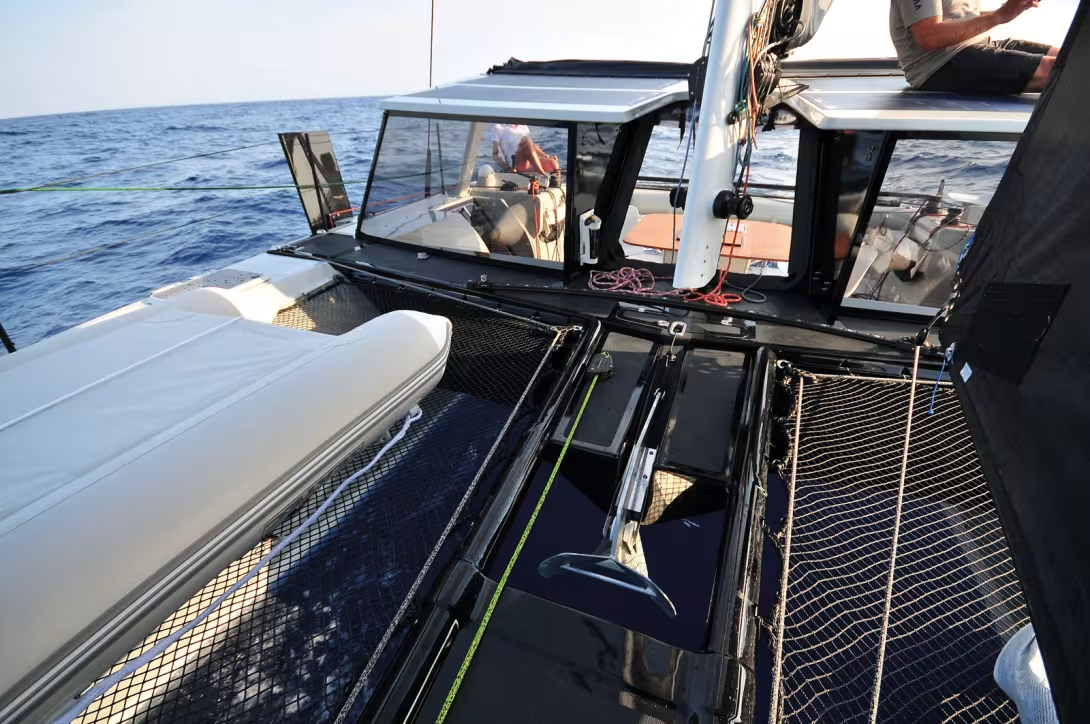
From every possible angle, the silhouette of the IC36 is attractive – as confirmed by the often-eloquent comments of passers-by at the Cannes Yachting Festival. The catamaran is perfectly weighted and floats high on the water, highlighting the balance of the hull forms, which are very slender at the waterline. Aft, the arches are narrow in order to avoid a hobbyhorsing effect in choppier seas and to remain consistent with the finesse of the bows. The sections are typical for this sort of performance boat with a flattened U shape without too much rocker. This curvature of the floats favors maneuverability but avoids being too pronounced, so as to limit pitching. The harmony of the proportions is undeniably sculptural, and this contributes greatly to the seductive power of the IC36. The aft beam houses the passerelle, but this cleverly transforms into a rear seat. Accessibility via the sugarscoops is good, and as for the deck layout, it logically takes up the space around the helm stations, but it is all superbly designed and installed - and there is no lack of room in the cockpit. Access to the trampolines is easy, and the anchor locker with its powerful windlass is very rational - an essential factor for cruising. The IC 36 is a semi-open catamaran, which means that it is equipped with an opening bimini Targa roof (congratulations are due for the ingenious automatic batten system for the canvas) and that the carbon posts are equipped with superb handrails that allow the large open cockpit to be quickly transformed into a comfortable living space, protected from the weather.
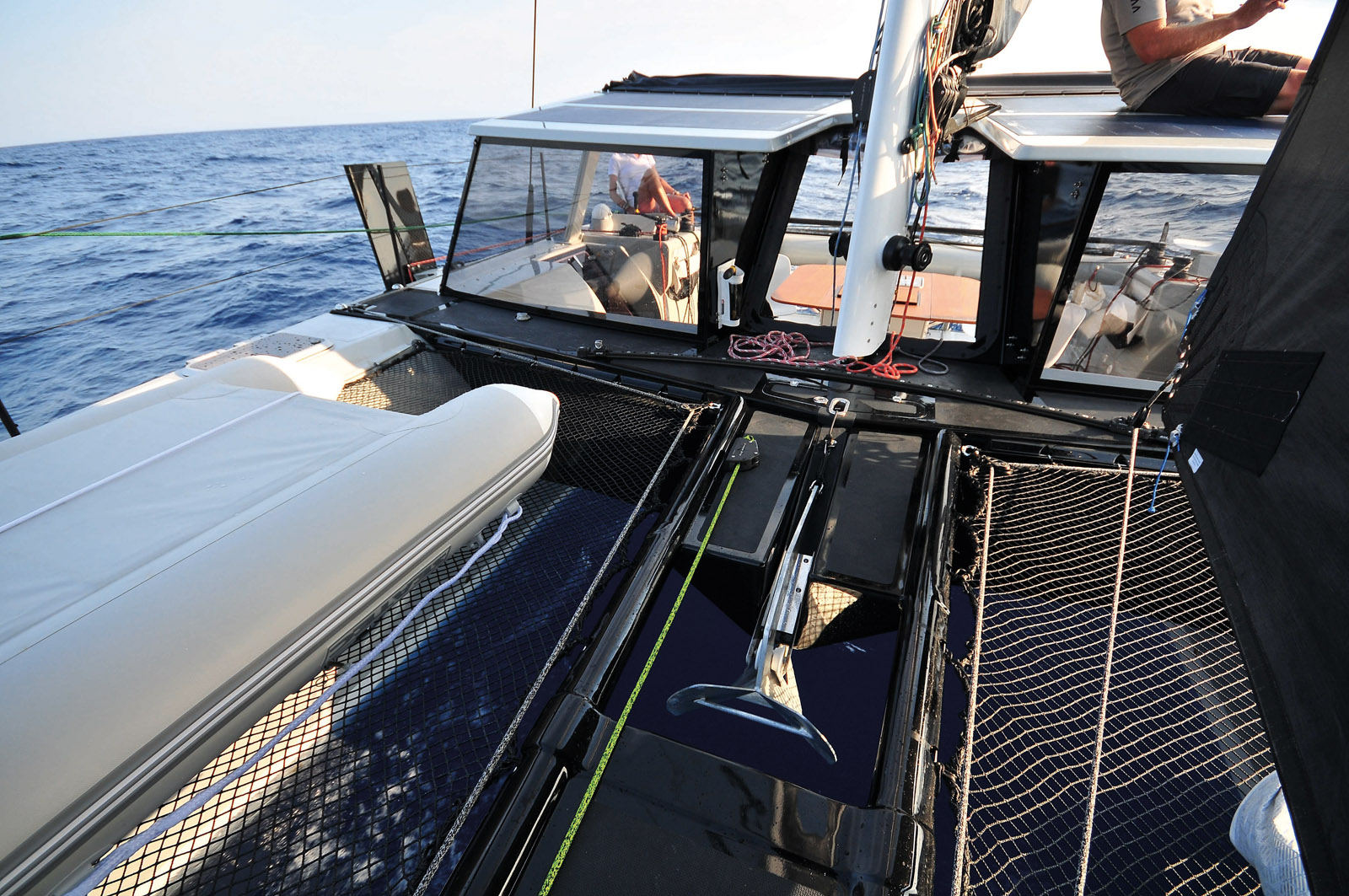
Forward, the trampolines provide a large area where you could stow a dinghy.
Outstanding accomodation
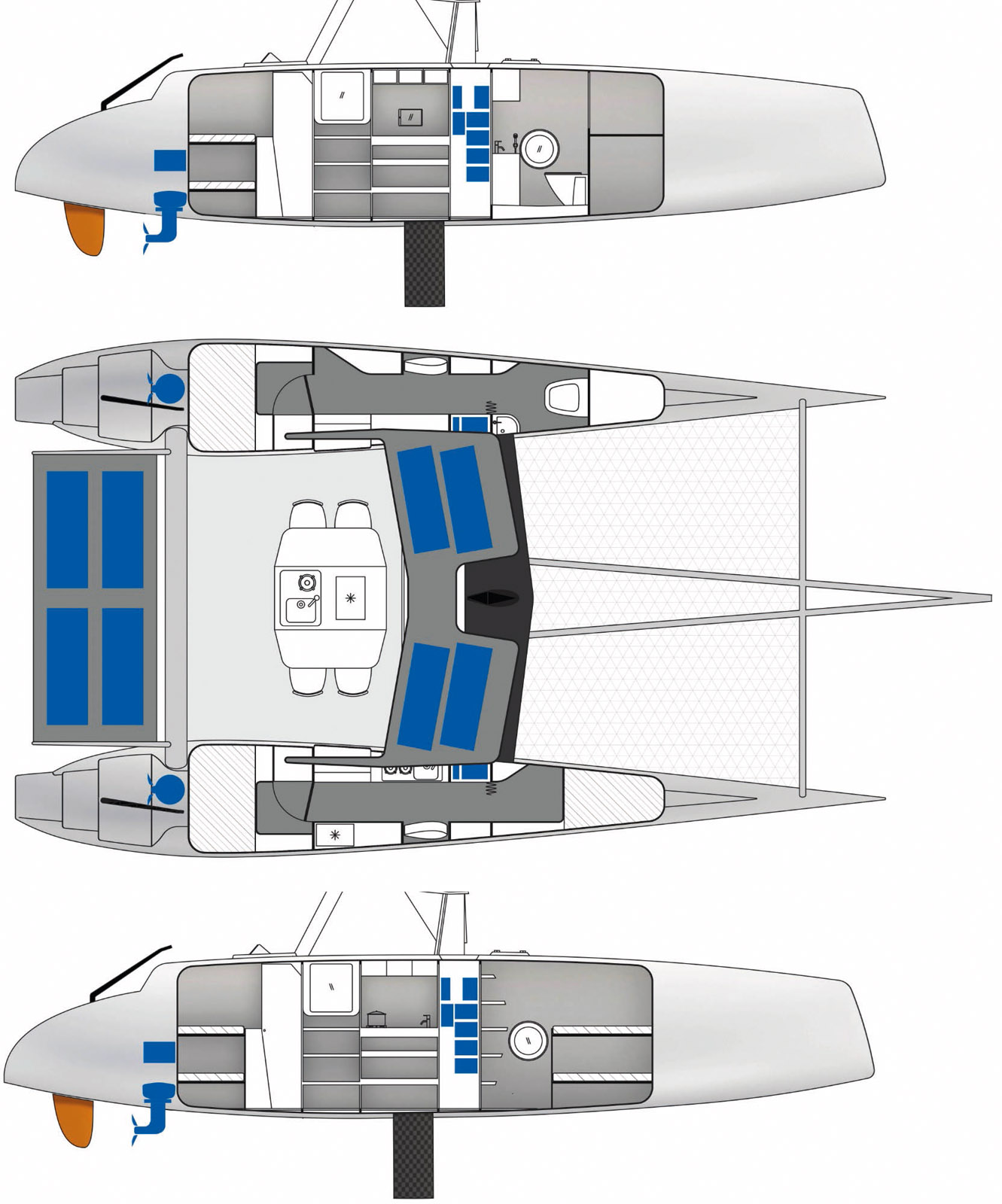
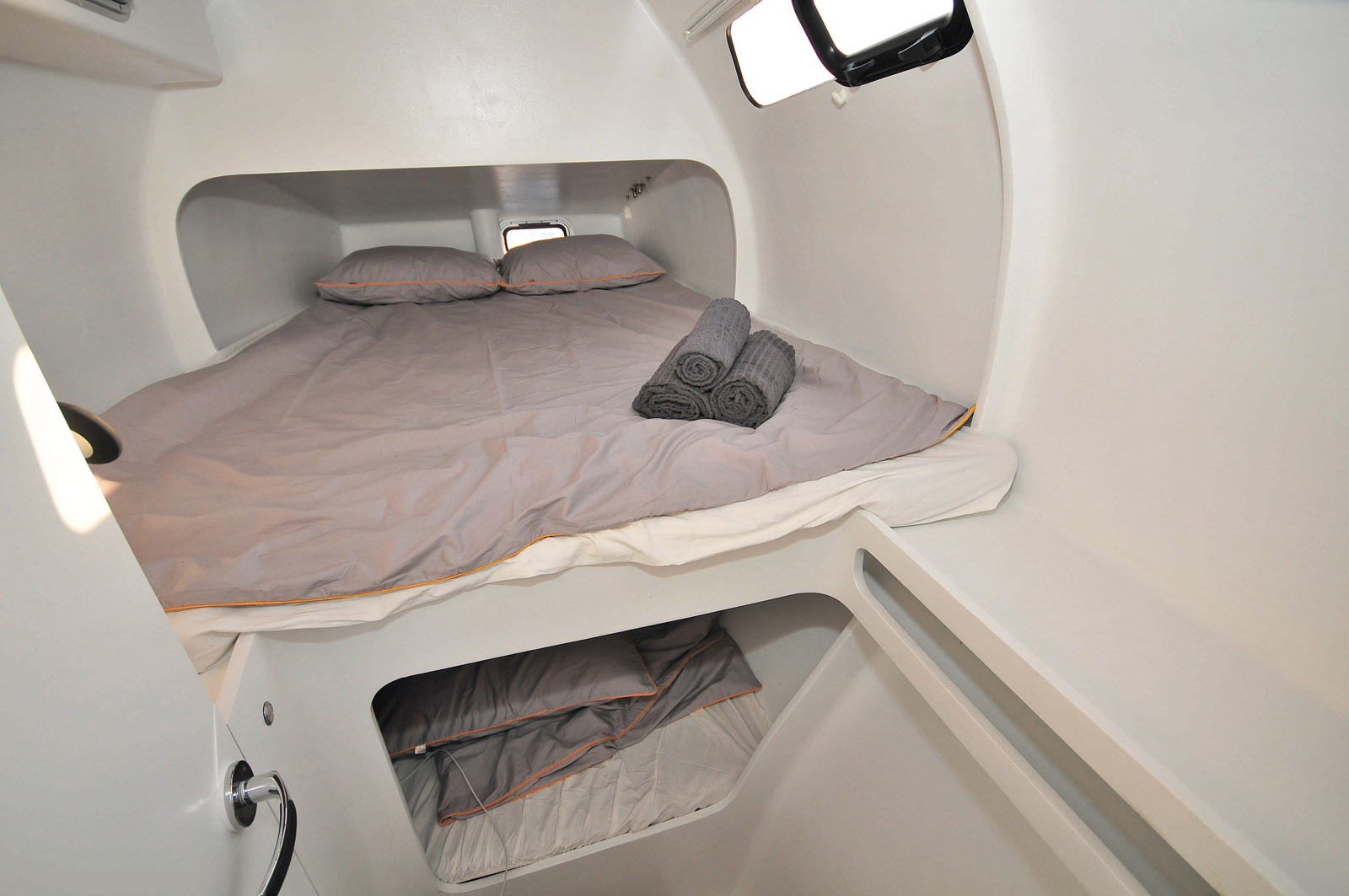
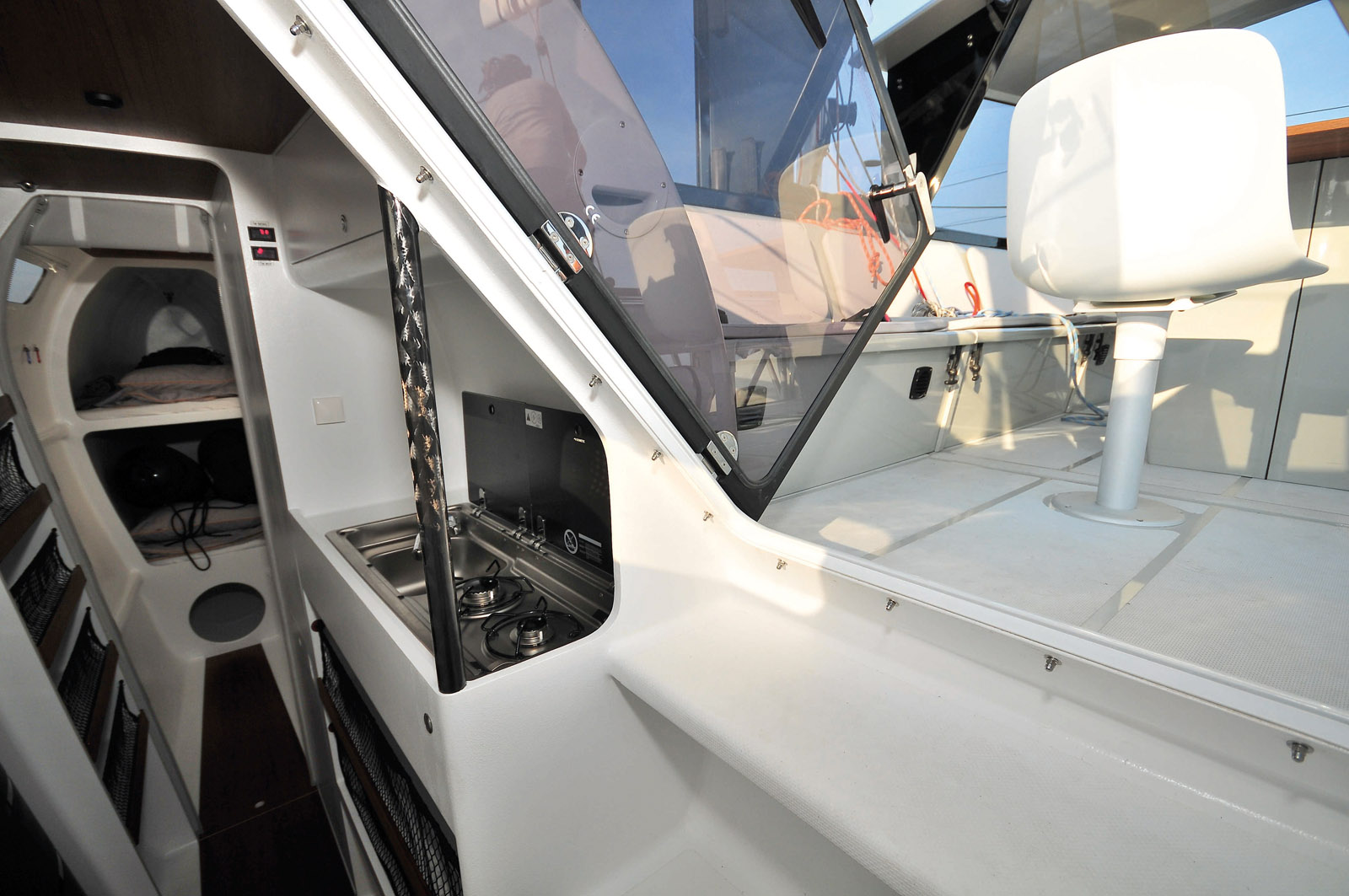
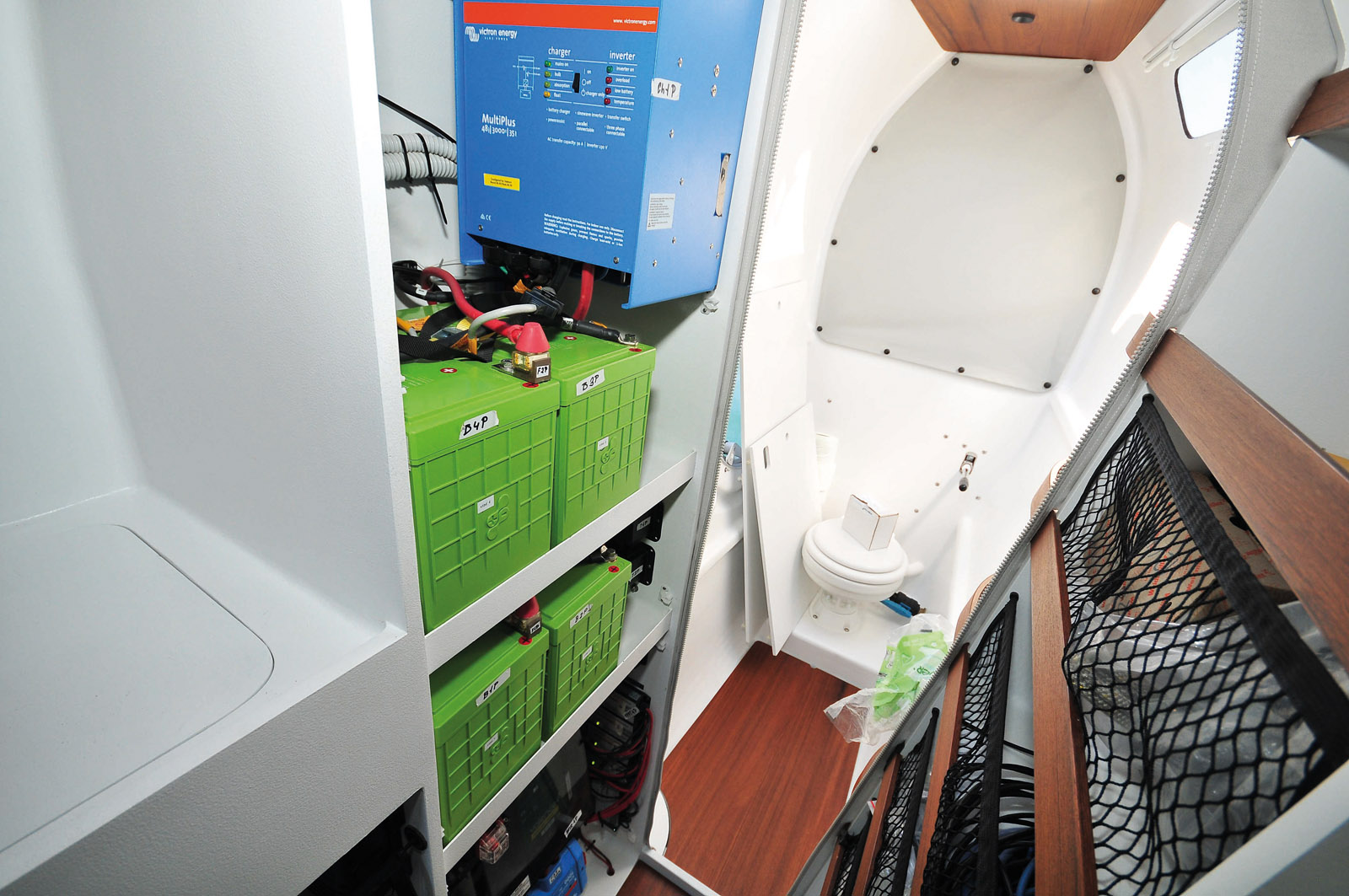
The exterior saloon-cockpit is multipurpose space can easily accommodate a dozen guests around the central multifunctional island that can be easily removed (for a week of racing or any other demanding program). The table, the sink and the work/cooking surface are well suited to snacks, under way or at anchor. The layout offers two large double berths aft (with a crew bunk below for racing). The starboard hull houses the chart table in the passageway as well as the technical equipment cabinet and the battery compartment (a superb installation!) as well as a beautiful bathroom with toilet. On the port side, the layout is the same aft, but the galley is in the central passageway, while forward, there are bunkbeds. All this is superbly finished in a chic and uncluttered style, all enhanced by the quality of the build.
 |
 |
 |
The double berths are well designed on this particularly high-performance boat.
The galley is to be found in the port hull passageway.
The 14-kWh lithium battery bank is installed aft of the heads compartment to optimize weight centering.
A varied range of engine options
Independent Catamaran offers three powertrain options. The first is a traditional setup with a pair of 9.9 HP outboard motors on articulated brackets. This option would be ideal for a catamaran that requires little engine power for docking maneuvers. The second option is also traditional with twin low power inboard diesels and folding propellers. The Independence version is the most sophisticated – and this was our test boat. This all-encompassing propulsion system incorporates two 6 kW Oceanvolt electric motors capable of providing a lot of power very quickly in hydro-generation mode, especially at 10 knots and above, a base speed for the IC36. The 14-kWh capacity of the lithium battery bank powered by the Solbian solar panels is however sufficient for all daily actions, port maneuvering included. The manufacturer specifies that it is intended for careful and knowledgeable users, and I would add to this that the price of this configuration is high. In use, I really appreciated the perfect maneuverability and the torque at low rpm, ideal for making a discreet entry into a congested marina. The hydro-generation tests demonstrated the excellent charging, with a speed loss just slightly over a knot - an acceptable figure considering the average speeds of the IC36 are between 10 and 20 knots.
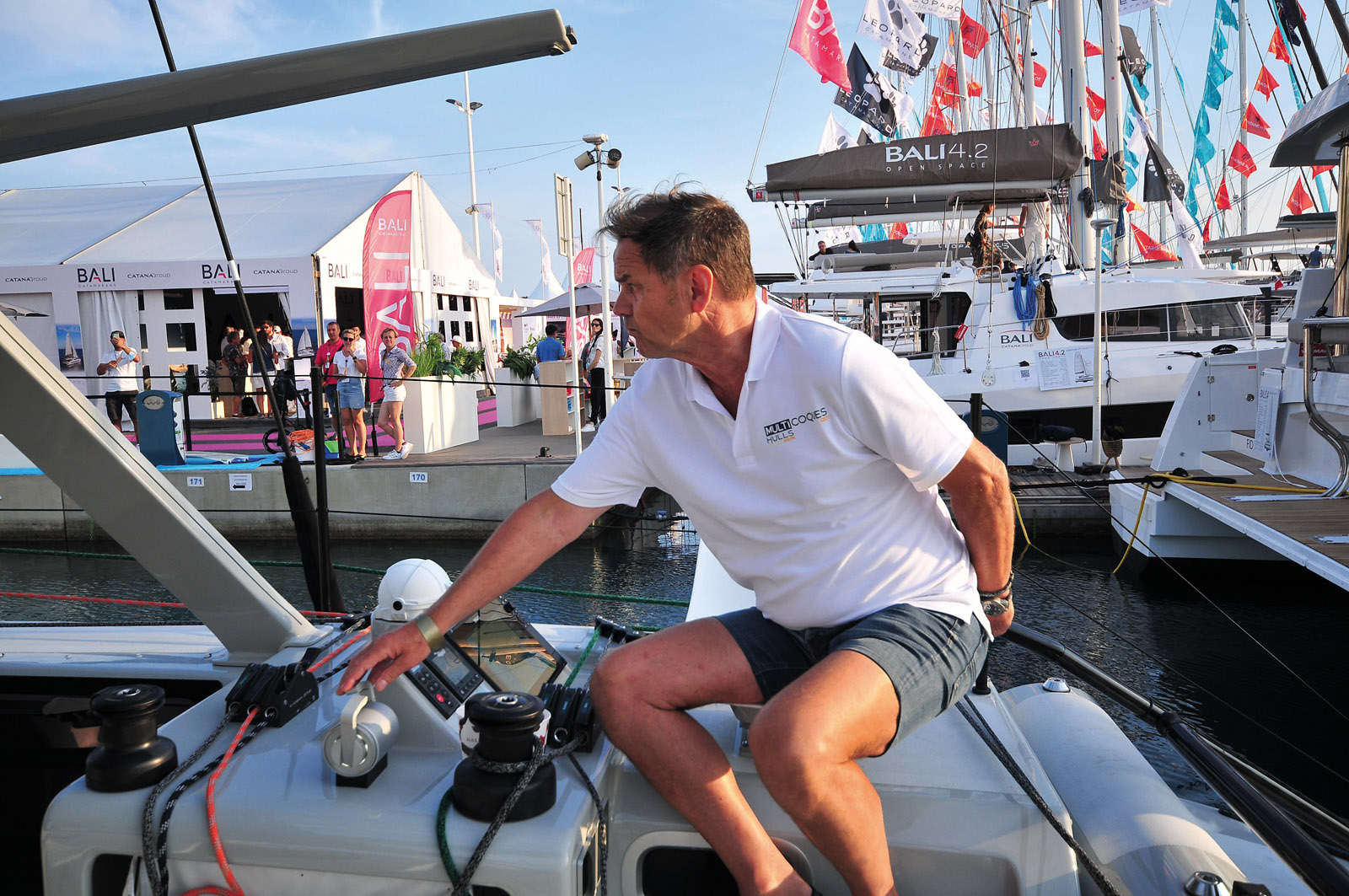
The Oceanvolt electric propulsion system is perfect – as here, during port maneuvers.
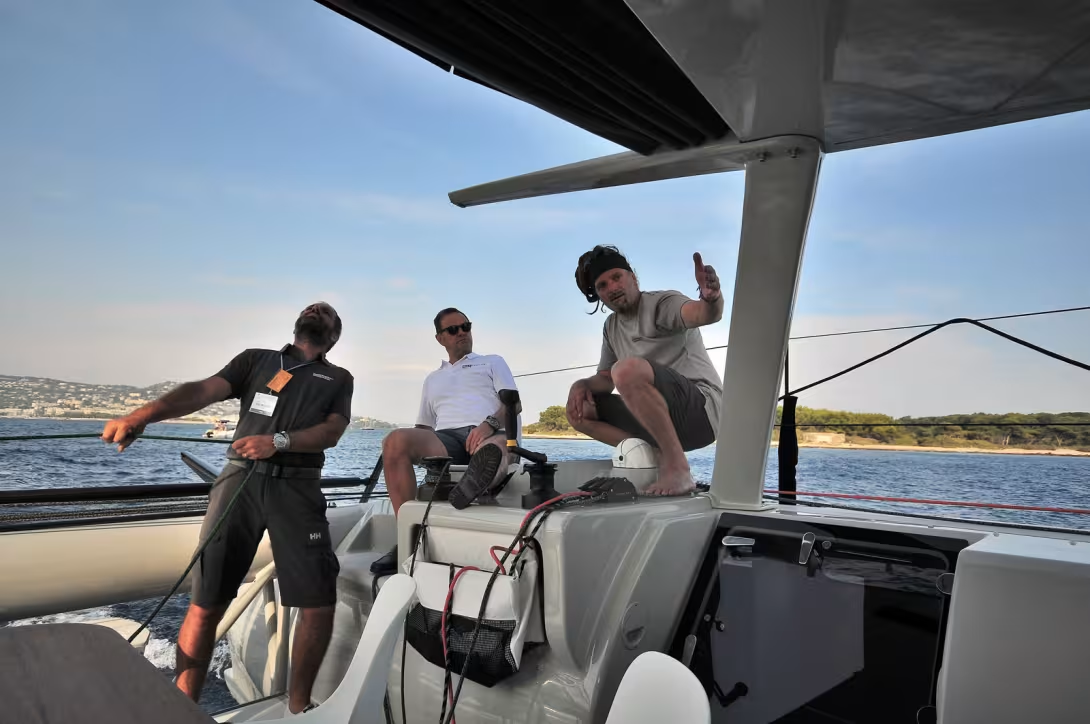
The helmswoman’s point of view
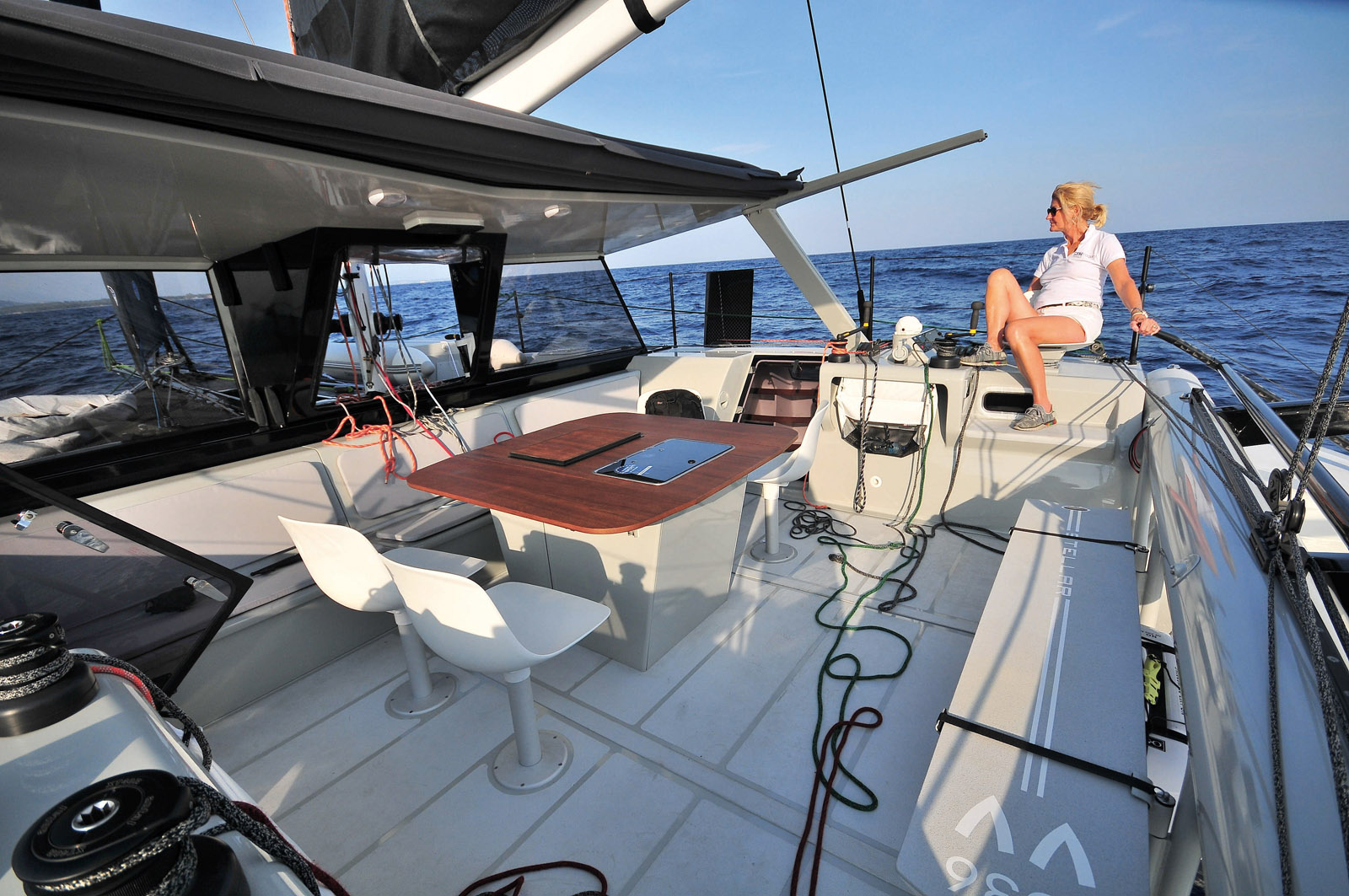
At the helm, the sensations are quite definite. I was very aware of the pleasure of safe and easy driving under code 0. The support on the water and the speed gave real comfort in the rough sea without upsetting the crew. This catamaran is really nice, and very well finished. There is a lot of living space in the nacelle, but while the small galley down below is certainly relevant, I wonder how actually living on board would be - meals and relaxation time. Another point I wondered about was the functioning of the island galley and its compatibility at sea or in a lively anchorage aboard this open cat with the fabric partitions, something we weren’t able to try during our test sail.
A sporty, versatile and reassuring catamaran
Pour un essayeur de multicoque, d crire For a multihull tester, describing 5 hours of pleasure on the water is not necessarily that easy. There are two pitfalls: being too factual, too analytical, the experience divided into component parts will seem devoid of substance. Too sensitive and emotional, the test report risks losing the reader in an all-too personal account. I’ve already said how easily the IC36 maneuvers in this electric version. The power, torque and top speed (9 knots) are all perfectly matched; I would even go so far as to say that it is a source of pleasure, as the Oceanvolt forward/ astern controls are so delicate and intuitive. The slalom of getting out past the pivoting pontoons at the Cannes Yachting Festival in the middle of the boat traffic was a good exercise in appropriation. As we got out into the Baie de Cannes, we hoisted the beautiful North membrane mainsail, leaving the mast in auto rotation, and unfurled the code 0. The dynamic temperament of the IC was immediately revealed in the messy chop accompanied by a 10-knot easterly breeze (we were still in the lee of the Iles de Lerins at this point). The catamaran easily stabilized its speed at the that of the true wind. Then, comfortably in his seat, the helmsman made the very best of this multihull: you can definitely feel that you’re creating your own apparent wind. The platform is very stiff, and the harmony between the deep daggerboards, rudders and wakes is immediately perceptible. This sensation, combined with the firm and precise directional effect of the appendages, is a source of intense pleasure at the helm. Without being over-canvassed, at 950 square feet upwind with a displacement of 6,600 lbs (88 m / 3 tonnes), this catamaran displays real velocity. This magnificent multihull measuring just 36 feet wove its way with remarkable ease through the turbulent cauldron kicked up by the easterly that had been blowing for three days and raising confused 5-foot (1.5 m) cross seas. A less agile multihull would have found this situation annoying, but at the helm of the IC, I felt a real sense of satisfaction, like that of an experienced skier in a field of moguls covered with fresh powder! It glides happily, the grip of the carbon helm is perfect, the linkages offering no inertia, and the course-keeping is ultra-precise: all the elements (chassis, appendages, carbon rigging, rotating carbon mast, and super stiff sails) contribute to the magnificent result produced by this sharp instrument. By paying a little attention, speeds of 14-15 knots can be maintained in the conditions we had, with a variable breeze of 13-15 knots. The top speed we saw on the day was 15.6 knots, but that’s just one number - it doesn’t reflect the elegance of the high average speed and real fun of our superb sail.
 |
 |
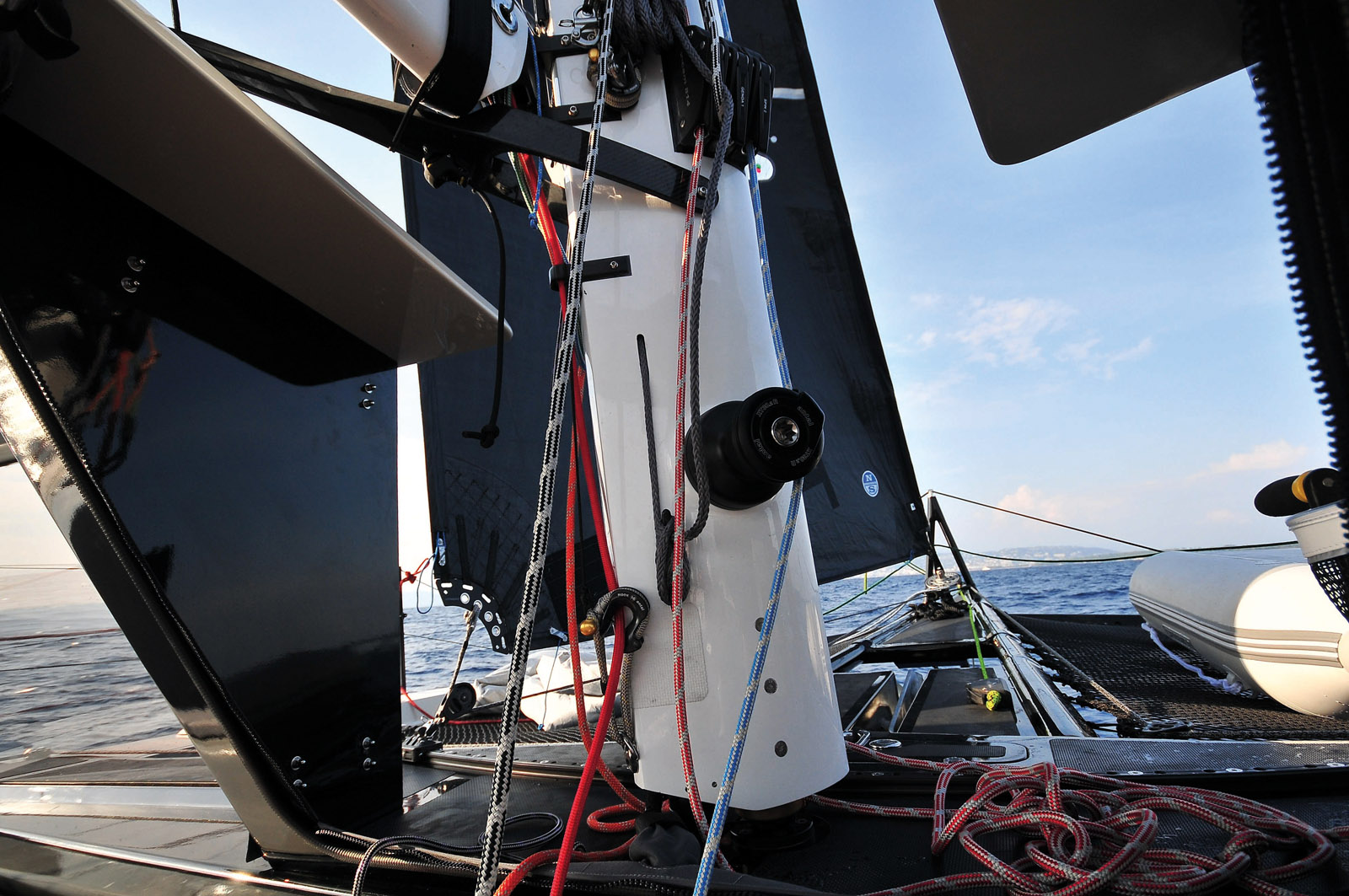
The rotating mast and the boom are made of carbon from Pauger Ltd. Weight savings are in the order of 40% compared to aluminum.
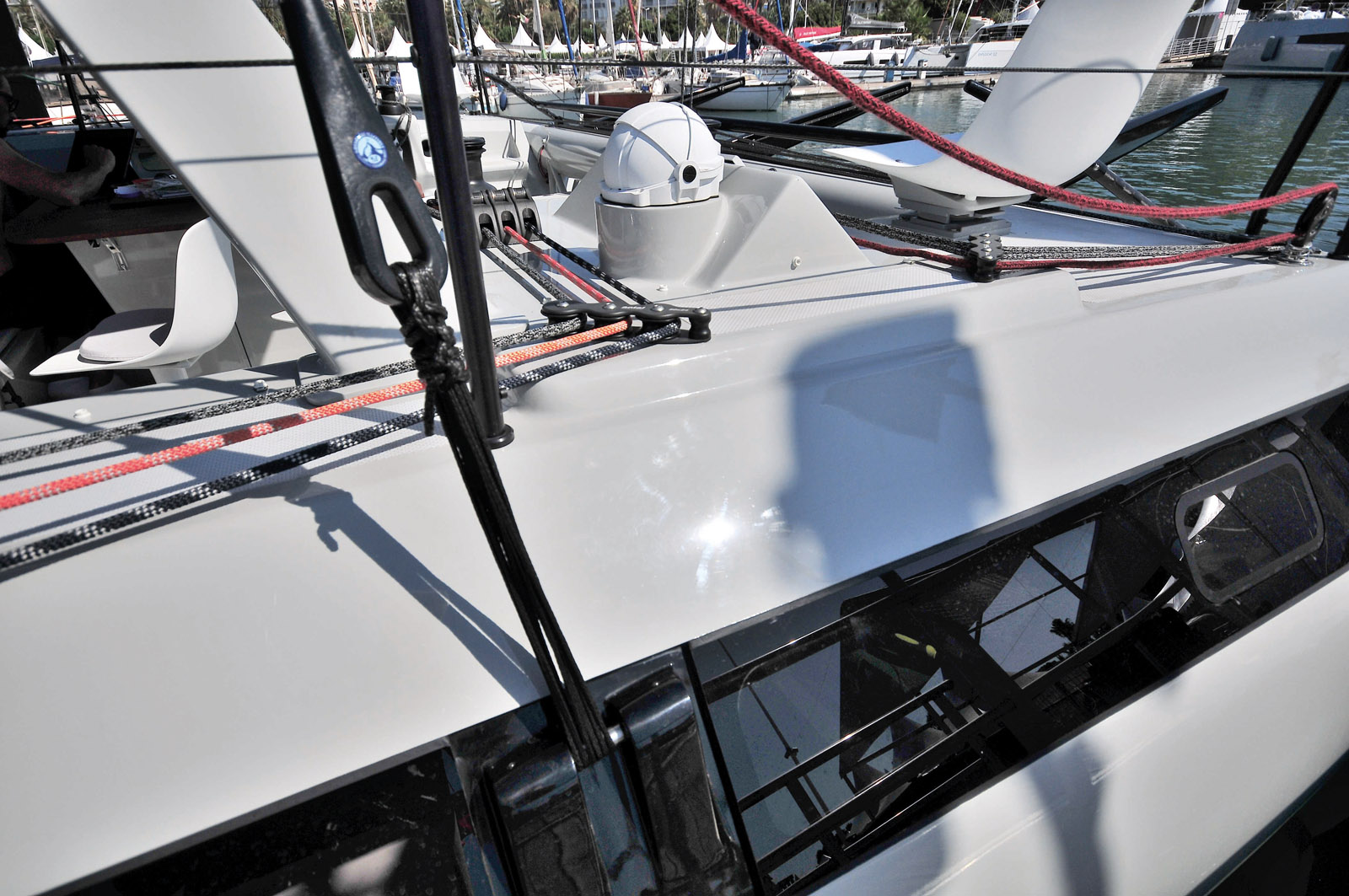
Rudder linking bar, capshroud lashings: the IC36 has been refined and optimized down to every last detail.
Conclusion
The reader will have understood that something happened here between this multihull and the tester! However, this fact doesn’t erase (or perhaps underline?) the objective qualities of the IC36, i.e. reasonable size, cleverness of the overall concept, quality of manufacture and pleasure of use. I liked the racy character of the machine, its formal beauty and its build quality. Having tested it again in its original birthplace, in Central Europe on Lake Lipno, I would certainly love to choose this beautiful multihull for taking part in the next ARC. Of course, this would be a use somewhat removed from the initial program, but it’d be great fun to compare the performance of the IC36 against a pack of big boats.
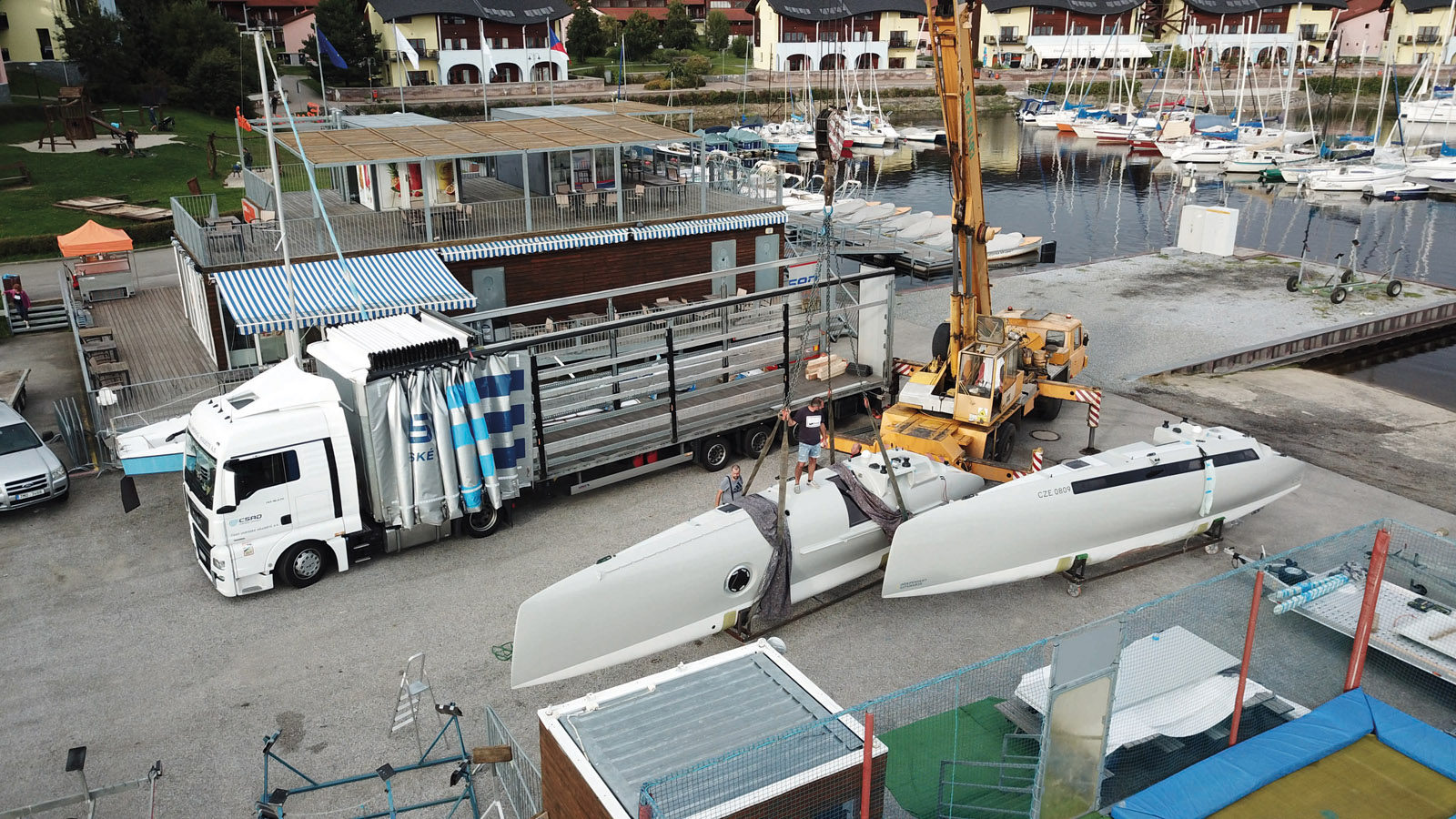
The IC36 is dismantlable and transportable - it can travel by truck or in a 40-foot shipping container.
The Pluses:
+ Superb design
+ Top level behavior and performance
+ Program versatility and transportability
The Minuses:
- Price high and uncertain on resale
- Not necessarily easy to convince a family crew
- Catamaran for a maximum of four people in cruising mode
TECHNICAL SPECIFICATIONS
Builder: Independent Catamaran
Naval architect: Jaromír Popek
Length: 36’1” (11.00 m)
Beam: 20’4” (6.20 m)
Bridgedeck clearance: 2’7” (0.80 m)
Displacement: 5,500/6,600 lbs (2.5/3 t) depending on version
Anti-leeway plan: daggerboards
Draft: 33” (0.85 m) - fixed rudders / 6’7” (2.00 m) – daggerboards down
Mast height: 49’10” (15.20 m) - rotating carbon or fixed aluminum
Mainsail: 452 sq ft (42 m2)
Solent: 194 sq ft (18 m2)
Jib: 97sq ft (9 m2)
Code 0: 495 sq ft (46 m2)
Berths: 6-8 Water: 2 x 52 US gal (2 x 200 l)
Motors: 2 x Oceanvolt 6 kW / 2 x Yanmar diesels / 2 x Yamaha 9.9 HP outboards
Prices : RAW: € 346,500 ex-tax - PACER: € 403,900 ex-tax
INDEPENDENCE: € 497,800 ex-tax