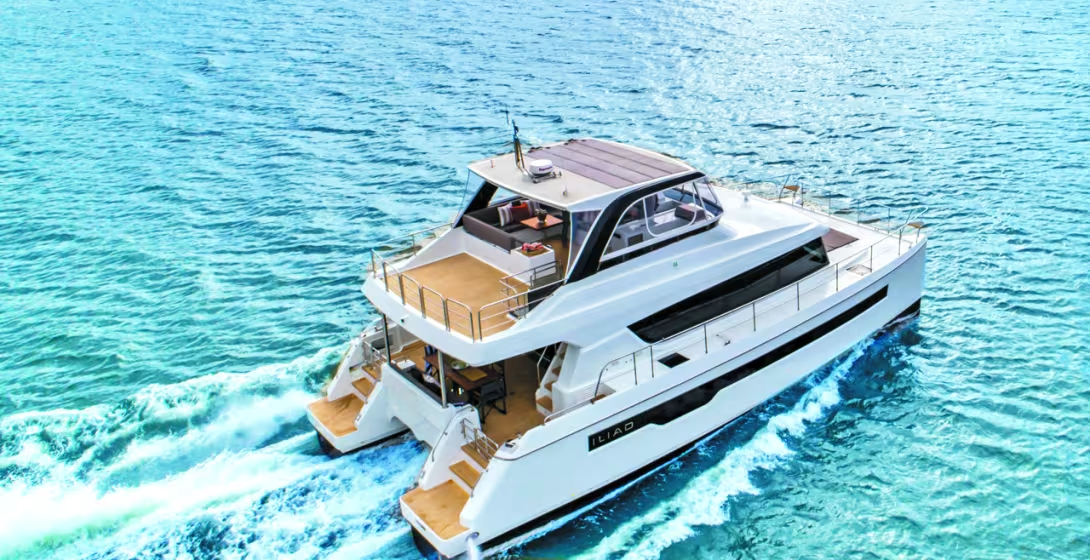
Powercats have many attractions for both the cruising boater and day sailor alike, who can enjoy the stability, space and frugality, as can be seen here on the Chinese-built Iliad 50 that Australian company Multihull Solutions has brought to market. At 50 feet, this boat is the first of a range that also saw a 70 model at the Sydney Show, with a 60 and 90 due to follow later.
Infos pratiques
- Le chantier : Iliad 50
- La fiche technique
- Découvrez notre vidéo exclusive
- Financez votre Iliad 50
- Assuez votre Iliad 50
- Articles autour du Iliad 50
“But this isn’t just another powercat”, as Multihull Solutions boss Mark Elkington was keen to point out to me as we gazed at the Iliad 50 moored on the Gold Coast. “The Iliad complements our Fountaine Pajot range (which is soon to include a Power 67 – Ed.), which are IPS driven boats ideal for coastal cruising, a very different market from the Iliad buyer. Here, we start at 50 feet because you need that size to have all the equipment that a true passage making boat requires.”
Focusing on an exploration vessel
The popularity of explorer-style yachts has never been higher: boaters seek to escape the madding crowd, while embracing the latest technologies that liberates them from onshore services. For motor yachts, fuel efficiency is a key feature and this is where catamarans with their low-drag hulls become attractive. “Realizing this and then forming a consortium to bring such a vessel to market proved a steep challenge however”, explains Elkington. “I explored about 50 shipyards around the world for an offshore passage maker style of vessel, that was tough enough to be beached if necessary, but most were using IPS engines, which are too vulnerable, so our choice was either forget about this market opportunity or put a team together and build something ourselves.”
The team included former Azimut designer Riccardo Bulgarelli, and a Chinese naval dockyard relaunched as Xinlong Yachts in Zhanjiang on the South China Sea, near the popular tourist destination of Hainan Island. The yard has experience in both metal and composite builds, including launching explorer class Bering motor yachts. A company was formed - Global Marine – which owns the Iliad brand and Multihull Solutions are the Asia-Pacific dealer. The first result of this collaboration was a prototype launched in October 2017 and motored 3,000 nautical miles around Asia for research and development purposes including surviving a typhoon in Vietnam. “This boat was built without a mold, and this allowed us to improve the prototype to the stage where we created the optimum mold for the first Iliad 50,” reveals Elkington. The explorer-style ethos required the hull to be resilient so the shaft drive engines and rudder are protected by a skeg and a keel-line.
The Iliad and her three levels of living space
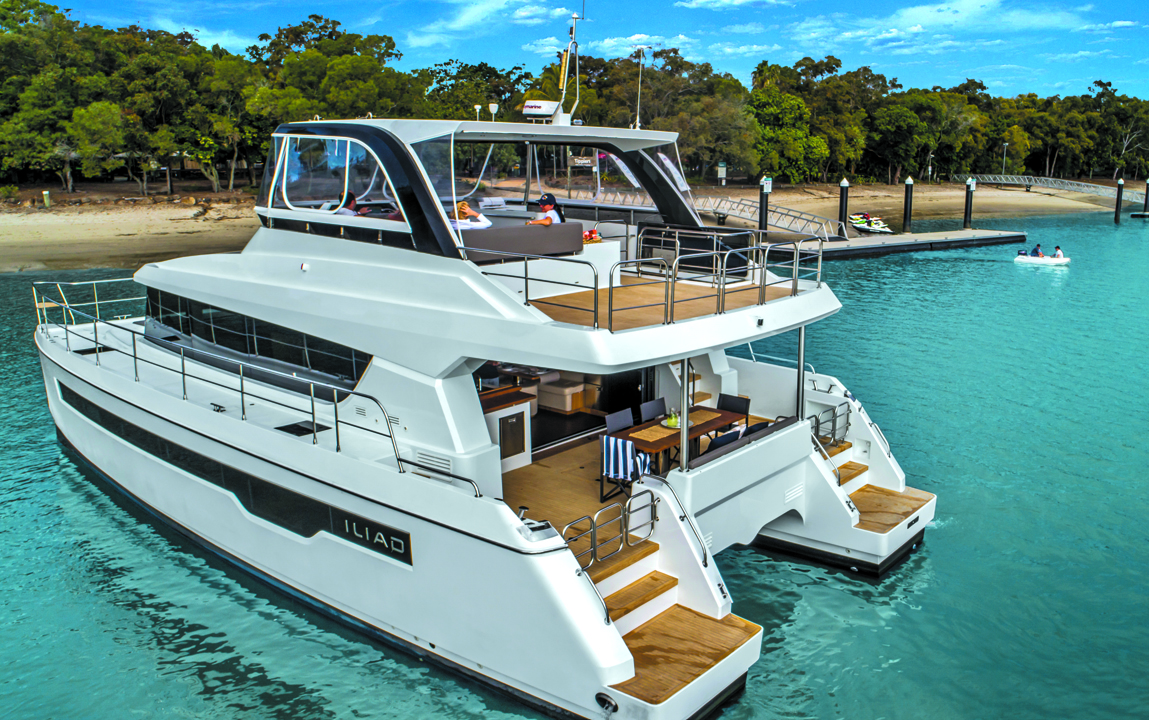
The result of this Australian-Chinese consortium stood impressively before me as I approached the 50-foot hull number one on the pontoon at the Southport Yacht Club on a warm Gold Coast day. “Dominated by the large flybridge that creates three levels of living space while below decks there are owner's or charter versions available”,explains Elkington, “The other key market differentiator is the semi-custom build and exceptionally high level of detail finish. Another selling point is offering fully optioned base boats, rather than creating add-ons afterwards which has been successfully proven by quality builders such as Nautor-Swan.”
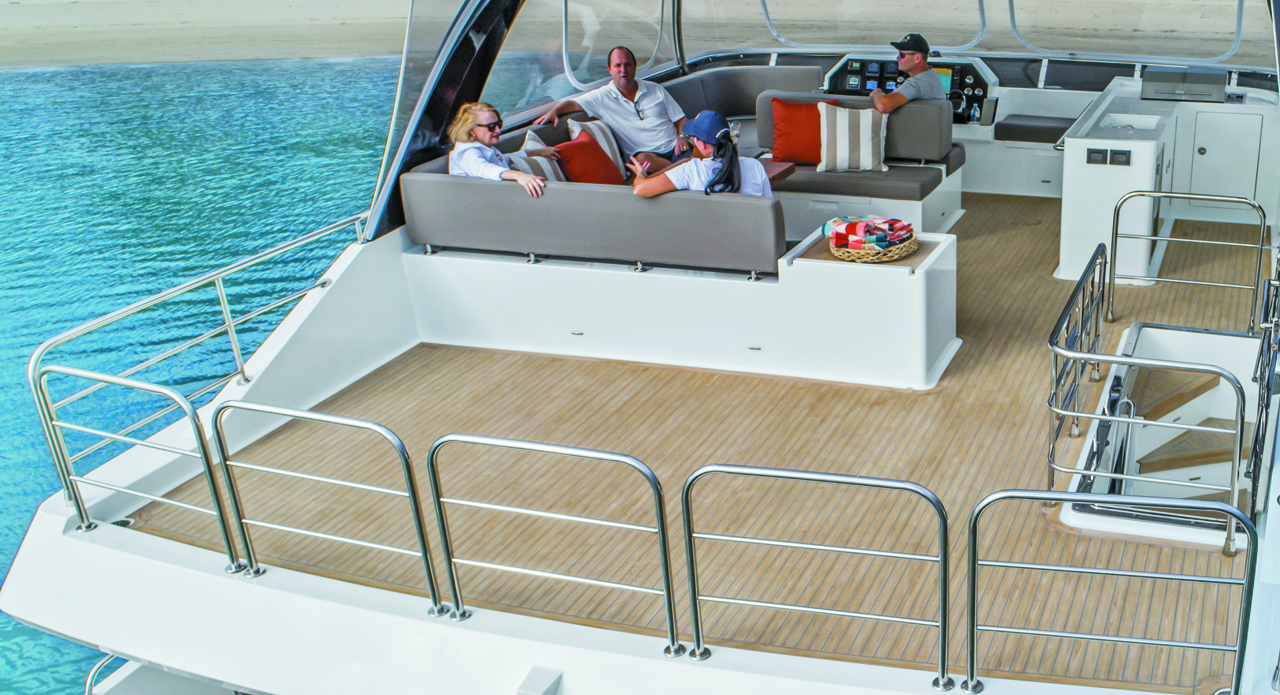
Three levels of living start at the top with a huge flybridge that extends right to the aft of the Iliad 50. Climbing up here via the inboard steps from the cockpit reveals a semi-covered area with lounge midships that seats eight; along with wet bar that includes an electric plate and bar fridge. Offset to port at the front is the steering console that complements another one in the saloon. Ideal for steering in shoal waters, the flybridge is also good for tight marina maneuvers.
Looking aft, across the swath of thick teak floor cladding is an open area designed to house a dinghy, with stainless winch base already in place, but being a custom boat, this area could have sunbeds or even a Jacuzzi perhaps. “Just let us know what you want,” advised Elkington.
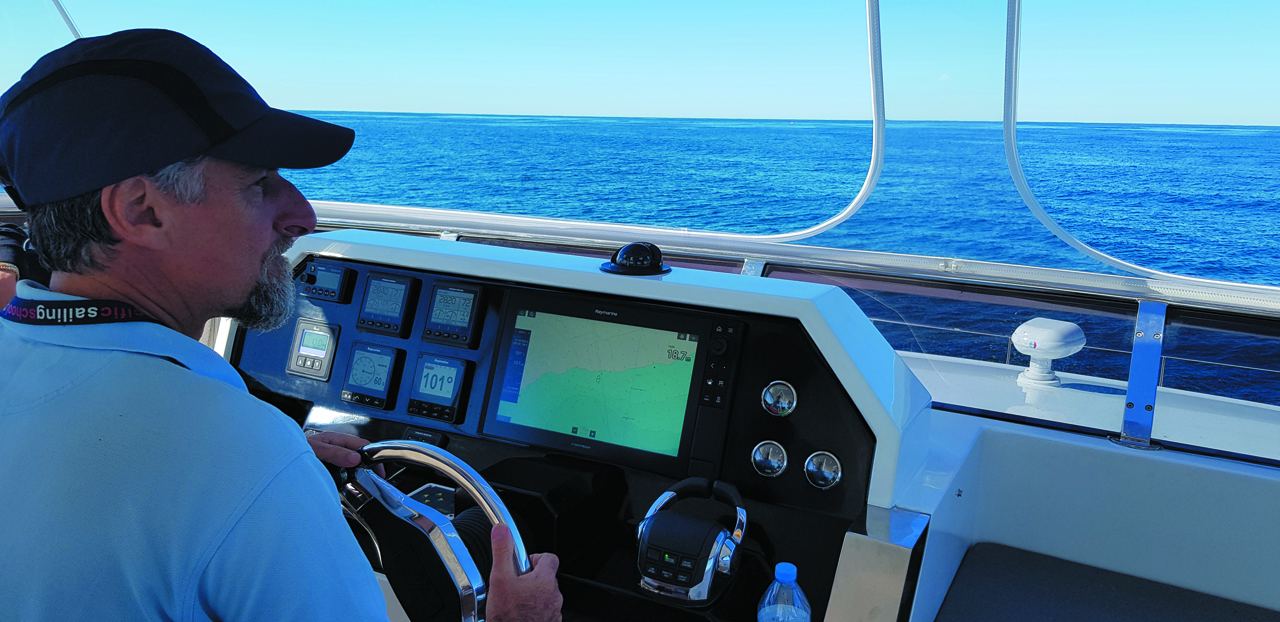
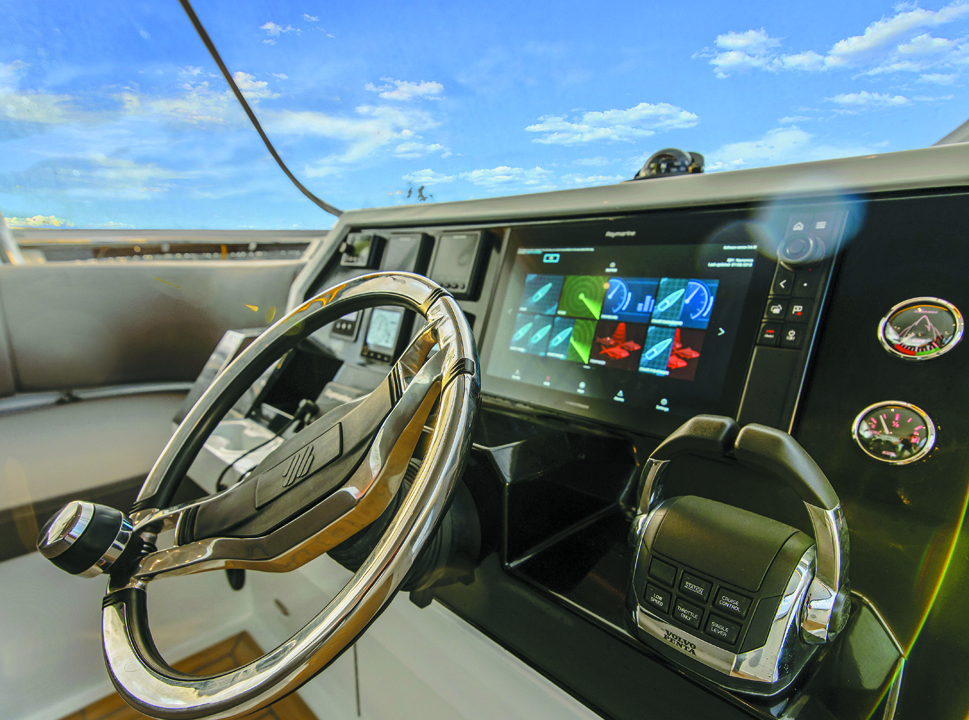
Overhead the fiberglass roof supports communications equipment and clear plastics can be closed to weatherproof the forward sections. The steering console was dominated by Raymarine Hybrid Touch chart screen, autopilot and electronic throttles for the Volvo D6-435HP motors fitted. Among the features of catamarans are their two engines located far apart (unlike a monohull) so this gives them incredible maneuverability, allowing the hulls to be pivoted, which generally offsets the need for a bow thruster. However, their vast bulk does create windage (and increased fuel consumption) so powerful engines like these 435HPs are ideal for this size of vessel.
Loft style saloon
On the main deck, the aft part will be a strong selling point for prospective buyers, especially coming from the narrower beam of a monohull, as the Iliad 50 has a vast area of unimpeded relaxing space that only a catamaran can offer. A wet bar and table for eight means the aft deck is an alfresco extension of the saloon, especially as the galley is just inside.
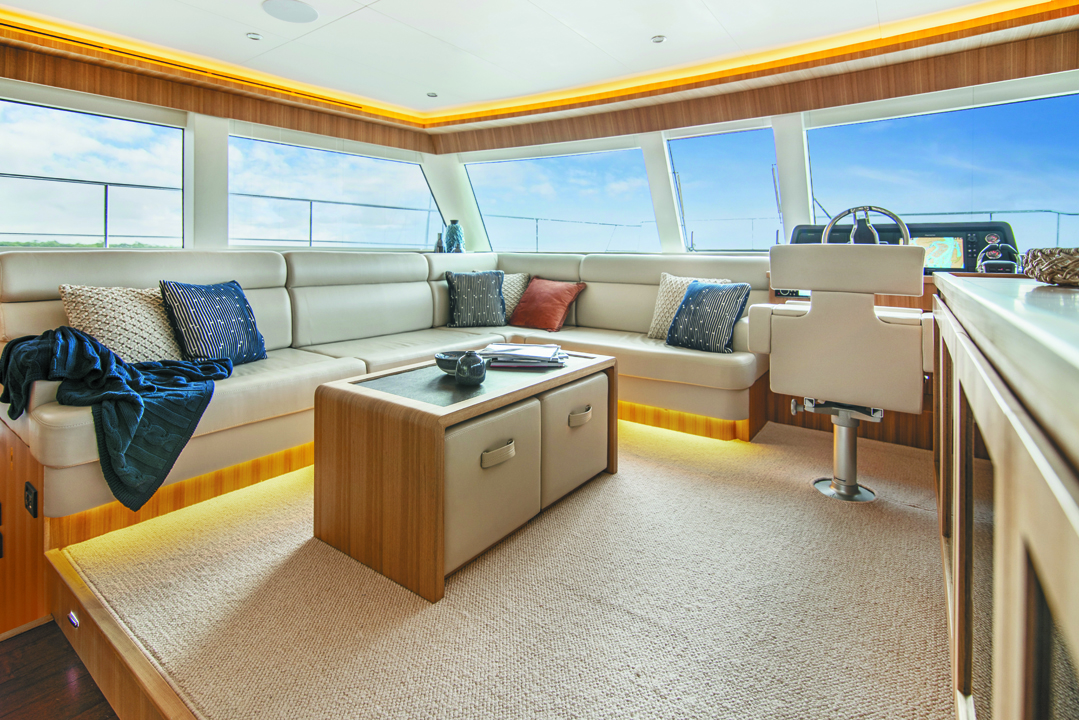
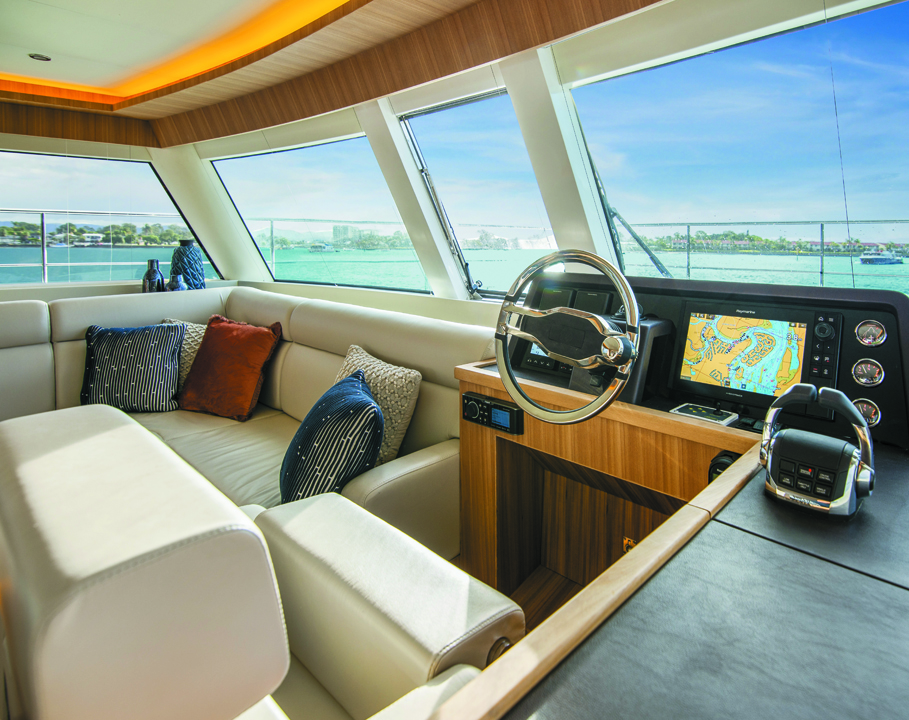
The entire area is shaded by the flybridge extension which is strongly supported by large diameter stainless struts and seamlessly flows into the saloon but protected by sturdy folding doors. Inside, the open plan saloon the galley is to port, dinette conveniently place opposite and lounge on the forward port quarter. Alongside is the second steering console (which is optional). As the forward part of the saloon is elevated by a step, this creates clear views from the steering console and given the low-slung styling of the cherrywood joinery, there are also clear views aft for navigation. Locker space surrounding the steering console has the main power board, so handy for the steerer to control all systems and its topside is ideal for rolling out a paper charter. Vertical side bulkheads throughout give lots of volume and natural light while a sensibly large front window allows airflow at anchor.
In the galley, a U-shaped arrangement supports the cook when rolling in a seaway and quality Siemens appliances are installed including electric hob. There are also spacious Corian worktops and a two deep stainless sinks. Large cupboards overhead and under the worktops are ideal for victualling long-term and can house a dishwasher, while twin drawer fridges keep the perishables cool. Other white goods include a washing machine installed in the owner's hull. My only complaint was the lack of fiddles to prevent crockery rolling onto the parquet flooring. Most striking, apart from the tasteful shade of cherrywood is the level of detailing and quality of finish. Clearly hand-finished in most places and includes rounded ends, curved cocktail table tops and immaculate stitching in the soft leather couches. Our test boat, a stock vessel, had been displayed for only a day before a couple bought it – they'd been keen on a production catamaran but changed their minds when they saw the level of detailing on the Iliad 50.
Private suite
Moving down into the port hull, from steps just in front of the dinette-galley area, brings me to the owner's suite. Closed-off by a sliding door, the entire hull is dedicated to the owner, with large island bed in the stern where the motion is kindest at sea, and ablutions in the bow with vanity/desk midships. The largest portlight is beside the bed, affording generous water views, and fairly large rectangular ones elsewhere give an airy feel while blinds ensure privacy when required.
The attention to detail again is subtle with quality metal door/cupboard fittings, petite leather chairs and a sumptuously padded couch along with strategically placed handrails. In the bathroom the tall topsides ensure volume is good and opening portlights give that essential airflow for the tropics to reduce the reliance on the fitted air conditioning unit. Teak underfoot and a quality Tecma electric head finish off the area nicely. Over in the starboard hull the two double berths with ensuite bathrooms are equally well appointed, including memory foam mattresses and surrounding bookshelves with tasteful mood-lights.
Beachable hull
Usable deck space is important factor for tropical voyaging, and is more than ample on the Iliad 50. The wide side-decks with high guard rails to guide you to the bows in total safety. Here, we discover twin sunbeds (in quality Sunbrella fabric). Between the seats is home to the ground tackle. The rode runs under the nacelle, safely away from bare feet and is controlled by a Quick 2000W vertical windlass. Ideally a second roller should be fitted, but good points included double sets of large cleats. Moving back aft, each hull has molded steps into the water and the transom can house a tender on davits (or beneath the flybridge). Here, also are the hatches to each engine. The standard fitting is for 375 HP Volvo shaft-drives but up to 10 engine choices are available including different brands. “Our slogan is freedom of choice which includes most of the systems, such as engines and electronics,” advises Elkington, “which the buyer can preference and we are happy to advise of course”.
In accordance with the philosophy of an exploration boat, however, only propeller shaft transmission is used. The choices for engining go up to 500 HP. And whatever the engines fitted, they will all be housed in hulls suitable for taking the ground, thanks to shafts protected by molded skegs.
Looking inside the engine room revealed a spacious and well-organized area with electrics and batteries elevated above the Volvo D6-435HPs. Only leading industry standard components are used such as Racor filters, Victron inverters and a Seafire automatic fire suppression system. Service access to the oilways and belts is also adequate, as is the quadrant and steering linkages. Other key systems here include the 12kVA Westerbeke generator and hot water system. This is all housed in a sturdily built CE Category-A hull that has solid fiberglass base and mini keels to allow for taking the ground. Watertight bulkheads are used throughout – in the engine room, the central hull and in case of collision on the bows.
“It's a full vinylester hull, not just below the waterline but above as well with monolithic or solid glass around the keel line and key parts,” said Elkington. Elsewhere PVC closed-cell infusion has been used by the experienced Xinlong yard, who were subject to visits by independent inspectors at key stages of the build.
Offshore on the Gold Coast
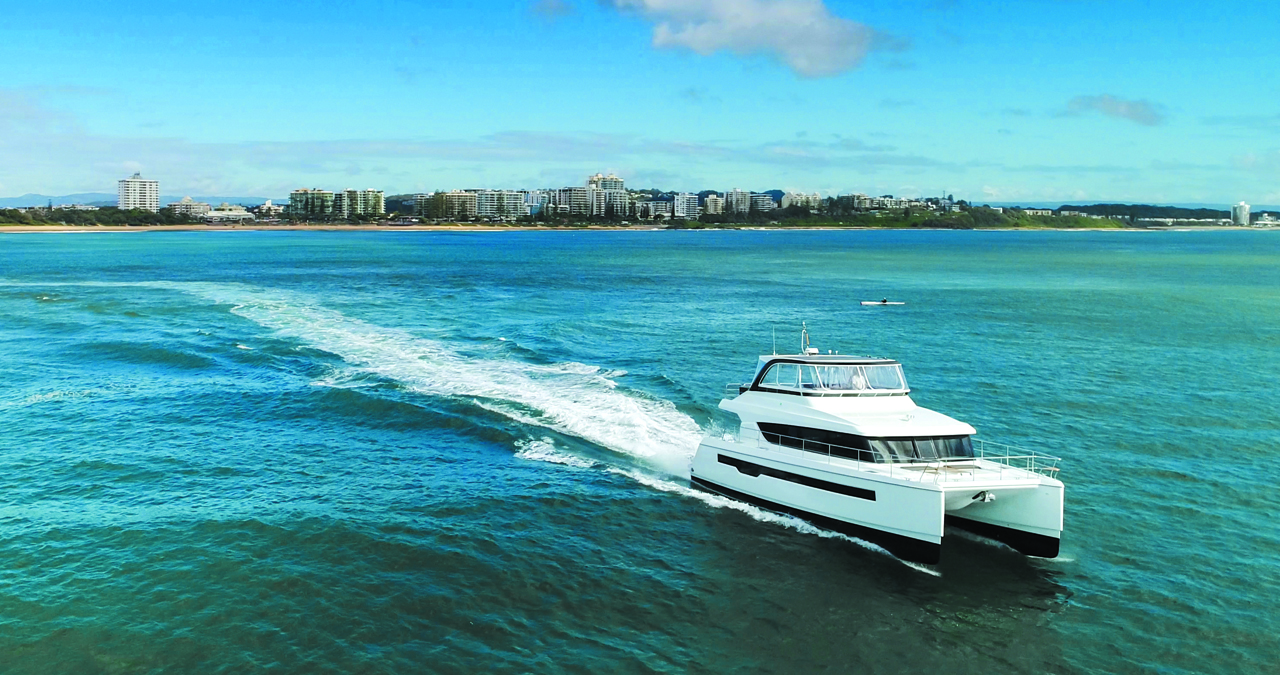
Gliding out from the tight confines of the marina was the first test of the Iliad 50's capabilities, requiring only the two throttles to be pushed fore and aft separately to spin the 50 footer in her own length before we proceeded along the shallow waterway – yet another reason to have such a low draft hull that could nudge itself up to beaches if necessary. Behind the wheel, high up on the flybridge I had clear views of the surfers paddling across to South Stradbroke island so easily dodged them before putting the throttles down which caused a mild roar but absolutely no juddering from the 435 HP Volvos as they maxed-out at 21 knots with the engines turning at 3,450 RPM before I slowed to a more sedate cruising speed of 18 knots which showed a fuel burn of 105 liters (28 US gal) per hour. For those hops between Pacific islands, which this particular boat will be doing, I'd ease back to about 10 knots for a range of 750 miles, to reach my favorite anchorages in New Caledonia and beyond. The sunny and calm weather perhaps wasn't the sternest test for the Iliad 50 so I had to chase my own wake to seek out some motion, so turning the hydraulic wheel brought the big cat around fairly quickly as we punched through our wake without a murmur from anything. In fact, there was hardly a murmur of complaint from this journalist which says a lot for this highly competent power catamaran.
Conclusion
This semi-displacement powercat is capable of maintaining cruising speeds in double figures, while still offering good range. The key to this versatility lies in a huge choice of engines, all shaft-driven, to suit the needs of every owner.
Pluses
Large range
Robustness
Standard of finish
Minuses
High Price
Lacking a few fiddles in the galley
Significant windage
Technical specifications
Builder: Xinlong Yachts
Architect: Riccardo Bulgarelli
Length overall: 15.51m (50’11”)
Maximum beam: 7.35m (24’1”)
Draft: 1.25m (4’1”)
Air draft: 6.49m (21’4”)
Displacement (lightship): 24,000 kg (52,910 lbs)
Engines: std is 2 x 370HP Volvo/Yanmar shaft drives (2 x Volvo D6-435HP, shaft drives on our test boat)
Fuel tanks capacity: 2,700 l (710 US gal)
Water tanks capacity: 700 l (185 US gal)
Fuel range: 2,500nm
Price: AU$2,500,000 (sail away Australian tax paid)
MULTIHULLS WORLD FIGURES
Test location: Southport Yacht Club, Gold Coast, Australia
Conditions: Calm sea, light wind, six persons on board, tanks 60% full
Engines: 2 x Volvo D6-435 HP
|
RPM |
Speed (knots) |
Consumption per hour (total) |
Range nm |
|
1000 |
5.7 |
5.7 l / 1.5 US gal |
2700 |
|
1500 |
8.6 |
12 l / 2.3 US gal |
1935 |
|
2000 |
10 |
36 l / 9.5 US gal |
750 |
|
2500 |
13 |
70 l / 18.5 US gal |
501 |
|
3000 |
18 |
105 l / 27.8 US gal |
462 |
|
3450 |
21 |
150 l / 39.6 US gal |
378 |
|
|
|
|
|