
This new model - the smallest in the Fountaine Pajot range - is a real surprise for the summer of 2020. An upstream communications blackout was orchestrated to offer a bonus in addition to the manufacturer’s two new flagship models - the Samana 59 and the Power 67 - at this fall’s boat shows. Having been cancelled at short notice, the shows have been replaced by private viewings. It was after the first of these, at Bandol in the South of France, that we were able to discover the Isla 40.
Infos pratiques
- Le chantier : Isla 40
- La fiche technique
-
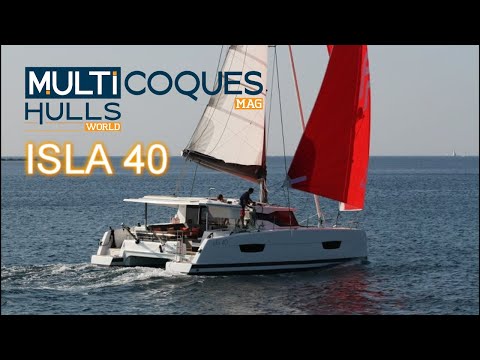 Découvrez notre vidéo exclusive
- Financez votre Isla 40
- Assuez votre Isla 40
- Articles autour du Isla 40
Lieu de l’essai : Bandol, France
Conditions : mer peu agitée, vent de sud-est de 5 à 15 nœuds
For a few years now, all the sailing catamarans bearing the Fountaine Pajot signature have had island names - with the names of some of them, such as the Samana - ending in an “a”. So, for the manufacturer’s entry-level range, why not use the generic term - in Spanish, to keep the “a”? This is the choice validated by the manufacturer. Readers who keep abreast of the offer of multihulls in this size - 40 feet - will note many similarities with the previous model, the Lucia 40: and they’d be right, since the Isla uses the base of her predecessor, which saw almost 300 examples built in a career lasting just under 5 years. No need to wait any longer before revealing the main modifications: these focus on the hulls, whose bows now adopt inverted stems; and the interior.
An extra 8 inches for the hulls
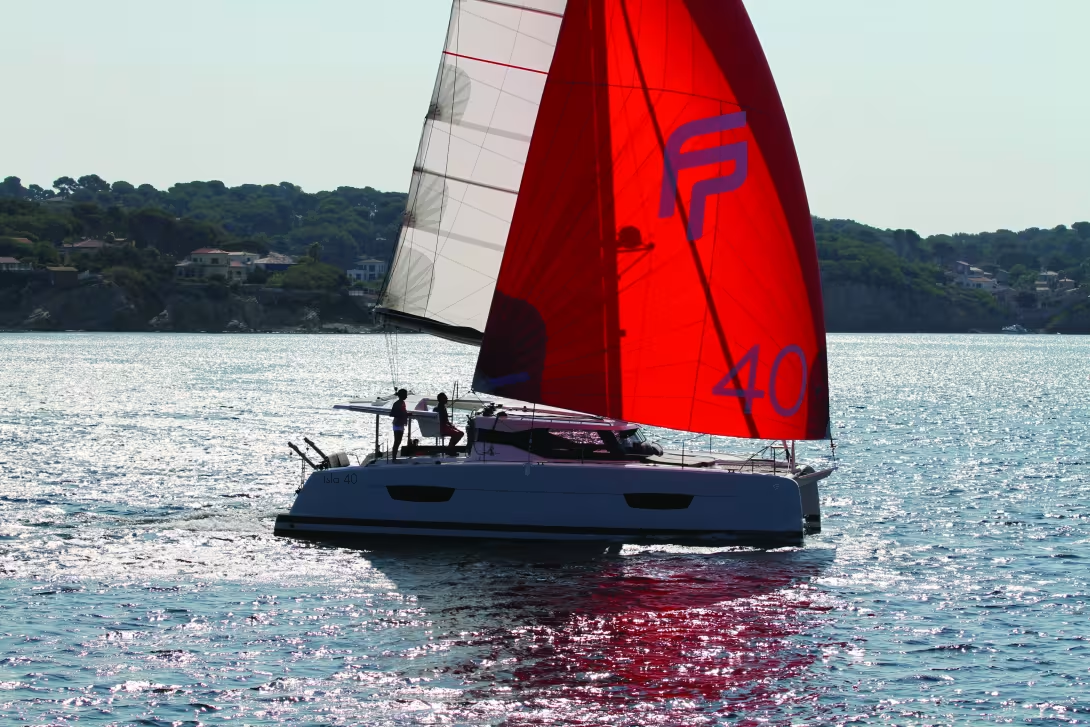
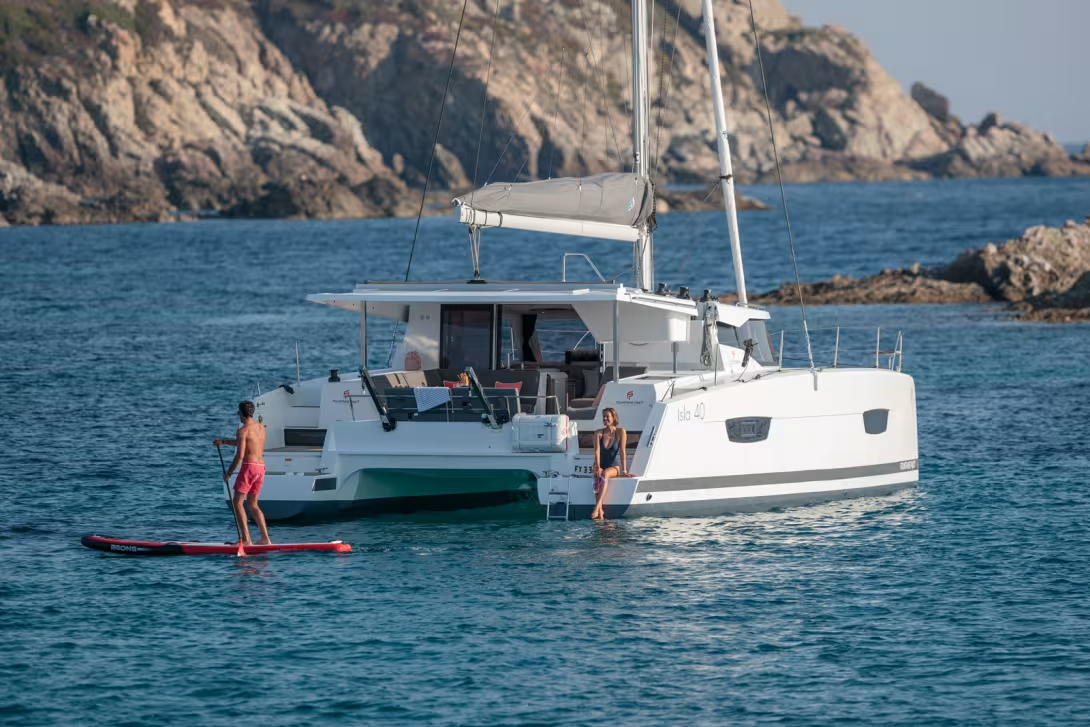
It’s quite amazing how the inverted bows alter the silhouette: the wise Lucia 40 turns into a catamaran with a much more sporty and seductive design. However, the hulls have only gained 8 inches (20 cm) at the waterline, increasing from 38’6” to 39’2” (11.73 to 11.93 m). In this pivotal 40-foot size (below this, some crews might hesitate to embark on ocean passages), the performance/comfort compromise is a subtle equation, for want of space: hulls that are too narrow deprive the boat of double berths in the forecabins, a nacelle that is too large on the other hand, translates into displacement and consequent windage... The Isla 40 scores highly, with sufficient but controlled volumes everywhere. A visible compromise on the water - the balanced silhouette is pleasing, but also on paper with a light displacement of less than 9 tons and a sail area of nearly 1,150 sq ft (105 m²) – giving a very favorable sail area to weight ratio. Note the generous semi-circular sections of the hulls, capable of carrying the load, but also the fine entry bows and the comfortable bridgedeck clearance. The hulls adopt a discreet chine on their inboard sides.
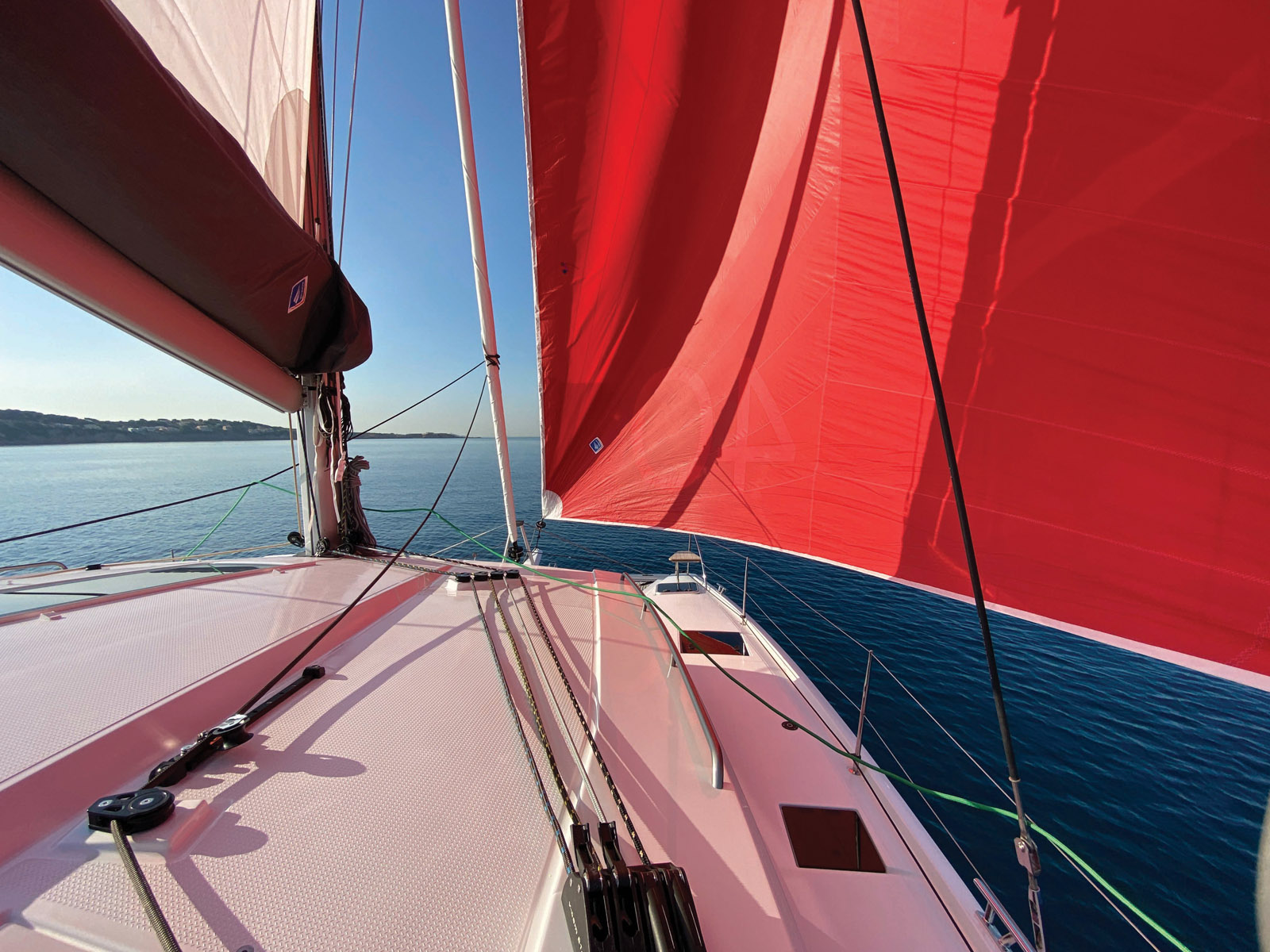
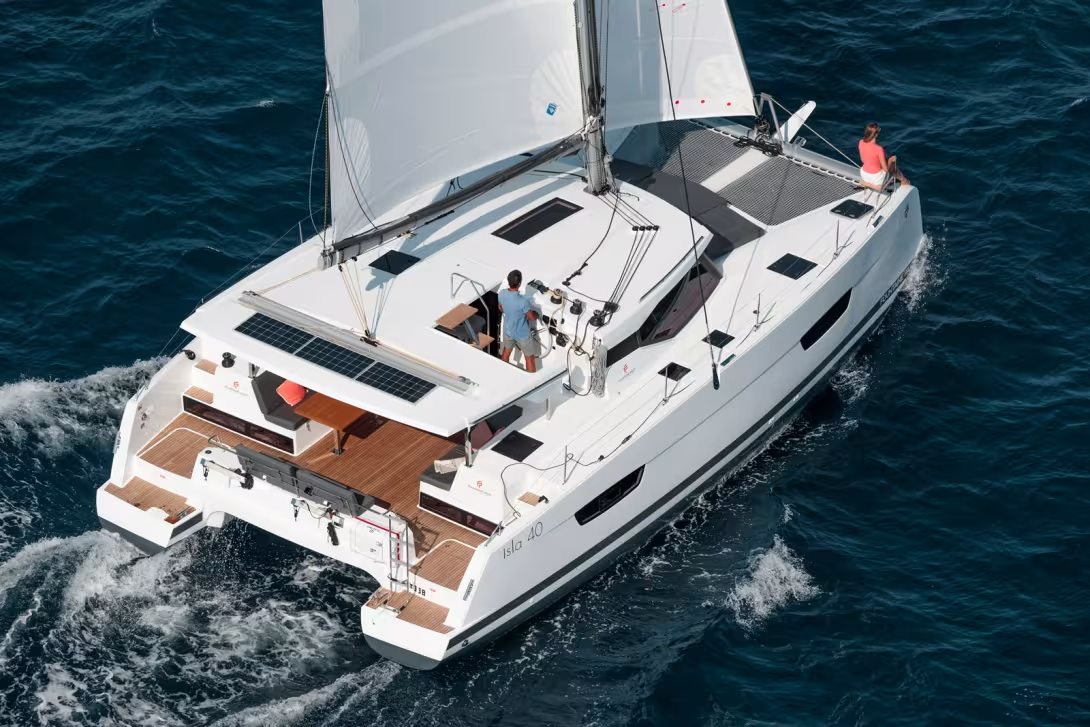
Safe movement around the deck is ensured by wide side-decks, flush hatches and handrails on the coachroof.
A little bit of technical…
The hulls built using infusion process are made up in three sections: the underside of the nacelle, the inboard topsides and the outboard half-hulls. The sandwich consists of a balsa core and skins made of multiaxial glass cloth. The deck and the coachroof, true to the yard’s know-how, are injected parts - vacuum lamination in a two-sided mold. A closer examination of both the bilges and the electrical circuits inspires confidence: all elements are accessible and the connections are carefully made. The engine compartments are particularly large. The three-cylinder motors thus benefit from easy access for maintenance operations. The alternators provide 35 A at idle and 100 A at cruising speed to the on-board batteries. The house bank is fitted higher up to prevent any of the consequences of flooding. It should be noted that the Isla 40, in addition to its sandwich construction, is equip - ped with four buoyancy zones. The assembly of the catamaran’s steering components is robust and all the ele - ments such as the rod connecting the two rudders and the autopilot ram are accessible.
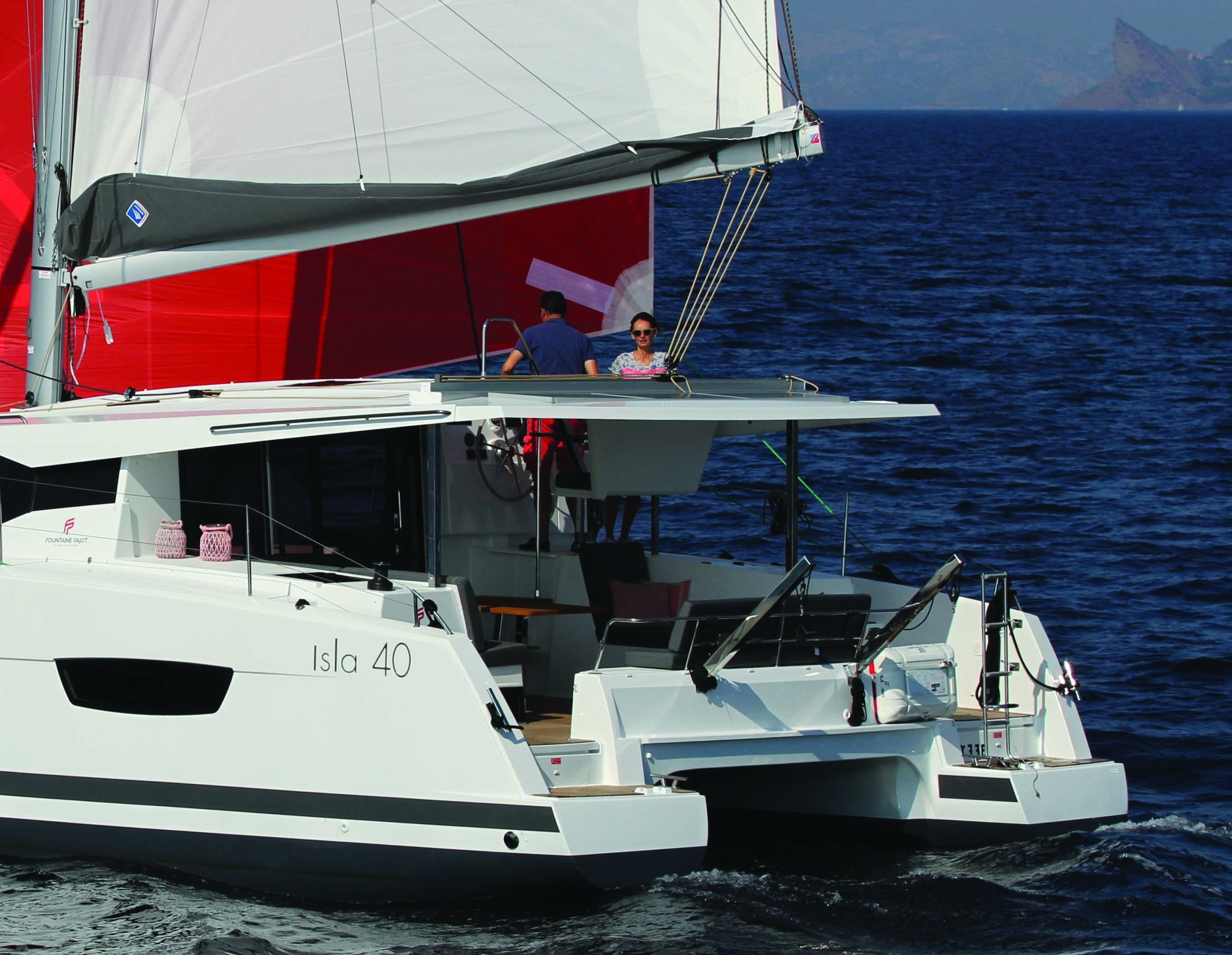
Le poste de barre – et de manœuvres – à mi-hauteur offre une parfaite vue sur le plan d’eau et les voiles, tout en restant tout proche du cockpit.
Grand-voile à corne et foc à recouvrement
Square-topped mainsail and overlapping headsail Our test model was equipped with twin 30 hp Volvo engines. This powertrain is available as an option - the manufacturer offers 20 hp mo - tors as standard. In view of the price difference, it would be a mistake for the buyer not to go for the 30% extra power. Thus motorized, the Isla 40 can maintain an average speed of 7 to 8 knots without pushing it. The helm and maneuvering station is raised, but not on the flybridge - always a compromise on the middle ground. This layout offers many ad - vantages: perfect visibility over the water, user-friendliness thanks to the double bench seat and the proximity of the cockpit, accessible sailing maneu - vers, the possibility of intervening on deck, a pleasant silhouette, better cen - tering of weights, more mainsail area... But no real flybridge, even though steps and a railing allow easy access to the bimini.
The mainsail is quick to hoist. As soon as the overlapping genoa is unfurled, the Isla 40 starts to move even though there’s barely a ripple on the water. However, we are far from being in “light” configuration, as the fuel and water tanks are 80% full. She tacks easily in spite of a still low speed to get closer to where the breeze looks to be. There, with 8/9 knots of wind, we strode along at 5 knots at an angle of 50° off the true wind. No need to head up any further - the Isla 40 prefers the sails just a little open. The cable linkage results in a fairly neutral helm feel - but the course stability is excellent.
The wind finally settled down for good between 12 and 15 knots: we took advantage of this to unfurl the gennaker. This gave a guaranteed turbo-boost, with the GPS displaying between 8 and 9 knots. From his three winches and two banks of clutches, the helmsman easily manages all sailing maneuvers. An optional, small fixed bimini provides protection. The sturdy aluminum structure holds well in the wind: the Isla 40 should perform nicely in windier conditions and bigger seas
A tried and tested deck layout
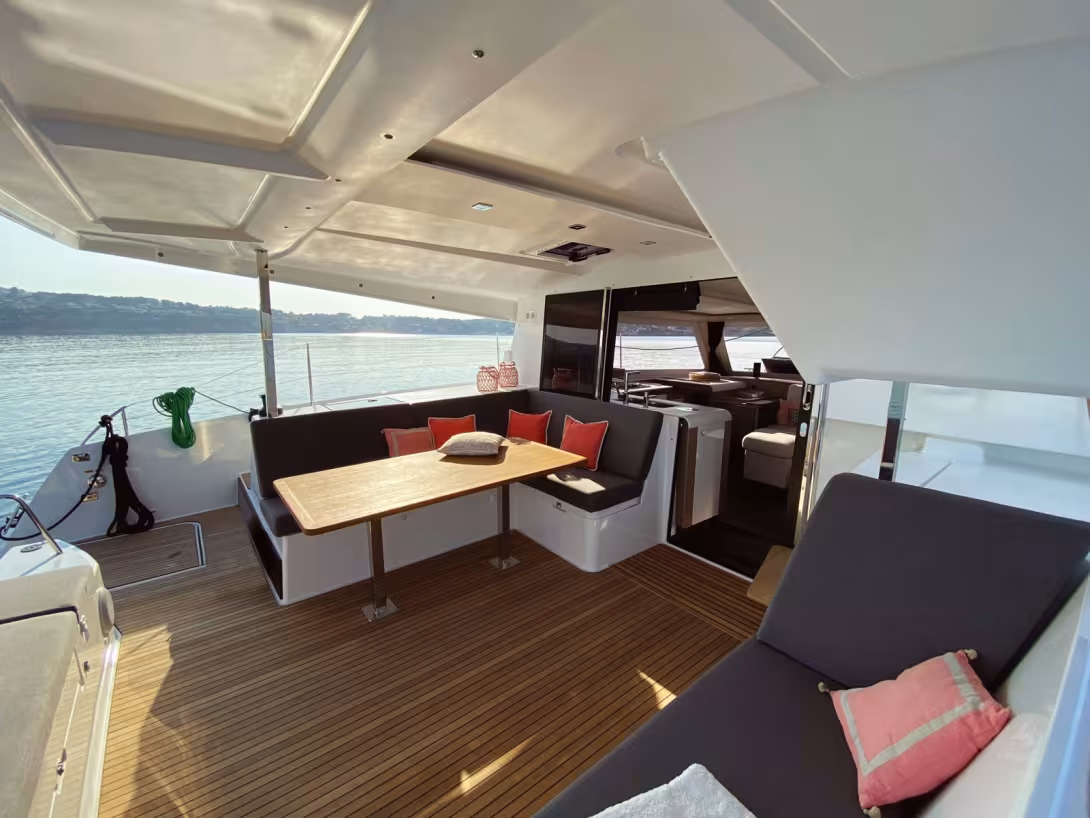
The first impression when you come aboard the Isla 40 is that the deck is clean, bare and efficient. The side decks are at least 2 feet (0.62 m) wide, the non-slip is effective even when wet, and the handrails are right there on the coachroof. Forward, the manufacturer offers sunbathing space, just behind the trampolines. As for the cockpit, it is protected by the generous - yet discreet - bimini. The anchoring gear is well designed and easy to use.Close to the galley, the table measures 65” by 33 (165 by 83 cm). It seats five, but with the addition of four stools, you could squeeze in ten guests. The manufacturer also offers an extension. To starboard, a comfortable lounger is an invitation to idleness. This seat is complemented by a 6- foot (1.86 m) aft bench seat. The large open areas facilitate circulation and access to the deck as well as to the wide sugarscoops. One drawback: the bathing ladder deserves to be of better quality.
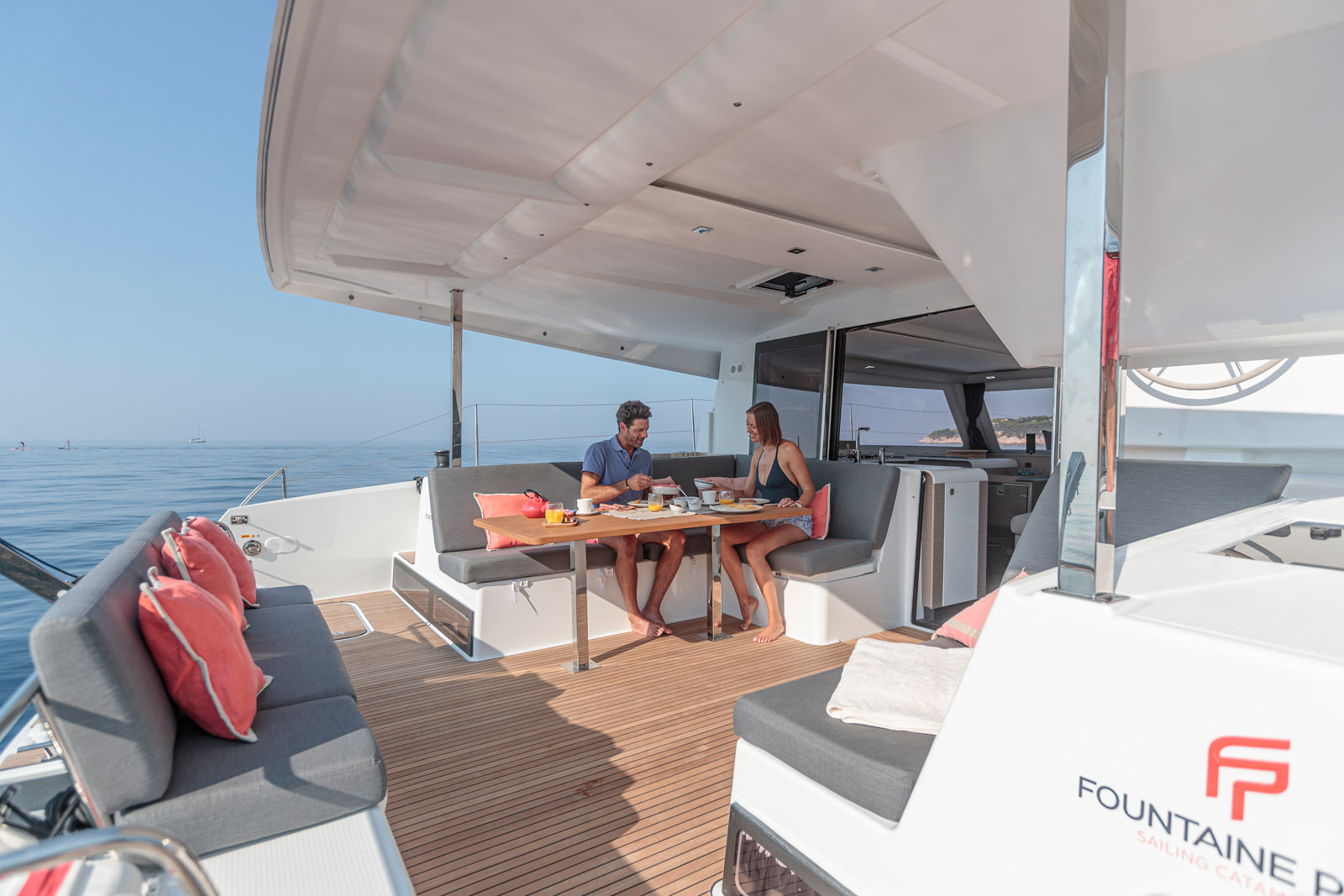
The cockpit features a table to port, a lounger on the starboard side, and a large open area in between.
She’s still got the “peaked cap” roof!
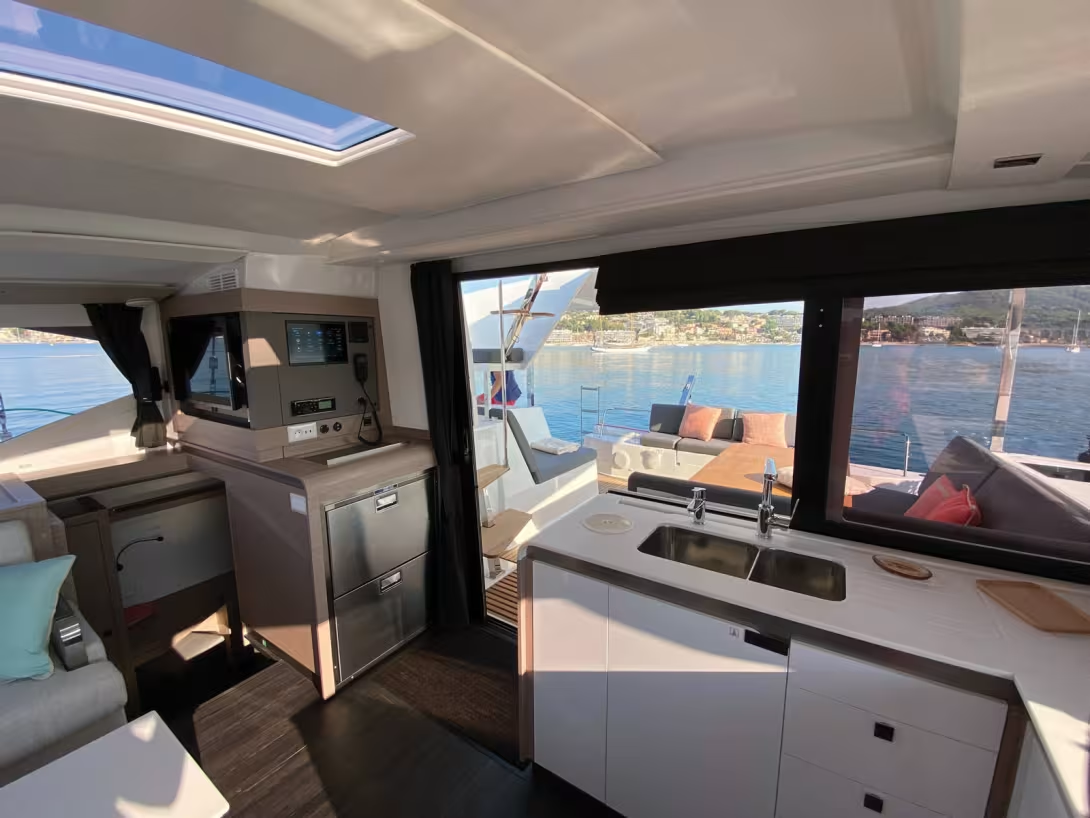
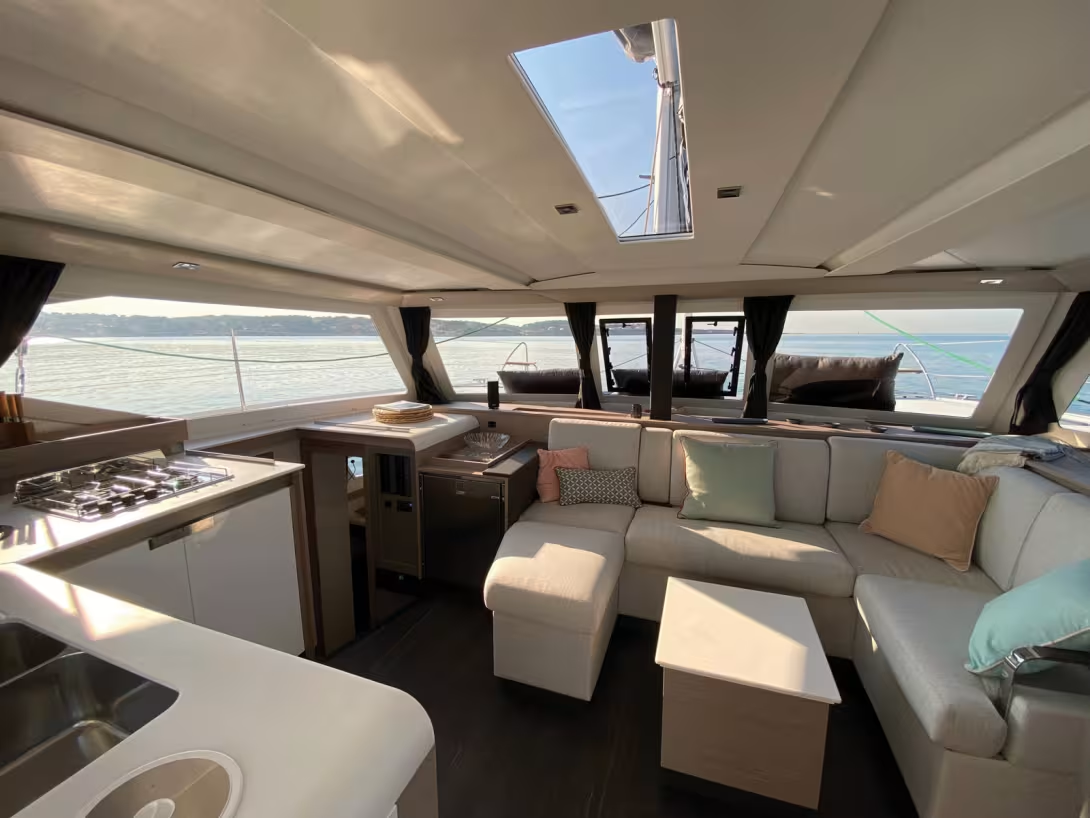
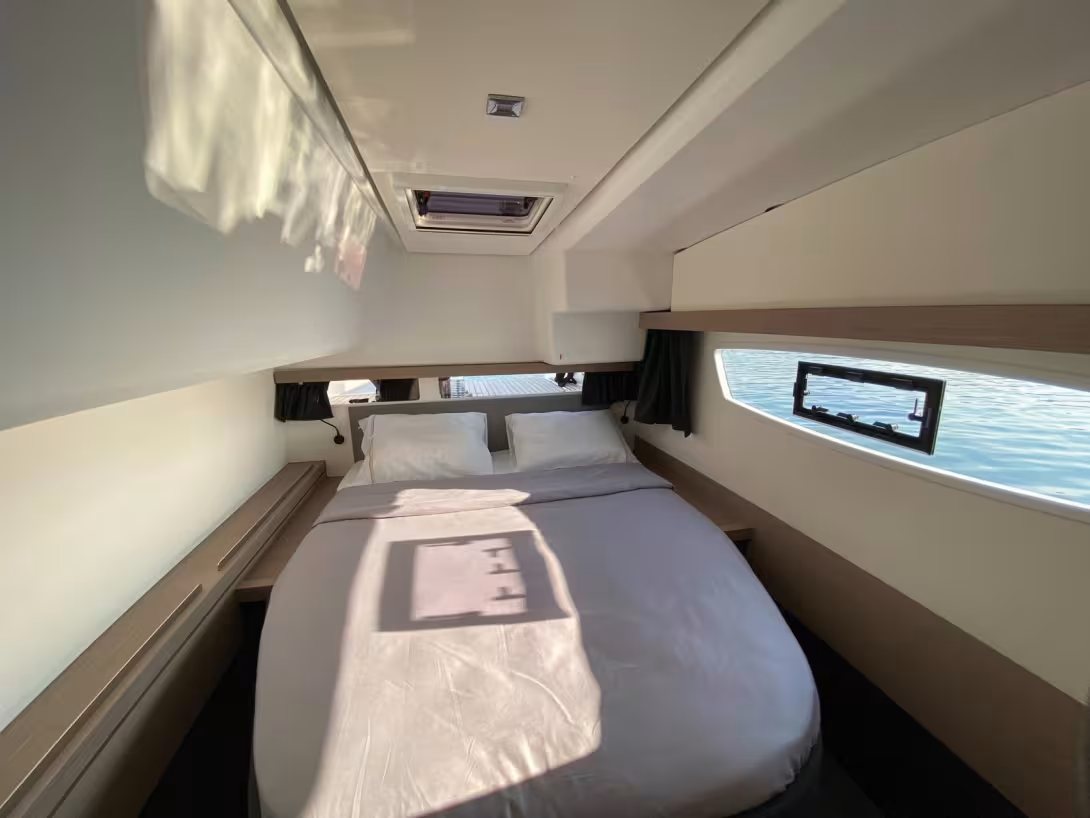
The sliding bay door is of course the passing point – all on the same level - between the cockpit and the saloon. The opening is wide: the main door, which folds away into the bulkhead of the nav-station, measures 6’3” high by 2’7” wide (1.90 m by 0.79 m). Above the galley, an additional 28” (72 cm) opening provides an attractive interior/exterior connection. With headroom of 6’10” (2.08 m), there is plenty of volume. Fountaine Pajot has kept its sloping, forward windows, topped with the peak of a cap. This configuration avoids the greenhouse effect. The only overhead opening in the coachroof is of a moderate surface area. The windows are wide on the sides, with the view very open towards the stern... so many windows make the saloon particularly luminous, especially since the structural uprights of the coachroof seem rather discreet. Forward, the two very large opening hatches provide effective ventilation. The L-shaped galley is completed by a 3-burner hob, oven, double sink and drawer-type refrigerators. Compared to the Lucia, it offers additional storage space and very pleasant rounded corners. The small chart table in the saloon has disappeared: all the navigation equipment is grouped together to starboard, near the cockpit. As a result, the saloon has gained a very attractive watchkeeper’s berth. The table makes do with a surface area of 21” by 20 (54 by 51 cm), but as an option, the latter two can be transformed into a double berth. The overall finish, very close to that of the Elba 45, is very attractive. In the hulls, there are three or four cabins and two to four bathrooms. The width of the doors is 17” (43 cm). In the aft cabins, there are island beds, but not at the bow. The mattresses are of excellent quality, and the ventilation is well designed. Note that the extra 8” (20 cm) hulls can accommodate a (compact) skipper’s berth.
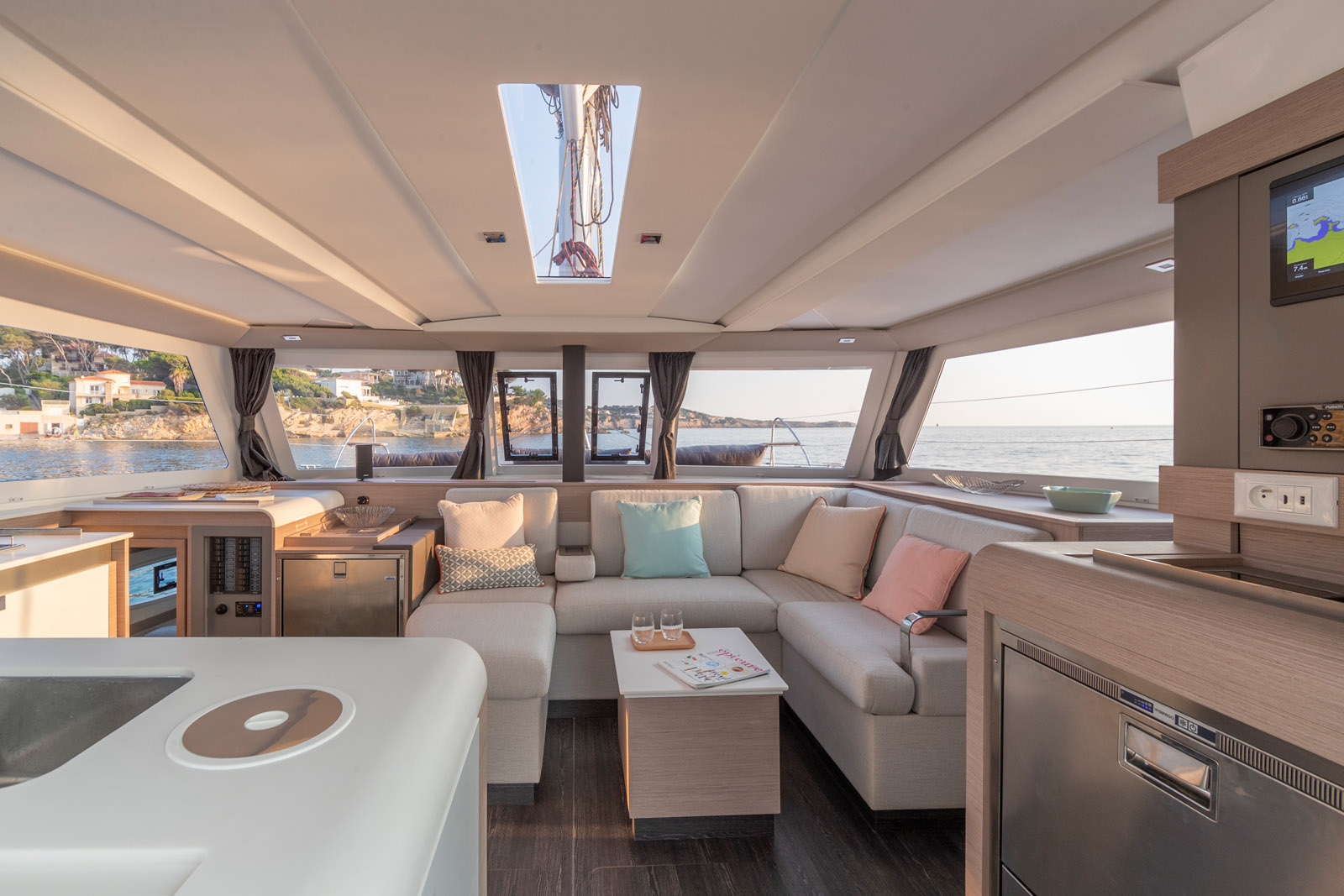
Les outils destinés à la navigation sont regroupés à l’arrière de la nacelle tribord. Notez l’arrondi des meubles, design emprunté à l’Elba 45.
Conclusion
If you try it, you’ll want one! We took great pleasure in sailing aboard this catamaran. She’s well- balanced under sail and so easy to handle. A single-hander will manage fine... and novice sailors will quickly get their bearings as the miles go by. Inside, the saloon gains in conviviality with its larger size. As for the more numerous stowage spaces, they will obviously lend themselves perfectly to offshore use. This is an evolution as intelligent as it is seductive. Bravo!
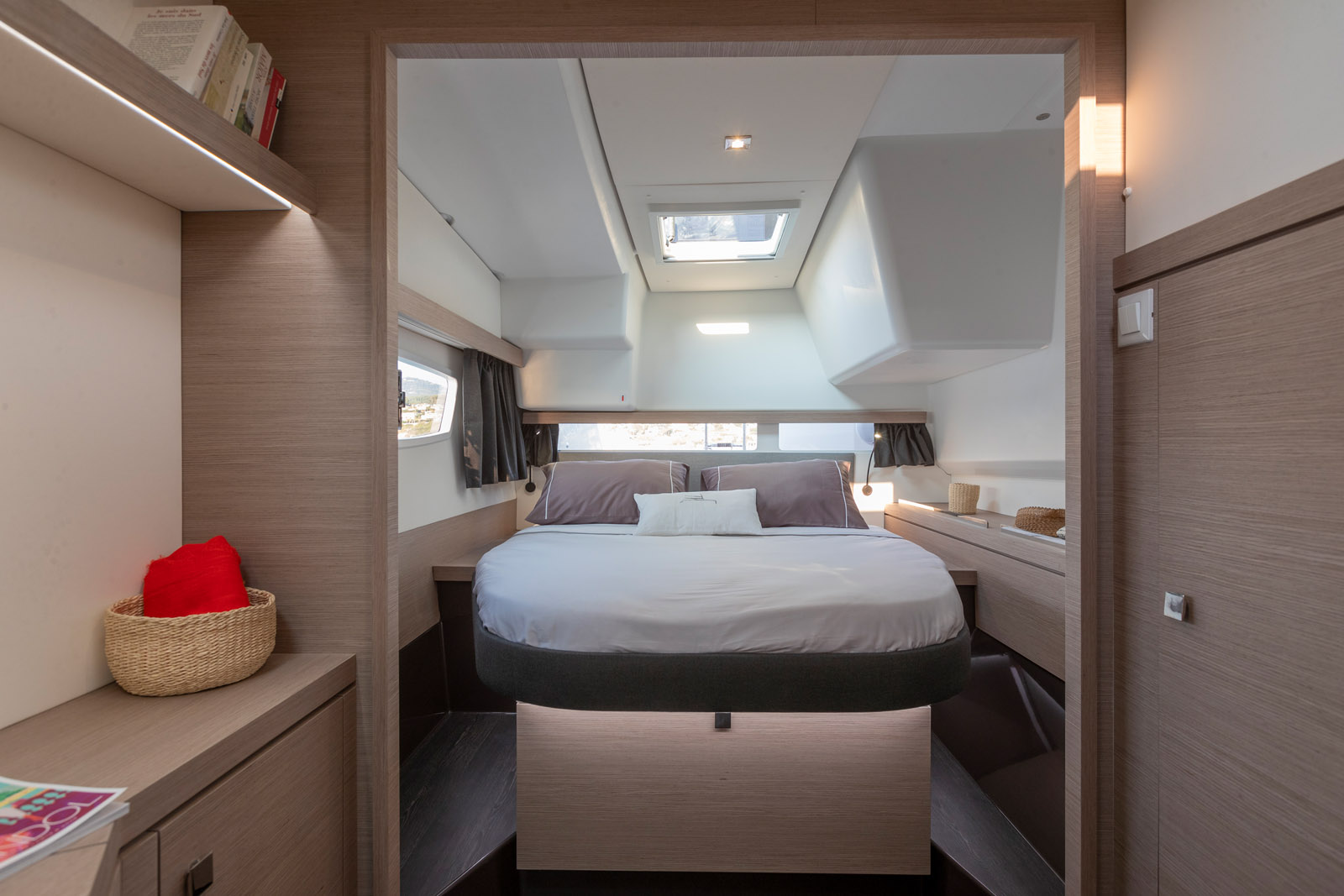
The aft cabins are equipped with island beds, unlike those forward.
The pluses
+ Successful silhouette
+Convincing performance
+ Excellent comfort for her size
The minuses
- Little feel to the helm
- Forecabins less attractive than aft cabins
- Forecabin mattresses make it difficult to access the lockers beneath
TECHNICAL SPECIFICATIONS
Builder: Fountaine Pajot
Naval Architects: Berret-Racoupeau Yacht Design
Length: 39’2” (11.93 m)
Beam: 21’9” (6.63 m)
Draft: 4’ (1.21 m)
Displacement: 19,620 lbs (8.9 t)
Mainsail area: 635 sq ft (59 m²)
Genoa: 390 sq ft (36 m²)
Engines: 2 x 20 hp or 2 x 30 hp Volvo
Fuel capacity: 79 US gal (300 l) Water: 2 x 70 US gal (2 x 265 l)
Construction: composite foam glass polyester sandwich (infusion process for the hull, injection for the coachroof and deck)
Versions available and prices excluding tax:
3-cabin, 3-bathroom Maestro: € 299,637
3-cabin, 2-bathroom Maestro:€ 298,669
4-cabin, 4-bathroom Quartet:€ 302,439
Principal options excluding tax:
Offshore Pack:€ 15,500
Ocean Pack:€ 28,500
Comfort Pack:€ 36,000
Fixed helm station bimini:€ 2,292
Garmin 1 electronics package:€1 3,000
Solar panels 3 x 100 W:€ 3,890
15.8 US gal (60 l) / h Watermaker:€ 10,125
30 hp engines:€ 614
Three-blade folding propellers: for 2 x 20 hp:€ 1,632 / for 2 x 30 hp:€ 1,999
Hull and saloon heating:€ 11,780
Sails in Hydranet:€ 13,144
Gennaker:€ 3,090 10’ (3.15m)
Hypalon dinghy and 15 hp outboard:€ 7,907
Commissioning:€ 10,800
Handover and training:€ 2,600