
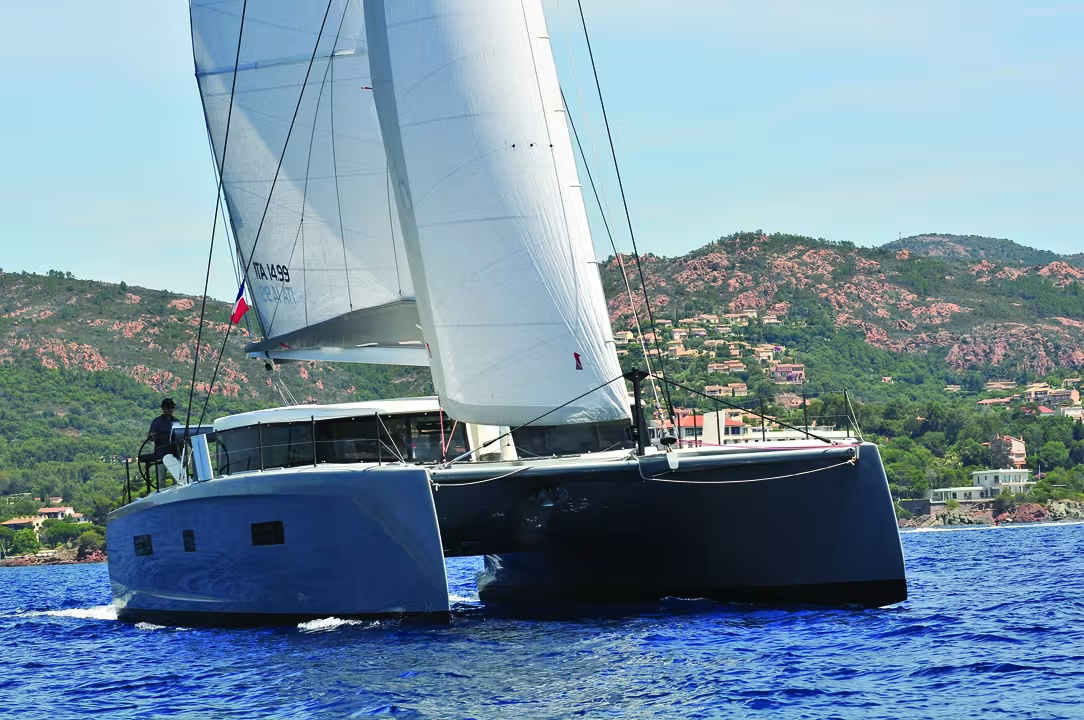
Discreetly, the 50-foot "Archimedean" catamaran sector, on which a limited band of world leaders reigns, is seeing the emergence of new high-end initiatives. Are we witnessing a strong return of the artisan shipwright’s yard? The example of the ITA 14.99 illustrates this diversification: we went to Saint Raphaël, in the south of France, to take a closer look.
Infos pratiques
- Le chantier : ITA 14.99
- La fiche technique
-
 Découvrez notre vidéo exclusive
- Financez votre Ita 14.99
- Assuez votre Ita 14.99
- Articles autour du Ita 14.99
In less than half a century, catamarans have managed to win over a cautious public and promote the image of the cruising multihull. Through its own qualities and developments, this platform - almost considered scandalous in the 1960s and still being contested in the 1980s - was becoming desirable by the early 2000s. From then on, one could have thought that the catamaran success had stopped in its tracks... Wrong! Foils and generating lift are once again shaking up conformity, while the very high-end of the range is seeing exuberant creativity. All this coming directly from ocean racing.
Creativity at the helm
In 2016, Emanuele Caprini, an outstanding yachtsman, decided to build a 50-foot catamaran for his own use. This enterprising businessman couldn’t find a multihull corresponding to his expectations on the new market, so decided to launch his own design. Together with Sonia Segato, who has a very good knowledge of the Italian industrial sector and in particular the Italian "Silicon Valley yachts", they scoured European boat shows before entrusting the design of the future ITA 14.99 to the naval architecture firm Yacht Design Collective. The manufacturing process and the fine tuning were still under consideration, but the desire to share this creative effort and commercialize their future multihull was already there. The choice of high-tech manufacturing was essential if they were to stand out from the competitors. So, an epoxy/Airex/glass infused composite - carbon reinforced where necessary - was chosen. Franck de Rivoyre, one of France's most experienced structural engineers, achieved weight savings on the structure (probably nearly 400 kg/880 lbs) compared to the vinylester composite option which was initially considered. A prototype was then launched, and now two more orders are currently in build.
An original but fully-mastered construction process
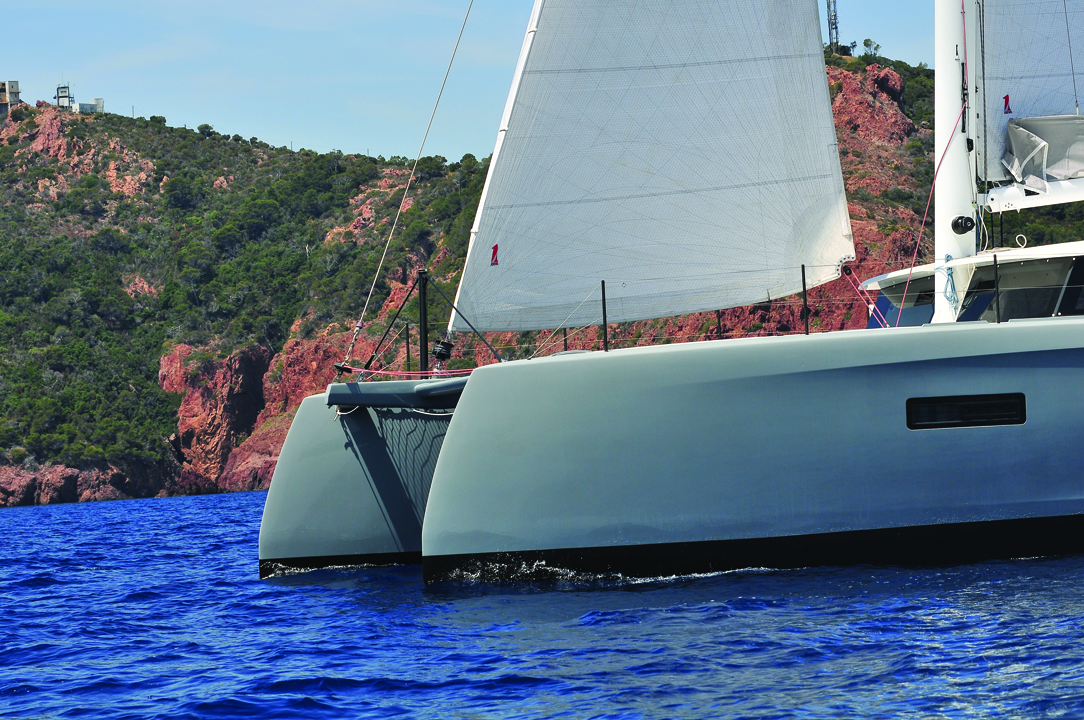
The Italian yachting industry is as original as it is abundant; it integrates the manufacture of a wide variety of units on different sites - prestigious yachts, exceptional one-off yachts, racing prototypes, cruiser-racers and, of course, multihulls. At the various yards, the balance between subcontracting and manufacturing allows the players to apply themselves in their field of competence and to delegate the rest to specialized external operators. The Itacat team therefore selected an excellent composite specialist site in Fano (on the Adriatic coast) and set up technical, financial and marketing governance. The precise and rigorous specifications facilitated the costing of the finished multihull - a delicate step for all boat builders - with particularly qualitative trade-offs. The resin supplier Resoltech, selected as a technical partner, was involved in the decisive phase of infusion carried out in Poland. An inspection of the technical areas, bilges and engine compartments highlights rare manufacturing quality. The chassis is equipped with longitudinal stiffeners in carbon, such as recesses for hatches and around bulkheads. The infusion of the composite is carried out in "one shot" (the underside of the nacelle and hulls with part of the foredeck) for a better structural homogeneity compared to the technique of connecting the outer half hulls. The composite bows are attached, forming an independent safety shield.
A new brand, but already a style…
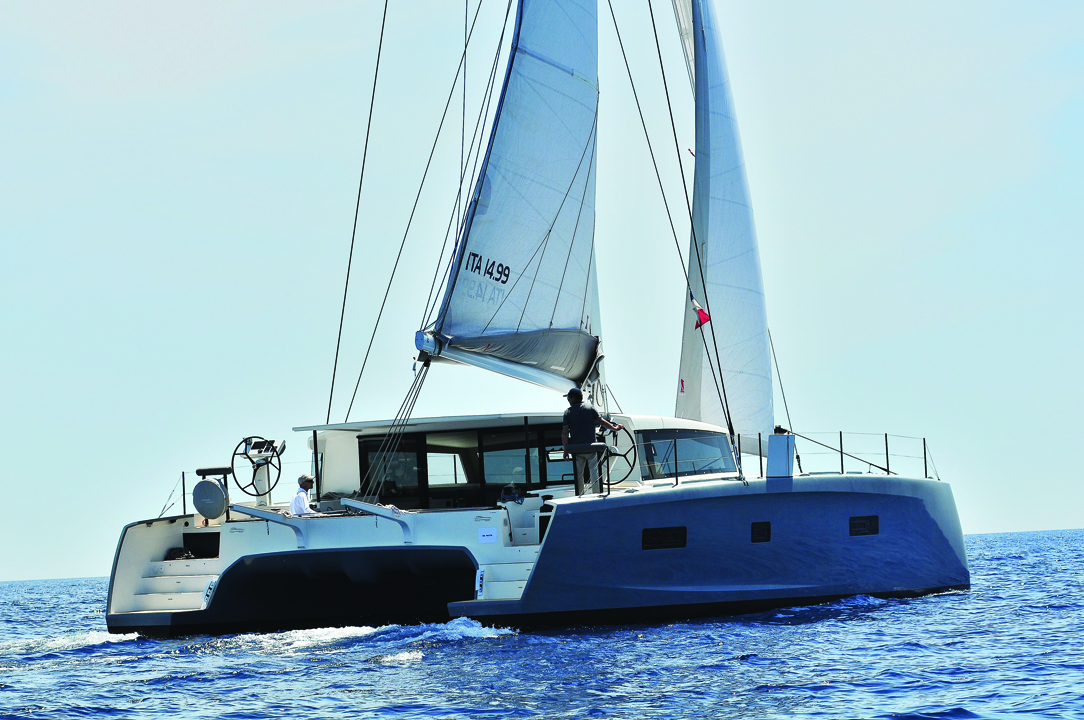
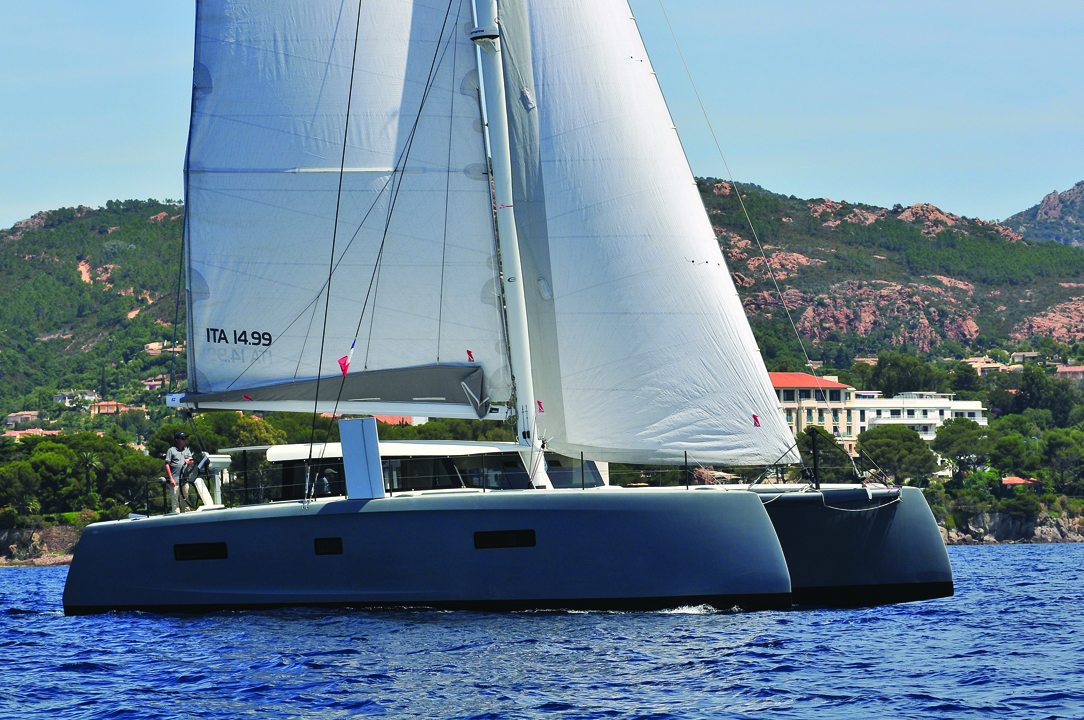
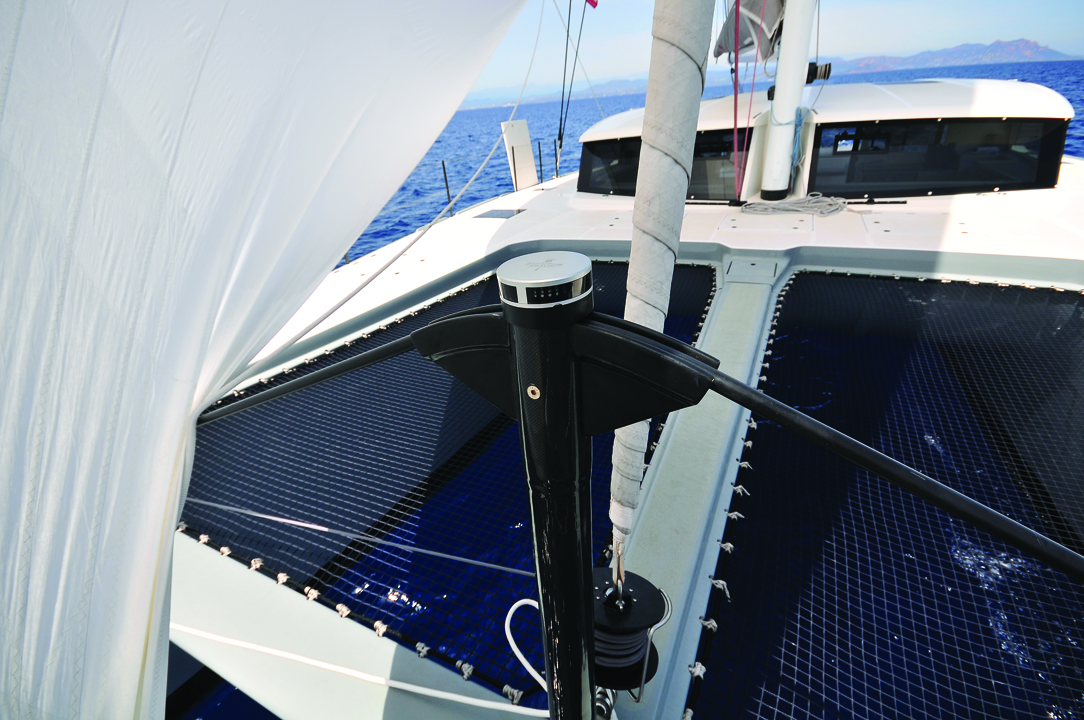
François Pérus, now one of the pillars at Yacht Design Collective, is a graduate of the Christophe Barreau school, one of the world leaders in catamaran design for some years now; this is clearly visible in the fundamentals - the general finesse of the lines, the maniacal attention to the weight specifications, and the stiffness of the chassis. The young architect has implemented the 14.99 project in compliance with the specifications set by Itacatamarans, while coming up with an authentic and attractive design. The overall lines have strength, the straightness of the topsides is delicately sculpted, a light shear gives movement to the deck edge, bows and sugarscoops are finely connected. A high platform and wide-open tunnel contribute, with the sleek sail plan, to the perception of a luxury sport catamaran. The colored gelcoat is a good idea: maintenance will be less demanding than for a painted or wrapped finish. The coachroof – with its large vertical glazed surfaces - and the bimini, with its deliberate, almost cubist design, remain elegant despite the boat’s impressive living space. The mast, by Lorima, the carbon chainplates embedded in the topsides, the carbon fiber cross (compression beam and front beam), the monopod cathedral-stay support and the fiber martingale reveal the obsession for quality.
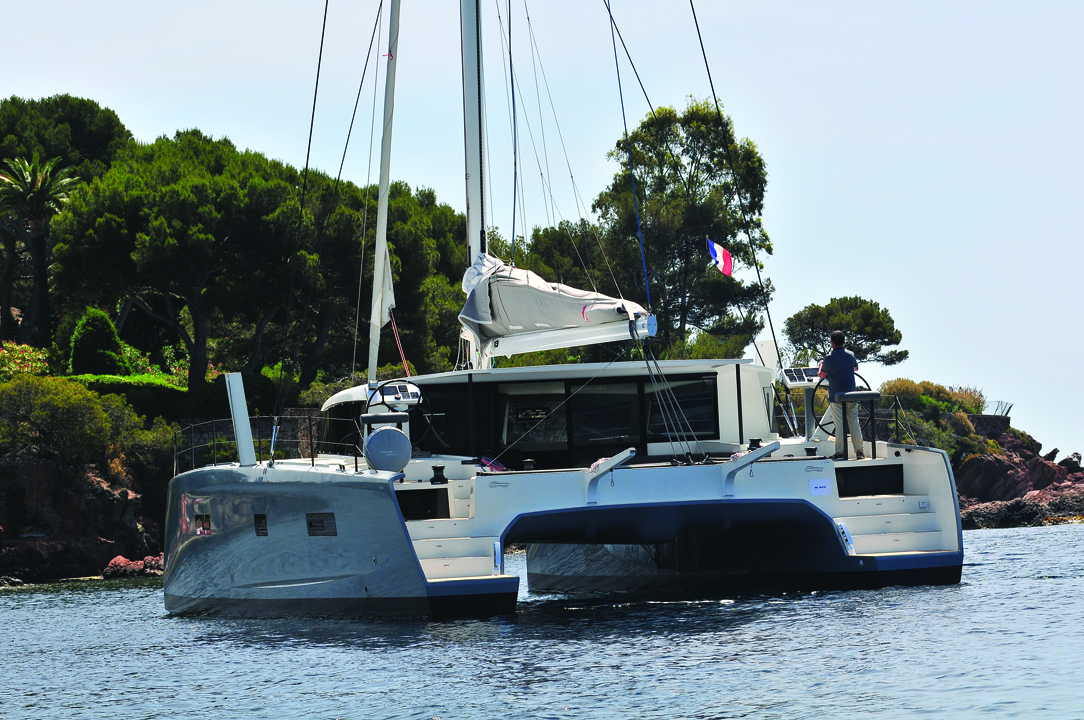
A sail plan optimized for performance
Before we cast off, I had the architecture of the Ocean Volt electric propulsion system explained in detail (two 15kWA/48V saildrives, a 15kWA Fisher Panda generator and a 16.5kW lithium battery bank). The installation is very careful done, in particular the sound insulation and anti-vibration of the engine compartments. As we left the dock, the available torque was obviously considerable, right from the first revolutions of the propellers, which facilitates extracting yourself from tight spaces in a marina. The control with the superb brushed aluminum throttles is precise. The three-bladed folding Gori propellers (reversible for hydro-generation) have excellent efficiency and we theoretically have a ½ hour range before the generator (automatically) fires up. For the purposes of our test, we intentionally used the entire available reserve, and the generator kicked in at the said time - with such discretion that we had to check using the on-board computer. We made headway towards the Rade d’Agay at 7 knots in around 10 knots of southeasterly breeze. The maximum speed stabilized at around 7.9 knots. To fully understand this boat, let's accept the starting equation: it's a real sailboat, not a motorsailer. The ITA moves under sail from 5 knots of wind; 10 knots is enough to recharge its entire battery capacity by hydro-generation in a few hours. The generator is therefore reduced to a secondary role: that of supplying power to the air conditioning at anchor (rarely required), heating (possibly depending on the sailing area and the season) or the motors if the use exceeds the planned range, which is largely sufficient for typical anchoring and docking maneuvers. After taking a few shots in the perfect setting of Agay, we headed straight out for the open sea under solent and main to take some dynamic videos - which allowed me to see the excellent choice of fast tender and the operation of the davit system when going into the open sea with a big chop. The One Sails membrane sails are a good match for this catamaran; the solent on its furler (all or nothing) is equipped with soft shackles, a great idea that eliminates the weight and windage of the furling system. The solent gets replaced by a staysail for sailing in very strong winds. The generous sail area (91m²/980 sq ft) of the main contributes to the consistency of this choice of sail plan. A code 0 and a code D - furlable asymmetrical spinnaker - skillfully completes the light airs strategy. It’s surprising to feel the boat's agility under main/solent in just 10 knots of wind; however, we hoisted the gennaker to sail offshore in search of the afternoon’s south-westerly breeze. Unfortunately, this can be capricious... but the conditions are ideal to highlight the qualities of the ITA in light airs. The steering is precise and the feeling of the appendages is very pleasant and direct: self-aligning bearings, Jefa articulated steering column, rigid transmission and Carbonautica composite tiller... a must! This multihull is alive all the time, and I even noted a peak - which went unnoticed - at 10.3 knots with a wind that rarely exceeded 9/10 knots true, and our average speed varied between 7 and 8 knots on a fairly rough stretch of water. Remarkable performance! The hulls pass very delicately through the water, the bows lift quickly in the water for more than a meter while the wakes remain very soft. This medium-sized catamaran has the particularity of featuring very flattened U-shaped hull sections and little rocker, which favors the high speeds promised by the VPPs (22 knots at 115° in 25 knots true and a weight of 12.5 t). Amazing performances for typical fast cruising hulls of only 15 m (50’) in length.
Interior layout designed for an owner
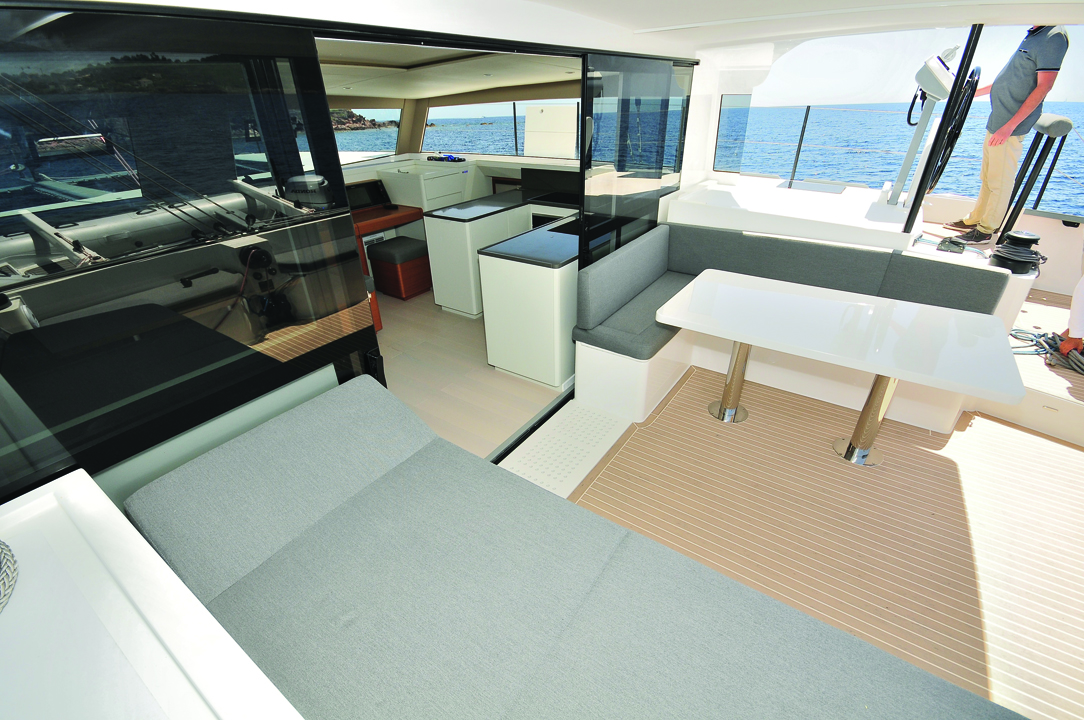
The interior layout is elegant, yet not ostentatious, and the care taken with the assemblies is obvious. The style plays on a palette of colors and materials that harmoniously mixes light woods, raw fabrics and light beige headlinings: it's beautiful, and is as luxuriously simple as suits this kind of racy multihull. Elegant design and attention to detail are characteristic of “Made in Italy” style and quality. The nacelle remains high at the front, which makes it easy to accommodate a large dining area and a forward-facing navstation. The ITA is available in five accommodation versions. Three of them offer three cabins and two bathrooms; the starboard hull is dedicated to the owner while the port forward cabin, narrower due to the slimness of the hulls, offers a more relative comfort. For these models, the galley can be upgraded - central island, C- or U-shaped. The fourth accommodation plan proposes a real office forward, to port. The last version adopts bunk beds. In all of the cases, the designers have focused on the comfort and convenience of an owner - no rushing to get the best cabin.
Conclusion
A beautiful machine... Rigorous design, careful execution, and the selected equipment will allow serene use when cruising short-handed, as well as the search for high performance in a breeze when fully crewed.
THE ESSENTIALS
- HIGH QUALITY BUILD
- STRONG PERSONALITY
PLUSES
- Rigorous design and build
- Authentic personality
- Silhouette and performance
MISUSES
- Brand image to conquer
- Massive instrument pods
- Delivery and launching not included
TECHNICAL SPECIFICATIONS
Builder: Itacatamarans
Naval Architects: Yacht Design Collective - Pérus/Scolari/Hertwig
Interior designer: Emanuele Soli
Construction: epoxy /glass/carbon sandwich using infusion process and 50° post-curing.
Length: 14.99 m/49’ 2''
Beam: 7.99 m/26’ 3''
Hull depth: 0.65 m/2’2''
Draft: 1.15-2.50 m/3' 9” -8’2''
Platform height: 0.92 m/3’
Mast height above deck: 21.50 m/70' 6”.
Mainsail area: 91 m²/972sq ft
Self-tacking solent: 49 m²/527 sq ft
Code C: 90 m²/970 sq ft
Fuel capacity: One tank of 215 l/57 US gal.
Water: 2x 330 l/2x87 US gal
Basic price excluding tax: € 880,000
Main options in € ex-tax
Lorima carbon mast: 64,900
Fiber rigging and Dyform forestay: 10,110
Solar panels 4 x 118W: 3,950
Raymarine electronics: 13,710
Delivery and launching: 15,000
The architect's point of view by François Pérus, of Yacht Design Collective
YDC was created by François Pérus and Romain Scolari, two naval architect engineers from ENSTA Bretagne. Since 2015, they’ve been working together on joint projects with the idea of sharing their respective experiences and expertise, and being able to reach out to the two environments from which they come: production yacht building and large custom projects in steel, aluminum or wood, in both the river and maritime sectors.
"The general idea was to create a boat that slips through the water. Speed is not a criterion in itself, but a guarantee of safety and a consequence of the boat's seakeeping qualities: essential for a sailing catamaran with an offshore program. These two criteria form the basis of the design. Of course, the comfort aspect of the boat must be kept in mind during the design phase: people will be living on board for long periods of time. The displacement of the boat is very important in order to have the possibility to install the comfort equipment which is expected in a model of such a high standard. A particular effort has been made on materials and construction techniques: the hulls, the nacelle and part of the deck are infused at the same time. The deck is clear and the superstructures non-structural, allowing the coachroof to be opened wide to the sea and limits the weight aloft. In short, a boat that accelerates in gusts and waves rather than heeling and coping with stress. The underwater hull form is at the heart of this philosophy and derives from practical experiments, carried out in particular on the Pandora 8.50 and Pulse 600, and hydrodynamic studies conducted on other multihulls. The hulls are relatively beamy and very tight, which is slightly penalizing in light airs, but favors the boat's maximum speeds. The shapes and the very tight keel line make it possible to generate hydrodynamic thrust, to give lift to the bows when the boat is loaded, to limit pitch effects and suction phenomena. It is not about breaking records, but about sailing fast (at wind speed as much as possible), safely and in a comfortable space designed to maximize the experience of life on the water.”
