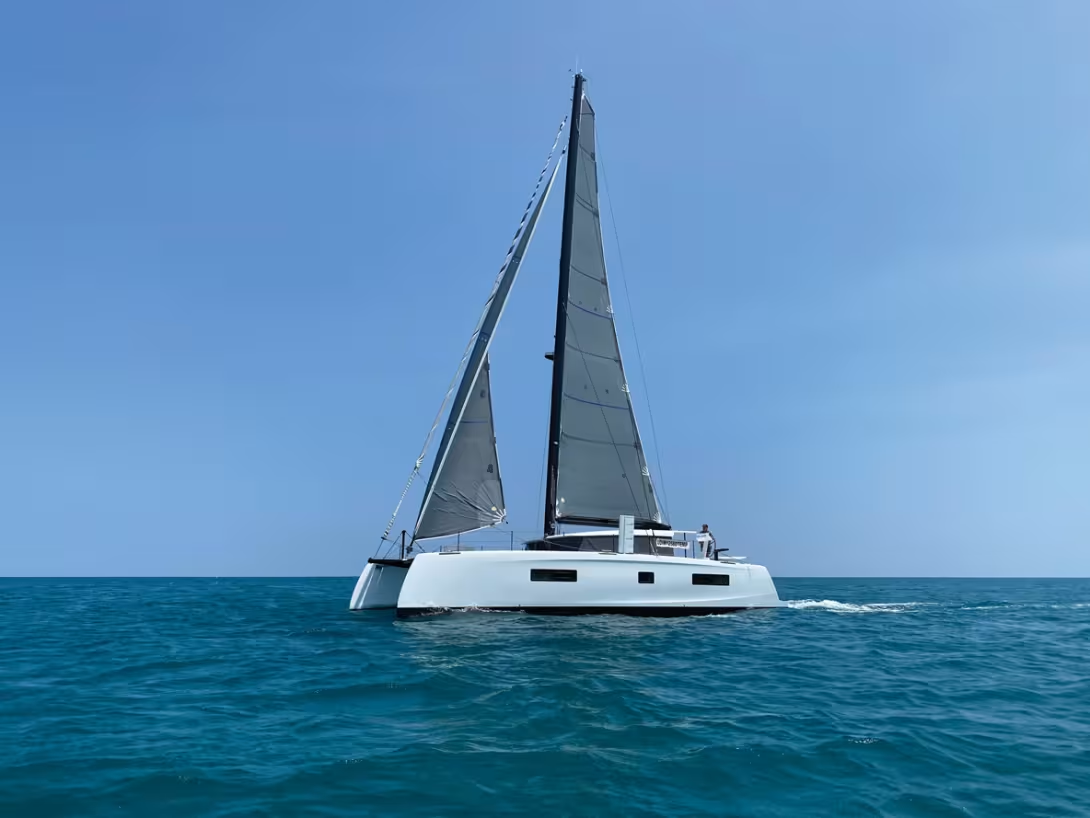
The young Italian brand ITACATAMARANS, launched by Emanuele Caprini, has set itself apart by optimizing the finish and performance of its first model, the ITA14.99. The result is a slightly longer catamaran, the ITA15.49, presented to the public for the first time at the Cannes Yachting Festival back in September - this new model will also be on display at April’s International Multihull show at La Grande-Motte in the South of France. We got the chance to take the helm of this catamaran drawn by the Yacht Design Collective and sailed on the Côte d’Azur for long enough to take stock of the evolutions compared to the 14.99.
Infos pratiques
- Le chantier : Ita 15.49
- La fiche technique
-
 Découvrez notre vidéo exclusive
- Financez votre ITA15.49
- Assuez votre ITA15.49
- Articles autour du ITA15.49
Conditions: 0 to 20 knots of easterly wind, short chop
The first ITA14.99 was launched at Cannes in 2019, making a name for itself (in a good way) with its sleek lines, sharp hulls and slender rig. During our visit, we noted its refined finish and controlled displacement. A top-of-the-range sail wardrobe combined with a hybrid powertrain promised the best in sailing, and our tests (MW #168) confirmed this boat’s excellent seakeeping ability and first-rate performance. The ITA14.99 proved capable of sailing at wind speeds from as low as 7 knots. In breezy conditions, peak speeds of 20 knots were recorded. This performance, combined with an irreproachable stiffness to the platform and easy maneuverability, classed this catamaran as a top-of-the-range sportyacht. A category somewhat apart, with a high price tag… and an understandably limited production run. The figures bear this out: over the past four years, five examples of the 14.99 have been produced, two ITA15.49s have just been delivered and three more are on order. In this highly elitist segment, where Owners demand the very best in quality and personalized service, building the manufacturer’s brand image remains quite a challenge. Builders offering this type of catamaran can be counted on your fingers, and most have only recently entered this exclusive market. This interest, which may seem belated, can be explained quite simply by the fact that sportyacht catamarans have only really developed in the last ten years or so - with the exception of Gunboat, which is a forerunner - and an example to follow - in this field. This offer is motivated by a clientele eager to share the best sensations on the water with their loved ones. The aim is to increase speed and emotion tenfold, while ensuring a judicious compromise with comfort and luxury. It’s also worth noting that these new high-end catamarans have become a source of inspiration for mass production, a sign that this sector is beginning to mature. Though it’s still far from monohull cruiser-racer builders such as Swan, X-Yachts or Solaris, who enjoy a much more established reputation.
The Italian touch
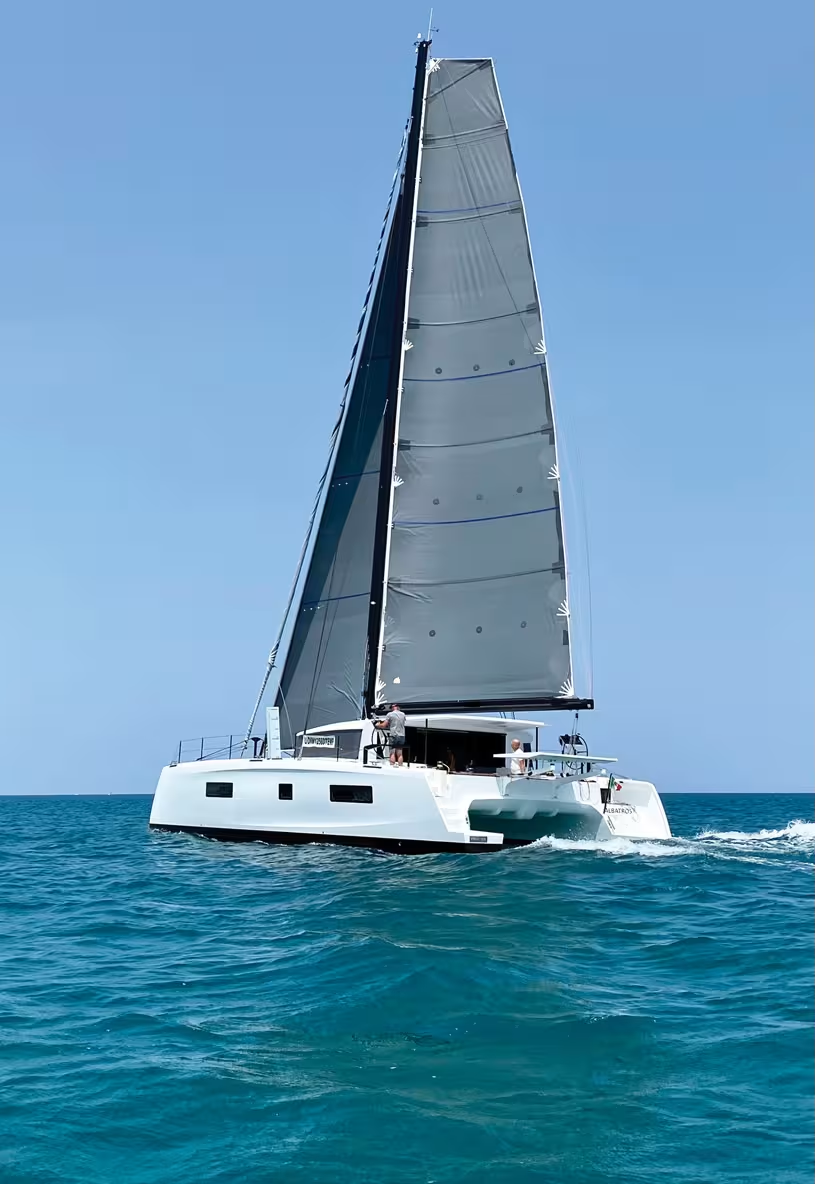
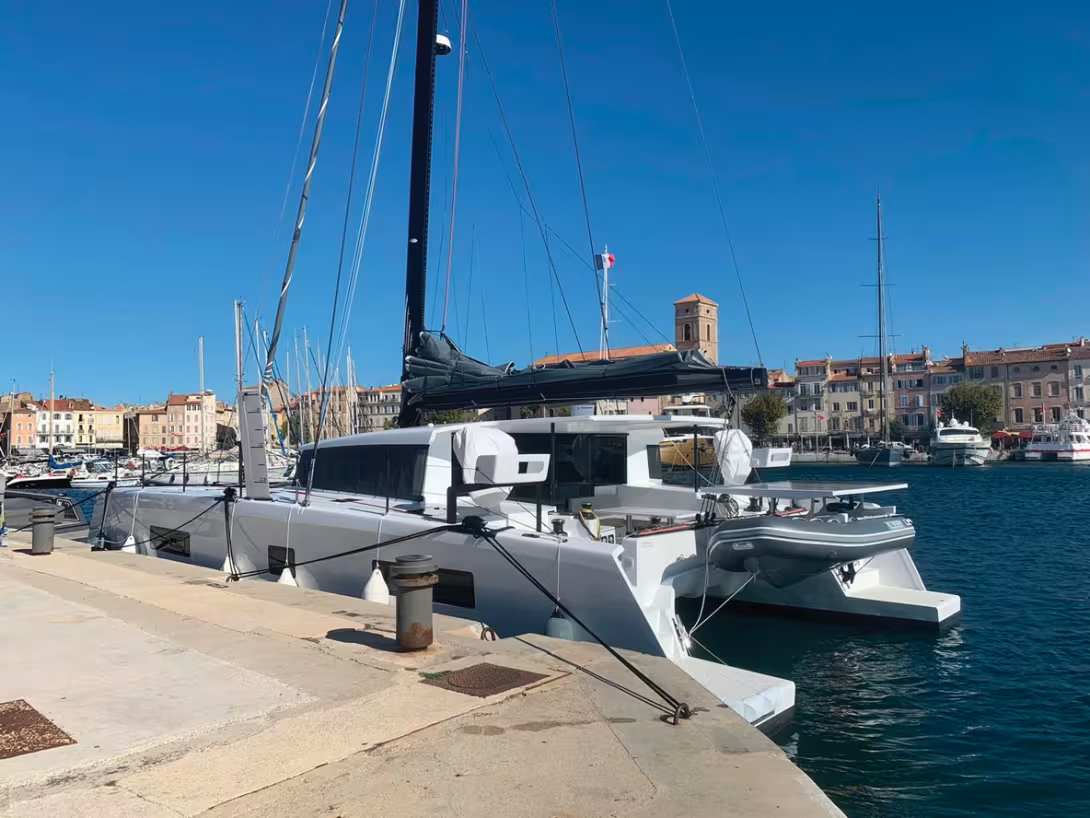
A little (still very recent) history… in 2010, Emilio Caprini owned a Solaris 44. Like the owners described above, he wanted to switch to a fast, luxurious catamaran. His ideal multihull would have been a 50-footer in the same spirit of construction and finish as his Solaris. But unable to find what he was looking for, Emilio decided to set up his own brand in 2017. If you’re familiar with the remarkable features of the Solaris, it’s easy to see why. When I discovered the ITA15.49 at Cannes, I immediately noticed the Italian touch - but also a form of Solaris filiation. This is finally more evident with the 15.49 - the 14.99, with its grey gelcoat-tinted hulls, struck me as more robust than superb. This is one of the many points that have been modified. In this new version, the gelcoat is completed with hull paint. The lacquered finish is more attractive, and the color can be chosen by the customer - who’s going to complain? I immediately noticed that the hull portholes have increased in size and, above all, that the sugarscoops have been enlarged. The bulwark stops just above the lower step, making this a very practical platform for boarding when alongside. It also adds a neat space for swimming from and for accessing the tender. And it doesn’t detract from the glide felt when underway, quite the contrary. The coachroof’s glass walls are also slightly more curved, to match the modified deck sheer. In its white livery, accented by black fittings, the impression of Italian elegance comes through much more clearly. From an aesthetic point of view, it’s a success, and the result is more in line with the desired positioning.
Even more advanced features
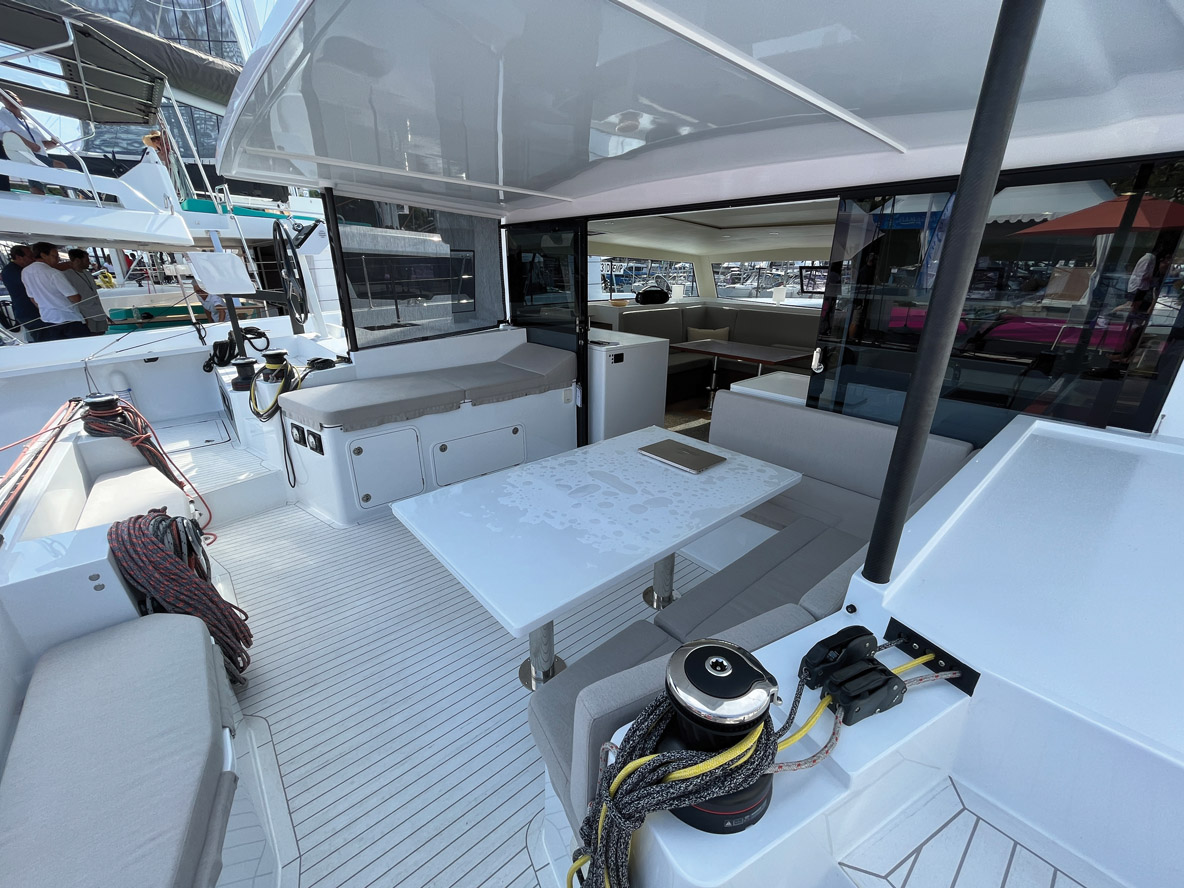
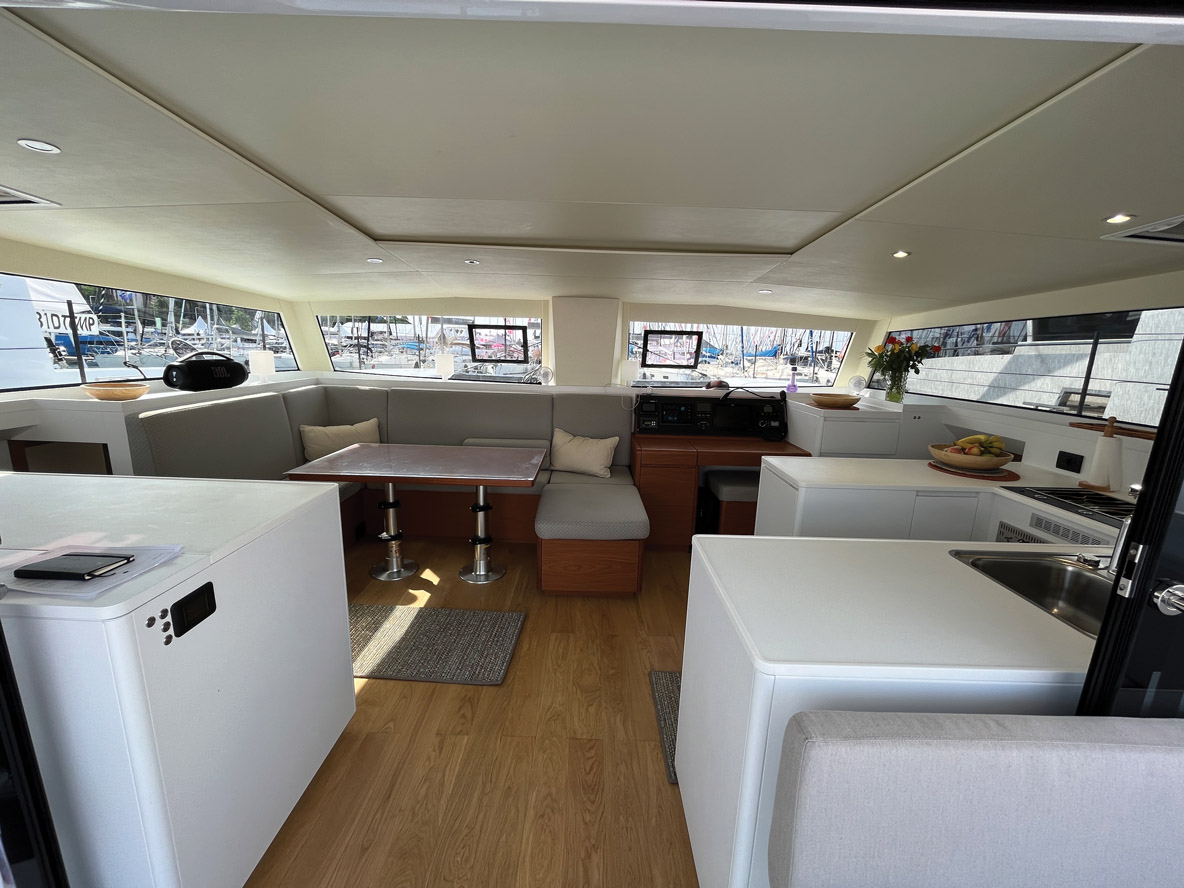
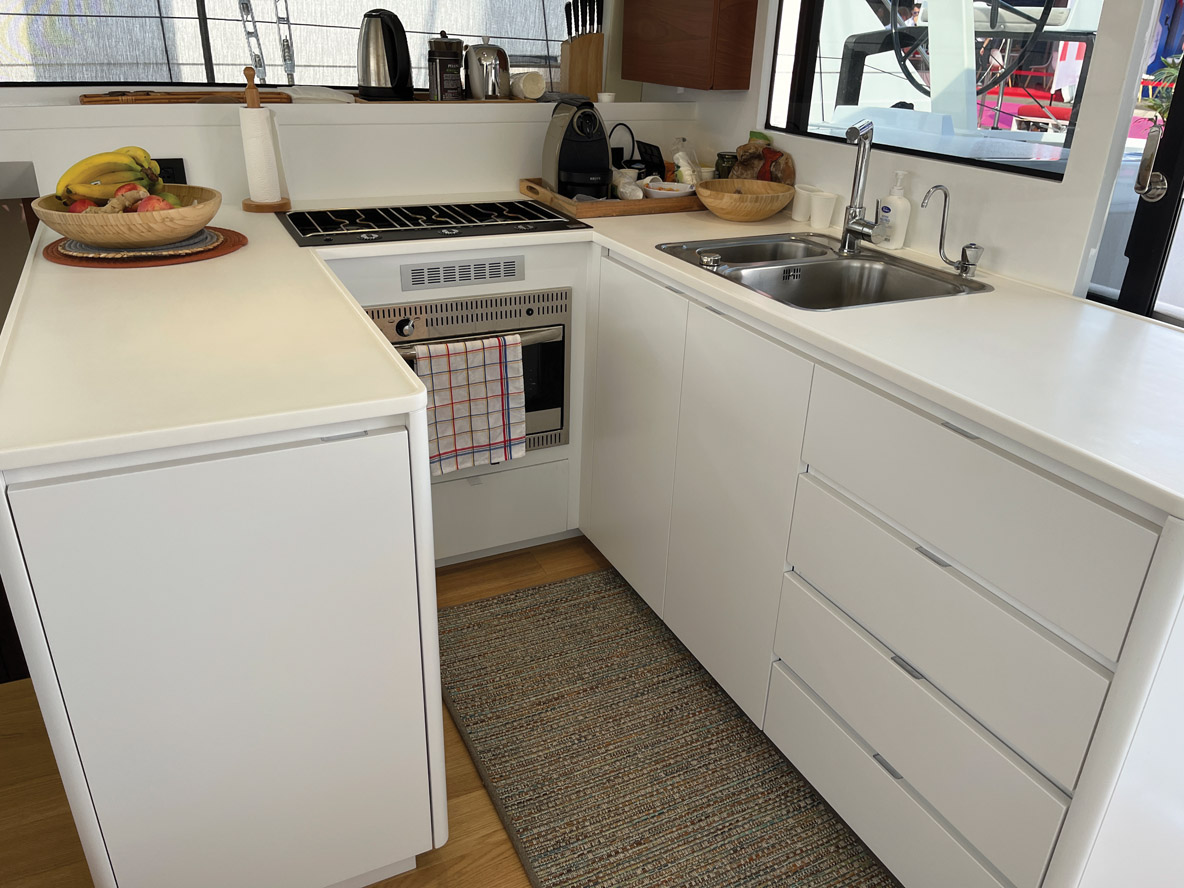
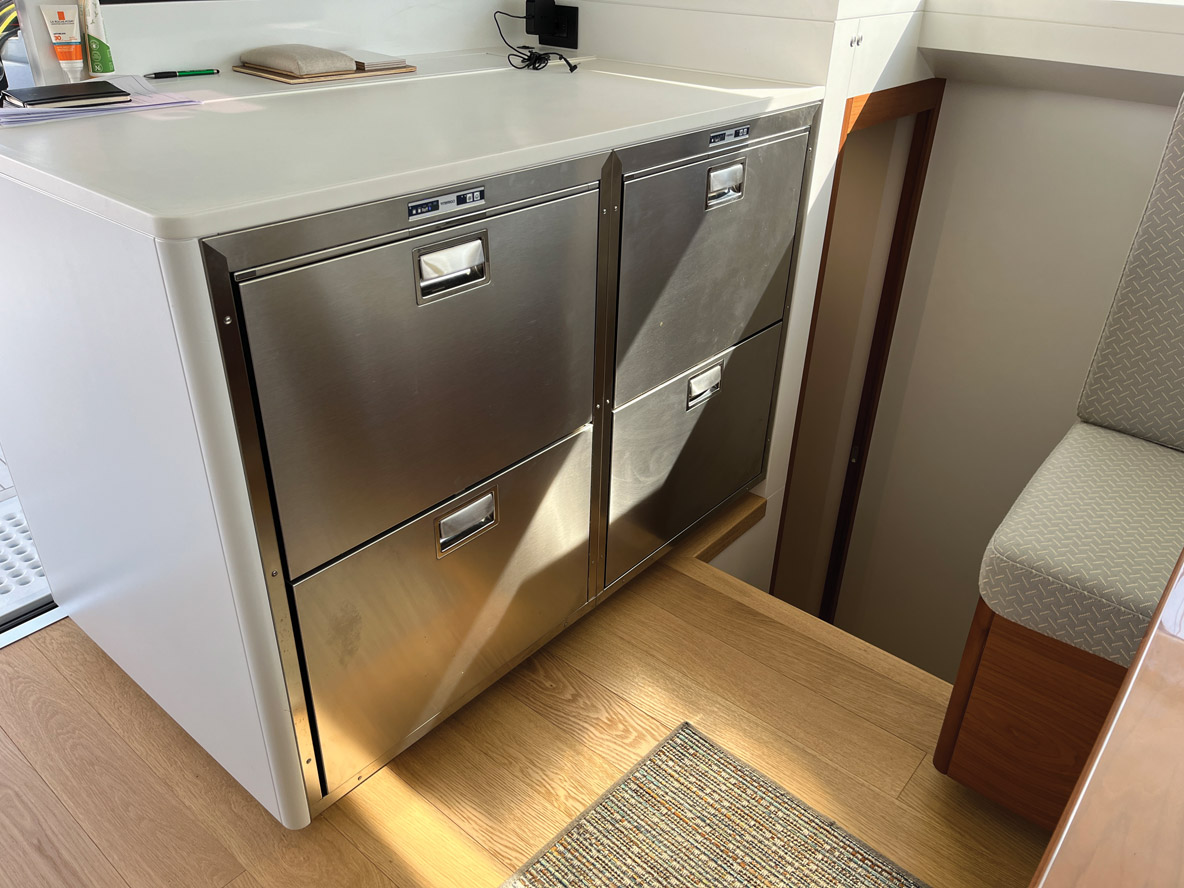
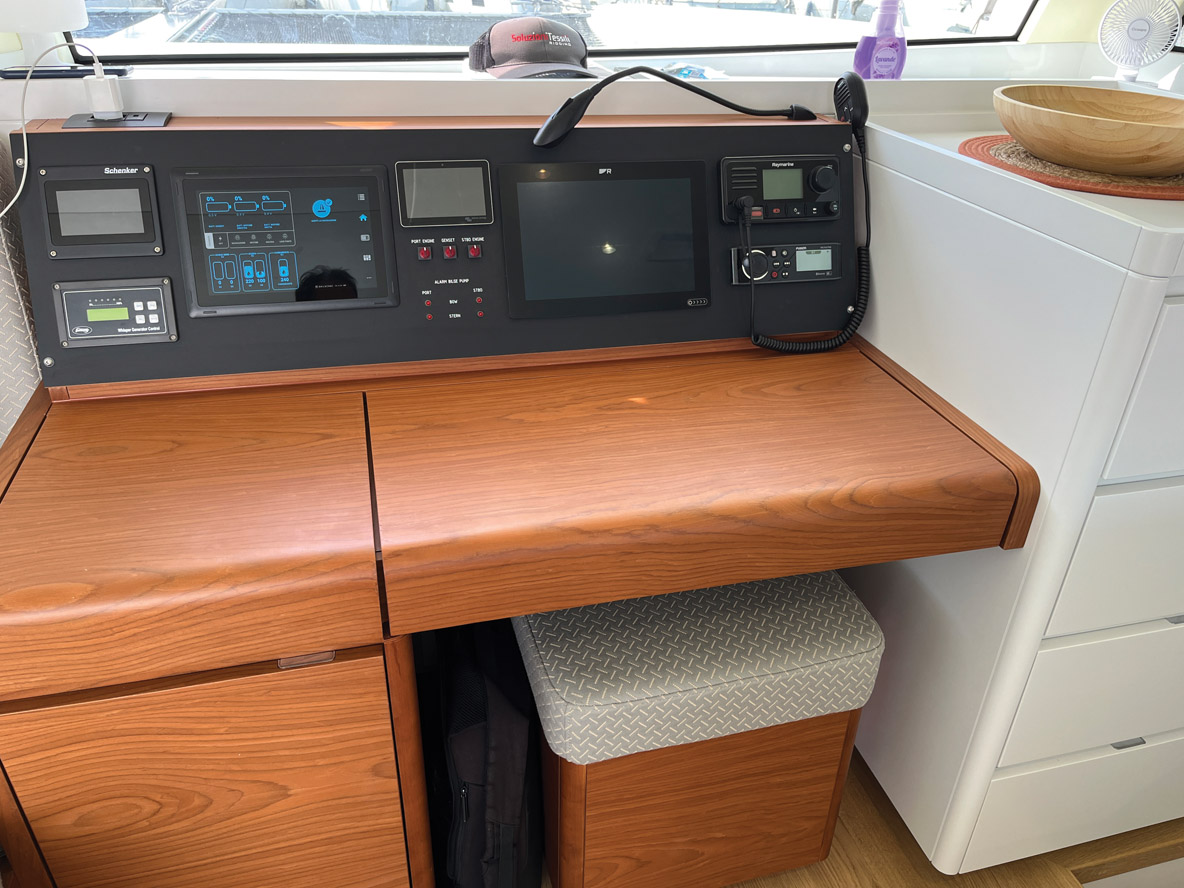
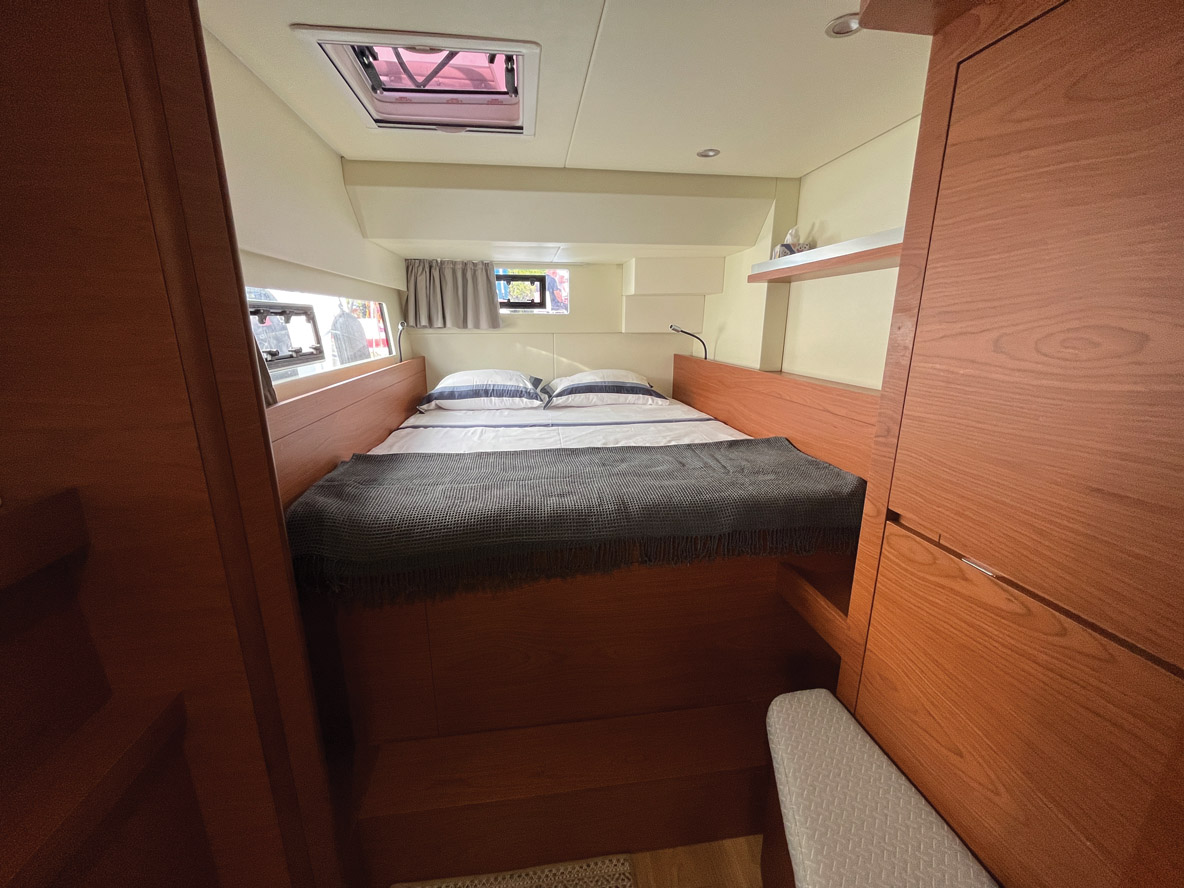
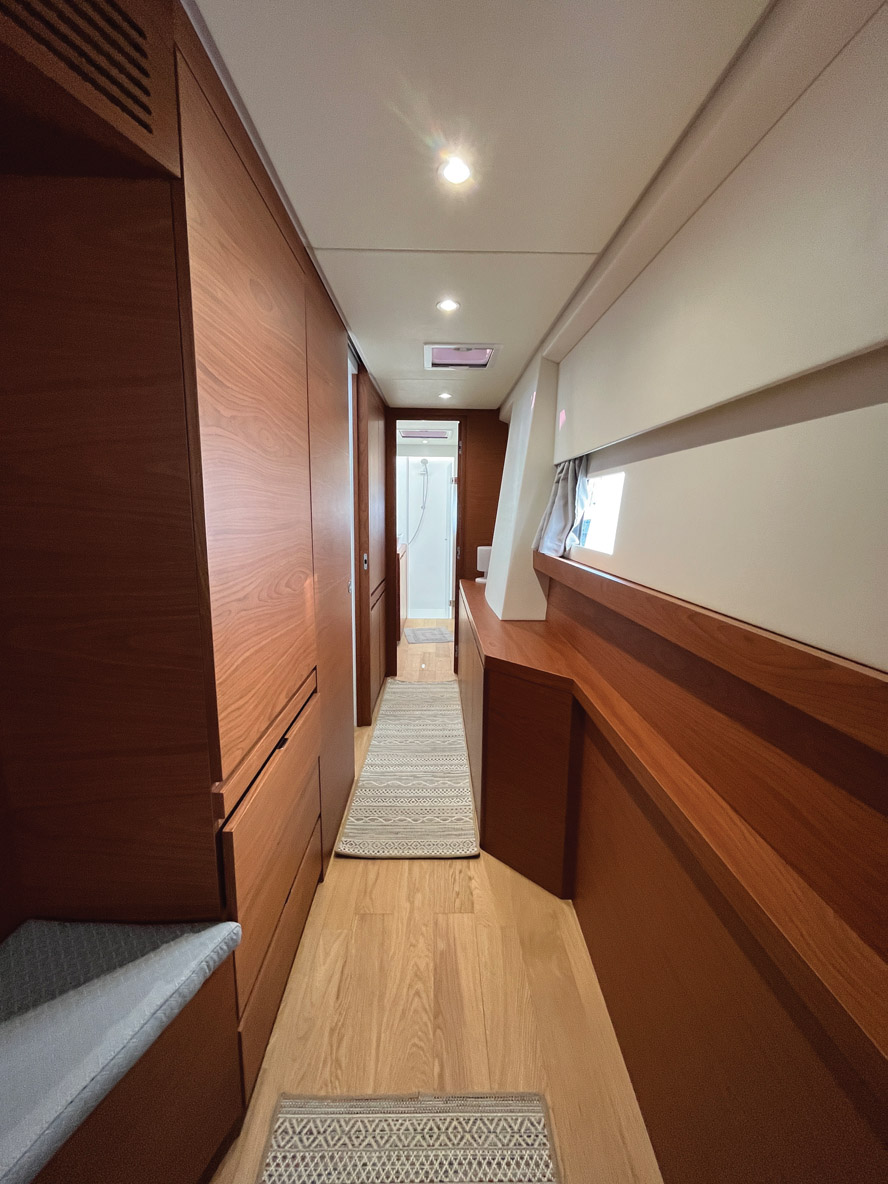
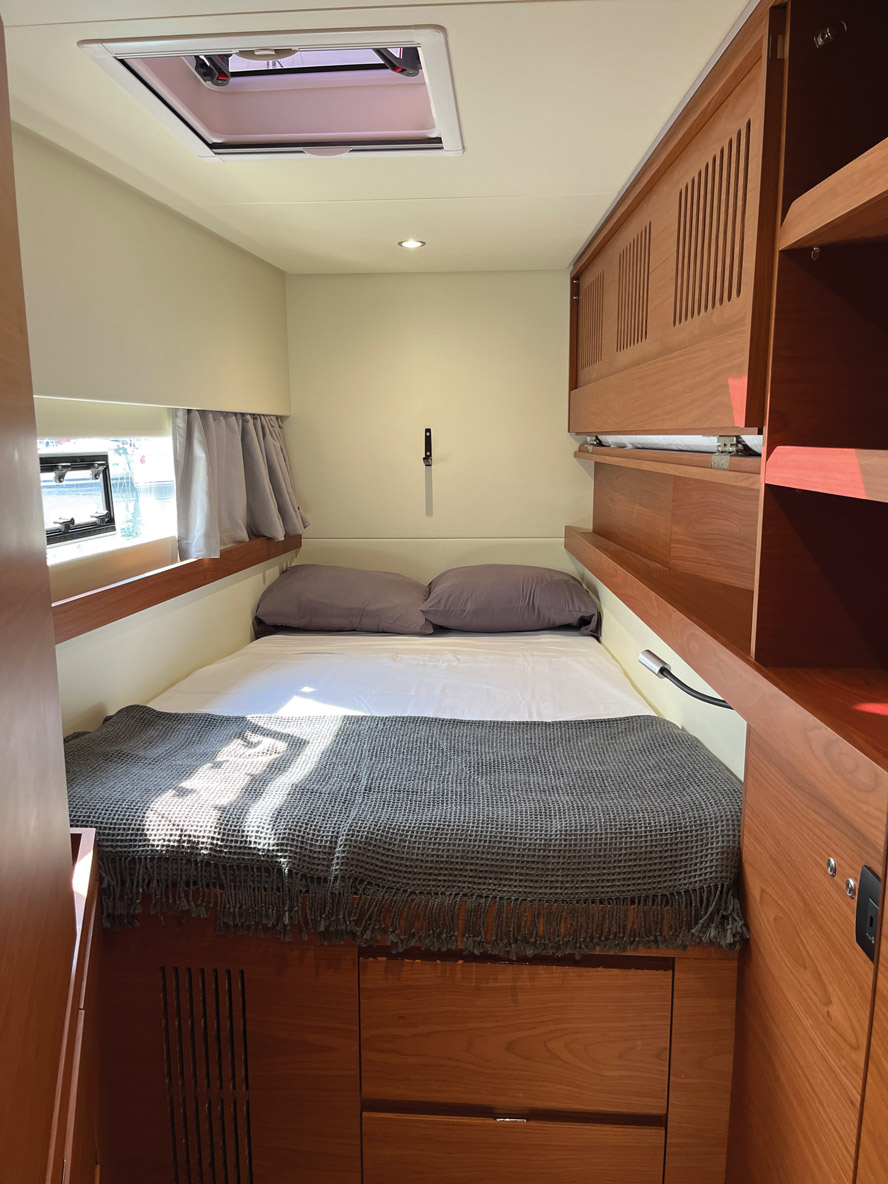
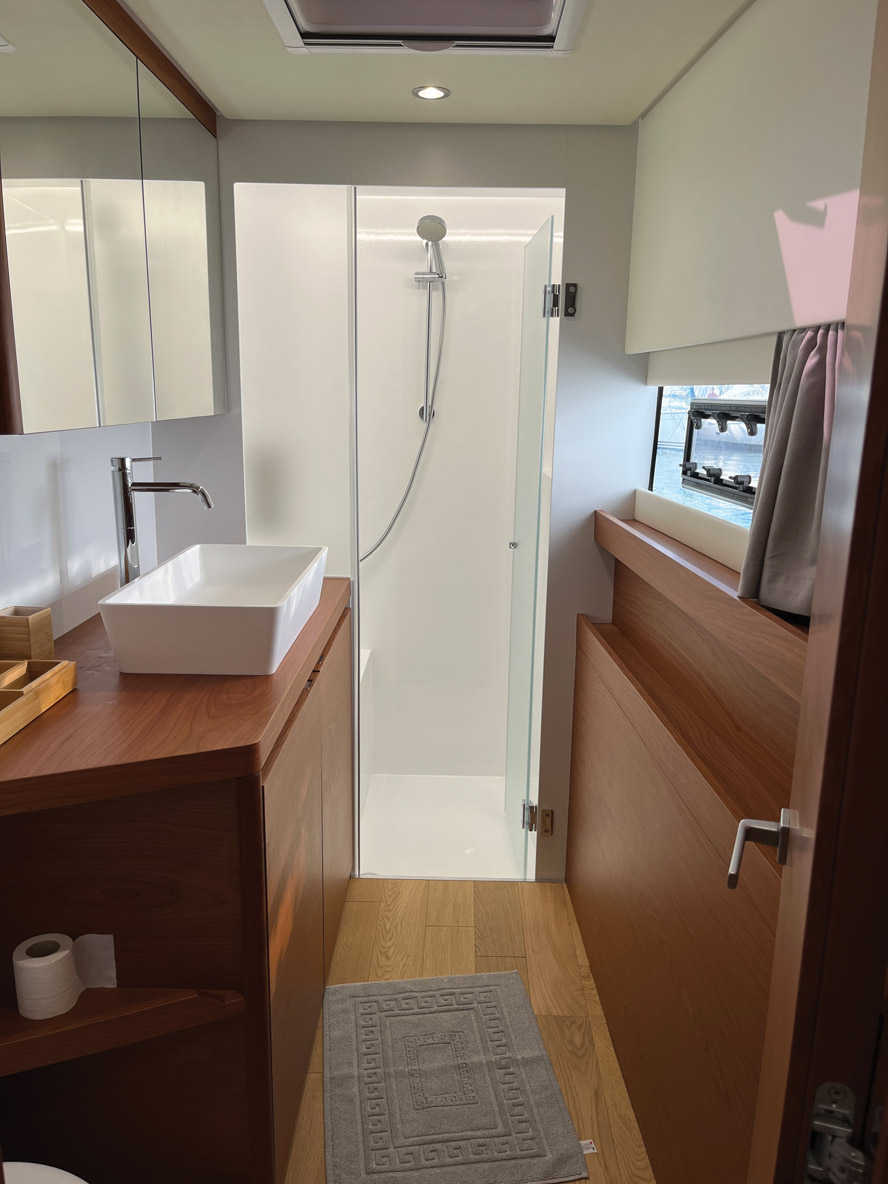
The ITA15.49’s layout differs little from that of its predecessors, but a number of modifications represent real improvements. The first to benefit - from enlarged portholes - are the cabins. The newfound clarity brings a very different perspective and makes these volumes much more welcoming. Our test model featured cherry veneers and oak flooring. These refined hues, juxtaposed with the cream headlinings and gray upholstery, lend a natural class that feels superior to that of the 14.99. The focus is on the Owner, with a full suite in the starboard hull, equipped with larger storage compartments. The only practical drawback is the lack of ventilation over the shower. On the opposite side of the boat, the aft cabin provides cozy comfort. The single bathroom is organized around the centerboard well. Forward, several layouts are available. The double berth is a little narrow (the hull is only 4’11” (1.5 m at its widest point), but on our test boat, there was an additional pullman berth. A cabin with bunk berths, or an office with a simple bench berth, could replace the layout of this example, to match a precise specification. As for the nacelle, the living area is very pleasant. In the saloon, the dining table converts into a berth, while a beautiful forward-positioned chart table offers an unobstructed view over the water. We really liked the U-shaped galley with its wide countertop, but a less voluminous L-shaped version is also available. The cockpit is accessible through a large opening bay window. Outside – but under shelter - there’s an L-shaped dining area to starboard and a lovely, raised bench seat to port - perfect for night watches. Additional seating is available aft. The shipyard has made an effort to organize storage space under these seats. The saloon-cockpit layout is thus conventional, but flawless.
High-quality construction
What’s special about these “confidential” boatbuilders is that they’re able to opt for construction methods that are not subject to the heavy constraints of mass production. Another advantage is that it’s relatively easy for these small yards to upgrade their product(s), even after launch. In the case of this ITA15.49, hulls and structures are manufactured under vacuum using Corecell foam and epoxy. Hulls (including the outboard topsides and part of the foredeck) and nacelle are infused in a single block. The forward part of the bows with their crash boxes is then bonded together, before the whole is post-cured at 50°C (122°F). A network of carbon stringers and frames reinforces the whole. Daggerboard wells, hull joins, hatches, mast foot crossbeam, forward crossbeam, and bay window structure are all carbon-infused. All these elements contribute to the structural rigidity of this performance catamaran, as we’ll soon be able to testify under sail.
Powerful sailing is provided by a 71-foot (21.5-meter), spreaderless Lorima rig and a fine wardrobe of Doyle membrane sails. Keels are available if you want a basic configuration, but the electrical handling of the daggerboards, with their classic carbon composite profile, is so simple that it would be a shame to not have them. Everywhere you look, the finish is impeccable, even sophisticated. From the bottom of the bilge to the hatch surrounds and lockers, everything exudes robustness and refinement, a characteristic of exclusive units.
Astounding speed
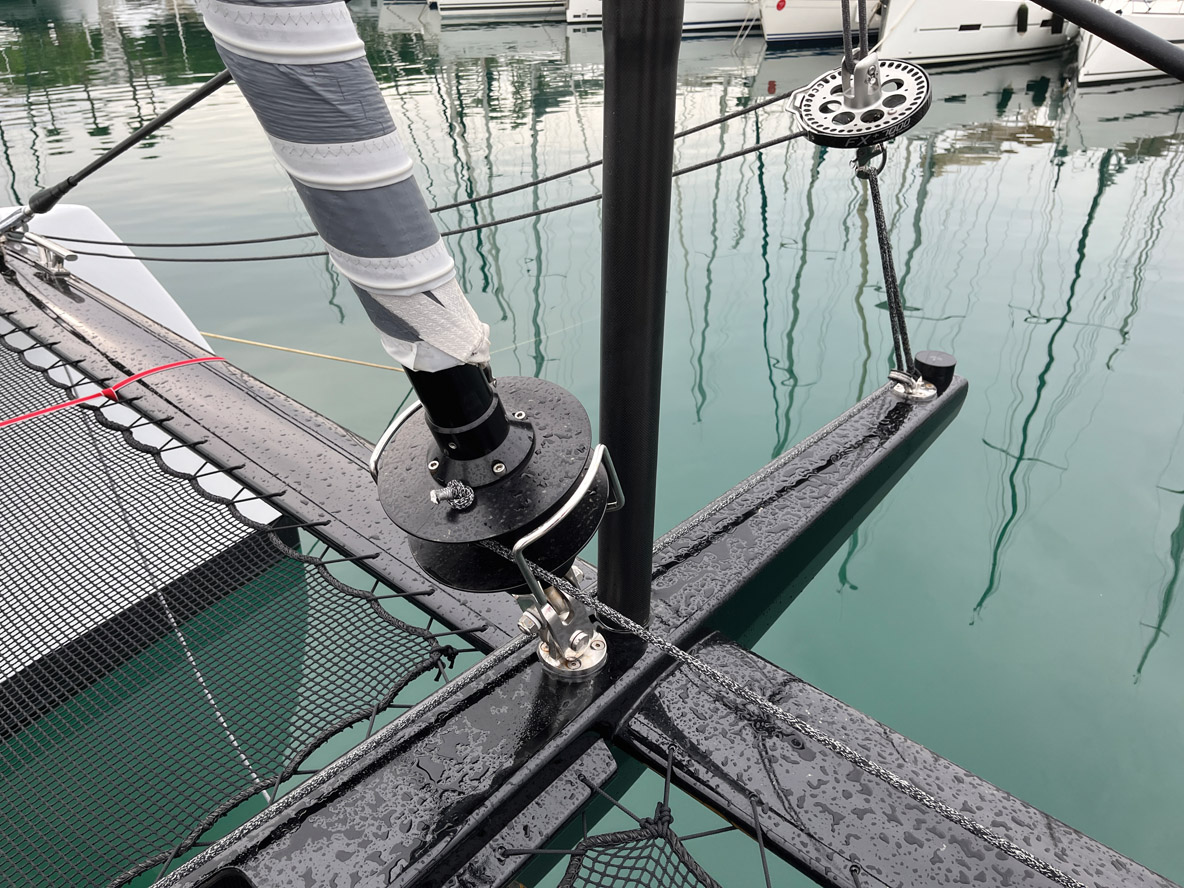
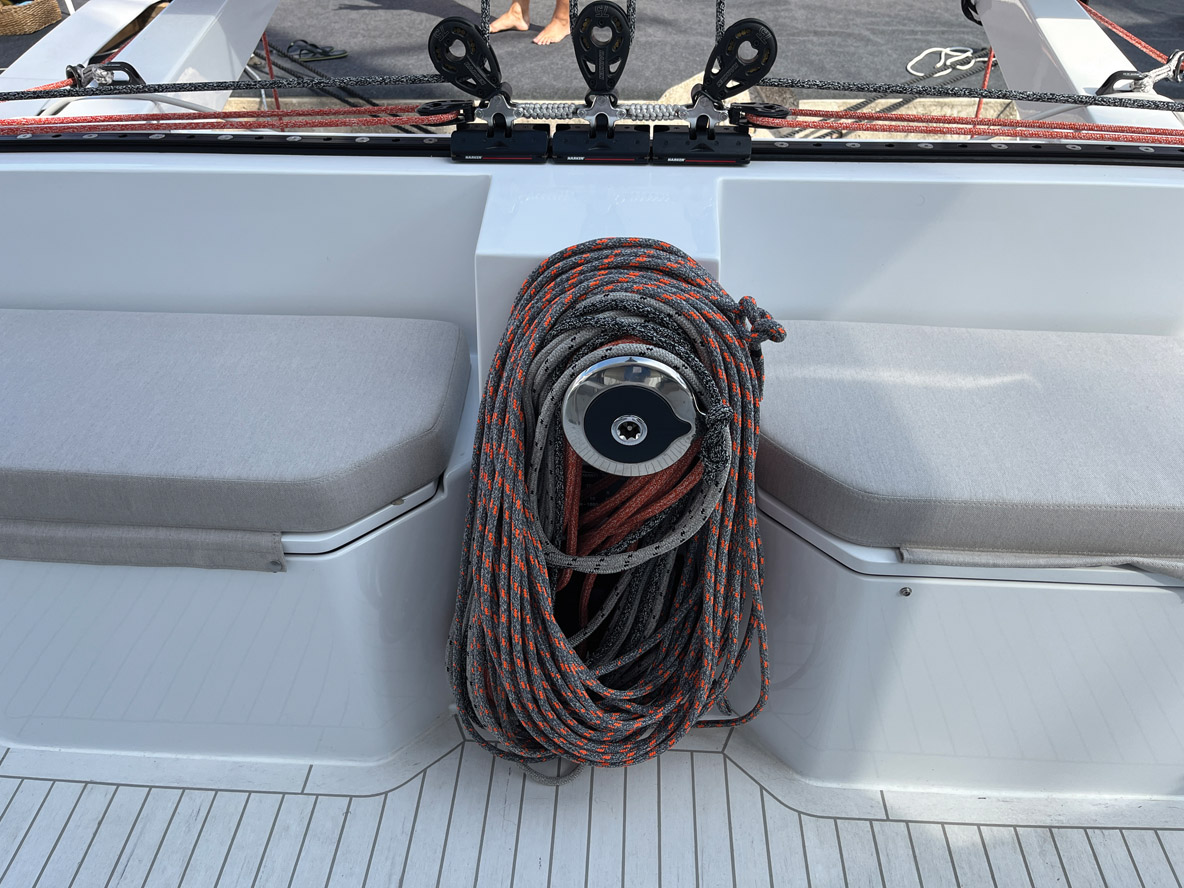
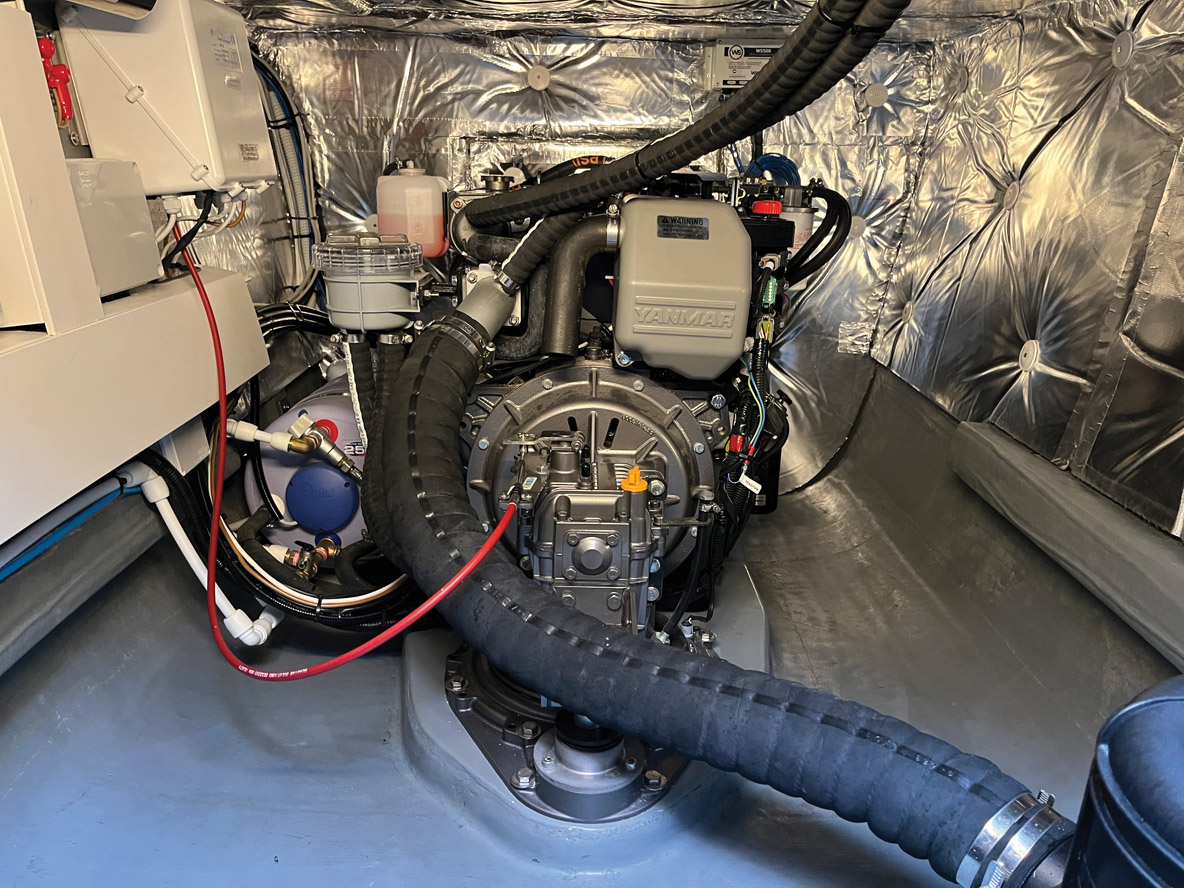
The time had come to set sail, but we weren’t being spoiled by the weather, which had blessed us with an easterly low-pressure system for our trip out into the Bay of Cannes. In more graphic terms, we were in the middle of a little doldrum area on the Côte d’Azur! No wind, gusts, rain, no wind again - all served up on a very choppy sea – that was the day’s menu. As we left Port Canto, we put the throttles down to get out into the Mediterranean (which had been transformed into a cauldron), and we noticed some very fluid movement. The hulls pass smoothly over the waves. Another modification is that the engines have been relocated further forward, improving longitudinal balance. This catamaran is equipped with a pair of 57-hp Yanmar blocks with saildrive transmission. In the version with a hybrid powertrain, the generator can be positioned forward of the pods. We were making 7.5 knots as we headed out to sea, cruising at 2,000 rpm in a comfortable active position, with no jerks or vibrations. The light weight on the stern, combined with the extended sugarscoops, made for a very efficient passage: we never felt the ITA bumping into the chop, let alone coming to a screeching halt during our attempts under sail alone... because we did eventually end up switching off the engines! Mainsail and self-tacking solent are hoisted by a winch fixed horizontally to the aft beam, which takes up the lines passing through the nacelle from the mast foot. In the conditions described above, the catamaran easily achieved five or six knots in the chop. The chaotic conditions allowed us to appreciate the wonderful precision and smoothness of the helm, and we were able to enjoy a meal very pleasantly even though the conditions were far from guaranteeing any such level of relaxation. Later in the day, the wind picked up to a steady 12 knots, and our point of sail now allowed us to unfurl the gennaker and see the GPS at 9 knots. This is just a small glimpse of the ITA’s potential: in a good breeze, her performance will easily reach 20 knots - and that’s what we’ve come to expect from these boats!
Conclusion
Just a personal observation: I’m delighted to see that a brand that is still confidential has managed to break into a market sector that is as narrow as it is demanding, all while bringing its own personality to the table. ITACATAMARANS has succeeded in establishing itself among sportyacht catamarans by playing the cards of build quality and Italian elegance. This 15.49 is an excellent evolution of the earlier 14.99. Its greater balance under sail and more refined finishes make it a credible and seductive competitor. Its program can include racing or round-the-world cruising. And all in great style.
Incomparable Italian style and quality of finish
Excellent sail handling ergonomics
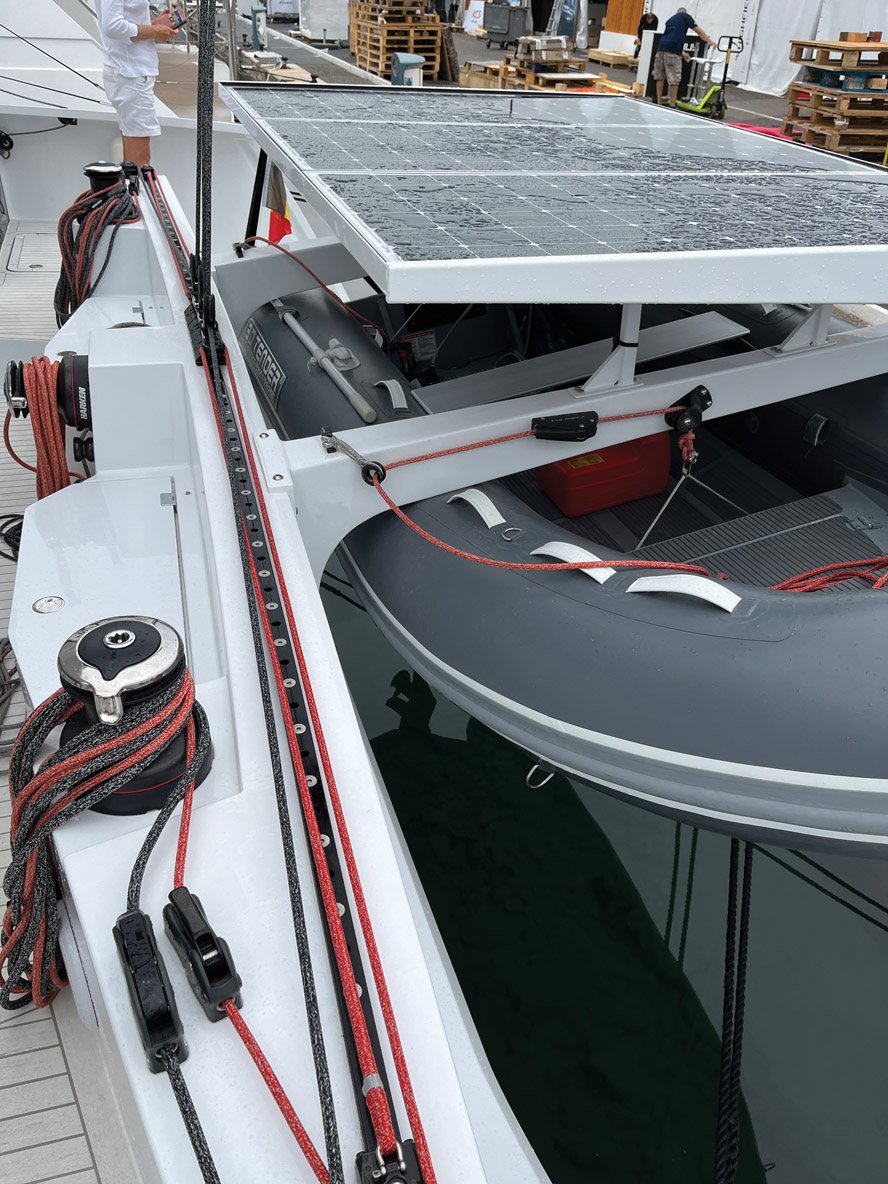
No sheet bags under the winches
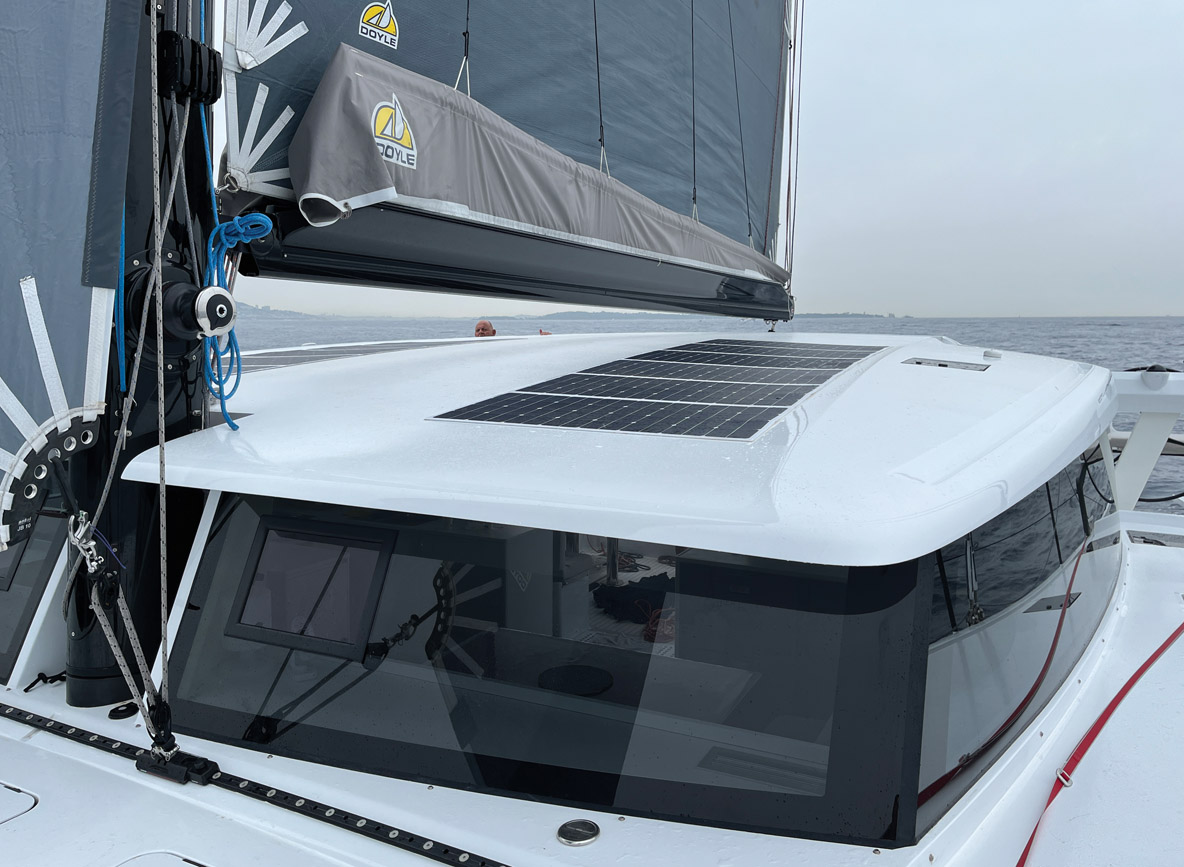
Solar panel surface area could be improved
Technical specifications
Architect: Yacht Design Collective
Interior design: Emanuele Soli
Overall length: 50’10” (15.49 m)
Beam: 25’7” (7.8 m)
Draft: 2’ or 7’9” (0.6/2.35 m)
Mast length: 71’ (21.5 m)
Bridgedeck clearance: 36” (0.92 m)
Light displacement: 26,455 lbs (12 t)
Laden displacement: 33,070 lbs (15 t)
Engines: 2 x 57 HP Yanmar or hybrid system
Mainsail: 980 sq ft (91 m²)
Solent: 527 sq ft (49 m²)
Code 0: 1,291 sq ft (120 m²)
Gennaker: 1,507 sq ft (140 m²)
Fuel: 113 US gal (430 l)
Water: 174 US gal (660 l)
Base price with 40HP Yanmars: €1,375,000 ex-tax
Price of version we tested: approx. €1,800,000 ex-tax